About Ebykr
Ebykr celebrates classic and vintage lightweight bicycles through provocative imagery and opinion. Ride along with us.
About Ebykr
Ebykr celebrates classic and vintage lightweight bicycles through provocative imagery and opinion. Ride along with us.

Source: Gallica (Bibliothèque nationale de France), L'Officiel du cycle, du motocycle et du camping, 3 May 1952, N° 18, page 17; ark:/12148/bd6t54182062z. Source gallica.bnf.fr / BnF.
| Type | Review |
|---|---|
| Year | 1952 |
| Publisher | L'Officiel du cycle |
| Country | France |
| Language | French |
| Pages | 1 |
| Source | Gallica (Bibliothèque nationale de France), L'Officiel du cycle, du motocycle et du camping, 3 May 1952, N° 18, page 17; ark:/12148/bd6t54182062z. Source gallica.bnf.fr / BnF. |
| Credit | Ebykr archive; Bibliothèque nationale de France |
| Identifier | Gallica (BnF) ark:/12148/bd6t54182062z/f17 |
| Transcription | Headings and specifications transcribed; article text summarized |
Reference
"Autour de la bicyclette 1952." L'Officiel du cycle, 3 May 1952. Ebykr, https://ebykr.com/library/lofficiel-du-cycle-1952-05-autour-de-la-bicyclette-1952-ducoudray/.
Wikipedia
{{cite magazine |title=Autour de la bicyclette 1952 |magazine=L'Officiel du cycle |date=3 May 1952 |language=French |url=https://ebykr.com/library/lofficiel-du-cycle-1952-05-autour-de-la-bicyclette-1952-ducoudray/ |via=Ebykr |access-date=}}La Bicyclette AUTOUR DE LA BICYCLETTE 1952 par R. DUCOUDRAY — un guidon de forme commode, à deux positions, avec poi- gnées souples ; — deux freins dont le type le plus courant est celui à mâchoire (beaucoup plus robustes que ceux des années 30 et répondant parfaitement « à la demande »), ce qui …
This is a magazine article, so its running text is summarized here rather than reproduced; the headline, byline, specifications and scores are transcribed as printed.
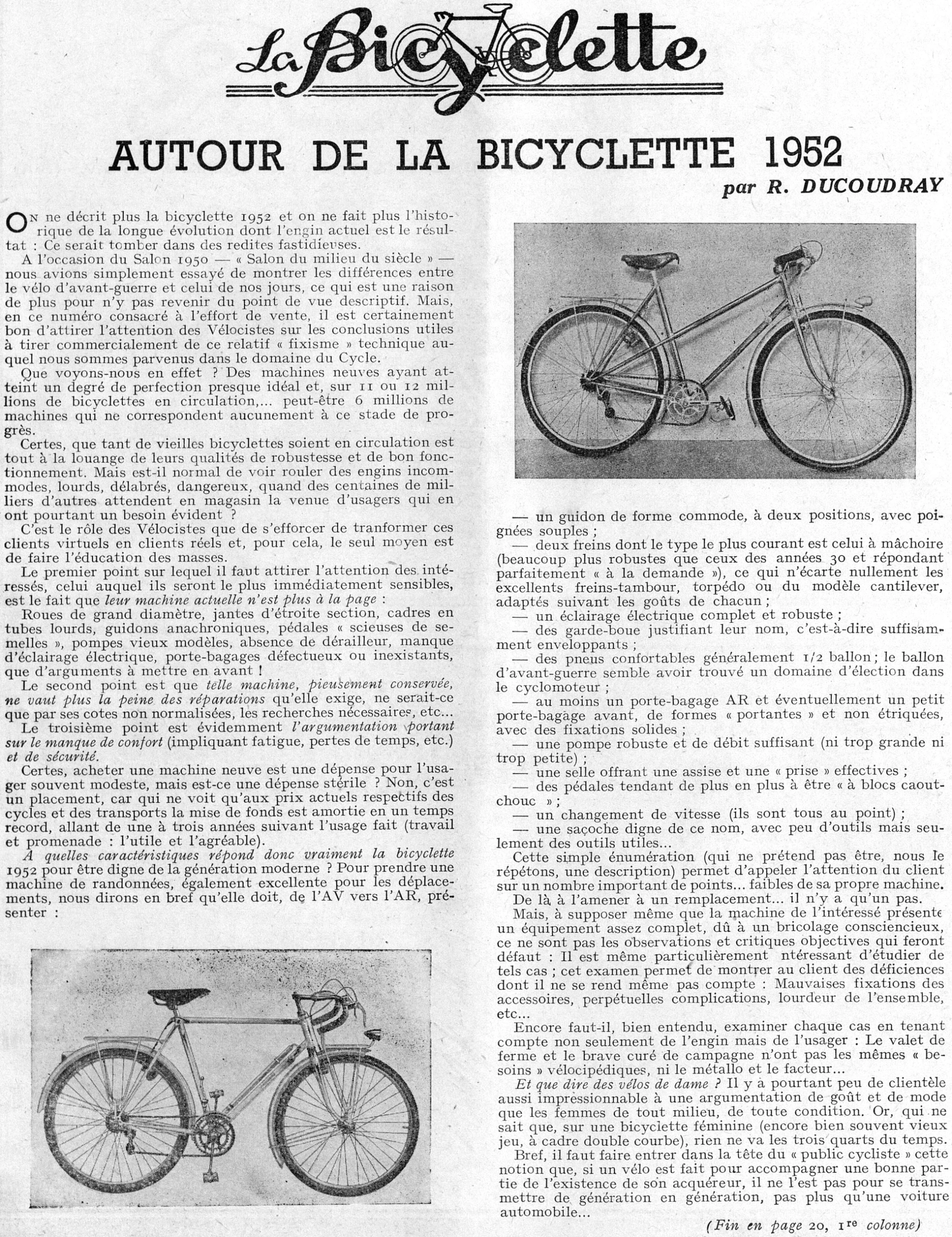
From L’Officiel du cycle, du motocycle et du camping, 3 May 1952, N° 18, the spring number, page 17: ‘Autour de la bicyclette 1952′ by R. Ducoudray: what the 1952 bicycle should be, with two photographs of bicycles (a touring man’s bicycle and a woman’s model). The title, headings, captions and lists are transcribed as printed; the text is summarized in Ebykr’s words, and the page images carry it in full.
— Page 1 —
La Bicyclette
AUTOUR DE LA BICYCLETTE 1952
par R. DUCOUDRAY
[Ebykr summary; the article’s text is not reproduced. Ducoudray begins by saying that the 1952 bicycle is no longer described, nor the long history behind it retold, which would only bring tedious repetition. On the occasion of the 1950 Salon, the “Salon du milieu du siècle”, the review had simply tried to show the differences between the prewar bicycle and the present one. In this number, devoted to the selling effort, it is good to draw the dealers’ attention to the commercial conclusions to be drawn from the relative technical fixity now reached in cycles. New machines have reached an almost ideal degree of perfection, yet of the 11 or 12 million bicycles in circulation perhaps 6 million do not match that stage of progress. That so many old bicycles are still running speaks for their sturdiness, but it is not normal to see clumsy, heavy, dilapidated and dangerous machines on the road while hundreds of thousands of others wait in the shops for users who plainly need them. The dealers’ role is to turn these virtual customers into real ones, and the only means is to educate the masses. The first point to stress is that the customer’s present machine is no longer up to date: wheels of large diameter, rims of narrow section, frames of heavy tubing, outdated handlebars, pedals that saw at the soles, old model pumps, no derailleur, no electric lighting and a poor or missing luggage rack, so there are many arguments to put forward. The second point is that such a machine, piously kept, is no longer worth the repairs it demands, if only because of its nonstandard dimensions and the searching it requires. The third is the argument about lack of comfort, with its fatigue and lost time, and of safety. Buying a new machine is a modest expense for the user and not a sterile one but an investment, since at present prices of cycles and transport the outlay is paid back in record time, in one to three years depending on use for work and for leisure. The author then asks what characteristics the 1952 bicycle must really have to be worthy of the modern generation, and, taking a touring machine that is also excellent for getting about, says in brief that from front to rear it must offer the following.]
— un guidon de forme commode, à deux positions, avec poi-
gnées souples ;
— deux freins dont le type le plus courant est celui à mâchoire
(beaucoup plus robustes que ceux des années 30 et répondant
parfaitement « à la demande »), ce qui n’écarte nullement les
excellents freins-tambour, torpédo ou du modèle cantilever,
adaptés suivant les goûts de chacun ;
— un éclairage électrique complet et robuste ;
— des garde-boue justifiant leur nom, c’est-à-dire suffisam-
ment enveloppants ;
— des pneus confortables généralement 1/2 ballon ; le ballon
d’avant-guerre semble avoir trouvé un domaine d’élection dans
le cyclomoteur ;
— au moins un porte-bagage AR et éventuellement un petit
porte-bagage avant, de formes « portantes » et non étriquées,
avec des fixations solides ;
— une pompe robuste et de débit suffisant (ni trop grande ni
trop petite) ;
— une selle offrant une assise et une « prise » effectives ;
— des pédales tendant de plus en plus à être « à blocs caout-
chouc » ;
— un changement de vitesse (ils sont tous au point) ;
— une sacoche digne de ce nom, avec peu d’outils mais seu-
lement des outils utiles…
[Ebykr summary, continuing. This simple enumeration, which does not claim to be a description, lets the dealer draw the customer’s attention to a good number of weak points in his own machine, and from there to getting him to replace it there is only one step. Even if the customer’s machine has fairly complete equipment thanks to conscientious tinkering, objective observations and criticisms will not be lacking, and such cases are especially interesting to study, because the examination shows the customer deficiencies he does not notice: poor fixings of accessories, perpetual complications and heaviness of the whole. Each case must be examined with the user in mind as well as the machine: the farm hand and the good country priest do not have the same cycling needs as the metalworker and the postman. As for women’s bicycles, few customers are as impressionable to an argument of taste and fashion, women of every background, yet a woman’s bicycle, often still an old model with a double-curved frame, is wrong three quarters of the time. In short, the “cycling public” must be made to understand that a bicycle is made to accompany a good part of its buyer’s life but not to be handed down from generation to generation, any more than a motor car.]
(Fin en page 20, 1re colonne)
[A full page of printed text with two halftone photographs of bicycles, neither carrying a caption or signature. The head of the page carries the lettered title “La Bicyclette” in dark shaded script capitals and lower case, with a drawn bicycle, handlebars, frame and two wheels, standing in for the middle letters, and heavy rules beneath it. Below it the headline “AUTOUR DE LA BICYCLETTE 1952” runs across the page in widely spaced heavy roman capitals, with the byline “par R. DUCOUDRAY” in bold italic capitals at the right. At the upper right is a halftone photograph of a woman’s bicycle seen from the side, with a low sloping frame, a rear luggage rack, a derailleur, full mudguards and a saddle and handlebar with grips, standing against a plain pale ground. At the lower left, a second halftone photograph in a thin ruled frame shows a man’s touring bicycle from the side, with a high cross bar, curved handlebars, a rear rack, mudguards, a derailleur and a saddle against a plain ground. The text is set in two justified columns of serif type with an indented first line and a decorated initial letter at the start, italic for some phrases and long dashes before each item of the equipment list in the right column. The closing note “(Fin en page 20, 1re colonne)” stands in italics at the lower right. No advertisement or agency mark appears.]
Ebykr presents this material for research and education. If you hold rights to it or notice an ownership issue, please contact us and we will respond promptly.
The Ebykr Digest
New articles, timelines, catalog finds and registry activity — assembled from the archive once a month. Your address is never shared.
Double opt-in. One email per month. Unsubscribe at any time with one click.