About Ebykr
Ebykr celebrates classic and vintage lightweight bicycles through provocative imagery and opinion. Ride along with us.
About Ebykr
Ebykr celebrates classic and vintage lightweight bicycles through provocative imagery and opinion. Ride along with us.

Source: Gallica (Bibliothèque nationale de France), L'Officiel du cycle, du motocycle et du camping, N° 39 (Compte rendu Salon 1951), 17 November 1951, pages 3 and 4; ark:/12148/bd6t541928887. Source gallica.bnf.fr / BnF.
| Type | Review |
|---|---|
| Year | 1951 |
| Publisher | L'Officiel du cycle |
| Country | France |
| Language | French |
| Pages | 2 |
| Source | Gallica (Bibliothèque nationale de France), L'Officiel du cycle, du motocycle et du camping, N° 39 (Compte rendu Salon 1951), 17 November 1951, pages 3 and 4; ark:/12148/bd6t541928887. Source gallica.bnf.fr / BnF. |
| Credit | Ebykr archive; Bibliothèque nationale de France |
| Identifier | Gallica (BnF) ark:/12148/bd6t541928887/f3 |
| Transcription | Headings and specifications transcribed; article text summarized |
UN VÉRITABLE SALON DU CYCLE ET DU MOTOCYCLE LES CYCLOMOTEURS LA BICYCLETTE LES SCOOTERS LE VÉLOMOTEUR LA MOTOCYCLETTE LES ÉQUIPEMENTS — 4 —
This is a magazine article, so its running text is summarized here rather than reproduced; the headline, byline, specifications and scores are transcribed as printed.
From L’Officiel du cycle, du motocycle et du camping, 17 November 1951, N° 39, the cycle edition’s report on the 1951 Paris Salon du Cycle et du Motocycle, pages 3 and 4: the opening editorial on the 1951 Salon at the Porte de Versailles and the trends it showed class by class, the bicycle among them. The title, headings, captions and lists are transcribed as printed; the text is summarized in Ebykr’s words, and the page images carry it in full.
— Page 1 —
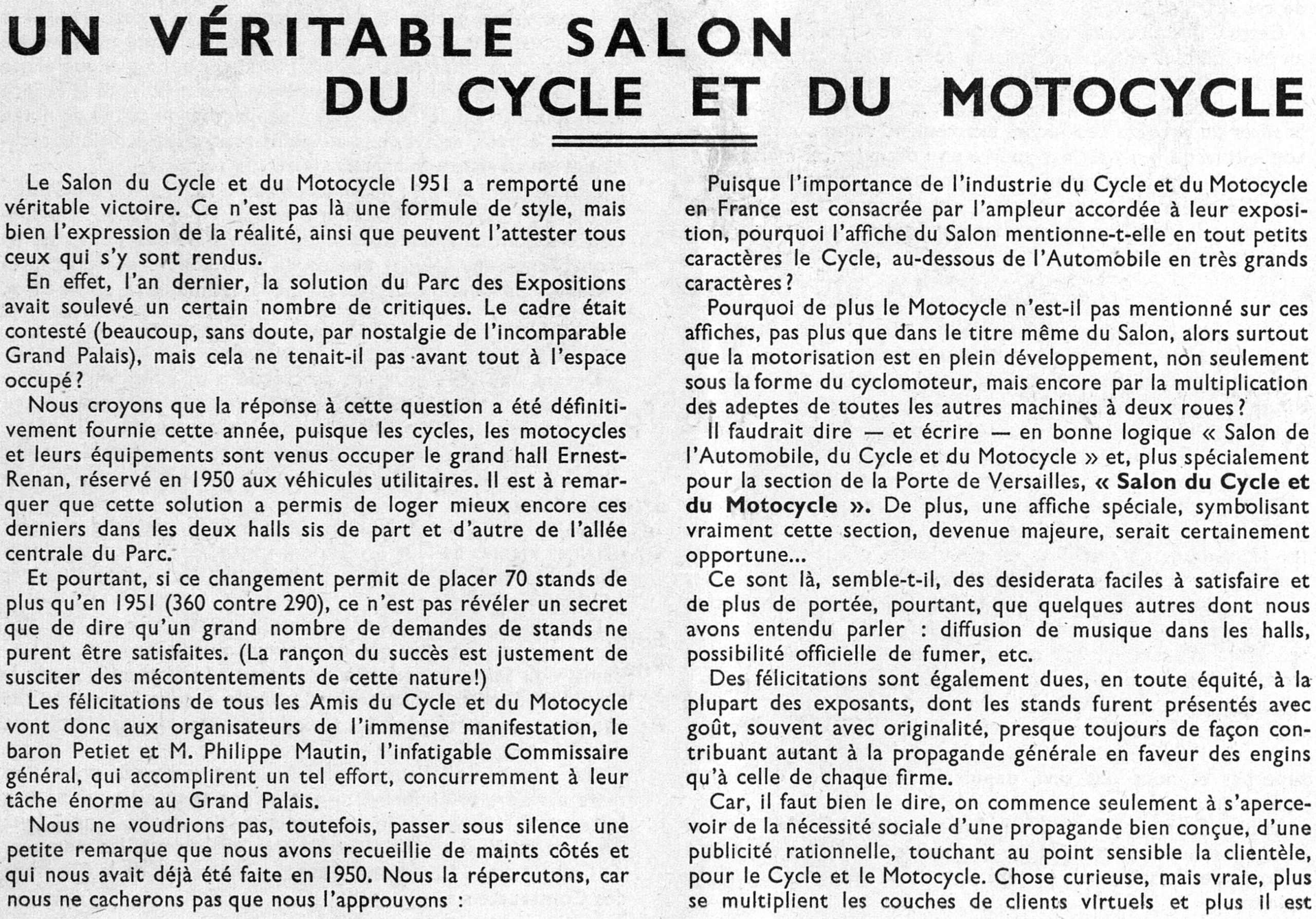
UN VÉRITABLE SALON
DU CYCLE ET DU MOTOCYCLE
[Ebykr summary; the article’s text is not reproduced. The paper calls the 1951 Salon du Cycle et du Motocycle a real victory, not as a figure of speech but as the fact all who went can attest. The year before, the Parc des Expositions had drawn criticism: the setting was disputed, many no doubt missing the incomparable Grand Palais, but the paper asks whether the trouble was not above all the space allotted. It believes the answer was given for good this year, since cycles, motorcycles and their equipment came to fill the great Ernest-Renan hall, reserved in 1950 for commercial vehicles, while the latter were housed better still in the two halls on either side of the Parc’s central alley. Yet although the change allowed 70 more stands than “en 1951” (360 against 290), many requests for stands could not be met, which the paper calls the price of success. The congratulations of all the Amis du Cycle et du Motocycle go to the organizers, the baron Petiet and M. Philippe Mautin, the tireless Commissaire général, who made this effort alongside their enormous task at the Grand Palais. The paper then passes on, with its approval, a remark heard on many sides and already made in 1950: since the importance of the cycle and motorcycle industry in France is confirmed by the size of its exhibition, why does the Salon poster name the Cycle in very small type beneath the Automobile in very large type, and why is the Motocycle named neither on the posters nor in the Salon’s title, when motorization is spreading fast, not only as the cyclomoteur but through the growing number of riders of every other two-wheeled machine? Logic would call it “Salon de l’Automobile, du Cycle et du Motocycle” and, for the Porte de Versailles section, “Salon du Cycle et du Motocycle”, with a special poster for this section, now a major one. These wishes, the paper says, are easy to satisfy and of more consequence than others it has heard of, such as music played in the halls or official leave to smoke. Congratulations are also due to most exhibitors, whose stands were shown with taste, often with originality and almost always in a way that served general propaganda for the machines as much as each firm’s own. The paper adds that the social necessity of well-conceived propaganda and rational advertising for the Cycle and the Motocycle is only now being noticed: the more layers of potential customers multiply, the more — the sentence running on to the following page.]
[Text only: the head of an editorial page. The title stands across the full width in two lines of heavy geometric sans-serif capitals, “UN VÉRITABLE SALON” ranged left and “DU CYCLE ET DU MOTOCYCLE” ranged right, closed beneath the second line by a short double rule. The text below is set in two justified columns of a light humanist sans-serif with paragraph indents; the phrase « Salon du Cycle et du Motocycle » in the right column is set in bold. There is no illustration, no subheading and no signature on this part of the page; the masthead block and table of contents are not on this image.]
— Page 2 —
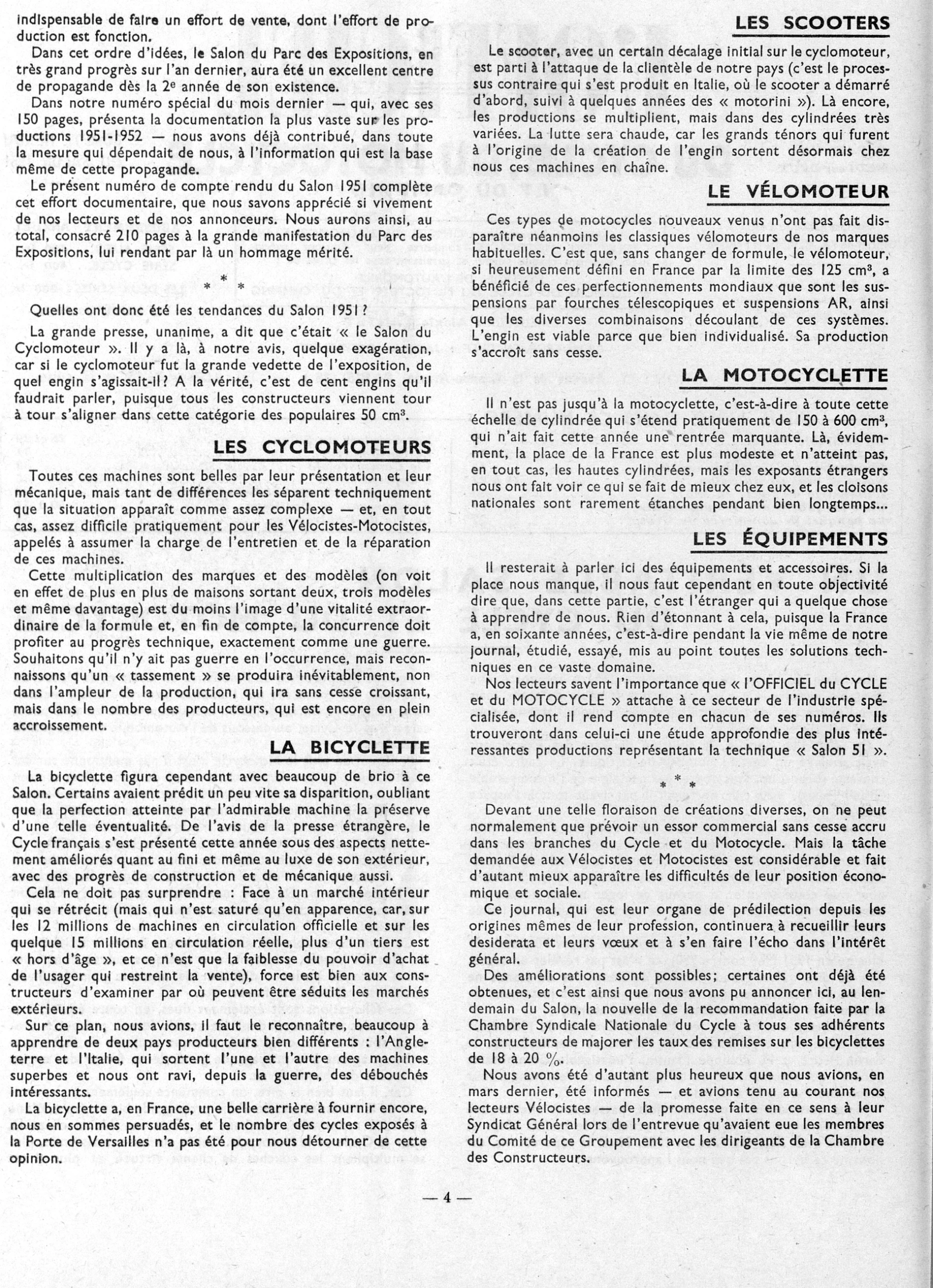
[Ebykr summary; the article’s text is not reproduced. Continuing from the previous page, the paper says it becomes indispensable to make a selling effort, on which the production effort depends. In that sense the Salon at the Parc des Expositions, in very great progress on the year before, was an excellent center of propaganda from only the 2nd year of its existence. The paper’s special number of the month before, which with its 150 pages gave the widest documentation on the 1951-1952 productions, already served the information that is the basis of that propaganda; the present report number on the 1951 Salon completes the effort, so that in all the paper will have given 210 pages to the great event at the Parc des Expositions.]
[Ebykr summary, after a three-star break. The paper asks what the trends of the 1951 Salon were. The daily press unanimously called it “the Salon of the cyclomoteur”, which the paper thinks an exaggeration: if the cyclomoteur was the star of the show, it was a hundred machines rather than one, since every maker in turn is lining up in this category of the popular 50 cm3.]
LES CYCLOMOTEURS
[Ebykr summary; the article’s text is not reproduced. All these machines are handsome in finish and mechanism, but they differ so much technically that the situation looks complex and, in practice, hard for the Vélocistes-Motocistes who must maintain and repair them. The multiplication of marques and models, with more and more houses bringing out two, three or more models, shows the extraordinary vitality of the formula, and competition should in the end serve technical progress “exactement comme une guerre”. The paper hopes there will be no war, but foresees an inevitable “tassement”, not in the volume of production, which will keep growing, but in the number of producers, which is still rising.]
LA BICYCLETTE
[Ebykr summary; the article’s text is not reproduced. This is the passage on the bicycle itself. The bicycle figured with great brio at the Salon; some had foretold its disappearance too quickly, forgetting that the perfection reached by “l’admirable machine” protects it from that. In the opinion of the foreign press, the French cycle appeared this year clearly improved in finish and even in the luxury of its exterior, with progress in construction and mechanism too. The paper says this is no surprise: facing a shrinking home market, which is saturated only in appearance, since of the 12 million machines in official circulation and some 15 million in real circulation more than a third is “hors d’âge” and only the user’s weak purchasing power restricts sales, the makers must look to win foreign markets. There, it concedes, France had much to learn from two very different producing countries, England and Italy, which both turn out superb machines and have taken from France since the war some worthwhile outlets. The paper is persuaded that the bicycle still has a fine career to run in France, and the number of cycles shown at the Porte de Versailles did nothing to change its view.]
LES SCOOTERS
[Ebykr summary; the article’s text is not reproduced. The scooter, starting somewhat behind the cyclomoteur, has set out to win French customers; the reverse happened in Italy, where the scooter came first and the “motorini” followed some years later. Here too productions multiply, but in very varied cylinder capacities. The struggle will be hot, since the great names that created the machine now build it on the production line in France.]
LE VÉLOMOTEUR
[Ebykr summary; the article’s text is not reproduced. These newcomers have not displaced the classic vélomoteurs of the usual marques. Without changing its formula, the vélomoteur, so happily defined in France by the 125 cm3 limit, has gained from worldwide improvements, telescopic forks and rear suspension and their various combinations. The machine is viable because it is well individualized, and its production grows without pause.]
LA MOTOCYCLETTE
[Ebykr summary; the article’s text is not reproduced. Even the motorcycle, the whole range of capacities from about 150 to 600 cm3, made a marked return this year. France’s place is more modest there and does not in any case reach the large capacities, but the foreign exhibitors showed the best of their own work, and national partitions are rarely watertight for long.]
LES ÉQUIPEMENTS
[Ebykr summary; the article’s text is not reproduced. Space is short for equipment and accessories, but the paper says in all objectivity that here it is the foreigner who has something to learn from France, which in sixty years, the very life of the paper, has studied, tried and perfected every technical solution in the field. Readers know the importance « l’OFFICIEL du CYCLE et du MOTOCYCLE » gives this sector of the specialized industry in every number, and they will find in this one a thorough study of the most interesting productions representing the « Salon 51 » technique.]
[Ebykr summary, after a second three-star break. Before such a flowering of creations the paper can only foresee an ever greater commercial growth in the Cycle and Motocycle trades, but the task asked of the Vélocistes and Motocistes is considerable and shows all the more the difficulties of their economic and social position. The paper, their favored organ since the origins of their profession, will go on gathering and echoing their wishes in the general interest. Improvements are possible and some have been won: just after the Salon the paper was able to announce the recommendation by the Chambre Syndicale Nationale du Cycle to all its maker members to raise the discount rates on bicycles from 18 to 20 %. It was the more pleased because in March it had learned, and told its Vélociste readers, of the promise made to that effect to their Syndicat Général at the meeting of the members of that body’s Comité with the heads of the Chambre des Constructeurs.]
— 4 —
[Text only: the continuation of the editorial, filling page 4 in two justified columns of a light humanist sans-serif with paragraph indents. The section heads “LES CYCLOMOTEURS”, “LA BICYCLETTE”, “LES SCOOTERS”, “LE VÉLOMOTEUR”, “LA MOTOCYCLETTE” and “LES ÉQUIPEMENTS” are set in heavy geometric sans-serif capitals, ranged right and underscored by a thick rule. Two three-star ornaments arranged in a triangle divide the opening paragraphs from the trends survey in the left column and the equipment section from the closing paragraphs in the right. The folio “— 4 —” is centered at the foot. There is no illustration and no signature. Faint text from the reverse of the leaf shows through the paper.]
Ebykr presents this material for research and education. If you hold rights to it or notice an ownership issue, please contact us and we will respond promptly.
The Ebykr Digest
New articles, timelines, catalog finds and registry activity — assembled from the archive once a month. Your address is never shared.
Double opt-in. One email per month. Unsubscribe at any time with one click.