About Ebykr
Ebykr celebrates classic and vintage lightweight bicycles through provocative imagery and opinion. Ride along with us.
About Ebykr
Ebykr celebrates classic and vintage lightweight bicycles through provocative imagery and opinion. Ride along with us.

Source: Gallica (Bibliothèque nationale de France), L'Officiel du cycle, du motocycle et du camping, N° 39 (Compte rendu Salon 1951), 17 November 1951, page 18; ark:/12148/bd6t541928887. Source gallica.bnf.fr / BnF.
| Type | Review |
|---|---|
| Year | 1951 |
| Publisher | L'Officiel du cycle |
| Artist | G. Gédovius |
| Country | France |
| Language | French |
| Pages | 1 |
| Source | Gallica (Bibliothèque nationale de France), L'Officiel du cycle, du motocycle et du camping, N° 39 (Compte rendu Salon 1951), 17 November 1951, page 18; ark:/12148/bd6t541928887. Source gallica.bnf.fr / BnF. |
| Credit | Ebykr archive; Bibliothèque nationale de France |
| Identifier | Gallica (BnF) ark:/12148/bd6t541928887/f18 |
| Transcription | Headings and specifications transcribed; article text summarized |
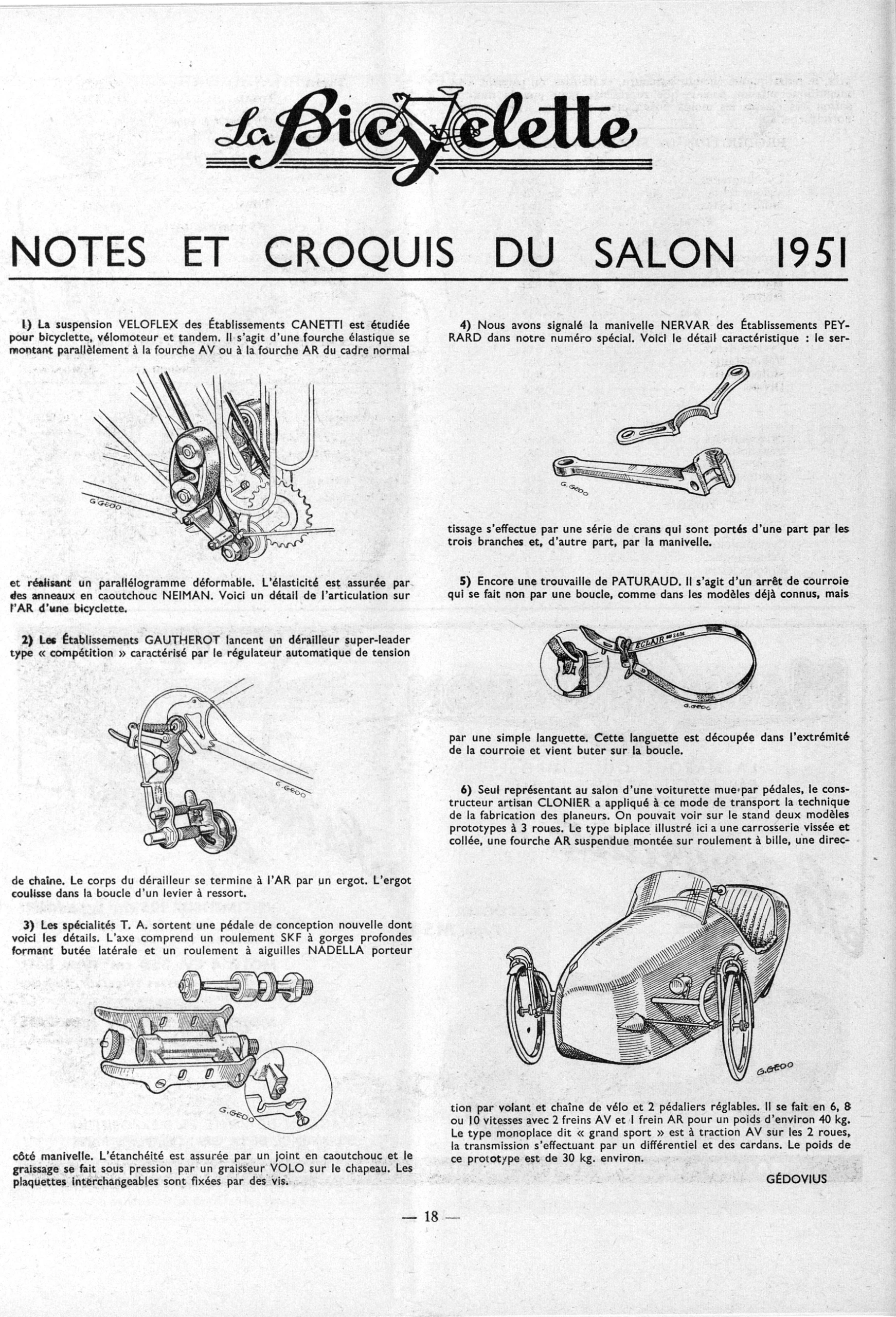
La Bicyclette NOTES ET CROQUIS DU SALON 1951 1) La suspension VELOFLEX des Établissements CANETTI est étudiée pour bicyclette, vélomoteur et tandem. Il s'agit d'une fourche élastique se montant parallèlement à la fourche AV ou à la fourche AR du cadre normal et réalisant un parallélogramme déformable. L'élasticité est assurée par des anneaux en caoutchouc …
This is a magazine article, so its running text is summarized here rather than reproduced; the headline, byline, specifications and scores are transcribed as printed.
From L’Officiel du cycle, du motocycle et du camping, 17 November 1951, N° 39, the cycle edition’s report on the 1951 Paris Salon du Cycle et du Motocycle, page 18: G. Gédovius’s six drawn notes on the novelties of the Salon for the bicycle. The title, headings, captions and lists are transcribed as printed; the text is summarized in Ebykr’s words, and the page images carry it in full.
— Page 1 —
La Bicyclette
NOTES ET CROQUIS DU SALON 1951
1) La suspension VELOFLEX des Établissements CANETTI est étudiée
pour bicyclette, vélomoteur et tandem. Il s’agit d’une fourche élastique se
montant parallèlement à la fourche AV ou à la fourche AR du cadre normal
et réalisant un parallélogramme déformable. L’élasticité est assurée par
des anneaux en caoutchouc NEIMAN. Voici un détail de l’articulation sur
l’AR d’une bicyclette.
2) Les Établissements GAUTHEROT lancent un dérailleur super-leader
type « compétition » caractérisé par le régulateur automatique de tension
de chaîne. Le corps du dérailleur se termine à l’AR par un ergot. L’ergot
coulisse dans la boucle d’un levier à ressort.
3) Les spécialités T. A. sortent une pédale de conception nouvelle dont
voici les détails. L’axe comprend un roulement SKF à gorges profondes
formant butée latérale et un roulement à aiguilles NADELLA porteur
côté manivelle. L’étanchéité est assurée par un joint en caoutchouc et le
graissage se fait sous pression par un graisseur VOLO sur le chapeau. Les
plaquettes interchangeables sont fixées par des vis.
4) Nous avons signalé la manivelle NERVAR des Établissements PEY-
RARD dans notre numéro spécial. Voici le détail caractéristique : le ser-
tissage s’effectue par une série de crans qui sont portés d’une part par les
trois branches et, d’autre part, par la manivelle.
5) Encore une trouvaille de PATURAUD. Il s’agit d’un arrêt de courroie
qui se fait non par une boucle, comme dans les modèles déjà connus, mais
par une simple languette. Cette languette est découpée dans l’extrémité
de la courroie et vient buter sur la boucle.
6) Seul représentant au salon d’une voiturette mue par pédales, le cons-
tructeur artisan CLONIER a appliqué à ce mode de transport la technique
de la fabrication des planeurs. On pouvait voir sur le stand deux modèles
prototypes à 3 roues. Le type biplace illustré ici a une carrosserie vissée et
collée, une fourche AR suspendue montée sur roulement à bille, une direc-
tion par volant et chaîne de vélo et 2 pédaliers réglables. Il se fait en 6, 8
ou 10 vitesses avec 2 freins AV et 1 frein AR pour un poids d’environ 40 kg.
Le type monoplace dit « grand sport » est à traction AV sur les 2 roues,
la transmission s’effectuant par un différentiel et des cardans. Le poids de
ce prototype est de 30 kg. environ.
GÉDOVIUS
— 18 —
[A full editorial page of six numbered notes on bicycle novelties, each followed or split by a pen-and-ink drawing, set in two columns in a bold humanist sans-serif with trade names in capitals: notes 1 to 3 in the left column and 4 to 6 in the right. Across the head stands the standing section title “La Bicyclette” in a heavy brush script whose letters “c” and final “e” are formed by the two wheels of a small line-drawn bicycle with a saddle and dropped handlebar riding on three parallel rules, and below it “NOTES ET CROQUIS DU SALON 1951” in tall light sans-serif capitals over a full-width rule. Every drawing is a line engraving in close hatching and stipple and every one is signed “G. GEDO” at its lower edge. The first shows the Veloflex suspension at the rear dropout of a bicycle: a rounded link holding two rubber rings on hex-bolted pivots beside the chainstay and seatstay, with spokes, a sprocket and the chain behind it. The second shows the Gautherot derailleur clamped to the chainstay, a cast body ending in a lug that runs in the loop of a spring lever, with a coil spring along its top, a cable curving over it and a jockey wheel with two knurled adjusters below; tiny lettering on the body is too small to read. The third shows the T.A. pedal exploded: the spindle with its bearings and threaded end above, the quill pedal body with slotted interchangeable plates and a knurled dust cap below, and a circled detail of a plate fixed by a countersunk screw. The fourth shows the Nervar crank in two parts, the three-armed spider with its toothed central ring above and the fluted crank arm with its toothed boss below. The fifth shows a toe strap marked “ECLAIR” with a small partly legible mark resembling “S.G.D.G.”, looped round with its buckle, and a circled enlargement of the tongue cut in the strap’s end bearing on the buckle. The sixth shows Clonier’s pedal-driven three-wheeled voiturette seen from the front three-quarter: a streamlined planked body with a curved windscreen and quilted seat back, two bicycle-type front wheels on their own forks with mudguards, a small lamp and a pointed nose. The note text is signed “GÉDOVIUS” in roman capitals at the foot of the right column, above the centered folio “— 18 —”. Faint text from the reverse of the leaf shows through the paper.]
Ebykr presents this material for research and education. If you hold rights to it or notice an ownership issue, please contact us and we will respond promptly.
The Ebykr Digest
New articles, timelines, catalog finds and registry activity — assembled from the archive once a month. Your address is never shared.
Double opt-in. One email per month. Unsubscribe at any time with one click.