About Ebykr
Ebykr celebrates classic and vintage lightweight bicycles through provocative imagery and opinion. Ride along with us.
About Ebykr
Ebykr celebrates classic and vintage lightweight bicycles through provocative imagery and opinion. Ride along with us.

Source: Gallica (Bibliothèque nationale de France), L'Officiel du cycle, du motocycle et du camping, N° 39 (Compte rendu Salon 1951), 17 November 1951, pages 5, 6, 7, 9, 11 and 13; ark:/12148/bd6t541928887. Source gallica.bnf.fr / BnF.
| Type | Review |
|---|---|
| Year | 1951 |
| Publisher | L'Officiel du cycle |
| Country | France |
| Language | French |
| Pages | 6 |
| Source | Gallica (Bibliothèque nationale de France), L'Officiel du cycle, du motocycle et du camping, N° 39 (Compte rendu Salon 1951), 17 November 1951, pages 5, 6, 7, 9, 11 and 13; ark:/12148/bd6t541928887. Source gallica.bnf.fr / BnF. |
| Credit | Ebykr archive; Bibliothèque nationale de France |
| Identifier | Gallica (BnF) ark:/12148/bd6t541928887/f5 |
| Transcription | Headings and specifications transcribed; article text summarized |
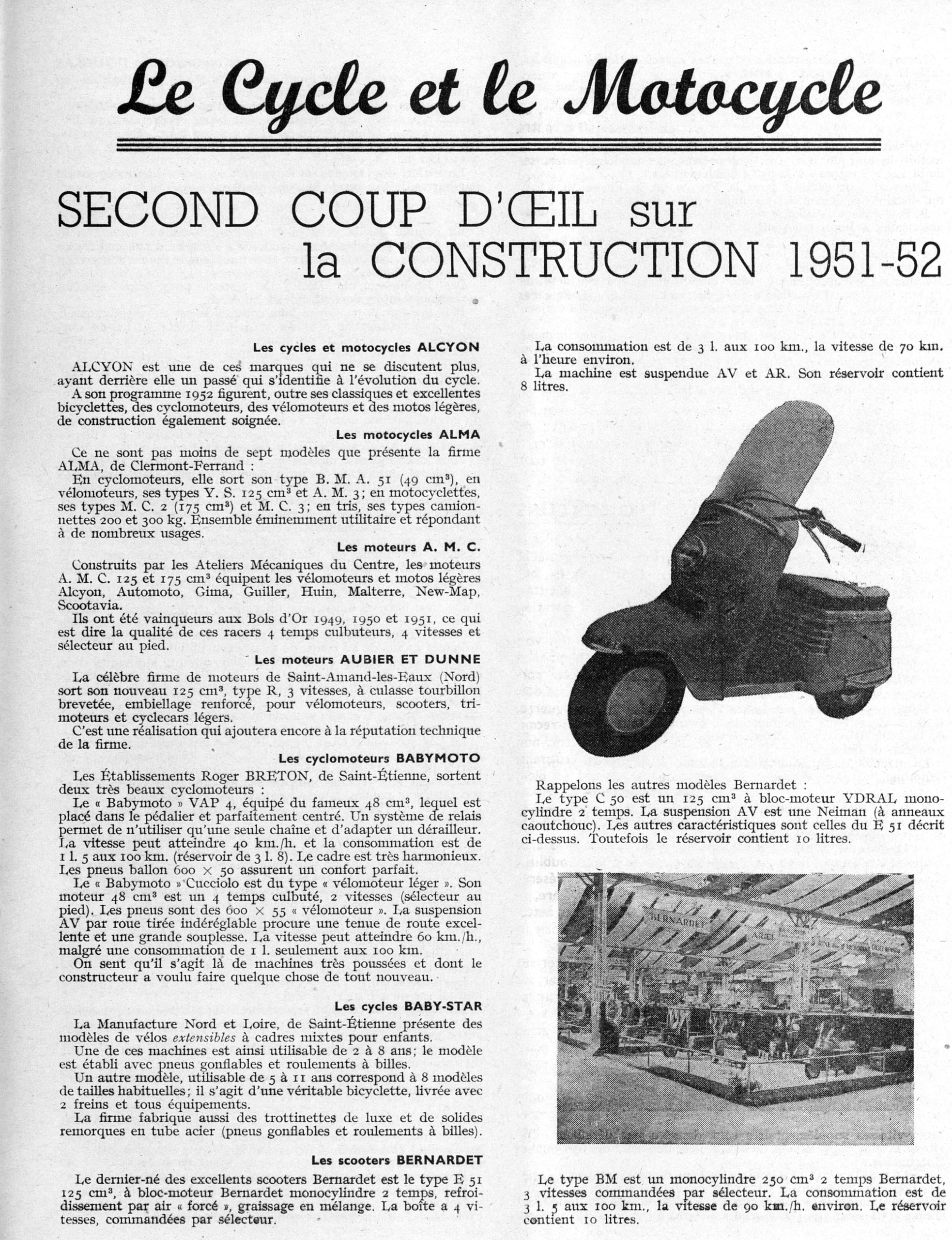
Le Cycle et le Motocycle SECOND COUP D'ŒIL sur la CONSTRUCTION 1951-52 Les cycles et motocycles ALCYON Les motocycles ALMA Les moteurs A. M. C. Les moteurs AUBIER ET DUNNE Les cyclomoteurs BABYMOTO Les cycles BABY-STAR Les scooters BERNARDET Les motocycles B. S. A. 1° Classe « C » : B. S. A. 500 A …
This is a magazine article, so its running text is summarized here rather than reproduced; the headline, byline, specifications and scores are transcribed as printed.
From L’Officiel du cycle, du motocycle et du camping, 17 November 1951, N° 39, the cycle edition’s report on the 1951 Paris Salon du Cycle et du Motocycle, pages 5 to 13: the magazine’s second survey of the 1951-52 production shown at the Salon, maker by maker: bicycles, cyclomoteurs, scooters and motorcycles. The title, headings, captions and lists are transcribed as printed; the text is summarized in Ebykr’s words, and the page images carry it in full.
— Page 1 —
Le Cycle et le Motocycle
SECOND COUP D’ŒIL sur
la CONSTRUCTION 1951-52
Les cycles et motocycles ALCYON
[Ebykr summary; the article’s text is not reproduced. Alcyon (bicycles and motor machines) is called one of those marques that are no longer argued over, with a past that is one with the evolution of the cycle. Its 1952 program carries, besides its classic and excellent bicycles, cyclomoteurs, vélomoteurs and light motorcycles, all of equally careful construction.]
Les motocycles ALMA
[Ebykr summary; the article’s text is not reproduced. Alma of Clermont-Ferrand (motor machines only) shows no fewer than seven models: in cyclomoteurs the type B. M. A. 51 (49 cm3); in vélomoteurs the types Y. S. 125 cm3 and A. M. 3; in motorcycles the types M. C. 2 (175 cm3) and M. C. 3; and in tricycles the delivery-van types of 200 and 300 kg. The paper calls the range eminently utilitarian and suited to many uses.]
Les moteurs A. M. C.
[Ebykr summary; the article’s text is not reproduced. Built by the Ateliers Mécaniques du Centre (engines only), the A. M. C. engines of 125 and 175 cm3 equip the vélomoteurs and light motorcycles of Alcyon, Automoto, Gima, Guiller, Huin, Malterre, New-Map and Scootavia. They won the Bols d’Or of 1949, 1950 and 1951, which the paper says tells the quality of these four-stroke overhead-valve racers with four speeds and foot selector.]
Les moteurs AUBIER ET DUNNE
[Ebykr summary; the article’s text is not reproduced. The celebrated engine firm of Saint-Amand-les-Eaux (Nord) (engines only) brings out its new 125 cm3 type R, three speeds, with a patented “tourbillon” cylinder head and strengthened connecting-rod assembly, for vélomoteurs, scooters, tri-moteurs and light cyclecars. The paper says it will add further to the firm’s technical reputation.]
Les cyclomoteurs BABYMOTO
[Ebykr summary; the article’s text is not reproduced. The Établissements Roger Breton of Saint-Étienne (motor machines only) bring out two cyclomoteurs. The « Babymoto » VAP 4 carries the famous 48 cm3 engine placed in the bottom bracket and perfectly centered; a relay system allows a single chain and the fitting of a derailleur; speed up to 40 km./h., consumption 1 l. 5 per 100 km. (tank of 3 l. 8); a very harmonious frame and 600 × 50 balloon tires. The « Babymoto » Cucciolo is of the « vélomoteur léger » type: a 48 cm3 four-stroke overhead-valve engine with two speeds (foot selector), 600 × 55 « vélomoteur » tires, a non-adjustable trailing-link front suspension giving excellent road holding and great suppleness, and a speed up to 60 km./h. on only 1 l. per 100 km. The paper says these are highly developed machines with which the maker wanted to do something entirely new.]
Les cycles BABY-STAR
[Ebykr summary; the article’s text is not reproduced. The Manufacture Nord et Loire of Saint-Étienne (bicycles only) presents extensible children’s bicycles (“extensibles”, in italic) with mixte frames. One can be used from 2 to 8 years and is built with pneumatic tires and ball bearings; another, usable from 5 to 11 years, takes the place of 8 models of the usual sizes and is described as a real bicycle, delivered with 2 brakes and full equipment. The firm also makes luxury scooters (trottinettes) and solid steel-tube trailers, with pneumatic tires and ball bearings.]
Les scooters BERNARDET
[Ebykr summary; the article’s text is not reproduced. Bernardet (motor scooters only) shows as its newest model the type E 51 of 125 cm3, with a Bernardet single-cylinder two-stroke engine unit, forced air cooling, petroil lubrication and a four-speed gearbox worked by a selector; consumption 3 l. per 100 km., speed about 70 km. an hour, front and rear suspension, tank of 8 liters. Of the other models, the type C 50 is a 125 cm3 with a YDRAL single-cylinder two-stroke engine unit and a Neiman front suspension (with rubber rings), otherwise as the E 51 but with a 10-liter tank; the type BM is a 250 cm3 Bernardet two-stroke single with three speeds by selector, consumption 3 l. 5 per 100 km., speed about 90 km./h. and a 10-liter tank.]
[A full page in two columns. The standing head “Le Cycle et le Motocycle” runs across the top in a large heavy connecting script, underlined by three thin parallel rules, and below it the title “SECOND COUP D’ŒIL sur / la CONSTRUCTION 1951-52” is set in two lines of large light slab-serif capitals, the second line stepped to the right. The firm headings are in bold sans-serif, ranged right over the left column, and the running text is in a roman with old-style figures. The left column holds the entries from Alcyon to Bernardet; the right column continues the Bernardet entry and carries two uncaptioned halftone photographs. The first is a Bernardet scooter cut out against the bare page, seen three-quarters from the front left: a tall rounded leg shield, handlebar with control cables, small disc front wheel under a deep mudguard and a broad enclosed body with a padded saddle. The second, in a square frame, is a view of the Bernardet stand at the Salon under a striped draped canopy, its frieze lettered “BERNARDET” with “ARIEL” and further lettering too small to read, scooters standing on a low railed platform. Neither photograph carries a signature.]
— Page 2 —
[Ebykr summary; the article’s text is not reproduced. The Bernardet entry from the previous page closes: the type D 51 has the same general characteristics but a four-speed gearbox. The paper calls the range a set of very fine productions that honor the French scooter industry, of which Bernardet is one of the pioneers.]
Les motocycles B. S. A.
[Ebykr summary; the article’s text is not reproduced. B. S. A. (motorcycles only), popular in Great Britain and around the world, presents 20 different models, from the 125 « Bantam » to the 650 « Golden Flash ». The exclusive importer for France is the firm MOVEA, which also distributes the « Subeam » (so printed) and « New Hudson » machines. B. S. A. has just taken two American speed records at Bonneville over the flying mile:]
1° Classe « C » : B. S. A. 500 A 7 « Star Twin », avec 199 km./h. ;
2° Classe « A » : B. S. A. 650 A 10 « Golden-Flash », avec 231 km./h.
[Ebykr summary, continued. The paper describes Bonneville as a dried-up lake left as a perfectly flat expanse of salt about 24 km. long and 13 km. wide, some 150 km. from Salt-Lake City (State of Utah), the city made famous by the Mormons, its surface shining like snow in the sun. The American rules for these records are very strict: in class « C » the machine must be a standard catalog model of current manufacture, the compression ratio may not exceed 8 to 1 and only normal commercial fuel is allowed.]
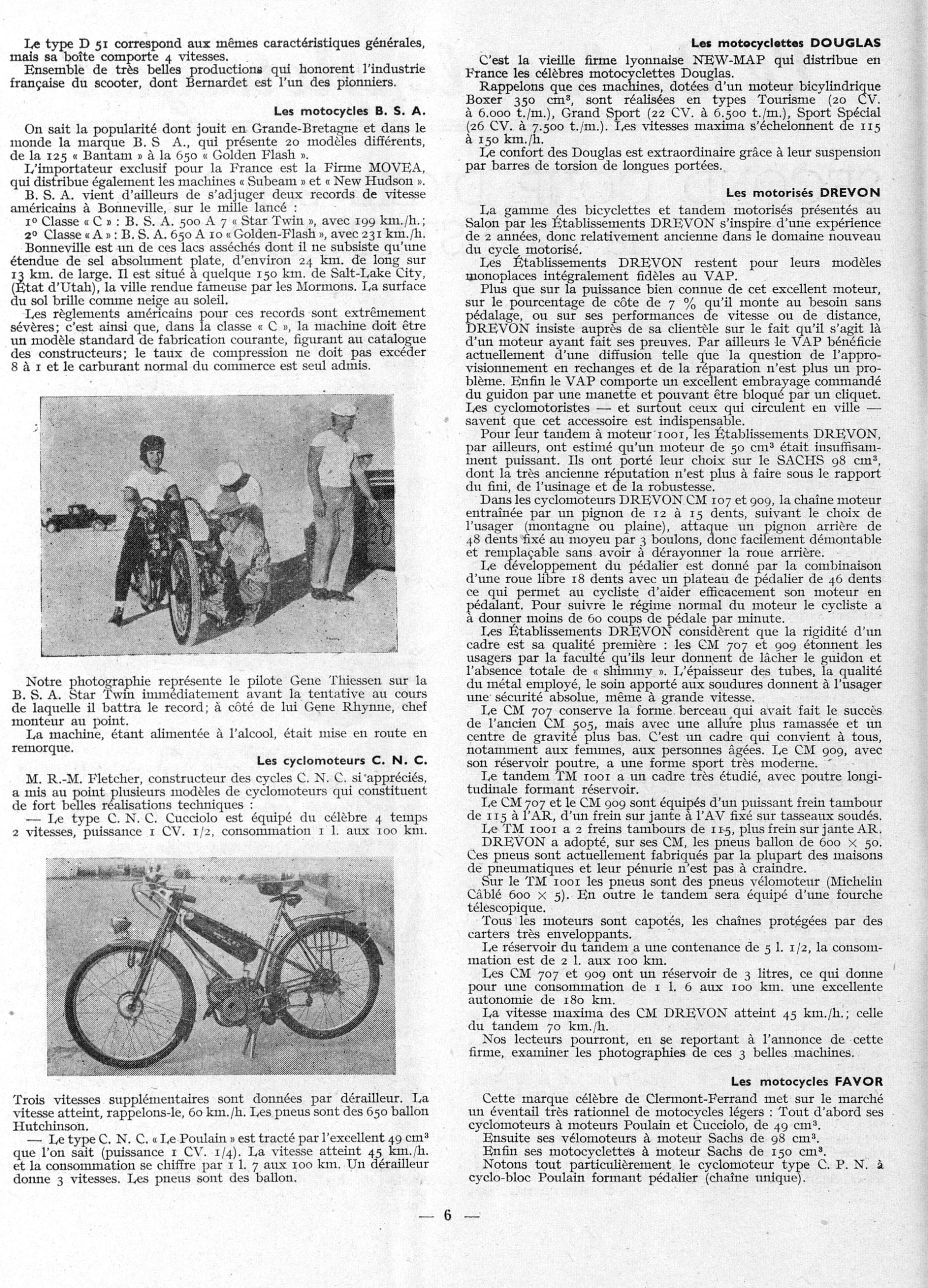
Notre photographie représente le pilote Gene Thiessen sur la B. S. A. Star Twin immédiatement avant la tentative au cours de laquelle il battra le record ; à côté de lui Gene Rhynne, chef monteur au point.
La machine, étant alimentée à l’alcool, était mise en route en remorque.
Les cyclomoteurs C. N. C.
[Ebykr summary; the article’s text is not reproduced. M. R.-M. Fletcher, maker of the much-appreciated C. N. C. bicycles (the firm builds bicycles, and here presents cyclomoteurs), has developed several cyclomoteur models the paper calls very fine technical achievements. The type C. N. C. Cucciolo carries the celebrated four-stroke engine with two speeds, 1 CV. 1/2, consumption 1 l. per 100 km., with three further speeds given by a derailleur, a speed of 60 km./h. and 650 Hutchinson balloon tires. The type C. N. C. « Le Poulain » is driven by the well-known 49 cm3 engine (1 CV. 1/4), reaches 45 km./h. on 1 l. 7 per 100 km., with a derailleur giving 3 speeds and balloon tires.]
Les motocyclettes DOUGLAS
[Ebykr summary; the article’s text is not reproduced. The old Lyon firm NEW-MAP distributes in France the celebrated Douglas motorcycles (motor machines only), with a 350 cm3 Boxer flat-twin engine, in the types Tourisme (20 CV. at 6.000 t./m.), Grand Sport (22 CV. at 6.500 t./m.) and Sport Spécial (26 CV. at 7.500 t./m.), with top speeds from 115 to 150 km./h. Their comfort is called extraordinary, thanks to suspension by long torsion bars.]
Les motorisés DREVON
[Ebykr summary; the article’s text is not reproduced. The Établissements DREVON show a range of motorized bicycles and a motorized tandem built on two years of experience, which the paper calls relatively long in the new field of the motorized cycle. For the single-seat models Drevon stays wholly faithful to the VAP engine, stressing less its power, the 7 % gradient it climbs without pedaling or its speed and range than its proven record, the wide availability of spares and repairs and its clutch worked from the handlebar by a lever and lockable by a ratchet. For the tandem à moteur 1001 a 50 cm3 engine was judged too weak and the SACHS 98 cm3 was chosen. In the cyclomoteurs CM 107 (so printed; elsewhere CM 707) and 909, the engine chain runs on a 12- to 15-tooth sprocket, by the rider’s choice for mountain or plain, to a 48-tooth rear sprocket held to the hub by 3 bolts and removable without unlacing the wheel; pedaling is geared by an 18-tooth freewheel and a 46-tooth chainwheel, and under 60 pedal strokes a minute follow the engine’s normal speed. Drevon holds frame rigidity the first quality: riders of the CM 707 and 909 can let go of the handlebar without « shimmy », and tube thickness, metal and welding give complete safety at speed. The CM 707 keeps the cradle form of the earlier CM 505, lower and more compact, a frame for everyone, notably women and the elderly; the CM 909, with a beam tank, has a very modern sport form. The tandem TM 1001 has a longitudinal beam frame forming the tank. The CM 707 and 909 have a 115 drum brake at the rear and a rim brake at the front on welded bosses; the TM 1001 has 2 drum brakes of 115 plus a rear rim brake. The CM run on 600 × 50 balloon tires, now made by most tire houses; the TM 1001 on vélomoteur tires (Michelin Câblé 600 × 5, so printed) and will have a telescopic fork. All engines are cowled and the chains enclosed. The tandem’s tank holds 5 l. 1/2 at 2 l. per 100 km.; the CM 707 and 909 hold 3 liters at 1 l. 6 per 100 km., a range of 180 km. The CM top speed is 45 km./h., the tandem’s 70 km./h. Readers are referred to the firm’s advertisement for photographs of the 3 machines.]
Les motocycles FAVOR
[Ebykr summary; the article’s text is not reproduced. The celebrated Clermont-Ferrand marque Favor (motor machines only) offers a very rational range of light motor machines: cyclomoteurs with Poulain and Cucciolo engines of 49 cm3, vélomoteurs with the Sachs 98 cm3 engine and motorcycles with the Sachs 150 cm3 engine. The paper singles out the cyclomoteur type C. P. N. with the Poulain cyclo-bloc forming the bottom bracket (single chain).]
— 6 —
[A full page in two columns, text set in a roman with old-style figures, with the firm headings in bold sans-serif ranged right and the folio “— 6 —” centered at the foot. The left column carries two square halftone photographs without printed captions. The first shows a record machine on a pale flat ground: a rider in a white crash helmet and dark trousers stands astride a stripped motorcycle while a kneeling mechanic in a white cap works at its front wheel and a third man in white stands at the right; a pick-up truck is parked in the distance at the left. The text below identifies the rider as Gene Thiessen on the B. S. A. Star Twin. The second shows a cyclomoteur in left profile against a pale wall: a step-through frame with a deep beam tank, a small engine with a finned cylinder at the bottom bracket, full mudguards, a rear carrier, a front lamp and a sprung saddle. The right column is text only. No signature appears in the corners of either photograph.]
— Page 3 —
Les cycles FONLUPT
[Ebykr summary; the article’s text is not reproduced. Fonlupt (bicycles, with cyclomoteurs) is called an old and excellent house of La Clayette (Saône-et-Loire). Besides its superb range of children’s bicycles it brings out bicycles and cyclomoteurs whose presentation is admirably studied, and the marque’s Cyclo-tourisme, Sport and Course models are said to be quite outstanding for their mechanical qualities and their finish.]
Les cycles et motocycles FRANCE MOTOR CYCLES
[Ebykr summary; the article’s text is not reproduced. The four great marques of France Motor Cycles (bicycles and motor machines), Griffon, Aiglon, Météore and Trophée de France, are called too well known to need presenting. New 1952 models leave the firm’s works in bicycles, motor-assisted bicycles, vélomoteurs, motorcycles and trimoteurs, and the paper says they represent the most advanced French technique.]
Les cycles GÉNIAL-LUCIFER
[Ebykr summary; the article’s text is not reproduced. Presented by MESTRE et BLATGÉ, the celebrated firm of the avenue de la Grande-Armée, the GÉNIAL-LUCIFER cycles (bicycles only) are called particularly luxurious. Their cyclo-touriste model, ideal for long rides and the mountains, has a derailleur and a mountain chainwheel giving 8 speeds, a cyclo-touriste handlebar and randonneur carriers front and rear; the paper calls it a super-luxe ensemble.]
Les motocyclettes GUILLER
[Ebykr summary; the article’s text is not reproduced. The firm GUILLER Frères (motorcycles only) is said to have done much, by its industrial growth, to make Fontenay-le-Comte, the charming capital of the Bas-Poitou, a little Saint-Étienne. Its latest production is the Guiller A. M. C. 175 cm3 Sport, modèle 52, with long-travel swinging-arm rear suspension, a two-seat saddle, a speedometer in the headlamp driven directly from the gearbox, a 15 l. tank and a new telescopic fork that gives, with the rear suspension, full suspension.]
Les cycles HELYETT
[Ebykr summary; the article’s text is not reproduced. Olympic champion, the HELYETT marque (bicycles only) sets out to be the great marque of the young, and the paper says it succeeds with an elegant, solid and varied production from its Sully-sur-Loire works, rebuilt and working at full output to satisfy a large clientele.]
Les vélomoteurs JONGHI
[Ebykr summary; the article’s text is not reproduced. JONGHI (motor machines only) means 125 cm3 vélomoteurs in two-stroke and four-stroke form, and the paper analyzes the two models:]
1° Bloc moteur 2 temps, 3 vitesses, sélecteur au pied, cylindre chemisé, double échappement, embrayage à disques, allumage et éclairage par volant magnétique, freins de direction et de suspension réglables, ressort amortisseur de fourche protégé, réservoir 10 l., porte-bagages, béquille centrale, pneus de 24 × 2.375 ;
2° Bloc moteur 4 temps, 4 vitesses, sélecteur au pied, distribution par pignons, arbre à cames en tête, graissage sous pression, échappement simple, allumage par volant magnétique, éclairage par volant magnétique et batterie avec chargeur automatique, avance réglable, embrayage à disques dans carter fonctionnant dans l’huile, cadre double berceau, fourche avant à roue tirée, suspension arrière articulée, moyeu arrière à broche, freins tambour, réservoir 12 l., tableau de bord, avertisseur, compteur kilométrique dans le phare, pompe, outillage, porte-bagages, pneus de 25 × 3.00.
La contribution LAVALETTE à la motorisation légère
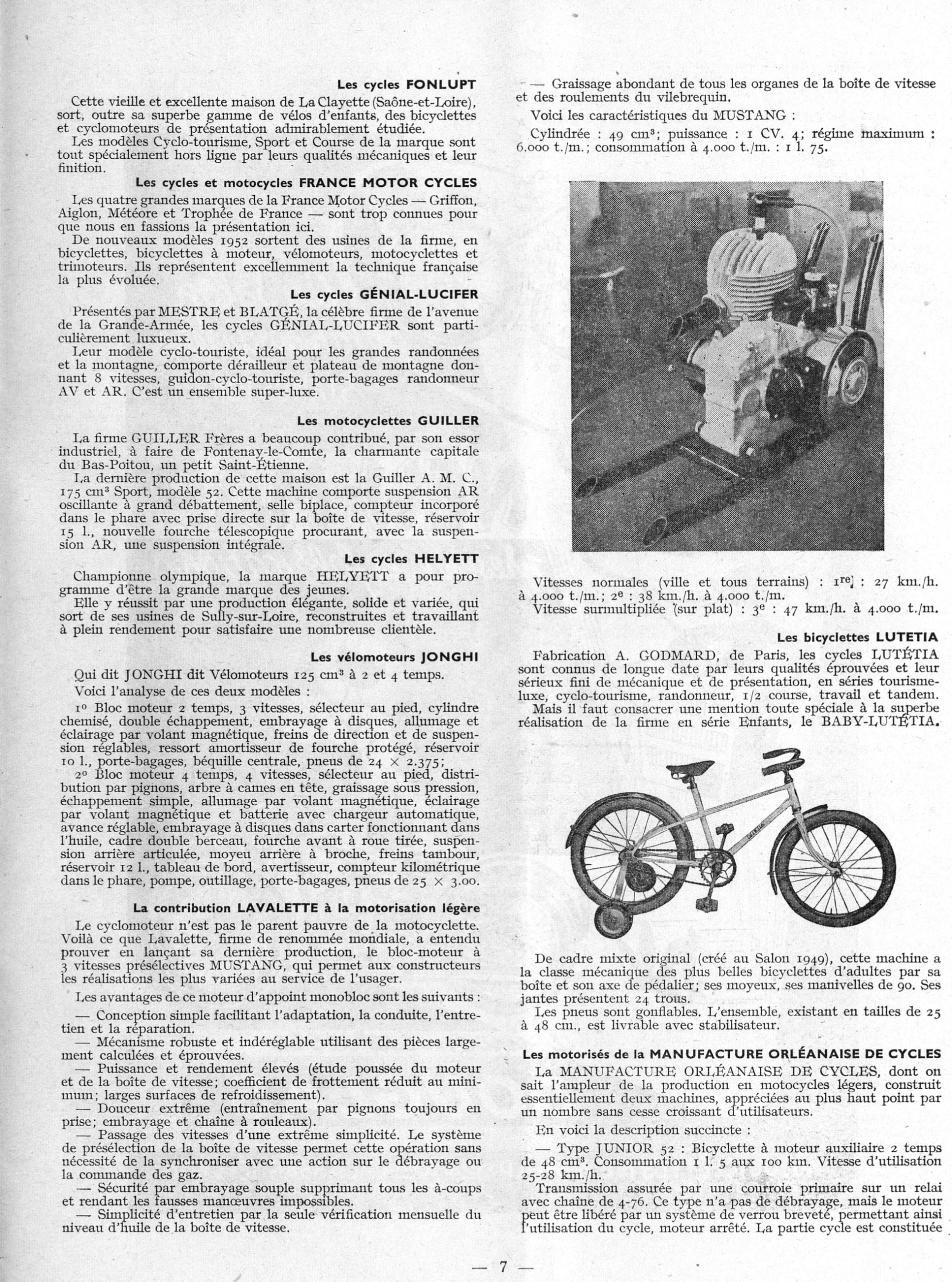
[Ebykr summary; the article’s text is not reproduced. Lavalette (auxiliary engines only), a firm of world renown, sets out to show that the cyclomoteur is not the poor relation of the motorcycle with its latest production, the MUSTANG engine unit with 3 preselective speeds, which lets makers build the most varied machines. The paper lists the advantages of this monobloc auxiliary engine:]
— Conception simple facilitant l’adaptation, la conduite, l’entretien et la réparation.
— Mécanisme robuste et indéréglable utilisant des pièces largement calculées et éprouvées.
— Puissance et rendement élevés (étude poussée du moteur et de la boîte de vitesse ; coefficient de frottement réduit au minimum ; larges surfaces de refroidissement).
— Douceur extrême (entraînement par pignons toujours en prise ; embrayage et chaîne à rouleaux).
— Passage des vitesses d’une extrême simplicité. Le système de présélection de la boîte de vitesse permet cette opération sans nécessité de la synchroniser avec une action sur le débrayage ou la commande des gaz.
— Sécurité par embrayage souple supprimant tous les à-coups et rendant les fausses manœuvres impossibles.
— Simplicité d’entretien par la seule vérification mensuelle du niveau d’huile de la boîte de vitesse.
— Graissage abondant de tous les organes de la boîte de vitesse et des roulements du vilebrequin.
Voici les caractéristiques du MUSTANG :
Cylindrée : 49 cm³ ; puissance : 1 CV. 4 ; régime maximum : 6.000 t./m. ; consommation à 4.000 t./m. : 1 l. 75.
Vitesses normales (ville et tous terrains) : 1re : 27 km./h. à 4.000 t./m. ; 2e : 38 km./h. à 4.000 t./m.
Vitesse surmultipliée (sur plat) : 3e : 47 km./h. à 4.000 t./m.
Les bicyclettes LUTETIA
[Ebykr summary; the article’s text is not reproduced. Made by A. GODMARD of Paris, the LUTÉTIA cycles (bicycles only) are long known for their proven qualities and their serious mechanical finish and presentation, in tourisme-luxe, cyclo-tourisme, randonneur, 1/2 course, travail and tandem series. The paper gives special mention to the firm’s children’s model, the BABY-LUTÉTIA: of an original mixte frame (created at the Salon of 1949), it is said to have the mechanical class of the finest adult bicycles in its bottom-bracket shell and axle, its hubs and its 90 cranks; its rims have 24 holes, its tires are pneumatic, and it comes in sizes from 25 to 48 cm. and can be delivered with a stabilizer.]
Les motorisés de la MANUFACTURE ORLÉANAISE DE CYCLES
[Ebykr summary; the article’s text is not reproduced. The MANUFACTURE ORLÉANAISE DE CYCLES (motor machines only), known for the scale of its light motor-machine production, builds essentially two machines, appreciated by a growing number of users. The first is the Type JUNIOR 52, a bicycle with a two-stroke auxiliary engine of 48 cm3, consumption 1 l. 5 per 100 km. and a working speed of 25-28 km./h.; transmission is by a primary belt to a relay with a 4-76 chain; it has no clutch, but the engine can be freed by a patented locking system so that the cycle can be ridden with the engine stopped. The description of its cycle part runs on to the following page.]
— 7 —
[A full page in two columns, text set in a roman with old-style figures and the firm headings in bold sans-serif ranged right, the folio “— 7 —” at the foot of the right column. The left column is text only. The right column carries two uncaptioned illustrations. The first is a square halftone photograph, in close view, of a small auxiliary engine standing on a dark ground: a finned cylinder with the spark plug and cable on top, a pale rounded crankcase and, behind it, part of a cycle frame and wheel; it sits with the Lavalette entry and its MUSTANG figures. The second is a retouched halftone of a child’s bicycle in right-side profile, cut out against the bare page: a sloping mixte frame lettered “LUTETIA” on the down tube, a sprung saddle, a raised curved handlebar, full mudguards, a chainwheel with a chain to the rear wheel and a small stabilizer wheel on an arm beside the rear wheel. No signature appears in the corners of either picture.]
— Page 4 —
[Ebykr summary; the article’s text is not reproduced. The Manufacture Orléanaise de Cycles entry from the previous page continues. The Junior 52’s cycle part is a cradle frame of reinforced 15/10 tubes, triangulated by two bi-conical longerons joined to the seat tube by a spacer and carried on to the rear as double stays, for very great rigidity; braking is by a rear drum hub and a front stirrup brake (reversed levers on the handlebar); throttle and decompressor are worked by twist grips and the air shutter by a handlebar lever; an aerodynamic fairing gives perfect cooling and protection from all splashing. The second machine is the TYPE V. M. 52 PARIS-NICE, a grand sport vélomoteur derived from the TOUR de FRANCE cyclomoteur but fitted with a SACHS 50 engine of 98 cm3, two-stroke, 3 CV. at 4.000 t./m., 2 speeds and a disc clutch, with a top speed of 80 km./h. Its cycle part is a cradle frame of 38, 20/10 tubes, assembled by braze-welding, with a large beam tank giving the frame very great rigidity; the engine is on silentbloc mountings; pedaling is synchronized with the engine drive so the rider can help it, through a 60-tooth chainwheel and a 3-speed derailleur with freewheel; the fork is a V. M. SANCHOC deformable parallelogram; braking is by two 120 mm. MAXI drum-brake hubs; the wheels take 650 × 50 balloon tires. The machine was designed for long rides, and its prototype won the 27e PARIS-NICE in 21 h. 15.]
Le cyclomoteur MÉTALLOPLAN
[Ebykr summary; the article’s text is not reproduced. The Établissements MÉTALLOPLAN of Saint-Étienne, known for nearly half a century for their R. A. R. cycles (the firm is a bicycle maker; here it shows a cyclomoteur), bring out this year a cyclomoteur with a normal frame, which the paper says makes it easy for women and the elderly. The lowered frame is widely open, the very low center of gravity gives perfect stability and a supple telescopic fork perfect road holding. The engine is a Poulain 49 cm3 with a flywheel magneto for lighting; the wheels carry the famous patented Duralumin cyclomoteur drum-brake hubs of Métalloplan make, and the rims are hollow Duralumin sections made for cyclomoteurs, for lightness. The single chain is enclosed by a large case that leaves the 3-speed derailleur accessible, and the handlebar has a twist grip and two reversed brake levers. The paper expects the machine a most favorable reception.]
Aux ateliers de la MOTOBÉCANE
[Ebykr summary; the article’s text is not reproduced. The statistics for the 1er semestre 1951 show Motobécane’s production effort (motor machines only in this entry) at nearly 76.000 machines in all, of which the celebrated MOBYLETTE accounts for 56.000 units. The paper puts this success down to the mechanical qualities and the solidity of this popular machine.]
Les vélomoteurs NARCISSE
[Ebykr summary; the article’s text is not reproduced. The paper recalls that its special Salon issue presented the NARCISSE vélomoteurs (motor machines only), which answer the definition « cyclomoteurs à grande puissance ».]
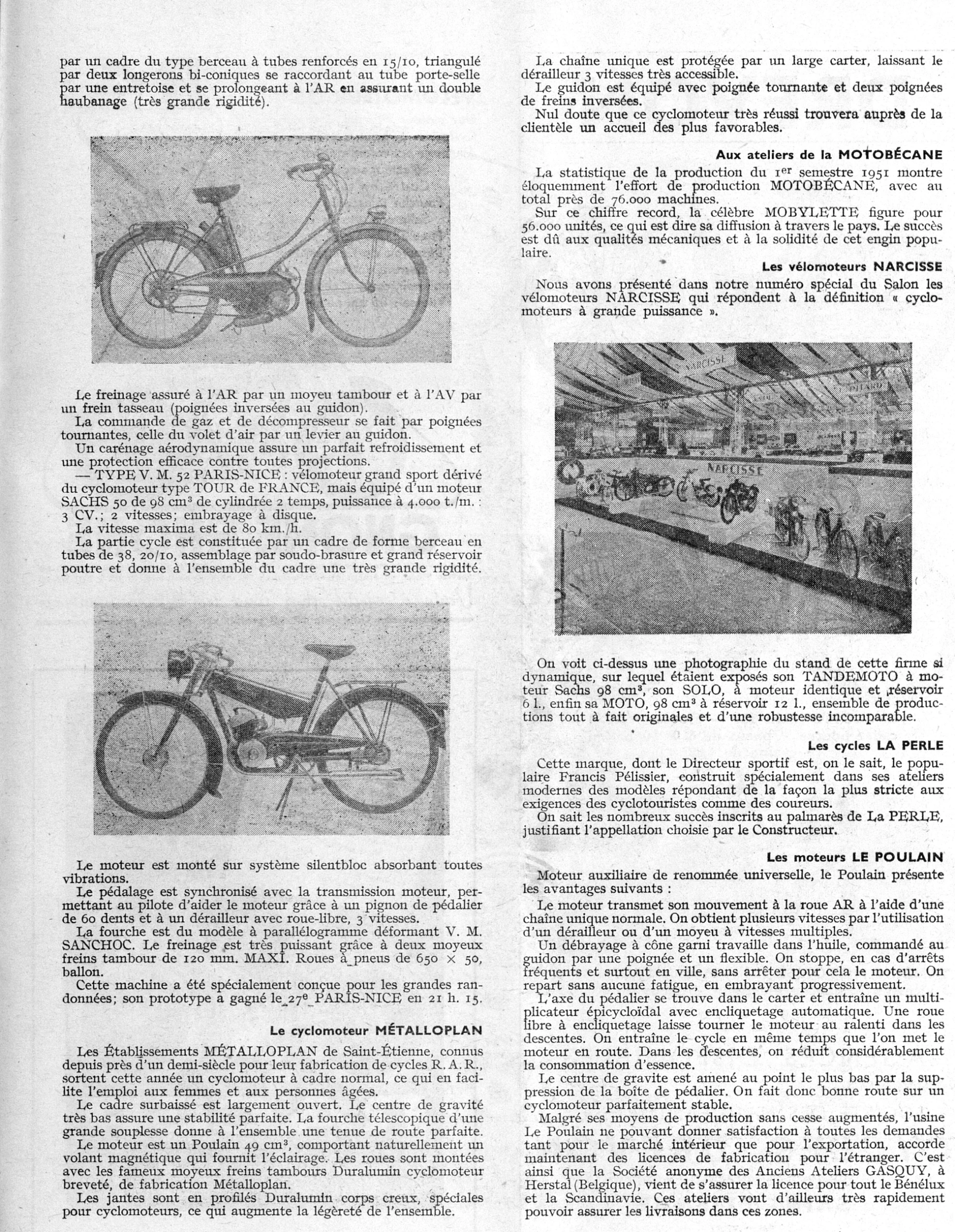
On voit ci-dessus une photographie du stand de cette firme si dynamique, sur lequel étaient exposés son TANDEMOTO à moteur Sachs 98 cm³, son SOLO, à moteur identique et réservoir 6 l., enfin sa MOTO, 98 cm³ à réservoir 12 l., ensemble de productions tout à fait originales et d’une robustesse incomparable.
Les cycles LA PERLE
[Ebykr summary; the article’s text is not reproduced. La Perle (bicycles only), whose Directeur sportif is the popular Francis Pélissier, builds in its modern workshops models meeting most strictly the demands of cyclotourists and racers alike. The paper says the many successes on La PERLE’s record justify the name the maker chose.]
Les moteurs LE POULAIN
[Ebykr summary; the article’s text is not reproduced. Le Poulain (auxiliary engines only), an auxiliary engine of universal renown, drives the rear wheel by a normal single chain, so that several speeds can be had from a derailleur or a multi-speed hub. A lined cone clutch runs in oil and is worked from the handlebar by a lever and cable, so the rider can stop often, in town above all, without stopping the engine and move off again without effort. The bottom-bracket axle lies in the crankcase and drives an epicyclic step-up gear with automatic ratchet; a ratchet freewheel lets the engine idle downhill, the cycle is set moving as the engine is started and fuel use falls greatly on descents. Doing away with the bottom-bracket shell brings the center of gravity to its lowest, for a perfectly stable cyclomoteur. Unable, despite growing means, to meet all home and export demand, Le Poulain now grants manufacturing licenses abroad: the Société anonyme des Anciens Ateliers GASQUY, at Herstal (Belgique), has just taken the license for all Bénélux and Scandinavia and will soon deliver in those areas.]
[A full page in two columns, text set in a roman with old-style figures and the firm headings in bold sans-serif ranged right; no folio shows. Three uncaptioned square halftone photographs stand in the text. In the left column, the first shows a cyclomoteur in right-side profile against a plain wall: a step-through frame with an engine fairing behind the seat tube, a sprung saddle, a curved handlebar, full mudguards and a front lamp. The second, below it, shows a vélomoteur in left profile: a cradle frame with a long beam tank under the top of the frame, an engine low in the frame behind an enclosed chain case, a headlamp at the bars, a sprung saddle, a rear carrier and deep mudguards. In the right column the third shows the Narcisse stand at the Salon under a draped striped canopy whose frieze is lettered “NARCISSE”, with “NARCISSE” again on the front of a low platform carrying motorized bicycles and a tandem, and visitors standing at the right. No signature appears in the corners of any photograph.]
— Page 5 —
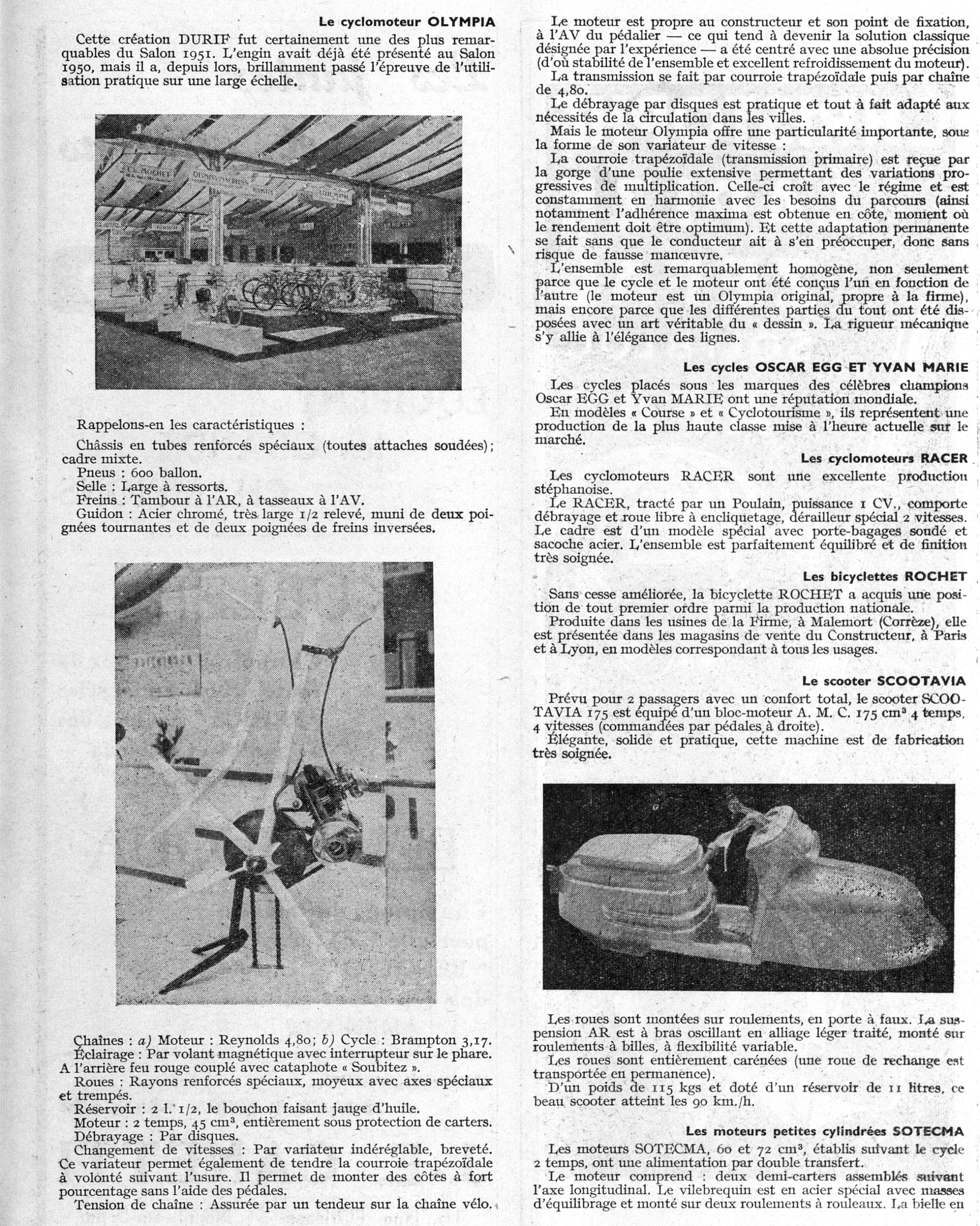
Le cyclomoteur OLYMPIA
[Ebykr summary; the article’s text is not reproduced. This DURIF creation (a cyclomoteur, motor machine only) is called certainly one of the most remarkable of the Salon 1951; it had already been shown at the Salon 1950 and has since passed the test of practical use on a wide scale. The paper then recalls its characteristics:]
Châssis en tubes renforcés spéciaux (toutes attaches soudées) ; cadre mixte.
Pneus : 600 ballon.
Selle : Large à ressorts.
Freins : Tambour à l’AR, à tasseaux à l’AV.
Guidon : Acier chromé, très large 1/2 relevé, muni de deux poignées tournantes et de deux poignées de freins inversées.
Chaînes : a) Moteur : Reynolds 4,80 ; b) Cycle : Brampton 3,17.
Éclairage : Par volant magnétique avec interrupteur sur le phare. A l’arrière feu rouge couplé avec cataphote « Soubitez ».
Roues : Rayons renforcés spéciaux, moyeux avec axes spéciaux et trempés.
Réservoir : 2 l. 1/2, le bouchon faisant jauge d’huile.
Moteur : 2 temps, 45 cm³, entièrement sous protection de carters.
Débrayage : Par disques.
Changement de vitesses : Par variateur indéréglable, breveté. Ce variateur permet également de tendre la courroie trapézoïdale à volonté suivant l’usure. Il permet de monter des côtes à fort pourcentage sans l’aide des pédales.
Tension de chaîne : Assurée par un tendeur sur la chaîne vélo.
[Ebykr summary, continued at the head of the right column. The engine is the maker’s own, mounted ahead of the bottom bracket, which the paper says is becoming the classic solution, and centered with absolute precision for stability and good cooling. Transmission is by V-belt and then by a 4,80 chain; the disc clutch suits town traffic. The Olympia engine’s important feature is its speed variator: the V-belt (primary drive) runs in the groove of an expanding pulley that varies the gearing progressively, rising with engine speed and always matched to the road, giving the greatest grip on climbs where output must be best, with no attention from the rider and so no risk of a wrong move. The paper calls the whole remarkably homogeneous, cycle and engine (an original Olympia, the firm’s own) designed for each other and laid out with a true art of « dessin », mechanical rigor joined to elegance of line.]
Les cycles OSCAR EGG ET YVAN MARIE
[Ebykr summary; the article’s text is not reproduced. The cycles sold under the names of the celebrated champions Oscar EGG and Yvan MARIE (bicycles only) are said to have a world reputation; in « Course » and « Cyclotourisme » models they represent a production of the highest class now on the market.]
Les cyclomoteurs RACER
[Ebykr summary; the article’s text is not reproduced. The RACER cyclomoteurs (motor machines only) are called an excellent Saint-Étienne production. The RACER, driven by a Poulain of 1 CV., has a clutch and ratchet freewheel and a special 2-speed derailleur; the frame is of a special pattern with a welded carrier and a steel bag, and the whole is called perfectly balanced and very carefully finished.]
Les bicyclettes ROCHET
[Ebykr summary; the article’s text is not reproduced. Constantly improved, the ROCHET bicycle (bicycles only) is said to have won a position of the very first rank in the national production. Made in the firm’s works at Malemort (Corrèze), it is shown in the maker’s own sales shops in Paris and Lyon, in models for every use.]
Le scooter SCOOTAVIA
[Ebykr summary; the article’s text is not reproduced. Built for 2 passengers in full comfort, the SCOOTAVIA 175 scooter (motor machines only) has an A. M. C. 175 cm3 four-stroke engine unit with 4 speeds worked by pedals on the right, and is called elegant, solid, practical and very carefully made. Its wheels run on bearings, cantilevered; the rear suspension is a swinging arm in treated light alloy on ball bearings, of variable flexibility; the wheels are fully faired, and a spare wheel is carried at all times. Weighing 115 kgs, with an 11-liter tank, it reaches 90 km./h.]
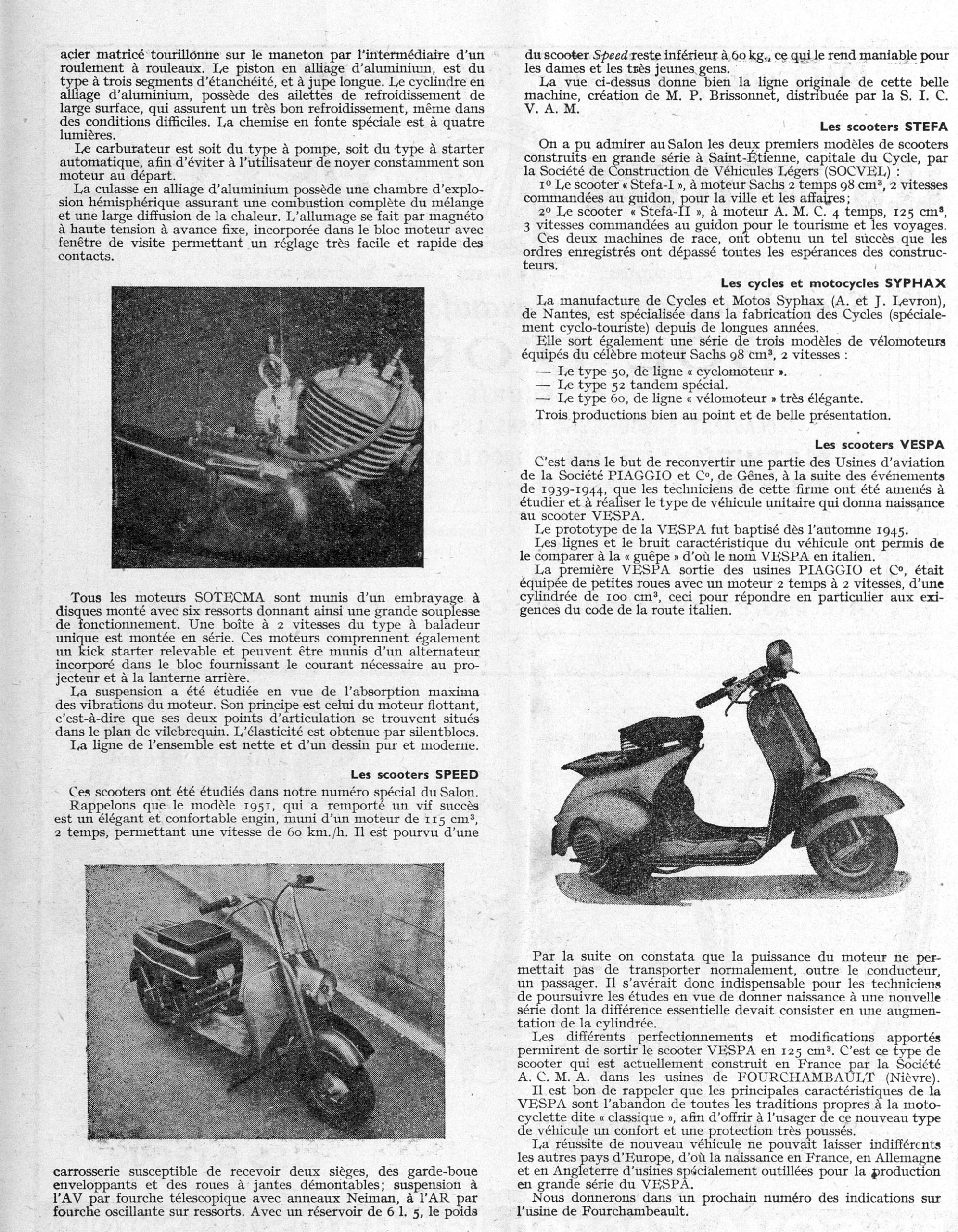
Les moteurs petites cylindrées SOTECMA
[Ebykr summary; the article’s text is not reproduced. The SOTECMA engines (engines only) of 60 and 72 cm3 are two-strokes with double-transfer induction. The engine has two half-crankcases joined on the longitudinal axis and a special-steel crankshaft with balance weights on two roller bearings; the description of the connecting rod runs on to the following page.]
[A full page in two columns, text set in a roman with old-style figures and the firm headings in bold sans-serif ranged right; no folio shows. The left column carries two uncaptioned square halftone photographs. The first shows a Salon stand under a draped striped canopy hung with signboards whose lettering is mostly too small to read, one apparently reading “ROCHET” and another beginning “OLYMPIA”, with bicycles and cyclomoteurs ranged on low platforms. The second is a close view, from above and in front, of a cyclomoteur’s handlebar, frame and cranks against a pale wall, with a lettered panel too blurred to read in the background. The right column carries one square halftone photograph of a scooter in three-quarter view against a dark ground: a fully enclosed body with a pale rounded rear, a padded two-place saddle and a raised handlebar with a curved leg shield. No signature appears in the corners of any photograph.]
— Page 6 —
[Ebykr summary; the article’s text is not reproduced. The SOTECMA engine entry from the previous page continues. The die-forged steel connecting rod runs on the crankpin on a roller bearing; the aluminum-alloy piston has three rings and a long skirt; the aluminum-alloy cylinder has broad cooling fins for very good cooling even in hard conditions, with a special cast-iron liner with four ports. The carburetor is either of the pump type or of the automatic-starter type, so the rider need not flood the engine to start. The aluminum-alloy head has a hemispherical combustion chamber for complete combustion and wide heat spread. Ignition is by a fixed-advance high-tension magneto built into the engine unit, with an inspection window for quick, easy adjustment of the points. All SOTECMA engines have a disc clutch with six springs for smooth working and a 2-speed gearbox of the single sliding-gear type as standard, a folding kick starter and, as an option, an alternator in the unit feeding the headlamp and rear lamp. The suspension is designed for the greatest absorption of engine vibration on the floating-engine principle, its two pivot points lying in the plane of the crankshaft, with silentblocs for elasticity. The paper calls the whole clean in line and of pure, modern design.]
Les scooters SPEED
[Ebykr summary; the article’s text is not reproduced. The paper recalls that its special Salon issue studied these scooters (motor machines only). The 1951 model, a lively success, is called an elegant and comfortable machine with a 115 cm3 two-stroke engine giving 60 km./h.; it has bodywork able to take two seats, enclosing mudguards and wheels with detachable rims, a telescopic front fork with Neiman rings and a sprung swinging rear fork. With a 6 l. 5 tank the Speed (“Speed”, in italic) weighs under 60 kg., which the paper says makes it easy to handle for ladies and very young people. The view shows the original line of this machine, a creation of M. P. Brissonnet, distributed by the S. I. C. V. A. M.]
Les scooters STEFA
[Ebykr summary; the article’s text is not reproduced. The Salon showed the first two scooter models (motor machines only) built in large series at Saint-Étienne, « capitale du Cycle », by the Société de Construction de Véhicules Légers (SOCVEL):]
1° Le scooter « Stefa-I », à moteur Sachs 2 temps 98 cm³, 2 vitesses commandées au guidon, pour la ville et les affaires ;
2° Le scooter « Stefa-II », à moteur A. M. C. 4 temps, 125 cm³, 3 vitesses commandées au guidon pour le tourisme et les voyages.
[Ebykr summary, continued. The paper says these two thoroughbred machines won such success that the orders taken passed all the makers’ hopes.]
Les cycles et motocycles SYPHAX
[Ebykr summary; the article’s text is not reproduced. The manufacture de Cycles et Motos Syphax (A. et J. Levron) of Nantes (bicycles and motor machines) has specialized for many years in making cycles, especially cyclo-touriste machines. It also brings out a series of three vélomoteurs with the celebrated Sachs 98 cm3 two-speed engine:]
— Le type 50, de ligne « cyclomoteur ».
— Le type 52 tandem spécial.
— Le type 60, de ligne « vélomoteur » très élégante.
[Ebykr summary, continued. The paper calls them three well-developed productions of fine presentation.]
Les scooters VESPA
[Ebykr summary; the article’s text is not reproduced. The VESPA scooter (motor machines only) was born when the technicians of the Société PIAGGIO et C° of Genoa (Gênes), seeking after the events of 1939-1944 to reconvert part of the firm’s aviation works, studied and built a unitary vehicle; the prototype was named in the autumn of 1945, and its lines and characteristic noise led to its comparison with a « guêpe », hence VESPA in Italian. The first VESPA from the PIAGGIO works had small wheels and a two-stroke two-speed engine of 100 cm3, chosen to meet the Italian highway code. Since that engine could not properly carry a passenger besides the rider, a new series with a larger engine was developed, and the VESPA came out in 125 cm3; that type is now built in France by the Société A. C. M. A. in its works at FOURCHAMBAULT (Nièvre). The paper notes the VESPA abandons every tradition of the « classique » motorcycle to give its rider very advanced comfort and protection, and that its success led to works equipped for its large-scale production in France, Germany and England. It promises details of the Fourchambeault works (so spelled) in a coming issue.]
[A full page in two columns, text set in a roman with old-style figures and the firm headings in bold sans-serif ranged right; no folio shows. The left column carries two uncaptioned square halftone photographs: the first a dark close view of a small two-stroke engine with a deeply finned cylinder and its control cables, with the SOTECMA entry; the second a Speed scooter seen from above in three-quarter view on a pale floor, with a squared rear body, a padded saddle, a tall front shield and a raised handlebar. The right column carries a large halftone of a Vespa scooter in left-side profile, cut out against the bare page above a dark shadow: the curved leg shield, the handlebar with headlamp on top, a sprung saddle, the swelling side cowls over the rear wheel and small disc wheels. No signature appears in the corners of any photograph.]
Ebykr presents this material for research and education. If you hold rights to it or notice an ownership issue, please contact us and we will respond promptly.
The Ebykr Digest
New articles, timelines, catalog finds and registry activity — assembled from the archive once a month. Your address is never shared.
Double opt-in. One email per month. Unsubscribe at any time with one click.