About Ebykr
Ebykr celebrates classic and vintage lightweight bicycles through provocative imagery and opinion. Ride along with us.
About Ebykr
Ebykr celebrates classic and vintage lightweight bicycles through provocative imagery and opinion. Ride along with us.

Source: Gallica (Bibliothèque nationale de France), L'Officiel du cycle, du motocycle et du camping, 30 June 1951, page 9; ark:/12148/bd6t54206308g. Source gallica.bnf.fr / BnF.
| Type | Review |
|---|---|
| Year | 1951 |
| Publisher | L'Officiel du cycle |
| Country | France |
| Language | French |
| Pages | 1 |
| Source | Gallica (Bibliothèque nationale de France), L'Officiel du cycle, du motocycle et du camping, 30 June 1951, page 9; ark:/12148/bd6t54206308g. Source gallica.bnf.fr / BnF. |
| Credit | Ebykr archive; Bibliothèque nationale de France |
| Identifier | Gallica (BnF) ark:/12148/bd6t54206308g/f9 |
| Transcription | Headings and specifications transcribed; article text summarized |
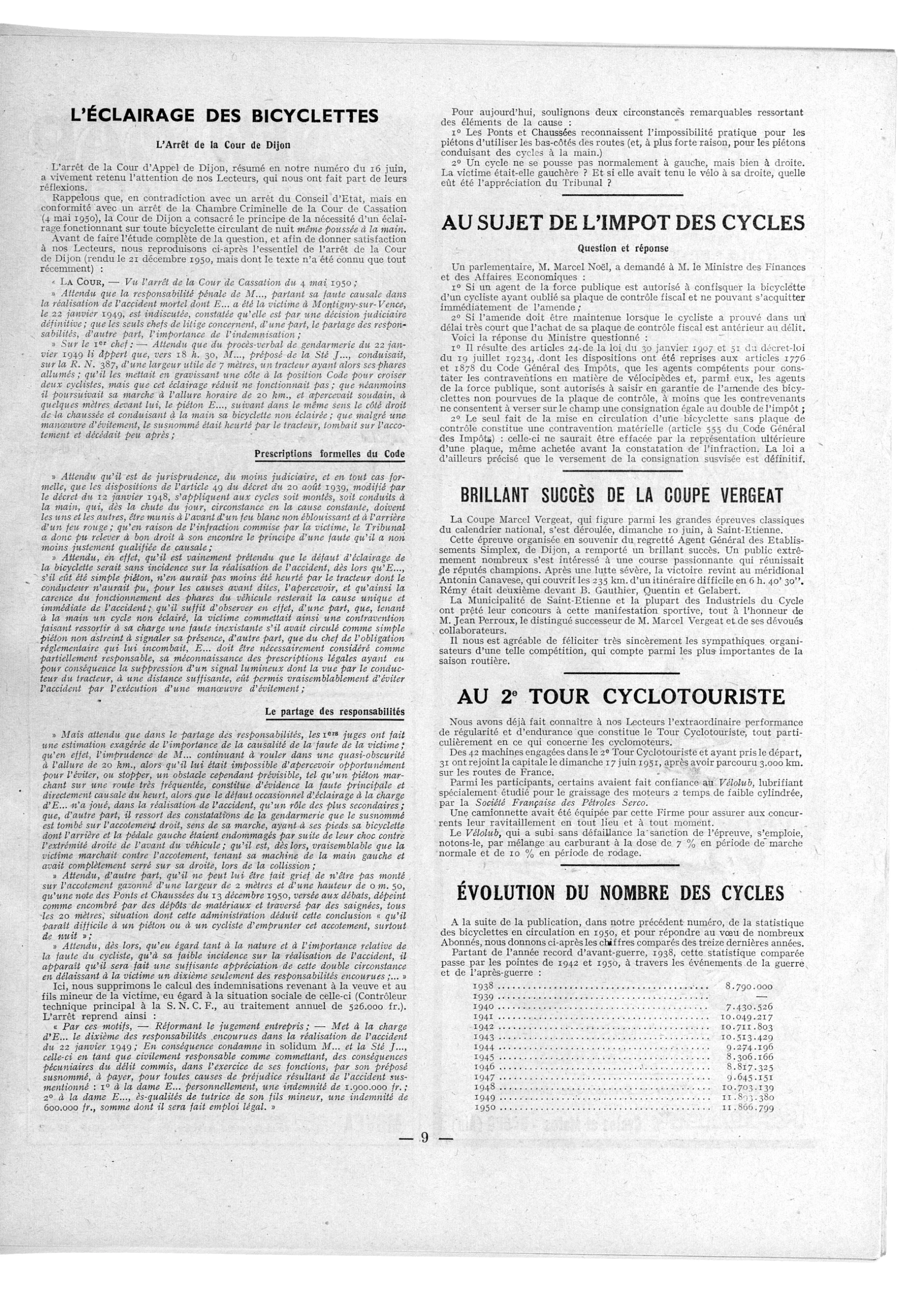
L’ÉCLAIRAGE DES BICYCLETTES L’Arrêt de la Cour de Dijon Prescriptions formelles du Code Le partage des responsabilités AU SUJET DE L’IMPOT DES CYCLES Question et réponse BRILLANT SUCCÈS DE LA COUPE VERGEAT AU 2e TOUR CYCLOTOURISTE ÉVOLUTION DU NOMBRE DES CYCLES 1938 — 8.790.000 1939 — — 1940 — 7.430.526 1941 — 10.049.217 1942 — …
This is a magazine article, so its running text is summarized here rather than reproduced; the headline, byline, specifications and scores are transcribed as printed.
From L’Officiel du cycle, 30 June 1951, page 9: five pieces: the Dijon appeal ruling on the lighting of bicycles, a ministerial answer on the cycle tax, the Coupe Vergeat at Saint-Étienne, the 2nd Tour Cyclotouriste and the table of the number of cycles in circulation. The title, headings, captions and lists are transcribed as printed; the text is summarized in Ebykr’s words, and the page images carry it in full. It belongs to the trade columns that the weekly addressed to the French cycle dealers, the vélocistes.
— Page 1 —
L’ÉCLAIRAGE DES BICYCLETTES
L’Arrêt de la Cour de Dijon
[Ebykr summary; the article’s text is not reproduced. The paper says the ruling of the Cour d’Appel de Dijon, summarized in its issue of 16 June, drew keen interest and comments from readers. It recalls that, against a ruling of the Conseil d’Etat but in line with a ruling of the Criminal Chamber of the Cour de Cassation (4 May 1950), the Dijon court upheld the principle that every bicycle used at night needs a working light, even when pushed by hand. Before a full study it reproduces the essentials of the Dijon ruling, delivered on 21 December 1950 but known only recently, as a quotation in italic.]
[Ebykr summary of the quoted ruling, first part. The court recites the fatal accident of 22 January 1949 at Montigny-sur-Vence, in which a man (named only as E…) died; the driver’s criminal fault (M…, employee of a company, Sté J…) was already settled, and only the sharing of responsibility and the amount of damages remained in dispute. According to the gendarmerie report, at about 6:30 p.m. M… was driving a tractor up a hill on national road 387, which is 7 meters wide, at about 20 km/h; its headlights were lit and he dipped them to pass two cyclists, but the dipped lamp did not work. He suddenly saw, a few meters ahead, the pedestrian walking along the right side of the road in the same direction, pushing an unlit bicycle. Despite an avoiding maneuver the man was struck by the tractor, fell onto the verge and died soon after.]
Prescriptions formelles du Code
[Ebykr summary of the quoted ruling, second part. The court holds that article 49 of the decree of 20 August 1939, as amended by the decree of 12 January 1948, applies to cycles ridden or pushed by hand, which after nightfall must carry a non-dazzling white light at the front and a red light at the rear, so the victim’s breach was rightly treated as a causal fault. It rejects the argument that the missing light made no difference because a mere pedestrian would have been hit as well: a pedestrian pushing no cycle commits no offense, and by ignoring the rule the victim removed a light signal that would probably have let the tractor driver see him in time to avoid the accident, so he must be held partly responsible.]
Le partage des responsabilités
[Ebykr summary of the quoted ruling, third part. The court finds that the first judges overstated the victim’s share of the blame. The tractor driver’s imprudence in going on at 20 km/h in near darkness, when he could not see in time an obstacle as foreseeable as a pedestrian on a busy road, is the main and direct cause of the collision, while the victim’s occasional lack of a light played a most secondary part. From the gendarmerie findings the court infers that the victim was walking against the verge, holding his machine with his left hand and keeping close to his right when struck. It adds that he cannot be blamed for not walking on the verge, 2 meters wide and 0.50 meter high, which a note of the Ponts et Chaussées dated 13 December 1950 describes as cluttered with stored materials and cut by drainage channels every 20 meters, and so hard to use for a pedestrian or cyclist, especially at night. It therefore fixes the victim’s share at one tenth of the responsibility.]
[Ebykr summary, after the quotation. The paper says it omits the calculation of the compensation due to the victim’s widow and minor son, given his position as principal technical controller at the S.N.C.F. on an annual salary of 526,000 francs. The operative part of the ruling reverses the first judgment, puts one tenth of the responsibility on E…, and jointly orders M… and the company, as his civil employer, to pay the widow 1,900,000 francs personally and 600,000 francs as guardian of her minor son.]
[Ebykr summary, second column. For today the paper points out two remarkable circumstances in the case. First, the Ponts et Chaussées acknowledge that it is practically impossible for pedestrians, and still more for pedestrians pushing cycles, to use the road verges. Second, a cycle is normally pushed on the right and not the left, and the paper asks whether the victim was left-handed and what the court would have decided had he held the bicycle on his right.]
AU SUJET DE L’IMPOT DES CYCLES
Question et réponse
[Ebykr summary; the article’s text is not reproduced. A member of Parliament, M. Marcel Noël, asked the Minister of Finance and Economic Affairs two questions: whether a police officer may confiscate the bicycle of a cyclist who has forgotten his tax control plate and cannot pay the fine on the spot, and whether the fine must stand when the cyclist proves within a very short time that he bought the plate before the offense. The Minister answered, first, that under article 24 of the law of 30 January 1907 and article 51 of the decree-law of 19 July (the year is printed 19234), whose terms are now articles 1776 and 1878 of the Code Général des Impôts, officers of the public force may seize bicycles without a control plate as security for the fine unless the offender at once deposits a sum equal to double the tax. Second, riding a bicycle without a plate is in itself a material offense (article 555 of the Code Général des Impôts) which a plate produced later, even one bought before the offense was recorded, cannot erase, and the law makes the deposit final.]
BRILLANT SUCCÈS DE LA COUPE VERGEAT
[Ebykr summary; the article’s text is not reproduced. The Coupe Marcel Vergeat, one of the major classics of the national calendar, was run on Sunday 10 June at Saint-Etienne in memory of the late general agent of the Simplex firm at Dijon. A very large crowd watched a hard race among renowned champions, won by the southerner Antonin Canavese over the 235 km course in 6 h 40′ 30″. Rémy was second ahead of B. Gauthier, Quentin and Gelabert. The city council and most cycle manufacturers supported the event, in honor of M. Jean Perroux, successor to Marcel Vergeat, and his helpers, whom the paper congratulates.]
AU 2e TOUR CYCLOTOURISTE
[Ebykr summary; the article’s text is not reproduced. The paper recalls the feat of regularity and endurance that the Tour Cyclotouriste represents, especially for the moped class. Of the 42 machines that started the second Tour, 31 reached the capital on Sunday 17 June 1951 after covering 3,000 km on the roads of France. Some competitors used Vélolub, a lubricant made for small two-stroke engines by the Société Française des Pétroles Serco, which had equipped a small truck to supply the riders anywhere at any time. Vélolub, which came through the test without failure, is mixed with the fuel at 7 % in normal running and 10 % during running-in.]
ÉVOLUTION DU NOMBRE DES CYCLES
[Ebykr summary; the article’s text is not reproduced. Following the publication in the previous issue of the statistic of bicycles in circulation in 1950, and at the request of many subscribers, the paper gives the figures for the last thirteen years, starting from the prewar record year 1938 and passing through the peaks of 1942 and 1950, as follows.]
1938 — 8.790.000
1939 — —
1940 — 7.430.526
1941 — 10.049.217
1942 — 10.711.803
1943 — 10.513.429
1944 — 9.274.196
1945 — 8.306.166
1946 — 8.817.325
1947 — 9.645.151
1948 — 10.703.139
1949 — 11.8[illisible]3.380
1950 — 11.866.799
— 9 —
[A full text page printed in black on a buff stock, with no illustration. The page is set in a wide left column and a narrower right column, with each item opened by a heavy sans-serif or condensed capital title and separated from the next by a short thick rule. The left column carries the first article under the title “L’ÉCLAIRAGE DES BICYCLETTES”, a bold subheading, a few roman paragraphs and then a long block of italic roman text in quotation, broken by two bold subheadings set to the right and underlined with a rule. The right column holds four items in roman text with their capital titles and, in the first, a bold subheading, a ruled-off item on a race, an item on a touring event and a final item that closes with a table of thirteen years, the years at the left joined by dot leaders to the figures at the right, the 1939 line holding a dash. The page number stands at the foot between dashes. Faint ghosts of the reverse page show through in places. No signature or monogram is present.]
Ebykr presents this material for research and education. If you hold rights to it or notice an ownership issue, please contact us and we will respond promptly.
The Ebykr Digest
New articles, timelines, catalog finds and registry activity — assembled from the archive once a month. Your address is never shared.
Double opt-in. One email per month. Unsubscribe at any time with one click.