About Ebykr
Ebykr celebrates classic and vintage lightweight bicycles through provocative imagery and opinion. Ride along with us.
About Ebykr
Ebykr celebrates classic and vintage lightweight bicycles through provocative imagery and opinion. Ride along with us.

Source: Gallica (Bibliothèque nationale de France), L'Officiel du cycle, du motocycle et du camping, 16 June 1951, N° 17, page 5; ark:/12148/bd6t541855453. Source gallica.bnf.fr / BnF.
| Type | Review |
|---|---|
| Year | 1951 |
| Publisher | L'Officiel du cycle |
| Country | France |
| Language | French |
| Pages | 3 |
| Source | Gallica (Bibliothèque nationale de France), L'Officiel du cycle, du motocycle et du camping, 16 June 1951, N° 17, page 5; ark:/12148/bd6t541855453. Source gallica.bnf.fr / BnF. |
| Credit | Ebykr archive; Bibliothèque nationale de France |
| Identifier | Gallica (BnF) ark:/12148/bd6t541855453/f5 |
| Transcription | Headings and specifications transcribed; article text summarized |
Reference
"Quoi de neuf dans la Bicyclette ?" L'Officiel du cycle, 16 June 1951. Ebykr, https://ebykr.com/library/lofficiel-du-cycle-1951-06-16-quoi-de-neuf-dans-la-bicyclette-ducoudray/.
Wikipedia
{{cite magazine |title=Quoi de neuf dans la Bicyclette ? |magazine=L'Officiel du cycle |date=16 June 1951 |language=French |url=https://ebykr.com/library/lofficiel-du-cycle-1951-06-16-quoi-de-neuf-dans-la-bicyclette-ducoudray/ |via=Ebykr |access-date=}}La Bicyclette QUOI DE NEUF DANS LA BICYCLETTE ? Après trois manifestations A LA POLYMULTIPLIEE A LA FOIRE DE PARIS AU CONCOURS LEPINE R. DUCOUDRAY.
This is a magazine article, so its running text is summarized here rather than reproduced; the headline, byline, specifications and scores are transcribed as printed.
From L’Officiel du cycle, du motocycle et du camping, 16 June 1951, N° 17, page 5: editorial “Quoi de neuf dans la Bicyclette ? Après trois manifestations” by R. Ducoudray: new bicycle ideas seen at the Polymultipliée, the Foire de Paris and the Concours Lépine (Cycloutil, Soupless fork, Vélo-Réaction, a Cattini semi-reactor and others). The title, headings, captions and lists are transcribed as printed; the text is summarized in Ebykr’s words, and the page images carry it in full.
— Page 1 —
La Bicyclette
QUOI DE NEUF DANS LA BICYCLETTE ?
Après trois manifestations
[The head of an editorial, with no body text on this strip. A section masthead reads “La Bicyclette” in a large flourished script, heavy black, with a line drawing of a bicycle worked into the lettering: its two wheels sit inside the letters “c” and “y” and the frame and fork run across the middle of the word. Three thin ruled lines run beneath the masthead from the “La” to the end of the word. Below it, the title “QUOI DE NEUF DANS LA BICYCLETTE ?” is set in bold roman capitals across the full width, with the subtitle “Après trois manifestations” in bold italic lower case beneath it, offset to the left of center. There is no signature or firm name on this strip.]
— Page 2 —
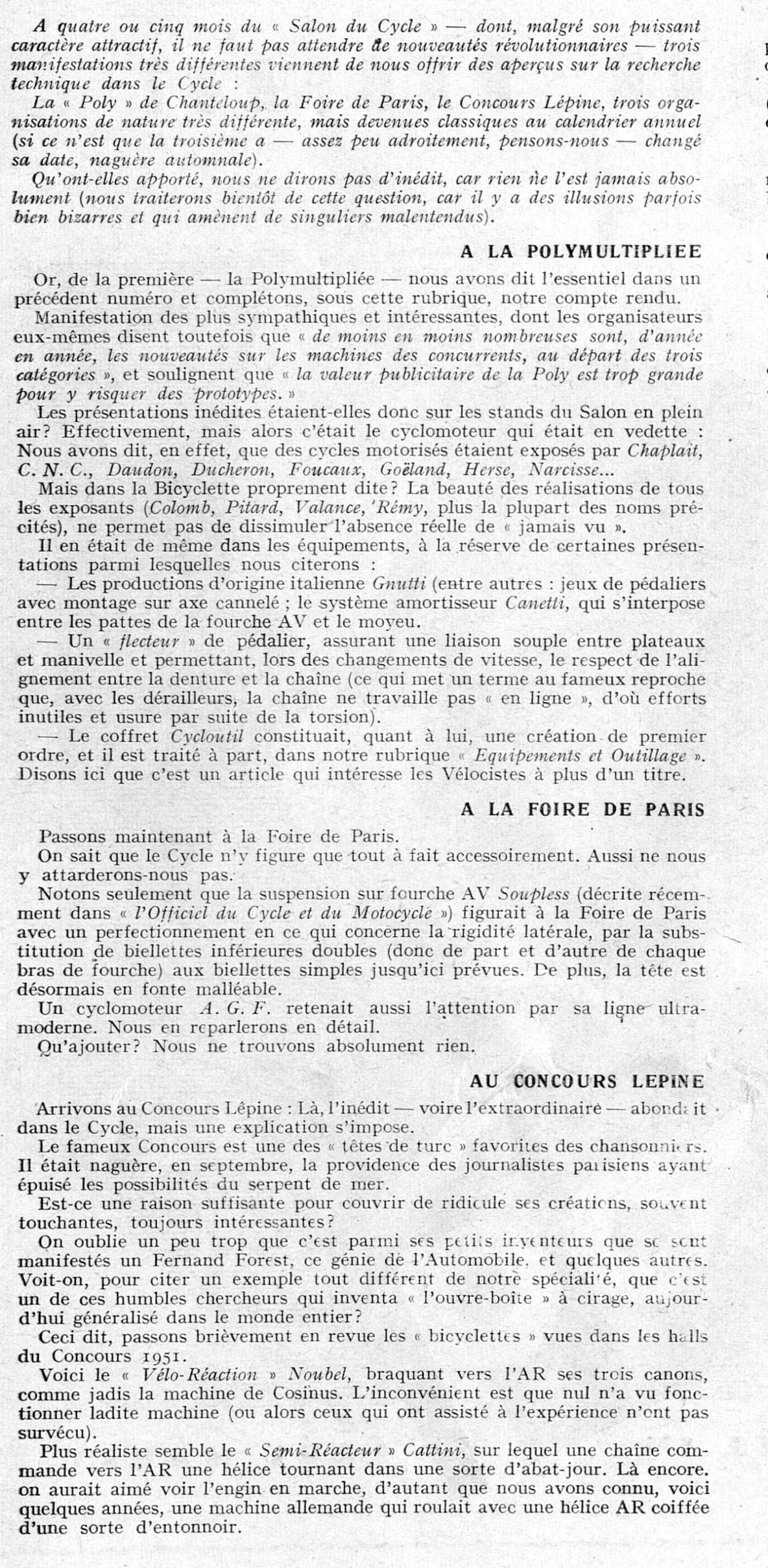
[Ebykr summary; the article’s text is not reproduced. The author opens by noting that the “Salon du Cycle” is four or five months away and that, despite its great pull, no revolutionary novelties should be expected from it. Three very different events have just given a view of technical research in the cycle trade: the “Poly” at Chanteloup, the Foire de Paris and the Concours Lépine, all now classics of the yearly calendar, although the third has changed its date, formerly in autumn, rather clumsily in his view. What they brought was not truly new, since nothing ever is absolutely, and he promises to return soon to the illusions and misunderstandings this causes.]
A LA POLYMULTIPLIEE
[Ebykr summary, first section. The Polymultipliée was covered in an earlier issue, and this report completes it. The organizers themselves say that novelties on the competitors’ machines are fewer from year to year in the three starting categories and that the “Poly” has too much publicity value to risk prototypes on. Novelties at the open-air show were mostly motorized cycles, shown by Chaplait, C. N. C., Daudon, Ducheron, Foucaux, Goëland, Herse and Narcisse. In the bicycle proper, the fine work of all the exhibitors (Colomb, Pitard, Valance, Rémy and most of those already named) cannot hide the real absence of anything never seen. The same held for equipment, with some exceptions, which he lists: Italian products by Gnutti (among others pedal sets mounted on a splined axle, and the Canetti shock-absorbing system fitted between the front fork ends and the hub); a pedal “flecteur” giving a flexible link between chainrings and crank so that the chain and teeth stay aligned when changing gear, which answers the complaint that with derailleurs the chain does not run “in line” and suffers needless effort and wear from twisting; and the Cycloutil case, called a first-rate creation and treated separately under the paper’s “Equipements et Outillage” heading as an article that interests bicycle dealers in more than one way.]
A LA FOIRE DE PARIS
[Ebykr summary, second section. The cycle appears at the Foire de Paris only incidentally, so the author does not linger. He notes only that the Soupless front fork suspension, described recently in the paper, was shown with an improvement in lateral rigidity: double lower links on each fork blade replace the single links used before, and the head is now of malleable cast iron. A moped marked A.G.F. also drew attention by its ultra-modern lines, and the paper will return to it in detail. He finds nothing else to add.]
AU CONCOURS LEPINE
[Ebykr summary, third section. Here novelty, even the extraordinary, abounded in the cycle field, but an explanation is due: the Concours is a favorite target of songwriters and was once, in September, the providence of Paris journalists who had run out of sea-serpent stories. He argues that its often touching and always interesting creations should not be ridiculed, because its small inventors have included Fernand Forest, the genius of the automobile, and, as an example far from the cycle trade, one of those humble seekers who invented the wax-sealed can opener now used worldwide. He then reviews briefly the “bicycles” in the 1951 halls. The “Vélo-Réaction” by Noubel points three cannons toward the rear, like the old machine of Cosinus; the drawback, he says, is that nobody has seen it work, or else those who watched the test did not survive. More realistic seems the “Semi-Réacteur” by Cattini, in which a chain drives a rear propeller turning inside a kind of louvered shade; again he would have liked to see it running, all the more since he knew a German machine some years ago with a rear propeller topped by a funnel-like hood.]
[A continuation of an editorial, text only, set in a single wide column. The body type is a light roman face with the quoted passages, product names and some phrases in italic, indented paragraphs and hyphenated line ends. Three short subheadings in bold spaced capitals stand flush right: “A LA POLYMULTIPLIEE”, “A LA FOIRE DE PARIS” and “AU CONCOURS LEPINE”. The opening paragraphs at the top are set wholly in italic. There is no illustration, signature or firm address on this part.]
— Page 3 —
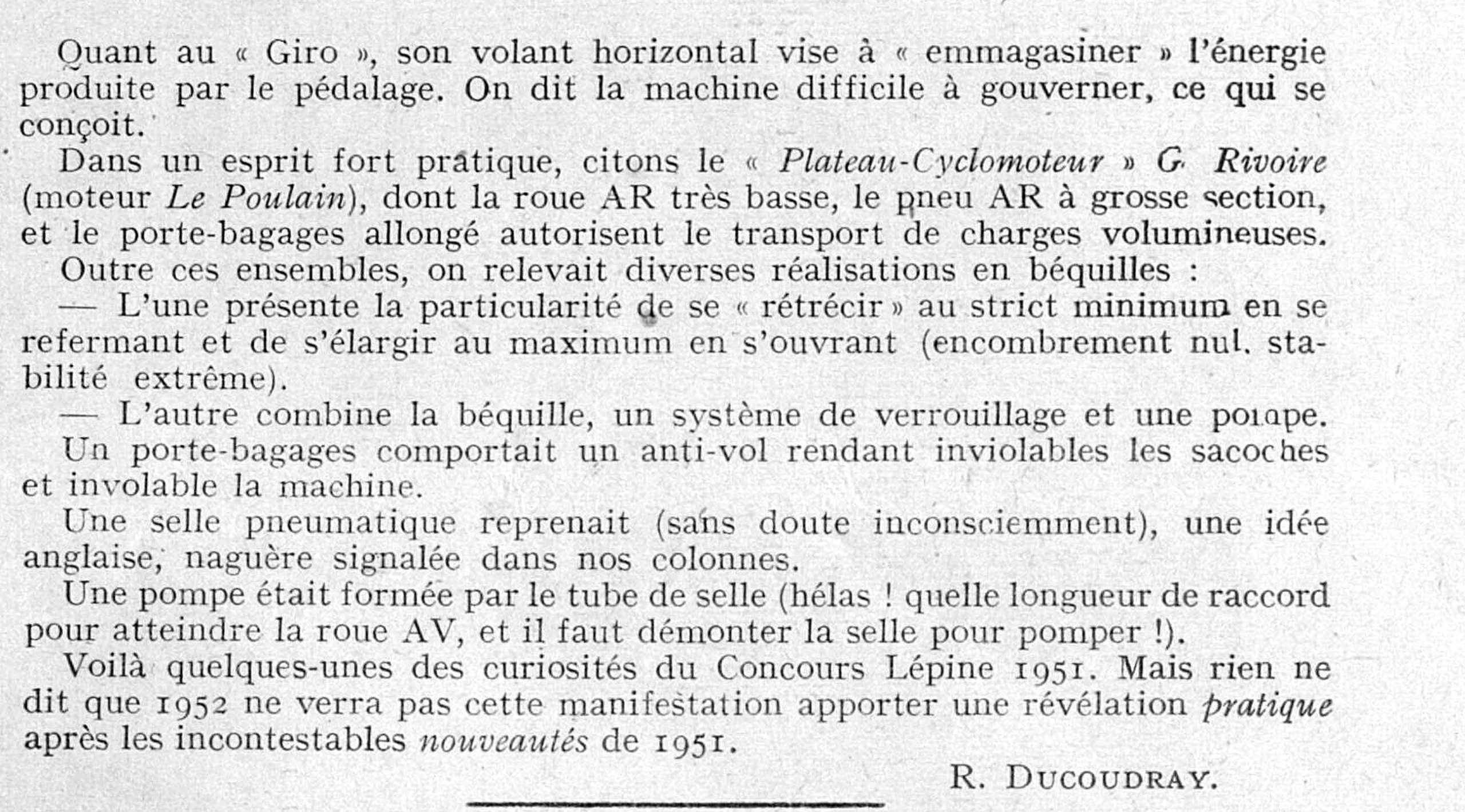
[Ebykr summary, continuing the Concours Lépine section. The “Giro” has a horizontal flywheel meant to “store” the energy produced by pedaling, and the machine is said to be hard to steer, which the author finds understandable. In a very practical spirit he cites the “Plateau-Cyclomoteur” by G. Rivoire (the motor being Le Poulain), whose very low rear wheel, large-section rear tire and lengthened luggage rack allow bulky loads to be carried. Beyond these assemblies, various kickstands were seen: one “shrinks” to a strict minimum when folded and widens to the maximum when opened (no bulk, extreme stability), and another combines the stand, a locking system and a pump. A luggage rack carried an anti-theft device making the saddlebags and the machine unstealable. A pneumatic saddle revived, probably unwittingly, an English idea noted earlier in the paper’s columns. A pump was formed by the seat tube, though with a long connecting hose to reach the front wheel, and the saddle must be removed to pump. These, he says, are some of the curiosities of the Concours Lépine 1951, and he doubts that 1952 will bring a practical revelation after the undeniable novelties of 1951.]
R. DUCOUDRAY.
[The end of an editorial, text only, set in a single wide column of light roman type with a few phrases and product names in italic. The signature “R. DUCOUDRAY.” stands at the lower right in spaced small capitals, and a short rule is centered below it. There is no illustration or firm address.]
Ebykr presents this material for research and education. If you hold rights to it or notice an ownership issue, please contact us and we will respond promptly.
The Ebykr Digest
New articles, timelines, catalog finds and registry activity — assembled from the archive once a month. Your address is never shared.
Double opt-in. One email per month. Unsubscribe at any time with one click.