About Ebykr
Ebykr celebrates classic and vintage lightweight bicycles through provocative imagery and opinion. Ride along with us.
About Ebykr
Ebykr celebrates classic and vintage lightweight bicycles through provocative imagery and opinion. Ride along with us.

Source: Gallica (Bibliothèque nationale de France), L'Officiel du cycle, du motocycle et du camping, 16 June 1951, N° 17, pages 3 and 4; ark:/12148/bd6t541855453. Source gallica.bnf.fr / BnF.
| Type | Review |
|---|---|
| Year | 1951 |
| Publisher | L'Officiel du cycle |
| Country | France |
| Language | French |
| Pages | 2 |
| Source | Gallica (Bibliothèque nationale de France), L'Officiel du cycle, du motocycle et du camping, 16 June 1951, N° 17, pages 3 and 4; ark:/12148/bd6t541855453. Source gallica.bnf.fr / BnF. |
| Credit | Ebykr archive; Bibliothèque nationale de France |
| Identifier | Gallica (BnF) ark:/12148/bd6t541855453/f3 |
| Transcription | Headings and specifications transcribed; article text summarized |
Reference
"La Bicyclette et les chiffres." L'Officiel du cycle, 16 June 1951. Ebykr, https://ebykr.com/library/lofficiel-du-cycle-1951-06-16-bicyclette-et-les-chiffres/.
Wikipedia
{{cite magazine |title=La Bicyclette et les chiffres |magazine=L'Officiel du cycle |date=16 June 1951 |language=French |url=https://ebykr.com/library/lofficiel-du-cycle-1951-06-16-bicyclette-et-les-chiffres/ |via=Ebykr |access-date=}}LA BICYCLETTE ET LES CHIFFRES Les bottes de sept lieues de M. Toulemonde Vous irez plus loin, sans fatigue, partout et quatre fois plus vite qu'à pied avec une bicyclette, véritable botte de sept lieues de l'homme du vingtième siècle. En outre, la bicyclette, à la portée de tout le monde, est le seul moyen …
This is a magazine article, so its running text is summarized here rather than reproduced; the headline, byline, specifications and scores are transcribed as printed.
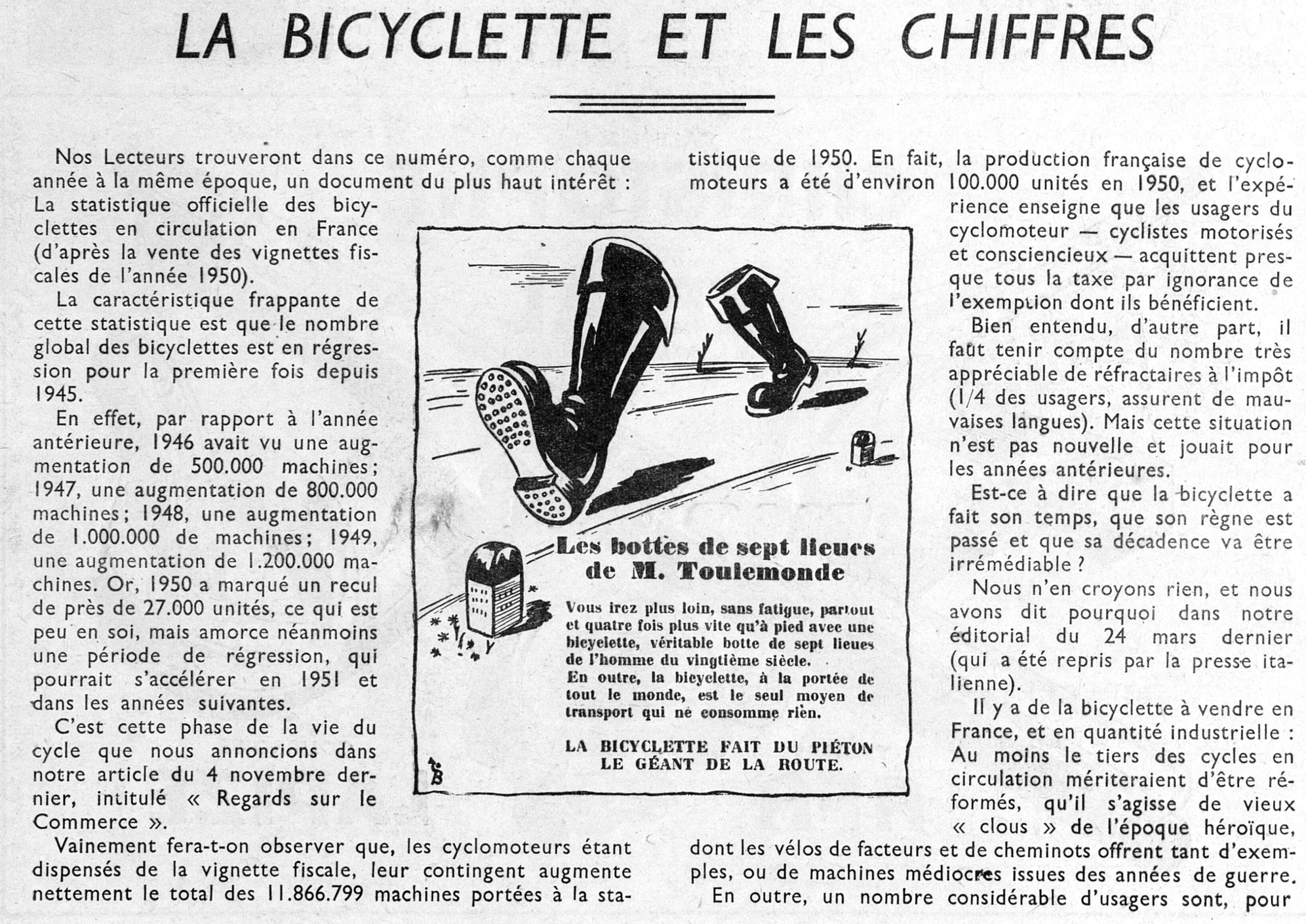
From L’Officiel du cycle, du motocycle et du camping, 16 June 1951, N° 17, pages 3 and 4: editorial “La Bicyclette et les chiffres”: the 1950 count of bicycles in circulation fell for the first time since 1945 (about 27,000 fewer), the case for pushing bicycle sales; with a cartoon of seven-league boots, “La bicyclette fait du piéton le géant de la route”. The title, headings, captions and lists are transcribed as printed; the text is summarized in Ebykr’s words, and the page images carry it in full.
— Page 1 —
LA BICYCLETTE ET LES CHIFFRES
[Ebykr summary; the article’s text is not reproduced. The editorial tells readers that this issue carries, as it does every year at the same season, the official statistics of bicycles in circulation in France, drawn from the sale of tax stamps (vignettes fiscales) in 1950. Its striking feature is that the total number of bicycles is falling for the first time since 1945. Against the previous year, 1946 had added 500,000 machines, 1947 added 800,000, 1948 added 1,000,000 and 1949 added 1,200,000, whereas 1950 shows a drop of nearly 27,000 units. The author calls that small in itself but says it starts a period of decline that could speed up in 1951 and the following years, the phase announced in the paper’s article of 4 November, “Regards sur le Commerce”.]
Les bottes de sept lieues
de M. Toulemonde
Vous irez plus loin, sans fatigue, partout
et quatre fois plus vite qu’à pied avec une
bicyclette, véritable botte de sept lieues
de l’homme du vingtième siècle.
En outre, la bicyclette, à la portée de
tout le monde, est le seul moyen de
transport qui ne consomme rien.
LA BICYCLETTE FAIT DU PIÉTON
LE GÉANT DE LA ROUTE.
[Ebykr summary, after the illustration. The author anticipates the objection that mopeds (cyclomoteurs), exempt from the stamp, swell the total of 11,866,799 machines in the 1950 statistics. He answers that French moped production was only about 100,000 units in 1950, that moped riders, being conscientious motorized cyclists, nearly all pay the tax anyway through ignorance of their exemption, and that a considerable share of cyclists, about one quarter by malicious report, do not pay at all, a situation he says is not new and applied in earlier years. He asks whether the bicycle has had its day and answers no, referring to the paper’s editorial of 24 March last, which the Italian press took up. There is bicycle business to be done in France on an industrial scale: at least a third of the cycles in circulation deserve to be scrapped, whether old “clous” of the heroic period (the bicycles of postmen and railwaymen are the examples he gives) or mediocre machines from the war years. In addition, a considerable number of users are, for a thousand reasons, natural customers for a bicycle. The text continues on the next page.]
[A text article under a large title, set in three columns with a boxed cartoon at the center. The title “LA BICYCLETTE ET LES CHIFFRES” runs across the head in heavy slanted sans-serif capitals above three thin ruled lines. The body is in a light roman face with indented paragraphs and hyphenated line ends; the left and right columns run around the box and the last four lines of each column span the width below it. The cartoon is a square panel with a ruled black border, drawn in black line and solid black with light hatching. It shows two enormous high boots in mid-stride across a flat road, one boot in the foreground with its studded sole turned up toward the viewer and the other behind it, with small bare shrubs at the roadside and two kilometer posts, one large at the lower left with a few weeds beside it and one small at the right. Under the drawing the panel carries the caption in heavy bold serif type, a title in larger type, a short text in smaller bold type and a final line in spaced capitals. At the lower left corner of the panel stands a small unread monogram that looks like a capital B with a small flourish above it. There is no firm name or address.]
— Page 2 —
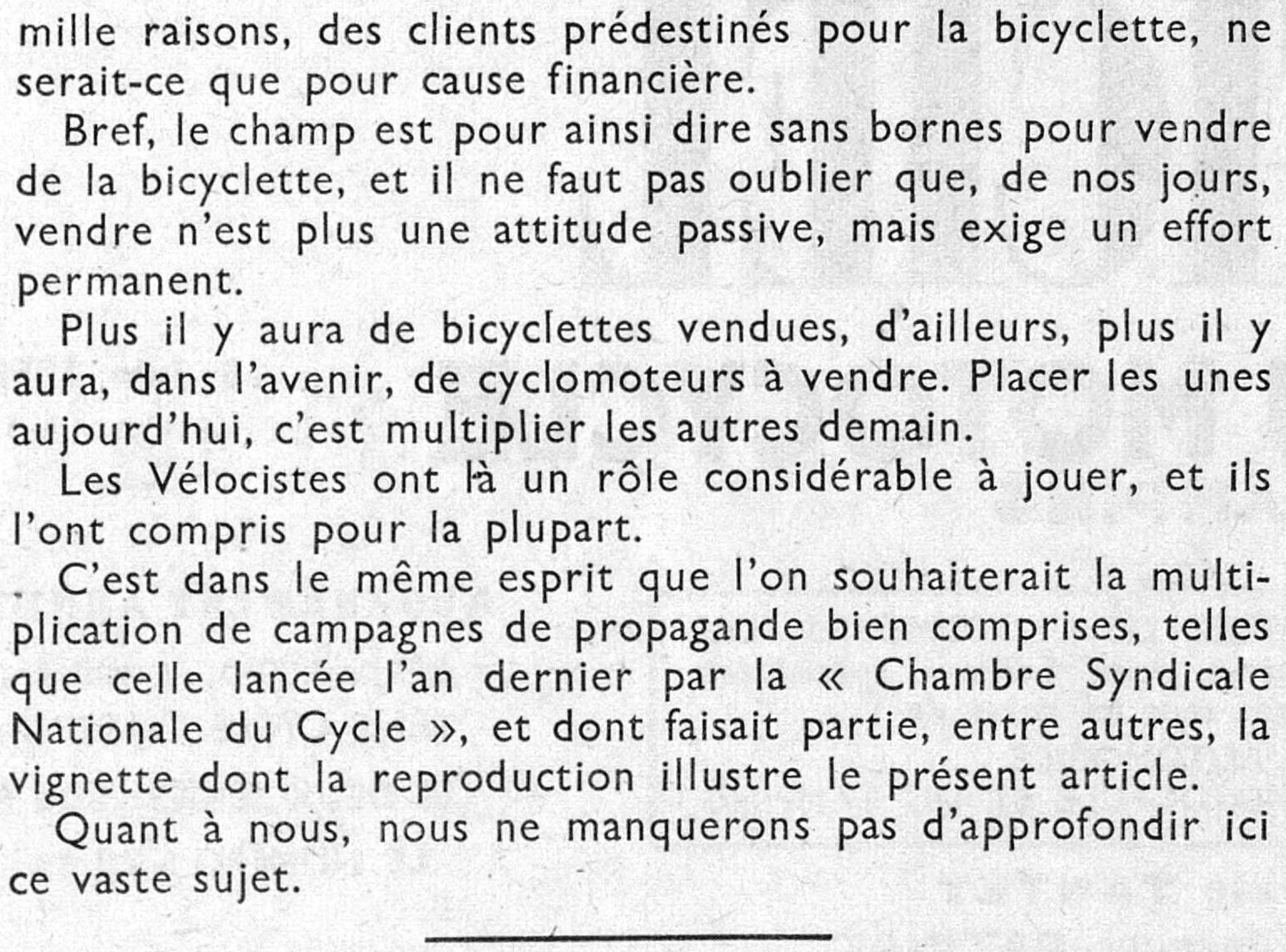
[Ebykr summary, continuing the editorial from the previous page. The sentence broken off at the foot of the first page ends by saying that many users are, for a thousand reasons, predestined customers for a bicycle, if only for financial reasons. In short, the field for selling bicycles is almost limitless, and selling today is no longer a passive attitude but demands a permanent effort. The more bicycles are sold, he adds, the more mopeds there will be to sell later: placing the former today multiplies the latter tomorrow. Bicycle dealers (vélocistes) have a considerable part to play, and most of them have understood it. In the same spirit the author hopes for more well-conceived propaganda campaigns like the one launched the year before by the Chambre Syndicale Nationale du Cycle, which included the vignette reproduced with this article. He closes by promising that the paper will not fail to go further into this broad subject.]
[A continuation of a text article, text only, with no heading, no signature and no illustration. The body is set in a single wide column of light roman type with indented paragraphs. The last line is followed by a short centered rule. A faint shadow of text from the reverse of the leaf shows through at the right edge.]
Ebykr presents this material for research and education. If you hold rights to it or notice an ownership issue, please contact us and we will respond promptly.
The Ebykr Digest
New articles, timelines, catalog finds and registry activity — assembled from the archive once a month. Your address is never shared.
Double opt-in. One email per month. Unsubscribe at any time with one click.