About Ebykr
Ebykr celebrates classic and vintage lightweight bicycles through provocative imagery and opinion. Ride along with us.
About Ebykr
Ebykr celebrates classic and vintage lightweight bicycles through provocative imagery and opinion. Ride along with us.

Source: Gallica (Bibliothèque nationale de France), L'Officiel du cycle, du motocycle et du camping, 21 April 1951, page 33; ark:/12148/bd6t54185541f. Source gallica.bnf.fr / BnF.
| Type | Review |
|---|---|
| Year | 1951 |
| Publisher | L'Officiel du cycle |
| Country | France |
| Language | French |
| Pages | 2 |
| Source | Gallica (Bibliothèque nationale de France), L'Officiel du cycle, du motocycle et du camping, 21 April 1951, page 33; ark:/12148/bd6t54185541f. Source gallica.bnf.fr / BnF. |
| Credit | Ebykr archive; Bibliothèque nationale de France |
| Identifier | Gallica (BnF) ark:/12148/bd6t54185541f/f31 |
| Transcription | Headings and specifications transcribed; article text summarized |
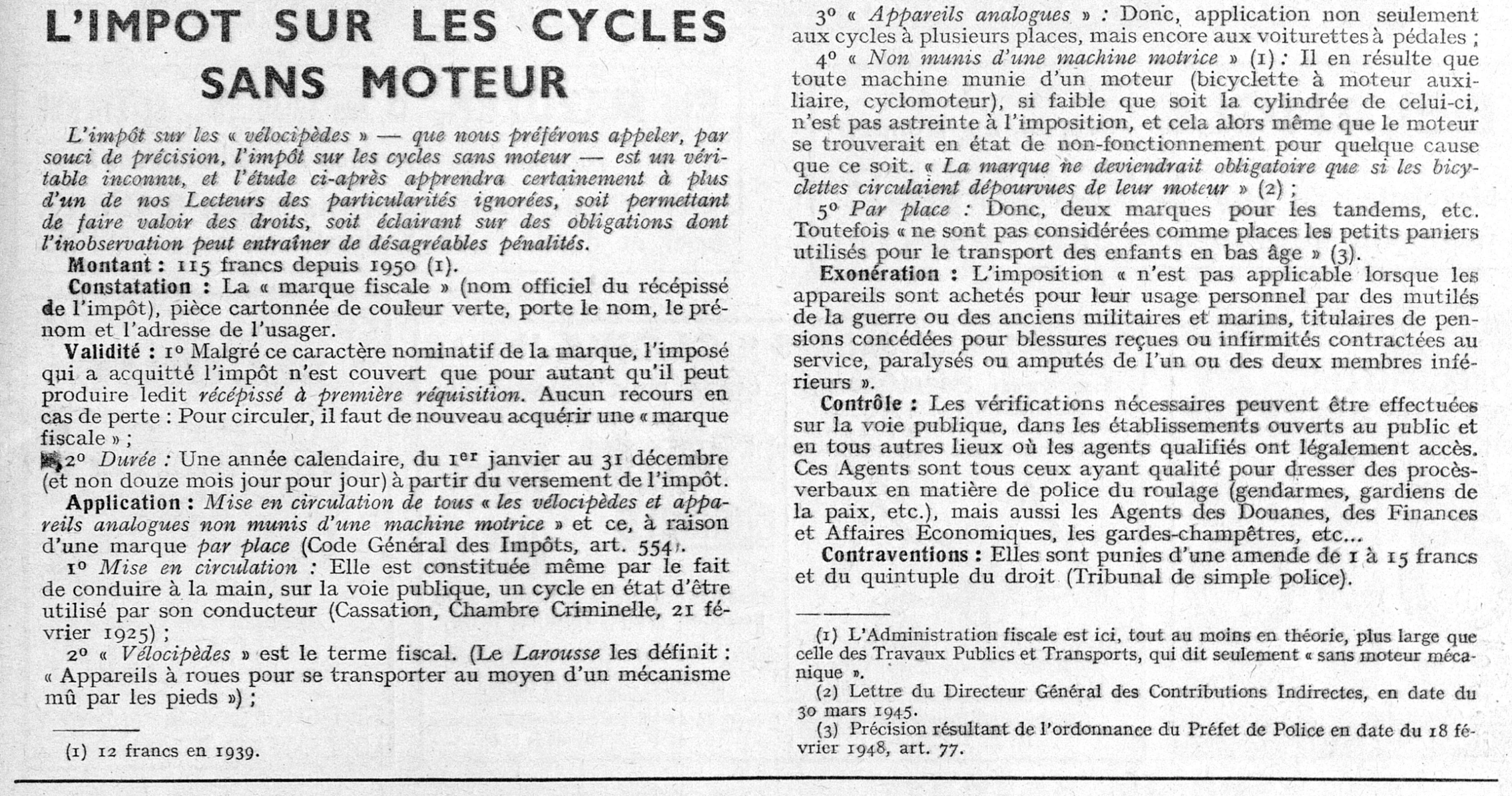
L'IMPOT SUR LES CYCLES SANS MOTEUR Montant : Constatation : Validité : Application : Exonération : Contrôle : Contraventions : (1) 12 francs en 1939. (1) L'Administration fiscale est ici, tout au moins en théorie, plus large que celle des Travaux Publics et Transports, qui dit seulement « sans moteur mécanique ». (2) Lettre du …
This is a magazine article, so its running text is summarized here rather than reproduced; the headline, byline, specifications and scores are transcribed as printed.
From L’Officiel du cycle, 21 April 1951, pages 31 and 33: the explainer on the tax on bicycles without motor: who pays it, its marks, controls and penalties. The title, headings, captions and lists are transcribed as printed; the text is summarized in Ebykr’s words, and the page images carry it in full. It belongs to the trade columns that the weekly addressed to the French cycle dealers, the vélocistes.
— Page 1 —
L’IMPOT SUR LES CYCLES
SANS MOTEUR
[Ebykr summary; the article’s text is not reproduced. An italic lead says the tax on “vélocipèdes”, which the paper prefers for precision to call the tax on cycles without motor, is a true unknown, and that the study below will teach many readers overlooked particulars, either allowing them to assert rights or warning of obligations whose neglect can bring unpleasant penalties.]
Montant :
[Ebykr summary, the entry “Montant”. The tax is 115 francs since 1950 (note 1: 12 francs in 1939).]
Constatation :
[Ebykr summary, the entry “Constatation”. The “marque fiscale” (the official name of the tax receipt) is a green cardboard piece bearing the user’s surname, first name and address.]
Validité :
[Ebykr summary, the entry “Validité”. First, despite the nominative character of the mark, the taxpayer is covered only so far as he can produce the receipt on first demand; there is no recourse in case of loss, and to ride he must buy a new “marque fiscale”. Second, the duration is one calendar year, from 1 January to 31 December (not twelve months day for day) from payment of the tax.]
Application :
[Ebykr summary, the entry “Application”. The tax applies to putting into circulation all “vélocipèdes et appareils analogues non munis d’une machine motrice”, at the rate of one mark per place (Code Général des Impôts, art. 554). Point 1, “Mise en circulation”: it exists even by the act of leading by hand on the public road a cycle fit to be used by its rider (Cassation, Chambre Criminelle, 21 February 1925). Point 2: “Vélocipèdes” is the fiscal term, which the Larousse defines as wheeled apparatus for moving by a mechanism driven by the feet. Point 3, “Appareils analogues”: the tax therefore applies not only to multi-seat cycles but also to pedal cars. Point 4, “Non munis d’une machine motrice” (note 1): any machine fitted with a motor (motor-assisted bicycle, cyclomotor), however small its displacement, is not liable even if the engine is out of working order for any reason; the mark would become compulsory only if the bicycles circulated stripped of their motor (note 2). Point 5, “Par place”: two marks for tandems and so on, though small baskets used for carrying infants are not counted as places (note 3).]
Exonération :
[Ebykr summary, the entry “Exonération”. The tax does not apply when the machines are bought for personal use by war-disabled men or former soldiers and sailors holding pensions granted for wounds received or infirmities contracted in service, paralyzed or amputated in one or both lower limbs.]
Contrôle :
[Ebykr summary, the entry “Contrôle”. The necessary checks may be made on the public road, in establishments open to the public and in any other places the officials may legally enter. The officials are all those qualified to draw up reports on road-traffic police matters (gendarmes, gardiens de la paix and so on) but also customs, finance and economic-affairs officers, rural wardens and others.]
Contraventions :
[Ebykr summary, the entry “Contraventions”. They are punished by a fine of 1 à 15 francs and five times the duty (Tribunal de simple police). The entry continues on the next page.]
(1) 12 francs en 1939.
(1) L’Administration fiscale est ici, tout au moins en théorie, plus large que celle des Travaux Publics et Transports, qui dit seulement « sans moteur mécanique ».
(2) Lettre du Directeur Général des Contributions Indirectes, en date du 30 mars 1945.
(3) Précision résultant de l’ordonnance du Préfet de Police en date du 18 février 1948, art. 77.
[A text-only article with no illustration or signature. The headline is set in large heavy sans-serif capitals over two centered lines across the top, and the body is in two roman columns, with an italic lead and italic run-in phrases, while each entry is introduced by a bold run-in label (“Montant :”, “Constatation :”, “Validité :”, “Application :”, “Exonération :”, “Contrôle :”, “Contraventions :”). Numbered points sit inside the entries. Short footnote blocks stand under a short rule at the foot of each column, the left one holding a single line and the right one three, and a thick rule closes the page at the bottom.]
— Page 2 —
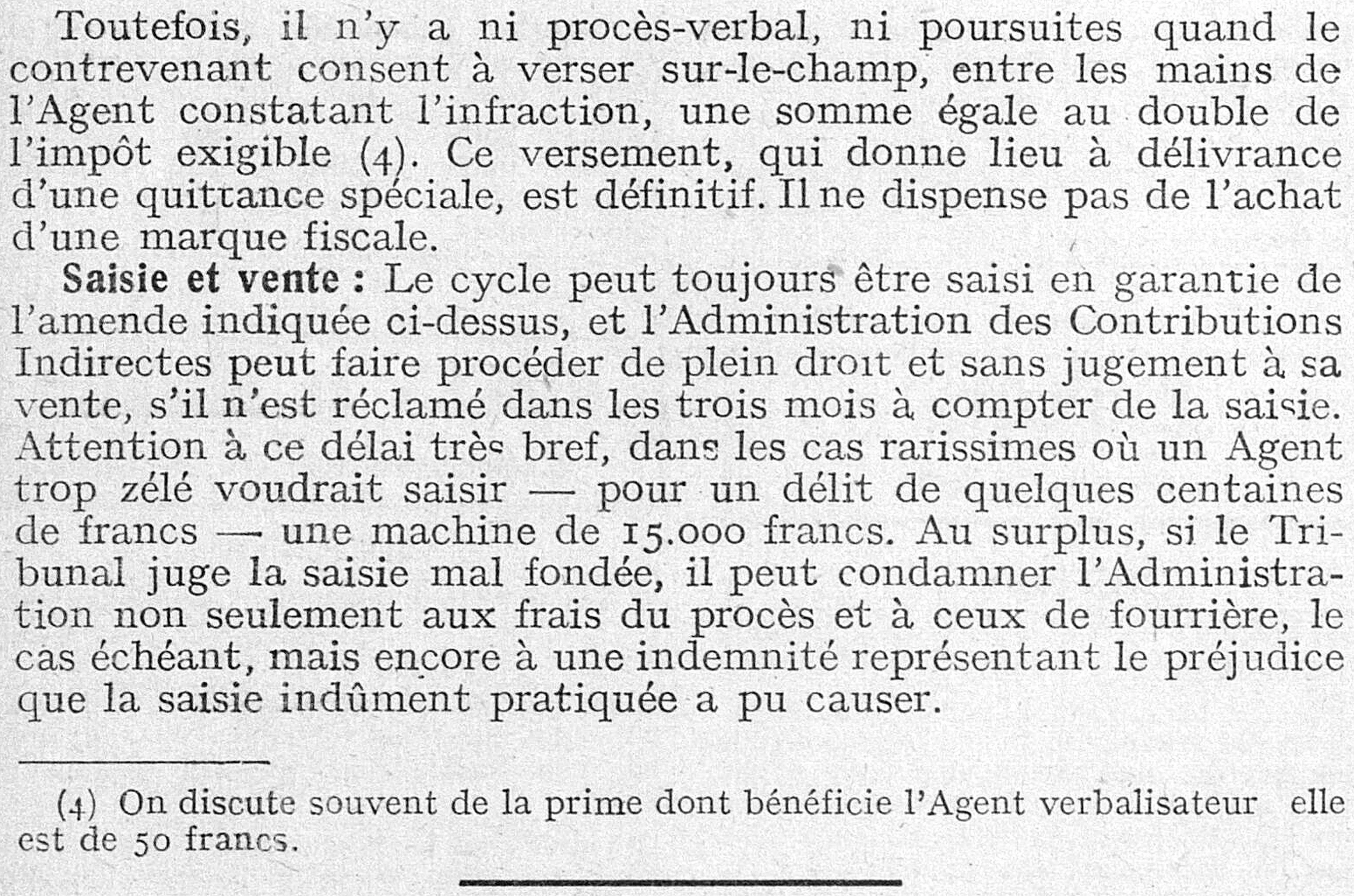
[Ebykr summary; the article’s text is not reproduced. Continuing the entry on penalties, the article says there is no report and no prosecution when the offender agrees to pay on the spot, into the hands of the officer recording the offense, a sum equal to double the tax due (note 4). This payment, for which a special receipt is issued, is final, but it does not excuse the purchase of a “marque fiscale”.]
Saisie et vente :
[Ebykr summary, the entry “Saisie et vente”. The cycle can always be seized as security for the fine, and the Administration des Contributions Indirectes may have it sold as of right and without judgment if it is not claimed within three months of the seizure. The author warns of this very short period in the rarest cases where an overzealous officer might seize, for an offense of a few hundred francs, a machine worth 15.000 francs. Moreover, if the court finds the seizure ill-founded it may order the Administration to pay not only the costs of the case and of the pound where applicable but also an indemnity for the harm the wrongful seizure may have caused.]
(4) On discute souvent de la prime dont bénéficie l’Agent verbalisateur elle est de 50 francs.
[A short text-only block with no illustration, headline or signature, set in a roman face in one wide column. It opens in mid-entry on the word “Toutefois,” carries the bold run-in label “Saisie et vente :” and ends with a footnote under a short rule, and a thick rule closes the page at the bottom. The footnote as printed has no punctuation between “verbalisateur” and “elle”.]
Ebykr presents this material for research and education. If you hold rights to it or notice an ownership issue, please contact us and we will respond promptly.
The Ebykr Digest
New articles, timelines, catalog finds and registry activity — assembled from the archive once a month. Your address is never shared.
Double opt-in. One email per month. Unsubscribe at any time with one click.