About Ebykr
Ebykr celebrates classic and vintage lightweight bicycles through provocative imagery and opinion. Ride along with us.
About Ebykr
Ebykr celebrates classic and vintage lightweight bicycles through provocative imagery and opinion. Ride along with us.

Source: Gallica (Bibliothèque nationale de France), L'Officiel du cycle, du motocycle et du camping, 21 April 1951, page 13; ark:/12148/bd6t54185541f. Source gallica.bnf.fr / BnF.
| Type | Review |
|---|---|
| Year | 1951 |
| Publisher | L'Officiel du cycle |
| Country | France |
| Language | French |
| Pages | 1 |
| Source | Gallica (Bibliothèque nationale de France), L'Officiel du cycle, du motocycle et du camping, 21 April 1951, page 13; ark:/12148/bd6t54185541f. Source gallica.bnf.fr / BnF. |
| Credit | Ebykr archive; Bibliothèque nationale de France |
| Identifier | Gallica (BnF) ark:/12148/bd6t54185541f/f13 |
| Transcription | Headings and specifications transcribed; article text summarized |
Les manivelles « Professionnels » A. DUPRAT * * * Amortisseur de selle SOUPLESS * * * Les moyeux TORPEDO * * * A la Manufacture Orléanaise de Cycles Le changement de vitesse automatique SELECTIC - 13 -
This is a magazine article, so its running text is summarized here rather than reproduced; the headline, byline, specifications and scores are transcribed as printed.
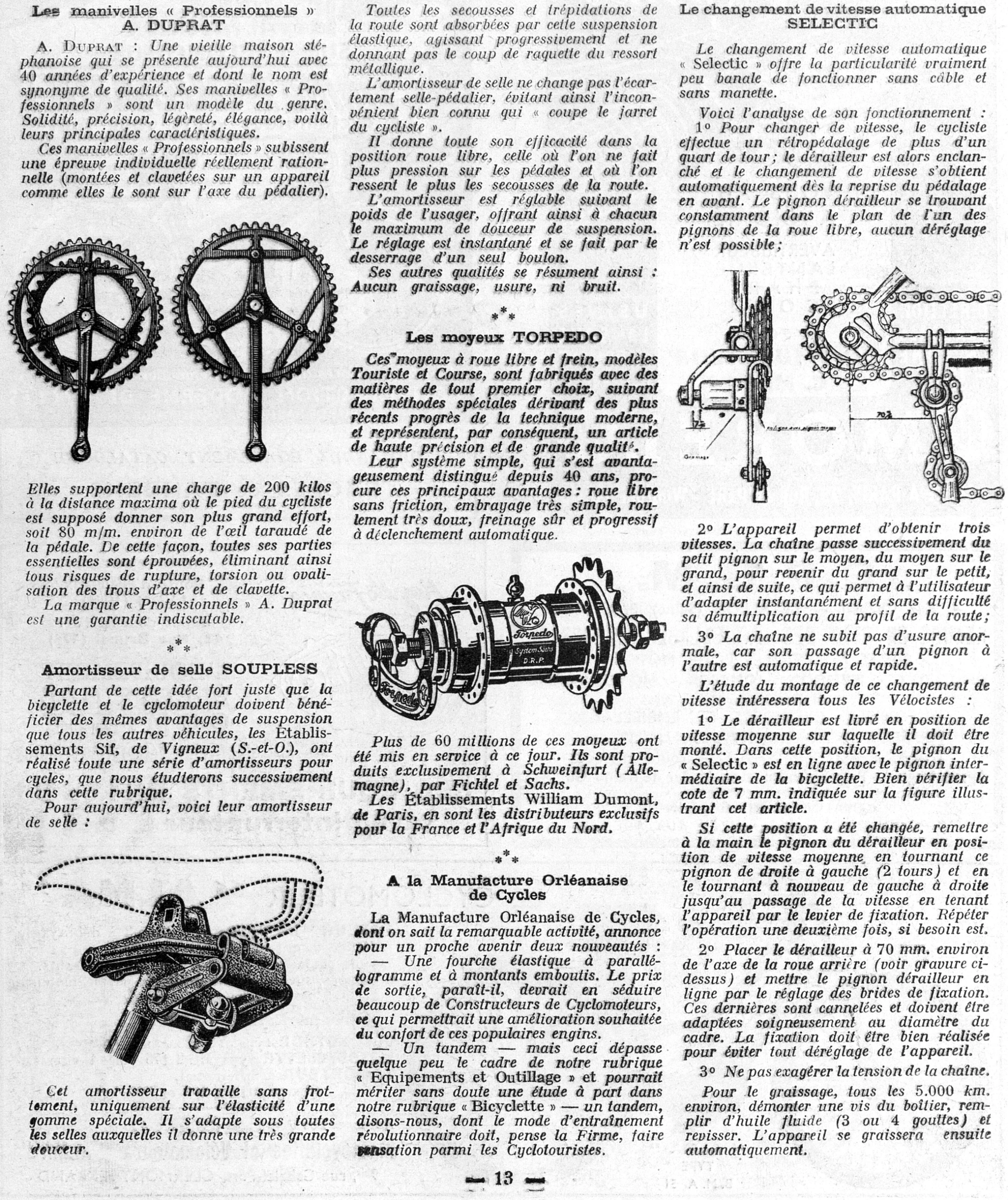
From L’Officiel du cycle, 21 April 1951, page 13: the column of product notes on cranks, hubs, gear changers and handlebar dampers. The title, headings, captions and lists are transcribed as printed; the text is summarized in Ebykr’s words, and the page images carry it in full. It belongs to the trade columns that the weekly addressed to the French cycle dealers, the vélocistes.
— Page 1 —
Les manivelles « Professionnels »
A. DUPRAT
[Ebykr summary; the article’s text is not reproduced. The item presents A. Duprat as an old firm of Saint-Étienne with 40 years of experience whose name is a synonym of quality, and calls its “Professionnels” cranks a model of their kind, with solidity, precision, lightness and elegance as their main characteristics. Each crank is said to undergo a truly rational individual test, mounted and keyed on an apparatus as it is on the bottom-bracket axle. The cranks are stated to bear a load of 200 kilos at the maximum distance where the cyclist’s foot is supposed to give its greatest effort, about 80 mm from the threaded eye of the pedal, so that all essential parts are tried and every risk of breakage, twisting or ovalization of the axle and key holes is removed. The mark “Professionnels” A. Duprat is called an unquestionable guarantee.]
* * *
Amortisseur de selle SOUPLESS
[Ebykr summary; the article’s text is not reproduced. Starting from the idea that the bicycle and the cyclomotor should enjoy the same suspension advantages as other vehicles, the Établissements Sif of Vigneux (S.-et-O.) have made a whole series of shock absorbers for cycles, to be studied one by one in this column, and the first is their saddle absorber. A drawing shows it, with a caption saying it works without friction, solely on the elasticity of a special rubber and fits under all saddles, giving very great softness. Every shock and vibration from the road is absorbed by this elastic suspension, which acts progressively and does not give the recoil of a metal spring. The absorber does not change the distance between saddle and bottom bracket, so it avoids the known drawback that “cuts the cyclist’s hamstring” (coupe le jarret du cycliste). It is most effective when coasting, when no pressure is put on the pedals and the road shocks are felt most. It is adjustable to the weight of the user, giving each rider maximum softness, and the adjustment is instantaneous by loosening a single bolt. Its other qualities are summed up as no greasing, no wear and no noise.]
* * *
Les moyeux TORPEDO
[Ebykr summary; the article’s text is not reproduced. These freewheel and brake hubs, Touriste and Course models, are made of first-grade materials by special methods derived from the most recent progress in modern technique, and so represent an article of high precision and great quality. Their simple system, which has distinguished itself for 40 years, gives these main advantages: frictionless freewheel, very simple clutch, very smooth running and safe, progressive braking with automatic release. The item states that more than 60 million of these hubs have been put into service to date, made exclusively at Schweinfurt (Germany) by Fichtel and Sachs. The Établissements William Dumont of Paris are the exclusive distributors for France and North Africa.]
* * *
A la Manufacture Orléanaise
de Cycles
[Ebykr summary; the article’s text is not reproduced. The Manufacture Orléanaise de Cycles, known for its remarkable activity, announces two novelties for the near future. The first is an elastic fork with parallelogram action and pressed-steel legs; its price at launch, it is said, should tempt many makers of cyclomotors and so allow a hoped-for improvement in the comfort of those popular machines. The second is a tandem whose revolutionary drive, the firm believes, should cause a sensation among cyclotourists; the writer says this goes somewhat beyond the column “Equipements et Outillage” and may deserve a separate study in the column “Bicyclette”.]
Le changement de vitesse automatique
SELECTIC
[Ebykr summary; the article’s text is not reproduced. The “Selectic” automatic gear change is described as unusual in working without cable and without a lever. Its working is analyzed in three points. First, to change gear the cyclist back-pedals more than a quarter turn; the derailleur is then engaged and the change takes place automatically when forward pedaling resumes, and because the derailleur sprocket always sits in the plane of one of the freewheel sprockets, no misadjustment is possible. Second, the device gives three speeds: the chain passes in turn from the small sprocket to the middle one, from the middle to the large, then back from the large to the small, and so on, letting the user adapt his gearing at once and without difficulty to the profile of the road. Third, the chain suffers no abnormal wear because the passage from one sprocket to another is automatic and quick.]
[Ebykr summary, continued; the fitting instructions, said to interest all dealers. First, the derailleur is delivered in the middle-speed position on which it must be mounted; in that position the Selectic sprocket is in line with the intermediate sprocket of the bicycle, and the 7 mm dimension shown on the figure should be checked carefully. If the position has been changed, the derailleur sprocket is reset by hand to middle speed by turning it from right to left (2 turns) and then from left to right until the gear passes, holding the device by its fixing lever, and the operation is repeated a second time if needed. Second, place the derailleur about 70 mm from the rear-wheel axle (see the engraving above) and bring the derailleur sprocket into line by adjusting the fixing clamps, which are grooved and must be carefully matched to the frame diameter and fixed firmly to prevent any misadjustment. Third, do not overdo the chain tension. For lubrication, about every 5.000 km, remove one screw of the housing, fill with fluid oil (3 or 4 drops) and screw it back; the device then oils itself automatically.]
– 13 –
[A full page of text and illustration in three columns, reviewing trade equipment. Subheads are set in a heavy slab-serif face, centered over each column section, and the text is in italic sans serif, with three-star ornaments between the items; the page number “13” sits at the foot between two dashes. At the upper left, two line engravings show a pair of cast cranks with large chainrings of many teeth, a three-armed model beside a five-armed one, each with a long arm ending in a pedal eye. Beneath the Soupless item a line engraving in halftone texture shows a saddle-post clamp with a rubber block, with a dotted outline of a saddle above it. In the middle column a line engraving shows a hub with a rear sprocket and flange marked “Torpedo”, “System Sachs” and “D.R.P.” with a winged emblem. In the right column a technical line drawing shows the derailleur, chain, sprockets and rear dropout, with a dimension line marked 70 and small handwritten labels. No artist signature, initials or photographer credit appear. The crop starts at the first subhead and holds the full page.]
Ebykr presents this material for research and education. If you hold rights to it or notice an ownership issue, please contact us and we will respond promptly.
The Ebykr Digest
New articles, timelines, catalog finds and registry activity — assembled from the archive once a month. Your address is never shared.
Double opt-in. One email per month. Unsubscribe at any time with one click.