About Ebykr
Ebykr celebrates classic and vintage lightweight bicycles through provocative imagery and opinion. Ride along with us.
About Ebykr
Ebykr celebrates classic and vintage lightweight bicycles through provocative imagery and opinion. Ride along with us.

Source: Gallica (Bibliothèque nationale de France), L'Officiel du cycle, du motocycle et du camping, 21 April 1951, pages 3 and 4; ark:/12148/bd6t54185541f. Source gallica.bnf.fr / BnF.
| Type | Review |
|---|---|
| Year | 1951 |
| Publisher | L'Officiel du cycle |
| Country | France |
| Language | French |
| Pages | 2 |
| Source | Gallica (Bibliothèque nationale de France), L'Officiel du cycle, du motocycle et du camping, 21 April 1951, pages 3 and 4; ark:/12148/bd6t54185541f. Source gallica.bnf.fr / BnF. |
| Credit | Ebykr archive; Bibliothèque nationale de France |
| Identifier | Gallica (BnF) ark:/12148/bd6t54185541f/f3 |
| Transcription | Headings and specifications transcribed; article text summarized |
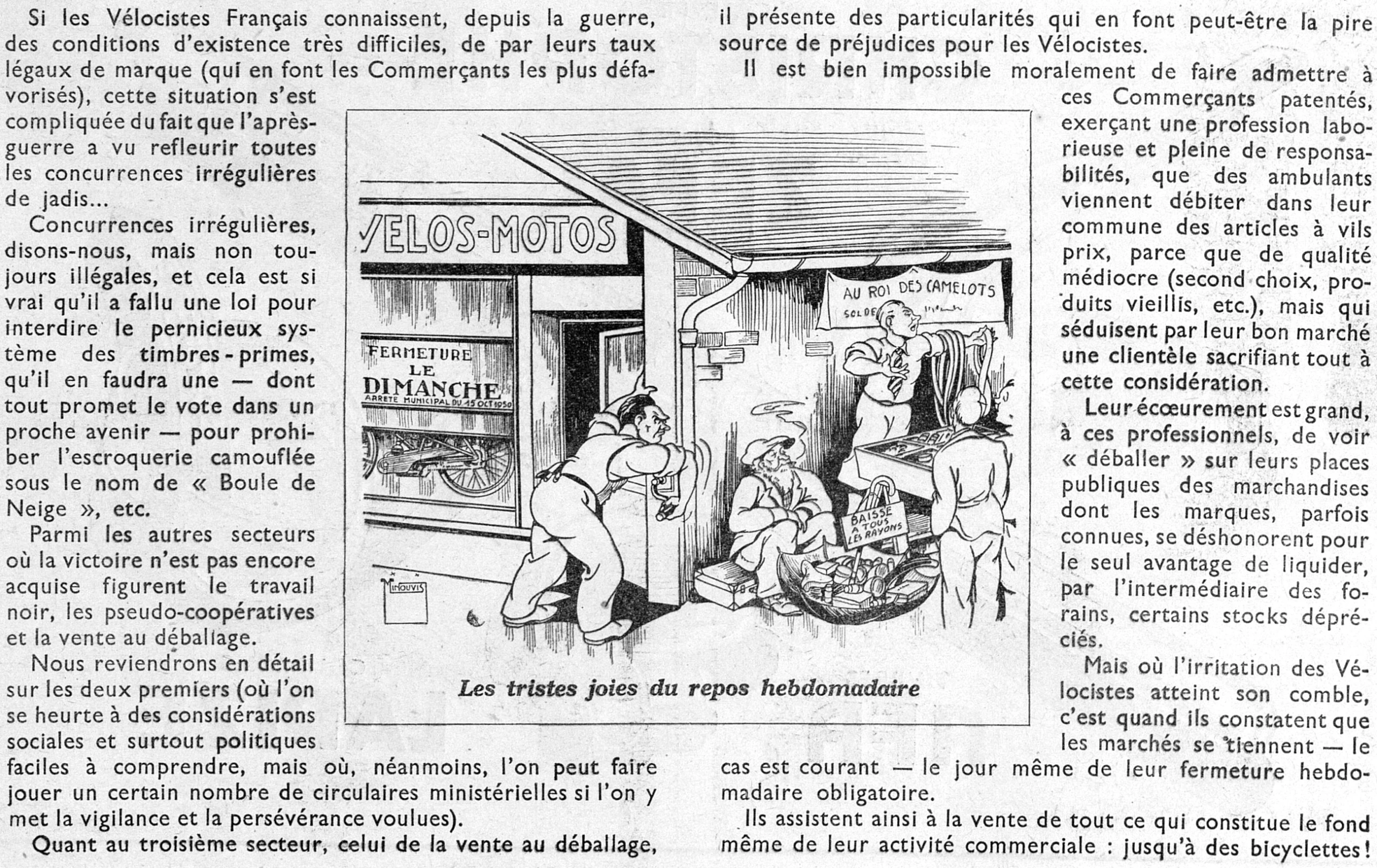
Les tristes joies du repos hebdomadaire
This is a magazine article, so its running text is summarized here rather than reproduced; the headline, byline, specifications and scores are transcribed as printed.
From L’Officiel du cycle, 21 April 1951, page 3 and 4: the paper’s editorial against street selling of goods on market days, with the dealers’ remedies, under a cartoon of a shut cycle shop. The title, headings, captions and lists are transcribed as printed; the text is summarized in Ebykr’s words, and the page images carry it in full. It belongs to the trade columns that the weekly addressed to the French cycle dealers, the vélocistes.
— Page 1 —
Les tristes joies du repos hebdomadaire
[Ebykr summary; the article’s text is not reproduced. The author says French cycle dealers have lived in very hard conditions since the war because the legal margins on branded goods make them the most disadvantaged tradesmen, and that the postwar years complicated this by reviving all the irregular forms of competition of earlier days. Irregular competition, he says, is not always illegal, as shown by the law that had to be passed to ban the pernicious system of trading stamps, and another law, whose vote everything promises for the near future, will be needed to prohibit the swindle disguised as the “Boule de Neige” scheme and similar devices. Among the other sectors where victory is not yet won he lists black-market labor, pseudo-cooperatives and sale by unpacking (vente au déballage). He promises to return in detail to the first two, where social and above all political considerations arise but where a number of ministerial circulars can be made to count with vigilance and perseverance. The third sector, sale by unpacking, has particular features that make it perhaps the worst source of prejudice to dealers.]
[Ebykr summary, continued. It is morally impossible, he argues, to make licensed tradesmen who follow a laborious profession full of responsibilities accept that itinerant sellers come to sell in their own commune articles at low prices because the quality is mediocre (seconds, aged stock and so on), yet who win over a clientele that sacrifices everything to price. These professionals are sickened to see goods whose brands, sometimes well known, are dishonored being “unpacked” in their public squares, for the sole benefit of clearing certain depreciated stocks through fairground traders. Their irritation peaks when they find that markets are held, as often happens, on the very day of their compulsory weekly closing, so that they watch the sale of the very goods that make up the core of their business: even bicycles.]
[A ruled line drawing in black and white, framed by a thin rule, with a bold italic caption beneath it, “Les tristes joies du repos hebdomadaire”. It shows a shop front and a narrow alley beside it. Above the shop window a sign reads “VELOS-MOTOS” in outlined capitals, and a notice in the window reads “FERMETURE LE DIMANCHE” with the small line “ARRETE MUNICIPAL DU 15 OCT 1950”, above a drawing of a bicycle wheel and chain. A shopkeeper in shirtsleeves and braces leans out of the half-open side door, scowling, with one hand on the door. In the alley a street trader, standing in front of a banner reading “AU ROI DES CAMELOTS” with the word “SOLDE” below, holds up coils of rubber tubing. Below him a bearded man in a cap sits smoking among a heap of boxes and small wares beside a placard reading “BAISSE A TOUS LES RAYONS”, while a customer stands with his back to the viewer. The shading is done in fine hatched lines and solid black. The artist’s signature “Minouvis” appears in a small box at the lower left of the drawing. The text is set in a roman face in wide columns that wrap around the illustration; the crop begins with the text already running and carries no headline of its own.]
— Page 2 —
[Ebykr summary; the article’s text is not reproduced. Continuing the piece, the author says that it will fall to the dealers not only to repair these goods (for a largely rural clientele that pays very badly) but also to take the complaints about the poor quality of the articles: porous inner tubes, handlebars without strength, screws that “give out” and so on.]
[Ebykr summary, continued. He asks what reason leads municipalities to authorize competition that kills their own local trades, and says this is true well beyond the cycle trade. Officially, he writes, the reason is that markets, with their stall-holders from outside, introduce a moderating and even price-lowering element that reduces the cost of living. In fact, he says, the municipal administrations see mainly the immediate gains to their finances from the stall fees collected. He calls this a short-sighted policy, since it is local economic life that will be more or less asphyxiated before long.]
[Ebykr summary, continued. As to the remedy, he finds it hard to seek one in a restrictive regulation of the trades allowed to set up on the markets, which would open the door to a dirigisme that would soon do its own damage among the sedentary trades. At least, he says, dealers can still act on their elected municipal officials and at the same time on the suppliers who stock the fairground traders, making the former feel the danger to their communes and the latter the danger to their brands from sale by unpacking. Dealers can also demand a change of their compulsory closing day if it falls on market day in their commune or district. Finally, by common agreement, they can take a place on that market for a collective unpacking sale, which he says he will return to.]
[Text only: a single wide column of running text in a roman face, with no headline, illustration, caption or signature on this sheet. It carries the closing part of the piece, ending on the sentence promising to come back to the collective unpacking sale.]
Ebykr presents this material for research and education. If you hold rights to it or notice an ownership issue, please contact us and we will respond promptly.
The Ebykr Digest
New articles, timelines, catalog finds and registry activity — assembled from the archive once a month. Your address is never shared.
Double opt-in. One email per month. Unsubscribe at any time with one click.