About Ebykr
Ebykr celebrates classic and vintage lightweight bicycles through provocative imagery and opinion. Ride along with us.
About Ebykr
Ebykr celebrates classic and vintage lightweight bicycles through provocative imagery and opinion. Ride along with us.

Source: Gallica (Bibliothèque nationale de France), L'Officiel du cycle, du motocycle et du camping, 21 April 1951, page 5; ark:/12148/bd6t54185541f. Source gallica.bnf.fr / BnF.
| Type | Review |
|---|---|
| Year | 1951 |
| Publisher | L'Officiel du cycle |
| Country | France |
| Language | French |
| Pages | 1 |
| Source | Gallica (Bibliothèque nationale de France), L'Officiel du cycle, du motocycle et du camping, 21 April 1951, page 5; ark:/12148/bd6t54185541f. Source gallica.bnf.fr / BnF. |
| Credit | Ebykr archive; Bibliothèque nationale de France |
| Identifier | Gallica (BnF) ark:/12148/bd6t54185541f/f5 |
| Transcription | Headings and specifications transcribed; article text summarized |
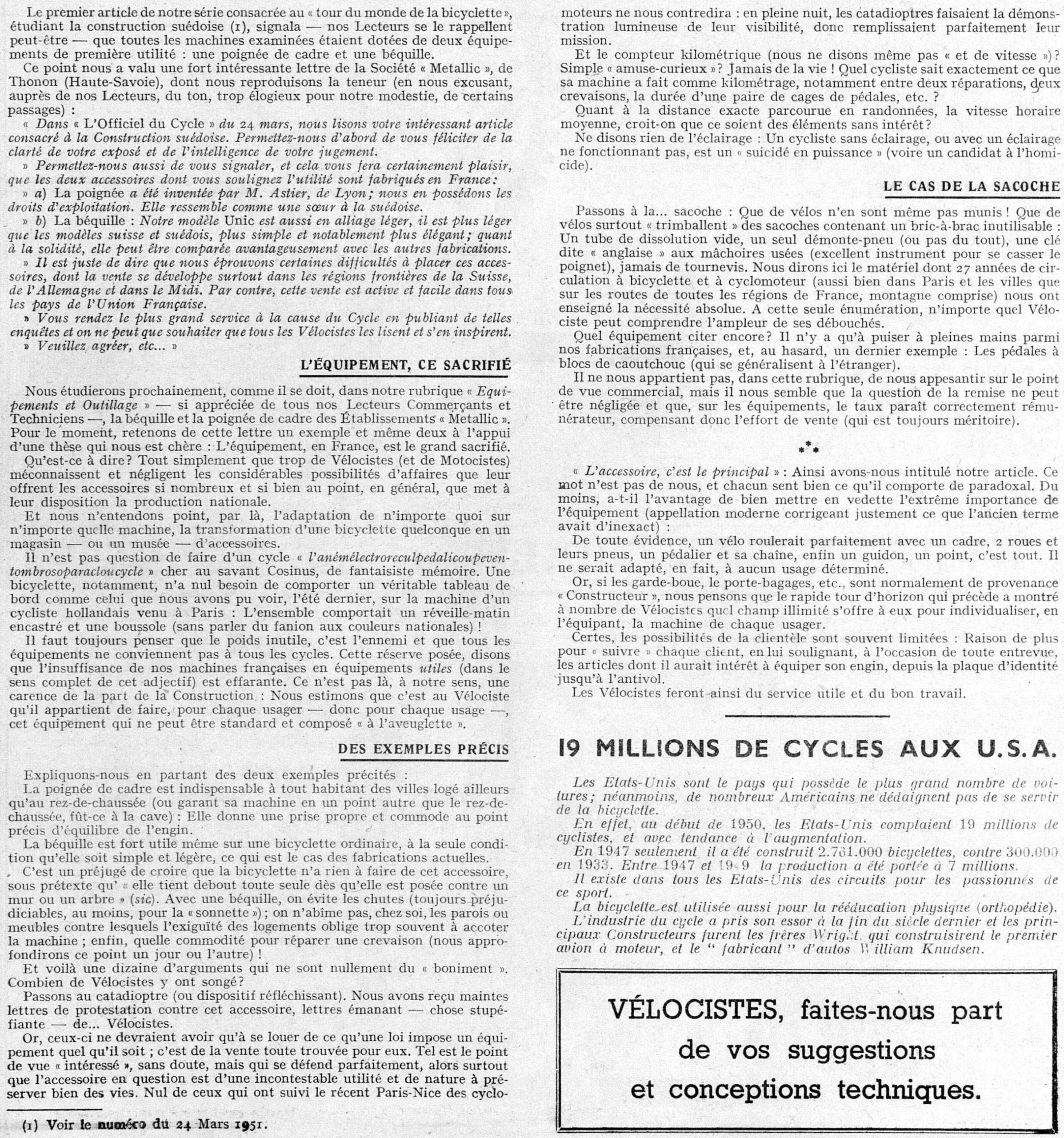
L'ÉQUIPEMENT, CE SACRIFIÉ DES EXEMPLES PRÉCIS LE CAS DE LA SACOCHE * * * 19 MILLIONS DE CYCLES AUX U.S.A. VÉLOCISTES, faites-nous part de vos suggestions et conceptions techniques. (1) Voir le numéro du 24 Mars 1951.
This is a magazine article, so its running text is summarized here rather than reproduced; the headline, byline, specifications and scores are transcribed as printed.
From L’Officiel du cycle, 21 April 1951, page 5: R. Ducoudray’s article on bicycle accessories, from Swedish machines to a frame handle and a kickstand, with the short item on 19 million American cycles. The title, headings, captions and lists are transcribed as printed; the text is summarized in Ebykr’s words, and the page images carry it in full. It belongs to the trade columns that the weekly addressed to the French cycle dealers, the vélocistes.
— Page 1 —
[Ebykr summary; the article’s text is not reproduced. The opening recalls that the first article of the series on the “tour du monde de la bicyclette”, on Swedish construction (see note 1), noted that every machine examined carried two items of first-rate utility: a frame handle and a kickstand. The piece then gives the substance of a letter from the firm “Metallic” of Thonon (Haute-Savoie), whose flattering passages the editors say they have toned down. The letter praises the clarity of the 24 March article and says that both accessories are made in France. The frame handle was invented by M. Astier of Lyon, the firm holds the rights to exploit it, and it closely resembles the Swedish one. Its kickstand, the Unic model, is also in light alloy and is lighter than the Swiss and Swedish models, simpler and notably more elegant, with strength comparable to other makes. The firm admits some difficulty in placing these accessories, which sell mainly in the frontier regions of Switzerland and Germany and in the Midi, but says sales are active and easy in all the countries of the Union Française. It closes by saying the paper does the cause of the cycle the greatest service by publishing such surveys.]
L’ÉQUIPEMENT, CE SACRIFIÉ
[Ebykr summary; the article’s text is not reproduced. The editors say they will study the Metallic kickstand and frame handle soon in their column “Equipements et Outillage”. For now they take the letter as one example, and even two, to support a thesis dear to them: in France, equipment is the great sacrifice. Too many dealers (and motorcycle dealers), they say, ignore the considerable business opportunities offered by the many well-developed accessories of national production. They do not mean fitting anything to any machine or turning a bicycle into an accessory shop or museum, nor the fanciful “l’anémélectroreculpédalicoupeventombrosoparacloucycle” of the savant Cosinus, nor a full dashboard like the one seen last summer on the machine of a Dutch cyclist visiting Paris, which carried a built-in alarm clock and a compass, without counting a pennant in national colors. Useless weight is the enemy and not every item suits every cycle. That said, they find the shortage of useful equipment on French machines striking. They do not blame the makers; they hold that it falls to the dealer to fit out each machine for each user and each use, since such equipment cannot be standard or chosen at random.]
DES EXEMPLES PRÉCIS
[Ebykr summary; the article’s text is not reproduced. Taking the two examples named above, the author says the frame handle is indispensable to any city dweller who lives above the ground floor or keeps the machine anywhere but at street level, even in the cellar, because it gives a clean, convenient grip at the machine’s exact balance point. The kickstand is very useful even on an ordinary bicycle if it is simple and light, as current makes are. It is a prejudice, he says, to think a bicycle needs none because it stands up against a wall or tree: a stand prevents falls (always harmful at least to the bell), protects the walls and furniture of cramped homes and is a great convenience when repairing a puncture, a point to be developed another day. He counts about ten arguments that are not mere patter and asks how many dealers have thought of them. On the reflector (catadioptre) the paper has received many letters of protest, astonishingly from dealers themselves, who should instead welcome an equipment requirement imposed by law as ready-made sales; the accessory is of undeniable utility and can save lives. No one who followed the recent Paris-Nice of the cyclomotors, he continues, will contradict him: in full night the reflectors gave a luminous demonstration of their visibility and so fulfilled their mission perfectly.]
[Ebykr summary, continued. The author asks about the odometer (not even speaking of the speedometer): it is not a mere gadget, since few cyclists know exactly the mileage of their machine, notably between two repairs, two punctures or the life of a pair of pedal cages, nor the exact distance of tours or the average hourly speed. Lighting needs no comment: a cyclist with no lights, or lights that do not work, is a “suicidé en puissance” (even a candidate for homicide).]
LE CAS DE LA SACOCHE
[Ebykr summary; the article’s text is not reproduced. Turning to the saddlebag, he notes that many bicycles have none and that many more carry bags of unusable odds and ends: an empty tube of solution, a single tire lever or none, a worn “English” wrench (“an excellent instrument for breaking a wrist”) and never a screwdriver. He says he will list the tools that 27 years of riding bicycles and cyclomotors, in Paris and towns and on the roads of every region of France including the mountains, have taught him are absolutely necessary, and that this list alone shows any dealer how wide the outlets are. As a last random example from French production he names rubber-block pedals, which are becoming general abroad. It is not for this column to dwell on the commercial side, but he thinks the dealer’s discount cannot be neglected and that on equipment the rate seems correctly remunerative, compensating the sales effort (always meritorious).]
* * *
[Ebykr summary, after a three-star break. The editors recall that they titled the article “L’accessoire, c’est le principal”, a phrase not their own whose paradox everyone feels, though it usefully highlights the great importance of equipment (the modern term, which fairly corrects what the old word got wrong). A bicycle would plainly run with a frame, two wheels with tires, pedals and chain and handlebars, but it would suit no particular use. Mudguards and luggage rack normally come from the maker, but the quick survey shows dealers the unlimited field open to them to individualize each user’s machine by equipping it. Customers’ means are often limited, which is a reason to follow each client and point out, at every meeting, the items worth fitting, from the identity plate to the anti-theft lock. Dealers will thus do useful service and good work.]
19 MILLIONS DE CYCLES AUX U.S.A.
[Ebykr summary; the article’s text is not reproduced. The item says the United States has the most cars of any country, yet many Americans do not disdain the bicycle. At the start of 1950 the country counted 19 million cyclists and the number was rising. In 1947 alone 2.761.000 bicycles were built, against 300.000 in 1933, and between 1947 and 1949 production rose to 7 millions. Tracks for enthusiasts exist all over the country, and the bicycle is also used for physical re-education (orthopedics). The cycle industry took off at the end of the last century, and its chief makers were the Wright brothers, who built the first powered airplane, and the automobile maker William Knudsen.]
VÉLOCISTES, faites-nous part
de vos suggestions
et conceptions techniques.
(1) Voir le numéro du 24 Mars 1951.
[A full page of text only, with no photograph or drawing. The headlines are set in small heavy roman capitals, right-aligned and underlined with a thick rule, for “L’ÉQUIPEMENT, CE SACRIFIÉ”, “LE CAS DE LA SACOCHE” and “DES EXEMPLES PRÉCIS”, and a three-star ornament marks the break before the closing paragraphs. The letter quoted near the top is set in italic. The short item “19 MILLIONS DE CYCLES AUX U.S.A.” has a large heavy sans-serif headline across the column and an italic body. At the foot of the right column a ruled rectangular box holds three centered lines in a bold geometric sans serif (“VÉLOCISTES, faites-nous part de vos suggestions et conceptions techniques.”). A footnote reading “(1) Voir le numéro du 24 Mars 1951.” sits at the foot of the left column under a short rule. No signature or initials appear. The crop begins at the first line of running text, so the piece’s own main headline is not in it.]
Ebykr presents this material for research and education. If you hold rights to it or notice an ownership issue, please contact us and we will respond promptly.
The Ebykr Digest
New articles, timelines, catalog finds and registry activity — assembled from the archive once a month. Your address is never shared.
Double opt-in. One email per month. Unsubscribe at any time with one click.