About Ebykr
Ebykr celebrates classic and vintage lightweight bicycles through provocative imagery and opinion. Ride along with us.
About Ebykr
Ebykr celebrates classic and vintage lightweight bicycles through provocative imagery and opinion. Ride along with us.

Source: Gallica (Bibliothèque nationale de France), L'Officiel du cycle, du motocycle et du camping, 3 June 1950, page 7; ark:/12148/bd6t54185521p. Source gallica.bnf.fr / BnF.
| Type | Review |
|---|---|
| Year | 1950 |
| Publisher | L'Officiel du cycle |
| Country | France |
| Language | French |
| Pages | 1 |
| Source | Gallica (Bibliothèque nationale de France), L'Officiel du cycle, du motocycle et du camping, 3 June 1950, page 7; ark:/12148/bd6t54185521p. Source gallica.bnf.fr / BnF. |
| Credit | Ebykr archive; Bibliothèque nationale de France |
| Identifier | Gallica (BnF) ark:/12148/bd6t54185521p/f7 |
| Transcription | Headings and specifications transcribed; article text summarized |
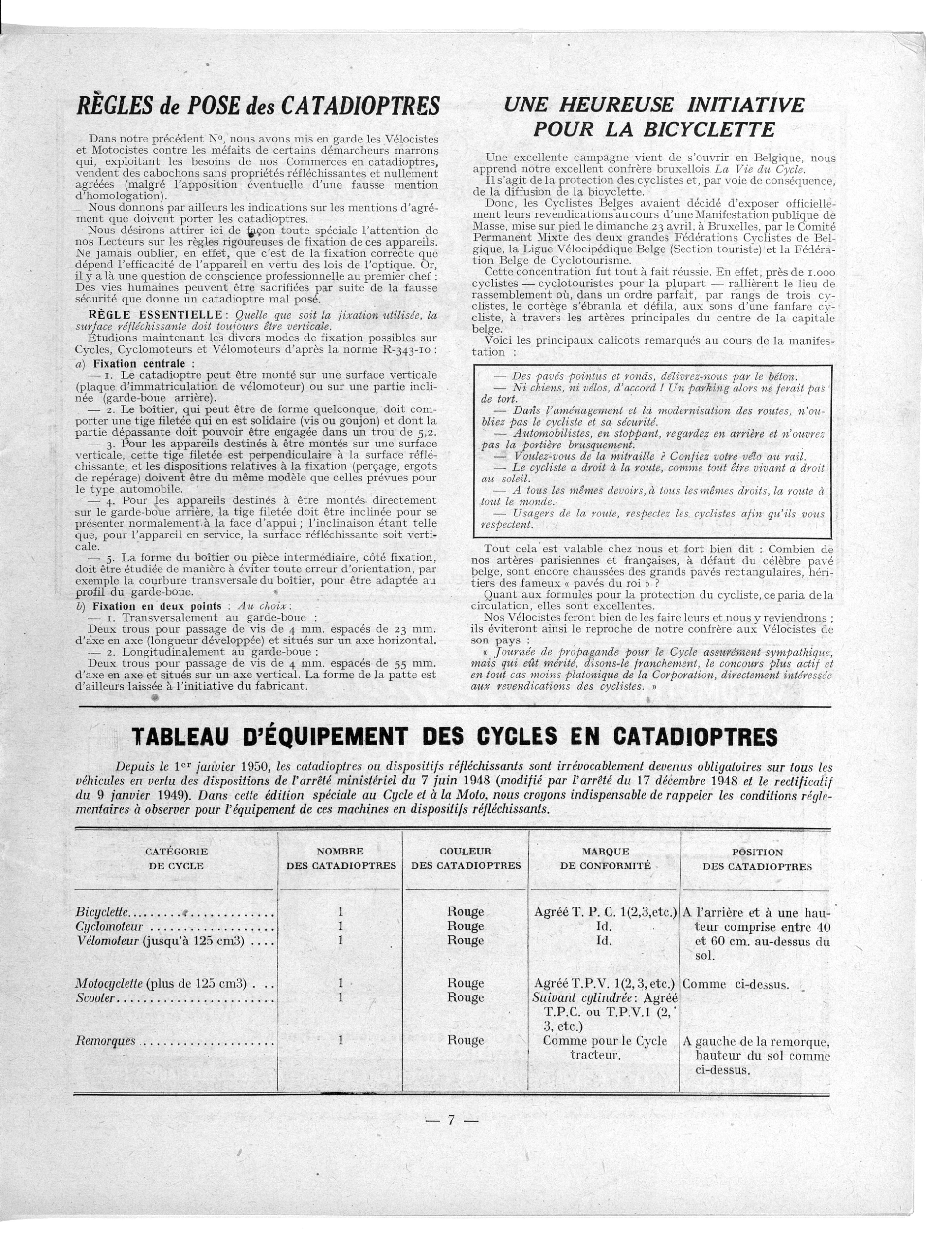
RÈGLES de POSE des CATADIOPTRES RÈGLE ESSENTIELLE : Quelle que soit la fixation utilisée, la surface réfléchissante doit toujours être verticale. a) Fixation centrale : — 1. Le catadioptre peut être monté sur une surface verticale (plaque d'immatriculation de vélomoteur) ou sur une partie inclinée (garde-boue arrière). — 2. Le boîtier, qui peut être de …
This is a magazine article, so its running text is summarized here rather than reproduced; the headline, byline, specifications and scores are transcribed as printed.
From L’Officiel du cycle, 3 June 1950, page 7: the rules for fitting reflectors, a Belgian cyclists’ demonstration and the table of reflector equipment for each category of cycle. The title, headings, captions and lists are transcribed as printed; the text is summarized in Ebykr’s words, and the page images carry it in full. It belongs to the trade columns that the weekly addressed to the French cycle dealers, the vélocistes.
— Page 1 —
RÈGLES de POSE des CATADIOPTRES
[Ebykr summary; the article’s text is not reproduced. In its previous number the paper warned vélocistes and motocistes against shady canvassers who, exploiting the trade’s need for reflectors, sell lenses with no reflecting properties and no approval at all (sometimes bearing a false mark of homologation); elsewhere in this issue it gives the approval marks reflectors must carry. Here it draws readers’ special attention to the strict rules for mounting them, since by the laws of optics a reflector works only if it is fitted correctly. The writer calls this above all a matter of professional conscience: human lives may be lost through the false security of a badly fitted reflector. He then sets out the mounting methods allowed on cycles, cyclomoteurs and vélomoteurs under standard R-343-10, as follows.]
RÈGLE ESSENTIELLE : Quelle que soit la fixation utilisée, la surface réfléchissante doit toujours être verticale.
a) Fixation centrale :
— 1. Le catadioptre peut être monté sur une surface verticale (plaque d’immatriculation de vélomoteur) ou sur une partie inclinée (garde-boue arrière).
— 2. Le boîtier, qui peut être de forme quelconque, doit comporter une tige filetée qui en est solidaire (vis ou goujon) et dont la partie dépassante doit pouvoir être engagée dans un trou de 5,2.
— 3. Pour les appareils destinés à être montés sur une surface verticale, cette tige filetée est perpendiculaire à la surface réfléchissante, et les dispositions relatives à la fixation (perçage, ergots de repérage) doivent être du même modèle que celles prévues pour le type automobile.
— 4. Pour les appareils destinés à être montés directement sur le garde-boue arrière, la tige filetée doit être inclinée pour se présenter normalement à la face d’appui ; l’inclinaison étant telle que, pour l’appareil en service, la surface réfléchissante soit verticale.
— 5. La forme du boîtier ou pièce intermédiaire, côté fixation, doit être étudiée de manière à éviter toute erreur d’orientation, par exemple la courbure transversale du boîtier, pour être adaptée au profil du garde-boue.
b) Fixation en deux points : Au choix :
— 1. Transversalement au garde-boue :
Deux trous pour passage de vis de 4 mm. espacés de 23 mm. d’axe en axe (longueur développée) et situés sur un axe horizontal.
— 2. Longitudinalement au garde-boue :
Deux trous pour passage de vis de 4 mm. espacés de 55 mm. d’axe en axe et situés sur un axe vertical. La forme de la patte est d’ailleurs laissée à l’initiative du fabricant.
UNE HEUREUSE INITIATIVE
POUR LA BICYCLETTE
[Ebykr summary; the article’s text is not reproduced. The paper’s Brussels colleague La Vie du Cycle reports an excellent campaign just opened in Belgium for the protection of cyclists and so for the spread of the bicycle. Belgian cyclists chose to present their demands officially at a mass public demonstration held on Sunday 23 April in Brussels, organized by the Comité Permanent Mixte of the two large Belgian cycling federations, the Ligue Vélocipédique Belge (Section touriste) and the Fédération Belge de Cyclotourisme. It was a full success: nearly 1.000 cyclists, most of them cyclotourists, gathered and rode in perfect order, three abreast, to the music of a cyclists’ band through the main streets of central Brussels. The chief banners seen were these.]
— Des pavés pointus et ronds, délivrez-nous par le béton.
— Ni chiens, ni vélos, d’accord ! Un parking alors ne ferait pas de tort.
— Dans l’aménagement et la modernisation des routes, n’oubliez pas le cycliste et sa sécurité.
— Automobilistes, en stoppant, regardez en arrière et n’ouvrez pas la portière brusquement.
— Voulez-vous de la mitraille ? Confiez votre vélo au rail.
— Le cycliste a droit à la route, comme tout être vivant a droit au soleil.
— A tous les mêmes devoirs, à tous les mêmes droits, la route à tout le monde.
— Usagers de la route, respectez les cyclistes afin qu’ils vous respectent.
[Ebykr summary, after the boxed banners. The writer finds all this valid in France too, asking how many Parisian and French streets, short of the famous Belgian cobble, are still paved with the large rectangular setts inherited from the « pavés du roi ». He calls the slogans for the protection of the cyclist, “this pariah of the traffic”, excellent and urges French vélocistes to adopt them, promising to return to the subject; they would so avoid the reproach the Belgian colleague addressed to the vélocistes of his own country, which the paper quotes: a propaganda day for the cycle that was certainly appealing but deserved, frankly, more active and less platonic support from the trade, which has a direct stake in cyclists’ demands.]
TABLEAU D’ÉQUIPEMENT DES CYCLES EN CATADIOPTRES
[Ebykr summary; the introduction’s text is not reproduced. Since 1 January 1950 reflectors have been irrevocably compulsory on all vehicles under the ministerial order of 7 June 1948 (amended by the order of 17 December 1948 and the correction of 9 January 1949), and in this special edition devoted to the cycle and the motorcycle the paper restates the regulation conditions for equipping these machines with reflectors.]
CATÉGORIE DE CYCLE — NOMBRE DES CATADIOPTRES — COULEUR DES CATADIOPTRES — MARQUE DE CONFORMITÉ — POSITION DES CATADIOPTRES
Bicyclette — 1 — Rouge — Agréé T. P. C. 1(2,3,etc.) — A l’arrière et à une hauteur comprise entre 40 et 60 cm. au-dessus du sol.
Cyclomoteur — 1 — Rouge — Id. — [same entry, set once across the three rows]
Vélomoteur (jusqu’à 125 cm3) — 1 — Rouge — Id. — [same entry, set once across the three rows]
Motocyclette (plus de 125 cm3) — 1 — Rouge — Agréé T.P.V. 1(2, 3, etc.) — Comme ci-dessus.
Scooter — 1 — Rouge — Suivant cylindrée : Agréé T.P.C. ou T.P.V.1 (2, 3, etc.) — [no separate entry]
Remorques — 1 — Rouge — Comme pour le Cycle tracteur. — A gauche de la remorque, hauteur du sol comme ci-dessus.
[A full page of text only, with no illustration. The upper half holds two columns: at the left “RÈGLES de POSE des CATADIOPTRES” in bold condensed italic, its rules set in roman with the run-in labels “RÈGLE ESSENTIELLE”, “Fixation centrale” and “Fixation en deux points” in bold; at the right “UNE HEUREUSE INITIATIVE POUR LA BICYCLETTE” in two lines of bold italic capitals, with the eight banner slogans set in italic inside a ruled box. A heavy rule divides them from the lower half, where “TABLEAU D’ÉQUIPEMENT DES CYCLES EN CATADIOPTRES” runs across the page in heavy condensed sans-serif capitals over an italic introduction, followed by a five-column table between double rules, its column heads in small roman capitals, the vehicle categories in italic with dot leaders and the remaining entries in roman. The folio “— 7 —” is printed at the foot.]
Ebykr presents this material for research and education. If you hold rights to it or notice an ownership issue, please contact us and we will respond promptly.
The Ebykr Digest
New articles, timelines, catalog finds and registry activity — assembled from the archive once a month. Your address is never shared.
Double opt-in. One email per month. Unsubscribe at any time with one click.