About Ebykr
Ebykr celebrates classic and vintage lightweight bicycles through provocative imagery and opinion. Ride along with us.
About Ebykr
Ebykr celebrates classic and vintage lightweight bicycles through provocative imagery and opinion. Ride along with us.

Source: Gallica (Bibliothèque nationale de France), L'Officiel du cycle, du motocycle et du camping, 3 June 1950, page 5; ark:/12148/bd6t54185521p. Source gallica.bnf.fr / BnF.
| Type | Review |
|---|---|
| Year | 1950 |
| Publisher | L'Officiel du cycle |
| Country | France |
| Language | French |
| Pages | 1 |
| Source | Gallica (Bibliothèque nationale de France), L'Officiel du cycle, du motocycle et du camping, 3 June 1950, page 5; ark:/12148/bd6t54185521p. Source gallica.bnf.fr / BnF. |
| Credit | Ebykr archive; Bibliothèque nationale de France |
| Identifier | Gallica (BnF) ark:/12148/bd6t54185521p/f5 |
| Transcription | Headings and specifications transcribed; article text summarized |
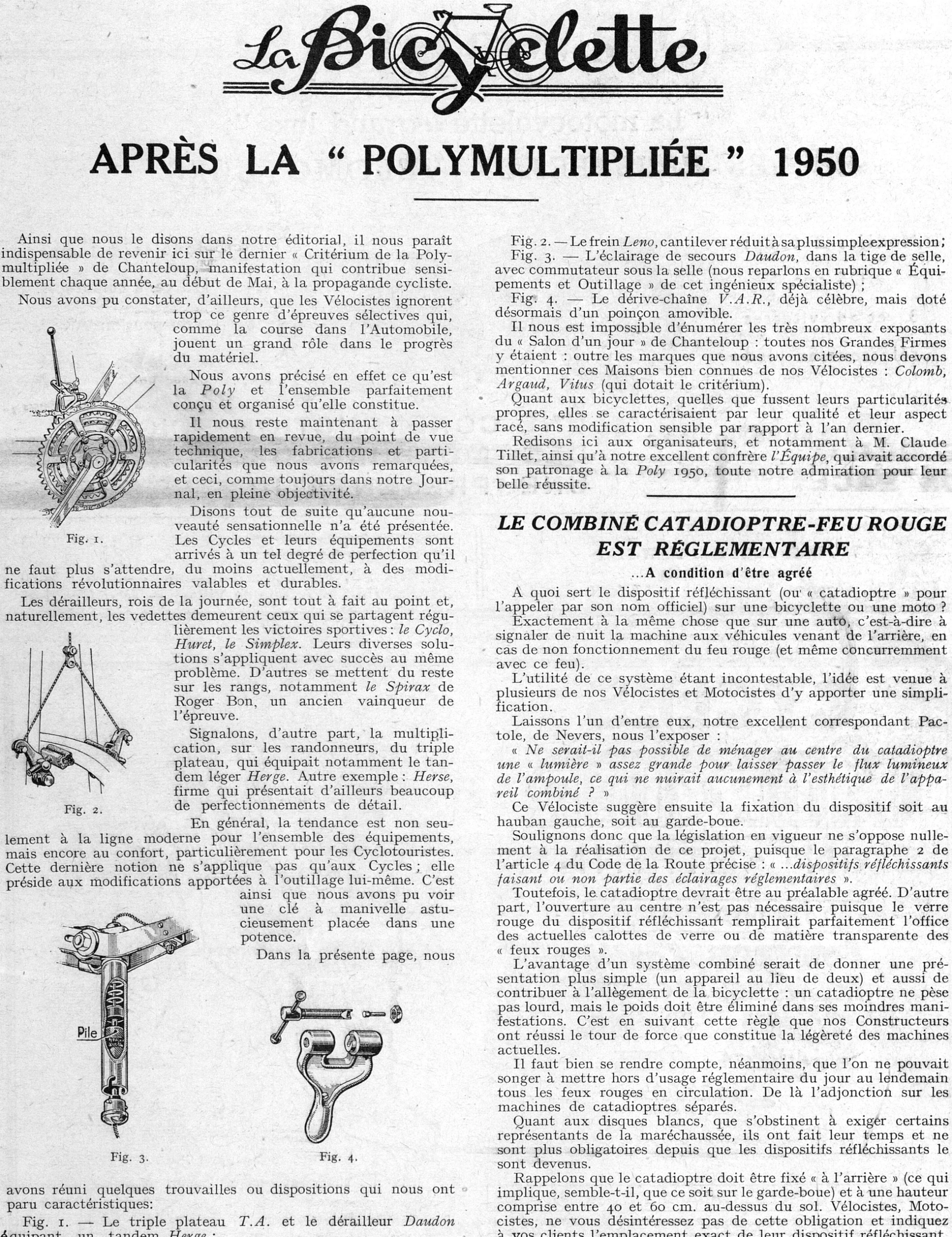
La Bicyclette APRÈS LA " POLYMULTIPLIÉE " 1950 Fig. 1. — Le triple plateau T.A. et le dérailleur Daudon équipant un tandem Herge ; Fig. 2. — Le frein Leno, cantilever réduit à sa plus simple expression ; Fig. 3. — L'éclairage de secours Daudon, dans la tige de selle, avec commutateur sous la selle …
This is a magazine article, so its running text is summarized here rather than reproduced; the headline, byline, specifications and scores are transcribed as printed.
From L’Officiel du cycle, 3 June 1950, page 5: the review of the equipment seen at Chanteloup, with four figures, and the piece on the combined reflector and red rear lamp. The title, headings, captions and lists are transcribed as printed; the text is summarized in Ebykr’s words, and the page images carry it in full. It belongs to the trade columns that the weekly addressed to the French cycle dealers, the vélocistes.
— Page 1 —
La Bicyclette
APRÈS LA ” POLYMULTIPLIÉE ” 1950
[Ebykr summary; the article’s text is not reproduced. As promised in the paper’s editorial, the writer returns to the last « Critérium de la Polymultipliée » at Chanteloup, an event held each year at the start of May that does much for cycling. He regrets that vélocistes pay too little attention to such selective trials which, like racing for the automobile, play a large part in the progress of equipment. Having already described what the Poly is, he now reviews, from the technical point of view and with the paper’s usual objectivity, the products and details he noticed. No sensational novelty was shown: cycles and their equipment have reached such perfection that no worthwhile and lasting revolutionary change is to be expected, at least for now.]
[Ebykr summary, continued. The derailleurs, kings of the day, are fully developed, and the stars remain those that regularly share the sporting wins: le Cyclo, Huret and le Simplex, whose different solutions all succeed at the same problem. Others are coming forward, notably le Spirax of Roger Bon, a former winner of the event. Among the randonneurs the writer notes the spread of the triple chainring, fitted in particular to the light Herge tandem, and cites Herse as a firm that showed many refinements of detail. The general trend favors not only a modern line for all equipment but comfort, above all for cyclotourists, and the same idea now shapes tools: he saw a crank wrench cleverly housed in a stem. The page gathers some finds and arrangements he found characteristic, captioned as follows.]
Fig. 1. — Le triple plateau T.A. et le dérailleur Daudon équipant un tandem Herge ;
Fig. 2. — Le frein Leno, cantilever réduit à sa plus simple expression ;
Fig. 3. — L’éclairage de secours Daudon, dans la tige de selle, avec commutateur sous la selle (nous reparlons en rubrique « Équipements et Outillage » de cet ingénieux spécialiste) ;
Fig. 4. — Le dérive-chaîne V.A.R., déjà célèbre, mais doté désormais d’un poinçon amovible.
[Ebykr summary, continued. The many exhibitors at the « Salon d’un jour » at Chanteloup cannot all be listed: every large firm was there, and besides the marques already named the writer mentions Colomb, Argaud and Vitus (which endowed the critérium). The bicycles, whatever their individual features, stood out for their quality and thoroughbred look, with no notable change from the year before. He closes by repeating his admiration to the organizers, notably M. Claude Tillet, and to the paper’s colleague l’Équipe, which gave its patronage to the 1950 Poly.]
LE COMBINÉ CATADIOPTRE-FEU ROUGE
EST RÉGLEMENTAIRE
…A condition d’être agréé
[Ebykr summary; the article’s text is not reproduced. The reflector, or « catadioptre » by its official name, serves on a bicycle or a motorcycle exactly as on a car: it signals the machine at night to vehicles coming from behind if the red lamp fails, and alongside it. Several vélocistes and motocistes have thought to simplify the arrangement, and the paper’s correspondent Pactole, of Nevers, asks whether a “window” could be left at the center of the reflector, large enough to let the bulb’s light through without spoiling the look of the combined unit; he suggests mounting it on the left seat stay or on the mudguard.]
[Ebykr summary, continued. The writer stresses that current law does not oppose the idea, since paragraph 2 of article 4 of the Code de la Route speaks of « …dispositifs réfléchissants faisant ou non partie des éclairages réglementaires ». The reflector would, however, have to be approved beforehand, and the central opening is unnecessary because the red glass of the reflector would serve perfectly in place of the present glass or transparent caps of the red lamps. A combined unit would be simpler (one device instead of two) and would help lighten the bicycle: a reflector weighs little, but every trace of weight must go, and it is by this rule that the constructeurs achieved the lightness of present machines. All red lamps in use could not, he grants, be outlawed overnight, hence the separate reflectors added to machines. The white discs still demanded by some members of the police have had their day and are no longer compulsory since reflectors became so. He recalls that the reflector must be fitted « à l’arrière » (which seems to mean on the mudguard) at a height of 40 to 60 cm. above the ground, and urges vélocistes and motocistes to show their customers the exact place for it; the text runs on below the foot of the photographed page.]
[A full page of editorial text in two columns. At the head a drawn department title, “La Bicyclette”, is lettered in heavy swash script over triple rules, with a small line drawing of a bicycle worked into the middle letters, its wheels circling the second “c” and the first “e”; no signature is visible on it. Below, the article title “APRÈS LA ” POLYMULTIPLIÉE ” 1950″ runs across the page in large bold roman capitals over a short rule. The left column is broken by four line engravings with captions in small roman, each in precise outline with fine hatching: Fig. 1, a triple chainring and crank with a front changer and chain; Fig. 2, a cantilever brake mounted on a fork with its straddle cable; Fig. 3, a seat post opened in cutaway to show a battery labeled “Pile” with a spring and a bulb at its foot; Fig. 4, a chain tool with a threaded handle and a separate pin and nut. No signature or monogram can be found in the corners of any of the four drawings. The second article, “LE COMBINÉ CATADIOPTRE-FEU ROUGE EST RÉGLEMENTAIRE”, opens in the right column under a rule in bold italic capitals with a bold sans-serif subheading. The bottom line of both columns is cut by the edge of the photograph, so the text breaks off in mid-sentence.]
Ebykr presents this material for research and education. If you hold rights to it or notice an ownership issue, please contact us and we will respond promptly.
The Ebykr Digest
New articles, timelines, catalog finds and registry activity — assembled from the archive once a month. Your address is never shared.
Double opt-in. One email per month. Unsubscribe at any time with one click.