About Ebykr
Ebykr celebrates classic and vintage lightweight bicycles through provocative imagery and opinion. Ride along with us.
About Ebykr
Ebykr celebrates classic and vintage lightweight bicycles through provocative imagery and opinion. Ride along with us.

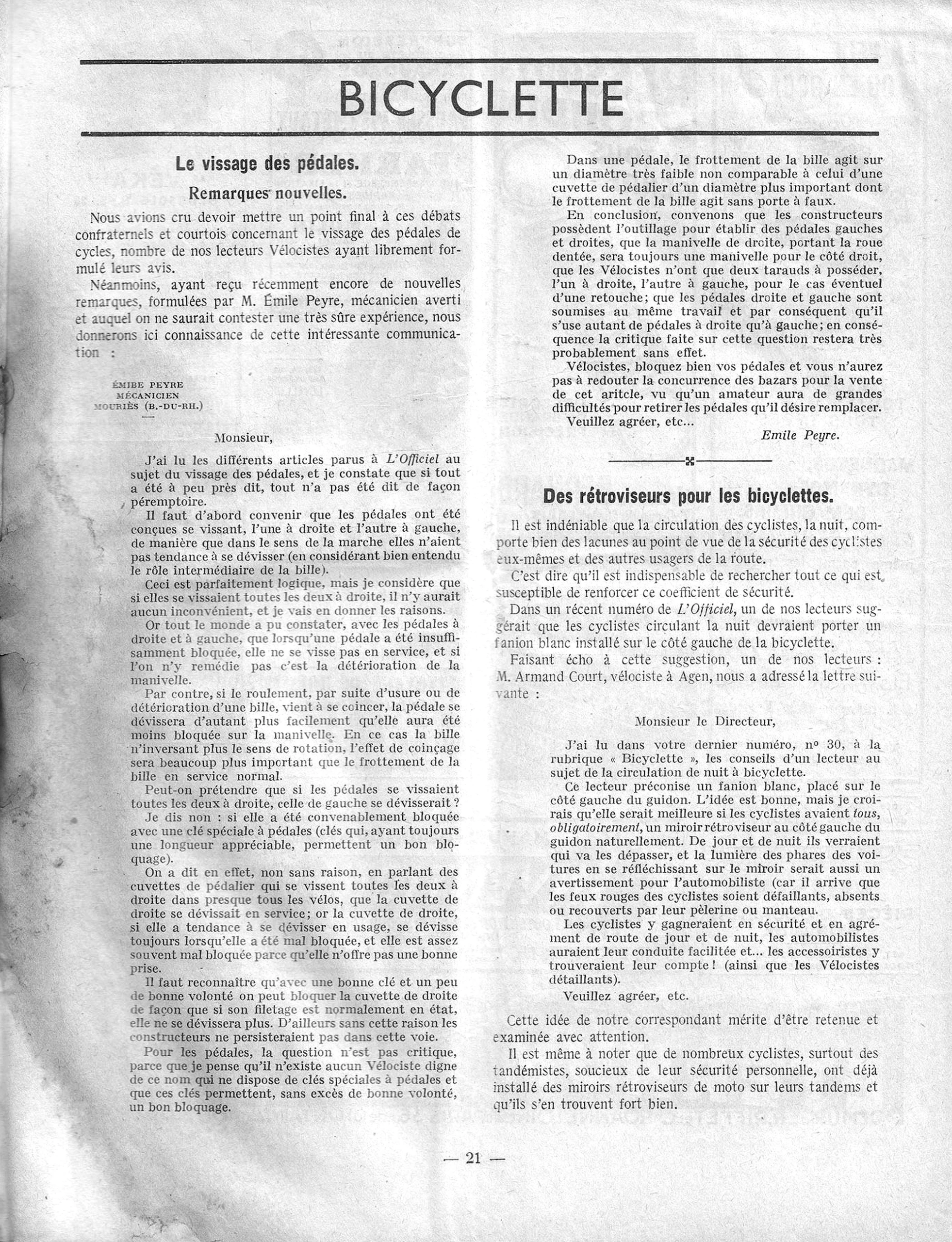
Source: L'Officiel de l'Automobile, du Cycle et de la Motocyclette, N° 3, 16 January 1938, page 21; scan of the issue from Cycle Memory (Mémoire du Cycle), Collection privée F.
| Type | Review |
|---|---|
| Year | 1938 |
| Publisher | L'Officiel du cycle |
| Country | France |
| Language | French |
| Pages | 1 |
| Source | L'Officiel de l'Automobile, du Cycle et de la Motocyclette, N° 3, 16 January 1938, page 21; scan of the issue from Cycle Memory (Mémoire du Cycle), Collection privée F. |
| Credit | Ebykr archive |
| Identifier | Permalink https://cyclememory.org/fr/search-coll-list.php?collectionID=325&docID=B-1-0000001016 |
| Transcription | Headings and specifications transcribed; article text summarized |
BICYCLETTE Le vissage des pédales. Remarques nouvelles. ÉMIBE PEYRE MÉCANICIEN MOURIÈS (B.-DU-RH.) Monsieur, Veuillez agréer, etc... Emile Peyre. Des rétroviseurs pour les bicyclettes. Monsieur le Directeur, Veuillez agréer, etc. — 21 —
This is a magazine article, so its running text is summarized here rather than reproduced; the headline, byline, specifications and scores are transcribed as printed.
“Bicyclette”, L’Officiel de l’Automobile, du Cycle et de la Motocyclette, 16 January 1938, page 21: readers’ letters on the threading of bicycle pedals (Émile Peyre of Mouriès) and on rear-view mirrors for cyclists (Armand Court of Agen). The headings, address block and signature are transcribed as printed; the text is summarized in Ebykr’s words, and the page image carries it in full.
— Page 1 —
BICYCLETTE
Le vissage des pédales.
Remarques nouvelles.
ÉMIBE PEYRE
MÉCANICIEN
MOURIÈS (B.-DU-RH.)
Monsieur,
Veuillez agréer, etc…
Emile Peyre.
Des rétroviseurs pour les bicyclettes.
Monsieur le Directeur,
Veuillez agréer, etc.
[Ebykr summary; the article’s text is not reproduced. The first item, “Le vissage des pédales. Remarques nouvelles.”, returns to the paper’s long-running exchange on how bicycle pedals are threaded onto the cranks. The editors say they had meant to close the courteous debate, since many reader Vélocistes had already given their views, but they print one more communication, from M. Émile Peyre, an experienced mechanic at Mouriès (Bouches-du-Rhône). In his letter Peyre writes that he has read the earlier articles in L’Officiel and finds that the matter has not been settled conclusively. He accepts that pedals were designed with one right-hand and one left-hand thread so that they do not unscrew in the direction of travel, allowing for the intermediate role of the ball bearing, but argues that two right-hand threads would cause no trouble. A pedal that is not tightened enough works loose and ruins the crank whichever thread it has; a seized bearing, from a worn or broken ball, unscrews a pedal all the more readily the less tightly it was locked, because the jamming effect then outweighs normal ball friction. A pedal locked properly with a special pedal spanner, whose length gives good leverage, will not come undone. He compares the bottom-bracket cups, both right-hand threaded on almost every bicycle, where the right cup is said to unscrew in service: it does so only when badly locked, often because it offers a poor grip, and a good spanner and a little care hold it if its thread is sound, which is why makers persist. Pedals, he says, are not a critical case, since every Vélociste worthy of the name owns special pedal spanners, and ball friction in a pedal acts on a very small diameter, unlike a bottom-bracket cup of larger diameter whose ball friction acts without overhang. He concludes that makers have the tooling for left and right pedals, that the right crank carrying the chainwheel will always be a right-side crank, that Vélocistes need only two taps (right and left) for any retouching, and that both pedals do the same work and wear alike, so the criticism will probably come to nothing. He urges Vélocistes to lock pedals firmly, so that they need not fear the competition of the bazaars, since an amateur will then struggle to remove pedals he wants to replace.
The second item, “Des rétroviseurs pour les bicyclettes.”, notes that cycling at night has many shortcomings for the safety of cyclists and of other road users, and that anything raising that margin of safety should be sought. A reader had suggested in a recent number of L’Officiel that night cyclists carry a white pennant (fanion) on the left side of the bicycle; in response M. Armand Court, vélociste at Agen, sent a letter. He refers to the advice printed in the last number, n° 30, under the « Bicyclette » rubric, and finds the white pennant on the left of the handlebar a good idea, but thinks it better that all cyclists be required to fit a rear-view mirror (miroir rétroviseur) on the left of the handlebar. By day and night riders would see who is about to overtake, and car headlights reflected in the mirror would also warn the motorist, as cyclists’ red rear lights are sometimes faulty, missing or hidden by a cape or coat. Cyclists would gain in safety and comfort, motorists would find driving easier, and the accessory makers (accessoiristes), as well as the retail Vélocistes, would profit. The editors close by calling the idea worth keeping and examining, and add that many cyclists, tandem riders above all, have already fitted motorcycle rear-view mirrors to their tandems and are well pleased with them.]
[The page has no drawings or photographs; the two items are separated by a short rule with a small cross ornament at its center.]
— 21 —
Ebykr presents this material for research and education. If you hold rights to it or notice an ownership issue, please contact us and we will respond promptly.
The Ebykr Digest
New articles, timelines, catalog finds and registry activity — assembled from the archive once a month. Your address is never shared.
Double opt-in. One email per month. Unsubscribe at any time with one click.