About Ebykr
Ebykr celebrates classic and vintage lightweight bicycles through provocative imagery and opinion. Ride along with us.
About Ebykr
Ebykr celebrates classic and vintage lightweight bicycles through provocative imagery and opinion. Ride along with us.

Source: Le Cycle, n° 119, May 1971, pages 33, 34, 35, 36; scan of the issue from Cycle Memory (Mémoire du Cycle), Collection privée H.D.
| Type | Review |
|---|---|
| Year | 1971 |
| Publisher | Le Cycle |
| Country | France |
| Language | French |
| Pages | 4 |
| Source | Le Cycle, n° 119, May 1971, pages 33, 34, 35, 36; scan of the issue from Cycle Memory (Mémoire du Cycle), Collection privée H.D. |
| Credit | Ebykr archive |
| Identifier | Permalink https://cyclememory.org/fr/search-coll-list.php?collectionID=773&docID=B-1-0000000811 |
| Transcription | Headings and specifications transcribed; article text summarized |
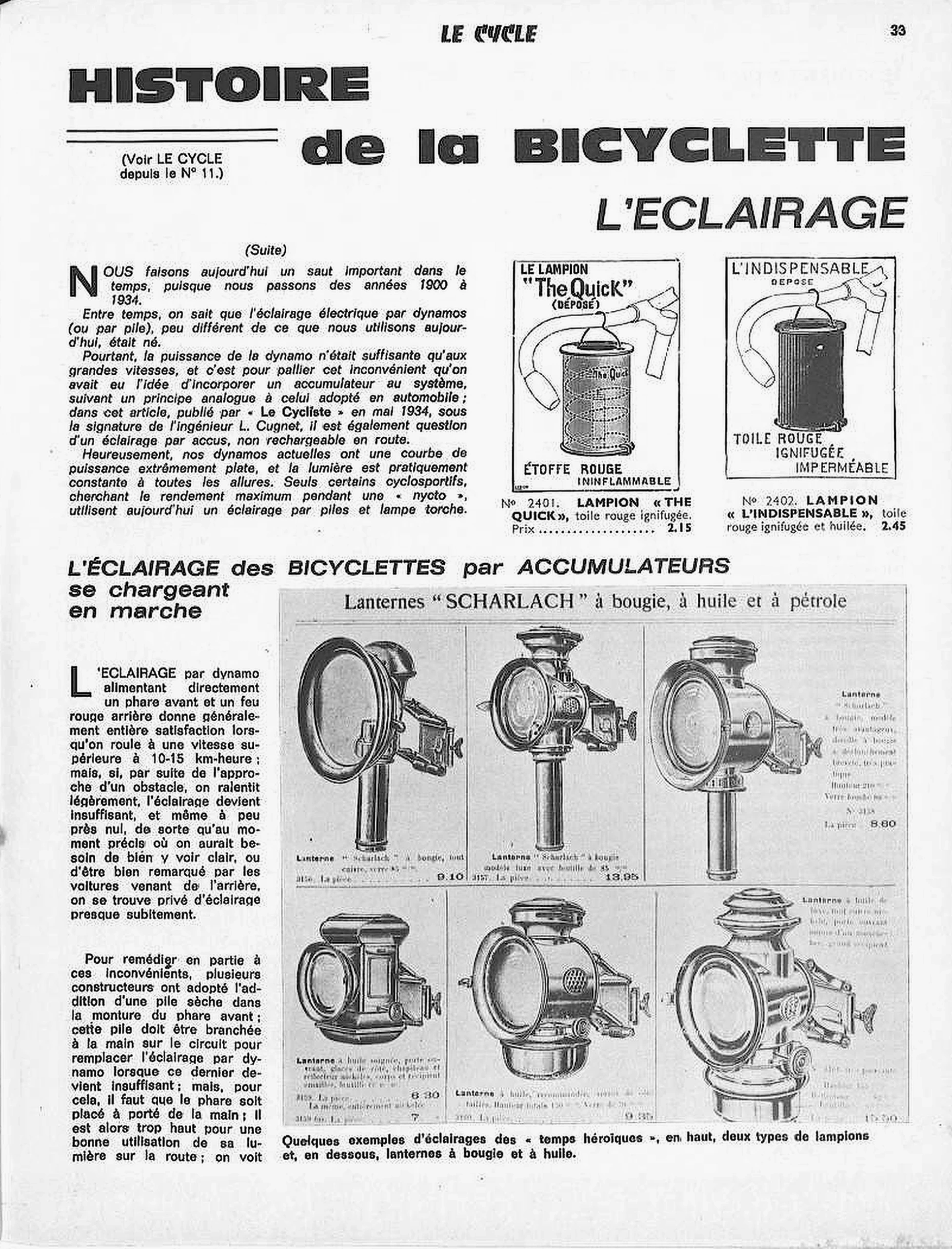
LE CYCLE HISTOIRE de la BICYCLETTE (Voir LE CYCLE depuis le N° 11.) L'ECLAIRAGE (Suite) L'ÉCLAIRAGE des BICYCLETTES par ACCUMULATEURS se chargeant en marche LE LAMPION "The Quick" (DÉPOSÉ) ÉTOFFE ROUGE ININFLAMMABLE N° 2401. LAMPION « THE QUICK», toile rouge ignifugée. Prix .................... 2.15 L'INDISPENSABLE DEPOSE TOILE ROUGE IGNIFUGÉE IMPERMÉABLE N° 2402. LAMPION « L'INDISPENSABLE …
This is a magazine article, so its running text is summarized here rather than reproduced; the headline, byline, specifications and scores are transcribed as printed.
An installment of Le Cycle’s serial “Histoire de la Bicyclette”, pages 33 to 36 of n° 119, May 1971, on lighting (“L’Éclairage”): accumulator lighting charged on the road, quoting L. Cugnet’s 1934 article in Le Cycliste, with reproduced catalog cuts of Scharlach, acetylene and other lanterns, the 1936 Jux Dyna-Phare and a panel of old head badges. Headlines, model names and prices are transcribed as printed; the text is summarized in Ebykr’s words, and the page images carry it in full.
— Page 1 —
LE CYCLE
HISTOIRE de la BICYCLETTE
(Voir LE CYCLE depuis le N° 11.)
L’ECLAIRAGE
(Suite)
L’ÉCLAIRAGE des BICYCLETTES par ACCUMULATEURS se chargeant en marche
[Reproduced period catalog cuts, upper right of the page:]
LE LAMPION
“The Quick”
(DÉPOSÉ)
ÉTOFFE ROUGE
ININFLAMMABLE
N° 2401. LAMPION « THE QUICK», toile rouge ignifugée. Prix ……………….. 2.15
L’INDISPENSABLE
DEPOSE
TOILE ROUGE
IGNIFUGÉE
IMPERMÉABLE
N° 2402. LAMPION « L’INDISPENSABLE », toile rouge ignifugée et huilée. 2.45
[Reproduced period catalog page, lower right of the page; its small descriptive type is only partly legible at this scan’s resolution:]
Lanternes “SCHARLACH” à bougie, à huile et à pétrole
N° | Lanterne | La pièce
3156 | Lanterne ” Scharlach ” à bougie, tout cuivre, verre 85 m/m [?] | 9.10
3157 | Lanterne ” Scharlach ” à bougie modèle luxe avec lentille [?] de 85 m/m [?] | 13.95
N° 3158 | Lanterne ” Scharlach ” à bougie, modèle très avantageux [?], douille à bougie [?] [illegible] breveté [?], très pratique [?]. Hauteur 210 m/m [?]. Verre [illegible] | 8.60
3159 | Lanterne à huile soignée, porte ouvrant, glaces de côté, chapeau et réflecteur nickelés, corps et récipient émaillés [?], [illegible] | 6.30
3159 bis | La même, entièrement nickelée | 7
3160 | Lanterne à huile, recommandée, [illegible]. Hauteur totale 150 m/m [?]. Verre de 70 [?] m/m | 9.35
[illegible] | Lanterne à huile de luxe, tout cuivre nickelé [?], porte ouvrant [?], [illegible], grand récipient [?] | 15.50 [?]
[Ebykr summary; the article’s text is not reproduced. The installment jumps from the 1900s to 1934. By then electric lighting by dynamo (or by battery), much like that of 1971, existed, but the dynamo gave enough power only at speed, so the idea arose of adding an accumulator to the system, as in the automobile. The installment reprints an article published by « Le Cycliste » in May 1934 under the signature of the engineer L. Cugnet, which deals with accumulator lighting that could not be recharged on the road. The editor adds that modern dynamos have a very flat output curve and give almost constant light at any speed; only some cyclosportifs chasing maximum output on a night ride (a « nycto ») still use battery lighting and a torch lamp. The 1934 text, under its own heading, opens: a dynamo feeding a front lamp and a red rear light satisfies the rider above 10-15 km per hour, but when he slows for an obstacle the light fades almost to nothing just when he must see and be seen by cars from behind. Several makers therefore fitted a dry cell in the lamp body, switched in by hand when the dynamo fails, which puts the lamp within reach of the hand and so too high to light the road well (the sentence runs on to the next page). The caption calls the pictures examples of lighting from the heroic days: two types of lampion above, candle and oil lanterns below.]
[Two reproduced catalog cuts at upper right show a folding cloth lampion hung by a wire hook from a dropped handlebar: “The Quick”, a pale cylinder patterned with a dashed spiral, and L’Indispensable, a dark ribbed cylinder. Below, a reproduced catalog page shows six engraved bicycle lanterns in two rows of three: in the upper row three Scharlach candle lanterns with round lenses, bracket clamps and a long candle tube under the body; in the lower row three oil lanterns, one square bodied and two drum bodied with chimneys and fuel reservoirs. No drawing on the page is signed.]
33
— Page 2 —
LE CYCLE
HISTOIRE DE LA BICYCLETTE • HIST
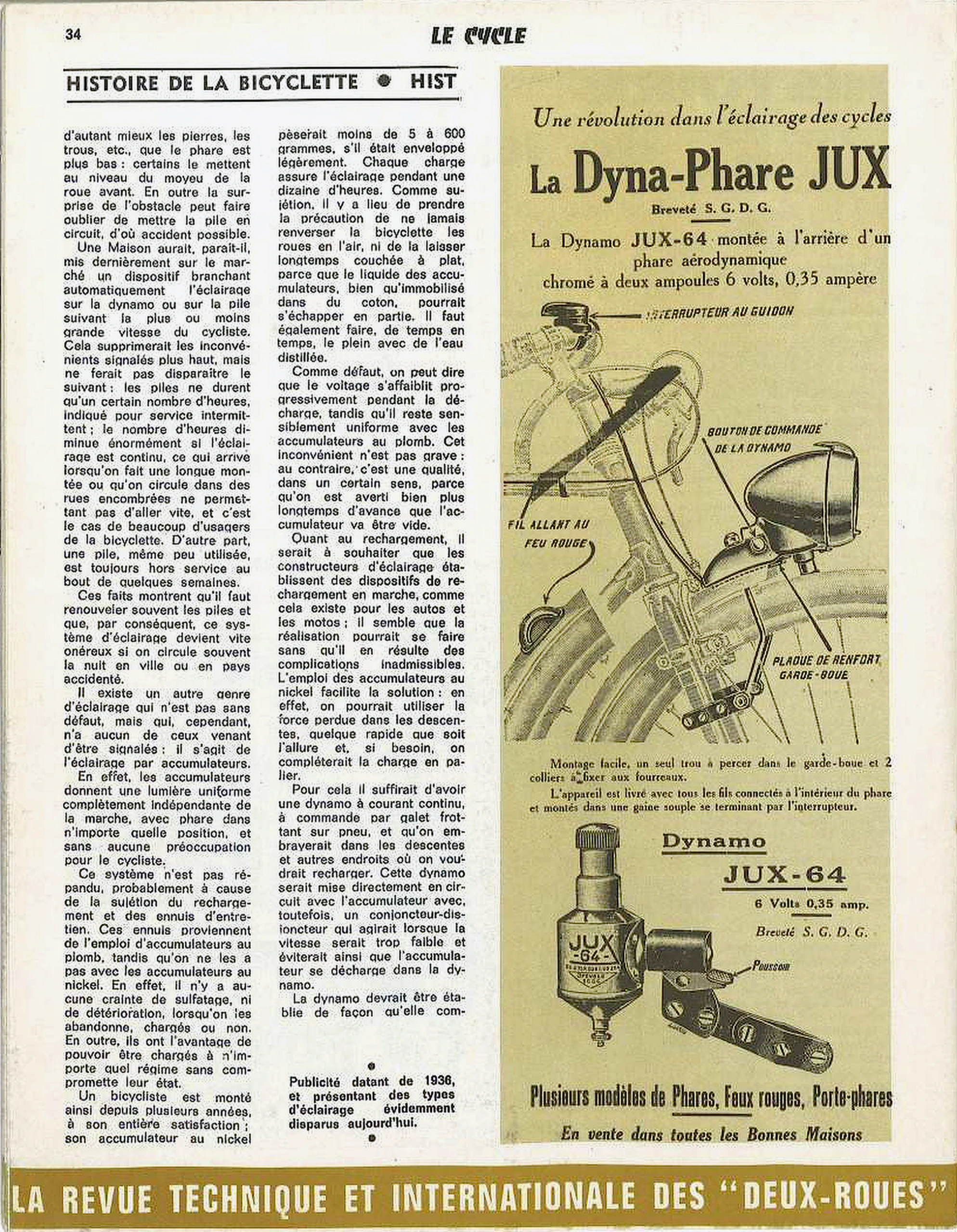
[Reproduced period advertisement, right half of the page, printed on a gold ochre panel:]
Une révolution dans l’éclairage des cycles
La Dyna-Phare JUX
Breveté S. G. D. G.
La Dynamo JUX-64 montée à l’arrière d’un phare aérodynamique chromé à deux ampoules 6 volts, 0,35 ampère
INTERRUPTEUR [?] AU GUIDON
BOUTON DE COMMANDE DE LA DYNAMO
FIL ALLANT AU FEU ROUGE
PLAQUE DE RENFORT GARDE-BOUE
Montage facile, un seul trou à percer dans le garde-boue et 2 colliers à fixer aux fourreaux.
L’appareil est livré avec tous les fils connectés à l’intérieur du phare et montés dans une gaine souple se terminant par l’interrupteur.
Dynamo
JUX-64
6 Volts 0,35 amp.
Breveté S. G. D. G.
Poussoir
Plusieurs modèles de Phares, Feux rouges, Porte-phares
En vente dans toutes les Bonnes Maisons
[Ebykr summary; the article’s text is not reproduced. L. Cugnet’s 1934 text continues: a lamp shows stones and holes better the lower it sits, and some riders mount it at front hub height; the surprise of an obstacle can also make a rider forget the dry cell. One firm is said to have marketed a device switching automatically between dynamo and battery according to speed, but dry cells are rated for a set number of hours of intermittent use, last far less when lit continuously on a long climb or in crowded streets and die within weeks even unused, so night riding in town or hilly country grows costly. Accumulators give uniform light independent of speed, with the lamp in any position. They are rare because of recharging and upkeep, troubles of lead accumulators that nickel ones avoid: no sulfation, no harm left charged or not, any charging rate. One cyclist has ridden so for several years; his nickel accumulator, lightly wrapped, would weigh under 500 to 600 grams and lights about ten hours per charge, but the bicycle must not stand upside down or lie flat for long, lest the electrolyte held in cotton escape, and it needs distilled water. Its voltage sinks gradually as it discharges, unlike lead, an early warning the author almost counts a virtue. He asks lighting makers for charging on the move, as on cars and motorcycles: a direct-current dynamo driven by a roller on the tire, engaged on descents, wired through a conjoncteur-disjoncteur cut-out so the accumulator cannot discharge into the dynamo at low speed (the sentence runs on to the next page). The caption dates the advertisement to 1936 and calls its lighting types long gone.]
[The reproduced 1936 advertisement shows the front of a bicycle in close view: a streamlined chrome headlamp mounted over the front mudguard with the dynamo behind it, a switch clamped to the handlebar, a wire running back toward the red rear light and a reinforcing plate on the mudguard, each pointed out by a lettered arrow. Below it a separate cut shows the JUX-64 bottle dynamo on its slotted mounting bracket with its plunger labeled Poussoir. No drawing on the page is signed by Rebour.]
34
— Page 3 —
LE CYCLE
HISTOIRE DE LA BICYCLETTE • HISTOIRE DE LA BICYCLETTE • HISTOIRE DE LA
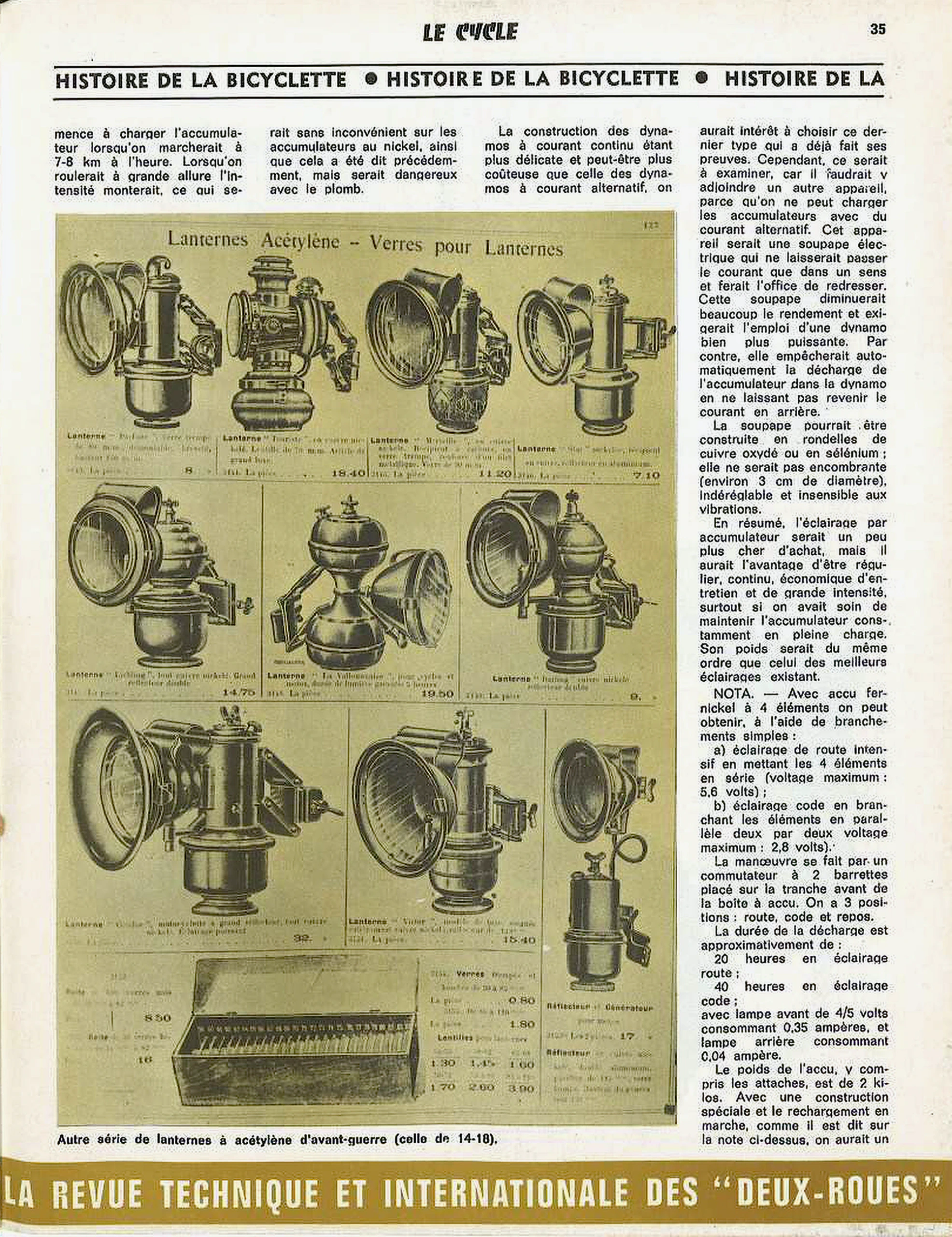
[Reproduced period catalog page, left three quarters of the page; its small descriptive type is only partly legible at this scan’s resolution:]
Lanternes Acétylène – Verres pour Lanternes
122 [?]
N° | Article | La pièce
[illegible] | Lanterne ” Parfaite [?] “, verre trempé [?], démontable [?], [illegible] | 8 »
[illegible] | Lanterne ” Touriste [?] “, en cuivre nickelé. Lentille de 70 [?] m/m. Article de grand luxe [?] | 18.40
[illegible] | Lanterne ” Mireille [?] “, en cuivre nickelé. Récipient à carbure [?], [illegible]. Verre de 90 [?] m/m | 11.20
[illegible] | Lanterne ” Star [?] ” nickelée, récipient en cuivre, réflecteur en aluminium [?] | 7.10
[illegible] | Lanterne ” Lichtling [?] “, tout cuivre nickelé. Grand réflecteur double | 14.75 [?]
[illegible] | Lanterne ” La Vallonnaise [?] “, pour cycles et motos, durée de lumière garantie 5 heures [?] | 19.50
[illegible] | Lanterne ” [illegible] ” cuivre nickelé, réflecteur double | 9. »
[illegible] | Lanterne ” [illegible] “, motocyclette à grand réflecteur, tout cuivre nickelé. Éclairage puissant | 32. »
[illegible] | Lanterne ” Victor [?] “, modèle de luxe, [illegible] cuivre nickelé, réflecteur de [illegible] | 15.40
[illegible] | Boîte de [illegible] verres [illegible] | 8.50
[illegible] | Boîte de [illegible] verres [illegible] | 16
[illegible] | Verres trempés et bombés de [illegible] m/m. La pièce | 0.80
[illegible] | de [illegible] m/m. La pièce | 1.80
[illegible] | Réflecteur et Générateur [illegible]. Les 2 pièces | 17. »
[illegible] | Réflecteur [illegible] | [illegible]
Lentilles pour lanternes
[illegible] | [illegible] | [illegible]
1.30 | 1.45 [?] | 1.60
[illegible] | [illegible] | [illegible]
1.70 | 2.60 | 3.90
[Ebykr summary; the article’s text is not reproduced. L. Cugnet’s 1934 text continues: the charging dynamo should begin charging at 7-8 km per hour; at high speed the current would rise, harmless for nickel accumulators but dangerous for lead ones. Direct-current dynamos are more delicate and perhaps dearer than the proven alternating-current type, but alternating current cannot charge an accumulator, so a one-way electric valve (soupape) would be needed as a rectifier; it would cut efficiency and demand a stronger dynamo, but would also stop the accumulator discharging into the dynamo. It could be made of oxidized copper discs or selenium, about 3 cm across, needing no adjustment and indifferent to vibration. In short, accumulator lighting would cost a little more to buy but be steady, continuous, cheap to run and bright, and no heavier than the best existing systems. A note (NOTA) adds that a four-cell iron-nickel (fer-nickel) accumulator gives intense road lighting with its cells in series (5.6 volts maximum) or code lighting with them paired in parallel (2.8 volts maximum), selected by a two-bar switch on the front edge of the battery box with three positions: road, code and rest. Discharge lasts about 20 hours on road and 40 hours on code, with a 4/5 volt front lamp drawing 0.35 ampere and a rear lamp drawing 0.04 ampere. The accumulator weighs 2 kilos with its fittings; special construction and charging on the move would make it far lighter (the sentence runs on to the next page). The caption calls the pictures another series of acetylene lanterns from before the 1914-18 war.]
[The reproduced catalog page shows engraved acetylene bicycle and motorcycle lanterns: four across the top row, three in the middle row and, in the third row, two more beside a headlamp joined by a coiled tube to a separate carbide generator. Each lantern has a round lens, a carbide reservoir below and a bracket clamp. The bottom row shows an open wooden box holding rows of spare lantern glasses. No drawing on the page is signed by Rebour; a tiny engraver’s mark under the middle lantern of the second row is illegible.]
35
— Page 4 —
LE CYCLE
HISTOIRE DE LA BICYCLETTE • HISTOIRE DE LA BICYCLETTE • HISTOIRE DE LA
L. CUGNET,
Ingénieur aux Aciéries de Firminy
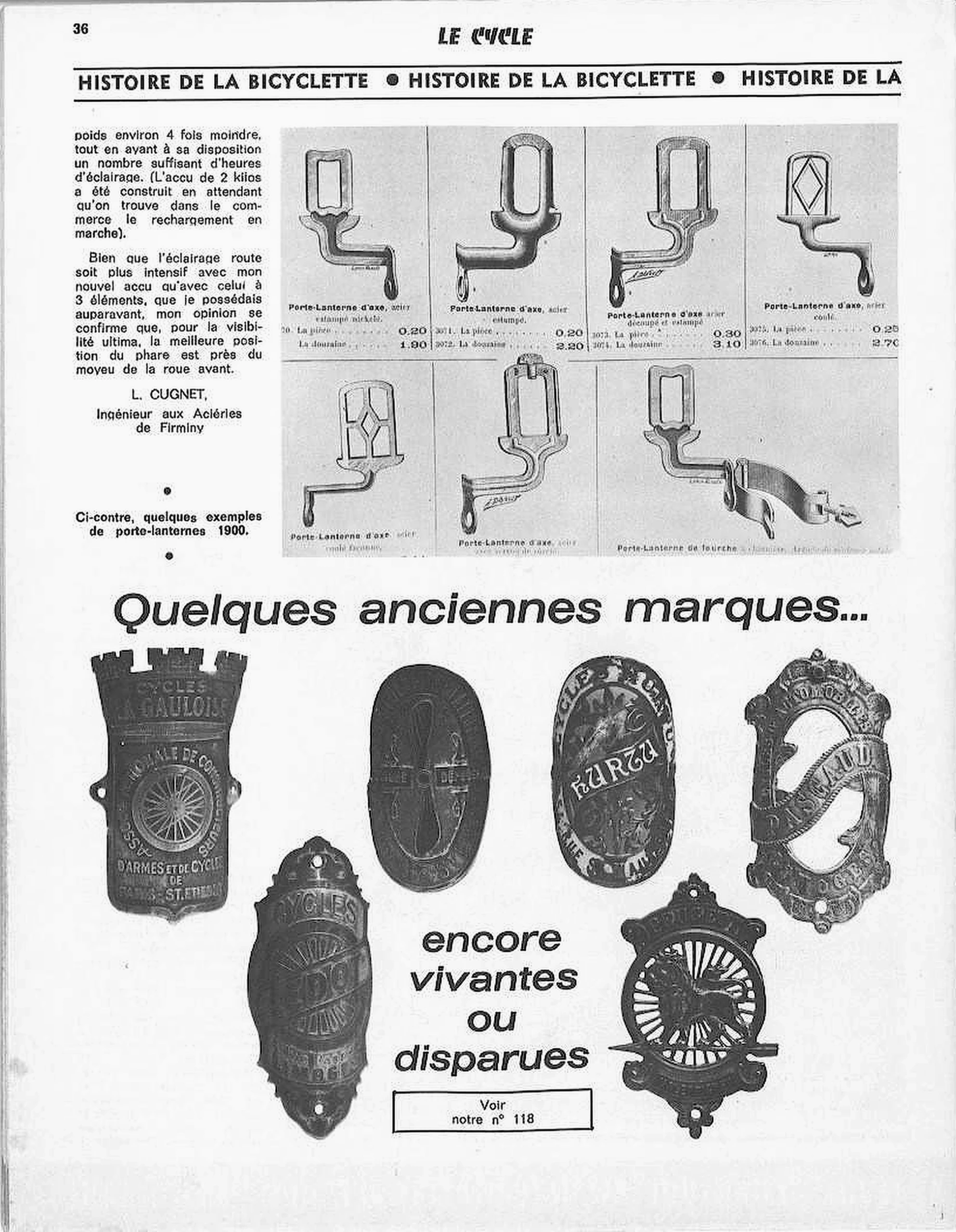
[Reproduced period catalog cuts, upper right of the page; the second row’s prices are cut off by the reproduction’s lower edge and some descriptive type is too small to read:]
N° | Article | Prix
[cut off]0. | Porte-Lanterne d’axe, acier estampé nickelé. La pièce | 0.20
| La douzaine | 1.90
3071. | Porte-Lanterne d’axe, acier estampé. La pièce | 0.20
3072. | La douzaine | 2.20
3073. | Porte-Lanterne d’axe acier découpé et estampé. La pièce | 0.30
3074. | La douzaine | 3.10
3075. | Porte-Lanterne d’axe, acier coulé. La pièce | 0.25
3076. | La douzaine | 2.70
| Porte-Lanterne d’axe, acier coulé [illegible] | [cut off]
| Porte-Lanterne d’axe, acier [illegible] | [cut off]
| Porte-Lanterne de fourche [illegible] | [cut off]
Quelques anciennes marques…
encore vivantes ou disparues
Voir
notre n° 118
[Ebykr summary; the article’s text is not reproduced. L. Cugnet’s 1934 text ends here (continued from page 35): with a special construction and charging on the move, an accumulator could weigh about four times less and still give enough hours of light, and the author explains that his 2-kilo accumulator was built while waiting for charging on the move to reach the market. Although road lighting is brighter with his new accumulator than with the three-cell one he owned before, he remains convinced that for the best visibility the lamp belongs near the front wheel hub. The text is signed L. CUGNET, engineer at the Aciéries de Firminy. The caption beside the pictures calls them a few examples of lantern brackets (porte-lanternes) of 1900. The box below introduces a few old makes, still alive or vanished, and refers the reader to the magazine’s issue n° 118.]
[The reproduced catalog cuts show seven engraved lantern brackets in two rows: six axle-mounted brackets (porte-lanterne d’axe), each a flat plate with a rectangular or lattice-pierced frame for the lantern, a cranked arm and an eye that fits over the hub axle, and one fork-mounted bracket (porte-lanterne de fourche) with a hinged clamp. Two cuts carry a small engraver’s script signature that is illegible at this resolution, and three carry tiny printed marks; none is signed by Rebour. Below, the box shows six photographed head badges: a crenellated Cycles La Gauloise badge naming an association of arms and cycle makers of Paris and Saint-Étienne around a spoked wheel; a dark oval badge with a propeller; an oval Hurtu badge with the name on a ribbon; an openwork badge of a Limoges automobile and cycle maker with its name on a ribbon; a Cycles badge with a rayed wheel crossed by a diagonal ribbon; and a lion walking across a spoked wheel pierced by an arrow. The names on the propeller, rayed-wheel and lion badges are too worn or too small to read at this resolution.]
36
Ebykr presents this material for research and education. If you hold rights to it or notice an ownership issue, please contact us and we will respond promptly.
The Ebykr Digest
New articles, timelines, catalog finds and registry activity — assembled from the archive once a month. Your address is never shared.
Double opt-in. One email per month. Unsubscribe at any time with one click.