About Ebykr
Ebykr celebrates classic and vintage lightweight bicycles through provocative imagery and opinion. Ride along with us.
About Ebykr
Ebykr celebrates classic and vintage lightweight bicycles through provocative imagery and opinion. Ride along with us.

Source: Le Cycle, n° 119, May 1971, pages 27, 29, 31; scan of the issue from Cycle Memory (Mémoire du Cycle), Collection privée H.D.
| Type | Review |
|---|---|
| Year | 1971 |
| Publisher | Le Cycle |
| Country | France |
| Language | French |
| Pages | 3 |
| Source | Le Cycle, n° 119, May 1971, pages 27, 29, 31; scan of the issue from Cycle Memory (Mémoire du Cycle), Collection privée H.D. |
| Credit | Ebykr archive |
| Identifier | Permalink https://cyclememory.org/fr/search-coll-list.php?collectionID=773&docID=B-1-0000000811 |
| Transcription | Headings and specifications transcribed; article text summarized |
LE CYCLE Les conseils et souvenirs d'un grand champion ANDRE LEDUCQ nous conte ses débuts 7 (voir LE CYCLE depuis le n° 113) 1927, mon premier Tour de France 27 LE CYCLE HISTOIRE DE LA BICYCLETTE • HISTOIRE DE LA BICYCLETTE • HISTOIRE DE LA TOUR DE FRANCE 29 LE CYCLE • LES SOUVENIRS D'ANDRE …
This is a magazine article, so its running text is summarized here rather than reproduced; the headline, byline, specifications and scores are transcribed as printed.
The seventh installment of André Leducq’s memoirs in Le Cycle n° 119, May 1971, “1927, mon premier Tour de France”: he recalls the start of his first Tour, the riders of 1927 and Francis Pélissier’s yellow jersey, with a reproduced page of the weekly Match. The titles and captions’ names are transcribed as printed; the text is summarized in Ebykr’s words, and the page images carry it in full.
— Page 1 —
LE CYCLE
Les conseils et souvenirs d’un grand champion
ANDRE LEDUCQ
nous conte ses débuts
7 (voir LE CYCLE depuis le n° 113)
1927, mon premier Tour de France
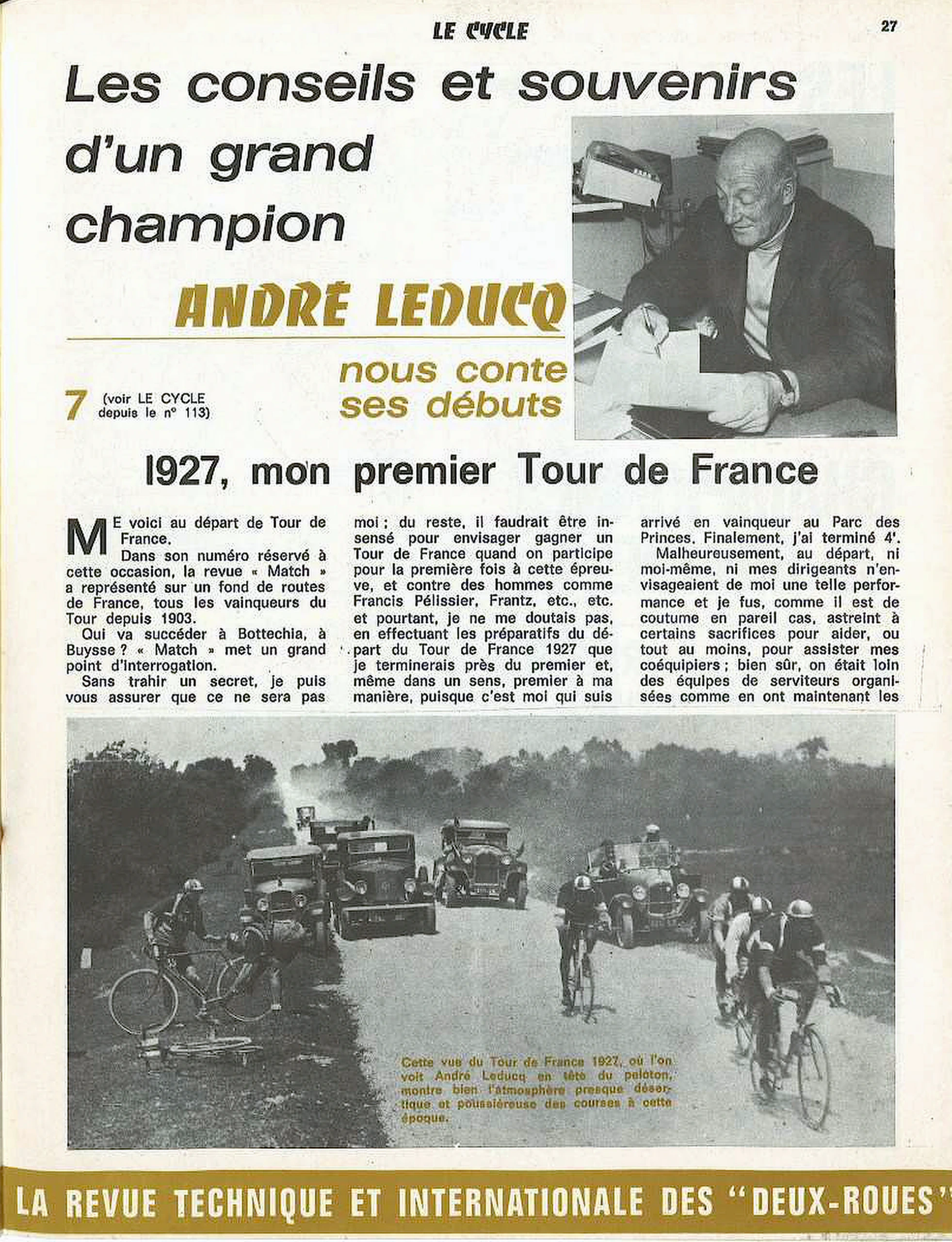
[Ebykr summary; the article’s text is not reproduced. André Leducq, writing in the first person, opens the seventh installment of his memoirs at the start of his first Tour de France, in 1927. The magazine « Match », in its special Tour issue, had pictured every winner of the Tour since 1903 against a background of French roads and asked, with a big question mark, who would succeed Bottechia and Buysse. Leducq says it was not going to be him: it would have been madness to think of winning the Tour at a first attempt against men such as Francis Pélissier and Frantz. Yet while preparing for the start of the 1927 Tour de France he did not suspect that he would finish close to the winner, and even in a sense first in his own way, since it was he who rode in as winner at the Parc des Princes; in the end he finished fourth (printed 4′). At the start, however, neither he nor his team managers expected such a result, and, as was usual, he was bound to make sacrifices to help, or at least to assist, his teammates, at a time when nothing like the organized teams of helpers that the leaders of the Tour now have existed (continued on page 29). The caption says the photograph of the 1927 Tour de France, with André Leducq at the head of the peloton, shows how almost deserted and dusty the races of that time were.]
[At upper right a photograph shows Leducq in later life, bald, in a dark jacket and a light roll-neck, writing at a desk beside a telephone and stacked papers. The lower part of the page is filled by a photograph of the 1927 Tour: riders in leather hairnet helmets come along a dusty unpaved road followed by several open and closed motor cars, while at left a rider stands beside his bicycle at the roadside with another bicycle lying on the verge; the caption is printed in the gold second ink over the lower part of the photograph. The name ANDRE LEDUCQ, the words nous conte ses débuts and the figure 7 are also printed in gold. The page carries no drawing signed Rebour.]
27
— Page 2 —
LE CYCLE
HISTOIRE DE LA BICYCLETTE • HISTOIRE DE LA BICYCLETTE • HISTOIRE DE LA
TOUR DE FRANCE
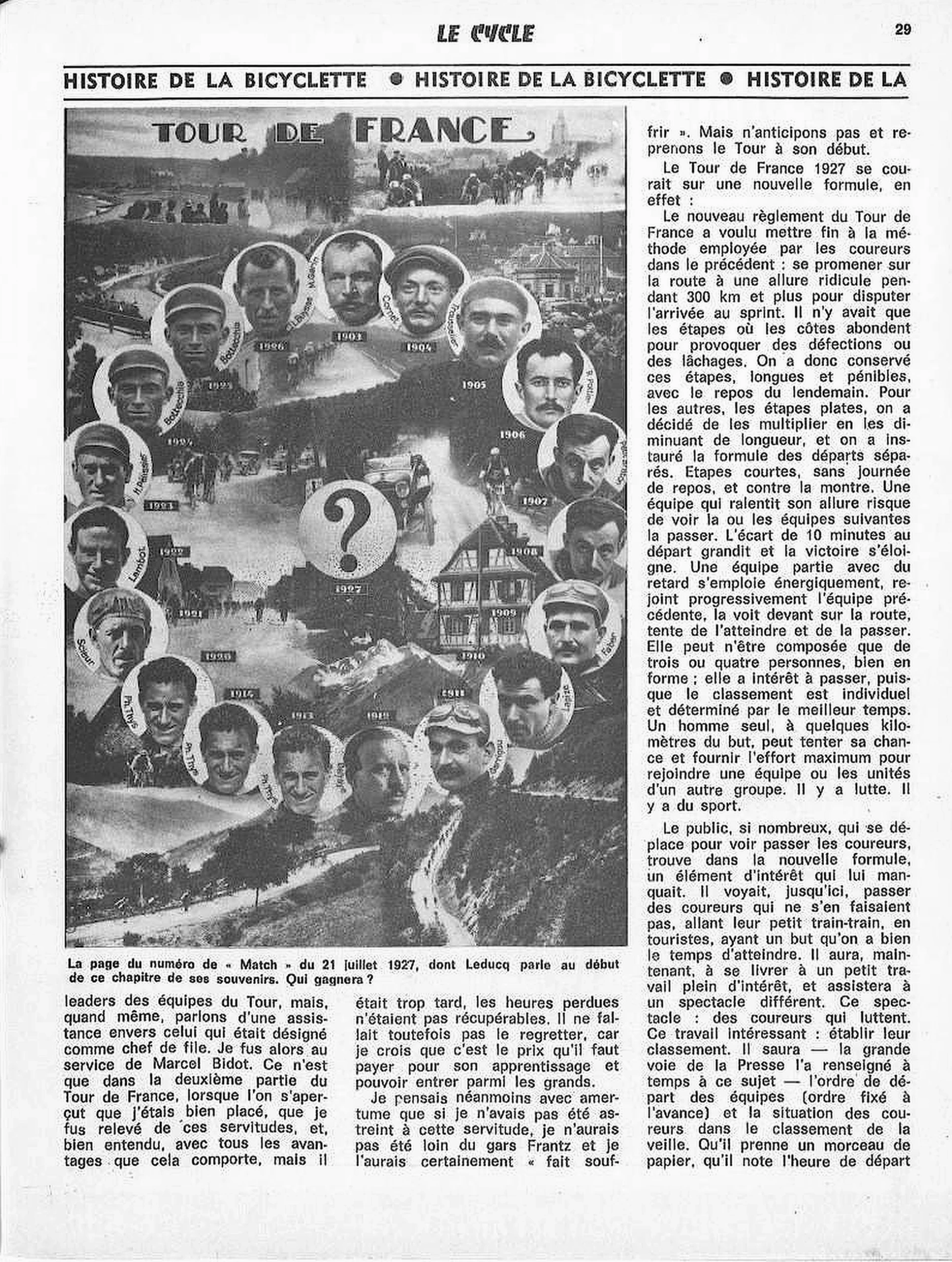
[Ebykr summary; the article’s text is not reproduced. (Continued from page 27.) Teams in 1927 still expected help for the rider named as team leader (chef de file), and Leducq rode in the service of Marcel Bidot. Only in the second part of the Tour de France, once he was seen to be well placed, was he released from those duties, too late to win back the lost hours. He calls it the price of an apprenticeship among the great riders, yet thought bitterly that without it he would have been close to Frantz and made him suffer. He then explains the new formula of the 1927 Tour, meant to stop riders dawdling for 300 km and more before sprinting for the finish, since only hilly stages caused abandons. The long, hard climbing stages were kept, each followed by a rest day; the flat stages were made more numerous and shorter and run with separate starts (départs séparés), against the clock and without rest days, by teams that might number only three or four riders. A team that slowed could be passed by the next and a 10-minute starting gap could grow; since the classification was individual, on best time, a lone rider a few kilometers from the finish could chase a team ahead. Spectators, used to seeing riders amble like tourists, now saw a real contest and, knowing from the Press the teams’ starting order and the previous day’s standings, could note the starting times (continued on page 31). The caption says the picture is the page of « Match » of 21 July 1927 that Leducq mentions at the start of the chapter, and asks who will win.]
[The left two thirds of the upper page reproduce a page of the magazine « Match »: a photomontage of race scenes (riders on country roads, crowds, a half-timbered house, mountains and a winding mountain road) under the large headline TOUR DE FRANCE, with oval portraits of past winners set around it, each with a small name label and a year plate from 1903 to 1926. The name labels appear to read M. Garin, Cornet, Trousselier, R. Pottier, Petit-Breton, Faber, Lapize, Garrigou, Defraye, Ph. Thys (three portraits), Scieur, Lambot, H. Pélissier, Bottecchia (two portraits) and L. Buysse, and a large question mark at the center stands over the year 1927. The page carries no drawing signed Rebour.]
29
— Page 3 —
LE CYCLE
• LES SOUVENIRS D’ANDRE LEDUCQ • LES SOUVENIRS D’ANDRE LEDUCQ •
(A suivre)
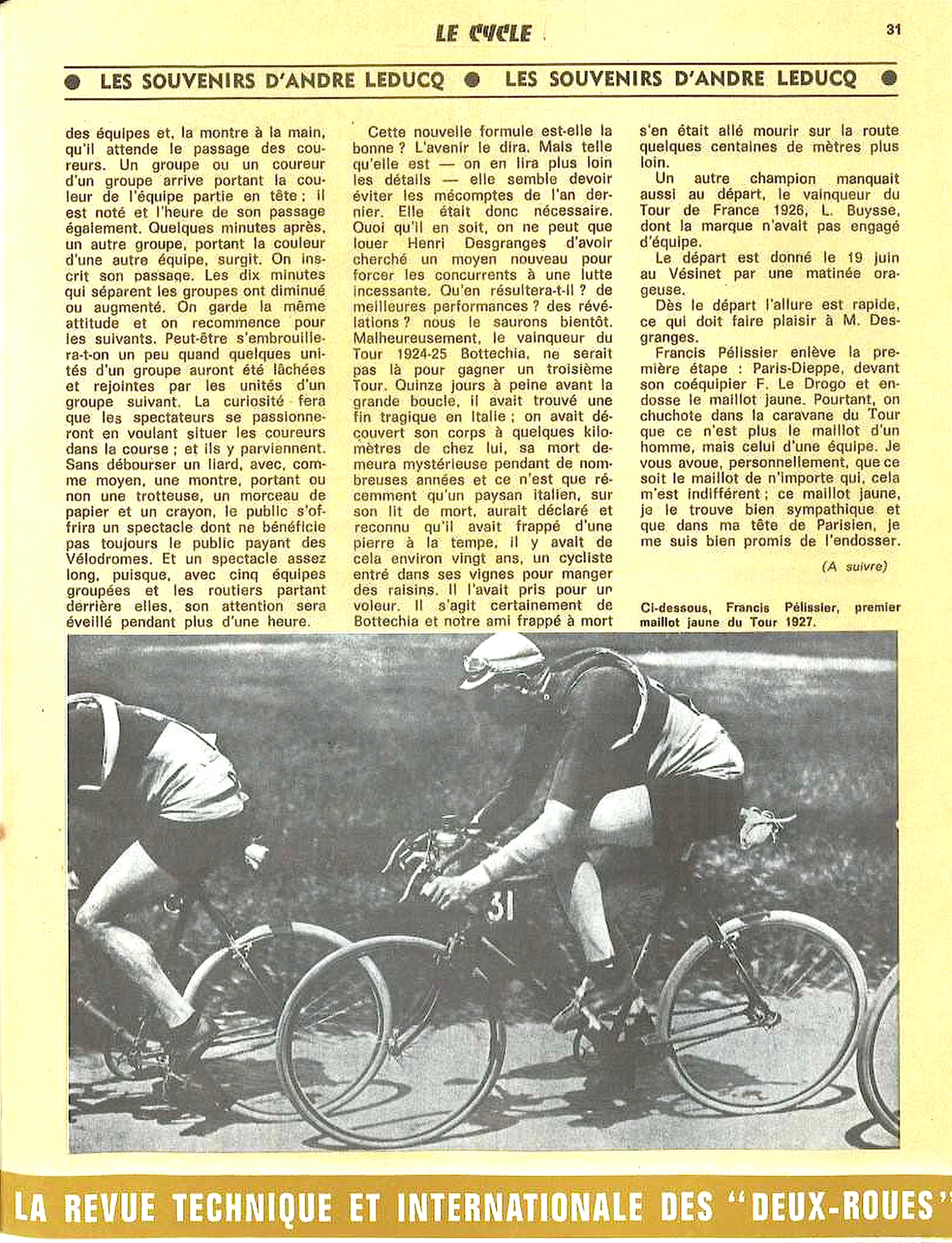
[Ebykr summary; the article’s text is not reproduced. (Continued from page 29.) Under the 1927 separate-start formula the roadside spectator, watch in hand, notes when a group in one team’s colors passes, sees whether the 10-minute gaps to the next teams shrink or grow and may lose track when dropped riders are caught by the next group; with a watch, paper and pencil, and without spending a penny (un liard), he gets a show the paying public of the Vélodromes does not always see, lasting over an hour with five grouped teams and the routiers starting behind them. Time would judge the formula, but it seemed to avoid the previous year’s disappointments, and Henri Desgranges deserved praise for forcing the riders into constant battle. Bottechia, winner in 1924-25, could not try for a third Tour: barely 15 days before the race he met a tragic end in Italy a few kilometers from home, a mystery until an Italian peasant reportedly confessed on his deathbed that about 20 years earlier he had struck a cyclist with a stone, taking him for a grape thief in his vineyard, the man dying on the road a few hundred meters away. L. Buysse, winner of the 1926 Tour de France, was absent because his make (marque) entered no team. The start was given on 19 June at Le Vésinet on a stormy morning, the pace pleased M. Desgranges and Francis Pélissier won the first stage, Paris-Dieppe, ahead of his teammate F. Le Drogo, taking the yellow jersey (maillot jaune), now whispered to be a team’s jersey rather than one man’s; Leducq, in his Parisian head, had promised himself to wear it. The caption names Francis Pélissier as first yellow jersey of the 1927 Tour.]
[The lower half of the page carries a photograph of Francis Pélissier on the road in the 1927 Tour, in a cap with goggles pushed up, riding a bicycle with the number plate 31 and drop handlebars beside another rider whose back wheel and legs show at left; a front wheel shows at the right edge. The page carries no drawing signed Rebour.]
31
Ebykr presents this material for research and education. If you hold rights to it or notice an ownership issue, please contact us and we will respond promptly.
The Ebykr Digest
New articles, timelines, catalog finds and registry activity — assembled from the archive once a month. Your address is never shared.
Double opt-in. One email per month. Unsubscribe at any time with one click.