About Ebykr
Ebykr celebrates classic and vintage lightweight bicycles through provocative imagery and opinion. Ride along with us.
About Ebykr
Ebykr celebrates classic and vintage lightweight bicycles through provocative imagery and opinion. Ride along with us.

Source: bulgier.net (Mark Bulgier's catalog archive), scans by Dan Wildhirt and Mark Perkins, posted in 2020; enlarged for Ebykr.
| Marque | Klein |
|---|---|
| Type | Catalog |
| Year | 1978 |
| Publisher | Klein Corporation |
| Country | United States |
| Language | English |
| Pages | 13 |
| Source | bulgier.net (Mark Bulgier's catalog archive), scans by Dan Wildhirt and Mark Perkins, posted in 2020; enlarged for Ebykr. |
| Credit | Ebykr archive |
| Identifier | Permalink http://bulgier.net/pics/bike/Catalogs/Klein-78/ |
| Transcription | Transcribed by eye |
Reference
Klein Corporation. Klein Frame Information of 1978: the Team Super Frameset, Frame Design Considerations, Specifications, Questions and Deflection Data. 1978. Ebykr, https://ebykr.com/library/klein-frame-information-1978/.
Wikipedia
{{cite book |title=Klein Frame Information of 1978: the Team Super Frameset, Frame Design Considerations, Specifications, Questions and Deflection Data |publisher=Klein Corporation |date=1978 |url=https://ebykr.com/library/klein-frame-information-1978/ |via=Ebykr |access-date=}}KLEIN ENGINEERED LIKE NO OTHER FRAME IN THE WORLD. We at Klein don't just make and sell bicycle frames. Before we produced the ultimate frame, we invested a great deal of research and development. Over a span of nearly five years a small team of engineers at the world's leading technological institute — the Massachusetts …
Thirteen pages from Klein Corporation of San Martin, California: a cover, typed essays on bicycle frame design and tube comparisons, the “1978 Klein Team Super Frameset” sheet and its back, a specifications table, frequently asked questions, deflection data from tests at M.I.T. and photographs.
— Page 1 (front cover) —
KLEIN
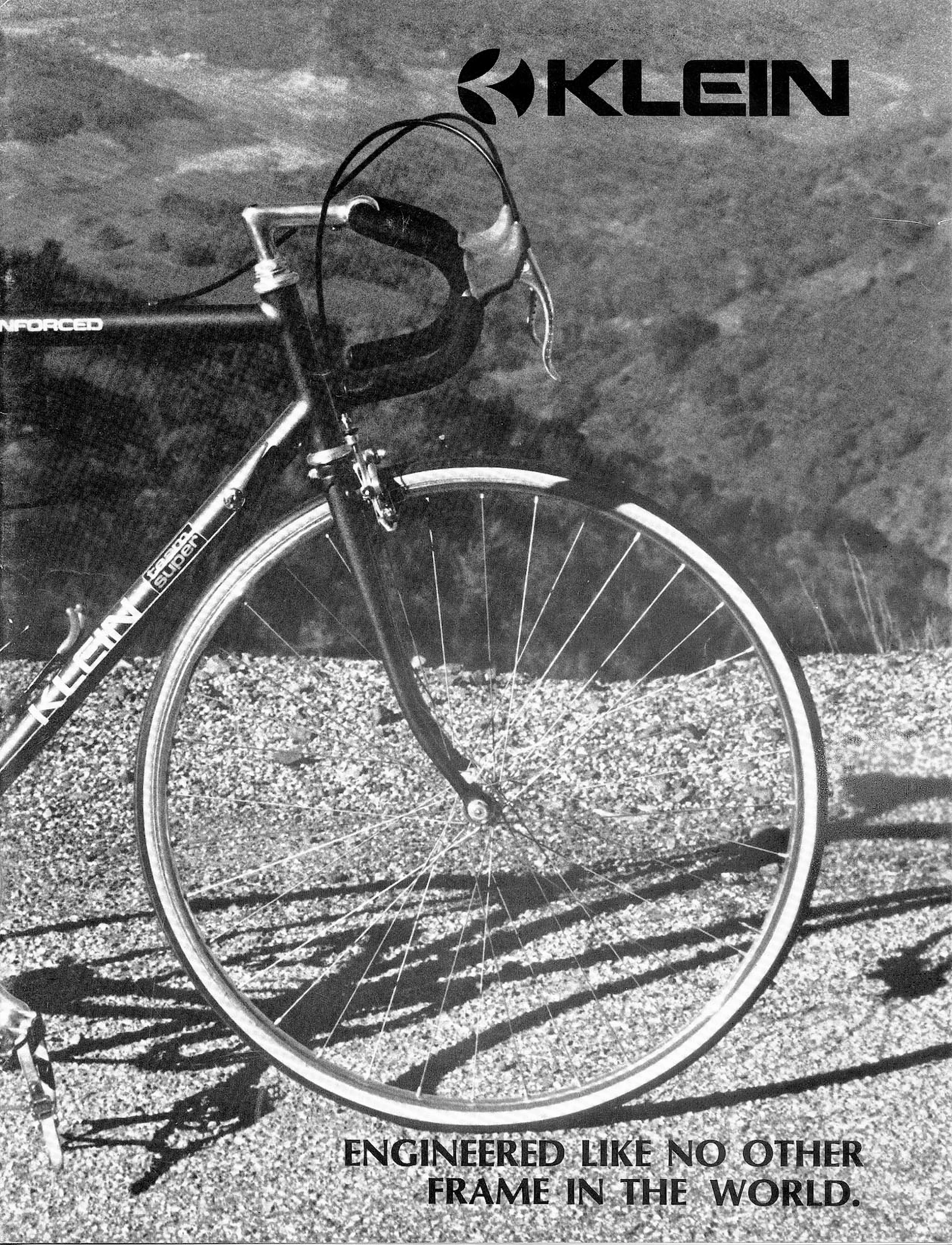
ENGINEERED LIKE NO OTHER FRAME IN THE WORLD.
[The front cover shows the front of a Klein bicycle with a decal reading “team super” standing on gravel above a hillside, with the KLEIN logo at the top right and the slogan “ENGINEERED LIKE NO OTHER FRAME IN THE WORLD.” at the bottom right. The top tube is partly cut off at the left edge, with part of a word showing on it.]
— Page 2 —
We at Klein don’t just make and sell bicycle frames. Before we produced the ultimate frame, we invested a great deal of research and development. Over a span of nearly five years a small team of engineers at the world’s leading technological institute — the Massachusetts Institute of Technology — conducted extensive research into the mechanics of bicycle frame design. With a grant from the M.I.T. Innovation Center and with additional technical assistance from AVCO they went on to develop the true state of the art bicycle frame — the Klein frame.
All the important criteria of cycling including power efficiency, lightness, ride, durability and functional detail have been given the attention they deserve. The result is a bicycle frame that provides optimum performance. This is the frame of the future — for the rider who wants it right now.
[A typeset page of two paragraphs about the research and development behind the Klein frame at the Massachusetts Institute of Technology, on a white page with no illustrations.]
— Page 3 —
BICYCLE FRAME DESIGN CONSIDERATIONS
Definitions
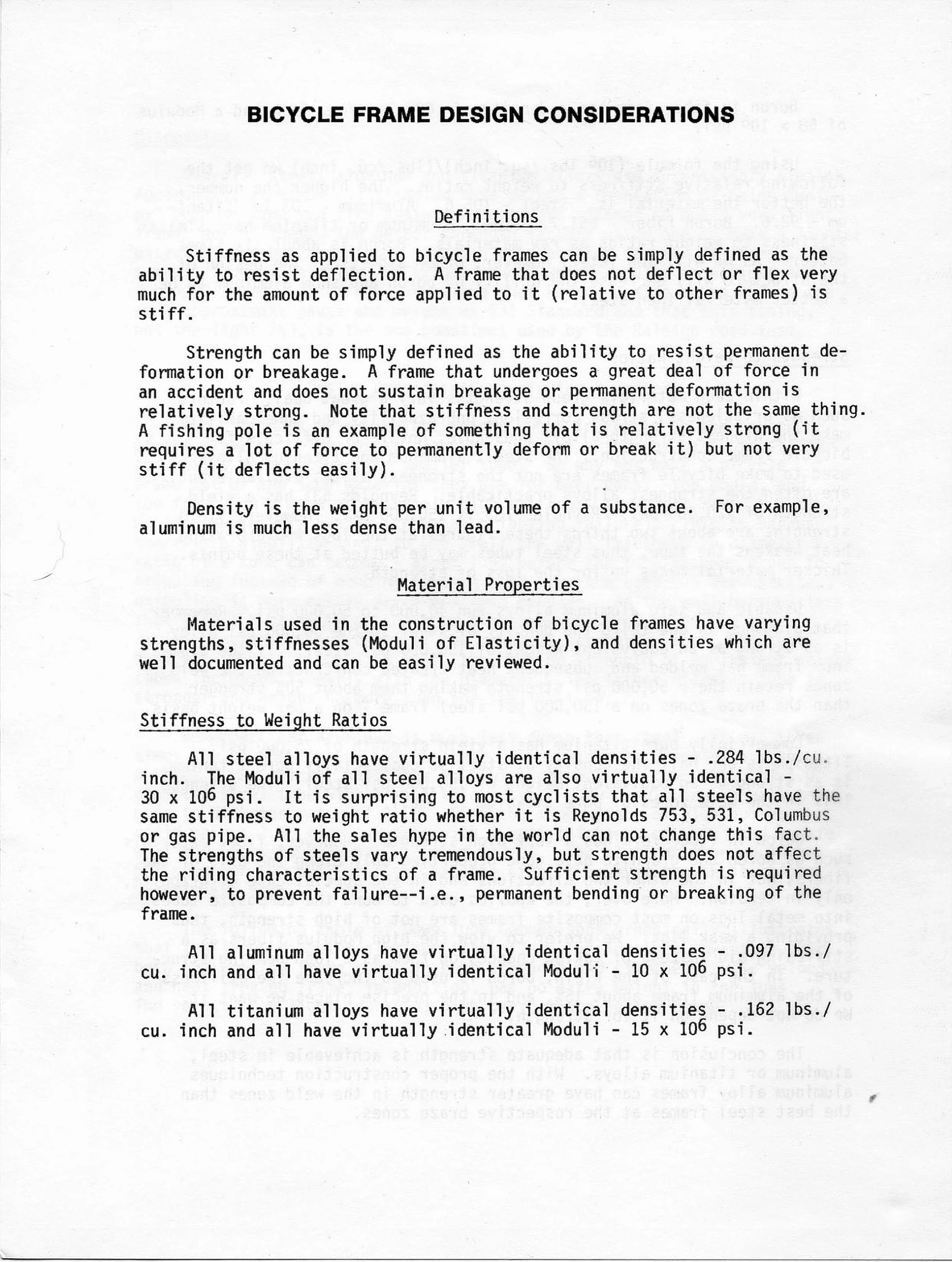
Stiffness as applied to bicycle frames can be simply defined as the ability to resist deflection. A frame that does not deflect or flex very much for the amount of force applied to it (relative to other frames) is stiff.
Strength can be simply defined as the ability to resist permanent deformation or breakage. A frame that undergoes a great deal of force in an accident and does not sustain breakage or permanent deformation is relatively strong. Note that stiffness and strength are not the same thing. A fishing pole is an example of something that is relatively strong (it requires a lot of force to permanently deform or break it) but not very stiff (it deflects easily).
Density is the weight per unit volume of a substance. For example, aluminum is much less dense than lead.
Material Properties
Materials used in the construction of bicycle frames have varying strengths, stiffnesses (Moduli of Elasticity), and densities which are well documented and can be easily reviewed.
Stiffness to Weight Ratios
All steel alloys have virtually identical densities – .284 lbs./cu. inch. The Moduli of all steel alloys are also virtually identical – 30 x 10^6 psi. It is surprising to most cyclists that all steels have the same stiffness to weight ratio whether it is Reynolds 753, 531, Columbus or gas pipe. All the sales hype in the world can not change this fact. The strengths of steels vary tremendously, but strength does not affect the riding characteristics of a frame. Sufficient strength is required however, to prevent failure–i.e., permanent bending or breaking of the frame.
All aluminum alloys have virtually identical densities – .097 lbs./cu. inch and all have virtually identical Moduli – 10 x 10^6 psi.
All titanium alloys have virtually identical densities – .162 lbs./cu. inch and all have virtually identical Moduli – 15 x 10^6 psi.
[A typed page headed “BICYCLE FRAME DESIGN CONSIDERATIONS” with the sections “Definitions”, “Material Properties” and “Stiffness to Weight Ratios”, in typewriter-style type. Faint text from the other side of the sheet shows through the paper, and the exponent 6 in each modulus figure is a raised digit, written here with a caret.]
— Page 4 —
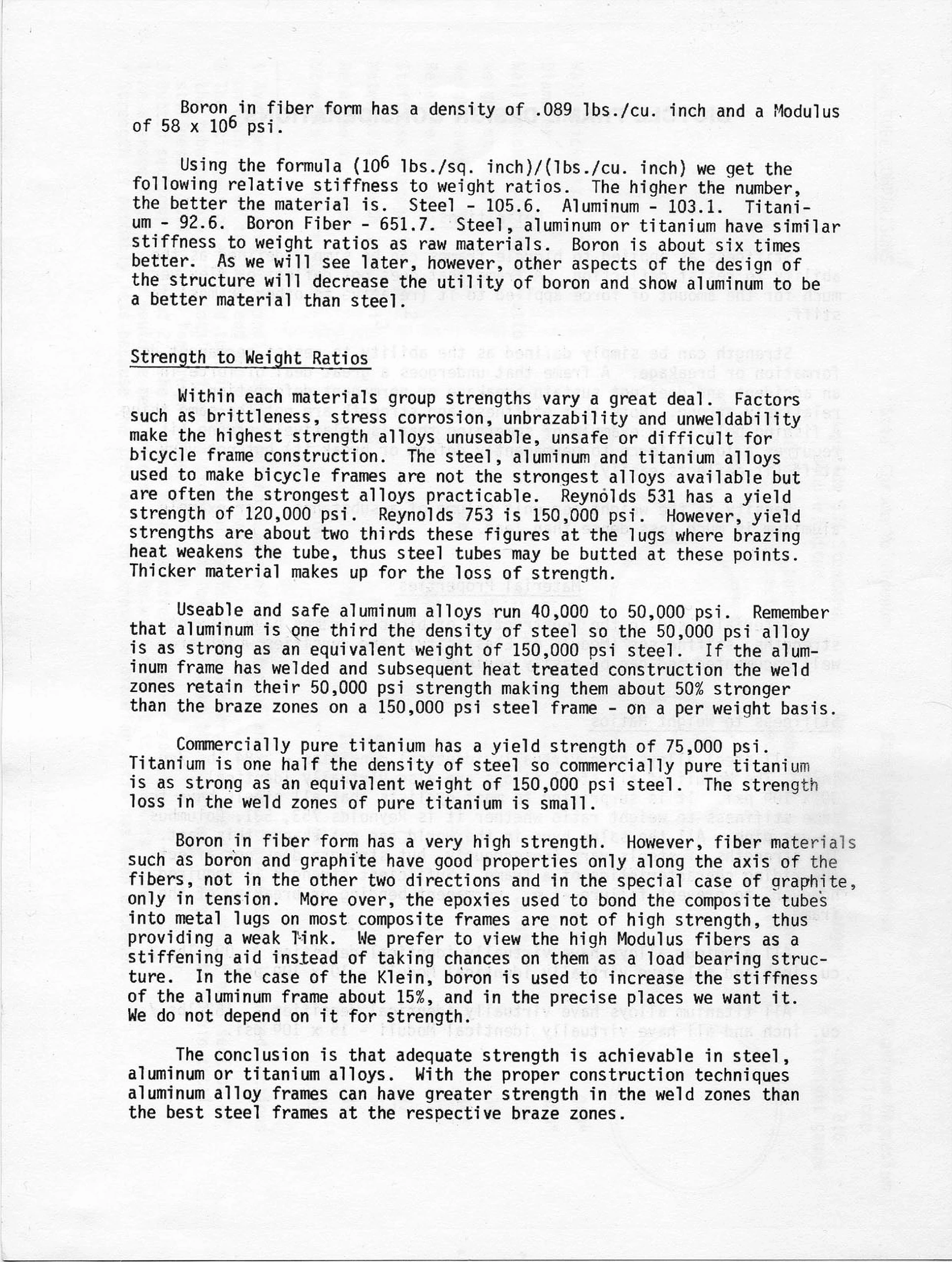
Boron in fiber form has a density of .089 lbs./cu. inch and a Modulus of 58 x 10^6 psi.
Using the formula (10^6 lbs./sq. inch)/(lbs./cu. inch) we get the following relative stiffness to weight ratios. The higher the number, the better the material is. Steel – 105.6. Aluminum – 103.1. Titanium – 92.6. Boron Fiber – 651.7. Steel, aluminum or titanium have similar stiffness to weight ratios as raw materials. Boron is about six times better. As we will see later, however, other aspects of the design of the structure will decrease the utility of boron and show aluminum to be a better material than steel.
Strength to Weight Ratios
Within each materials group strengths vary a great deal. Factors such as brittleness, stress corrosion, unbrazability and unweldability make the highest strength alloys unuseable, unsafe or difficult for bicycle frame construction. The steel, aluminum and titanium alloys used to make bicycle frames are not the strongest alloys available but are often the strongest alloys practicable. Reynolds 531 has a yield strength of 120,000 psi. Reynolds 753 is 150,000 psi. However, yield strengths are about two thirds these figures at the lugs where brazing heat weakens the tube, thus steel tubes may be butted at these points. Thicker material makes up for the loss of strength.
Useable and safe aluminum alloys run 40,000 to 50,000 psi. Remember that aluminum is one third the density of steel so the 50,000 psi alloy is as strong as an equivalent weight of 150,000 psi steel. If the aluminum frame has welded and subsequent heat treated construction the weld zones retain their 50,000 psi strength making them about 50% stronger than the braze zones on a 150,000 psi steel frame – on a per weight basis.
Commercially pure titanium has a yield strength of 75,000 psi. Titanium is one half the density of steel so commercially pure titanium is as strong as an equivalent weight of 150,000 psi steel. The strength loss in the weld zones of pure titanium is small.
Boron in fiber form has a very high strength. However, fiber materials such as boron and graphite have good properties only along the axis of the fibers, not in the other two directions and in the special case of graphite, only in tension. More over, the epoxies used to bond the composite tubes into metal lugs on most composite frames are not of high strength, thus providing a weak link. We prefer to view the high Modulus fibers as a stiffening aid instead of taking chances on them as a load bearing structure. In the case of the Klein, boron is used to increase the stiffness of the aluminum frame about 15%, and in the precise places we want it. We do not depend on it for strength.
The conclusion is that adequate strength is achievable in steel, aluminum or titanium alloys. With the proper construction techniques aluminum alloy frames can have greater strength in the weld zones than the best steel frames at the respective braze zones.
[A typed page continuing the frame design essay, with the section “Strength to Weight Ratios”, in typewriter-style type. Faint text from the other side of the sheet shows through the paper, and the exponent 6 in each figure is a raised digit, written here with a caret.]
— Page 5 —
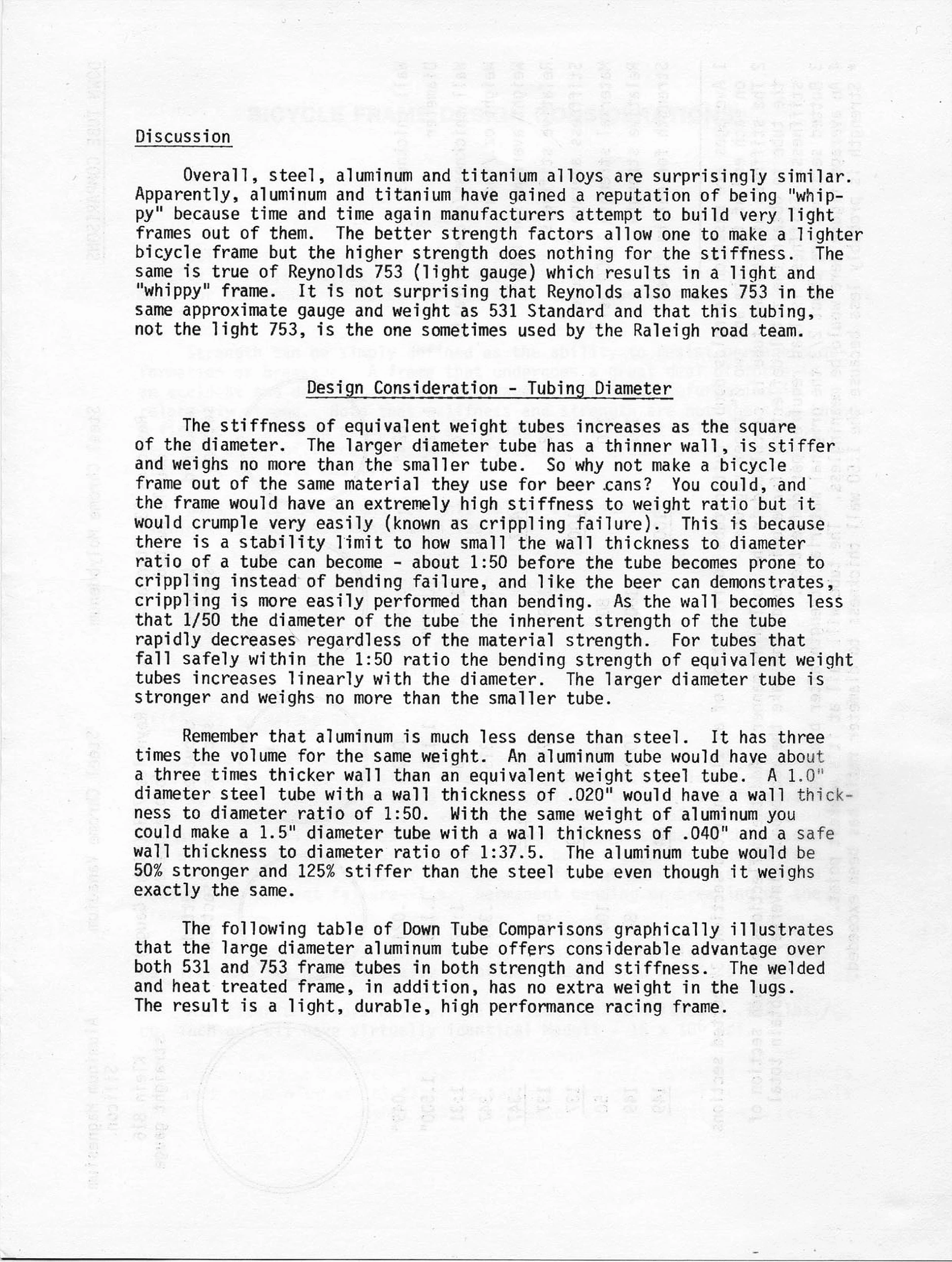
Discussion
Overall, steel, aluminum and titanium alloys are surprisingly similar. Apparently, aluminum and titanium have gained a reputation of being “whippy” because time and time again manufacturers attempt to build very light frames out of them. The better strength factors allow one to make a lighter bicycle frame but the higher strength does nothing for the stiffness. The same is true of Reynolds 753 (light gauge) which results in a light and “whippy” frame. It is not surprising that Reynolds also makes 753 in the same approximate gauge and weight as 531 Standard and that this tubing, not the light 753, is the one sometimes used by the Raleigh road team.
Design Consideration – Tubing Diameter
The stiffness of equivalent weight tubes increases as the square of the diameter. The larger diameter tube has a thinner wall, is stiffer and weighs no more than the smaller tube. So why not make a bicycle frame out of the same material they use for beer cans? You could, and the frame would have an extremely high stiffness to weight ratio but it would crumple very easily (known as crippling failure). This is because there is a stability limit to how small the wall thickness to diameter ratio of a tube can become – about 1:50 before the tube becomes prone to crippling instead of bending failure, and like the beer can demonstrates, crippling is more easily performed than bending. As the wall becomes less that 1/50 the diameter of the tube the inherent strength of the tube rapidly decreases regardless of the material strength. For tubes that fall safely within the 1:50 ratio the bending strength of equivalent weight tubes increases linearly with the diameter. The larger diameter tube is stronger and weighs no more than the smaller tube.
Remember that aluminum is much less dense than steel. It has three times the volume for the same weight. An aluminum tube would have about a three times thicker wall than an equivalent weight steel tube. A 1.0″ diameter steel tube with a wall thickness of .020″ would have a wall thickness to diameter ratio of 1:50. With the same weight of aluminum you could make a 1.5″ diameter tube with a wall thickness of .040″ and a safe wall thickness to diameter ratio of 1:37.5. The aluminum tube would be 50% stronger and 125% stiffer than the steel tube even though it weighs exactly the same.
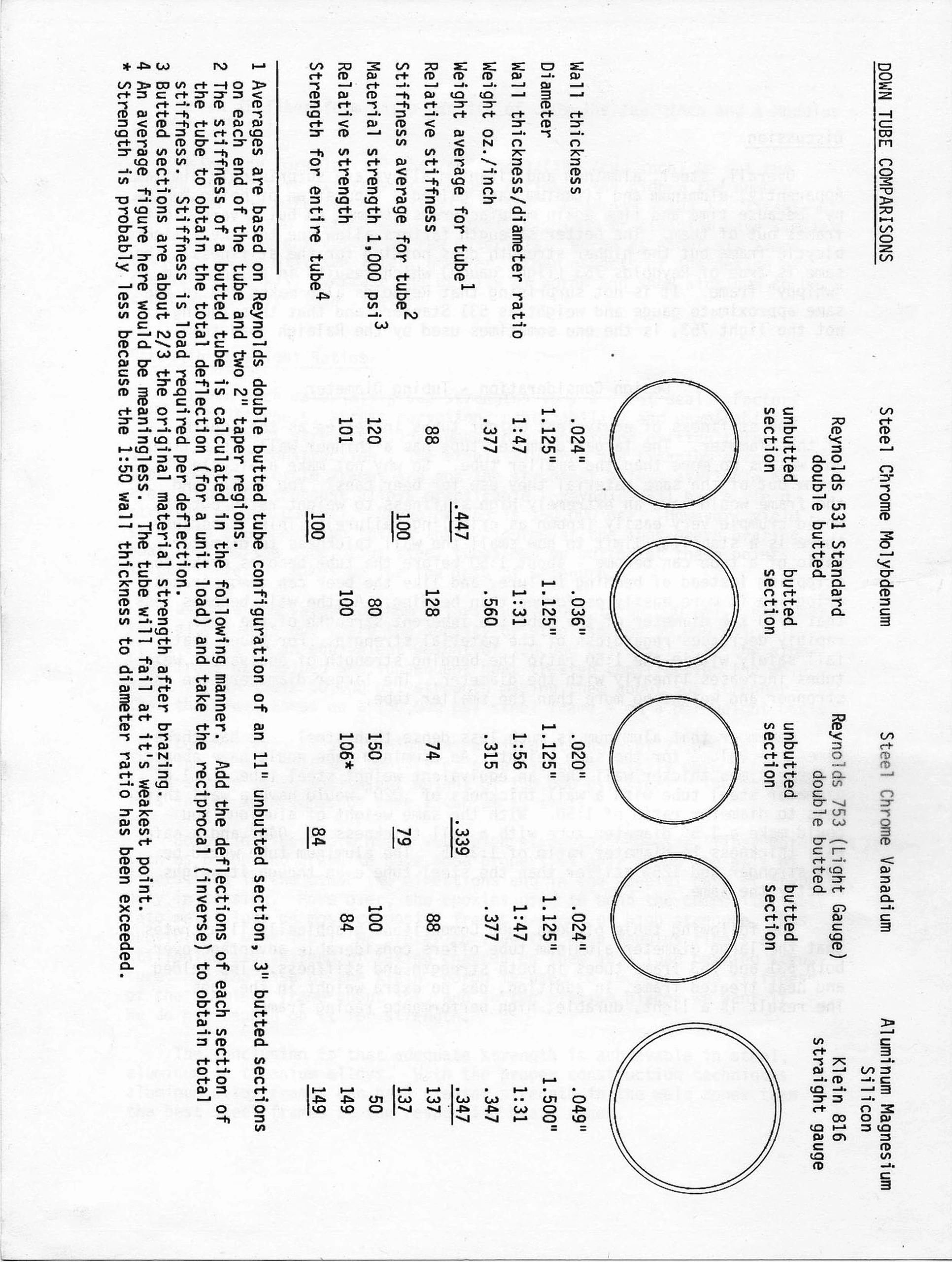
The following table of Down Tube Comparisons graphically illustrates that the large diameter aluminum tube offers considerable advantage over both 531 and 753 frame tubes in both strength and stiffness. The welded and heat treated frame, in addition, has no extra weight in the lugs. The result is a light, durable, high performance racing frame.
[A typed page continuing the frame design essay, with the section “Discussion” and the section “Design Consideration – Tubing Diameter”, in typewriter-style type. Faint mirrored text and figures from the other side of the sheet show through the paper.]
— Page 6 —
DOWN TUBE COMPARISONS
| Steel Chrome Molybdenum | | Steel Chrome Vanadium | | Aluminum Magnesium Silicon
| Reynolds 531 Standard double butted | | Reynolds 753 (Light Gauge) double butted | | Klein 816 straight gauge
| unbutted section | butted section | unbutted section | butted section |
Wall thickness | .024″ | .036″ | .020″ | .024″ | .049″
Diameter | 1.125″ | 1.125″ | 1.125″ | 1.125″ | 1.500″
Wall thickness/diameter ratio | 1:47 | 1:31 | 1:56 | 1:47 | 1:31
Weight oz./inch | .377 | .560 | .315 | .377 | .347
Weight average for tube^1 | .447 | | .339 | | .347
Relative stiffness | 88 | 128 | 74 | 88 | 137
Stiffness average for tube^2 | 100 | | 79 | | 137
Material strength 1,000 psi^3 | 120 | 80 | 150 | 100 | 50
Relative strength | 101 | 100 | 106* | 84 | 149
Strength for entire tube^4 | 100 | | 84 | | 149
1 Averages are based on Reynolds double butted tube configuration of an 11″ unbutted section, 3″ butted sections on each end of the tube and two 2″ taper regions.
2 The stiffness of a butted tube is calculated in the following manner. Add the deflections of each section of the tube to obtain the total deflection (for a unit load) and take the reciprocal (inverse) to obtain total stiffness. Stiffness is load required per deflection.
3 Butted sections are about 2/3 the original material strength after brazing.
4 An average figure here would be meaningless. The tube will fail at it’s weakest point.
* Strength is probably less because the 1:50 wall thickness to diameter ratio has been exceeded.
[A typed table headed “DOWN TUBE COMPARISONS” printed sideways on the sheet, comparing five down tube sections (Reynolds 531 Standard and Reynolds 753 Light Gauge, each unbutted and butted, and Klein 816 straight gauge) beside outline drawings of five tube cross sections. Each underlined average figure is centered across a pair of data columns for the Reynolds tubes [spans each pair of data columns]; the footnote numbers on the row labels are raised digits, written here with a caret.]
— Page 7 —
KLEIN
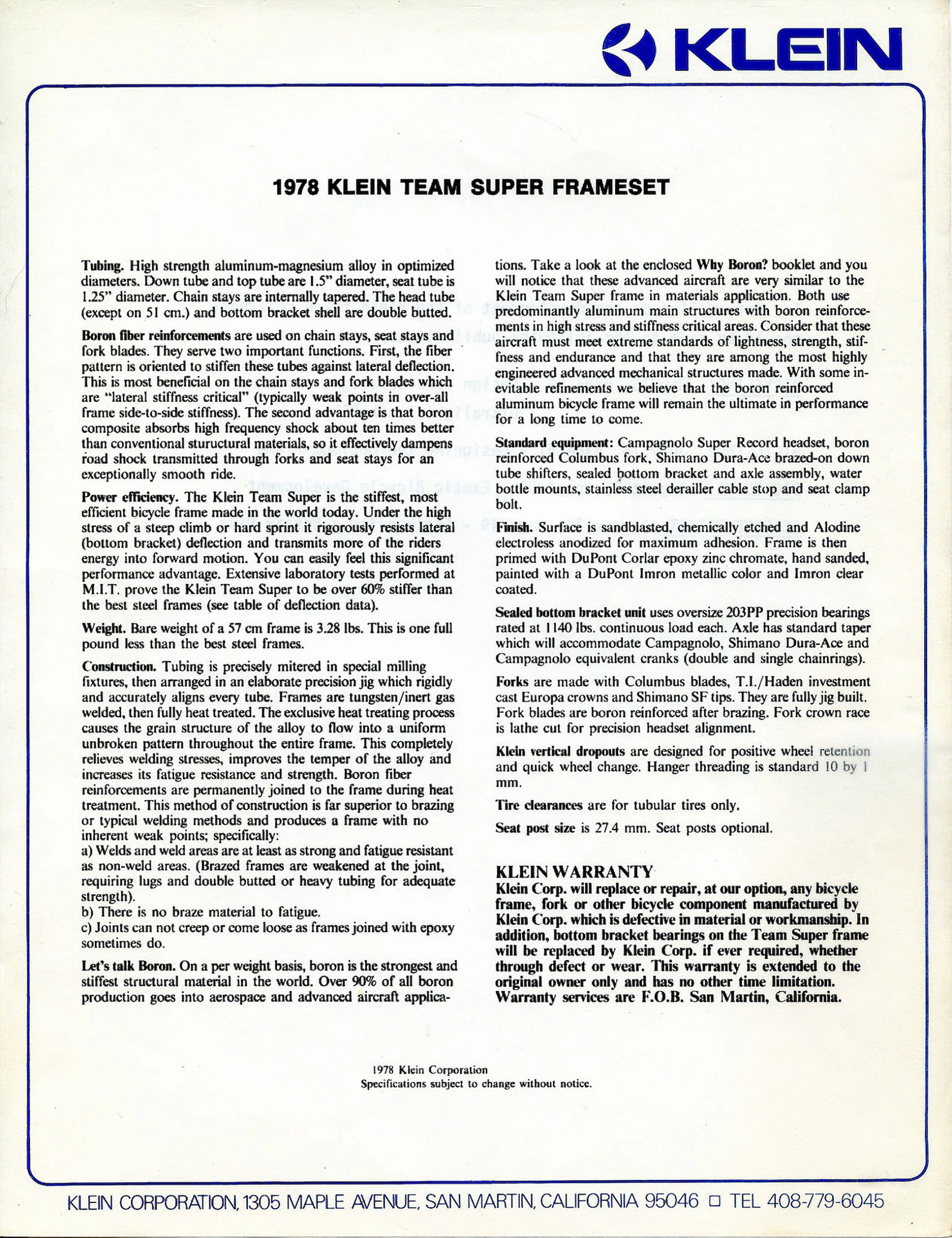
1978 KLEIN TEAM SUPER FRAMESET
Tubing. High strength aluminum-magnesium alloy in optimized diameters. Down tube and top tube are 1.5″ diameter, seat tube is 1.25″ diameter. Chain stays are internally tapered. The head tube (except on 51 cm.) and bottom bracket shell are double butted.
Boron fiber reinforcements are used on chain stays, seat stays and fork blades. They serve two important functions. First, the fiber pattern is oriented to stiffen these tubes against lateral deflection. This is most beneficial on the chain stays and fork blades which are “lateral stiffness critical” (typically weak points in over-all frame side-to-side stiffness). The second advantage is that boron composite absorbs high frequency shock about ten times better than conventional stuructural materials, so it effectively dampens road shock transmitted through forks and seat stays for an exceptionally smooth ride.
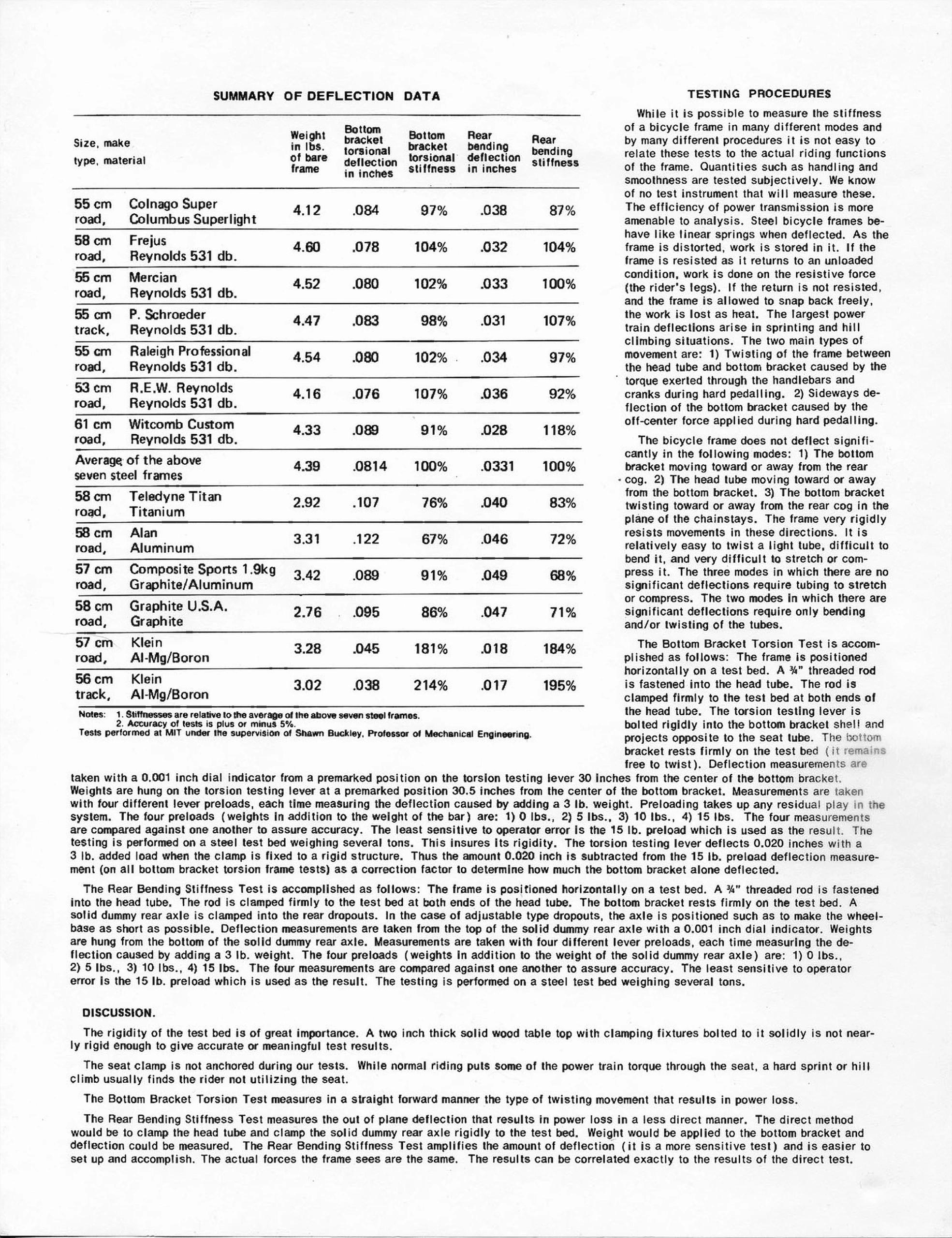
Power efficiency. The Klein Team Super is the stiffest, most efficient bicycle frame made in the world today. Under the high stress of a steep climb or hard sprint it rigorously resists lateral (bottom bracket) deflection and transmits more of the riders energy into forward motion. You can easily feel this significant performance advantage. Extensive laboratory tests performed at M.I.T. prove the Klein Team Super to be over 60% stiffer than the best steel frames (see table of deflection data).
Weight. Bare weight of a 57 cm frame is 3.28 lbs. This is one full pound less than the best steel frames.
Construction. Tubing is precisely mitered in special milling fixtures, then arranged in an elaborate precision jig which rigidly and accurately aligns every tube. Frames are tungsten/inert gas welded, then fully heat treated. The exclusive heat treating process causes the grain structure of the alloy to flow into a uniform unbroken pattern throughout the entire frame. This completely relieves welding stresses, improves the temper of the alloy and increases its fatigue resistance and strength. Boron fiber reinforcements are permanently joined to the frame during heat treatment. This method of construction is far superior to brazing or typical welding methods and produces a frame with no inherent weak points; specifically:
a) Welds and weld areas are at least as strong and fatigue resistant as non-weld areas. (Brazed frames are weakened at the joint, requiring lugs and double butted or heavy tubing for adequate strength).
b) There is no braze material to fatigue.
c) Joints can not creep or come loose as frames joined with epoxy sometimes do.
Let’s talk Boron. On a per weight basis, boron is the strongest and stiffest structural material in the world. Over 90% of all boron production goes into aerospace and advanced aircraft applications. Take a look at the enclosed Why Boron? booklet and you will notice that these advanced aircraft are very similar to the Klein Team Super frame in materials application. Both use predominantly aluminum main structures with boron reinforcements in high stress and stiffness critical areas. Consider that these aircraft must meet extreme standards of lightness, strength, stiffness and endurance and that they are among the most highly engineered advanced mechanical structures made. With some inevitable refinements we believe that the boron reinforced aluminum bicycle frame will remain the ultimate in performance for a long time to come.
Standard equipment: Campagnolo Super Record headset, boron reinforced Columbus fork, Shimano Dura-Ace brazed-on down tube shifters, sealed bottom bracket and axle assembly, water bottle mounts, stainless steel derailler cable stop and seat clamp bolt.
Finish. Surface is sandblasted, chemically etched and Alodine electroless anodized for maximum adhesion. Frame is then primed with DuPont Corlar epoxy zinc chromate, hand sanded, painted with a DuPont Imron metallic color and Imron clear coated.
Sealed bottom bracket unit uses oversize 203PP precision bearings rated at 1140 lbs. continuous load each. Axle has standard taper which will accommodate Campagnolo, Shimano Dura-Ace and Campagnolo equivalent cranks (double and single chainrings).
Forks are made with Columbus blades, T.I./Haden investment cast Europa crowns and Shimano SF tips. They are fully jig built. Fork blades are boron reinforced after brazing. Fork crown race is lathe cut for precision headset alignment.
Klein vertical dropouts are designed for positive wheel retention and quick wheel change. Hanger threading is standard 10 by 1 mm.
Tire clearances are for tubular tires only.
Seat post size is 27.4 mm. Seat posts optional.
KLEIN WARRANTY
Klein Corp. will replace or repair, at our option, any bicycle frame, fork or other bicycle component manufactured by Klein Corp. which is defective in material or workmanship. In addition, bottom bracket bearings on the Team Super frame will be replaced by Klein Corp. if ever required, whether through defect or wear. This warranty is extended to the original owner only and has no other time limitation. Warranty services are F.O.B. San Martin, California.
1978 Klein Corporation
Specifications subject to change without notice.
KLEIN CORPORATION, 1305 MAPLE AVENUE, SAN MARTIN, CALIFORNIA 95046 □ TEL 408-779-6045
[The “1978 KLEIN TEAM SUPER FRAMESET” sheet in two text columns with the KLEIN logo at the top right, covering tubing, boron fiber reinforcements, power efficiency, weight, construction, standard equipment, finish, forks, dropouts and the Klein warranty, inside a blue rounded border. The address line of Klein Corporation runs along the foot of the page.]
— Page 8 —
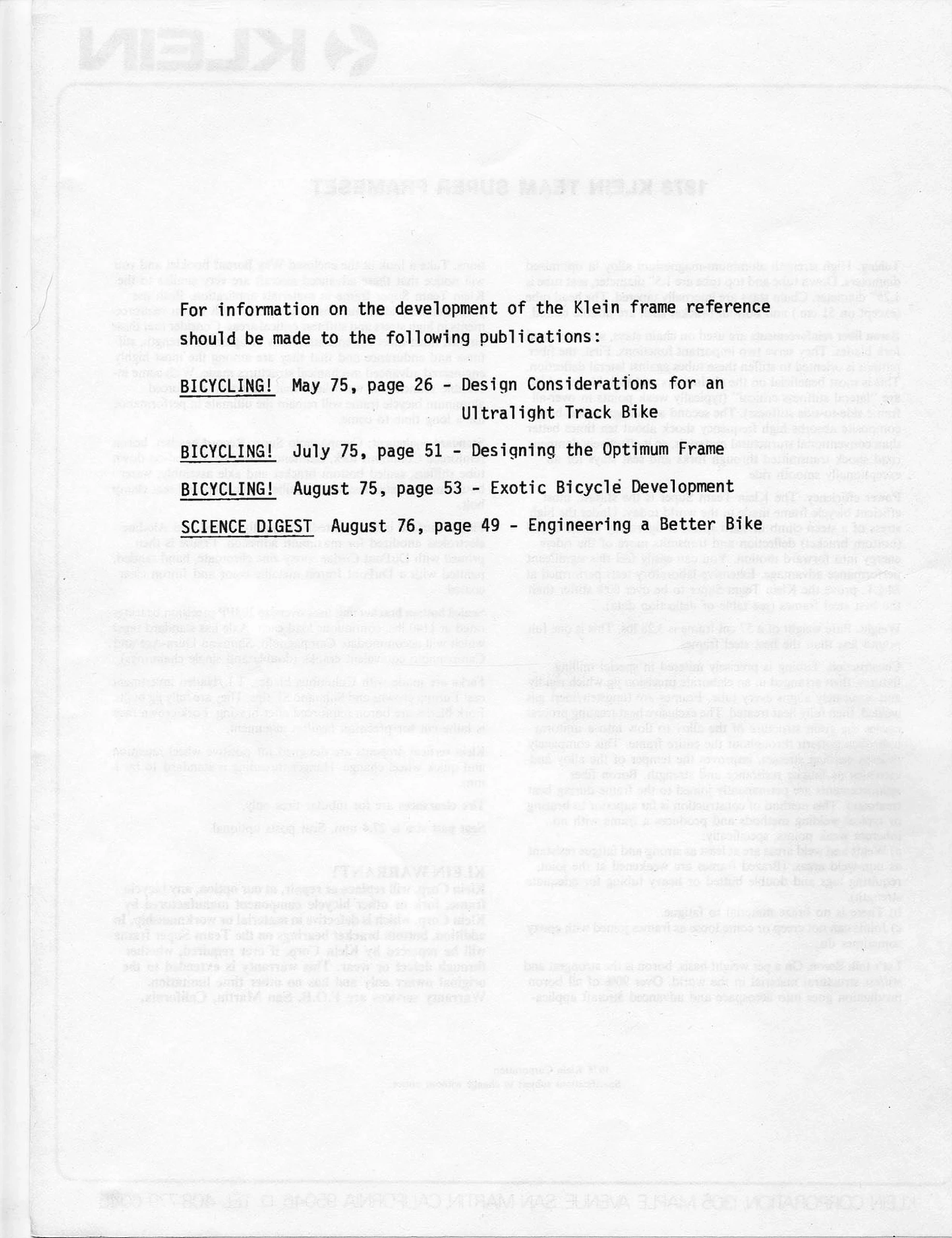
For information on the development of the Klein frame reference should be made to the following publications:
BICYCLING! May 75, page 26 – Design Considerations for an Ultralight Track Bike
BICYCLING! July 75, page 51 – Designing the Optimum Frame
BICYCLING! August 75, page 53 – Exotic Bicycle Development
SCIENCE DIGEST August 76, page 49 – Engineering a Better Bike
[A typed list of four magazine references (Bicycling! and Science Digest) on a white sheet; the reverse side of the sheet shows through faintly as mirrored text and a Klein logo, with no printed folio on this side.]
— Page 9 —
KLEIN
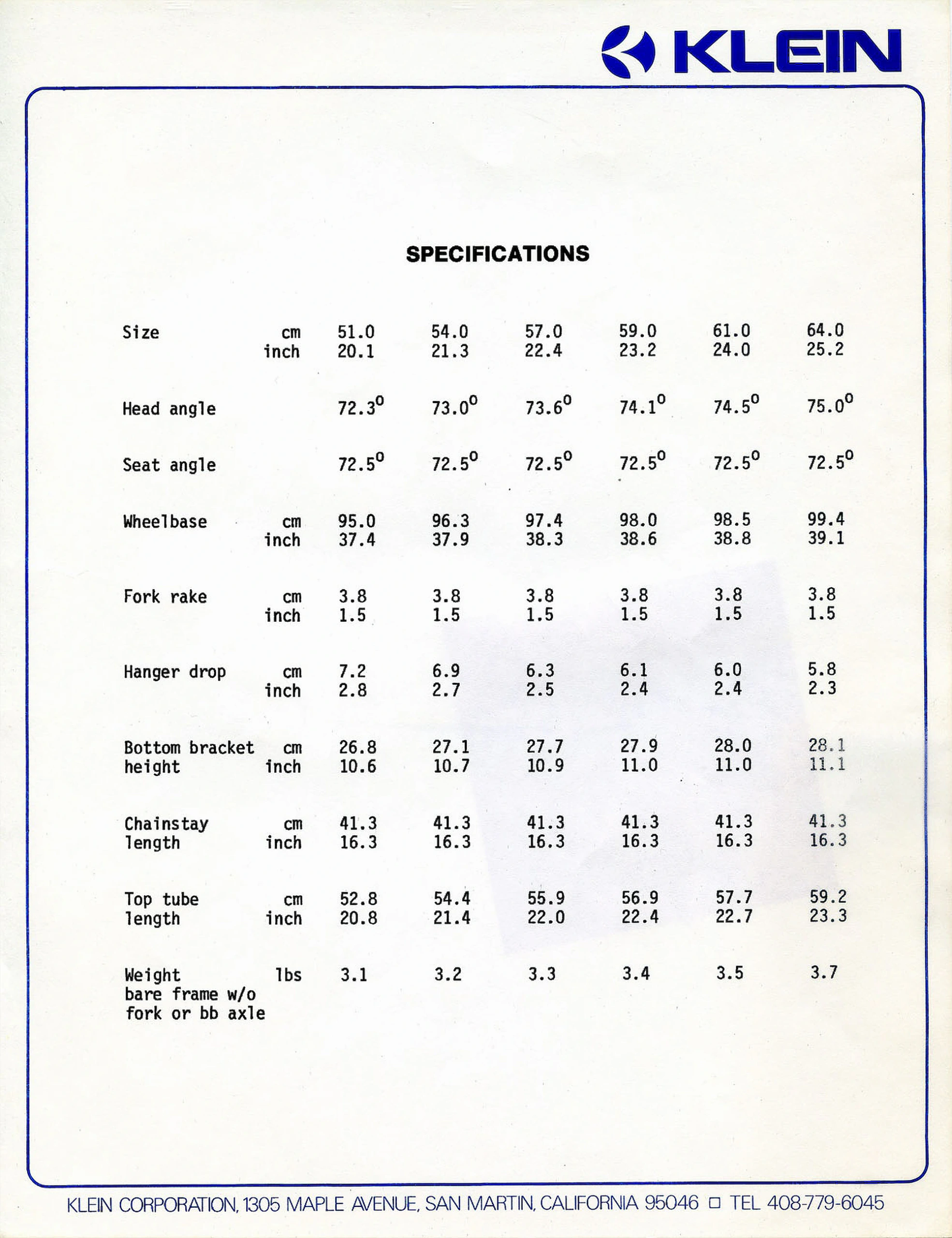
SPECIFICATIONS
Size | cm | 51.0 | 54.0 | 57.0 | 59.0 | 61.0 | 64.0
| inch | 20.1 | 21.3 | 22.4 | 23.2 | 24.0 | 25.2
Head angle | | 72.3° | 73.0° | 73.6° | 74.1° | 74.5° | 75.0°
Seat angle | | 72.5° | 72.5° | 72.5° | 72.5° | 72.5° | 72.5°
Wheelbase | cm | 95.0 | 96.3 | 97.4 | 98.0 | 98.5 | 99.4
| inch | 37.4 | 37.9 | 38.3 | 38.6 | 38.8 | 39.1
Fork rake | cm | 3.8 | 3.8 | 3.8 | 3.8 | 3.8 | 3.8
| inch | 1.5 | 1.5 | 1.5 | 1.5 | 1.5 | 1.5
Hanger drop | cm | 7.2 | 6.9 | 6.3 | 6.1 | 6.0 | 5.8
| inch | 2.8 | 2.7 | 2.5 | 2.4 | 2.4 | 2.3
Bottom bracket height | cm | 26.8 | 27.1 | 27.7 | 27.9 | 28.0 | 28.1
| inch | 10.6 | 10.7 | 10.9 | 11.0 | 11.0 | 11.1
Chainstay length | cm | 41.3 | 41.3 | 41.3 | 41.3 | 41.3 | 41.3
| inch | 16.3 | 16.3 | 16.3 | 16.3 | 16.3 | 16.3
Top tube length | cm | 52.8 | 54.4 | 55.9 | 56.9 | 57.7 | 59.2
| inch | 20.8 | 21.4 | 22.0 | 22.4 | 22.7 | 23.3
Weight bare frame w/o fork or bb axle | lbs | 3.1 | 3.2 | 3.3 | 3.4 | 3.5 | 3.7
KLEIN CORPORATION, 1305 MAPLE AVENUE, SAN MARTIN, CALIFORNIA 95046 □ TEL 408-779-6045
[A “SPECIFICATIONS” table with the Klein logo and a blue frame, giving size, head and seat angle, wheelbase, fork rake, hanger drop, bottom bracket height, chainstay length, top tube length and weight for six frame sizes from 51.0 to 64.0 cm. A small square symbol separates the address from the telephone number in the footer; a pale translucent patch lies over the lower right of the table, and the last bottom bracket height figures are printed lighter than the rest.]
— Page 10 —
KLEIN
MOST FREQUENTLY ASKED QUESTIONS
Q: What is the finish on the Klein and how will it hold up?
A: The Klein is finished in DuPont Imron polyurethane enamel. It is very durable and resistant to abrasion and scratches. DuPont Rain Dance car wax is recommended to maintain the best finish and appearance.
Q: Will there be corrosion problems if the underlying alloy becomes exposed?
A: No. Klein 816 aluminum-magnesium alloy is highly corrosion resistant. It will not be affected by water, salt or road dirt and should never rust or pit.
Q: Does the large diameter tubing present component fitting problems?
A: No. Down tube shift levers, water bottle mounts, top tube brake cable clips and derailler cable tunnels are direct mounted to the frame. Campagnolo and Dura-Ace front derailleurs, which were intended for a 1.125″ seat tube are easily fitted to the 1.25″ seat tube by expanding them over the seat tube and using the supplied mounting bolt. Another bolt is supplied for mounting a Campagnolo pump peg or umbrella pump holder in a similar manner. A frame fit pump can also be used.
Q: Is the Klein Team Super suitable for time trialling and criterium racing as well as road racing?
A: Yes. Although the Team Super was designed primarily for road racing and criterium type events, its light weight and exceptional lateral rigidity make it an excellent time trialling frame.
Q: Is there toe clip to front tire clearance?
A: No. Toe clip to front tire overlap is generally accepted in professional racing frames. It makes possible a more nearly balanced weight distribution and better handling.
Q: Why are the bottom bracket heights slightly greater on the larger size frames?
A: To accomodate slightly longer cranks which are often used by tall riders.
Q: What are the small holes in the bottom of the seat tube and down tube for?
A: They are for drainage and are necessary because these tubes cannot drain through the bottom bracket shell which is completely sealed.
Q: What do I do if my frame sustains accidental damage?
A: Contact Klein Corp. for advice on repair procedures. For a quote on repairs you must ship the frame to our address. We will inform you of the necessary procedures and delays, give a firm quote and wait for authorization before proceeding. Payment is C.O.D. Shipping is at owner’s expense.
Q: What do I do if my frame requires warranty service?
A: First, contact Klein Corp. You are responsible for shipping the frame to us. We will repair or replace the frame at our option and pay return shipping charges within the continental U.S. if it is determined that the frame is defective in material or workmanship.
Q: Can the Klein bottom bracket shell be tapped to fit a standard assembly?
A: No. The bottom bracket shell has a larger than standard diameter.
Q: How do I perform maintenance on the bottom bracket assembly?
A: No maintenance is recommended or possible on the bottom bracket unit. It should provide good service for a minimum of 10 years.
Q: What do I do if the bottom bracket bearings need replacement?
A: Bottom bracket bearings will be replaced under warranty by Klein Corp. if ever required whether through defect or wear.
Q: Does the Klein Team Super make a good touring frame?
A: The Team Super was designed very specifically for racing. It is not really suited for extended touring. It does, however, make an excellent touring/recreational frame for the cyclist who prefers racing geometry, quick steering and will use only tubular tires.
Q: Can I bend the rear triangle outward to fit a six speed rear hub?
A: The rear triangle width is 120-121 mm for hubs of that size only. This is the typical range for standard five speed hubs. Do not attempt to alter the rear triangle width.
Q: What is the content of Klein 816 alloy?
A: Aluminum, magnesium, silicon, titanium, zinc, iron, copper, chromium and manganese.
Q: Can I braze or weld items to my Klein?
A: It is not recommended. Welding or brazing to this alloy requires elaborate equipment. Either procedure will reduce the yield and fatigue strength unless the frame is re-heat-treated.
KLEIN CORPORATION, 1305 MAPLE AVENUE, SAN MARTIN, CALIFORNIA 95046 □ TEL 408-779-6045
[A typed “MOST FREQUENTLY ASKED QUESTIONS” sheet with the Klein logo and a blue frame, set in two columns of questions and answers about finish, Klein 816 alloy, component fitting, the Team Super, repairs, warranty and the bottom bracket. A small square symbol separates the address from the telephone number in the footer, and a pale translucent patch lies over part of the right column.]
— Page 11 —
SUMMARY OF DEFLECTION DATA
Size, make type, material | | Weight in lbs. of bare frame | Bottom bracket torsional deflection in inches | Bottom bracket torsional stiffness | Rear bending deflection in inches | Rear bending stiffness
55 cm road, | Colnago Super Columbus Superlight | 4.12 | .084 | 97% | .038 | 87%
58 cm road, | Frejus Reynolds 531 db. | 4.60 | .078 | 104% | .032 | 104%
55 cm road, | Mercian Reynolds 531 db. | 4.52 | .080 | 102% | .033 | 100%
55 cm track, | P. Schroeder Reynolds 531 db. | 4.47 | .083 | 98% | .031 | 107%
55 cm road, | Raleigh Professional Reynolds 531 db. | 4.54 | .080 | 102% | .034 | 97%
53 cm road, | R.E.W. Reynolds Reynolds 531 db. | 4.16 | .076 | 107% | .036 | 92%
61 cm road, | Witcomb Custom Reynolds 531 db. | 4.33 | .089 | 91% | .028 | 118%
Average of the above seven steel frames | | 4.39 | .0814 | 100% | .0331 | 100%
58 cm road, | Teledyne Titan Titanium | 2.92 | .107 | 76% | .040 | 83%
58 cm road, | Alan Aluminum | 3.31 | .122 | 67% | .046 | 72%
57 cm road, | Composite Sports 1.9kg Graphite/Aluminum | 3.42 | .089 | 91% | .049 | 68%
58 cm road, | Graphite U.S.A. Graphite | 2.76 | .095 | 86% | .047 | 71%
57 cm road, | Klein Al-Mg/Boron | 3.28 | .045 | 181% | .018 | 184%
56 cm track, | Klein Al-Mg/Boron | 3.02 | .038 | 214% | .017 | 195%
Notes: 1. Stiffnesses are relative to the average of the above seven steel frames.
2. Accuracy of tests is plus or minus 5%.
Tests performed at MIT under the supervision of Shawn Buckley, Professor of Mechanical Engineering.
TESTING PROCEDURES
While it is possible to measure the stiffness of a bicycle frame in many different modes and by many different procedures it is not easy to relate these tests to the actual riding functions of the frame. Quantities such as handling and smoothness are tested subjectively. We know of no test instrument that will measure these. The efficiency of power transmission is more amenable to analysis. Steel bicycle frames behave like linear springs when deflected. As the frame is distorted, work is stored in it. If the frame is resisted as it returns to an unloaded condition, work is done on the resistive force (the rider’s legs). If the return is not resisted, and the frame is allowed to snap back freely, the work is lost as heat. The largest power train deflections arise in sprinting and hill climbing situations. The two main types of movement are: 1) Twisting of the frame between the head tube and bottom bracket caused by the torque exerted through the handlebars and cranks during hard pedalling. 2) Sideways deflection of the bottom bracket caused by the off-center force applied during hard pedalling.
The bicycle frame does not deflect significantly in the following modes: 1) The bottom bracket moving toward or away from the rear cog. 2) The head tube moving toward or away from the bottom bracket. 3) The bottom bracket twisting toward or away from the rear cog in the plane of the chainstays. The frame very rigidly resists movements in these directions. It is relatively easy to twist a light tube, difficult to bend it, and very difficult to stretch or compress it. The three modes in which there are no significant deflections require tubing to stretch or compress. The two modes in which there are significant deflections require only bending and/or twisting of the tubes.
The Bottom Bracket Torsion Test is accomplished as follows: The frame is positioned horizontally on a test bed. A ¾” threaded rod is fastened into the head tube. The rod is clamped firmly to the test bed at both ends of the head tube. The torsion testing lever is bolted rigidly into the bottom bracket shell and projects opposite to the seat tube. The bottom bracket rests firmly on the test bed (it remains free to twist). Deflection measurements are taken with a 0.001 inch dial indicator from a premarked position on the torsion testing lever 30 inches from the center of the bottom bracket. Weights are hung on the torsion testing lever at a premarked position 30.5 inches from the center of the bottom bracket. Measurements are taken with four different lever preloads, each time measuring the deflection caused by adding a 3 lb. weight. Preloading takes up any residual play in the system. The four preloads (weights in addition to the weight of the bar) are: 1) 0 lbs., 2) 5 lbs., 3) 10 lbs., 4) 15 lbs. The four measurements are compared against one another to assure accuracy. The least sensitive to operator error is the 15 lb. preload which is used as the result. The testing is performed on a steel test bed weighing several tons. This insures its rigidity. The torsion testing lever deflects 0.020 inches with a 3 lb. added load when the clamp is fixed to a rigid structure. Thus the amount 0.020 inch is subtracted from the 15 lb. preload deflection measurement (on all bottom bracket torsion frame tests) as a correction factor to determine how much the bottom bracket alone deflected.
The Rear Bending Stiffness Test is accomplished as follows: The frame is positioned horizontally on a test bed. A ¾” threaded rod is fastened into the head tube. The rod is clamped firmly to the test bed at both ends of the head tube. The bottom bracket rests firmly on the test bed. A solid dummy rear axle is clamped into the rear dropouts. In the case of adjustable type dropouts, the axle is positioned such as to make the wheelbase as short as possible. Deflection measurements are taken from the top of the solid dummy rear axle with a 0.001 inch dial indicator. Weights are hung from the bottom of the solid dummy rear axle. Measurements are taken with four different lever preloads, each time measuring the deflection caused by adding a 3 lb. weight. The four preloads (weights in addition to the weight of the solid dummy rear axle) are: 1) 0 lbs., 2) 5 lbs., 3) 10 lbs., 4) 15 lbs. The four measurements are compared against one another to assure accuracy. The least sensitive to operator error is the 15 lb. preload which is used as the result. The testing is performed on a steel test bed weighing several tons.
DISCUSSION.
The rigidity of the test bed is of great importance. A two inch thick solid wood table top with clamping fixtures bolted to it solidly is not nearly rigid enough to give accurate or meaningful test results.
The seat clamp is not anchored during our tests. While normal riding puts some of the power train torque through the seat, a hard sprint or hill climb usually finds the rider not utilizing the seat.
The Bottom Bracket Torsion Test measures in a straight forward manner the type of twisting movement that results in power loss.
The Rear Bending Stiffness Test measures the out of plane deflection that results in power loss in a less direct manner. The direct method would be to clamp the head tube and clamp the solid dummy rear axle rigidly to the test bed. Weight would be applied to the bottom bracket and deflection could be measured. The Rear Bending Stiffness Test amplifies the amount of deflection (it is a more sensitive test) and is easier to set up and accomplish. The actual forces the frame sees are the same. The results can be correlated exactly to the results of the direct test.
[A typed “SUMMARY OF DEFLECTION DATA” table comparing bare frame weight and bottom bracket and rear bending stiffness for steel, titanium, aluminum, graphite and Klein Al-Mg/Boron frames, with a “TESTING PROCEDURES” text column and a “DISCUSSION.” section. The table’s first cell spans columns 1 to 2 and the “Average of the above seven steel frames” cell spans columns 1 to 2; the page has no logo, no printed folio, and part of the right-hand text is faded.]
— Page 12 —
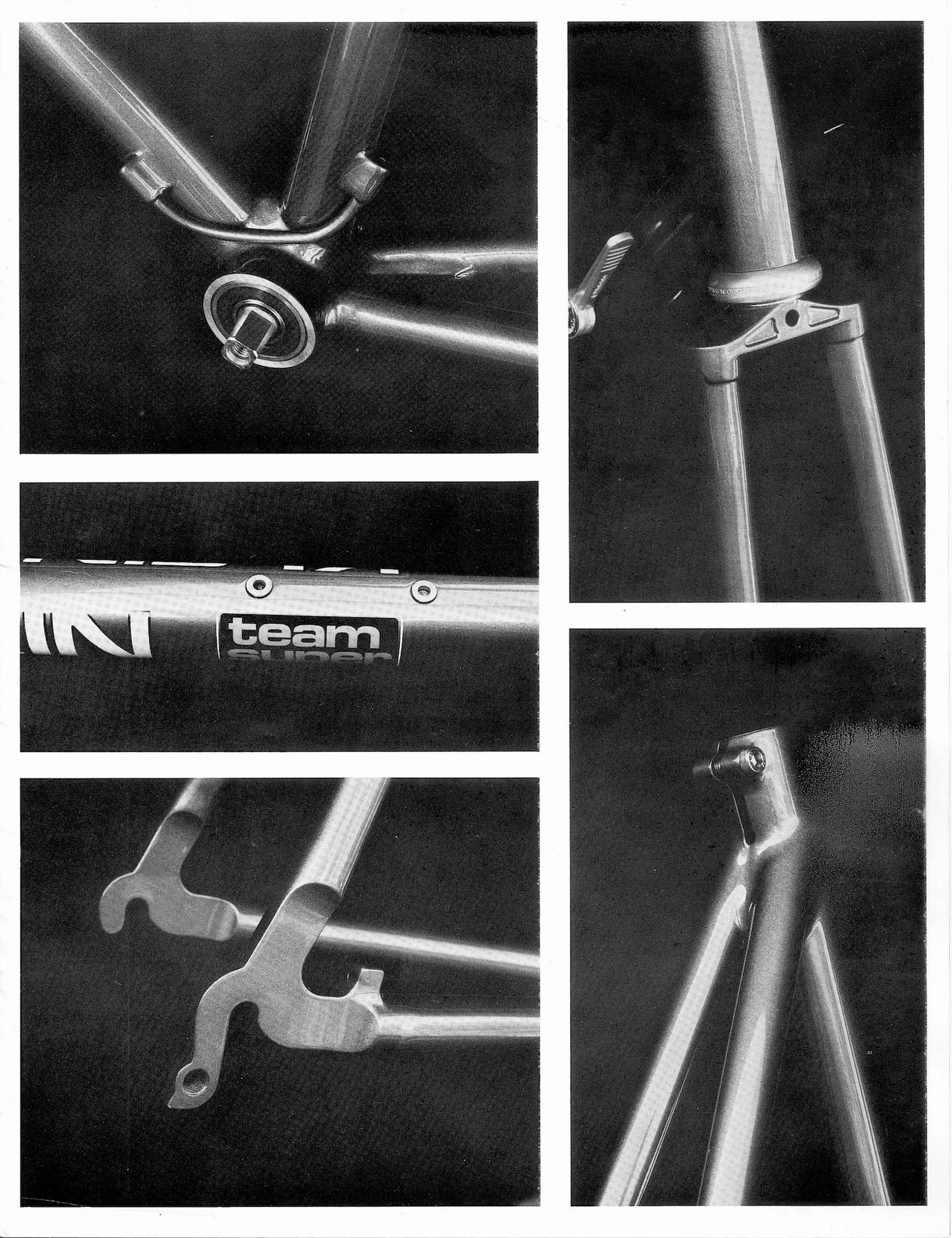
[Five black-and-white detail photographs of a Klein frame on a dark ground: the bottom bracket with its cable guide, a top tube with a “team super” decal, the rear dropouts, the fork crown and the seat lug with its bolt. The page carries no printed words, credit or folio; the decal and a partial logo appear only as lettering on the photographed tube.]
— Page 13 (back cover) —
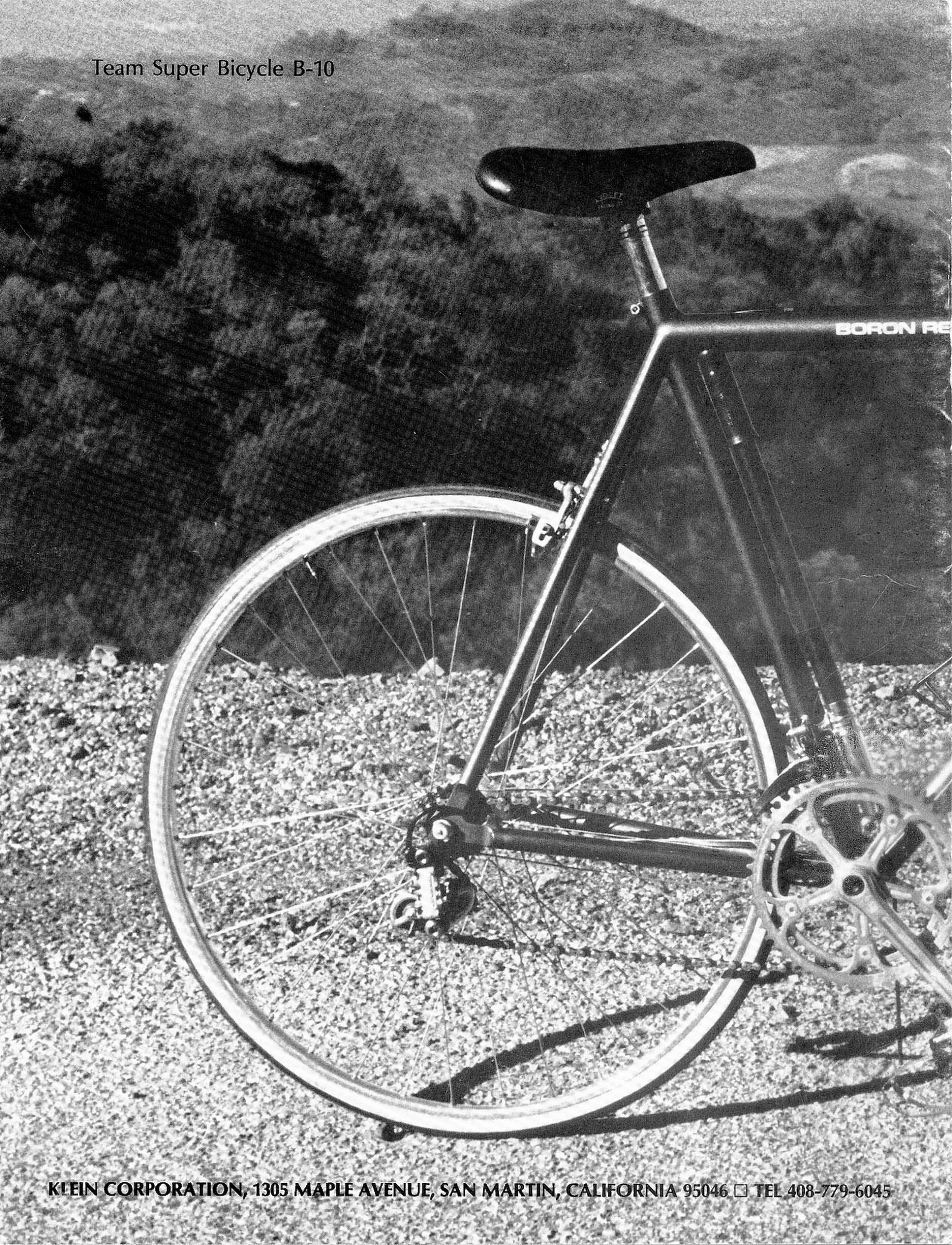
Team Super Bicycle B-10
KLEIN CORPORATION, 1305 MAPLE AVENUE, SAN MARTIN, CALIFORNIA 95046 □ TEL 408-779-6045
[The Team Super Bicycle B-10 photographed in black and white from behind the rear wheel, on gravel with a wooded hillside behind it, cropped at the right edge. The caption sits at the top left and the Klein Corporation address across the bottom, with a small square symbol before the telephone number.]
Ebykr presents this material for research and education. If you hold rights to it or notice an ownership issue, please contact us and we will respond promptly.
The Ebykr Digest
New articles, timelines, catalog finds and registry activity — assembled from the archive once a month. Your address is never shared.
Double opt-in. One email per month. Unsubscribe at any time with one click.