About Ebykr
Ebykr celebrates classic and vintage lightweight bicycles through provocative imagery and opinion. Ride along with us.
About Ebykr
Ebykr celebrates classic and vintage lightweight bicycles through provocative imagery and opinion. Ride along with us.

Source: Northwestern University Libraries, Transportation Library, "365 days ahead of them all" (digital collection, https://dc.library.northwestern.edu/items/80200bad-125e-4118-99e1-512b99737a3b); rights statement "No Copyright - United States".
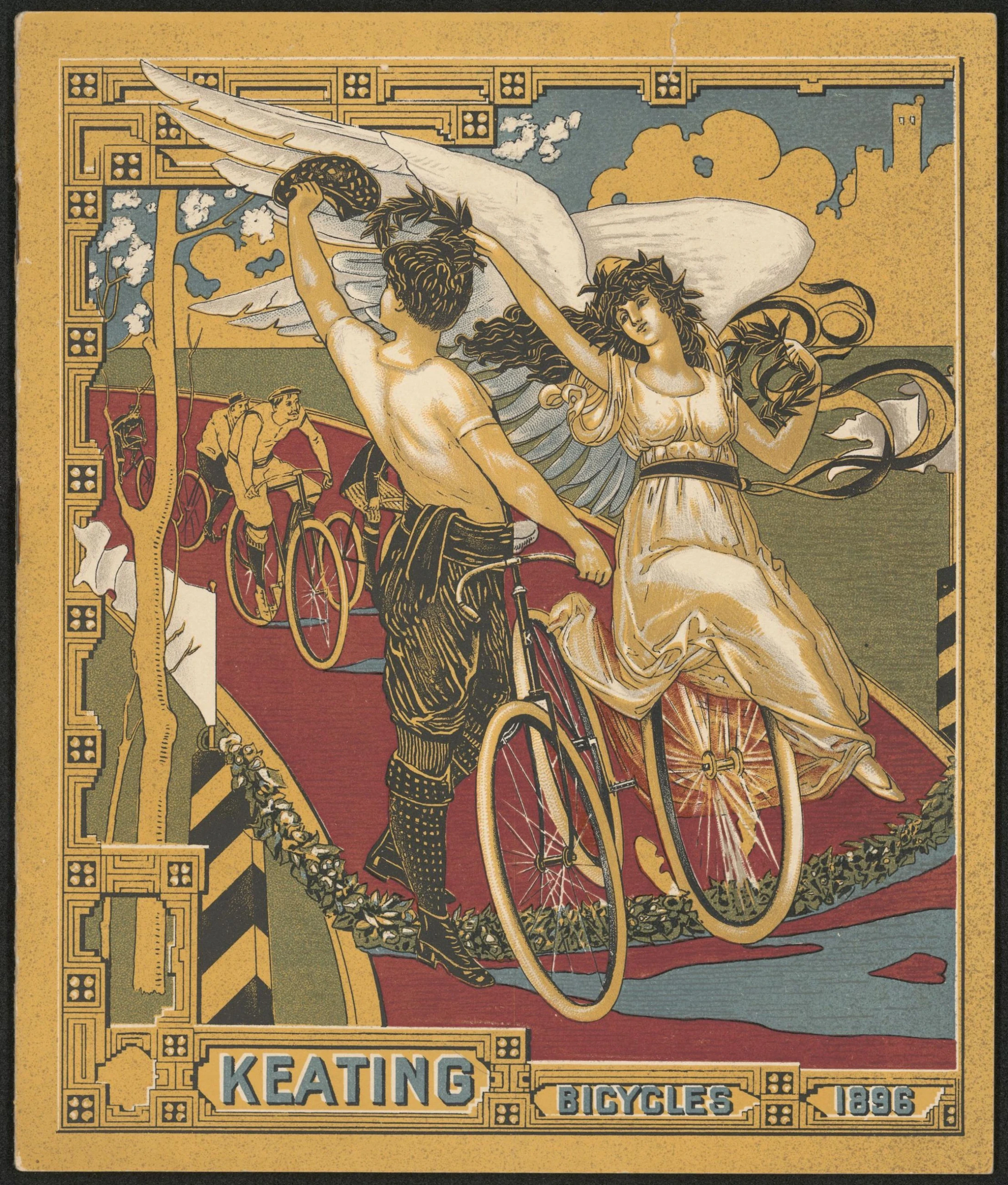 Page 1
 Page 2
 Page 3
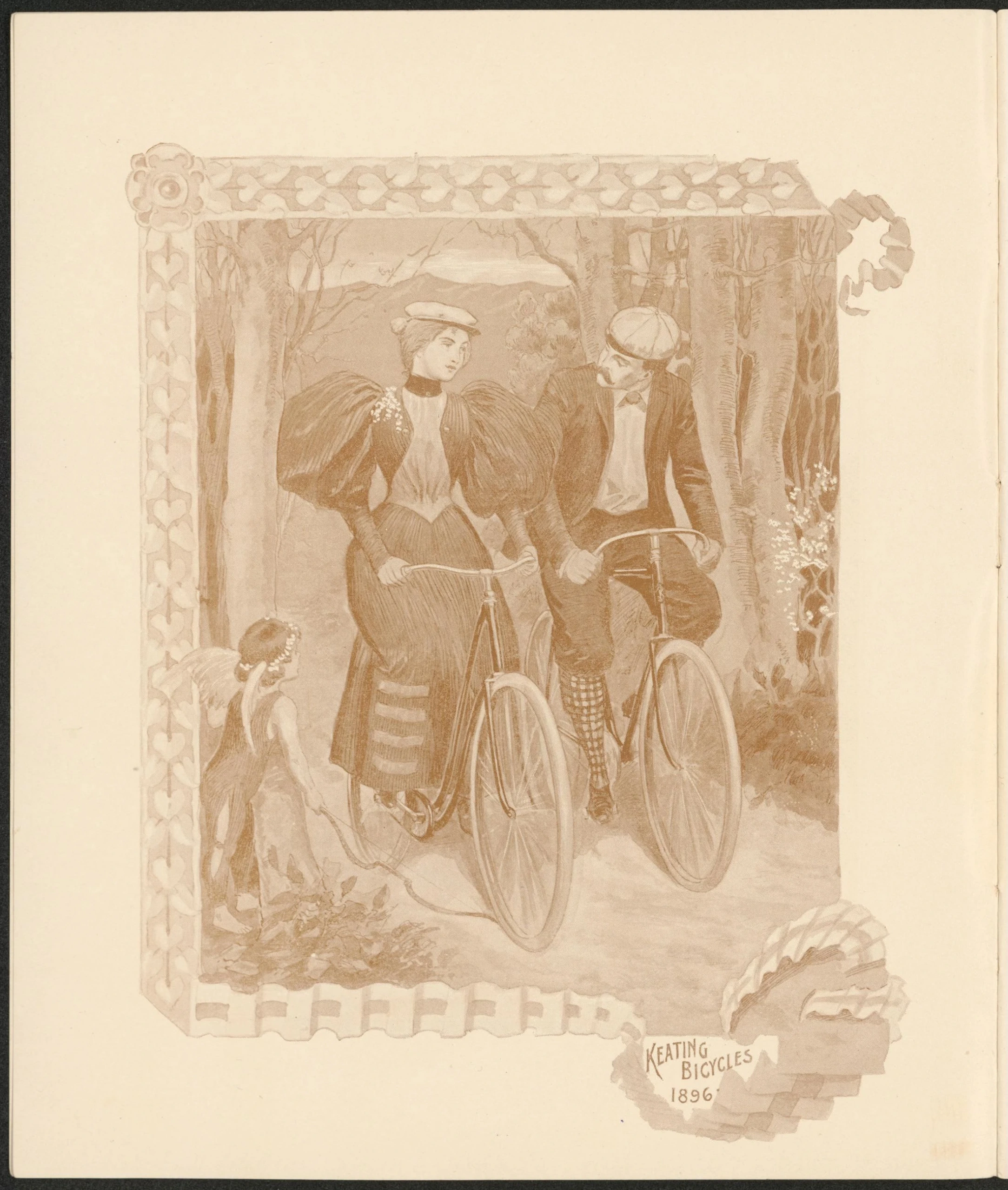 Page 4
 Page 5
 Page 6
 Page 7
 Page 8
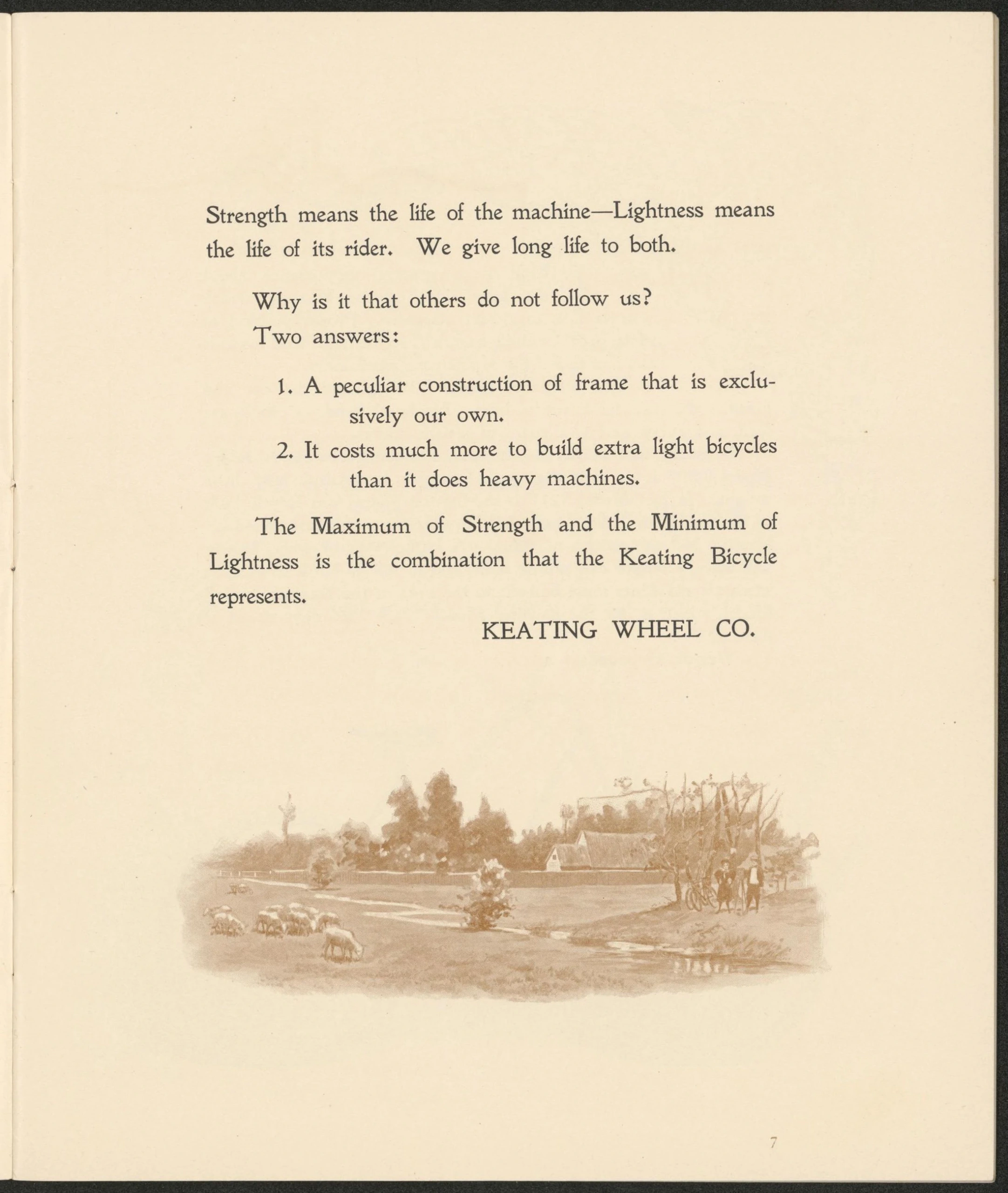 Page 9
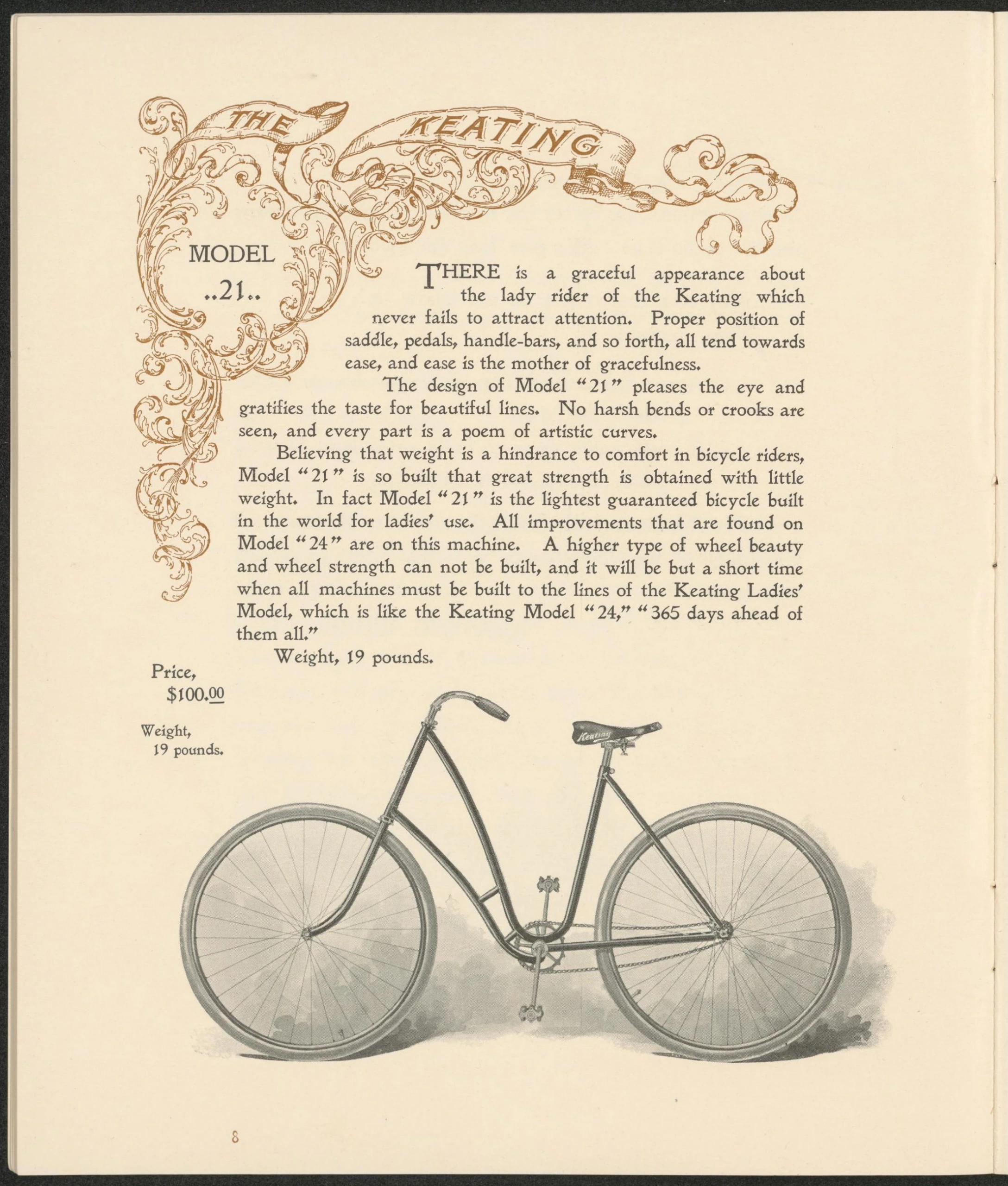 Page 10
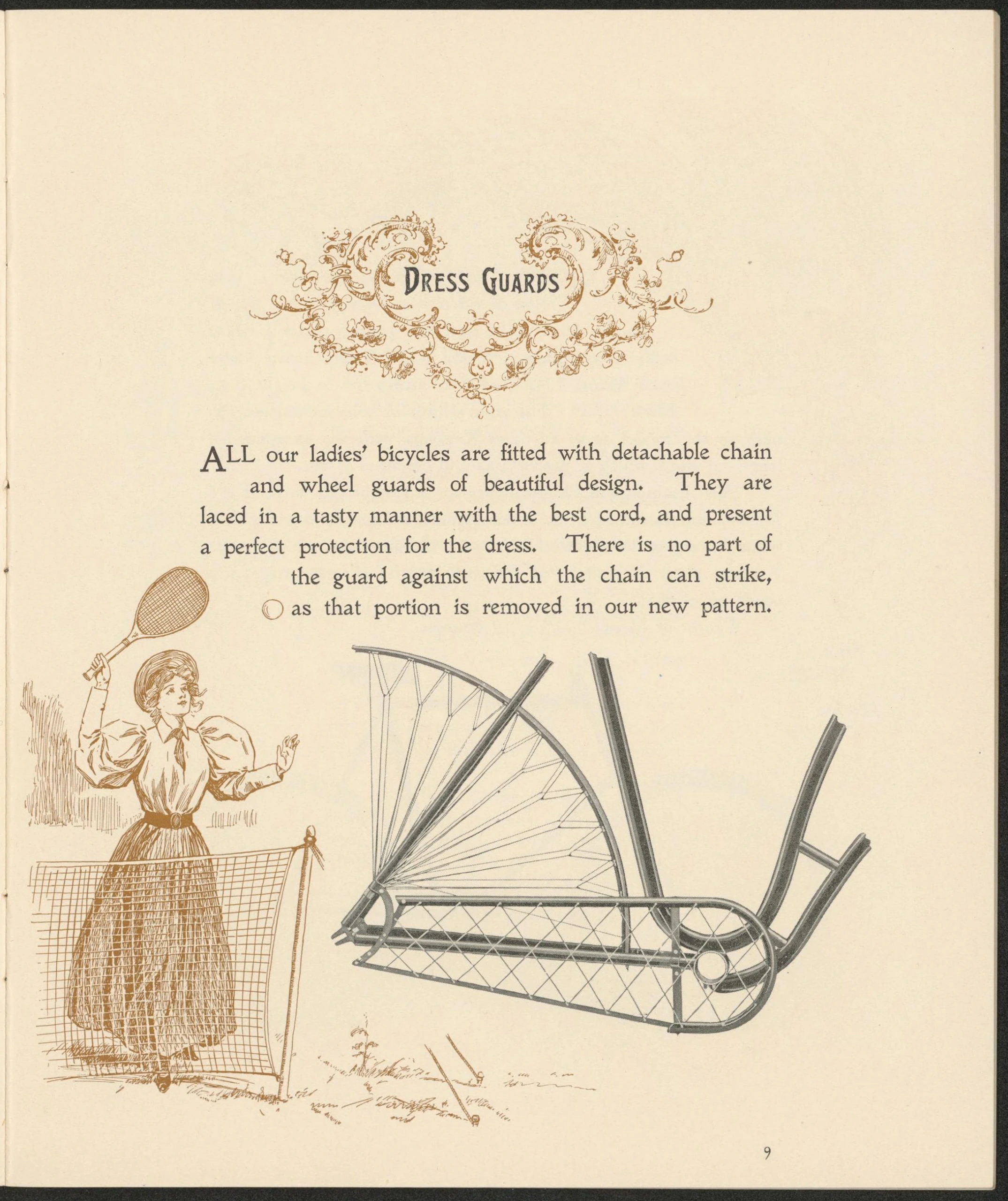 Page 11
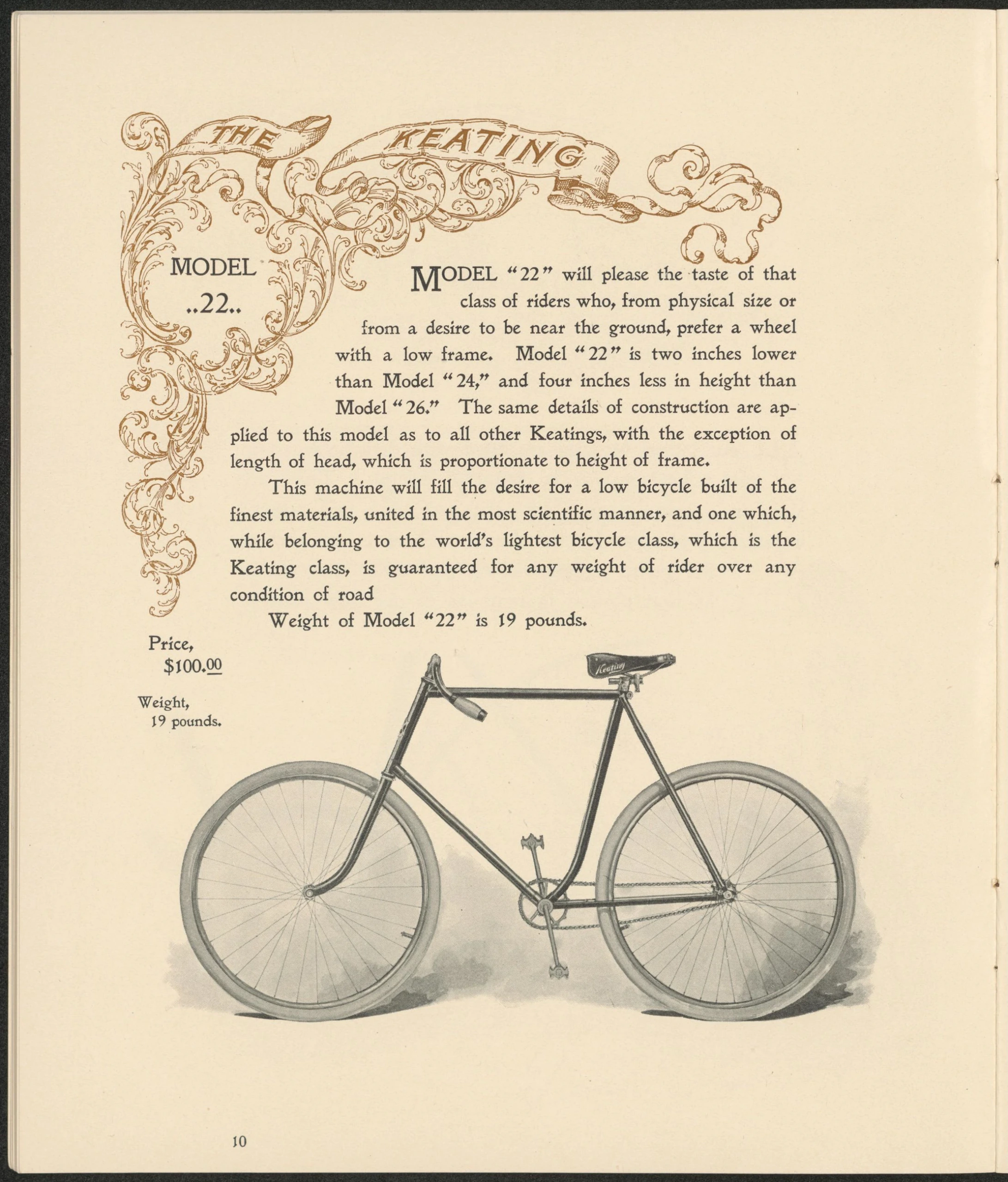 Page 12
 Page 13
 Page 14
 Page 15
 Page 16
 Page 17
 Page 18
 Page 19
 Page 20
 Page 21
 Page 22
 Page 23
 Page 24
 Page 25
 Page 26
 Page 27
 Page 28
 Page 29
 Page 30
 Page 31
 Page 32
 Page 33
 Page 34
 Page 35
 Page 36
| Marque | Keating |
|---|---|
| Type | Catalog |
| Year | 1896 |
| Publisher | Keating Wheel Co. |
| Country | United States |
| Language | English |
| Pages | 36 |
| Source | Northwestern University Libraries, Transportation Library, "365 days ahead of them all" (digital collection, https://dc.library.northwestern.edu/items/80200bad-125e-4118-99e1-512b99737a3b); rights statement "No Copyright - United States". |
| Credit | Northwestern University Libraries |
| Identifier | Permalink https://dc.library.northwestern.edu/items/80200bad-125e-4118-99e1-512b99737a3b |
| Transcription | Transcribed by eye |
Reference
Keating Wheel Co. Keating 1896 Catalog (Keating Wheel Co., Holyoke): "365 Days Ahead of Them All" 1896. Ebykr, https://ebykr.com/library/keating-1896-catalog-keating-wheel-co-holyoke-365-days-ahead-of-them-all/.
Wikipedia
{{cite book |title=Keating 1896 Catalog (Keating Wheel Co., Holyoke): "365 Days Ahead of Them All" |publisher=Keating Wheel Co. |date=1896 |url=https://ebykr.com/library/keating-1896-catalog-keating-wheel-co-holyoke-365-days-ahead-of-them-all/ |via=Ebykr |access-date=}}KEATING BICYCLES 1896 KEATING BICYCLES 1896 365 DAYS AHEAD OF THEM ALL KEATING WHEEL Co HOLYOKE MASS. For sale by F. SAMMIS. 358 MAIN ST. Bridgeport, Conn. "SEE THAT CURVE?" A WORD.... IN PASSING THE bicycle can no longer be looked upon as an oddity, fad or luxury. It is one of the many 19th …
The Keating Wheel Company’s sixth annual catalog, for 1896, “365 days ahead of them all”, from Holyoke, Massachusetts: the curved frame, the Models 21 (ladies’), 22, 24 and 26 at $100 and the Model 28 tandem and Model 29 combination tandem at $150, the frame, narrow tread, tires, pedals, handlebars, crank shaft, sprocket, hubs, saddle and guarantee, with plates and a touring essay. Transcribed from the page images (36 pages); each page ends with a bracketed description of its pictures.
— Page 1 —
KEATING
BICYCLES
1896
[The front cover, a color lithograph: a winged Victory in a white gown holds a laurel wreath over a bare-armed racing cyclist with his Keating safety, other riders behind them on a red track; a gold geometric border with square rosettes and black-and-gold striped posts.]
— Page 2 —
[Blank page.]
[The blank inside front cover, with a faint reddish offset of the cover lithograph at lower center and a small tear at the top edge.]
— Page 3 —
[Blank page.]
[A blank endpaper.]
— Page 4 —
KEATING
BICYCLES
1896
[A brown-tinted frontispiece: a lady in a leg-of-mutton-sleeved jacket and a gentleman in a cap and checked stockings ride side by side down a woodland lane while a winged Cupid with a bow follows; an ornamental heart-pattern frame and a scrolled cartouche lettered with the title.]
— Page 5 —
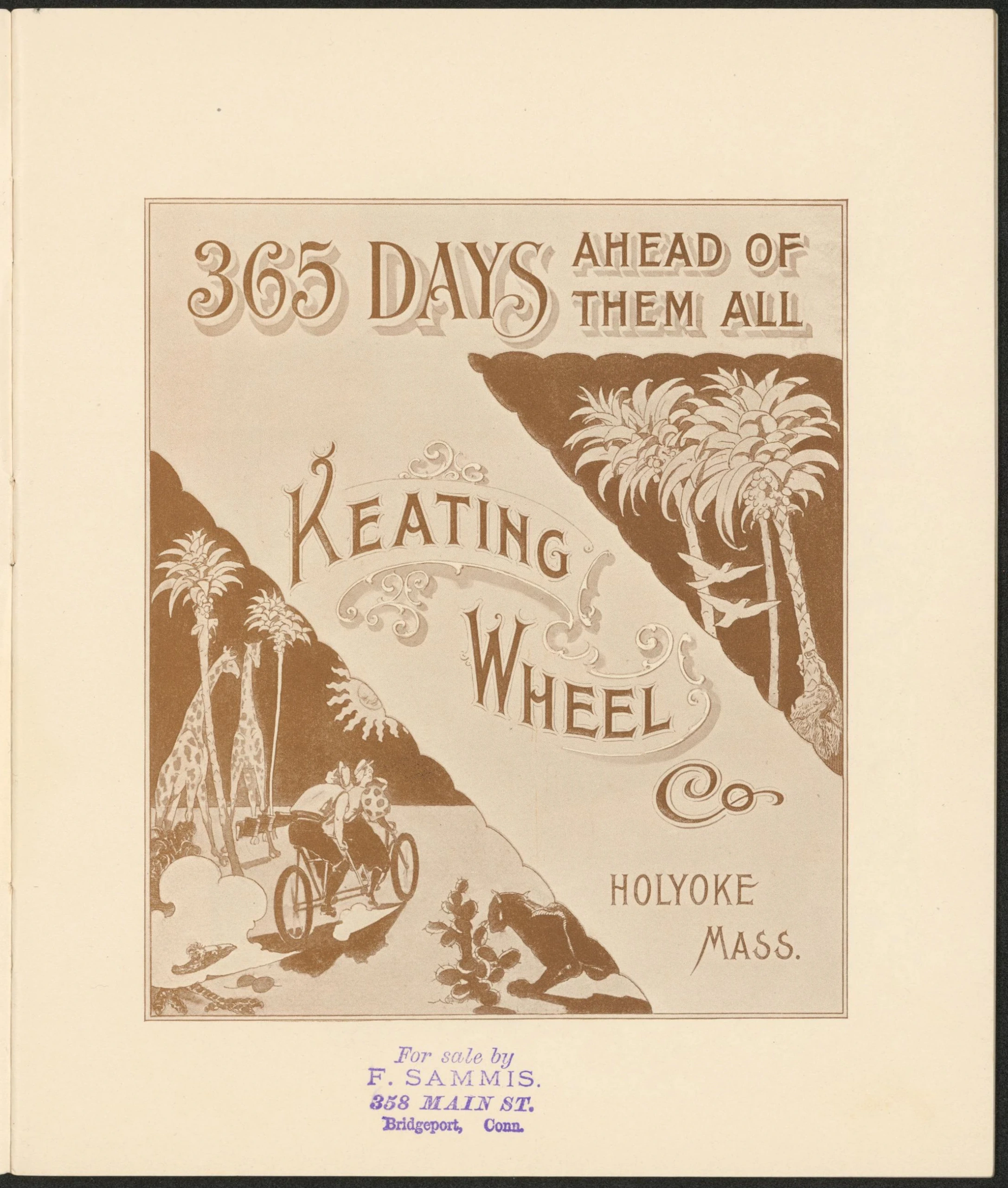
365 DAYS AHEAD OF THEM ALL
KEATING
WHEEL
Co
HOLYOKE
MASS.
For sale by
F. SAMMIS.
358 MAIN ST.
Bridgeport, Conn.
[The title page, printed in brown: ornamental lettering on a diagonal band between two fanciful jungle scenes with palms, giraffes, monkeys, a tandem ridden by a couple, a crocodile and a panther. A purple rubber dealer’s stamp of F. Sammis, Bridgeport, below the picture.]
— Page 6 —
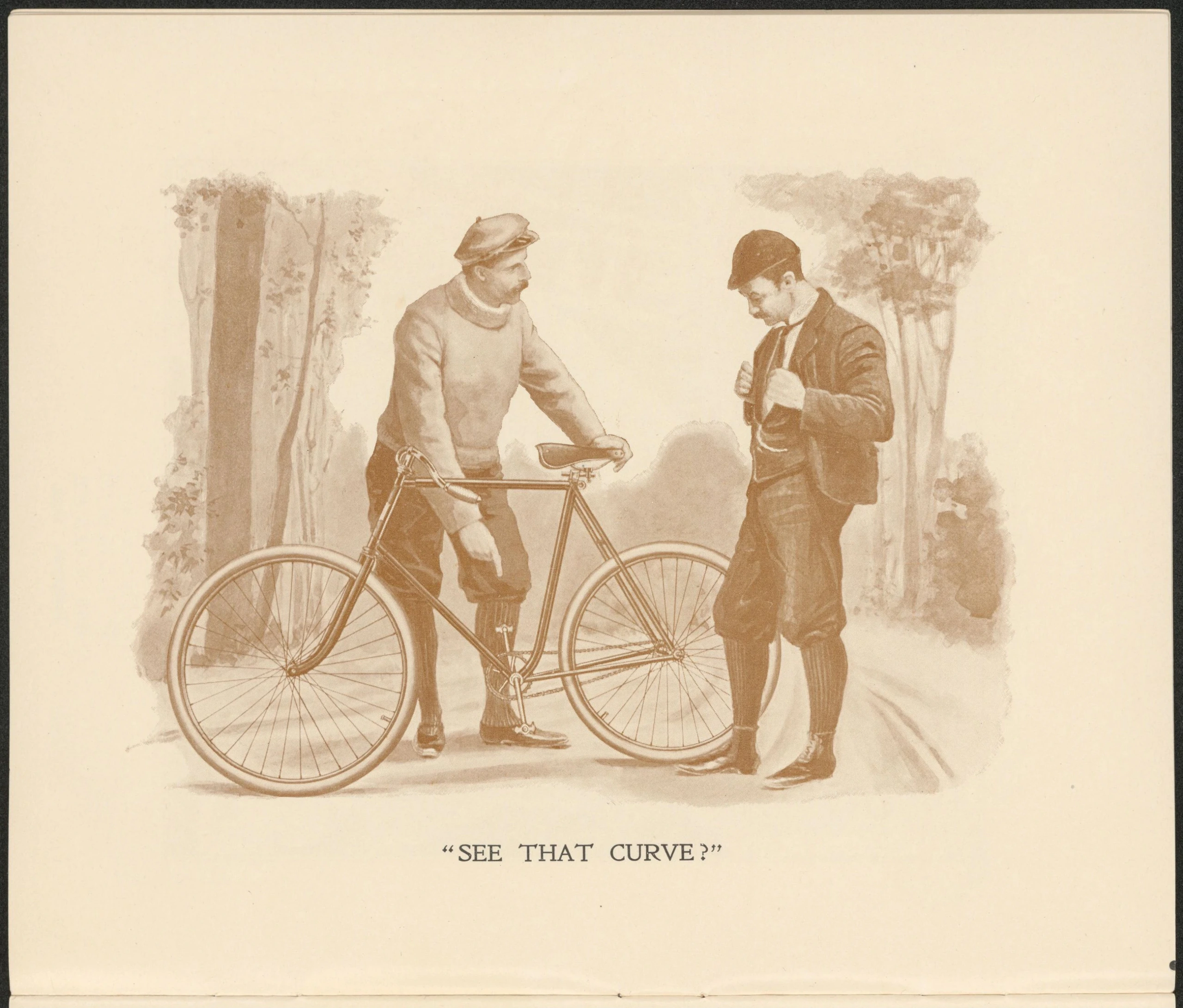
“SEE THAT CURVE?”
[A brown-tinted picture printed sideways on the page (the scan is turned to read it): on a woodland road a cyclist in a sweater and cap points to the curved frame tube of his Keating safety while a second man in a cap and knickerbockers looks on. No folio.]
— Page 7 —
A WORD….
IN PASSING
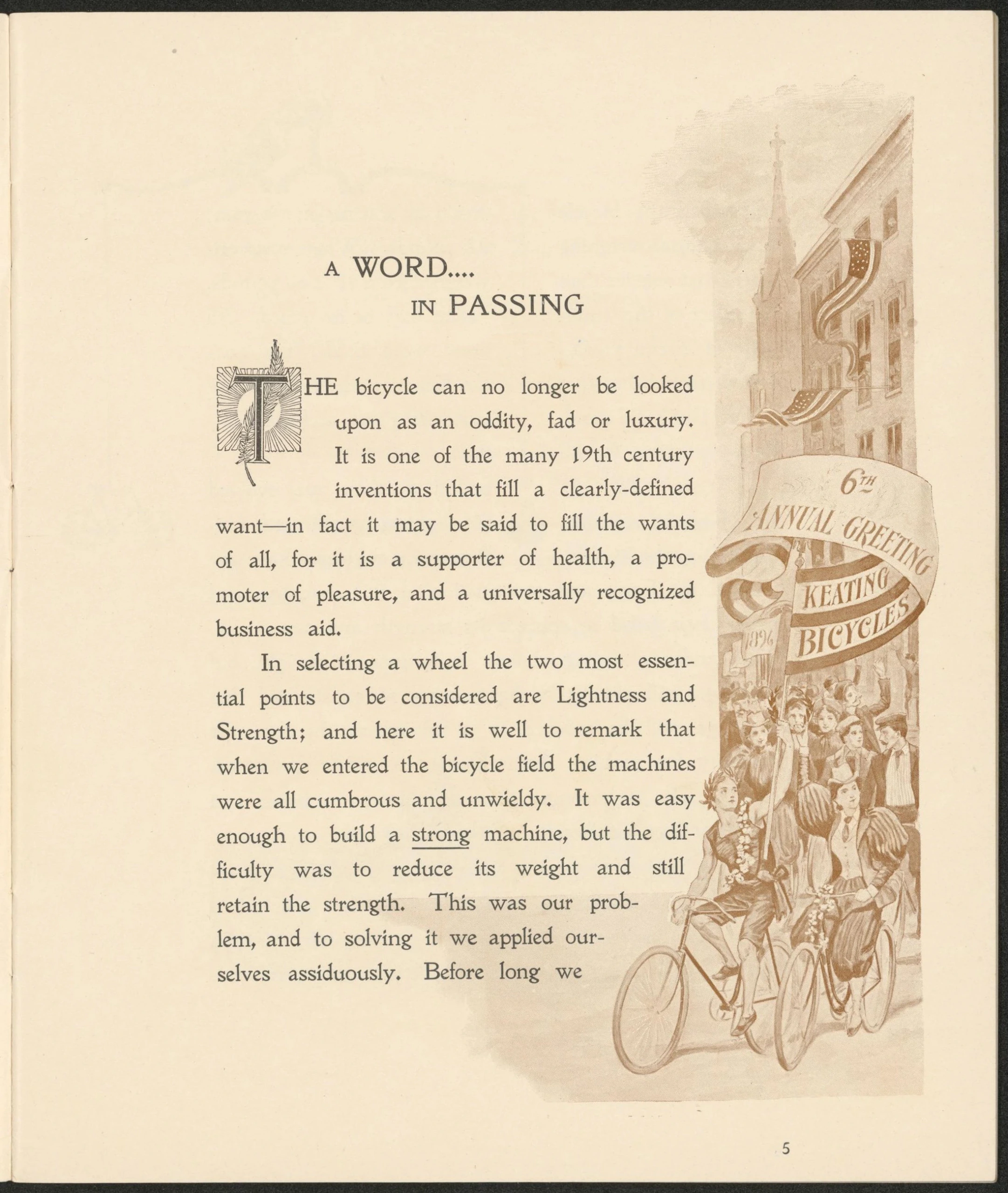
THE bicycle can no longer be looked upon as an oddity, fad or luxury. It is one of the many 19th century inventions that fill a clearly-defined want—in fact it may be said to fill the wants of all, for it is a supporter of health, a promoter of pleasure, and a universally recognized business aid.
In selecting a wheel the two most essential points to be considered are Lightness and Strength; and here it is well to remark that when we entered the bicycle field the machines were all cumbrous and unwieldy. It was easy enough to build a strong machine, but the difficulty was to reduce its weight and still retain the strength. This was our problem, and to solving it we applied ourselves assiduously. Before long we
6th ANNUAL GREETING
KEATING BICYCLES
1896
5
[A text page printed in black and brown: an ornamental initial “T” with a palm frond; at right a brown vignette of a city street hung with American flags, a crowd and two lady cyclists, one garlanded, carrying a banner reading “6th Annual Greeting Keating Bicycles” with “1896” on a placard. The word “strong” is underlined in the print.]
— Page 8 —
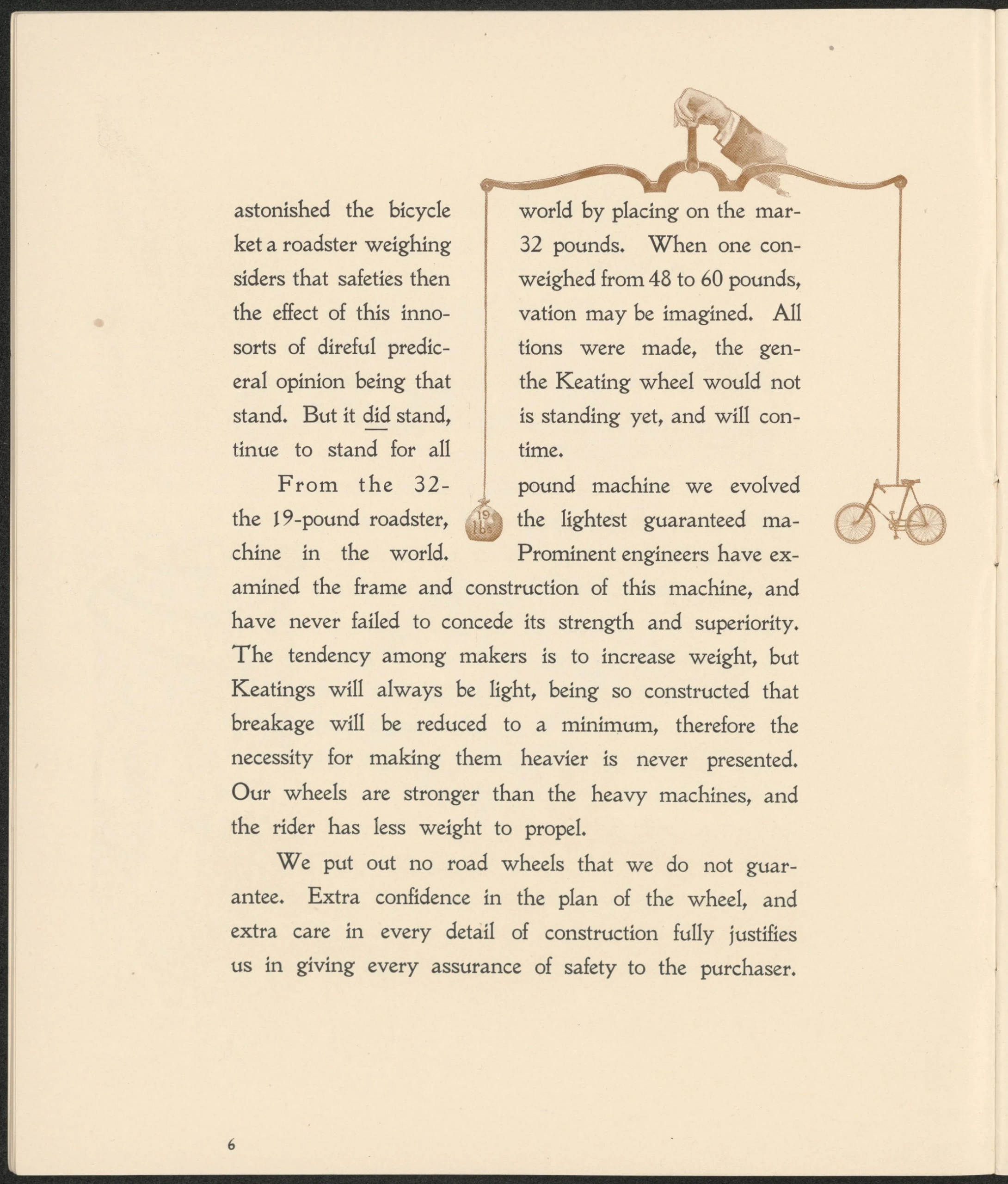
astonished the bicycle world by placing on the market a roadster weighing 32 pounds. When one considers that safeties then weighed from 48 to 60 pounds, the effect of this innovation may be imagined. All sorts of direful predictions were made, the general opinion being that the Keating wheel would not stand. But it did stand, is standing yet, and will continue to stand for all time.
From the 32-pound machine we evolved the 19-pound roadster, the lightest guaranteed machine in the world. Prominent engineers have examined the frame and construction of this machine, and have never failed to concede its strength and superiority. The tendency among makers is to increase weight, but Keatings will always be light, being so constructed that breakage will be reduced to a minimum, therefore the necessity for making them heavier is never presented. Our wheels are stronger than the heavy machines, and the rider has less weight to propel.
We put out no road wheels that we do not guarantee. Extra confidence in the plan of the wheel, and extra care in every detail of construction fully justifies us in giving every assurance of safety to the purchaser.
19 lbs
6
[A text page; the upper paragraph is set in two columns divided by the cords of a brown steelyard balance held by a hand, a weight marked “19 lbs” hanging from one end and a small bicycle from the other. The word “did” is underlined in the print.]
— Page 9 —
Strength means the life of the machine—Lightness means the life of its rider. We give long life to both.
Why is it that others do not follow us?
Two answers:
1. A peculiar construction of frame that is exclusively our own.
2. It costs much more to build extra light bicycles than it does heavy machines.
The Maximum of Strength and the Minimum of Lightness is the combination that the Keating Bicycle represents.
KEATING WHEEL CO.
7
[A text page with a brown vignette below: sheep grazing in a meadow by a stream, a farmhouse behind trees, and a couple standing with their bicycles at right.]
— Page 10 —
THE KEATING
MODEL ..21..
THERE is a graceful appearance about the lady rider of the Keating which never fails to attract attention. Proper position of saddle, pedals, handle-bars, and so forth, all tend towards ease, and ease is the mother of gracefulness.
The design of Model “21” pleases the eye and gratifies the taste for beautiful lines. No harsh bends or crooks are seen, and every part is a poem of artistic curves.
Believing that weight is a hindrance to comfort in bicycle riders, Model “21” is so built that great strength is obtained with little weight. In fact Model “21” is the lightest guaranteed bicycle built in the world for ladies’ use. All improvements that are found on Model “24” are on this machine. A higher type of wheel beauty and wheel strength can not be built, and it will be but a short time when all machines must be built to the lines of the Keating Ladies’ Model, which is like the Keating Model “24,” “365 days ahead of them all.”
Weight, 19 pounds.
Price, $100.00
Weight, 19 pounds.
8
[A text page under a brown scrollwork banner lettered “The Keating”; below, a halftone of the Model 21 ladies’ drop-frame safety in side view with a curved front frame tube, raised handlebar and a saddle lettered “Keating”.]
— Page 11 —
DRESS GUARDS
ALL our ladies’ bicycles are fitted with detachable chain and wheel guards of beautiful design. They are laced in a tasty manner with the best cord, and present a perfect protection for the dress. There is no part of the guard against which the chain can strike, as that portion is removed in our new pattern.
9
[A text page with the heading in a brown floral scrollwork cartouche; below, a brown drawing of a lady in a puffed-sleeve blouse holding a tennis racket beside a net, and an engraving of the detachable rear-wheel dress guard and chain guard frame with its fan of lacing.]
— Page 12 —
THE KEATING
MODEL ..22..
MODEL “22” will please the taste of that class of riders who, from physical size or from a desire to be near the ground, prefer a wheel with a low frame. Model “22” is two inches lower than Model “24,” and four inches less in height than Model “26.” The same details of construction are applied to this model as to all other Keatings, with the exception of length of head, which is proportionate to height of frame.
This machine will fill the desire for a low bicycle built of the finest materials, united in the most scientific manner, and one which, while belonging to the world’s lightest bicycle class, which is the Keating class, is guaranteed for any weight of rider over any condition of road
Weight of Model “22” is 19 pounds.
Price, $100.00
Weight, 19 pounds.
10
[A text page under a brown scrollwork banner lettered “The Keating”; below, a halftone of the Model 22 low-frame men’s safety in side view, with the curved Keating front tube, dropped handlebar and a saddle lettered “Keating”.]
— Page 13 —
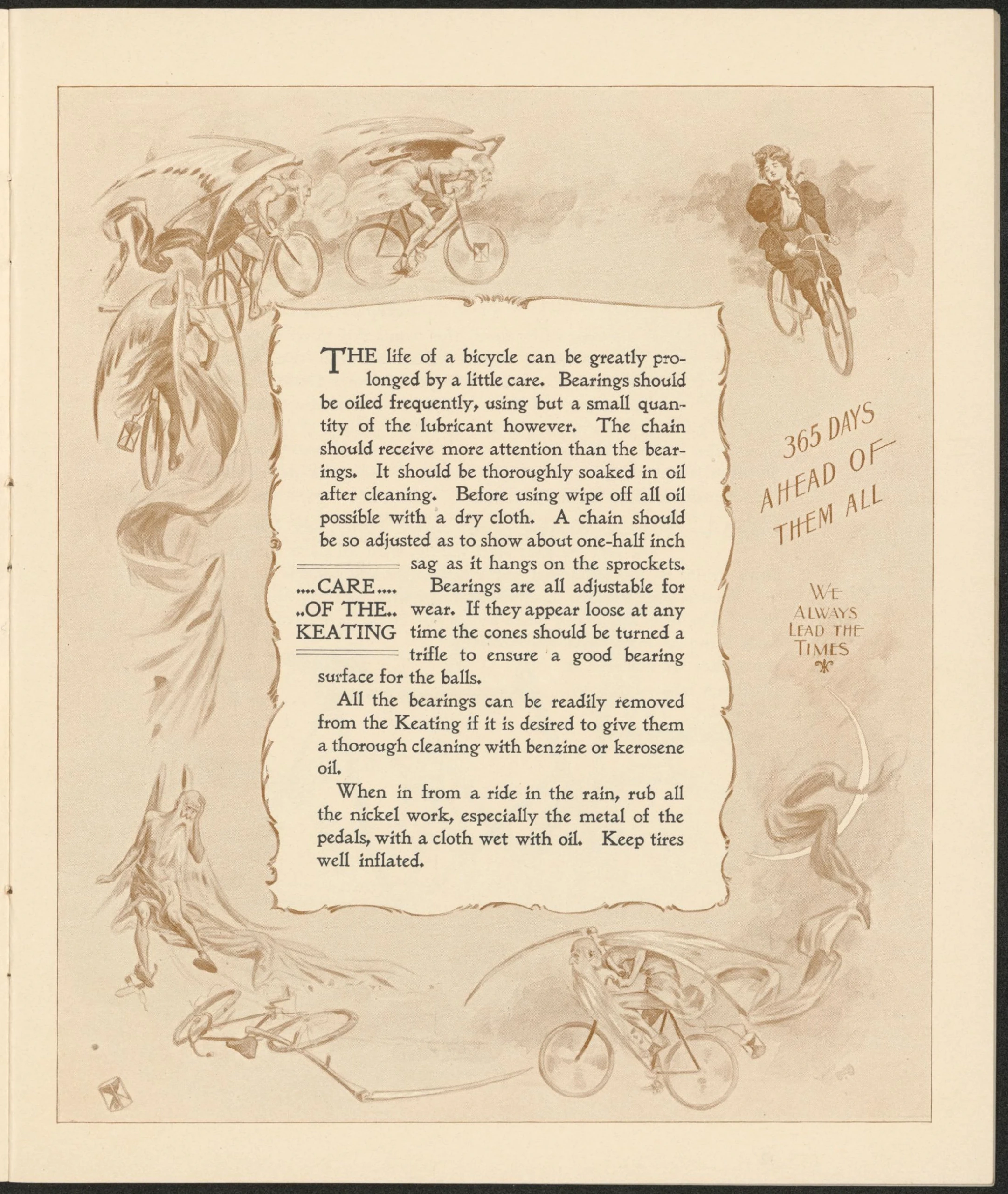
….CARE….
..OF THE..
KEATING
THE life of a bicycle can be greatly prolonged by a little care. Bearings should be oiled frequently, using but a small quantity of the lubricant however. The chain should receive more attention than the bearings. It should be thoroughly soaked in oil after cleaning. Before using wipe off all oil possible with a dry cloth. A chain should be so adjusted as to show about one-half inch sag as it hangs on the sprockets.
Bearings are all adjustable for wear. If they appear loose at any time the cones should be turned a trifle to ensure a good bearing surface for the balls.
All the bearings can be readily removed from the Keating if it is desired to give them a thorough cleaning with benzine or kerosene oil.
When in from a ride in the rain, rub all the nickel work, especially the metal of the pedals, with a cloth wet with oil. Keep tires well inflated.
365 DAYS AHEAD OF THEM ALL
WE ALWAYS LEAD THE TIMES
[A full-page brown-tinted plate: the text in a scalloped panel surrounded by winged figures of Father Time with scythes and hourglasses riding bicycles, one fallen beside a wrecked machine, all outpaced by a young lady cyclist at upper right. No folio.]
— Page 14 —
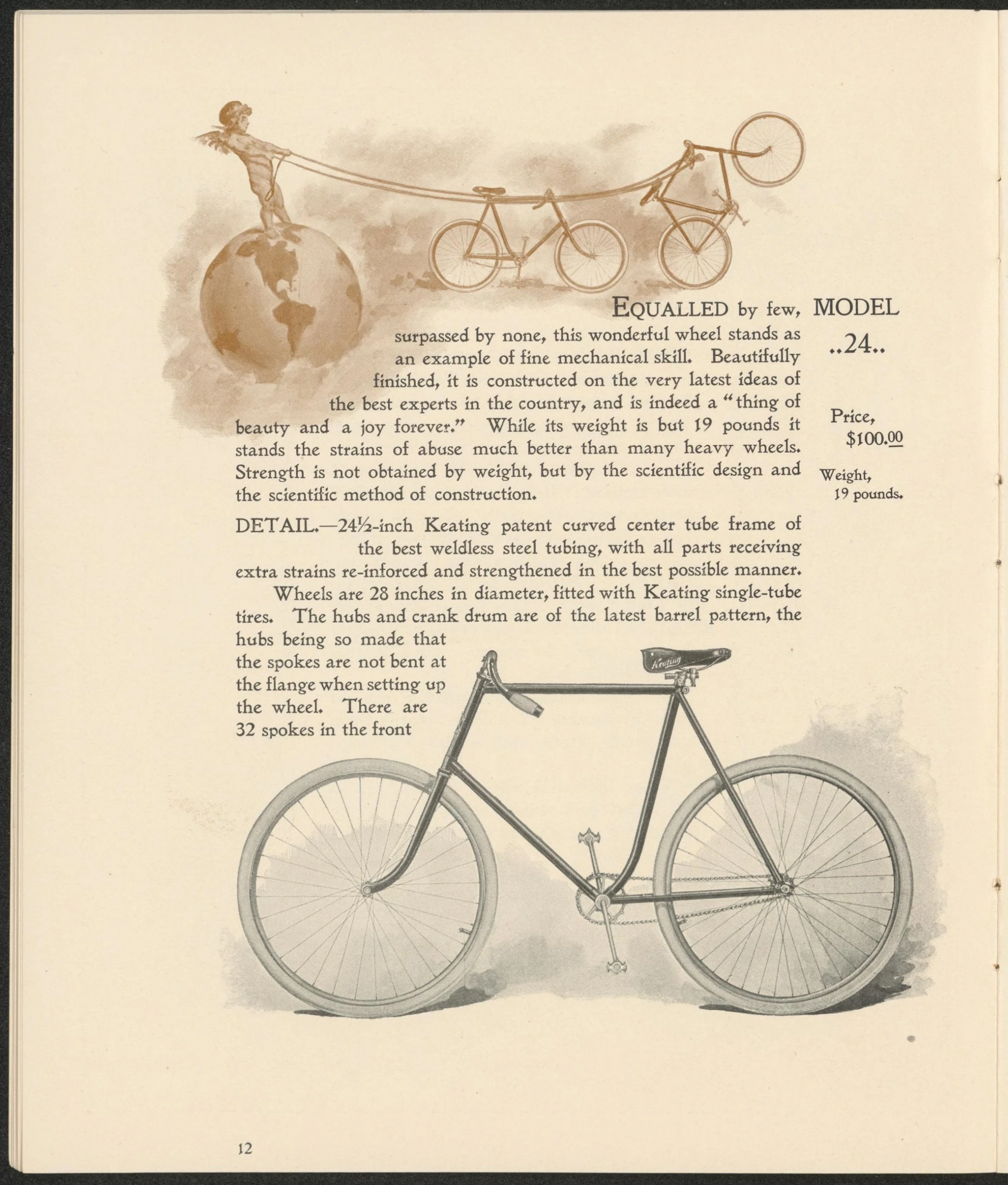
MODEL ..24..
EQUALLED by few, surpassed by none, this wonderful wheel stands as an example of fine mechanical skill. Beautifully finished, it is constructed on the very latest ideas of the best experts in the country, and is indeed a “thing of beauty and a joy forever.” While its weight is but 19 pounds it stands the strains of abuse much better than many heavy wheels. Strength is not obtained by weight, but by the scientific design and the scientific method of construction.
DETAIL.—24½-inch Keating patent curved center tube frame of the best weldless steel tubing, with all parts receiving extra strains re-inforced and strengthened in the best possible manner.
Wheels are 28 inches in diameter, fitted with Keating single-tube tires. The hubs and crank drum are of the latest barrel pattern, the hubs being so made that the spokes are not bent at the flange when setting up the wheel. There are 32 spokes in the front
Price, $100.00
Weight, 19 pounds.
12
[A brown vignette at top: a winged Cupid standing on a globe hauls on a long rope tied to a Keating bicycle that rears up and drags an older-style machine behind it. Below, a halftone of the Model 24 men’s safety in side view with the curved center tube and a saddle lettered “Keating”.]
— Page 15 —
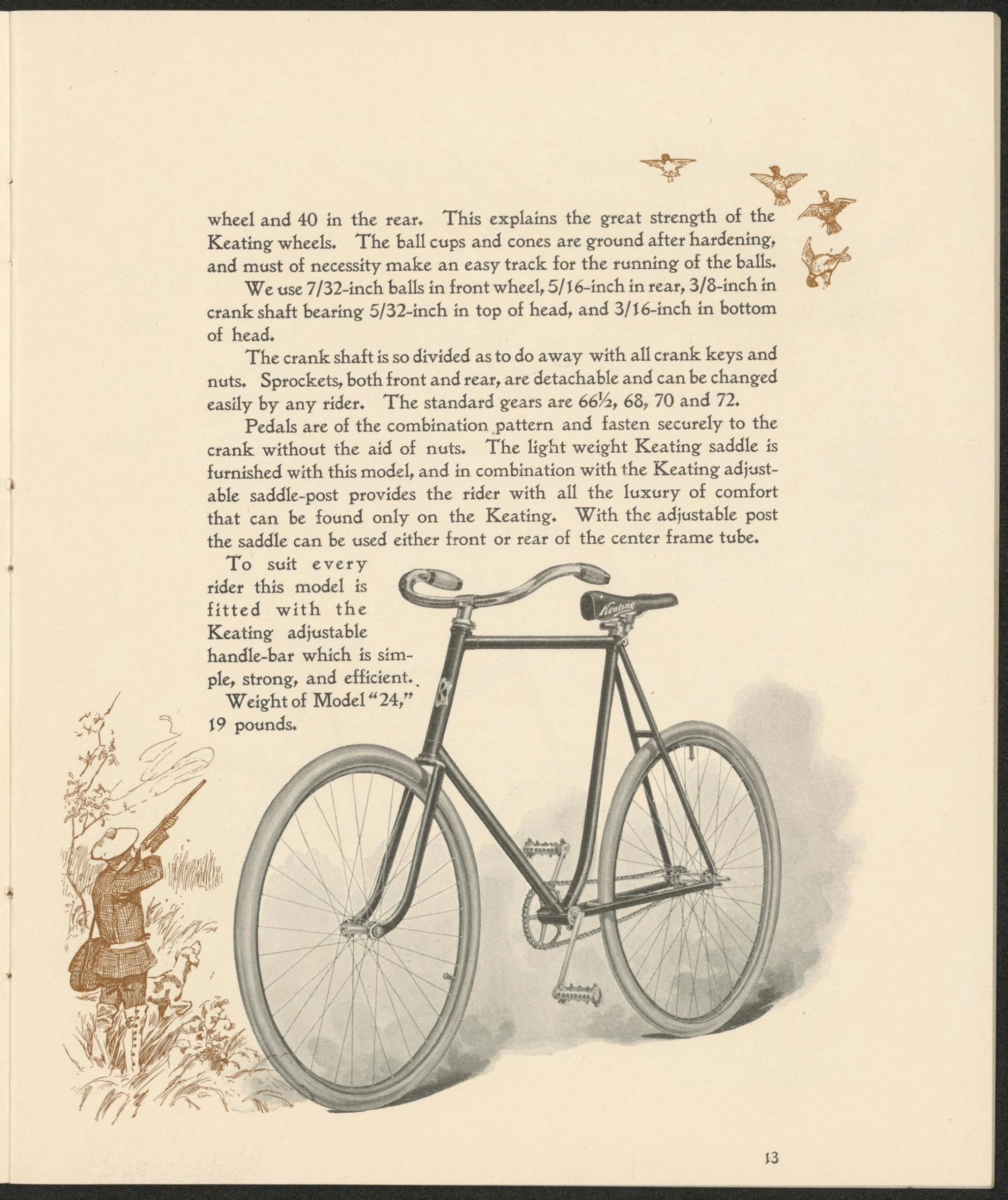
wheel and 40 in the rear. This explains the great strength of the Keating wheels. The ball cups and cones are ground after hardening, and must of necessity make an easy track for the running of the balls.
We use 7/32-inch balls in front wheel, 5/16-inch in rear, 3/8-inch in crank shaft bearing 5/32-inch in top of head, and 3/16-inch in bottom of head.
The crank shaft is so divided as to do away with all crank keys and nuts. Sprockets, both front and rear, are detachable and can be changed easily by any rider. The standard gears are 66½, 68, 70 and 72.
Pedals are of the combination pattern and fasten securely to the crank without the aid of nuts. The light weight Keating saddle is furnished with this model, and in combination with the Keating adjustable saddle-post provides the rider with all the luxury of comfort that can be found only on the Keating. With the adjustable post the saddle can be used either front or rear of the center frame tube.
To suit every rider this model is fitted with the Keating adjustable handle-bar which is simple, strong, and efficient.
Weight of Model “24,” 19 pounds.
13
[A text page with four brown birds in flight at upper right; a halftone of the Model 24 in three-quarter front view with raised adjustable handlebar and a saddle lettered “Keating”; at lower left a brown sketch of a sportsman in a checked jacket firing a shotgun, with his dog.]
— Page 16 —
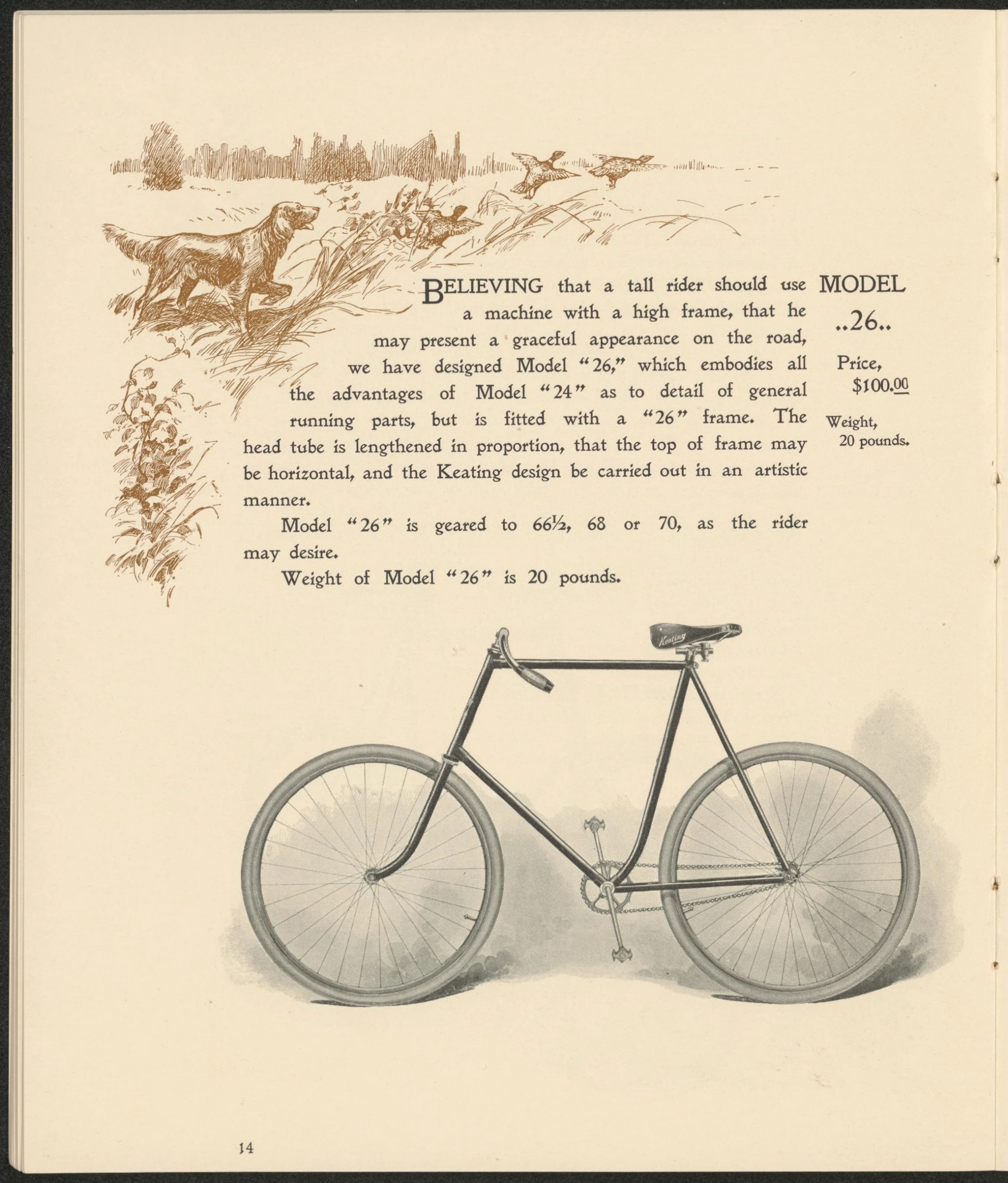
MODEL ..26..
BELIEVING that a tall rider should use a machine with a high frame, that he may present a graceful appearance on the road, we have designed Model “26,” which embodies all the advantages of Model “24” as to detail of general running parts, but is fitted with a “26” frame. The head tube is lengthened in proportion, that the top of frame may be horizontal, and the Keating design be carried out in an artistic manner.
Model “26” is geared to 66½, 68 or 70, as the rider may desire.
Weight of Model “26” is 20 pounds.
Price, $100.00
Weight, 20 pounds.
14
[A brown pen sketch at top of a setter flushing game birds from tall grass; below, a halftone of the Model 26 high-frame men’s safety in side view with the curved center tube and a saddle lettered “Keating”.]
— Page 17 —
THE KEATING
MODEL ..28..
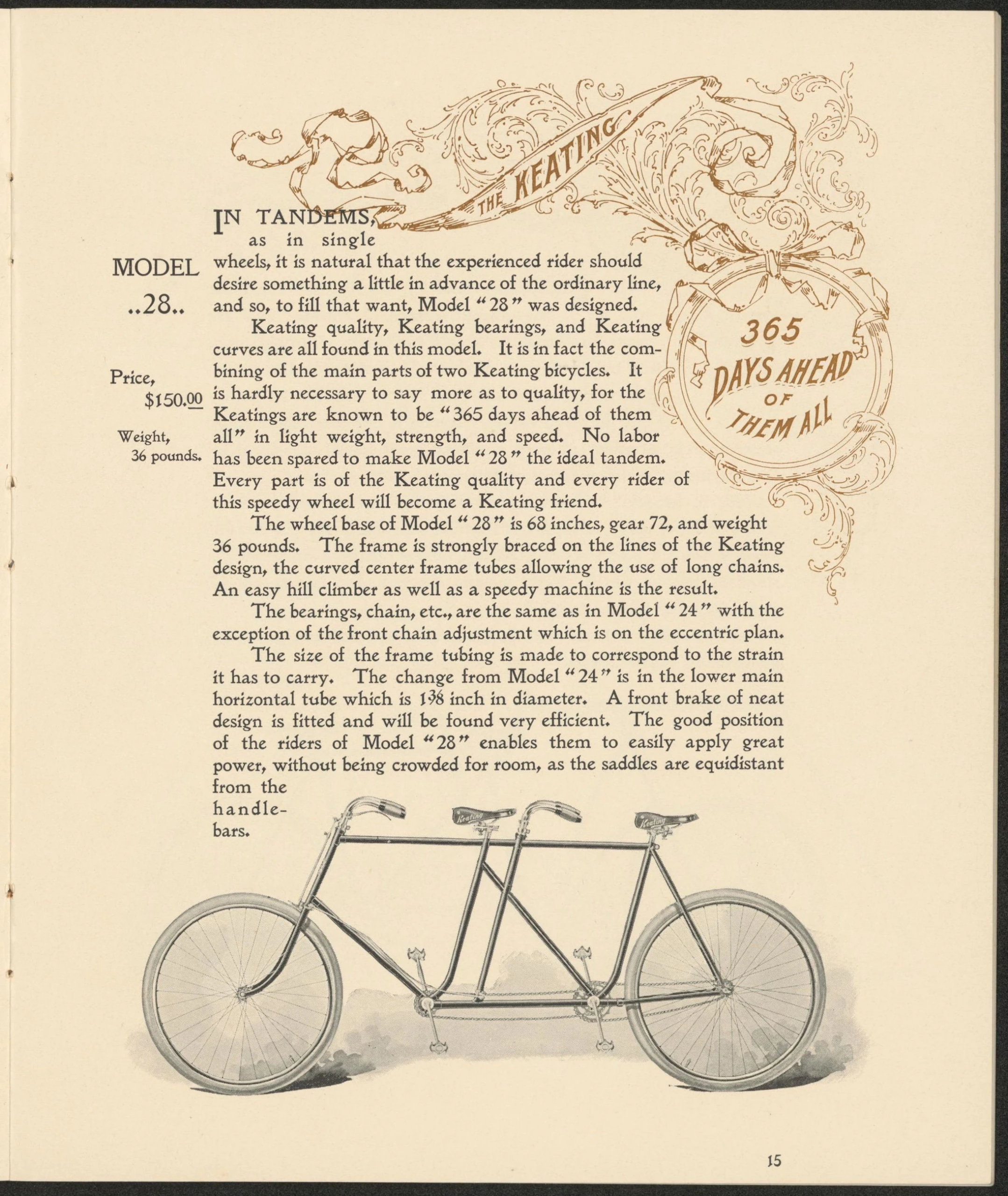
IN TANDEMS, as in single wheels, it is natural that the experienced rider should desire something a little in advance of the ordinary line, and so, to fill that want, Model “28” was designed.
Keating quality, Keating bearings, and Keating curves are all found in this model. It is in fact the combining of the main parts of two Keating bicycles. It is hardly necessary to say more as to quality, for the Keatings are known to be “365 days ahead of them all” in light weight, strength, and speed. No labor has been spared to make Model “28” the ideal tandem. Every part is of the Keating quality and every rider of this speedy wheel will become a Keating friend.
The wheel base of Model “28” is 68 inches, gear 72, and weight 36 pounds. The frame is strongly braced on the lines of the Keating design, the curved center frame tubes allowing the use of long chains. An easy hill climber as well as a speedy machine is the result.
The bearings, chain, etc., are the same as in Model “24” with the exception of the front chain adjustment which is on the eccentric plan.
The size of the frame tubing is made to correspond to the strain it has to carry. The change from Model “24” is in the lower main horizontal tube which is 1⅜ inch in diameter. A front brake of neat design is fitted and will be found very efficient. The good position of the riders of Model “28” enables them to easily apply great power, without being crowded for room, as the saddles are equidistant from the handle-bars.
365 DAYS AHEAD OF THEM ALL
Price, $150.00
Weight, 36 pounds.
15
[A text page with a brown scrollwork banner lettered “The Keating” and a ribboned wreath lettered “365 Days Ahead of Them All”; below, a halftone of the Model 28 men’s tandem in side view with two curved center tubes and two saddles lettered “Keating”.]
— Page 18 —
THE KEATING
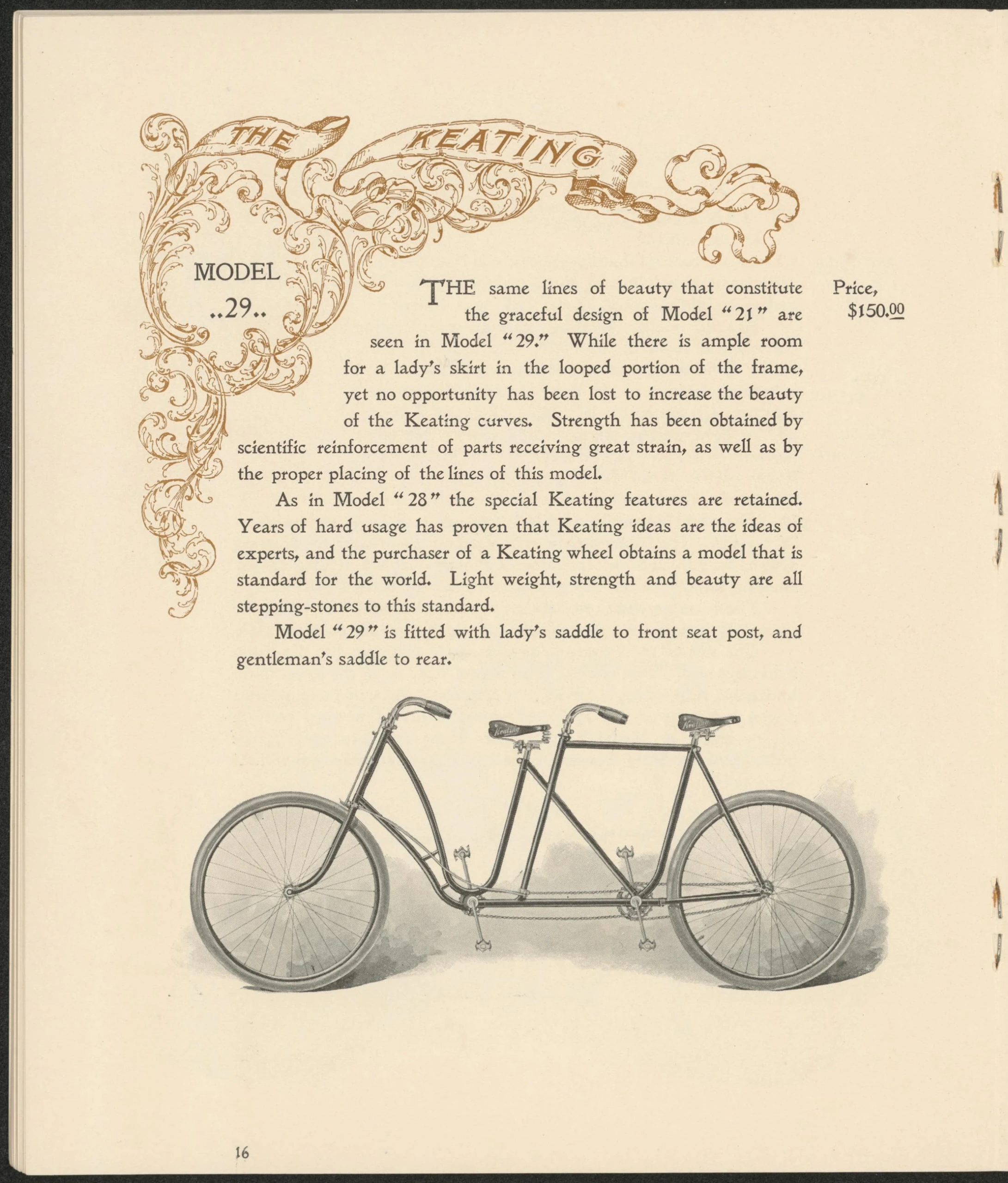
MODEL ..29..
THE same lines of beauty that constitute the graceful design of Model “21” are seen in Model “29.” While there is ample room for a lady’s skirt in the looped portion of the frame, yet no opportunity has been lost to increase the beauty of the Keating curves. Strength has been obtained by scientific reinforcement of parts receiving great strain, as well as by the proper placing of the lines of this model.
As in Model “28” the special Keating features are retained. Years of hard usage has proven that Keating ideas are the ideas of experts, and the purchaser of a Keating wheel obtains a model that is standard for the world. Light weight, strength and beauty are all stepping-stones to this standard.
Model “29” is fitted with lady’s saddle to front seat post, and gentleman’s saddle to rear.
Price, $150.00
16
[A text page under a brown scrollwork banner lettered “The Keating”; below, a halftone of the Model 29 combination tandem in side view, a looped drop frame in front for a lady and a diamond frame behind, two saddles lettered “Keating”.]
— Page 19 —
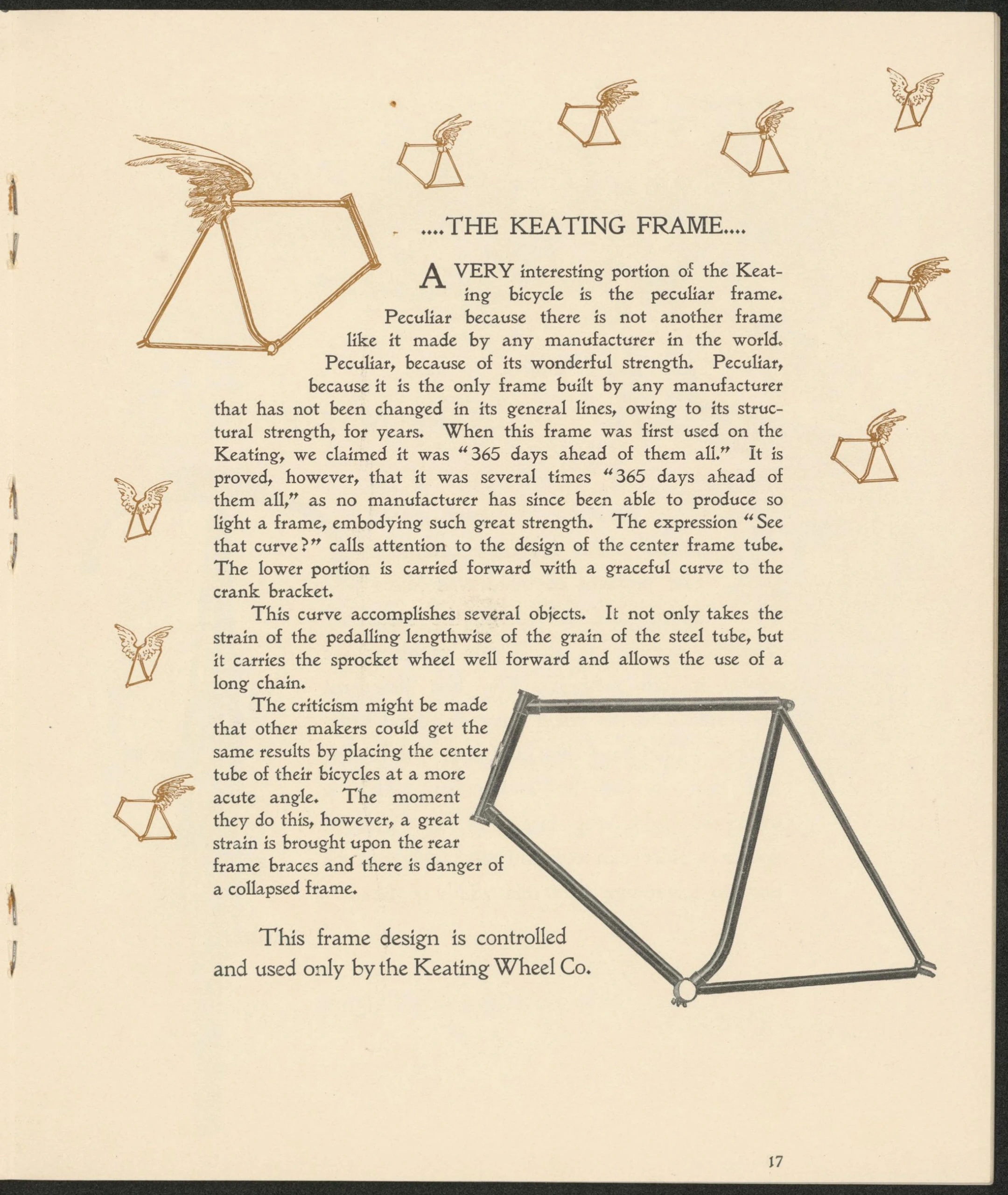
….THE KEATING FRAME….
A VERY interesting portion of the Keating bicycle is the peculiar frame. Peculiar because there is not another frame like it made by any manufacturer in the world. Peculiar, because of its wonderful strength. Peculiar, because it is the only frame built by any manufacturer that has not been changed in its general lines, owing to its structural strength, for years. When this frame was first used on the Keating, we claimed it was “365 days ahead of them all.” It is proved, however, that it was several times “365 days ahead of them all,” as no manufacturer has since been able to produce so light a frame, embodying such great strength. The expression “See that curve?” calls attention to the design of the center frame tube. The lower portion is carried forward with a graceful curve to the crank bracket.
This curve accomplishes several objects. It not only takes the strain of the pedalling lengthwise of the grain of the steel tube, but it carries the sprocket wheel well forward and allows the use of a long chain.
The criticism might be made that other makers could get the same results by placing the center tube of their bicycles at a more acute angle. The moment they do this, however, a great strain is brought upon the rear frame braces and there is danger of a collapsed frame.
This frame design is controlled and used only by the Keating Wheel Co.
17
[A text page scattered with small brown drawings of winged bicycle frames in flight and one large winged frame at upper left; at lower right a halftone of the bare Keating frame showing the curved center tube.]
— Page 20 —
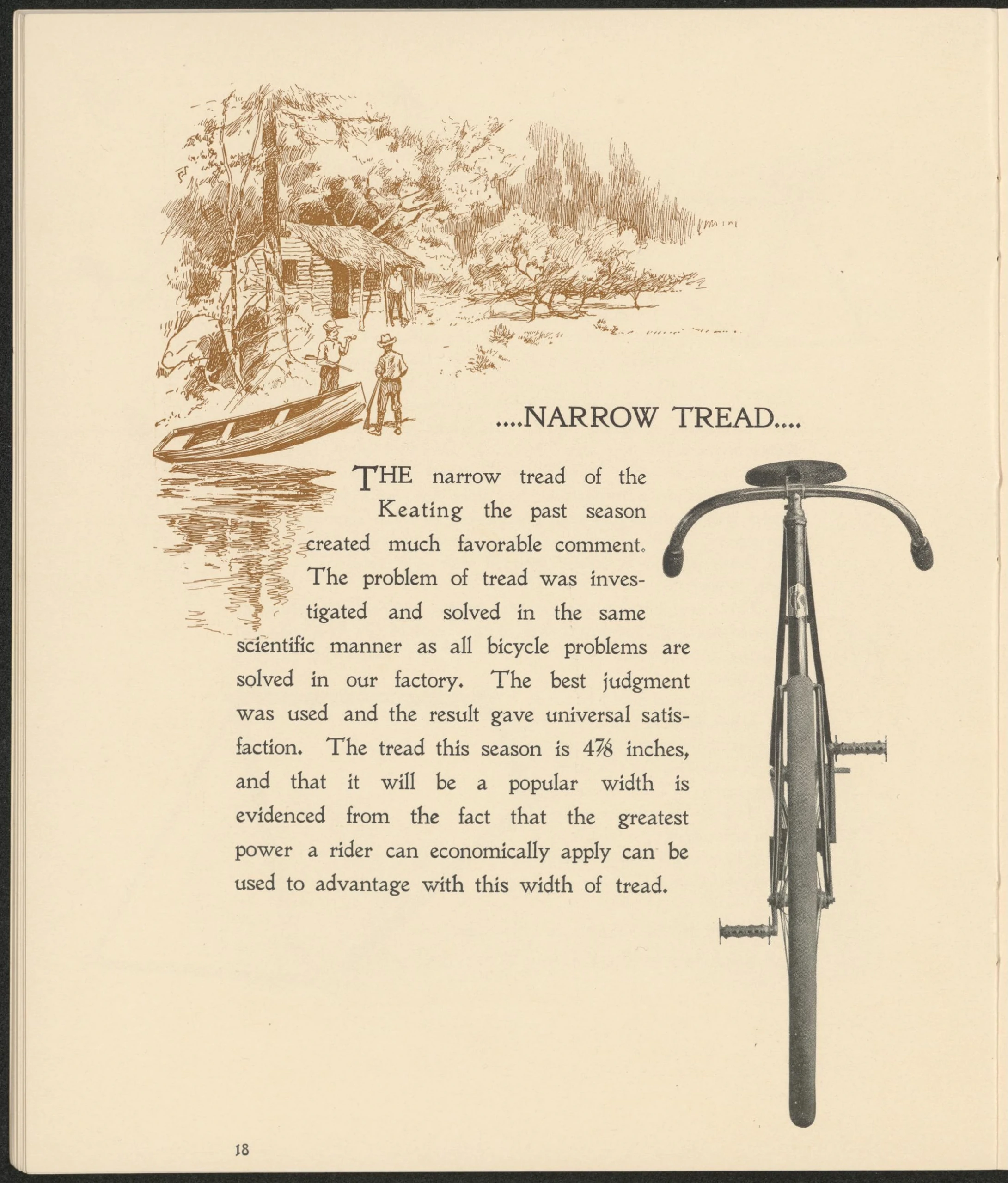
….NARROW TREAD….
THE narrow tread of the Keating the past season created much favorable comment. The problem of tread was investigated and solved in the same scientific manner as all bicycle problems are solved in our factory. The best judgment was used and the result gave universal satisfaction. The tread this season is 4⅞ inches, and that it will be a popular width is evidenced from the fact that the greatest power a rider can economically apply can be used to advantage with this width of tread.
18
[A text page with a brown pen sketch at top of two hunters with guns beside a boat at a riverbank below a log cabin; at right a halftone of a Keating bicycle seen end-on from the front, showing the narrow spacing of the pedals.]
— Page 21 —
CARE …OF… TIRES
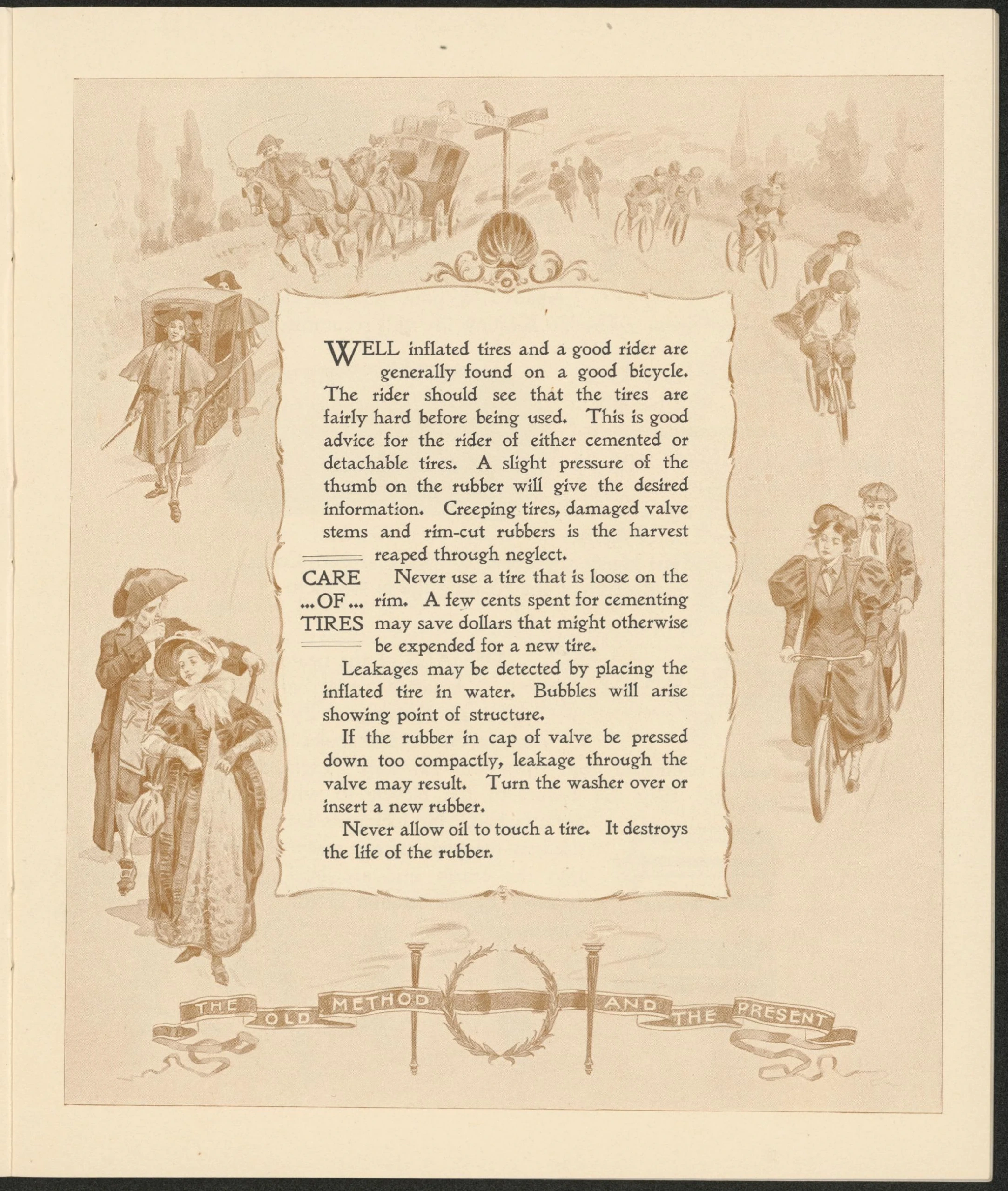
WELL inflated tires and a good rider are generally found on a good bicycle. The rider should see that the tires are fairly hard before being used. This is good advice for the rider of either cemented or detachable tires. A slight pressure of the thumb on the rubber will give the desired information. Creeping tires, damaged valve stems and rim-cut rubbers is the harvest reaped through neglect.
Never use a tire that is loose on the rim. A few cents spent for cementing may save dollars that might otherwise be expended for a new tire.
Leakages may be detected by placing the inflated tire in water. Bubbles will arise showing point of structure.
If the rubber in cap of valve be pressed down too compactly, leakage through the valve may result. Turn the washer over or insert a new rubber.
Never allow oil to touch a tire. It destroys the life of the rubber.
THE OLD METHOD AND THE PRESENT
[A full-page brown-tinted plate: the text in a scalloped panel framed by scenes contrasting old travel (an eighteenth-century coach and four at a signpost, a sedan chair with bearers, a couple in period dress) with modern cyclists, men and a lady, riding toward the reader; a ribbon below with two torches and a laurel wreath. No folio.]
— Page 22 —
….TIRES….
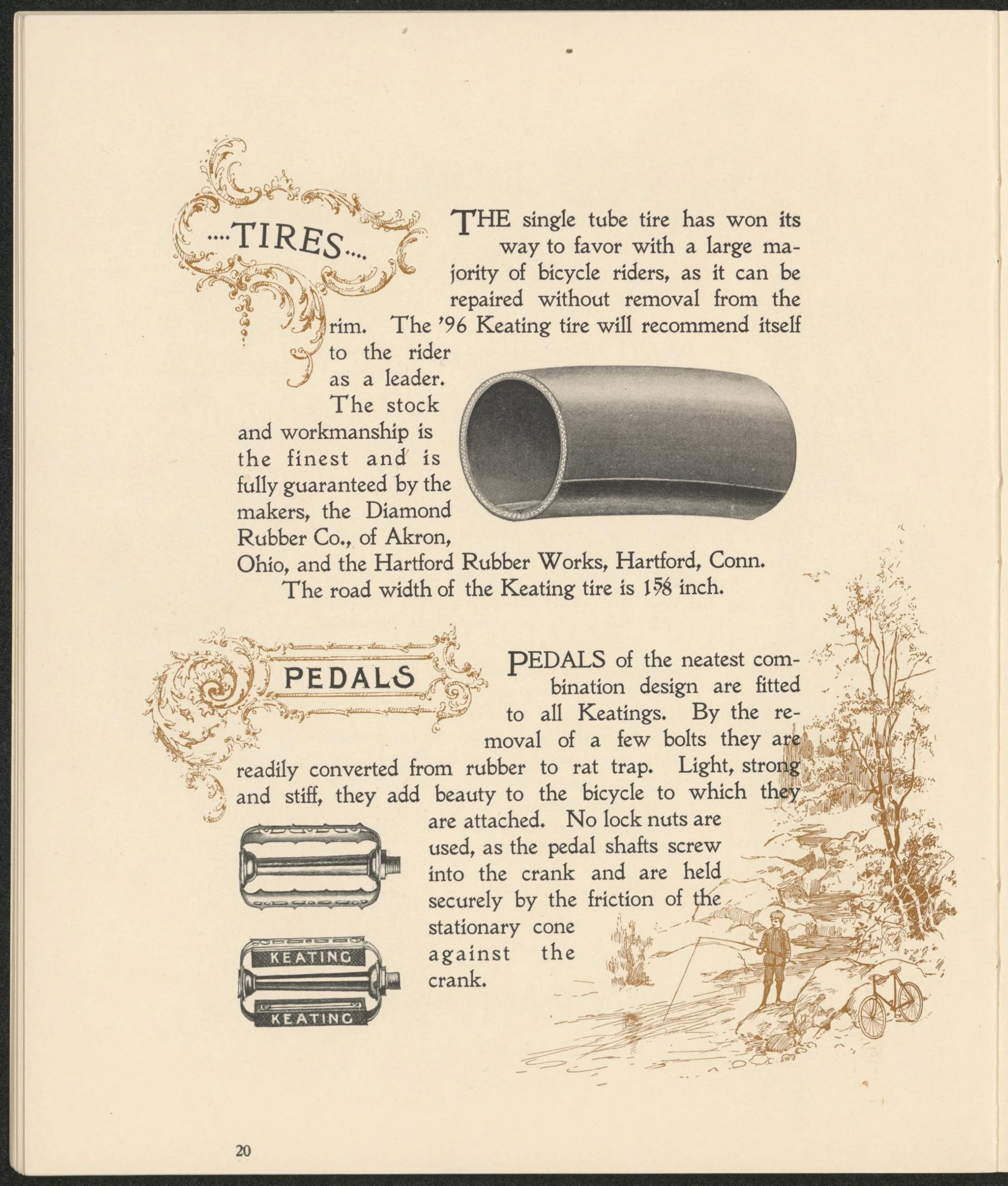
THE single tube tire has won its way to favor with a large majority of bicycle riders, as it can be repaired without removal from the rim. The ’96 Keating tire will recommend itself to the rider as a leader. The stock and workmanship is the finest and is fully guaranteed by the makers, the Diamond Rubber Co., of Akron, Ohio, and the Hartford Rubber Works, Hartford, Conn.
The road width of the Keating tire is 1⅝ inch.
PEDALS
PEDALS of the neatest combination design are fitted to all Keatings. By the removal of a few bolts they are readily converted from rubber to rat trap. Light, strong and stiff, they add beauty to the bicycle to which they are attached. No lock nuts are used, as the pedal shafts screw into the crank and are held securely by the friction of the stationary cone against the crank.
KEATING
KEATING
20
[A text page with headings in brown scrollwork cartouches; a halftone of a cut section of single-tube tire; engravings of the combination pedal as a rat-trap and with rubber blocks lettered “Keating”; a brown sketch at lower right of a boy fishing by a brook with his bicycle leaning on a rock.]
— Page 23 —
….HANDLE BARS….
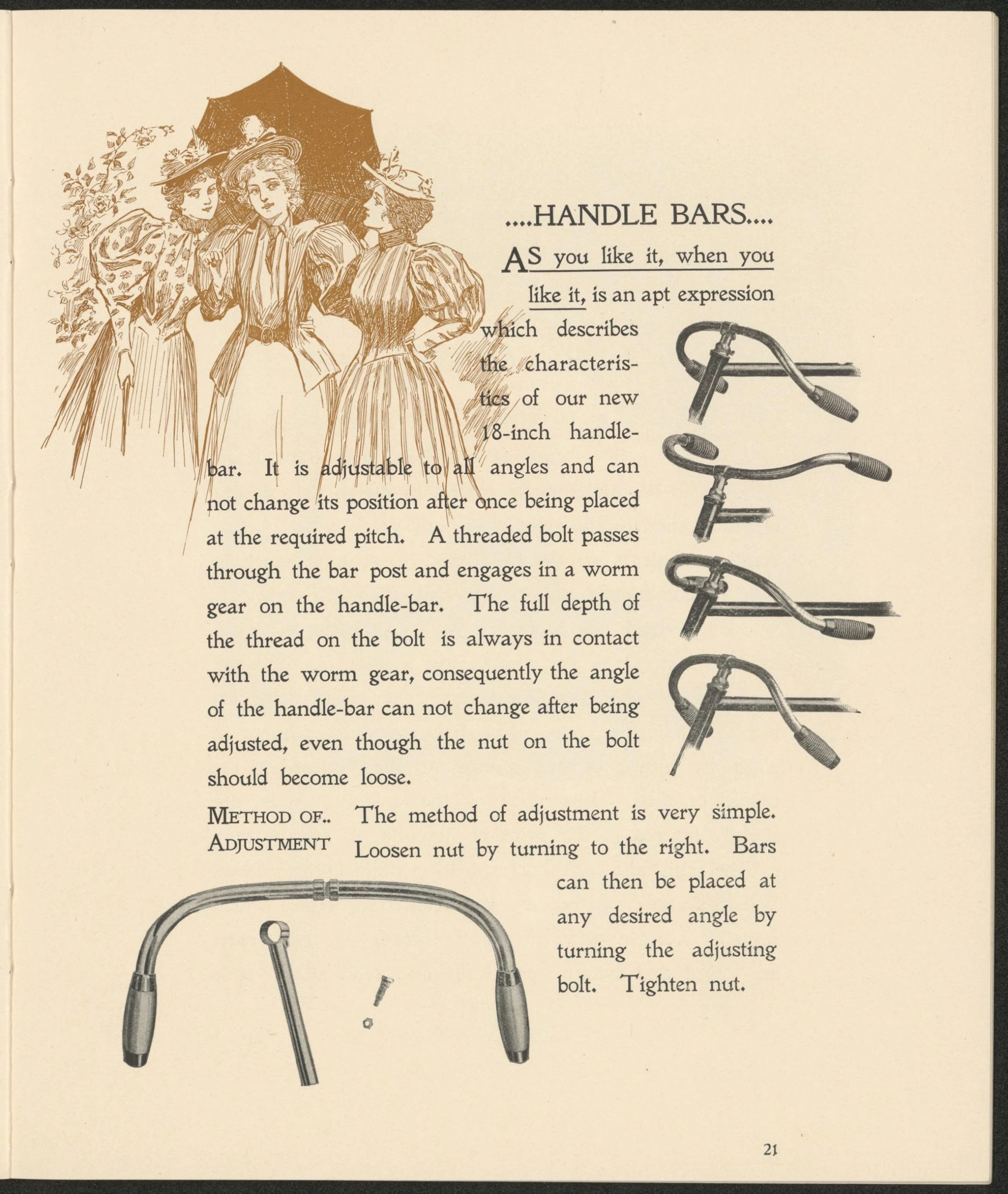
AS you like it, when you like it, is an apt expression which describes the characteristics of our new 18-inch handle-bar. It is adjustable to all angles and can not change its position after once being placed at the required pitch. A threaded bolt passes through the bar post and engages in a worm gear on the handle-bar. The full depth of the thread on the bolt is always in contact with the worm gear, consequently the angle of the handle-bar can not change after being adjusted, even though the nut on the bolt should become loose.
METHOD OF.. ADJUSTMENT
The method of adjustment is very simple. Loosen nut by turning to the right. Bars can then be placed at any desired angle by turning the adjusting bolt. Tighten nut.
21
[A text page with a brown pen drawing of three young ladies in puffed sleeves and flowered hats under a parasol; four engravings at right of the Keating adjustable handlebar set at different angles; below, the bar, bar post and adjusting bolt and nut shown apart. “As you like it, when you like it,” is underlined in the print.]
— Page 24 —
….CRANK SHAFT….
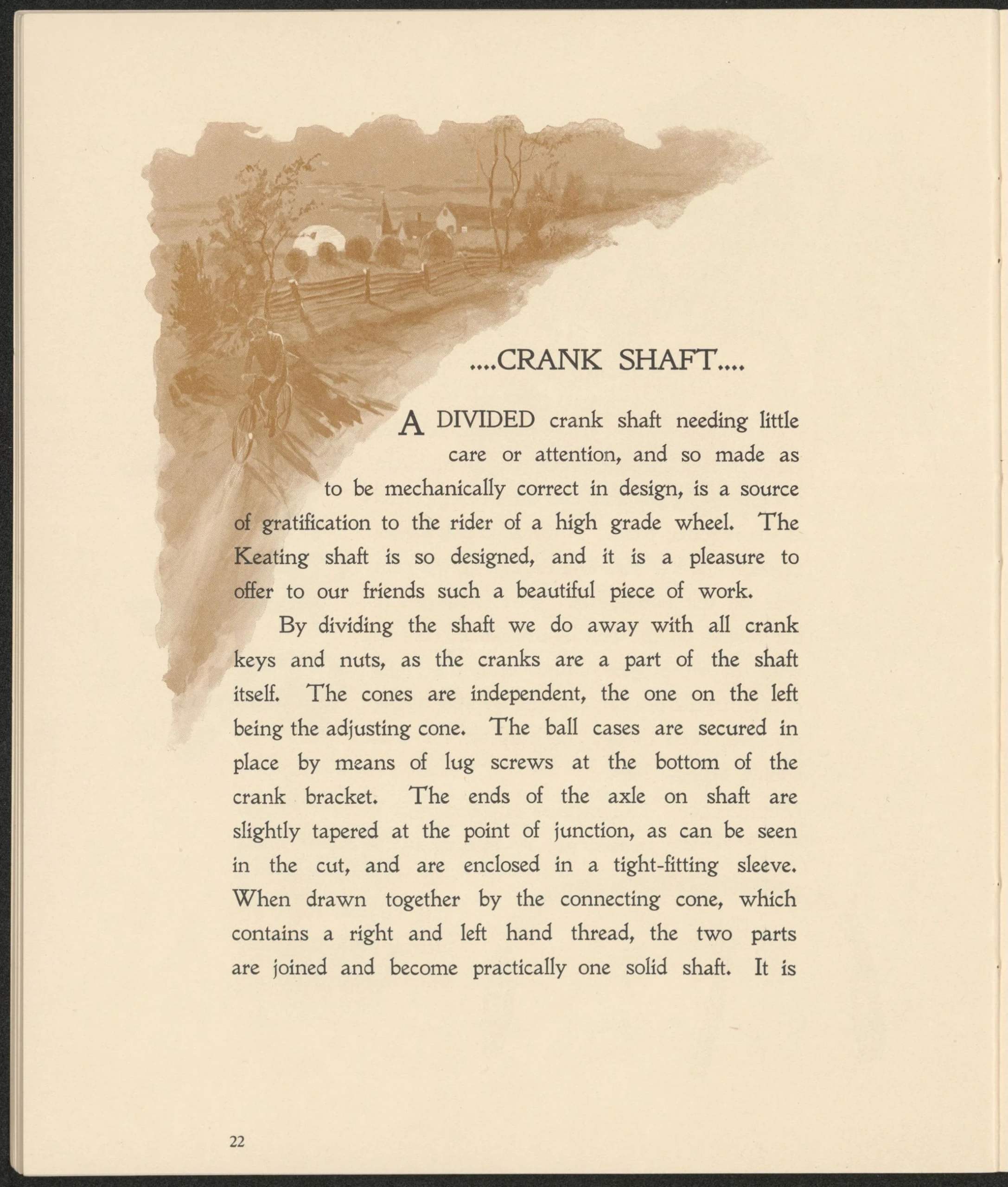
A DIVIDED crank shaft needing little care or attention, and so made as to be mechanically correct in design, is a source of gratification to the rider of a high grade wheel. The Keating shaft is so designed, and it is a pleasure to offer to our friends such a beautiful piece of work.
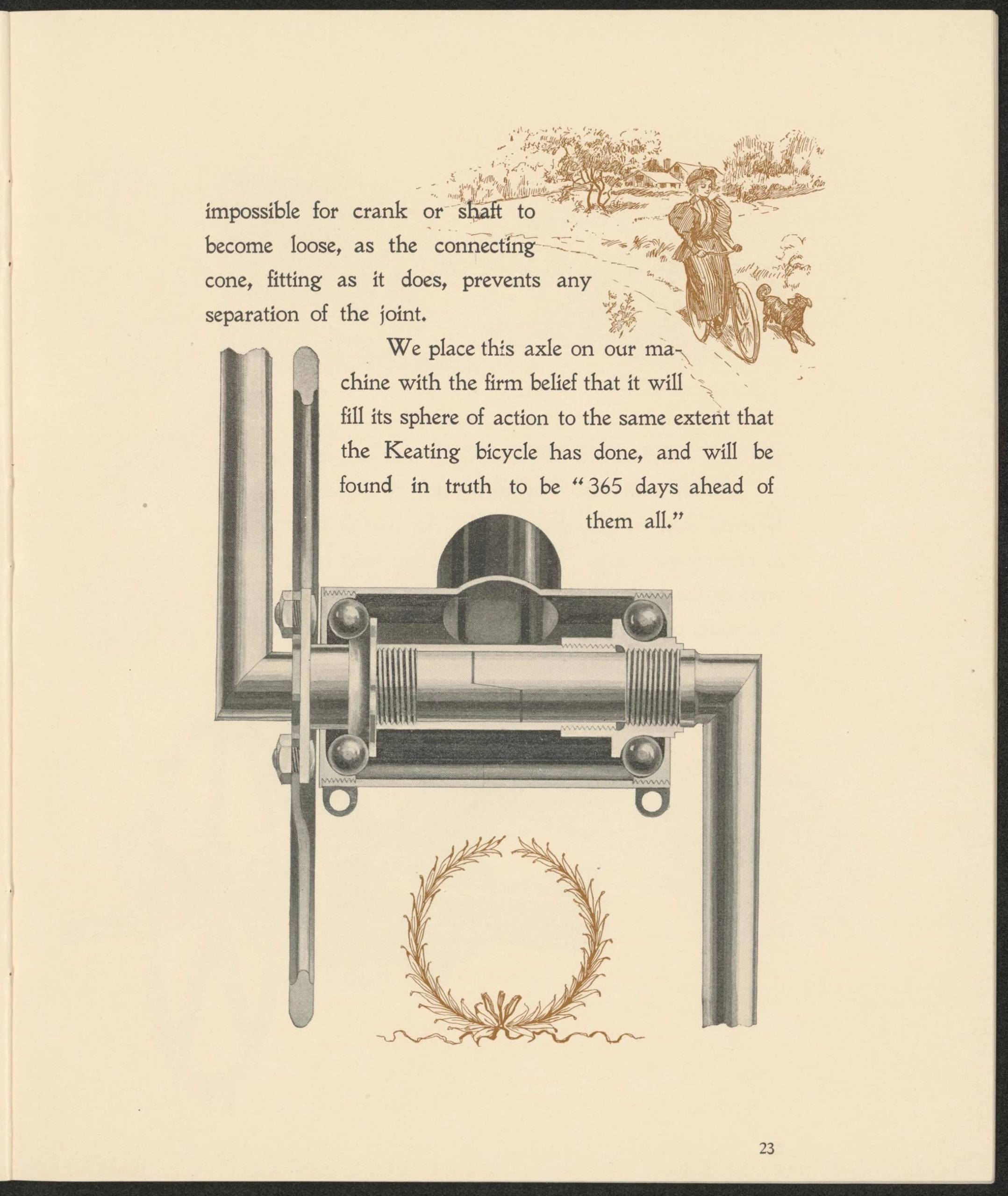
By dividing the shaft we do away with all crank keys and nuts, as the cranks are a part of the shaft itself. The cones are independent, the one on the left being the adjusting cone. The ball cases are secured in place by means of lug screws at the bottom of the crank bracket. The ends of the axle on shaft are slightly tapered at the point of junction, as can be seen in the cut, and are enclosed in a tight-fitting sleeve. When drawn together by the connecting cone, which contains a right and left hand thread, the two parts are joined and become practically one solid shaft. It is
22
[A text page with a brown halftone vignette, shaped like a torn corner, of a cyclist riding down a country lane past a rail fence toward a village with a church spire.]
— Page 25 —
impossible for crank or shaft to become loose, as the connecting cone, fitting as it does, prevents any separation of the joint.
We place this axle on our machine with the firm belief that it will fill its sphere of action to the same extent that the Keating bicycle has done, and will be found in truth to be “365 days ahead of them all.”
23
[A text page with a brown pen sketch at upper right of a lady cycling down a country lane, a small dog running beside her; a large engraving of the divided crank shaft in section in its bracket with the cranks and frame tubes; a small brown laurel wreath below.]
— Page 26 —
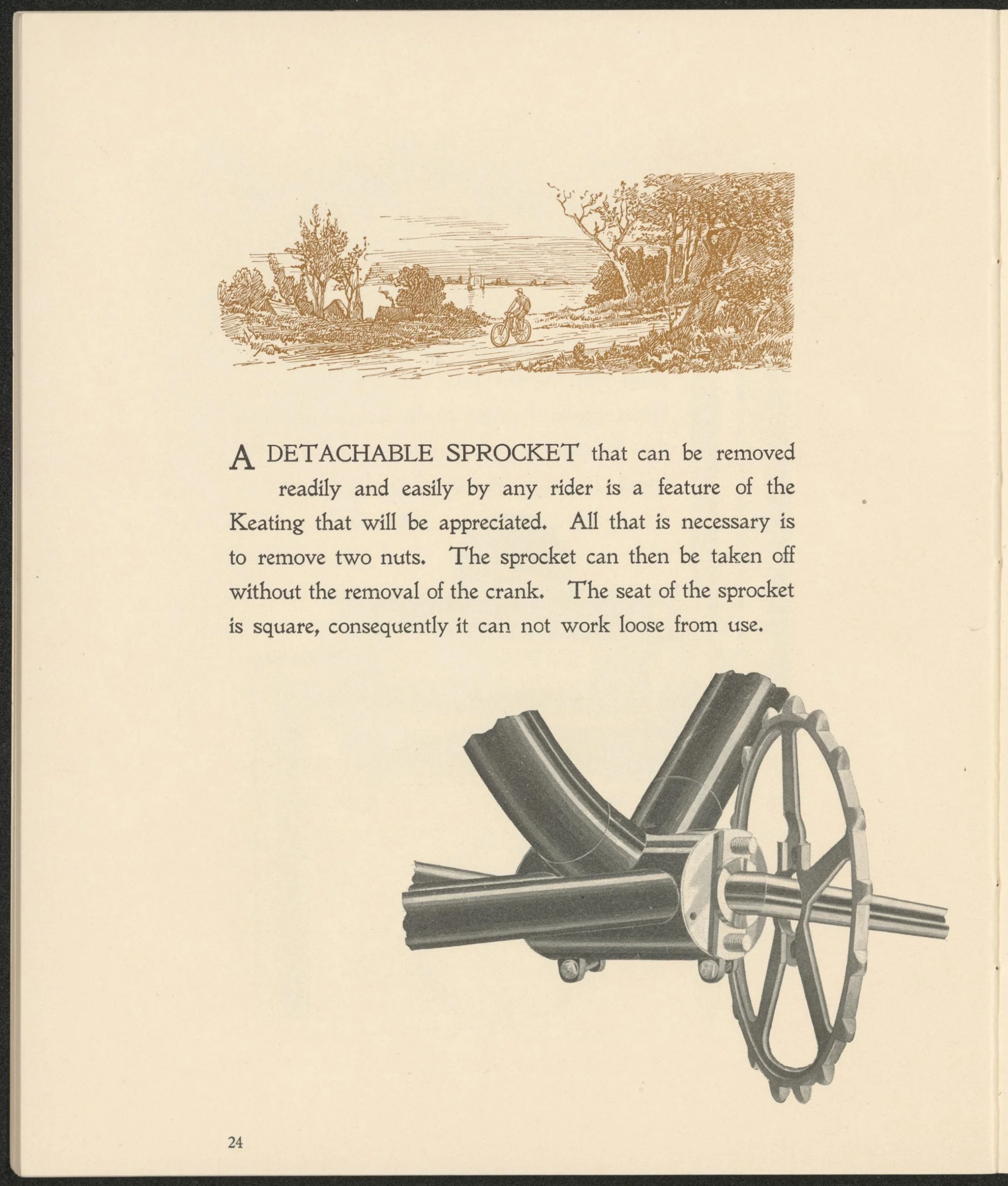
A DETACHABLE SPROCKET that can be removed readily and easily by any rider is a feature of the Keating that will be appreciated. All that is necessary is to remove two nuts. The sprocket can then be taken off without the removal of the crank. The seat of the sprocket is square, consequently it can not work loose from use.
24
[A text page with a brown pen sketch at top of a cyclist on a shore road with sailboats on the water beyond; below, an engraving of the crank bracket with the detachable front sprocket and crank.]
— Page 27 —
….HUBS….
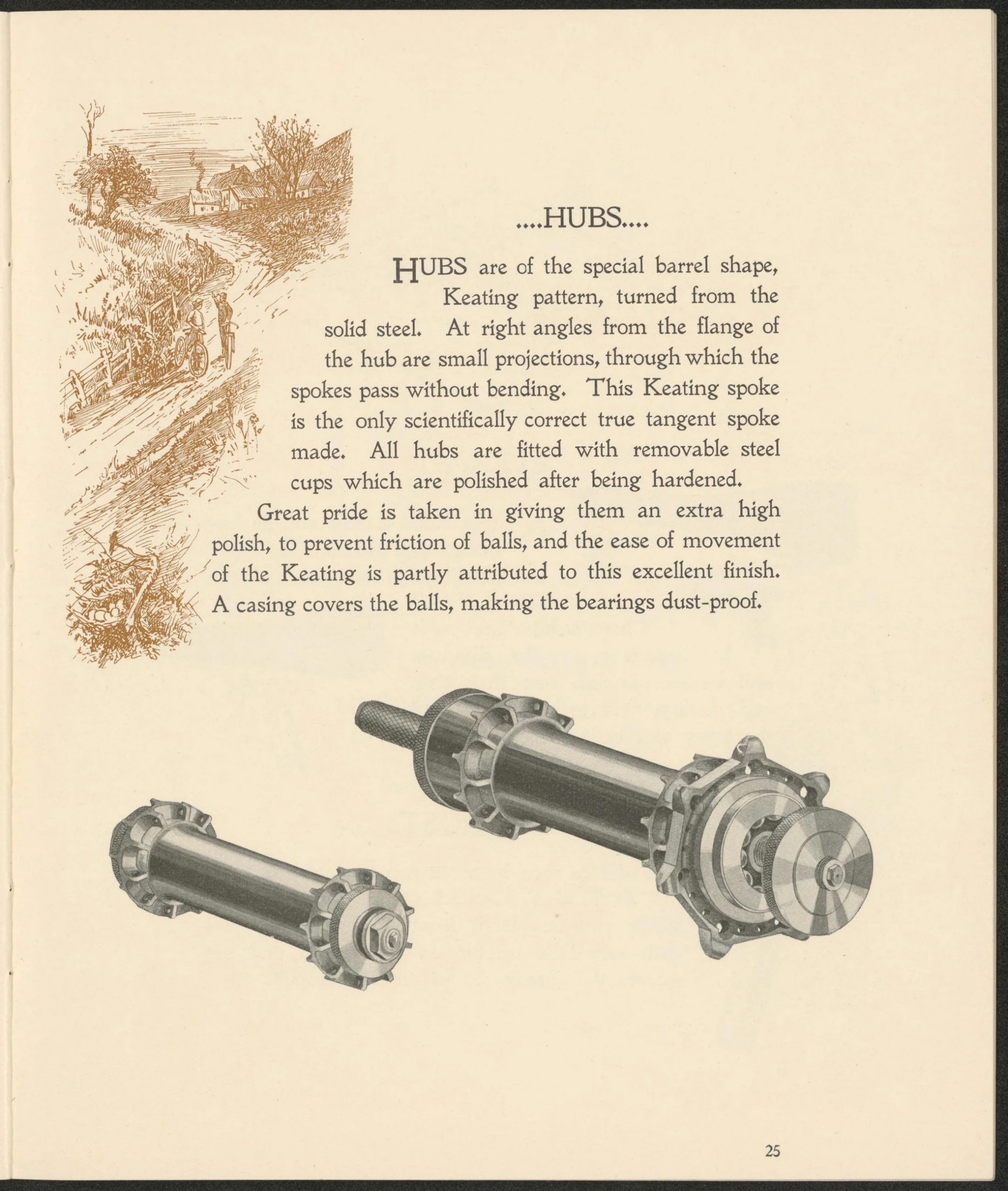
HUBS are of the special barrel shape, Keating pattern, turned from the solid steel. At right angles from the flange of the hub are small projections, through which the spokes pass without bending. This Keating spoke is the only scientifically correct true tangent spoke made. All hubs are fitted with removable steel cups which are polished after being hardened.
Great pride is taken in giving them an extra high polish, to prevent friction of balls, and the ease of movement of the Keating is partly attributed to this excellent finish. A casing covers the balls, making the bearings dust-proof.
25
[A text page with a brown pen sketch at left of two cyclists on a winding hill road below a cluster of farm buildings; engravings below of the Keating front and rear barrel hubs with their notched flanges, the rear hub with its sprocket.]
— Page 28 —
….SADDLE….
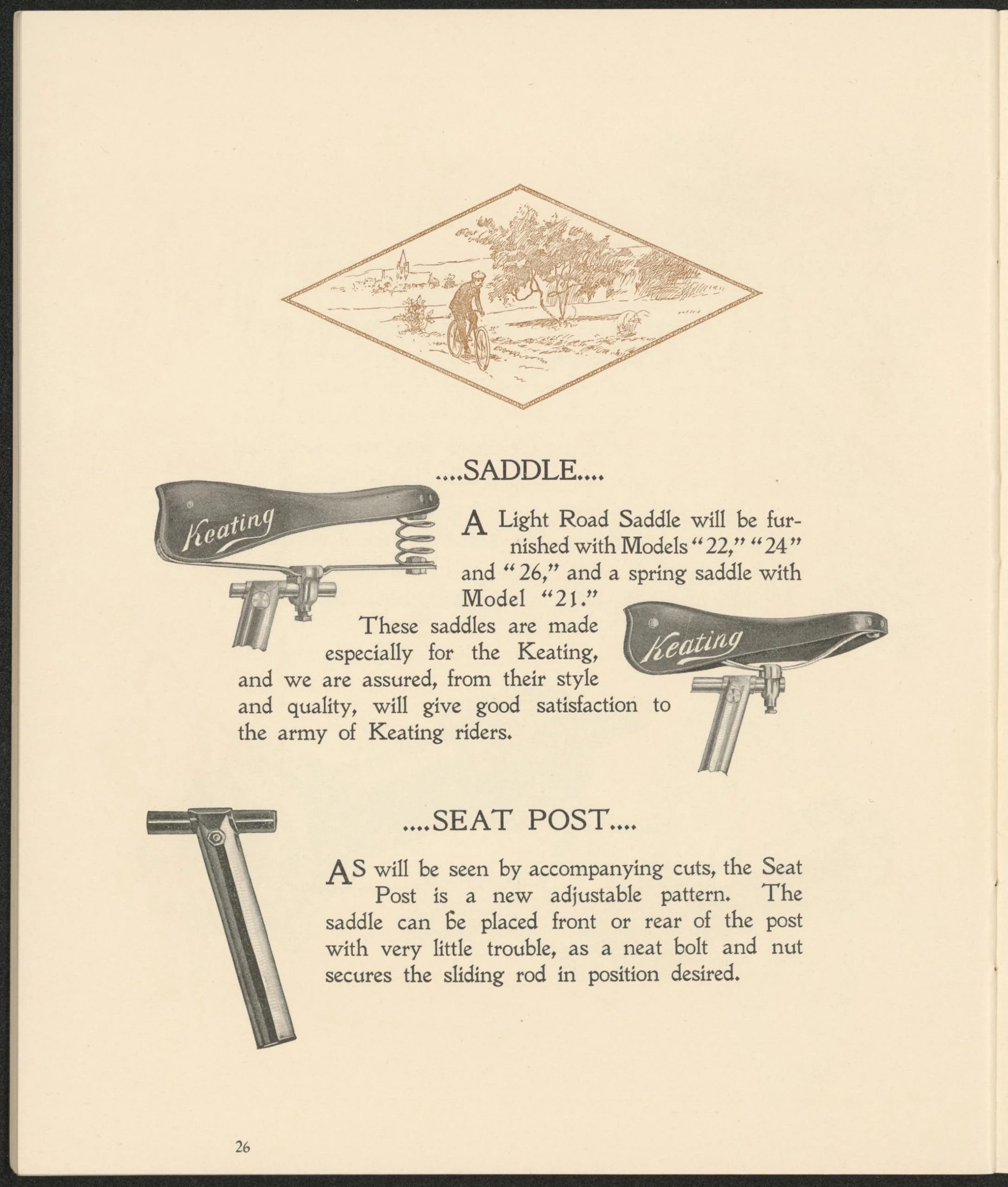
A Light Road Saddle will be furnished with Models “22,” “24” and “26,” and a spring saddle with Model “21.”
These saddles are made especially for the Keating, and we are assured, from their style and quality, will give good satisfaction to the army of Keating riders.
Keating
Keating
….SEAT POST….
AS will be seen by accompanying cuts, the Seat Post is a new adjustable pattern. The saddle can be placed front or rear of the post with very little trouble, as a neat bolt and nut secures the sliding rod in position desired.
26
[A text page with a brown diamond-shaped vignette at top of a cyclist on a country road; engravings of the Keating spring saddle and light road saddle, both lettered “Keating”, on their clamps, and of the adjustable T-shaped seat post.]
— Page 29 —
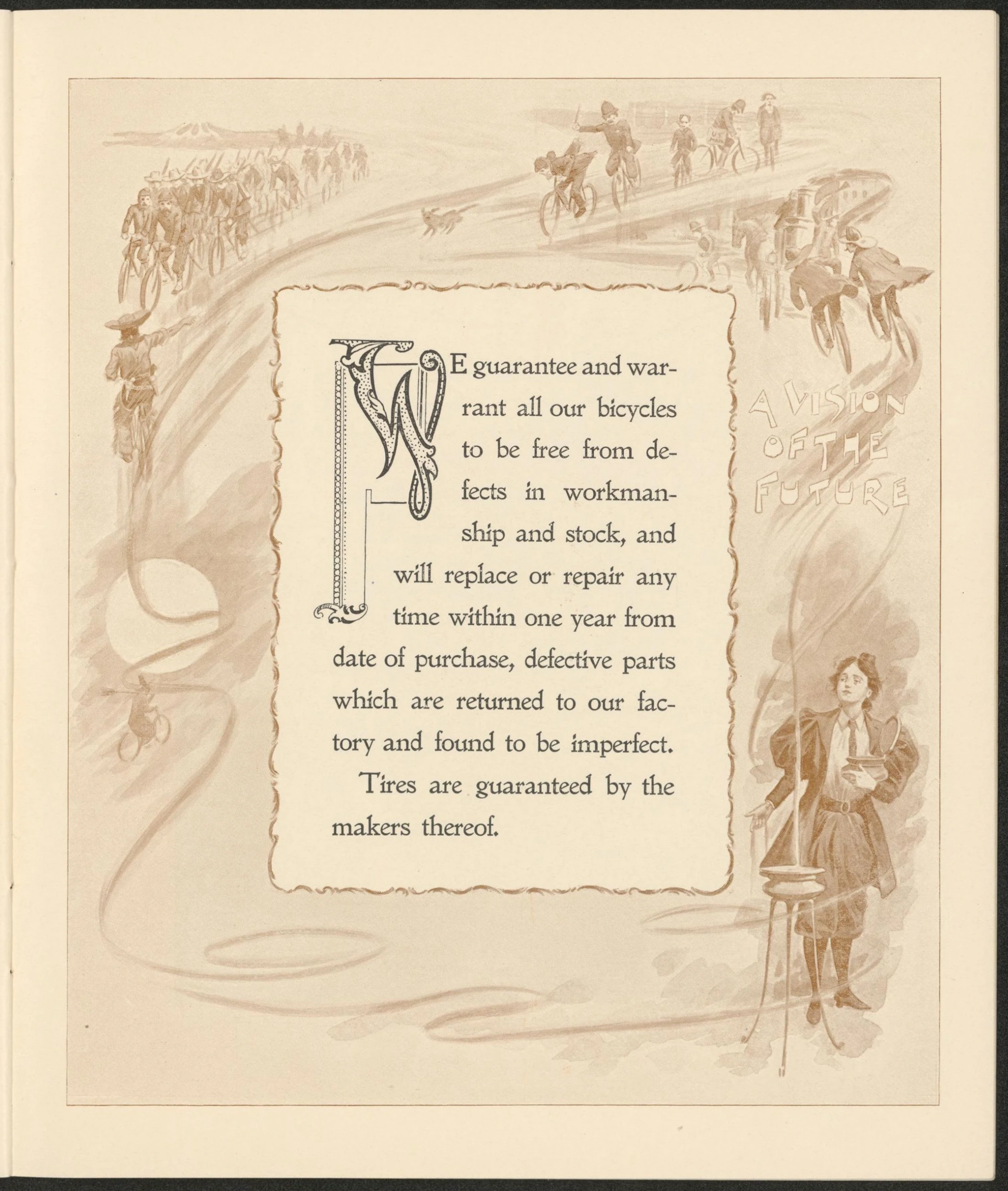
WE guarantee and warrant all our bicycles to be free from defects in workmanship and stock, and will replace or repair any time within one year from date of purchase, defective parts which are returned to our factory and found to be imperfect.
Tires are guaranteed by the makers thereof.
A VISION OF THE FUTURE
[A full-page brown-tinted plate: the guarantee in a scalloped panel with an ornamental initial “W”, framed by a “vision of the future” in which a column of soldiers, policemen, messengers and others all ride bicycles along winding roads, and a young woman in bloomers stands at lower right beside a pedestal. No folio.]
— Page 30 —
[A brown-toned halftone photograph, printed sideways on the page (the scan is turned to read it), of a woodland stream running through a wooded ravine beside a footpath. No caption and no folio.]
— Page 31 —
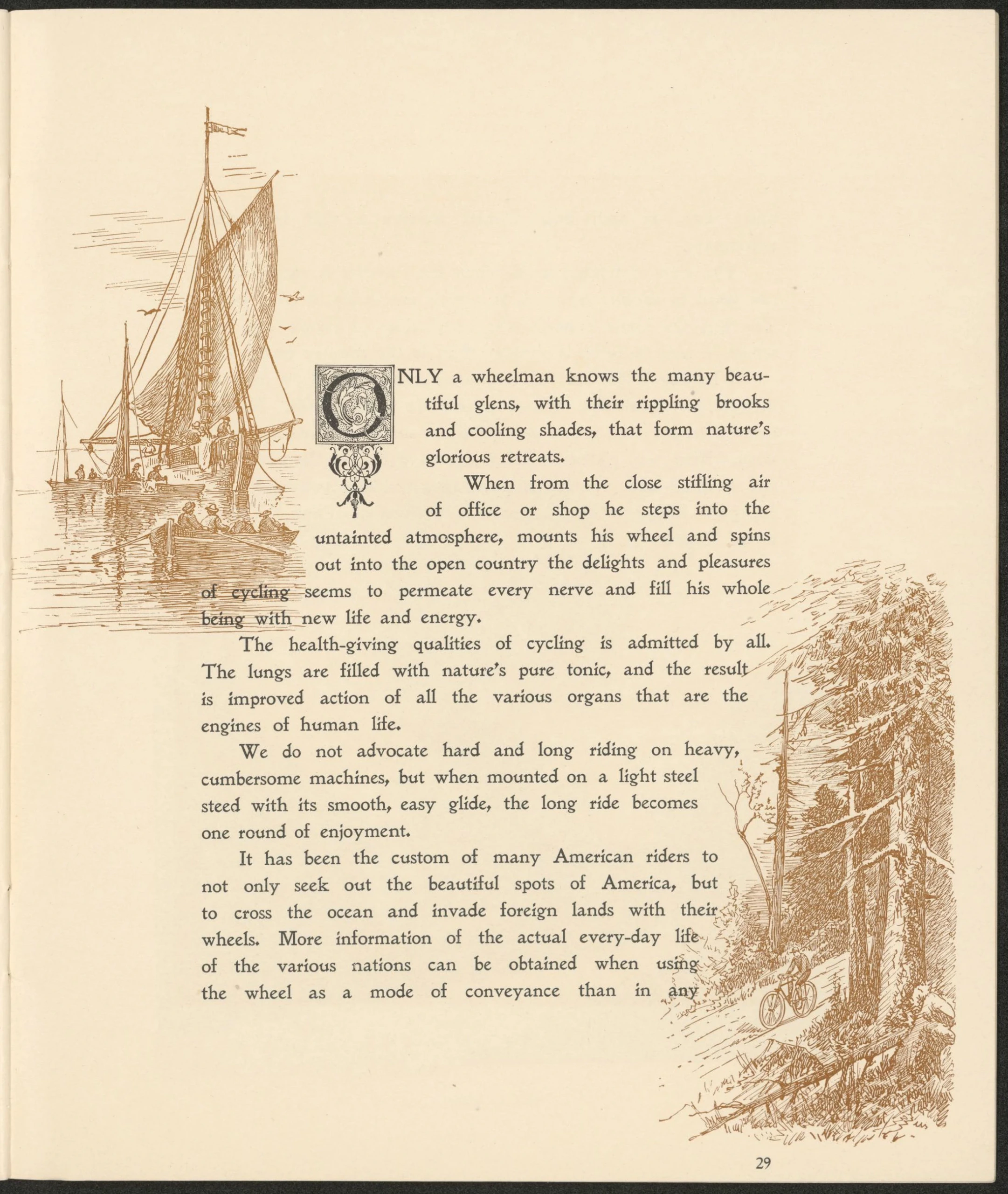
ONLY a wheelman knows the many beautiful glens, with their rippling brooks and cooling shades, that form nature’s glorious retreats.
When from the close stifling air of office or shop he steps into the untainted atmosphere, mounts his wheel and spins out into the open country the delights and pleasures of cycling seems to permeate every nerve and fill his whole being with new life and energy.
The health-giving qualities of cycling is admitted by all. The lungs are filled with nature’s pure tonic, and the result is improved action of all the various organs that are the engines of human life.
We do not advocate hard and long riding on heavy, cumbersome machines, but when mounted on a light steel steed with its smooth, easy glide, the long ride becomes one round of enjoyment.
It has been the custom of many American riders to not only seek out the beautiful spots of America, but to cross the ocean and invade foreign lands with their wheels. More information of the actual every-day life of the various nations can be obtained when using the wheel as a mode of conveyance than in any
29
[A text page with an ornamental initial “O”; brown pen sketches of a sailing ship and a rowing boat at upper left and of a cyclist on a wooded road at lower right.]
— Page 32 —
other way, as each little hamlet receives a visit from the wheelman.
The view of foreign lands, when the traveller is rushed from one point to another by train, is a view practically of cities only. The life, the home customs, the peculiarities of people can nowhere be seen to better advantage than in the country towns.
Wheeling is but one of the many means taken by man to increase his sociability. Wheel friends are good friends. Nature never intended that man’s social nature should be confined with walls. Man was placed in Eden, out of doors, in the open air; not confined and stunted morally and physically away from all the good influences that surround one when breathing the pure air of Heaven.
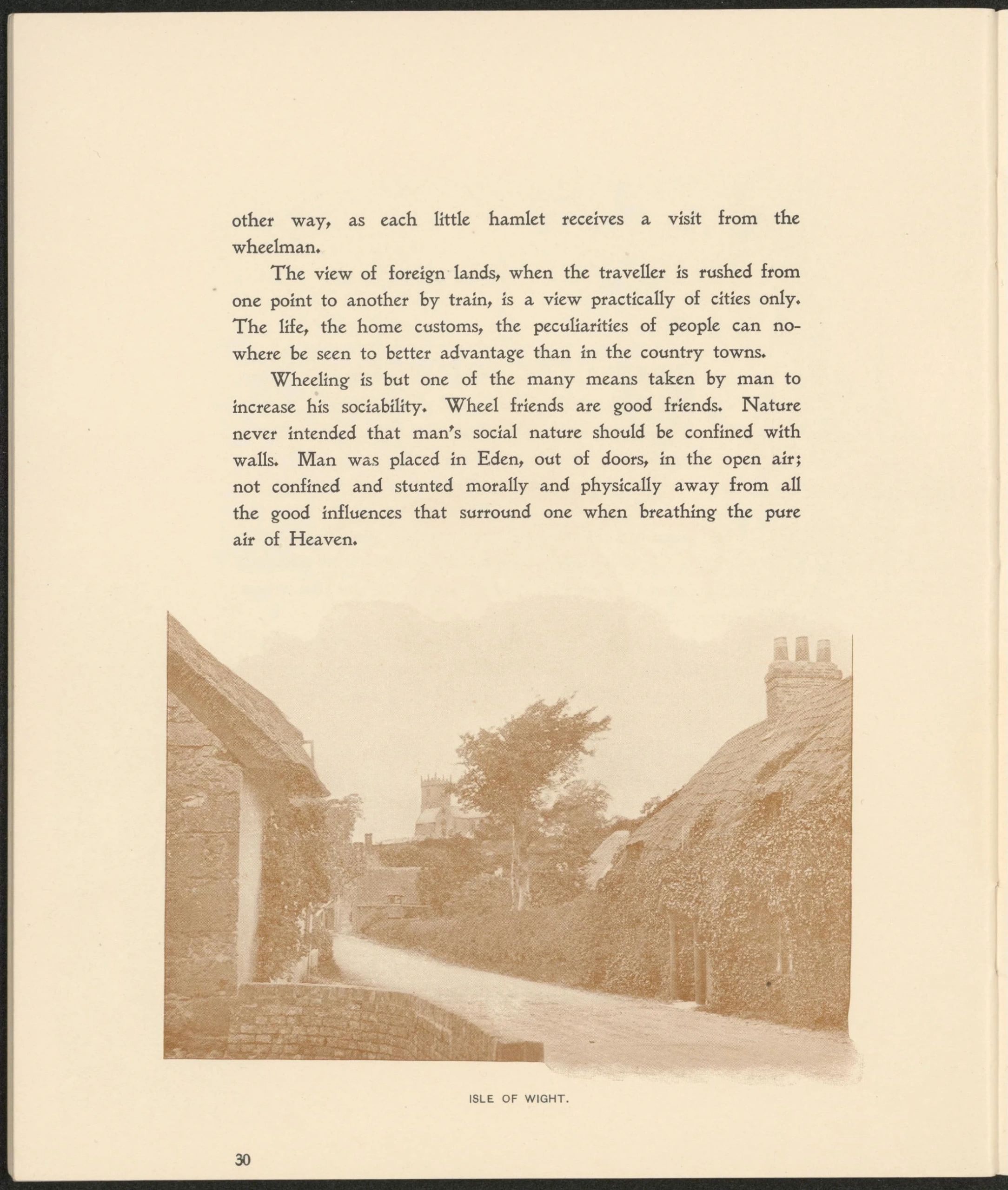
ISLE OF WIGHT.
30
[A text page with a brown-toned halftone photograph below of a village lane between ivy-covered thatched stone cottages, a church tower beyond.]
— Page 33 —
[A tailpiece printed in brown, centered on an otherwise blank page: a winged cyclist on a machine with sun-ray wheels inside a draped ribbon cartouche with radiating lines and looped ribbon ends. No text and no folio.]
— Page 34 —
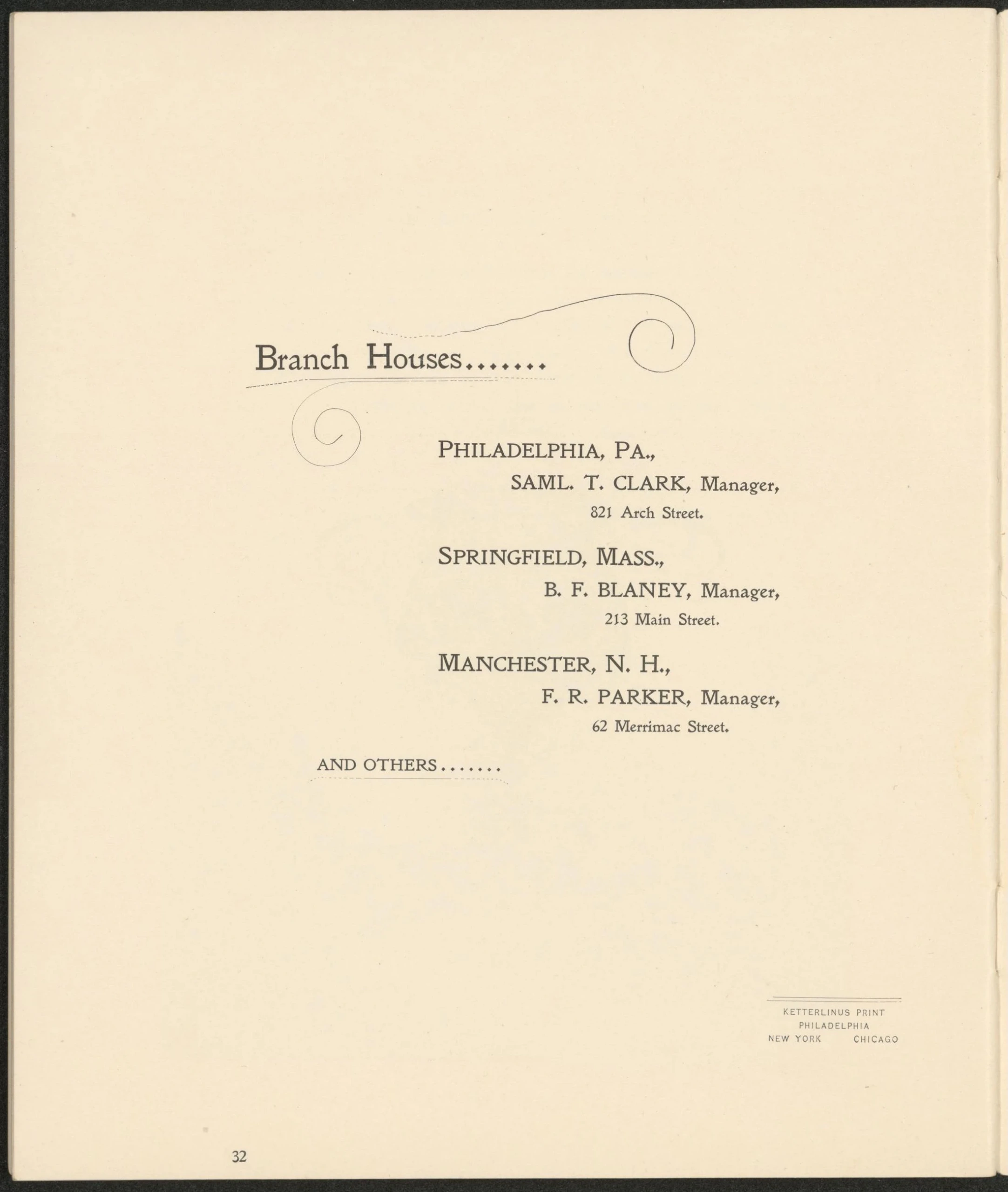
Branch Houses…….
PHILADELPHIA, PA.,
SAML. T. CLARK, Manager,
821 Arch Street.
SPRINGFIELD, MASS.,
B. F. BLANEY, Manager,
213 Main Street.
MANCHESTER, N. H.,
F. R. PARKER, Manager,
62 Merrimac Street.
AND OTHERS…….
KETTERLINUS PRINT
PHILADELPHIA
NEW YORK CHICAGO
32
[A text page listing the branch houses beside two looping pen flourishes; the printer’s imprint in small capitals at lower right.]
— Page 35 —
[Blank page.]
[A blank endpaper at the back of the booklet.]
— Page 36 —
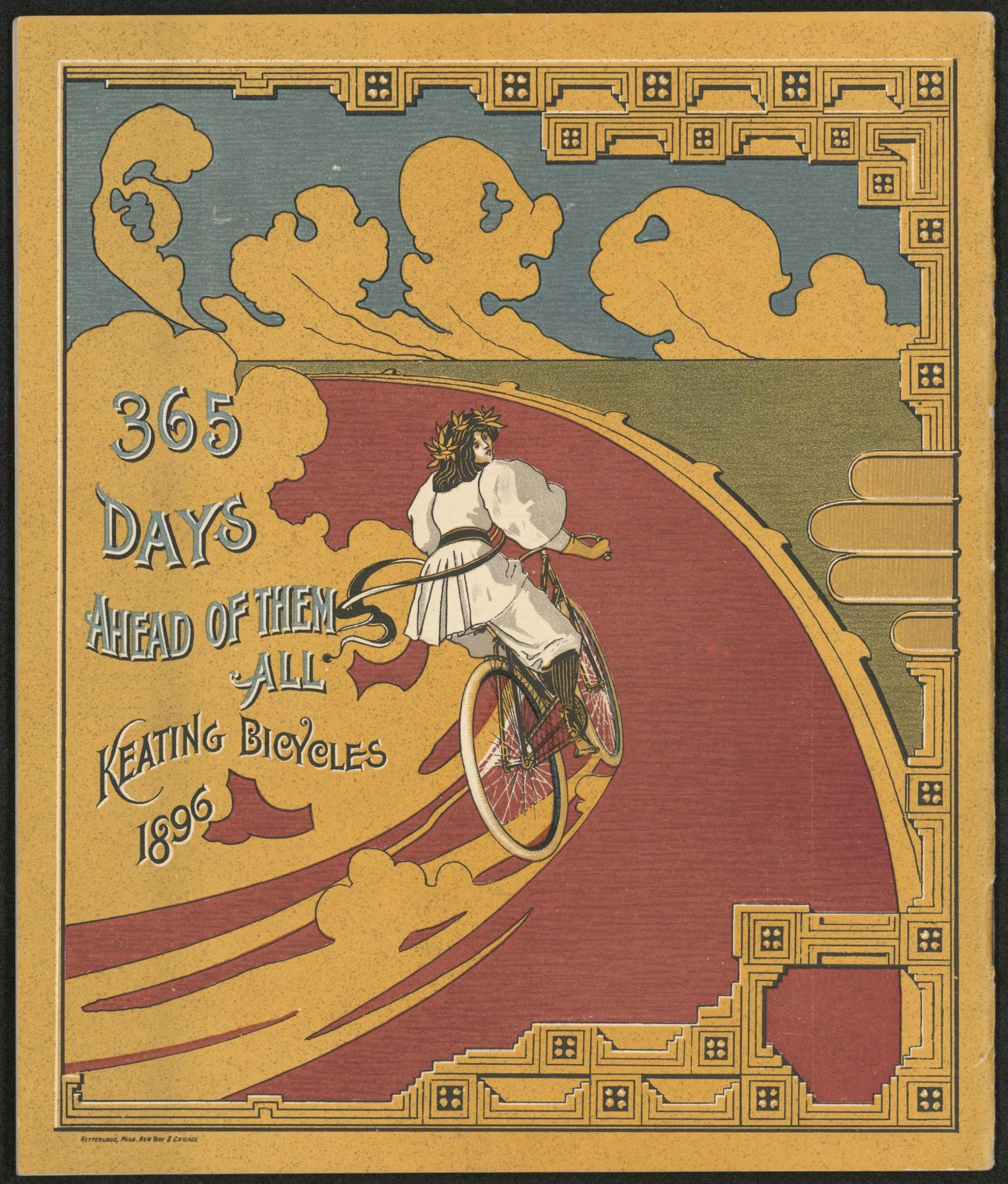
365 DAYS AHEAD OF THEM ALL
KEATING BICYCLES
1896
KETTERLINUS, PHILA. NEW YORK & CHICAGO.
[The back cover, a color lithograph: a lady cyclist in a white blouse and bloomers rides at speed along a sweeping red track through gold clouds against a blue and olive sky, inside a gold geometric border with square rosettes; the lithographer’s imprint in small type at lower left.]
Ebykr presents this material for research and education. If you hold rights to it or notice an ownership issue, please contact us and we will respond promptly.