About Ebykr
Ebykr celebrates classic and vintage lightweight bicycles through provocative imagery and opinion. Ride along with us.
About Ebykr
Ebykr celebrates classic and vintage lightweight bicycles through provocative imagery and opinion. Ride along with us.
Source: National Cycle Archive, in partnership with the Veteran-Cycle Club (V-CC Library scan).
| Marque | Hercules |
|---|---|
| Type | Ephemera |
| Year | 1955 |
| Publisher | The Hercules Cycle & Motor Co. Ltd. |
| Country | England |
| Language | English |
| Pages | 5 |
| Source | National Cycle Archive, in partnership with the Veteran-Cycle Club (V-CC Library scan). |
| Credit | National Cycle Archive, in partnership with the Veteran-Cycle Club |
| Transcription | Transcribed by eye |
Reference
The Hercules Cycle & Motor Co. Ltd. Hercules "Makes Cycling History", the 1955 Tour de France leaflet. 1955. Ebykr, https://ebykr.com/library/hercules-1955-leaflet-tour-de-france/.
Wikipedia
{{cite web |title=Hercules "Makes Cycling History", the 1955 Tour de France leaflet |publisher=The Hercules Cycle & Motor Co. Ltd. |date=1955 |url=https://ebykr.com/library/hercules-1955-leaflet-tour-de-france/ |website=Ebykr |access-date=}}Hercules Makes cycling history in the 1955 TOUR de FRANCE Brian Robinson on his Hercules races up the 8,385 feet Galibier Pass. The Epic story of Hercules in the Tour de France 1st BRITISH CYCLES EVER TO FINISH SUCCESSFULLY IN THE WORLD'S GREATEST, LONGEST & TOUGHEST ROAD CYCLE RACE WHEN the Hercules Cycle Company sent …
A Hercules fold-out leaflet on the first British team in the Tour de France, 7 to 30 July 1955: the story of the Hercules team with the route map and stage profiles, race photographs, B.B.C. radio extracts and what the press said. Transcribed from the page images (5 pages); each page ends with a bracketed description of its pictures.
— Page 1 —
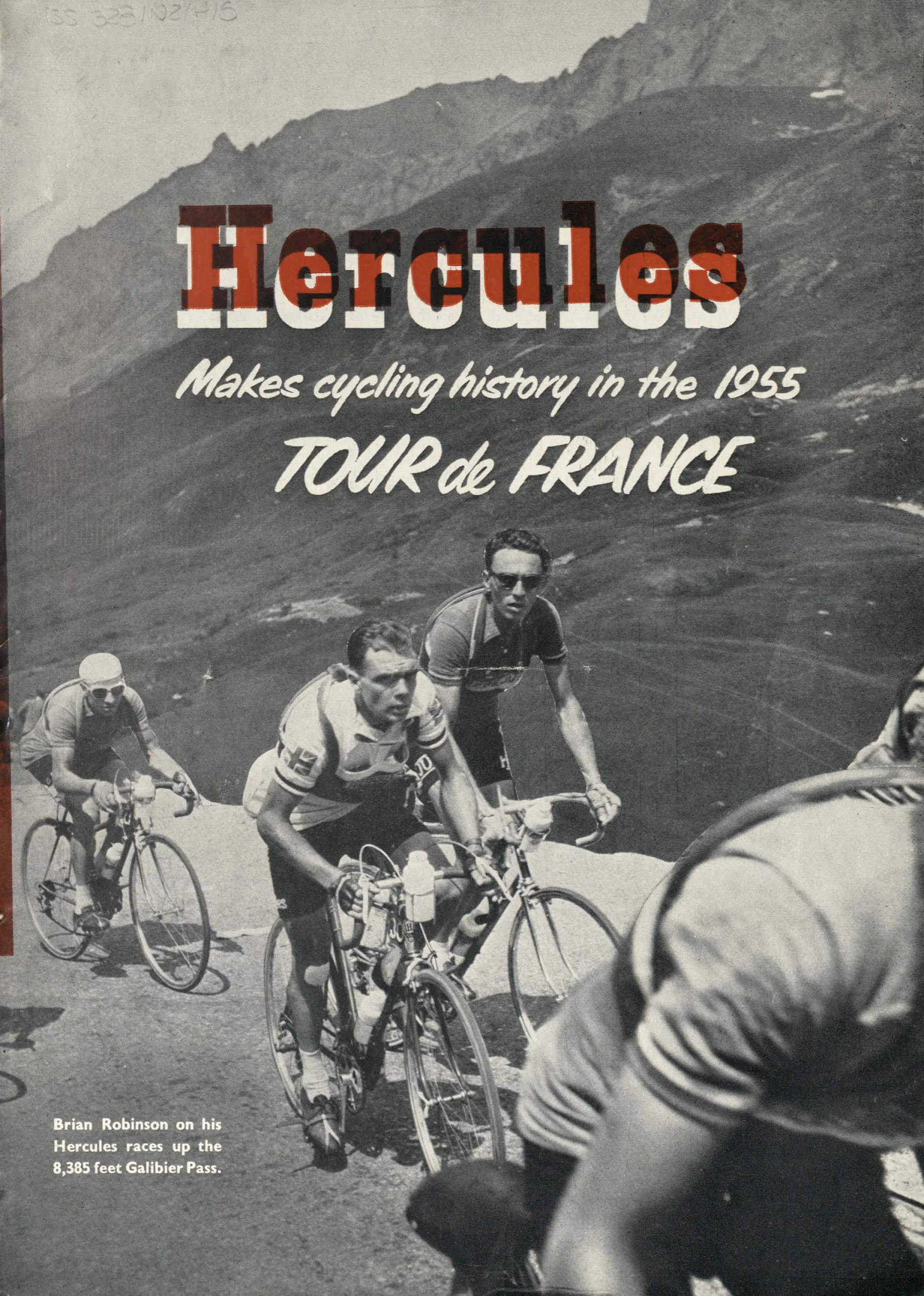
Hercules
Makes cycling history in the 1955
TOUR de FRANCE
Brian Robinson on his Hercules races up the 8,385 feet Galibier Pass.
[Front cover: a full-bleed photograph of riders climbing a mountain road, Brian Robinson in front, with the Hercules name in red and black block letters and the white script headline over the mountainside. Faint pencil library mark at top left, read as MSS.328/102/H/15 [?]. A thin red edge strip at left. No page number.]
— Page 2 —
The Epic story of
Hercules in the Tour de France
1st BRITISH CYCLES EVER TO FINISH SUCCESSFULLY IN THE WORLD’S GREATEST, LONGEST & TOUGHEST ROAD CYCLE RACE
WHEN the Hercules Cycle Company sent a ten-man team out from England in the spring of 1955, to train and race in France—the country which is the heart of international road cycle racing, they did so with one major objective . . . the Tour de France.
This is a race which is recognised throughout the world as the greatest test of man and machine . . . nearly three thousand miles, over every possible variety of road, from smooth concrete to almost un-rideable cobblestones, from dead flat to the eight thousand feet above-sea-level peaks of the Alps and the Pyrenees, through all sorts of weather, cold, wind, rain, thunderstorms and tropical heat.
There were many critics in England who said the experiment was ill-timed. “Our riders are not yet ready,” they said. “We don’t know enough about the type of machine wanted to stand up to the day-to-day pounding at racing speeds.”
But the critics were wrong.
British riders, and British bicycles, started in, rode in, and finished in, the Tour de France of 1955.
Thus was history made. For the first time since the race was founded in 1903 by the great “Papa” Desgranges, a British team was invited to compete in this, the toughest of all bicycle races.
For the first time, British riders finished the course. True, only two out of the ten-man team finished the 2,800 miles course . . . Brian Robinson (29th) and Tony Hoar (69th), both on HERCULES Cycles.
BUT just to finish is honour and glory enough for the riders.
And just to finish is satisfaction enough for the engineers and technicians of the Hercules company who designed and made the bicycles which stood up to every demand the riders made upon them.
Now, to build a bicycle which will stand up to the strain of day-to-day riding to work, to do the shopping, to cover an occasional fifty or so miles on a weekend run . . . that’s one thing. But to make a bicycle which will stand up to Tour de France conditions . . . well, that’s something else.
And the Hercules British-made bicycles, with their British equipment, went through the whole of the Tour de France without a single mechanical defect!
The three mechanics who accompanied the British team had the easiest task of all the mechanics who travelled with the total of 130 riders who started . . . and of whom only 69 finished.
The mechanics’ tasks were limited to fitting new tyres each day, changing the brake blocks as they wore out in the mountain stages, and changing the gear ratios to suit the next day’s racing.
What a tribute to British workmanship!
At the finish, in the historic Parc des Princes track at Paris, the dark blue Hercules bicycles, with their orange flashes, were the identical machines on which Robinson and Hoar had started their 2,800 mile, 22-day journey.
Not a nut needed tightening, not a bearing needed adjustment. Travel-stained, yes. Deep scratches in the enamel were scars of the many crashes in the mountain descents. Handlebar tapes were worn to shreds, oil-stained saddles gave mute testimony to the miles ridden.
It is impossible, in this short article, to give you a full picture of the Tour. The glamour, the romance, the drama, the tragedy, the humour . . . the Tour is something you must see in order to appreciate fully.
But just come with me on one day’s riding in the Tour, and try and visualise what it means to man . . . and machine.
Let’s take a typical mountain stage.
It’s from Briancon to Monaco (Monte Carlo), through the Alps, over four tough mountain passes. Twenty miles of give-and-take riding to start with and then, a sheer climb of 7,000 feet up the Col de Vars. Fifteen miles of non-stop climbing, changing down through all the ten speed gears (double chain wheel and five speed derailleur), into bottom, and finally crawling over the summit at just more than walking pace.
The field strings out . . . riders feel that they cannot possibly pedal another turn . . . but they go on and on.
Over the summit and then comes, instead of the test of the rider’s legs and lungs, the acid test of his nerves . . . and his confidence in his machine.
Through ice cold air, the riders freewheel down, gravity adding wings to their wheels. Forty, fifty and, at times, sixty miles an hour, for mile after mile to the valley far below.
Round hairpin after hairpin, with a sheer drop on one side which spells certain death to the rider whose machine fails him, or who loses his nerve.
Swoop down to the bend, a hasty snatch at the brakes, let them off a fraction of a second before the actual hairpin, freewheel, skidding and sliding round the bend, heeled over, bike into the bend, body bent away from it to keep the centre of gravity within the frame for safety’s sake . . . and you’re round.
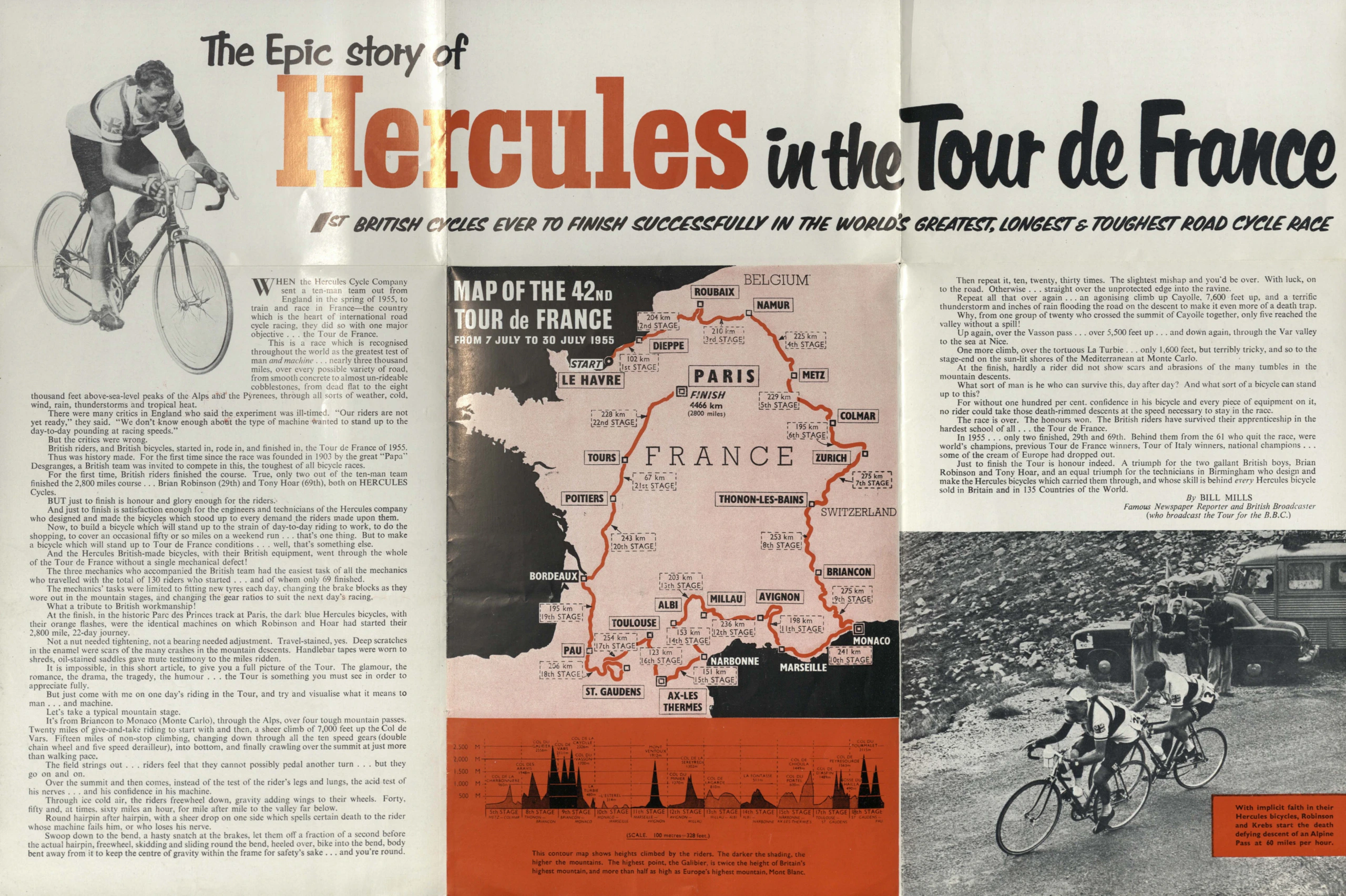
MAP OF THE 42ND TOUR de FRANCE
FROM 7 JULY TO 30 JULY 1955
START LE HAVRE
102 km 1st STAGE
DIEPPE
204 km 2nd STAGE
ROUBAIX
210 km 3rd STAGE
BELGIUM
NAMUR
225 km 4th STAGE
METZ
229 km 5th STAGE
COLMAR
195 km 6th STAGE
ZURICH
275 km 7th STAGE
THONON-LES-BAINS
SWITZERLAND
253 km 8th STAGE
BRIANCON
275 km 9th STAGE
MONACO
241 km 10th STAGE
MARSEILLE
198 km 11th STAGE
AVIGNON
236 km 12th STAGE
MILLAU
203 km 13th STAGE
ALBI
153 km 14th STAGE
NARBONNE
151 km 15th STAGE
AX-LES THERMES
123 km 16th STAGE
TOULOUSE
254 km 17th STAGE
ST. GAUDENS
206 km 18th STAGE
PAU
195 km 19th STAGE
BORDEAUX
243 km 20th STAGE
POITIERS
67 km 21st STAGE
TOURS
228 km 22nd STAGE
PARIS FINISH 4466 km (2800 miles)
FRANCE
2,500 M | 2,000 M | 1,500 M | 1,000 M | 500 M
5th STAGE METZ—COLMAR: COL DE LA CHARBONNIERE 960m
8th STAGE THONON—BRIANCON: COL DES ARAVIS 1948m
9th STAGE BRIANCON—MONACO: COL DU GALIBIER 2556m; COL DE VARS 2111m; COL DE LA CAYOLLE 2326m; COL DU VASSON 1700m; LA TURBIE 480m
10th STAGE MONACO—MARSEILLE: L’ESTEREL 314m
11th STAGE MARSEILLE—AVIGNON: MONT VENTOUX 1912m
12th STAGE AVIGNON—MILLAU: COL DU MINIER 1270m; COL DE LA SEREYREDE 1302m
13th STAGE MILLAU—ALBI: COL DE LAGARDE 810m
14th STAGE ALBI—NARBONNE: LA FONTASSE 511m
15th STAGE NARBONNE—AX-LES-THERMES: COL DU PORTEL 600m; COL DE CHIOULA 1449m
17th STAGE TOULOUSE—ST GAUDENS: COL DE D’ASPIN 1489m; COL DE PEYRESOURDE 1563m
18th STAGE ST GAUDENS—PAU: BOSSE DU HAILLA 490m; COL DU TOURMALET 2115m
(SCALE. 100 metres=328 feet.)
This contour map shows heights climbed by the riders. The darker the shading, the higher the mountains. The highest point, the Galibier, is twice the height of Britain’s highest mountain, and more than half as high as Europe’s highest mountain, Mont Blanc.
Then repeat it, ten, twenty, thirty times. The slightest mishap and you’d be over. With luck, on to the road. Otherwise . . . straight over the unprotected edge into the ravine.
Repeat all that over again . . . an agonising climb up Cayolle, 7,600 feet up, and a terrific thunderstorm and inches of rain flooding the road on the descent to make it even more of a death trap.
Why, from one group of twenty who crossed the summit of Cayolle together, only five reached the valley without a spill!
Up again, over the Vasson pass . . . over 5,500 feet up . . . and down again, through the Var valley to the sea at Nice.
One more climb, over the tortuous La Turbie . . . only 1,600 feet, but terribly tricky, and so to the stage-end on the sun-lit shores of the Mediterranean at Monte Carlo.
At the finish, hardly a rider did not show scars and abrasions of the many tumbles in the mountain descents.
What sort of man is he who can survive this, day after day? And what sort of a bicycle can stand up to this?
For without one hundred per cent. confidence in his bicycle and every piece of equipment on it, no rider could take those death-rimmed descents at the speed necessary to stay in the race.
The race is over. The honours won. The British riders have survived their apprenticeship in the hardest school of all . . . the Tour de France.
In 1955 . . . only two finished, 29th and 69th. Behind them from the 61 who quit the race, were world’s champions, previous Tour de France winners, Tour of Italy winners, national champions . . . some of the cream of Europe had dropped out.
Just to finish the Tour is honour indeed. A triumph for the two gallant British boys, Brian Robinson and Tony Hoar, and an equal triumph for the technicians in Birmingham who design and make the Hercules bicycles which carried them through, and whose skill is behind every Hercules bicycle sold in Britain and in 135 Countries of the World.
By BILL MILLS
Famous Newspaper Reporter and British Broadcaster
(who broadcast the Tour for the B.B.C.)
With implicit faith in their Hercules bicycles, Robinson and Krebs start the death defying descent of an Alpine Pass at 60 miles per hour.
[Inside of a three-panel fold-out: a rider in a Union Jack jersey at top left under an orange and black headline; the article at left and right; at center a pink 1955 route map with stage distances over an orange stage-profile chart; at lower right two riders descending past spectators. Fold creases and a glare streak at the upper fold. No page numbers.]
— Page 3 —
Bob Maitland, a Hercules rider who put up a magnificent performance in the Tour until he “crashed” heavily with many other riders.
Amidst the magnificent panorama of the Alps, Robinson fights to the summit.
Taken from the snowbank, which acted as a natural refrigerator, a refreshing drink is given to Robinson.
Bob Maitland races round an Alpine bend, with a sheer drop of 1,000 feet to his right.
The gallant Tony Hoar, the famous “Lanterne Rouge” of The Tour.
A “Sound Barrier” of cheers for Tony Hoar and his famous Hercules.
[A long horizontal band of six captioned photographs across the folded panels: a close portrait of Bob Maitland, Robinson climbing past spectators below Alpine peaks, a drink handed to Robinson, Maitland on a cliff-edge bend, Tony Hoar riding and Hoar between cheering crowds. Fold creases and a thin orange edge at top. No page numbers.]
— Page 4 —
EXTRACTS FROM B.B.C. RADIO AND TELEVISION REPORTS
“CALLING ALL SPORTSMEN”
(Light Programme) Millau 19th. July, 1955
There were 79 riders still left in the Tour de France Cycle Race this morning at Avignon. This evening we’re nearly 150 miles away at Millau. From 130 who started so full of hopes at Le Havre, 1,665 miles away, only 79 were left this morning and there are only 72 left in this evening. And I’m glad to say that our two Englishmen, Brian Robinson of Yorkshire and Tony Hoar of Emsworth are still in the running. We’re more than half-way there now, but the riders have still got to climb the Pyrenees—that’s the big test.
Pau 26th. July, 1955
And here we are at the foot of the Pyrenees in the town of Pau. I’ll always remember to-day as a milestone in British Cycling history, for at last a British cyclist has proved he can really hold his own against the crack roadmen of the Continent. Yes, it’s been Brian Robinson’s day today. Robinson came in only 2 minutes and 45 seconds after the leader and did he get a cheer from the crowd! The French Press have all been predicting that our boys could never survive the Pyrenees but Robinson and Hoar proved them wrong.
Paris 2nd. August, 1955
The Tour de France has come to an end.
And for the first time in 50 years since the race started, we have had Englishmen finishing in it.
When they call this the toughest sporting event in the world they aren’t kidding. Only a super athlete can hope to finish.
I wish you could have been there. The officials put on the leaders to ride the usual lap of honour, with the bouquets, bands playing national anthems and so on. And then, quite suddenly the crowd . . . fifty thousand strong, jammed to the limit, set up a chant. It went like this, Oh-Ah, Oh-Ah. That’s the way they pronounce Hoar’s name over there. And they kept it up until the officials DID put Hoar and Robinson, of course, on for a lap of honour.
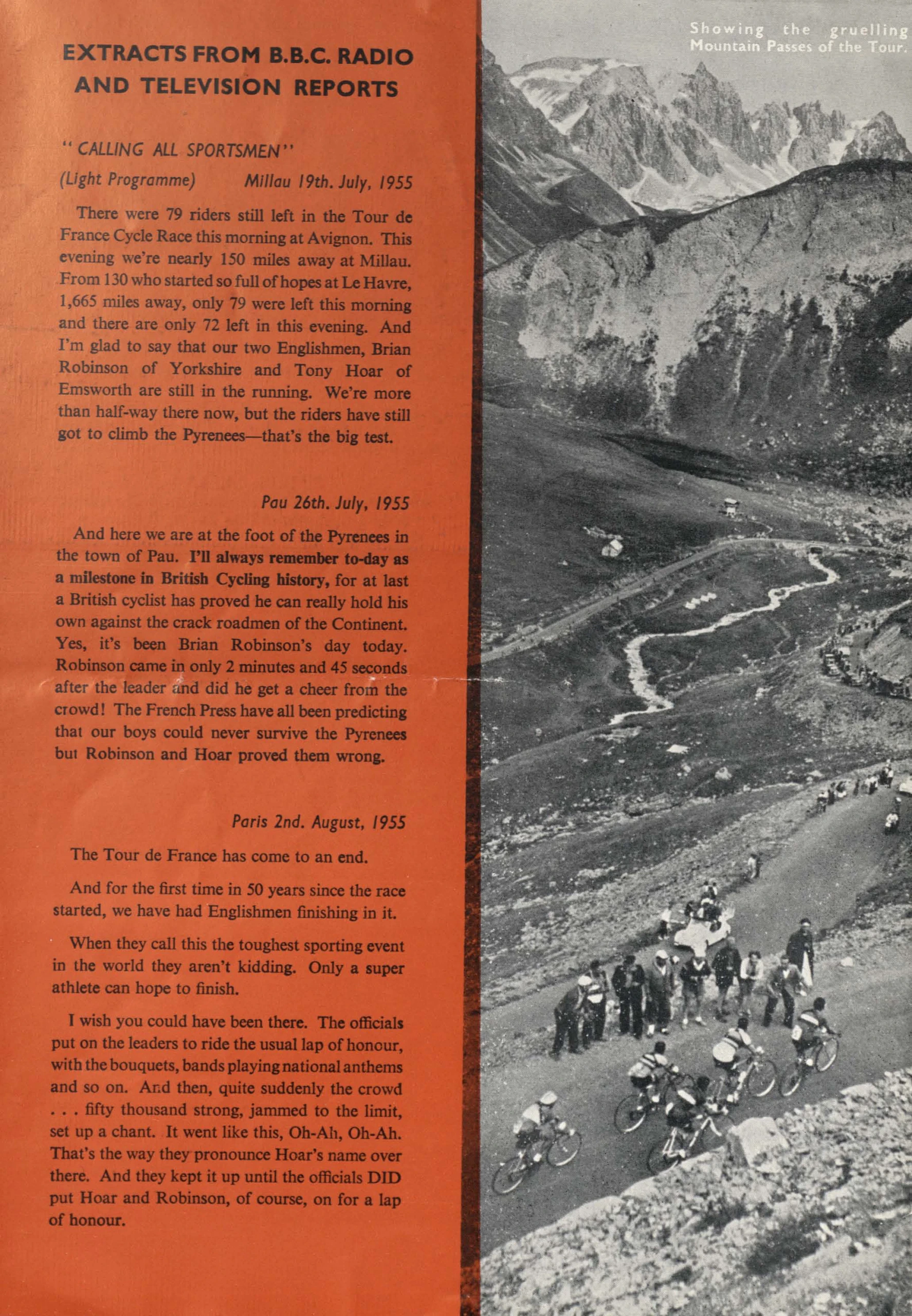
Showing the gruelling Mountain Passes of the Tour.
[Back panel: at left an orange column of B.B.C. broadcast extracts in black type; at right a tall photograph of a hairpin road climbing an Alpine pass with riders and spectators in the foreground, captioned in white at top right. No page number.]
— Page 5 —
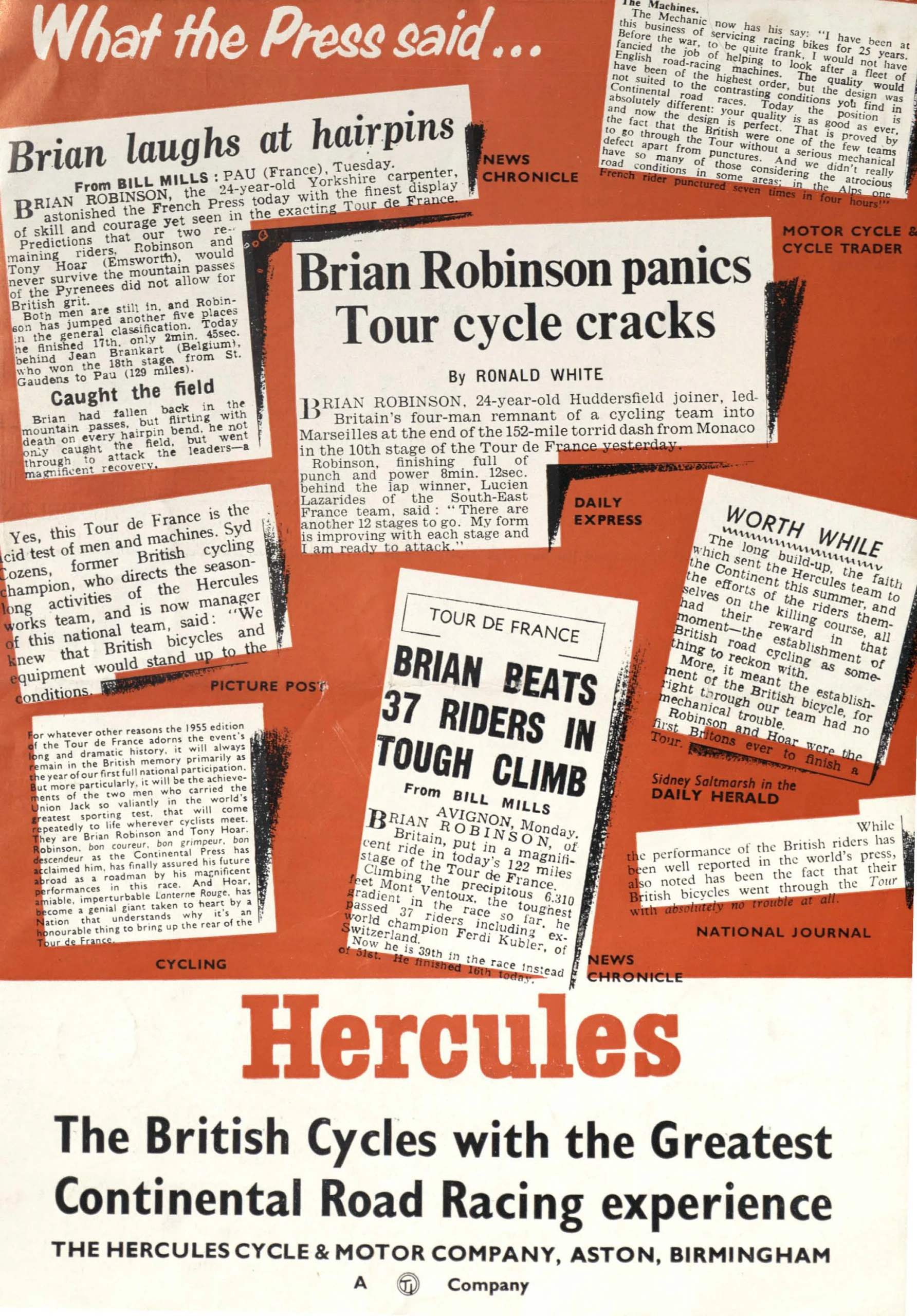
What the Press said…
Brian laughs at hairpins
From BILL MILLS: PAU (France), Tuesday.
BRIAN ROBINSON, the 24-year-old Yorkshire carpenter, astonished the French Press today with the finest display of skill and courage yet seen in the exacting Tour de France.
Predictions that our two remaining riders, Robinson and Tony Hoar (Emsworth), would never survive the mountain passes of the Pyrenees did not allow for British grit.
Both men are still in, and Robinson has jumped another five places in the general classification. Today he finished 17th, only 2min. 45sec. behind Jean Brankart (Belgium), who won the 18th stage from St. Gaudens to Pau (129 miles).
Caught the field
Brian had fallen back in the mountain passes, but flirting with death on every hairpin bend, he not only caught the field, but went through to attack the leaders—a magnificent recovery.
NEWS CHRONICLE
The Machines.
The Mechanic now has his say: “I have been at this business of servicing racing bikes for 25 years. Before the war, to be quite frank, I would not have fancied the job of helping to look after a fleet of English road-racing machines. The quality would have been of the highest order, but the design was not suited to the contrasting conditions you find in Continental road races. Today the position is absolutely different: your quality is as good as ever, and now the design is perfect. That is proved by the fact that the British were one of the few teams to go through the Tour without a serious mechanical defect apart from punctures. And we didn’t really have so many of those considering the atrocious road conditions in some areas; in the Alps one French rider punctured seven times in four hours!”
MOTOR CYCLE & CYCLE TRADER
Brian Robinson panics Tour cycle cracks
By RONALD WHITE
BRIAN ROBINSON, 24-year-old Huddersfield joiner, led Britain’s four-man remnant of a cycling team into Marseilles at the end of the 152-mile torrid dash from Monaco in the 10th stage of the Tour de France yesterday.
Robinson, finishing full of punch and power 8min. 12sec. behind the lap winner, Lucien Lazarides of the South-East France team, said: “There are another 12 stages to go. My form is improving with each stage and I am ready to attack.”
DAILY EXPRESS
Yes, this Tour de France is the acid test of men and machines. Syd Cozens, former British cycling champion, who directs the season-long activities of the Hercules works team, and is now manager of this national team, said: “We knew that British bicycles and equipment would stand up to the conditions.
PICTURE POST
WORTH WHILE
The long build-up, the faith which sent the Hercules team to the Continent this summer, and the efforts of the riders themselves on the killing course, all had their reward in that moment—the establishment of British road cycling as something to reckon with.
More, it meant the establishment of the British bicycle, for right through our team had no mechanical trouble.
Robinson and Hoar were the first Britons ever to finish a Tour.
Sidney Saltmarsh in the DAILY HERALD
TOUR DE FRANCE
BRIAN BEATS 37 RIDERS IN TOUGH CLIMB
From BILL MILLS
AVIGNON, Monday.
BRIAN ROBINSON, of Britain, put in a magnificent ride in today’s 122 miles stage of the Tour de France.
Climbing the precipitous 6,310 feet Mont Ventoux, the toughest gradient in the race so far, he passed 37 riders including ex-world champion Ferdi Kubler, of Switzerland.
Now he is 39th in the race instead of 51st. He finished 16th today.
NEWS CHRONICLE
For whatever other reasons the 1955 edition of the Tour de France adorns the event’s long and dramatic history, it will always remain in the British memory primarily as the year of our first full national participation. But more particularly, it will be the achievements of the two men who carried the Union Jack so valiantly in the world’s greatest sporting test, that will come repeatedly to life wherever cyclists meet. They are Brian Robinson and Tony Hoar. Robinson, bon coureur, bon grimpeur, bon descendeur as the Continental Press has acclaimed him, has finally assured his future abroad as a roadman by his magnificent performances in this race. And Hoar, amiable, imperturbable Lanterne Rouge, has become a genial giant taken to heart by a Nation that understands why it’s an honourable thing to bring up the rear of the Tour de France.
CYCLING
While the performance of the British riders has been well reported in the world’s press, also noted has been the fact that their British bicycles went through the Tour with absolutely no trouble at all.
NATIONAL JOURNAL
Hercules
The British Cycles with the Greatest Continental Road Racing experience
THE HERCULES CYCLE & MOTOR COMPANY, ASTON, BIRMINGHAM
A [TI monogram] Company
[Back cover: a collage of tilted newspaper clippings on an orange ground, each with its source in black capitals and black brush strokes behind, under the white script heading; below, a cream band with “Hercules” in large orange letters, the slogan and the company line with the circled TI monogram. No page number.]
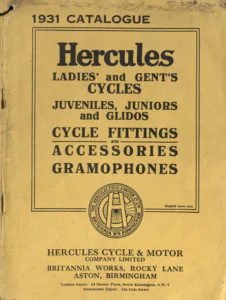 Hercules 1931 Catalogue: Cycles, Cycle Fittings, Accessories and Gramophones
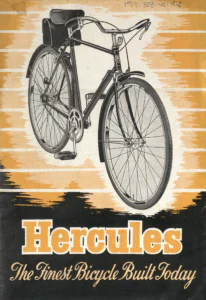 Hercules “The Finest Bicycle Built Today”, about 1947
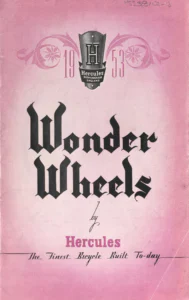 Hercules “Wonder Wheels”, with the price list of 15 April 1953
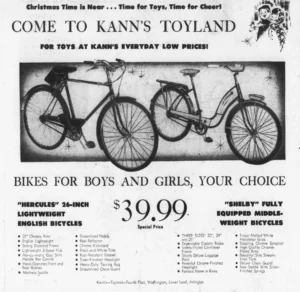 Hercules 1959 Advertisement — Kann’s Toyland, Washington: Hercules 26-Inch Lightweight English Bicycles With 3-Speed Hub and Her-cu-matic Shift, $39.99
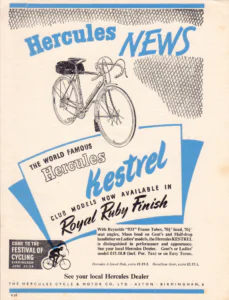 Hercules Advertisement (Undated) — Hercules News: The World Famous Hercules Kestrel Club Models Now Available in Royal Ruby Finish, £15.10.8
Ebykr presents this material for research and education. If you hold rights to it or notice an ownership issue, please contact us and we will respond promptly.