About Ebykr
Ebykr celebrates classic and vintage lightweight bicycles through provocative imagery and opinion. Ride along with us.
About Ebykr
Ebykr celebrates classic and vintage lightweight bicycles through provocative imagery and opinion. Ride along with us.

Source: bulgier.net (Mark Bulgier's catalog archive), Peter Brown's scans, posted in 2006.
 Page 1
 Page 2
 Page 3
 Page 4
 Page 5
 Page 6
 Page 7
 Page 8
 Page 9
 Page 10
 Page 11
 Page 12
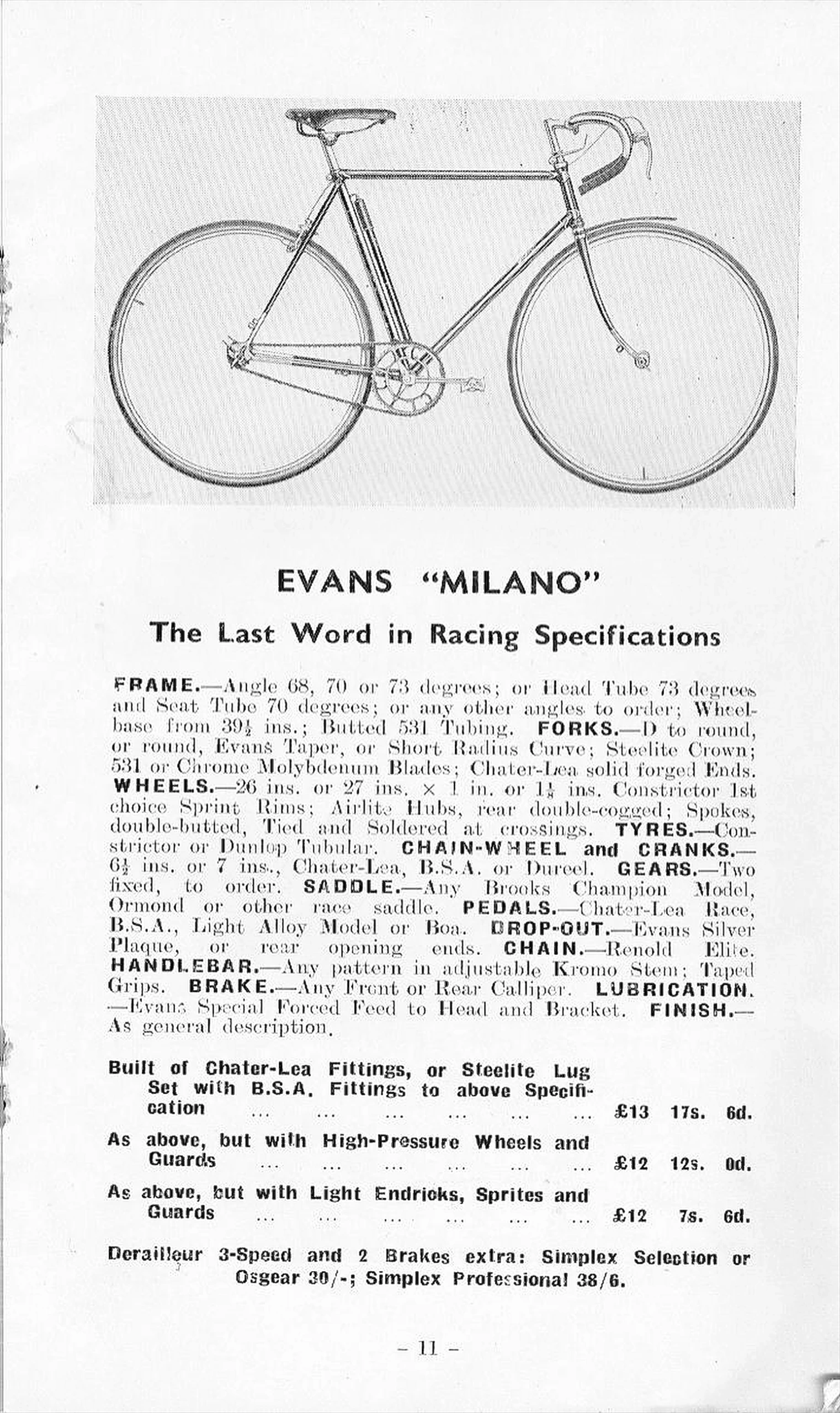 Page 13
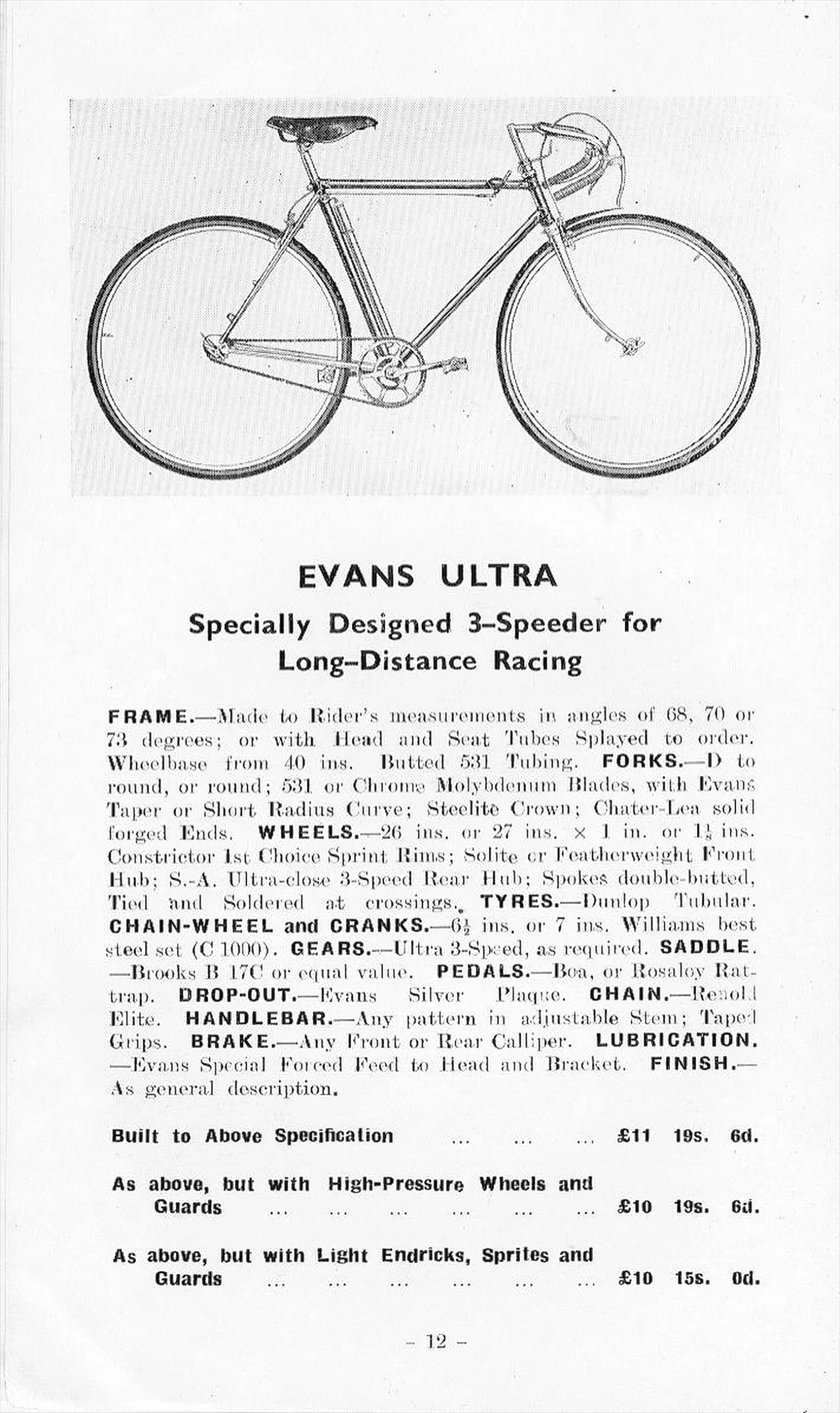 Page 14
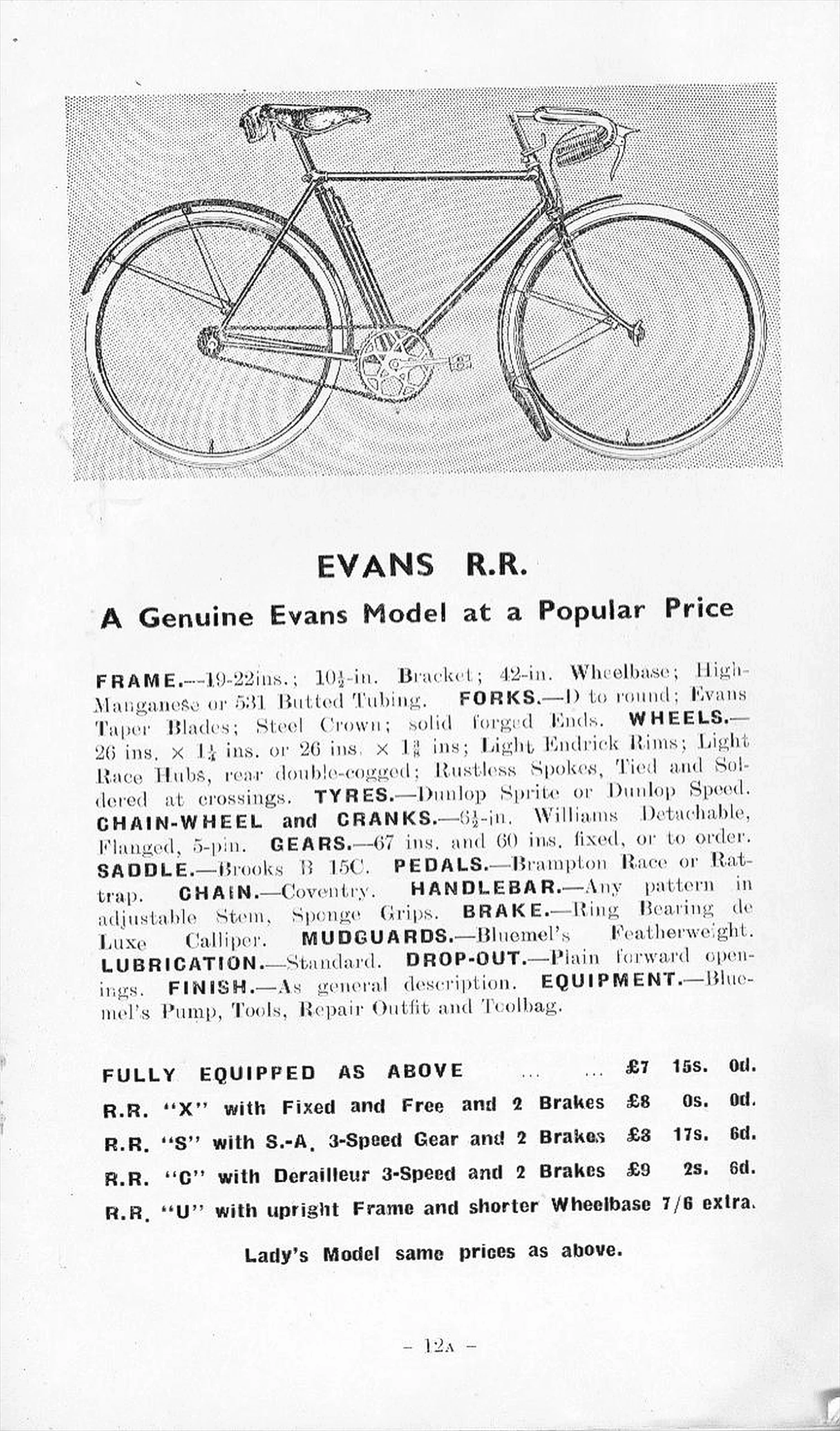 Page 15
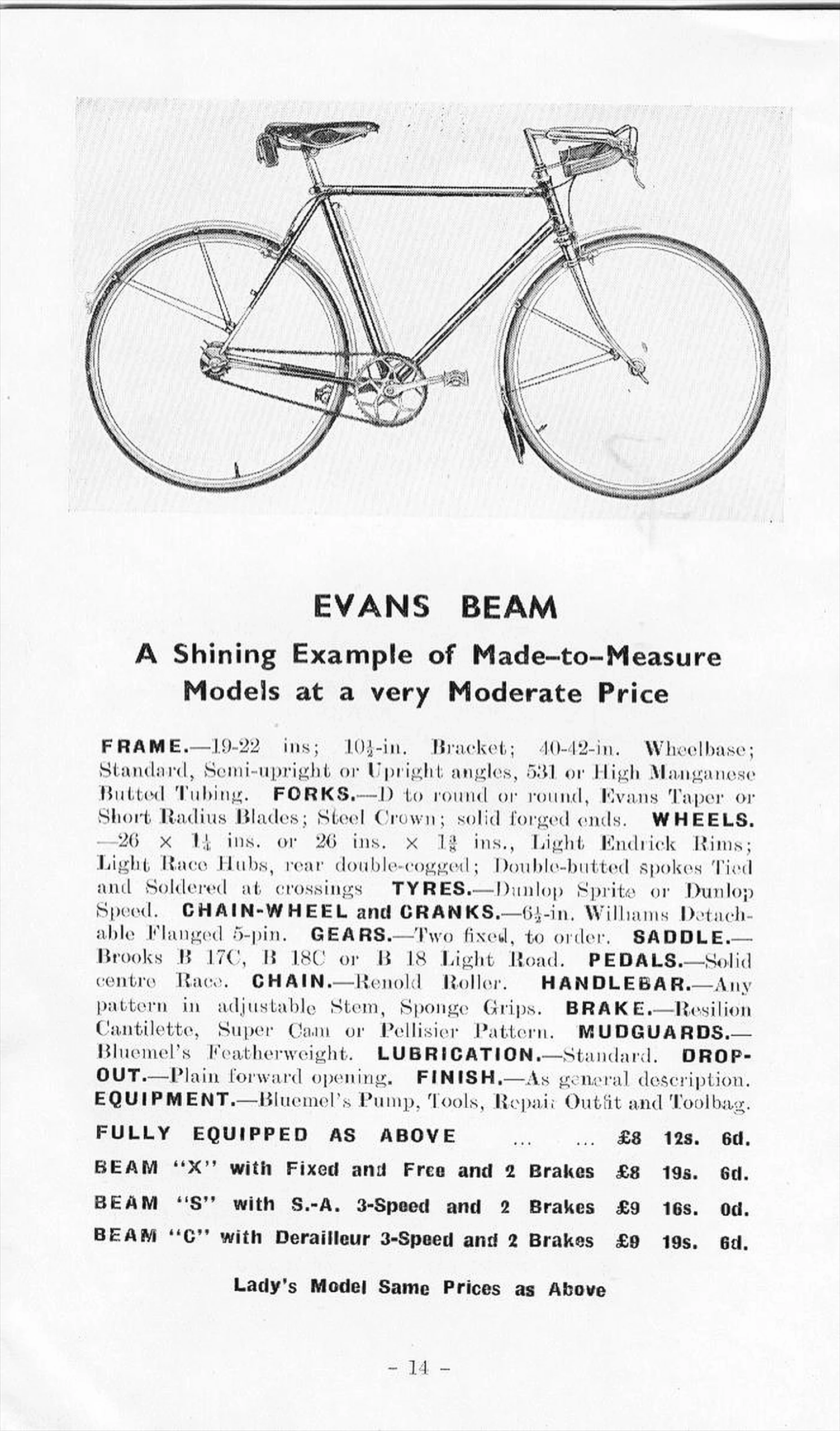 Page 16
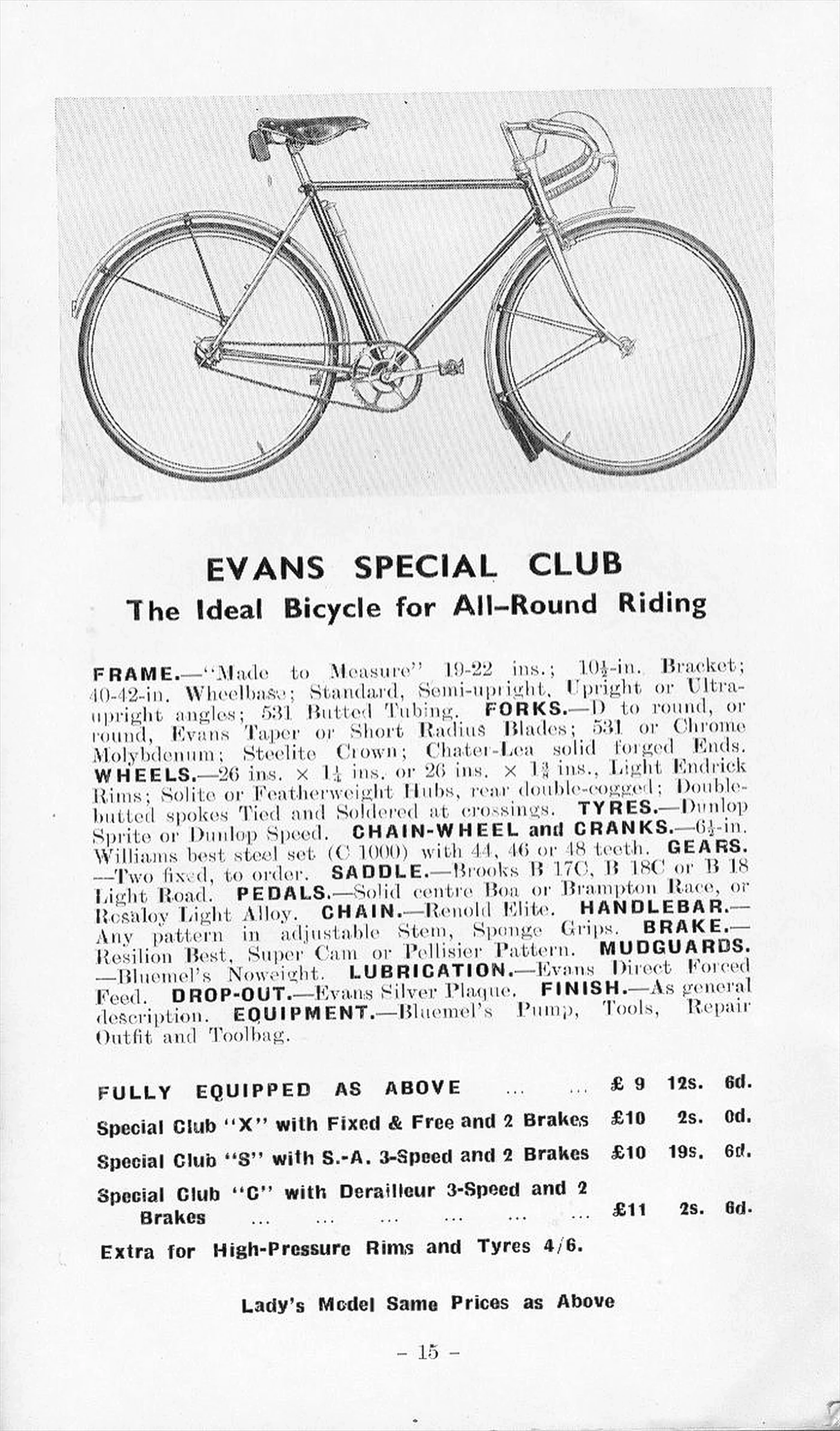 Page 17
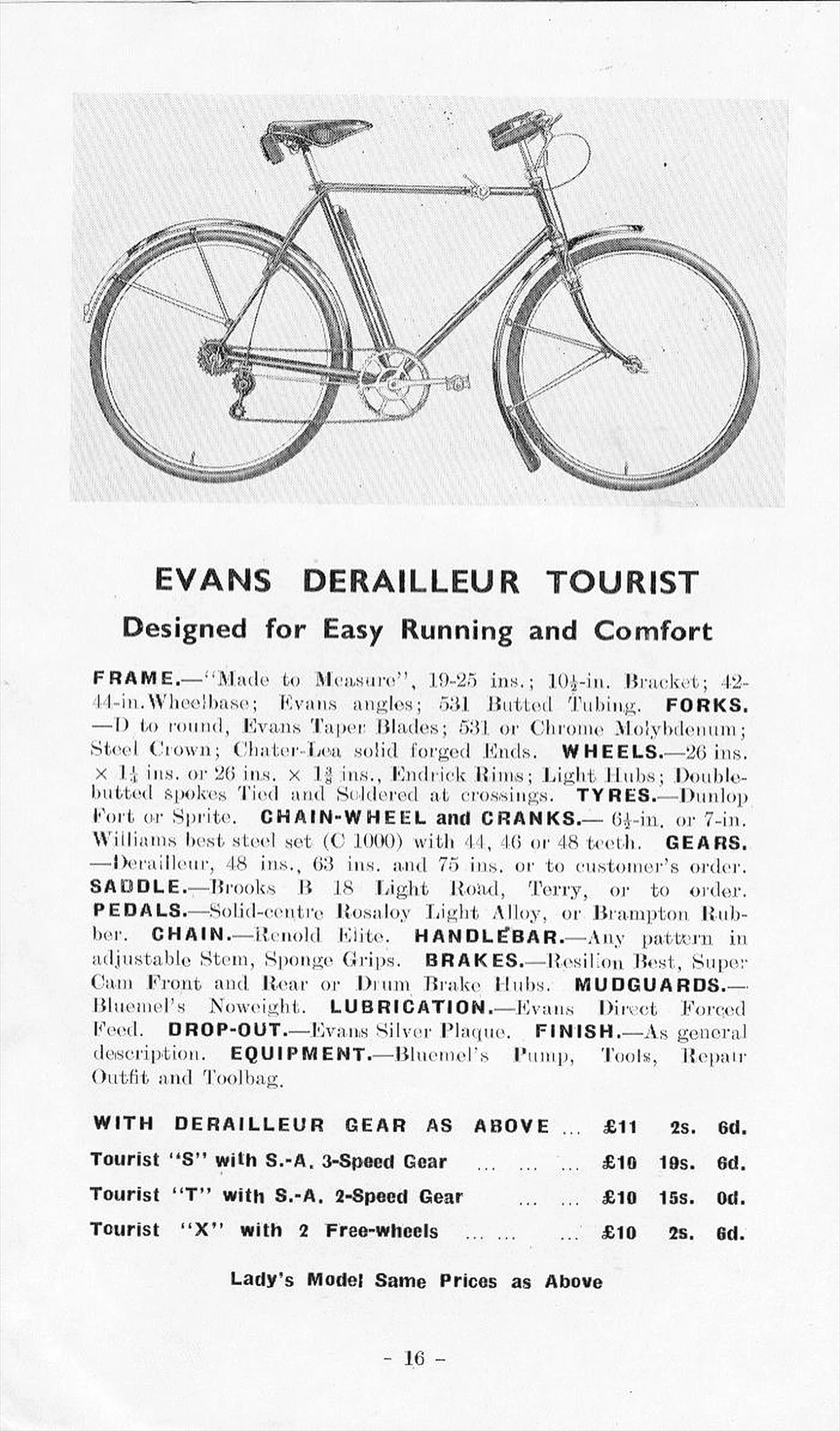 Page 18
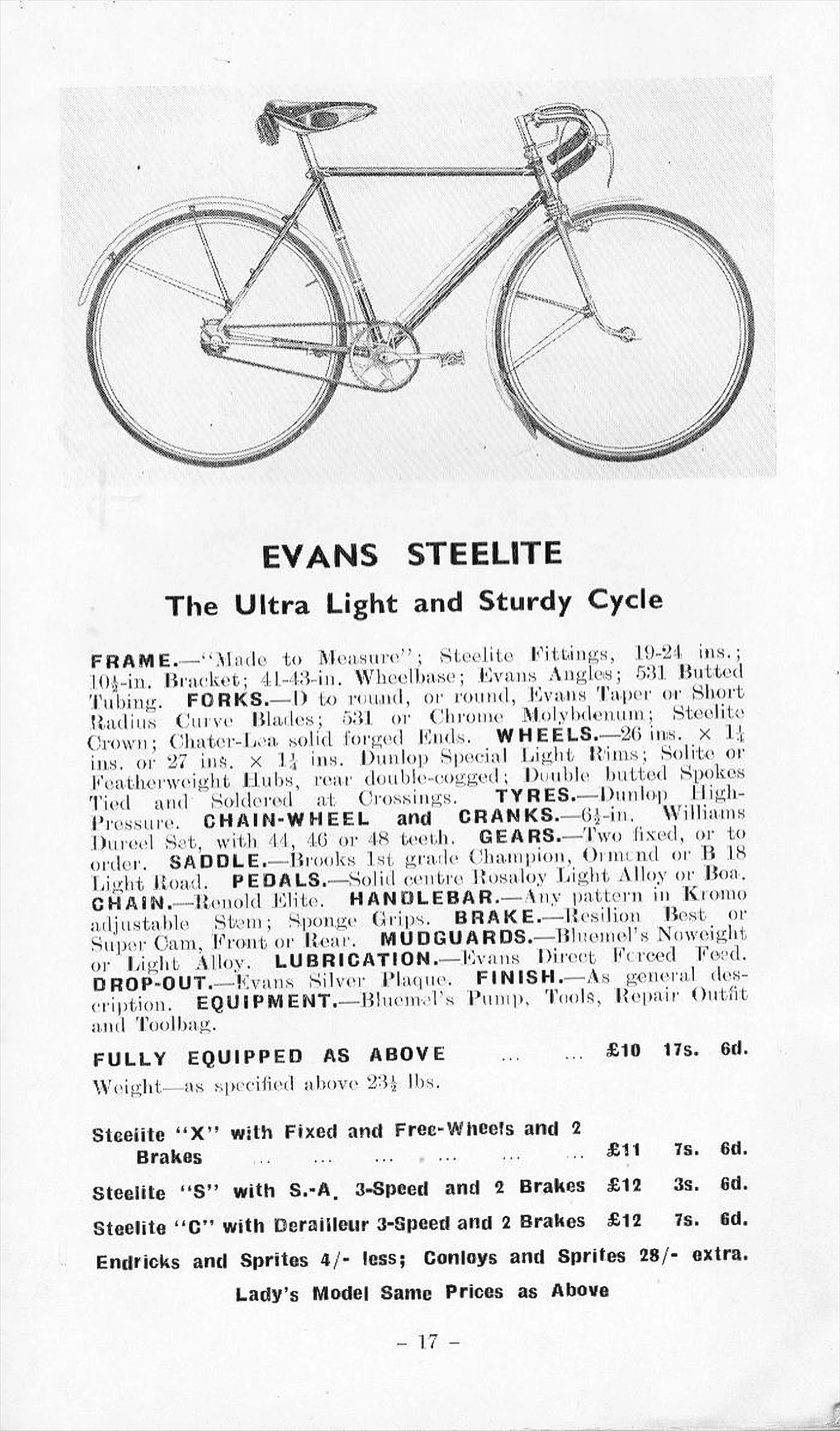 Page 19
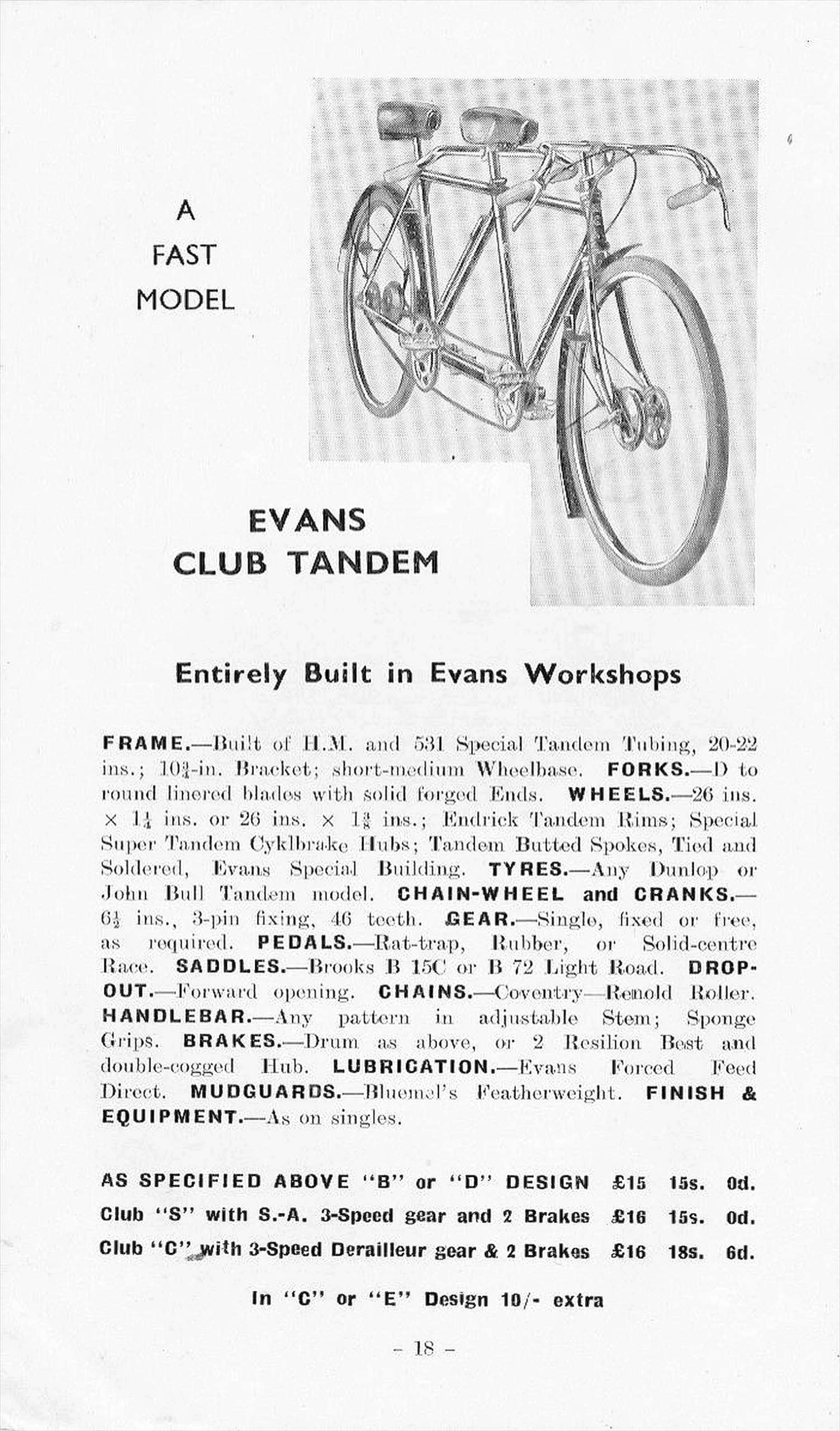 Page 20
 Page 21
 Page 22
 Page 23
 Page 24
 Page 25
 Page 26
| Marque | F. W. Evans |
|---|---|
| Type | Catalog |
| Publisher | F. W. Evans |
| Country | England |
| Language | English |
| Pages | 26 |
| Source | bulgier.net (Mark Bulgier's catalog archive), Peter Brown's scans, posted in 2006. |
| Credit | Ebykr archive |
| Identifier | Permalink http://bulgier.net/pics/bike/Catalogs/FWEvans-late30s/ |
| Transcription | Transcribed by eye |
The Evans Universal Cycle Frame Jig "THE SURE FOUNDATION FOR TRUTH IN CYCLE FRAMES IS AN ACCURATE JIG" says F. W. EVANS TERMS OF SALE AND GUARANTEE WITH all cycles, wheels, fittings and accessories made by me, all fittings and accessories supplied by me, and all repairs executed by me, the following guarantee is given …
The catalog of F. W. Evans, “The Cycle Engineer”, of 44 & 46 Kennington Road, London: the front cover and its inside, then pages 1 to 24, the page after 12 printed “12A”. The scans end at page 24, without the back cover. No year is printed; its 531 tubing places it in 1935 or later.
— Page 1 (front cover) —
The Evans Universal Cycle Frame Jig
“THE
SURE
FOUNDATION
FOR TRUTH IN
CYCLE FRAMES IS
AN ACCURATE JIG”
says F. W. EVANS
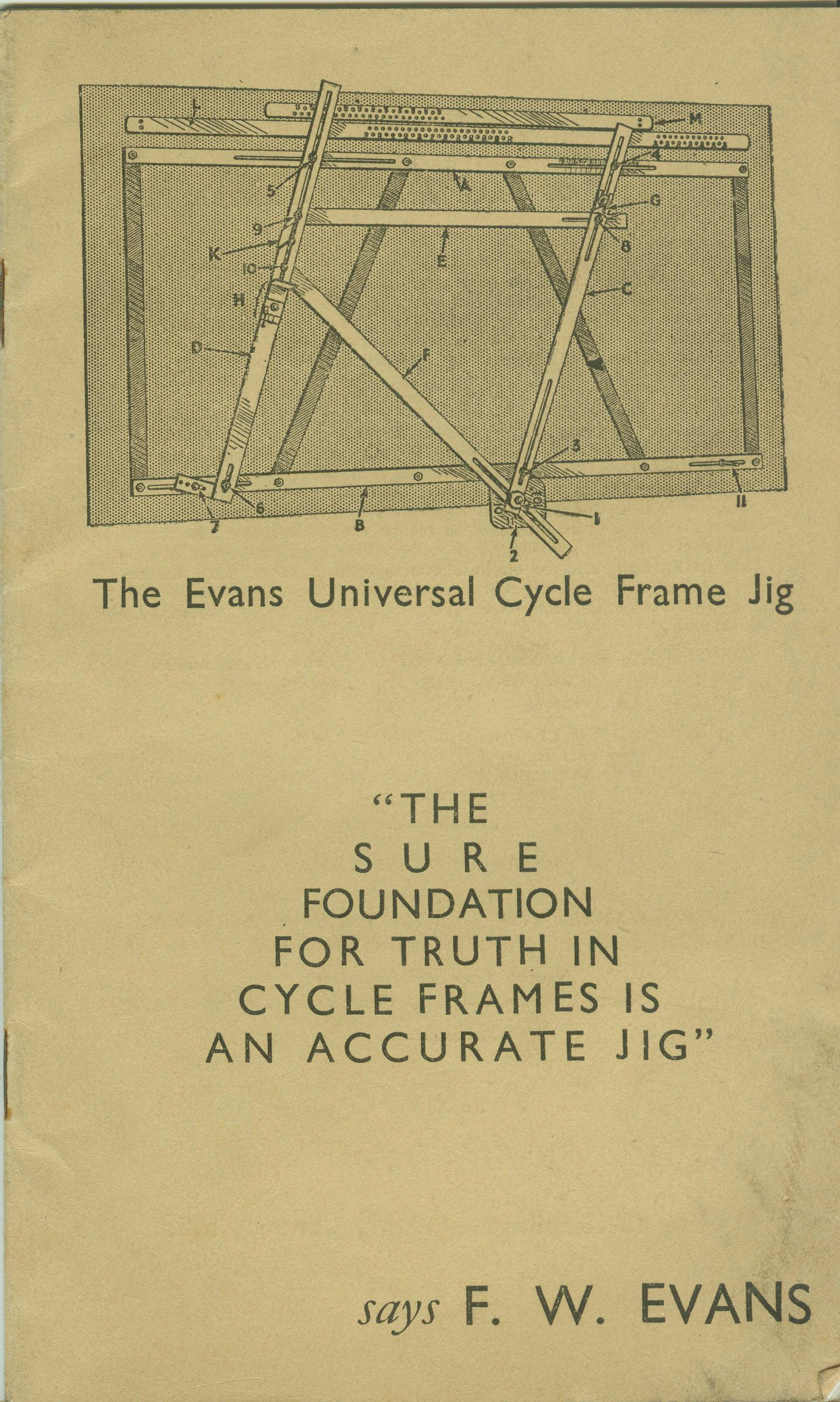
[The front cover: a line drawing of the Evans Universal Cycle Frame Jig, its rails, slides and pegs keyed by the letters A to H, K, L and M and the numbers 1 to 11, above the slogan “The sure foundation for truth in cycle frames is an accurate jig”, attributed to F. W. Evans. Dark ink on buff cover stock with no photographs; rust marks from two staples show at the spine edge, the lower right corner is worn and turned and there are no later marks.]
— Page 2 (inside front cover) —
TERMS OF SALE AND GUARANTEE
WITH all cycles, wheels, fittings and accessories made by me, all fittings and accessories supplied by me, and all repairs executed by me, the following guarantee is given in place of, and as superseding, any guarantee implied by statute or otherwise, the terms being similar in condition and period to the guarantee given with other first-grade cycles, components and accessories:—
I warrant that all precautions that are usual and reasonable have been taken by me to secure excellence of material and workmanship. Should any defect appear in the goods within a period of one year from the date of purchase, such defect not having been caused by ordinary wear and tear, misuse, accident or neglect, I undertake to make good such defect free of charge, provided that the defective part is returned to me carriage paid, my liability to be limited to the making good of defective parts as described in this paragraph, and to exclude consequential damage no matter from what cause arising. Tyres and other proprietary components and accessories are subject to the guarantee given by the makers of same.
New complete cycles are forwarded to provincial customers by passenger train, at company’s risk. Only half the cost of carriage is charged to customers.
It is requested that £1 deposit shall be sent with each cycle order and the balance paid on completion of the machine. Prices in this list are liable to alteration without notice, but no increase will be made in the price of an accepted order, errors and omissions excepted.
HOURS OF BUSINESS:
9 a.m. to 8 p.m. | Saturdays, 9 to 9. | Thursdays, 9 to 1.
Telephone : WATerloo 4785 | Post Office : Lambeth P.O.
Nearest Tube Station | “Lambeth North” (100 yards).
Nearest Tram and Bus stops :
“Lambeth North” Station, Christ Church, or Lambeth Baths.
MEMBER OF INSTITUTE OF PATENTEES (INC)
F. W. EVANS
The Cycle Engineer
Member of
LMA
44 & 46 Kennington Road, London, S.E.1
[The inside front cover: F. W. Evans’s terms of sale and guarantee and his hours of business, telephone number and nearest stations, above the firm’s name and Kennington Road address set between a round “Member of Institute of Patentees” seal (a machine drawn at its center) and an LMA membership box. Text only on buff stock, with no photographs, no folio and no later marks.]
— Page 3 —
THE FOUNDATION
OF TRUE FRAMES
The importance of jigs is accepted in every engineering shop. They offer two-fold advantages—they are valuable aids to accurate working, and they reduce the time taken in manufacture by cutting out guesswork. In the Evans workshops, where the time taken in building a frame is not cut to minutes, it is as aids to dead accurate building that they are chiefly regarded, although, naturally, any saving of time that can be passed on to the customer in the form of reduction in price is rightly welcomed. The disadvantage that is usually found in a jig is that it is useful for only one design of cycle, and while it will hold the various frame members perfectly in position for one design, it will not permit variation in the tube measurements and angles. This lack of adaptability has been largely responsible for the standardisation of jig-built frames, for no matter how the appearance or descriptions of machines may be altered by their equipment, it is not difficult for the trained eye to trace the standardised frame underneath. On the other hand, this rigidity in the designs permitted by jigs has possibly resulted in too many frames being built without jigs. It does not necessarily follow that such frames are untrue, but some of them are, and it is sometimes found that they do not provide the promised measurements and angles. Properly built on an accurately made jig, the frames could not be other than perfectly true; without jigs you may get truth; with jigs truth should be assured.
Never before in the whole history of the sport and pastime have keen cyclists demanded such a great variety of designs, involving so many odd angles and measurements. It was in these circumstances that I perfected the Evans Universal Cycle Jig—a jig that is so infinitely variable in design that it can be set up in five minutes to give any bracket height, tube length, frame angles, fork blade set-off and wheelbase. And the whole frame can be “pegged up” on it with the certainty that it will be absolutely correct in these details.
In the illustration of the jig, A and B are two horizontal and parallel fixed rails upon which the rails representing the frame are supported. C represents the seat tube, E the top tube, F the bottom tube, K the head tube and D a continuation of the head tube, the off-set in the fork blade (7) being measured from its centre. The peg is fitted to the hole giving the required measurement in the exact position which the front wheel axle will occupy. A peg (11) representing the rear wheel axle is seen near the other end. Slides at H are used to fix the position of the crown and the bottom head lug, but for the sake of clarity the appliances which hold the frame are not shown with the exception of the disc (1) which holds the bottom bracket shell. An interesting feature is the square plate (2), by the simple turning round of which different bracket heights are secured. The numbered slots and
– 1 –
[The opening essay page, “The Foundation of True Frames”, headed by a black silhouette of a man’s head and shoulders in profile, on why jigs make true frames and on the Evans Universal Cycle Jig. Its third paragraph keys the jig drawing by letter and number (the same letters and numbers as the drawing on the front cover) and runs on to the next page; text only, with the lower right corner creased and no later marks.]
— Page 4 —
bolts allow the frame members to slide in any direction to place them in the actual position the frame tubes are eventually to assume. The long strips L and M at the top are measuring strips, either of these may be hung on two bolts to retain the rails a certain distance apart while other parts of the jig are manipulated into position.
This jig only takes me past the “pegging” process, entirely without the distortion likely to arise from guesswork. It has replaced entirely the full scale drawings upon which Evans cycles were formerly built. As it is subject to no distortion it is more accurate and better in working. It is also a distinct time saver. It combines excellently with the jigs I have always used to retain the truth of the frame during brazing and cooling. These are ingenious in their way, as they maintain the alignment perfectly while allowing the frame members to expand under heat and resume their normal measurements while cooling. Altogether, an excellent combination for a cycle maker building frames of many designs.
In the building of Evans cycles there is no standardisation. A bicycle is treated as an individual affair, to be designed and built to suit the needs of the man who intends to ride it. Every measurement and angle is considered with that end in view, and every one of the fittings and every piece of equipment finds a place in the specification for the same purpose. Every constructional detail is included in the jig upon which the frame and forks are actually built. Wheels and gearing in infinite variety can be selected by the rider, and the colour schemes and finishes are as varied as the most fastidious cyclists can desire.
Except when a customer desires otherwise every Evans frame is of my own design, and, as previously stated, is built on—literally built on—the new jig which incorporates all the measurements and angles required by the rider. Thus, the frame can combine any possible combination of bracket height, tube lengths, wheelbase, etc. with the assurance that the desired result will be obtained without bowing, bending or straining the tubes. The whole will form a complete symmetrical design in which rule-of-thumb methods have played no part.
All Evans cycles are “balance built”. A cycle frame is not more rigid than its least rigid part, and one of my aims in designing is to specify the lightest materials that will preserve a given standard of all-round rigidity.
In the frames highest grade tubing is used, 531, HM or Chrome Molybdenum as preferred, but in cases where special circumstances suggest to me that some other tubing may be safer, more suitable or its properties better known for the job, I assume that some discretion is allowed me in the matter unless otherwise stated. Cost does not enter into the case; suitability is the sole consideration. Butted tubes are used. These, being stouter at the ends than in the middle, tend to distribute road shocks over the widest possible area of the frame. An aid to this end is given by the cut-away lugs of unique design and their finely tapered ends, all speaking eloquently of highly skilled work.
– 2 –
[An essay page of text only, continuing the account of the Evans jig and going on to Evans’s custom frame design, “balance built” frames and the tubing used (531, HM or Chrome Molybdenum, butted). No illustrations; a crease crosses the lower left corner and there are no later marks.]
— Page 5 —
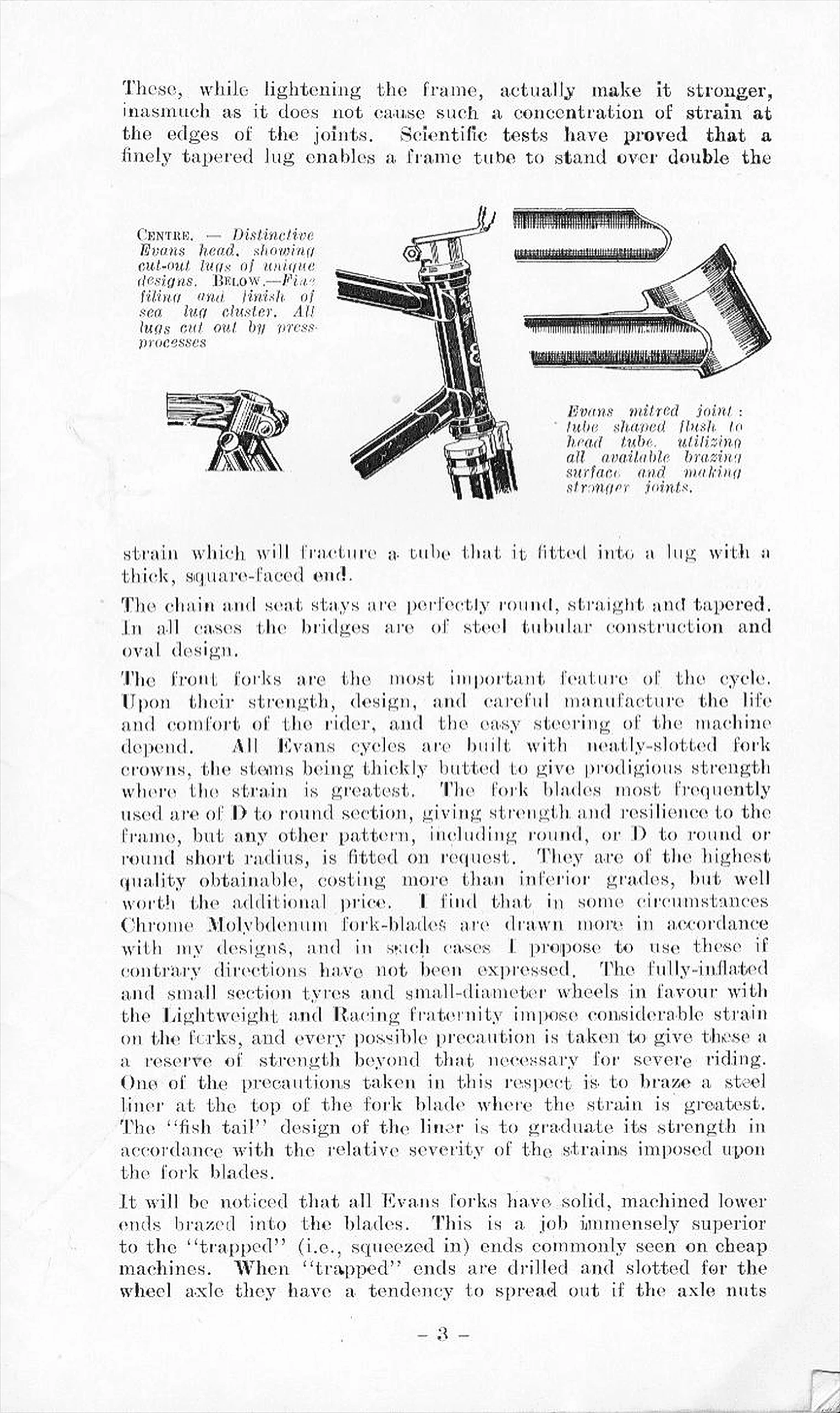
These, while lightening the frame, actually make it stronger, inasmuch as it does not cause such a concentration of strain at the edges of the joints. Scientific tests have proved that a finely tapered lug enables a frame tube to stand over double the strain which will fracture a tube that it fitted into a lug with a thick, square-faced end.
The chain and seat stays are perfectly round, straight and tapered. In all cases the bridges are of steel tubular construction and oval design.
The front forks are the most important feature of the cycle. Upon their strength, design, and careful manufacture the life and comfort of the rider, and the easy steering of the machine depend. All Evans cycles are built with neatly-slotted fork crowns, the stems being thickly butted to give prodigious strength where the strain is greatest. The fork blades most frequently used are of D to round section, giving strength and resilience to the frame, but any other pattern, including round, or D to round or round short radius, is fitted on request. They are of the highest quality obtainable, costing more than inferior grades, but well worth the additional price. I find that in some circumstances Chrome Molybdenum fork-blades are drawn more in accordance with my designs, and in such cases I propose to use these if contrary directions have not been expressed. The fully-inflated and small section tyres and small-diameter wheels in favour with the Lightweight and Racing fraternity impose considerable strain on the forks, and every possible precaution is taken to give these a a reserve of strength beyond that necessary for severe riding. One of the precautions taken in this respect is to braze a steel liner at the top of the fork blade where the strain is greatest. The “fish tail” design of the liner is to graduate its strength in accordance with the relative severity of the strains imposed upon the fork blades.
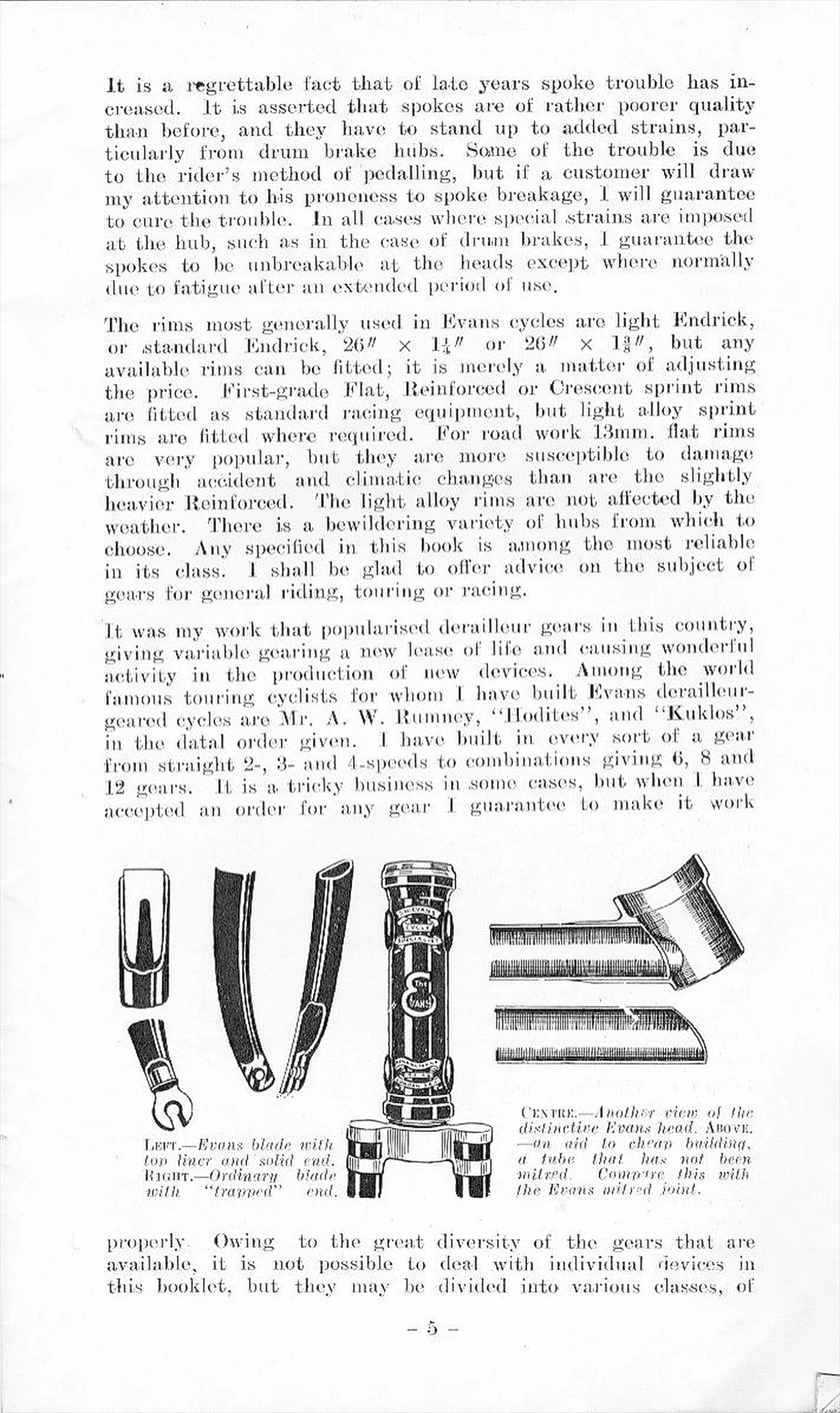
It will be noticed that all Evans forks have solid, machined lower ends brazed into the blades. This is a job immensely superior to the “trapped” (i.e., squeezed in) ends commonly seen on cheap machines. When “trapped” ends are drilled and slotted for the wheel axle they have a tendency to spread out if the axle nuts
CENTRE. — Distinctive Evans head, showing cut-out lugs of unique designs. BELOW.—Fine[?] filing and finish of sea lug cluster. All lugs cut out by press processes
Evans mitred joint : tube shaped flush to head tube.[?] utilizing all available brazing surface and making stronger joints.
– 3 –
[An essay page on lugs, stays and front forks, with three drawings set into the text: the Evans head with its cut-out lugs (center), a seat lug cluster (below left) and two views of the “Evans mitred joint”, a tube end shaped to fit flush against the head tube (right). The head tube in the center drawing carries a transfer too small to read; the lower right corner is creased and there are no later marks.]
— Page 6 —
are tightly screwed up, and it is also a quite common experience to find that these fork ends give way at the end of the liner usually inserted between the two sides of the fork blade.
There are approximately 30 points to be brazed in an Evans cycle. The time taken in building and brazing could be pretty nearly halved by taking risks with the work. I do not take risks. Every tube is correctly cut to the length shown by the new Evans jig, and properly mitred to provide the largest brazing surface and ensure the strongest joints. It may be remarked that in some machines the tube-ends are cut diagonally instead of being properly mitred—thereby reducing the area of the brazing surface, and providing a fruitful source of frame failure. In my workshops all joints are properly cleaned and prepared for brazing, and every possible care that experience and skill can suggest is taken with this most important operation. It is only a combination of experience and skill that enables the operator to get a perfect distribution of brazing metal with the least possible heat, to ensure that there shall be no chance of taking the liveliness and strength out of the frame by “burning” the tubes. Lack of skill, or quick work, may lead to incorrect application of the flame and result in unequal heating of the surfaces, and to confinement of the brazing to the outside edges of the joint.
Frame tubes are burnt from the same cause, while the allowance of insufficient time properly to clean and prepare the joints often leads to patchy and incomplete distribution of the brazing metal. Cyclists making out their own specifications might remember that the frame angles are as follows: Standard 68 degrees; semi-upright 70 degrees; and upright 73 degrees. Evans cycles are not only made in these angles and combinations of angles, but in any angle between, and occasionally, in the case of physical disability, at angles outside the extremes quoted. The frame angle is that formed by the seat tube and horizontal top tube. Where the choice is left to me, the rider’s measurements and the purpose for which the machine will be used control the design. I do not recommend a very short base in a tandem frame, as a cramped position or a rear seat too directly over the rear wheel makes for extreme discomfort. In cases where the rear rider is very short, the double-gents’ Touring Tandem is specially designed to meet the case. In tandem frames of the “B” and “D” designs, I find it desirable to use separate lugs for the rear cross tube, as in these lugs the angles can be modified to suit differing measurements in the front seat tube and rear top tube without “setting” or bending the cross tube, the latter being a practice of which I strongly disapprove.
WHEELS.—Lively wheels are essential to lively cycles. A heavy wheel with low tension spokes will run sluggishly. A good light rim and highly tensioned, double-butted spokes that combine strength with lightness make all the difference. The gradual tensioning of a highly strung Evans wheel demands and receives more time and skill than is usually given to this important feature. Spokes are tied and soldered unless otherwise requested. Black spokes are scraped bright at the crossings, tied and soldered, and then re-enamelled—a very much better job than the almost useless method of tying and soldering over the enamel.
– 4 –
[An essay page of text only on brazing, frame angles (standard 68, semi-upright 70 and upright 73 degrees) and tandem frames, followed by the opening of the section on wheels. No illustrations; a crease crosses the lower left corner and there are no later marks.]
— Page 7 —
It is a regrettable fact that of late years spoke trouble has increased. It is asserted that spokes are of rather poorer quality than before, and they have to stand up to added strains, particularly from drum brake hubs. Some of the trouble is due to the rider’s method of pedalling, but if a customer will draw my attention to his proneness to spoke breakage, I will guarantee to cure the trouble. In all cases where special strains are imposed at the hub, such as in the case of drum brakes, I guarantee the spokes to be unbreakable at the heads except where normally due to fatigue after an extended period of use.
The rims most generally used in Evans cycles are light Endrick, or standard Endrick, 26″ × 1¼” or 26″ × 1⅜”, but any available rims can be fitted; it is merely a matter of adjusting the price. First-grade Flat, Reinforced or Crescent sprint rims are fitted as standard racing equipment, but light alloy sprint rims are fitted where required. For road work 13mm. flat rims are very popular, but they are more susceptible to damage through accident and climatic changes than are the slightly heavier Reinforced. The light alloy rims are not affected by the weather. There is a bewildering variety of hubs from which to choose. Any specified in this book is among the most reliable in its class. I shall be glad to offer advice on the subject of gears for general riding, touring or racing.
It was my work that popularised derailleur gears in this country, giving variable gearing a new lease of life and causing wonderful activity in the production of new devices. Among the world famous touring cyclists for whom I have built Evans derailleur-geared cycles are Mr. A. W. Rumney, “Hodites”, and “Kuklos”, in the datal order given. I have built in every sort of a gear from straight 2-, 3- and 4-speeds to combinations giving 6, 8 and 12 gears. It is a tricky business in some cases, but when I have accepted an order for any gear I guarantee to make it work properly. Owing to the great diversity of the gears that are available, it is not possible to deal with individual devices in this booklet, but they may be divided into various classes, of
LEFT.—Evans blade with top liner and solid end. RIGHT.—Ordinary blade with “trapped” end.
CENTRE.—Another view of the distinctive Evans head. ABOVE.—an aid to cheap building, a tube that has not been mitred. Compare this with the Evans mitred joint.
– 5 –
[An essay page on spokes, rims and derailleur gears, with a band of drawings across the lower third: an Evans fork blade with top liner and solid end beside an ordinary blade with a “trapped” end (left), the Evans head tube (center) and a tube end that has not been mitered (right). The drawn head tube carries the Evans transfer, “F. W. Evans Cycle Specialist” above a large E enclosing “The Evans”, with an address panel at its foot too small to read; the lower right corner is creased and there are no later marks.]
— Page 8 —
which the following are the principal: Touring 3-speeds, Derailleur and Hub; Touring medium-ratio 3-speeds, Derailleur and Hub; Racing 3-speeds, Derailleur and Hub. Touring 2-speeds, Derailleur and Hub; Racing 2-speeds, Derailleur and Hub. If a prospective customer will inform me which class of gear is preferred, I shall be able to recommend the one most suitable for the particular purpose. Another guarantee that I give is that in all Evans cycles the wheels are of correct chain line, a perfection not found on all lightweights. Where fixed and free wheels providing different gears are fitted to a machine, it is desirable to have the free wheel on the lower gear. Where derailleur gears are included in specifications without the make being specifically mentioned, Cyclo or TriVelox are referred to.
TYRES.—Liveliness in a tyre is mainly dependent upon thin “walls” (or sides) and high quality tread. The better the rubber in the tread, the less likely it is to puncture, but it must be expected that very thin light tyres will not last so long as the heavier types with thick walls and treads. To those whose main consideration is ease rather than economy, the lighter tyres are recommended.
CHAIN WHEELS and CRANKS.—Except where B.S.A. or Chater-Lea chain-wheel and crank sets accompany fittings of these makes, other flanged sets of famous English make are specified. The Coventry chain is fitted to the R.R. [?] model and Renold Elite or Renold Roller to all others, except that Perry derailleur chain may be specified for gearing of that type.
SADDLES.—Except for riders who suffer severely from road shock I do not recommend saddles with spiral springs vertically placed. When the rider pushes hard from the saddle they waste his effort by swaying to the other side, and in addition they are heavy. Soft (or mattress) top saddles need less “breaking in” than do the leather type, but the latter are largely used, especially in serious racing. With each model we specify an appropriate type of saddle, but while I can give general information concerning these fittings, I am not able to say definitely that any particular saddle will suit the individual, and therefore a very wide choice is offered in most models.
PEDALS.—Brampton, Boa or Rosa light pedals are usually specified, except where Chater-Lea or B.S.A. are required.
BRAKES.—The specifications show the brakes most usually fitted to the various models, but any other make will be fitted on request. Hub brakes are standard on tandems, and can be fitted without extra charge in substitution of Cantilever “A” brakes on singles. Neat, brazed-on clips for brake arms form an attractive feature of Evans cycles.
DROP-OUT.—The Evans Drop-out is the famous device that won the first C.T.C. Silver Plaque for the greatest improvement in cycle design, construction or equipment. At that period, there were many devices to aid the quick replacement of double-cogged wheels; to-day, the Evans is the only one commonly seen. Even with cogs or free-wheels of different sizes, the simple act of pushing home the rear wheel accurately centres it and correctly adjusts the chain tension. With the Evans Drop-out, I have re-
– 6 –
[A full page of text continuing the essay on fittings, with paragraphs on gears, tires, chain wheels and cranks, saddles, pedals, brakes and the Evans drop-out. There are no illustrations and no later marks.]
— Page 9 —
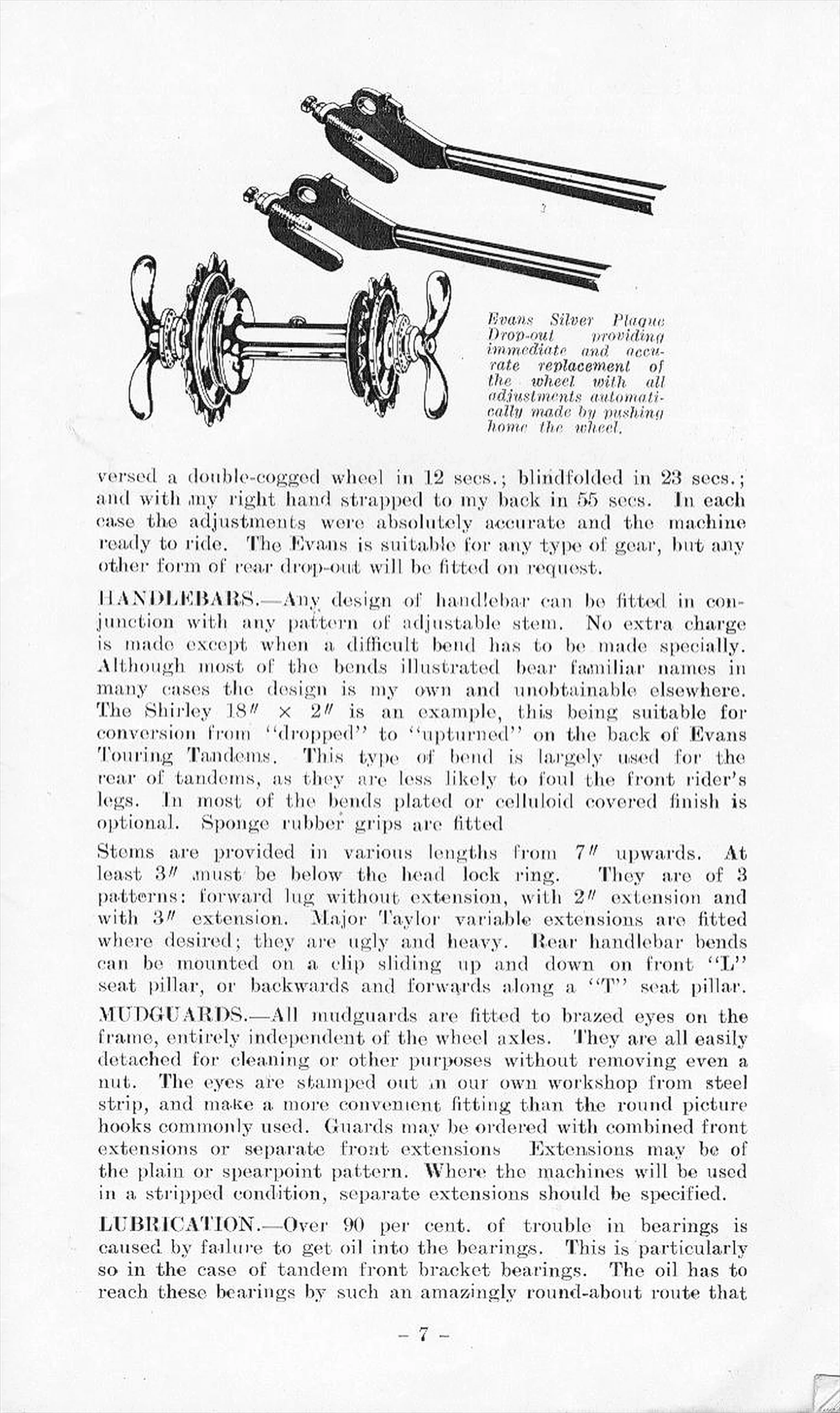
Evans Silver Plaque Drop-out providing immediate and accurate replacement of the wheel with all adjustments automatically made by pushing home the wheel.
versed a double-cogged wheel in 12 secs.; blindfolded in 23 secs.; and with my right hand strapped to my back in 55 secs. In each case the adjustments were absolutely accurate and the machine ready to ride. The Evans is suitable for any type of gear, but any other form of rear drop-out will be fitted on request.
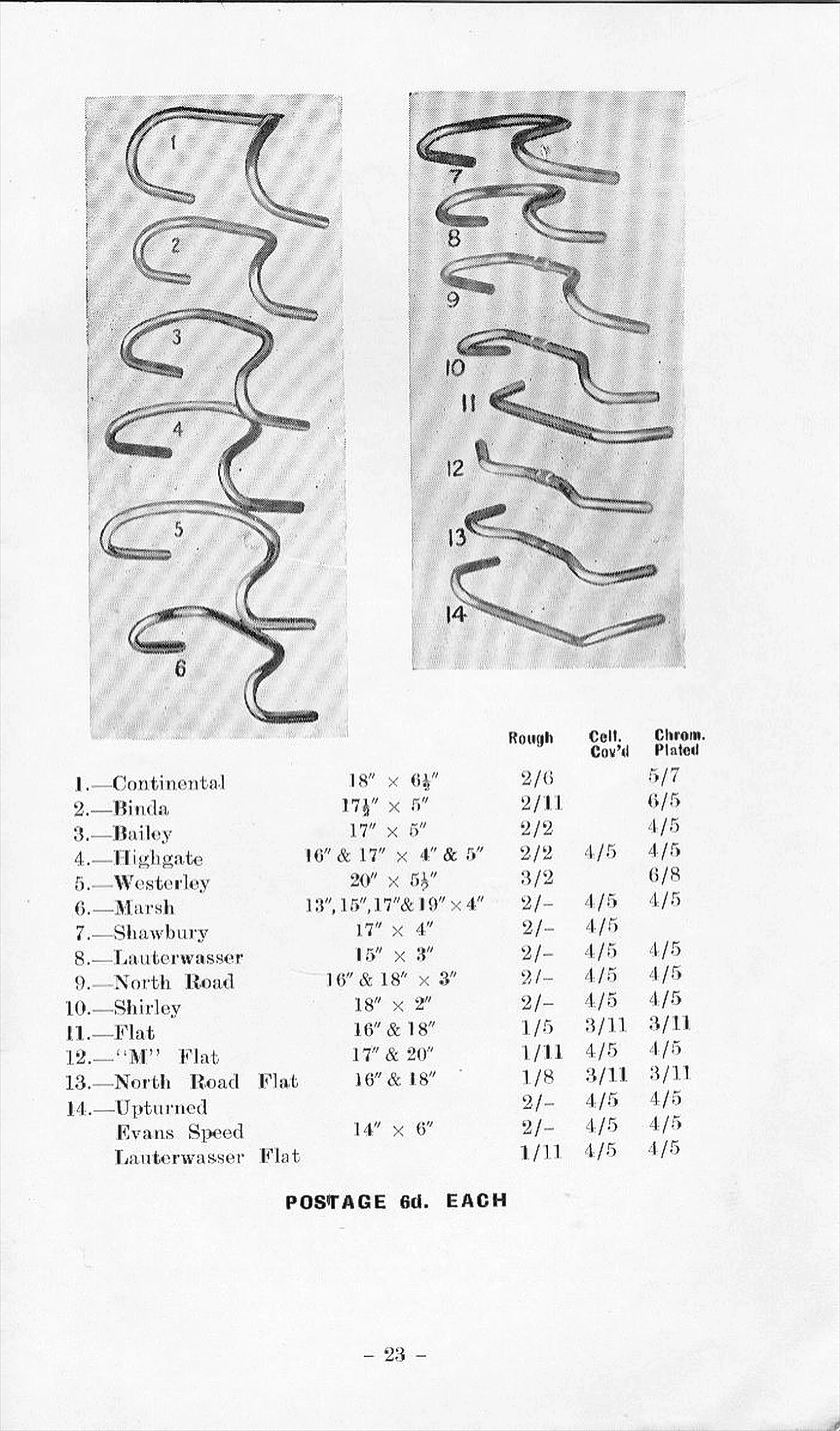
HANDLEBARS.—Any design of handlebar can be fitted in conjunction with any pattern of adjustable stem. No extra charge is made except when a difficult bend has to be made specially. Although most of the bends illustrated bear familiar names in many cases the design is my own and unobtainable elsewhere. The Shirley 18″ × 2″ is an example, this being suitable for conversion from “dropped” to “upturned” on the back of Evans Touring Tandems. This type of bend is largely used for the rear of tandems, as they are less likely to foul the front rider’s legs. In most of the bends plated or celluloid covered finish is optional. Sponge rubber grips are fitted
Stems are provided in various lengths from 7″ upwards. At least 3″ must be below the head lock ring. They are of 3 patterns: forward lug without extension, with 2″ extension and with 3″ extension. Major Taylor variable extensions are fitted where desired; they are ugly and heavy. Rear handlebar bends can be mounted on a clip sliding up and down on front “L” seat pillar, or backwards and forwards along a “T” seat pillar.
MUDGUARDS.—All mudguards are fitted to brazed eyes on the frame, entirely independent of the wheel axles. They are all easily detached for cleaning or other purposes without removing even a nut. The eyes are stamped out in our own workshop from steel strip, and make a more convenient fitting than the round picture hooks commonly used. Guards may be ordered with combined front extensions or separate front extensions Extensions may be of the plain or spearpoint pattern. Where the machines will be used in a stripped condition, separate extensions should be specified.
LUBRICATION.—Over 90 per cent. of trouble in bearings is caused by failure to get oil into the bearings. This is particularly so in the case of tandem front bracket bearings. The oil has to reach these bearings by such an amazingly round-about route that
– 7 –
[A drawing of two Evans Silver Plaque drop-outs with their adjusting screws above a double-cogged rear hub with wing nuts, with an italic caption beside it and the essay on fittings continuing below on handlebars, stems, mudguards and lubrication. The bottom right corner of the leaf is turned up in a small curl; there are no later marks.]
— Page 10 —
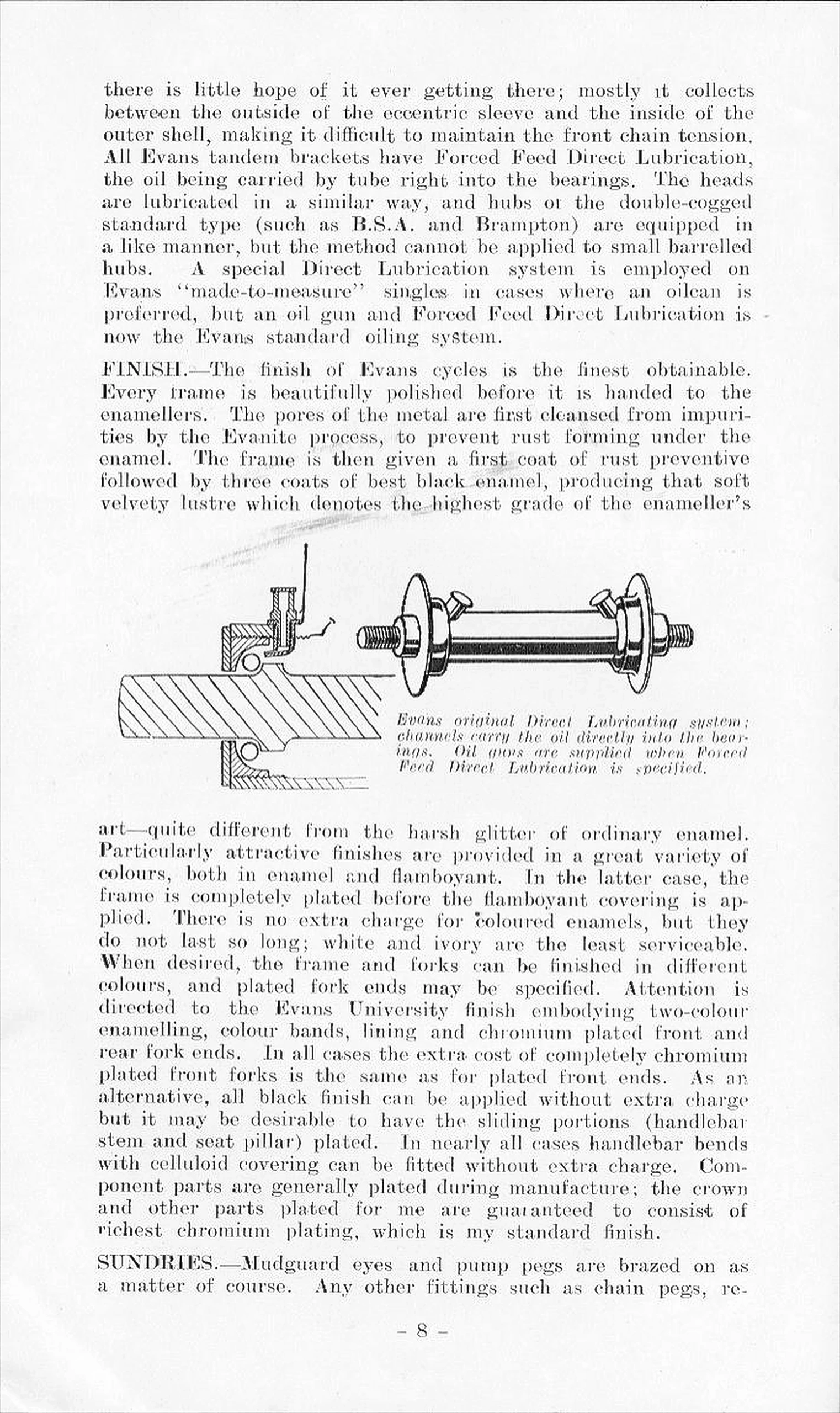
there is little hope of it ever getting there; mostly it collects between the outside of the eccentric sleeve and the inside of the outer shell, making it difficult to maintain the front chain tension. All Evans tandem brackets have Forced Feed Direct Lubrication, the oil being carried by tube right into the bearings. The heads are lubricated in a similar way, and hubs or the double-cogged standard type (such as B.S.A. and Brampton) are equipped in a like manner, but the method cannot be applied to small barrelled hubs. A special Direct Lubrication system is employed on Evans “made-to-measure” singles in cases where an oilcan is preferred, but an oil gun and Forced Feed Direct Lubrication is now the Evans standard oiling system.
FINISH.—The finish of Evans cycles is the finest obtainable. Every frame is beautifully polished before it is handed to the enamellers. The pores of the metal are first cleansed from impurities by the Evanite process, to prevent rust forming under the enamel. The frame is then given a first coat of rust preventive followed by three coats of best black enamel, producing that soft velvety lustre which denotes the highest grade of the enameller’s
Evans original Direct Lubricating system; channels carry the oil directly into the bearings. Oil guns [?] are supplied when Forced Feed Direct Lubrication is specified.
art—quite different from the harsh glitter of ordinary enamel. Particularly attractive finishes are provided in a great variety of colours, both in enamel and flamboyant. In the latter case, the frame is completely plated before the flamboyant covering is applied. There is no extra charge for coloured enamels, but they do not last so long; white and ivory are the least serviceable. When desired, the frame and forks can be finished in different colours, and plated fork ends may be specified. Attention is directed to the Evans University finish embodying two-colour enamelling, colour bands, lining and chromium plated front and rear fork ends. In all cases the extra cost of completely chromium plated front forks is the same as for plated front ends. As an alternative, all black finish can be applied without extra charge but it may be desirable to have the sliding portions (handlebar stem and seat pillar) plated. In nearly all cases handlebar bends with celluloid covering can be fitted without extra charge. Component parts are generally plated during manufacture; the crown and other parts plated for me are guaranteed to consist of richest chromium plating, which is my standard finish.
SUNDRIES.—Mudguard eyes and pump pegs are brazed on as a matter of course. Any other fittings such as chain pegs, re-
– 8 –
[A sectional drawing of the Evans Direct Lubricating system, an oil nipple and feed tube carrying oil to a ball bearing, beside a drawing of a large-flange hub with two oil nipples, with an italic caption, set between paragraphs on lubrication, finish and sundries. A faint, streaky diagonal gray smudge runs across the last lines of the upper text block and the space below it without hiding any words; there is no writing or stamp on the page.]
— Page 11 —
B
C
D
E
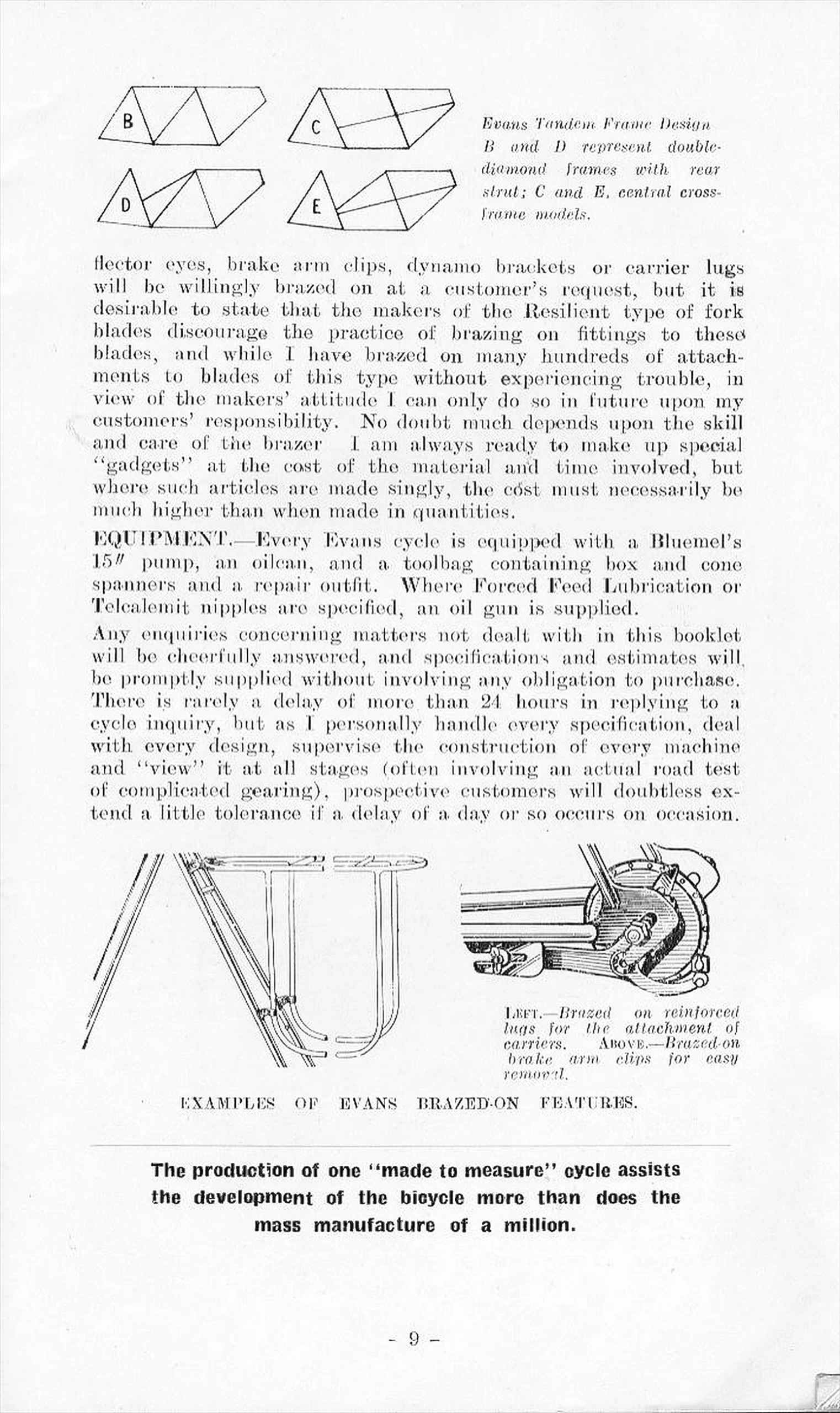
Evans Tandem Frame Design
B and D represent double-diamond frames with rear strut; C and E, central cross-frame models.
flector eyes, brake arm clips, dynamo brackets or carrier lugs will be willingly brazed on at a customer’s request, but it is desirable to state that the makers of the Resilient type of fork blades discourage the practice of brazing on fittings to these blades, and while I have brazed on many hundreds of attachments to blades of this type without experiencing trouble, in view of the makers’ attitude I can only do so in future upon my customers’ responsibility. No doubt much depends upon the skill and care of the brazer I am always ready to make up special “gadgets” at the cost of the material and time involved, but where such articles are made singly, the cost must necessarily be much higher than when made in quantities.
EQUIPMENT.—Every Evans cycle is equipped with a Bluemel’s 15″ pump, an oilcan, and a toolbag containing box and cone spanners and a repair outfit. Where Forced Feed Lubrication or Telcalemit nipples are specified, an oil gun is supplied.
Any enquiries concerning matters not dealt with in this booklet will be cheerfully answered, and specifications and estimates will be promptly supplied without involving any obligation to purchase. There is rarely a delay of more than 24 hours in replying to a cycle inquiry, but as I personally handle every specification, deal with every design, supervise the construction of every machine and “view” it at all stages (often involving an actual road test of complicated gearing), prospective customers will doubtless extend a little tolerance if a delay of a day or so occurs on occasion.
LEFT.—Brazed on reinforced lugs for the attachment of carriers. ABOVE.—Brazed-on brake arm clips for easy removal.
EXAMPLES OF EVANS BRAZED-ON FEATURES.
The production of one “made to measure” cycle assists the development of the bicycle more than does the mass manufacture of a million.
– 9 –
[Four line diagrams of Evans tandem frame designs lettered B, C, D and E, with an italic caption, above the end of the essay on fittings, equipment and inquiries. Below are drawings of a rear carrier mounted on brazed-on lugs on the seat stays and of a hub brake held by a brazed-on arm clip on the chain stay, each captioned, then a motto in bold sans serif type below a rule. The bottom right corner of the leaf is turned up in a small curl; there are no later marks.]
— Page 12 —
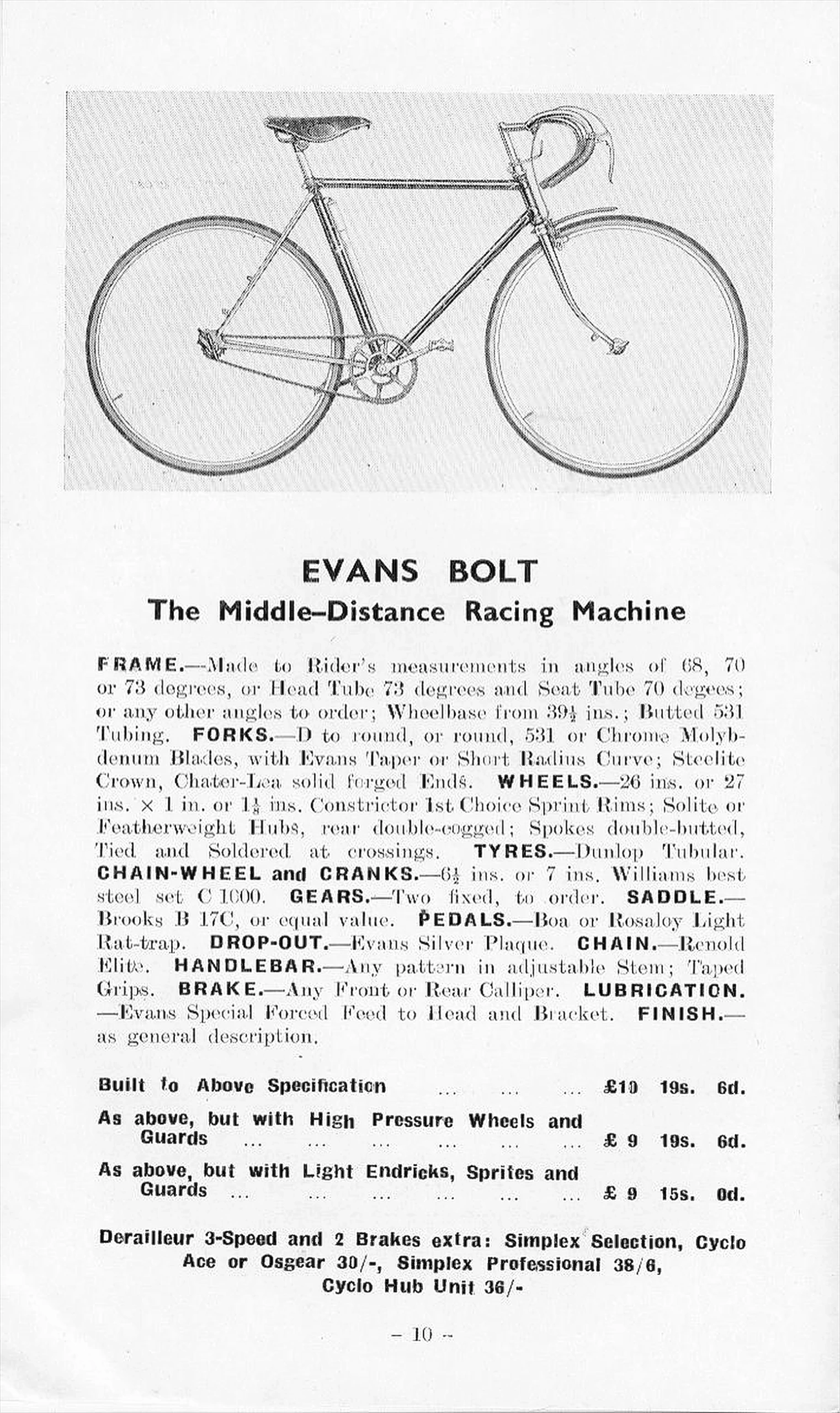
EVANS BOLT
The Middle–Distance Racing Machine
FRAME.—Made to Rider’s measurements in angles of 68, 70 or 73 degrees, or Head Tube 73 degrees and Seat Tube 70 degees; or any other angles to order; Wheelbase from 39½ ins.; Butted 531 Tubing. FORKS.—D to round, or round, 531 or Chrome Molybdenum Blades, with Evans Taper or Short Radius Curve; Steelite Crown, Chater-Lea solid forged Ends. WHEELS.—26 ins. or 27 ins. × 1 in. or 1⅛ ins. Constrictor 1st Choice Sprint Rims; Solite or Featherweight Hubs, rear double-cogged; Spokes double-butted, Tied and Soldered at crossings. TYRES.—Dunlop Tubular. CHAIN-WHEEL and CRANKS.—6½ ins. or 7 ins. Williams best steel set C 1000. GEARS.—Two fixed, to order. SADDLE.—Brooks B 17C, or equal value. PEDALS.—Boa or Rosaloy Light Rat-trap. DROP-OUT.—Evans Silver Plaque. CHAIN.—Renold Elite. HANDLEBAR.—Any pattern in adjustable Stem; Taped Grips. BRAKE.—Any Front or Rear Calliper. LUBRICATION.—Evans Special Forced Feed to Head and Bracket. FINISH.—as general description.
Built to Above Specification | £10 19s. 6d.
As above, but with High Pressure Wheels and Guards | £ 9 19s. 6d.
As above, but with Light Endricks, Sprites and Guards | £ 9 15s. 0d.
Derailleur 3-Speed and 2 Brakes extra: Simplex Selection, Cyclo Ace or Osgear 30/-, Simplex Professional 38/6, Cyclo Hub Unit 36/-
– 10 –
[The Evans Bolt middle-distance racing machine shown in a side-view photograph, with its specification and prices below. The machine is shown with dropped handlebars, a leather saddle and no mudguards; there are no later marks.]
— Page 13 —
EVANS “MILANO”
The Last Word in Racing Specifications
FRAME.—Angle 68, 70 or 73 degrees; or Head Tube 73 degrees and Seat Tube 70 degrees; or any other angles to order; Wheelbase from 39½ ins.; Butted 531 Tubing. FORKS.—D to round, or round, Evans Taper, or Short Radius Curve; Steelite Crown; 531 or Chrome Molybdenum Blades; Chater-Lea solid forged Ends. WHEELS.—26 ins. or 27 ins. × 1 in. or 1⅛ ins. Constrictor 1st choice Sprint Rims; Airlite Hubs, rear double-cogged; Spokes, double-butted, Tied and Soldered at crossings. TYRES.—Constrictor or Dunlop Tubular. CHAIN-WHEEL and CRANKS.—6½ ins. or 7 ins., Chater-Lea, B.S.A. or Dureel [?]. GEARS.—Two fixed, to order. SADDLE.—Any Brooks Champion Model, Ormond or other race saddle. PEDALS.—Chater-Lea Race, B.S.A., Light Alloy Model or Boa. DROP-OUT.—Evans Silver Plaque, or rear opening ends. CHAIN.—Renold Elite. HANDLEBAR.—Any pattern in adjustable Kromo Stem; Taped Grips. BRAKE.—Any Front or Rear Calliper. LUBRICATION.—Evans Special Forced Feed to Head and Bracket. FINISH.—As general description.
Built of Chater-Lea Fittings, or Steelite Lug Set with B.S.A. Fittings to above Specification | £13 17s. 6d.
As above, but with High-Pressure Wheels and Guards | £12 12s. 0d.
As above, but with Light Endricks, Sprites and Guards | £12 7s. 6d.
Derailleur 3-Speed and 2 Brakes extra: Simplex Selection or Osgear 30/-; Simplex Professional 38/6.
– 11 –
[The Evans “Milano” racing machine shown in a side-view photograph, with its specification and prices below. The machine is shown with dropped handlebars, a leather saddle, a pump along the seat tube and no mudguards; the bottom right corner of the leaf is turned up in a small curl and there are no later marks.]
— Page 14 —
EVANS ULTRA
Specially Designed 3–Speeder for
Long–Distance Racing
FRAME.—Made to Rider’s measurements in angles of 68, 70 or 73 degrees; or with Head and Seat Tubes Splayed to order. Wheelbase from 40 ins. Butted 531 Tubing. FORKS.—D to round, or round; 531 or Chrome Molybdenum Blades, with Evans Taper or Short Radius Curve; Steelite Crown; Chater-Lea solid forged Ends. WHEELS.—26 ins. or 27 ins. × 1 in. or 1⅛ ins. Constrictor 1st Choice Sprint Rims; Solite or Featherweight Front Hub; S.-A. Ultra-close 3-Speed Rear Hub; Spokes double-butted, Tied and Soldered at crossings. TYRES.—Dunlop Tubular. CHAIN-WHEEL and CRANKS.—6½ ins. or 7 ins. Williams best steel set (C 1000). GEARS.—Ultra 3-Speed, as required. SADDLE.—Brooks B 17C or equal value. PEDALS.—Boa, or Rosaloy Rat-trap. DROP-OUT.—Evans Silver Plaque. CHAIN.—Renold Elite. HANDLEBAR.—Any pattern in adjustable Stem; Taped Grips. BRAKE.—Any Front or Rear Calliper. LUBRICATION.—Evans Special Forced Feed to Head and Bracket. FINISH.—As general description.
Built to Above Specification | £11 19s. 6d.
As above, but with High-Pressure Wheels and Guards | £10 19s. 6d.
As above, but with Light Endricks, Sprites and Guards | £10 15s. 0d.
– 12 –
[The Evans Ultra three-speed long-distance racing machine shown in a side-view photograph, with dropped handlebars and a front caliper brake, and its specification and three prices below. The photograph is printed in a halftone screen on a light background; no later marks are on the page.]
— Page 15 —
EVANS R.R.
A Genuine Evans Model at a Popular Price
FRAME.—19-22ins.; 10½-in. Bracket; 42-in. Wheelbase; High-Manganese or 531 Butted Tubing. FORKS.—D to round; Evans Taper Blades; Steel Crown; solid forged Ends. WHEELS.—26 ins. × 1¼ ins. or 26 ins. × 1⅜ ins; Light Endrick Rims; Light Race Hubs, rear double-cogged; Rustless Spokes, Tied and Soldered at crossings. TYRES.—Dunlop Sprite or Dunlop Speed. CHAIN-WHEEL and CRANKS.—6½-in. Williams Detachable, Flanged, 5-pin. GEARS.—67 ins. and 60 ins. fixed, or to order. SADDLE.—Brooks B 15C. PEDALS.—Brampton Race or Rat-trap. CHAIN.—Coventry. HANDLEBAR.—Any pattern in adjustable Stem, Sponge Grips. BRAKE.—Ring Bearing de Luxe Calliper. MUDGUARDS.—Bluemel’s Featherweight. LUBRICATION.—Standard. DROP-OUT.—Plain forward openings. FINISH.—As general description. EQUIPMENT.—Bluemel’s Pump, Tools, Repair Outfit and Toolbag.
FULLY EQUIPPED AS ABOVE | £7 15s. 0d.
R.R. “X” with Fixed and Free and 2 Brakes | £8 0s. 0d.
R.R. “S” with S.-A. 3-Speed Gear and 2 Brakes | £8 17s. 6d.
R.R. “C” with Derailleur 3-Speed and 2 Brakes | £9 2s. 6d.
R.R. “U” with upright Frame and shorter Wheelbase 7/6 extra.
Lady’s Model same prices as above.
– 12A –
[The Evans R.R. model shown in side view on a dotted halftone ground, fitted with mudguards and a front mud flap, dropped handlebars with sponge grips, a front caliper brake, a pump along the seat tube and a toolbag behind the saddle, with its specification and prices below. The folio is printed “12A” with a small capital A. The bottom right corner of the page is curled, casting a small shadow, and two small dark marks sit at the very left edge about three quarters of the way down, clear of the print.]
— Page 16 —
EVANS BEAM
A Shining Example of Made–to–Measure
Models at a very Moderate Price
FRAME.—19-22 ins; 10½-in. Bracket; 40-42-in. Wheelbase; Standard, Semi-upright or Upright angles, 531 or High Manganese Butted Tubing. FORKS.—D to round or round, Evans Taper or Short Radius Blades; Steel Crown; solid forged ends. WHEELS.—26 × 1¼ ins. or 26 ins. × 1⅜ ins., Light Endrick Rims; Light Race Hubs, rear double-cogged; Double-butted spokes Tied and Soldered at crossings TYRES.—Dunlop Sprite or Dunlop Speed. CHAIN-WHEEL and CRANKS.—6½-in. Williams Detachable Flanged 5-pin. GEARS.—Two fixed, to order. SADDLE.—Brooks B 17C, B 18C or B 18 Light Road. PEDALS.—Solid centre Race. CHAIN.—Renold Roller. HANDLEBAR.—Any pattern in adjustable Stem, Sponge Grips. BRAKE.—Resilion Cantilette, Super Cam or Pellisier Pattern. MUDGUARDS.—Bluemel’s Featherweight. LUBRICATION.—Standard. DROP-OUT.—Plain forward opening. FINISH.—As general description. EQUIPMENT.—Bluemel’s Pump, Tools, Repair Outfit and Toolbag.
FULLY EQUIPPED AS ABOVE | £8 12s. 6d.
BEAM “X” with Fixed and Free and 2 Brakes | £8 19s. 6d.
BEAM “S” with S.-A. 3-Speed and 2 Brakes | £9 16s. 0d.
BEAM “C” with Derailleur 3-Speed and 2 Brakes | £9 19s. 6d.
Lady’s Model Same Prices as Above
– 14 –
[The Evans Beam made-to-measure model shown in a side-view photograph, fitted with mudguards and a front mud flap, dropped handlebars with sponge grips, a front brake, a pump along the seat tube and a toolbag behind the saddle, with its specification and prices below. A faint gray curved mark lies on the photograph’s ground below the front wheel; no later marks are on the page.]
— Page 17 —
EVANS SPECIAL CLUB
The Ideal Bicycle for All–Round Riding
FRAME.—”Made to Measure” 19-22 ins.; 10½-in. Bracket; 40-42-in. Wheelbase; Standard, Semi-upright, Upright or Ultra-upright angles; 531 Butted Tubing. FORKS.—D to round, or round, Evans Taper or Short Radius Blades; 531 or Chrome Molybdenum; Steelite Crown; Chater-Lea solid forged Ends. WHEELS.—26 ins. × 1¼ ins. or 26 ins. × 1⅜ ins., Light Endrick Rims; Solite or Featherweight Hubs, rear double-cogged; Double-butted spokes Tied and Soldered at crossings. TYRES.—Dunlop Sprite or Dunlop Speed. CHAIN-WHEEL and CRANKS.—6½-in. Williams best steel set (C 1000) with 44, 46 or 48 teeth. GEARS.—Two fixed, to order. SADDLE.—Brooks B 17C, B 18C or B 18 Light Road. PEDALS.—Solid centre Boa or Brampton Race, or Rosaloy Light Alloy. CHAIN.—Renold Elite. HANDLEBAR.—Any pattern in adjustable Stem, Sponge Grips. BRAKE.—Resilion Best, Super Cam or Pellisier Pattern. MUDGUARDS.—Bluemel’s Noweight. LUBRICATION.—Evans Direct Forced Feed. DROP-OUT.—Evans Silver Plaque. FINISH.—As general description. EQUIPMENT.—Bluemel’s Pump, Tools, Repair Outfit and Toolbag.
FULLY EQUIPPED AS ABOVE | £ 9 12s. 6d.
Special Club “X” with Fixed & Free and 2 Brakes | £10 2s. 0d.
Special Club “S” with S.-A. 3-Speed and 2 Brakes | £10 19s. 6d.
Special Club “C” with Derailleur 3-Speed and 2 Brakes | £11 2s. 6d.
Extra for High-Pressure Rims and Tyres 4/6.
Lady’s Model Same Prices as Above
– 15 –
[The Evans Special Club all-round model shown in a side-view photograph, fitted with mudguards and a front mud flap, dropped handlebars with sponge grips, a front caliper brake, a pump along the seat tube and a toolbag behind the saddle, with its specification and prices below. No later marks are on the page; its bottom right corner is curled, casting a small shadow.]
— Page 18 —
EVANS DERAILLEUR TOURIST
Designed for Easy Running and Comfort
FRAME.—”Made to Measure”, 19-25 ins.; 10½-in. Bracket; 42-44-in.Wheelbase; Evans angles; 531 Butted Tubing. FORKS.—D to round, Evans Taper Blades; 531 or Chrome Molybdenum; Steel Crown; Chater-Lea solid forged Ends. WHEELS.—26 ins. × 1¼ ins. or 26 ins. × 1⅜ ins., Endrick Rims; Light Hubs; Double-butted spokes Tied and Soldered at crossings. TYRES.—Dunlop Fort or Sprite. CHAIN-WHEEL and CRANKS.— 6½-in. or 7-in. Williams best steel set (C 1000) with 44, 46 or 48 teeth. GEARS.—Derailleur, 48 ins., 63 ins. and 75 ins. or to customer’s order. SADDLE.—Brooks B 18 Light Road, Terry, or to order. PEDALS.—Solid-centre Rosaloy Light Alloy, or Brampton Rubber. CHAIN.—Renold Elite. HANDLEBAR.—Any pattern in adjustable Stem, Sponge Grips. BRAKES.—Resilion Best, Super Cam Front and Rear or Drum Brake Hubs. MUDGUARDS.—Bluemel’s Noweight. LUBRICATION.—Evans Direct Forced Feed. DROP-OUT.—Evans Silver Plaque. FINISH.—As general description. EQUIPMENT.—Bluemel’s Pump, Tools, Repair Outfit and Toolbag.
WITH DERAILLEUR GEAR AS ABOVE | £11 2s. 6d.
Tourist “S” with S.-A. 3-Speed Gear | £10 19s. 6d.
Tourist “T” with S.-A. 2-Speed Gear | £10 15s. 0d.
Tourist “X” with 2 Free-wheels | £10 2s. 6d.
Lady’s Model Same Prices as Above
– 16 –
[The Evans Derailleur Tourist shown in a side-view photograph, fitted with a rear derailleur gear, mudguards and a front mud flap, a pump along the seat tube and a toolbag behind the saddle, with its specification and prices below. No later marks are on the page.]
— Page 19 —
EVANS STEELITE
The Ultra Light and Sturdy Cycle
FRAME.—”Made to Measure”; Steelite Fittings, 19-24 ins.; 10½-in. Bracket; 41-43-in. Wheelbase; Evans Angles; 531 Butted Tubing. FORKS.—D to round, or round, Evans Taper or Short Radius Curve Blades; 531 or Chrome Molybdenum; Steelite Crown; Chater-Lea solid forged Ends. WHEELS.—26 ins. × 1¼ ins. or 27 ins. × 1¼ ins. Dunlop Special Light Rims; Solite or Featherweight Hubs, rear double-cogged; Double butted Spokes Tied and Soldered at Crossings. TYRES.—Dunlop High-Pressure. CHAIN-WHEEL and CRANKS.—6½-in. Williams Dureel Set, with 44, 46 or 48 teeth. GEARS.—Two fixed, or to order. SADDLE.—Brooks 1st grade Champion, Ormond [?] or B 18 Light Road. PEDALS.—Solid centre Rosaloy Light Alloy or Boa. CHAIN.—Renold Elite. HANDLEBAR.—Any pattern in Kromo adjustable Stem; Sponge Grips. BRAKE.—Resilion Best or Super Cam, Front or Rear. MUDGUARDS.—Bluemel’s Noweight or Light Alloy. LUBRICATION.—Evans Direct Forced Feed. DROP-OUT.—Evans Silver Plaque. FINISH.—As general description. EQUIPMENT.—Bluemel’s Pump, Tools, Repair Outfit and Toolbag.
FULLY EQUIPPED AS ABOVE | £10 17s. 6d.
Weight—as specified above 23½ lbs.
Steelite “X” with Fixed and Free-Wheels and 2 Brakes | £11 7s. 6d.
Steelite “S” with S.-A. 3-Speed and 2 Brakes | £12 3s. 6d.
Steelite “C” with Derailleur 3-Speed and 2 Brakes | £12 7s. 6d.
Endricks and Sprites 4/- less; Conloys and Sprites 28/- extra.
Lady’s Model Same Prices as Above
– 17 –
[The Evans Steelite ultra light model shown in a side-view photograph, fitted with mudguards, dropped handlebars with sponge grips, a front caliper brake, a pump along the down tube and a toolbag behind the saddle, with its specification and prices below. No later marks are on the page; its bottom right corner is curled, casting a small shadow.]
— Page 20 —
A
FAST
MODEL
EVANS
CLUB TANDEM
Entirely Built in Evans Workshops
FRAME.—Built of H.M. and 531 Special Tandem Tubing, 20-22 ins.; 10¾-in. Bracket; short-medium Wheelbase. FORKS.—D to round linered blades with solid forged Ends. WHEELS.—26 ins. × 1¼ ins. or 26 ins. × 1⅜ ins.; Endrick Tandem Rims; Special Super Tandem Cyklbrake Hubs; Tandem Butted Spokes, Tied and Soldered, Evans Special Building. TYRES.—Any Dunlop or John Bull Tandem model. CHAIN-WHEEL and CRANKS.—6½ ins., 3-pin fixing, 46 teeth. GEAR.—Singlo [?], fixed or free, as required. PEDALS.—Rat-trap, Rubber, or Solid-centre Race. SADDLES.—Brooks B 15C or B 72 Light Road. DROP-OUT.—Forward opening. CHAINS.—Coventry—Renold Roller. HANDLEBAR.—Any pattern in adjustable Stem; Sponge Grips. BRAKES.—Drum as above, or 2 Resilion Best and double-cogged Hub. LUBRICATION.—Evans Forced Feed Direct. MUDGUARDS.—Bluemel’s Featherweight. FINISH & EQUIPMENT.—As on singles.
AS SPECIFIED ABOVE “B” or “D” DESIGN | £15 15s. 0d.
Club “S” with S.-A. 3-Speed gear and 2 Brakes | £16 15s. 0d.
Club “C” with 3-Speed Derailleur gear & 2 Brakes | £16 18s. 6d.
In “C” or “E” Design 10/- extra
– 18 –
[The Evans Club Tandem shown in a three-quarter front-view photograph, with two saddles, dropped handlebars with sponge grips, drum brake hubs front and rear and a front mudguard with a mud flap; the photograph is cut away at its lower left corner to hold the model name, and the words “A FAST MODEL” stand to its left. The specification and three prices are below. A gray smear runs down and to the left from the w of “with” in the last price line, without hiding any letter; no other marks are on the page.]
— Page 21 —
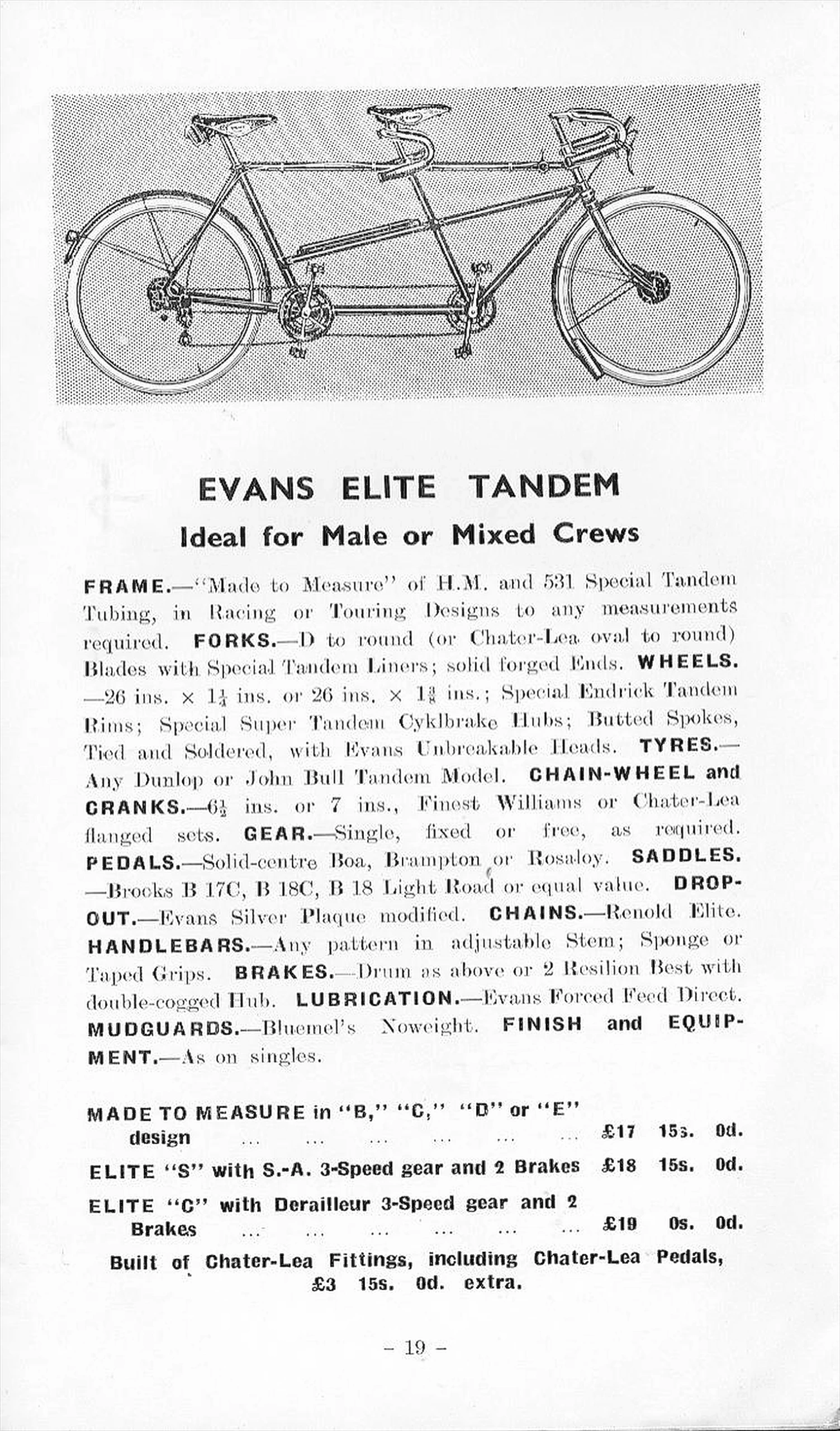
EVANS ELITE TANDEM
Ideal for Male or Mixed Crews
FRAME.—”Made to Measure” of H.M. and 531 Special Tandem Tubing, in Racing or Touring Designs to any measurements required. FORKS.—D to round (or Chater-Lea oval to round) Blades with Special Tandem Liners; solid forged Ends. WHEELS.—26 ins. × 1¼ ins. or 26 ins. × 1⅜ ins.; Special Endrick Tandem Rims; Special Super Tandem Cyklbrake Hubs; Butted Spokes, Tied and Soldered, with Evans Unbreakable Heads. TYRES.—Any Dunlop or John Bull Tandem Model. CHAIN-WHEEL and CRANKS.—6½ ins. or 7 ins., Finest Williams or Chater-Lea flanged sets. GEAR.—Single, fixed or free, as required. PEDALS.—Solid-centre Boa, Brampton or Rosaloy. SADDLES.—Brooks B 17C, B 18C, B 18 Light Road or equal value. DROP-OUT.—Evans Silver Plaque modified. CHAINS.—Renold Elite. HANDLEBARS.—Any pattern in adjustable Stem; Sponge or Taped Grips. BRAKES.—Drum as above or 2 Resilion Best with double-cogged Hub. LUBRICATION.—Evans Forced Feed Direct. MUDGUARDS.—Bluemel’s Noweight. FINISH and EQUIPMENT.—As on singles.
MADE TO MEASURE in “B,” “C,” “D” or “E” design | £17 15s. 0d.
ELITE “S” with S.-A. 3-Speed gear and 2 Brakes | £18 15s. 0d.
ELITE “C” with Derailleur 3-Speed gear and 2 Brakes | £19 0s. 0d.
Built of Chater-Lea Fittings, including Chater-Lea Pedals, £3 15s. 0d. extra.
– 19 –
[The Evans Elite Tandem shown in a retouched side-view photograph on a stippled ground, with its specification and prices below. The tandem has dropped handlebars for both riders, mudguards, a pump along the lower frame tube and a hub brake on the front wheel.]
— Page 22 —
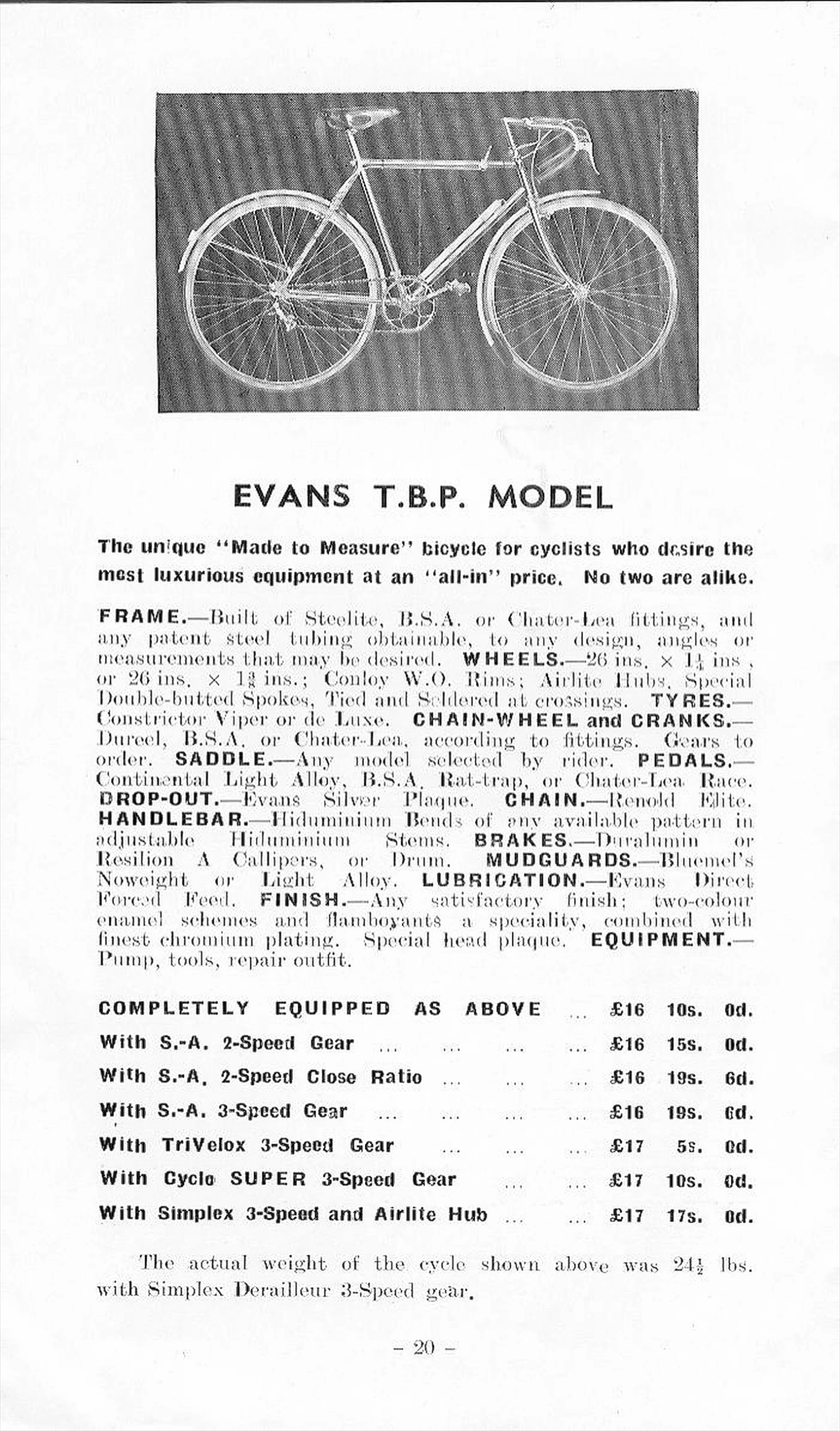
EVANS T.B.P. MODEL
The unique “Made to Measure” bicycle for cyclists who desire the most luxurious equipment at an “all-in” price. No two are alike.
FRAME.—Built of Steelite, B.S.A. or Chater-Lea fittings, and any patent steel tubing obtainable, to any design, angles or measurements that may be desired. WHEELS.—26 ins. × 1¼ ins , or 26 ins. × 1⅜ ins.; Conloy W.O. Rims; Airlite Hubs, Special Double-butted Spokes, Tied and Soldered at crossings. TYRES.—Constrictor Viper or de Luxe. CHAIN-WHEEL and CRANKS.—Dureel [?], B.S.A. or Chater-Lea, according to fittings. Gears to order. SADDLE.—Any model selected by rider. PEDALS.—Continental Light Alloy, B.S.A. Rat-trap, or Chater-Lea Race. DROP-OUT.—Evans Silver Plaque. CHAIN.—Renold Elite. HANDLEBAR.—Hiduminium Bends of any available pattern in adjustable Hiduminium Stems. BRAKES.—Duralumin or Resilion A Callipers, or Drum. MUDGUARDS.—Bluemel’s Noweight or Light Alloy. LUBRICATION.—Evans Direct Forced Feed. FINISH.—Any satisfactory finish; two-colour enamel schemes and flamboyants a speciality, combined with finest chromium plating. Special head plaque. EQUIPMENT.—Pump, tools, repair outfit.
COMPLETELY EQUIPPED AS ABOVE | £16 10s. 0d.
With S.-A. 2-Speed Gear | £16 15s. 0d.
With S.-A. 2-Speed Close Ratio | £16 19s. 6d.
With S.-A. 3-Speed Gear | £16 19s. 6d.
With TriVelox 3-Speed Gear | £17 5s. 0d.
With Cyclo SUPER 3-Speed Gear | £17 10s. 0d.
With Simplex 3-Speed and Airlite Hub | £17 17s. 0d.
The actual weight of the cycle shown above was 24½ lbs. with Simplex Derailleur 3-Speed gear.
– 20 –
[The Evans T.B.P. Model shown in a side-view photograph against a dark draped backdrop, with its specification and prices below. The light-colored bicycle has dropped handlebars, mudguards, a pump along the down tube and a derailleur gear on the rear wheel.]
— Page 23 —
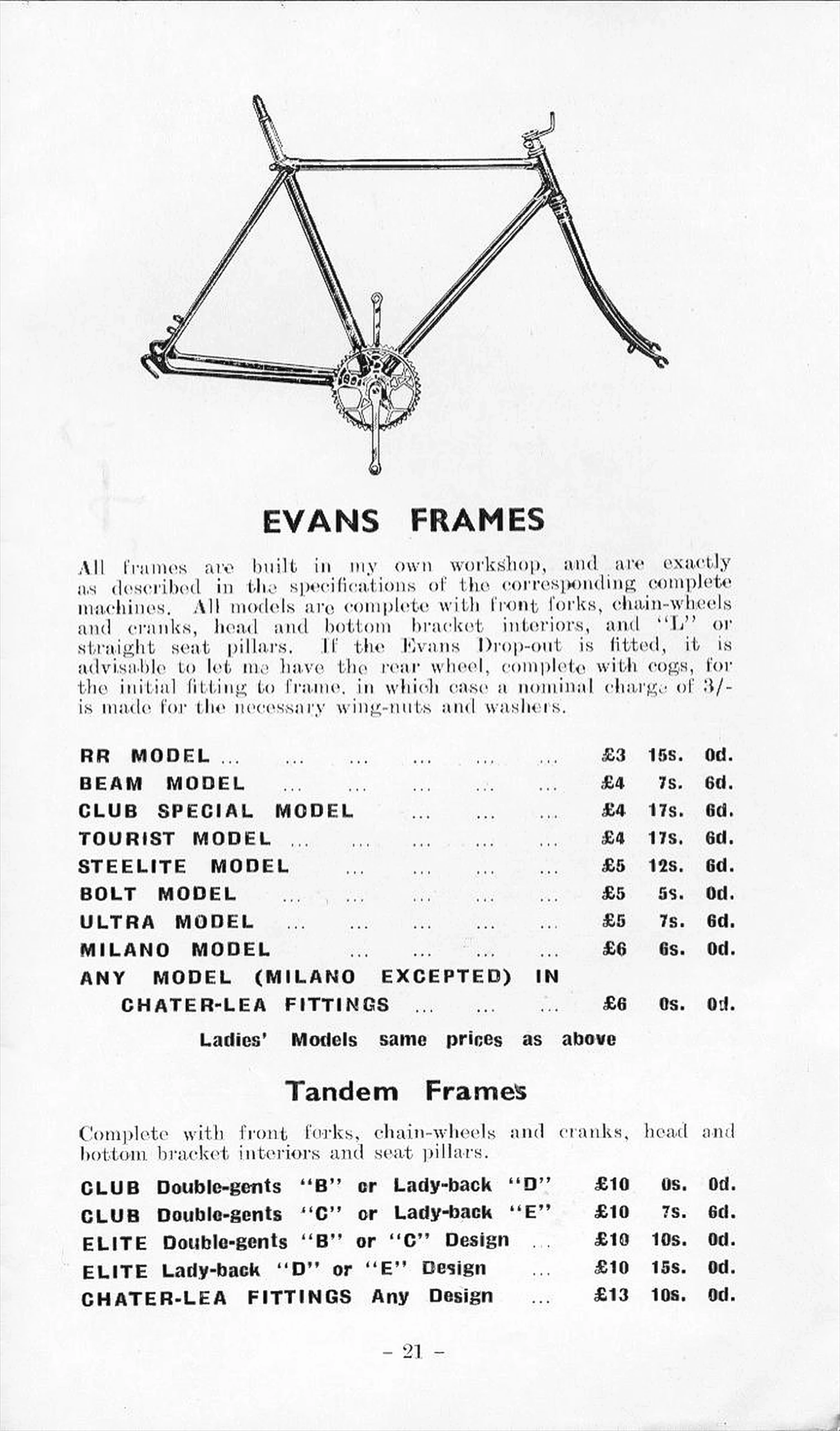
EVANS FRAMES
All frames are built in my own workshop, and are exactly as described in the specifications of the corresponding complete machines. All models are complete with front forks, chain-wheels and cranks, head and bottom bracket interiors, and “L” or straight seat pillars. If the Evans Drop-out is fitted, it is advisable to let me have the rear wheel, complete with cogs, for the initial fitting to frame, in which case a nominal charge of 3/- is made for the necessary wing-nuts and washers.
RR MODEL | £3 15s. 0d.
BEAM MODEL | £4 7s. 6d.
CLUB SPECIAL MODEL | £4 17s. 6d.
TOURIST MODEL | £4 17s. 6d.
STEELITE MODEL | £5 12s. 6d.
BOLT MODEL | £5 5s. 0d.
ULTRA MODEL | £5 7s. 6d.
MILANO MODEL | £6 6s. 0d.
ANY MODEL (MILANO EXCEPTED) IN CHATER-LEA FITTINGS | £6 0s. 0d.
Ladies’ Models same prices as above
Tandem Frames
Complete with front forks, chain-wheels and cranks, head and bottom bracket interiors and seat pillars.
CLUB Double-gents “B” or Lady-back “D” | £10 0s. 0d.
CLUB Double-gents “C” or Lady-back “E” | £10 7s. 6d.
ELITE Double-gents “B” or “C” Design | £10 10s. 0d.
ELITE Lady-back “D” or “E” Design | £10 15s. 0d.
CHATER-LEA FITTINGS Any Design | £13 10s. 0d.
– 21 –
[A bare Evans frame shown in a side-view picture with its front fork, seat pillar, handlebar stem, chainwheel and cranks, above the price lists for Evans Frames and Tandem Frames.]
— Page 24 —
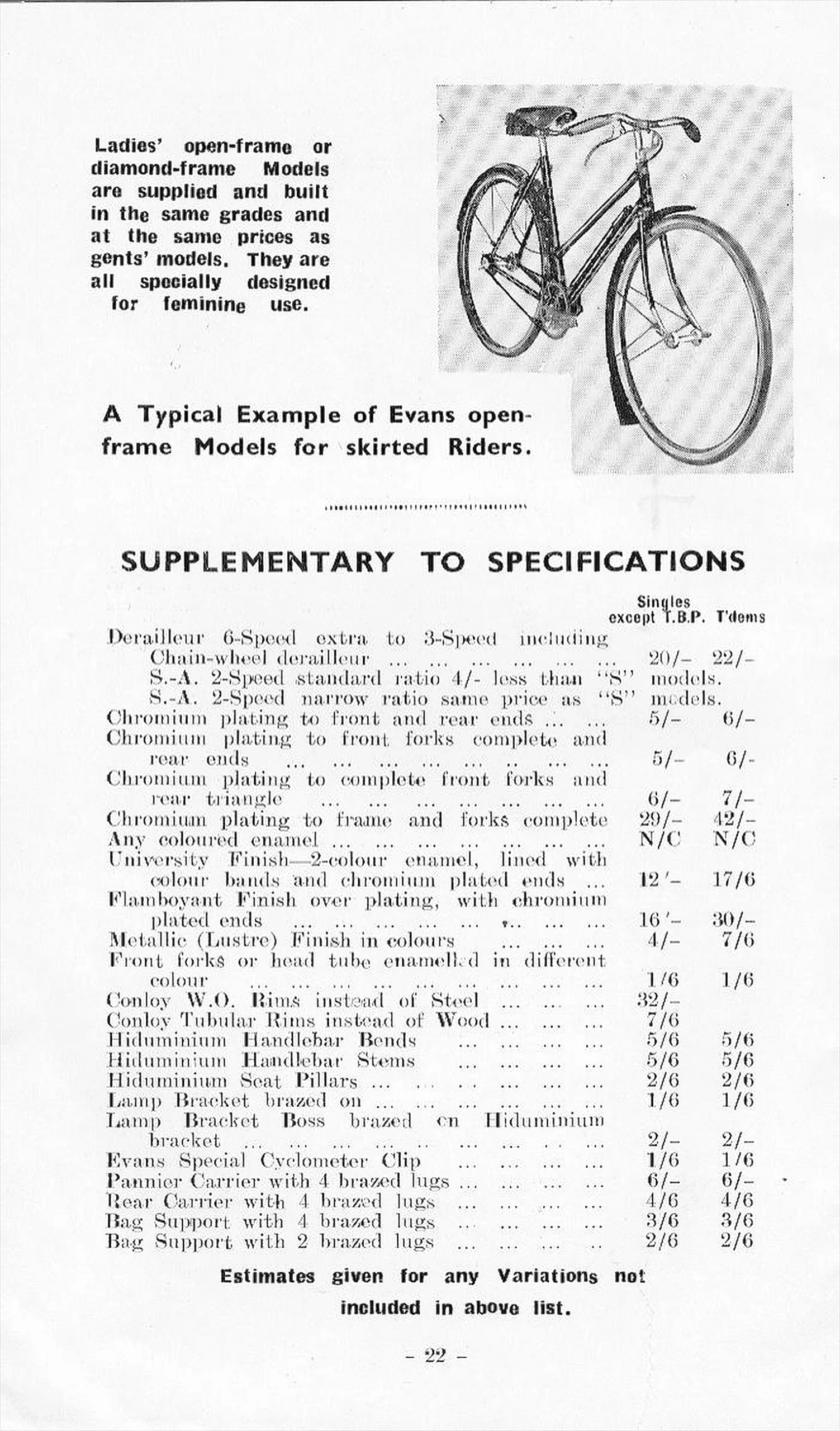
Ladies’ open-frame or diamond-frame Models are supplied and built in the same grades and at the same prices as gents’ models. They are all specially designed for feminine use.
A Typical Example of Evans open-frame Models for skirted Riders.
SUPPLEMENTARY TO SPECIFICATIONS
| Singles except T.B.P. | T’dems
Derailleur 6-Speed extra to 3-Speed including Chain-wheel derailleur | 20/- | 22/-
S.-A. 2-Speed standard ratio 4/- less than “S” models.
S.-A. 2-Speed narrow ratio same price as “S” models.
Chromium plating to front and rear ends | 5/- | 6/-
Chromium plating to front forks complete and rear ends | 5/- | 6/-
Chromium plating to complete front forks and rear triangle | 6/- | 7/-
Chromium plating to frame and forks complete | 29/- | 42/-
Any coloured enamel | N/C | N/C
University Finish—2-colour enamel, lined with colour bands and chromium plated ends | 12/- | 17/6
Flamboyant Finish over plating, with chromium plated ends | 16/- | 30/-
Metallic (Lustre) Finish in colours | 4/- | 7/6
Front forks or head tube enamelled in different colour | 1/6 | 1/6
Conloy W.O. Rims instead of Steel | 32/- |
Conloy Tubular Rims instead of Wood | 7/6 |
Hiduminium Handlebar Bends | 5/6 | 5/6
Hiduminium Handlebar Stems | 5/6 | 5/6
Hiduminium Seat Pillars | 2/6 | 2/6
Lamp Bracket brazed on | 1/6 | 1/6
Lamp Bracket Boss brazed cn [?] Hiduminium bracket | 2/- | 2/-
Evans Special Cyclometer Clip | 1/6 | 1/6
Pannier Carrier with 4 brazed lugs | 6/- | 6/-
Rear Carrier with 4 brazed lugs | 4/6 | 4/6
Bag Support with 4 brazed lugs | 3/6 | 3/6
Bag Support with 2 brazed lugs | 2/6 | 2/6
Estimates given for any Variations not included in above list.
– 22 –
[A ladies’ open-frame Evans bicycle shown in a three-quarter photograph beside its caption, above the Supplementary to Specifications price list for singles and tandems. The bicycle has swept-back handlebars with a brake lever, mudguards and what appears to be a pump along the lower frame tube.]
— Page 25 —
| | Rough | Cell. Cov’d | Chrom. Plated
1.—Continental | 18″ × 6½” | 2/6 | | 5/7
2.—Binda | 17½” × 5″ | 2/11 | | 6/5
3.—Bailey | 17″ × 5″ | 2/2 | | 4/5
4.—Highgate | 16″ & 17″ × 4″ & 5″ | 2/2 | 4/5 | 4/5
5.—Westerley | 20″ × 5½” | 3/2 | | 6/8
6.—Marsh | 13″,15″,17″&19″×4″ | 2/- | 4/5 | 4/5
7.—Shawbury | 17″ × 4″ | 2/- | 4/5 |
8.—Lauterwasser | 15″ × 3″ | 2/- | 4/5 | 4/5
9.—North Road | 16″ & 18″ × 3″ | 2/- | 4/5 | 4/5
10.—Shirley | 18″ × 2″ | 2/- | 4/5 | 4/5
11.—Flat | 16″ & 18″ | 1/5 | 3/11 | 3/11
12.—”M” Flat | 17″ & 20″ | 1/11 | 4/5 | 4/5
13.—North Road Flat | 16″ & 18″ | 1/8 | 3/11 | 3/11
14.—Upturned | | 2/- | 4/5 | 4/5
Evans Speed | 14″ × 6″ | 2/- | 4/5 | 4/5
Lauterwasser Flat | | 1/11 | 4/5 | 4/5
POSTAGE 6d. EACH
– 23 –
[Photographs of 14 handlebar bends in two panels, each bend numbered 1 to 14 in the picture, above a price list giving each bend’s name, sizes and prices in three finishes. The bends range from deep dropped racing patterns to flat and upturned touring bars.]
— Page 26 —
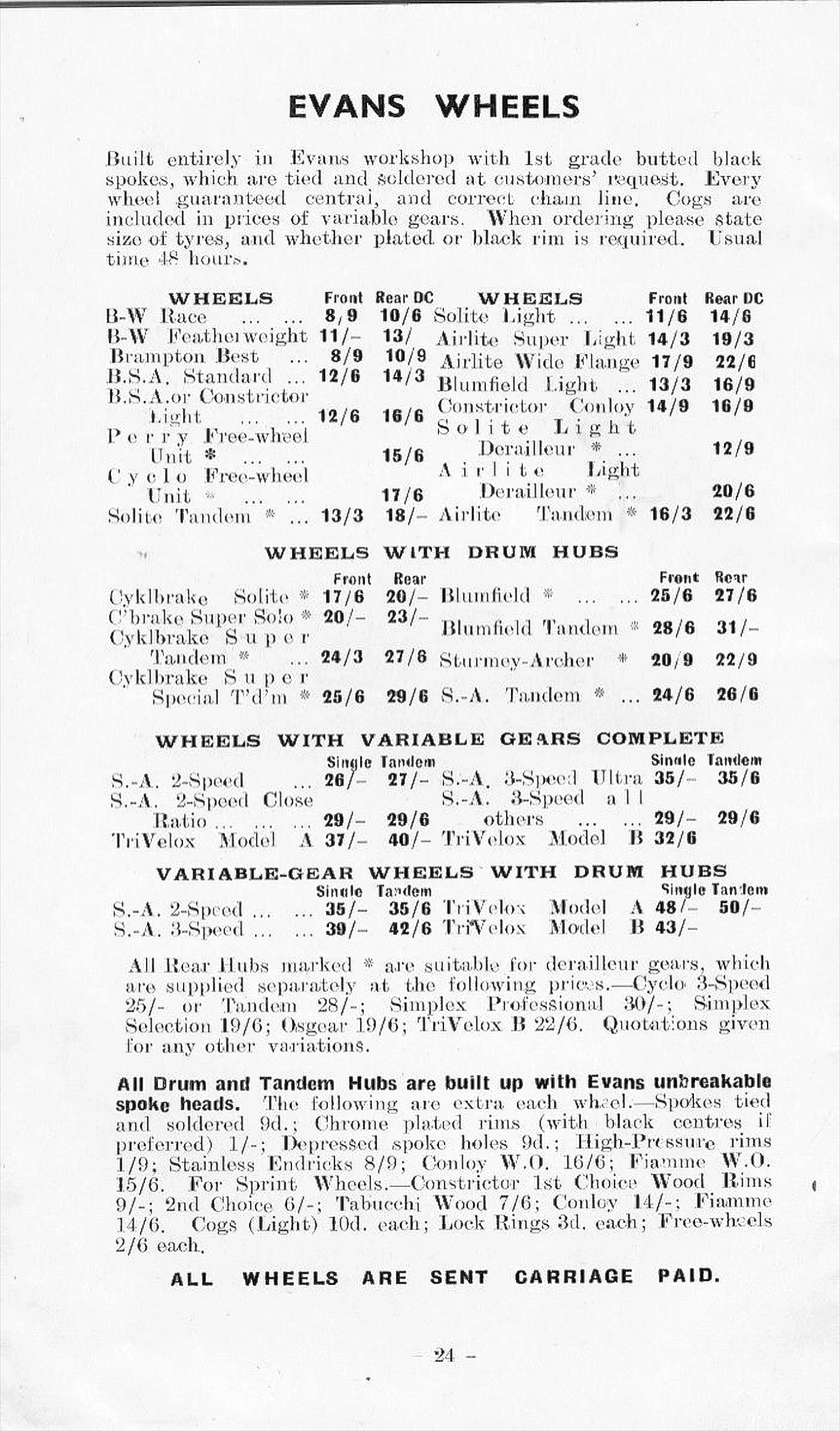
EVANS WHEELS
Built entirely in Evans workshop with 1st grade butted black spokes, which are tied and soldered at customers’ request. Every wheel guaranteed centrai [?], and correct chain line. Cogs are included in prices of variable gears. When ordering please state size of tyres, and whether plated or black rim is required. Usual time 48 hours.
WHEELS | Front | Rear DC
B-W Race | 8/9 [?] | 10/6
B-W Featherweight | 11/- | 13/
Brampton Best | 8/9 | 10/9
B.S.A. Standard | 12/6 | 14/3
B.S.A.or Constrictor Light | 12/6 | 16/6
Perry Free-wheel Unit * | | 15/6
Cyclo Free-wheel Unit * | | 17/6
Solite Tandem * | 13/3 | 18/-
WHEELS | Front | Rear DC
Solite Light | 11/6 | 14/6
Airlite Super Light | 14/3 | 19/3
Airlite Wide Flange | 17/9 | 22/6
Blumfield Light | 13/3 | 16/9
Constrictor Conloy | 14/9 | 16/9
Solite Light Derailleur * | | 12/9
Airlite Light Derailleur * | | 20/6
Airlite Tandem * | 16/3 | 22/6
WHEELS WITH DRUM HUBS
| Front | Rear
Cyklbrake Solite * | 17/6 | 20/-
C’brake Super Solo * | 20/- | 23/-
Cyklbrake Super Tandem * | 24/3 | 27/6
Cyklbrake Super Special T’d’m * | 25/6 | 29/6
| Front | Rear
Blumfield * | 25/6 | 27/6
Blumfield Tandem * | 28/6 | 31/-
Sturmey-Archer * | 20/9 | 22/9
S.-A. Tandem * | 24/6 | 26/6
WHEELS WITH VARIABLE GEARS COMPLETE
| Single | Tandem
S.-A. 2-Speed | 26/- | 27/-
S.-A. 2-Speed Close Ratio | 29/- | 29/6
TriVelox Model A | 37/- | 40/-
| Single | Tandem
S.-A. 3-Speed Ultra | 35/- | 35/6
S.-A. 3-Speed all others | 29/- | 29/6
TriVelox Model B | 32/6 |
VARIABLE-GEAR WHEELS WITH DRUM HUBS
| Single | Tandem
S.-A. 2-Speed | 35/- | 35/6
S.-A. 3-Speed | 39/- | 42/6
| Single | Tandem
TriVelox Model A | 48/- | 50/-
TriVelox Model B | 43/- |
All Rear Hubs marked * are suitable for derailleur gears, which are supplied separately at the following prices.—Cyclo 3-Speed 25/- or Tandem 28/-; Simplex Professional 30/-; Simplex Selection 19/6; Osgear 19/6; TriVelox B 22/6. Quotations given for any other variations.
All Drum and Tandem Hubs are built up with Evans unbreakable spoke heads. The following are extra each wheel.—Spokes tied and soldered 9d.; Chrome plated rims (with black centres if preferred) 1/-; Depressed spoke holes 9d.; High-Pressure rims 1/9; Stainless Endricks 8/9; Conloy W.O. 16/6; Fiamme W.O. 15/6. For Sprint Wheels.—Constrictor 1st Choice Wood Rims 9/-; 2nd Choice 6/-; Tabucchi Wood 7/6; Conloy 14/-; Fiamme 14/6. Cogs (Light) 10d. each; Lock Rings 3d. each; Free-wheels 2/6 each.
ALL WHEELS ARE SENT CARRIAGE PAID.
– 24 –
[The Evans Wheels price list, set as tables of built wheels by hub with front and rear prices, wheels with drum hubs, and wheels with variable gears for singles and tandems, followed by notes on derailleur gears and extras. The page has no illustrations.]
Ebykr presents this material for research and education. If you hold rights to it or notice an ownership issue, please contact us and we will respond promptly.
The Ebykr Digest
New articles, timelines, catalog finds and registry activity — assembled from the archive once a month. Your address is never shared.
Double opt-in. One email per month. Unsubscribe at any time with one click.
