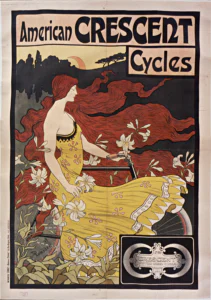
About Ebykr
Ebykr celebrates classic and vintage lightweight bicycles through provocative imagery and opinion. Ride along with us.
About Ebykr
Ebykr celebrates classic and vintage lightweight bicycles through provocative imagery and opinion. Ride along with us.

Source: Northwestern University Libraries, Transportation Library, "Crescent bicycles" (digital collection, https://dc.library.northwestern.edu/items/6d110e22-dd4a-4257-8401-27b5006f3c5f); rights statement "No Copyright - United States".
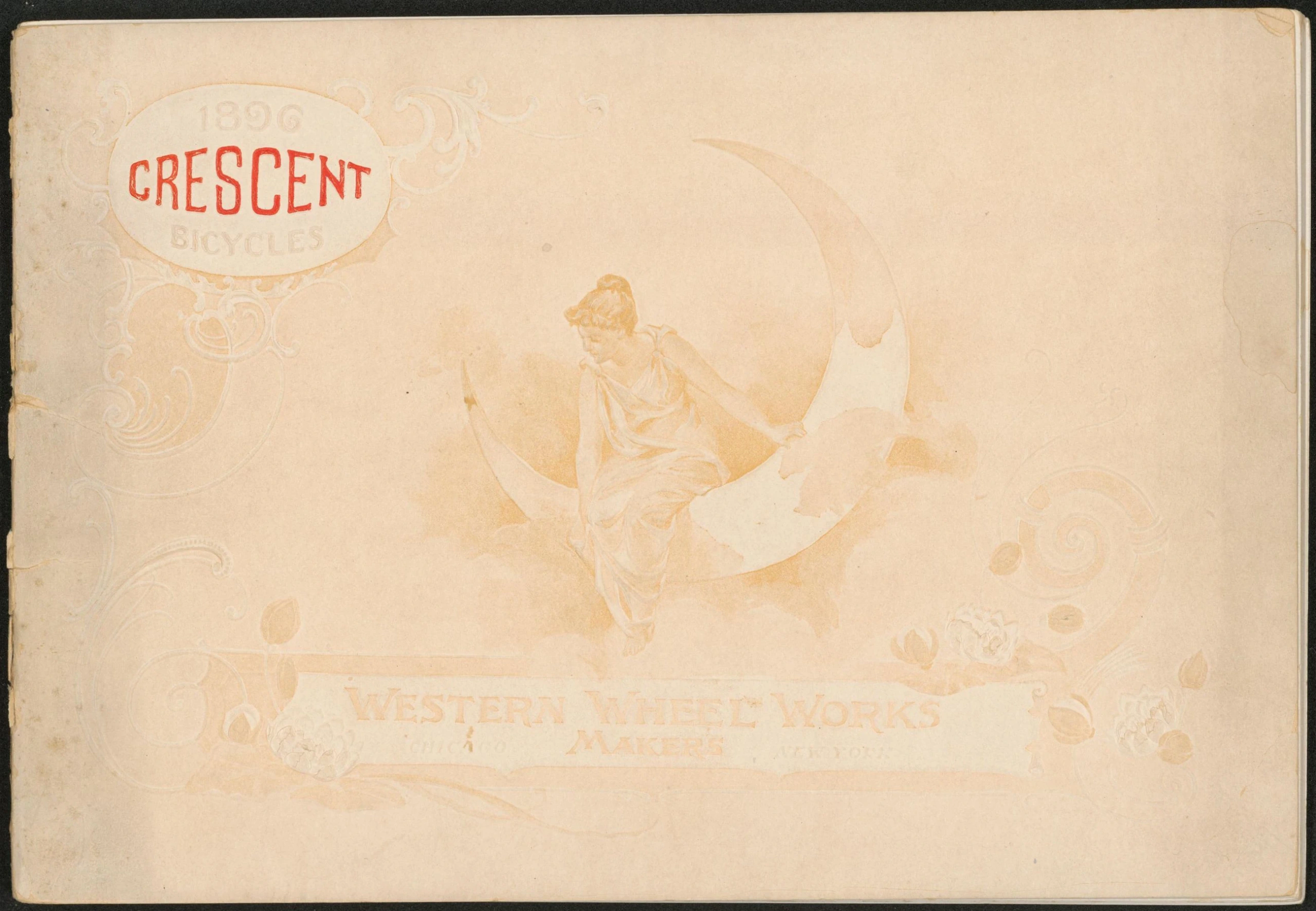 Page 1
 Page 2
 Page 3
 Page 4
 Page 5
 Page 6
 Page 7
 Page 8
 Page 9
 Page 10
 Page 11
 Page 12
 Page 13
 Page 14
 Page 15
 Page 16
 Page 17
 Page 18
 Page 19
 Page 20
 Page 21
 Page 22
 Page 23
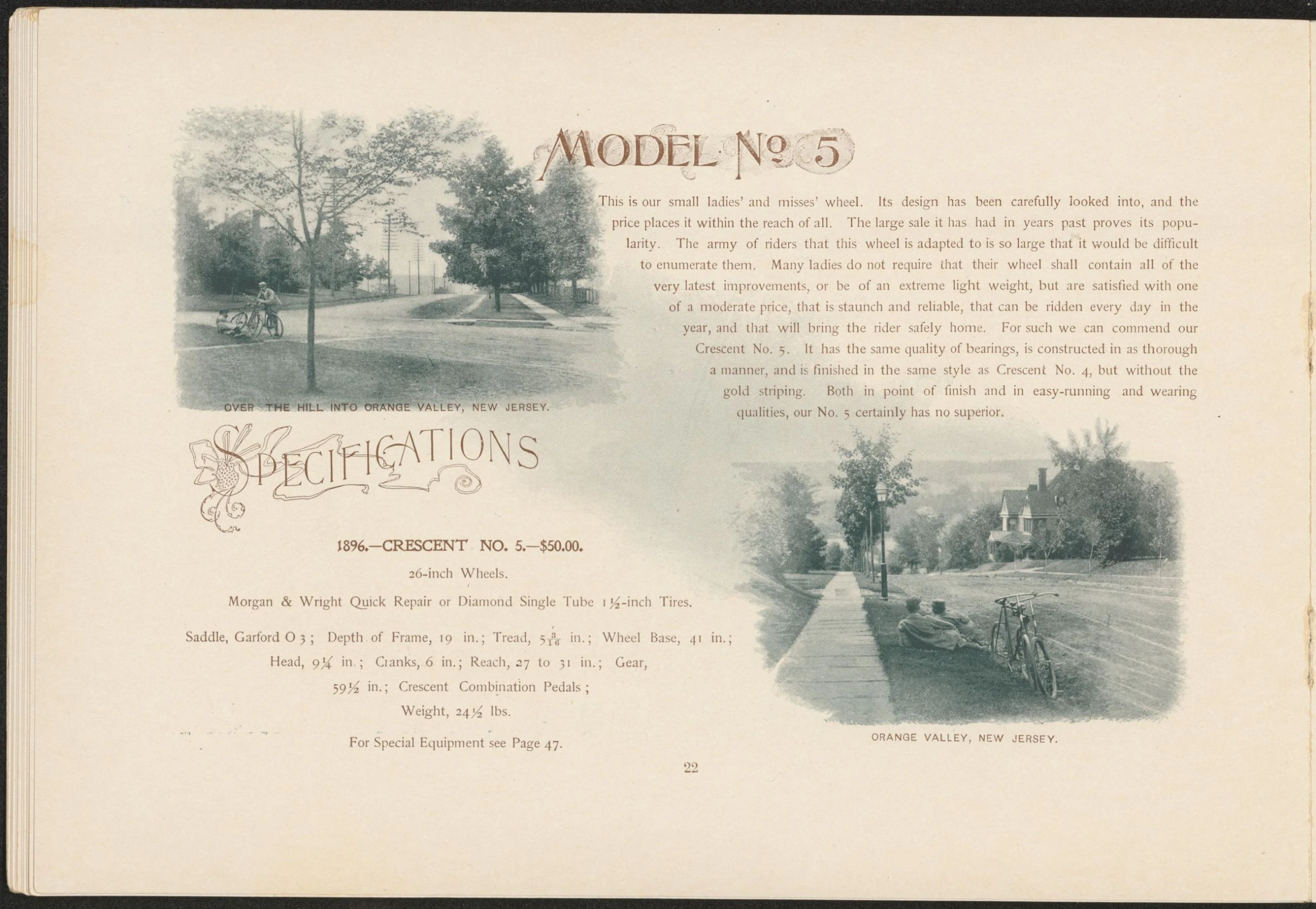 Page 24
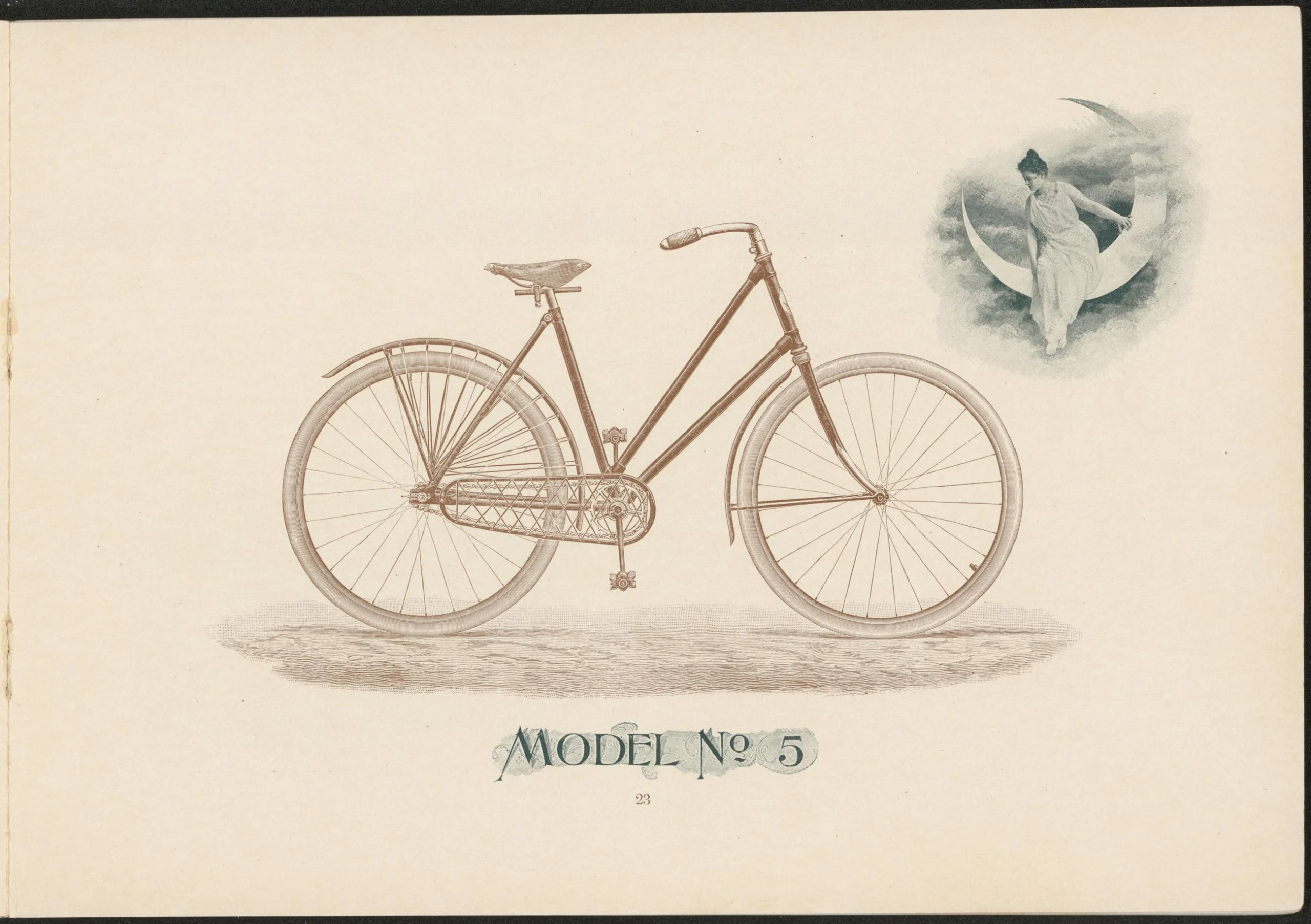 Page 25
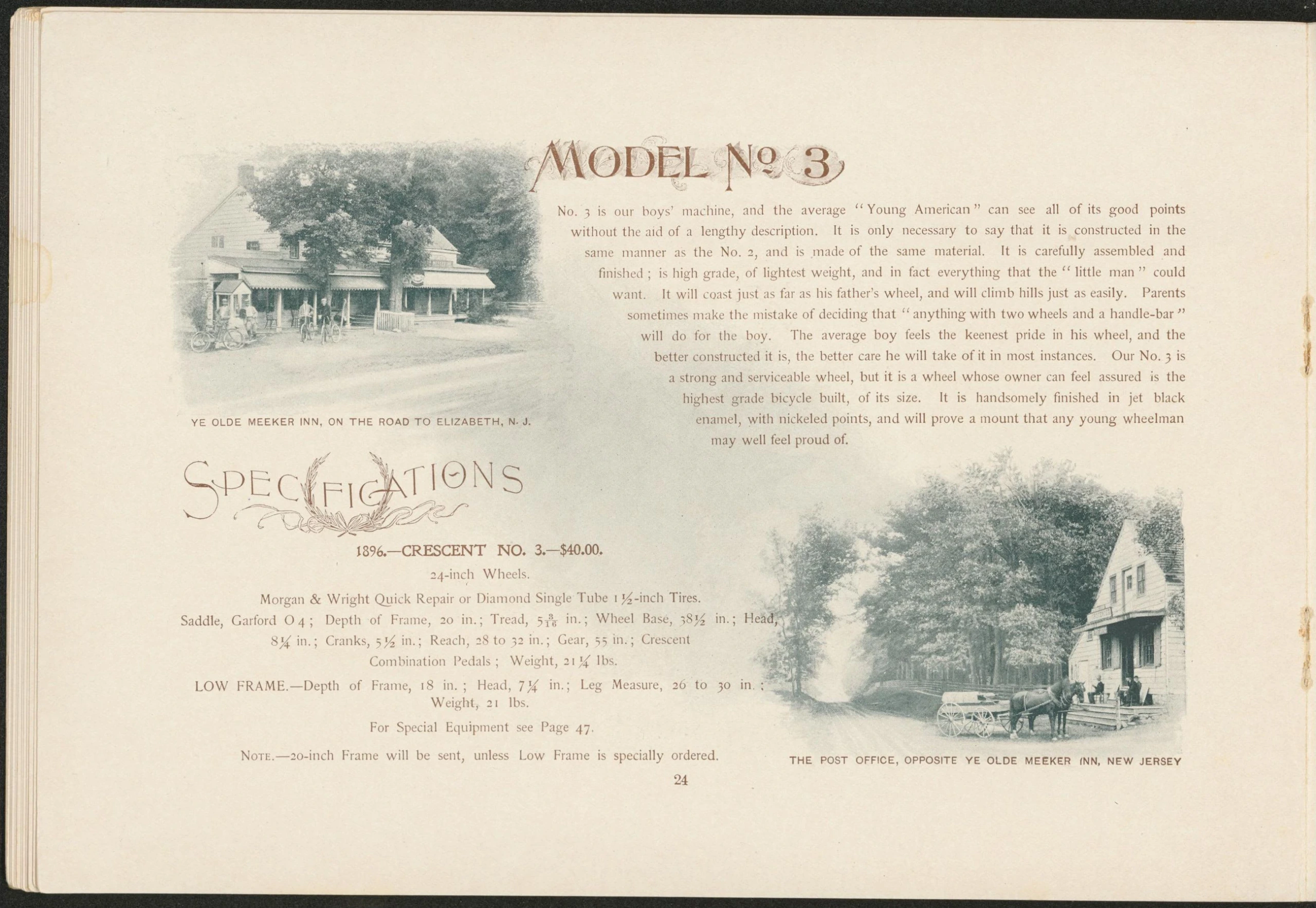 Page 26
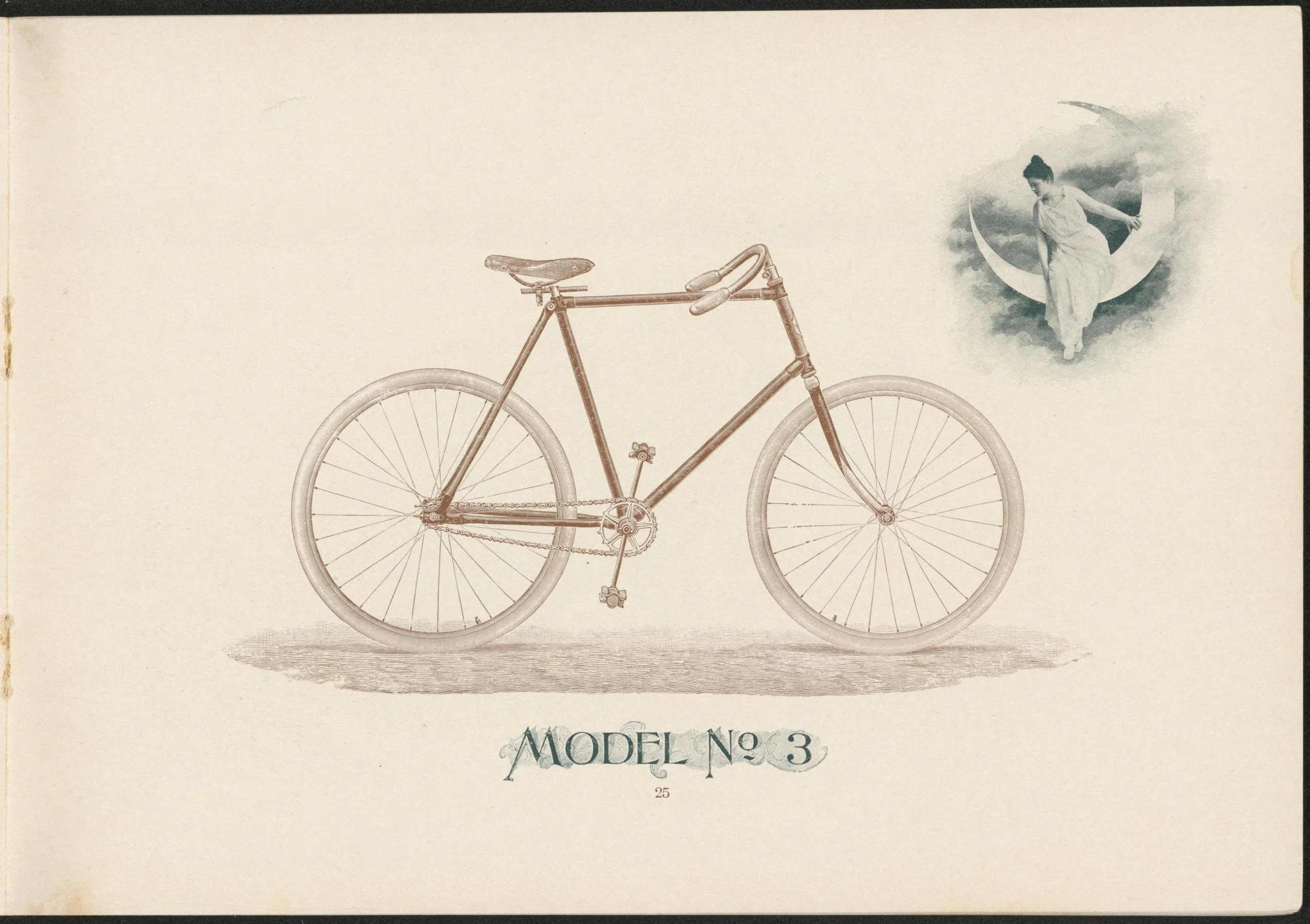 Page 27
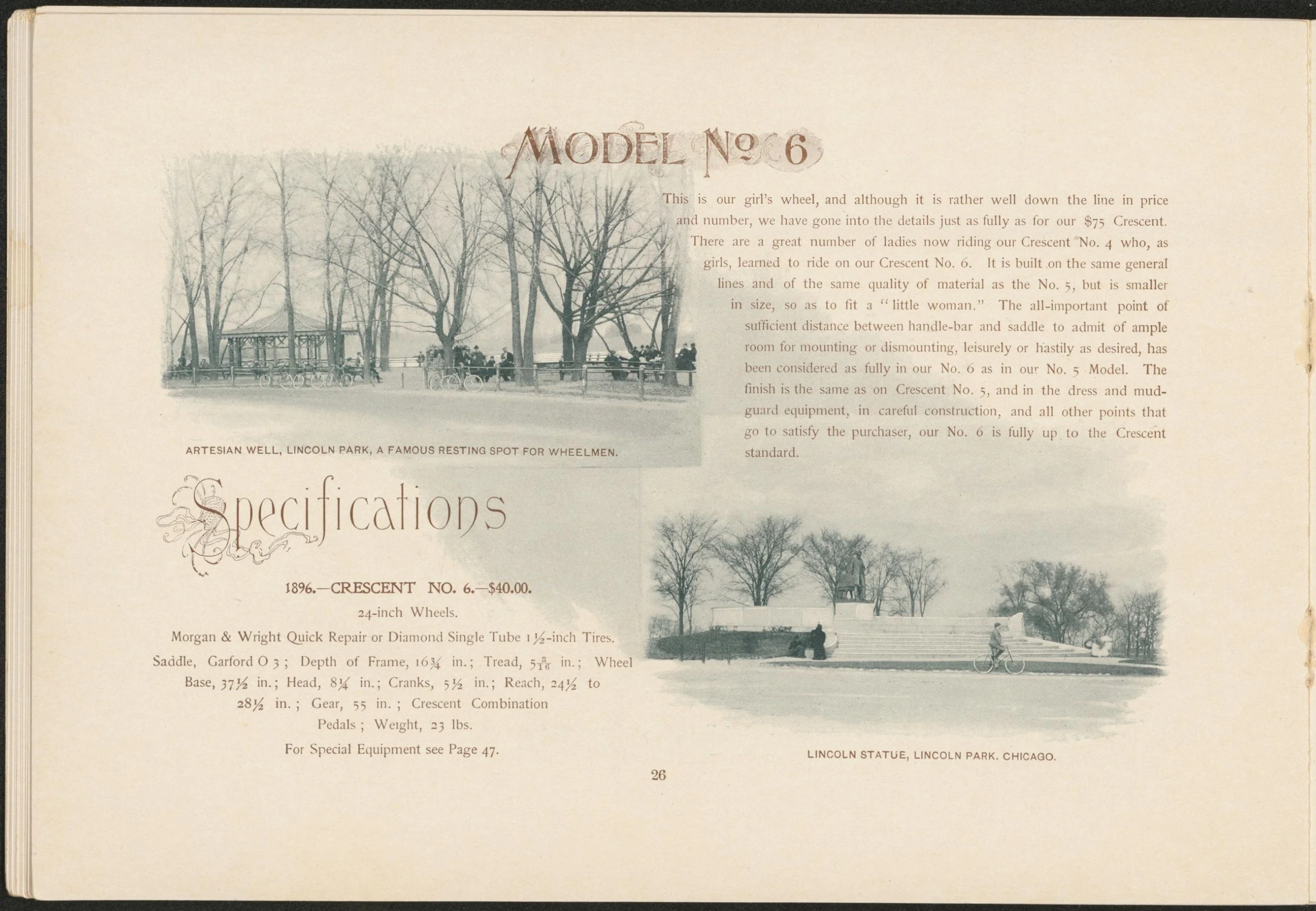 Page 28
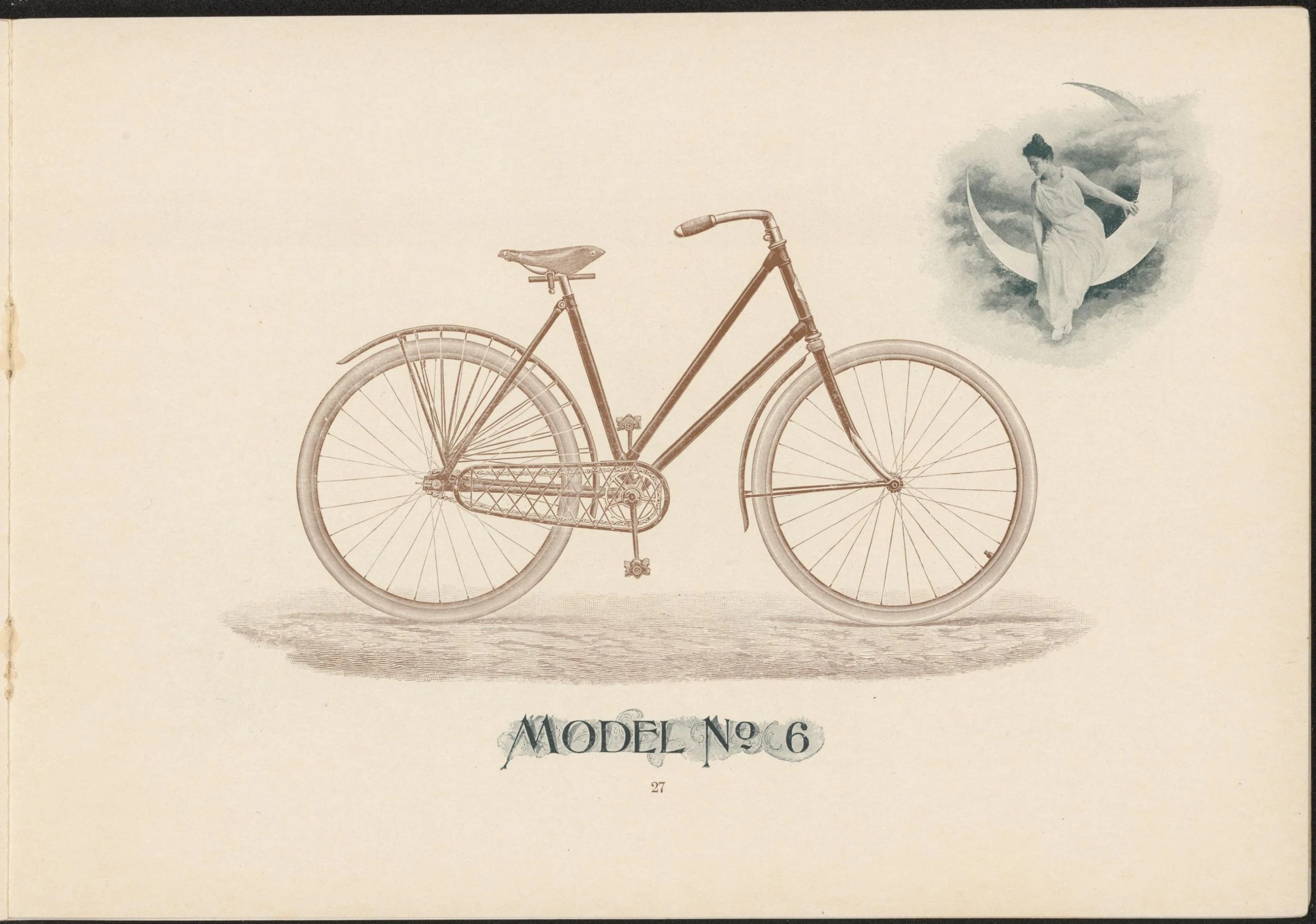 Page 29
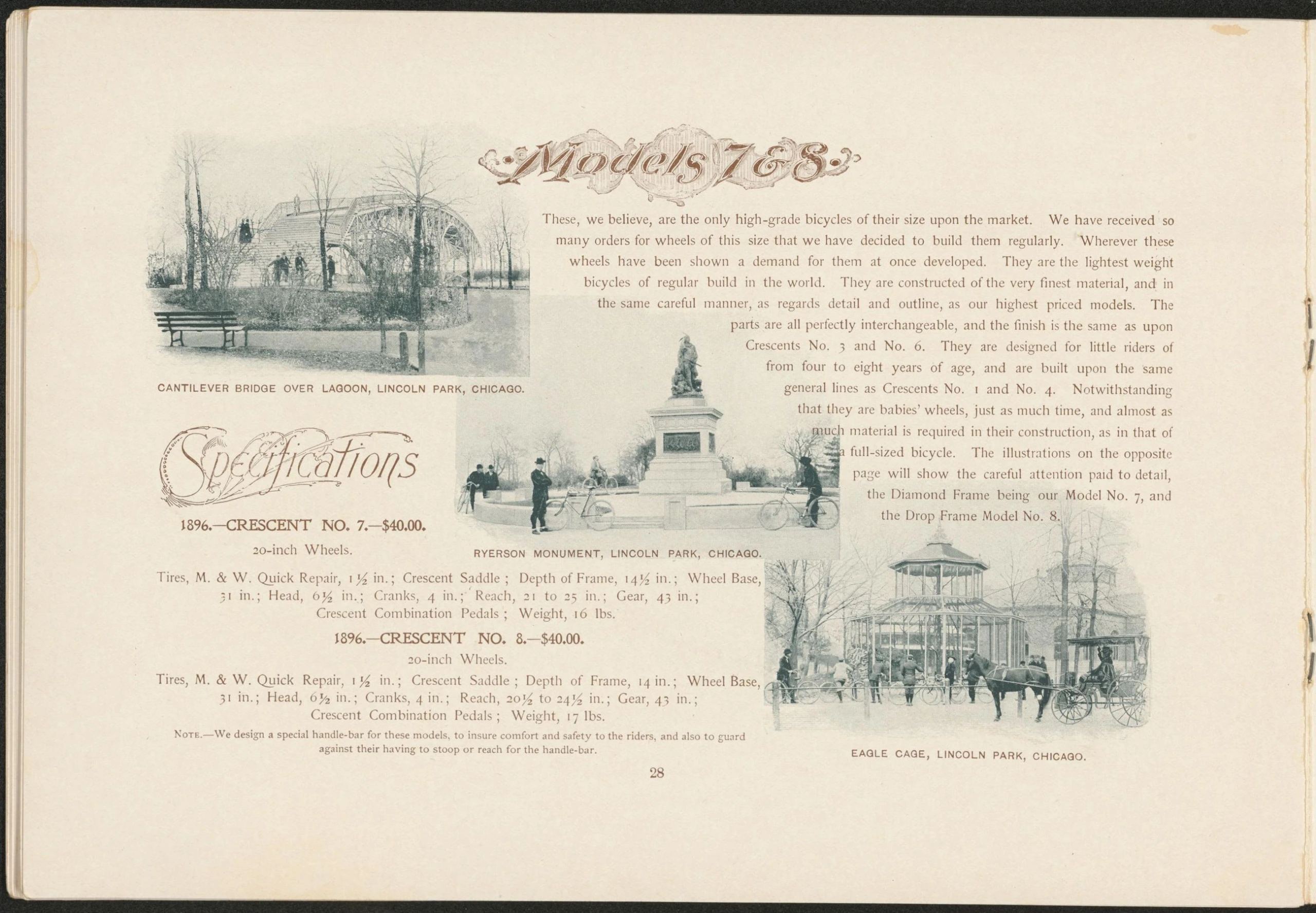 Page 30
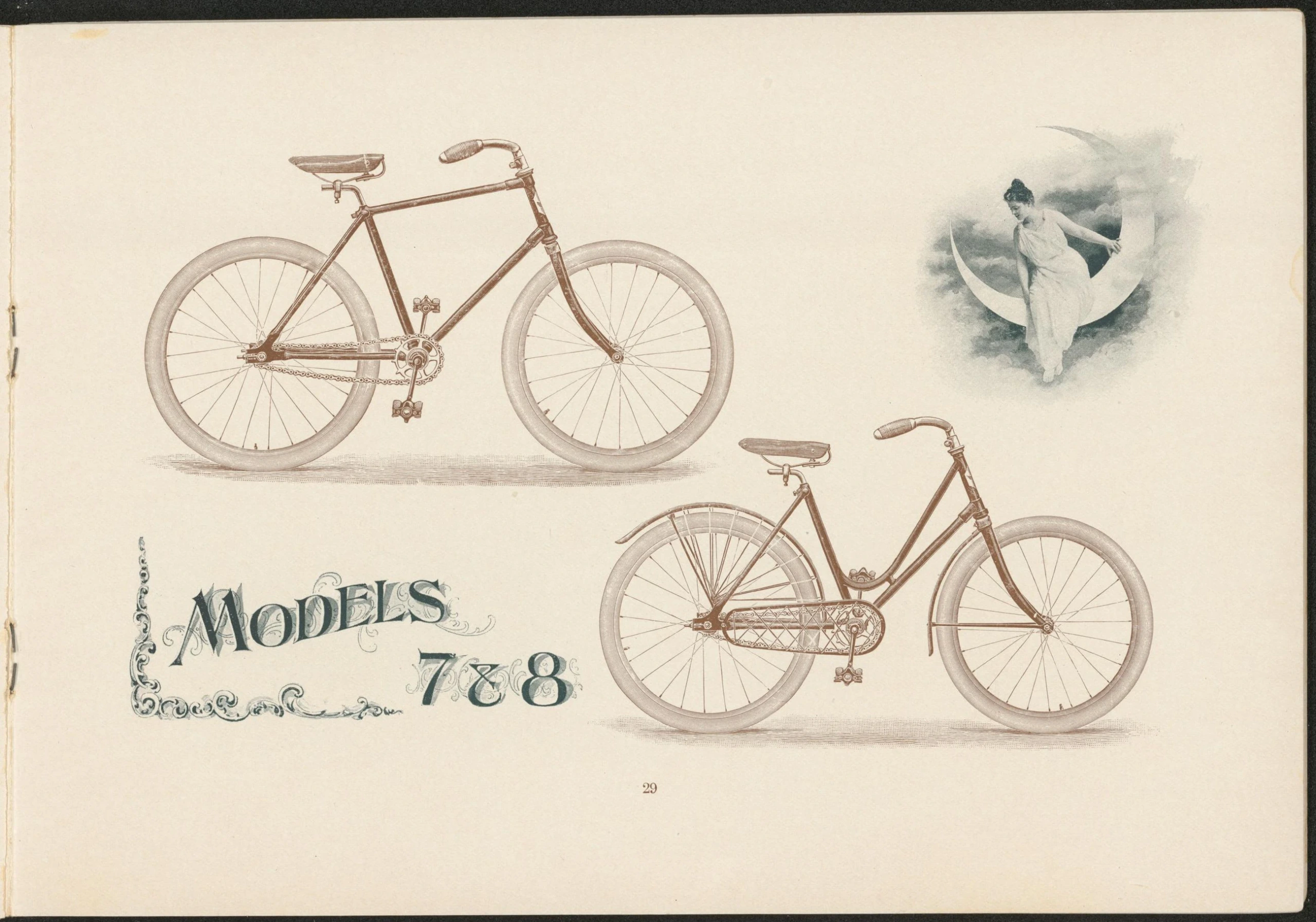 Page 31
 Page 32
 Page 33
 Page 34
 Page 35
 Page 36
 Page 37
 Page 38
 Page 39
 Page 40
 Page 41
 Page 42
 Page 43
 Page 44
 Page 45
 Page 46
 Page 47
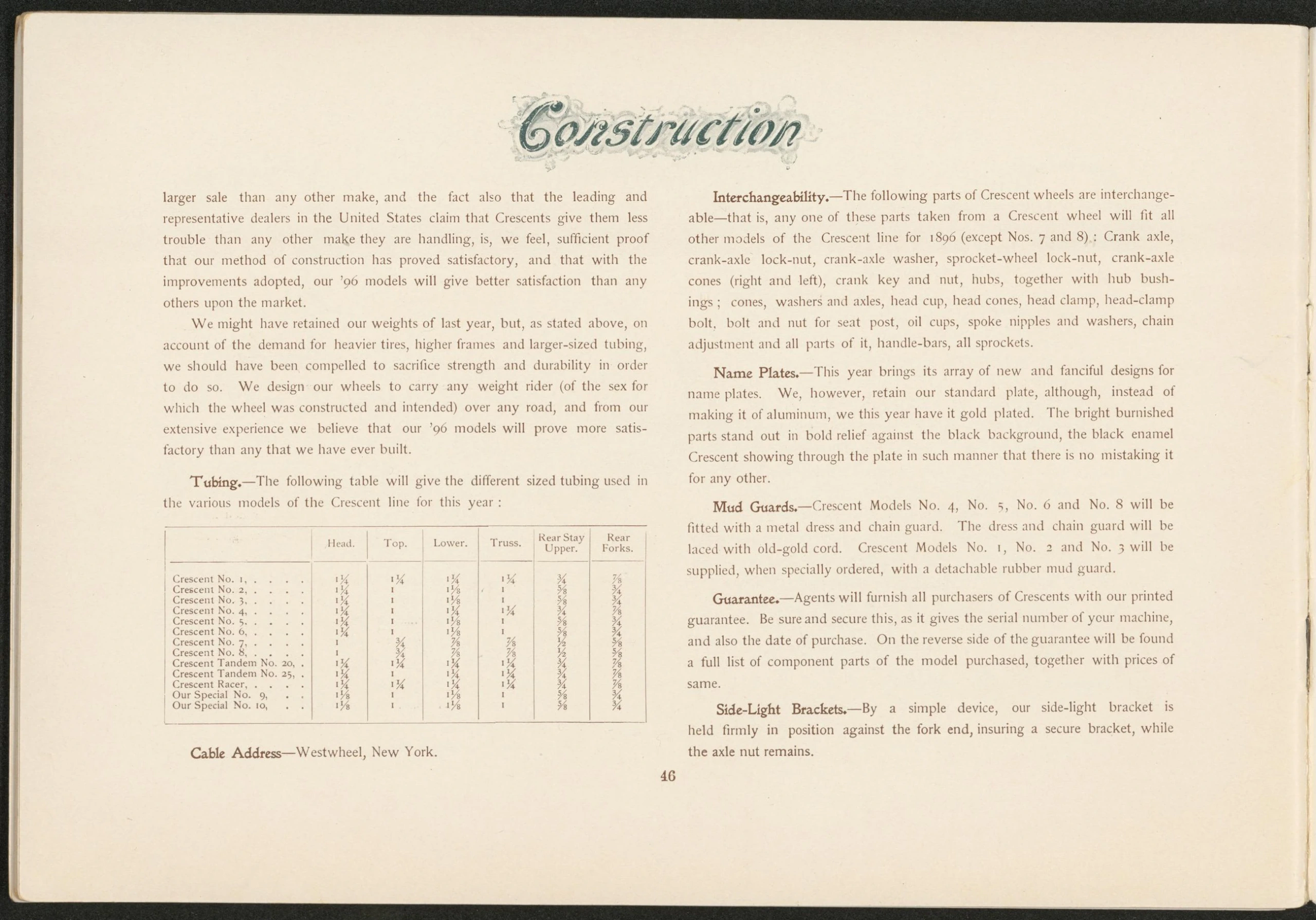 Page 48
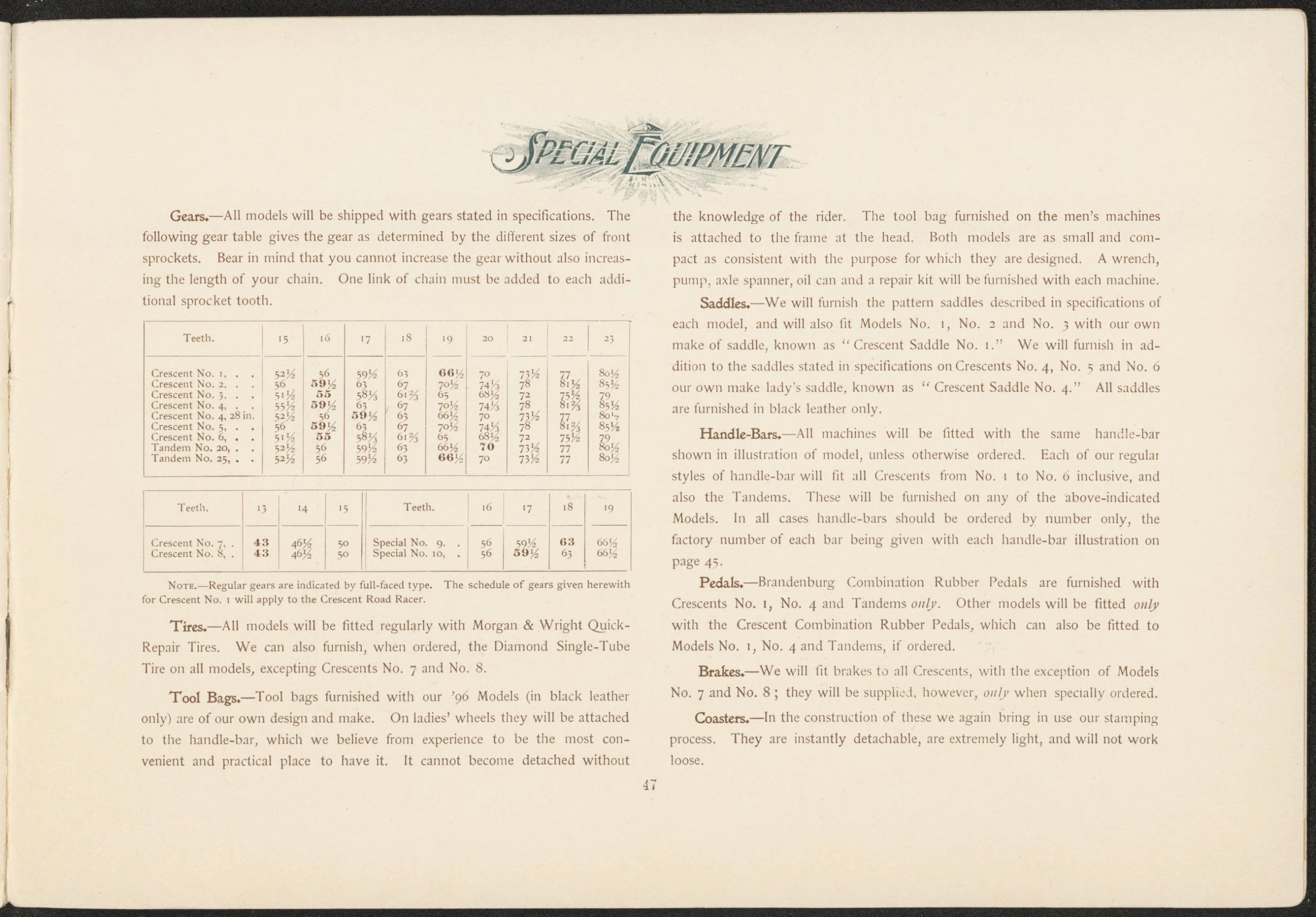 Page 49
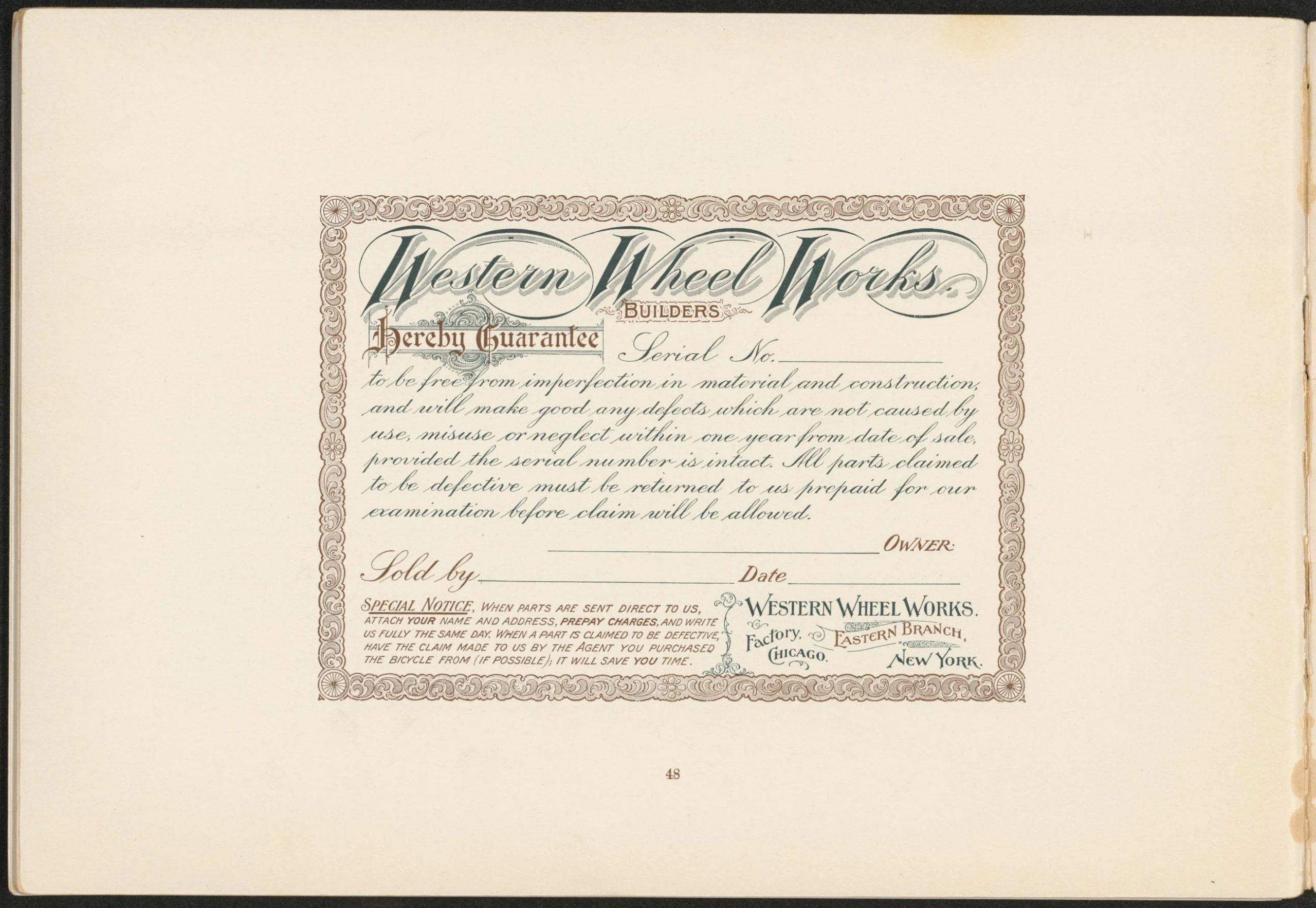 Page 50
 Page 51
 Page 52
| Marque | American Crescent |
|---|---|
| Type | Catalog |
| Year | 1896 |
| Publisher | Western Wheel Works |
| Country | United States |
| Language | English |
| Pages | 52 |
| Source | Northwestern University Libraries, Transportation Library, "Crescent bicycles" (digital collection, https://dc.library.northwestern.edu/items/6d110e22-dd4a-4257-8401-27b5006f3c5f); rights statement "No Copyright - United States". |
| Credit | Northwestern University Libraries |
| Identifier | Permalink https://dc.library.northwestern.edu/items/6d110e22-dd4a-4257-8401-27b5006f3c5f |
| Transcription | Transcribed by eye |
Reference
Western Wheel Works. Crescent 1896 Catalog (Western Wheel Works, Chicago): Thirteen Models from the No. 1 to the Tandems. 1896. Ebykr, https://ebykr.com/library/crescent-catalog-1896/.
Wikipedia
{{cite book |title=Crescent 1896 Catalog (Western Wheel Works, Chicago): Thirteen Models from the No. 1 to the Tandems |publisher=Western Wheel Works |date=1896 |url=https://ebykr.com/library/crescent-catalog-1896/ |via=Ebykr |access-date=}}1896 CRESCENT BICYCLES WESTERN WHEEL WORKS CHICAGO MAKERS NEW YORK Crescent Bicycles 1896 Greeting To Riders Tens of thousands of Crescent riders know the merits of Crescent wheels; know their enduring as well as their easy-running qualities, and know that the record of the past year has borne out our promise to furnish a strictly …
The Western Wheel Works’ Crescent catalog for 1896, from Chicago: a greeting to riders and agents with road views of New Jersey and Chicago, then the Crescent No. 1 men’s, No. 4 ladies’ and Road Racer at $75, the No. 20 diamond-frame and No. 25 combination tandems at $125, the youths’, misses’ and “Our Special” Nos. 2, 5, 9 and 10 at $50 and the boys’, girls’ and children’s Nos. 3, 6, 7 and 8 at $40, each with its specifications facing its engraving, then the plant, the riders R. P. Searle and Cox, a construction section, tubing and gear tables and the guarantee. Transcribed from the page images (52 pages); each page ends with a bracketed description of its pictures.
— Page 1 —
1896
CRESCENT
BICYCLES
WESTERN WHEEL WORKS
CHICAGO MAKERS NEW YORK
[The front cover of an oblong booklet: a pale embossed and tinted design of a draped woman seated on a crescent moon among clouds, with scrollwork and water lilies; the title in red in an oval cartouche at upper left; the makers’ name on a ribbon below. Light soiling and a worn spine edge.]
— Page 2 —
[The blank inside front cover, showing the reverse of the cover embossing, a faint red smudge near the foot and a few faint pencil strokes at center.]
— Page 3 —
Crescent
Bicycles
[The title page: the words “Crescent Bicycles” in ornamented blackletter, printed in dark green with brown shading and a decorated initial panel with fleurs-de-lis, centered on an otherwise plain page.]
— Page 4 —
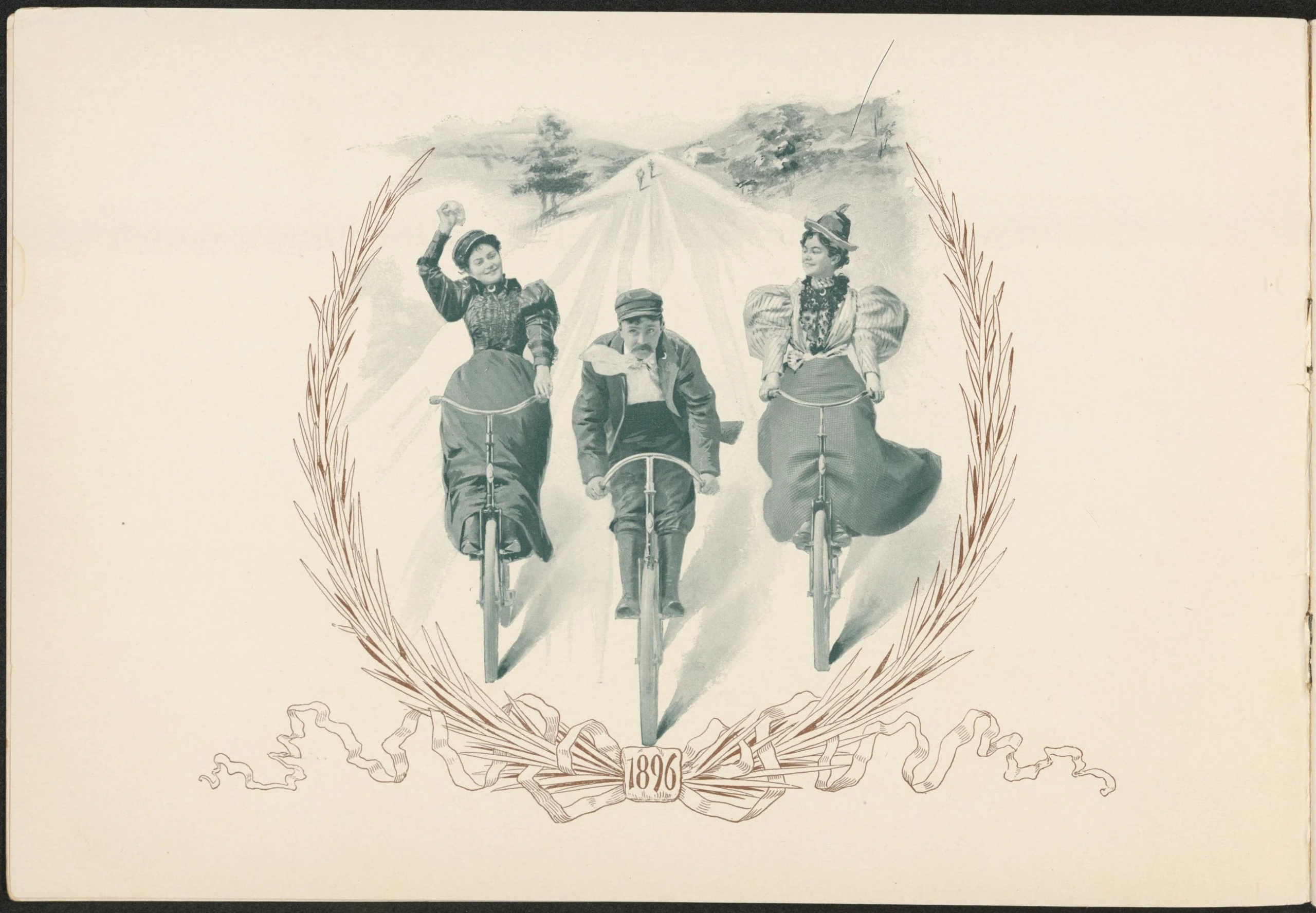
1896
[A frontispiece halftone of three riders coming head-on down a country road, a woman at each side and a man with a mustache and cap in the center, framed by a brown wreath of wheat sheaves tied with a ribbon bearing the date 1896. A stray pen line at upper right.]
— Page 5 —
Greeting
To Riders
Tens of thousands of Crescent riders know the merits of Crescent wheels; know their enduring as well as their easy-running qualities, and know that the record of the past year has borne out our promise to furnish a strictly high-grade wheel at a moderate price. We would respectfully call the attention of these, and all others who may have decided to select a mount for the coming season, to the superb line of wheels we have placed upon the market for 1896. They are as good as the highest skilled labor, the best of materials, and unequaled facilities for manufacture can make them.
To Agents
To the thousands of Crescent agents, both at home and abroad, we extend our hearty greetings! The success attained by them in their respective communities during past years, is the best evidence we could desire of the merit in design, construction and equipment of Crescent wheels.
Despite the era of confusion and dissatisfaction which last year affected so many factories, as the result of an unprecedented and phenomenal demand, we venture to say that Crescent agents suffered less inconvenience than those of any other cycle-building concern, while the high standard of quality and workmanship which has at all times characterized Crescent bicycles, was maintained then, as it will be for all time to come.
To all of our agents we wish a prosperous year, and a long continuance of the cordial relations existing between themselves and
WESTERN WHEEL WORKS.
3
[A text page headed “Greeting” in ornamental letters, with a large decorated initial “T” hung with bells beside “To Riders” and an ornamental “To Agents” subheading, printed in dark green.]
— Page 6 —
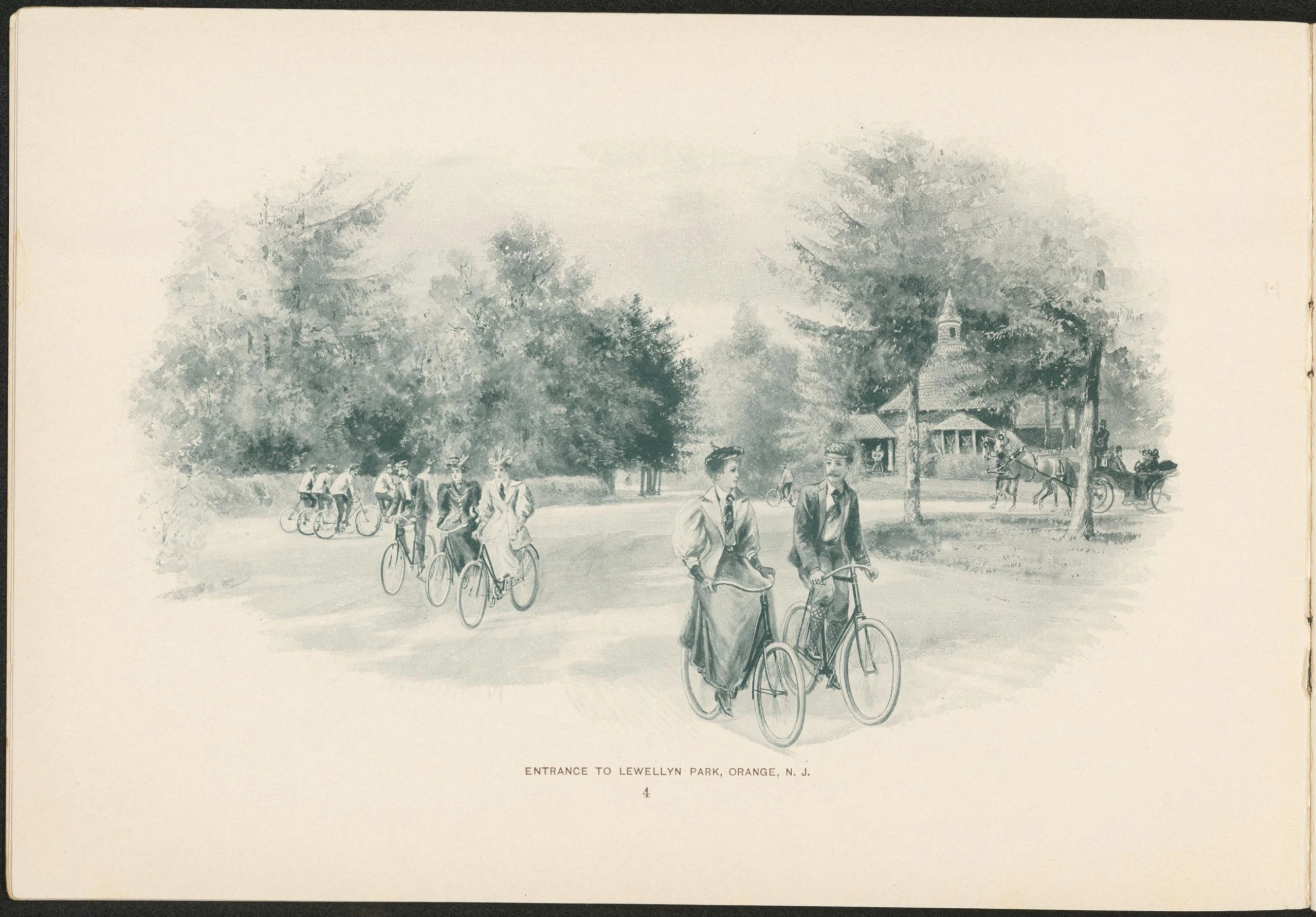
ENTRANCE TO LEWELLYN PARK, ORANGE, N. J.
4
[A vignetted halftone of cyclists at a tree-lined park entrance: a woman and a man walking drop-frame and diamond-frame safeties in the foreground, groups of riders behind, a gatehouse with a cupola and a horse-drawn carriage at right.]
— Page 7 —
A Word With The Rider
If you are a rider, a glance through the pages of the Crescent catalogue for 1896 can scarcely fail to awaken some of the most enjoyable memories of past years and be replete with interest throughout every line, from cover to cover.
If you have not yet tasted of the pleasures shared by more than a million devotees of the wheel in America, the Crescent catalogue must surely open up to you new possibilities for enjoyment, such as you have never understood or anticipated.
In constructing our catalogue for 1896 we have found no room for self-laudation or congratulation upon what has been accomplished by the Western Wheel Works in the field of cycle construction. Feeling sure that our readers are gifted with sufficient intelligence to understand that we are actuated by the same business motives and aspirations that incite all other manufacturers, we shall pass all reference to “our personal gratification” and the “enterprise and tireless energy which has built up so vast a business,” and content ourselves with the simple statement that the Western Wheel Works is to-day the largest bicycle factory in the world, and that it has been made so by the merit and popularity of its product, now in use in every State in the Union and in almost every country upon the globe.
The widespread popularity of the bicycle is beyond question due, in the majority, to the delightful and exhilarating effects of riding. Although of great practical service to many individuals in both the mercantile and professional walks of life; to great corporations demanding the speedy transmission of messages and the execution of commissions; to the soldier, and to the Government official; the bicycle still owes its great popularity to those who have taken it up as a means of recreation, enjoyment and personal convenience.
5
[A text page headed “A Word With The Rider” in ornamental capitals, the initial “A” set inside a spoked wheel within scrollwork, printed in dark green.]
— Page 8 —
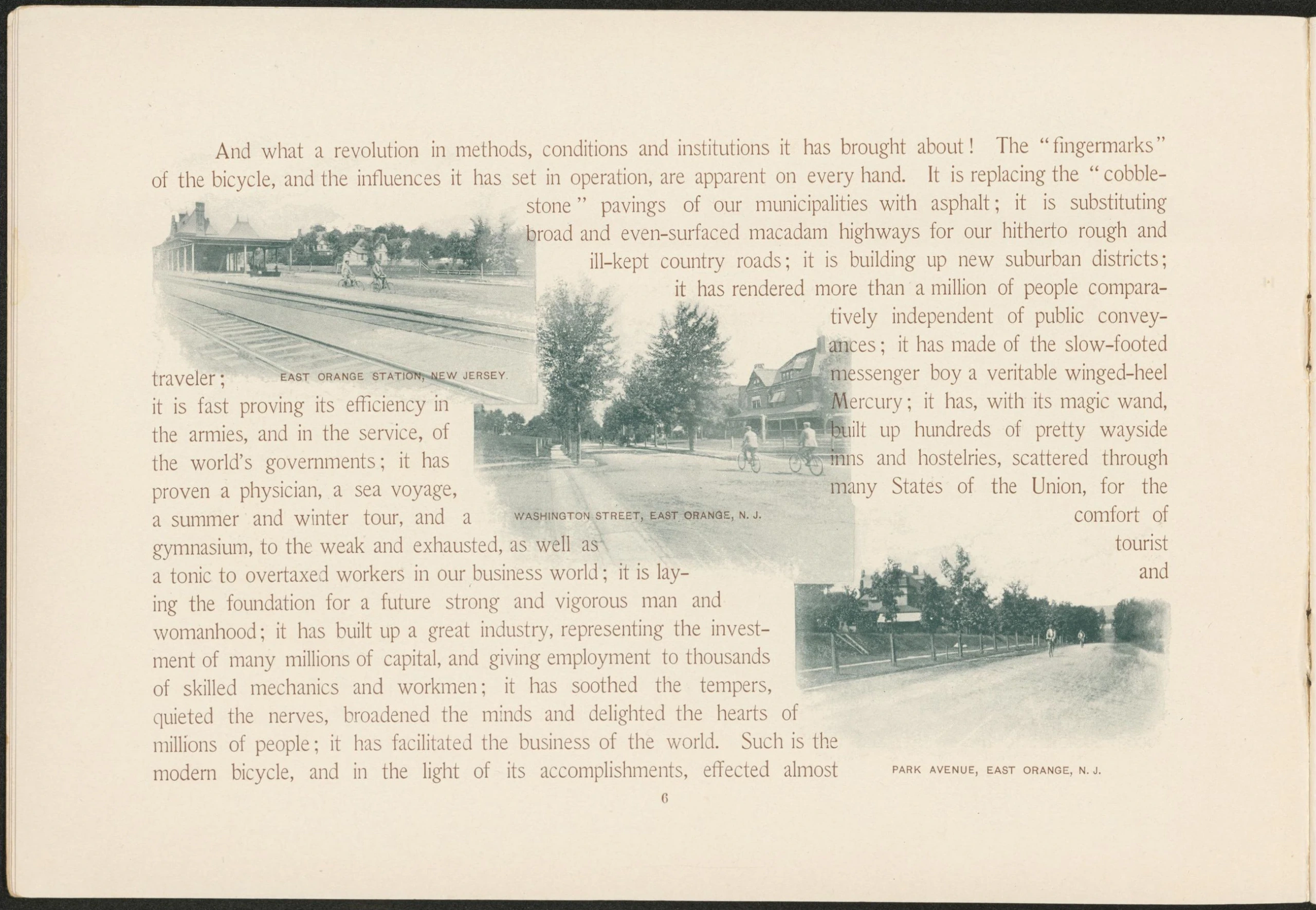
And what a revolution in methods, conditions and institutions it has brought about! The “fingermarks” of the bicycle, and the influences it has set in operation, are apparent on every hand. It is replacing the “cobblestone” pavings of our municipalities with asphalt; it is substituting broad and even-surfaced macadam highways for our hitherto rough and ill-kept country roads; it is building up new suburban districts; it has rendered more than a million of people comparatively independent of public conveyances; it has made of the slow-footed messenger boy a veritable winged-heel Mercury; it has, with its magic wand, built up hundreds of pretty wayside inns and hostelries, scattered through many States of the Union, for the comfort of tourist and traveler; it is fast proving its efficiency in the armies, and in the service, of the world’s governments; it has proven a physician, a sea voyage, a summer and winter tour, and a gymnasium, to the weak and exhausted, as well as a tonic to overtaxed workers in our business world; it is laying the foundation for a future strong and vigorous man and womanhood; it has built up a great industry, representing the investment of many millions of capital, and giving employment to thousands of skilled mechanics and workmen; it has soothed the tempers, quieted the nerves, broadened the minds and delighted the hearts of millions of people; it has facilitated the business of the world. Such is the modern bicycle, and in the light of its accomplishments, effected almost
EAST ORANGE STATION, NEW JERSEY.
WASHINGTON STREET, EAST ORANGE, N. J.
PARK AVENUE, EAST ORANGE, N. J.
6
[A text page with three inset halftone vignettes set in a stepped diagonal, around which the text runs: a railroad station with two cyclists on the platform, a residential street with two riders and a tree-lined avenue with distant riders.]
— Page 9 —
in the babyhood of its career, verily no man can assume to say where its sphere of usefulness shall end. Scattered throughout these pages will be found a number of roadside views from the cameras of Crescent riders. Perhaps no more forceful or comprehensive method could be employed to convey, to some extent, an adequate idea of the pleasures of wheeling. The strong sentiment in favor of improved roadways for both city and suburb that has swept the country since the advent of the bicycle has, through the construction of hundreds of miles of fine highways, added to the attractiveness of cycling in many States of the Union. The views herein given have been taken from Central Park, from among the famous Oranges in New Jersey, along the Palisades of the Hudson, the beautiful Riverside Drive of New York City, and from the perhaps unrivaled park system of Chicago. They are not imaginary views, but photographs, and convey a true idea of the natural beauty and superb roadways to be enjoyed awheel through these sections.
To experienced riders of either sex, there is perhaps nothing we can say that will sharpen their appreciation of all that a tour awheel of these beautiful districts means. They have doubtless bowled along over every yard of road in these Edens, and are eagerly looking forward to a repetition of their rides with the coming of another season. To those who yet have their riding-school experiences in anticipation, however, we can promise a degree of enjoyment that no one but a cyclist has ever shared or understood. To start awheel, with the clear and invigorating air of the sunrise hour imparting fresh strength to the muscles, and the glow of health to the cheek; or, in the evening, when the desire for rest that comes with the close of the day’s annoyances and vexations makes one glad to get away from apartments or the office desk, is an experience which one must really enjoy before they can understand its fascination. The refreshing influences of the open country, the beauty of the foliage and shrubbery, the thrilling and exhilarating movement of the wheel beneath you, the ever-changing scenes through which you pass, and the spirit of good fellowship making itself felt nowhere so pleasantly as among a party of cyclists—all go to contribute to a sense of enjoyment and physical and mental recuperation which you can never know until you become a rider.
WESTERN WHEEL WORKS
CRESCENT
No. 1
CHICAGO
U.S.A.
7
[A text page overprinted at right with a large dark green engraving of the pointed oval Crescent head badge: a crescent moon, “Western Wheel Works”, “Crescent”, “No. 1” and “Chicago U.S.A.”, with two screw holes.]
— Page 10 —
Crescent Line for 1896.
The line of Crescent bicycles for 1896 is beyond question the most complete, for all practical purposes, ever turned out by any manufacturer.
As may be seen by reference to the illustrations and specifications on succeeding pages, it consists of thirteen models, with varying heights of frames, as being adapted to riders of tall and short stature and of different weights. The provisions thus embraced enable us to furnish almost any style of wheel desired, for riders of either sex, from adults of any weight down to the baby of four to eight years, to meet which latter demand we have placed upon the market models No. 7 and No. 8, having 20-inch wheels, with diamond and drop frame respectively.
In point of structural merit, Crescent wheels are as nearly perfect as the facilities of the largest bicycle factory in the world can make them. The utmost care is taken in the selection of all materials, and in the testing of each part and section, no matter how minute, of every wheel. The strength and wearing quality of Crescents is thus such as to fully entitle them to their well-earned catch line of “The wheel that stands up,” or, in other words, the wheel that—barring accident—will break down only after it has been literally worn out, as the result of years of hard and continued use. In design and finish, Crescents are the superior of many and the equal of any bicycle offered the public.
8
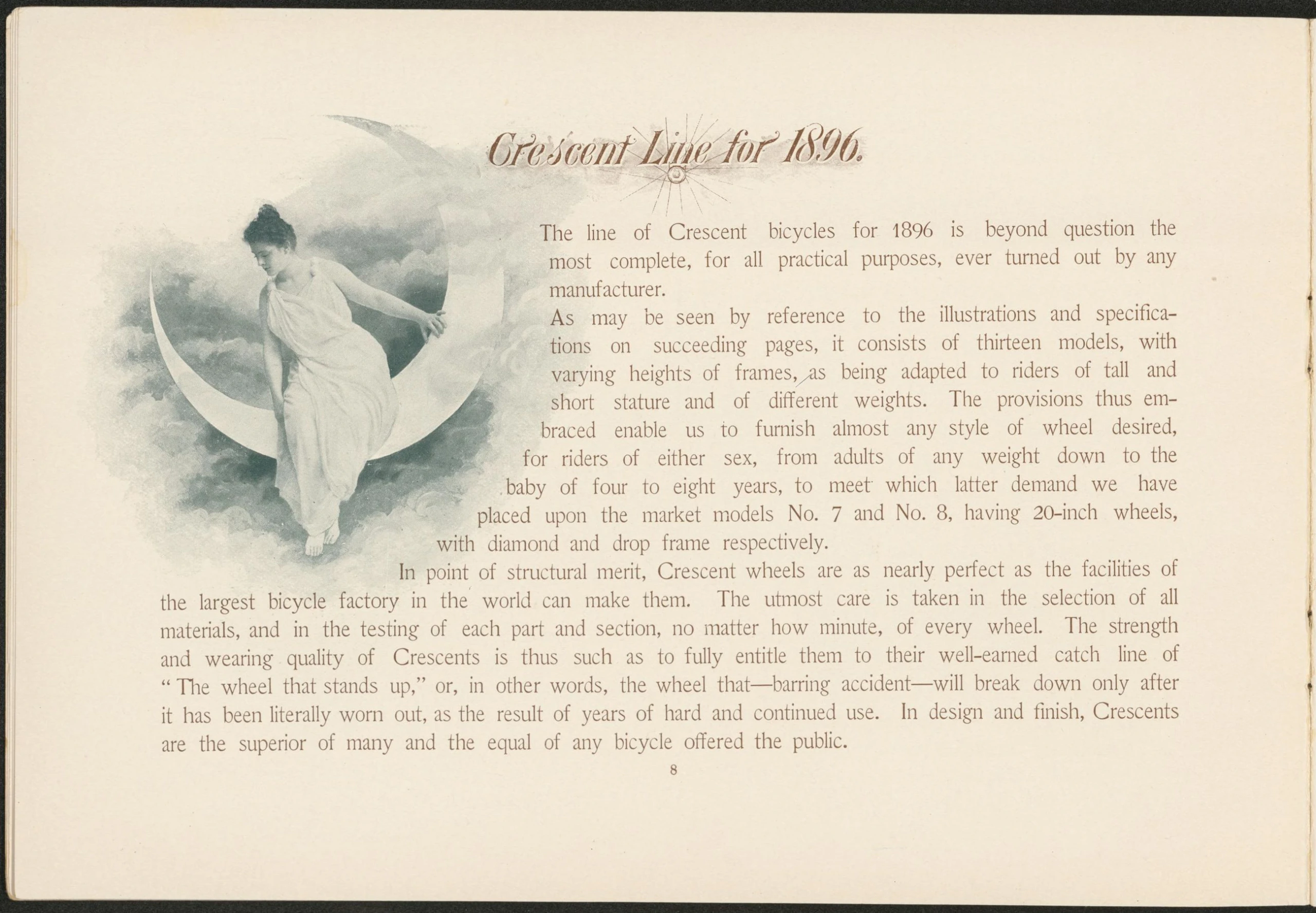
[A text page with the brown script heading “Crescent Line for 1896.” and a vignetted halftone at left of a draped woman seated on a large crescent moon among clouds.]
— Page 11 —
As a “family line,” Crescents must prove pre-eminent for the coming season. With the varied styles and sizes of frames and wheels furnished, we can fit riders of any age or size, and purchasers may feel assured that the same careful attention regarding construction has been adhered to throughout. For instance, the nuts, cones, sprockets, handle-bars and many other parts are interchangeable; that is, each one of them will fit the entire Crescent line—an advantage that will readily be understood by experienced riders, and a strong argument in favor of supplying Crescents, and Crescents only, for each and every member of the family.
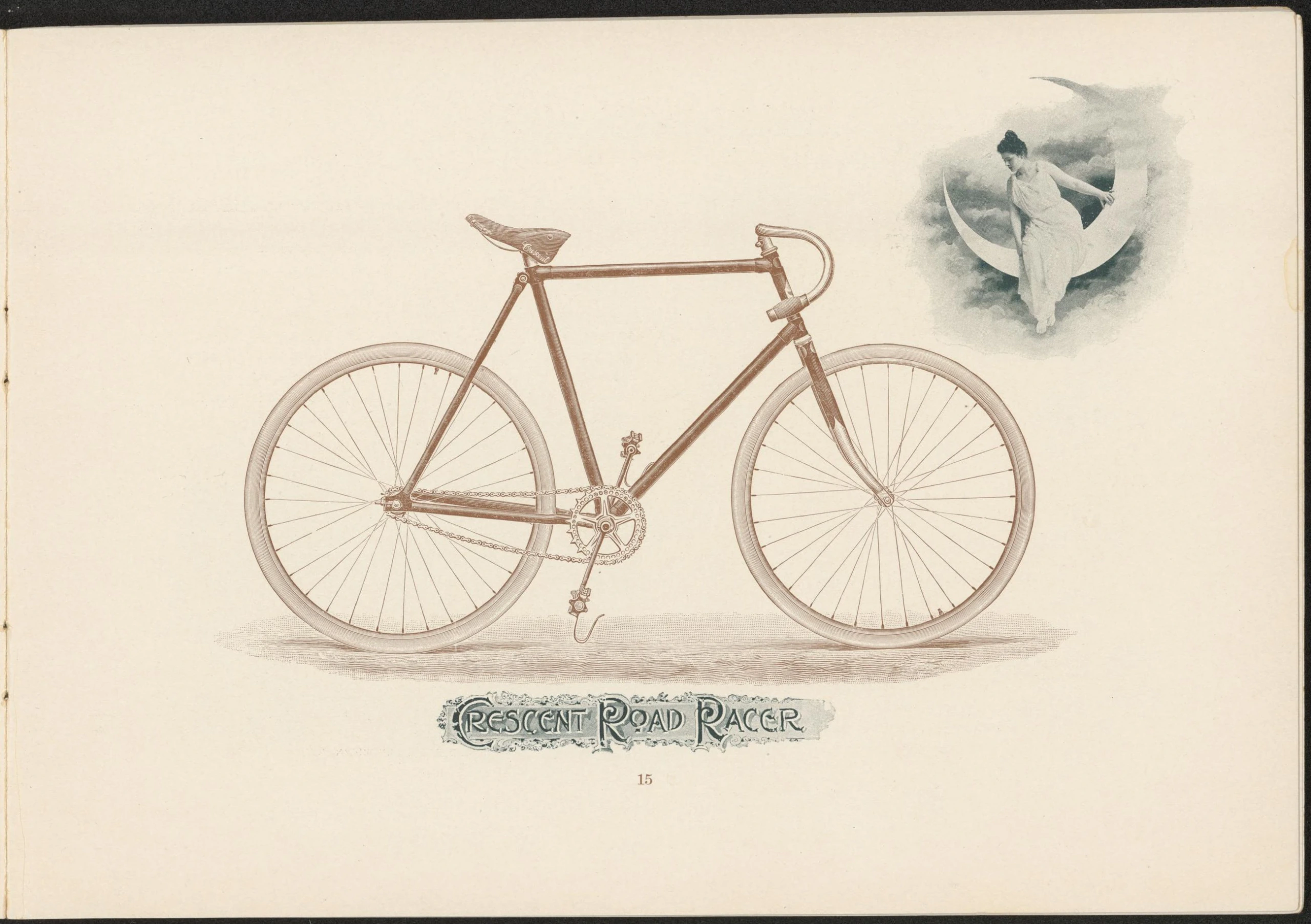
For a road racing wheel we present this year the Crescent Road Racer. A glance at its structural lines and specifications on page 15 will show it to be what the requirements for such a wheel call for—a light, strong, and perfectly balanced machine, especially designed for fast work upon road or track.
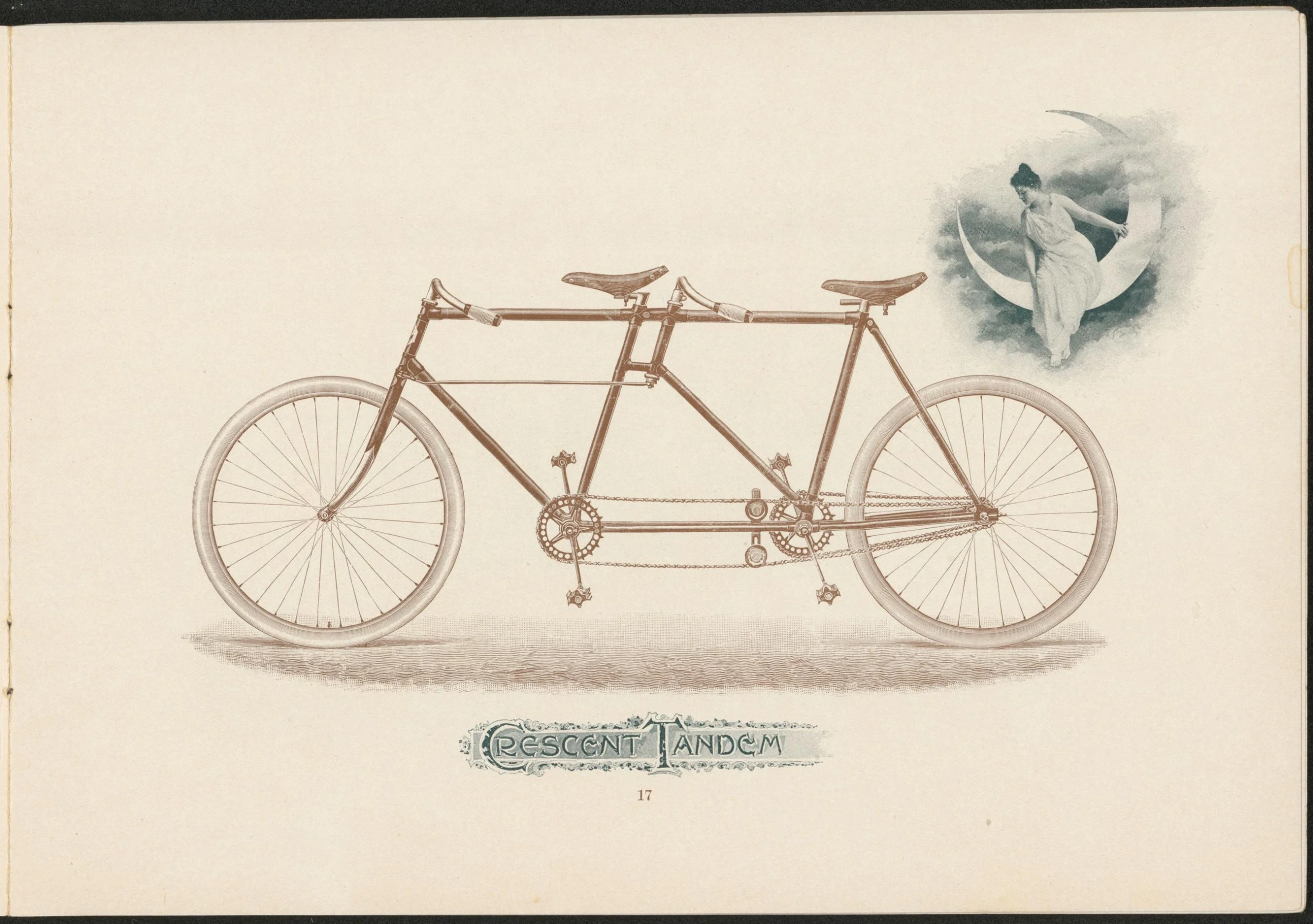
Special attention is called to the Crescent Tandem, in two models, illustrated on pages 17 and 19. These are the first machines of the kind to be put upon the market by the Western Wheel Works, and we offer them to lovers of tandem riding as the most perfect and practical tandem bicycles for all-around riding and touring, yet manufactured. Reference to the specifications and illustrations will show these wheels to be mechanically perfect, while we can safely assert that no tandem has ever been constructed upon more graceful and practical lines.
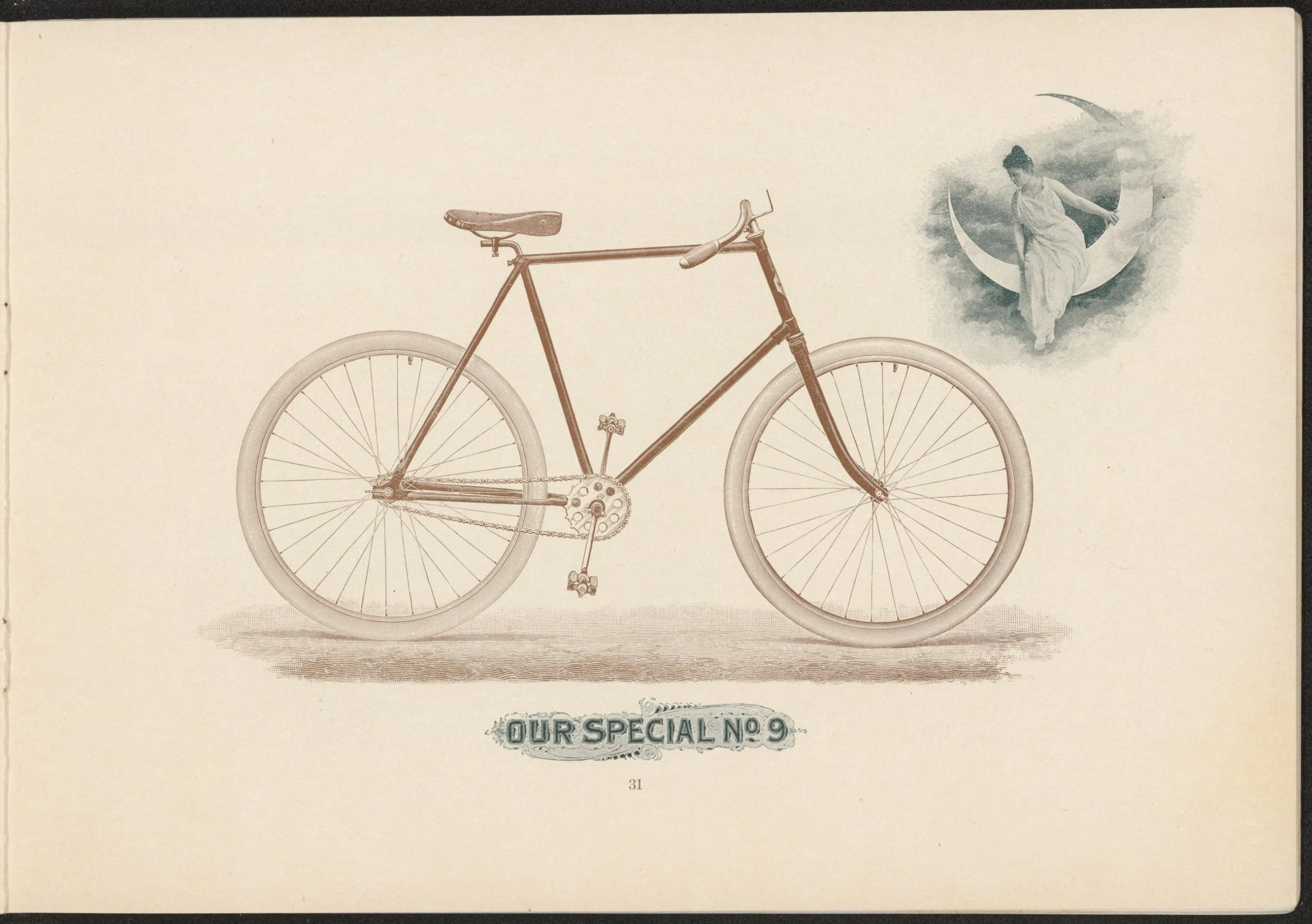
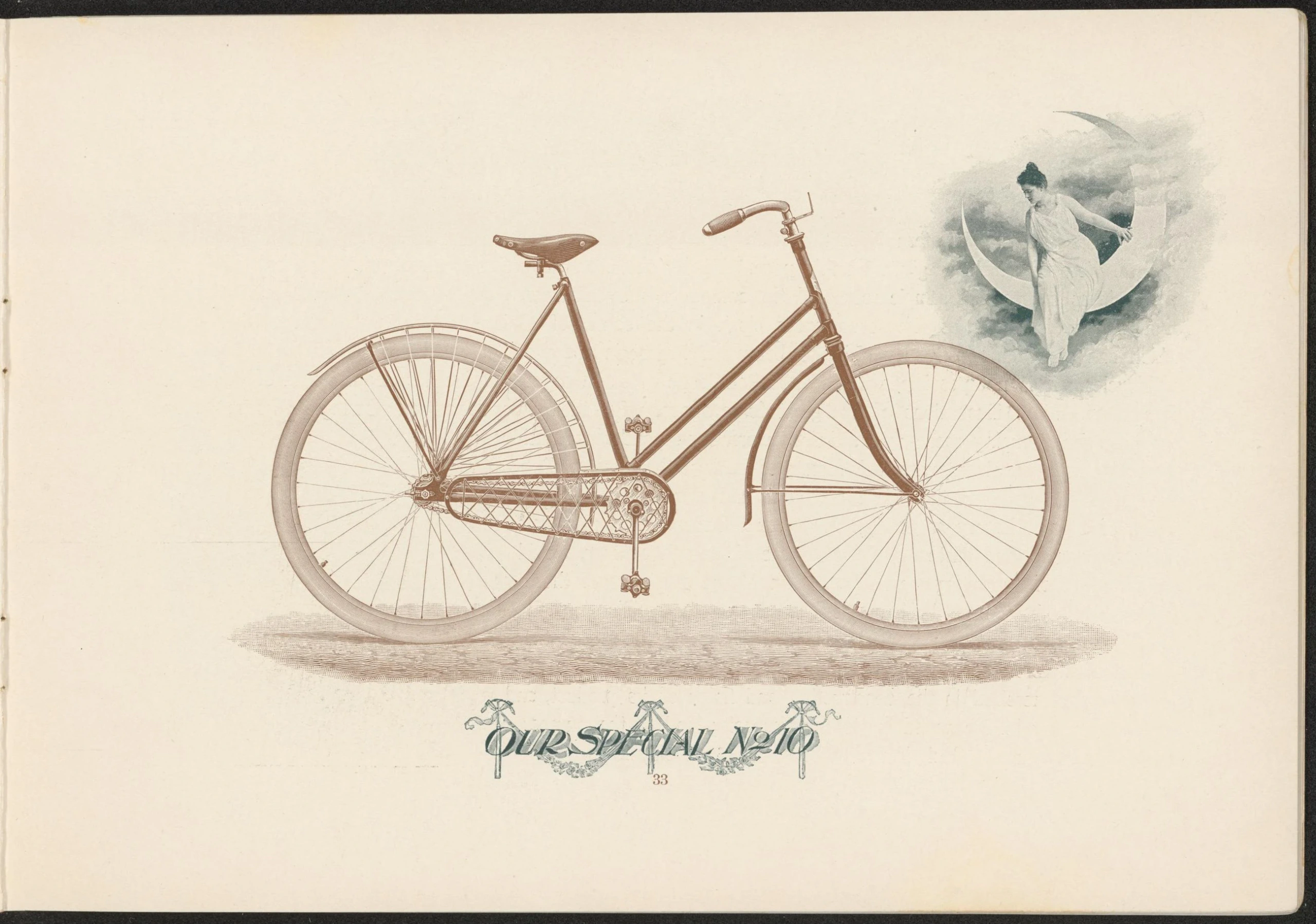
“Our Specials,” illustrated on pages 31 and 33, were especially designed to meet the demand among riders of both sexes for a thoroughly reliable, full-sized bicycle, at a price of $50.00. Many riders do not require that their mounts shall be of the very lightest weights obtainable; they simply want a wheel that will prove satisfactory for all-around road riding and touring purposes, without regard to an extra three or four pounds of weight. For such, we have placed “Our Specials” upon the market. They are carefully constructed, well finished, and up to date in all important particulars, while they are fully guaranteed.
A glance through the following pages can scarcely fail to convince any rider that the product of the Western Wheel Works stands without a superior, and but few, if any, equals, among the models of 1896.
WESTERN WHEEL WORKS
CRESCENT
No. 1
CHICAGO
U.S.A.
9
[A text page overprinted at right with the same large dark green engraving of the pointed oval Crescent “No. 1” head badge of the Western Wheel Works, Chicago.]
— Page 12 —
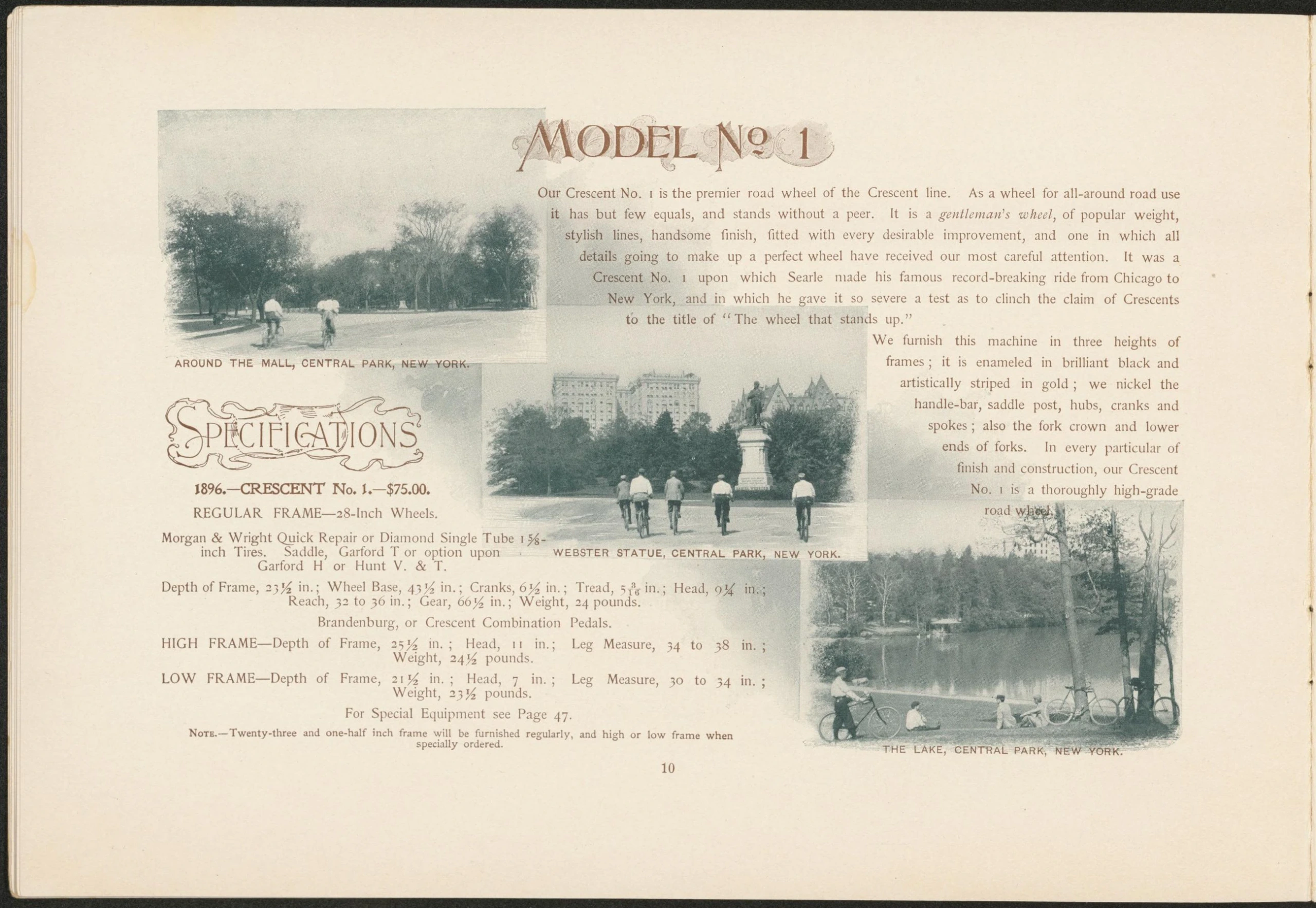
Model No 1
Our Crescent No. 1 is the premier road wheel of the Crescent line. As a wheel for all-around road use it has but few equals, and stands without a peer. It is a gentleman’s wheel, of popular weight, stylish lines, handsome finish, fitted with every desirable improvement, and one in which all details going to make up a perfect wheel have received our most careful attention. It was a Crescent No. 1 upon which Searle made his famous record-breaking ride from Chicago to New York, and in which he gave it so severe a test as to clinch the claim of Crescents to the title of “The wheel that stands up.”
We furnish this machine in three heights of frames; it is enameled in brilliant black and artistically striped in gold; we nickel the handle-bar, saddle post, hubs, cranks and spokes; also the fork crown and lower ends of forks. In every particular of finish and construction, our Crescent No. 1 is a thoroughly high-grade road wheel.
Specifications
1896.—CRESCENT No. 1.—$75.00.
REGULAR FRAME—28-Inch Wheels.
Morgan & Wright Quick Repair or Diamond Single Tube 1 5/8-inch Tires. Saddle, Garford T or option upon Garford H or Hunt V. & T.
Depth of Frame, 23 1/2 in.; Wheel Base, 43 1/2 in.; Cranks, 6 1/2 in.; Tread, 5 3/16 in.; Head, 9 1/4 in.; Reach, 32 to 36 in.; Gear, 66 1/2 in.; Weight, 24 pounds.
Brandenburg, or Crescent Combination Pedals.
HIGH FRAME—Depth of Frame, 25 1/2 in.; Head, 11 in.; Leg Measure, 34 to 38 in.; Weight, 24 1/2 pounds.
LOW FRAME—Depth of Frame, 21 1/2 in.; Head, 7 in.; Leg Measure, 30 to 34 in.; Weight, 23 1/2 pounds.
For Special Equipment see Page 47.
NOTE.—Twenty-three and one-half inch frame will be furnished regularly, and high or low frame when specially ordered.
AROUND THE MALL, CENTRAL PARK, NEW YORK.
WEBSTER STATUE, CENTRAL PARK, NEW YORK.
THE LAKE, CENTRAL PARK, NEW YORK.
10
[A text page with the heading “Model No 1” and an ornamental “Specifications” panel in brown, and three overlapping halftones of cyclists in Central Park: riders on the Mall, a group riding past the Webster statue and a man with a bicycle beside the lake.]
— Page 13 —
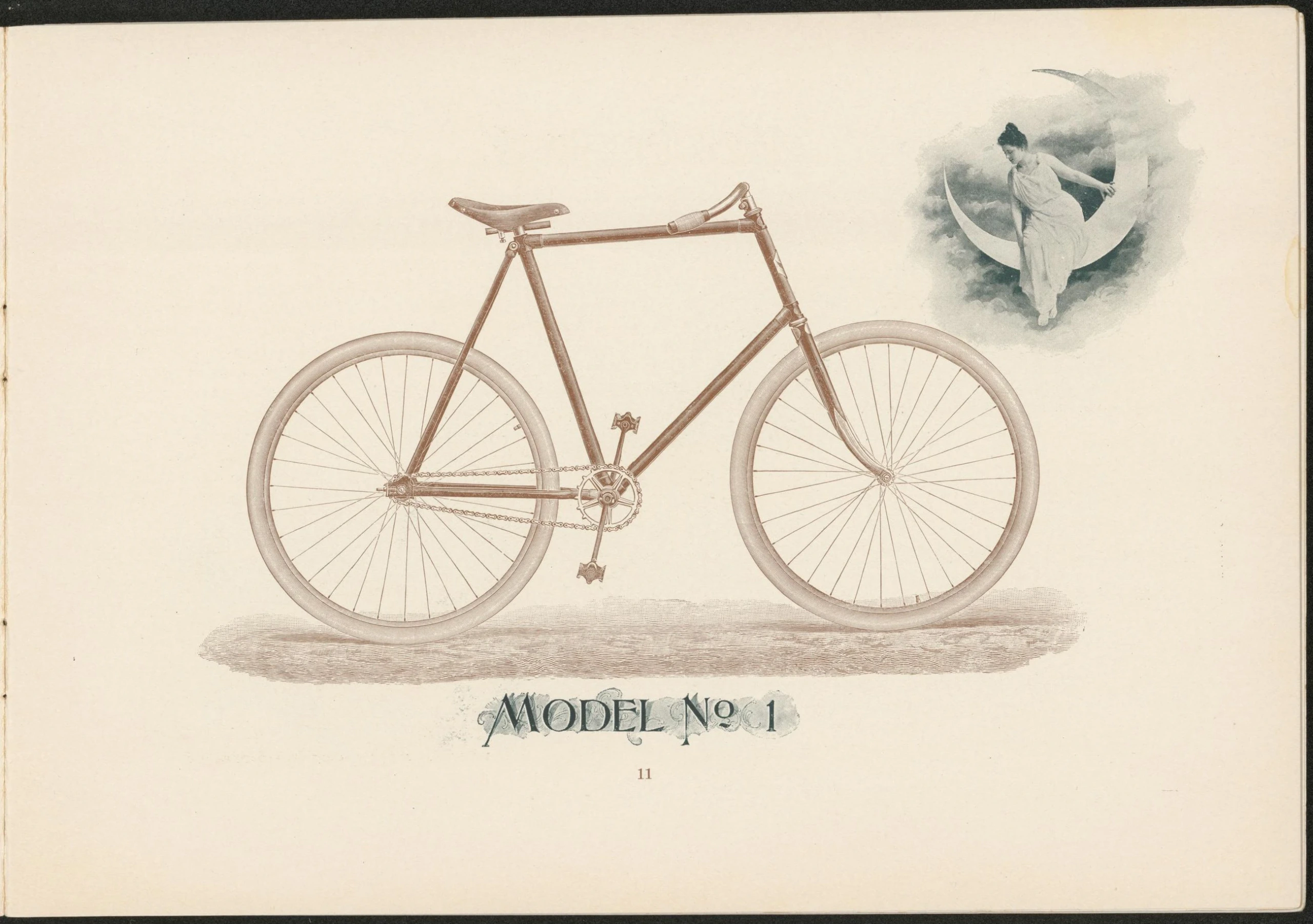
Model No 1
11
[A side-view engraving in brown of the Model No. 1 men’s diamond-frame safety with dropped handlebar, saddle, toe-clip pedals and pneumatic tires on a shaded ground, with a small halftone vignette at upper right of a draped woman seated on a crescent moon.]
— Page 14 —
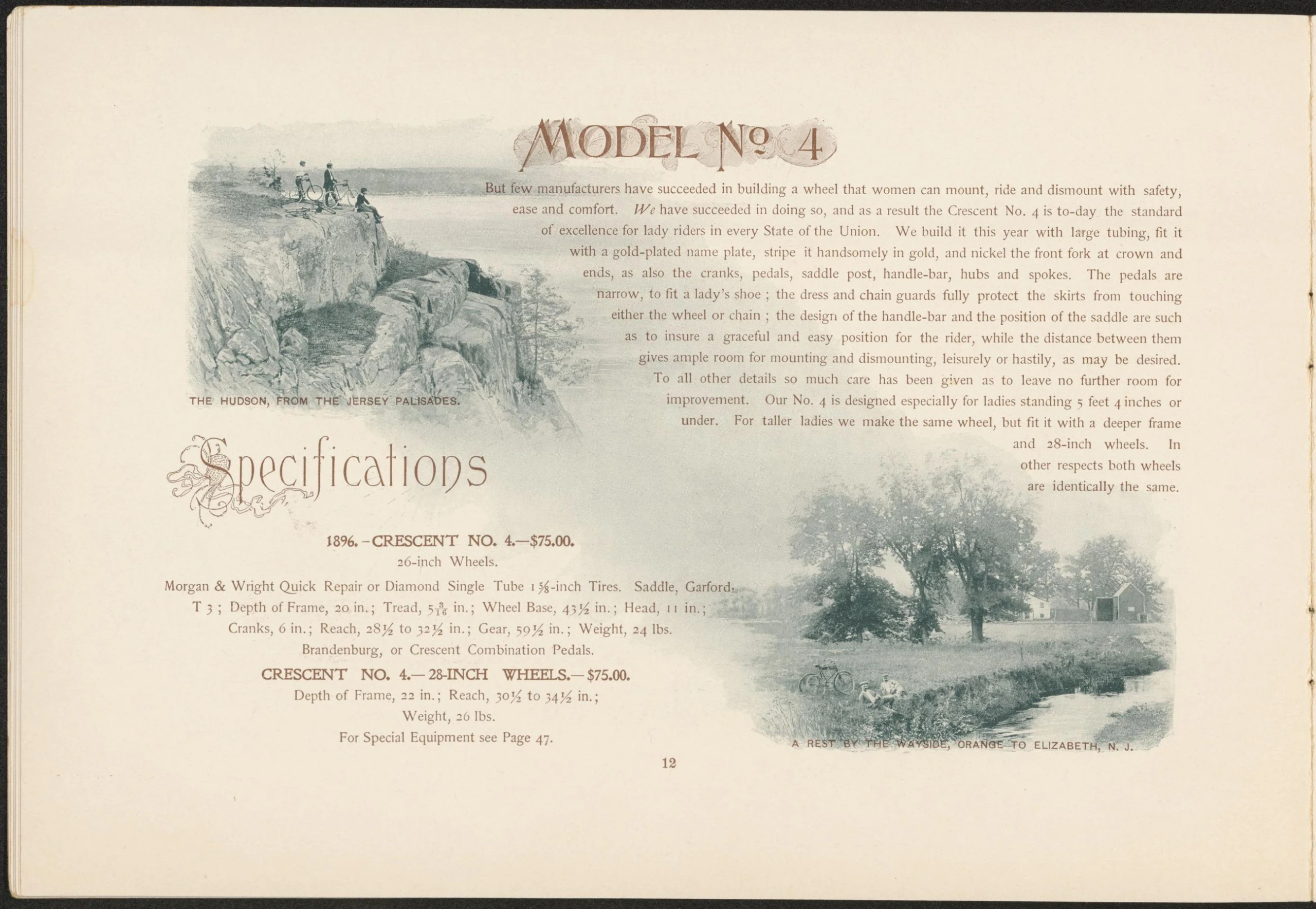
Model No 4
But few manufacturers have succeeded in building a wheel that women can mount, ride and dismount with safety, ease and comfort. We have succeeded in doing so, and as a result the Crescent No. 4 is to-day the standard of excellence for lady riders in every State of the Union. We build it this year with large tubing, fit it with a gold-plated name plate, stripe it handsomely in gold, and nickel the front fork at crown and ends, as also the cranks, pedals, saddle post, handle-bar, hubs and spokes. The pedals are narrow, to fit a lady’s shoe; the dress and chain guards fully protect the skirts from touching either the wheel or chain; the design of the handle-bar and the position of the saddle are such as to insure a graceful and easy position for the rider, while the distance between them gives ample room for mounting and dismounting, leisurely or hastily, as may be desired. To all other details so much care has been given as to leave no further room for improvement. Our No. 4 is designed especially for ladies standing 5 feet 4 inches or under. For taller ladies we make the same wheel, but fit it with a deeper frame and 28-inch wheels. In other respects both wheels are identically the same.
Specifications
1896.-CRESCENT NO. 4.—$75.00.
26-inch Wheels.
Morgan & Wright Quick Repair or Diamond Single Tube 1 5/8-inch Tires. Saddle, Garford, T 3; Depth of Frame, 20 in.; Tread, 5 3/16 in.; Wheel Base, 43 1/2 in.; Head, 11 in.; Cranks, 6 in.; Reach, 28 1/2 to 32 1/2 in.; Gear, 59 1/2 in.; Weight, 24 lbs.
Brandenburg, or Crescent Combination Pedals.
CRESCENT NO. 4.—28-INCH WHEELS.—$75.00.
Depth of Frame, 22 in.; Reach, 30 1/2 to 34 1/2 in.;
Weight, 26 lbs.
For Special Equipment see Page 47.
THE HUDSON, FROM THE JERSEY PALISADES.
A REST BY THE WAYSIDE, ORANGE TO ELIZABETH, N. J.
12
[A text page with the heading “Model No 4” and an ornamental “Specifications” title in brown, and two halftones: cyclists with their machines on a rocky cliff top above the Hudson and riders resting beside a stream with a bicycle on the bank and a farmhouse beyond.]
— Page 15 —
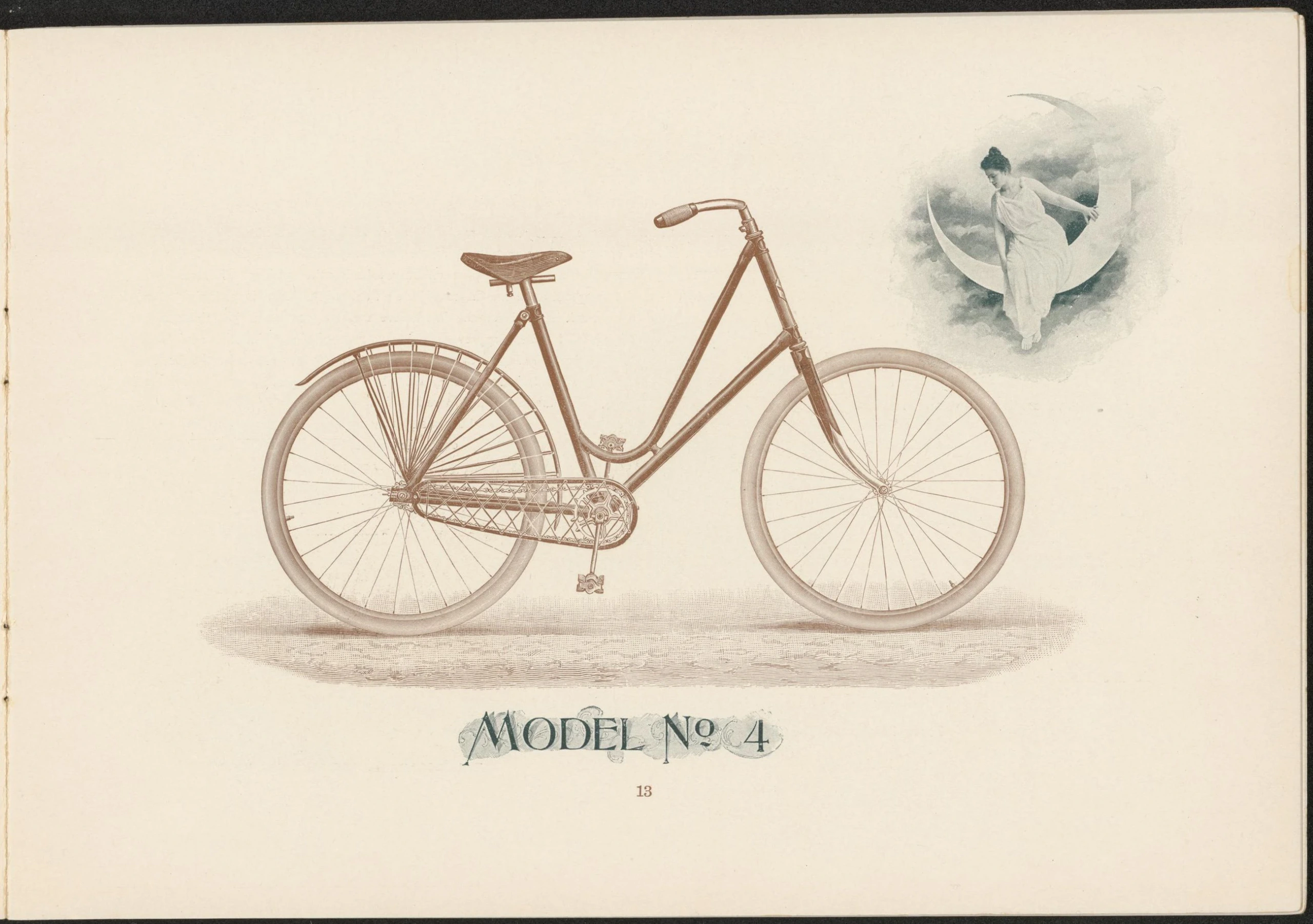
Model No 4
13
[A side-view engraving in brown of the Model No. 4 ladies’ drop-frame safety with upright handlebar, laced dress guard over the rear wheel and a latticed chain guard, with a small halftone vignette at upper right of a draped woman seated on a crescent moon.]
— Page 16 —
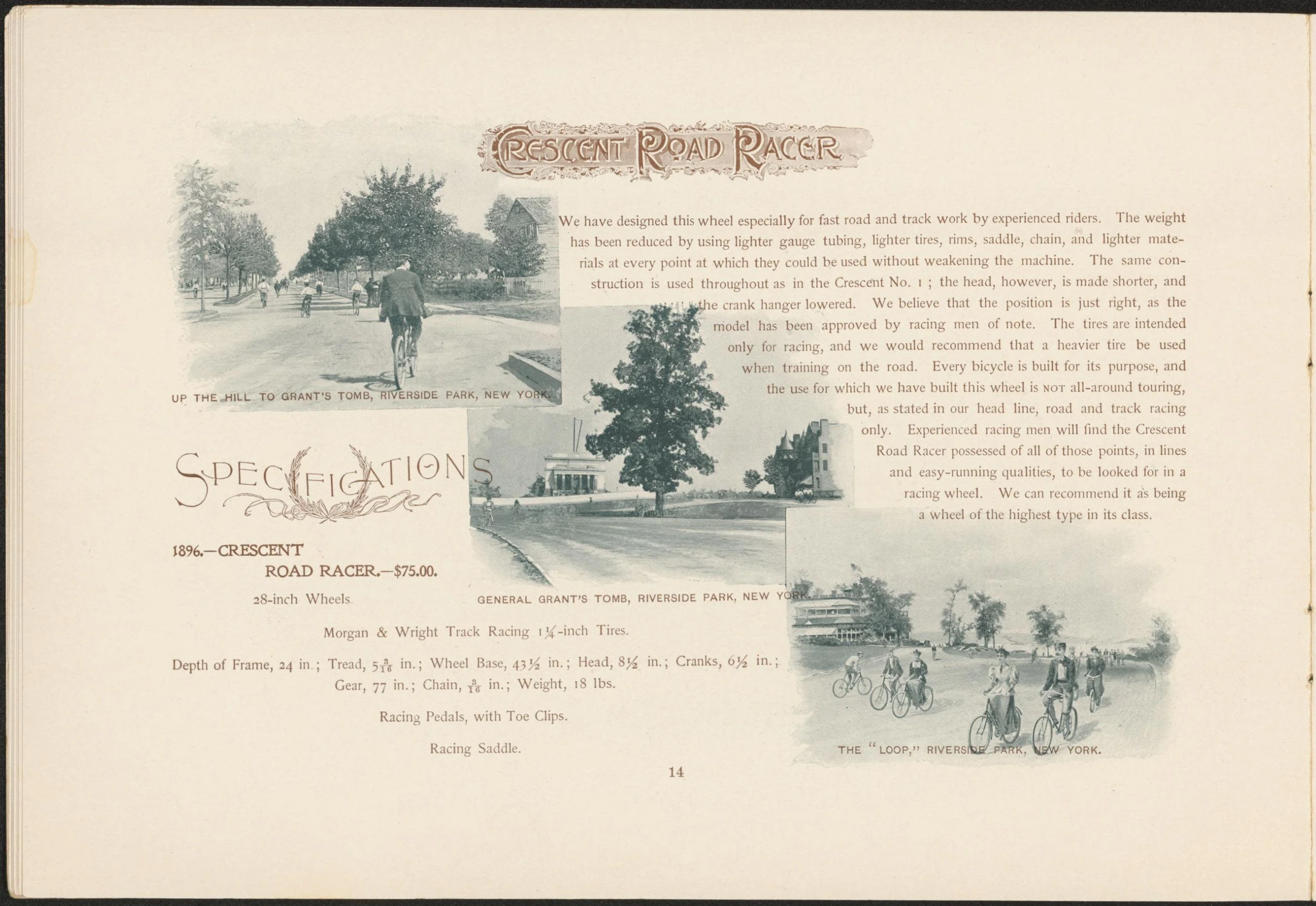
Crescent Road Racer
We have designed this wheel especially for fast road and track work by experienced riders. The weight has been reduced by using lighter gauge tubing, lighter tires, rims, saddle, chain, and lighter materials at every point at which they could be used without weakening the machine. The same construction is used throughout as in the Crescent No. 1; the head, however, is made shorter, and the crank hanger lowered. We believe that the position is just right, as the model has been approved by racing men of note. The tires are intended only for racing, and we would recommend that a heavier tire be used when training on the road. Every bicycle is built for its purpose, and the use for which we have built this wheel is NOT all-around touring, but, as stated in our head line, road and track racing only. Experienced racing men will find the Crescent Road Racer possessed of all of those points, in lines and easy-running qualities, to be looked for in a racing wheel. We can recommend it as being a wheel of the highest type in its class.
Specifications
1896.—CRESCENT
ROAD RACER.—$75.00.
28-inch Wheels.
Morgan & Wright Track Racing 1 1/4-inch Tires.
Depth of Frame, 24 in.; Tread, 5 3/16 in.; Wheel Base, 43 1/2 in.; Head, 8 1/2 in.; Cranks, 6 1/2 in.; Gear, 77 in.; Chain, 3/16 in.; Weight, 18 lbs.
Racing Pedals, with Toe Clips.
Racing Saddle.
UP THE HILL TO GRANT’S TOMB, RIVERSIDE PARK, NEW YORK.
GENERAL GRANT’S TOMB, RIVERSIDE PARK, NEW YORK.
THE “LOOP,” RIVERSIDE PARK, NEW YORK.
14
[A text page with the heading “Crescent Road Racer” and an ornamental “Specifications” title in brown, and three overlapping halftones in Riverside Park: riders climbing a tree-lined hill, the tomb grounds with a large tree and a group of men and women riding the Loop.]
— Page 17 —
Crescent Road Racer
15
[A side-view engraving in brown of the Crescent Road Racer, a men’s diamond-frame safety with a short head, deep dropped handlebar, racing saddle and rat-trap pedals with toe clips, with a small halftone vignette at upper right of a draped woman seated on a crescent moon.]
— Page 18 —
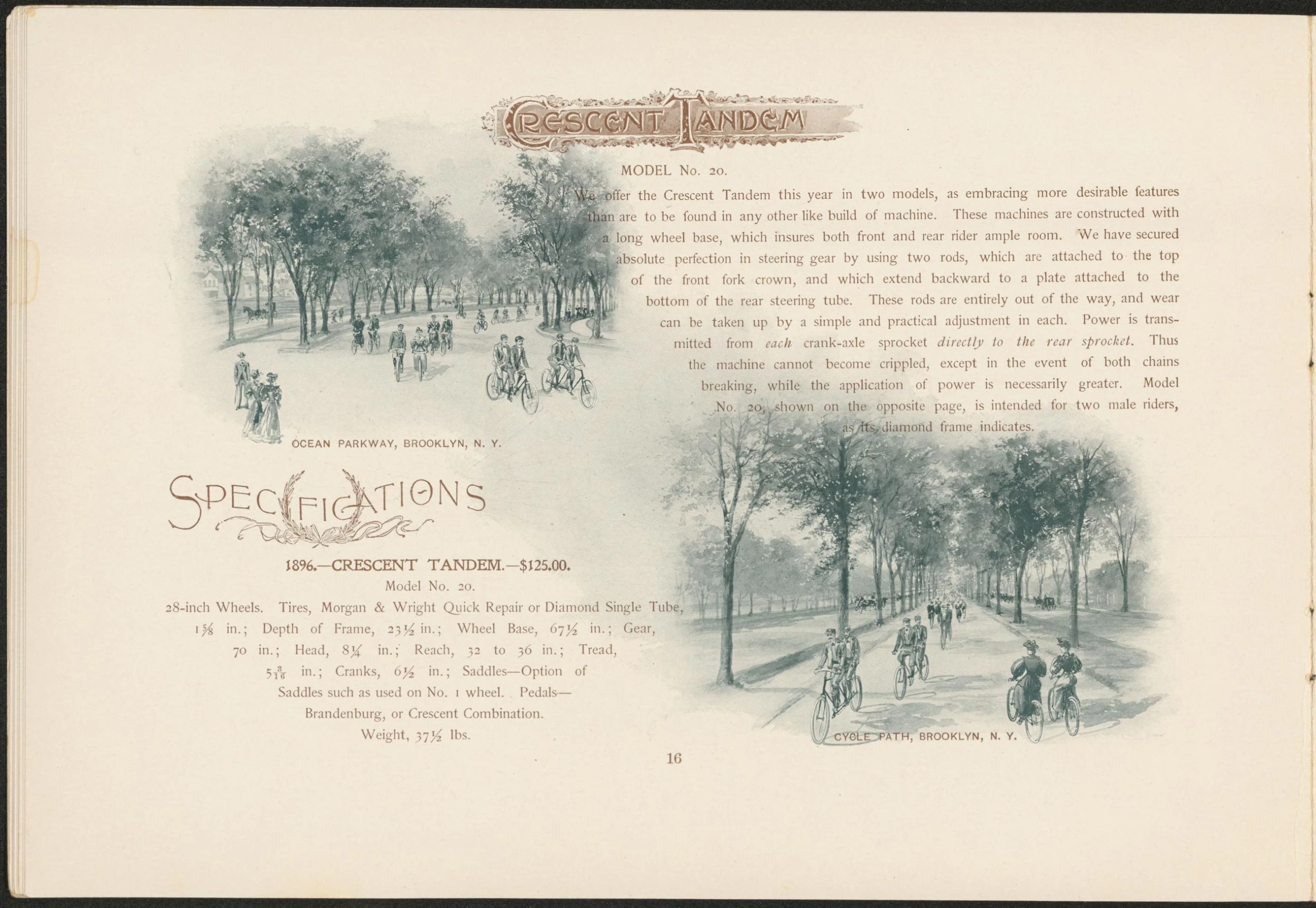
Crescent Tandem
MODEL No. 20.
We offer the Crescent Tandem this year in two models, as embracing more desirable features than are to be found in any other like build of machine. These machines are constructed with a long wheel base, which insures both front and rear rider ample room. We have secured absolute perfection in steering gear by using two rods, which are attached to the top of the front fork crown, and which extend backward to a plate attached to the bottom of the rear steering tube. These rods are entirely out of the way, and wear can be taken up by a simple and practical adjustment in each. Power is transmitted from each crank-axle sprocket directly to the rear sprocket. Thus the machine cannot become crippled, except in the event of both chains breaking, while the application of power is necessarily greater. Model No. 20, shown on the opposite page, is intended for two male riders, as its diamond frame indicates.
Specifications
1896.—CRESCENT TANDEM.—$125.00.
Model No. 20.
28-inch Wheels. Tires, Morgan & Wright Quick Repair or Diamond Single Tube, 1 5/8 in.; Depth of Frame, 23 1/2 in.; Wheel Base, 67 1/2 in.; Gear, 70 in.; Head, 8 1/4 in.; Reach, 32 to 36 in.; Tread, 5 3/16 in.; Cranks, 6 1/2 in.; Saddles—Option of Saddles such as used on No. 1 wheel. Pedals—Brandenburg, or Crescent Combination.
Weight, 37 1/2 lbs.
OCEAN PARKWAY, BROOKLYN, N. Y.
CYCLE PATH, BROOKLYN, N. Y.
16
[A text page with the heading “Crescent Tandem” and an ornamental “Specifications” title in brown, and two vignetted halftones of tree-lined Brooklyn parkways crowded with cyclists, among them men on tandems and women riding drop-frame safeties.]
— Page 19 —
Crescent Tandem
17
[A side-view engraving in brown of the Crescent Tandem Model No. 20, a double diamond-frame tandem with two saddles, two handlebars, steering rods from the front fork crown back to the rear head and twin chains to the rear wheel, with a small halftone vignette at upper right of a draped woman seated on a crescent moon.]
— Page 20 —
Crescent Tandem
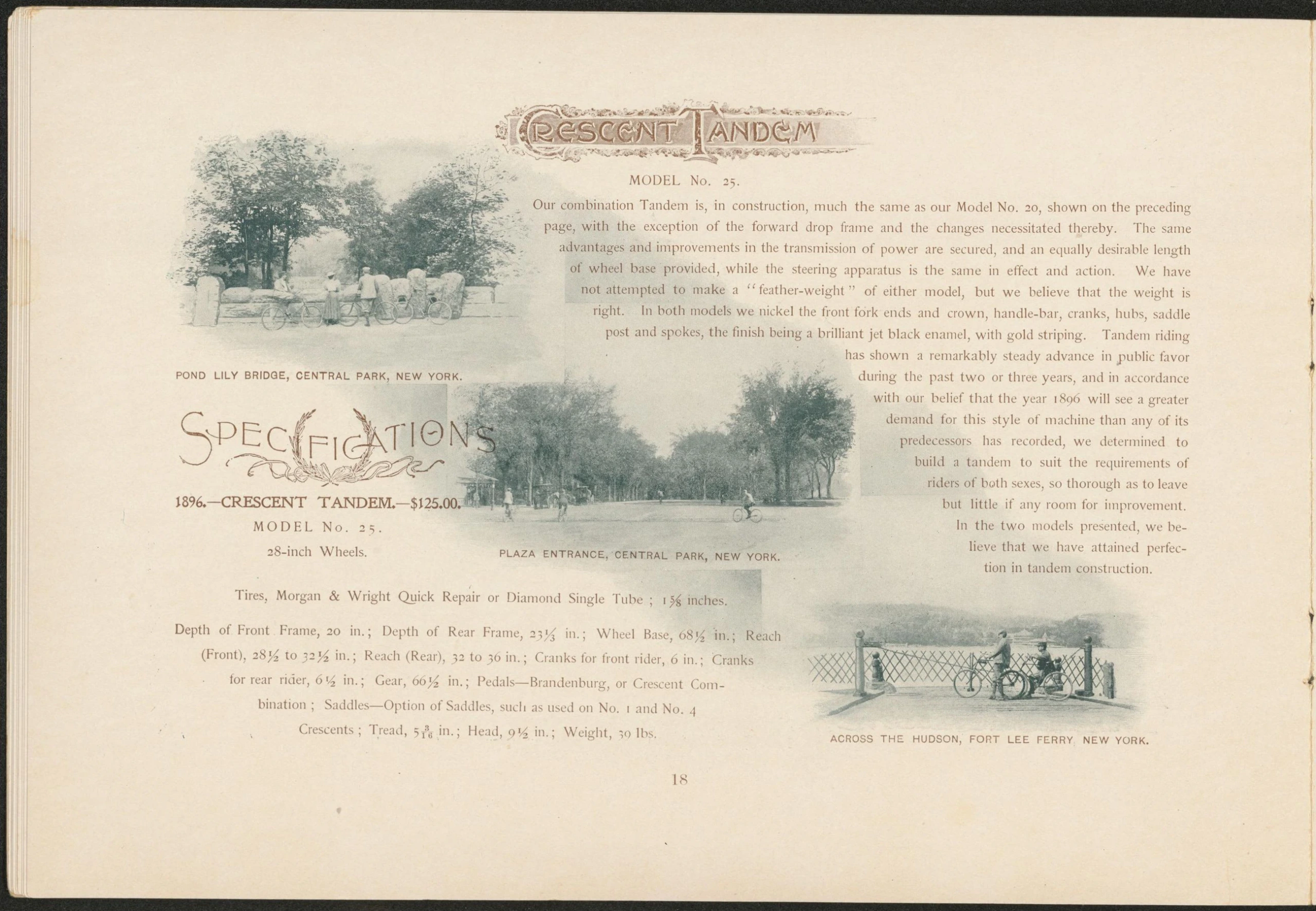
MODEL No. 25.
Our combination Tandem is, in construction, much the same as our Model No. 20, shown on the preceding page, with the exception of the forward drop frame and the changes necessitated thereby. The same advantages and improvements in the transmission of power are secured, and an equally desirable length of wheel base provided, while the steering apparatus is the same in effect and action. We have not attempted to make a “feather-weight” of either model, but we believe that the weight is right. In both models we nickel the front fork ends and crown, handle-bar, cranks, hubs, saddle post and spokes, the finish being a brilliant jet black enamel, with gold striping. Tandem riding has shown a remarkably steady advance in public favor during the past two or three years, and in accordance with our belief that the year 1896 will see a greater demand for this style of machine than any of its predecessors has recorded, we determined to build a tandem to suit the requirements of riders of both sexes, so thorough as to leave but little if any room for improvement. In the two models presented, we believe that we have attained perfection in tandem construction.
Specifications
1896.—CRESCENT TANDEM.—$125.00.
MODEL No. 25.
28-inch Wheels.
Tires, Morgan & Wright Quick Repair or Diamond Single Tube; 1 5/8 inches.
Depth of Front Frame, 20 in.; Depth of Rear Frame, 23 1/3 in.; Wheel Base, 68 1/2 in.; Reach (Front), 28 1/2 to 32 1/2 in.; Reach (Rear), 32 to 36 in.; Cranks for front rider, 6 in.; Cranks for rear rider, 6 1/2 in.; Gear, 66 1/2 in.; Pedals—Brandenburg, or Crescent Combination; Saddles—Option of Saddles, such as used on No. 1 and No. 4 Crescents; Tread, 5 3/16 in.; Head, 9 1/2 in.; Weight, 39 lbs.
POND LILY BRIDGE, CENTRAL PARK, NEW YORK.
PLAZA ENTRANCE, CENTRAL PARK, NEW YORK.
ACROSS THE HUDSON, FORT LEE FERRY, NEW YORK.
18
[A text page with the heading “Crescent Tandem” and an ornamental “Specifications” title in brown, and three halftones: cyclists with machines on a stone bridge, riders at a park entrance and two men with bicycles on a ferry deck behind a lattice gate.]
— Page 21 —
Crescent Tandem
19
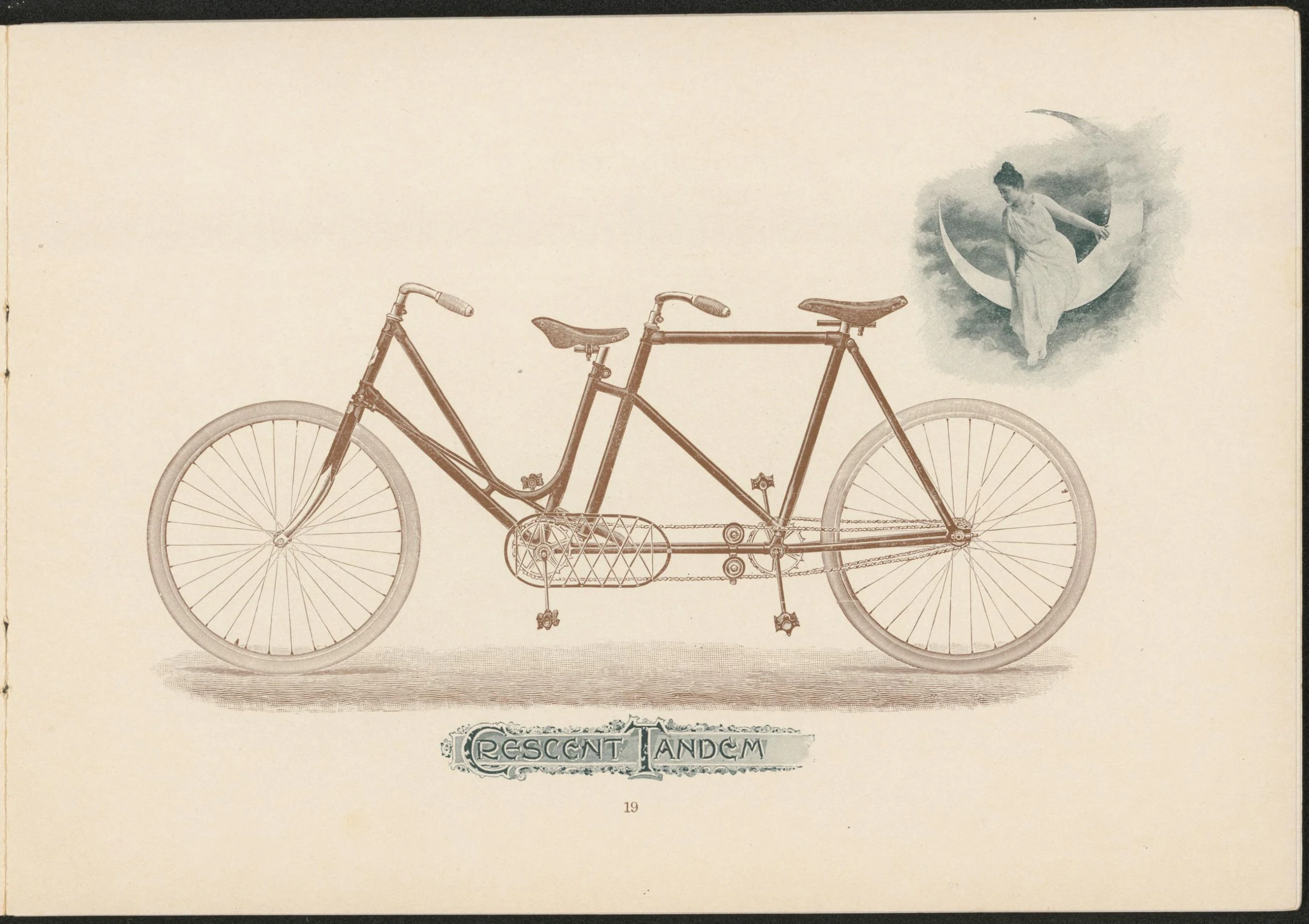
[A side-view engraving in brown of the Crescent Tandem Model No. 25, a combination tandem with a drop frame for the front rider and a diamond frame behind, two saddles and handlebars and a latticed chain guard, with a small halftone vignette at upper right of a draped woman seated on a crescent moon.]
— Page 22 —
Model No 2
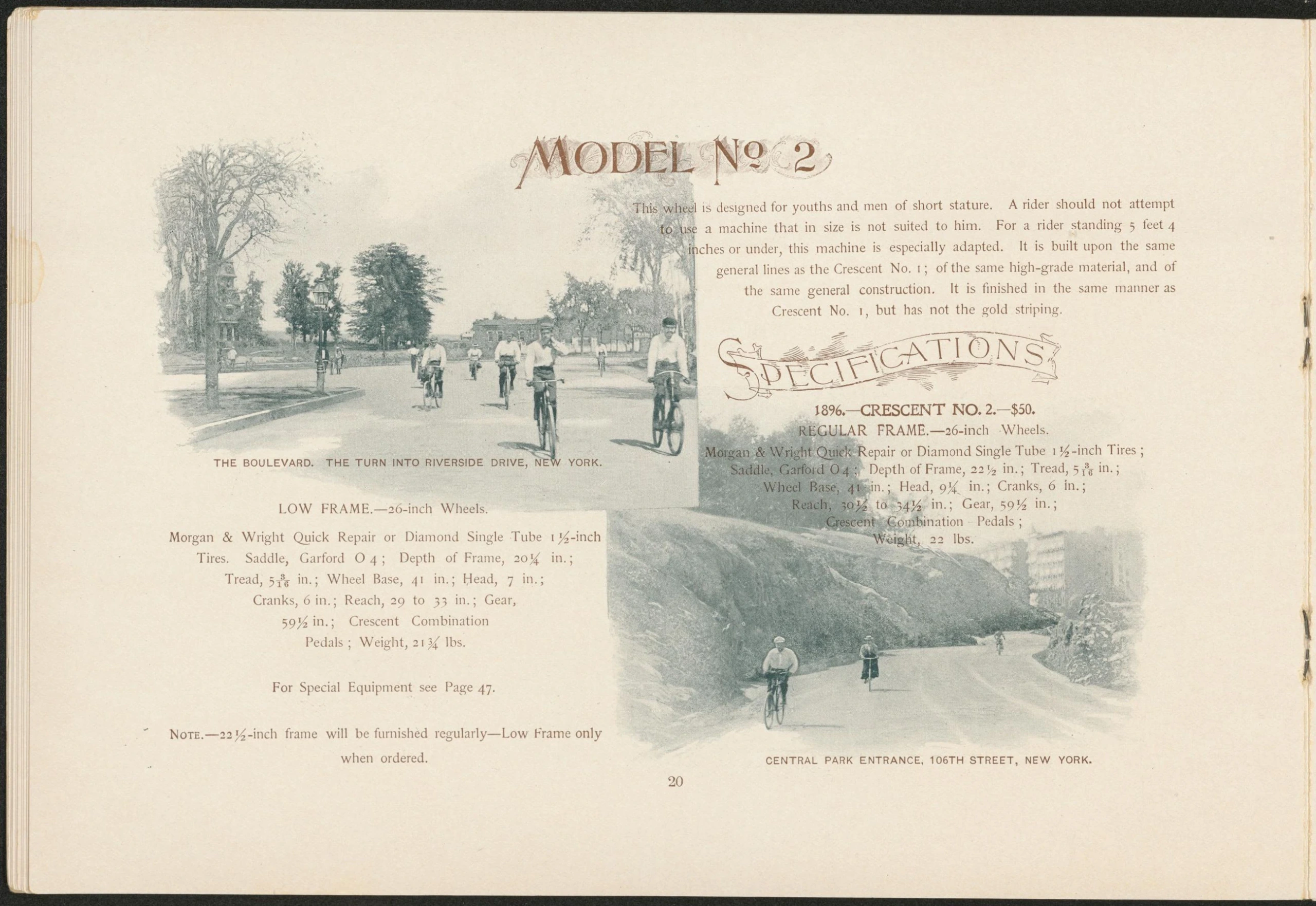
This wheel is designed for youths and men of short stature. A rider should not attempt to use a machine that in size is not suited to him. For a rider standing 5 feet 4 inches or under, this machine is especially adapted. It is built upon the same general lines as the Crescent No. 1; of the same high-grade material, and of the same general construction. It is finished in the same manner as Crescent No. 1, but has not the gold striping.
Specifications
1896.—CRESCENT NO. 2.—$50.
REGULAR FRAME.—26-inch Wheels.
Morgan & Wright Quick Repair or Diamond Single Tube 1 1/2-inch Tires; Saddle, Garford O 4; Depth of Frame, 22 1/2 in.; Tread, 5 3/16 in.; Wheel Base, 41 in.; Head, 9 1/4 in.; Cranks, 6 in.; Reach, 30 1/2 to 34 1/2 in.; Gear, 59 1/2 in.; Crescent Combination Pedals; Weight, 22 lbs.
LOW FRAME.—26-inch Wheels.
Morgan & Wright Quick Repair or Diamond Single Tube 1 1/2-inch Tires. Saddle, Garford O 4; Depth of Frame, 20 1/4 in.; Tread, 5 3/16 in.; Wheel Base, 41 in.; Head, 7 in.; Cranks, 6 in.; Reach, 29 to 33 in.; Gear, 59 1/2 in.; Crescent Combination Pedals; Weight, 21 3/4 lbs.
For Special Equipment see Page 47.
NOTE.—22 1/2-inch frame will be furnished regularly—Low Frame only when ordered.
THE BOULEVARD. THE TURN INTO RIVERSIDE DRIVE, NEW YORK.
CENTRAL PARK ENTRANCE, 106TH STREET, NEW YORK.
20
[A text page with the heading “Model No 2” and a ribbon “Specifications” title in brown, and two halftones: men riding toward the camera on a broad boulevard and two riders on a curving road below a rocky bank with apartment buildings beyond.]
— Page 23 —
Model No 2
21
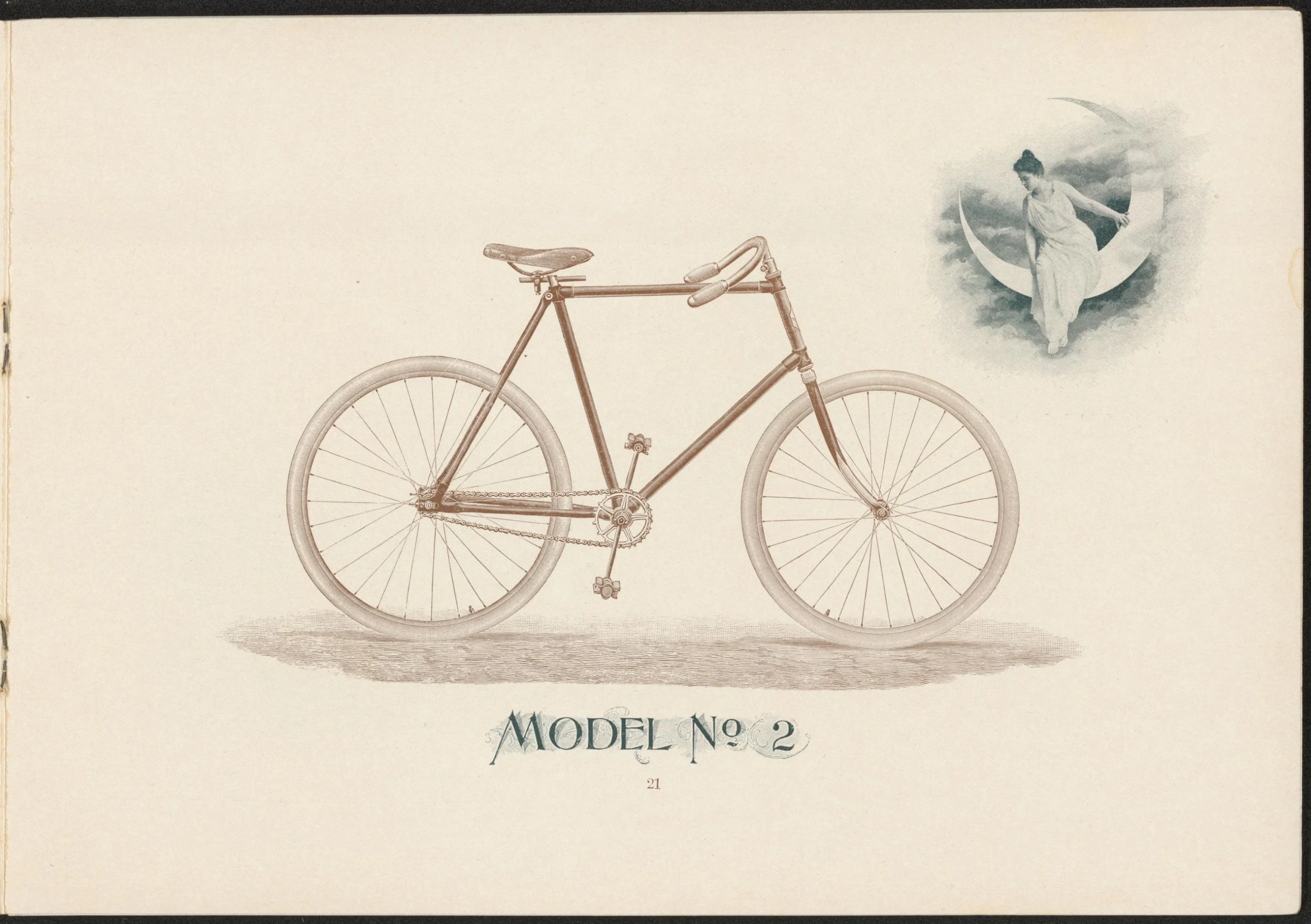
[A side-view engraving in brown of the Model No. 2 men’s diamond-frame safety for youths and short riders, with dropped handlebar and smaller wheels, with a small halftone vignette at upper right of a draped woman seated on a crescent moon.]
— Page 24 —
Model No 5
This is our small ladies’ and misses’ wheel. Its design has been carefully looked into, and the price places it within the reach of all. The large sale it has had in years past proves its popularity. The army of riders that this wheel is adapted to is so large that it would be difficult to enumerate them. Many ladies do not require that their wheel shall contain all of the very latest improvements, or be of an extreme light weight, but are satisfied with one of a moderate price, that is staunch and reliable, that can be ridden every day in the year, and that will bring the rider safely home. For such we can commend our Crescent No. 5. It has the same quality of bearings, is constructed in as thorough a manner, and is finished in the same style as Crescent No. 4, but without the gold striping. Both in point of finish and in easy-running and wearing qualities, our No. 5 certainly has no superior.
Specifications
1896.—CRESCENT NO. 5.—$50.00.
26-inch Wheels.
Morgan & Wright Quick Repair or Diamond Single Tube 1 1/2-inch Tires.
Saddle, Garford O 3; Depth of Frame, 19 in.; Tread, 5 3/16 in.; Wheel Base, 41 in.; Head, 9 1/4 in.; Cranks, 6 in.; Reach, 27 to 31 in.; Gear, 59 1/2 in.; Crescent Combination Pedals; Weight, 24 1/2 lbs.
For Special Equipment see Page 47.
OVER THE HILL INTO ORANGE VALLEY, NEW JERSEY.
ORANGE VALLEY, NEW JERSEY.
22
[A text page with the heading “Model No 5” and a floral “Specifications” title in brown, and two halftones: a rider with bicycles at a suburban crossroads and two men resting on a grassy verge beside a sidewalk with a bicycle propped near them.]
— Page 25 —
Model No 5
23
[A side-view engraving in brown of the Model No. 5 small ladies’ and misses’ drop-frame safety with upright handlebar, laced dress guard, latticed chain guard and front mudguard, with a small halftone vignette at upper right of a draped woman seated on a crescent moon.]
— Page 26 —
Model No 3
No. 3 is our boys’ machine, and the average “Young American” can see all of its good points without the aid of a lengthy description. It is only necessary to say that it is constructed in the same manner as the No. 2, and is made of the same material. It is carefully assembled and finished; is high grade, of lightest weight, and in fact everything that the “little man” could want. It will coast just as far as his father’s wheel, and will climb hills just as easily. Parents sometimes make the mistake of deciding that “anything with two wheels and a handle-bar” will do for the boy. The average boy feels the keenest pride in his wheel, and the better constructed it is, the better care he will take of it in most instances. Our No. 3 is a strong and serviceable wheel, but it is a wheel whose owner can feel assured is the highest grade bicycle built, of its size. It is handsomely finished in jet black enamel, with nickeled points, and will prove a mount that any young wheelman may well feel proud of.
Specifications
1896.—CRESCENT NO. 3.—$40.00.
24-inch Wheels.
Morgan & Wright Quick Repair or Diamond Single Tube 1 1/2-inch Tires.
Saddle, Garford O 4; Depth of Frame, 20 in.; Tread, 5 3/16 in.; Wheel Base, 38 1/2 in.; Head, 8 1/4 in.; Cranks, 5 1/2 in.; Reach, 28 to 32 in.; Gear, 55 in.; Crescent Combination Pedals; Weight, 21 1/4 lbs.
LOW FRAME.—Depth of Frame, 18 in.; Head, 7 1/4 in.; Leg Measure, 26 to 30 in.; Weight, 21 lbs.
For Special Equipment see Page 47.
NOTE.—20-inch Frame will be sent, unless Low Frame is specially ordered.
YE OLDE MEEKER INN, ON THE ROAD TO ELIZABETH, N. J.
THE POST OFFICE, OPPOSITE YE OLDE MEEKER INN, NEW JERSEY
24
[A text page with the heading “Model No 3” and an ornamental “Specifications” title in brown, and two halftones: cyclists with their machines before a clapboard roadside inn with awnings and a horse-drawn wagon outside a small frame post office beneath trees.]
— Page 27 —
Model No 3
25
[A side-view engraving in brown of the Model No. 3 boys’ diamond-frame safety on 24-inch wheels with dropped handlebar, with a small halftone vignette at upper right of a draped woman seated on a crescent moon.]
— Page 28 —
Model No 6
This is our girl’s wheel, and although it is rather well down the line in price and number, we have gone into the details just as fully as for our $75 Crescent. There are a great number of ladies now riding our Crescent No. 4 who, as girls, learned to ride on our Crescent No. 6. It is built on the same general lines and of the same quality of material as the No. 5, but is smaller in size, so as to fit a “little woman.” The all-important point of sufficient distance between handle-bar and saddle to admit of ample room for mounting or dismounting, leisurely or hastily as desired, has been considered as fully in our No. 6 as in our No. 5 Model. The finish is the same as on Crescent No. 5, and in the dress and mud-guard equipment, in careful construction, and all other points that go to satisfy the purchaser, our No. 6 is fully up to the Crescent standard.
Specifications
1896.—CRESCENT NO. 6.—$40.00.
24-inch Wheels.
Morgan & Wright Quick Repair or Diamond Single Tube 1 1/2-inch Tires.
Saddle, Garford O 3; Depth of Frame, 16 3/4 in.; Tread, 5 3/16 in.; Wheel Base, 37 1/2 in.; Head, 8 1/4 in.; Cranks, 5 1/2 in.; Reach, 24 1/2 to 28 1/2 in.; Gear, 55 in.; Crescent Combination Pedals; Weight, 23 lbs.
For Special Equipment see Page 47.
ARTESIAN WELL, LINCOLN PARK, A FAMOUS RESTING SPOT FOR WHEELMEN.
LINCOLN STATUE, LINCOLN PARK, CHICAGO.
26
[A text page with the heading “Model No 6” and an ornamental “Specifications” title in brown, and two halftones in Chicago’s Lincoln Park: wheelmen with bicycles gathered by a pavilion among bare trees and a rider passing the steps of the Lincoln statue.]
— Page 29 —
Model No 6
27
[A side-view engraving in brown of the Model No. 6 girl’s drop-frame safety on 24-inch wheels with upright handlebar, laced dress guard, latticed chain guard and front mudguard, with a small halftone vignette at upper right of a draped woman seated on a crescent moon.]
— Page 30 —
Models 7 & 8
These, we believe, are the only high-grade bicycles of their size upon the market. We have received so many orders for wheels of this size that we have decided to build them regularly. Wherever these wheels have been shown a demand for them at once developed. They are the lightest weight bicycles of regular build in the world. They are constructed of the very finest material, and in the same careful manner, as regards detail and outline, as our highest priced models. The parts are all perfectly interchangeable, and the finish is the same as upon Crescents No. 3 and No. 6. They are designed for little riders of from four to eight years of age, and are built upon the same general lines as Crescents No. 1 and No. 4. Notwithstanding that they are babies’ wheels, just as much time, and almost as much material is required in their construction, as in that of a full-sized bicycle. The illustrations on the opposite page will show the careful attention paid to detail, the Diamond Frame being our Model No. 7, and the Drop Frame Model No. 8.
Specifications
1896.—CRESCENT NO. 7.—$40.00.
20-inch Wheels.
Tires, M. & W. Quick Repair, 1 1/2 in.; Crescent Saddle; Depth of Frame, 14 1/2 in.; Wheel Base, 31 in.; Head, 6 1/2 in.; Cranks, 4 in.; Reach, 21 to 25 in.; Gear, 43 in.; Crescent Combination Pedals; Weight, 16 lbs.
1896.—CRESCENT NO. 8.—$40.00.
20-inch Wheels.
Tires, M. & W. Quick Repair, 1 1/2 in.; Crescent Saddle; Depth of Frame, 14 in.; Wheel Base, 31 in.; Head, 6 1/2 in.; Cranks, 4 in.; Reach, 20 1/2 to 24 1/2 in.; Gear, 43 in.; Crescent Combination Pedals; Weight, 17 lbs.
NOTE.—We design a special handle-bar for these models, to insure comfort and safety to the riders, and also to guard against their having to stoop or reach for the handle-bar.
CANTILEVER BRIDGE OVER LAGOON, LINCOLN PARK, CHICAGO.
RYERSON MONUMENT, LINCOLN PARK, CHICAGO.
EAGLE CAGE, LINCOLN PARK, CHICAGO.
28
[A text page with the script heading “Models 7 & 8” and a script “Specifications” title in brown, and three halftones in Lincoln Park, Chicago: an arched footbridge over a lagoon, cyclists beside a statue on a pedestal and a domed eagle cage with a horse and buggy and bicycles.]
— Page 31 —
Models 7 & 8
29
[Side-view engravings in brown of the two children’s models on 20-inch wheels: the Model No. 7 diamond frame at upper left and the Model No. 8 drop frame with dress guard and latticed chain guard at lower right, both with raised handlebars; an ornamental title panel at lower left and a halftone vignette at upper right of a draped woman seated on a crescent moon.]
— Page 32 —
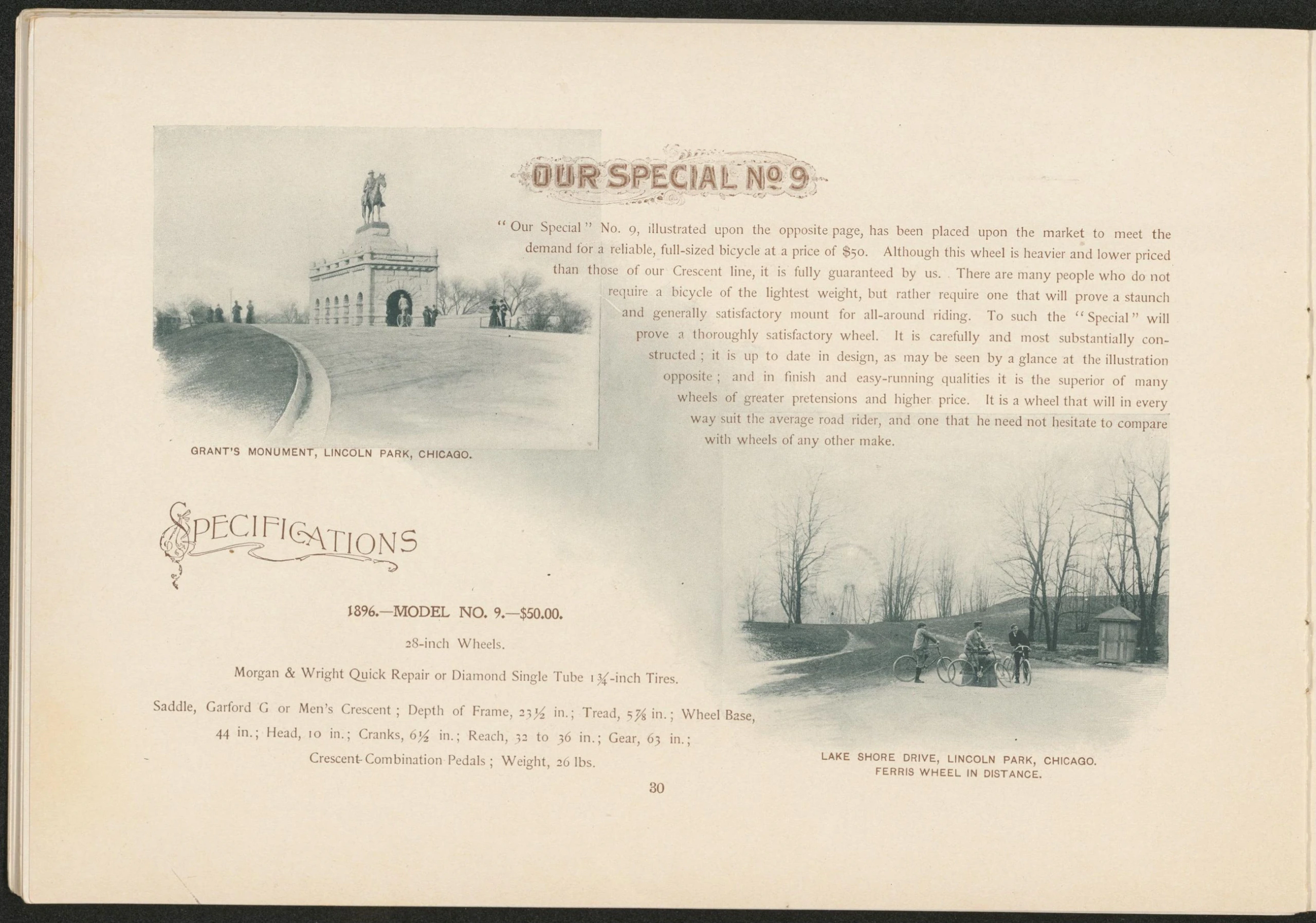
Our Special No 9
“Our Special” No. 9, illustrated upon the opposite page, has been placed upon the market to meet the demand for a reliable, full-sized bicycle at a price of $50. Although this wheel is heavier and lower priced than those of our Crescent line, it is fully guaranteed by us. There are many people who do not require a bicycle of the lightest weight, but rather require one that will prove a staunch and generally satisfactory mount for all-around riding. To such the “Special” will prove a thoroughly satisfactory wheel. It is carefully and most substantially constructed; it is up to date in design, as may be seen by a glance at the illustration opposite; and in finish and easy-running qualities it is the superior of many wheels of greater pretensions and higher price. It is a wheel that will in every way suit the average road rider, and one that he need not hesitate to compare with wheels of any other make.
Specifications
1896.—MODEL NO. 9.—$50.00.
28-inch Wheels.
Morgan & Wright Quick Repair or Diamond Single Tube 1 3/4-inch Tires.
Saddle, Garford G or Men’s Crescent; Depth of Frame, 23 1/2 in.; Tread, 5 7/8 in.; Wheel Base, 44 in.; Head, 10 in.; Cranks, 6 1/2 in.; Reach, 32 to 36 in.; Gear, 63 in.; Crescent Combination Pedals; Weight, 26 lbs.
GRANT’S MONUMENT, LINCOLN PARK, CHICAGO.
LAKE SHORE DRIVE, LINCOLN PARK, CHICAGO.
FERRIS WHEEL IN DISTANCE.
30
[A text page with the heading “Our Special No 9” and a script “Specifications” title in brown, and two halftones: the equestrian Grant monument on its arched base with strollers, and three men with bicycles on a park drive among bare trees with the Ferris wheel in the distance.]
— Page 33 —
Our Special No 9
31
[A side-view engraving in brown of “Our Special” No. 9, a full-sized men’s diamond-frame safety with dropped handlebar and heavier tires, with a small halftone vignette at upper right of a draped woman seated on a crescent moon.]
— Page 34 —
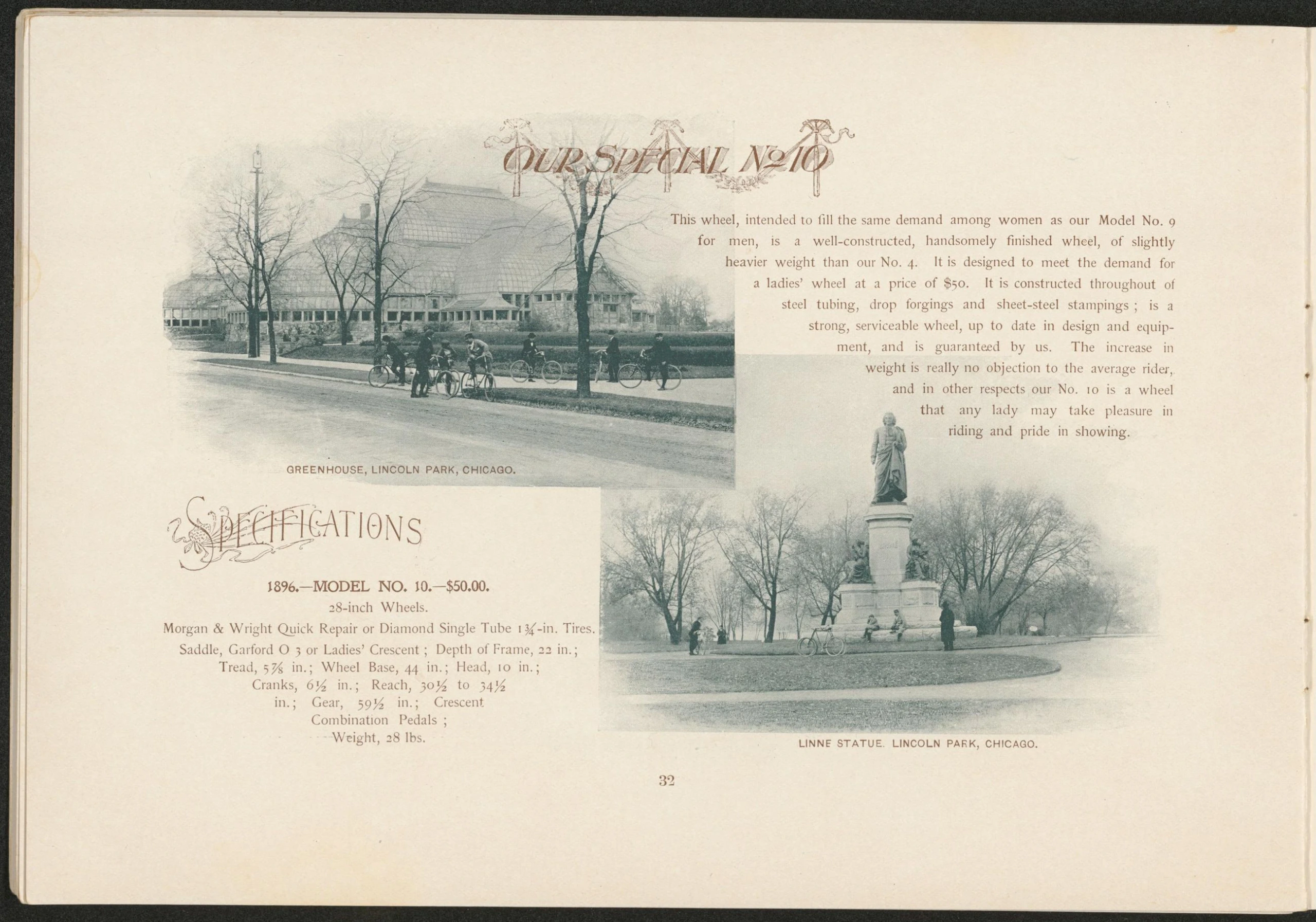
Our Special No 10
This wheel, intended to fill the same demand among women as our Model No. 9 for men, is a well-constructed, handsomely finished wheel, of slightly heavier weight than our No. 4. It is designed to meet the demand for a ladies’ wheel at a price of $50. It is constructed throughout of steel tubing, drop forgings and sheet-steel stampings; is a strong, serviceable wheel, up to date in design and equipment, and is guaranteed by us. The increase in weight is really no objection to the average rider, and in other respects our No. 10 is a wheel that any lady may take pleasure in riding and pride in showing.
Specifications
1896.—MODEL NO. 10.—$50.00.
28-inch Wheels.
Morgan & Wright Quick Repair or Diamond Single Tube 1 3/4-in. Tires.
Saddle, Garford O 3 or Ladies’ Crescent; Depth of Frame, 22 in.; Tread, 5 7/8 in.; Wheel Base, 44 in.; Head, 10 in.; Cranks, 6 1/2 in.; Reach, 30 1/2 to 34 1/2 in.; Gear, 59 1/2 in.; Crescent Combination Pedals; Weight, 28 lbs.
GREENHOUSE, LINCOLN PARK, CHICAGO.
LINNE STATUE. LINCOLN PARK, CHICAGO.
32
[A text page with the heading “Our Special No 10” hung from ribbons and a “Specifications” title in brown, and two halftones in Lincoln Park, Chicago: wheelmen with bicycles before the glass conservatory and a statue on a tall pedestal among bare trees with a bicycle on the lawn.]
— Page 35 —
Our Special No 10
33
[A side-view engraving in brown of “Our Special” No. 10, a full-sized ladies’ drop-frame safety with upright handlebar, laced dress guard, latticed chain guard and front mudguard, with a small halftone vignette at upper right of a draped woman seated on a crescent moon; the title hung from ribbons below.]
— Page 36 —
The Home of Crescent Bicycles
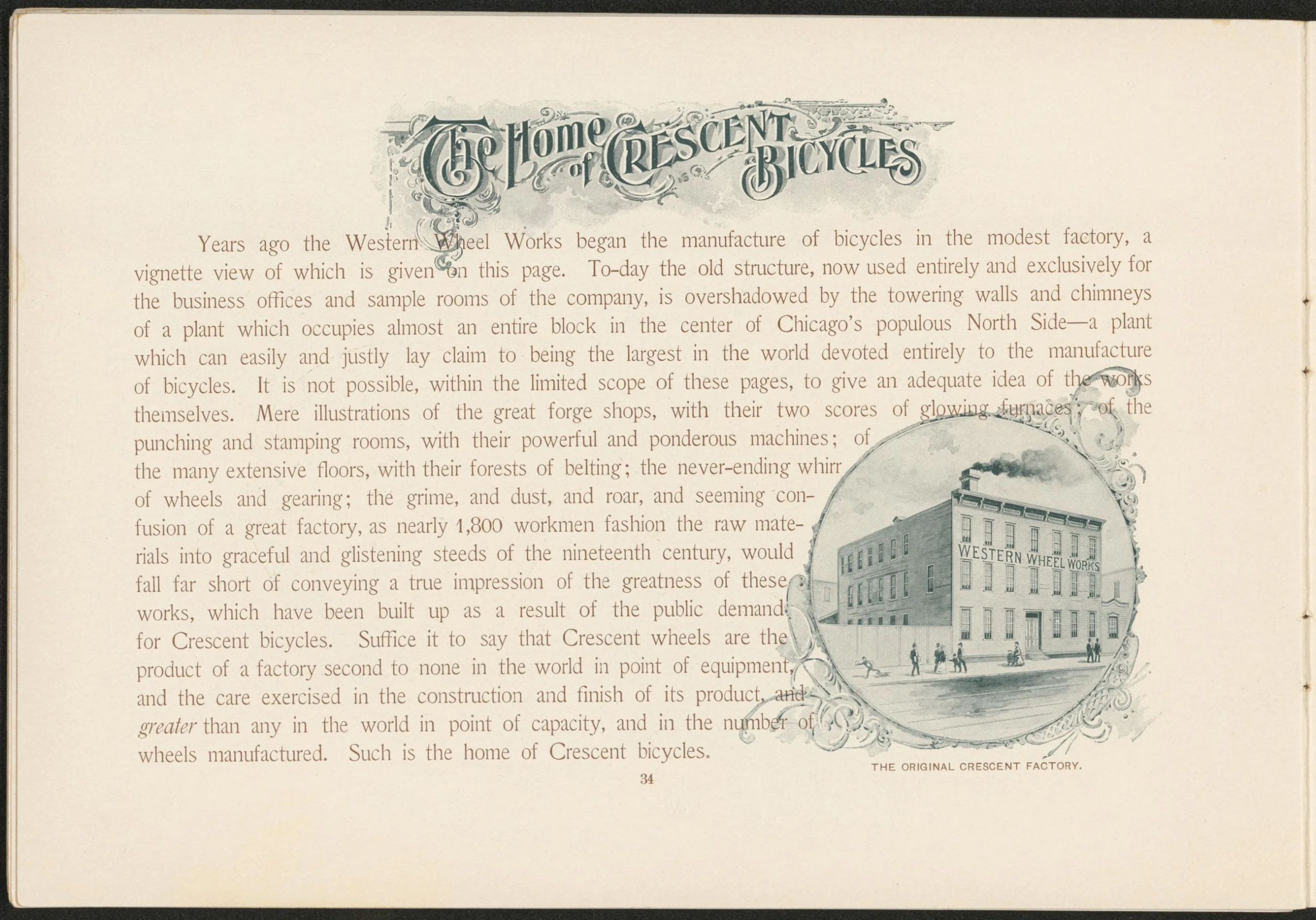
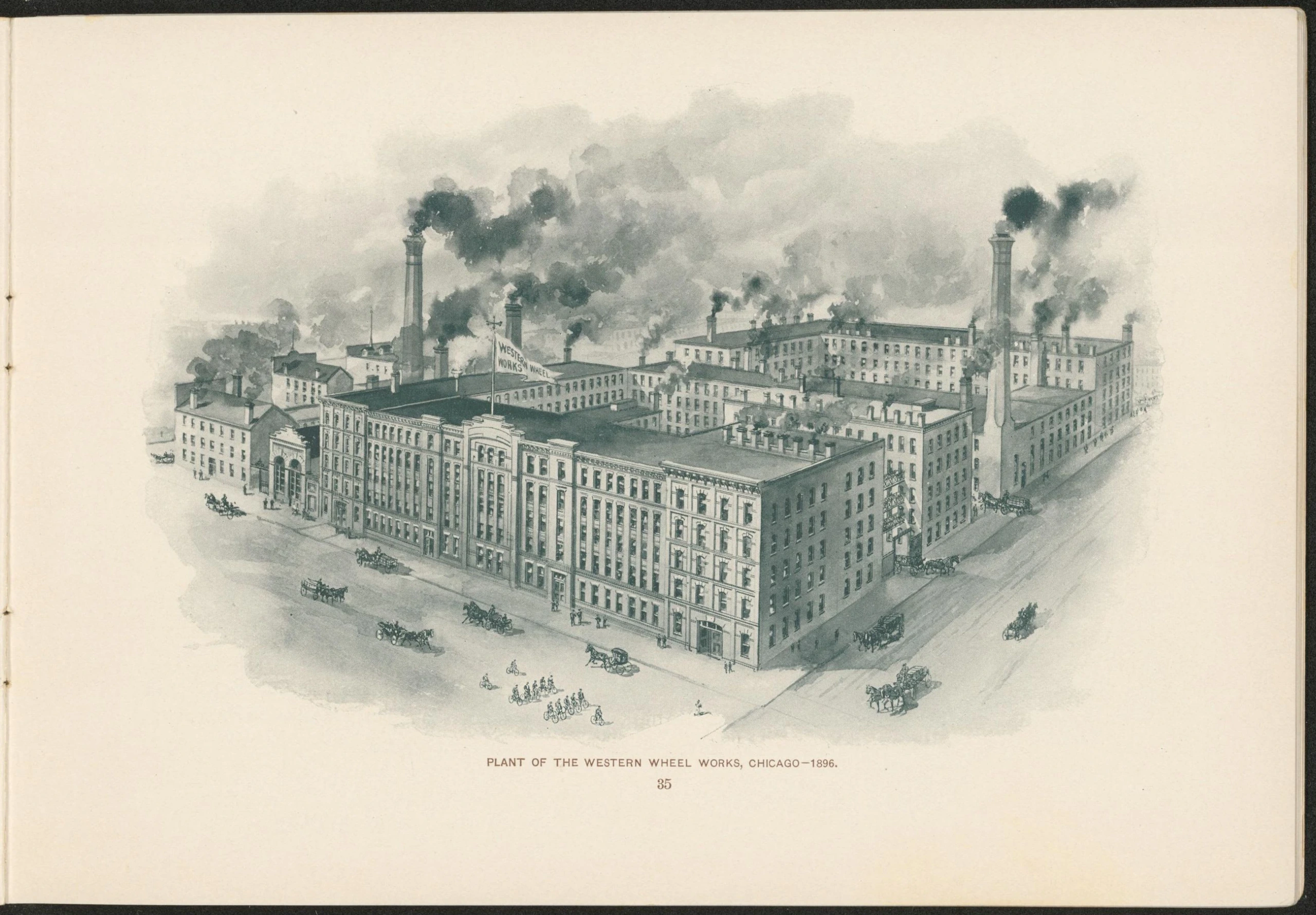
Years ago the Western Wheel Works began the manufacture of bicycles in the modest factory, a vignette view of which is given on this page. To-day the old structure, now used entirely and exclusively for the business offices and sample rooms of the company, is overshadowed by the towering walls and chimneys of a plant which occupies almost an entire block in the center of Chicago’s populous North Side—a plant which can easily and justly lay claim to being the largest in the world devoted entirely to the manufacture of bicycles. It is not possible, within the limited scope of these pages, to give an adequate idea of the works themselves. Mere illustrations of the great forge shops, with their two scores of glowing furnaces; of the punching and stamping rooms, with their powerful and ponderous machines; of the many extensive floors, with their forests of belting; the never-ending whirr of wheels and gearing; the grime, and dust, and roar, and seeming confusion of a great factory, as nearly 1,800 workmen fashion the raw materials into graceful and glistening steeds of the nineteenth century, would fall far short of conveying a true impression of the greatness of these works, which have been built up as a result of the public demand for Crescent bicycles. Suffice it to say that Crescent wheels are the product of a factory second to none in the world in point of equipment, and the care exercised in the construction and finish of its product, and greater than any in the world in point of capacity, and in the number of wheels manufactured. Such is the home of Crescent bicycles.
WESTERN WHEEL WORKS
THE ORIGINAL CRESCENT FACTORY.
34
[A text page headed “The Home of Crescent Bicycles” in ornamental lettering, with a circular vignette engraving framed in scrollwork of the original Crescent factory, a three-story corner building lettered “Western Wheel Works” with a smoking chimney and figures on the street.]
— Page 37 —
WESTERN WHEEL WORKS
PLANT OF THE WESTERN WHEEL WORKS, CHICAGO—1896.
35
[A full-page vignetted bird’s-eye engraving of the Western Wheel Works plant, a block of multistory brick factory buildings with tall smoking chimneys and a flag lettered “Western Wheel Works”, with horse-drawn wagons and groups of cyclists in the streets.]
— Page 38 —
Speed and Endurance
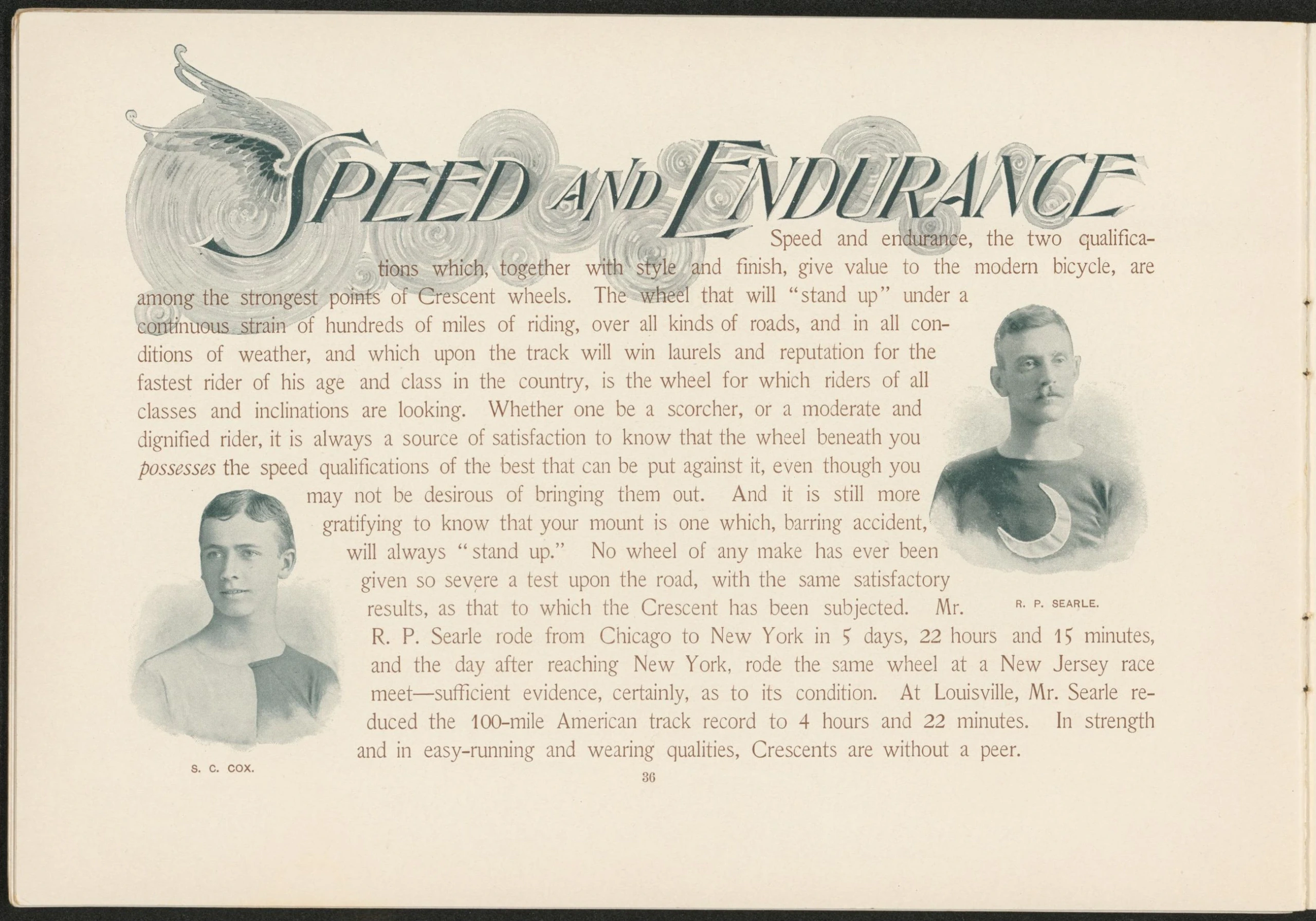
Speed and endurance, the two qualifications which, together with style and finish, give value to the modern bicycle, are among the strongest points of Crescent wheels. The wheel that will “stand up” under a continuous strain of hundreds of miles of riding, over all kinds of roads, and in all conditions of weather, and which upon the track will win laurels and reputation for the fastest rider of his age and class in the country, is the wheel for which riders of all classes and inclinations are looking. Whether one be a scorcher, or a moderate and dignified rider, it is always a source of satisfaction to know that the wheel beneath you possesses the speed qualifications of the best that can be put against it, even though you may not be desirous of bringing them out. And it is still more gratifying to know that your mount is one which, barring accident, will always “stand up.” No wheel of any make has ever been given so severe a test upon the road, with the same satisfactory results, as that to which the Crescent has been subjected. Mr. R. P. Searle rode from Chicago to New York in 5 days, 22 hours and 15 minutes, and the day after reaching New York, rode the same wheel at a New Jersey race meet—sufficient evidence, certainly, as to its condition. At Louisville, Mr. Searle reduced the 100-mile American track record to 4 hours and 22 minutes. In strength and in easy-running and wearing qualities, Crescents are without a peer.
R. P. SEARLE.
S. C. COX.
36
[A text page headed “Speed and Endurance” in winged italic capitals over swirling disks, with two vignetted halftone portraits: R. P. Searle, mustached, in a jersey with a crescent emblem, and the young rider S. C. Cox in a two-tone jersey.]
— Page 39 —
Construction
The degree of care exercised in the construction of a bicycle very largely determines the period of its life, and not infrequently has much to do with the life of its rider. A wheel constructed of poor materials, hastily and carelessly put together, is not only poor value for the money invested in it—no matter how low the price—but is a constant menace to the life and limb of its rider. It is, therefore, well worth the while of every purchaser of a bicycle, to be sure that the machine he contemplates buying has been properly constructed, that only the very best of materials have been used, and that the builders are both experienced and responsible. It is largely to their structural merit that Crescent wheels owe their present enviable reputation for speed and endurance. They are not only up to date in design, finish and improvements, but are unquestionably the equal of any, and the superior of many, in point of strength and absolute reliability. Only the best and most carefully selected materials are used, and these are so skillfully treated at the hands of expert workmen, that the possibility of breakage is reduced to the minimum, while the easy-running qualities of the wheel are known in every country where bicycle riding has become popular. The unequaled equipment of the Western Wheel Works factory, embracing the most improved and expensive machinery employed in bicycle building; the fact that all important parts are interchangeable, and that they are rigidly and carefully tested before leaving the factory, are points so well known as to scarcely require mention here. Some reference, however, to those structural features which have placed Crescents in the front rank of American-built wheels, may not be wholly without interest.
37
[A text page headed “Construction” in ornamental lettering set over a faint vignette of a bicycle whose two wheels form the letters’ background.]
— Page 40 —
Construction
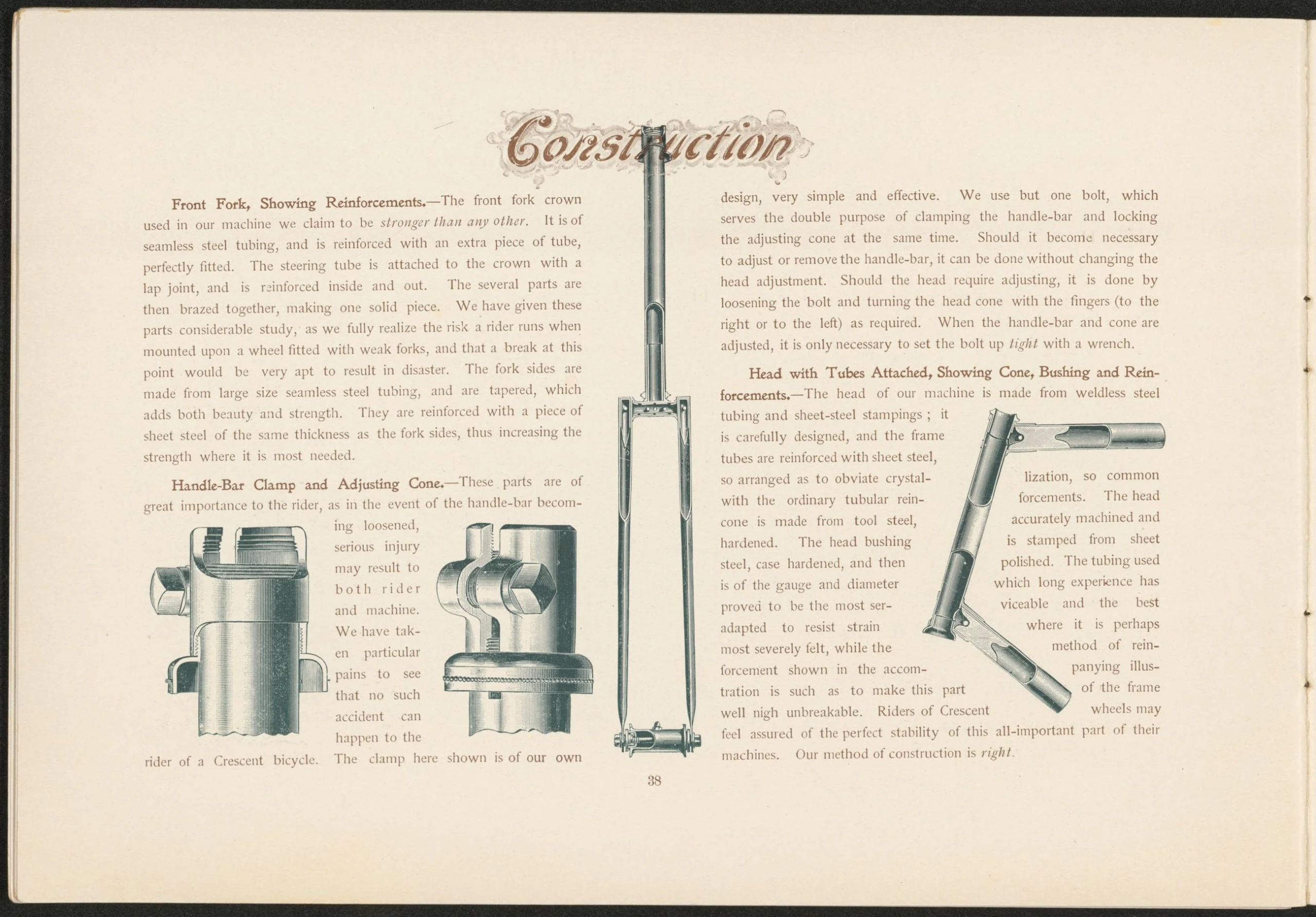
Front Fork, Showing Reinforcements.—The front fork crown used in our machine we claim to be stronger than any other. It is of seamless steel tubing, and is reinforced with an extra piece of tube, perfectly fitted. The steering tube is attached to the crown with a lap joint, and is reinforced inside and out. The several parts are then brazed together, making one solid piece. We have given these parts considerable study, as we fully realize the risk a rider runs when mounted upon a wheel fitted with weak forks, and that a break at this point would be very apt to result in disaster. The fork sides are made from large size seamless steel tubing, and are tapered, which adds both beauty and strength. They are reinforced with a piece of sheet steel of the same thickness as the fork sides, thus increasing the strength where it is most needed.
Handle-Bar Clamp and Adjusting Cone.—These parts are of great importance to the rider, as in the event of the handle-bar becoming loosened, serious injury may result to both rider and machine. We have taken particular pains to see that no such accident can happen to the rider of a Crescent bicycle. The clamp here shown is of our own design, very simple and effective. We use but one bolt, which serves the double purpose of clamping the handle-bar and locking the adjusting cone at the same time. Should it become necessary to adjust or remove the handle-bar, it can be done without changing the head adjustment. Should the head require adjusting, it is done by loosening the bolt and turning the head cone with the fingers (to the right or to the left) as required. When the handle-bar and cone are adjusted, it is only necessary to set the bolt up tight with a wrench.
Head with Tubes Attached, Showing Cone, Bushing and Reinforcements.—The head of our machine is made from weldless steel tubing and sheet-steel stampings; it is carefully designed, and the frame tubes are reinforced with sheet steel, so arranged as to obviate crystallization, so common with the ordinary tubular reinforcements. The head cone is made from tool steel, accurately machined and hardened. The head bushing is stamped from sheet steel, case hardened, and then polished. The tubing used is of the gauge and diameter which long experience has proved to be the most serviceable and the best adapted to resist strain where it is perhaps most severely felt, while the method of reinforcement shown in the accompanying illustration is such as to make this part of the frame well nigh unbreakable. Riders of Crescent wheels may feel assured of the perfect stability of this all-important part of their machines. Our method of construction is right.
38
[A two-column text page headed “Construction” in brown script, with engravings: a sectioned front fork with steering tube and crown down the center, two views of the handle-bar clamp and adjusting cone at lower left and a cutaway head with top and down tubes attached at right showing the internal reinforcements.]
— Page 41 —
Construction
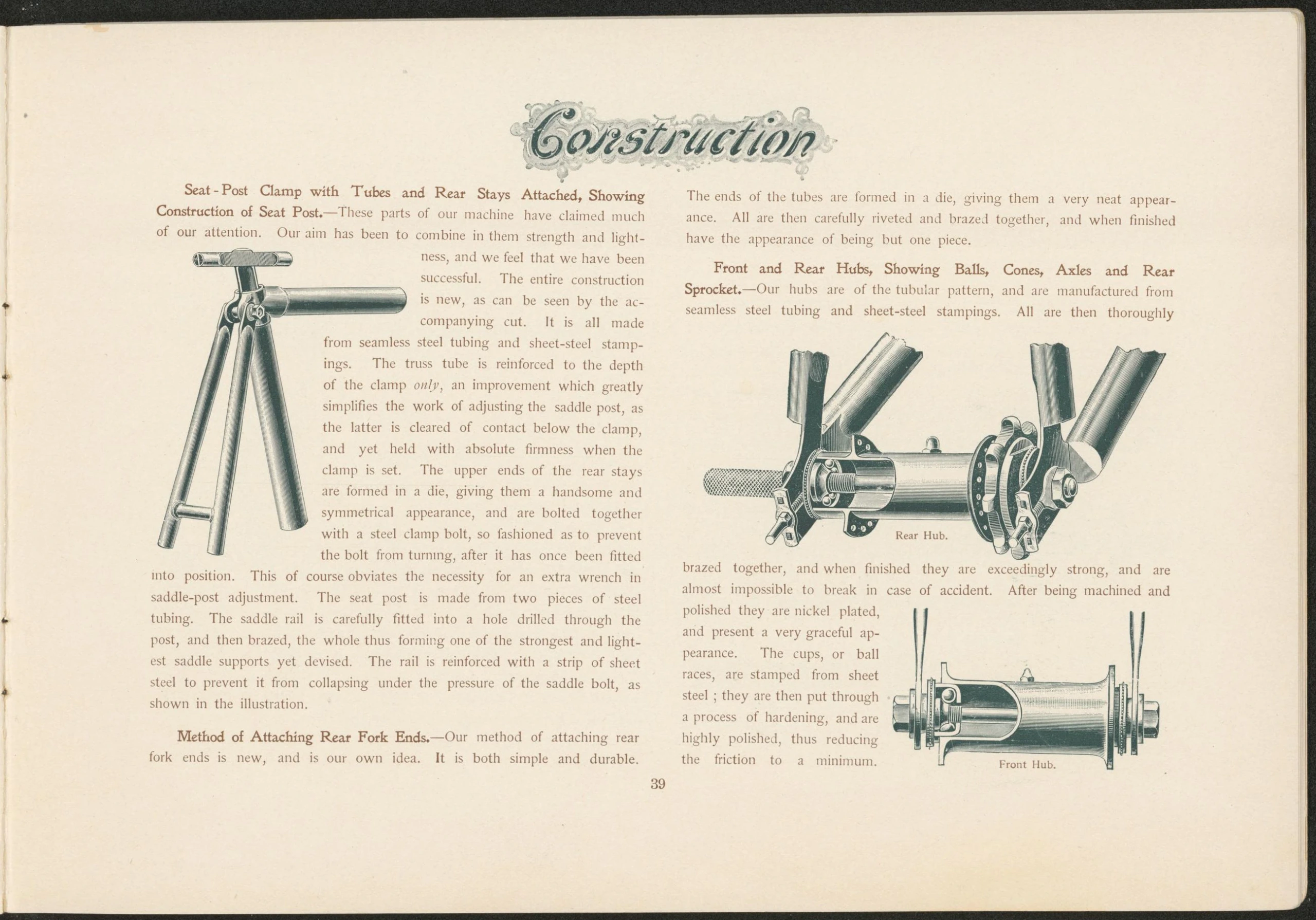
Seat-Post Clamp with Tubes and Rear Stays Attached, Showing Construction of Seat Post.—These parts of our machine have claimed much of our attention. Our aim has been to combine in them strength and lightness, and we feel that we have been successful. The entire construction is new, as can be seen by the accompanying cut. It is all made from seamless steel tubing and sheet-steel stampings. The truss tube is reinforced to the depth of the clamp only, an improvement which greatly simplifies the work of adjusting the saddle post, as the latter is cleared of contact below the clamp, and yet held with absolute firmness when the clamp is set. The upper ends of the rear stays are formed in a die, giving them a handsome and symmetrical appearance, and are bolted together with a steel clamp bolt, so fashioned as to prevent the bolt from turning, after it has once been fitted into position. This of course obviates the necessity for an extra wrench in saddle-post adjustment. The seat post is made from two pieces of steel tubing. The saddle rail is carefully fitted into a hole drilled through the post, and then brazed, the whole thus forming one of the strongest and lightest saddle supports yet devised. The rail is reinforced with a strip of sheet steel to prevent it from collapsing under the pressure of the saddle bolt, as shown in the illustration.
Method of Attaching Rear Fork Ends.—Our method of attaching rear fork ends is new, and is our own idea. It is both simple and durable. The ends of the tubes are formed in a die, giving them a very neat appearance. All are then carefully riveted and brazed together, and when finished have the appearance of being but one piece.
Front and Rear Hubs, Showing Balls, Cones, Axles and Rear Sprocket.—Our hubs are of the tubular pattern, and are manufactured from seamless steel tubing and sheet-steel stampings. All are then thoroughly brazed together, and when finished they are exceedingly strong, and are almost impossible to break in case of accident. After being machined and polished they are nickel plated, and present a very graceful appearance. The cups, or ball races, are stamped from sheet steel; they are then put through a process of hardening, and are highly polished, thus reducing the friction to a minimum.
Rear Hub.
Front Hub.
39
[A two-column text page headed “Construction” in script, with engravings of the seat-post clamp with the T-shaped seat post, seat tube and rear stays, a cutaway rear hub mounted in the fork ends with sprocket and cones, and a cutaway front hub showing the ball races.]
— Page 42 —
Construction
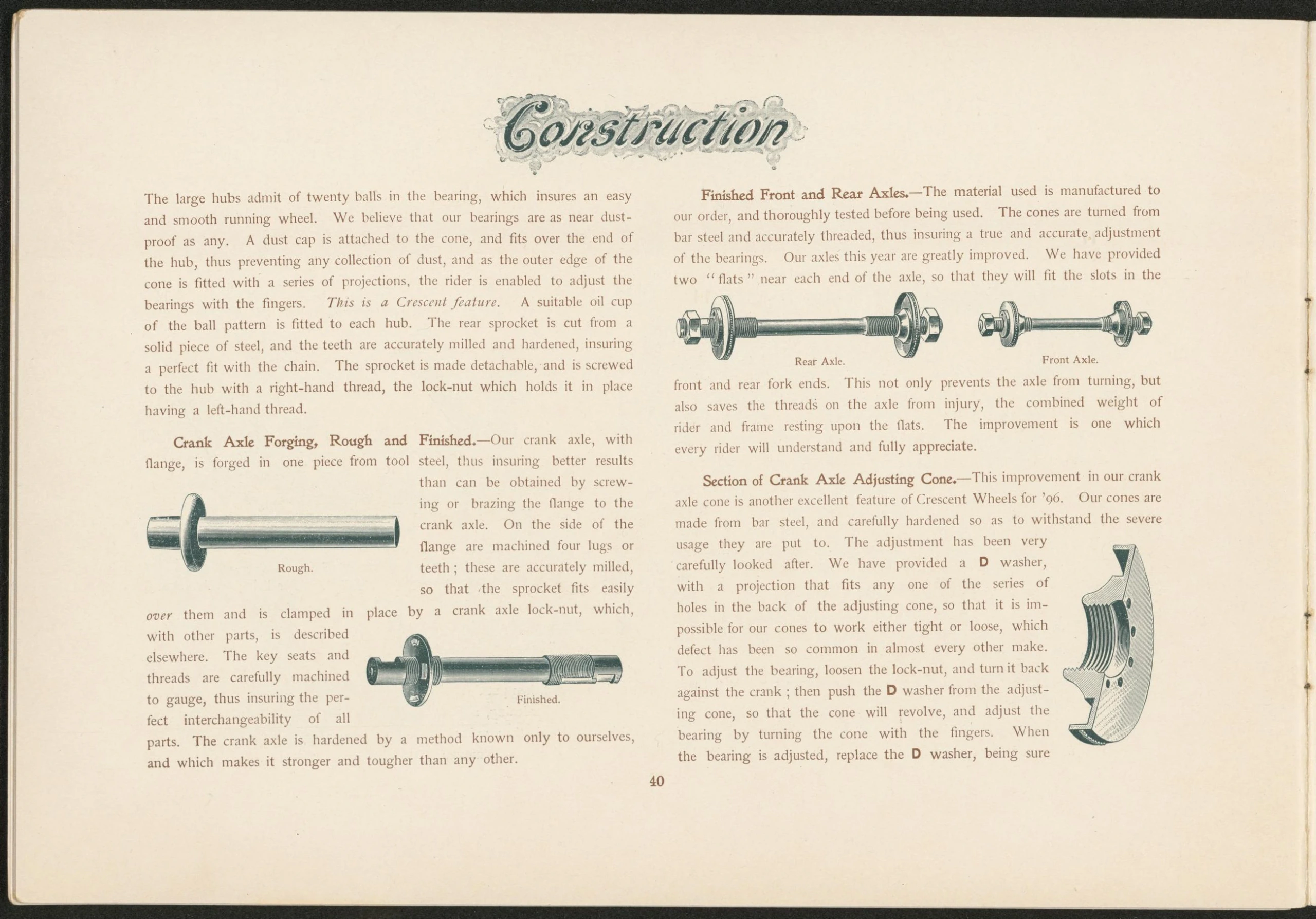
The large hubs admit of twenty balls in the bearing, which insures an easy and smooth running wheel. We believe that our bearings are as near dust-proof as any. A dust cap is attached to the cone, and fits over the end of the hub, thus preventing any collection of dust, and as the outer edge of the cone is fitted with a series of projections, the rider is enabled to adjust the bearings with the fingers. This is a Crescent feature. A suitable oil cup of the ball pattern is fitted to each hub. The rear sprocket is cut from a solid piece of steel, and the teeth are accurately milled and hardened, insuring a perfect fit with the chain. The sprocket is made detachable, and is screwed to the hub with a right-hand thread, the lock-nut which holds it in place having a left-hand thread.
Crank Axle Forging, Rough and Finished.—Our crank axle, with flange, is forged in one piece from tool steel, thus insuring better results than can be obtained by screwing or brazing the flange to the crank axle. On the side of the flange are machined four lugs or teeth; these are accurately milled, so that the sprocket fits easily over them and is clamped in place by a crank axle lock-nut, which, with other parts, is described elsewhere. The key seats and threads are carefully machined to gauge, thus insuring the perfect interchangeability of all parts. The crank axle is hardened by a method known only to ourselves, and which makes it stronger and tougher than any other.
Rough.
Finished.
Finished Front and Rear Axles.—The material used is manufactured to our order, and thoroughly tested before being used. The cones are turned from bar steel and accurately threaded, thus insuring a true and accurate adjustment of the bearings. Our axles this year are greatly improved. We have provided two “flats” near each end of the axle, so that they will fit the slots in the front and rear fork ends. This not only prevents the axle from turning, but also saves the threads on the axle from injury, the combined weight of rider and frame resting upon the flats. The improvement is one which every rider will understand and fully appreciate.
Rear Axle.
Front Axle.
Section of Crank Axle Adjusting Cone.—This improvement in our crank axle cone is another excellent feature of Crescent Wheels for ’96. Our cones are made from bar steel, and carefully hardened so as to withstand the severe usage they are put to. The adjustment has been very carefully looked after. We have provided a D washer, with a projection that fits any one of the series of holes in the back of the adjusting cone, so that it is impossible for our cones to work either tight or loose, which defect has been so common in almost every other make. To adjust the bearing, loosen the lock-nut, and turn it back against the crank; then push the D washer from the adjusting cone, so that the cone will revolve, and adjust the bearing by turning the cone with the fingers. When the bearing is adjusted, replace the D washer, being sure
40
[A two-column text page headed “Construction” in script, with engravings of the crank axle forging in rough and finished states, the finished rear and front axles with their cones and nuts and a sectioned crank axle adjusting cone.]
— Page 43 —
Construction
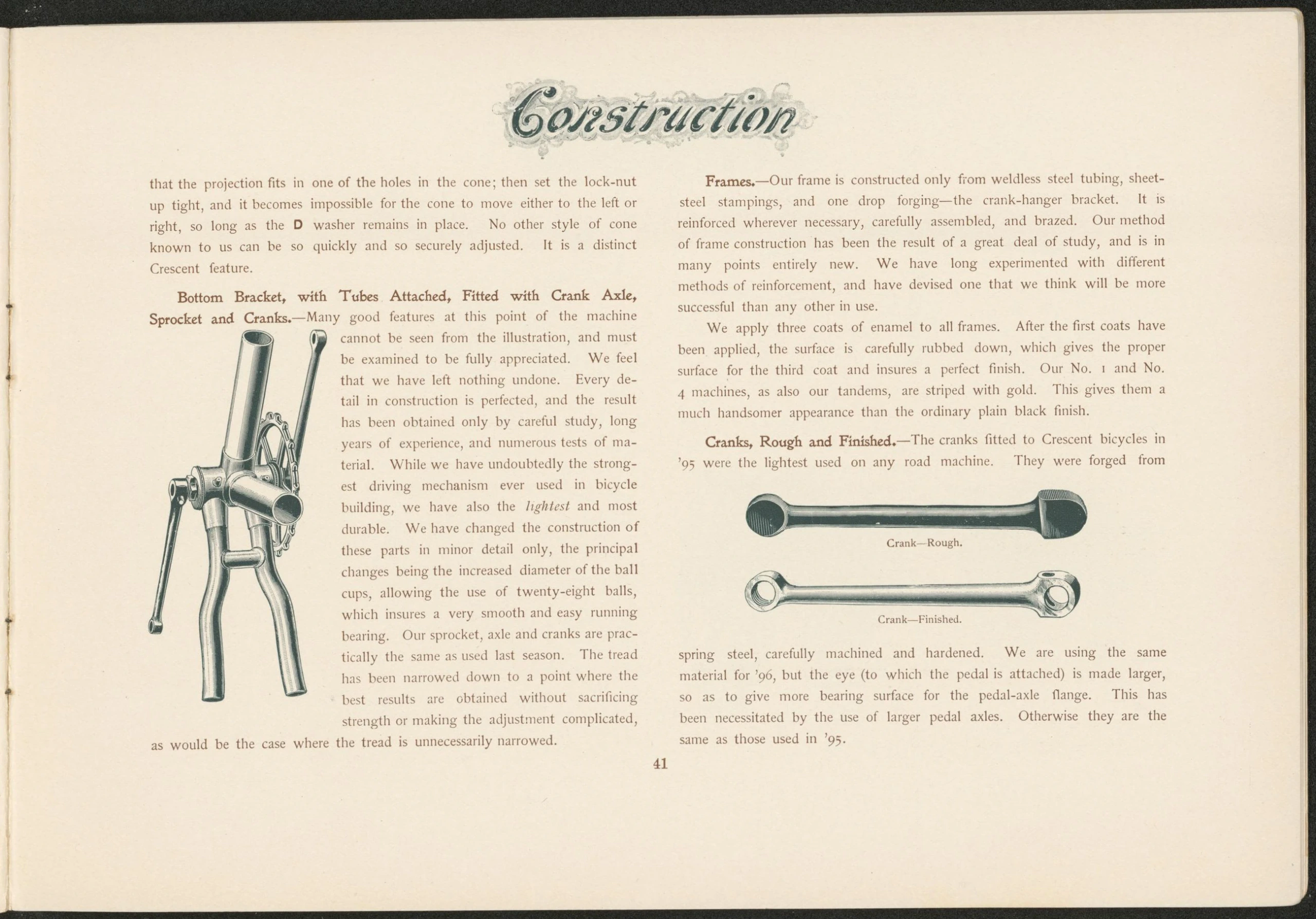
that the projection fits in one of the holes in the cone; then set the lock-nut up tight, and it becomes impossible for the cone to move either to the left or right, so long as the D washer remains in place. No other style of cone known to us can be so quickly and so securely adjusted. It is a distinct Crescent feature.
Bottom Bracket, with Tubes Attached, Fitted with Crank Axle, Sprocket and Cranks.—Many good features at this point of the machine cannot be seen from the illustration, and must be examined to be fully appreciated. We feel that we have left nothing undone. Every detail in construction is perfected, and the result has been obtained only by careful study, long years of experience, and numerous tests of material. While we have undoubtedly the strongest driving mechanism ever used in bicycle building, we have also the lightest and most durable. We have changed the construction of these parts in minor detail only, the principal changes being the increased diameter of the ball cups, allowing the use of twenty-eight balls, which insures a very smooth and easy running bearing. Our sprocket, axle and cranks are practically the same as used last season. The tread has been narrowed down to a point where the best results are obtained without sacrificing strength or making the adjustment complicated, as would be the case where the tread is unnecessarily narrowed.
Frames.—Our frame is constructed only from weldless steel tubing, sheet-steel stampings, and one drop forging—the crank-hanger bracket. It is reinforced wherever necessary, carefully assembled, and brazed. Our method of frame construction has been the result of a great deal of study, and is in many points entirely new. We have long experimented with different methods of reinforcement, and have devised one that we think will be more successful than any other in use.
We apply three coats of enamel to all frames. After the first coats have been applied, the surface is carefully rubbed down, which gives the proper surface for the third coat and insures a perfect finish. Our No. 1 and No. 4 machines, as also our tandems, are striped with gold. This gives them a much handsomer appearance than the ordinary plain black finish.
Cranks, Rough and Finished.—The cranks fitted to Crescent bicycles in ’95 were the lightest used on any road machine. They were forged from spring steel, carefully machined and hardened. We are using the same material for ’96, but the eye (to which the pedal is attached) is made larger, so as to give more bearing surface for the pedal-axle flange. This has been necessitated by the use of larger pedal axles. Otherwise they are the same as those used in ’95.
Crank—Rough.
Crank—Finished.
41
[A two-column text page headed “Construction” in script, with engravings of the bottom bracket assembly with seat tube, down tube, chain stays, sprocket and crank, and of a crank forging in rough and finished states.]
— Page 44 —
Construction
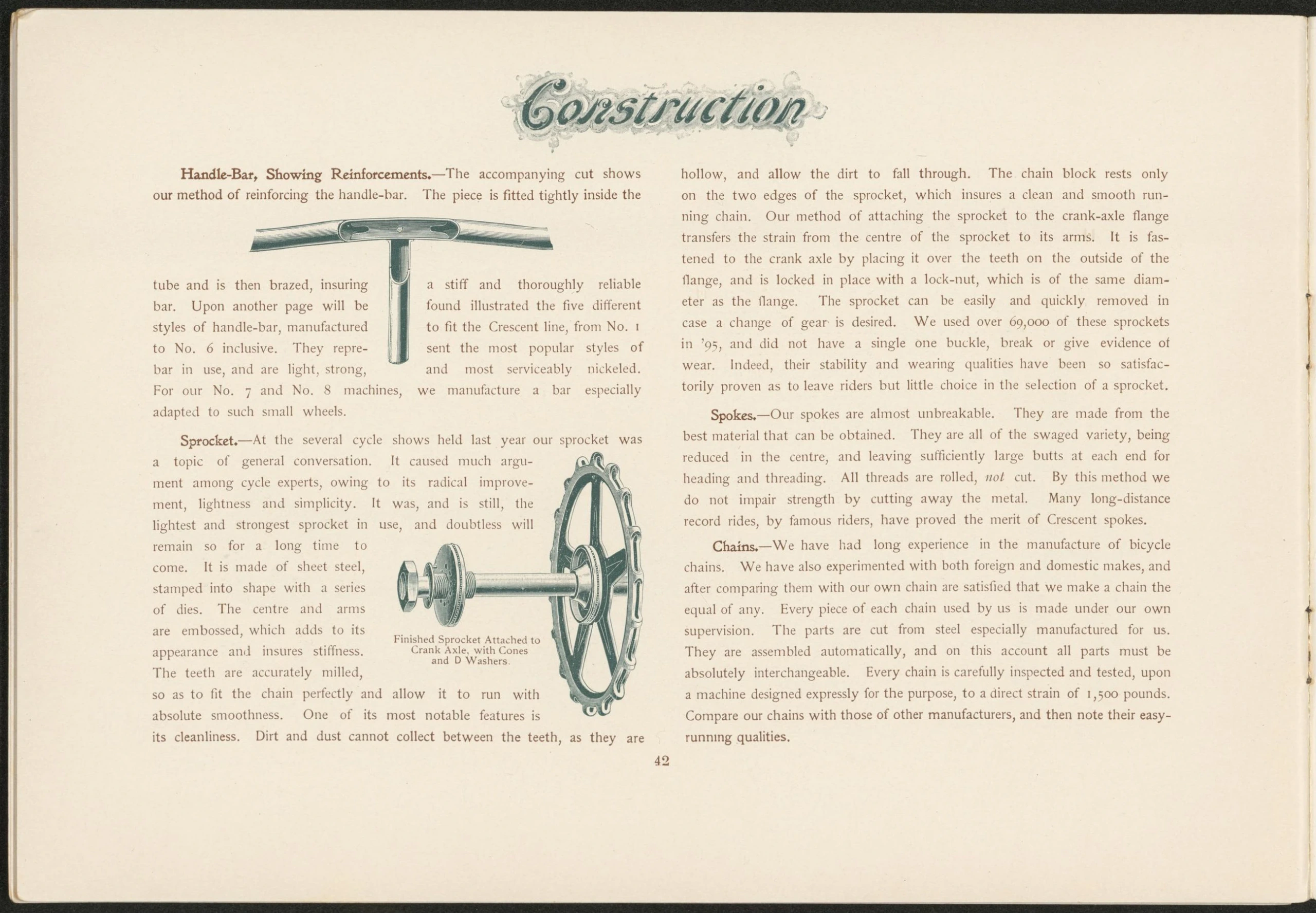
Handle-Bar, Showing Reinforcements.—The accompanying cut shows our method of reinforcing the handle-bar. The piece is fitted tightly inside the tube and is then brazed, insuring a stiff and thoroughly reliable bar. Upon another page will be found illustrated the five different styles of handle-bar, manufactured to fit the Crescent line, from No. 1 to No. 6 inclusive. They represent the most popular styles of bar in use, and are light, strong, and most serviceably nickeled. For our No. 7 and No. 8 machines, we manufacture a bar especially adapted to such small wheels.
Sprocket.—At the several cycle shows held last year our sprocket was a topic of general conversation. It caused much argument among cycle experts, owing to its radical improvement, lightness and simplicity. It was, and is still, the lightest and strongest sprocket in use, and doubtless will remain so for a long time to come. It is made of sheet steel, stamped into shape with a series of dies. The centre and arms are embossed, which adds to its appearance and insures stiffness. The teeth are accurately milled, so as to fit the chain perfectly and allow it to run with absolute smoothness. One of its most notable features is its cleanliness. Dirt and dust cannot collect between the teeth, as they are hollow, and allow the dirt to fall through. The chain block rests only on the two edges of the sprocket, which insures a clean and smooth running chain. Our method of attaching the sprocket to the crank-axle flange transfers the strain from the centre of the sprocket to its arms. It is fastened to the crank axle by placing it over the teeth on the outside of the flange, and is locked in place with a lock-nut, which is of the same diameter as the flange. The sprocket can be easily and quickly removed in case a change of gear is desired. We used over 69,000 of these sprockets in ’95, and did not have a single one buckle, break or give evidence of wear. Indeed, their stability and wearing qualities have been so satisfactorily proven as to leave riders but little choice in the selection of a sprocket.
Finished Sprocket Attached to Crank Axle, with Cones and D Washers.
Spokes.—Our spokes are almost unbreakable. They are made from the best material that can be obtained. They are all of the swaged variety, being reduced in the centre, and leaving sufficiently large butts at each end for heading and threading. All threads are rolled, not cut. By this method we do not impair strength by cutting away the metal. Many long-distance record rides, by famous riders, have proved the merit of Crescent spokes.
Chains.—We have had long experience in the manufacture of bicycle chains. We have also experimented with both foreign and domestic makes, and after comparing them with our own chain are satisfied that we make a chain the equal of any. Every piece of each chain used by us is made under our own supervision. The parts are cut from steel especially manufactured for us. They are assembled automatically, and on this account all parts must be absolutely interchangeable. Every chain is carefully inspected and tested, upon a machine designed expressly for the purpose, to a direct strain of 1,500 pounds. Compare our chains with those of other manufacturers, and then note their easy-running qualities.
42
[A two-column text page headed “Construction” in script, with engravings of a handle-bar cut away to show its internal reinforcing piece and stem, and of the five-armed stamped sprocket mounted on the crank axle with cones and D washers.]
— Page 45 —
Construction
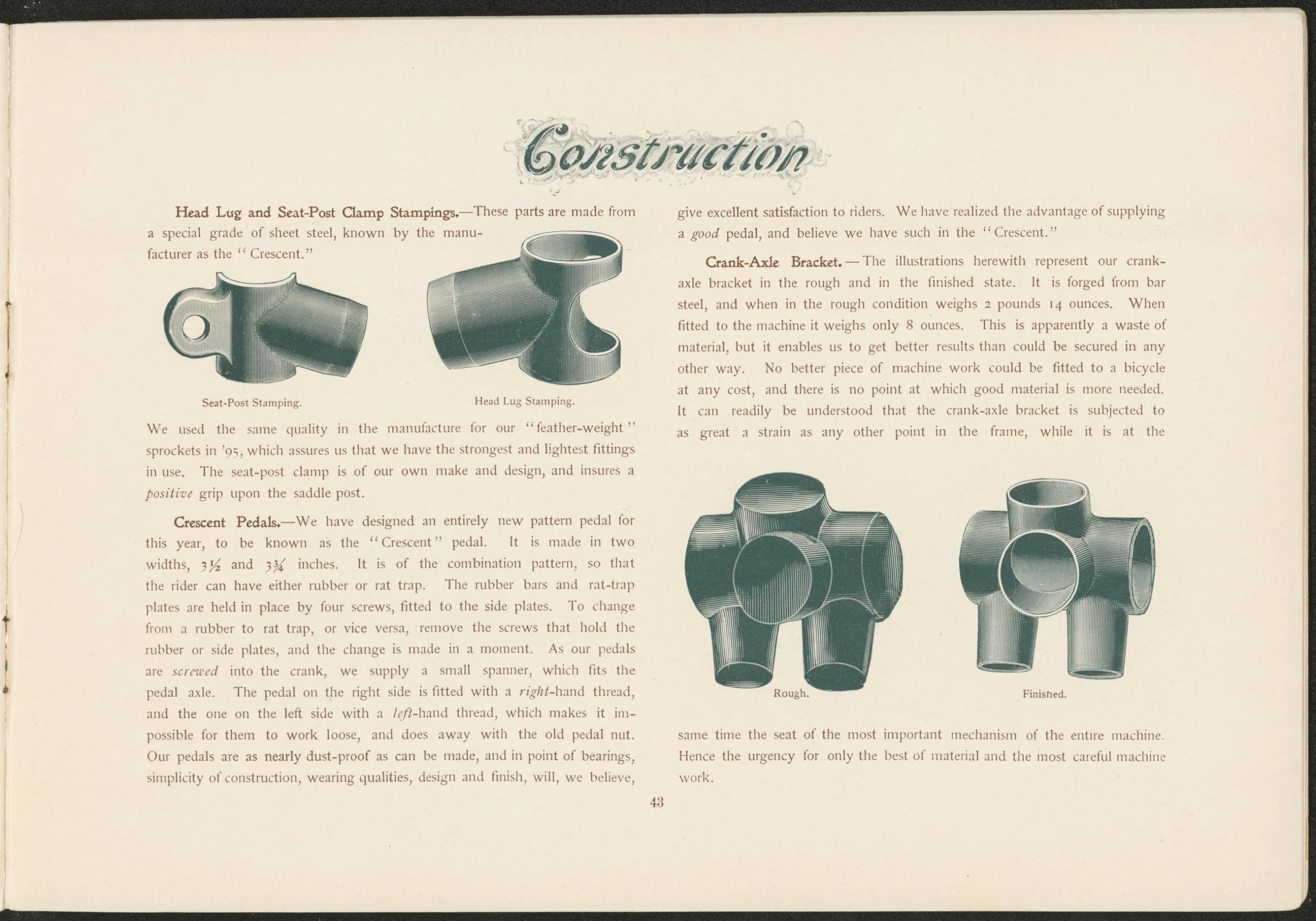
Head Lug and Seat-Post Clamp Stampings.—These parts are made from a special grade of sheet steel, known by the manufacturer as the “Crescent.”
Seat-Post Stamping.
Head Lug Stamping.
We used the same quality in the manufacture for our “feather-weight” sprockets in ’95, which assures us that we have the strongest and lightest fittings in use. The seat-post clamp is of our own make and design, and insures a positive grip upon the saddle post.
Crescent Pedals.—We have designed an entirely new pattern pedal for this year, to be known as the “Crescent” pedal. It is made in two widths, 3 1/2 and 3 3/4 inches. It is of the combination pattern, so that the rider can have either rubber or rat trap. The rubber bars and rat-trap plates are held in place by four screws, fitted to the side plates. To change from a rubber to rat trap, or vice versa, remove the screws that hold the rubber or side plates, and the change is made in a moment. As our pedals are screwed into the crank, we supply a small spanner, which fits the pedal axle. The pedal on the right side is fitted with a right-hand thread, and the one on the left side with a left-hand thread, which makes it impossible for them to work loose, and does away with the old pedal nut. Our pedals are as nearly dust-proof as can be made, and in point of bearings, simplicity of construction, wearing qualities, design and finish, will, we believe, give excellent satisfaction to riders. We have realized the advantage of supplying a good pedal, and believe we have such in the “Crescent.”
Crank-Axle Bracket.—The illustrations herewith represent our crank-axle bracket in the rough and in the finished state. It is forged from bar steel, and when in the rough condition weighs 2 pounds 14 ounces. When fitted to the machine it weighs only 8 ounces. This is apparently a waste of material, but it enables us to get better results than could be secured in any other way. No better piece of machine work could be fitted to a bicycle at any cost, and there is no point at which good material is more needed. It can readily be understood that the crank-axle bracket is subjected to as great a strain as any other point in the frame, while it is at the same time the seat of the most important mechanism of the entire machine. Hence the urgency for only the best of material and the most careful machine work.
Rough.
Finished.
43
[A two-column text page headed “Construction” in script, with engravings of the seat-post clamp and head lug stampings and of the crank-axle bracket forging in rough and finished states.]
— Page 46 —
Construction
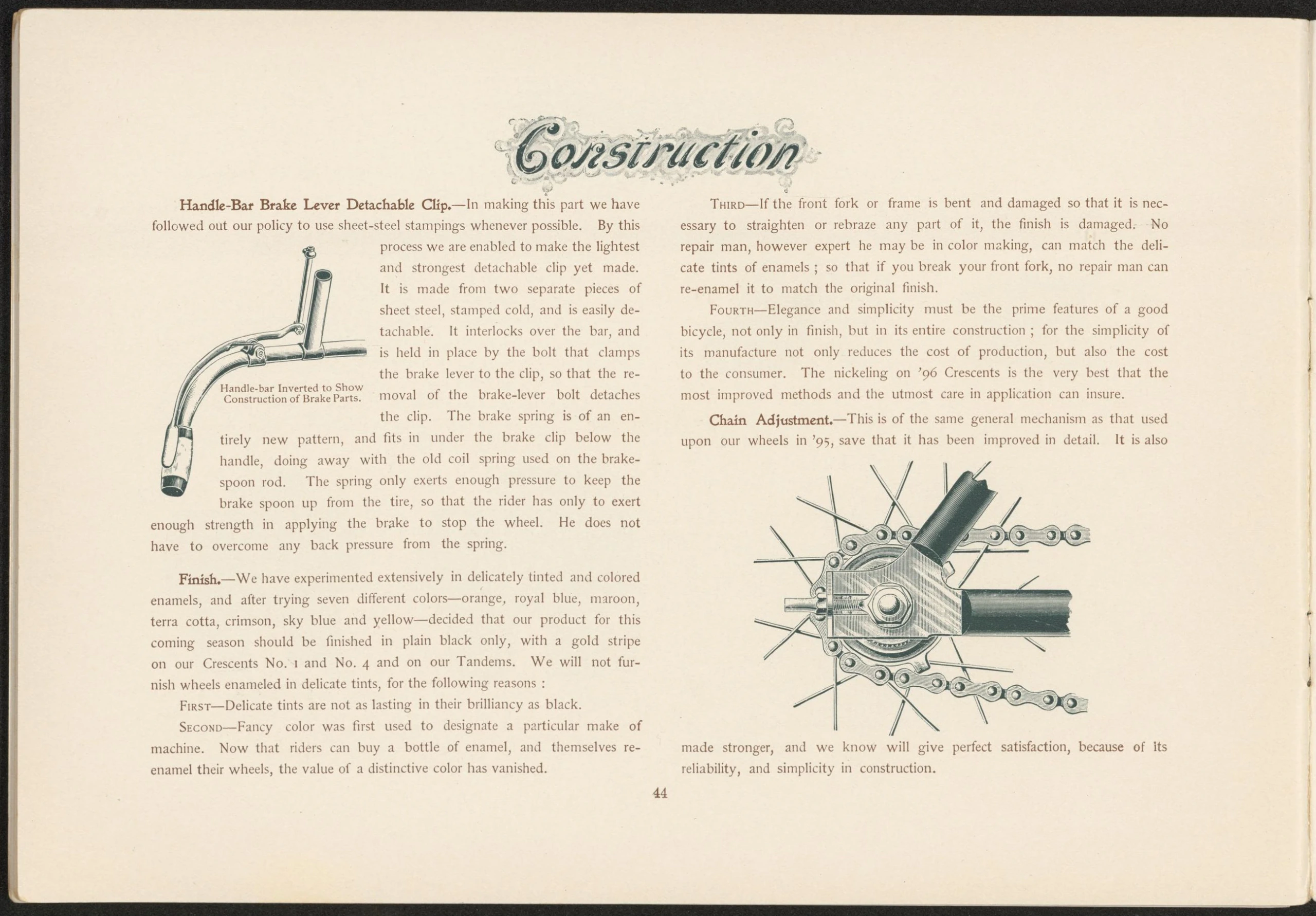
Handle-Bar Brake Lever Detachable Clip.—In making this part we have followed out our policy to use sheet-steel stampings whenever possible. By this process we are enabled to make the lightest and strongest detachable clip yet made. It is made from two separate pieces of sheet steel, stamped cold, and is easily detachable. It interlocks over the bar, and is held in place by the bolt that clamps the brake lever to the clip, so that the removal of the brake-lever bolt detaches the clip. The brake spring is of an entirely new pattern, and fits in under the brake clip below the handle, doing away with the old coil spring used on the brake-spoon rod. The spring only exerts enough pressure to keep the brake spoon up from the tire, so that the rider has only to exert enough strength in applying the brake to stop the wheel. He does not have to overcome any back pressure from the spring.
Handle-bar Inverted to Show Construction of Brake Parts.
Finish.—We have experimented extensively in delicately tinted and colored enamels, and after trying seven different colors—orange, royal blue, maroon, terra cotta, crimson, sky blue and yellow—decided that our product for this coming season should be finished in plain black only, with a gold stripe on our Crescents No. 1 and No. 4 and on our Tandems. We will not furnish wheels enameled in delicate tints, for the following reasons:
FIRST—Delicate tints are not as lasting in their brilliancy as black.
SECOND—Fancy color was first used to designate a particular make of machine. Now that riders can buy a bottle of enamel, and themselves re-enamel their wheels, the value of a distinctive color has vanished.
THIRD—If the front fork or frame is bent and damaged so that it is necessary to straighten or rebraze any part of it, the finish is damaged. No repair man, however expert he may be in color making, can match the delicate tints of enamels; so that if you break your front fork, no repair man can re-enamel it to match the original finish.
FOURTH—Elegance and simplicity must be the prime features of a good bicycle, not only in finish, but in its entire construction; for the simplicity of its manufacture not only reduces the cost of production, but also the cost to the consumer. The nickeling on ’96 Crescents is the very best that the most improved methods and the utmost care in application can insure.
Chain Adjustment.—This is of the same general mechanism as that used upon our wheels in ’95, save that it has been improved in detail. It is also made stronger, and we know will give perfect satisfaction, because of its reliability, and simplicity in construction.
44
[A two-column text page headed “Construction” in script, with engravings of an inverted handle-bar showing the brake lever, detachable clip and brake rod, and of a rear fork end with axle, adjusting bolt, chain and spokes showing the chain adjustment.]
— Page 47 —
Construction
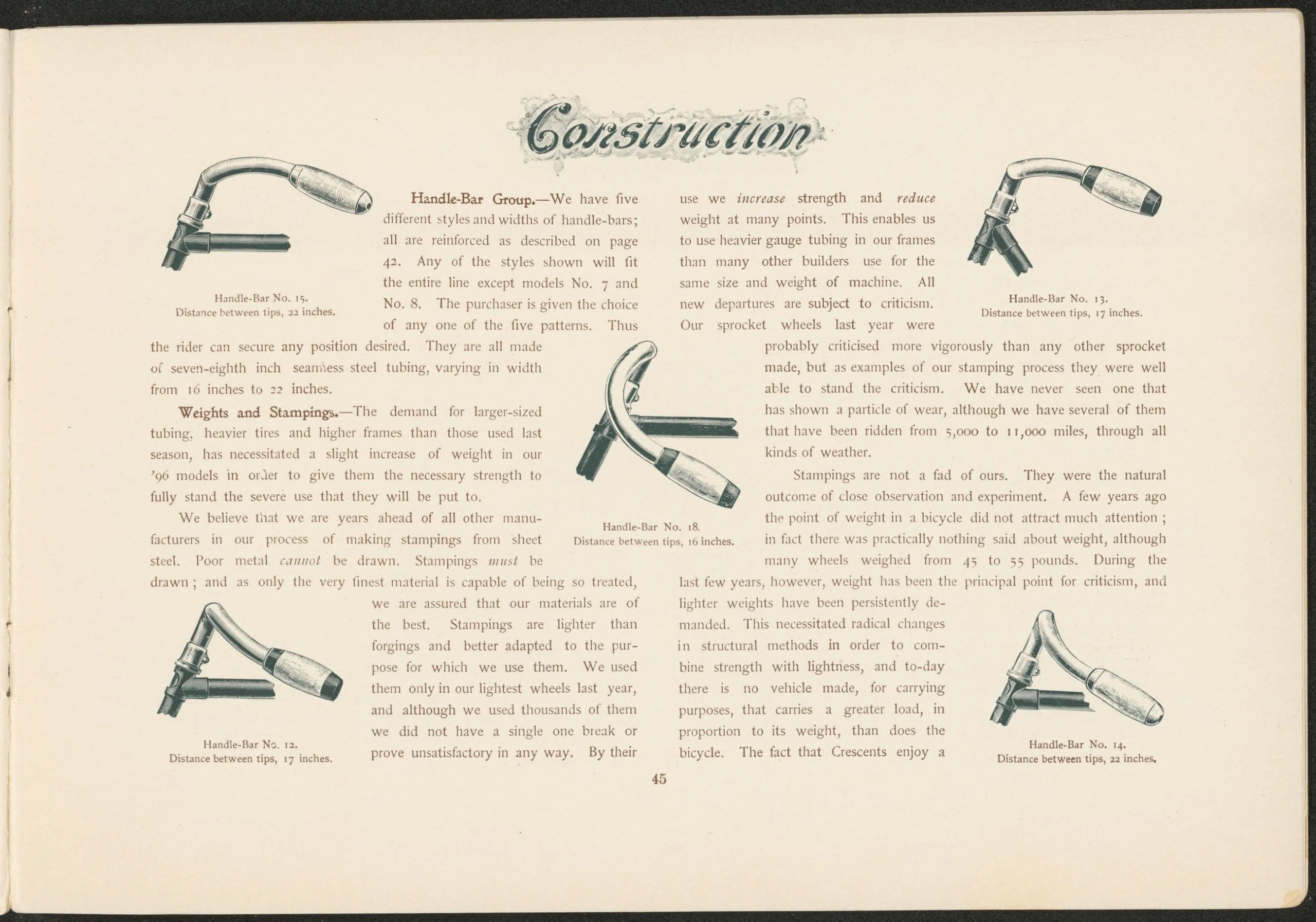
Handle-Bar Group.—We have five different styles and widths of handle-bars; all are reinforced as described on page 42. Any of the styles shown will fit the entire line except models No. 7 and No. 8. The purchaser is given the choice of any one of the five patterns. Thus the rider can secure any position desired. They are all made of seven-eighth inch seamless steel tubing, varying in width from 16 inches to 22 inches.
Weights and Stampings.—The demand for larger-sized tubing, heavier tires and higher frames than those used last season, has necessitated a slight increase of weight in our ’96 models in order to give them the necessary strength to fully stand the severe use that they will be put to.
We believe that we are years ahead of all other manufacturers in our process of making stampings from sheet steel. Poor metal cannot be drawn. Stampings must be drawn; and as only the very finest material is capable of being so treated, we are assured that our materials are of the best. Stampings are lighter than forgings and better adapted to the purpose for which we use them. We used them only in our lightest wheels last year, and although we used thousands of them we did not have a single one break or prove unsatisfactory in any way. By their use we increase strength and reduce weight at many points. This enables us to use heavier gauge tubing in our frames than many other builders use for the same size and weight of machine. All new departures are subject to criticism. Our sprocket wheels last year were probably criticised more vigorously than any other sprocket made, but as examples of our stamping process they were well able to stand the criticism. We have never seen one that has shown a particle of wear, although we have several of them that have been ridden from 5,000 to 11,000 miles, through all kinds of weather.
Stampings are not a fad of ours. They were the natural outcome of close observation and experiment. A few years ago the point of weight in a bicycle did not attract much attention; in fact there was practically nothing said about weight, although many wheels weighed from 45 to 55 pounds. During the last few years, however, weight has been the principal point for criticism, and lighter weights have been persistently demanded. This necessitated radical changes in structural methods in order to combine strength with lightness, and to-day there is no vehicle made, for carrying purposes, that carries a greater load, in proportion to its weight, than does the bicycle. The fact that Crescents enjoy a
Handle-Bar No. 15.
Distance between tips, 22 inches.
Handle-Bar No. 13.
Distance between tips, 17 inches.
Handle-Bar No. 18.
Distance between tips, 16 inches.
Handle-Bar No. 12.
Distance between tips, 17 inches.
Handle-Bar No. 14.
Distance between tips, 22 inches.
45
[A text page headed “Construction” in script, with five engravings of handle-bar patterns with stems and cork grips, one at each corner and one at center, each captioned with its number and width.]
— Page 48 —
Construction
larger sale than any other make, and the fact also that the leading and representative dealers in the United States claim that Crescents give them less trouble than any other make they are handling, is, we feel, sufficient proof that our method of construction has proved satisfactory, and that with the improvements adopted, our ’96 models will give better satisfaction than any others upon the market.
We might have retained our weights of last year, but, as stated above, on account of the demand for heavier tires, higher frames and larger-sized tubing, we should have been compelled to sacrifice strength and durability in order to do so. We design our wheels to carry any weight rider (of the sex for which the wheel was constructed and intended) over any road, and from our extensive experience we believe that our ’96 models will prove more satisfactory than any that we have ever built.
Tubing.—The following table will give the different sized tubing used in the various models of the Crescent line for this year:
| Head. | Top. | Lower. | Truss. | Rear Stay Upper. | Rear Forks.
Crescent No. 1, | 1 1/4 | 1 1/4 | 1 1/4 | 1 1/4 | 3/4 | 7/8
Crescent No. 2, | 1 1/4 | 1 | 1 1/8 | 1 | 5/8 | 3/4
Crescent No. 3, | 1 1/4 | 1 | 1 1/8 | 1 | 5/8 | 3/4
Crescent No. 4, | 1 1/4 | 1 | 1 1/4 | 1 1/4 | 3/4 | 7/8
Crescent No. 5, | 1 1/4 | 1 | 1 1/8 | 1 | 5/8 | 3/4
Crescent No. 6, | 1 1/4 | 1 | 1 1/8 | 1 | 5/8 | 3/4
Crescent No. 7, | 1 | 3/4 | 7/8 | 7/8 | 1/2 | 5/8
Crescent No. 8, | 1 | 3/4 | 7/8 | 7/8 | 1/2 | 5/8
Crescent Tandem No. 20, | 1 1/4 | 1 1/4 | 1 1/4 | 1 1/4 | 3/4 | 7/8
Crescent Tandem No. 25, | 1 1/4 | 1 | 1 1/4 | 1 1/4 | 3/4 | 7/8
Crescent Racer, | 1 1/4 | 1 1/4 | 1 1/4 | 1 1/4 | 3/4 | 7/8
Our Special No. 9, | 1 1/8 | 1 | 1 1/8 | 1 | 5/8 | 3/4
Our Special No. 10, | 1 1/8 | 1 | 1 1/8 | 1 | 5/8 | 3/4
Cable Address—Westwheel, New York.
Interchangeability.—The following parts of Crescent wheels are interchangeable—that is, any one of these parts taken from a Crescent wheel will fit all other models of the Crescent line for 1896 (except Nos. 7 and 8): Crank axle, crank-axle lock-nut, crank-axle washer, sprocket-wheel lock-nut, crank-axle cones (right and left), crank key and nut, hubs, together with hub bushings; cones, washers and axles, head cup, head cones, head clamp, head-clamp bolt, bolt and nut for seat post, oil cups, spoke nipples and washers, chain adjustment and all parts of it, handle-bars, all sprockets.
Name Plates.—This year brings its array of new and fanciful designs for name plates. We, however, retain our standard plate, although, instead of making it of aluminum, we this year have it gold plated. The bright burnished parts stand out in bold relief against the black background, the black enamel Crescent showing through the plate in such manner that there is no mistaking it for any other.
Mud Guards.—Crescent Models No. 4, No. 5, No. 6 and No. 8 will be fitted with a metal dress and chain guard. The dress and chain guard will be laced with old-gold cord. Crescent Models No. 1, No. 2 and No. 3 will be supplied, when specially ordered, with a detachable rubber mud guard.
Guarantee.—Agents will furnish all purchasers of Crescents with our printed guarantee. Be sure and secure this, as it gives the serial number of your machine, and also the date of purchase. On the reverse side of the guarantee will be found a full list of component parts of the model purchased, together with prices of same.
Side-Light Brackets.—By a simple device, our side-light bracket is held firmly in position against the fork end, insuring a secure bracket, while the axle nut remains.
46
[A two-column text page headed “Construction” in script, with a ruled table of tubing diameters in inches for each of the thirteen models; no illustrations.]
— Page 49 —
Special Equipment
Gears.—All models will be shipped with gears stated in specifications. The following gear table gives the gear as determined by the different sizes of front sprockets. Bear in mind that you cannot increase the gear without also increasing the length of your chain. One link of chain must be added to each additional sprocket tooth.
Teeth. | 15 | 16 | 17 | 18 | 19 | 20 | 21 | 22 | 23
Crescent No. 1, | 52 1/2 | 56 | 59 1/2 | 63 | **66 1/2** | 70 | 73 1/2 | 77 | 80 1/2
Crescent No. 2, | 56 | **59 1/2** | 63 | 67 | 70 1/2 | 74 1/3 | 78 | 81 1/2 | 85 1/2
Crescent No. 3, | 51 1/2 | **55** | 58 1/3 | 61 2/3 | 65 | 68 1/2 | 72 | 75 1/2 | 79
Crescent No. 4, | 55 1/2 | **59 1/2** | 63 | 67 | 70 1/2 | 74 1/3 | 78 | 81 2/3 | 85 1/2
Crescent No. 4, 28 in. | 52 1/2 | 56 | **59 1/2** | 63 | 66 1/2 | 70 | 73 1/2 | 77 | 80 1/2
Crescent No. 5, | 56 | **59 1/2** | 63 | 67 | 70 1/2 | 74 1/3 | 78 | 81 2/3 | 85 1/2
Crescent No. 6, | 51 1/2 | **55** | 58 1/3 | 61 2/3 | 65 | 68 1/2 | 72 | 75 1/2 | 79
Tandem No. 20, | 52 1/2 | 56 | 59 1/2 | 63 | 66 1/2 | **70** | 73 1/2 | 77 | 80 1/2
Tandem No. 25, | 52 1/2 | 56 | 59 1/2 | 63 | **66 1/2** | 70 | 73 1/2 | 77 | 80 1/2
Teeth. | 13 | 14 | 15
Crescent No. 7, | **43** | 46 1/2 | 50
Crescent No. 8, | **43** | 46 1/2 | 50
Teeth. | 16 | 17 | 18 | 19
Special No. 9. | 56 | 59 1/2 | **63** | 66 1/2
Special No. 10, | 56 | **59 1/2** | 63 | 66 1/2
NOTE.—Regular gears are indicated by full-faced type. The schedule of gears given herewith for Crescent No. 1 will apply to the Crescent Road Racer.
Tires.—All models will be fitted regularly with Morgan & Wright Quick-Repair Tires. We can also furnish, when ordered, the Diamond Single-Tube Tire on all models, excepting Crescents No. 7 and No. 8.
Tool Bags.—Tool bags furnished with our ’96 Models (in black leather only) are of our own design and make. On ladies’ wheels they will be attached to the handle-bar, which we believe from experience to be the most convenient and practical place to have it. It cannot become detached without the knowledge of the rider. The tool bag furnished on the men’s machines is attached to the frame at the head. Both models are as small and compact as consistent with the purpose for which they are designed. A wrench, pump, axle spanner, oil can and a repair kit will be furnished with each machine.
Saddles.—We will furnish the pattern saddles described in specifications of each model, and will also fit Models No. 1, No. 2 and No. 3 with our own make of saddle, known as “Crescent Saddle No. 1.” We will furnish in addition to the saddles stated in specifications on Crescents No. 4, No. 5 and No. 6 our own make lady’s saddle, known as “Crescent Saddle No. 4.” All saddles are furnished in black leather only.
Handle-Bars.—All machines will be fitted with the same handle-bar shown in illustration of model, unless otherwise ordered. Each of our regular styles of handle-bar will fit all Crescents from No. 1 to No. 6 inclusive, and also the Tandems. These will be furnished on any of the above-indicated Models. In all cases handle-bars should be ordered by number only, the factory number of each bar being given with each handle-bar illustration on page 45.
Pedals.—Brandenburg Combination Rubber Pedals are furnished with Crescents No. 1, No. 4 and Tandems only. Other models will be fitted only with the Crescent Combination Rubber Pedals, which can also be fitted to Models No. 1, No. 4 and Tandems, if ordered.
Brakes.—We will fit brakes to all Crescents, with the exception of Models No. 7 and No. 8; they will be supplied, however, only when specially ordered.
Coasters.—In the construction of these we again bring in use our stamping process. They are instantly detachable, are extremely light, and will not work loose.
47
[A two-column text page headed “Special Equipment” in winged italic capitals, with two ruled gear tables giving gear in inches by front-sprocket teeth for each model; the regular gears, set in bold full-faced type, are marked here with double asterisks.]
— Page 50 —
Western Wheel Works.
BUILDERS
Hereby Guarantee Serial No. ____________
to be free from imperfection in material and construction, and will make good any defects which are not caused by use, misuse or neglect within one year from date of sale, provided the serial number is intact. All parts claimed to be defective must be returned to us prepaid for our examination before claim will be allowed.
____________ OWNER.
Sold by ____________ Date ____________
SPECIAL NOTICE. WHEN PARTS ARE SENT DIRECT TO US, ATTACH YOUR NAME AND ADDRESS, PREPAY CHARGES, AND WRITE US FULLY THE SAME DAY. WHEN A PART IS CLAIMED TO BE DEFECTIVE, HAVE THE CLAIM MADE TO US BY THE AGENT YOU PURCHASED THE BICYCLE FROM (IF POSSIBLE); IT WILL SAVE YOU TIME.
WESTERN WHEEL WORKS.
Factory, CHICAGO.
EASTERN BRANCH, NEW YORK.
48
[A facsimile of the Crescent printed guarantee certificate, unfilled, within an ornate brown scroll border with wheel motifs at the corners: “Western Wheel Works” in large shaded script, the guarantee in copperplate script, blank lines for serial number, owner, seller and date.]
— Page 51 —
[The blank inside back cover, with light foxing and wear along the spine edge.]
— Page 52 —
[The plain unprinted outside back cover, with scattered foxing, a small stain near the top edge and wear along the fore-edge.]
Ebykr presents this material for research and education. If you hold rights to it or notice an ownership issue, please contact us and we will respond promptly.