About Ebykr
Ebykr celebrates classic and vintage lightweight bicycles through provocative imagery and opinion. Ride along with us.
About Ebykr
Ebykr celebrates classic and vintage lightweight bicycles through provocative imagery and opinion. Ride along with us.

Source: bulgier.net (Mark Bulgier's catalog archive), scans posted in 2002; 2velo.com serves the same files.
| Marque | Colnago |
|---|---|
| Type | Review |
| Publisher | Colnago Srl |
| Country | Italy |
| Language | English |
| Pages | 4 |
| Source | bulgier.net (Mark Bulgier's catalog archive), scans posted in 2002; 2velo.com serves the same files. |
| Credit | Ebykr archive |
| Identifier | Permalink http://bulgier.net/pics/bike/Catalogs/Colnago-89/ |
| Transcription | Headings and specifications transcribed; article text summarized |
CARBITUBO What does the trade press say about us? COLNAGO By kind permission of LA BICICLETTA TECHNIQUE TOWARDS NEW FRONTIERS The Colnago «Carbitubo» By Sergio Meda/Foto Yes Advertising The Colnago «Carbitubo» YES ADVERTISING 118 COLNAGO Srl - Cambiago (MI) - Tel. 02/95.308.082 (5 linee r. a.) - Telex 326461 ERCOL I - Fax 02/95.067.379
This is a magazine article, so its running text is summarized here rather than reproduced; the headline, byline, specifications and scores are transcribed as printed.
— Page 1 —
CARBITUBO
What does the trade press say about us?
COLNAGO
[A front cover on a pale gray ground: the yellow Colnago clover with a registered mark above a white outlined CARBITUBO logotype, a square color photograph of a polished aluminum bottom bracket fitting with black carbon tube ends and a clover-in-C mark, the bold italic question below it and COLNAGO spaced across the foot in outlined yellow capitals.]
— Page 2 —
By kind permission of LA BICICLETTA
TECHNIQUE TOWARDS NEW FRONTIERS
The Colnago «Carbitubo»
By Sergio Meda/Foto Yes Advertising
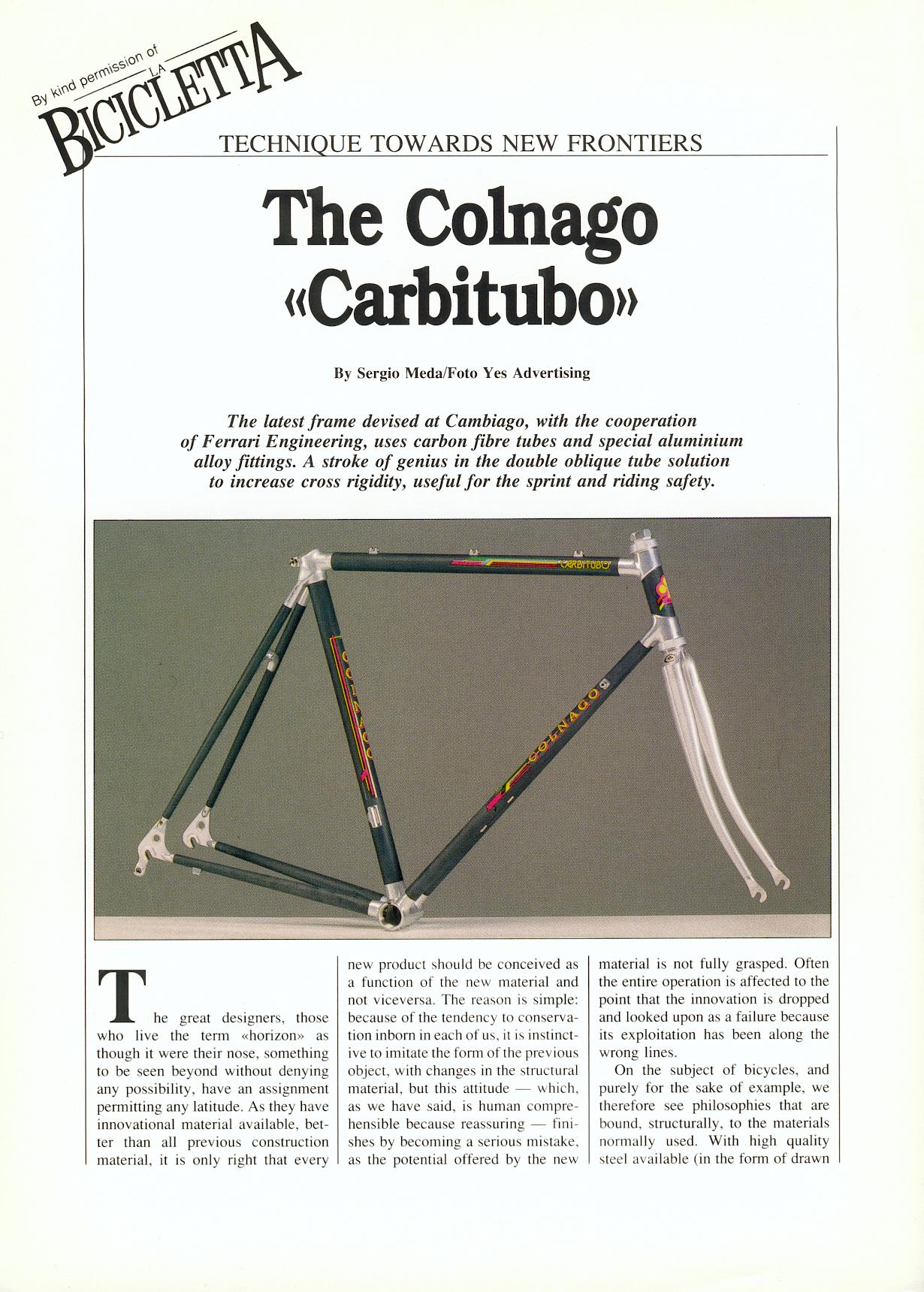
[Ebykr summary; the article’s running text is not reproduced. The standfirst presents the Carbitubo as the latest frame devised at Cambiago with the cooperation of Ferrari Engineering, built from carbon fiber tubes joined by special aluminum alloy fittings, and singles out its twin down tubes as the way to greater lateral stiffness for sprinting and for safe riding. Meda opens with an argument about design: a designer given a new material should shape the product around that material instead of imitating the form of the object it replaces. He calls the habit of imitation human and reassuring but a serious mistake, since it wastes what the new material offers and can make a real innovation look like a failure. He then turns to the bicycle, beginning with drawn steel tubing.]
[The opening page of a reprinted magazine article: the LA BICICLETTA masthead set at an angle in the top left corner with a permission line, then a ruled kicker, a large serif headline, a byline and an italic standfirst. A wide color photograph shows the Carbitubo frame and fork on a gray backdrop, with dark carbon tubes in silver aluminum lugs, aluminum fork blades and CARBITUBO and COLNAGO decals with multicolor stripes. Three columns of text run below, opening with a drop capital.]
— Page 3 —
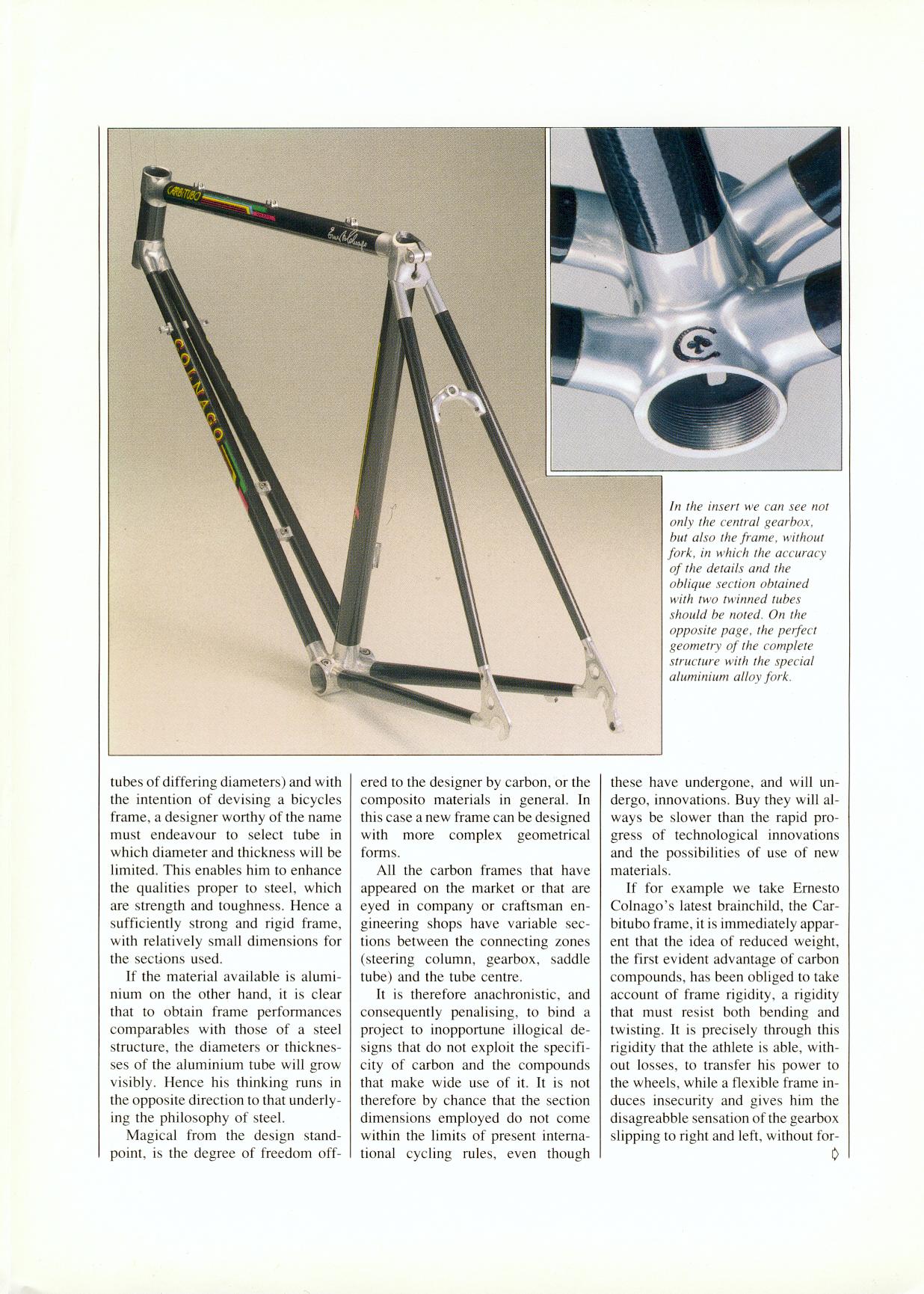
[Ebykr summary, continued. Meda sets the three materials against one another. Steel lets a designer keep tube diameters and wall thicknesses small; aluminum forces them to grow if the frame is to match a steel frame’s stiffness; carbon fiber and other composites leave the designer free to vary a tube’s section between its joints. That freedom, he notes, is why the new carbon frames fall outside the international racing rules of the day, rules he expects always to lag behind the technology. Of the Carbitubo he writes that Colnago had to weigh carbon’s low weight against stiffness in bending and twisting, the stiffness that lets a rider put his power into the wheels without the frame flexing from side to side under him.]
[The caption points to the inset of the bottom bracket fitting and to the twin down tubes of the frame shown without its fork, and refers the reader to the complete frame and its aluminum alloy fork on the facing page.]
[A large color photograph of the Carbitubo frame without its fork, seen from behind at an angle, showing the CARBITUBO decal and a script signature on the top tube and COLNAGO on the twin down tubes, with an inset close-up of the silver aluminum bottom bracket fitting and its clover-in-C mark. An italic caption sits to the right of the photograph, and three columns of text run beneath it, ending with a small outlined arrow.]
— Page 4 —
The Colnago «Carbitubo»
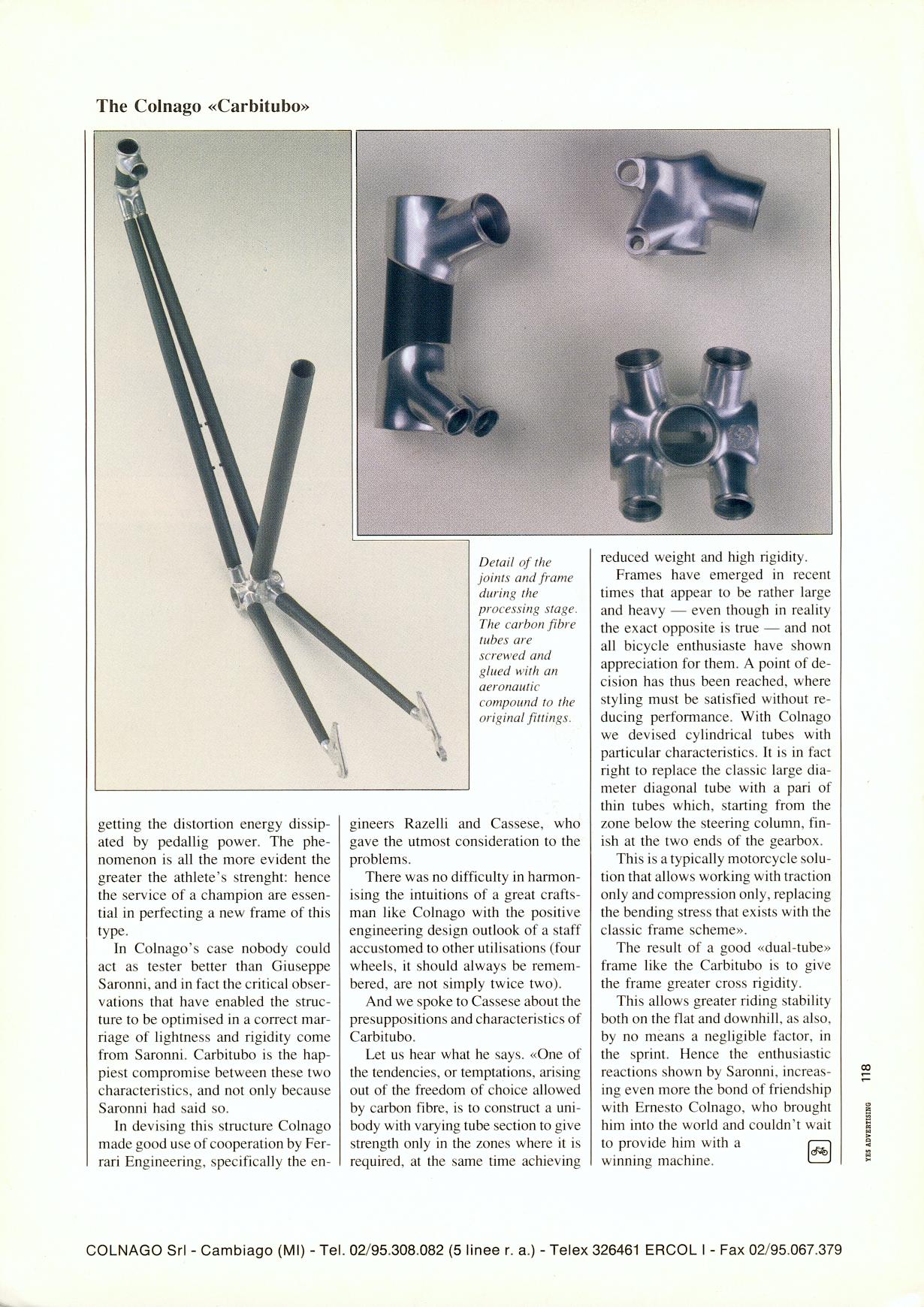
[Ebykr summary, continued. Meda names Giuseppe Saronni as the tester whose criticism set the balance between lightness and stiffness, and credits Ferrari Engineering, naming the engineers Razelli and Cassese, with the design work. Cassese, quoted at length, explains the choice: instead of a molded one-piece frame with varying sections, which had produced frames many riders found bulky, Colnago and Ferrari kept cylindrical tubes and replaced the single large down tube with a pair of thin tubes running from below the head tube to the two ends of the bottom bracket shell, a motorcycle practice that loads the tubes in tension and compression rather than in bending. The article closes on the twin-tube frame’s greater lateral stiffness on the flat, downhill and in the sprint, and on Saronni’s enthusiasm for it.]
[The caption describes the joints during assembly: the carbon fiber tubes are screwed and glued into the fittings with an aeronautical adhesive.]
YES ADVERTISING 118
COLNAGO Srl – Cambiago (MI) – Tel. 02/95.308.082 (5 linee r. a.) – Telex 326461 ERCOL I – Fax 02/95.067.379
[The closing page of the article under a running head. On the left, a tall photograph shows a partly assembled frame, with the head fitting, twin carbon down tubes, seat tube stub and chainstays joined to bare aluminum fittings; on the right, a photograph shows three aluminum fittings for the head, seat and bottom bracket, the head fitting joined by a short black carbon section. An italic caption and three columns of text end with a small boxed bicycle symbol, an agency credit runs vertically in the right margin and the Colnago address line is set in a sans serif face across the foot.]
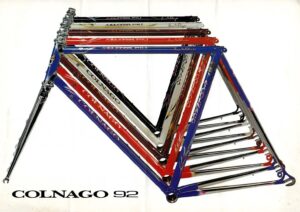 Colnago 1992 Catalog — C35 and Carbitubo, Master Più, Conic SLX and Super 91, the Mountain Bikes and Professional Equipment
 Colnago Advertisement — La Bicicletta per l’Europa: Carbitubo di Colnago
 Colnago Catalog Sheets — Export, Saronni Giro d’Italia, Mexico Oro, International, Roger de Vlaeminck, Mexico and Super, with Accessories
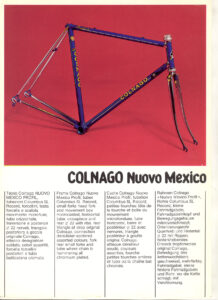 Colnago Frameset Sheets — Nuovo Mexico Profil and Super
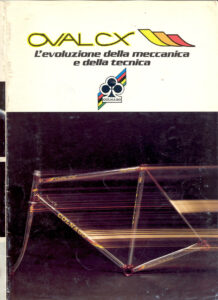 Colnago Oval CX Folder — L’Evoluzione della Meccanica e della Tecnica: CX Cromosatinato and CX Cromovelato
Ebykr presents this material for research and education. If you hold rights to it or notice an ownership issue, please contact us and we will respond promptly.
The Ebykr Digest
New articles, timelines, catalog finds and registry activity — assembled from the archive once a month. Your address is never shared.
Double opt-in. One email per month. Unsubscribe at any time with one click.