About Ebykr
Ebykr celebrates classic and vintage lightweight bicycles through provocative imagery and opinion. Ride along with us.
About Ebykr
Ebykr celebrates classic and vintage lightweight bicycles through provocative imagery and opinion. Ride along with us.

Source: Retrobike archive (retrobike.co.uk), "1986 - Campagnolo Record Catalogue", uploaded by the forum member FluffyChicken.
| Marque | Campagnolo |
|---|---|
| Type | Catalog |
| Year | 1986 |
| Publisher | Campagnolo S.p.A., Via della Chimica 4, 36100 Vicenza, Italy |
| Country | Italy |
| Language | English |
| Pages | 13 |
| Source | Retrobike archive (retrobike.co.uk), "1986 - Campagnolo Record Catalogue", uploaded by the forum member FluffyChicken. |
| Credit | Retrobike (scan by FluffyChicken) |
| Identifier | Permalink https://www.retrobike.co.uk/archive/1986-campagnolo-record-catalogue.907/ |
| Transcription | Transcribed by eye |
Reference
Campagnolo S.p.A., Via della Chimica 4, 36100 Vicenza, Italy. Campagnolo Record Brochure, November 1986: Record: the Name of Success, the Record Road Group Part by Part and the Record Pista. November 1986. Ebykr, https://ebykr.com/library/campagnolo-record-brochure-1986/.
Wikipedia
{{cite book |title=Campagnolo Record Brochure, November 1986: Record: the Name of Success, the Record Road Group Part by Part and the Record Pista |publisher=Campagnolo S.p.A., Via della Chimica 4, 36100 Vicenza, Italy |date=November 1986 |url=https://ebykr.com/library/campagnolo-record-brochure-1986/ |via=Ebykr |access-date=}}Campagnolo® RECORD® WORLD CHAMPIONSHIPS 1968 | V. Adorni 1969 | -- 1970 | J.P. Monseré 1971 | E. Merckx 1972 | M. Basso 1973 | F. Gimondi 1974 | E. Merckx 1975 | H. Kuiper 1976 | F. Maertens 1977 | F. Moser 1978 | G. Knetemann 1979 | J. Raas 1980 | B. Hinault …
Campagnolo’s English brochure for the Record group, “Record: the name of success”: the winners’ jerseys and the races won on Record to 1986, the group laid out, then the gear set, shift levers with the Syncro option, brake set, head and seat pin sets, chainwheel and bottom bracket, pedals and hubs, the professional teams of 1986, the Record Pista track group and the Campagnolo addresses. Transcribed from the page images (13 pages); each page ends with a bracketed description of its pictures.
— Page 1 —
Campagnolo®
RECORD®
[Front cover: the blue Campagnolo script logo at top of a white page; in the lower half a block of twelve red squares with white component pictograms from the Campagnolo alphabet (pedal, brake lever, derailleurs, headset, brake, crank, hub, seat pin, chainring, bottom bracket) above the word RECORD. No printer’s code visible.]
— Page 2 —
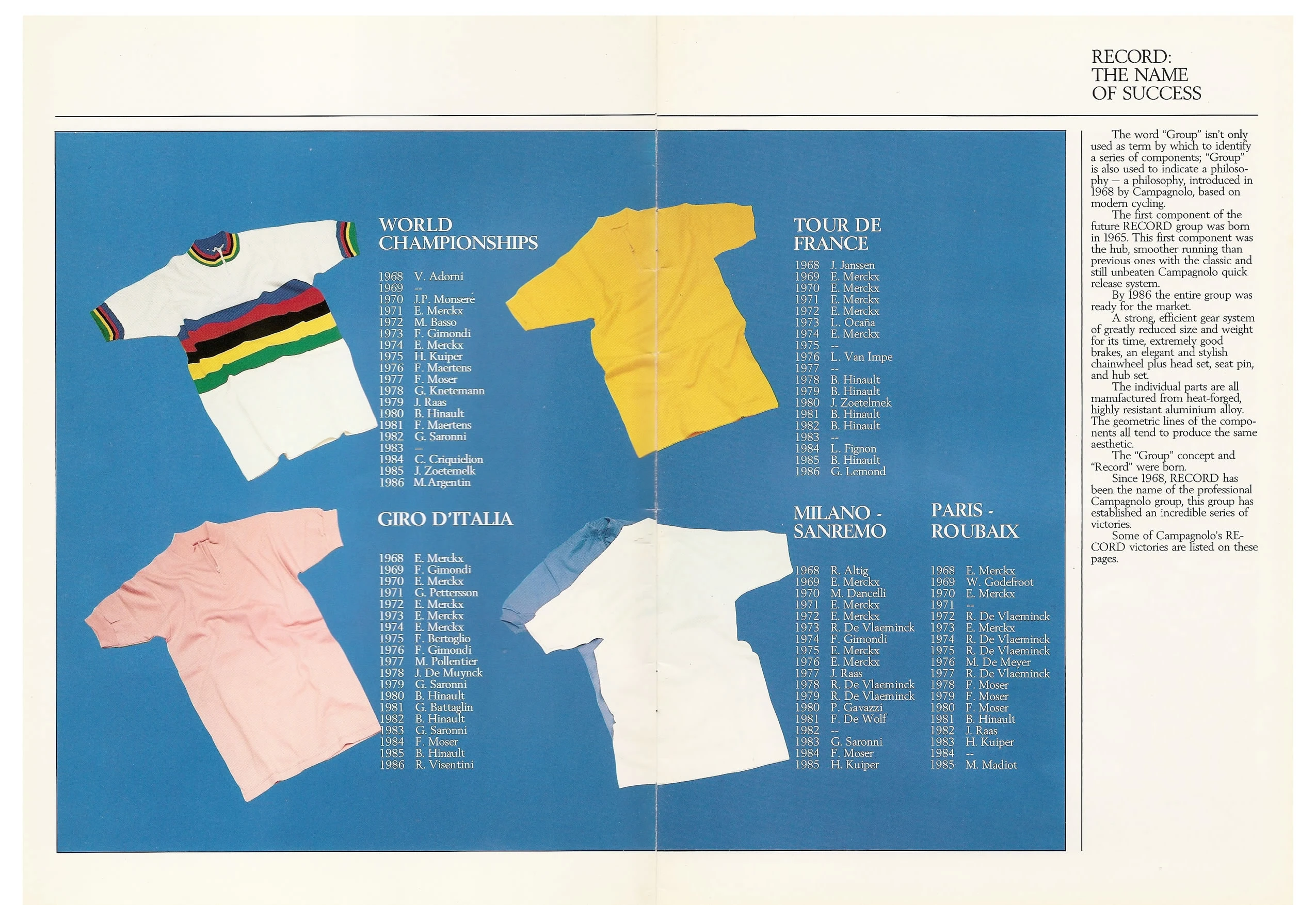
WORLD CHAMPIONSHIPS
1968 | V. Adorni
1969 | —
1970 | J.P. Monseré
1971 | E. Merckx
1972 | M. Basso
1973 | F. Gimondi
1974 | E. Merckx
1975 | H. Kuiper
1976 | F. Maertens
1977 | F. Moser
1978 | G. Knetemann
1979 | J. Raas
1980 | B. Hinault
1981 | F. Maertens
1982 | G. Saronni
1983 | —
1984 | C. Criquielion
1985 | J. Zoetemelk
1986 | M. Argentin
GIRO D’ITALIA
1968 | E. Merckx
1969 | F. Gimondi
1970 | E. Merckx
1971 | G. Pettersson
1972 | E. Merckx
1973 | E. Merckx
1974 | E. Merckx
1975 | F. Bertoglio
1976 | F. Gimondi
1977 | M. Pollentier
1978 | J. De Muynck
1979 | G. Saronni
1980 | B. Hinault
1981 | G. Battaglin
1982 | B. Hinault
1983 | G. Saronni
1984 | F. Moser
1985 | B. Hinault
1986 | R. Visentini
TOUR DE FRANCE
1968 | J. Janssen
1969 | E. Merckx
1970 | E. Merckx
1971 | E. Merckx
1972 | E. Merckx
1973 | L. Ocaña
1974 | E. Merckx
1975 | —
1976 | L. Van Impe
1977 | —
1978 | B. Hinault
1979 | B. Hinault
1980 | J. Zoetelmek
1981 | B. Hinault
1982 | B. Hinault
1983 | —
1984 | L. Fignon
1985 | B. Hinault
1986 | G. Lemond
MILANO – SANREMO
1968 | R. Altig
1969 | E. Merckx
1970 | M. Dancelli
1971 | E. Merckx
1972 | E. Merckx
1973 | R. De Vlaeminck
1974 | F. Gimondi
1975 | E. Merckx
1976 | E. Merckx
1977 | J. Raas
1978 | R. De Vlaeminck
1979 | R. De Vlaeminck
1980 | P. Gavazzi
1981 | F. De Wolf
1982 | —
1983 | G. Saronni
1984 | F. Moser
1985 | H. Kuiper
PARIS – ROUBAIX
1968 | E. Merckx
1969 | W. Godefroot
1970 | E. Merckx
1971 | —
1972 | R. De Vlaeminck
1973 | E. Merckx
1974 | R. De Vlaeminck
1975 | R. De Vlaeminck
1976 | M. De Meyer
1977 | R. De Vlaeminck
1978 | F. Moser
1979 | F. Moser
1980 | F. Moser
1981 | B. Hinault
1982 | J. Raas
1983 | H. Kuiper
1984 | —
1985 | M. Madiot
RECORD: THE NAME OF SUCCESS
The word “Group” isn’t only used as term by which to identify a series of components; “Group” is also used to indicate a philosophy – a philosophy, introduced in 1968 by Campagnolo, based on modern cycling.
The first component of the future RECORD group was born in 1965. This first component was the hub, smoother running than previous ones with the classic and still unbeaten Campagnolo quick release system.
By 1986 the entire group was ready for the market.
A strong, efficient gear system of greatly reduced size and weight for its time, extremely good brakes, an elegant and stylish chainwheel plus head set, seat pin, and hub set.
The individual parts are all manufactured from heat-forged, highly resistant aluminium alloy. The geometric lines of the components all tend to produce the same aesthetic.
The “Group” concept and “Record” were born.
Since 1968, RECORD has been the name of the professional Campagnolo group, this group has established an incredible series of victories.
Some of Campagnolo’s RECORD victories are listed on these pages.
[A spread: on a blue panel four racing jerseys laid flat (the white rainbow-striped world champion jersey, the yellow Tour de France jersey, the pink Giro d’Italia jersey and a white jersey with blue sleeves) beside white lists of race winners by year; a narrow text column at far right.]
— Page 3 —
RECORD
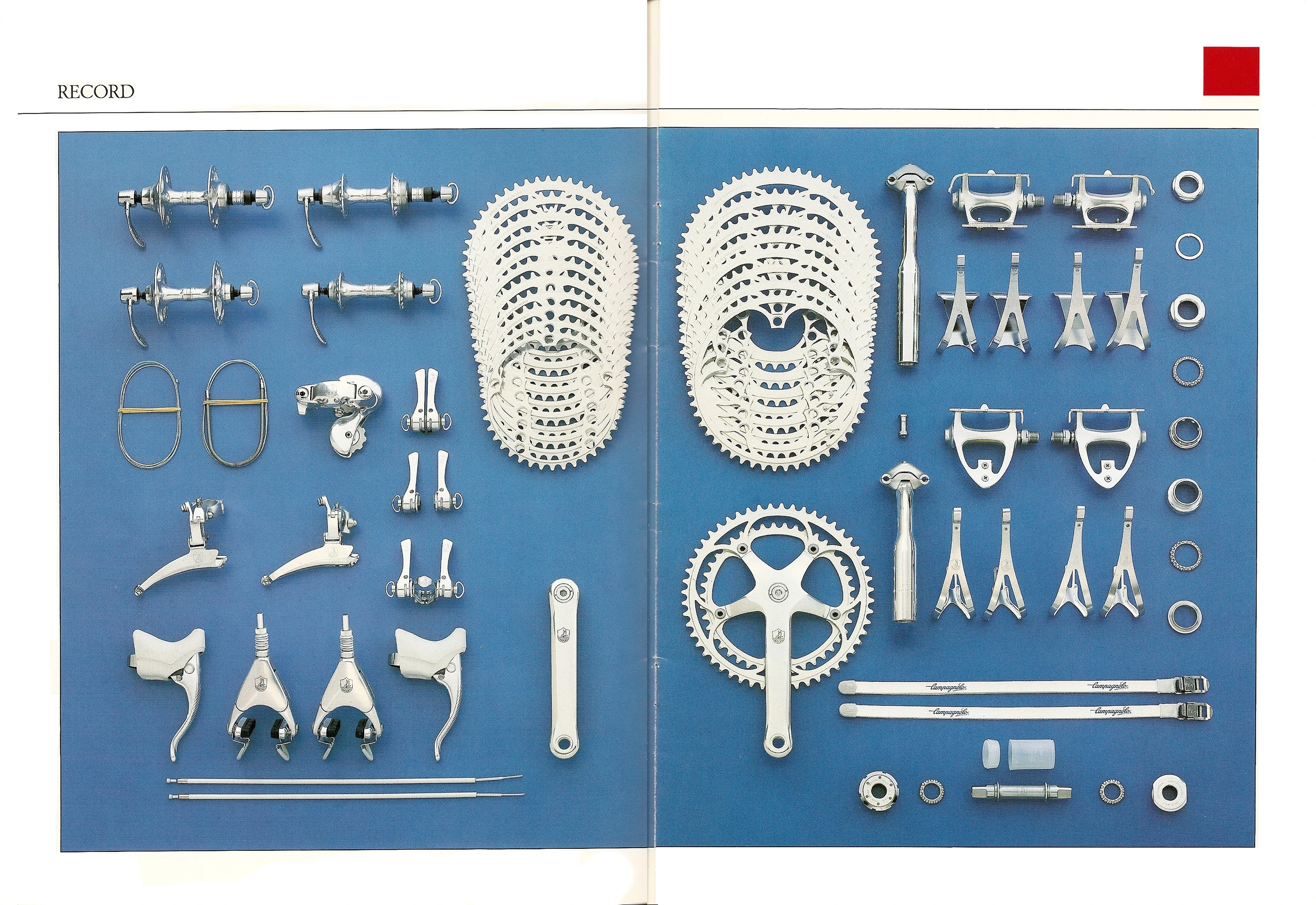
[A spread: a red square tab at upper right; on a blue background the complete polished Record group laid out flat: hubs with quick releases, rear derailleur, front derailleurs, shift levers, brake levers, side-pull brakes, cables, crank arms, a double chainset and a fan of loose chainrings, seat pins, quill pedals, toe clips, Campagnolo straps and headset and bottom bracket parts.]
— Page 4 —
GEAR SET
All gears work… for some time.
Only some gears can change millions of times as efficiently and as silently as they did on the first day: gears made by Campagnolo.
The RECORD.
The shape in the classical Campagnolo racing design, an articulated parallelogram with a perpendicular movement to the chain. This ensures that the cage plate and sprockets remain on the same plane allowing the chain to run with maximum efficiency and silent precision.
The gear capacity, from 12 to 28, is the usual range for racing or fast touring.
The articulated shape of the parallelogram and the gear change capacity have been tried and race tested.
Movement is controlled by means of three springs, two main ones and one secondary.
The cage plate is also made of heat-forged alluminium alloy. The spring which controls the movement of the cage plate is made from square-shaped silicon wire and may be adjusted to support two different load levels.
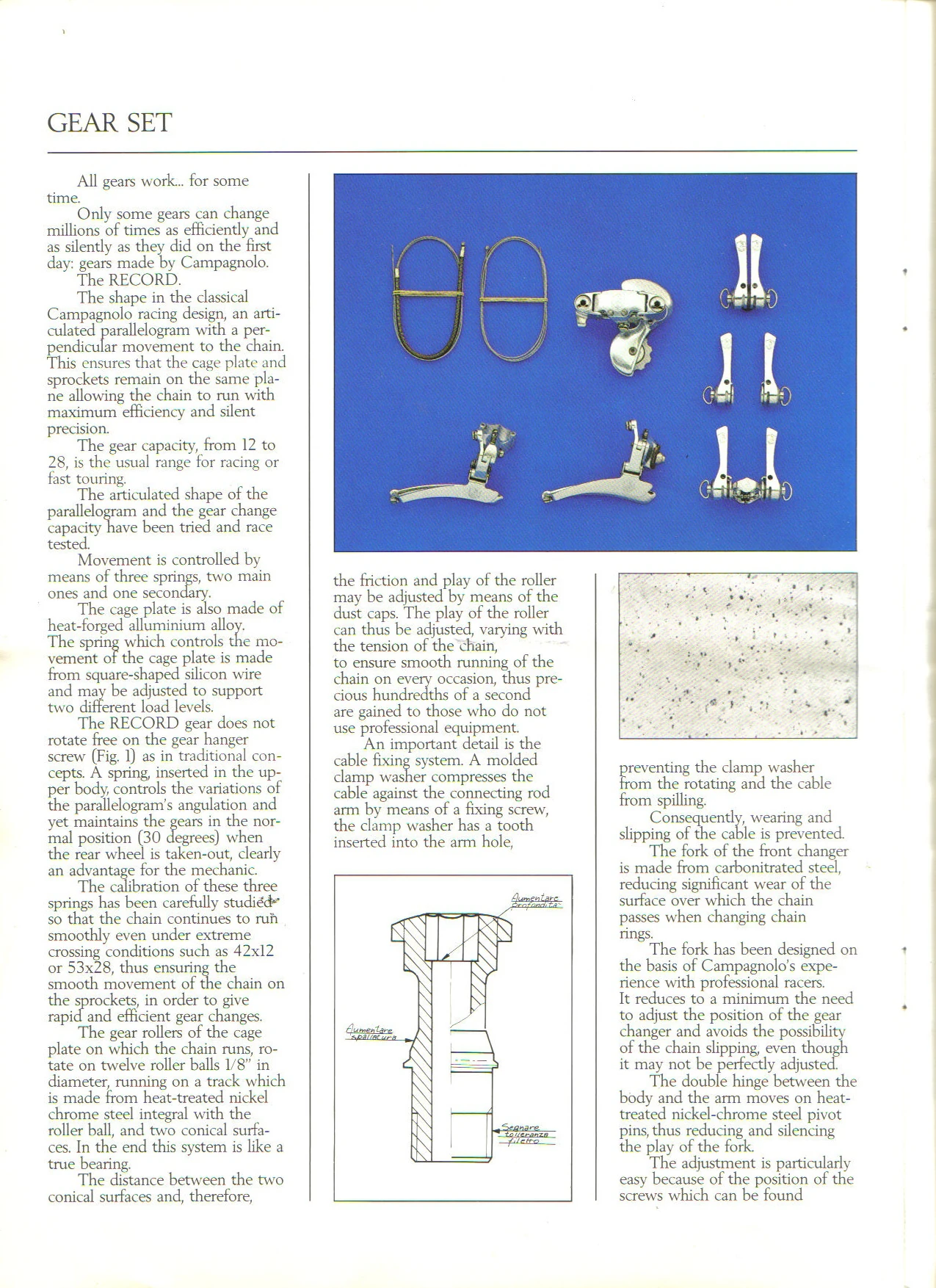
The RECORD gear does not rotate free on the gear hanger screw (Fig. 1) as in traditional concepts. A spring, inserted in the upper body, controls the variations of the parallelogram’s angulation and yet maintains the gears in the normal position (30 degrees) when the rear wheel is taken-out, clearly an advantage for the mechanic.
The calibration of these three springs has been carefully studied so that the chain continues to run smoothly even under extreme crossing conditions such as 42×12 or 53×28, thus ensuring the smooth movement of the chain on the sprockets, in order to give rapid and efficient gear changes.
The gear rollers of the cage plate on which the chain runs, rotate on twelve roller balls 1/8″ in diameter, running on a track which is made from heat-treated nickel chrome steel integral with the roller ball, and two conical surfaces. In the end this system is like a true bearing.
The distance between the two conical surfaces and, therefore,
the friction and play of the roller may be adjusted by means of the dust caps. The play of the roller can thus be adjusted, varying with the tension of the chain, to ensure smooth running of the chain on every occasion, thus precious hundredths of a second are gained to those who do not use professional equipment.
An important detail is the cable fixing system. A molded clamp washer compresses the cable against the connecting rod arm by means of a fixing screw, the clamp washer has a tooth inserted into the arm hole,
[Handwritten notes on the technical drawing:] Aumentare profondità | Aumentare spallatura | Segnare tolleranza filetto
preventing the clamp washer from the rotating and the cable from spilling.
Consequently, wearing and slipping of the cable is prevented.
The fork of the front changer is made from carbonitrated steel, reducing significant wear of the surface over which the chain passes when changing chain rings.
The fork has been designed on the basis of Campagnolo’s experience with professional racers. It reduces to a minimum the need to adjust the position of the gear changer and avoids the possibility of the chain slipping, even though it may not be perfectly adjusted.
The double hinge between the body and the arm moves on heat-treated nickel-chrome steel pivot pins, thus reducing and silencing the play of the fork.
The adjustment is particularly easy because of the position of the screws which can be found
[A three-column text page: a color photograph on blue of two Record rear derailleur cages, a rear derailleur and two front derailleurs at top center; a gray speckled close-up of a metal surface at upper right; a sectional technical drawing of a hollow bolt with handwritten Italian notes in color pen at lower center.]
— Page 5 —
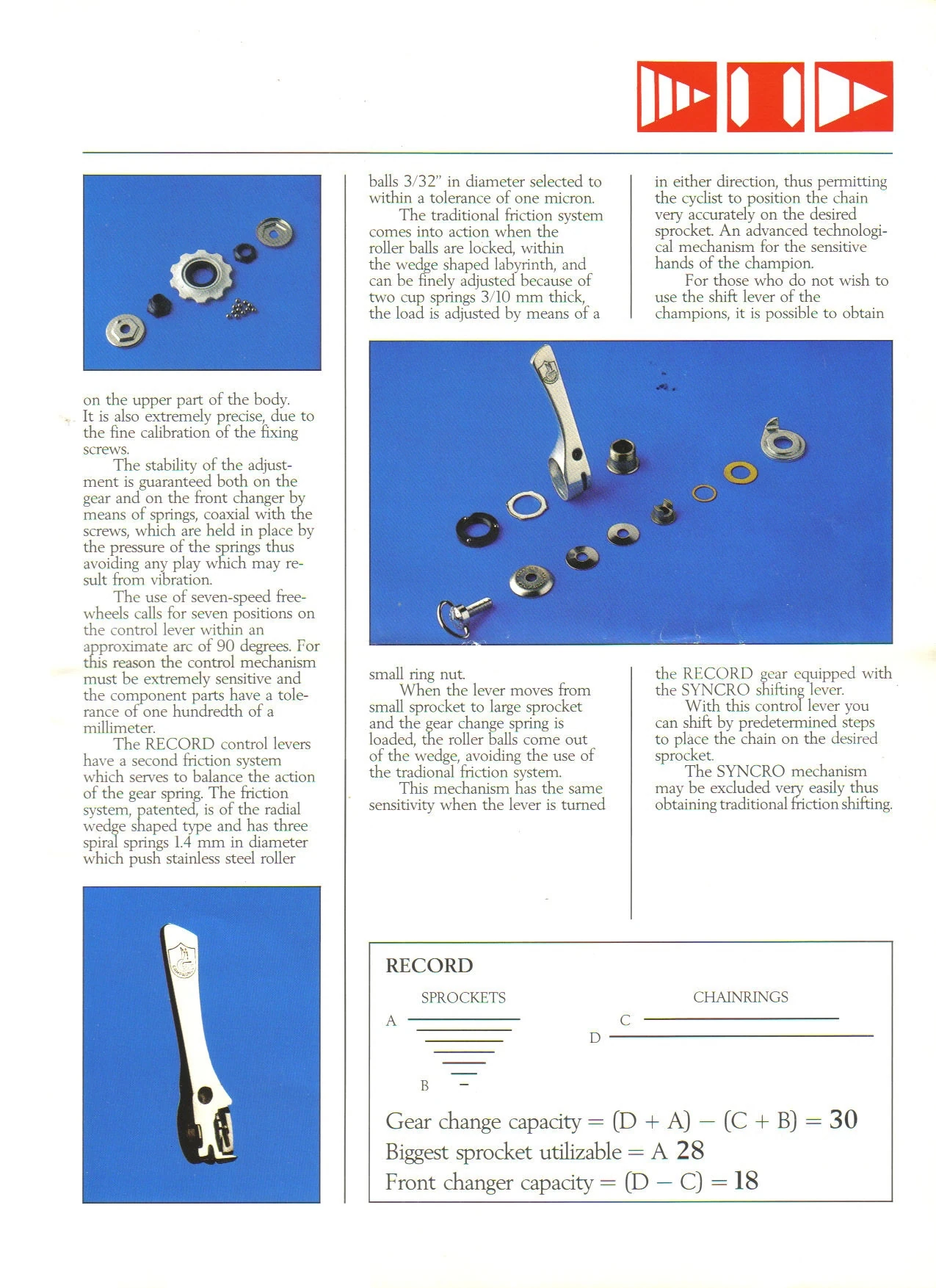
on the upper part of the body. It is also extremely precise, due to the fine calibration of the fixing screws.
The stability of the adjustment is guaranteed both on the gear and on the front changer by means of springs, coaxial with the screws, which are held in place by the pressure of the springs thus avoiding any play which may result from vibration.
The use of seven-speed freewheels calls for seven positions on the control lever within an approximate arc of 90 degrees. For this reason the control mechanism must be extremely sensitive and the component parts have a tolerance of one hundredth of a millimeter.
The RECORD control levers have a second friction system which serves to balance the action of the gear spring. The friction system, patented, is of the radial wedge shaped type and has three spiral springs 1.4 mm in diameter which push stainless steel roller
balls 3/32″ in diameter selected to within a tolerance of one micron.
The traditional friction system comes into action when the roller balls are locked, within the wedge shaped labyrinth, and can be finely adjusted because of two cup springs 3/10 mm thick, the load is adjusted by means of a small ring nut.
When the lever moves from small sprocket to large sprocket and the gear change spring is loaded, the roller balls come out of the wedge, avoiding the use of the tradional friction system.
This mechanism has the same sensitivity when the lever is turned
in either direction, thus permitting the cyclist to position the chain very accurately on the desired sprocket. An advanced technological mechanism for the sensitive hands of the champion.
For those who do not wish to use the shift lever of the champions, it is possible to obtain the RECORD gear equipped with the SYNCRO shifting lever.
With this control lever you can shift by predetermined steps to place the chain on the desired sprocket.
The SYNCRO mechanism may be excluded very easily thus obtaining traditional friction shifting.
RECORD
SPROCKETS | CHAINRINGS
A | B | C | D
Gear change capacity = (D + A) – (C + B) = 30
Biggest sprocket utilizable = A 28
Front changer capacity = (D – C) = 18
[A three-column text page with three red Campagnolo alphabet squares (rear derailleur, shifting levers, front derailleur) at upper right; color photographs on blue of a derailleur jockey wheel exploded with its ball bearings, a single Record shift lever and an exploded shift lever with its washers and bolt; a ruled box diagramming sprockets and chainrings.]
— Page 6 —
[Photograph signs:] CAMPIONE Mio | TERMOZETA | CARRERA | VAGABOND | FUJI FILM
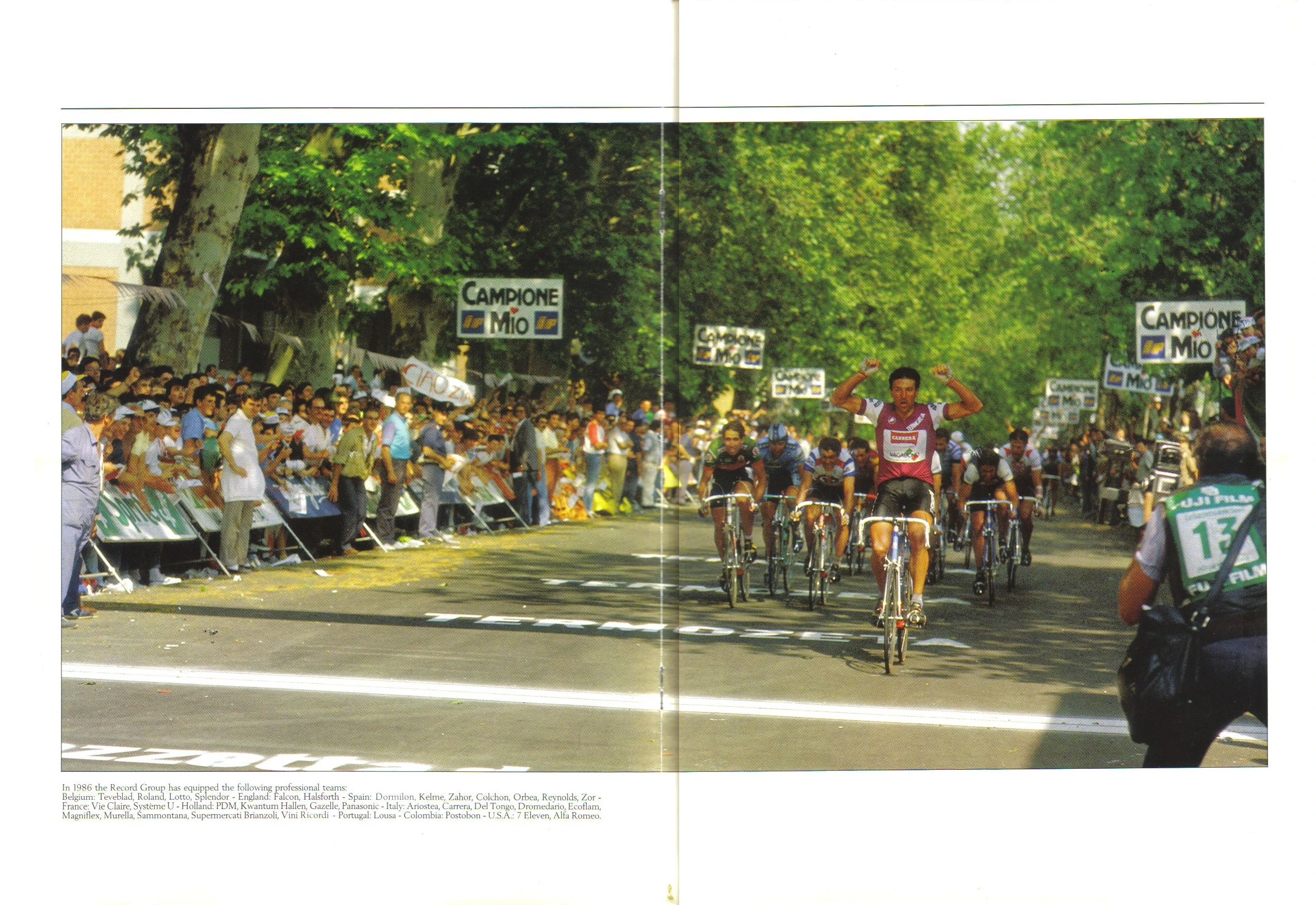
In 1986 the Record Group has equipped the following professional teams:
Belgium: Teveblad, Roland, Lotto, Splendor – England: Falcon, Halsforth – Spain: Dormilon, Kelme, Zahor, Colchon, Orbea, Reynolds, Zor –
France: Vie Claire, Système U – Holland: PDM, Kwantum Hallen, Gazelle, Panasonic – Italy: Ariostea, Carrera, Del Tongo, Dromedario, Ecoflam,
Magniflex, Murella, Sammontana, Supermercati Brianzoli, Vini Ricordi – Portugal: Lousa – Colombia: Postobon – U.S.A.: 7 Eleven, Alfa Romeo.
[A spread-wide color photograph of a tree-lined road race finish: a rider in a pink and white Carrera Vagabond jersey raises both arms in victory ahead of the bunch, spectators behind barriers at left, CAMPIONE Mio banners overhead and a Fuji Film photographer at right; a caption of teams below.]
— Page 7 —
BRAKE SET
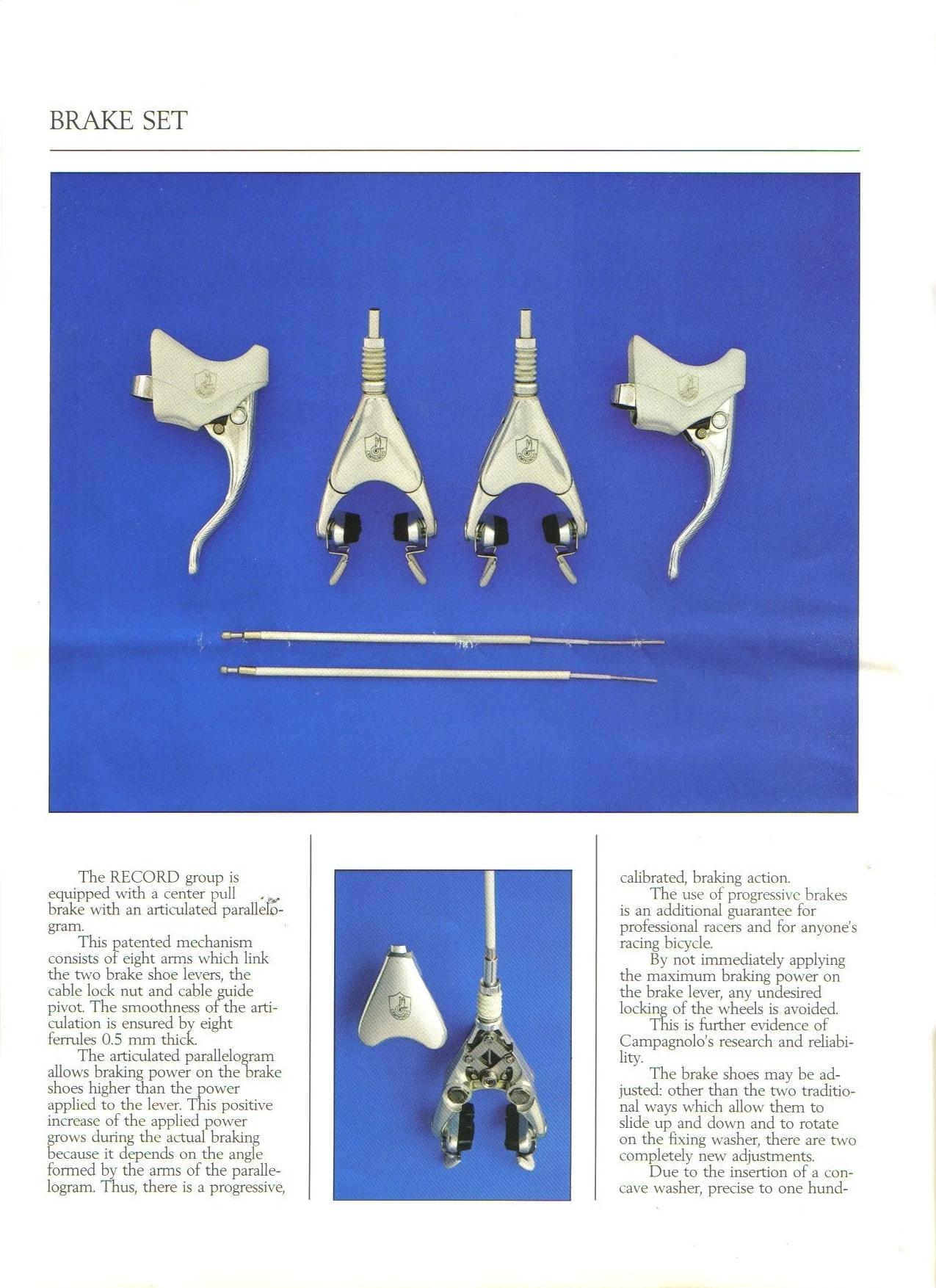
The RECORD group is equipped with a center pull brake with an articulated parallelogram.
This patented mechanism consists of eight arms which link the two brake shoe levers, the cable lock nut and cable guide pivot. The smoothness of the articulation is ensured by eight ferrules 0.5 mm thick.
The articulated parallelogram allows braking power on the brake shoes higher than the power applied to the lever. This positive increase of the applied power grows during the actual braking because it depends on the angle formed by the arms of the parallelogram. Thus, there is a progressive,
calibrated, braking action.
The use of progressive brakes is an additional guarantee for professional racers and for anyone’s racing bicycle.
By not immediately applying the maximum braking power on the brake lever, any undesired locking of the wheels is avoided.
This is further evidence of Campagnolo’s research and reliability.
The brake shoes may be adjusted: other than the two traditional ways which allow them to slide up and down and to rotate on the fixing washer, there are two completely new adjustments.
Due to the insertion of a concave washer, precise to one hund-
[A page with a large color photograph on blue of a pair of Record brake levers with white hoods, two brake calipers and two cables; a smaller photograph at lower center of a caliper with its lever hood on a white background; text columns below.]
— Page 8 —
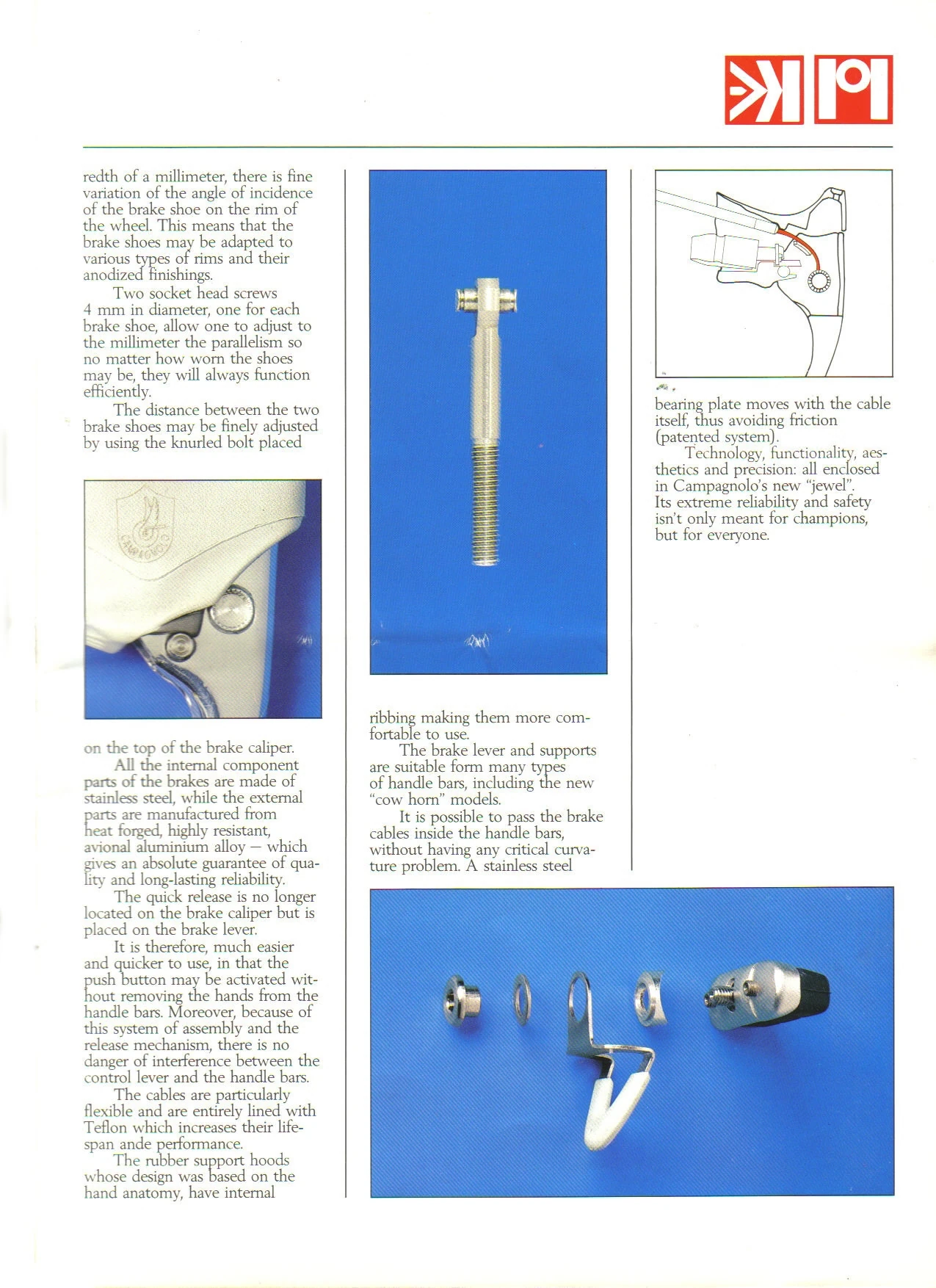
redth of a millimeter, there is fine variation of the angle of incidence of the brake shoe on the rim of the wheel. This means that the brake shoes may be adapted to various types of rims and their anodized finishings.
Two socket head screws 4 mm in diameter, one for each brake shoe, allow one to adjust to the millimeter the parallelism so no matter how worn the shoes may be, they will always function efficiently.
The distance between the two brake shoes may be finely adjusted by using the knurled bolt placed on the top of the brake caliper.
All the internal component parts of the brakes are made of stainless steel, while the external parts are manufactured from heat forged, highly resistant, avional aluminium alloy – which gives an absolute guarantee of quality and long-lasting reliability.
The quick release is no longer located on the brake caliper but is placed on the brake lever.
It is therefore, much easier and quicker to use, in that the push button may be activated without removing the hands from the handle bars. Moreover, because of this system of assembly and the release mechanism, there is no danger of interference between the control lever and the handle bars.
The cables are particularly flexible and are entirely lined with Teflon which increases their lifespan ande performance.
The rubber support hoods whose design was based on the hand anatomy, have internal
ribbing making them more comfortable to use.
The brake lever and supports are suitable form many types of handle bars, including the new “cow horn” models.
It is possible to pass the brake cables inside the handle bars, without having any critical curvature problem. A stainless steel
bearing plate moves with the cable itself, thus avoiding friction (patented system).
Technology, functionality, aesthetics and precision: all enclosed in Campagnolo’s new “jewel”. Its extreme reliability and safety isn’t only meant for champions, but for everyone.
[A three-column text page with two red Campagnolo alphabet squares (brake, brake lever) at upper right; a close-up photograph of a brake lever hood with the winged-wheel emblem; a tall photograph of a quick-release bolt; a line drawing of a brake lever with the cable path in red; a photograph on blue of the lever pivot parts and a white cable hook.]
— Page 9 —
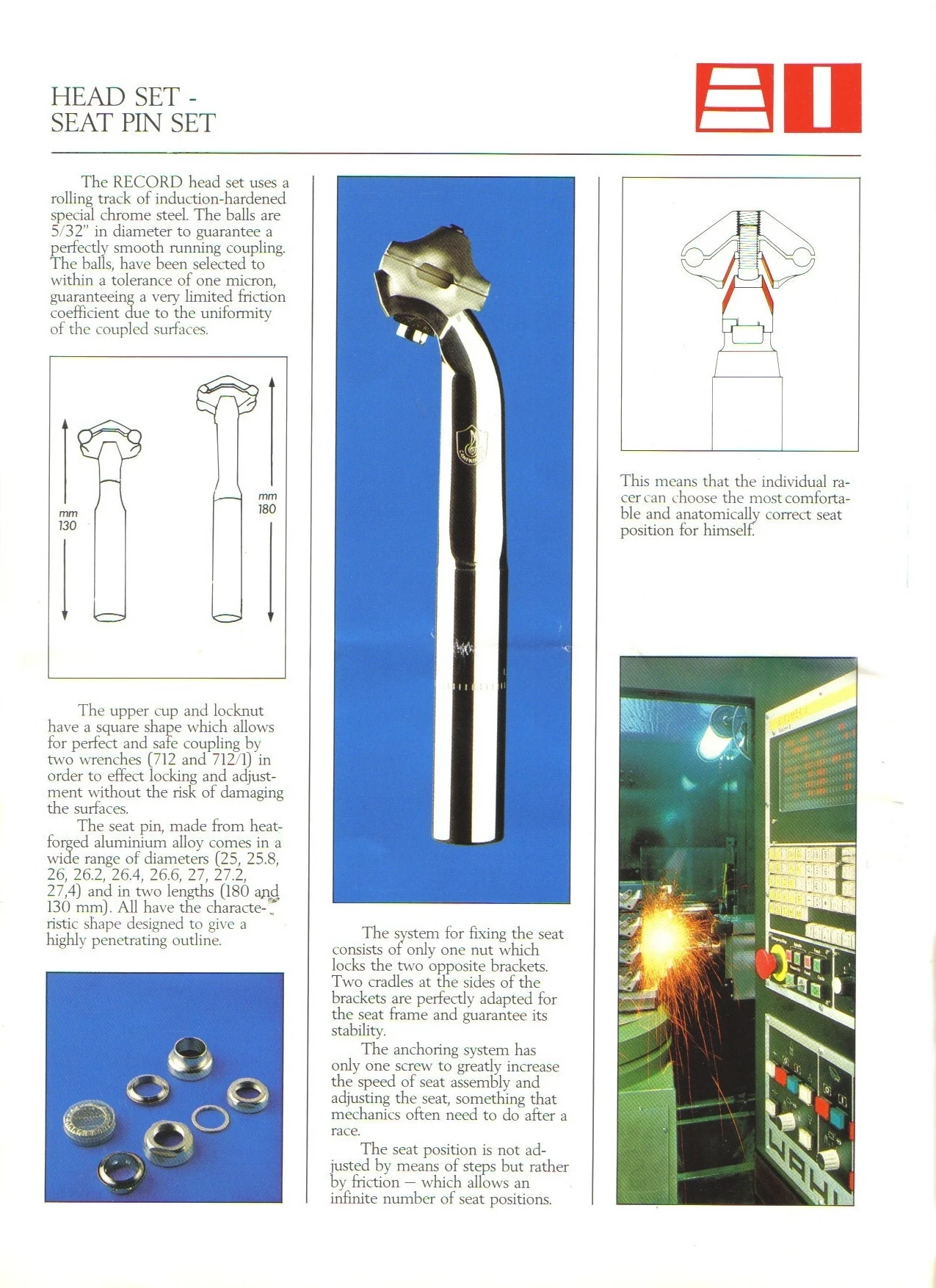
HEAD SET – SEAT PIN SET
The RECORD head set uses a rolling track of induction-hardened special chrome steel. The balls are 5/32″ in diameter to guarantee a perfectly smooth running coupling. The balls, have been selected to within a tolerance of one micron, guaranteeing a very limited friction coefficient due to the uniformity of the coupled surfaces.
[Drawing labels:] mm 130 | mm 180
The upper cup and locknut have a square shape which allows for perfect and safe coupling by two wrenches (712 and 712/1) in order to effect locking and adjustment without the risk of damaging the surfaces.
The seat pin, made from heat-forged aluminium alloy comes in a wide range of diameters (25, 25.8, 26, 26.2, 26.4, 26.6, 27, 27.2, 27,4) and in two lengths (180 and 130 mm). All have the characteristic shape designed to give a highly penetrating outline.
The system for fixing the seat consists of only one nut which locks the two opposite brackets. Two cradles at the sides of the brackets are perfectly adapted for the seat frame and guarantee its stability.
The anchoring system has only one screw to greatly increase the speed of seat assembly and adjusting the seat, something that mechanics often need to do after a race.
The seat position is not adjusted by means of steps but rather by friction – which allows an infinite number of seat positions.
This means that the individual racer can choose the most comfortable and anatomically correct seat position for himself.
[A three-column page with red alphabet squares (headset, seat pin) at upper right; line drawings of 130 mm and 180 mm seat pins; a photograph on blue of headset cups and locknuts; a tall photograph of a fluted Record seat pin; a sectional drawing of the seat pin clamp with red wedges; a color photograph of a machine shop with sparks from a machine tool.]
— Page 10 —
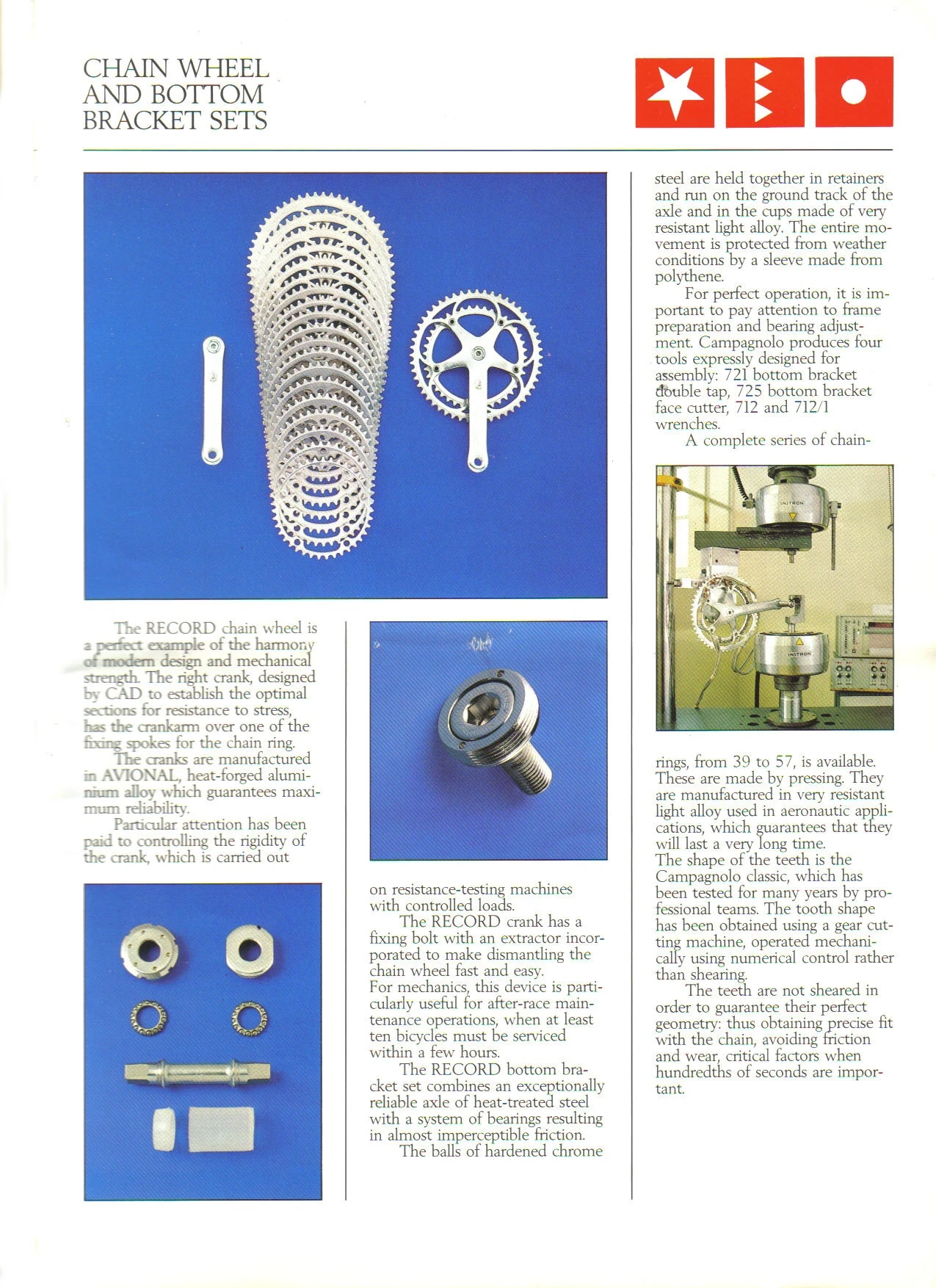
CHAIN WHEEL AND BOTTOM BRACKET SETS
The RECORD chain wheel is a perfect example of the harmony of modern design and mechanical strength. The right crank, designed by CAD to establish the optimal sections for resistance to stress, has the crankarm over one of the fixing spokes for the chain ring.
The cranks are manufactured in AVIONAL, heat-forged aluminium alloy which guarantees maximum reliability.
Particular attention has been paid to controlling the rigidity of the crank, which is carried out on resistance-testing machines with controlled loads.
The RECORD crank has a fixing bolt with an extractor incorporated to make dismantling the chain wheel fast and easy.
For mechanics, this device is particularly useful for after-race maintenance operations, when at least ten bicycles must be serviced within a few hours.
The RECORD bottom bracket set combines an exceptionally reliable axle of heat-treated steel with a system of bearings resulting in almost imperceptible friction.
The balls of hardened chrome steel are held together in retainers and run on the ground track of the axle and in the cups made of very resistant light alloy. The entire movement is protected from weather conditions by a sleeve made from polythene.
For perfect operation, it is important to pay attention to frame preparation and bearing adjustment. Campagnolo produces four tools expressly designed for assembly: 721 bottom bracket double tap, 725 bottom bracket face cutter, 712 and 712/1 wrenches.
A complete series of chainrings, from 39 to 57, is available. These are made by pressing. They are manufactured in very resistant light alloy used in aeronautic applications, which guarantees that they will last a very long time.
The shape of the teeth is the Campagnolo classic, which has been tested for many years by professional teams. The tooth shape has been obtained using a gear cutting machine, operated mechanically using numerical control rather than shearing.
The teeth are not sheared in order to guarantee their perfect geometry: thus obtaining precise fit with the chain, avoiding friction and wear, critical factors when hundredths of seconds are important.
[Photograph label:] INSTRON
[A three-column page with red alphabet squares (crank, chainring, bottom bracket) at upper right; a large photograph on blue of a Record crankset with a fan of spare chainrings and a left crank arm; photographs on blue of bottom bracket cups, retainers, axle and plastic sleeve and of a crank fixing bolt; a photograph of a crank on an Instron testing machine.]
— Page 11 —
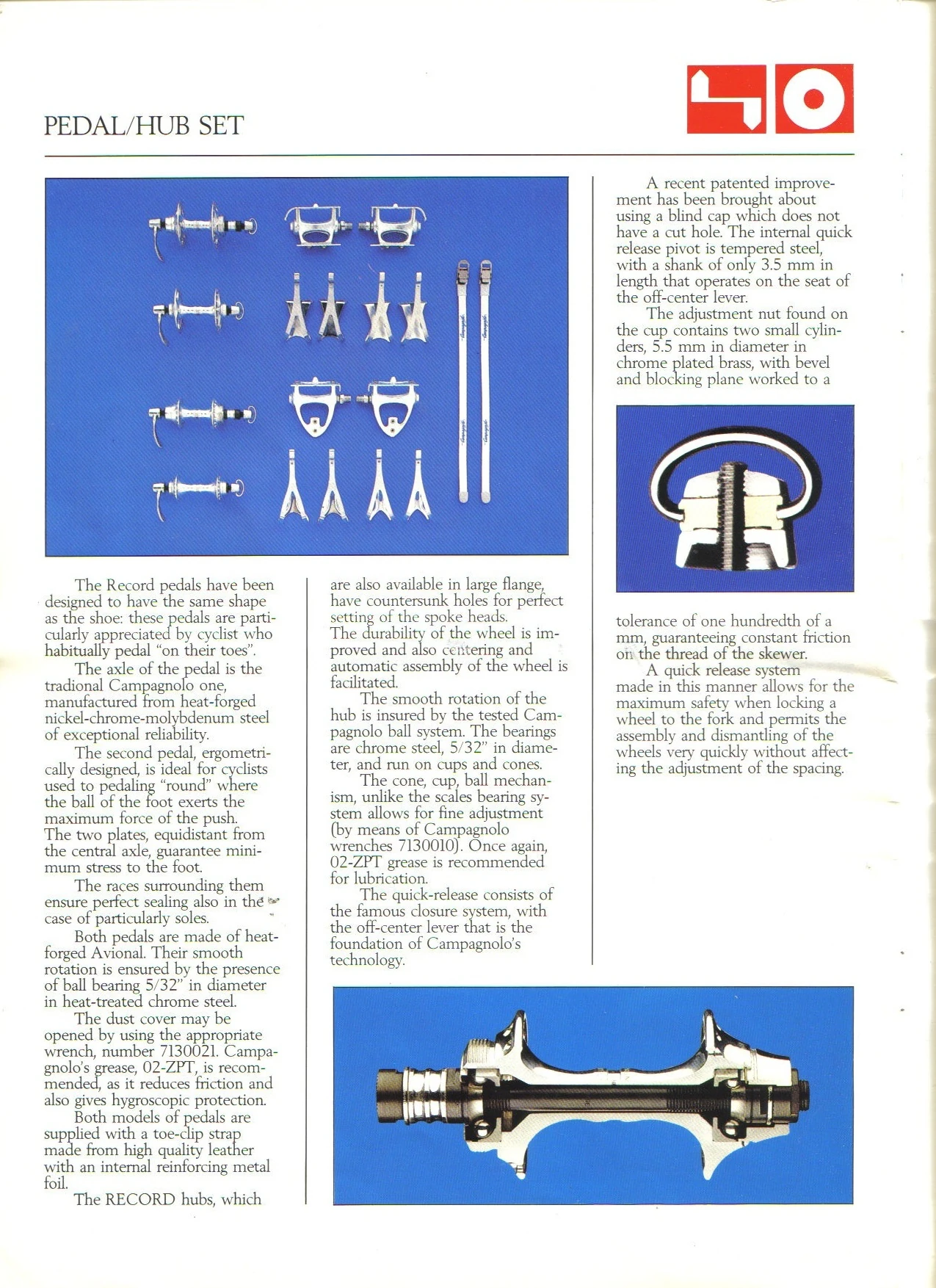
PEDAL/HUB SET
The Record pedals have been designed to have the same shape as the shoe: these pedals are particularly appreciated by cyclist who habitually pedal “on their toes”.
The axle of the pedal is the tradional Campagnolo one, manufactured from heat-forged nickel-chrome-molybdenum steel of exceptional reliability.
The second pedal, ergometrically designed, is ideal for cyclists used to pedaling “round” where the ball of the foot exerts the maximum force of the push. The two plates, equidistant from the central axle, guarantee minimum stress to the foot.
The races surrounding them ensure perfect sealing also in the case of particularly soles.
Both pedals are made of heat-forged Avional. Their smooth rotation is ensured by the presence of ball bearing 5/32″ in diameter in heat-treated chrome steel.
The dust cover may be opened by using the appropriate wrench, number 7130021. Campagnolo’s grease, 02-ZPT, is recommended, as it reduces friction and also gives hygroscopic protection.
Both models of pedals are supplied with a toe-clip strap made from high quality leather with an internal reinforcing metal foil.
The RECORD hubs, which are also available in large flange, have countersunk holes for perfect setting of the spoke heads.
The durability of the wheel is improved and also centering and automatic assembly of the wheel is facilitated.
The smooth rotation of the hub is insured by the tested Campagnolo ball system. The bearings are chrome steel, 5/32″ in diameter, and run on cups and cones.
The cone, cup, ball mechanism, unlike the scales bearing system allows for fine adjustment (by means of Campagnolo wrenches 7130010). Once again, 02-ZPT grease is recommended for lubrication.
The quick-release consists of the famous closure system, with the off-center lever that is the foundation of Campagnolo’s technology.
A recent patented improvement has been brought about using a blind cap which does not have a cut hole. The internal quick release pivot is tempered steel, with a shank of only 3.5 mm in length that operates on the seat of the off-center lever.
The adjustment nut found on the cup contains two small cylinders, 5.5 mm in diameter in chrome plated brass, with bevel and blocking plane worked to a tolerance of one hundredth of a mm, guaranteeing constant friction on the thread of the skewer.
A quick release system made in this manner allows for the maximum safety when locking a wheel to the fork and permits the assembly and dismantling of the wheels very quickly without affecting the adjustment of the spacing.
[A three-column page with red alphabet squares (pedal, hub) at upper right; a large photograph on blue of four pairs of Record hubs with quick releases, two styles of quill pedals, toe clips and two Campagnolo straps; a sectioned quick-release nut; a cutaway photograph of a hub showing axle, cones and bearings.]
— Page 12 —
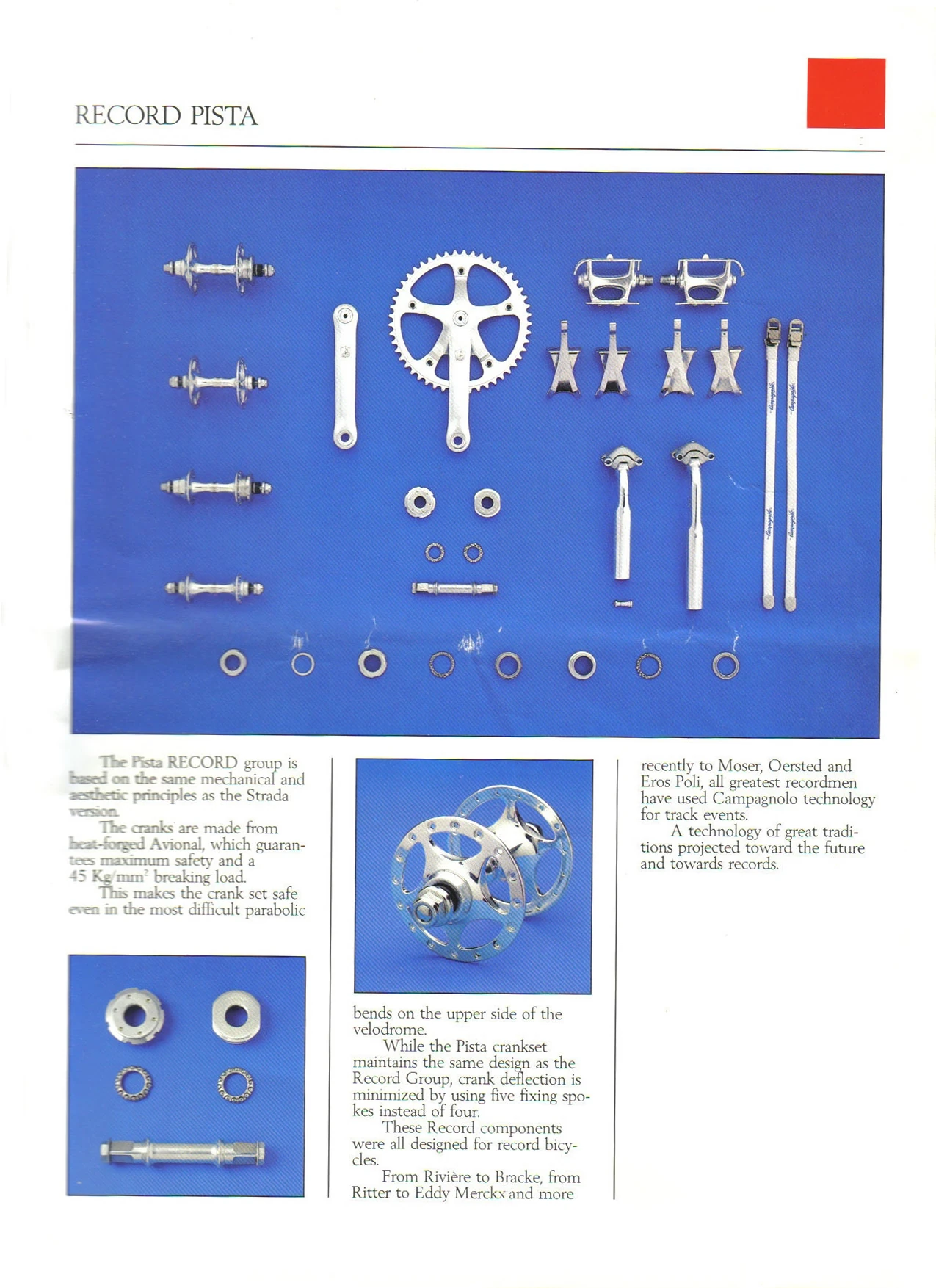
RECORD PISTA
The Pista RECORD group is based on the same mechanical and aesthetic principles as the Strada version.
The cranks are made from heat-forged Avional, which guarantees maximum safety and a 45 Kg/mm² breaking load.
This makes the crank set safe even in the most difficult parabolic bends on the upper side of the velodrome.
While the Pista crankset maintains the same design as the Record Group, crank deflection is minimized by using five fixing spokes instead of four.
These Record components were all designed for record bicycles.
From Rivière to Bracke, from Ritter to Eddy Merckx and more recently to Moser, Oersted and Eros Poli, all greatest recordmen have used Campagnolo technology for track events.
A technology of great traditions projected toward the future and towards records.
[A three-column page with a plain red square at upper right; a large photograph on blue of the Pista group: track hubs, a single-ring crankset and crank arm, quill track pedals with toe clips, seat pins, straps, bottom bracket parts and a row of headset rings; smaller photographs on blue of bottom bracket parts and a high-flange track hub.]
— Page 13 —
printeco – vr Printed in Italy November 1986
Campagnolo®
CAMPAGNOLO S.P.A. – VIA DELLA CHIMICA, 4 – 36100 VICENZA – ITALIA – Telefono 0444/564933 – Telex 480074 CAMPA I – Telefax 0444/565062
CAMPAGNOLO SARL – RUE DU CHATEAU D’EAU – ROUZIERS DU TOURAINE – 37360 NEUILLE PONT PIERRE – Télephone 47-566569 – Telex 750373 WEIFRA – Telefax 47-566779
CAMPAGNOLO CORPORATION – 43 FAIRFIELD PLACE-WEST CALDWELL, N.J. 07006 – Phone 201-8828733 – Telex 705994 CAMPA CORP – Telefax 201-8828939
SERVICE AND TECHNICAL INFORMATION • CENTRAL (ITALY) – Telephone 0444-571871
• U.S.A. – Telephone 201-8828733
[Back cover: a blank white page with the blue Campagnolo script logo, three company address lines and a service telephone block in small type at the foot; the printer’s line runs vertically in tiny type up the right edge near the top.]
 Campagnolo Croce d’Aune Brochure, March 1988 (U.S.A.) — the Group B000 Part by Part: Penta-Drive Brakes, Power Grade Levers, Twin-Axle Derailleur and Triple Bearing Pedals
 Campagnolo Catalog, June 1990 — Xenon, Athena, Chorus, Croce d’Aune and Record Road Groups, Olympus, Centaur and Euclid Mountain Groups and the Tandem Groups
 Campagnolo Catalog, January 1991 — Xenon, Athena, Chorus, Croce d’Aune, Record and Record Pista, the New Themis, Olympus, Centaur, Euclid and the Tandem Groups
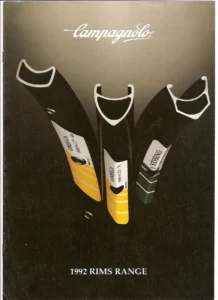 Campagnolo 1992 Rims Range — Sigma, Omega and Lambda Tubular and Clincher Rims, the Mountain Bike Rims and the Ghibli, Scirocco and Khamsin Wheels
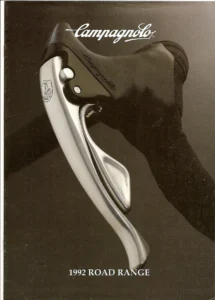 Campagnolo 1992 Road Range — the Record with Ergopower, Chorus RS and Athena RS Groups Part by Part, with the Tandem and Triple Optionals
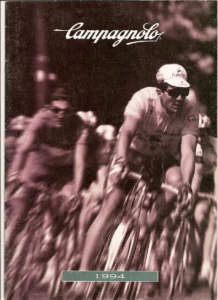 Campagnolo Catalog 1994 — Sixty Years: Record, Chorus, Athena, Veloce, Stratos and Record O.R., the Shamal, Bora and Vento Wheels and the Rims
Ebykr presents this material for research and education. If you hold rights to it or notice an ownership issue, please contact us and we will respond promptly.