About Ebykr
Ebykr celebrates classic and vintage lightweight bicycles through provocative imagery and opinion. Ride along with us.
About Ebykr
Ebykr celebrates classic and vintage lightweight bicycles through provocative imagery and opinion. Ride along with us.

Source: Retrobike archive (retrobike.co.uk), "1987 - Campagnolo Fluid-dynamic Wheels", uploaded by the forum member FluffyChicken.
| Marque | Campagnolo |
|---|---|
| Type | Catalog |
| Year | 1987 |
| Publisher | Campagnolo S.p.A., Via della Chimica 4, 36100 Vicenza, Italy |
| Country | Italy |
| Language | English |
| Pages | 10 |
| Source | Retrobike archive (retrobike.co.uk), "1987 - Campagnolo Fluid-dynamic Wheels", uploaded by the forum member FluffyChicken. |
| Credit | Retrobike (scan by FluffyChicken) |
| Identifier | Permalink https://www.retrobike.co.uk/archive/1987-campagnolo-fluid-dynamic-wheels.908/ |
| Transcription | Transcribed by eye |
Reference
Campagnolo S.p.A., Via della Chimica 4, 36100 Vicenza, Italy. Campagnolo Fluid-Dynamic Wheels Brochure, November 1987 (U.S.A.): the Ghibli M23, Ghibli Gyroscopic and Khamsin Disc Wheels and the Wheel Bags. November 1987. Ebykr, https://ebykr.com/library/campagnolo-fluid-dynamic-wheels-1987/.
Wikipedia
{{cite book |title=Campagnolo Fluid-Dynamic Wheels Brochure, November 1987 (U.S.A.): the Ghibli M23, Ghibli Gyroscopic and Khamsin Disc Wheels and the Wheel Bags |publisher=Campagnolo S.p.A., Via della Chimica 4, 36100 Vicenza, Italy |date=November 1987 |url=https://ebykr.com/library/campagnolo-fluid-dynamic-wheels-1987/ |via=Ebykr |access-date=}}Campagnolo® FLUID-DYNAMIC WHEELS USA FLUID-DYNAMICS The study of fluid movement in contact with a solid body has defined the principle that turbulent behavior of fluid threads in contact with a solid body causes a higher resistance to forward motion compared to the behavior of laminar threads. This is due to the creation of more fluid …
Campagnolo’s brochure for its disc wheels, in its English edition for the United States: fluid dynamics, lightness, ergonomics, elasticity and rigidity with their diagrams, the Ghibli M23 road and track discs, the Ghibli M23 “Gyroscopic” front discs, the Khamsin with its testing and maintenance, the wheel bags, the specification tables with catalog numbers and the Campagnolo addresses. Transcribed from the page images (10 pages); each page ends with a bracketed description of its pictures.
— Page 1 —
Campagnolo®
FLUID-DYNAMIC WHEELS
USA
[Front cover on white: the blue script Campagnolo logo at top center; near the bottom a blue square with a white outlined diamond symbol above the title in black capitals; a small boxed USA market code at lower right.]
— Page 2 —
FLUID-DYNAMICS
The study of fluid movement in contact with a solid body has defined the principle that turbulent behavior of fluid threads in contact with a solid body causes a higher resistance to forward motion compared to the behavior of laminar threads.
This is due to the creation of more fluid movement around the body; movement that obviously requires energy dispersion.
Therefore when the body moves, it must give part of its motive energy to the fluid in order to compensate for the turbulence.
Turbulence is created when the angle of deviation of threads, in regards directional flow, exceeds 10 degrees.
In a spoked wheel, every spoke produces turbulence, since the deviation of the threads reaches 90 degrees.
The disc wheels solve this problem by creating a smooth sliding surface with an angle of deviation always less than 10 degrees.
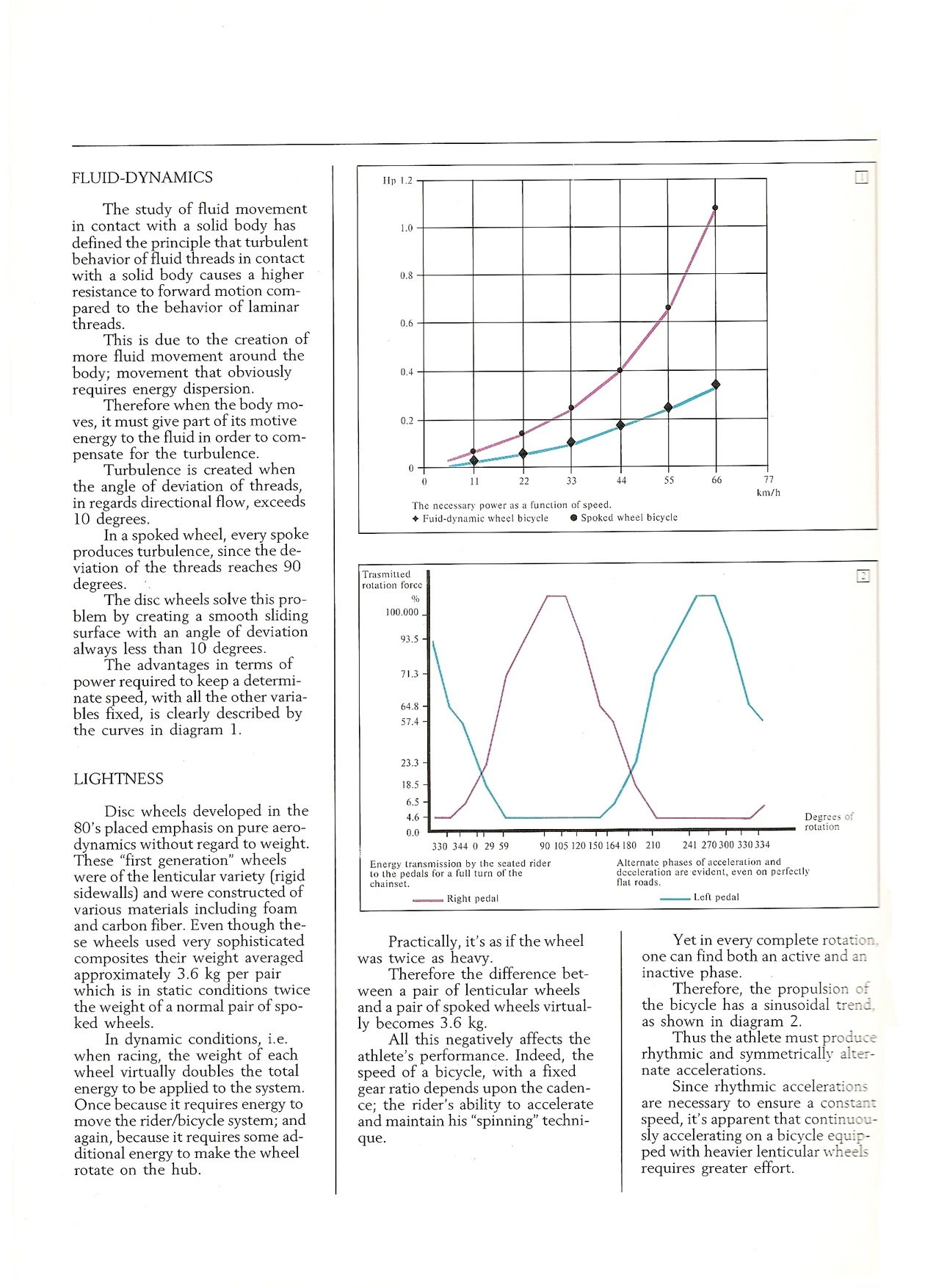
The advantages in terms of power required to keep a determinate speed, with all the other variables fixed, is clearly described by the curves in diagram 1.
LIGHTNESS
Disc wheels developed in the 80’s placed emphasis on pure aerodynamics without regard to weight. These “first generation” wheels were of the lenticular variety (rigid sidewalls) and were constructed of various materials including foam and carbon fiber. Even though these wheels used very sophisticated composites their weight averaged approximately 3.6 kg per pair which is in static conditions twice the weight of a normal pair of spoked wheels.
In dynamic conditions, i.e. when racing, the weight of each wheel virtually doubles the total energy to be applied to the system. Once because it requires energy to move the rider/bicycle system; and again, because it requires some additional energy to make the wheel rotate on the hub.
Practically, it’s as if the wheel was twice as heavy.
Therefore the difference between a pair of lenticular wheels and a pair of spoked wheels virtually becomes 3.6 kg.
All this negatively affects the athlete’s performance. Indeed, the speed of a bicycle, with a fixed gear ratio depends upon the cadence; the rider’s ability to accelerate and maintain his “spinning” technique.
Yet in every complete rotation, one can find both an active and an inactive phase.
Therefore, the propulsion of the bicycle has a sinusoidal trend, as shown in diagram 2.
Thus the athlete must produce rhythmic and symmetrically alternate accelerations.
Since rhythmic accelerations are necessary to ensure a constant speed, it’s apparent that continuously accelerating on a bicycle equipped with heavier lenticular wheels requires greater effort.
1
Hp | 1.2 | 1.0 | 0.8 | 0.6 | 0.4 | 0.2 | 0
km/h | 0 | 11 | 22 | 33 | 44 | 55 | 66 | 77
The necessary power as a function of speed.
✦ Fuid-dynamic wheel bicycle ● Spoked wheel bicycle
2
Trasmitted rotation force %
100.000 | 93.5 | 71.3 | 64.8 | 57.4 | 23.3 | 18.5 | 6.5 | 4.6 | 0.0
Degrees of rotation | 330 | 344 | 0 | 29 | 59 | 90 | 105 | 120 | 150 | 164 | 180 | 210 | 241 | 270 | 300 | 330 | 334
Energy transmission by the seated rider to the pedals for a full turn of the chainset.
Alternate phases of acceleration and deceleration are evident, even on perfectly flat roads.
Right pedal
Left pedal
[A text page with two boxed line graphs: diagram 1 plots power against speed, a magenta curve for the spoked wheel bicycle rising well above a blue curve for the disc wheel bicycle; diagram 2 shows the alternating sinusoidal force curves of the right and left pedals in magenta and blue.]
— Page 3 —
When Campagnolo decided to undertake serious research into perfecting disc wheels their first goal was weight reduction. The engineers knew that a lightweight disc would limit loss of effort and optimize the energetic gain of an aerodynamic structure.
GHIBLI M23
The advantage Campagnolo offers the athlete is a patented manufacturing process which permits the use of the super light materials that maintain the reliability and dependability of the material.
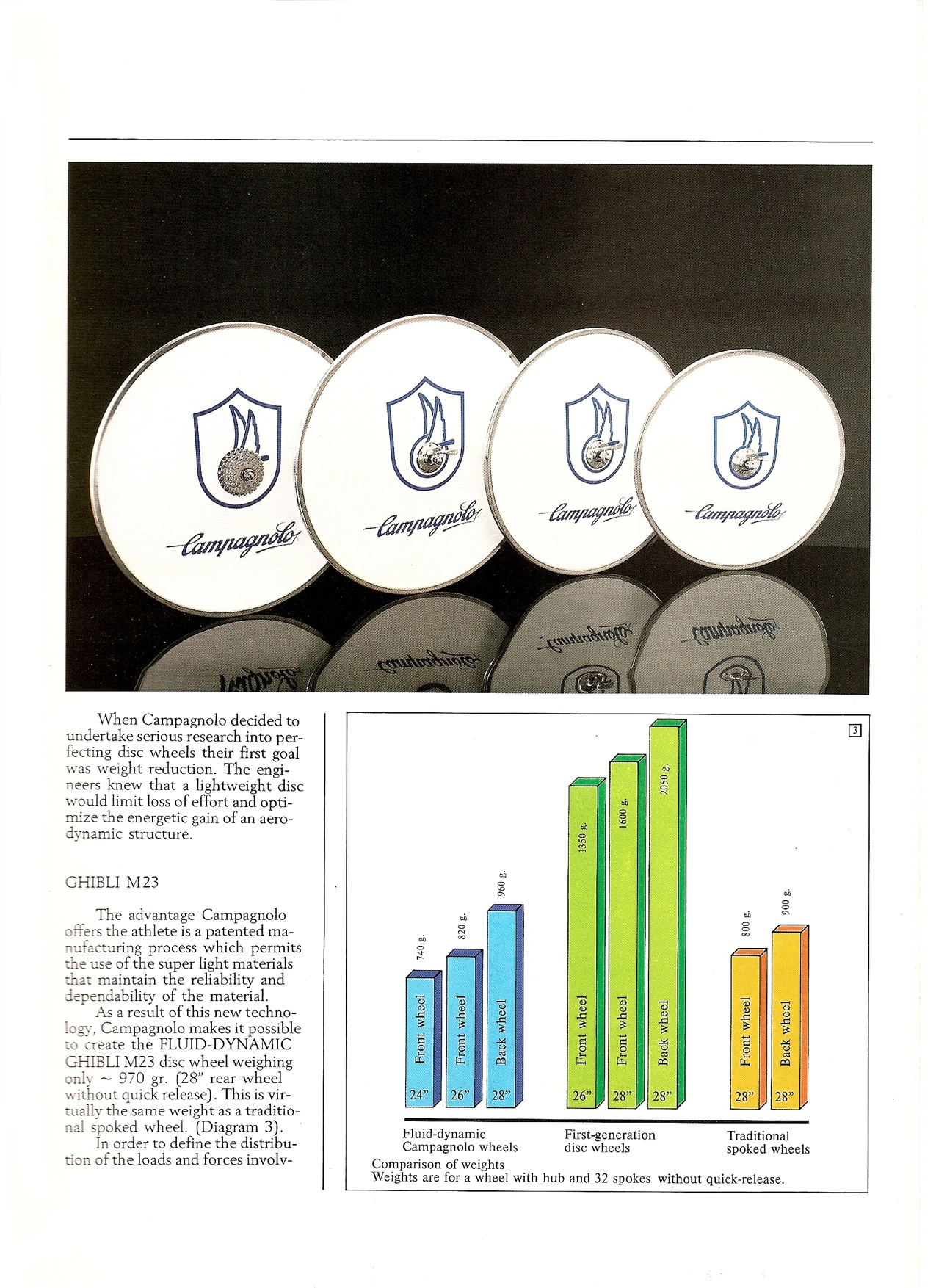
As a result of this new technology, Campagnolo makes it possible to create the FLUID-DYNAMIC GHIBLI M23 disc wheel weighing only ~ 970 gr. (28″ rear wheel without quick release). This is virtually the same weight as a traditional spoked wheel. (Diagram 3).
In order to define the distribution of the loads and forces involv-
3
Fluid-dynamic Campagnolo wheels | Front wheel 24″ 740 g. | Front wheel 26″ 820 g. | Back wheel 28″ 960 g.
First-generation disc wheels | Front wheel 26″ 1350 g. | Front wheel 28″ 1600 g. | Back wheel 28″ 2050 g.
Traditional spoked wheels | Front wheel 28″ 800 g. | Back wheel 28″ 900 g.
Comparison of weights
Weights are for a wheel with hub and 32 spokes without quick-release.
Campagnolo
[A photograph of four white Campagnolo disc wheels of decreasing size standing in a row on a black reflective surface, each with the blue winged-wheel shield and script logo; below, diagram 3, a bar chart in blue, green and orange comparing wheel weights.]
— Page 4 —
ed, Campagnolo engineers utilized a computer to obtain the necessary calculations and information vital to improve the existing disc wheel.
Upon completion, this information was, through the use of CAD/CAM technology, translated into profiles which determined the optimum requirements for the construction and mechanical characteristics to exceed all present lenticular wheels.
As a result, a new structural principle makes it possible to use tensioned fibers instead of compressed fibers, resulting in weight reduction while developing the most efficient application for fiber, ever.
ERGONOMICS OF THE GHIBLI M23
GHIBLI M23 FLUID-DYNAMIC wheels have been designed for highly specialized uses.
For this reason Campagnolo has designed two different models, one for track events and one for road racing, because the professional requirements of these two sectors are very different.
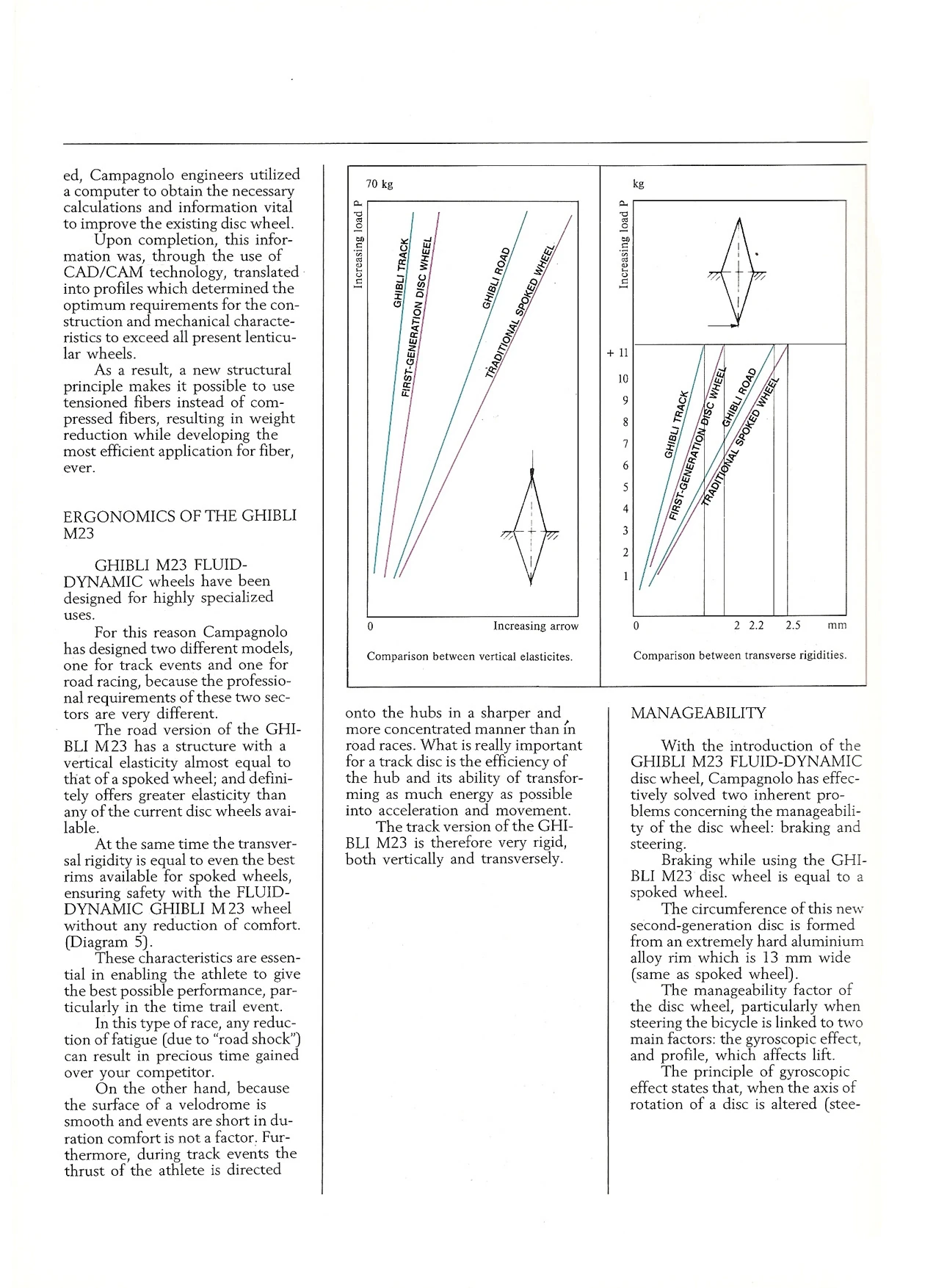
The road version of the GHIBLI M23 has a structure with a vertical elasticity almost equal to that of a spoked wheel; and definitely offers greater elasticity than any of the current disc wheels available.
At the same time the transversal rigidity is equal to even the best rims available for spoked wheels, ensuring safety with the FLUID-DYNAMIC GHIBLI M23 wheel without any reduction of comfort. (Diagram 5).
These characteristics are essential in enabling the athlete to give the best possible performance, particularly in the time trail event.
In this type of race, any reduction of fatigue (due to “road shock”) can result in precious time gained over your competitor.
On the other hand, because the surface of a velodrome is smooth and events are short in duration comfort is not a factor. Furthermore, during track events the thrust of the athlete is directed onto the hubs in a sharper and more concentrated manner than in road races. What is really important for a track disc is the efficiency of the hub and its ability of transforming as much energy as possible into acceleration and movement.
The track version of the GHIBLI M23 is therefore very rigid, both vertically and transversely.
MANAGEABILITY
With the introduction of the GHIBLI M23 FLUID-DYNAMIC disc wheel, Campagnolo has effectively solved two inherent problems concerning the manageability of the disc wheel: braking and steering.
Braking while using the GHIBLI M23 disc wheel is equal to a spoked wheel.
The circumference of this new second-generation disc is formed from an extremely hard aluminium alloy rim which is 13 mm wide (same as spoked wheel).
The manageability factor of the disc wheel, particularly when steering the bicycle is linked to two main factors: the gyroscopic effect, and profile, which affects lift.
The principle of gyroscopic effect states that, when the axis of rotation of a disc is altered (stee-
70 kg
Increasing load P
GHIBLI TRACK
FIRST-GENERATION DISC WHEEL
GHIBLI ROAD
TRADITIONAL SPOKED WHEEL
0 | Increasing arrow
Comparison between vertical elasticites.
kg
Increasing load P
+ 11 | 10 | 9 | 8 | 7 | 6 | 5 | 4 | 3 | 2 | 1
GHIBLI TRACK
FIRST-GENERATION DISC WHEEL
GHIBLI ROAD
TRADITIONAL SPOKED WHEEL
0 | 2 | 2.2 | 2.5 | mm
Comparison between transverse rigidities.
[A text page with two boxed line diagrams side by side comparing the vertical elasticity and transverse rigidity of the Ghibli track and road discs, first-generation discs and spoked wheels, with small diamond-shaped load schematics.]
— Page 5 —
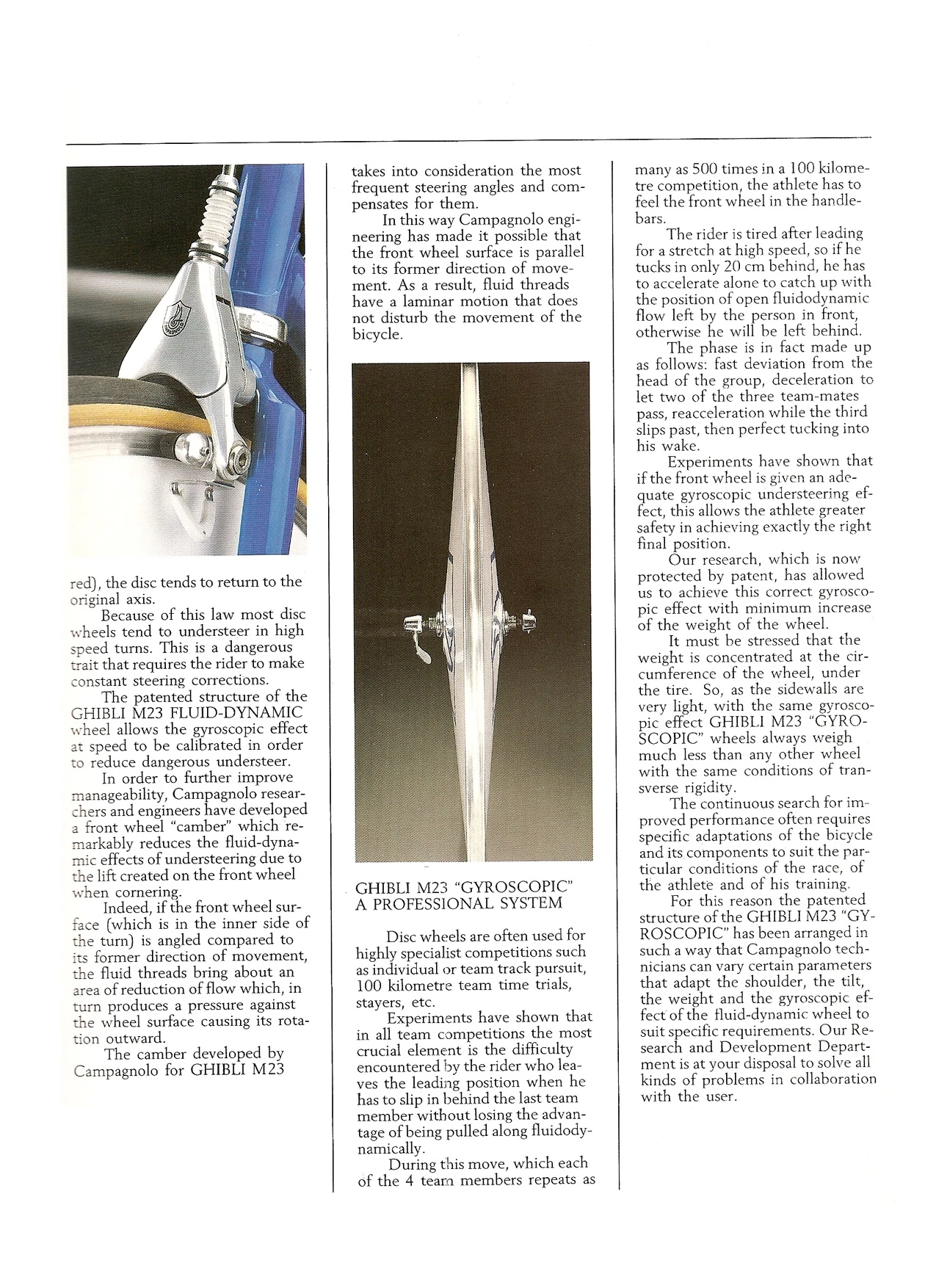
red), the disc tends to return to the original axis.
Because of this law most disc wheels tend to understeer in high speed turns. This is a dangerous trait that requires the rider to make constant steering corrections.
The patented structure of the GHIBLI M23 FLUID-DYNAMIC wheel allows the gyroscopic effect at speed to be calibrated in order to reduce dangerous understeer.
In order to further improve manageability, Campagnolo researchers and engineers have developed a front wheel “camber” which remarkably reduces the fluid-dynamic effects of understeering due to the lift created on the front wheel when cornering.
Indeed, if the front wheel surface (which is in the inner side of the turn) is angled compared to its former direction of movement, the fluid threads bring about an area of reduction of flow which, in turn produces a pressure against the wheel surface causing its rotation outward.
The camber developed by Campagnolo for GHIBLI M23 takes into consideration the most frequent steering angles and compensates for them.
In this way Campagnolo engineering has made it possible that the front wheel surface is parallel to its former direction of movement. As a result, fluid threads have a laminar motion that does not disturb the movement of the bicycle.
GHIBLI M23 “GYROSCOPIC” A PROFESSIONAL SYSTEM
Disc wheels are often used for highly specialist competitions such as individual or team track pursuit, 100 kilometre team time trials, stayers, etc.
Experiments have shown that in all team competitions the most crucial element is the difficulty encountered by the rider who leaves the leading position when he has to slip in behind the last team member without losing the advantage of being pulled along fluidodynamically.
During this move, which each of the 4 team members repeats as many as 500 times in a 100 kilometre competition, the athlete has to feel the front wheel in the handlebars.
The rider is tired after leading for a stretch at high speed, so if he tucks in only 20 cm behind, he has to accelerate alone to catch up with the position of open fluidodynamic flow left by the person in front, otherwise he will be left behind.
The phase is in fact made up as follows: fast deviation from the head of the group, deceleration to let two of the three team-mates pass, reacceleration while the third slips past, then perfect tucking into his wake.
Experiments have shown that if the front wheel is given an adequate gyroscopic understeering effect, this allows the athlete greater safety in achieving exactly the right final position.
Our research, which is now protected by patent, has allowed us to achieve this correct gyroscopic effect with minimum increase of the weight of the wheel.
It must be stressed that the weight is concentrated at the circumference of the wheel, under the tire. So, as the sidewalls are very light, with the same gyroscopic effect GHIBLI M23 “GYROSCOPIC” wheels always weigh much less than any other wheel with the same conditions of transverse rigidity.
The continuous search for improved performance often requires specific adaptations of the bicycle and its components to suit the particular conditions of the race, of the athlete and of his training.
For this reason the patented structure of the GHIBLI M23 “GYROSCOPIC” has been arranged in such a way that Campagnolo technicians can vary certain parameters that adapt the shoulder, the tilt, the weight and the gyroscopic effect of the fluid-dynamic wheel to suit specific requirements. Our Research and Development Department is at your disposal to solve all kinds of problems in collaboration with the user.
[A close-up color photograph of a Campagnolo brake caliper on a blue fork gripping the aluminum rim of a white disc wheel; a tall photograph of a disc wheel seen edge-on, showing its lens-shaped profile and quick-release hub.]
— Page 6 —
KHAMSIN
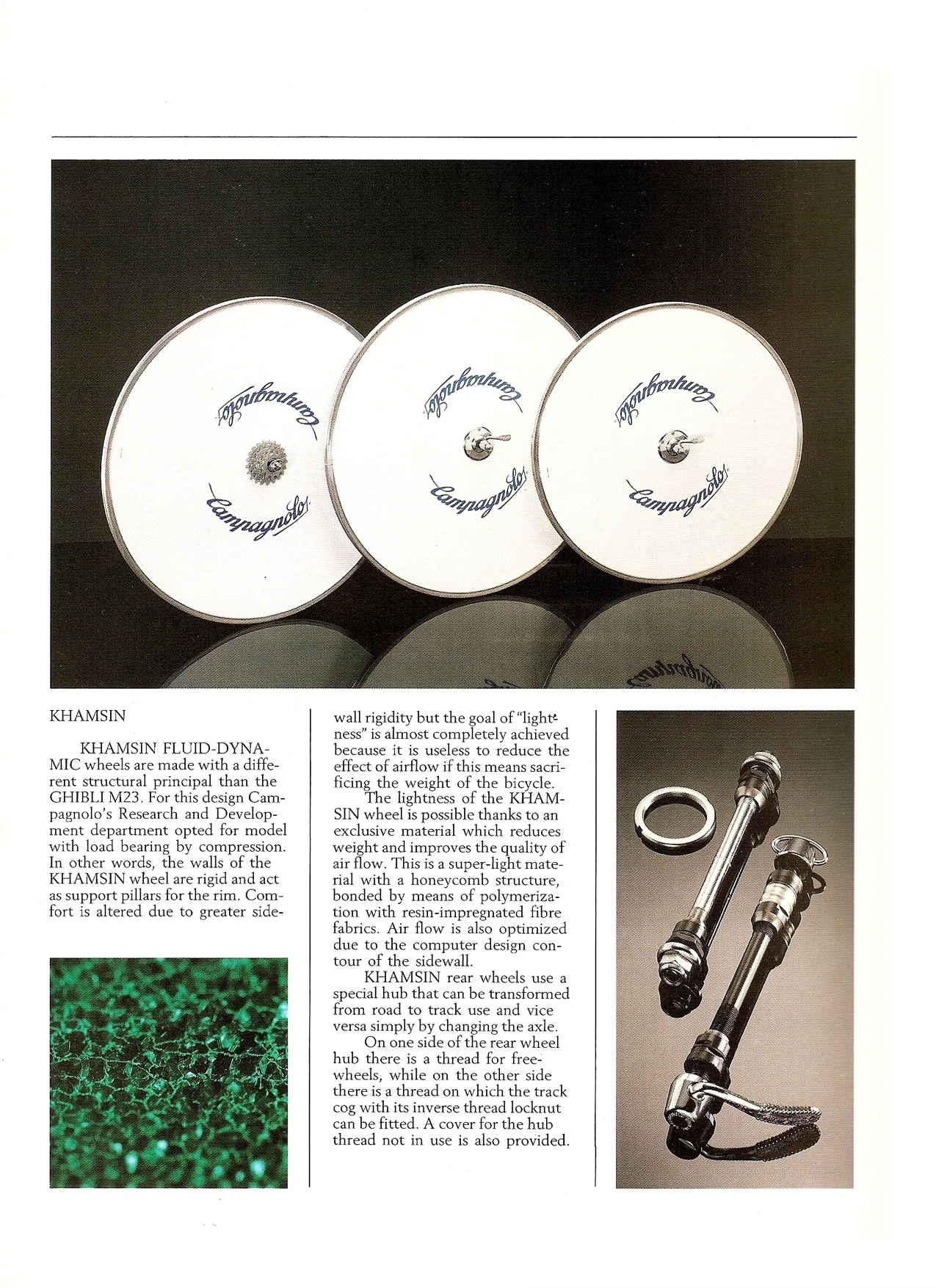
KHAMSIN FLUID-DYNAMIC wheels are made with a different structural principal than the GHIBLI M23. For this design Campagnolo’s Research and Development department opted for model with load bearing by compression. In other words, the walls of the KHAMSIN wheel are rigid and act as support pillars for the rim. Comfort is altered due to greater sidewall rigidity but the goal of “lightness” is almost completely achieved because it is useless to reduce the effect of airflow if this means sacrificing the weight of the bicycle.
The lightness of the KHAMSIN wheel is possible thanks to an exclusive material which reduces weight and improves the quality of air flow. This is a super-light material with a honeycomb structure, bonded by means of polymerization with resin-impregnated fibre fabrics. Air flow is also optimized due to the computer design contour of the sidewall.
KHAMSIN rear wheels use a special hub that can be transformed from road to track use and vice versa simply by changing the axle.
On one side of the rear wheel hub there is a thread for freewheels, while on the other side there is a thread on which the track cog with its inverse thread locknut can be fitted. A cover for the hub thread not in use is also provided.
[A photograph of three white Khamsin disc wheels with blue Campagnolo script logos on a black reflective surface; a green macro photograph of the honeycomb core material; a photograph of the interchangeable road and track hub axles with a lockring and quick-release.]
— Page 7 —
For those who are interested in taking part in high-level competition, the KHAMSIN road model is the ideal fluid-dynamic wheel for developing and emphasizing the talents of a fast rider or a promising sprinter.
For the Club rider or young racer this is an especially nice feature because one wheel can meet the demands of both road and track specialities.
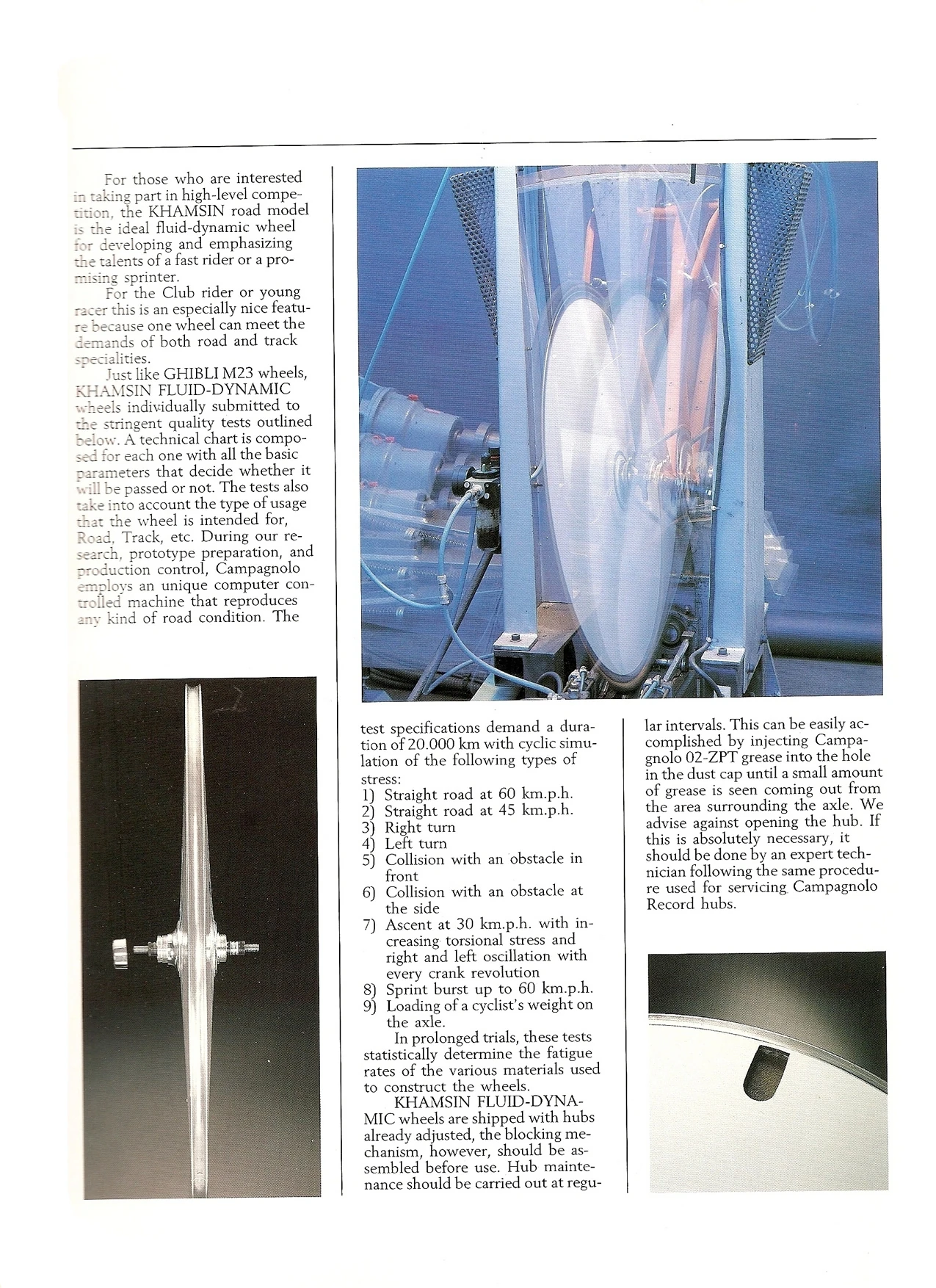
Just like GHIBLI M23 wheels, KHAMSIN FLUID-DYNAMIC wheels individually submitted to the stringent quality tests outlined below. A technical chart is composed for each one with all the basic parameters that decide whether it will be passed or not. The tests also take into account the type of usage that the wheel is intended for, Road, Track, etc. During our research, prototype preparation, and production control, Campagnolo employs an unique computer controlled machine that reproduces any kind of road condition. The test specifications demand a duration of 20.000 km with cyclic simulation of the following types of stress:
1) Straight road at 60 km.p.h.
2) Straight road at 45 km.p.h.
3) Right turn
4) Left turn
5) Collision with an obstacle in front
6) Collision with an obstacle at the side
7) Ascent at 30 km.p.h. with increasing torsional stress and right and left oscillation with every crank revolution
8) Sprint burst up to 60 km.p.h.
9) Loading of a cyclist’s weight on the axle.
In prolonged trials, these tests statistically determine the fatigue rates of the various materials used to construct the wheels.
KHAMSIN FLUID-DYNAMIC wheels are shipped with hubs already adjusted, the blocking mechanism, however, should be assembled before use. Hub maintenance should be carried out at regular intervals. This can be easily accomplished by injecting Campagnolo 02-ZPT grease into the hole in the dust cap until a small amount of grease is seen coming out from the area surrounding the axle. We advise against opening the hub. If this is absolutely necessary, it should be done by an expert technician following the same procedure used for servicing Campagnolo Record hubs.
[A color photograph of a disc wheel spinning in a computer-controlled test rig with blue pneumatic lines behind a clear guard; an edge-on photograph of a disc wheel with its hub; a close-up of the valve access hole near the disc rim. The left text column is faded where the scan caught the binding.]
— Page 8 —
The white surfaces of Campagnolo fluid-dynamic wheels can be cleaned with ordinary detergent and, if necessary, with most kinds of petroleum distillates, without risking damage to the sidewalls or decorations.
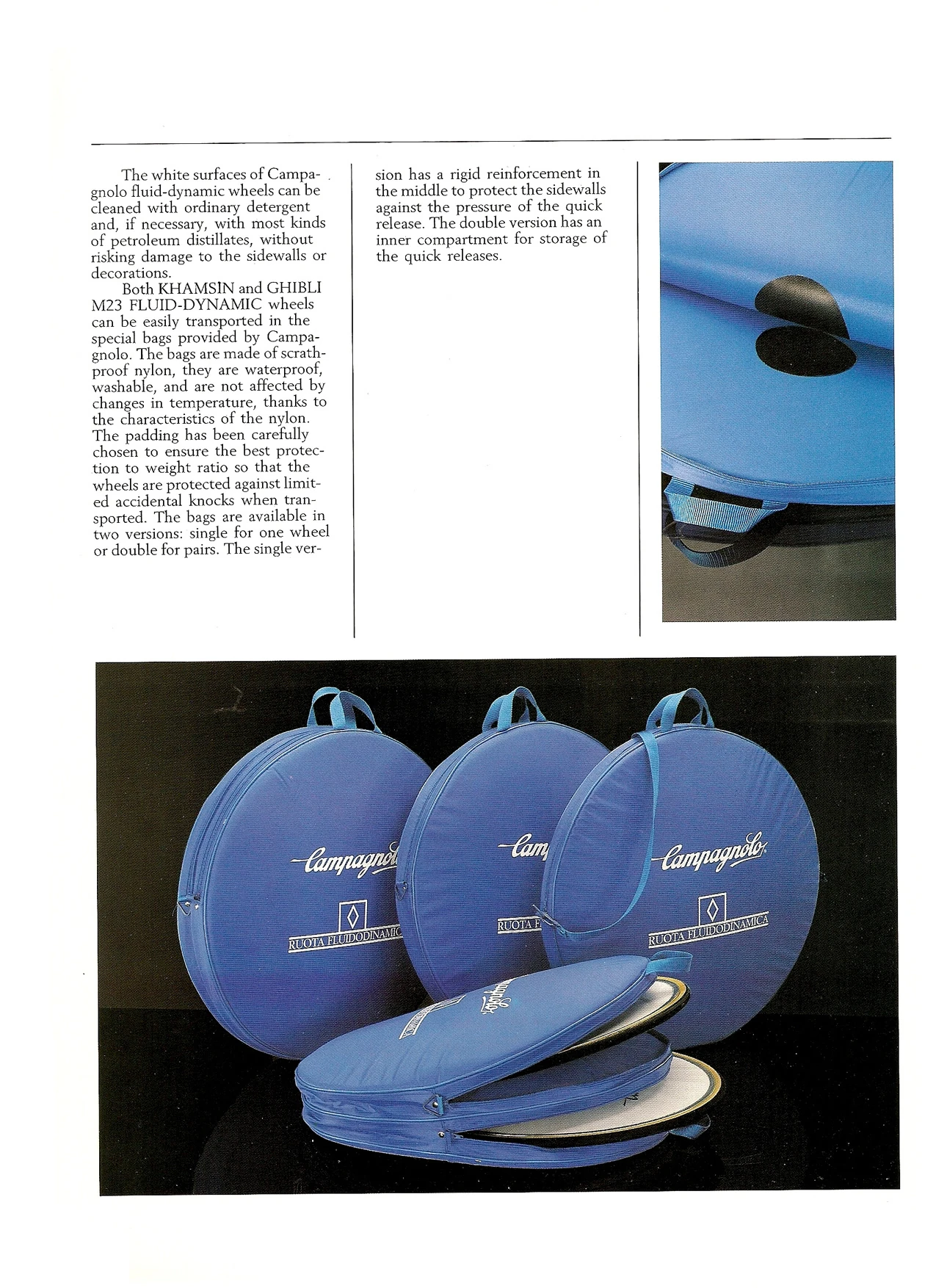
Both KHAMSIN and GHIBLI M23 FLUID-DYNAMIC wheels can be easily transported in the special bags provided by Campagnolo. The bags are made of scrathproof nylon, they are waterproof, washable, and are not affected by changes in temperature, thanks to the characteristics of the nylon. The padding has been carefully chosen to ensure the best protection to weight ratio so that the wheels are protected against limited accidental knocks when transported. The bags are available in two versions: single for one wheel or double for pairs. The single version has a rigid reinforcement in the middle to protect the sidewalls against the pressure of the quick release. The double version has an inner compartment for storage of the quick releases.
Campagnolo
RUOTA FLUIDODINAMICA
[A close-up color photograph of a blue padded wheel bag with its black hub cover; a larger photograph on black of four blue Campagnolo wheel bags printed with the white script logo, the diamond emblem and RUOTA FLUIDODINAMICA, one double bag open to show two disc wheels.]
— Page 9 —
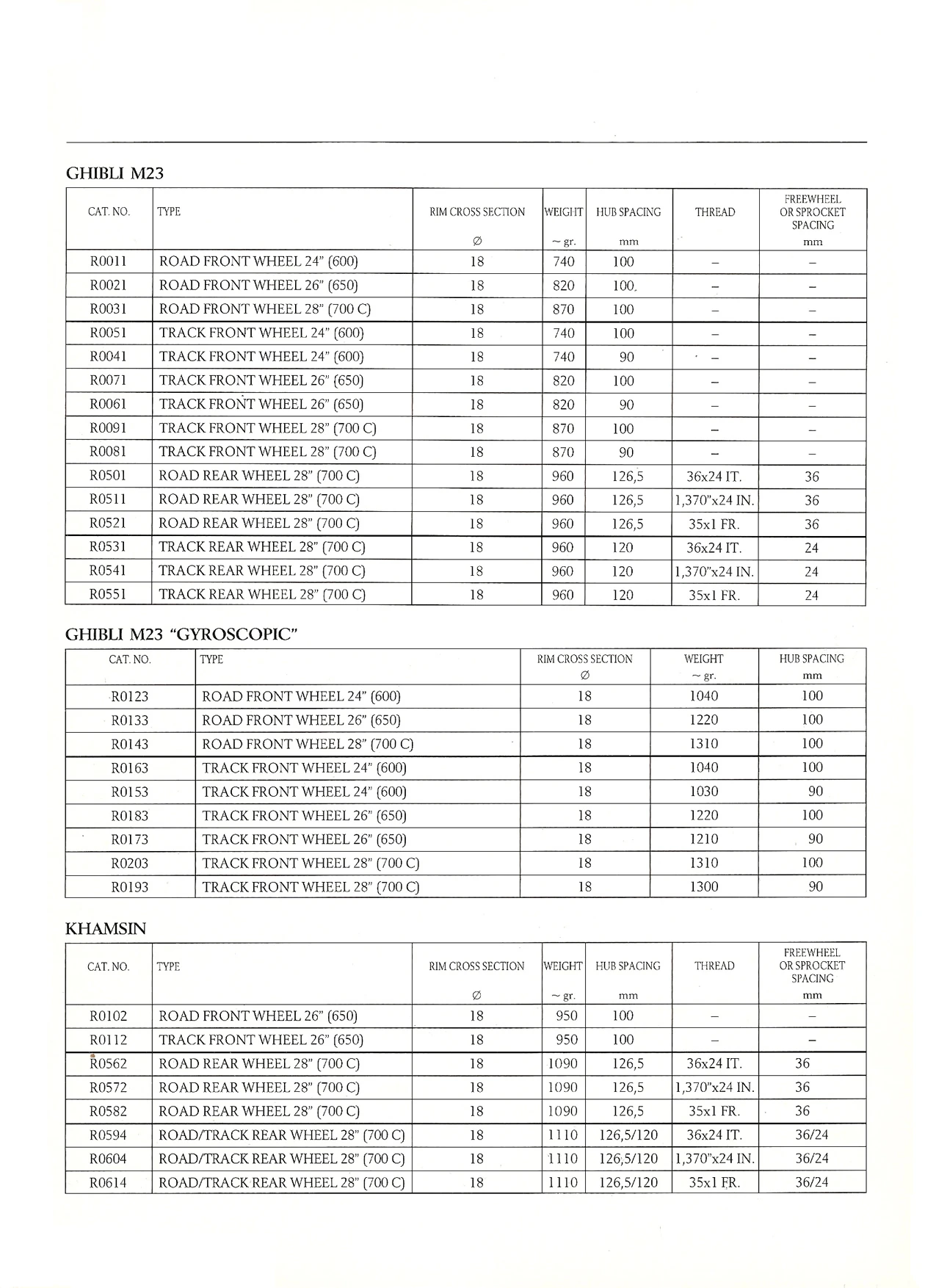
GHIBLI M23
CAT. NO. | TYPE | RIM CROSS SECTION Ø | WEIGHT ~ gr. | HUB SPACING mm | THREAD | FREEWHEEL OR SPROCKET SPACING mm
R0011 | ROAD FRONT WHEEL 24″ (600) | 18 | 740 | 100 | – | –
R0021 | ROAD FRONT WHEEL 26″ (650) | 18 | 820 | 100 | – | –
R0031 | ROAD FRONT WHEEL 28″ (700 C) | 18 | 870 | 100 | – | –
R0051 | TRACK FRONT WHEEL 24″ (600) | 18 | 740 | 100 | – | –
R0041 | TRACK FRONT WHEEL 24″ (600) | 18 | 740 | 90 | – | –
R0071 | TRACK FRONT WHEEL 26″ (650) | 18 | 820 | 100 | – | –
R0061 | TRACK FRONT WHEEL 26″ (650) | 18 | 820 | 90 | – | –
R0091 | TRACK FRONT WHEEL 28″ (700 C) | 18 | 870 | 100 | – | –
R0081 | TRACK FRONT WHEEL 28″ (700 C) | 18 | 870 | 90 | – | –
R0501 | ROAD REAR WHEEL 28″ (700 C) | 18 | 960 | 126,5 | 36×24 IT. | 36
R0511 | ROAD REAR WHEEL 28″ (700 C) | 18 | 960 | 126,5 | 1,370″x24 IN. | 36
R0521 | ROAD REAR WHEEL 28″ (700 C) | 18 | 960 | 126,5 | 35×1 FR. | 36
R0531 | TRACK REAR WHEEL 28″ (700 C) | 18 | 960 | 120 | 36×24 IT. | 24
R0541 | TRACK REAR WHEEL 28″ (700 C) | 18 | 960 | 120 | 1,370″x24 IN. | 24
R0551 | TRACK REAR WHEEL 28″ (700 C) | 18 | 960 | 120 | 35×1 FR. | 24
GHIBLI M23 “GYROSCOPIC”
CAT. NO. | TYPE | RIM CROSS SECTION Ø | WEIGHT ~ gr. | HUB SPACING mm
R0123 | ROAD FRONT WHEEL 24″ (600) | 18 | 1040 | 100
R0133 | ROAD FRONT WHEEL 26″ (650) | 18 | 1220 | 100
R0143 | ROAD FRONT WHEEL 28″ (700 C) | 18 | 1310 | 100
R0163 | TRACK FRONT WHEEL 24″ (600) | 18 | 1040 | 100
R0153 | TRACK FRONT WHEEL 24″ (600) | 18 | 1030 | 90
R0183 | TRACK FRONT WHEEL 26″ (650) | 18 | 1220 | 100
R0173 | TRACK FRONT WHEEL 26″ (650) | 18 | 1210 | 90
R0203 | TRACK FRONT WHEEL 28″ (700 C) | 18 | 1310 | 100
R0193 | TRACK FRONT WHEEL 28″ (700 C) | 18 | 1300 | 90
KHAMSIN
CAT. NO. | TYPE | RIM CROSS SECTION Ø | WEIGHT ~ gr. | HUB SPACING mm | THREAD | FREEWHEEL OR SPROCKET SPACING mm
R0102 | ROAD FRONT WHEEL 26″ (650) | 18 | 950 | 100 | – | –
R0112 | TRACK FRONT WHEEL 26″ (650) | 18 | 950 | 100 | – | –
R0562 | ROAD REAR WHEEL 28″ (700 C) | 18 | 1090 | 126,5 | 36×24 IT. | 36
R0572 | ROAD REAR WHEEL 28″ (700 C) | 18 | 1090 | 126,5 | 1,370″x24 IN. | 36
R0582 | ROAD REAR WHEEL 28″ (700 C) | 18 | 1090 | 126,5 | 35×1 FR. | 36
R0594 | ROAD/TRACK REAR WHEEL 28″ (700 C) | 18 | 1110 | 126,5/120 | 36×24 IT. | 36/24
R0604 | ROAD/TRACK REAR WHEEL 28″ (700 C) | 18 | 1110 | 126,5/120 | 1,370″x24 IN. | 36/24
R0614 | ROAD/TRACK REAR WHEEL 28″ (700 C) | 18 | 1110 | 126,5/120 | 35×1 FR. | 36/24
[A text-only specification page with three ruled tables listing catalog numbers, sizes, weights, hub spacings and threads for the Ghibli M23, Ghibli M23 Gyroscopic and Khamsin disc wheels.]
— Page 10 —
Printed in Italy by CARTOGRAFICA VENETA – Lonigo (VI) – November ’87
□ CAMPAGNOLO S.P.A. – VIA DELLA CHIMICA, 4 – 36100 VICENZA – ITALIA – Tel. 0444/564933 – Telex 480074 CAMPA I – Telefax 0444/565062
□ CAMPAGNOLO SARL – RUE DU CHATEAU D’EAU – ROUZIERS DE TOURAINE – 37360 NEUILLE PONT PIERRE – Tél. 47-566569 – Telex 750373 WEIFRA – Telefax 47-566779
□ CAMPAGNOLO CORPORATION – 43 FAIRFIELD PLACE-WEST CALDWELL, N.J. 07006 – Tel. 201-8828733 – Telex 705994 CAMPA CORP – Telefax 201-8828939
□ TECHNISCHER KUNDENDIENST • ITALY – Tel. 0444/571871
• U.S.A. Tel. 1/800 US CAMPI
[Back cover, otherwise blank white: a tiny vertical printer’s line at the upper right edge and a block of Campagnolo company addresses for Italy, France and the United States along the bottom.]
 Campagnolo Croce d’Aune Brochure, March 1988 (U.S.A.) — the Group B000 Part by Part: Penta-Drive Brakes, Power Grade Levers, Twin-Axle Derailleur and Triple Bearing Pedals
 Campagnolo Catalog, June 1990 — Xenon, Athena, Chorus, Croce d’Aune and Record Road Groups, Olympus, Centaur and Euclid Mountain Groups and the Tandem Groups
 Campagnolo Catalog, January 1991 — Xenon, Athena, Chorus, Croce d’Aune, Record and Record Pista, the New Themis, Olympus, Centaur, Euclid and the Tandem Groups
 Campagnolo 1992 Rims Range — Sigma, Omega and Lambda Tubular and Clincher Rims, the Mountain Bike Rims and the Ghibli, Scirocco and Khamsin Wheels
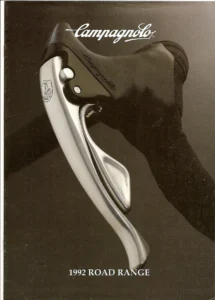 Campagnolo 1992 Road Range — the Record with Ergopower, Chorus RS and Athena RS Groups Part by Part, with the Tandem and Triple Optionals
 Campagnolo Catalog 1994 — Sixty Years: Record, Chorus, Athena, Veloce, Stratos and Record O.R., the Shamal, Bora and Vento Wheels and the Rims
Ebykr presents this material for research and education. If you hold rights to it or notice an ownership issue, please contact us and we will respond promptly.