About Ebykr
Ebykr celebrates classic and vintage lightweight bicycles through provocative imagery and opinion. Ride along with us.
About Ebykr
Ebykr celebrates classic and vintage lightweight bicycles through provocative imagery and opinion. Ride along with us.

Source: Retrobike archive (retrobike.co.uk), "1987 - Campagnolo Chorus", uploaded by the forum member FluffyChicken.
| Marque | Campagnolo |
|---|---|
| Type | Catalog |
| Year | 1987 |
| Publisher | Campagnolo S.p.A., Via della Chimica 4, 36100 Vicenza, Italy |
| Country | Italy |
| Language | English |
| Pages | 14 |
| Source | Retrobike archive (retrobike.co.uk), "1987 - Campagnolo Chorus", uploaded by the forum member FluffyChicken. |
| Credit | Retrobike (scan by FluffyChicken) |
| Identifier | Permalink https://www.retrobike.co.uk/archive/1987-campagnolo-chorus.909/ |
| Transcription | Transcribed by eye |
Reference
Campagnolo S.p.A., Via della Chimica 4, 36100 Vicenza, Italy. Campagnolo Chorus Brochure, July 1987 (U.S.A.): the Chorus Group No. 700: Derailleurs, Doppler and Syncro Levers, Crankset, Brakes, Headset, Hubs and Pedals. July 1987. Ebykr, https://ebykr.com/library/campagnolo-chorus-brochure-1987/.
Wikipedia
{{cite book |title=Campagnolo Chorus Brochure, July 1987 (U.S.A.): the Chorus Group No. 700: Derailleurs, Doppler and Syncro Levers, Crankset, Brakes, Headset, Hubs and Pedals |publisher=Campagnolo S.p.A., Via della Chimica 4, 36100 Vicenza, Italy |date=July 1987 |url=https://ebykr.com/library/campagnolo-chorus-brochure-1987/ |via=Ebykr |access-date=}}Campagnolo® CHORUS® USA CHORUS® 700 | "CHORUS" Campagnolo group composed of: Cat. No. | Description 715/100 | Subgroup brakes (front and rear brake, two brake levers, cables and casings) 265/CS | Subgroup SM gear and braze-on front changer 542/S | "Friction" levers braze-on version (left and right hand lever, cables, stainless steel outer casing) 722/101 …
Campagnolo’s brochure for the new Chorus group, catalog no. 700, in its English edition for the United States: the group’s parts key, a photograph across three pages, then the SM and LG rear derailleurs and the front derailleur with the Dual-Mode rules and Syncro compatibility, the chainwheel and bottom bracket, brakes, brake levers and pads, headset, hubs, pedals and seat pins, each with its specifications, and the Campagnolo addresses in Italy, France and the United States. Transcribed from the page images (14 pages); each page ends with a bracketed description of its pictures.
— Page 1 —
Campagnolo®
CHORUS®
USA
[Front cover on white: the blue script Campagnolo logo at top center; near the bottom the word CHORUS above a grid of twelve magenta squares, each with a white geometric symbol for a component; a small boxed USA market code at lower right.]
— Page 2 —
CHORUS®
700 | “CHORUS” Campagnolo group composed of:
Cat. No. | Description
715/100 | Subgroup brakes (front and rear brake, two brake levers, cables and casings)
265/CS | Subgroup SM gear and braze-on front changer
542/S | “Friction” levers braze-on version (left and right hand lever, cables, stainless steel outer casing)
722/101 | Subgroup small flange hubs, (front and rear quick release hub)
706/101 | Subgroup chainwheel (r.h. crank with two chainrings, l.h. crank)
703/101 | Bottom bracket
705/000 | Subgroup pedals (l.h. and r.h. pedals complete with steel toe-clips and straps)
704/101 | Head set
545 | Seat pin 180 mm, with fixing seat pin screw and nut Ø 8
Alternative subgroups and components
Cat. No. | Description
280/CS | Subgroup LG gear and braze-on front changer
702/101 | clip-on front changer
“FRICTION” levers with cables and stainless steel outer casing, versions:
543/ST | braze-on on top of tube
544/F | clip-on
“DOPPLER” levers with cables and stainless steel outer casing, versions:
325 | braze-on
326 | braze-on on top of tube
327 | clip-on
“SYNCRO” levers with micrometric inserts for A and B positions of “DUAL-MODE” system, cables e stainless steel outer casing, versions:
535/6AB | braze-on for 6 speed
536/6AB | braze-on on top of tube for 6 speed
537/6AB | clip-on for 6 speed
538/7AB | braze-on for 7 speed
539/7AB | braze-on on top of tube for 7 speed
541/7AB | clip-on for 7 speed
716/102 | Seat pin 130 mm, with fixing seat pin screw and nut Ø 8.
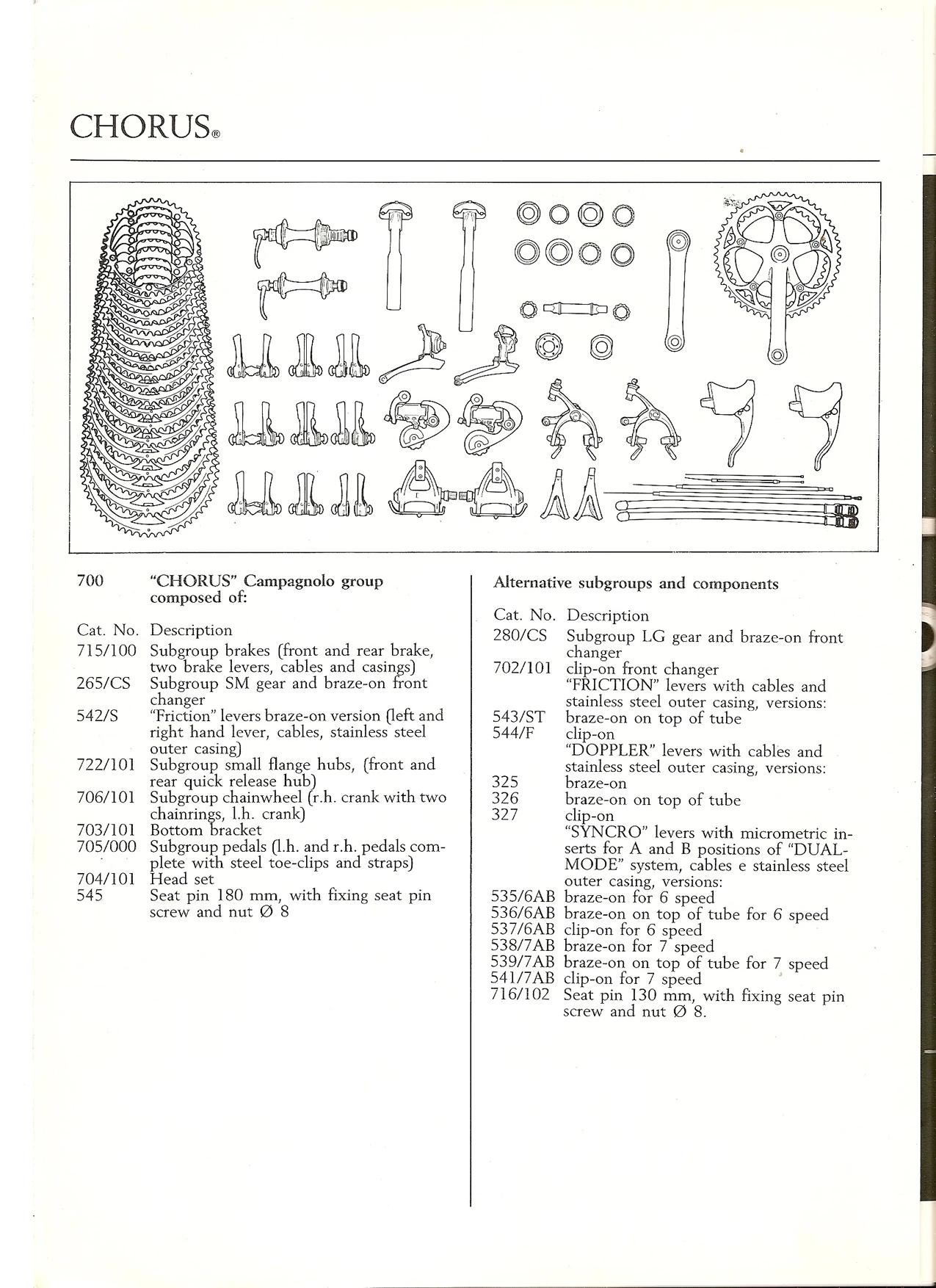
[A boxed line-drawing key of the whole Chorus group: a fanned stack of chainrings at left, hubs, two seat pins, headset and bottom bracket parts, crankset, shift levers in three styles, front and rear derailleurs, brakes and levers, pedals, toe-clips, cables and straps; two-column catalog list below.]
— Page 3 —
CHORUS®
BREV. CAMPAGNOLO
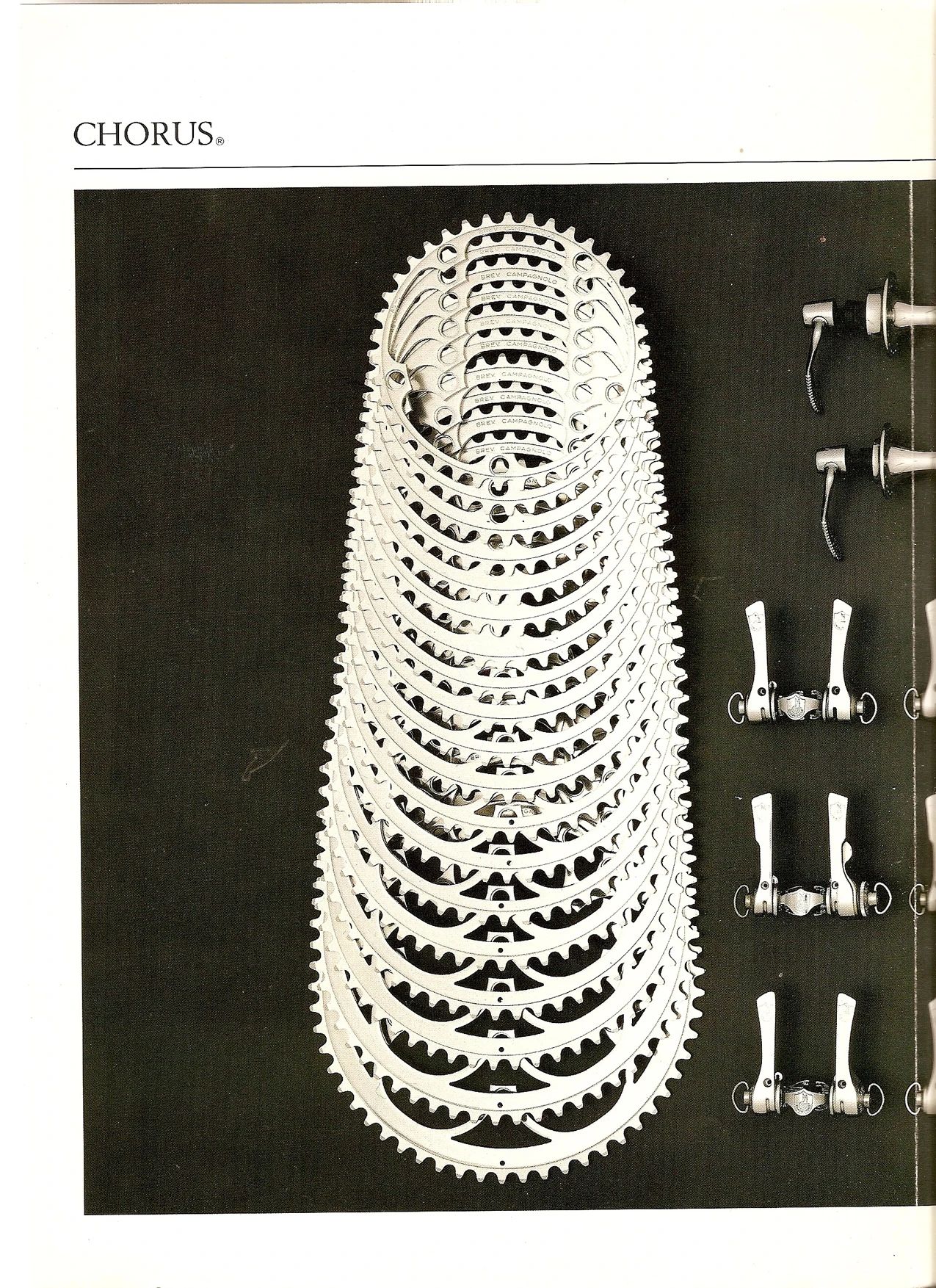
[Left half of a black-background photograph spread: a long fanned stack of silver Chorus chainrings, some stamped BREV. CAMPAGNOLO, with quick-release hubs and three pairs of shift levers at right; the image continues on the facing page.]
— Page 4 —
Campagnolo
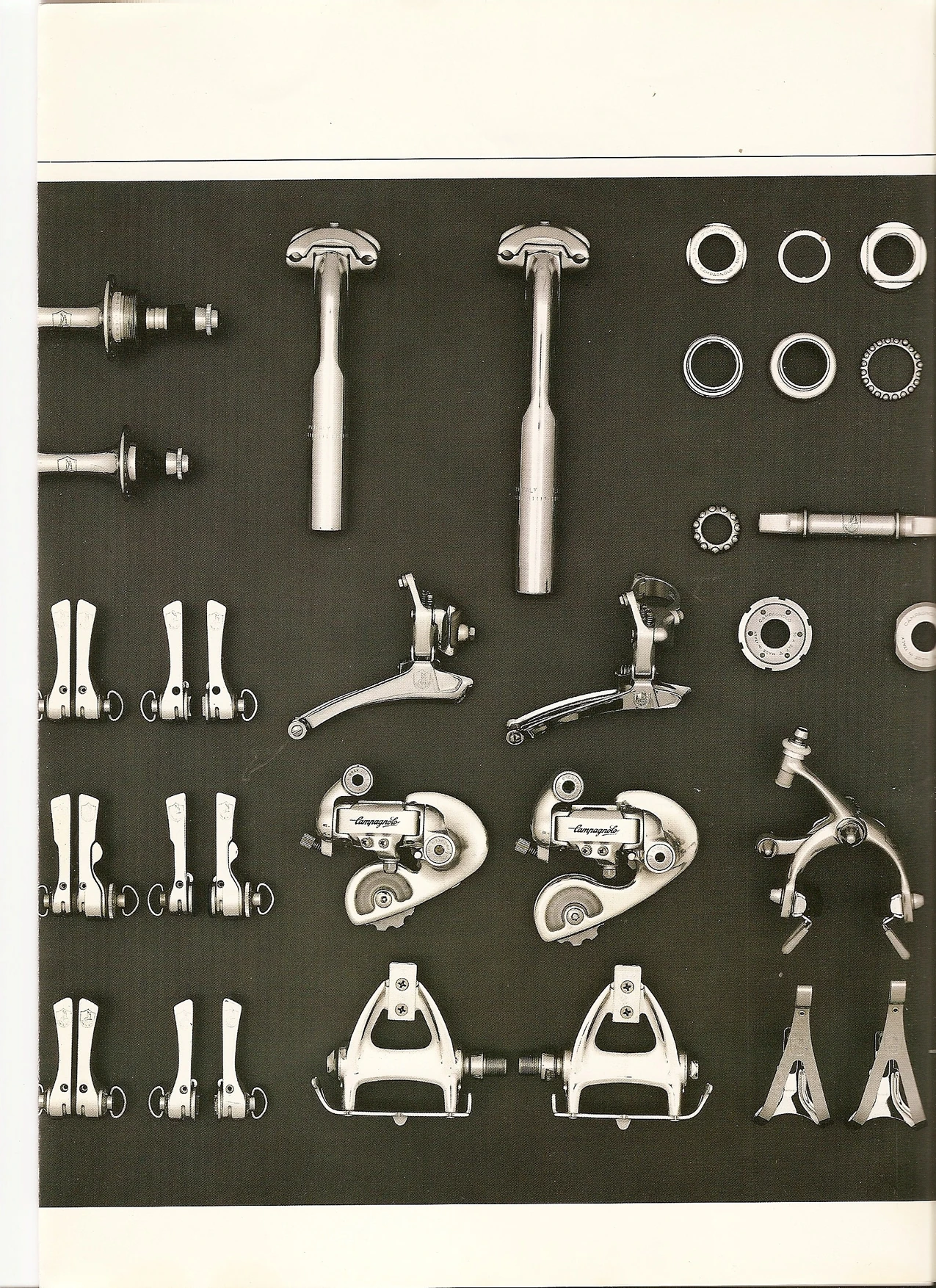
[Right half of the black-background photograph spread: hubs, two silver seat pins, headset cups and races, bottom bracket axle and cups, two front derailleurs, two rear derailleurs marked Campagnolo, a sidepull brake, shift levers, pedals with cages and a pair of toe-clips.]
— Page 5 —
Campagnolo
Campagnolo
Campagnolo
Campagnolo
MADE IN ITALY
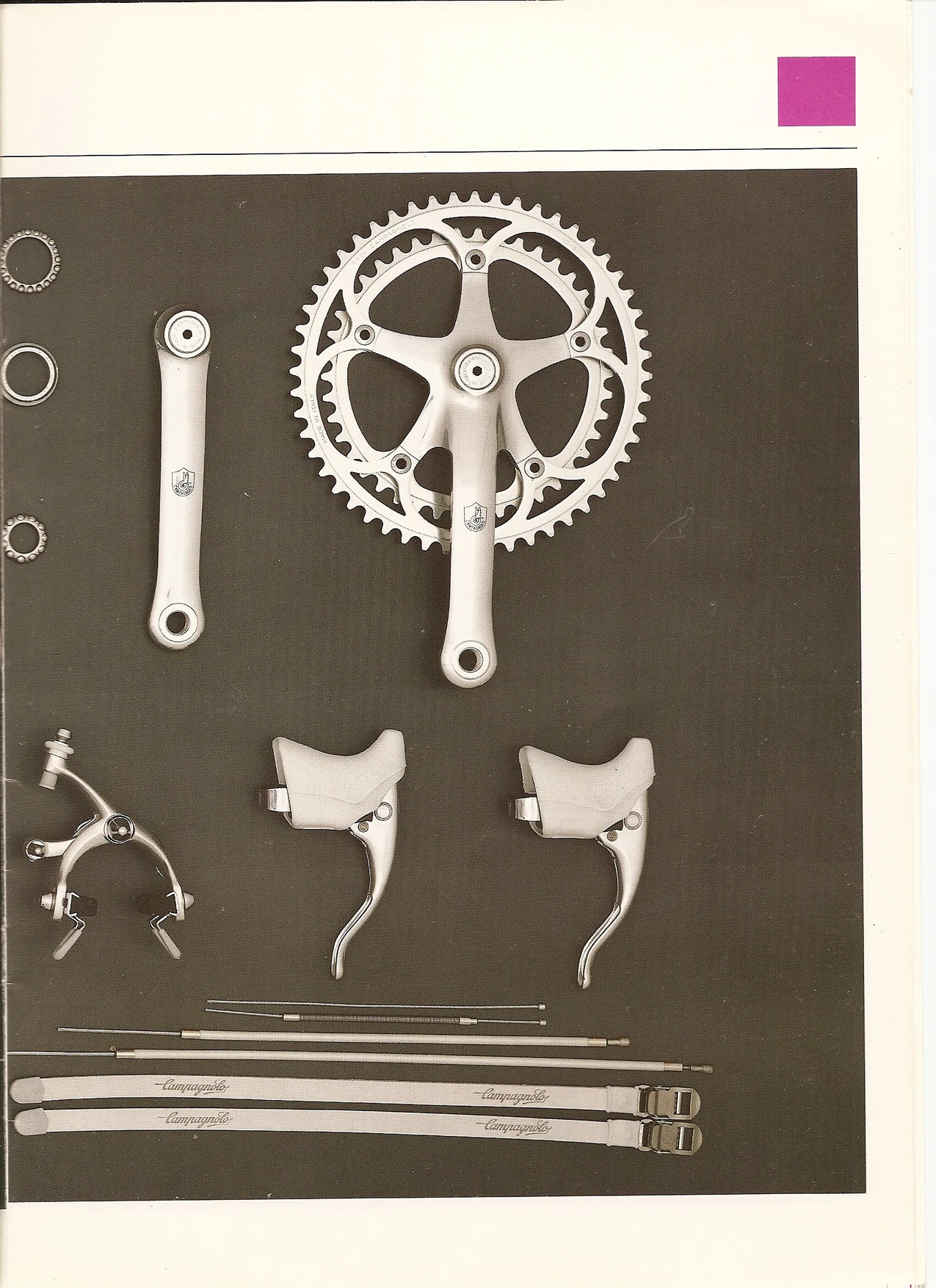
[Continuation of the black-background group photograph: headset races, a crankset with two chainrings and the left crank, a sidepull brake, two brake levers with hoods, cables and casings and two Campagnolo toe-straps; a solid magenta square tab at upper right.]
— Page 6 —
REAR DERAILLEUR AND FRONT DERAILLEUR
VERSATILE COMPONENTS
Versatility, especially for a bicycle whose specifications lend it toward a wide range of uses, is an indispensable characteristic. A bicycle for professional racing can in fact be used for competition, touring, triathlons and non-competitive cycling.
THE DUAL-MODE SYSTEM
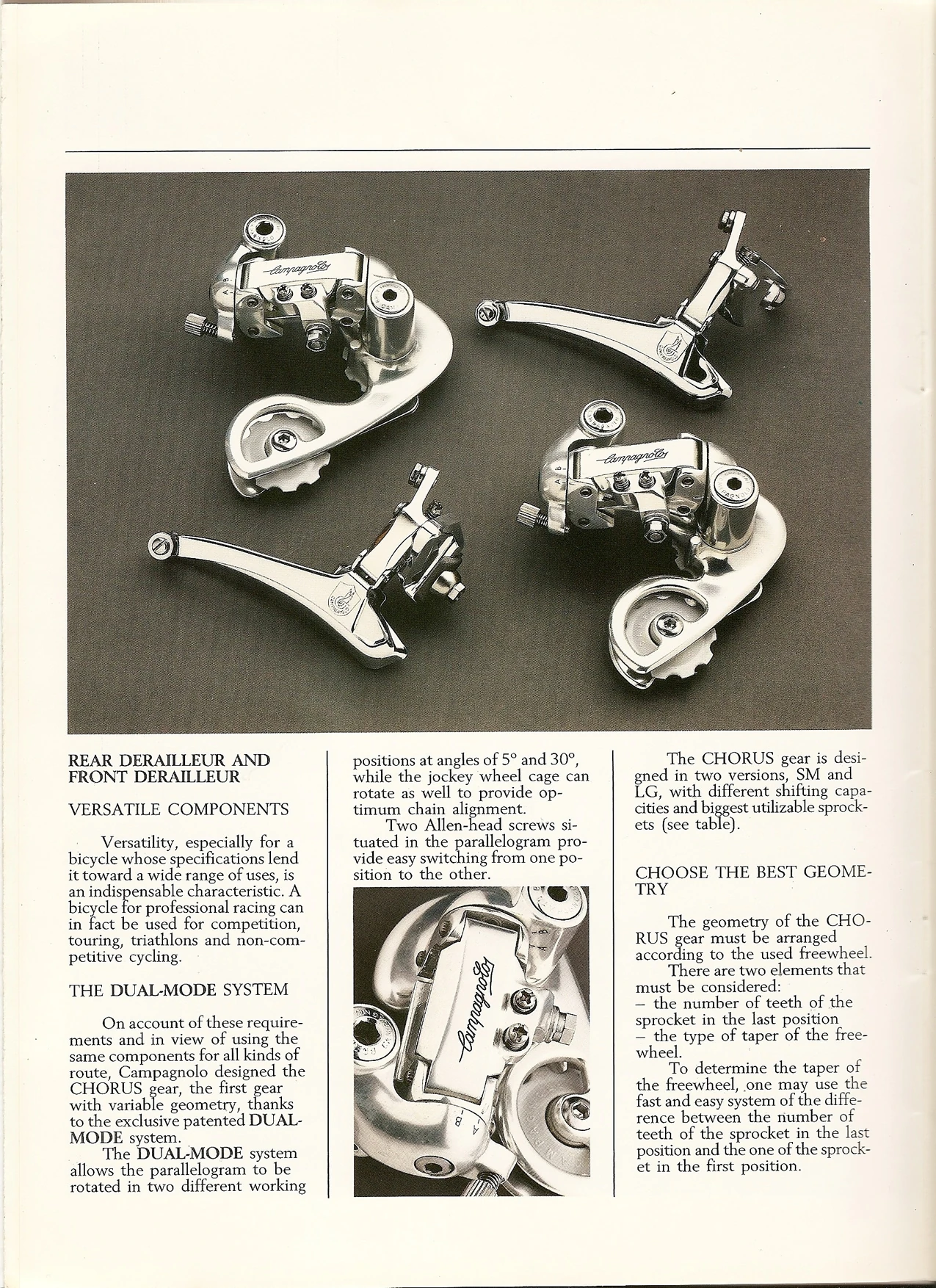
On account of these requirements and in view of using the same components for all kinds of route, Campagnolo designed the CHORUS gear, the first gear with variable geometry, thanks to the exclusive patented DUAL-MODE system.
The DUAL-MODE system allows the parallelogram to be rotated in two different working positions at angles of 5° and 30°, while the jockey wheel cage can rotate as well to provide optimum chain alignment.
Two Allen-head screws situated in the parallelogram provide easy switching from one position to the other.
The CHORUS gear is designed in two versions, SM and LG, with different shifting capacities and biggest utilizable sprockets (see table).
CHOOSE THE BEST GEOMETRY
The geometry of the CHORUS gear must be arranged according to the used freewheel.
There are two elements that must be considered:
– the number of teeth of the sprocket in the last position
– the type of taper of the freewheel.
To determine the taper of the freewheel, one may use the fast and easy system of the difference between the number of teeth of the sprocket in the last position and the one of the sprocket in the first position.
[A photograph on a gray ground of two Chorus rear derailleurs and two front derailleurs, the rear units with Campagnolo script plates and A and B marks; an inset close-up below shows the parallelogram with its A-B position marks and Allen screws.]
— Page 7 —
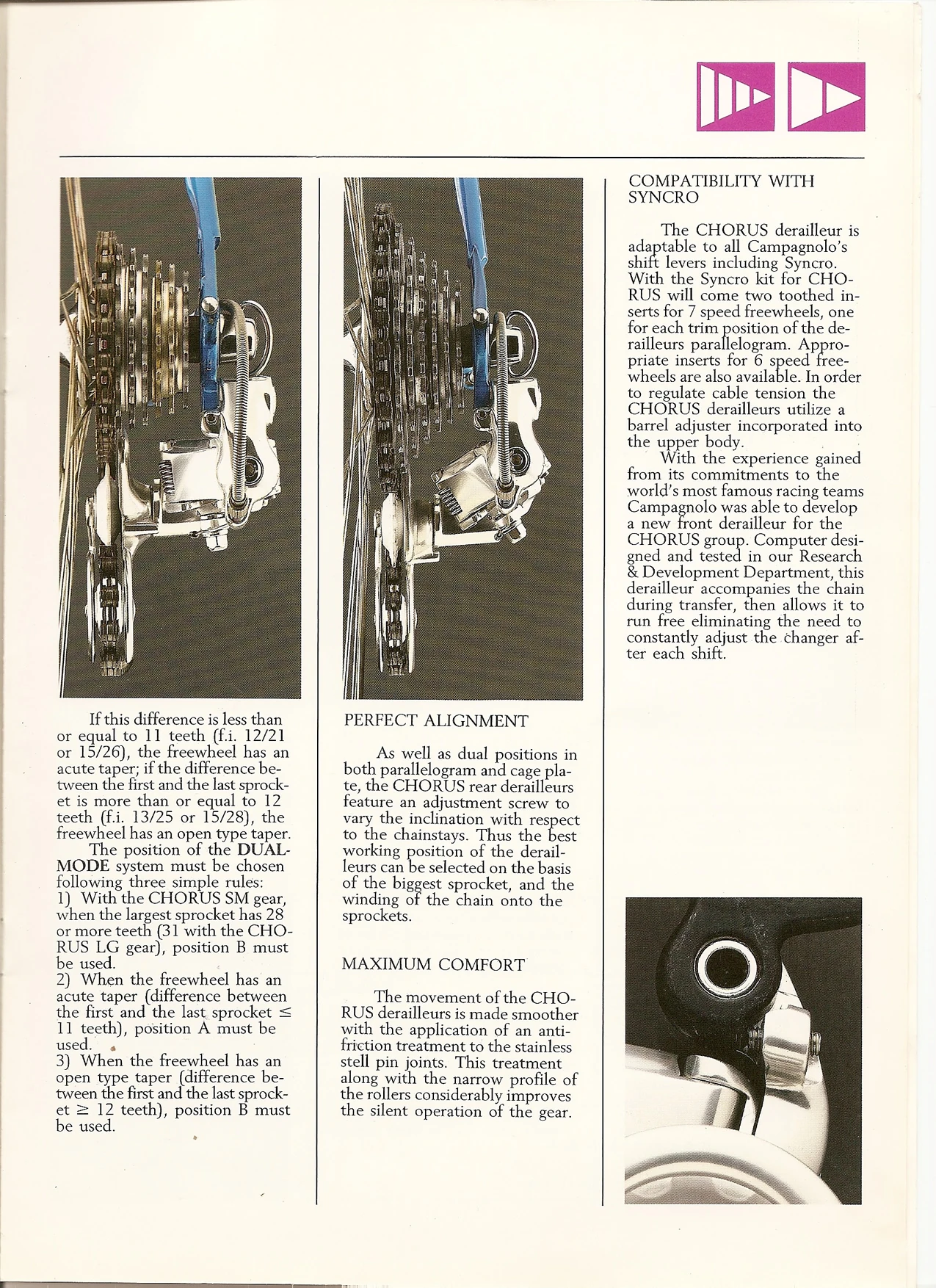
If this difference is less than or equal to 11 teeth (f.i. 12/21 or 15/26), the freewheel has an acute taper; if the difference between the first and the last sprocket is more than or equal to 12 teeth (f.i. 13/25 or 15/28), the freewheel has an open type taper.
The position of the DUAL-MODE system must be chosen following three simple rules:
1) With the CHORUS SM gear, when the largest sprocket has 28 or more teeth (31 with the CHORUS LG gear), position B must be used.
2) When the freewheel has an acute taper (difference between the first and the last sprocket ≤ 11 teeth), position A must be used.
3) When the freewheel has an open type taper (difference between the first and the last sprocket ≥ 12 teeth), position B must be used.
PERFECT ALIGNMENT
As well as dual positions in both parallelogram and cage plate, the CHORUS rear derailleurs feature an adjustment screw to vary the inclination with respect to the chainstays. Thus the best working position of the derailleurs can be selected on the basis of the biggest sprocket, and the winding of the chain onto the sprockets.
MAXIMUM COMFORT
The movement of the CHORUS derailleurs is made smoother with the application of an antifriction treatment to the stainless stell pin joints. This treatment along with the narrow profile of the rollers considerably improves the silent operation of the gear.
COMPATIBILITY WITH SYNCRO
The CHORUS derailleur is adaptable to all Campagnolo’s shift levers including Syncro. With the Syncro kit for CHORUS will come two toothed inserts for 7 speed freewheels, one for each trim position of the derailleurs parallelogram. Appropriate inserts for 6 speed freewheels are also available. In order to regulate cable tension the CHORUS derailleurs utilize a barrel adjuster incorporated into the upper body.
With the experience gained from its commitments to the world’s most famous racing teams Campagnolo was able to develop a new front derailleur for the CHORUS group. Computer designed and tested in our Research & Development Department, this derailleur accompanies the chain during transfer, then allows it to run free eliminating the need to constantly adjust the changer after each shift.
[Two color photographs of a Chorus rear derailleur on a blue frame dropout with a seven-speed freewheel, shown in its two working positions; a close-up at lower right of the derailleur pivot; two magenta symbol tabs for the derailleurs at upper right.]
— Page 8 —
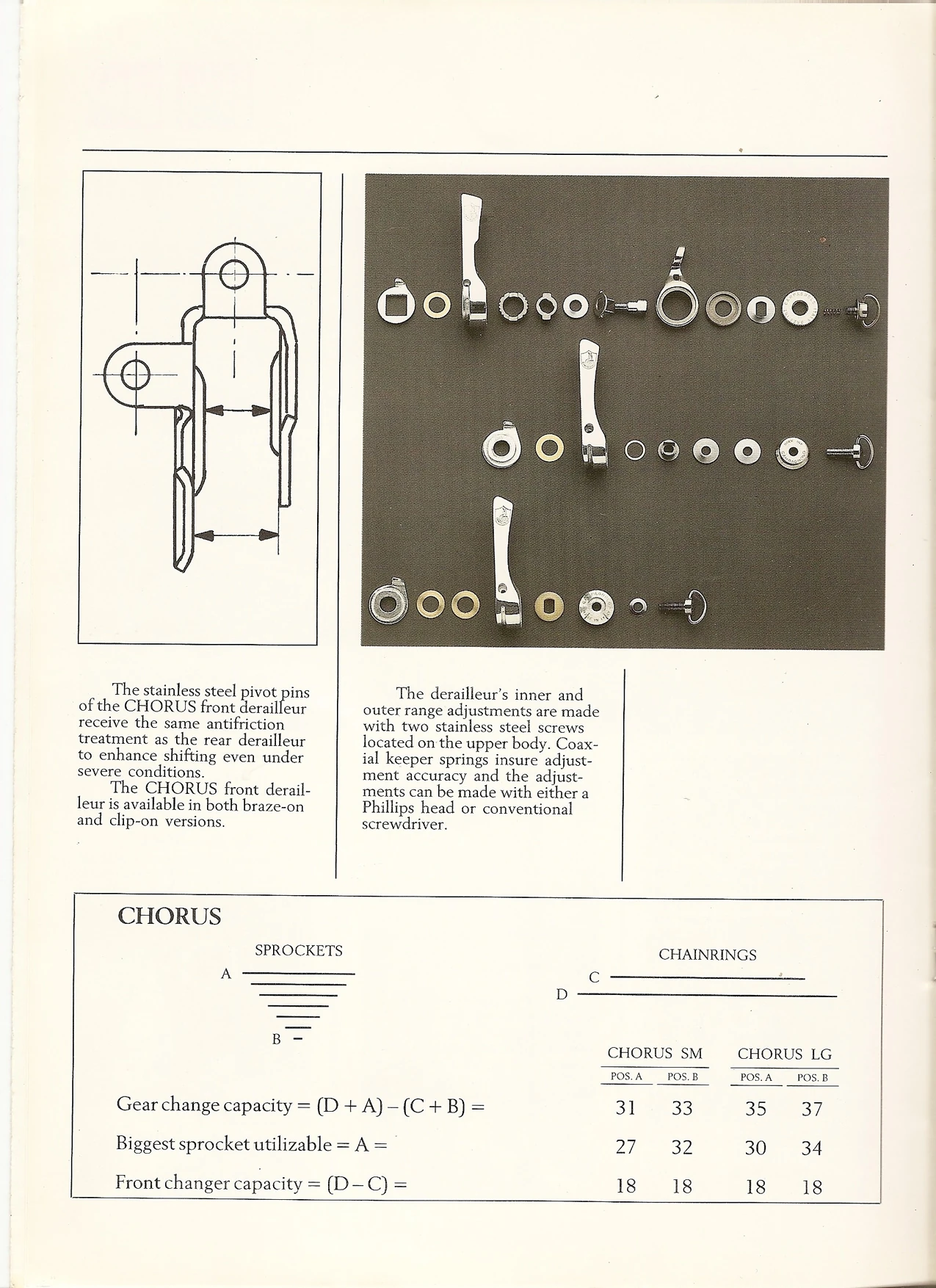
The stainless steel pivot pins of the CHORUS front derailleur receive the same antifriction treatment as the rear derailleur to enhance shifting even under severe conditions.
The CHORUS front derailleur is available in both braze-on and clip-on versions.
The derailleur’s inner and outer range adjustments are made with two stainless steel screws located on the upper body. Coaxial keeper springs insure adjustment accuracy and the adjustments can be made with either a Phillips head or conventional screwdriver.
CHORUS
SPROCKETS (A largest, B smallest)
CHAINRINGS (C small, D large)
| CHORUS SM POS. A | CHORUS SM POS. B | CHORUS LG POS. A | CHORUS LG POS. B
Gear change capacity = (D + A) – (C + B) = | 31 | 33 | 35 | 37
Biggest sprocket utilizable = A = | 27 | 32 | 30 | 34
Front changer capacity = (D – C) = | 18 | 18 | 18 | 18
[A boxed line drawing of the front derailleur cage with dimension arrows; a photograph on a dark ground of three shift levers exploded into their washers, bosses and D-ring screws; a capacity table below with diagrams of sprockets marked A and B and chainrings marked C and D.]
— Page 9 —
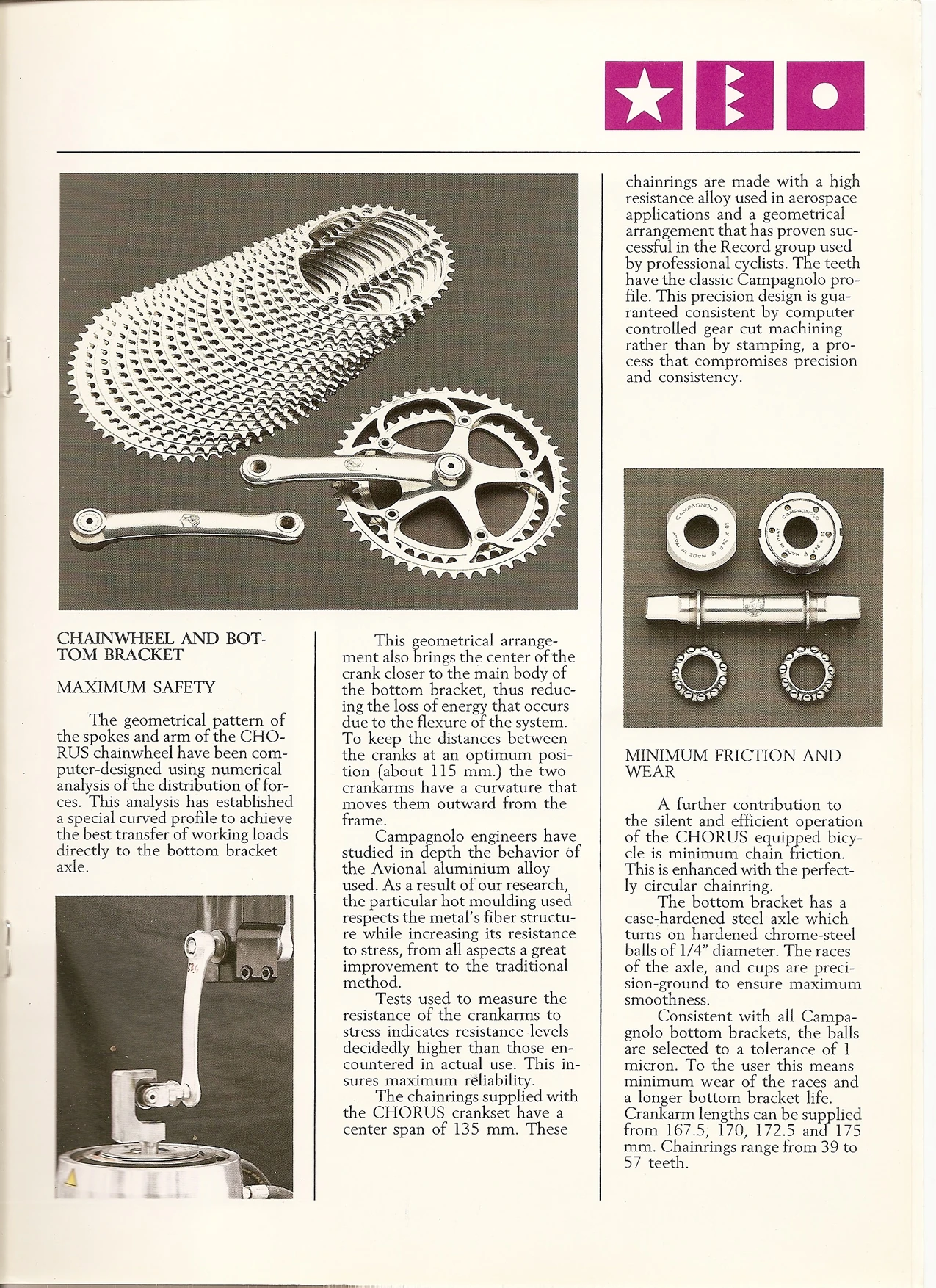
CHAINWHEEL AND BOTTOM BRACKET
MAXIMUM SAFETY
The geometrical pattern of the spokes and arm of the CHORUS chainwheel have been computer-designed using numerical analysis of the distribution of forces. This analysis has established a special curved profile to achieve the best transfer of working loads directly to the bottom bracket axle.
This geometrical arrangement also brings the center of the crank closer to the main body of the bottom bracket, thus reducing the loss of energy that occurs due to the flexure of the system. To keep the distances between the cranks at an optimum position (about 115 mm.) the two crankarms have a curvature that moves them outward from the frame.
Campagnolo engineers have studied in depth the behavior of the Avional aluminium alloy used. As a result of our research, the particular hot moulding used respects the metal’s fiber structure while increasing its resistance to stress, from all aspects a great improvement to the traditional method.
Tests used to measure the resistance of the crankarms to stress indicates resistance levels decidedly higher than those encountered in actual use. This insures maximum reliability.
The chainrings supplied with the CHORUS crankset have a center span of 135 mm. These chainrings are made with a high resistance alloy used in aerospace applications and a geometrical arrangement that has proven successful in the Record group used by professional cyclists. The teeth have the classic Campagnolo profile. This precision design is guaranteed consistent by computer controlled gear cut machining rather than by stamping, a process that compromises precision and consistency.
MINIMUM FRICTION AND WEAR
A further contribution to the silent and efficient operation of the CHORUS equipped bicycle is minimum chain friction. This is enhanced with the perfectly circular chainring.
The bottom bracket has a case-hardened steel axle which turns on hardened chrome-steel balls of 1/4″ diameter. The races of the axle, and cups are precision-ground to ensure maximum smoothness.
Consistent with all Campagnolo bottom brackets, the balls are selected to a tolerance of 1 micron. To the user this means minimum wear of the races and a longer bottom bracket life. Crankarm lengths can be supplied from 167.5, 170, 172.5 and 175 mm. Chainrings range from 39 to 57 teeth.
[A photograph of a fanned stack of chainrings with a Chorus crankset and left crank; a test-rig photograph of a crankarm clamped in a fatigue machine; a photograph of bottom bracket cups stamped CAMPAGNOLO, axle and ball retainers; three magenta symbol tabs at upper right.]
— Page 10 —
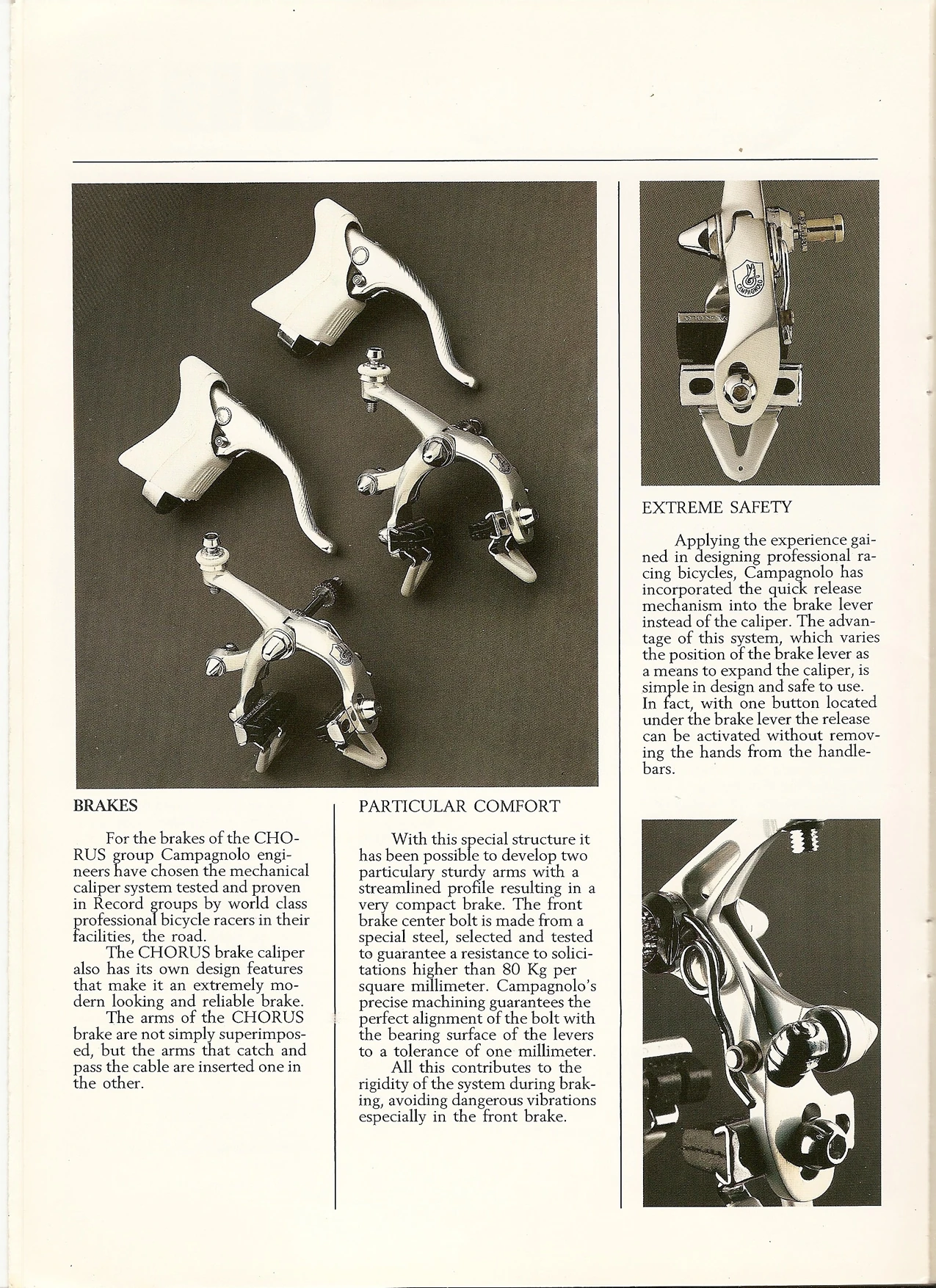
BRAKES
For the brakes of the CHORUS group Campagnolo engineers have chosen the mechanical caliper system tested and proven in Record groups by world class professional bicycle racers in their facilities, the road.
The CHORUS brake caliper also has its own design features that make it an extremely modern looking and reliable brake.
The arms of the CHORUS brake are not simply superimposed, but the arms that catch and pass the cable are inserted one in the other.
PARTICULAR COMFORT
With this special structure it has been possible to develop two particulary sturdy arms with a streamlined profile resulting in a very compact brake. The front brake center bolt is made from a special steel, selected and tested to guarantee a resistance to solicitations higher than 80 Kg per square millimeter. Campagnolo’s precise machining guarantees the perfect alignment of the bolt with the bearing surface of the levers to a tolerance of one millimeter.
All this contributes to the rigidity of the system during braking, avoiding dangerous vibrations especially in the front brake.
EXTREME SAFETY
Applying the experience gained in designing professional racing bicycles, Campagnolo has incorporated the quick release mechanism into the brake lever instead of the caliper. The advantage of this system, which varies the position of the brake lever as a means to expand the caliper, is simple in design and safe to use. In fact, with one button located under the brake lever the release can be activated without removing the hands from the handlebars.
[A photograph on a dark ground of two Chorus brake levers with white hoods and two sidepull calipers; at right a close-up of a caliper arm with the Campagnolo shield and a close-up of the caliper pivot and cable clamp.]
— Page 11 —
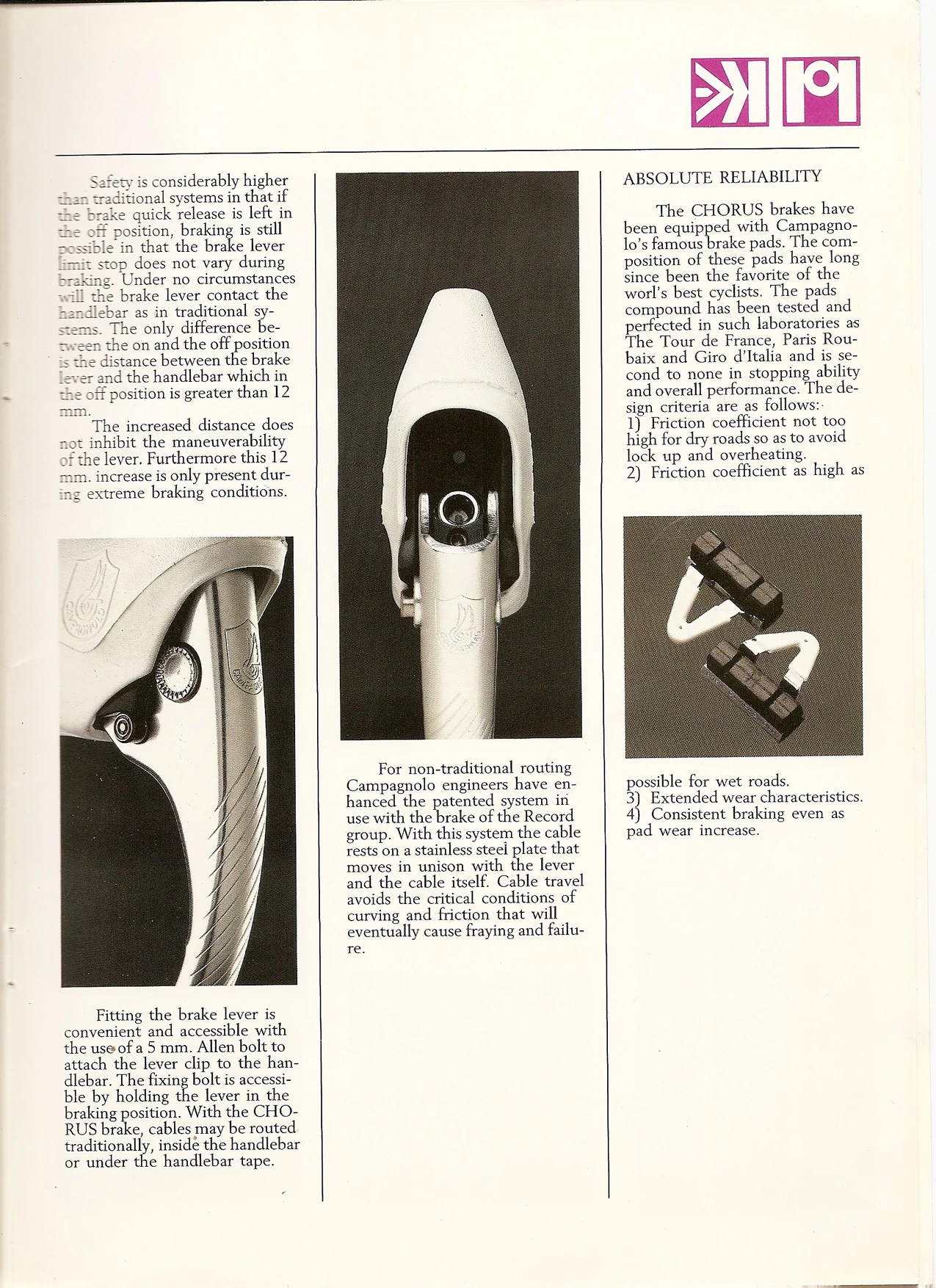
Safety is considerably higher than traditional systems in that if the brake quick release is left in the off position, braking is still possible in that the brake lever limit stop does not vary during braking. Under no circumstances will the brake lever contact the handlebar as in traditional systems. The only difference between the on and the off position is the distance between the brake lever and the handlebar which in the off position is greater than 12 mm.
The increased distance does not inhibit the maneuverability of the lever. Furthermore this 12 mm. increase is only present during extreme braking conditions.
Fitting the brake lever is convenient and accessible with the use of a 5 mm. Allen bolt to attach the lever clip to the handlebar. The fixing bolt is accessible by holding the lever in the braking position. With the CHORUS brake, cables may be routed traditionally, inside the handlebar or under the handlebar tape.
For non-traditional routing Campagnolo engineers have enhanced the patented system in use with the brake of the Record group. With this system the cable rests on a stainless steel plate that moves in unison with the lever and the cable itself. Cable travel avoids the critical conditions of curving and friction that will eventually cause fraying and failure.
ABSOLUTE RELIABILITY
The CHORUS brakes have been equipped with Campagnolo’s famous brake pads. The composition of these pads have long since been the favorite of the worl’s best cyclists. The pads compound has been tested and perfected in such laboratories as The Tour de France, Paris Roubaix and Giro d’Italia and is second to none in stopping ability and overall performance. The design criteria are as follows:
1) Friction coefficient not too high for dry roads so as to avoid lock up and overheating.
2) Friction coefficient as high as possible for wet roads.
3) Extended wear characteristics.
4) Consistent braking even as pad wear increase.
[Close-up photographs of a Chorus brake lever with white hood showing the quick-release button, a head-on view of the lever body and cable exit, and a pair of brake shoes with white holders; two magenta symbol tabs at upper right. The left margin text is faded where the scan caught the binding.]
— Page 12 —
HEADSET AND HUBS
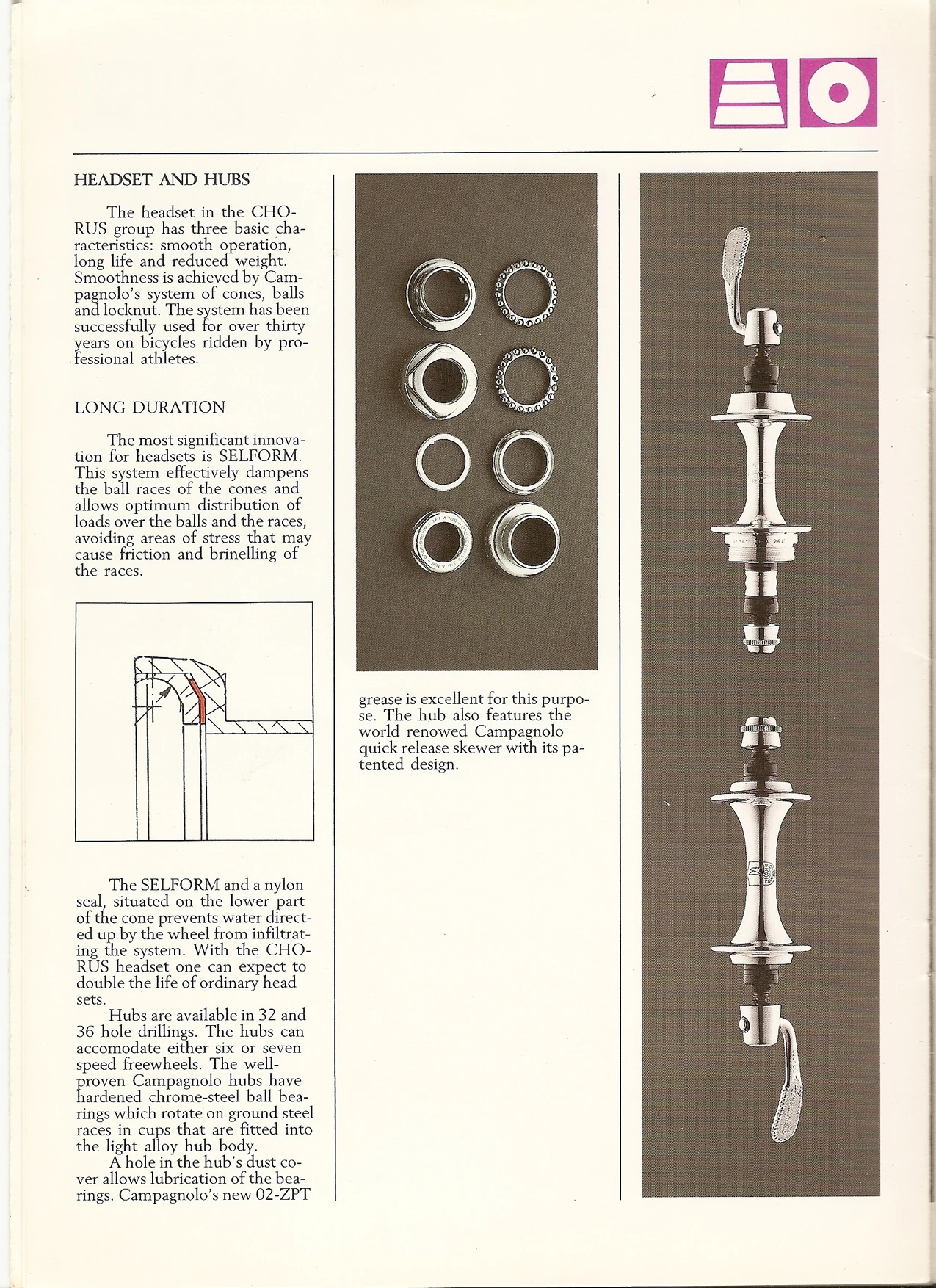
The headset in the CHORUS group has three basic characteristics: smooth operation, long life and reduced weight. Smoothness is achieved by Campagnolo’s system of cones, balls and locknut. The system has been successfully used for over thirty years on bicycles ridden by professional athletes.
LONG DURATION
The most significant innovation for headsets is SELFORM. This system effectively dampens the ball races of the cones and allows optimum distribution of loads over the balls and the races, avoiding areas of stress that may cause friction and brinelling of the races.
The SELFORM and a nylon seal, situated on the lower part of the cone prevents water directed up by the wheel from infiltrating the system. With the CHORUS headset one can expect to double the life of ordinary head sets.
Hubs are available in 32 and 36 hole drillings. The hubs can accomodate either six or seven speed freewheels. The well-proven Campagnolo hubs have hardened chrome-steel ball bearings which rotate on ground steel races in cups that are fitted into the light alloy hub body.
A hole in the hub’s dust cover allows lubrication of the bearings. Campagnolo’s new 02-ZPT grease is excellent for this purpose. The hub also features the world renowed Campagnolo quick release skewer with its patented design.
[A photograph of the Chorus headset cups, cones and ball retainers on a dark ground; a boxed sectional drawing of the headset cone with the SELFORM ring in red; a tall photograph of the rear and front quick-release hubs; two magenta symbol tabs at upper right.]
— Page 13 —
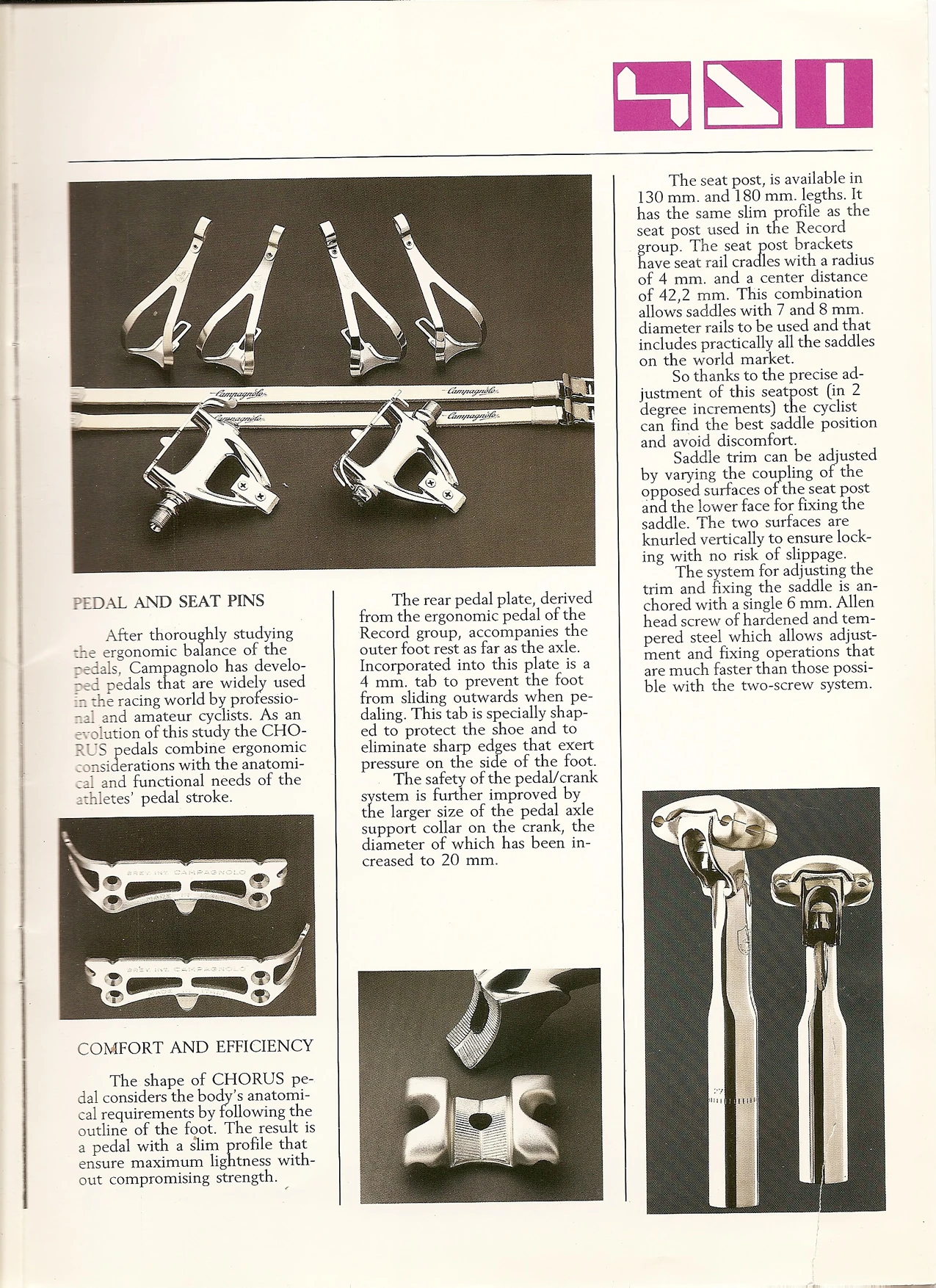
PEDAL AND SEAT PINS
After thoroughly studying the ergonomic balance of the pedals, Campagnolo has developed pedals that are widely used in the racing world by professional and amateur cyclists. As an evolution of this study the CHORUS pedals combine ergonomic considerations with the anatomical and functional needs of the athletes’ pedal stroke.
COMFORT AND EFFICIENCY
The shape of CHORUS pedal considers the body’s anatomical requirements by following the outline of the foot. The result is a pedal with a slim profile that ensure maximum lightness without compromising strength.
The rear pedal plate, derived from the ergonomic pedal of the Record group, accompanies the outer foot rest as far as the axle. Incorporated into this plate is a 4 mm. tab to prevent the foot from sliding outwards when pedaling. This tab is specially shaped to protect the shoe and to eliminate sharp edges that exert pressure on the side of the foot.
The safety of the pedal/crank system is further improved by the larger size of the pedal axle support collar on the crank, the diameter of which has been increased to 20 mm.
The seat post, is available in 130 mm. and 180 mm. legths. It has the same slim profile as the seat post used in the Record group. The seat post brackets have seat rail cradles with a radius of 4 mm. and a center distance of 42,2 mm. This combination allows saddles with 7 and 8 mm. diameter rails to be used and that includes practically all the saddles on the world market.
So thanks to the precise adjustment of this seatpost (in 2 degree increments) the cyclist can find the best saddle position and avoid discomfort.
Saddle trim can be adjusted by varying the coupling of the opposed surfaces of the seat post and the lower face for fixing the saddle. The two surfaces are knurled vertically to ensure locking with no risk of slippage.
The system for adjusting the trim and fixing the saddle is anchored with a single 6 mm. Allen head screw of hardened and tempered steel which allows adjustment and fixing operations that are much faster than those possible with the two-screw system.
BREV. INT. CAMPAGNOLO
[Photographs of two pairs of steel toe-clips, two Campagnolo toe-straps and a pair of Chorus pedals; two rear pedal plates stamped BREV. INT. CAMPAGNOLO; a knurled seat post clamp detail; two seat pins; three magenta symbol tabs at upper right.]
— Page 14 —
July 1987 – Printed in Italy by Mondadori – A.G.V. – Vicenza
□ CAMPAGNOLO S.P.A. – VIA DELLA CHIMICA, 4 – 36100 VICENZA – ITALIA – Telefono 0444/564933 – Telex 480074 CAMPA I – Telefax 0444/565062
□ CAMPAGNOLO SARL – RUE DU CHATEAU D’EAU – ROUZIERS DE TOURAINE – 37360 NEUILLE PONT PIERRE – Télephone 47-566569 – Telex 750373 WEIFRA – Telefax 47-566779
□ CAMPAGNOLO CORPORATION – 43 FAIRFIELD PLACE-WEST CALDWELL, N.J. 07006 – Phone 201-8828733 – Telex 705994 CAMPA CORP – Telefax 201-8828939
□ SERVICE AND TECHNICAL INFORMATION • CENTRAL (ITALY) – Telephone 0444/571871
• U.S.A. Telephone 1/800 US CAMPI
[Back cover, otherwise blank white: a tiny vertical printer’s line at the upper right edge and a block of Campagnolo company addresses for Italy, France and the United States along the bottom.]
 Campagnolo Croce d’Aune Brochure, March 1988 (U.S.A.) — the Group B000 Part by Part: Penta-Drive Brakes, Power Grade Levers, Twin-Axle Derailleur and Triple Bearing Pedals
 Campagnolo Catalog, June 1990 — Xenon, Athena, Chorus, Croce d’Aune and Record Road Groups, Olympus, Centaur and Euclid Mountain Groups and the Tandem Groups
 Campagnolo Catalog, January 1991 — Xenon, Athena, Chorus, Croce d’Aune, Record and Record Pista, the New Themis, Olympus, Centaur, Euclid and the Tandem Groups
 Campagnolo 1992 Rims Range — Sigma, Omega and Lambda Tubular and Clincher Rims, the Mountain Bike Rims and the Ghibli, Scirocco and Khamsin Wheels
 Campagnolo 1992 Road Range — the Record with Ergopower, Chorus RS and Athena RS Groups Part by Part, with the Tandem and Triple Optionals
 Campagnolo Catalog 1994 — Sixty Years: Record, Chorus, Athena, Veloce, Stratos and Record O.R., the Shamal, Bora and Vento Wheels and the Rims
Ebykr presents this material for research and education. If you hold rights to it or notice an ownership issue, please contact us and we will respond promptly.