About Ebykr
Ebykr celebrates classic and vintage lightweight bicycles through provocative imagery and opinion. Ride along with us.
About Ebykr
Ebykr celebrates classic and vintage lightweight bicycles through provocative imagery and opinion. Ride along with us.

Source: Ebykr archive.
 Page 1
 Page 2
 Page 3
 Page 4
 Page 5
 Page 6
 Page 7
 Page 8
 Page 9
 Page 10
 Page 11
 Page 12
 Page 13
 Page 14
 Page 15
 Page 16
| Marque | Brooks |
|---|---|
| Type | Catalog |
| Year | 1937 |
| Publisher | J. B. Brooks & Co., Ltd. |
| Country | England |
| Language | English |
| Pages | 16 |
| Source | Ebykr archive. |
| Credit | Ebykr archive |
| Transcription | Transcribed by eye |
BROOKS The Best for Riding The BROOKS REGISTERED TRADE MARK BOOK OF SADDLES AND KIT FOR CYCLISTS AND MOTOR CYCLISTS 1937 The Best for Riding J. B. BROOKS & CO. LTD. CRITERION WORKS GREAT CHARLES STREET BIRMINGHAM 3 Telephone: CENtral 3671 10 lines Telegrams: BROOKS Birmingham Codes:—Bentley's Complete Phrase LIST No. 247 What sort of …
The Brooks Book of Saddles and Kit for 1937, issued as List No. 247 from the Criterion Works in Great Charles Street, Birmingham 3. The book prints its own title and its own slogan, “The Best for Riding,” and it is a different kind of publication from the plain range lists either side of it: roughly the first seven printed pages argue a case about leather, chassis and saddle care before a single model is listed.
Four things make it the most quotable book in the Brooks run.
The first is that it prices everything. Where the 1933 catalog left every price line blank, the 1937 book prints a figure against every model, and because Brooks built the same chassis in four grades of top, the result is a set of clean like-for-like ladders. On the three-coil chassis the Brooks solid butt hide B73 is 10/3, the Challenge C31 is 7/9, the Kaydex K2 is 6/6 and the Junior is 3/9. On the four-wire chassis the Brooks B18 is 11/6, the B72 is 9/6, the Challenge C30 is 7/6 and the Kaydex K3 is 6/3. On the two-wire chassis the B17 Champion is 14/3 in all three sizes, the Challenge C32 is 7/9 and the Kaydex K5 is 6/6. Kaydex therefore undercuts the equivalent Brooks-topped model on the same chassis by about 37 percent on the three-coil, about 46 percent on the four-wire and about 54 percent on the two-wire.
The second is the care page. Printed page 6, under the heading “Care of the saddle,” carries the company’s own instruction, and printed page 39 lists the tools and dressings it refers to. Brooks recommends “occasional dressings of Proofide or Neats Foot Oil,” names the tension pin at the front of the saddle as the adjustment point, and warns that “to prevent any danger of over tensioning when making this adjustment, a light spanner should be used,” cross-referring to page 39 where Spanner No. 3 is sold for tension pin and spring nuts at 10d. and Spanner No. 5 for the tension pin and clip nuts of Champion saddles at 1/8. Proofide is 3d. and 6d. per tin. That Brooks itself named neatsfoot oil in 1937 is worth noting, because modern guidance treats oils quite differently.
The third is the chassis. Printed page 5 carries the passage beginning “Many types are produced, to suit the variety of purposes embraced by the one word cycling,” and it goes on to say that “as a protection against rust, all metal parts of Brooks enamel-finished saddles undergo a special process.”
The fourth is what the finishes actually are. Every saddle in this book is priced in Enamel, and the heavier loop-front, tension-coil and hammock models carry a second Nickel price beside it: B90/2 at 19/- enamel or 21/- nickel, B90/3 at 21/- or 24/-, C5 at 14/9 or 16/3, B130 at 20/- or 25/6, B80 at 18/6 or 20/6. There is no chromium price anywhere in the saddle range. Chromium appears in this book only on toeclips, where the No. 7, No. 7A, No. 9 and No. 9A patterns are chromium plated, and the phrase “full chrome leather” on the toestraps refers to chrome tannage rather than plating.
Two absences are worth recording, because the whole saddle range from printed page 8 to printed page 30 was read to establish them. Impervia does not appear in the 1937 catalog, though it was a full range in 1933 with the R.2, R.3 and R.6. Brooks Legion does not appear either, though 1933 carried Legion A, B, E, H and J. Challenge and Kaydex both survive into 1937 as full ranges. Plyflex survives too, and its prices place it as a premium line rather than a cheap one: the P205 at 11/- is dearer than the Brooks-topped B73 at 10/3 on the same chassis.
One introduction is dated precisely. Printed page 8 announces that “an entirely new Champion—the B.17 Flyweight is introduced,” with “the chassis lightened by the use of aluminium alloy parts and special steel wire frame” and a weight of 19 ozs.; printed page 10 lists it at 1 lb. 3 ozs. and 16/-. Aluminum alloy therefore had not left the Brooks range by 1937. It had moved off the cast girder frame and into the wire chassis.
This record reproduces the cover, the title page, the seven pages of argument and the whole priced saddle range, together with the toeclip, spanner and Proofide page. Printed pages 31 through 37 and 40 through 48, covering holdalls, bags, oilskins, shoes and capes, are held in the Ebykr collection but are not reproduced here.
The scan is a low-resolution one. The embedded images run about 1,048 pixels across per two-page spread, which is roughly 524 pixels per printed page, and the images in this record are presented at twice that. Headings, model numbers, prices and weights read cleanly. The smallest body copy sits at the floor of legibility, and single glyphs at that scale are not treated as evidence.
— Page 1 —
[Front cover. Russet-brown card, blind-embossed.]
BROOKS
The Best for Riding
[The cover carries no printed ink: the wordmark and slogan are blind-embossed into the card.]
— Page 2 —
[Title page, printed in green.]
The BROOKS
REGISTERED TRADE MARK
BOOK OF SADDLES AND KIT FOR CYCLISTS AND MOTOR CYCLISTS
1937
The Best for Riding
J. B. BROOKS & CO. LTD.
CRITERION WORKS
GREAT CHARLES STREET
BIRMINGHAM 3
Telephone: CENtral 3671 10 lines
Telegrams: BROOKS Birmingham
Codes:—Bentley’s Complete Phrase
LIST No. 247
— Page 3 —
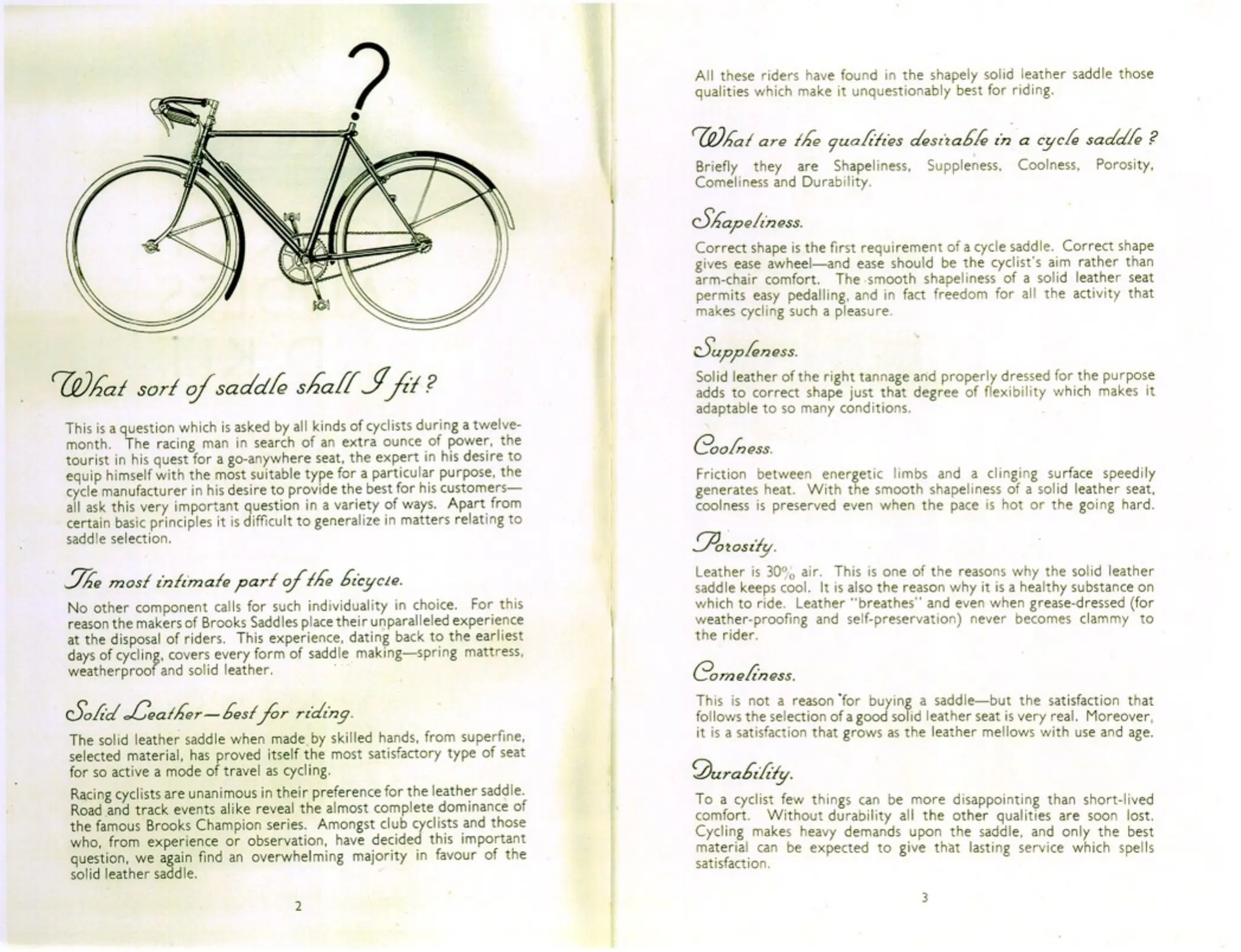
[Printed pages 2 and 3.]
What sort of saddle shall I fit?
This is a question which is asked by all kinds of cyclists during a twelvemonth. The racing man in search of an extra ounce of power, the tourist in his quest for a go-anywhere seat, the expert in his desire to equip himself with the most suitable type for a particular purpose, the cycle manufacturer in his desire to provide the best for his customers—all ask this very important question in a variety of ways. Apart from certain basic principles it is difficult to generalize in matters relating to saddle selection.
The most intimate part of the bicycle.
No other component calls for such individuality in choice. For this reason the makers of Brooks Saddles place their unparalleled experience at the disposal of riders. This experience, dating back to the earliest days of cycling, covers every form of saddle making—spring mattress, weatherproof and solid leather.
Solid Leather—best for riding.
The solid leather saddle when made by skilled hands, from superfine, selected material, has proved itself the most satisfactory type of seat for so active a mode of travel as cycling.
Racing cyclists are unanimous in their preference for the leather saddle. Road and track events alike reveal the almost complete dominance of the famous Brooks Champion series. Amongst club cyclists and those who, from experience or observation, have decided this important question, we again find an overwhelming majority in favour of the solid leather saddle.
All these riders have found in the shapely solid leather saddle those qualities which make it unquestionably best for riding.
What are the qualities desirable in a cycle saddle?
Briefly they are Shapeliness, Suppleness, Coolness, Porosity, Comeliness and Durability.
Shapeliness. Correct shape is the first requirement of a cycle saddle. Correct shape gives ease awheel—and ease should be the cyclist’s aim rather than arm-chair comfort. The smooth shapeliness of a solid leather seat permits easy pedalling, and in fact freedom for all the activity that makes cycling such a pleasure.
Suppleness. Solid leather of the right tannage and properly dressed for the purpose adds to correct shape just that degree of flexibility which makes it adaptable to so many conditions.
Coolness. Friction between energetic limbs and a clinging surface speedily generates heat. With the smooth shapeliness of a solid leather seat, coolness is preserved even when the pace is hot or the going hard.
Porosity. Leather is 30% air. This is one of the reasons why the solid leather saddle keeps cool. It is also the reason why it is a healthy substance on which to ride. Leather “breathes” and even when grease-dressed (for weather-proofing and self-preservation) never becomes clammy to the rider.
Comeliness. This is not a reason for buying a saddle—but the satisfaction that follows the selection of a good solid leather seat is very real. Moreover, it is a satisfaction that grows as the leather mellows with use and age.
Durability. To a cyclist few things can be more disappointing than short-lived comfort. Without durability all the other qualities are soon lost. Cycling makes heavy demands upon the saddle, and only the best material can be expected to give that lasting service which spells satisfaction.
[An outline drawing of a bicycle with a question mark above the saddle heads the left page.]
— Page 4 —
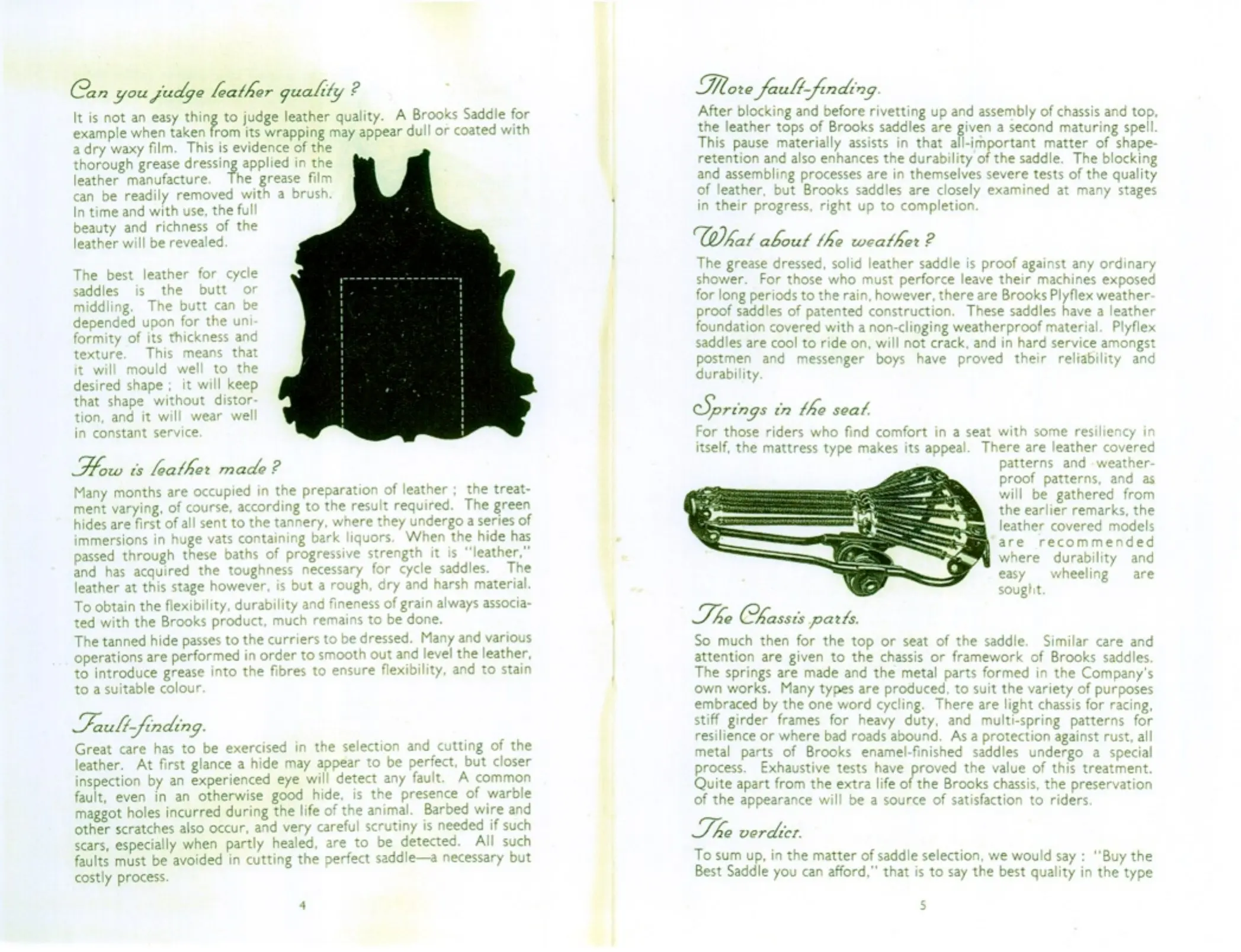
[Printed pages 4 and 5.]
Can you judge leather quality?
It is not an easy thing to judge leather quality. A Brooks Saddle for example when taken from its wrapping may appear dull or coated with a dry waxy film. This is evidence of the thorough grease dressing applied in the leather manufacture. The grease film can be readily removed with a brush. In time and with use, the full beauty and richness of the leather will be revealed.
The best leather for cycle saddles is the butt or middling. The butt can be depended upon for the uniformity of its thickness and texture. This means that it will mould well to the desired shape; it will keep that shape without distortion, and it will wear well in constant service.
How is leather made?
Many months are occupied in the preparation of leather; the treatment varying, of course, according to the result required. The green hides are first of all sent to the tannery, where they undergo a series of immersions in huge vats containing bark liquors. When the hide has passed through these baths of progressive strength it is “leather,” and has acquired the toughness necessary for cycle saddles. The leather at this stage however, is but a rough, dry and harsh material. To obtain the flexibility, durability and fineness of grain always associated with the Brooks product, much remains to be done.
The tanned hide passes to the curriers to be dressed. Many and various operations are performed in order to smooth out and level the leather, to introduce grease into the fibres to ensure flexibility, and to stain to a suitable colour.
Fault-finding.
Great care has to be exercised in the selection and cutting of the leather. At first glance a hide may appear to be perfect, but closer inspection by an experienced eye will detect any fault. A common fault, even in an otherwise good hide, is the presence of warble maggot holes incurred during the life of the animal. Barbed wire and other scratches also occur, and very careful scrutiny is needed if such scars, especially when partly healed, are to be detected. All such faults must be avoided in cutting the perfect saddle—a necessary but costly process.
More fault-finding.
After blocking and before rivetting up and assembly of chassis and top, the leather tops of Brooks saddles are given a second maturing spell. This pause materially assists in that all-important matter of shape-retention and also enhances the durability of the saddle. The blocking and assembling processes are in themselves severe tests of the quality of leather, but Brooks saddles are closely examined at many stages in their progress, right up to completion.
What about the weather?
The grease dressed, solid leather saddle is proof against any ordinary shower. For those who must perforce leave their machines exposed for long periods to the rain, however, there are Brooks Plyflex weatherproof saddles of patented construction. These saddles have a leather foundation covered with a non-clinging weatherproof material. Plyflex saddles are cool to ride on, will not crack, and in hard service amongst postmen and messenger boys have proved their reliability and durability.
Springs in the seat.
For those riders who find comfort in a seat with some resiliency in itself, the mattress type makes its appeal. There are leather covered patterns and weatherproof patterns, and as will be gathered from the earlier remarks, the leather covered models are recommended where durability and easy wheeling are sought.
The Chassis parts.
So much then for the top or seat of the saddle. Similar care and attention are given to the chassis or framework of Brooks saddles. The springs are made and the metal parts formed in the Company’s own works. Many types are produced, to suit the variety of purposes embraced by the one word cycling. There are light chassis for racing, stiff girder frames for heavy duty, and multi-spring patterns for resilience or where bad roads abound. As a protection against rust, all metal parts of Brooks enamel-finished saddles undergo a special process. Exhaustive tests have proved the value of this treatment. Quite apart from the extra life of the Brooks chassis, the preservation of the appearance will be a source of satisfaction to riders.
The verdict.
To sum up, in the matter of saddle selection, we would say: “Buy the Best Saddle you can afford,” that is to say the best quality in the type
[A silhouette of a full hide, with the butt marked out by a dotted rectangle, sits on the left page. A photograph of a spring mattress chassis sits on the right.]
— Page 5 —
[Printed pages 6 and 7.]
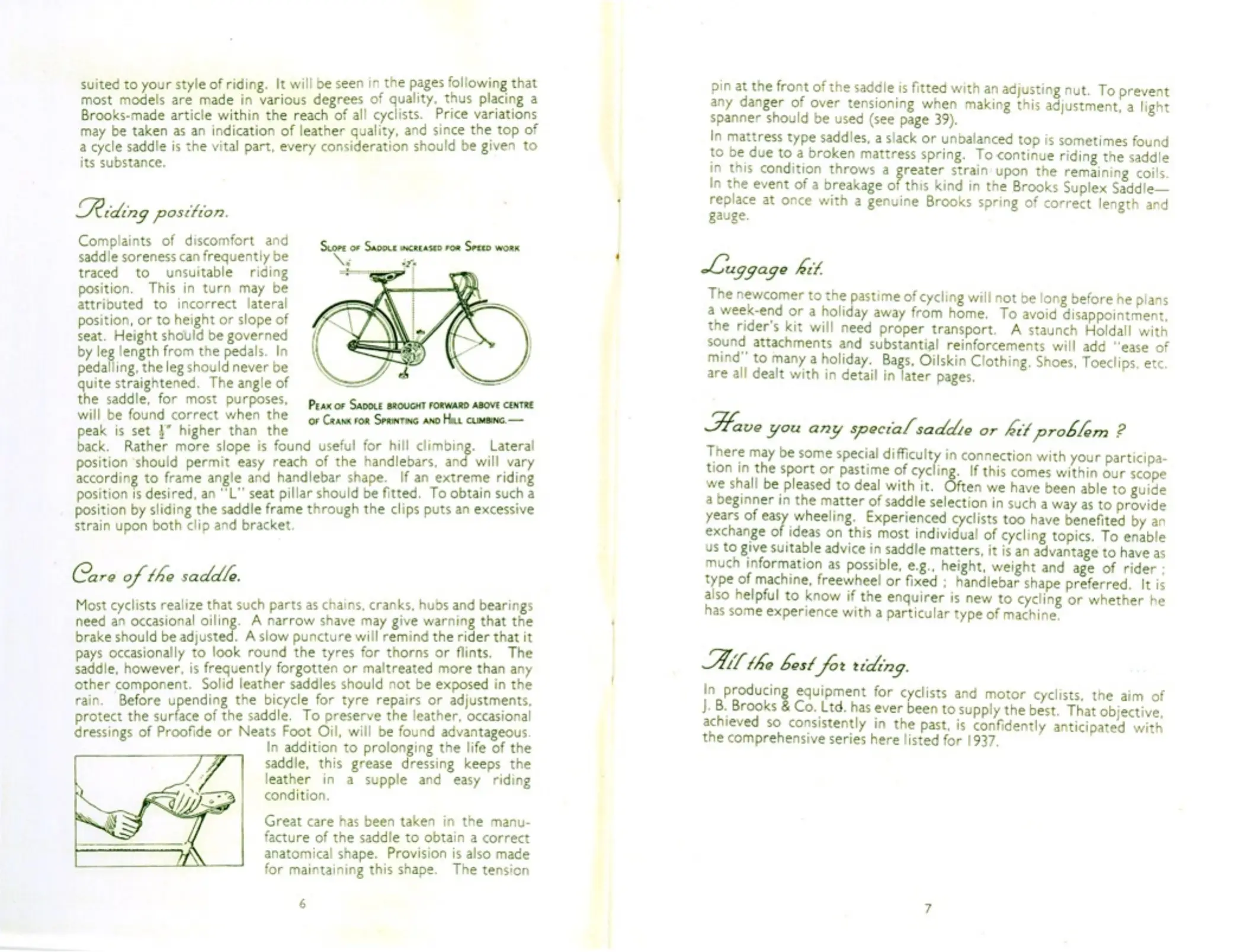
suited to your style of riding. It will be seen in the pages following that most models are made in various degrees of quality, thus placing a Brooks-made article within the reach of all cyclists. Price variations may be taken as an indication of leather quality, and since the top of a cycle saddle is the vital part, every consideration should be given to its substance.
Riding position.
Complaints of discomfort and saddle soreness can frequently be traced to unsuitable riding position. This in turn may be attributed to incorrect lateral position, or to height or slope of seat. Height should be governed by leg length from the pedals. In pedalling, the leg should never be quite straightened. The angle of the saddle, for most purposes, will be found correct when the peak is set ½” higher than the back. Rather more slope is found useful for hill climbing. Lateral position should permit easy reach of the handlebars, and will vary according to frame angle and handlebar shape. If an extreme riding position is desired, an “L” seat pillar should be fitted. To obtain such a position by sliding the saddle frame through the clips puts an excessive strain upon both clip and bracket.
Care of the saddle.
Most cyclists realize that such parts as chains, cranks, hubs and bearings need an occasional oiling. A narrow shave may give warning that the brake should be adjusted. A slow puncture will remind the rider that it pays occasionally to look round the tyres for thorns or flints. The saddle, however, is frequently forgotten or maltreated more than any other component. Solid leather saddles should not be exposed in the rain. Before upending the bicycle for tyre repairs or adjustments, protect the surface of the saddle. To preserve the leather, occasional dressings of Proofide or Neats Foot Oil, will be found advantageous.
In addition to prolonging the life of the saddle, this grease dressing keeps the leather in a supple and easy riding condition.
Great care has been taken in the manufacture of the saddle to obtain a correct anatomical shape. Provision is also made for maintaining this shape. The tension pin at the front of the saddle is fitted with an adjusting nut. To prevent any danger of over tensioning when making this adjustment, a light spanner should be used (see page 39).
In mattress type saddles, a slack or unbalanced top is sometimes found to be due to a broken mattress spring. To continue riding the saddle in this condition throws a greater strain upon the remaining coils. In the event of a breakage of this kind in the Brooks Suplex Saddle—replace at once with a genuine Brooks spring of correct length and gauge.
Luggage kit.
The newcomer to the pastime of cycling will not be long before he plans a week-end or a holiday away from home. To avoid disappointment, the rider’s kit will need proper transport. A staunch Holdall with sound attachments and substantial reinforcements will add “ease of mind” to many a holiday. Bags, Oilskin Clothing, Shoes, Toeclips, etc. are all dealt with in detail in later pages.
Have you any special saddle or kit problem?
There may be some special difficulty in connection with your participation in the sport or pastime of cycling. If this comes within our scope we shall be pleased to deal with it. Often we have been able to guide a beginner in the matter of saddle selection in such a way as to provide years of easy wheeling. Experienced cyclists too have benefited by an exchange of ideas on this most individual of cycling topics. To enable us to give suitable advice in saddle matters, it is an advantage to have as much information as possible, e.g., height, weight and age of rider; type of machine, freewheel or fixed; handlebar shape preferred. It is also helpful to know if the enquirer is new to cycling or whether he has some experience with a particular type of machine.
All the best for riding.
In producing equipment for cyclists and motor cyclists, the aim of J. B. Brooks & Co. Ltd. has ever been to supply the best. That objective, achieved so consistently in the past, is confidently anticipated with the comprehensive series here listed for 1937.
[A diagram of a bicycle captioned “Slope of Saddle increased for Speed work” and “Peak of Saddle brought forward above centre of Crank for Sprinting and Hill climbing” sits on the left page, above a drawing of a hand applying dressing to a saddle on a bicycle.]
— Page 6 —
[Printed pages 8 and 9.]
Two-wire Saddles
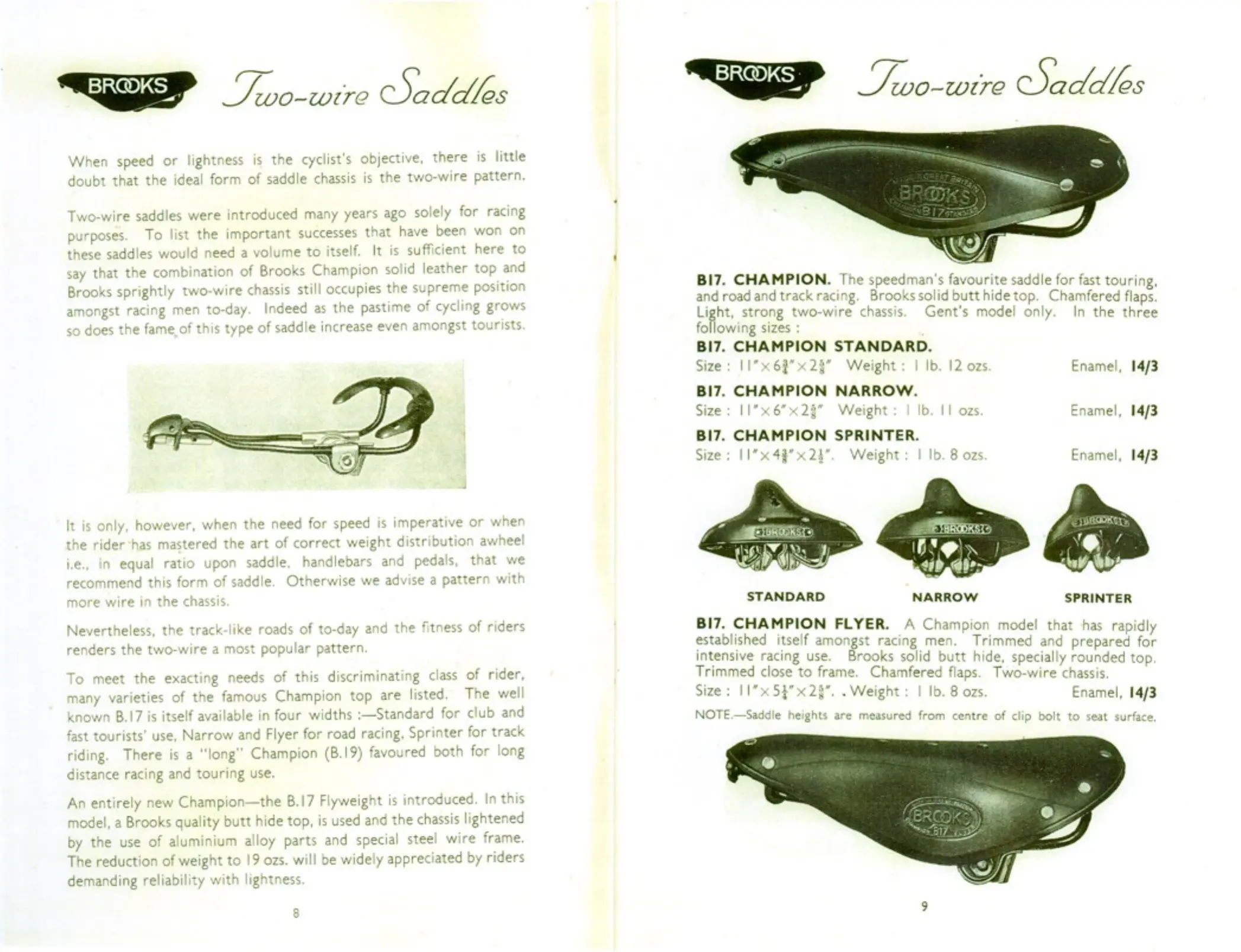
When speed or lightness is the cyclist’s objective, there is little doubt that the ideal form of saddle chassis is the two-wire pattern.
Two-wire saddles were introduced many years ago solely for racing purposes. To list the important successes that have been won on these saddles would need a volume to itself. It is sufficient here to say that the combination of Brooks Champion solid leather top and Brooks sprightly two-wire chassis still occupies the supreme position amongst racing men to-day. Indeed as the pastime of cycling grows so does the fame of this type of saddle increase even amongst tourists.
It is only, however, when the need for speed is imperative or when the rider has mastered the art of correct weight distribution awheel i.e., in equal ratio upon saddle, handlebars and pedals, that we recommend this form of saddle. Otherwise we advise a pattern with more wire in the chassis.
Nevertheless, the track-like roads of to-day and the fitness of riders renders the two-wire a most popular pattern.
To meet the exacting needs of this discriminating class of rider, many varieties of the famous Champion top are listed. The well known B.17 is itself available in four widths:—Standard for club and fast tourists’ use, Narrow and Flyer for road racing, Sprinter for track riding. There is a “long” Champion (B.19) favoured both for long distance racing and touring use.
An entirely new Champion—the B.17 Flyweight is introduced. In this model, a Brooks quality butt hide top, is used and the chassis lightened by the use of aluminium alloy parts and special steel wire frame. The reduction of weight to 19 ozs. will be widely appreciated by riders demanding reliability with lightness.
B17. CHAMPION. The speedman’s favourite saddle for fast touring, and road and track racing. Brooks solid butt hide top. Chamfered flaps. Light, strong two-wire chassis. Gent’s model only. In the three following sizes:
B17. CHAMPION STANDARD. Size: 11″ × 6¾” × 2⅜”. Weight: 1 lb. 12 ozs. Enamel, 14/3
B17. CHAMPION NARROW. Size: 11″ × 6″ × 2⅜”. Weight: 1 lb. 11 ozs. Enamel, 14/3
B17. CHAMPION SPRINTER. Size: 11″ × 4⅞” × 2¼”. Weight: 1 lb. 8 ozs. Enamel, 14/3
B17. CHAMPION FLYER. A Champion model that has rapidly established itself amongst racing men. Trimmed and prepared for intensive racing use. Brooks solid butt hide, specially rounded top. Trimmed close to frame. Chamfered flaps. Two-wire chassis. Size: 11″ × 5½” × 2⅜”. Weight: 1 lb. 8 ozs. Enamel, 14/3
NOTE.—Saddle heights are measured from centre of clip bolt to seat surface.
[A photograph of a bare two-wire chassis sits on the left page. The right page shows the B17 Champion in side view and the Standard, Narrow and Sprinter tops from above.]
— Page 7 —
[Printed pages 10 and 11.]
Two-wire Saddles
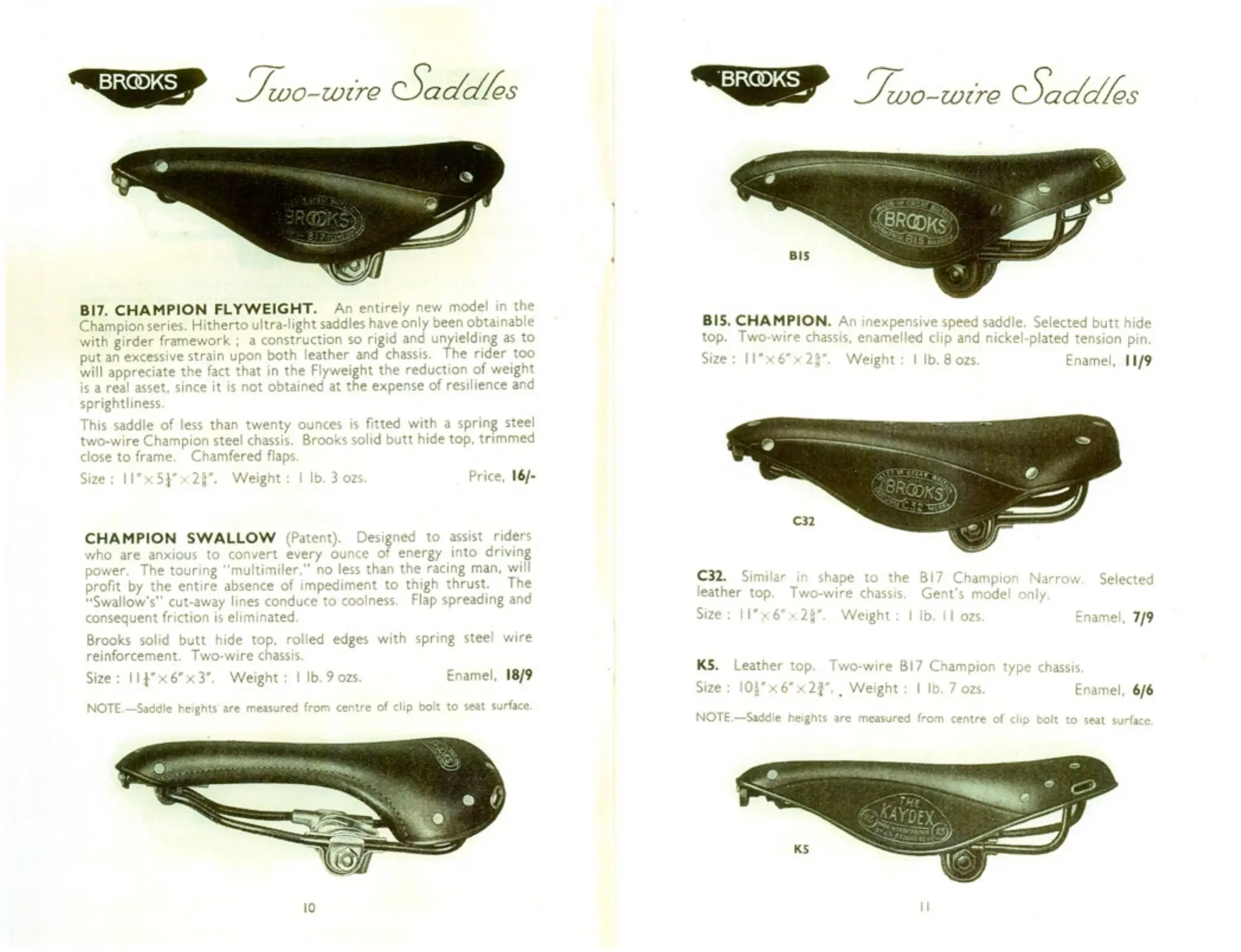
B17. CHAMPION FLYWEIGHT. An entirely new model in the Champion series. Hitherto ultra-light saddles have only been obtainable with girder framework; a construction so rigid and unyielding as to put an excessive strain upon both leather and chassis. The rider too will appreciate the fact that in the Flyweight the reduction of weight is a real asset, since it is not obtained at the expense of resilience and sprightliness.
This saddle of less than twenty ounces is fitted with a spring steel two-wire Champion steel chassis. Brooks solid butt hide top, trimmed close to frame. Chamfered flaps. Size: 11″ × 5¼” × 2⅜”. Weight: 1 lb. 3 ozs. Price, 16/-
CHAMPION SWALLOW (Patent). Designed to assist riders who are anxious to convert every ounce of energy into driving power. The touring “multimiler,” no less than the racing man, will profit by the entire absence of impediment to thigh thrust. The “Swallow’s” cut-away lines conduce to coolness. Flap spreading and consequent friction is eliminated.
Brooks solid butt hide top, rolled edges with spring steel wire reinforcement. Two-wire chassis. Size: 11¼” × 6″ × 3″. Weight: 1 lb. 9 ozs. Enamel, 18/9
B15. CHAMPION. An inexpensive speed saddle. Selected butt hide top. Two-wire chassis, enamelled clip and nickel-plated tension pin. Size: 11″ × 6″ × 2⅜”. Weight: 1 lb. 8 ozs. Enamel, 11/9
C32. Similar in shape to the B17 Champion Narrow. Selected leather top. Two-wire chassis. Gent’s model only. Size: 11″ × 6″ × 2⅜”. Weight: 1 lb. 11 ozs. Enamel, 7/9
K5. Leather top. Two-wire B17 Champion type chassis. Size: 10½” × 6″ × 2¾”. Weight: 1 lb. 7 ozs. Enamel, 6/6
NOTE.—Saddle heights are measured from centre of clip bolt to seat surface.
[Photographs of the B17 Flyweight, the Champion Swallow, the B15, the C32 and the Kaydex K5.]
— Page 8 —
[Printed pages 12 and 13.]
Two-wire Saddles
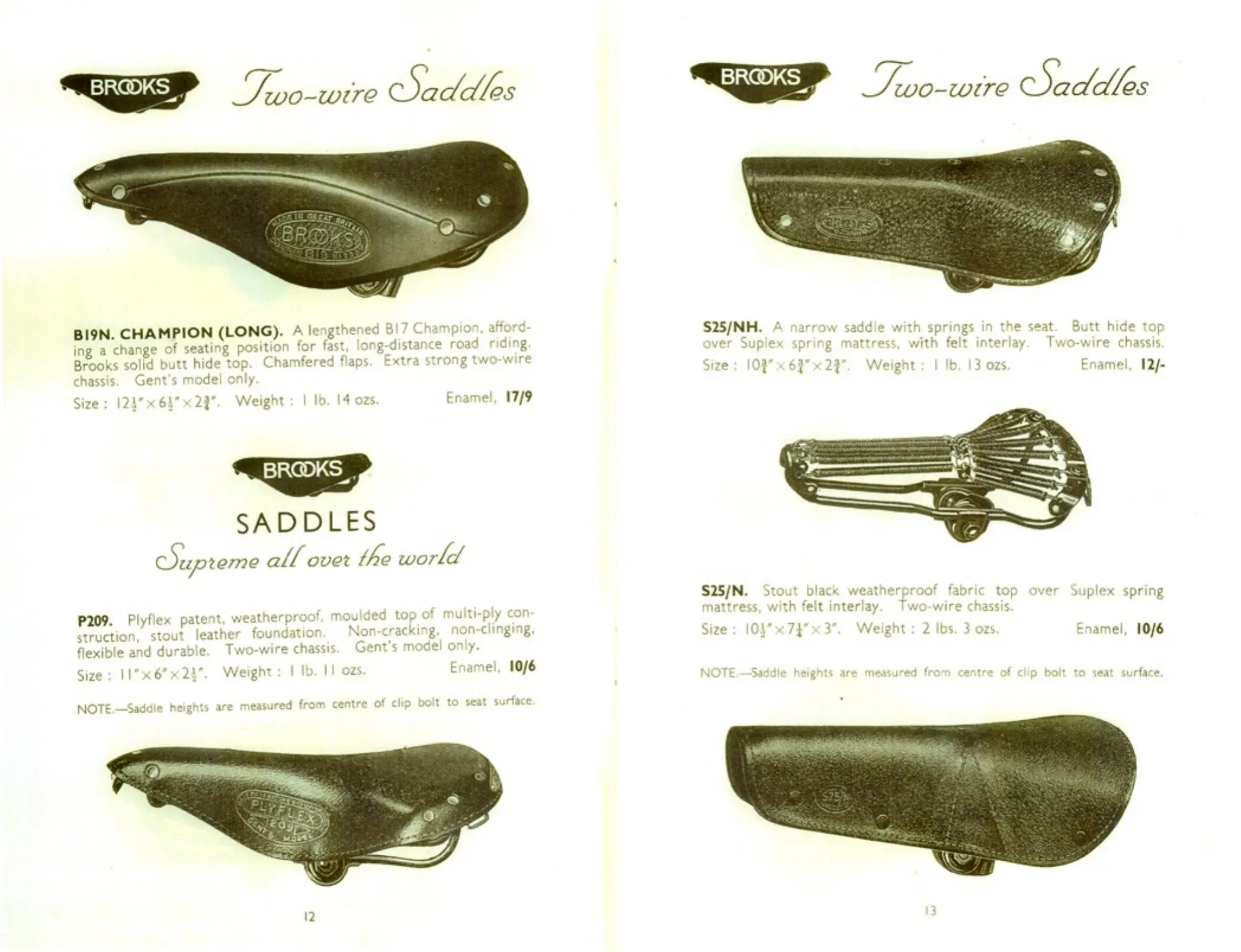
B19N. CHAMPION (LONG). A lengthened B17 Champion, affording a change of seating position for fast, long-distance road riding. Brooks solid butt hide top. Chamfered flaps. Extra strong two-wire chassis. Gent’s model only. Size: 12½” × 6½” × 2¾”. Weight: 1 lb. 14 ozs. Enamel, 17/9
SADDLES — Supreme all over the world
P209. Plyflex patent, weatherproof, moulded top of multi-ply construction, stout leather foundation. Non-cracking, non-clinging, flexible and durable. Two-wire chassis. Gent’s model only. Size: 11″ × 6″ × 2⅜”. Weight: 1 lb. 11 ozs. Enamel, 10/6
S25/NH. A narrow saddle with springs in the seat. Butt hide top over Suplex spring mattress, with felt interlay. Two-wire chassis. Size: 10¾” × 6¾” × 2¾”. Weight: 1 lb. 13 ozs. Enamel, 12/-
S25/N. Stout black weatherproof fabric top over Suplex spring mattress, with felt interlay. Two-wire chassis. Size: 10½” × 7¼” × 3″. Weight: 2 lbs. 3 ozs. Enamel, 10/6
NOTE.—Saddle heights are measured from centre of clip bolt to seat surface.
[Photographs of the B19N Champion, the Plyflex P209 and the two Suplex S25 patterns.]
— Page 9 —
[Printed pages 16 and 17.]
Four-wire Saddles
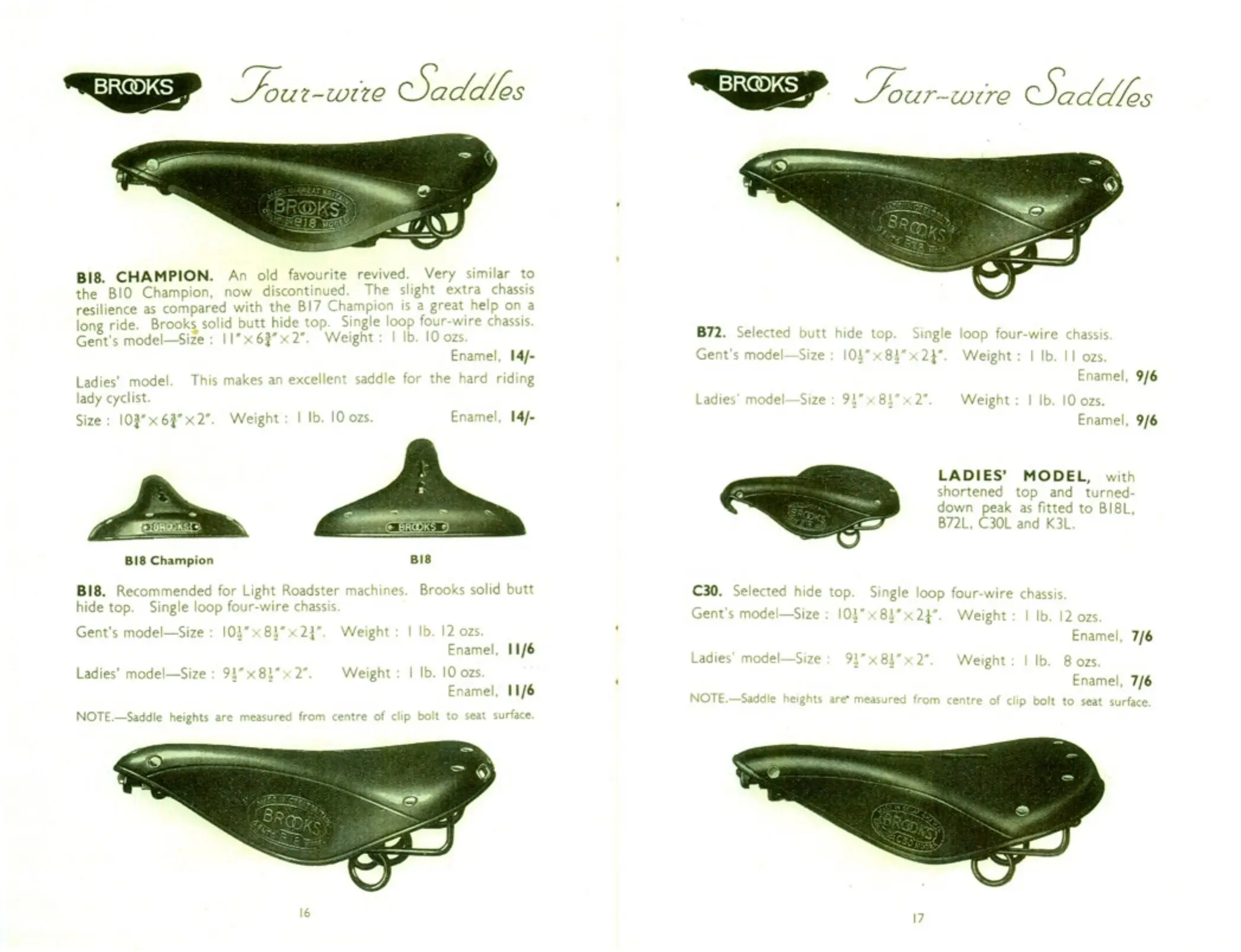
B18. CHAMPION. An old favourite revived. Very similar to the B10 Champion, now discontinued. The slight extra chassis resilience as compared with the B17 Champion is a great help on a long ride. Brooks solid butt hide top. Single loop four-wire chassis.
Gent’s model—Size: 11″ × 6¾” × 2″. Weight: 1 lb. 10 ozs. Enamel, 14/-
Ladies’ model. This makes an excellent saddle for the hard riding lady cyclist. Size: 10¾” × 6¾” × 2″. Weight: 1 lb. 10 ozs. Enamel, 14/-
B18. Recommended for Light Roadster machines. Brooks solid butt hide top. Single loop four-wire chassis.
Gent’s model—Size: 10½” × 8½” × 2¼”. Weight: 1 lb. 12 ozs. Enamel, 11/6
Ladies’ model—Size: 9½” × 8½” × 2″. Weight: 1 lb. 10 ozs. Enamel, 11/6
B72. Selected butt hide top. Single loop four-wire chassis.
Gent’s model—Size: 10½” × 8½” × 2¼”. Weight: 1 lb. 11 ozs. Enamel, 9/6
Ladies’ model—Size: 9½” × 8½” × 2″. Weight: 1 lb. 10 ozs. Enamel, 9/6
LADIES’ MODEL, with shortened top and turned-down peak as fitted to B18L, B72L, C30L and K3L.
C30. Selected hide top. Single loop four-wire chassis.
Gent’s model—Size: 10½” × 8½” × 2¼”. Weight: 1 lb. 12 ozs. Enamel, 7/6
Ladies’ model—Size: 9½” × 8½” × 2″. Weight: 1 lb. 8 ozs. Enamel, 7/6
NOTE.—Saddle heights are measured from centre of clip bolt to seat surface.
— Page 10 —
[Printed pages 18 and 19.]
Four-wire Saddles
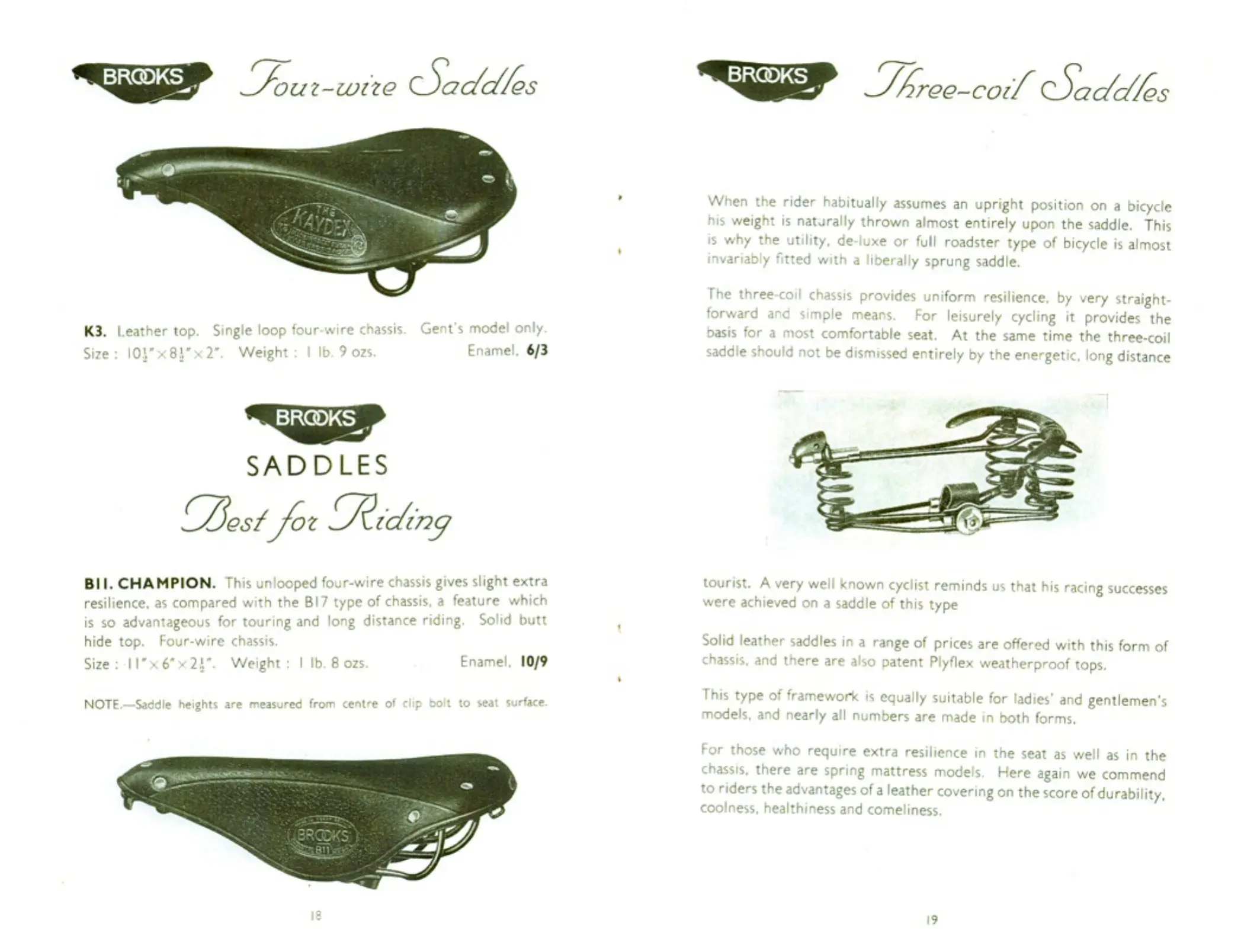
K3. Leather top. Single loop four-wire chassis. Gent’s model only. Size: 10½” × 8½” × 2″. Weight: 1 lb. 9 ozs. Enamel, 6/3
SADDLES — Best for Riding
B11. CHAMPION. This unlooped four-wire chassis gives slight extra resilience, as compared with the B17 type of chassis, a feature which is so advantageous for touring and long distance riding. Solid butt hide top. Four-wire chassis. Size: 11″ × 6″ × 2½”. Weight: 1 lb. 8 ozs. Enamel, 10/9
NOTE.—Saddle heights are measured from centre of clip bolt to seat surface.
Three-coil Saddles
When the rider habitually assumes an upright position on a bicycle his weight is naturally thrown almost entirely upon the saddle. This is why the utility, de-luxe or full roadster type of bicycle is almost invariably fitted with a liberally sprung saddle.
The three-coil chassis provides uniform resilience, by very straightforward and simple means. For leisurely cycling it provides the basis for a most comfortable seat. At the same time the three-coil saddle should not be dismissed entirely by the energetic, long distance tourist. A very well known cyclist reminds us that his racing successes were achieved on a saddle of this type.
Solid leather saddles in a range of prices are offered with this form of chassis, and there are also patent Plyflex weatherproof tops.
This type of framework is equally suitable for ladies’ and gentlemen’s models, and nearly all numbers are made in both forms.
For those who require extra resilience in the seat as well as in the chassis, there are spring mattress models. Here again we commend to riders the advantages of a leather covering on the score of durability, coolness, healthiness and comeliness.
— Page 11 —
[Printed pages 20 and 21.]
Three-coil Saddles
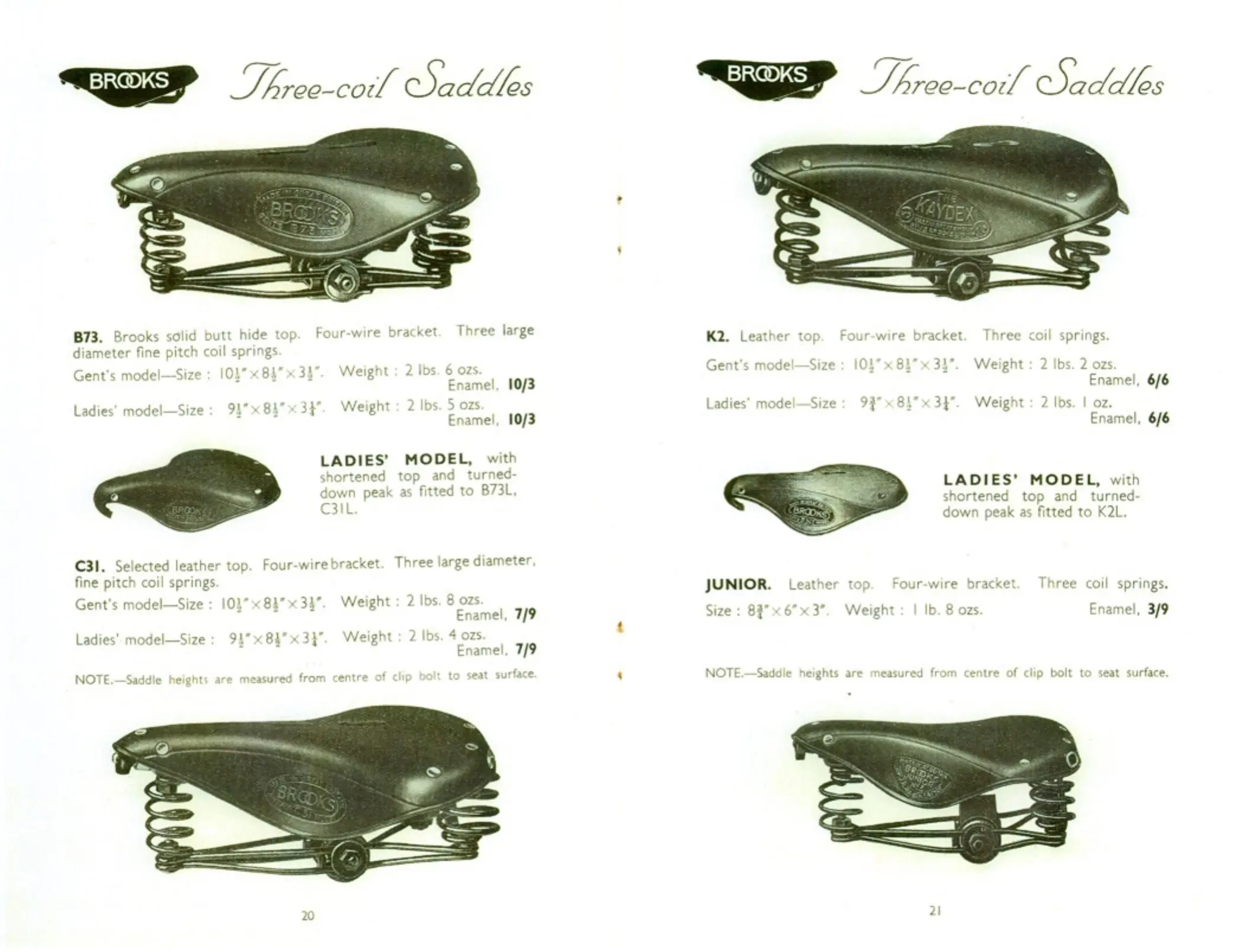
B73. Brooks solid butt hide top. Four-wire bracket. Three large diameter fine pitch coil springs.
Gent’s model—Size: 10½” × 8½” × 3½”. Weight: 2 lbs. 6 ozs. Enamel, 10/3
Ladies’ model—Size: 9½” × 8½” × 3¼”. Weight: 2 lbs. 5 ozs. Enamel, 10/3
LADIES’ MODEL, with shortened top and turned-down peak as fitted to B73L, C31L.
C31. Selected leather top. Four-wire bracket. Three large diameter, fine pitch coil springs.
Gent’s model—Size: 10½” × 8½” × 3½”. Weight: 2 lbs. 8 ozs. Enamel, 7/9
Ladies’ model—Size: 9½” × 8½” × 3¼”. Weight: 2 lbs. 4 ozs. Enamel, 7/9
K2. Leather top. Four-wire bracket. Three coil springs.
Gent’s model—Size: 10½” × 8½” × 3½”. Weight: 2 lbs. 2 ozs. Enamel, 6/6
Ladies’ model—Size: 9¾” × 8½” × 3¼”. Weight: 2 lbs. 1 oz. Enamel, 6/6
LADIES’ MODEL, with shortened top and turned-down peak as fitted to K2L.
JUNIOR. Leather top. Four-wire bracket. Three coil springs. Size: 8¾” × 6″ × 3″. Weight: 1 lb. 8 ozs. Enamel, 3/9
NOTE.—Saddle heights are measured from centre of clip bolt to seat surface.
— Page 12 —
[Printed pages 22 and 23.]
Three-coil Saddles
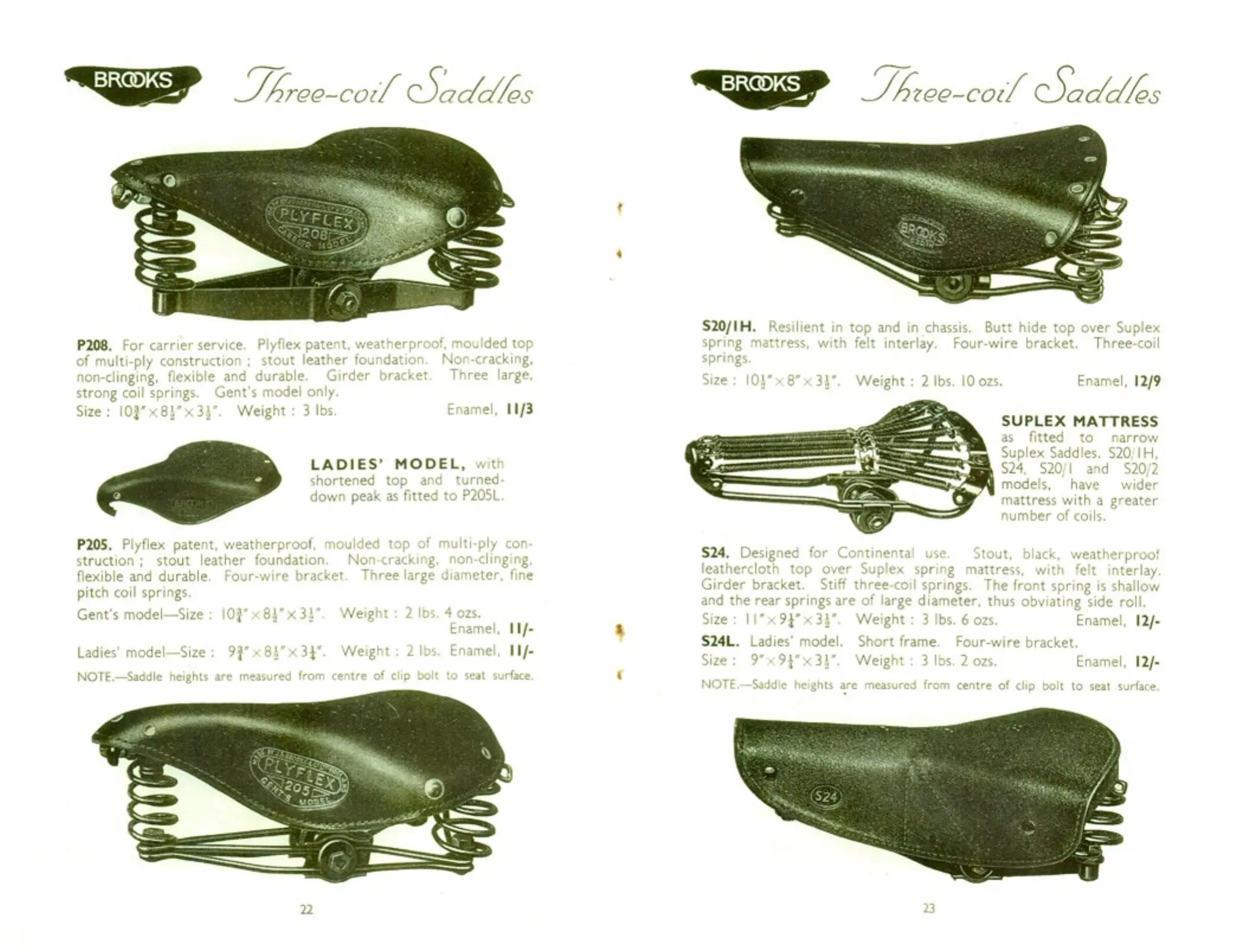
P208. For carrier service. Plyflex patent, weatherproof, moulded top of multi-ply construction; stout leather foundation. Non-cracking, non-clinging, flexible and durable. Girder bracket. Three large, strong coil springs. Gent’s model only. Size: 10¾” × 8½” × 3½”. Weight: 3 lbs. Enamel, 11/3
LADIES’ MODEL, with shortened top and turned-down peak as fitted to P205L.
P205. Plyflex patent, weatherproof, moulded top of multi-ply construction; stout leather foundation. Non-cracking, non-clinging, flexible and durable. Four-wire bracket. Three large diameter, fine pitch coil springs.
Gent’s model—Size: 10¾” × 8½” × 3½”. Weight: 2 lbs. 4 ozs. Enamel, 11/-
Ladies’ model—Size: 9¾” × 8½” × 3¼”. Weight: 2 lbs. Enamel, 11/-
S20/1H. Resilient in top and in chassis. Butt hide top over Suplex spring mattress, with felt interlay. Four-wire bracket. Three-coil springs. Size: 10½” × 8″ × 3½”. Weight: 2 lbs. 10 ozs. Enamel, 12/9
SUPLEX MATTRESS as fitted to narrow Suplex Saddles. S20/1H, S24, S20/1 and S20/2 models, have wider mattress with a greater number of coils.
S24. Designed for Continental use. Stout, black, weatherproof leathercloth top over Suplex spring mattress, with felt interlay. Girder bracket. Stiff three-coil springs. The front spring is shallow and the rear springs are of large diameter, thus obviating side roll. Size: 11″ × 9¼” × 3½”. Weight: 3 lbs. 6 ozs. Enamel, 12/-
S24L. Ladies’ model. Short frame. Four-wire bracket. Size: 9″ × 9¼” × 3½”. Weight: 3 lbs. 2 ozs. Enamel, 12/-
NOTE.—Saddle heights are measured from centre of clip bolt to seat surface.
— Page 13 —
[Printed pages 24 and 25.]
Three-coil Saddles
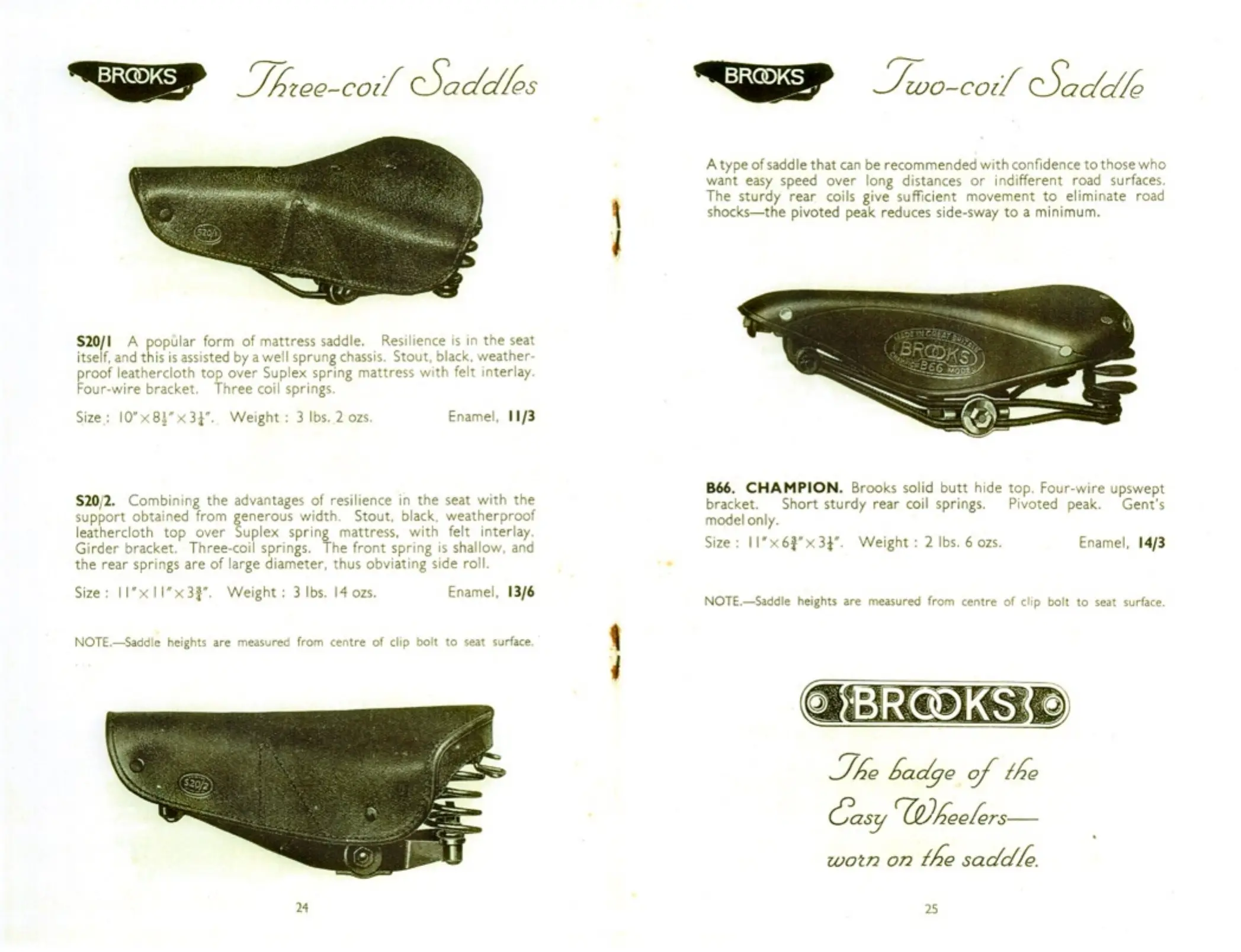
S20/1. A popular form of mattress saddle. Resilience is in the seat itself, and this is assisted by a well sprung chassis. Stout, black, weatherproof leathercloth top over Suplex spring mattress with felt interlay. Four-wire bracket. Three coil springs. Size: 10″ × 8½” × 3¼”. Weight: 3 lbs. 2 ozs. Enamel, 11/3
S20/2. Combining the advantages of resilience in the seat with the support obtained from generous width. Stout, black, weatherproof leathercloth top over Suplex spring mattress, with felt interlay. Girder bracket. Three-coil springs. The front spring is shallow, and the rear springs are of large diameter, thus obviating side roll. Size: 11″ × 11″ × 3¾”. Weight: 3 lbs. 14 ozs. Enamel, 13/6
Two-coil Saddle
A type of saddle that can be recommended with confidence to those who want easy speed over long distances or indifferent road surfaces. The sturdy rear coils give sufficient movement to eliminate road shocks—the pivoted peak reduces side-sway to a minimum.
B66. CHAMPION. Brooks solid butt hide top. Four-wire upswept bracket. Short sturdy rear coil springs. Pivoted peak. Gent’s model only. Size: 11″ × 6¾” × 3¼”. Weight: 2 lbs. 6 ozs. Enamel, 14/3
NOTE.—Saddle heights are measured from centre of clip bolt to seat surface.
[The oval BROOKS badge is reproduced at the foot of the right page with the line:]
The badge of the Easy Wheelers—worn on the saddle.
— Page 14 —
[Printed pages 26 and 27.]
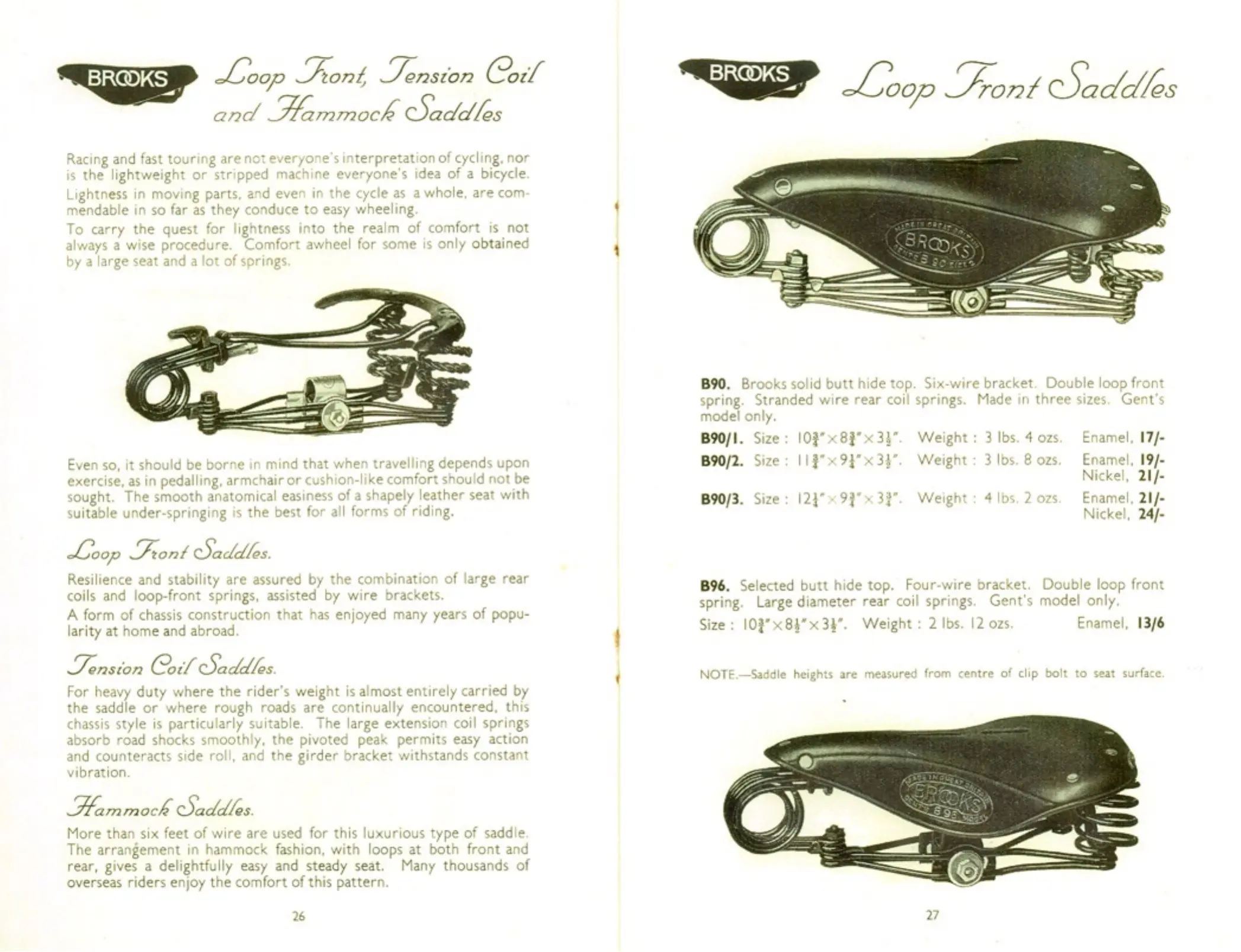
Loop Front, Tension Coil and Hammock Saddles
Racing and fast touring are not everyone’s interpretation of cycling, nor is the lightweight or stripped machine everyone’s idea of a bicycle.
Lightness in moving parts, and even in the cycle as a whole, are commendable in so far as they conduce to easy wheeling.
To carry the quest for lightness into the realm of comfort is not always a wise procedure. Comfort awheel for some is only obtained by a large seat and a lot of springs.
Even so, it should be borne in mind that when travelling depends upon exercise, as in pedalling, armchair or cushion-like comfort should not be sought. The smooth anatomical easiness of a shapely leather seat with suitable under-springing is the best for all forms of riding.
Loop Front Saddles. Resilience and stability are assured by the combination of large rear coils and loop-front springs, assisted by wire brackets. A form of chassis construction that has enjoyed many years of popularity at home and abroad.
Tension Coil Saddles. For heavy duty where the rider’s weight is almost entirely carried by the saddle or where rough roads are continually encountered, this chassis style is particularly suitable. The large extension coil springs absorb road shocks smoothly, the pivoted peak permits easy action and counteracts side roll, and the girder bracket withstands constant vibration.
Hammock Saddles. More than six feet of wire are used for this luxurious type of saddle. The arrangement in hammock fashion, with loops at both front and rear, gives a delightfully easy and steady seat. Many thousands of overseas riders enjoy the comfort of this pattern.
Loop Front Saddles
B90. Brooks solid butt hide top. Six-wire bracket. Double loop front spring. Stranded wire rear coil springs. Made in three sizes. Gent’s model only.
B90/1. Size: 10¾” × 8¾” × 3½”. Weight: 3 lbs. 4 ozs. Enamel, 17/-
B90/2. Size: 11¾” × 9¼” × 3½”. Weight: 3 lbs. 8 ozs. Enamel, 19/- Nickel, 21/-
B90/3. Size: 12¼” × 9¾” × 3¾”. Weight: 4 lbs. 2 ozs. Enamel, 21/- Nickel, 24/-
B96. Selected butt hide top. Four-wire bracket. Double loop front spring. Large diameter rear coil springs. Gent’s model only. Size: 10¾” × 8½” × 3½”. Weight: 2 lbs. 12 ozs. Enamel, 13/6
NOTE.—Saddle heights are measured from centre of clip bolt to seat surface.
— Page 15 —
[Printed pages 28 and 29.]
Loop Front Saddles
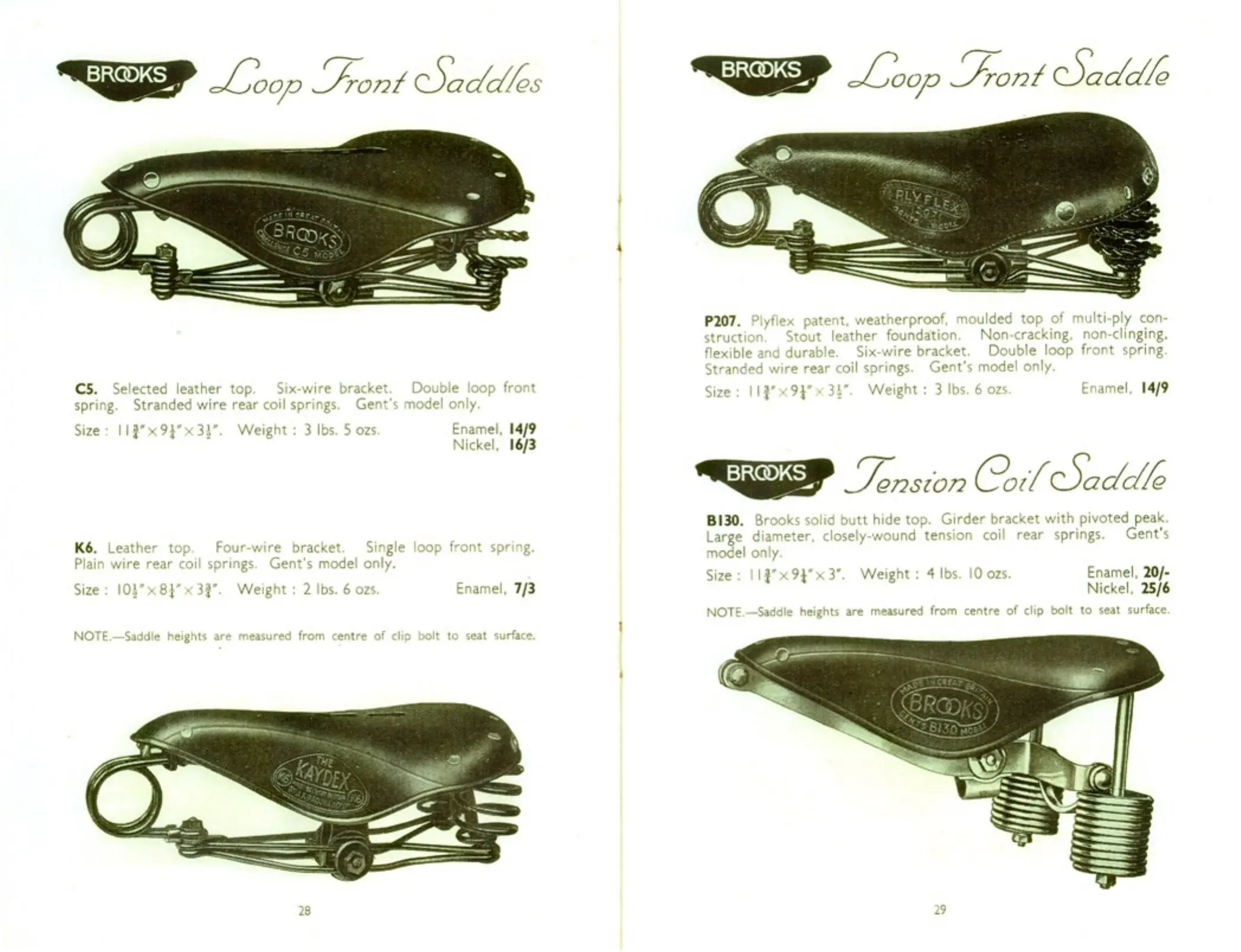
C5. Selected leather top. Six-wire bracket. Double loop front spring. Stranded wire rear coil springs. Gent’s model only. Size: 11¾” × 9¼” × 3½”. Weight: 3 lbs. 5 ozs. Enamel, 14/9 Nickel, 16/3
K6. Leather top. Four-wire bracket. Single loop front spring. Plain wire rear coil springs. Gent’s model only. Size: 10½” × 8¼” × 3¾”. Weight: 2 lbs. 6 ozs. Enamel, 7/3
Loop Front Saddle
P207. Plyflex patent, weatherproof, moulded top of multi-ply construction. Stout leather foundation. Non-cracking, non-clinging, flexible and durable. Six-wire bracket. Double loop front spring. Stranded wire rear coil springs. Gent’s model only. Size: 11¾” × 9¼” × 3½”. Weight: 3 lbs. 6 ozs. Enamel, 14/9
Tension Coil Saddle
B130. Brooks solid butt hide top. Girder bracket with pivoted peak. Large diameter, closely-wound tension coil rear springs. Gent’s model only. Size: 11¾” × 9¼” × 3″. Weight: 4 lbs. 10 ozs. Enamel, 20/- Nickel, 25/6
NOTE.—Saddle heights are measured from centre of clip bolt to seat surface.
— Page 16 —
[Printed pages 38 and 39.]
Toe Clips
Dependable Equipment for the Speedman and Enthusiast.
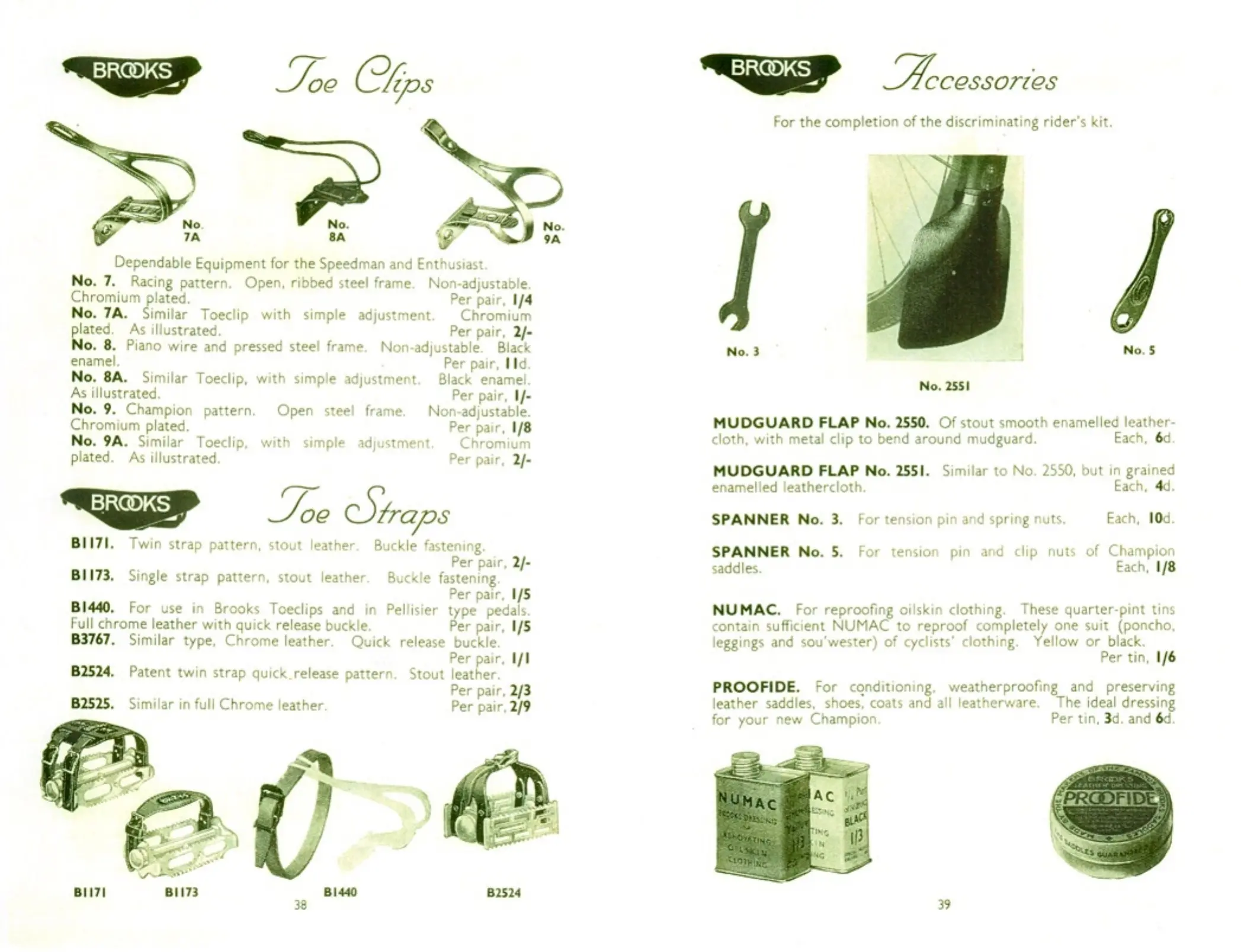
No. 7. Racing pattern. Open, ribbed steel frame. Non-adjustable. Chromium plated. Per pair, 1/4
No. 7A. Similar Toeclip with simple adjustment. Chromium plated. As illustrated. Per pair, 2/-
No. 8. Piano wire and pressed steel frame. Non-adjustable. Black enamel. Per pair, 11d.
No. 8A. Similar Toeclip, with simple adjustment. Black enamel. As illustrated. Per pair, 1/-
No. 9. Champion pattern. Open steel frame. Non-adjustable. Chromium plated. Per pair, 1/8
No. 9A. Similar Toeclip, with simple adjustment. Chromium plated. As illustrated. Per pair, 2/-
Toe Straps
B1171. Twin strap pattern, stout leather. Buckle fastening. Per pair, 2/-
B1173. Single strap pattern, stout leather. Buckle fastening. Per pair, 1/5
B1440. For use in Brooks Toeclips and in Pellisier type pedals. Full chrome leather with quick release buckle. Per pair, 1/5
B3767. Similar type, Chrome leather. Quick release buckle. Per pair, 1/1
B2524. Patent twin strap quick release pattern. Stout leather. Per pair, 2/3
B2525. Similar in full Chrome leather. Per pair, 2/9
Accessories
For the completion of the discriminating rider’s kit.
MUDGUARD FLAP No. 2550. Of stout smooth enamelled leathercloth, with metal clip to bend around mudguard. Each, 6d.
MUDGUARD FLAP No. 2551. Similar to No. 2550, but in grained enamelled leathercloth. Each, 4d.
SPANNER No. 3. For tension pin and spring nuts. Each, 10d.
SPANNER No. 5. For tension pin and clip nuts of Champion saddles. Each, 1/8
NUMAC. For reproofing oilskin clothing. These quarter-pint tins contain sufficient NUMAC to reproof completely one suit (poncho, leggings and sou’wester) of cyclists’ clothing. Yellow or black. Per tin, 1/6
PROOFIDE. For conditioning, weatherproofing and preserving leather saddles, shoes, coats and all leatherware. The ideal dressing for your new Champion. Per tin, 3d. and 6d.
[The left page illustrates toeclips No. 7A, No. 8A and No. 9A and toestraps B1171, B1173, B1440 and B2524. The right page shows the No. 3 and No. 5 spanners, a mudguard flap fitted to a wheel, two tins of Numac and a tin of Proofide.]
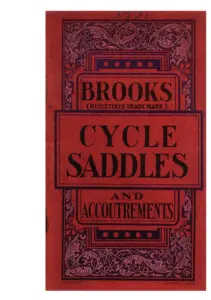 Brooks 1901 Catalog — Cycle Saddles and Accoutrements
 Brooks 1902 Catalog — Cycle Saddles and Accoutrements for 1902
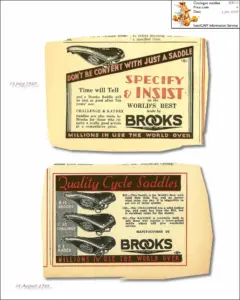 Brooks 1935 Advertisement — Specify and Insist, and Quality Cycle Saddles with Challenge and Kaydex
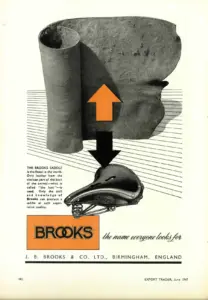 Brooks 1947 Advertisement — The Name Everyone Looks For (Export Trader)
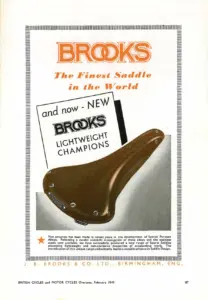 Brooks 1949 Advertisement — The New Lightweight Champions (British Cycles and Motor Cycles Overseas)
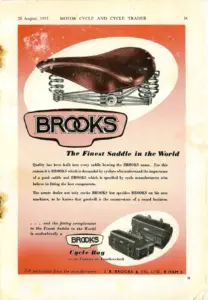 Brooks 1955 Advertisement — It’s the Saddle that Sells the Cycle (Motor Cycle and Cycle Trader)
Ebykr presents this material for research and education. If you hold rights to it or notice an ownership issue, please contact us and we will respond promptly.
The Ebykr Digest
New articles, timelines, catalog finds and registry activity — assembled from the archive once a month. Your address is never shared.
Double opt-in. One email per month. Unsubscribe at any time with one click.
