About Ebykr
Ebykr celebrates classic and vintage lightweight bicycles through provocative imagery and opinion. Ride along with us.
About Ebykr
Ebykr celebrates classic and vintage lightweight bicycles through provocative imagery and opinion. Ride along with us.

Source: Ebykr archive.
| Marque | Brooks |
|---|---|
| Type | Catalog |
| Year | 1923 |
| Publisher | J. B. Brooks & Co., Ltd. |
| Country | England |
| Language | English |
| Pages | 8 |
| Source | Ebykr archive. |
| Credit | Ebykr archive |
| Transcription | Transcribed by eye |
The BROOKS REGISTERED TRADE MARK BOOK of Saddles and Equipment. A Catalogue of BROOKS Saddles & Equipment. With notes on their selection & adaptation to the needs of cyclists and motor cyclists… By the Manufacturers J. B. BROOKS & Co. Ltd Criterion Works Great Charles Street BIRMINGHAM Telephone Central 3670. Telegrams Brooks, B'ham. B 95 …
A Catalogue of Brooks Saddles and Equipment for 1923, from the Criterion Works in Great Charles Street, Birmingham. It is the earliest of the Brooks books held here from the 1920s and it is a quite different kind of publication from the 1925 and 1927 ones that follow it.
The whole catalogue is written as a continuous dialogue between a dealer and his customers, a different customer on almost every page, arguing his way through leather quality, riding position, spring rates and rider weights. Beside each entry sits a pen vignette of a named place — the Gap of Dunloe, St Mary’s Abbey at York, Loch Lomond, Swallow Falls, Lichfield, St Michael’s Mount, Cleeve Abbey, Millers Dale — with a table of road distances to it from London, Glasgow, Dublin, Birmingham, Manchester and Leeds, closing each time with the line “In comfort on a Brooks.” Printed page 48 records that “Our indebtedness for the distances given throughout this Catalogue is due to the Touring Department, Royal Automobile Club.” Every page foot carries a large orange Brooks trade-mark ornament, a device the later books drop.
Dating this book takes a moment. The title page prints no year and no List No., and the List No. series that dates the 1930s books (168 for 1933 through 280 for 1939) does not reach back this far. The year is instead printed in the body: on printed page 26, discussing the B 170 motor cycle saddle, the dealer says “The makers have effected one or two improvements on this pattern for 1923. You will get larger coil springs, a hinged movement to the spring pillar, and more luxurious padding.” The telephone is Central 3670, the number Brooks still prints in 1935. There is no London Depot line, which the 1927 title page does carry and the 1925 one does not, so the depot opens after this book and after 1925.
Four things make it worth citing, and one of them is an absence.
The first is the absence. There is no Supple Seat in this catalogue. The complete motor cycle saddle range, read across printed pages 22 to 31, is the B 600, B 650 and B 700 cantilever spring saddles, the B 500, the B 400, the B 170, the B 175, the B 150, the B 155, the B 220 and the B 225, with backrests on page 31. These are pan and coil saddles. There is no B 185, no B 190, no B 195, no B 200, no spring mattress and no mention anywhere of a supple mattress. The B 185 Racing-Supple and the whole Supple Seat range therefore arrive between this book and the 1925 one.
The second is the B 28 on printed page 13, a cycle saddle, described this way: “Brooks show here real ingenuity in the solution of the problem. The hammock principle is adopted, assisted by four rubber buffers, which absorb the shocks through the medium of bell crank levers.” The rubber-buffer shock absorber is therefore on a Brooks bicycle saddle in 1923, and the bell crank levers are a mechanical detail neither the 1925 nor the 1927 book gives.
The third is the No. 3 on printed page 15, sold as “Carrier Saddle No. 3”, badged CARRIER No3 MODEL, and introduced with the words “This one here is modelled after the War Office pattern; it is built to wear, and forms an ideal saddle for the tradesman’s carrier cycle or tricycle.” The commercial framing and the War Office pedigree are both already in place. What is not here is the designation “Army. Mark 3.”, which the 1925 book prints and the 1927 book does not.
The fourth is a name. Printed page 44, selling the B 4952 motor cycle carrier case, says “the material used here is the new vulcanized fibre used for the famous ‘Antler’ Travelware.” Brooks is already calling Antler famous in 1923.
One pattern runs through the prices. Every model that can be compared is dearer here than in 1925: the Carrier No. 3 at 18/3 against 15/6, the B 28 at 22/3 against 20/6, the B 600 at 88/- against 65/-, the B 700 at 112/- against 80/-, the B 18 at 12/3 against 10/-. The fall is deepest on the expensive motor cycle products, at a quarter to nearly a third, and prices then hold flat from 1925 to 1927.
The book runs to printed pages 2 through 48 across twenty-seven scanned sheets, with no gaps. This record reproduces the cover, the title page and the six pages that carry the citable material. The remaining printed pages, which cover the rest of the cycle range, the motor cycle range, tool bags, cases, trunks, leggings and the pillion seats, are held in the Ebykr collection but are not reproduced here.
The scan is a low-resolution one. The embedded images run about 1,004 pixels across per two-page spread, which is roughly 502 pixels per printed page, and the images in this record are presented at twice that. Headings, model numbers, prices and weights read cleanly. The smallest body copy, and the printer’s imprint on the title page, sit at the floor of legibility.
— Page 1 —
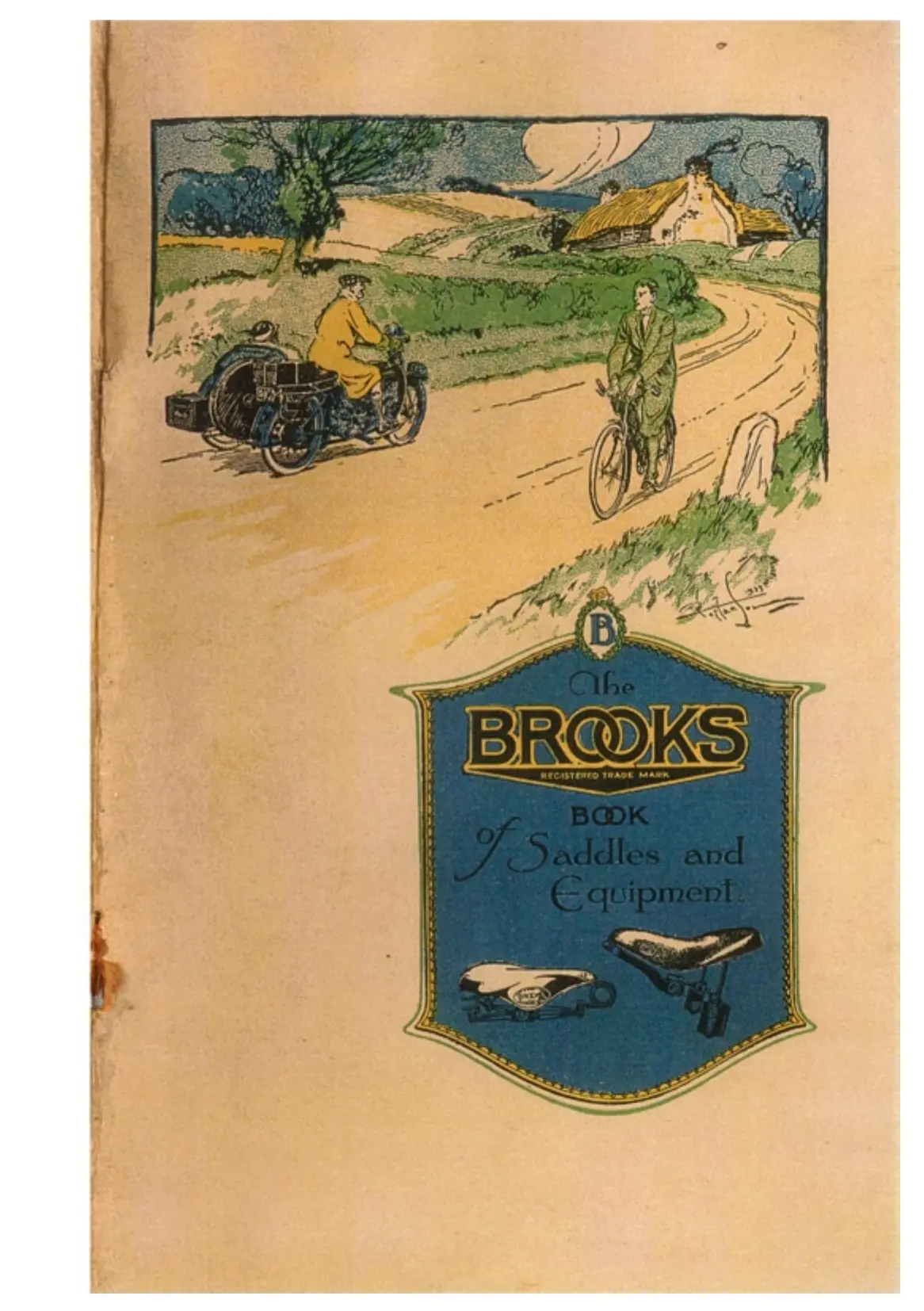
[Front cover. A full-colour lithograph over buff stock.]
[A country road curves away between hedges towards a thatched cottage and a line of trees, under a pale sky. A motor cyclist with a sidecar rides towards the viewer on the left; a cyclist in a green jacket rides away on the right. Below the scene, a shield-shaped panel in blue and gold, with a small monogram of the letter E above it.]
The BROOKS
REGISTERED TRADE MARK
BOOK
of Saddles and Equipment.
[Two saddles are drawn at the foot of the shield, one a sprung motor cycle pattern and one a cycle saddle.]
— Page 2 —
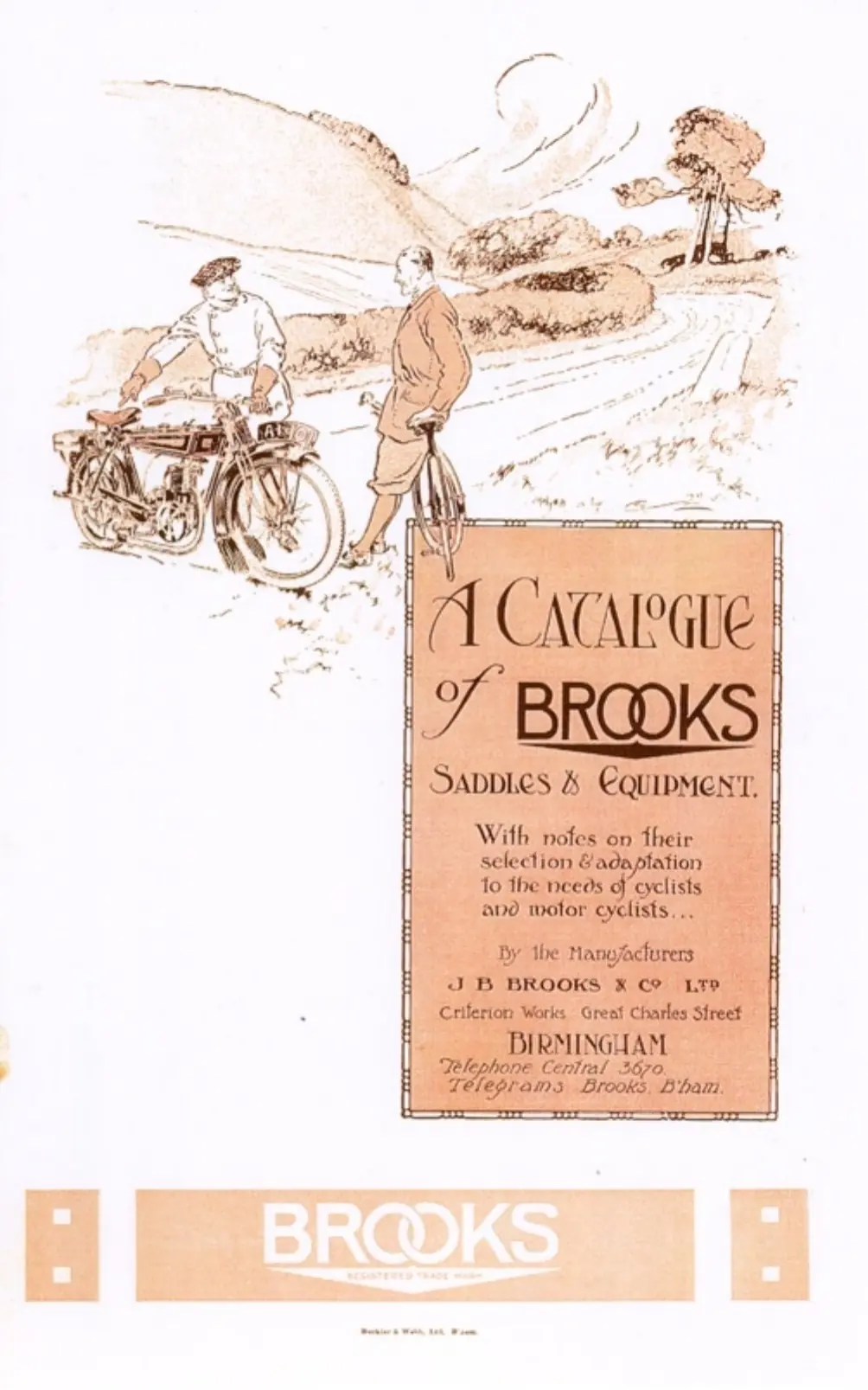
[Title page. A pen and wash vignette across the upper half shows a motor cyclist and a cyclist halted together on a country road beside a hedge, a tree and a distant hillside. The lettering below is hand-drawn on an orange panel with a ruled border.]
A Catalogue
of BROOKS
Saddles & Equipment.
With notes on their selection & adaptation to the needs of cyclists and motor cyclists…
By the Manufacturers
J. B. BROOKS & Co. Ltd
Criterion Works Great Charles Street
BIRMINGHAM
Telephone Central 3670.
Telegrams Brooks, B’ham.
[A printer’s imprint is set very small at the foot of the page, below the Brooks ornament. It reads as “Buckler & Webb, Ltd., B’ham.” but sits at the floor of legibility in this scan.]
— Page 3 —
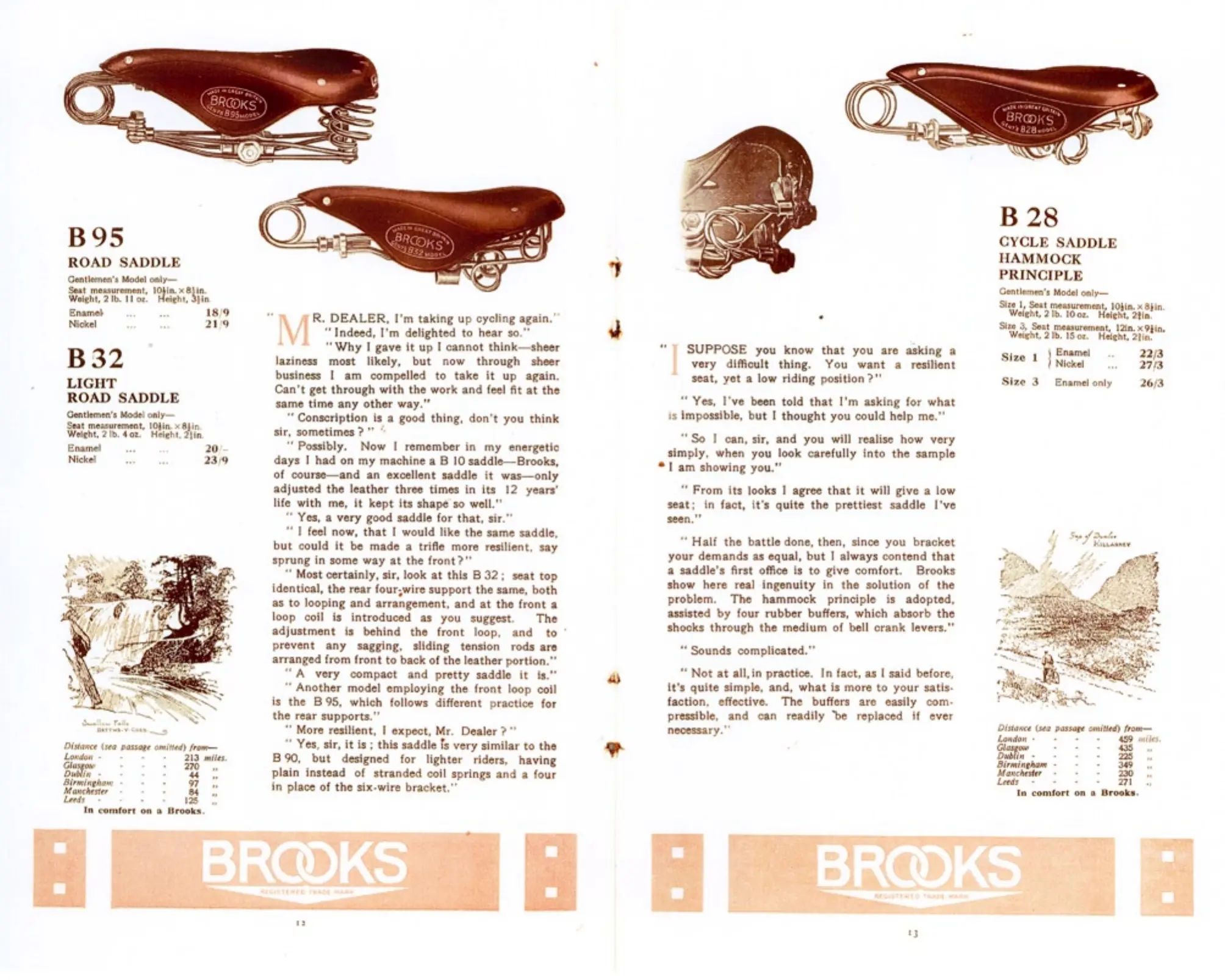
[Printed pages 12 and 13. On the left the B 95 and B 32; on the right the B 28, shown both in three-quarter view and from the rear so the buffer gear is visible. The B 95 badge reads GENTS B95 MODEL, the B 32 badge GENTS B32 MODEL and the B 28 badge GENTS B28 MODEL.]
[Printed page 12.]
B 95 ROAD SADDLE
Gentlemen’s Model only—
Seat measurement, 10¼in. × 8½in. Weight, 2 lb. 11 oz. Height, 3¼in.
Enamel 18/9
Nickel 21/9
B 32 LIGHT ROAD SADDLE
Gentlemen’s Model only—
Seat measurement, 10¼in. × 8½in. Weight, 2 lb. 4 oz. Height, 2¼in.
Enamel 20/-
Nickel 23/9
“MR. DEALER, I’m taking up cycling again.”
“Indeed, I’m delighted to hear so.”
“Why I gave it up I cannot think—sheer laziness most likely, but now through sheer business I am compelled to take it up again. Can’t get through with the work and feel fit at the same time any other way.”
“Conscription is a good thing, don’t you think sir, sometimes?”
“Possibly. Now I remember in my energetic days I had on my machine a B 10 saddle—Brooks, of course—and an excellent saddle it was—only adjusted the leather three times in its 12 years’ life with me, it kept its shape so well.”
“Yes, a very good saddle for that, sir.”
“I feel now, that I would like the same saddle, but could it be made a trifle more resilient, say sprung in some way at the front?”
“Most certainly, sir, look at this B 32; seat top identical, the rear four-wire support the same, both as to looping and arrangement, and at the front a loop coil is introduced as you suggest. The adjustment is behind the front loop, and to prevent any sagging, sliding tension rods are arranged from front to back of the leather portion.”
“A very compact and pretty saddle it is.”
“Another model employing the front loop coil is the B 95, which follows different practice for the rear supports.”
“More resilient, I expect, Mr. Dealer?”
“Yes, sir, it is; this saddle is very similar to the B 90, but designed for lighter riders, having plain instead of stranded coil springs and a four in place of the six-wire bracket.”
[Vignette: Swallow Falls, Bettws-y-Coed. Distance (sea passage omitted) from — London 213 miles, Glasgow 270, Dublin 44, Birmingham 97, Manchester 84, Leeds 125. In comfort on a Brooks.]
[Printed page 13.]
B 28 CYCLE SADDLE HAMMOCK PRINCIPLE
Gentlemen’s Model only—
Size 1, Seat measurement, 10½in. × 8½in. Weight, 2 lb. 10 oz. Height, 2½in.
Size 3, Seat measurement, 12in. × 9¼in. Weight, 2 lb. 15 oz. Height, 2½in.
Size 1 Enamel 22/3 Nickel 27/3
Size 3 Enamel only 26/3
“I SUPPOSE you know that you are asking a very difficult thing. You want a resilient seat, yet a low riding position?”
“Yes, I’ve been told that I’m asking for what is impossible, but I thought you could help me.”
“So I can, sir, and you will realise how very simply, when you look carefully into the sample I am showing you.”
“From its looks I agree that it will give a low seat; in fact, it’s quite the prettiest saddle I’ve seen.”
“Half the battle done, then, since you bracket your demands as equal, but I always contend that a saddle’s first office is to give comfort. Brooks show here real ingenuity in the solution of the problem. The hammock principle is adopted, assisted by four rubber buffers, which absorb the shocks through the medium of bell crank levers.”
“Sounds complicated.”
“Not at all, in practice. In fact, as I said before, it’s quite simple, and, what is more to your satisfaction, effective. The buffers are easily compressible, and can readily be replaced if ever necessary.”
[Vignette: Gap of Dunloe, Killarney. Distance (sea passage omitted) from — London 459 miles, Glasgow 435, Dublin 225, Birmingham 349, Manchester 230, Leeds 271. In comfort on a Brooks.]
— Page 4 —
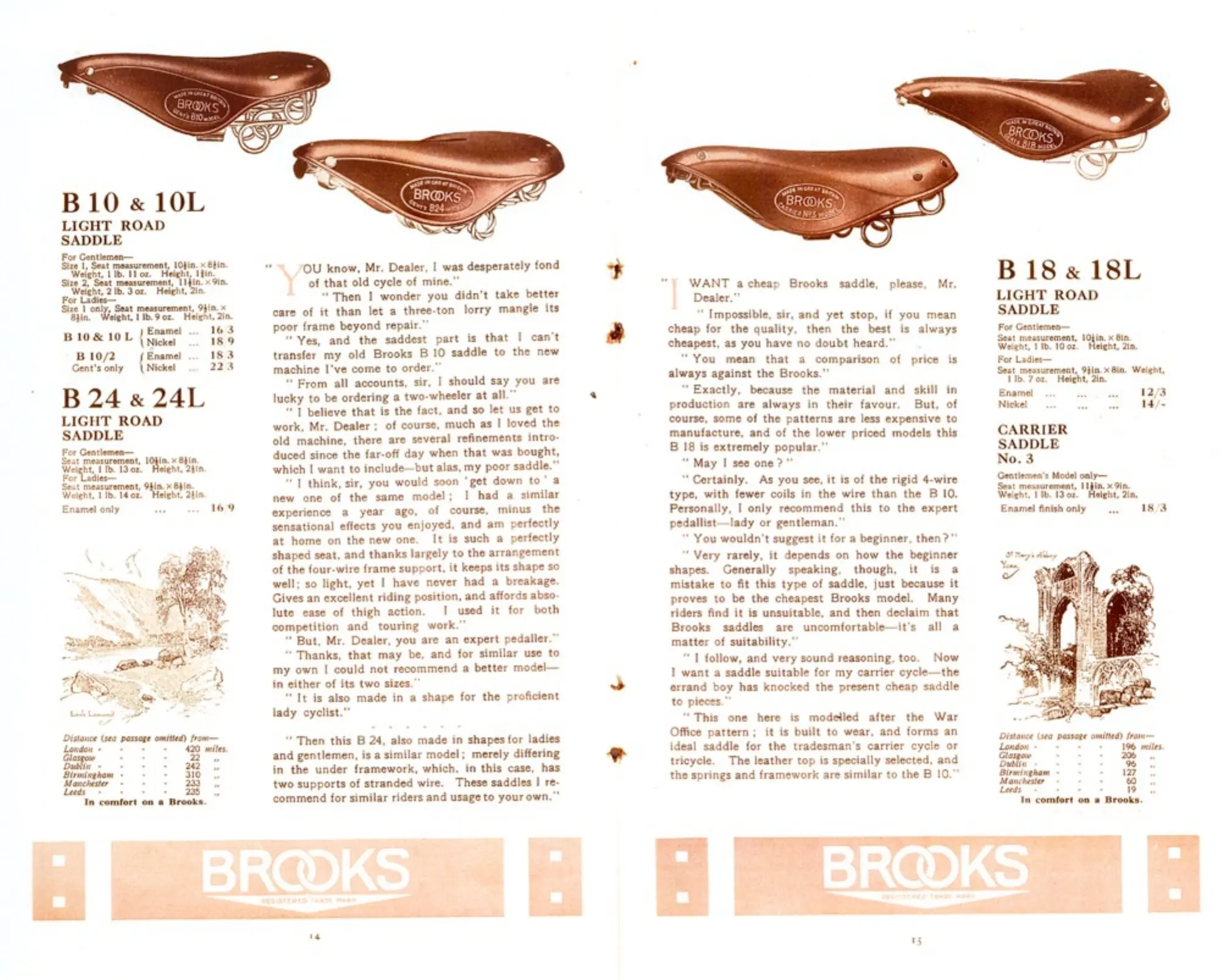
[Printed pages 14 and 15. Four saddles in side view. The badges read GENTS B10 MODEL, GENTS B24 MODEL, GENTS B18 MODEL and CARRIER No3 MODEL.]
[Printed page 14.]
B 10 & 10L LIGHT ROAD SADDLE
For Gentlemen—
Size 1, Seat measurement, 10¼in. × 8½in. Weight, 1 lb. 11 oz. Height, 1½in.
Size 2, Seat measurement, 11¼in. × 9in. Weight, 2 lb. 3 oz. Height, 2in.
For Ladies—
Size 1 only, Seat measurement, 9½in. × 8½in. Weight, 1 lb. 9 oz. Height, 2in.
B 10 & 10 L Enamel 16/3 Nickel 18/9
B 10/2 Gent’s only Enamel 18/3 Nickel 22/3
B 24 & 24L LIGHT ROAD SADDLE
For Gentlemen—
Seat measurement, 10¼in. × 8½in. Weight, 1 lb. 13 oz. Height, 2¼in.
For Ladies—
Seat measurement, 9½in. × 8½in. Weight, 1 lb. 14 oz. Height, 2¼in.
Enamel only 16/9
“YOU know, Mr. Dealer, I was desperately fond of that old cycle of mine.”
“Then I wonder you didn’t take better care of it than let a three-ton lorry mangle its poor frame beyond repair.”
“Yes, and the saddest part is that I can’t transfer my old Brooks B 10 saddle to the new machine I’ve come to order.”
“From all accounts, sir, I should say you are lucky to be ordering a two-wheeler at all.”
“I believe that is the fact, and so let us get to work, Mr. Dealer; of course, much as I loved the old machine, there are several refinements introduced since the far-off day when that was bought, which I want to include—but alas, my poor saddle.”
“I think, sir, you would soon ‘get down to’ a new one of the same model; I had a similar experience a year ago, of course, minus the sensational effects you enjoyed, and am perfectly at home on the new one. It is such a perfectly shaped seat, and thanks largely to the arrangement of the four-wire frame support, it keeps its shape so well; so light, yet I have never had a breakage. Gives an excellent riding position, and affords absolute ease of thigh action. I used it for both competition and touring work.”
“But, Mr. Dealer, you are an expert pedaller.”
“Thanks, that may be, and for similar use to my own I could not recommend a better model—in either of its two sizes.”
“It is also made in a shape for the proficient lady cyclist.”
“Then this B 24, also made in shapes for ladies and gentlemen, is a similar model; merely differing in the under framework, which, in this case, has two supports of stranded wire. These saddles I recommend for similar riders and usage to your own.”
[Vignette: Loch Lomond. Distance (sea passage omitted) from — London 420 miles, Glasgow 22, Dublin 242, Birmingham 310, Manchester 233, Leeds 235. In comfort on a Brooks.]
[Printed page 15.]
B 18 & 18L LIGHT ROAD SADDLE
For Gentlemen—
Seat measurement, 10¼in. × 8in. Weight, 1 lb. 10 oz. Height, 2in.
For Ladies—
Seat measurement, 9¼in. × 8in. Weight, 1 lb. 7 oz. Height, 2in.
Enamel 12/3
Nickel 14/-
CARRIER SADDLE No. 3
Gentlemen’s Model only—
Seat measurement, 11½in. × 9in. Weight, 1 lb. 13 oz. Height, 2in.
Enamel finish only 18/3
“I WANT a cheap Brooks saddle, please, Mr. Dealer.”
“Impossible, sir, and yet stop, if you mean cheap for the quality, then the best is always cheapest, as you have no doubt heard.”
“You mean that a comparison of price is always against the Brooks.”
“Exactly, because the material and skill in production are always in their favour. But, of course, some of the patterns are less expensive to manufacture, and of the lower priced models this B 18 is extremely popular.”
“May I see one?”
“Certainly. As you see, it is of the rigid 4-wire type, with fewer coils in the wire than the B 10. Personally, I only recommend this to the expert pedallist—lady or gentleman.”
“You wouldn’t suggest it for a beginner, then?”
“Very rarely, it depends on how the beginner shapes. Generally speaking, though, it is a mistake to fit this type of saddle, just because it proves to be the cheapest Brooks model. Many riders find it is unsuitable, and then declaim that Brooks saddles are uncomfortable—it’s all a matter of suitability.”
“I follow, and very sound reasoning, too. Now I want a saddle suitable for my carrier cycle—the errand boy has knocked the present cheap saddle to pieces.”
“This one here is modelled after the War Office pattern; it is built to wear, and forms an ideal saddle for the tradesman’s carrier cycle or tricycle. The leather top is specially selected, and the springs and framework are similar to the B 10.”
[Vignette: St Mary’s Abbey, York. Distance (sea passage omitted) from — London 196 miles, Glasgow 206, Dublin 96, Birmingham 127, Manchester 60, Leeds 19. In comfort on a Brooks.]
— Page 5 —
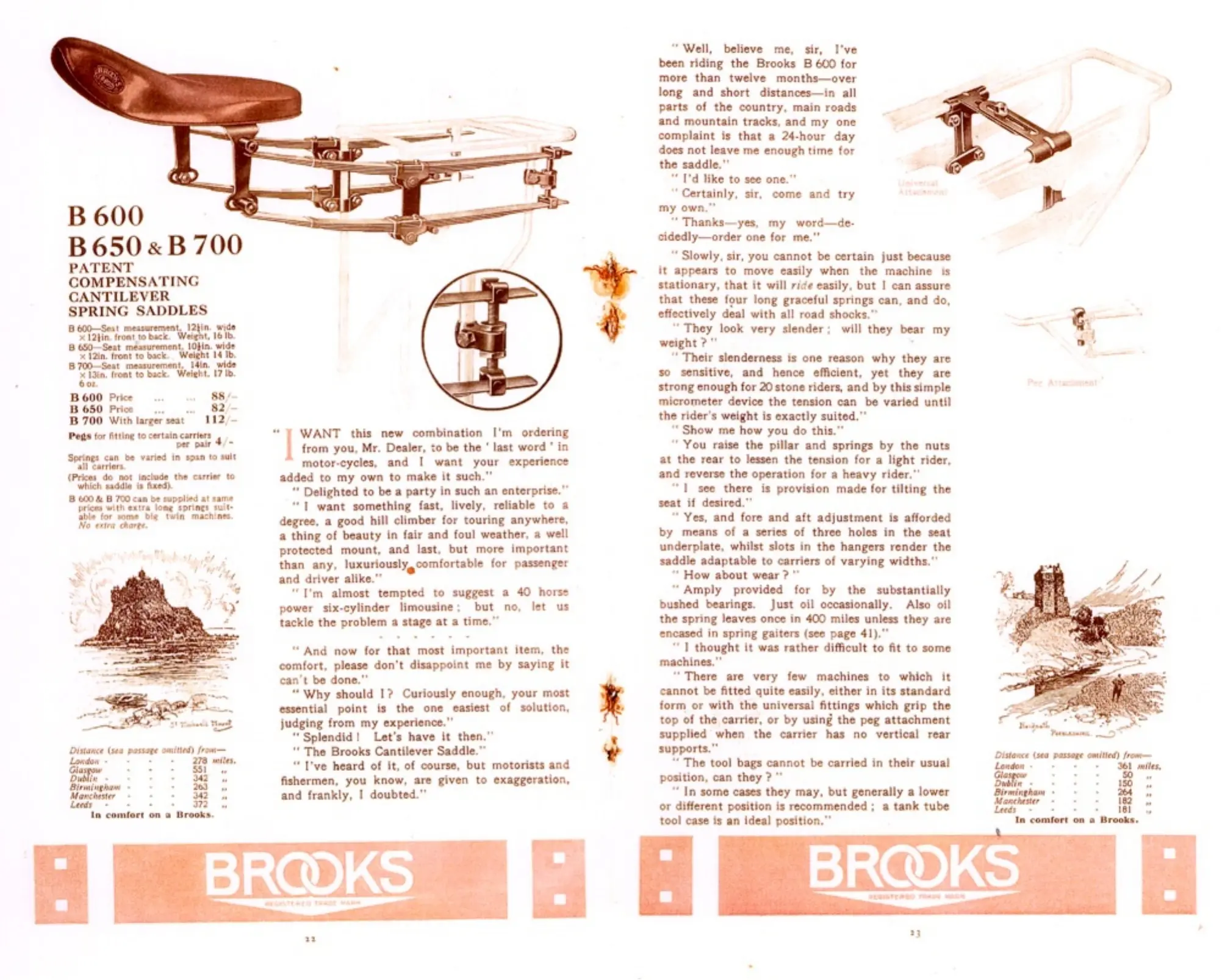
[Printed pages 22 and 23. Printed page 22 shows the cantilever assembly in three-quarter view, the padded seat carried on four long leaf springs above a ghosted outline of a carrier, with a circular inset of the micrometer adjustment pillar. Printed page 23 shows two further line details, captioned Universal Attachment and Peg Attachment.]
[Printed page 22.]
B 600
B 650 & B 700
PATENT COMPENSATING CANTILEVER SPRING SADDLES
B 600—Seat measurement, 12½in. wide × 12½in. front to back. Weight, 16 lb.
B 650—Seat measurement, 10½in. wide × 12in. front to back. Weight, 14 lb.
B 700—Seat measurement, 14in. wide × 13in. front to back. Weight, 17 lb. 6 oz.
B 600 Price 88/-
B 650 Price 82/-
B 700 With larger seat 112/-
Pegs for fitting to certain carriers, per pair 4/-
Springs can be varied in span to suit all carriers.
(Prices do not include the carrier to which saddle is fixed).
B 600 & B 700 can be supplied at same prices with extra long springs suitable for some big twin machines. No extra charge.
“I WANT this new combination I’m ordering from you, Mr. Dealer, to be the ‘last word’ in motor-cycles, and I want your experience added to my own to make it such.”
“Delighted to be a party in such an enterprise.”
“I want something fast, lively, reliable to a degree, a good hill climber for touring anywhere, a thing of beauty in fair and foul weather, a well protected mount, and last, but more important than any, luxuriously comfortable for passenger and driver alike.”
“I’m almost tempted to suggest a 40 horse power six-cylinder limousine; but no, let us tackle the problem a stage at a time.”
“And now for that most important item, the comfort, please don’t disappoint me by saying it can’t be done.”
“Why should I? Curiously enough, your most essential point is the one easiest of solution, judging from my experience.”
“Splendid! Let’s have it then.”
“The Brooks Cantilever Saddle.”
“I’ve heard of it, of course, but motorists and fishermen, you know, are given to exaggeration, and frankly, I doubted.”
[Vignette: St Michael’s Mount. Distance (sea passage omitted) from — London 278 miles, Glasgow 551, Dublin 342, Birmingham 263, Manchester 342, Leeds 372. In comfort on a Brooks.]
[Printed page 23.]
“Well, believe me, sir, I’ve been riding the Brooks B 600 for more than twelve months—over long and short distances—in all parts of the country, main roads and mountain tracks, and my one complaint is that a 24-hour day does not leave me enough time for the saddle.”
“I’d like to see one.”
“Certainly, sir, come and try my own.”
“Thanks—yes, my word—decidedly—order one for me.”
“Slowly, sir, you cannot be certain just because it appears to move easily when the machine is stationary, that it will ride easily, but I can assure that these four long graceful springs can, and do, effectively deal with all road shocks.”
“They look very slender; will they bear my weight?”
“Their slenderness is one reason why they are so sensitive, and hence efficient, yet they are strong enough for 20 stone riders, and by this simple micrometer device the tension can be varied until the rider’s weight is exactly suited.”
“Show me how you do this.”
“You raise the pillar and springs by the nuts at the rear to lessen the tension for a light rider, and reverse the operation for a heavy rider.”
“I see there is provision made for tilting the seat if desired.”
“Yes, and fore and aft adjustment is afforded by means of a series of three holes in the seat underplate, whilst slots in the hangers render the saddle adaptable to carriers of varying widths.”
“How about wear?”
“Amply provided for by the substantially bushed bearings. Just oil occasionally. Also oil the spring leaves once in 400 miles unless they are encased in spring gaiters (see page 41).”
“I thought it was rather difficult to fit to some machines.”
“There are very few machines to which it cannot be fitted quite easily, either in its standard form or with the universal fittings which grip the top of the carrier, or by using the peg attachment supplied when the carrier has no vertical rear supports.”
“The tool bags cannot be carried in their usual position, can they?”
“In some cases they may, but generally a lower or different position is recommended; a tank tube tool case is an ideal position.”
[Vignette: a ruined tower on a hillside; the place name is illegible at this resolution. Distance (sea passage omitted) from — London 361 miles, Glasgow 50, Dublin 150, Birmingham 264, Manchester 182, Leeds 181. In comfort on a Brooks.]
— Page 6 —
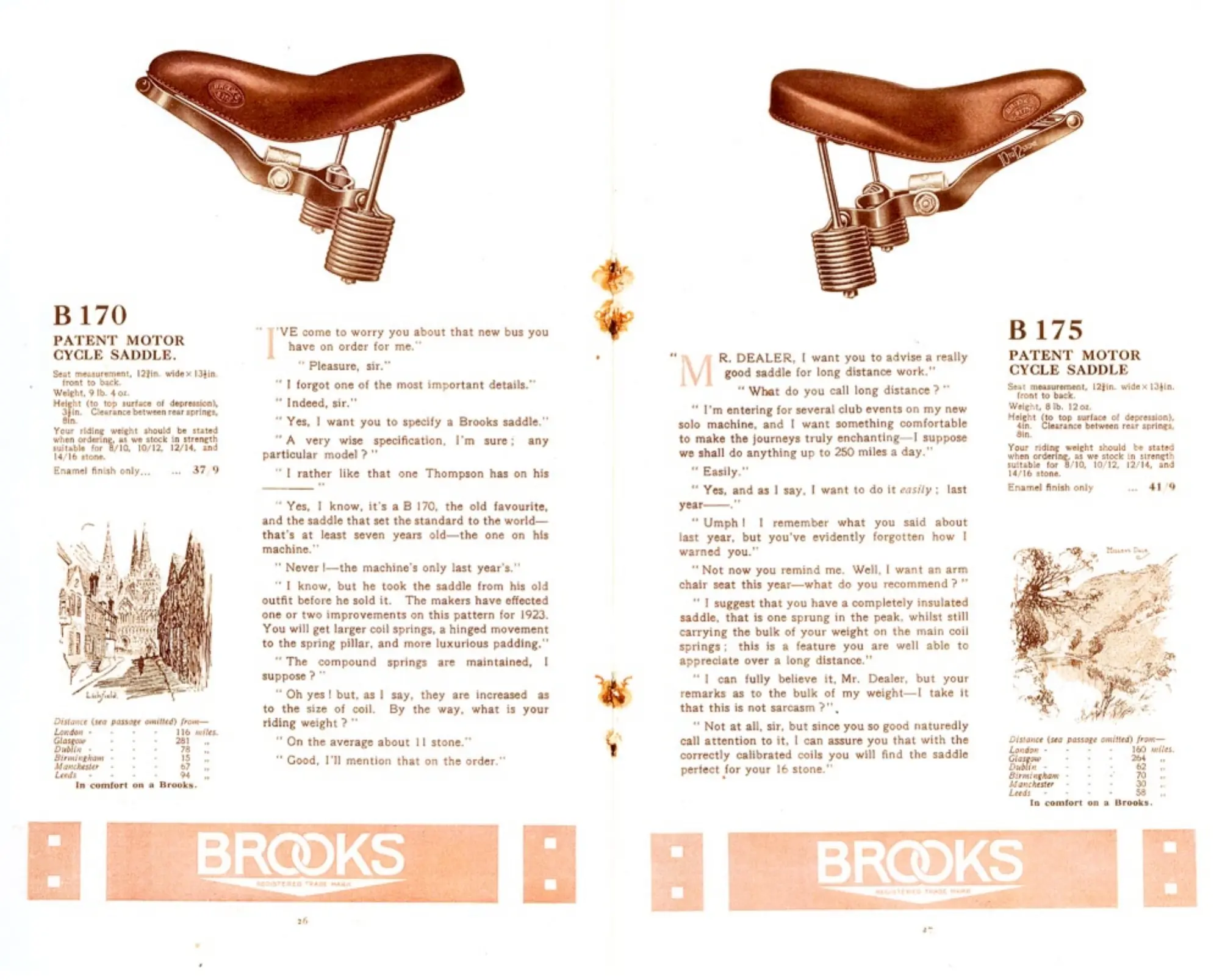
[Printed pages 26 and 27. Two motor cycle saddles in three-quarter view, each on twin coil springs. The B 175 side member is stamped 14 to 16 STONE.]
[Printed page 26.]
B 170 PATENT MOTOR CYCLE SADDLE.
Seat measurement, 12⅞in. wide × 13½in. front to back.
Weight, 9 lb. 4 oz.
Height (to top surface of depression), 3⅜in. Clearance between rear springs, 8in.
Your riding weight should be stated when ordering, as we stock in strength suitable for 8/10, 10/12, 12/14, and 14/16 stone.
Enamel finish only 37/9
“I’VE come to worry you about that new bus you have on order for me.”
“Pleasure, sir.”
“I forgot one of the most important details.”
“Indeed, sir.”
“Yes, I want you to specify a Brooks saddle.”
“A very wise specification, I’m sure; any particular model?”
“I rather like that one Thompson has on his ————”
“Yes, I know, it’s a B 170, the old favourite, and the saddle that set the standard to the world—that’s at least seven years old—the one on his machine.”
“Never!—the machine’s only last year’s.”
“I know, but he took the saddle from his old outfit before he sold it. The makers have effected one or two improvements on this pattern for 1923. You will get larger coil springs, a hinged movement to the spring pillar, and more luxurious padding.”
“The compound springs are maintained, I suppose?”
“Oh yes! but, as I say, they are increased as to the size of coil. By the way, what is your riding weight?”
“On the average about 11 stone.”
“Good, I’ll mention that on the order.”
[Vignette: Lichfield. Distance (sea passage omitted) from — London 116 miles, Glasgow 281, Dublin 78, Birmingham 15, Manchester 67, Leeds 94. In comfort on a Brooks.]
[Printed page 27.]
B 175 PATENT MOTOR CYCLE SADDLE
Seat measurement, 12⅞in. wide × 13½in. front to back.
Weight, 8 lb. 12 oz.
Height (to top surface of depression), 4in. Clearance between rear springs, 8in.
Your riding weight should be stated when ordering, as we stock in strength suitable for 8/10, 10/12, 12/14, and 14/16 stone.
Enamel finish only 41/9
“MR. DEALER, I want you to advise a really good saddle for long distance work.”
“What do you call long distance?”
“I’m entering for several club events on my new solo machine, and I want something comfortable to make the journeys truly enchanting—I suppose we shall do anything up to 250 miles a day.”
“Easily.”
“Yes, and as I say, I want to do it easily; last year——.”
“Umph! I remember what you said about last year, but you’ve evidently forgotten how I warned you.”
“Not now you remind me. Well, I want an arm chair seat this year—what do you recommend?”
“I suggest that you have a completely insulated saddle, that is one sprung in the peak, whilst still carrying the bulk of your weight on the main coil springs; this is a feature you are well able to appreciate over a long distance.”
“I can fully believe it, Mr. Dealer, but your remarks as to the bulk of my weight—I take it that this is not sarcasm?”
“Not at all, sir, but since you so good naturedly call attention to it, I can assure you that with the correctly calibrated coils you will find the saddle perfect for your 16 stone.”
[Vignette: Millers Dale. Distance (sea passage omitted) from — London 160 miles, Glasgow 264, Dublin 62, Birmingham 70, Manchester 30, Leeds 58. In comfort on a Brooks.]
— Page 7 —
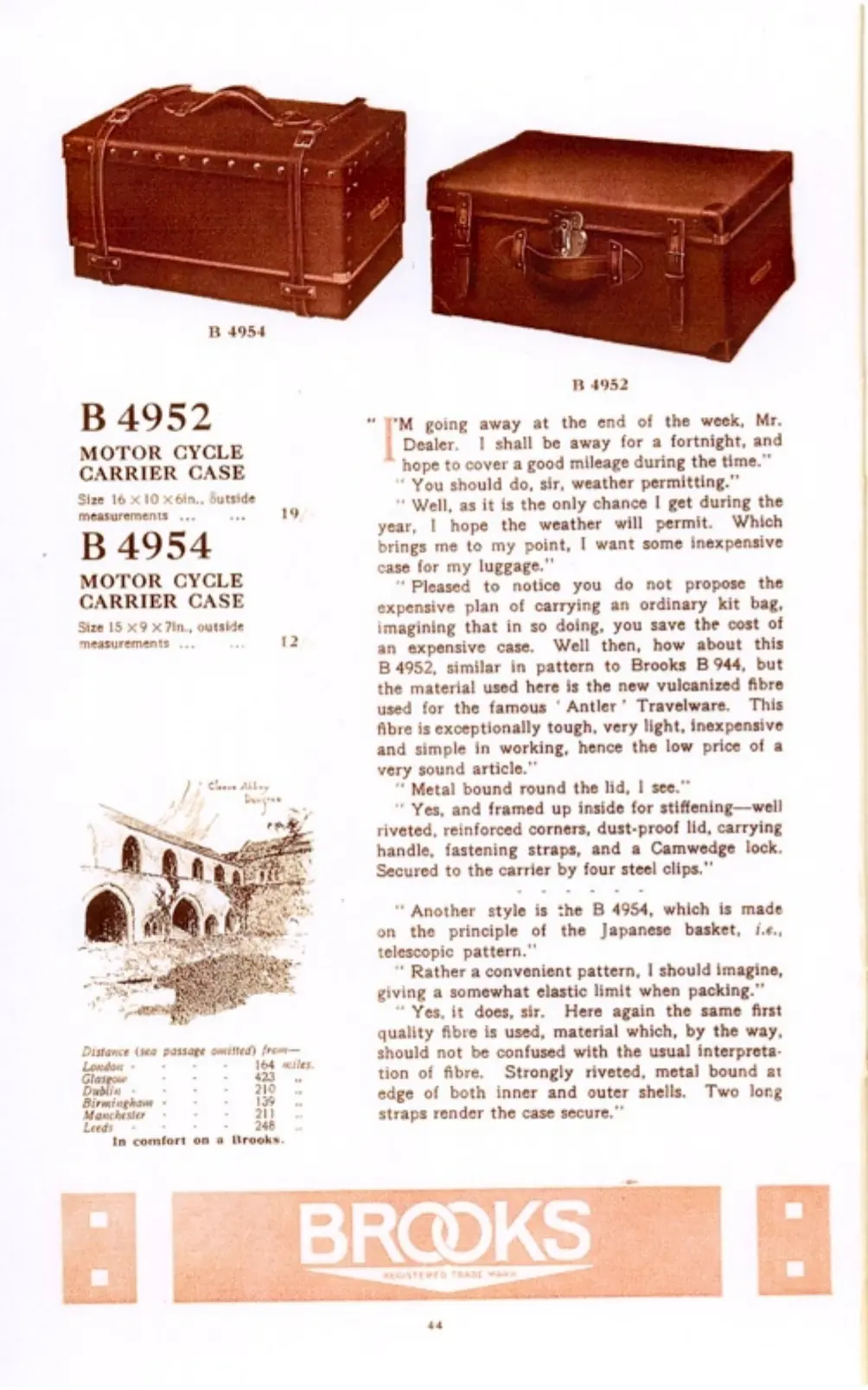
[Printed page 44. Two fibre cases photographed at an angle, one strapped and studded, one plain with a lever lock.]
B 4952 MOTOR CYCLE CARRIER CASE
Size 16 × 10 × 6in., outside measurements 19/-
B 4954 MOTOR CYCLE CARRIER CASE
Size 15 × 9 × 7in., outside measurements 12/-
“I’M going away at the end of the week, Mr. Dealer. I shall be away for a fortnight, and hope to cover a good mileage during the time.”
“You should do, sir, weather permitting.”
“Well, as it is the only chance I get during the year, I hope the weather will permit. Which brings me to my point, I want some inexpensive case for my luggage.”
“Pleased to notice you do not propose the expensive plan of carrying an ordinary kit bag, imagining that in so doing, you save the cost of an expensive case. Well then, how about this B 4952, similar in pattern to Brooks B 944, but the material used here is the new vulcanized fibre used for the famous ‘Antler’ Travelware. This fibre is exceptionally tough, very light, inexpensive and simple in working, hence the low price of a very sound article.”
“Metal bound round the lid, I see.”
“Yes, and framed up inside for stiffening—well riveted, reinforced corners, dust-proof lid, carrying handle, fastening straps, and a Camwedge lock. Secured to the carrier by four steel clips.”
“Another style is the B 4954, which is made on the principle of the Japanese basket, i.e., telescopic pattern.”
“Rather a convenient pattern, I should imagine, giving a somewhat elastic limit when packing.”
“Yes, it does, sir. Here again the same first quality fibre is used, material which, by the way, should not be confused with the usual interpretation of fibre. Strongly riveted, metal bound at edge of both inner and outer shells. Two long straps render the case secure.”
[Vignette: Cleeve Abbey, Dunster. Distance (sea passage omitted) from — London 164 miles, Glasgow 423, Dublin 210, Birmingham 139, Manchester 211, Leeds 248. In comfort on a Brooks.]
— Page 8 —
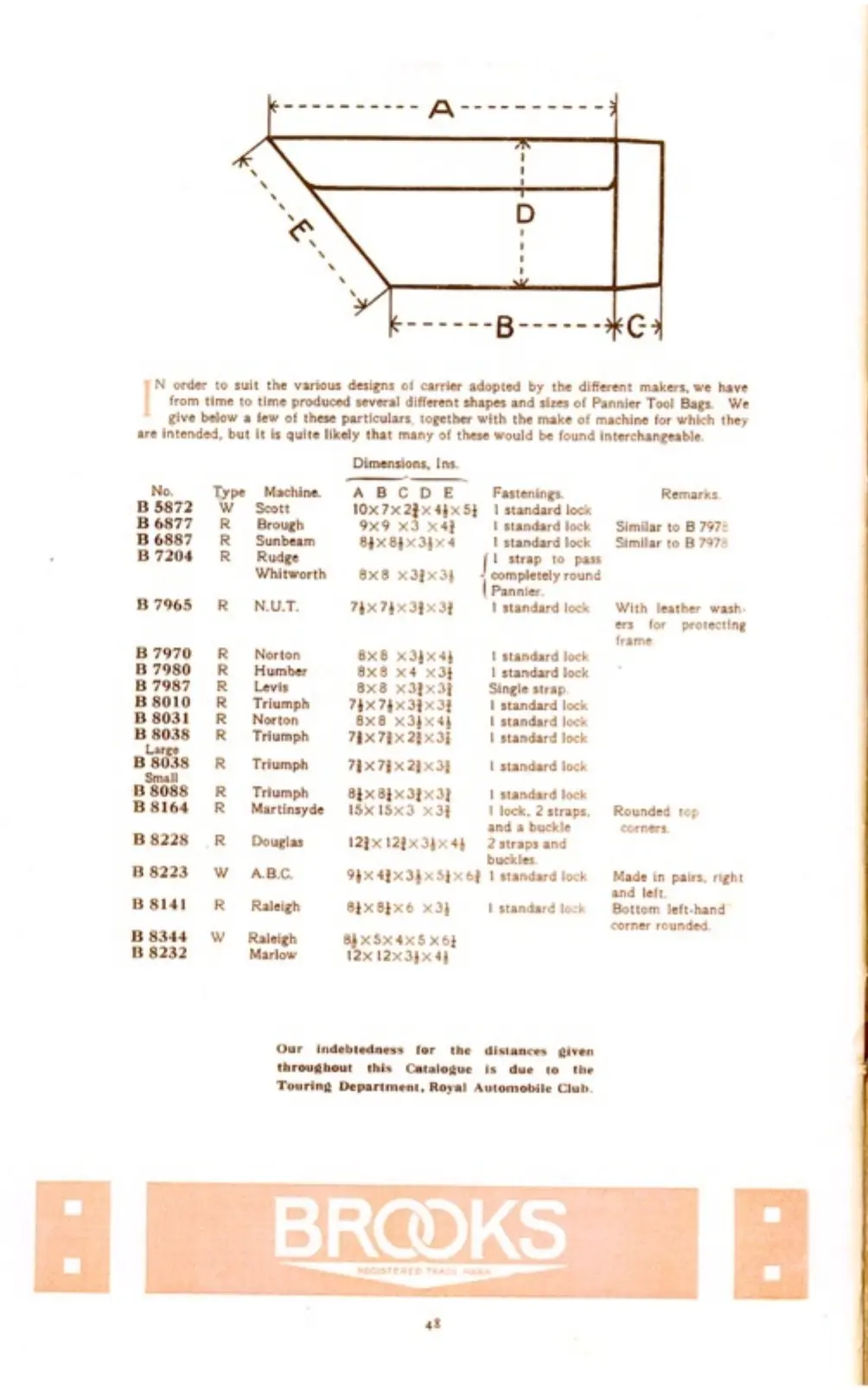
[Printed page 48, the last page of the catalogue. A line diagram of a pannier tool bag at the head, lettered A, B, C, D and E for the dimensions tabulated below.]
IN order to suit the various designs of carrier adopted by the different makers, we have from time to time produced several different shapes and sizes of Pannier Tool Bags. We give below a few of these particulars, together with the make of machine for which they are intended, but it is quite likely that many of these would be found interchangeable.
No. · Type · Machine · Dimensions, Ins. A B C D E · Fastenings · Remarks
B 5872 · W · Scott · 10 × 7 × 2¾ × 4½ × 5½ · 1 standard lock
B 6877 · R · Brough · 9 × 9 × 3 × 4¾ · 1 standard lock · Similar to B 7978
B 6887 · R · Sunbeam · 8½ × 8½ × 3½ × 4 · 1 standard lock · Similar to B 7978
B 7204 · R · Rudge Whitworth · 8 × 8 × 3¾ × 3½ · 1 strap to pass completely round Pannier.
B 7965 · R · N.U.T. · 7½ × 7½ × 3¾ × 3¾ · 1 standard lock · With leather washers for protecting frame.
B 7970 · R · Norton · 8 × 8 × 3½ × 4½ · 1 standard lock
B 7980 · R · Humber · 8 × 8 × 4 × 3½ · 1 standard lock
B 7987 · R · Levis · 8 × 8 × 3¾ × 3½ · Single strap.
B 8010 · R · Triumph · 7½ × 7½ × 3¾ × 3¾ · 1 standard lock
B 8031 · R · Norton · 8 × 8 × 3½ × 4½ · 1 standard lock
B 8038 Large · R · Triumph · 7¾ × 7¾ × 2¾ × 3½ · 1 standard lock
B 8038 Small · R · Triumph · 7¾ × 7¾ × 2¾ × 3½ · 1 standard lock
B 8088 · R · Triumph · 8½ × 8½ × 3¾ × 3¾ · 1 standard lock
B 8164 · R · Martinsyde · 15 × 15 × 3 × 3¾ · 1 lock, 2 straps, and a buckle · Rounded top corners.
B 8228 · R · Douglas · 12¾ × 12¾ × 3½ × 4½ · 2 straps and buckles.
B 8223 · W · A.B.C. · 9½ × 4½ × 3½ × 5½ × 6¾ · 1 standard lock · Made in pairs, right and left.
B 8141 · R · Raleigh · 8½ × 8½ × 6 × 3½ · 1 standard lock · Bottom left-hand corner rounded.
B 8344 · W · Raleigh · 8½ × 5 × 4 × 5 × 6½
B 8232 · Marlow · 12 × 12 × 3½ × 4½
Our indebtedness for the distances given throughout this Catalogue is due to the Touring Department, Royal Automobile Club.
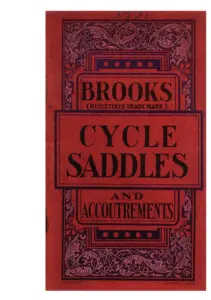 Brooks 1901 Catalog — Cycle Saddles and Accoutrements
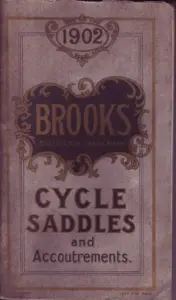 Brooks 1902 Catalog — Cycle Saddles and Accoutrements for 1902
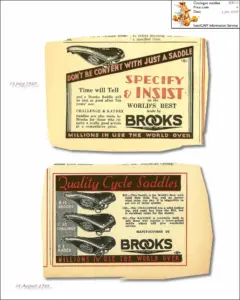 Brooks 1935 Advertisement — Specify and Insist, and Quality Cycle Saddles with Challenge and Kaydex
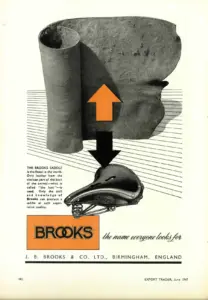 Brooks 1947 Advertisement — The Name Everyone Looks For (Export Trader)
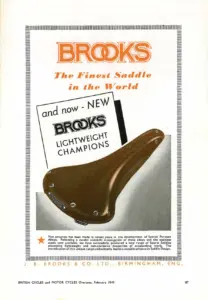 Brooks 1949 Advertisement — The New Lightweight Champions (British Cycles and Motor Cycles Overseas)
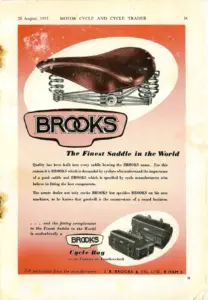 Brooks 1955 Advertisement — It’s the Saddle that Sells the Cycle (Motor Cycle and Cycle Trader)
Ebykr presents this material for research and education. If you hold rights to it or notice an ownership issue, please contact us and we will respond promptly.
The Ebykr Digest
New articles, timelines, catalog finds and registry activity — assembled from the archive once a month. Your address is never shared.
Double opt-in. One email per month. Unsubscribe at any time with one click.