About Ebykr
Ebykr celebrates classic and vintage lightweight bicycles through provocative imagery and opinion. Ride along with us.
About Ebykr
Ebykr celebrates classic and vintage lightweight bicycles through provocative imagery and opinion. Ride along with us.

Source: National Cycle Archive, in partnership with the Veteran-Cycle Club (V-CC Library scan).
 Page 1
 Page 2
 Page 3
 Page 4
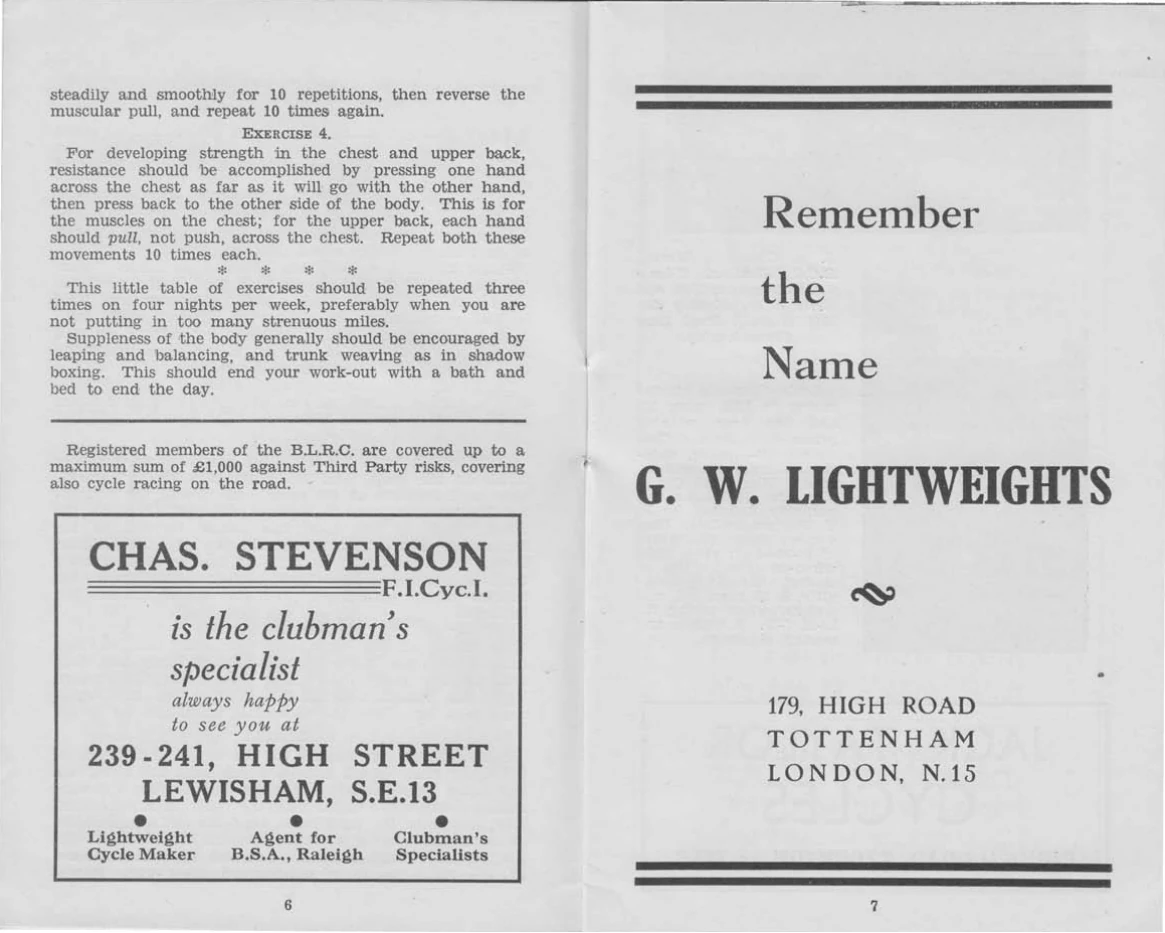 Page 5
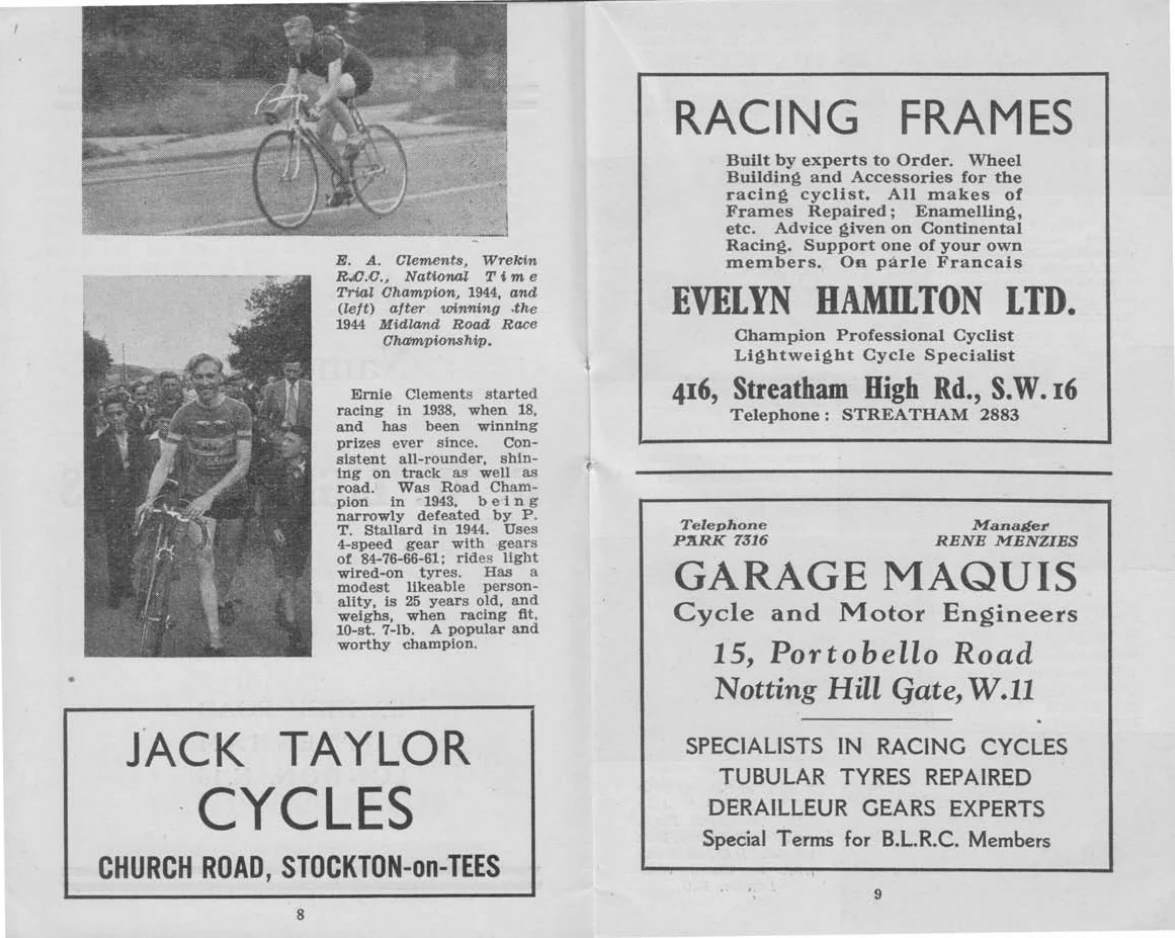 Page 6
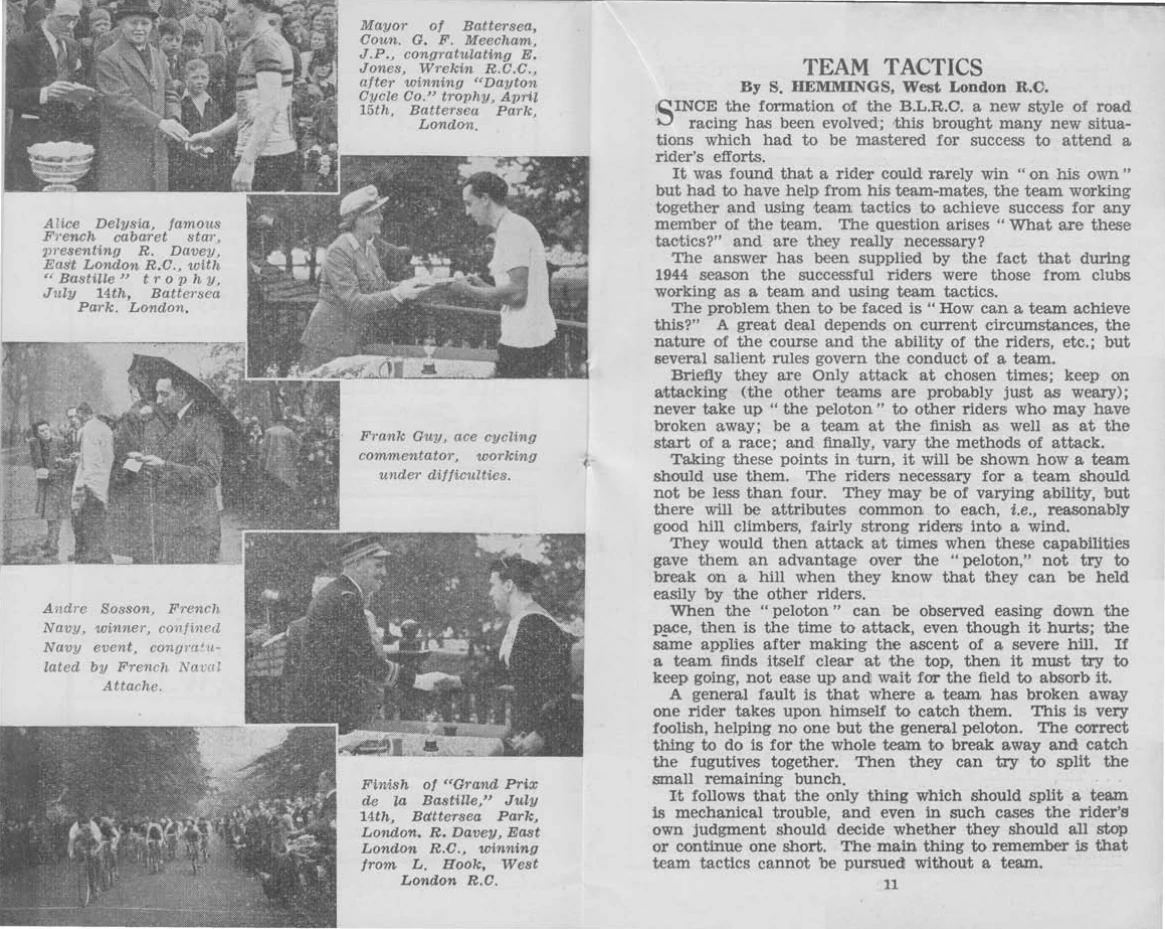 Page 7
 Page 8
 Page 9
 Page 10
 Page 11
 Page 12
 Page 13
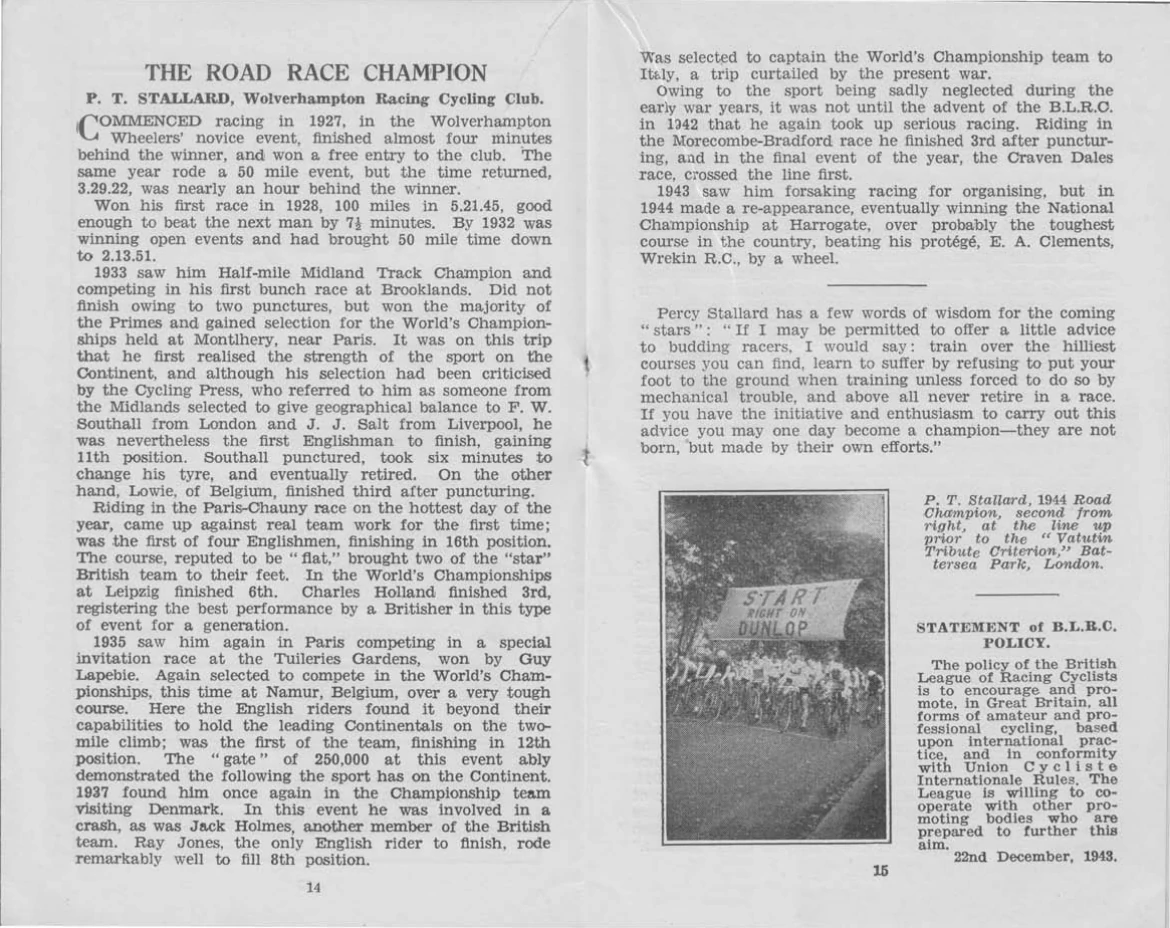
 Page 14
 Page 15
 Page 16
 Page 17
 Page 18
| Marque | British League of Racing Cyclists |
|---|---|
| Type | Ephemera |
| Year | 1945 |
| Publisher | British League of Racing Cyclists |
| Country | England |
| Language | English |
| Pages | 18 |
| Source | National Cycle Archive, in partnership with the Veteran-Cycle Club (V-CC Library scan). |
| Credit | National Cycle Archive, in partnership with the Veteran-Cycle Club |
| Transcription | Transcribed by eye |
Reference
British League of Racing Cyclists. British League of Racing Cyclists Handbook 1945. 1945. Ebykr, https://ebykr.com/library/british-league-of-racing-cyclists-handbook-1945/.
Wikipedia
{{cite web |title=British League of Racing Cyclists Handbook 1945 |publisher=British League of Racing Cyclists |date=1945 |url=https://ebykr.com/library/british-league-of-racing-cyclists-handbook-1945/ |website=Ebykr |access-date=}}Carlton CYCLES LTD. WISH ALL THEIR RIDERS A HAPPY NEW YEAR and a speedy return to peace-time activities Present conditions do not allow us to get back to normal production. Unless the war in Europe ends suddenly, Racing Cycles in quantity will not be available this season. Skeleton Racing Frames for replacement purposes are available …
The 1945 handbook of the British League of Racing Cyclists, founded in 1942 to bring massed-start road racing to British roads, price sixpence: the officials and policy, F. J. Camm’s “Public Enigma No. 1”, articles on fitness, team tactics, the Southern Grand Prix and road race champion P. T. Stallard, the 1944 results and the 1945 fixtures, among advertisements from Carlton, Dayton, Claud Butler, Ron Kitching, Hamilton and other lightweight makers and dealers. Transcribed from the page images (18 pages); each page ends with a bracketed description of its pictures.
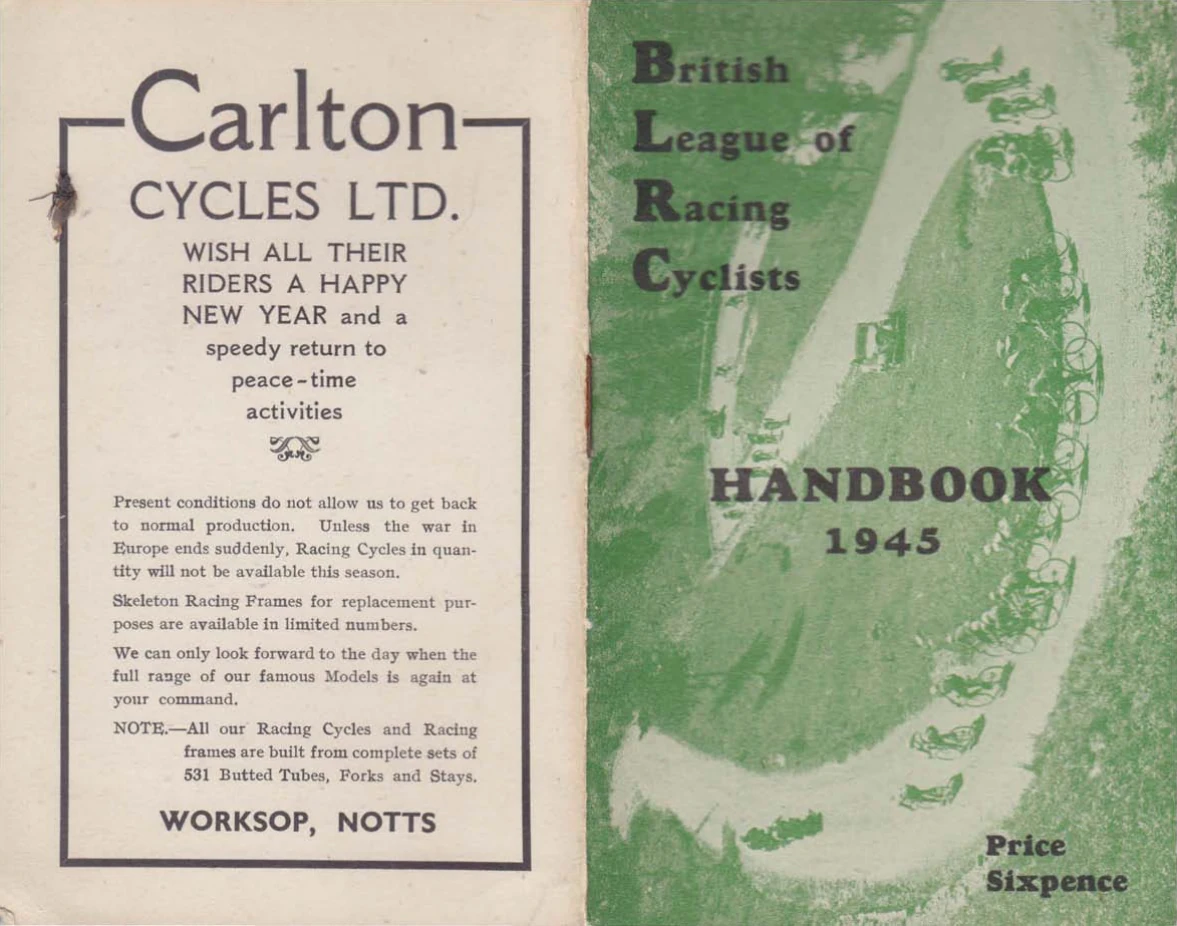
— Page 1 —
Carlton
CYCLES LTD.
WISH ALL THEIR
RIDERS A HAPPY
NEW YEAR and a
speedy return to
peace-time
activities
Present conditions do not allow us to get back to normal production. Unless the war in Europe ends suddenly, Racing Cycles in quantity will not be available this season.
Skeleton Racing Frames for replacement purposes are available in limited numbers.
We can only look forward to the day when the full range of our famous Models is again at your command.
NOTE.—All our Racing Cycles and Racing frames are built from complete sets of 531 Butted Tubes, Forks and Stays.
WORKSOP, NOTTS
[Right-hand page]
British
League of
Racing
Cyclists
HANDBOOK
1945
Price
Sixpence
[The outer cover opened flat: at left the back cover, a boxed Carlton Cycles advertisement with a small scroll ornament; at right the front cover printed in green with an aerial photograph of a massed field of racing cyclists rounding a curving road. A dead insect and a stain sit at the left margin.]
— Page 2 —
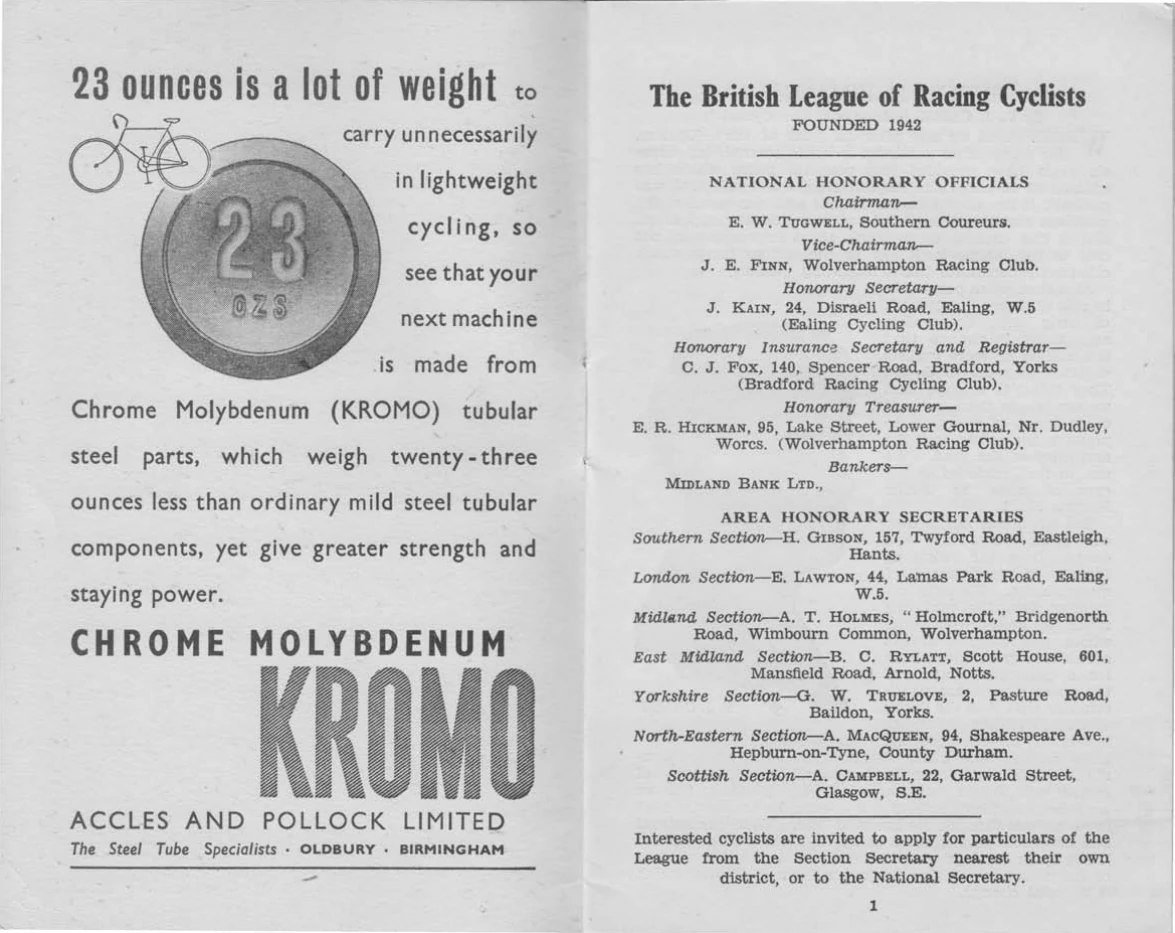
23 ounces is a lot of weight to carry unnecessarily in lightweight cycling, so see that your next machine is made from Chrome Molybdenum (KROMO) tubular steel parts, which weigh twenty-three ounces less than ordinary mild steel tubular components, yet give greater strength and staying power.
23
OZS
CHROME MOLYBDENUM
KROMO
ACCLES AND POLLOCK LIMITED
The Steel Tube Specialists · OLDBURY · BIRMINGHAM
[Right-hand page]
The British League of Racing Cyclists
FOUNDED 1942
NATIONAL HONORARY OFFICIALS
Chairman—
E. W. Tugwell, Southern Coureurs.
Vice-Chairman—
J. E. Finn, Wolverhampton Racing Club.
Honorary Secretary—
J. Kain, 24, Disraeli Road, Ealing, W.5
(Ealing Cycling Club).
Honorary Insurance Secretary and Registrar—
C. J. Fox, 140, Spencer Road, Bradford, Yorks
(Bradford Racing Cycling Club).
Honorary Treasurer—
E. R. Hickman, 95, Lake Street, Lower Gournal, Nr. Dudley, Worcs. (Wolverhampton Racing Club).
Bankers—
Midland Bank Ltd.,
AREA HONORARY SECRETARIES
Southern Section—H. Gibson, 157, Twyford Road, Eastleigh, Hants.
London Section—E. Lawton, 44, Lamas Park Road, Ealing, W.5.
Midland Section—A. T. Holmes, “Holmcroft,” Bridgenorth Road, Wimbourn Common, Wolverhampton.
East Midland Section—B. C. Rylatt, Scott House, 601, Mansfield Road, Arnold, Notts.
Yorkshire Section—G. W. Truelove, 2, Pasture Road, Baildon, Yorks.
North-Eastern Section—A. MacQueen, 94, Shakespeare Ave., Hepburn-on-Tyne, County Durham.
Scottish Section—A. Campbell, 22, Garwald Street, Glasgow, S.E.
Interested cyclists are invited to apply for particulars of the League from the Section Secretary nearest their own district, or to the National Secretary.
1
[A spread: at left the inside front cover, an Accles and Pollock Kromo tubing advertisement with a line drawing of a lightweight bicycle and a large disc weight marked 23 ozs; at right printed page 1, the League officials and section secretaries with two rules.]
— Page 3 —
PUBLIC ENIGMA No. 1
By F. J. CAMM (Editor of “The Cyclist”)
WHERE stand we now after six years of war? Cycling, like many other pastimes, is battle scarred, but those six years have provided that powerful pause which has enabled us to purge the Augean stables of much that was unclean; it has shown us our friends and our enemies, the weakness and the strength of our case and our opposition, and it has enabled us to think about improvements, not only in the bicycle itself but in the various facets which collectively constitute this scintillating pastime.
At a time when people are in risk of losing the strength of their legs, non-cyclists may think it strange that ten million or more cyclists continue to want to do so. They think it strange that we are keener than users of other forms of transport to preserve the safety and the amenities of the road. We are, in fact, regarded in the eyes of some as Public Enigma No. 1.
But when this war is over our great pastime will emerge from the refinining furnace of war purged of many things. We must remember that the part can never be greater than the whole, and there is always a risk that great enthusiasm for a particular branch of the sport may cause us to consider that it is the entire sport. Whether you are interested in road racing, track racing, time trials, touring, club runs, all are constituent parts of an integral whole. The pioneers, of course, will always be attacked by the plodders, but we must be particularly careful not to examine or criticise 1945 developments through the lenses of 1895. There are natural and inevitable developments going on in the field of cycling. Like all new developments it is being attacked by the apostles of the past, thus obeying the natural law of inertia, which is to resist change.
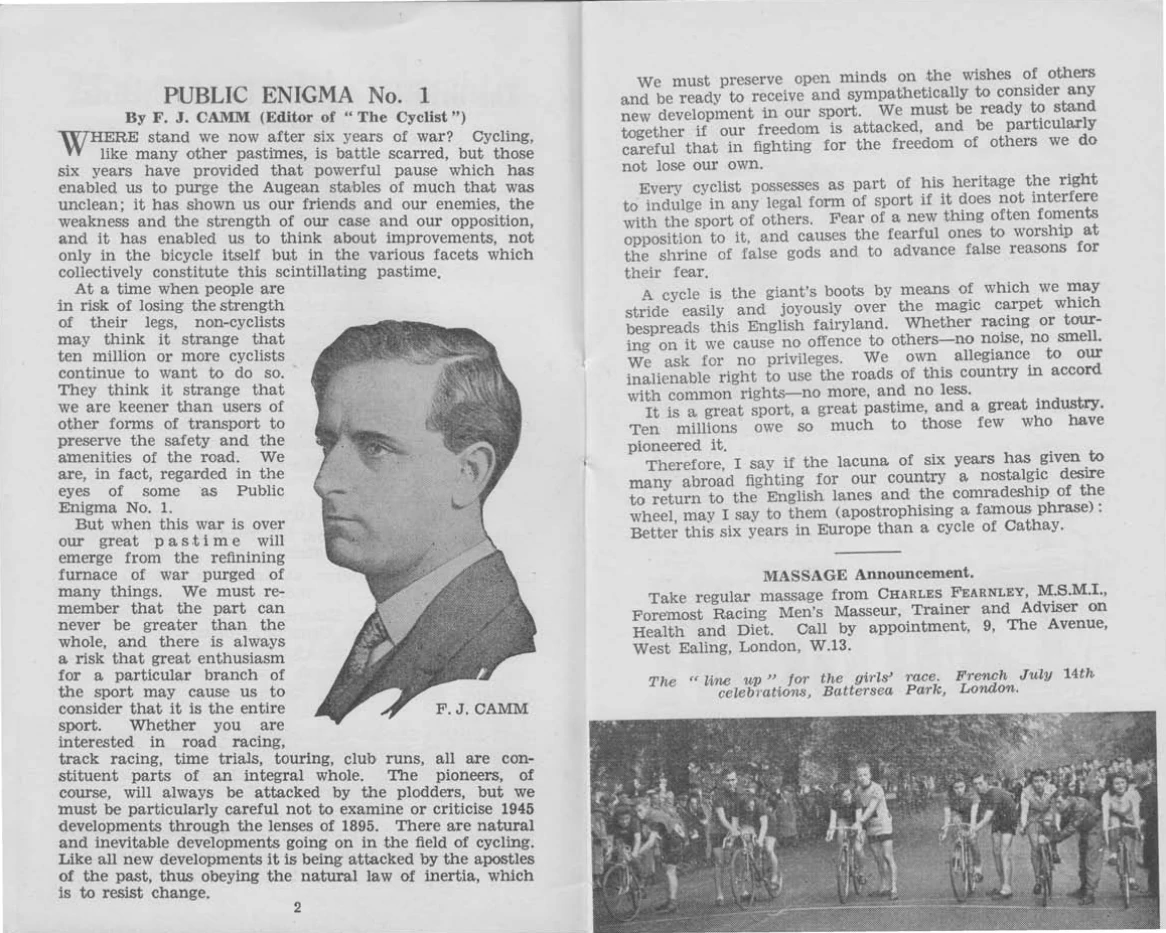
F. J. CAMM
2
[Right-hand page]
We must preserve open minds on the wishes of others and be ready to receive and sympathetically to consider any new development in our sport. We must be ready to stand together if our freedom is attacked, and be particularly careful that in fighting for the freedom of others we do not lose our own.
Every cyclist possesses as part of his heritage the right to indulge in any legal form of sport if it does not interfere with the sport of others. Fear of a new thing often foments opposition to it, and causes the fearful ones to worship at the shrine of false gods and to advance false reasons for their fear.
A cycle is the giant’s boots by means of which we may stride easily and joyously over the magic carpet which bespreads this English fairyland. Whether racing or touring on it we cause no offence to others—no noise, no smell. We ask for no privileges. We own allegiance to our inalienable right to use the roads of this country in accord with common rights—no more, and no less.
It is a great sport, a great pastime, and a great industry. Ten millions owe so much to those few who have pioneered it.
Therefore, I say if the lacuna of six years has given to many abroad fighting for our country a nostalgic desire to return to the English lanes and the comradeship of the wheel, may I say to them (apostrophising a famous phrase): Better this six years in Europe than a cycle of Cathay.
MASSAGE Announcement.
Take regular massage from Charles Fearnley, M.S.M.I., Foremost Racing Men’s Masseur, Trainer and Adviser on Health and Diet. Call by appointment, 9, The Avenue, West Ealing, London, W.13.
The “line up” for the girls’ race. French July 14th celebrations, Battersea Park, London.
[A spread: at left printed page 2 with a portrait photograph of F. J. Camm set into the text; at right the unnumbered page 3 ending in a photograph of women racers held at the start line with crowds behind, which runs to the foot and hides any page number.]
— Page 4 —
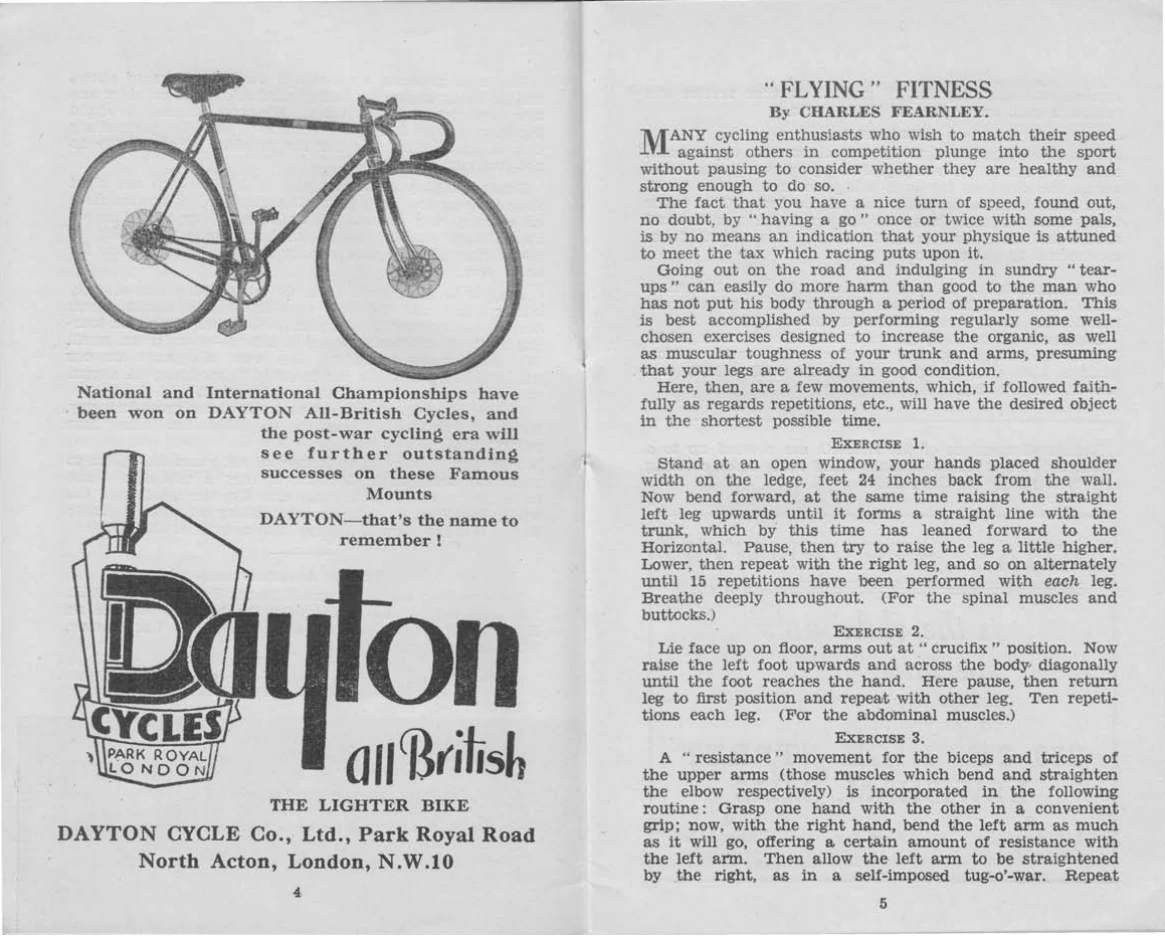
National and International Championships have been won on DAYTON All-British Cycles, and the post-war cycling era will see further outstanding successes on these Famous Mounts
DAYTON—that’s the name to remember!
Dayton
CYCLES
PARK ROYAL
LONDON
all British
THE LIGHTER BIKE
DAYTON CYCLE Co., Ltd., Park Royal Road
North Acton, London, N.W.10
4
[Right-hand page]
“FLYING” FITNESS
By CHARLES FEARNLEY.
MANY cycling enthusiasts who wish to match their speed against others in competition plunge into the sport without pausing to consider whether they are healthy and strong enough to do so.
The fact that you have a nice turn of speed, found out, no doubt, by “having a go” once or twice with some pals, is by no means an indication that your physique is attuned to meet the tax which racing puts upon it.
Going out on the road and indulging in sundry “tear-ups” can easily do more harm than good to the man who has not put his body through a period of preparation. This is best accomplished by performing regularly some well-chosen exercises designed to increase the organic, as well as muscular toughness of your trunk and arms, presuming that your legs are already in good condition.
Here, then, are a few movements, which, if followed faithfully as regards repetitions, etc., will have the desired object in the shortest possible time.
Exercise 1.
Stand at an open window, your hands placed shoulder width on the ledge, feet 24 inches back from the wall. Now bend forward, at the same time raising the straight left leg upwards until it forms a straight line with the trunk, which by this time has leaned forward to the Horizontal. Pause, then try to raise the leg a little higher. Lower, then repeat with the right leg, and so on alternately until 15 repetitions have been performed with each leg. Breathe deeply throughout. (For the spinal muscles and buttocks.)
Exercise 2.
Lie face up on floor, arms out at “crucifix” position. Now raise the left foot upwards and across the body diagonally until the foot reaches the hand. Here pause, then return leg to first position and repeat with other leg. Ten repetitions each leg. (For the abdominal muscles.)
Exercise 3.
A “resistance” movement for the biceps and triceps of the upper arms (those muscles which bend and straighten the elbow respectively) is incorporated in the following routine: Grasp one hand with the other in a convenient grip; now, with the right hand, bend the left arm as much as it will go, offering a certain amount of resistance with the left arm. Then allow the left arm to be straightened by the right, as in a self-imposed tug-o’-war. Repeat
5
[A spread: at left printed page 4, a Dayton Cycle Co. advertisement with a halftone of a drop-bar lightweight with hub brakes and the Dayton head badge logo; at right printed page 5, the opening of the Fearnley fitness article. Printed page 3 is not seen on this spread.]
— Page 5 —
steadily and smoothly for 10 repetitions, then reverse the muscular pull, and repeat 10 times again.
Exercise 4.
For developing strength in the chest and upper back, resistance should be accomplished by pressing one hand across the chest as far as it will go with the other hand, then press back to the other side of the body. This is for the muscles on the chest; for the upper back, each hand should pull, not push, across the chest. Repeat both these movements 10 times each.
* * * *
This little table of exercises should be repeated three times on four nights per week, preferably when you are not putting in too many strenuous miles.
Suppleness of the body generally should be encouraged by leaping and balancing, and trunk weaving as in shadow boxing. This should end your work-out with a bath and bed to end the day.
Registered members of the B.L.R.C. are covered up to a maximum sum of £1,000 against Third Party risks, covering also cycle racing on the road.
CHAS. STEVENSON
F.I.Cyc.I.
is the clubman’s specialist
always happy to see you at
239-241, HIGH STREET
LEWISHAM, S.E.13
Lightweight Cycle Maker
Agent for B.S.A., Raleigh
Clubman’s Specialists
6
[Right-hand page]
Remember
the
Name
G. W. LIGHTWEIGHTS
179, HIGH ROAD
TOTTENHAM
LONDON, N.15
7
[A spread: at left printed page 6, the end of the fitness article, an insurance note and a boxed Chas. Stevenson advertisement; at right printed page 7, a G. W. Lightweights advertisement between double rules with a small swash ornament. Show-through from the facing leaf is faint.]
— Page 6 —
E. A. Clements, Wrekin R.C.C., National Time Trial Champion, 1944, and (left) after winning the 1944 Midland Road Race Championship.
Ernie Clements started racing in 1938, when 18, and has been winning prizes ever since. Consistent all-rounder, shining on track as well as road. Was Road Champion in 1943, being narrowly defeated by P. T. Stallard in 1944. Uses 4-speed gear with gears of 84-76-66-61; rides light wired-on tyres. Has a modest likeable personality, is 25 years old, and weighs, when racing fit, 10-st. 7-lb. A popular and worthy champion.
JACK TAYLOR
CYCLES
CHURCH ROAD, STOCKTON-on-TEES
8
[Right-hand page]
RACING FRAMES
Built by experts to Order. Wheel Building and Accessories for the racing cyclist. All makes of Frames Repaired; Enamelling, etc. Advice given on Continental Racing. Support one of your own members. On parle Francais
EVELYN HAMILTON LTD.
Champion Professional Cyclist
Lightweight Cycle Specialist
416, Streatham High Rd., S.W.16
Telephone: STREATHAM 2883
Telephone
PARK 7316
Manager
RENE MENZIES
GARAGE MAQUIS
Cycle and Motor Engineers
15, Portobello Road
Notting Hill Gate, W.11
SPECIALISTS IN RACING CYCLES
TUBULAR TYRES REPAIRED
DERAILLEUR GEARS EXPERTS
Special Terms for B.L.R.C. Members
[A spread: at left printed page 8 with two photographs of E. A. Clements, one racing on a road and one standing with his bicycle among a crowd, above a boxed Jack Taylor Cycles advertisement; at right printed page 9 with boxed Evelyn Hamilton and Garage Maquis advertisements.]
— Page 7 —
Mayor of Battersea, Coun. G. F. Meecham, J.P., congratulating E. Jones, Wrekin R.C.C., after winning “Dayton Cycle Co.” trophy, April 15th, Battersea Park, London.
Alice Delysia, famous French cabaret star, presenting R. Davey, East London R.C., with “Bastille” trophy, July 14th, Battersea Park. London.
Frank Guy, ace cycling commentator, working under difficulties.
Andre Sosson, French Navy, winner, confined Navy event, congratulated by French Naval Attache.
Finish of “Grand Prix de la Bastille,” July 14th, Battersea Park, London. R. Davey, East London R.C., winning from L. Hook, West London R.C.
[Right-hand page]
TEAM TACTICS
By S. HEMMINGS, West London R.C.
SINCE the formation of the B.L.R.C. a new style of road racing has been evolved; this brought many new situations which had to be mastered for success to attend a rider’s efforts.
It was found that a rider could rarely win “on his own” but had to have help from his team-mates, the team working together and using team tactics to achieve success for any member of the team. The question arises “What are these tactics?” and are they really necessary?
The answer has been supplied by the fact that during 1944 season the successful riders were those from clubs working as a team and using team tactics.
The problem then to be faced is “How can a team achieve this?” A great deal depends on current circumstances, the nature of the course and the ability of the riders, etc.; but several salient rules govern the conduct of a team.
Briefly they are Only attack at chosen times; keep on attacking (the other teams are probably just as weary); never take up “the peloton” to other riders who may have broken away; be a team at the finish as well as at the start of a race; and finally, vary the methods of attack.
Taking these points in turn, it will be shown how a team should use them. The riders necessary for a team should not be less than four. They may be of varying ability, but there will be attributes common to each, i.e., reasonably good hill climbers, fairly strong riders into a wind.
They would then attack at times when these capabilities gave them an advantage over the “peloton,” not try to break on a hill when they know that they can be held easily by the other riders.
When the “peloton” can be observed easing down the pace, then is the time to attack, even though it hurts; the same applies after making the ascent of a severe hill. If a team finds itself clear at the top, then it must try to keep going, not ease up and wait for the field to absorb it.
A general fault is that where a team has broken away one rider takes upon himself to catch them. This is very foolish, helping no one but the general peloton. The correct thing to do is for the whole team to break away and catch the fugutives together. Then they can try to split the small remaining bunch.
It follows that the only thing which should split a team is mechanical trouble, and even in such cases the rider’s own judgment should decide whether they should all stop or continue one short. The main thing to remember is that team tactics cannot be pursued without a team.
11
[A spread: at left the unnumbered page 10, five staggered photographs printed to the edges (a trophy presentation by the Mayor of Battersea, Alice Delysia presenting a trophy, Frank Guy under an umbrella, a naval attache congratulating a sailor and a bunched race finish) with italic captions; at right printed page 11, the Team Tactics article.]
— Page 8 —
The final point is probably the most important; a team that varies the form of its attacks will usually succeed.
As an illustration of this point, a team of four riders could use the following variations:—
(1) Two riders sprint away; when caught, the other two jump. This is carried on until a break is achieved.
(2) All four riders go together, each doing bit and bit, remembering to first jump together, then in line.
(3) Attack after climbing a hill. Riders should do about 100 yards each as fast as possible, giving the opposition no time to recover from the climb.
(4) All four riders should take up different positions in the field so that the attention of the other riders is divided. Sprints can then be carried out at pre-arranged places with more chance of the “peloton” being caught off guard.
These are a few of the tactics which have been successfully used by the West London Road Club during the past season, a notable occasion being the Battersea Park Circuit Race. Here a decisive break was achieved and the team filled the first four places.
A point of interest was that contrary to general belief it was achieved on a flat course. The method used was general wearing down of the field and then a simultaneous sprint at a pre-arranged point.
By thus showing how team tactics have helped one club achieve success, it is hoped that the 1945 season will see other clubs thinking on the same lines. The standard of racing would be raised and massed racing would become a strategic sport as well as a strenuous one. For until races are won by teams using team tactics English riders cannot hope to compete successfully with their Continental rivals.
A WORD OF THANKS
Our cycling friends who have been called to the various Services crave for news of home conditions in war time. . . . The B.L.R.C. wishes to acknowledge with gratitude the public spirited policy of the Bicycle for the impartial manner in which they have published news and correspondence concerning B.L.R.C. activities during the past years. . . . the Bicycle has truly supplied the cycling news of war time Britain.
12
[Right-hand page]
★ For full and exclusive reports of all BLRC EVENTS
READ
The Bicycle
A Newspaper for all cyclists; every aspect of cycling covered
Action Photographs!
Candid Comments
Touring and Racing Articles by writers whose names are famous throughout wheeldom
The Cycling Paper with the largest post-bag
Every topic treated impartially
Get “THE BICYCLE” Habit
Every Wednesday 3d.
From your newsagent or direct from the Publishers, The Bicycle Publishing Co., Ltd., 8-10, Temple Avenue, E.C.4
13
[A spread: at left printed page 12, the end of Team Tactics and A Word of Thanks; at right printed page 13, a boxed advertisement for The Bicycle newspaper with its shaded masthead and bullet points. A diagonal crease runs across the upper left of page 13.]
— Page 9 —
THE ROAD RACE CHAMPION
P. T. STALLARD, Wolverhampton Racing Cycling Club.
COMMENCED racing in 1927, in the Wolverhampton Wheelers’ novice event, finished almost four minutes behind the winner, and won a free entry to the club. The same year rode a 50 mile event, but the time returned, 3.29.22, was nearly an hour behind the winner.
Won his first race in 1928, 100 miles in 5.21.45, good enough to beat the next man by 7 1/2 minutes. By 1932 was winning open events and had brought 50 mile time down to 2.13.51.
1933 saw him Half-mile Midland Track Champion and competing in his first bunch race at Brooklands. Did not finish owing to two punctures, but won the majority of the Primes and gained selection for the World’s Championships held at Montlhery, near Paris. It was on this trip that he first realised the strength of the sport on the Continent, and although his selection had been criticised by the Cycling Press, who referred to him as someone from the Midlands selected to give geographical balance to F. W. Southall from London and J. J. Salt from Liverpool, he was nevertheless the first Englishman to finish, gaining 11th position. Southall punctured, took six minutes to change his tyre, and eventually retired. On the other hand, Lowie, of Belgium, finished third after puncturing.
Riding in the Paris-Chauny race on the hottest day of the year, came up against real team work for the first time; was the first of four Englishmen, finishing in 16th position. The course, reputed to be “flat,” brought two of the “star” British team to their feet. In the World’s Championships at Leipzig finished 6th. Charles Holland finished 3rd, registering the best performance by a Britisher in this type of event for a generation.
1935 saw him again in Paris competing in a special invitation race at the Tuileries Gardens, won by Guy Lapebie. Again selected to compete in the World’s Championships, this time at Namur, Belgium, over a very tough course. Here the English riders found it beyond their capabilities to hold the leading Continentals on the two-mile climb; was the first of the team, finishing in 12th position. The “gate” of 250,000 at this event ably demonstrated the following the sport has on the Continent. 1937 found him once again in the Championship team visiting Denmark. In this event he was involved in a crash, as was Jack Holmes, another member of the British team. Ray Jones, the only English rider to finish, rode remarkably well to fill 8th position.
14
[Right-hand page]
Was selected to captain the World’s Championship team to Italy, a trip curtailed by the present war.
Owing to the sport being sadly neglected during the early war years, it was not until the advent of the B.L.R.C. in 1942 that he again took up serious racing. Riding in the Morecombe-Bradford race he finished 3rd after puncturing, and in the final event of the year, the Craven Dales race, crossed the line first.
1943 saw him forsaking racing for organising, but in 1944 made a re-appearance, eventually winning the National Championship at Harrogate, over probably the toughest course in the country, beating his protégé, E. A. Clements, Wrekin R.C., by a wheel.
Percy Stallard has a few words of wisdom for the coming “stars”: “If I may be permitted to offer a little advice to budding racers, I would say: train over the hilliest courses you can find, learn to suffer by refusing to put your foot to the ground when training unless forced to do so by mechanical trouble, and above all never retire in a race. If you have the initiative and enthusiasm to carry out this advice you may one day become a champion—they are not born, but made by their own efforts.”
P. T. Stallard, 1944 Road Champion, second from right, at the line up prior to the “Vatutin Tribute Criterion,” Battersea Park, London.
START
RIGHT ON
DUNLOP
STATEMENT of B.L.R.C. POLICY.
The policy of the British League of Racing Cyclists is to encourage and promote, in Great Britain, all forms of amateur and professional cycling, based upon international practice, and in conformity with Union Cycliste Internationale Rules. The League is willing to co-operate with other promoting bodies who are prepared to further this aim.
22nd December, 1943.
15
[A spread: at left printed page 14, the Stallard biography; at right printed page 15 with its conclusion, a framed photograph of riders massed at a start line under a Start Right on Dunlop banner, and the League policy statement.]
— Page 10 —
THE TOUR COMES NEARER
By WALLY SUMMERS, Organiser, Southern Grand Prix.
INSPIRED by the success of the “Mercury Grand Prix” two-stage race of 1943, I began to carry plans a step further towards the eventual goal that every member of the British League desires, a “Tour of Great Britain.”
The “Tour de France,” a 2,800 mile road race, was, before the war, the most talked of race in the cycling world, and on the Continent was the main news of France and her neighbours for the whole three weeks of its duration.
To win the “Tour de France” one has to be an all-round champion, the type that, by fostering this long distance stage racing in Britain, will eventually place the prestige of our men and machines at the helm of world’s competitive cycling. The organisation of the French “Tour” a professional race, is colossal; hundreds of people are employed during the event, the whole project being sponsored by a leading national daily paper.
The wild enthusiasm has to be seen to be believed, the newspapers, the radio, the news films, all devoted to this famous cycling race. The only comparable events in Britain are “The Boat Race,” “The Cup Final” or “The Derby.”
The “Southern Grand Prix,” however, a 270 mile, 3-day race, was an all-amateur affair, though employing scores of voluntary workers from the League for nearly a year.
The riders raced 276 miles, which included climbing 36 hills, in the total time of 12 hrs. 29 min. 18 sec.
The toughness of the course, and the riders’ ability to race long distances day after day, was a heartening pointer to future International competition. Frank Guy, now looked upon as the only commentator for cycling events, handled the mike with his usual incomparable efficient ease throughout the race, and Jimmy Kain, the evergreen veteran timekeeper from the Ealing C.C., was kept busy recording times and positions for the whole three days.
And the result?
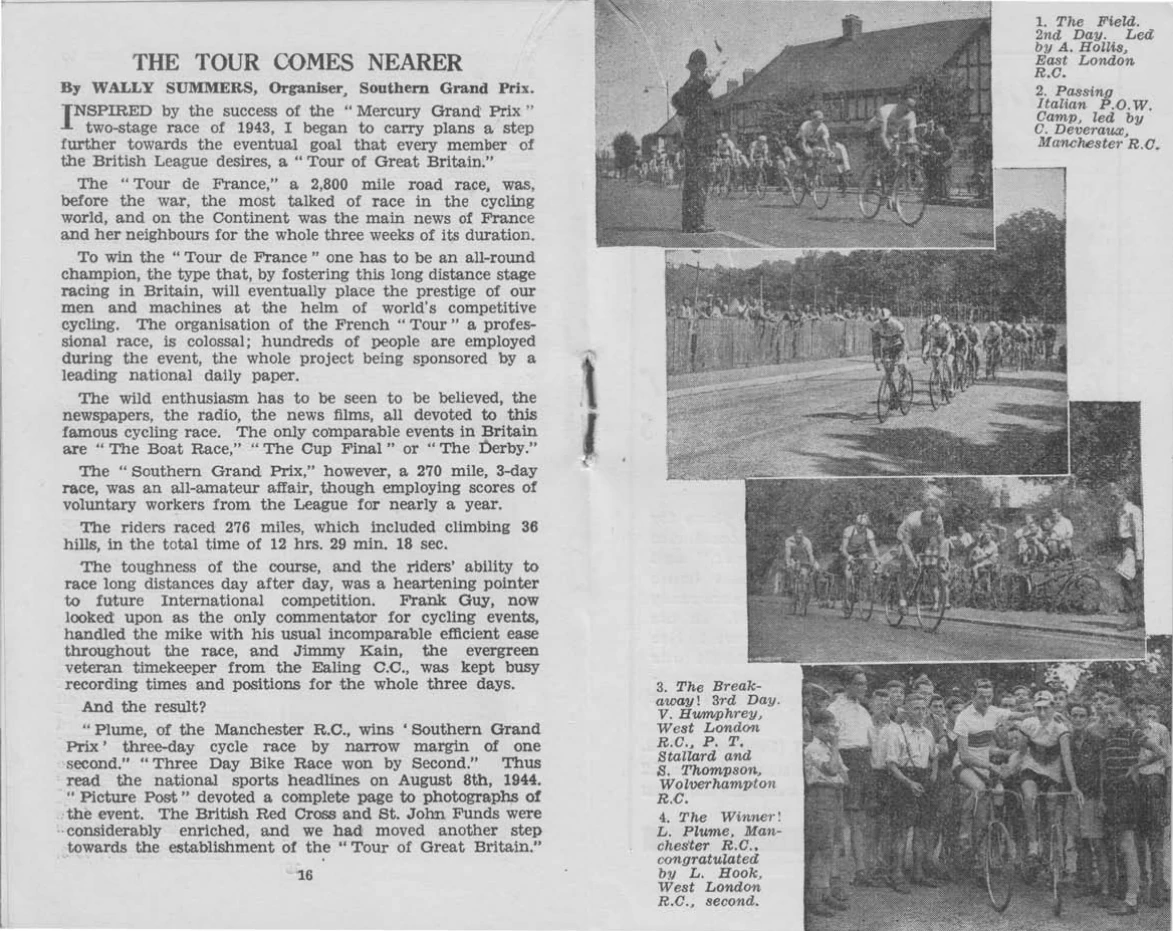
“Plume, of the Manchester R.C., wins ‘Southern Grand Prix’ three-day cycle race by narrow margin of one second.” “Three Day Bike Race won by Second.” Thus read the national sports headlines on August 8th, 1944. “Picture Post” devoted a complete page to photographs of the event. The British Red Cross and St. John Funds were considerably enriched, and we had moved another step towards the establishment of the “Tour of Great Britain.”
16
[Right-hand page]
1. The Field. 2nd Day. Led by A. Hollis, East London R.C.
2. Passing Italian P.O.W. Camp, led by C. Deveraux, Manchester R.C.
3. The Break-away! 3rd Day. V. Humphrey, West London R.C., P. T. Stallard and S. Thompson, Wolverhampton R.C.
4. The Winner! L. Plume, Manchester R.C., congratulated by L. Hook, West London R.C., second.
[A spread: at left printed page 16, the Southern Grand Prix article; at right the unnumbered page 17, four staggered race photographs (a policeman beside a passing field, a line of riders along a fence, a three-man breakaway and the winner among a crowd) with italic captions. A rusty staple mark shows in the gutter.]
— Page 11 —
LOOKING FORWARD. . .
CYC[hidden] E[hidden]HIBITION
To New Models… and New B and T
CYCLE ACCESSORIES
Our future plans for new Cycle Accessories are “all set,” and when the last bomb has fallen we are ready to go ahead. In the meantime we invite you to consult our special post-war enquiries department
B AND T
B and T (COMPONENT) LTD.
4-12, Whiston Rd., London, E.2
Phone: Bishopsgate 5008 & 6767
18
[Right-hand page]
CONGRATULATIONS
The B.L.R.C. with it’s efforts over the past three years towards putting British Cycling on the map, and with its plans for the future, has rightly earned the thanks of all enlightened cyclists
We too, are making our effort to maintain our reputation for the North’s most progressive cycle shop
Our post war plans include the finest display of Racing Cycles, Accessories and Clothing ever seen in the North
RON KITCHING
The Rider Agent
22, STATION PARADE
HARROGATE
Extends a hearty welcome to all B.L.R.C. boys
Personal Attention by Enthusiasts
LEONARD LAMBERT
(L. NIEL)
DUPLICATING
TYPEWRITING
CIRCULARISING
OFFICE SUPPLIES
106, TAUNTON ROAD
LEE, LONDON, S.E.12
Phone: LEE GREEN 1270
19
[A spread: at left printed page 18, a boxed B and T accessories advertisement with a drawing of a couple viewing bicycles at a cycle exhibition (the sign partly hidden by the figures), a pump, a spanner and the B and T monogram; at right printed page 19 with a cut-out photograph of a racing cyclist for Ron Kitching and a boxed Leonard Lambert advertisement.]
— Page 12 —
Mansfield Saddles have been gaining in popularity since we first started to manufacture them 50 years ago
Thousands of pre-war Mansfield Saddles are still giving excellent service, a tribute indeed to their qualities
If you must buy a saddle and you are fortunate enough to get a “Mansfield” you can be sure of getting the best value obtainable.
The strictly limited supplies are being fairly distributed, but a Mansfield Saddle is worth waiting for
MANSFIELD
SADDLES
MANSFIELD & CO., LTD.
HEATHFIELD RD., HANDSWORTH
BIRMINGHAM
20
[Right-hand page]
THE WORLD AND US
By A. H. CLARKE, Events Secretary, London Section.
NO cyclist who is interested in cycling as a sport is not dismally aware that this country has not produced a World’s Champion for over a generation. The fact that in other sporting spheres Britain can equal, and even better, International competition, proves that the material is available. Why, then, are we in this country unable to hold our own in the realms of International cycle racing? Those of you who have given it thought no doubt reflect upon the great difference in the popularity of the sport in nearly all Continental countries compared with the relative handful of enthusiasts in this, and think, if only we had that following in this country, with all its attendant facilities, trade support, indoor and outdoor tracks, an extensive and virile professional class, money, the interest and support of the “powers that be,” what couldn’t we do? Exactly. With these facilities for training, etc., British cyclists may then command some International respect. It is only too true that nowhere in the world is the sport of cycle racing practised in such a secretive and antiquated manner as in this country.
This secretive nature of cycle racing has successfully kept the public as a whole blissfully unaware that there is such a sport, and without the sanction and understanding of the public these longed for facilities are so much “pie in the sky.” Therefore, cycle racing must be presented to the public, they must be taught to understand the sport in all its aspects, and when this is achieved, and results of cycle races looked for as eagerly as the results of football and cricket matches, can we look to the future of the sport with confidence. For not only will it bring the required facilities for placing the sport before the public, but, with this public support, suppressive cycling legislature could be successfully abated.
The revolutionary changes practised by the B.L.R.C. have only one aim: to place the sport on a firm National footing. That this is possible has been proved by the measure of success achieved by the B.L.R.C. in three short years.
Also, were other bodies to frame rules more in keeping with the present trend, then undoubtedly we would find our position immeasurably strengthened, for the realisation that cyclists will have to present a strong front to combat post-war anti-cycling encroachments is not the prerogative of any one school of thought: it would be presumptuous to think so.
21
[A spread: at left printed page 20, a Mansfield Saddles advertisement between triple rules with the name in a large arched block letter logo; at right printed page 21, The World and Us article.]
— Page 13 —
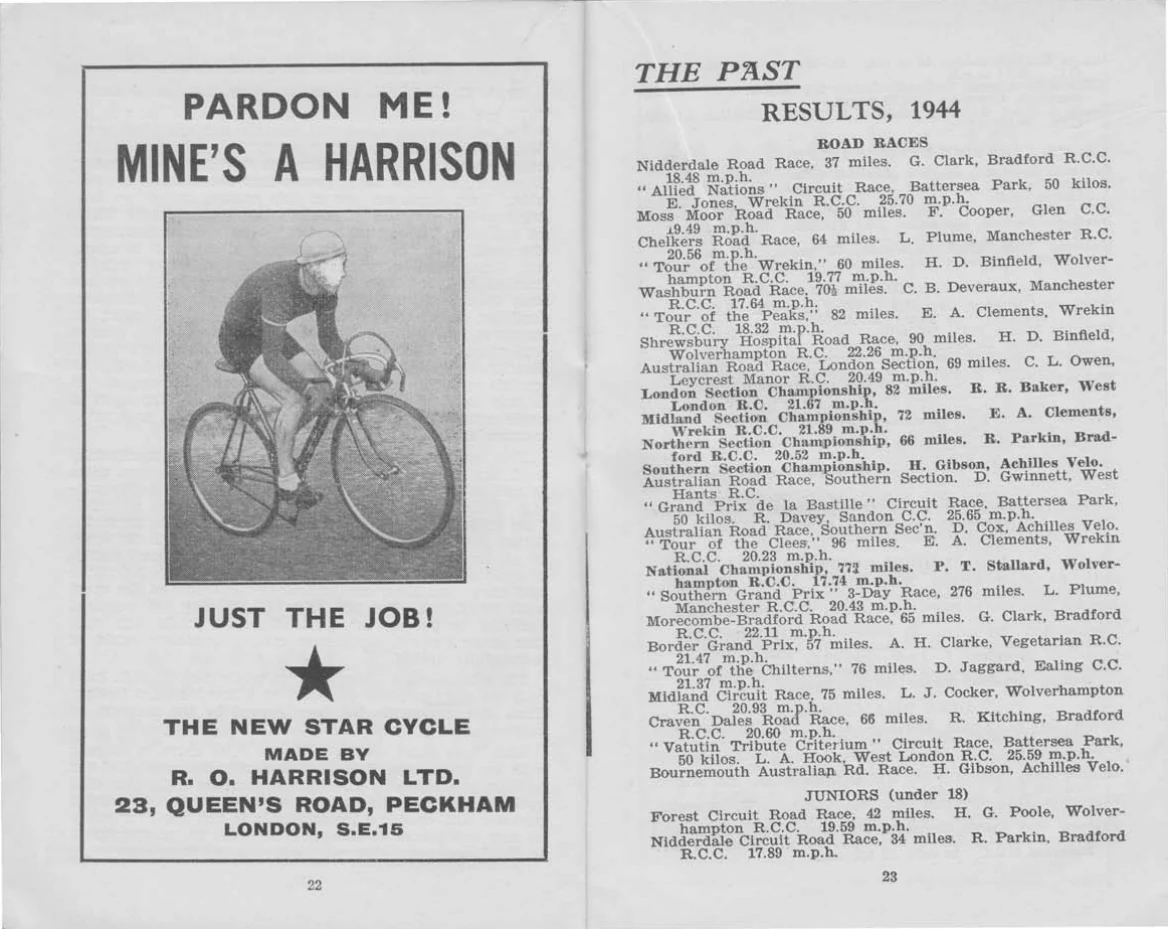
PARDON ME!
MINE’S A HARRISON
JUST THE JOB!
★
THE NEW STAR CYCLE
MADE BY
R. O. HARRISON LTD.
23, QUEEN’S ROAD, PECKHAM
LONDON, S.E.15
22
[Right-hand page]
THE PAST
RESULTS, 1944
ROAD RACES
Nidderdale Road Race, 37 miles. G. Clark, Bradford R.C.C. 18.48 m.p.h.
“Allied Nations” Circuit Race, Battersea Park, 50 kilos. E. Jones, Wrekin R.C.C. 25.70 m.p.h.
Moss Moor Road Race, 50 miles. F. Cooper, Glen C.C. 19.49 m.p.h.
Chelkers Road Race, 64 miles. L. Plume, Manchester R.C. 20.56 m.p.h.
“Tour of the Wrekin,” 60 miles. H. D. Binfield, Wolverhampton R.C.C. 19.77 m.p.h.
Washburn Road Race, 70 1/2 miles. C. B. Deveraux, Manchester R.C.C. 17.64 m.p.h.
“Tour of the Peaks,” 82 miles. E. A. Clements, Wrekin R.C.C. 18.32 m.p.h.
Shrewsbury Hospital Road Race, 90 miles. H. D. Binfield, Wolverhampton R.C. 22.26 m.p.h.
Australian Road Race, London Section, 69 miles. C. L. Owen, Leycrest Manor R.C. 20.49 m.p.h.
London Section Championship, 82 miles. R. R. Baker, West London R.C. 21.67 m.p.h.
Midland Section Championship, 72 miles. E. A. Clements, Wrekin R.C.C. 21.89 m.p.h.
Northern Section Championship, 66 miles. R. Parkin, Bradford R.C.C. 20.52 m.p.h.
Southern Section Championship. H. Gibson, Achilles Velo.
Australian Road Race, Southern Section. D. Gwinnett, West Hants R.C.
“Grand Prix de la Bastille” Circuit Race, Battersea Park, 50 kilos. R. Davey, Sandon C.C. 25.65 m.p.h.
Australian Road Race, Southern Sec’n. D. Cox, Achilles Velo.
“Tour of the Clees,” 96 miles. E. A. Clements, Wrekin R.C.C. 20.23 m.p.h.
National Championship, 77 [fraction illegible] miles. P. T. Stallard, Wolverhampton R.C.C. 17.74 m.p.h.
“Southern Grand Prix” 3-Day Race, 276 miles. L. Plume, Manchester R.C.C. 20.43 m.p.h.
Morecombe-Bradford Road Race, 65 miles. G. Clark, Bradford R.C.C. 22.11 m.p.h.
Border Grand Prix, 57 miles. A. H. Clarke, Vegetarian R.C. 21.47 m.p.h.
“Tour of the Chilterns,” 76 miles. D. Jaggard, Ealing C.C. 21.37 m.p.h.
Midland Circuit Race, 75 miles. L. J. Cocker, Wolverhampton R.C. 20.93 m.p.h.
Craven Dales Road Race, 66 miles. R. Kitching, Bradford R.C.C. 20.60 m.p.h.
“Vatutin Tribute Criterium” Circuit Race, Battersea Park, 50 kilos. L. A. Hook, West London R.C. 25.59 m.p.h.
Bournemouth Australian Rd. Race. H. Gibson, Achilles Velo.
JUNIORS (under 18)
Forest Circuit Road Race, 42 miles. H. G. Poole, Wolverhampton R.C.C. 19.59 m.p.h.
Nidderdale Circuit Road Race, 34 miles. R. Parkin, Bradford R.C.C. 17.89 m.p.h.
23
[A spread: at left printed page 22, a boxed R. O. Harrison New Star Cycle advertisement with a framed photograph of a rider in a cap on a drop-bar bicycle and a large star; at right printed page 23, the 1944 road race results, with the four section championships and the national championship in bold.]
— Page 14 —
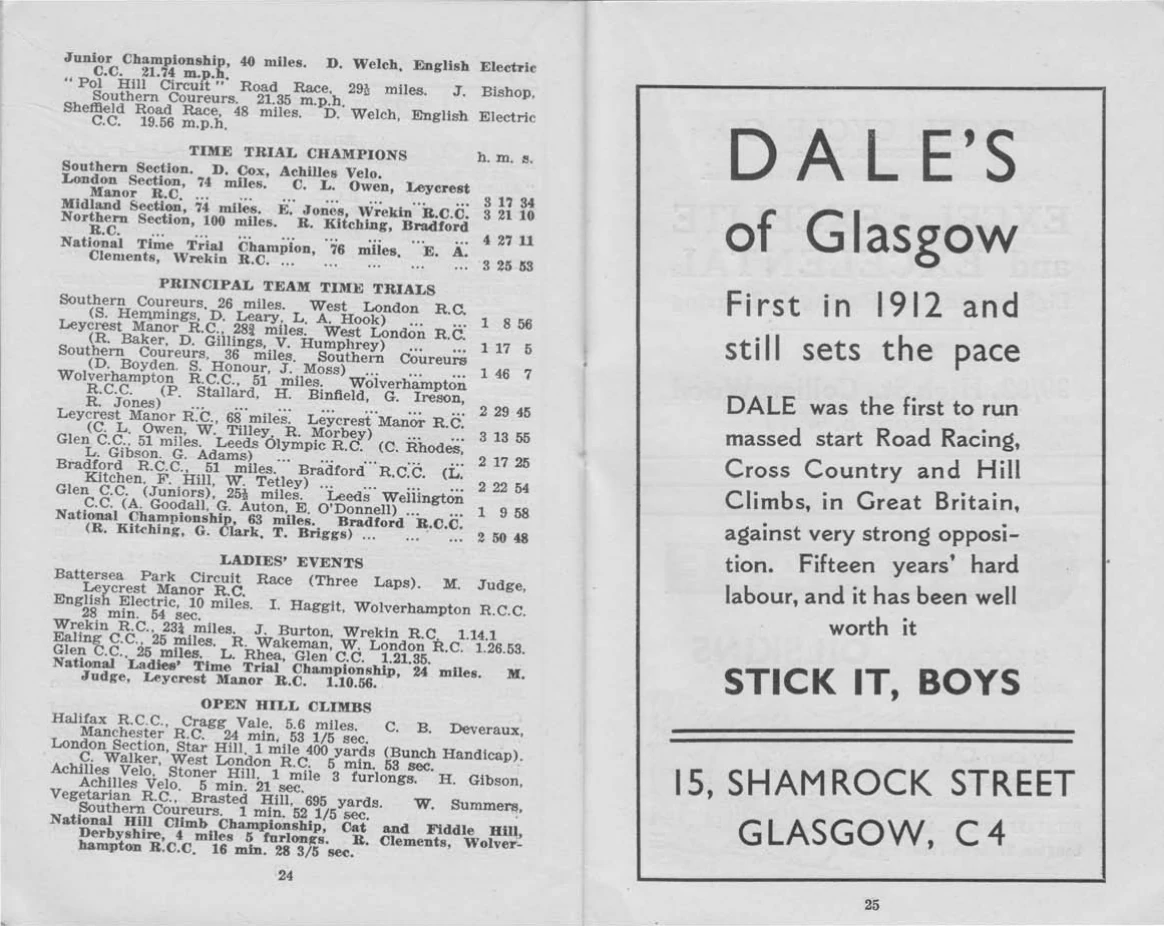
Junior Championship, 40 miles. D. Welch, English Electric C.C. 21.74 m.p.h.
“Pol Hill Circuit” Road Race, 29 1/2 miles. J. Bishop, Southern Coureurs. 21.35 m.p.h.
Sheffield Road Race, 48 miles. D. Welch, English Electric C.C. 19.56 m.p.h.
TIME TRIAL CHAMPIONS | h. m. s.
Southern Section. D. Cox, Achilles Velo.
London Section, 74 miles. C. L. Owen, Leycrest Manor R.C. | 3 17 34
Midland Section, 74 miles. E. Jones, Wrekin R.C.C. | 3 21 10
Northern Section, 100 miles. R. Kitching, Bradford R.C. | 4 27 11
National Time Trial Champion, 76 miles. E. A. Clements, Wrekin R.C. | 3 25 53
PRINCIPAL TEAM TIME TRIALS
Southern Coureurs, 26 miles. West London R.C. (S. Hemmings, D. Leary, L. A. Hook) | 1 8 56
Leycrest Manor R.C., 28 [fraction illegible] miles. West London R.C. (R. Baker, D. Gillings, V. Humphrey) | 1 17 5
Southern Coureurs, 36 miles. Southern Coureurs (D. Boyden, S. Honour, J. Moss) | 1 46 7
Wolverhampton R.C.C., 51 miles. Wolverhampton R.C.C. (P. Stallard, H. Binfield, G. Ireson, R. Jones) | 2 29 45
Leycrest Manor R.C., 68 miles. Leycrest Manor R.C. (C. L. Owen, W. Tilley, R. Morbey) | 3 13 55
Glen C.C., 51 miles. Leeds Olympic R.C. (C. Rhodes, L. Gibson, G. Adams) | 2 17 25
Bradford R.C.C., 51 miles. Bradford R.C.C. (L. Kitchen, F. Hill, W. Tetley) | 2 22 54
Glen C.C. (Juniors), 25 [fraction illegible] miles. Leeds Wellington C.C. (A. Goodall, G. Auton, E. O’Donnell) | 1 9 58
National Championship, 63 miles. Bradford R.C.C. (R. Kitching, G. Clark, T. Briggs) | 2 50 48
LADIES’ EVENTS
Battersea Park Circuit Race (Three Laps). M. Judge, Leycrest Manor R.C.
English Electric, 10 miles. I. Haggit, Wolverhampton R.C.C. 28 min. 54 sec.
Wrekin R.C., 23 [fraction illegible] miles. J. Burton, Wrekin R.C. 1.14.1
Ealing C.C., 25 miles. R. Wakeman, W. London R.C. 1.26.53.
Glen C.C., 25 miles. L. Rhea, Glen C.C. 1.21.35.
National Ladies’ Time Trial Championship, 24 miles. M. Judge, Leycrest Manor R.C. 1.10.56.
OPEN HILL CLIMBS
Halifax R.C.C., Cragg Vale, 5.6 miles. C. B. Deveraux, Manchester R.C. 24 min. 53 1/5 sec.
London Section, Star Hill, 1 mile 400 yards (Bunch Handicap). C. Walker, West London R.C. 5 min. 53 sec.
Achilles Velo, Stoner Hill, 1 mile 3 furlongs. H. Gibson, Achilles Velo. 5 min. 21 sec.
Vegetarian R.C., Brasted Hill, 695 yards. W. Summers, Southern Coureurs. 1 min. 52 1/5 sec.
National Hill Climb Championship, Cat and Fiddle Hill, Derbyshire, 4 miles 5 furlongs. R. Clements, Wolverhampton R.C.C. 16 min. 28 3/5 sec.
24
[Right-hand page]
DALE’S
of Glasgow
First in 1912 and still sets the pace
DALE was the first to run massed start Road Racing, Cross Country and Hill Climbs, in Great Britain, against very strong opposition. Fifteen years’ hard labour, and it has been well worth it
STICK IT, BOYS
15, SHAMROCK STREET
GLASGOW, C4
25
[A spread: at left printed page 24, results continued in small type with times in an h. m. s. column at right; at right printed page 25, a boxed Dale’s of Glasgow advertisement with a double rule above the address.]
— Page 15 —
EXCEL CYCLE CO.
(DAN GENNER, Proprietor)
Members of the Lightweight Mnfrs. Assn.
EXCEL · EXCELITE
and EXCELENTAL
Lightweights for Racing & Touring
Only Address
90/92, High St., Colliers Wood
London, S.W.19
The BELSTAFF
OILSKINS
✲ ROOMY and RELIABLE
Always chosen by keen Club riders
BELSTAFF MFG. Co., Ltd.
Longton, Stoke-on-Trent
26
[Right-hand page]
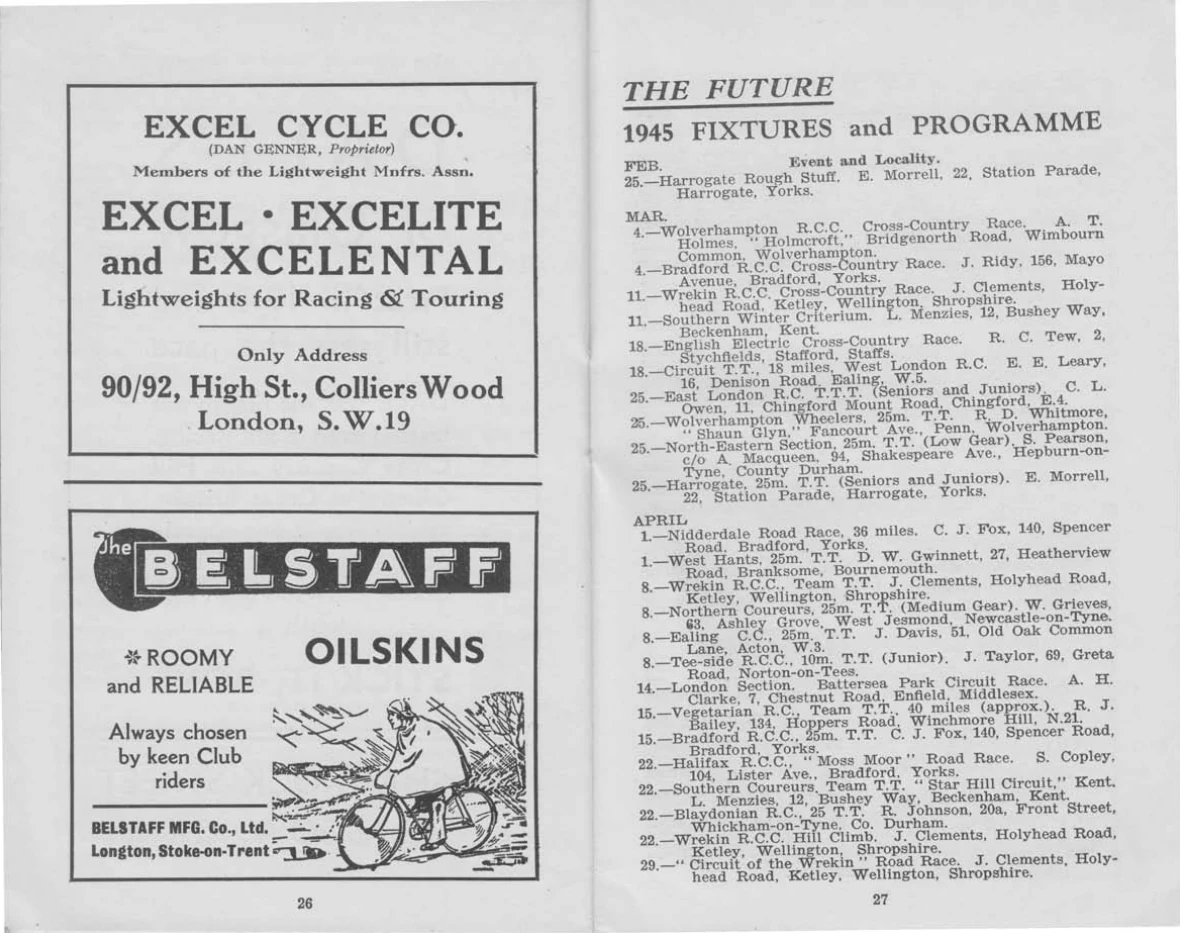
THE FUTURE
1945 FIXTURES and PROGRAMME
FEB. | Event and Locality.
25.—Harrogate Rough Stuff. E. Morrell, 22, Station Parade, Harrogate, Yorks.
MAR.
4.—Wolverhampton R.C.C. Cross-Country Race. A. T. Holmes, “Holmcroft,” Bridgenorth Road, Wimbourn Common, Wolverhampton.
4.—Bradford R.C.C. Cross-Country Race. J. Ridy, 156, Mayo Avenue, Bradford, Yorks.
11.—Wrekin R.C.C. Cross-Country Race. J. Clements, Holyhead Road, Ketley, Wellington, Shropshire.
11.—Southern Winter Criterium. L. Menzies, 12, Bushey Way, Beckenham, Kent.
18.—English Electric Cross-Country Race. R. C. Tew, 2, Stychfields, Stafford, Staffs.
18.—Circuit T.T., 18 miles, West London R.C. E. E. Leary, 16, Denison Road, Ealing, W.5.
25.—East London R.C. T.T.T. (Seniors and Juniors). C. L. Owen, 11, Chingford Mount Road, Chingford, E.4.
25.—Wolverhampton Wheelers, 25m. T.T. R. D. Whitmore, “Shaun Glyn,” Fancourt Ave., Penn, Wolverhampton.
25.—North-Eastern Section, 25m. T.T. (Low Gear). S. Pearson, c/o A. Macqueen, 94, Shakespeare Ave., Hepburn-on-Tyne, County Durham.
25.—Harrogate, 25m. T.T. (Seniors and Juniors). E. Morrell, 22, Station Parade, Harrogate, Yorks.
APRIL
1.—Nidderdale Road Race, 36 miles. C. J. Fox, 140, Spencer Road, Bradford, Yorks.
1.—West Hants, 25m. T.T. D. W. Gwinnett, 27, Heatherview Road, Branksome, Bournemouth.
8.—Wrekin R.C.C., Team T.T. J. Clements, Holyhead Road, Ketley, Wellington, Shropshire.
8.—Northern Coureurs, 25m. T.T. (Medium Gear). W. Grieves, 63, Ashley Grove, West Jesmond, Newcastle-on-Tyne.
8.—Ealing C.C., 25m. T.T. J. Davis, 51, Old Oak Common Lane, Acton, W.3.
8.—Tee-side R.C.C., 10m. T.T. (Junior). J. Taylor, 69, Greta Road, Norton-on-Tees.
14.—London Section. Battersea Park Circuit Race. A. H. Clarke, 7, Chestnut Road, Enfield, Middlesex.
15.—Vegetarian R.C., Team T.T., 40 miles (approx.). R. J. Bailey, 134, Hoppers Road, Winchmore Hill, N.21.
15.—Bradford R.C.C., 25m. T.T. C. J. Fox, 140, Spencer Road, Bradford, Yorks.
22.—Halifax R.C.C., “Moss Moor” Road Race. S. Copley, 104, Lister Ave., Bradford, Yorks.
22.—Southern Coureurs, Team T.T. “Star Hill Circuit,” Kent. L. Menzies, 12, Bushey Way, Beckenham, Kent.
22.—Blaydonian R.C., 25 T.T. R. Johnson, 20a, Front Street, Whickham-on-Tyne, Co. Durham.
22.—Wrekin R.C.C. Hill Climb. J. Clements, Holyhead Road, Ketley, Wellington, Shropshire.
29.—”Circuit of the Wrekin” Road Race. J. Clements, Holyhead Road, Ketley, Wellington, Shropshire.
27
[A spread: at left printed page 26 with boxed Excel Cycle Co. and Belstaff Oilskins advertisements, the second with a line drawing of a caped cyclist riding through wind and rain; at right printed page 27, the first page of the 1945 fixture list.]
— Page 16 —
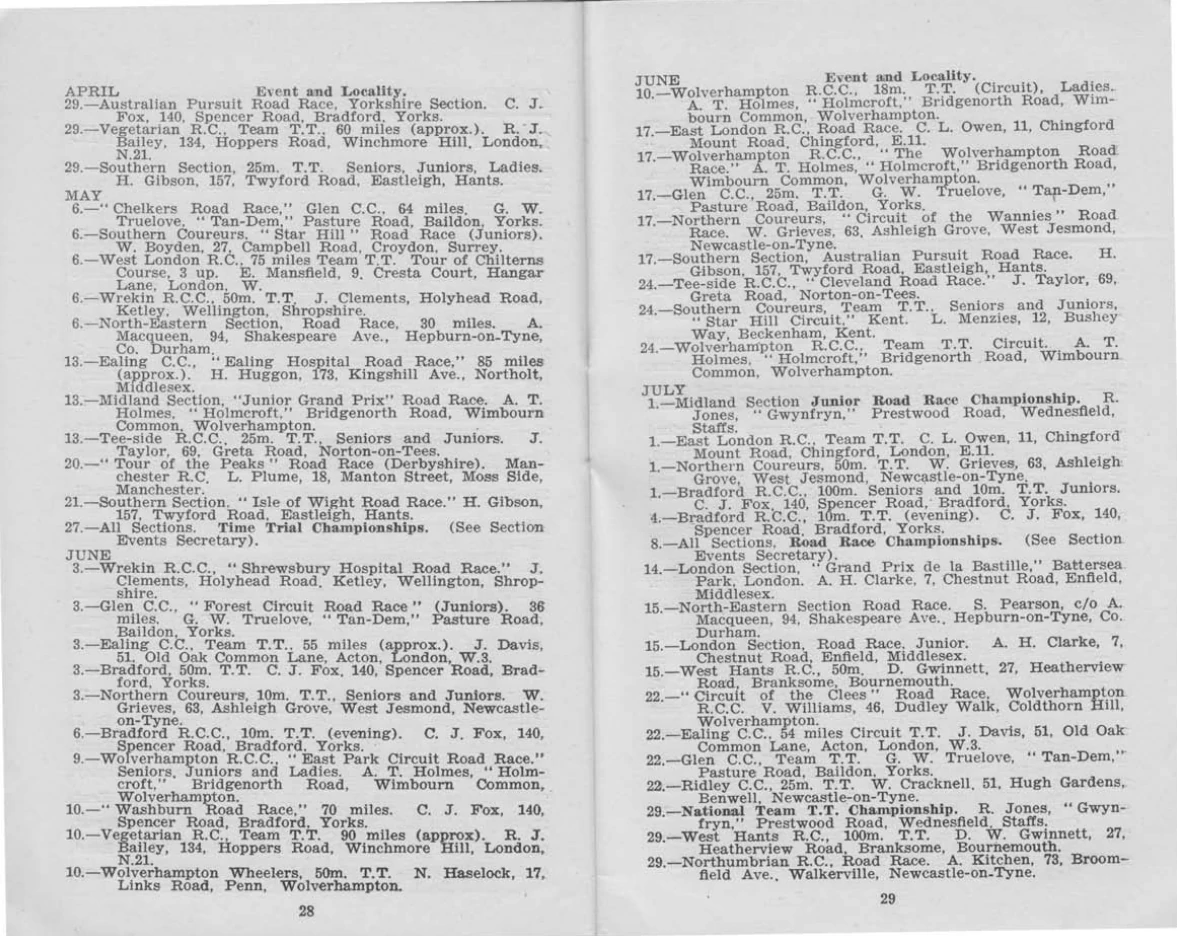
APRIL | Event and Locality.
29.—Australian Pursuit Road Race, Yorkshire Section. C. J. Fox, 140, Spencer Road, Bradford, Yorks.
29.—Vegetarian R.C., Team T.T., 60 miles (approx.). R. J. Bailey, 134, Hoppers Road, Winchmore Hill, London, N.21.
29.—Southern Section, 25m. T.T. Seniors, Juniors, Ladies. H. Gibson, 157, Twyford Road, Eastleigh, Hants.
MAY
6.—”Chelkers Road Race,” Glen C.C., 64 miles. G. W. Truelove, “Tan-Dem,” Pasture Road, Baildon, Yorks.
6.—Southern Coureurs, “Star Hill” Road Race (Juniors). W. Boyden, 27, Campbell Road, Croydon, Surrey.
6.—West London R.C., 75 miles Team T.T. Tour of Chilterns Course, 3 up. E. Mansfield, 9, Cresta Court, Hangar Lane, London, W.
6.—Wrekin R.C.C., 50m. T.T. J. Clements, Holyhead Road, Ketley, Wellington, Shropshire.
6.—North-Eastern Section, Road Race, 30 miles. A. Macqueen, 94, Shakespeare Ave., Hepburn-on-Tyne, Co. Durham.
13.—Ealing C.C., “Ealing Hospital Road Race,” 85 miles (approx.). H. Huggon, 173, Kingshill Ave., Northolt, Middlesex.
13.—Midland Section, “Junior Grand Prix” Road Race. A. T. Holmes, “Holmcroft,” Bridgenorth Road, Wimbourn Common, Wolverhampton.
13.—Tee-side R.C.C., 25m. T.T., Seniors and Juniors. J. Taylor, 69, Greta Road, Norton-on-Tees.
20.—”Tour of the Peaks” Road Race (Derbyshire). Manchester R.C. L. Plume, 18, Manton Street, Moss Side, Manchester.
21.—Southern Section. “Isle of Wight Road Race.” H. Gibson, 157, Twyford Road, Eastleigh, Hants.
27.—All Sections. Time Trial Championships. (See Section Events Secretary).
JUNE
3.—Wrekin R.C.C., “Shrewsbury Hospital Road Race.” J. Clements, Holyhead Road, Ketley, Wellington, Shropshire.
3.—Glen C.C., “Forest Circuit Road Race” (Juniors). 36 miles. G. W. Truelove, “Tan-Dem,” Pasture Road, Baildon, Yorks.
3.—Ealing C.C., Team T.T., 55 miles (approx.). J. Davis, 51, Old Oak Common Lane, Acton, London, W.3.
3.—Bradford, 50m. T.T. C. J. Fox, 140, Spencer Road, Bradford, Yorks.
3.—Northern Coureurs, 10m. T.T., Seniors and Juniors. W. Grieves, 63, Ashleigh Grove, West Jesmond, Newcastle-on-Tyne.
6.—Bradford R.C.C., 10m. T.T. (evening). C. J. Fox, 140, Spencer Road, Bradford, Yorks.
9.—Wolverhampton R.C.C., “East Park Circuit Road Race.” Seniors, Juniors and Ladies. A. T. Holmes, “Holmcroft,” Bridgenorth Road, Wimbourn Common, Wolverhampton.
10.—”Washburn Road Race,” 70 miles. C. J. Fox, 140, Spencer Road, Bradford, Yorks.
10.—Vegetarian R.C., Team T.T. 90 miles (approx). R. J. Bailey, 134, Hoppers Road, Winchmore Hill, London, N.21.
10.—Wolverhampton Wheelers, 50m. T.T. N. Haselock, 17, Links Road, Penn, Wolverhampton.
28
[Right-hand page]
JUNE | Event and Locality.
10.—Wolverhampton R.C.C., 18m. T.T. (Circuit), Ladies. A. T. Holmes, “Holmcroft,” Bridgenorth Road, Wimbourn Common, Wolverhampton.
17.—East London R.C., Road Race. C. L. Owen, 11, Chingford Mount Road, Chingford, E.11.
17.—Wolverhampton R.C.C., “The Wolverhampton Road Race.” A. T. Holmes, “Holmcroft,” Bridgenorth Road, Wimbourn Common, Wolverhampton.
17.—Glen C.C., 25m. T.T. G. W. Truelove, “Tan-Dem,” Pasture Road, Baildon, Yorks.
17.—Northern Coureurs, “Circuit of the Wannies” Road Race. W. Grieves, 63, Ashleigh Grove, West Jesmond, Newcastle-on-Tyne.
17.—Southern Section, Australian Pursuit Road Race. H. Gibson, 157, Twyford Road, Eastleigh, Hants.
24.—Tee-side R.C.C., “Cleveland Road Race.” J. Taylor, 69, Greta Road, Norton-on-Tees.
24.—Southern Coureurs, Team T.T., Seniors and Juniors, “Star Hill Circuit,” Kent. L. Menzies, 12, Bushey Way, Beckenham, Kent.
24.—Wolverhampton R.C.C., Team T.T. Circuit. A. T. Holmes, “Holmcroft,” Bridgenorth Road, Wimbourn Common, Wolverhampton.
JULY
1.—Midland Section Junior Road Race Championship. R. Jones, “Gwynfryn,” Prestwood Road, Wednesfield, Staffs.
1.—East London R.C., Team T.T. C. L. Owen, 11, Chingford Mount Road, Chingford, London, E.11.
1.—Northern Coureurs, 50m. T.T. W. Grieves, 63, Ashleigh Grove, West Jesmond, Newcastle-on-Tyne.
1.—Bradford R.C.C., 100m. Seniors and 10m. T.T. Juniors. C. J. Fox, 140, Spencer Road, Bradford, Yorks.
4.—Bradford R.C.C., 10m. T.T. (evening). C. J. Fox, 140, Spencer Road, Bradford, Yorks.
8.—All Sections, Road Race Championships. (See Section Events Secretary).
14.—London Section, “Grand Prix de la Bastille,” Battersea Park, London. A. H. Clarke, 7, Chestnut Road, Enfield, Middlesex.
15.—North-Eastern Section Road Race. S. Pearson, c/o A. Macqueen, 94, Shakespeare Ave., Hepburn-on-Tyne, Co. Durham.
15.—London Section, Road Race, Junior. A. H. Clarke, 7, Chestnut Road, Enfield, Middlesex.
15.—West Hants R.C., 50m. D. Gwinnett, 27, Heatherview Road, Branksome, Bournemouth.
22.—”Circuit of the Clees” Road Race, Wolverhampton R.C.C. V. Williams, 46, Dudley Walk, Coldthorn Hill, Wolverhampton.
22.—Ealing C.C., 54 miles Circuit T.T. J. Davis, 51, Old Oak Common Lane, Acton, London, W.3.
22.—Glen C.C., Team T.T. G. W. Truelove, “Tan-Dem,” Pasture Road, Baildon, Yorks.
22.—Ridley C.C., 25m. T.T. W. Cracknell, 51, Hugh Gardens, Benwell, Newcastle-on-Tyne.
29.—National Team T.T. Championship. R. Jones, “Gwynfryn,” Prestwood Road, Wednesfield, Staffs.
29.—West Hants R.C., 100m. T.T. D. W. Gwinnett, 27, Heatherview Road, Branksome, Bournemouth.
29.—Northumbrian R.C., Road Race. A. Kitchen, 73, Broomfield Ave., Walkerville, Newcastle-on-Tyne.
29
[A spread: printed pages 28 and 29, the 1945 fixture list in small type for late April through July, with championship entries in bold.]
— Page 17 —
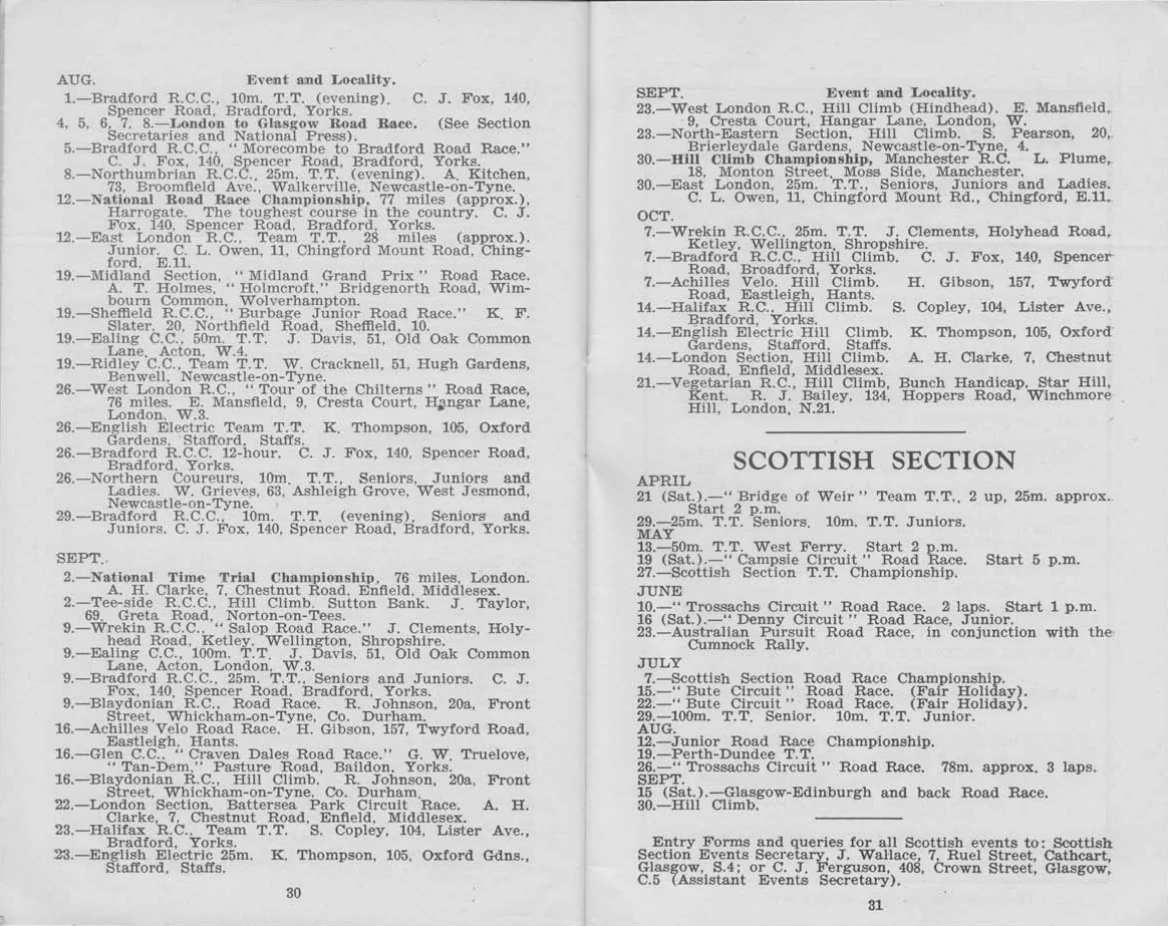
AUG. | Event and Locality.
1.—Bradford R.C.C., 10m. T.T. (evening). C. J. Fox, 140, Spencer Road, Bradford, Yorks.
4, 5, 6, 7, 8.—London to Glasgow Road Race. (See Section Secretaries and National Press).
5.—Bradford R.C.C., “Morecombe to Bradford Road Race.” C. J. Fox, 140, Spencer Road, Bradford, Yorks.
8.—Northumbrian R.C.C., 25m. T.T. (evening). A. Kitchen, 73, Broomfield Ave., Walkerville, Newcastle-on-Tyne.
12.—National Road Race Championship, 77 miles (approx.), Harrogate. The toughest course in the country. C. J. Fox, 140, Spencer Road, Bradford, Yorks.
12.—East London R.C., Team T.T., 28 miles (approx.). Junior. C. L. Owen, 11, Chingford Mount Road, Chingford, E.11.
19.—Midland Section, “Midland Grand Prix” Road Race. A. T. Holmes, “Holmcroft,” Bridgenorth Road, Wimbourn Common, Wolverhampton.
19.—Sheffield R.C.C., “Burbage Junior Road Race.” K. F. Slater, 20, Northfield Road, Sheffield, 10.
19.—Ealing C.C., 50m. T.T. J. Davis, 51, Old Oak Common Lane, Acton, W.4.
19.—Ridley C.C., Team T.T. W. Cracknell, 51, Hugh Gardens, Benwell, Newcastle-on-Tyne.
26.—West London R.C., “Tour of the Chilterns” Road Race, 76 miles. E. Mansfield, 9, Cresta Court, Hangar Lane, London, W.3.
26.—English Electric Team T.T. K. Thompson, 105, Oxford Gardens, Stafford, Staffs.
26.—Bradford R.C.C. 12-hour. C. J. Fox, 140, Spencer Road, Bradford, Yorks.
26.—Northern Coureurs, 10m. T.T., Seniors, Juniors and Ladies. W. Grieves, 63, Ashleigh Grove, West Jesmond, Newcastle-on-Tyne.
29.—Bradford R.C.C., 10m. T.T. (evening), Seniors and Juniors. C. J. Fox, 140, Spencer Road, Bradford, Yorks.
SEPT.
2.—National Time Trial Championship, 76 miles, London. A. H. Clarke, 7, Chestnut Road, Enfield, Middlesex.
2.—Tee-side R.C.C., Hill Climb. Sutton Bank. J. Taylor, 69, Greta Road, Norton-on-Tees.
9.—Wrekin R.C.C., “Salop Road Race.” J. Clements, Holyhead Road, Ketley, Wellington, Shropshire.
9.—Ealing C.C., 100m. T.T. J. Davis, 51, Old Oak Common Lane, Acton, London, W.3.
9.—Bradford R.C.C., 25m. T.T., Seniors and Juniors. C. J. Fox, 140, Spencer Road, Bradford, Yorks.
9.—Blaydonian R.C., Road Race. R. Johnson, 20a, Front Street, Whickham-on-Tyne, Co. Durham.
16.—Achilles Velo Road Race. H. Gibson, 157, Twyford Road, Eastleigh, Hants.
16.—Glen C.C., “Craven Dales Road Race.” G. W. Truelove, “Tan-Dem,” Pasture Road, Baildon, Yorks.
16.—Blaydonian R.C., Hill Climb. R. Johnson, 20a, Front Street, Whickham-on-Tyne, Co. Durham.
22.—London Section, Battersea Park Circuit Race. A. H. Clarke, 7, Chestnut Road, Enfield, Middlesex.
23.—Halifax R.C., Team T.T. S. Copley, 104, Lister Ave., Bradford, Yorks.
23.—English Electric 25m. K. Thompson, 105, Oxford Gdns., Stafford, Staffs.
30
[Right-hand page]
SEPT. | Event and Locality.
23.—West London R.C., Hill Climb (Hindhead). E. Mansfield, 9, Cresta Court, Hangar Lane, London, W.
23.—North-Eastern Section, Hill Climb. S. Pearson, 20, Brierleydale Gardens, Newcastle-on-Tyne, 4.
30.—Hill Climb Championship, Manchester R.C. L. Plume, 18, Monton Street, Moss Side, Manchester.
30.—East London, 25m. T.T., Seniors, Juniors and Ladies. C. L. Owen, 11, Chingford Mount Rd., Chingford, E.11.
OCT.
7.—Wrekin R.C.C., 25m. T.T. J. Clements, Holyhead Road, Ketley, Wellington, Shropshire.
7.—Bradford R.C.C., Hill Climb. C. J. Fox, 140, Spencer Road, Broadford, Yorks.
7.—Achilles Velo. Hill Climb. H. Gibson, 157, Twyford Road, Eastleigh, Hants.
14.—Halifax R.C., Hill Climb. S. Copley, 104, Lister Ave., Bradford, Yorks.
14.—English Electric Hill Climb. K. Thompson, 105, Oxford Gardens, Stafford, Staffs.
14.—London Section, Hill Climb. A. H. Clarke, 7, Chestnut Road, Enfield, Middlesex.
21.—Vegetarian R.C., Hill Climb, Bunch Handicap, Star Hill, Kent. R. J. Bailey, 134, Hoppers Road, Winchmore Hill, London, N.21.
SCOTTISH SECTION
APRIL
21 (Sat.).—”Bridge of Weir” Team T.T., 2 up, 25m. approx. Start 2 p.m.
29.—25m. T.T. Seniors. 10m. T.T. Juniors.
MAY
13.—50m. T.T. West Ferry. Start 2 p.m.
19 (Sat.).—”Campsie Circuit” Road Race. Start 5 p.m.
27.—Scottish Section T.T. Championship.
JUNE
10.—”Trossachs Circuit” Road Race. 2 laps. Start 1 p.m.
16 (Sat.).—”Denny Circuit” Road Race, Junior.
23.—Australian Pursuit Road Race, in conjunction with the Cumnock Rally.
JULY
7.—Scottish Section Road Race Championship.
15.—”Bute Circuit” Road Race. (Fair Holiday).
22.—”Bute Circuit” Road Race. (Fair Holiday).
29.—100m. T.T. Senior. 10m. T.T. Junior.
AUG.
12.—Junior Road Race Championship.
19.—Perth-Dundee T.T.
26.—”Trossachs Circuit” Road Race. 78m. approx. 3 laps.
SEPT.
15 (Sat.).—Glasgow-Edinburgh and back Road Race.
30.—Hill Climb.
Entry Forms and queries for all Scottish events to: Scottish Section Events Secretary, J. Wallace, 7, Ruel Street, Cathcart, Glasgow, S.4; or C. J. Ferguson, 408, Crown Street, Glasgow, C.5 (Assistant Events Secretary).
31
[A spread: printed pages 30 and 31, the fixture list for August through October and the Scottish Section program, with national championships in bold and short rules separating the Scottish list.]
— Page 18 —
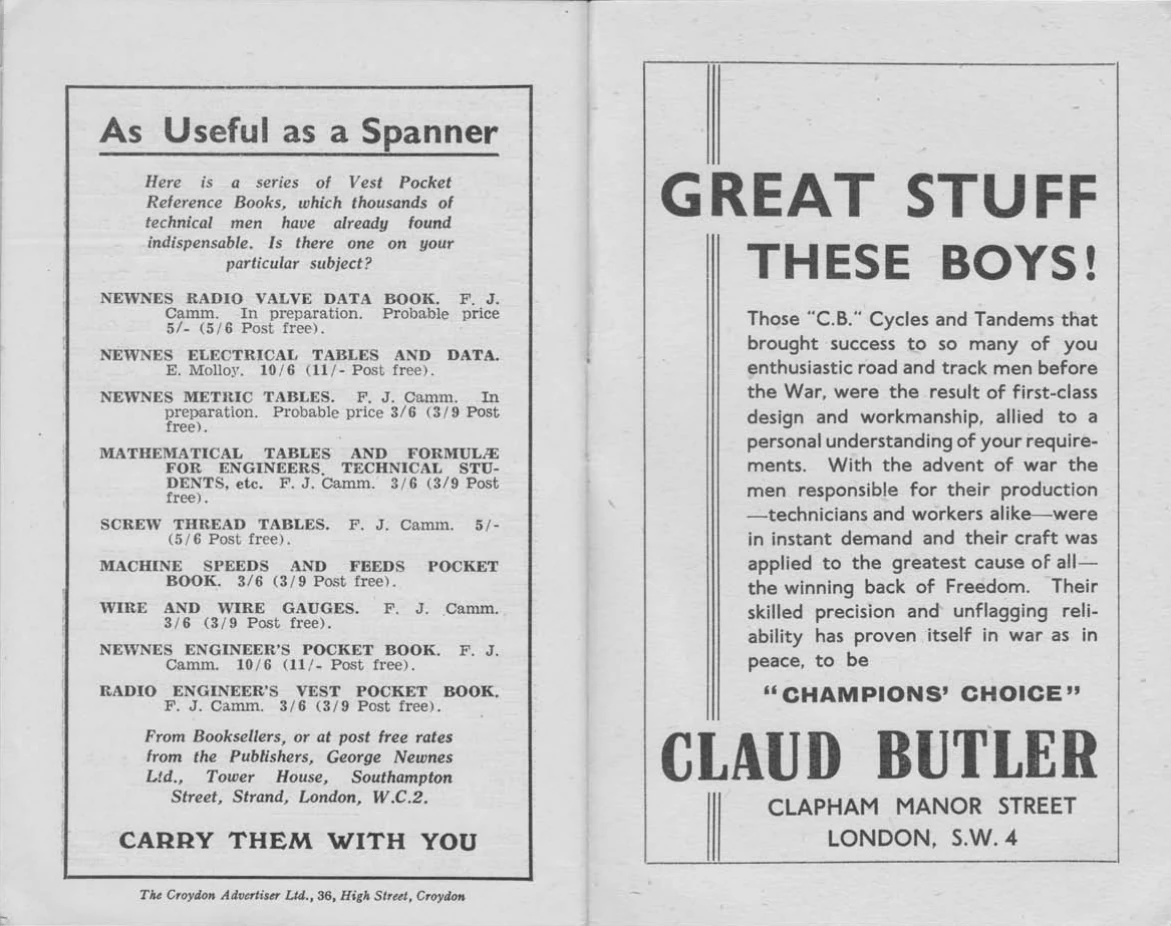
As Useful as a Spanner
Here is a series of Vest Pocket Reference Books, which thousands of technical men have already found indispensable. Is there one on your particular subject?
NEWNES RADIO VALVE DATA BOOK. F. J. Camm. In preparation. Probable price 5/- (5/6 Post free).
NEWNES ELECTRICAL TABLES AND DATA. E. Molloy. 10/6 (11/- Post free).
NEWNES METRIC TABLES. F. J. Camm. In preparation. Probable price 3/6 (3/9 Post free).
MATHEMATICAL TABLES AND FORMULÆ FOR ENGINEERS, TECHNICAL STUDENTS, etc. F. J. Camm. 3/6 (3/9 Post free).
SCREW THREAD TABLES. F. J. Camm. 5/- (5/6 Post free).
MACHINE SPEEDS AND FEEDS POCKET BOOK. 3/6 (3/9 Post free).
WIRE AND WIRE GAUGES. F. J. Camm. 3/6 (3/9 Post free).
NEWNES ENGINEER’S POCKET BOOK. F. J. Camm. 10/6 (11/- Post free).
RADIO ENGINEER’S VEST POCKET BOOK. F. J. Camm. 3/6 (3/9 Post free).
From Booksellers, or at post free rates from the Publishers, George Newnes Ltd., Tower House, Southampton Street, Strand, London, W.C.2.
CARRY THEM WITH YOU
The Croydon Advertiser Ltd., 36, High Street, Croydon
[Right-hand page]
GREAT STUFF
THESE BOYS!
Those “C.B.” Cycles and Tandems that brought success to so many of you enthusiastic road and track men before the War, were the result of first-class design and workmanship, allied to a personal understanding of your requirements. With the advent of war the men responsible for their production—technicians and workers alike—were in instant demand and their craft was applied to the greatest cause of all—the winning back of Freedom. Their skilled precision and unflagging reliability has proven itself in war as in peace, to be
“CHAMPIONS’ CHOICE”
CLAUD BUTLER
CLAPHAM MANOR STREET
LONDON, S.W.4
[A spread: at left the unnumbered last text page (page 32 by sequence), a boxed George Newnes advertisement for F. J. Camm pocket reference books with the printer’s imprint below; at right the inside back cover, a boxed Claud Butler advertisement with triple vertical rules.]
Ebykr presents this material for research and education. If you hold rights to it or notice an ownership issue, please contact us and we will respond promptly.