About Ebykr
Ebykr celebrates classic and vintage lightweight bicycles through provocative imagery and opinion. Ride along with us.
About Ebykr
Ebykr celebrates classic and vintage lightweight bicycles through provocative imagery and opinion. Ride along with us.

Source: bulgier.net (Mark Bulgier's catalog archive), no scanner named for this folder, posted in 2001; enlarged for Ebykr.
| Marque | Basso |
|---|---|
| Type | Catalog |
| Year | 1981 |
| Publisher | Cicli Basso, Cresole (Vicenza) |
| Country | Italy |
| Language | Three languages |
| Pages | 14 |
| Source | bulgier.net (Mark Bulgier's catalog archive), no scanner named for this folder, posted in 2001; enlarged for Ebykr. |
| Credit | Ebykr archive |
| Identifier | Permalink http://bulgier.net/pics/bike/Catalogs/Basso-CicliBasso81/ |
| Transcription | Transcribed by eye |
Reference
Cicli Basso, Cresole (Vicenza). Basso Catalog of 1981: the Veneto and the Workshop, Frame Brazing, the Components and the Tours, Vignola, Vuelta, Arenaccia, Gap and Gap-pista Specifications. 1981. Ebykr, https://ebykr.com/library/basso-catalog-1981/.
Wikipedia
{{cite book |title=Basso Catalog of 1981: the Veneto and the Workshop, Frame Brazing, the Components and the Tours, Vignola, Vuelta, Arenaccia, Gap and Gap-pista Specifications |publisher=Cicli Basso, Cresole (Vicenza) |date=1981 |url=https://ebykr.com/library/basso-catalog-1981/ |via=Ebykr |access-date=}}cicli BASSO Il Veneto è tradizionalmente terra di ciclisti. La bicicletta qui fa parte integrante del panorama, e gode di una popolarità raramente conosciuta in altre contrade italiane. È uno spettacolo familiare, per chiunque percorra le strade del Veneto, vedere giovani e meno giovani, a gruppi o isolati, pedalare con impegno agonistico, o semplicemente per …
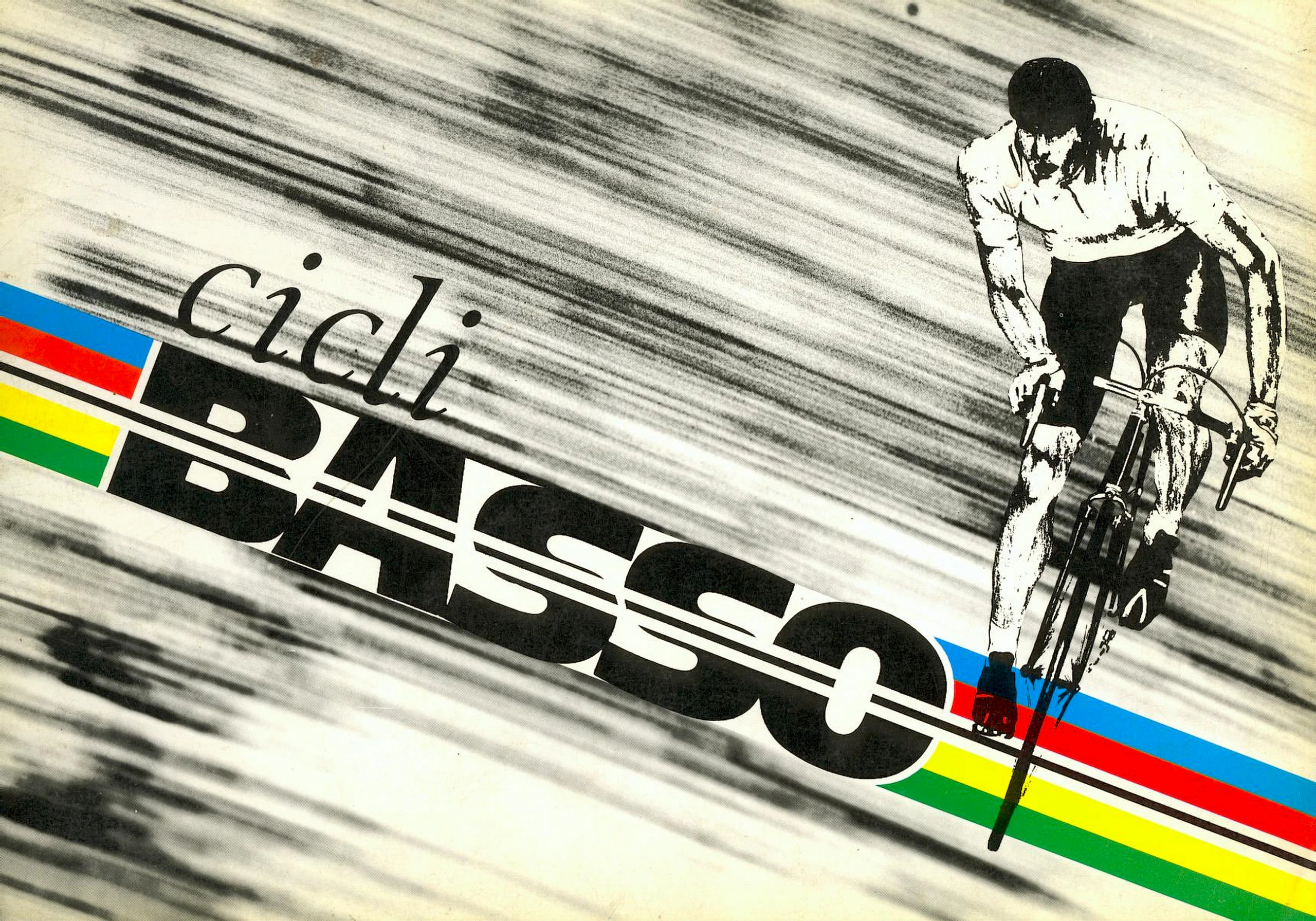
A fourteen-page oblong catalog of Cicli Basso of Cresole near Vicenza: a text on the Veneto, frame building and brazing pages, six models each with a photograph and a table of components in Italian, German and English, and a back cover with a map, marked “1981 Edition”.
— Page 1 (front cover) —
cicli
BASSO
[The front cover of a “cicli BASSO” catalog: the BASSO wordmark set diagonally across a motion-blurred gray background, with a cyclist in a black and white print and blue, red, yellow and green stripes at both ends of the wordmark. A small round dark dot sits near the top center, apparently a print or ink speck.]
— Page 2 —
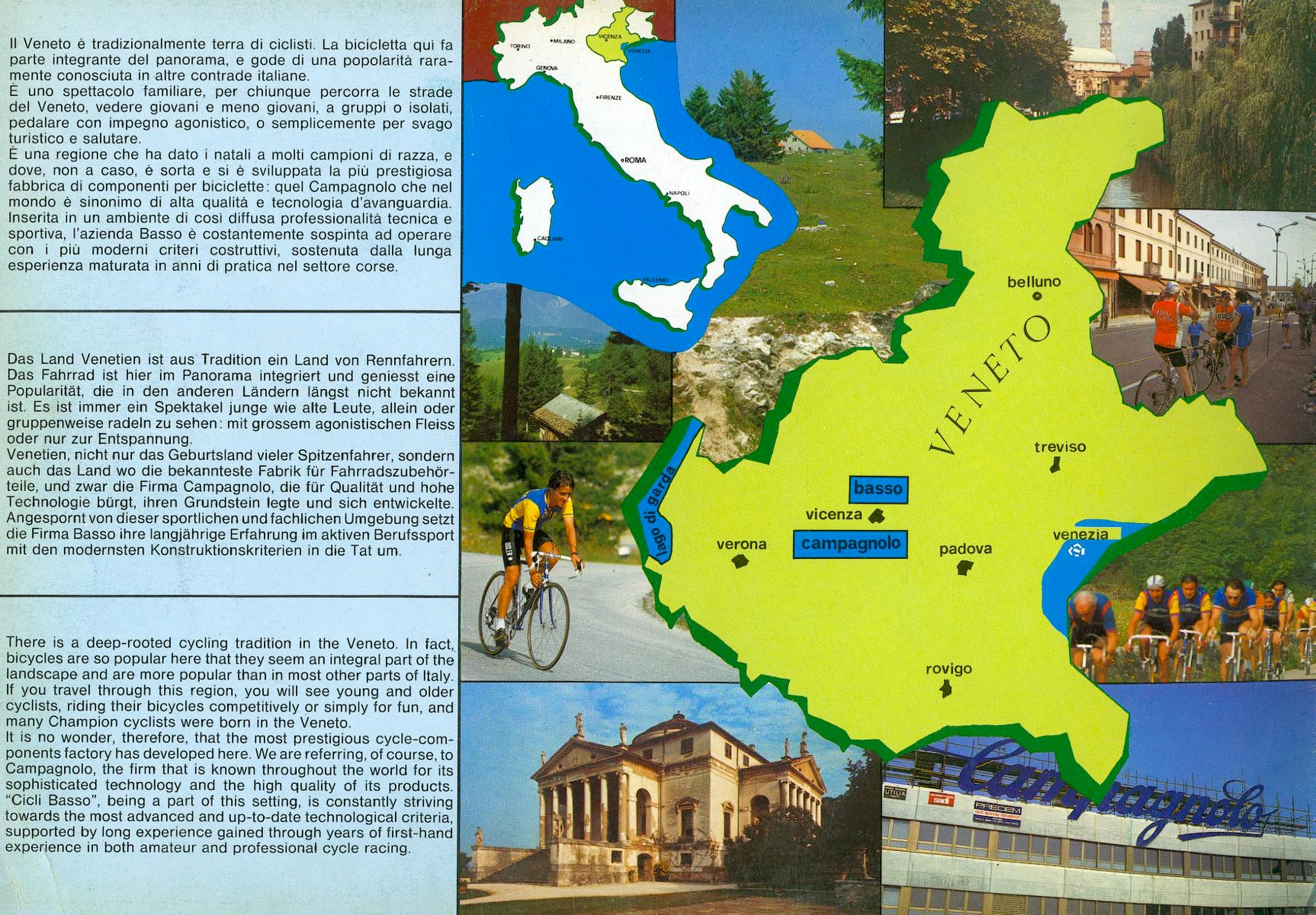
Il Veneto è tradizionalmente terra di ciclisti. La bicicletta qui fa parte integrante del panorama, e gode di una popolarità raramente conosciuta in altre contrade italiane.
È uno spettacolo familiare, per chiunque percorra le strade del Veneto, vedere giovani e meno giovani, a gruppi o isolati, pedalare con impegno agonistico, o semplicemente per svago turistico e salutare.
È una regione che ha dato i natali a molti campioni di razza, e dove, non a caso, è sorta e si è sviluppata la più prestigiosa fabbrica di componenti per biciclette: quel Campagnolo che nel mondo è sinonimo di alta qualità e tecnologia d’avanguardia.
Inserita in un ambiente di cosi diffusa professionalità tecnica e sportiva, l’azienda Basso è costantemente sospinta ad operare con i più moderni criteri costruttivi, sostenuta dalla lunga esperienza maturata in anni di pratica nel settore corse.
Das Land Venetien ist aus Tradition ein Land von Rennfahrern. Das Fahrrad ist hier im Panorama integriert und geniesst eine Popularität, die in den anderen Ländern längst nicht bekannt ist. Es ist immer ein Spektakel junge wie alte Leute, allein oder gruppenweise radeln zu sehen: mit grossem agonistischen Fleiss oder nur zur Entspannung.
Venetien, nicht nur das Geburtsland vieler Spitzenfahrer, sondern auch das Land wo die bekannteste Fabrik für Fahrradszubehörteile, und zwar die Firma Campagnolo, die für Qualität und hohe Technologie bürgt, ihren Grundstein legte und sich entwickelte.
Angespornt von dieser sportlichen und fachlichen Umgebung setzt die Firma Basso ihre langjährige Erfahrung im aktiven Berufssport mit den modernsten Konstruktionskriterien in die Tat um.
There is a deep-rooted cycling tradition in the Veneto. In fact, bicycles are so popular here that they seem an integral part of the landscape and are more popular than in most other parts of Italy. If you travel through this region, you will see young and older cyclists, riding their bicycles competitively or simply for fun, and many Champion cyclists were born in the Veneto.
It is no wonder, therefore, that the most prestigious cycle-components factory has developed here. We are referring, of course, to Campagnolo, the firm that is known throughout the world for its sophisticated technology and the high quality of its products. “Cicli Basso”, being a part of this setting, is constantly striving towards the most advanced and up-to-date technological criteria, supported by long experience gained through years of first-hand experience in both amateur and professional cycle racing.
TORINO MILANO GENOVA VICENZA VENEZIA FIRENZE ROMA NAPOLI CAGLIARI PALERMO
VENETO
belluno
treviso
basso
vicenza
campagnolo
verona
padova
venezia
rovigo
lago di garda
[A page of Italian, German and English text on the cycling tradition of the Veneto and the Campagnolo firm, beside a map of Italy with Vicenza marked and a map of the Veneto with boxes labeled “basso” and “campagnolo” near Vicenza. Photographs show cyclists on roads, a villa, a street scene and a building with a Campagnolo sign.]
— Page 3 —
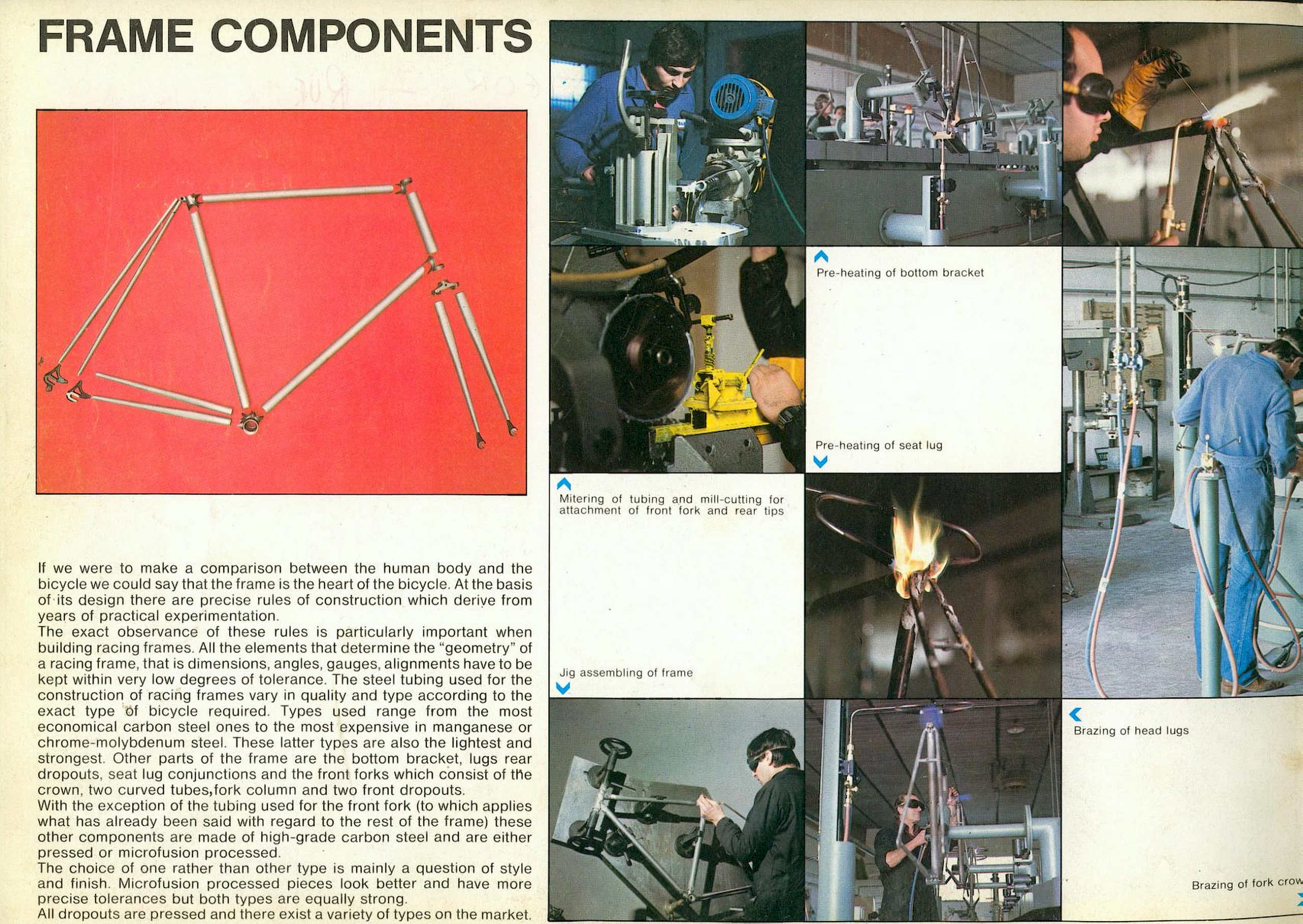
FRAME COMPONENTS
If we were to make a comparison between the human body and the bicycle we could say that the frame is the heart of the bicycle. At the basis of its design there are precise rules of construction which derive from years of practical experimentation.
The exact observance of these rules is particularly important when building racing frames. All the elements that determine the “geometry” of a racing frame, that is dimensions, angles, gauges, alignments have to be kept within very low degrees of tolerance. The steel tubing used for the construction of racing frames vary in quality and type according to the exact type of bicycle required. Types used range from the most economical carbon steel ones to the most expensive in manganese or chrome-molybdenum steel. These latter types are also the lightest and strongest. Other parts of the frame are the bottom bracket, lugs rear dropouts, seat lug conjunctions and the front forks which consist of the crown, two curved tubes,fork column and two front dropouts.
With the exception of the tubing used for the front fork (to which applies what has already been said with regard to the rest of the frame) these other components are made of high-grade carbon steel and are either pressed or microfusion processed.
The choice of one rather than other type is mainly a question of style and finish. Microfusion processed pieces look better and have more precise tolerances but both types are equally strong.
All dropouts are pressed and there exist a variety of types on the market.
Pre-heating of bottom bracket
Pre-heating of seat lug
Mitering of tubing and mill-cutting for attachment of front fork and rear tips
Jig assembling of frame
Brazing of head lugs
Brazing of fork crow[cut off]
[A page headed “FRAME COMPONENTS”: a red-background photograph of a disassembled frame (tubes, lugs, dropouts and bottom bracket laid out) with an English text on frame construction, beside photographs of workshop operations with printed captions and blue arrows. The caption at the lower right is cut off at the right edge of the scan, and faint pencil marks lie below the heading.]
— Page 4 —
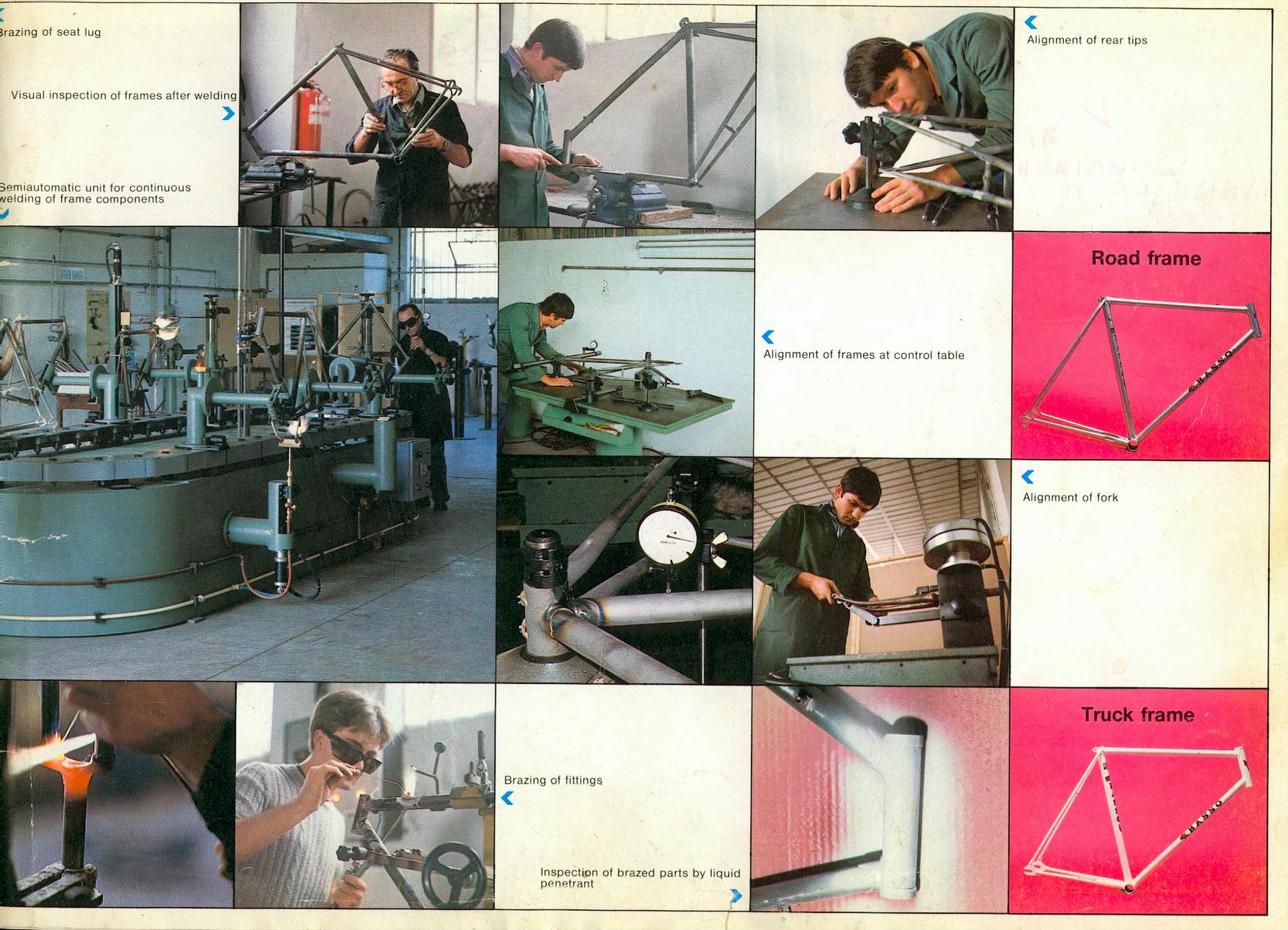
Brazing of seat lug
Visual inspection of frames after welding
Semiautomatic unit for continuous welding of frame components
Alignment of rear tips
Alignment of frames at control table
Road frame
Alignment of fork
Brazing of fittings
Inspection of brazed parts by liquid penetrant
Truck frame
[Workshop photographs of frame building with printed captions and blue arrows, including a long semiautomatic welding machine, frame alignment at a control table, a dial gauge on a bottom bracket joint and liquid penetrant inspection, with a “Road frame” and a “Truck frame” photographed on red backgrounds. The first letters of three captions at the left edge are partly cut off, and faint red pen writing and a pen arrow lie in the “Alignment of rear tips” box.]
— Page 5 —
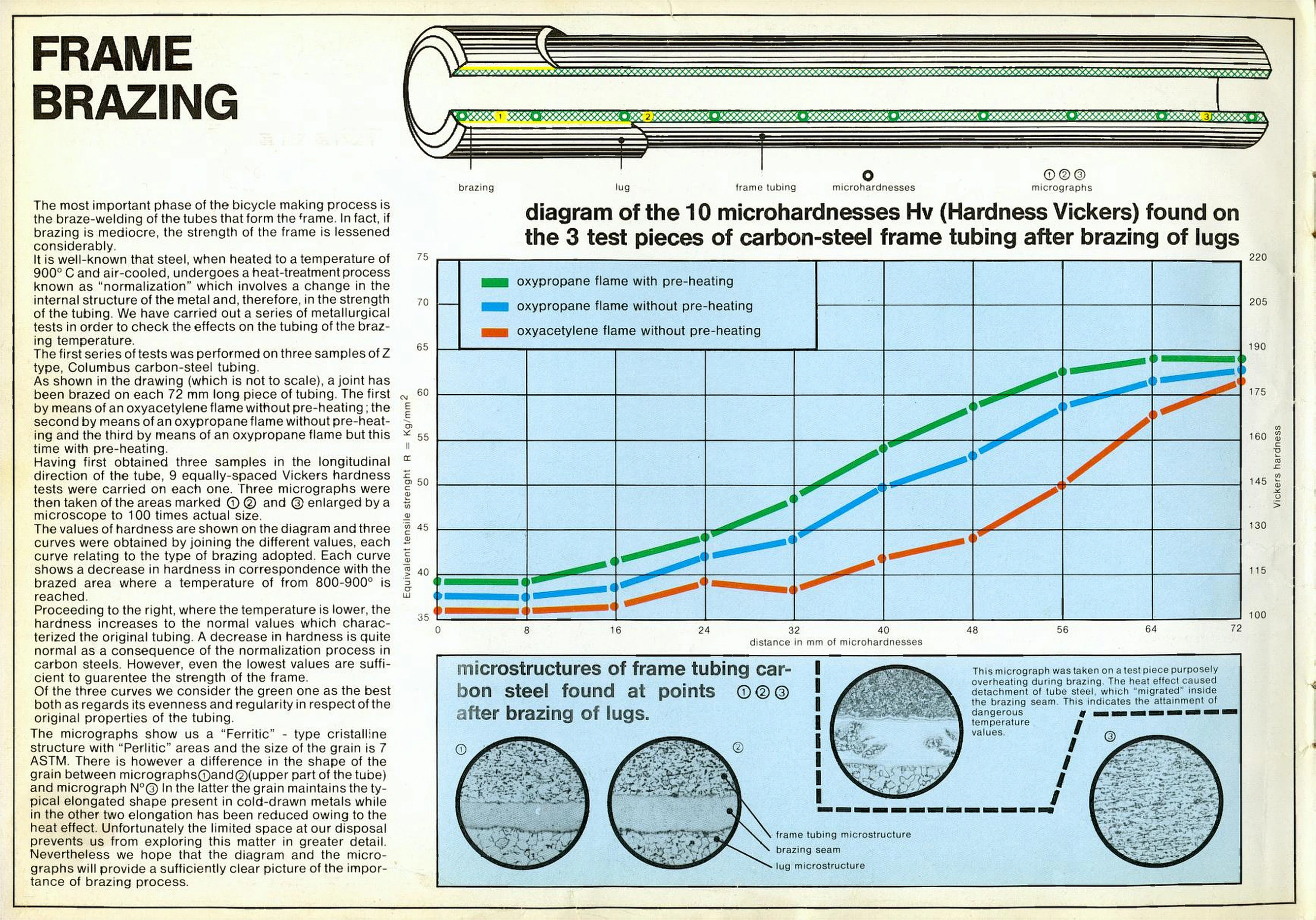
FRAME BRAZING
The most important phase of the bicycle making process is the braze-welding of the tubes that form the frame. In fact, if brazing is mediocre, the strength of the frame is lessened considerably.
It is well-known that steel, when heated to a temperature of 900° C and air-cooled, undergoes a heat-treatment process known as “normalization” which involves a change in the internal structure of the metal and, therefore, in the strength of the tubing. We have carried out a series of metallurgical tests in order to check the effects on the tubing of the brazing temperature.
The first series of tests was performed on three samples of Z type, Columbus carbon-steel tubing.
As shown in the drawing (which is not to scale), a joint has been brazed on each 72 mm long piece of tubing. The first by means of an oxyacetylene flame without pre-heating ; the second by means of an oxypropane flame without pre-heating and the third by means of an oxypropane flame but this time with pre-heating.
Having first obtained three samples in the longitudinal direction of the tube, 9 equally-spaced Vickers hardness tests were carried on each one. Three micrographs were then taken of the areas marked ① ② and ③ enlarged by a microscope to 100 times actual size.
The values of hardness are shown on the diagram and three curves were obtained by joining the different values, each curve relating to the type of brazing adopted. Each curve shows a decrease in hardness in correspondence with the brazed area where a temperature of from 800-900° is reached.
Proceeding to the right, where the temperature is lower, the hardness increases to the normal values which characterized the original tubing. A decrease in hardness is quite normal as a consequence of the normalization process in carbon steels. However, even the lowest values are sufficient to guarentee the strength of the frame.
Of the three curves we consider the green one as the best both as regards its evenness and regularity in respect of the original properties of the tubing.
The micrographs show us a “Ferritic” – type cristalline structure with “Perlitic” areas and the size of the grain is 7 ASTM. There is however a difference in the shape of the grain between micrographs①and②(upper part of the tube) and micrograph N°③ In the latter the grain maintains the typical elongated shape present in cold-drawn metals while in the other two elongation has been reduced owing to the heat effect. Unfortunately the limited space at our disposal prevents us from exploring this matter in greater detail. Nevertheless we hope that the diagram and the micrographs will provide a sufficiently clear picture of the importance of brazing process.
brazing
lug
frame tubing
microhardnesses
micrographs
① ② ③
diagram of the 10 microhardnesses Hv (Hardness Vickers) found on the 3 test pieces of carbon-steel frame tubing after brazing of lugs
oxypropane flame with pre-heating
oxypropane flame without pre-heating
oxyacetylene flame without pre-heating
Equivalent tensile strenght R = Kg/mm2
75 | 70 | 65 | 60 | 55 | 50 | 45 | 40 | 35
Vickers hardness
220 | 205 | 190 | 175 | 160 | 145 | 130 | 115 | 100
0 | 8 | 16 | 24 | 32 | 40 | 48 | 56 | 64 | 72
distance in mm of microhardnesses
microstructures of frame tubing carbon steel found at points ① ② ③ after brazing of lugs.
①
②
frame tubing microstructure
brazing seam
lug microstructure
This micrograph was taken on a test piece purposely overheating during brazing. The heat effect caused detachment of tube steel, which “migrated” inside the brazing seam. This indicates the attainment of dangerous temperature values.
③
[A page headed “FRAME BRAZING”: an English text on tests of tubing brazed with oxyacetylene and oxypropane flames, beside a drawing of a lug and tube with numbered test points, a line graph of three colored curves of hardness against distance, and three circular micrographs with captions. The graph scales and labels are given above as printed.]
— Page 6 —
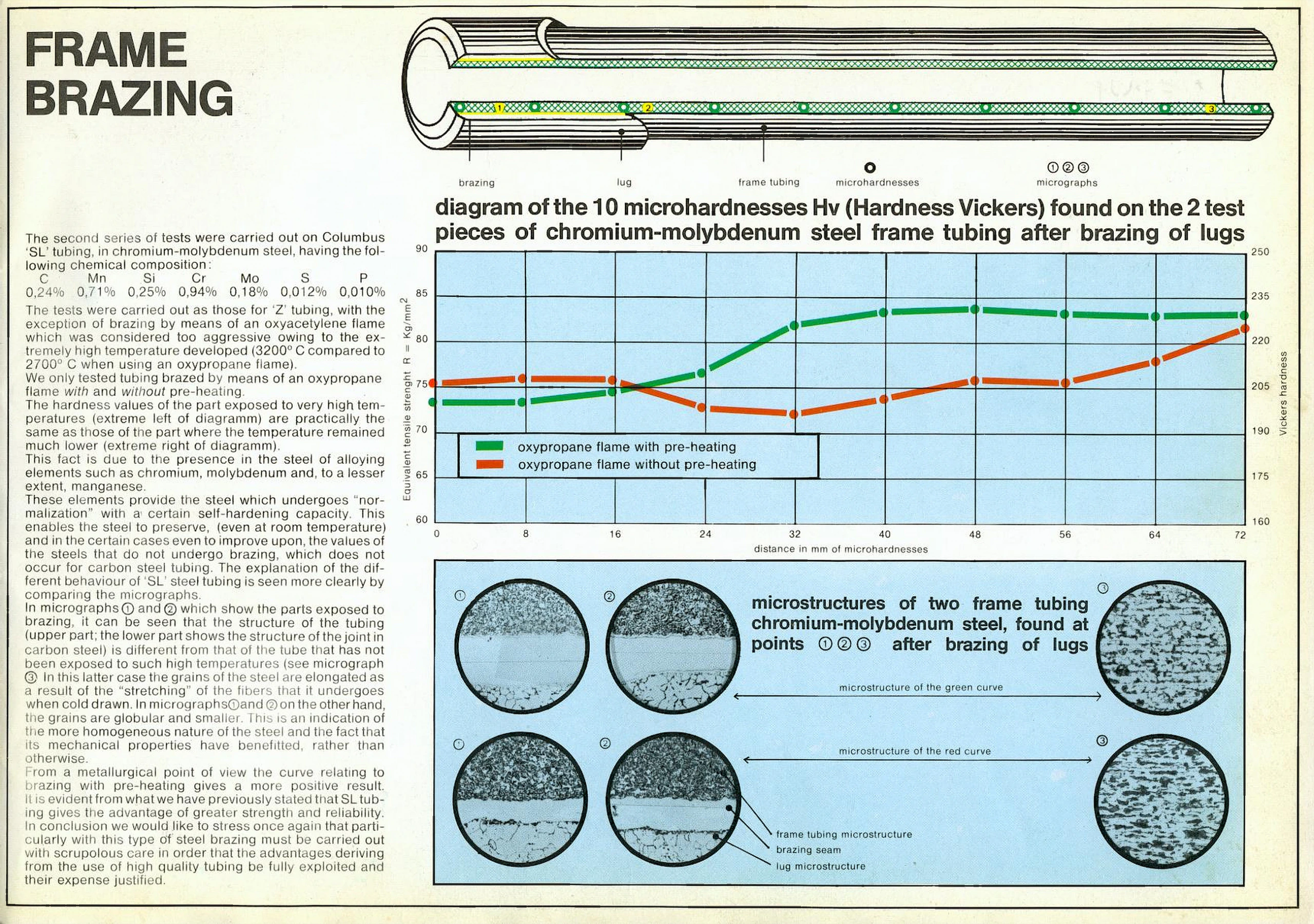
FRAME BRAZING
The second series of tests were carried out on Columbus ‘SL’ tubing, in chromium-molybdenum steel, having the following chemical composition:
C | Mn | Si | Cr | Mo | S | P
0,24% | 0,71% | 0,25% | 0,94% | 0,18% | 0,012% | 0,010%
The tests were carried out as those for ‘Z’ tubing, with the exception of brazing by means of an oxyacetylene flame which was considered too aggressive owing to the extremely high temperature developed (3200° C compared to 2700° C when using an oxypropane flame).
We only tested tubing brazed by means of an oxypropane flame with and without pre-heating.
The hardness values of the part exposed to very high temperatures (extreme left of diagramm) are practically the same as those of the part where the temperature remained much lower (extreme right of diagramm).
This fact is due to the presence in the steel of alloying elements such as chromium, molybdenum and, to a lesser extent, manganese.
These elements provide the steel which undergoes “normalization” with a certain self-hardening capacity. This enables the steel to preserve, (even at room temperature) and in the certain cases even to improve upon, the values of the steels that do not undergo brazing, which does not occur for carbon steel tubing. The explanation of the different behaviour of ‘SL’ steel tubing is seen more clearly by comparing the micrographs.
In micrographs ① and ② which show the parts exposed to brazing, it can be seen that the structure of the tubing (upper part; the lower part shows the structure of the joint in carbon steel) is different from that of the tube that has not been exposed to such high temperatures (see micrograph ③ In this latter case the grains of the steel are elongated as a result of the “stretching” of the fibers that it undergoes when cold drawn. In micrographs①and ② on the other hand, the grains are globular and smaller. This is an indication of the more homogeneous nature of the steel and the fact that its mechanical properties have benefitted, rather than otherwise.
From a metallurgical point of view the curve relating to brazing with pre-heating gives a more positive result. It is evident from what we have previously stated that SL tubing gives the advantage of greater strength and reliability.
In conclusion we would like to stress once again that particularly with this type of steel brazing must be carried out with scrupolous care in order that the advantages deriving from the use of high quality tubing be fully exploited and their expense justified.
brazing
lug
frame tubing
microhardnesses
micrographs
① ② ③
diagram of the 10 microhardnesses Hv (Hardness Vickers) found on the 2 test pieces of chromium-molybdenum steel frame tubing after brazing of lugs
oxypropane flame with pre-heating
oxypropane flame without pre-heating
Equivalent tensile strenght R = Kg/mm2
90 | 85 | 80 | 75 | 70 | 65 | 60
Vickers hardness
250 | 235 | 220 | 205 | 190 | 175 | 160
0 | 8 | 16 | 24 | 32 | 40 | 48 | 56 | 64 | 72
distance in mm of microhardnesses
①
②
microstructures of two frame tubing chromium-molybdenum steel, found at points ① ② ③ after brazing of lugs
③
microstructure of the green curve
①
②
microstructure of the red curve
③
frame tubing microstructure
brazing seam
lug microstructure
[A second “FRAME BRAZING” page: an English text on tests of Columbus ‘SL’ chromium-molybdenum tubing with a chemical composition line, beside a drawing of a lug and tube with numbered test points, a line graph of two colored hardness curves and two rows of three circular micrographs. The graph scales and labels are given above as printed, and faint pencil marks lie above the tube drawing at the top right.]
— Page 7 —
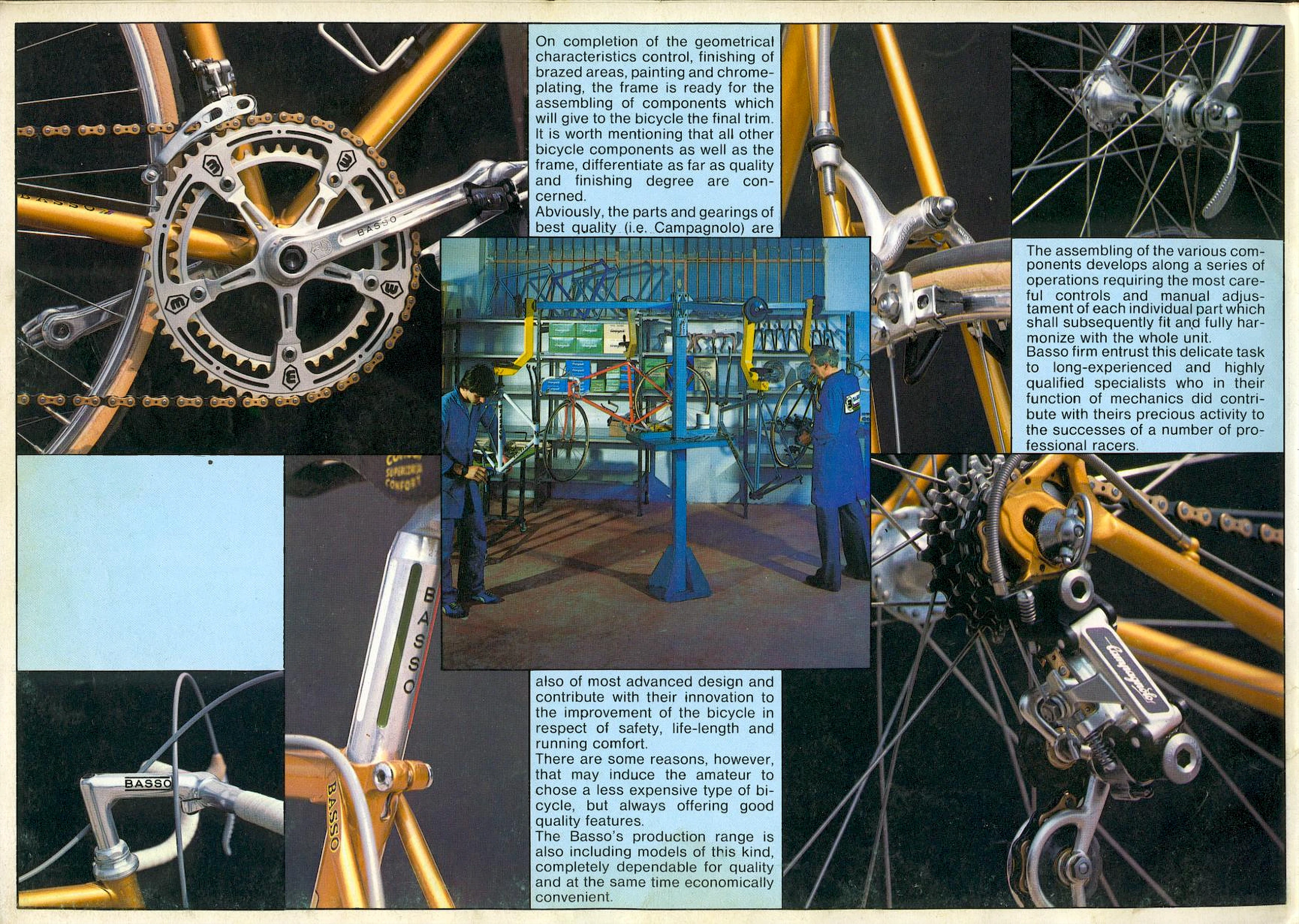
On completion of the geometrical characteristics control, finishing of brazed areas, painting and chrome-plating, the frame is ready for the assembling of components which will give to the bicycle the final trim.
It is worth mentioning that all other bicycle components as well as the frame, differentiate as far as quality and finishing degree are concerned.
Abviously, the parts and gearings of best quality (i.e. Campagnolo) are also of most advanced design and contribute with their innovation to the improvement of the bicycle in respect of safety, life-length and running comfort.
There are some reasons, however, that may induce the amateur to chose a less expensive type of bicycle, but always offering good quality features.
The Basso’s production range is also including models of this kind, completely dependable for quality and at the same time economically convenient.
The assembling of the various components develops along a series of operations requiring the most careful controls and manual adjustament of each individual part which shall subsequently fit and fully harmonize with the whole unit.
Basso firm entrust this delicate task to long-experienced and highly qualified specialists who in their function of mechanics did contribute with theirs precious activity to the successes of a number of professional racers.
[Close photographs of a BASSO crankset with chainrings and chain, brake calipers, hubs and a rear derailleur, a handlebar stem and a seat tube on gold frames, around a photograph of two workers assembling bicycles in a workshop, with two English text blocks on assembling the components. A blank light blue panel at the lower left carries a small round dark speck near its top edge.]
— Page 8 —
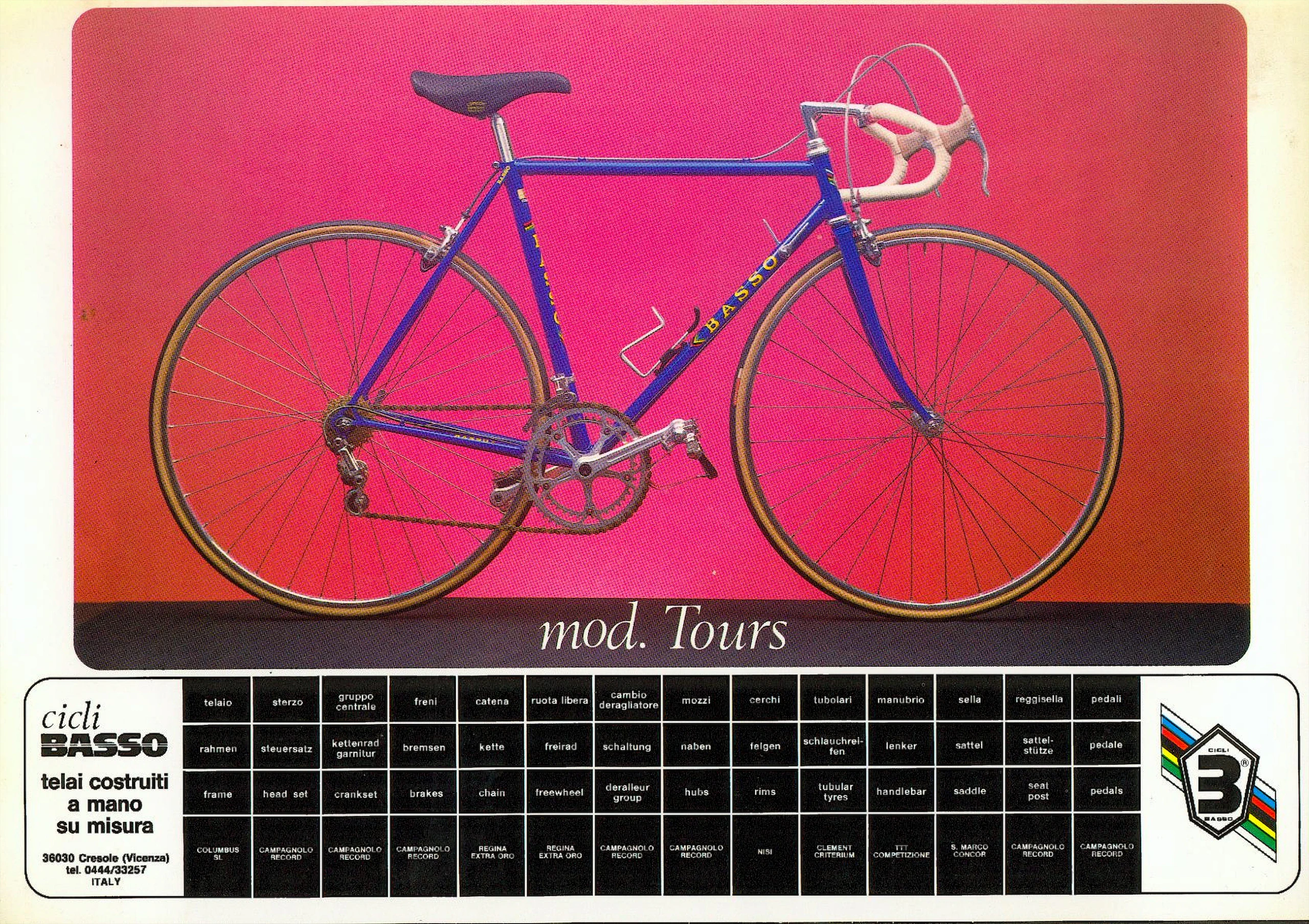
mod. Tours
cicli BASSO
telai costruiti a mano su misura
36030 Cresole (Vicenza)
tel. 0444/33257
ITALY
telaio | sterzo | gruppo centrale | freni | catena | ruota libera | cambio deragliatore | mozzi | cerchi | tubolari | manubrio | sella | reggisella | pedali
rahmen | steuersatz | kettenrad garnitur | bremsen | kette | freirad | schaltung | naben | felgen | schlauchreifen | lenker | sattel | sattelstütze | pedale
frame | head set | crankset | brakes | chain | freewheel | deralleur group | hubs | rims | tubular tyres | handlebar | saddle | seat post | pedals
COLUMBUS SL | CAMPAGNOLO RECORD | CAMPAGNOLO RECORD | CAMPAGNOLO RECORD | REGINA EXTRA ORO | REGINA EXTRA ORO | CAMPAGNOLO RECORD | CAMPAGNOLO RECORD | NISI | CLEMENT CRITERIUM | TTT COMPETIZIONE | S. MARCO CONCOR | CAMPAGNOLO RECORD | CAMPAGNOLO RECORD
CICLI 3 BASSO
[A blue-framed racing bicycle with cream handlebar tape in a studio photograph on a pink background, captioned “mod. Tours”, with a black specification table of 14 columns in Italian, German and English and the component names beneath. The cicli BASSO name and address sit at the left of the table and the “3” badge with rainbow stripes at the right.]
— Page 9 —
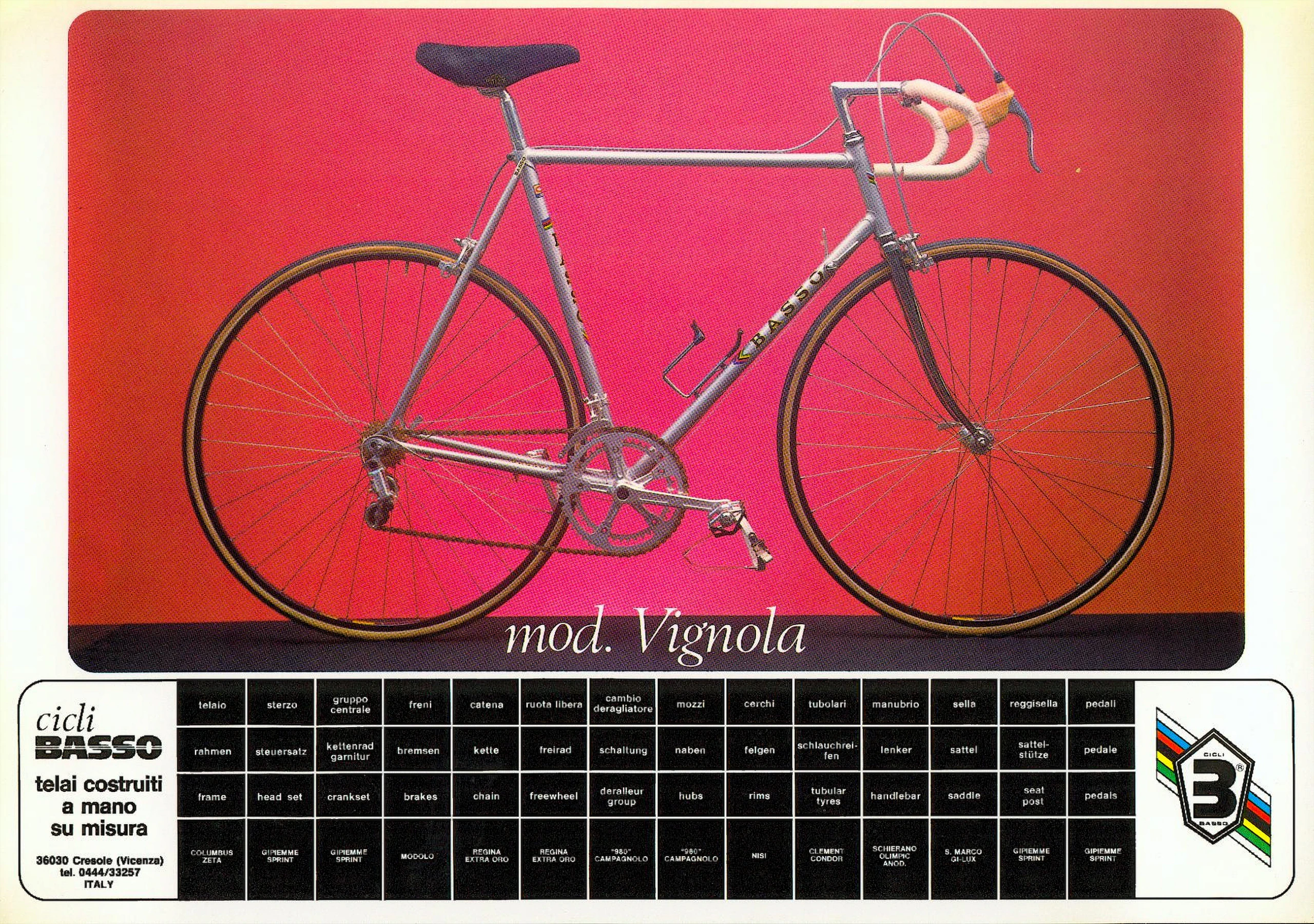
mod. Vignola
cicli BASSO
telai costruiti a mano su misura
36030 Cresole (Vicenza)
tel. 0444/33257
ITALY
telaio | sterzo | gruppo centrale | freni | catena | ruota libera | cambio deragliatore | mozzi | cerchi | tubolari | manubrio | sella | reggisella | pedali
rahmen | steuersatz | kettenrad garnitur | bremsen | kette | freirad | schaltung | naben | felgen | schlauchreifen | lenker | sattel | sattelstütze | pedale
frame | head set | crankset | brakes | chain | freewheel | deralleur group | hubs | rims | tubular tyres | handlebar | saddle | seat post | pedals
COLUMBUS ZETA | GIPIEMME SPRINT | GIPIEMME SPRINT | MODOLO | REGINA EXTRA ORO | REGINA EXTRA ORO | “980” CAMPAGNOLO | “980” CAMPAGNOLO | NISI | CLEMENT CONDOR | SCHIERANO OLIMPIC ANOD. | S. MARCO GI-LUX | GIPIEMME SPRINT | GIPIEMME SPRINT
CICLI 3 BASSO
[A silver-gray racing bicycle with cream handlebar tape in a studio photograph on a red background, captioned “mod. Vignola”, with a black specification table of 14 columns in Italian, German and English and the component names beneath. The cicli BASSO name and address sit at the left of the table and the “3” badge with rainbow stripes at the right.]
— Page 10 —
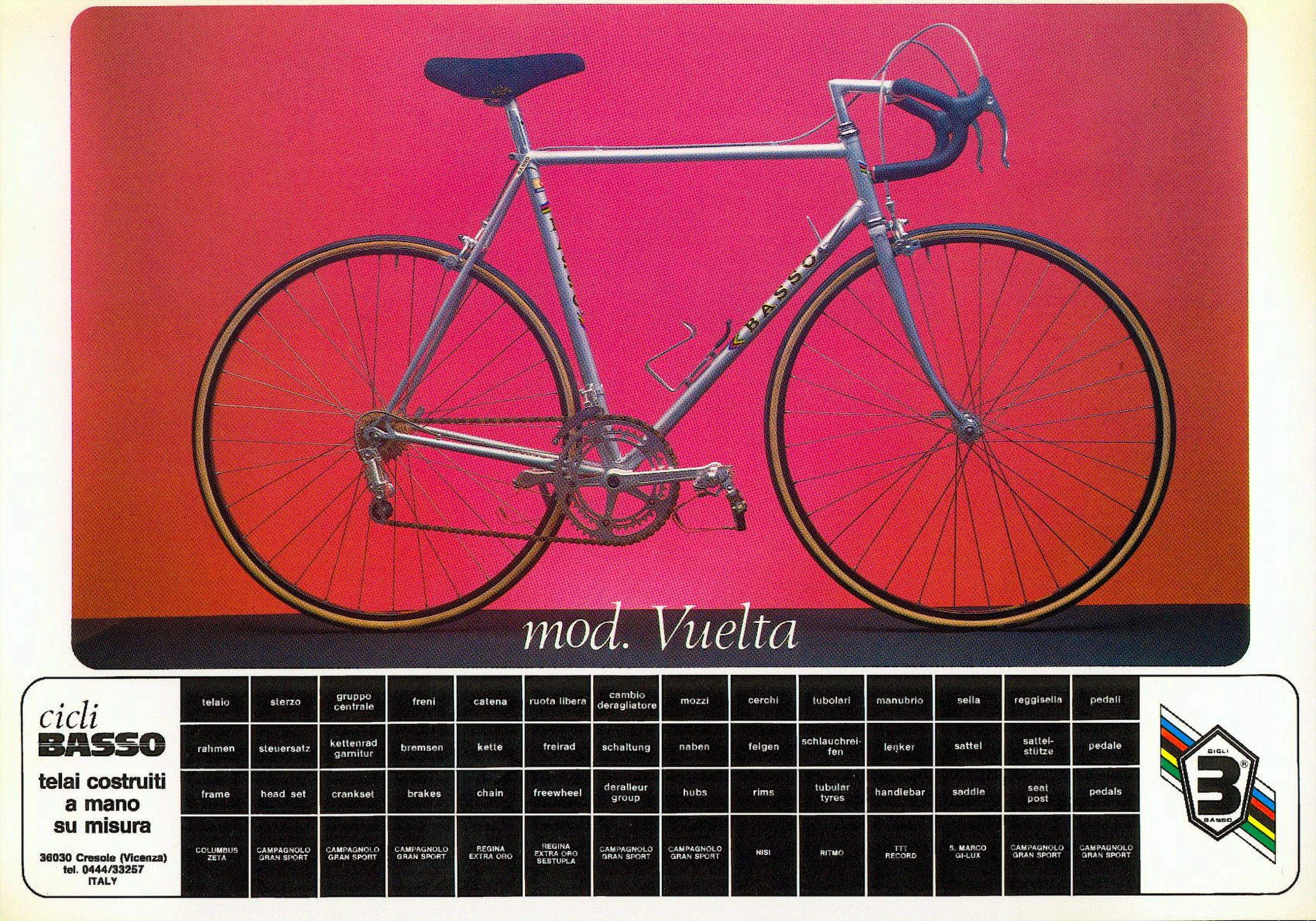
mod. Vuelta
cicli BASSO
telai costruiti a mano su misura
36030 Cresole (Vicenza)
tel. 0444/33257
ITALY
telaio | sterzo | gruppo centrale | freni | catena | ruota libera | cambio deragliatore | mozzi | cerchi | tubolari | manubrio | sella | reggisella | pedali
rahmen | steuersatz | kettenrad garnitur | bremsen | kette | freirad | schaltung | naben | felgen | schlauchreifen | lenker | sattel | sattelstütze | pedale
frame | head set | crankset | brakes | chain | freewheel | deralleur group | hubs | rims | tubular tyres | handlebar | saddle | seat post | pedals
COLUMBUS ZETA | CAMPAGNOLO GRAN SPORT | CAMPAGNOLO GRAN SPORT | CAMPAGNOLO GRAN SPORT | REGINA EXTRA ORO | REGINA EXTRA ORO SESTUPLA | CAMPAGNOLO GRAN SPORT | CAMPAGNOLO GRAN SPORT | NISI | RITMO | TTT RECORD | S. MARCO GI-LUX | CAMPAGNOLO GRAN SPORT | CAMPAGNOLO GRAN SPORT
CICLI 3 BASSO
[A silver-gray racing bicycle with dark blue handlebar tape in a studio photograph on a pink background, captioned “mod. Vuelta”, with a black specification table of 14 columns in Italian, German and English and the component names beneath. The cicli BASSO name and address sit at the left of the table and the “3” badge with rainbow stripes at the right.]
— Page 11 —
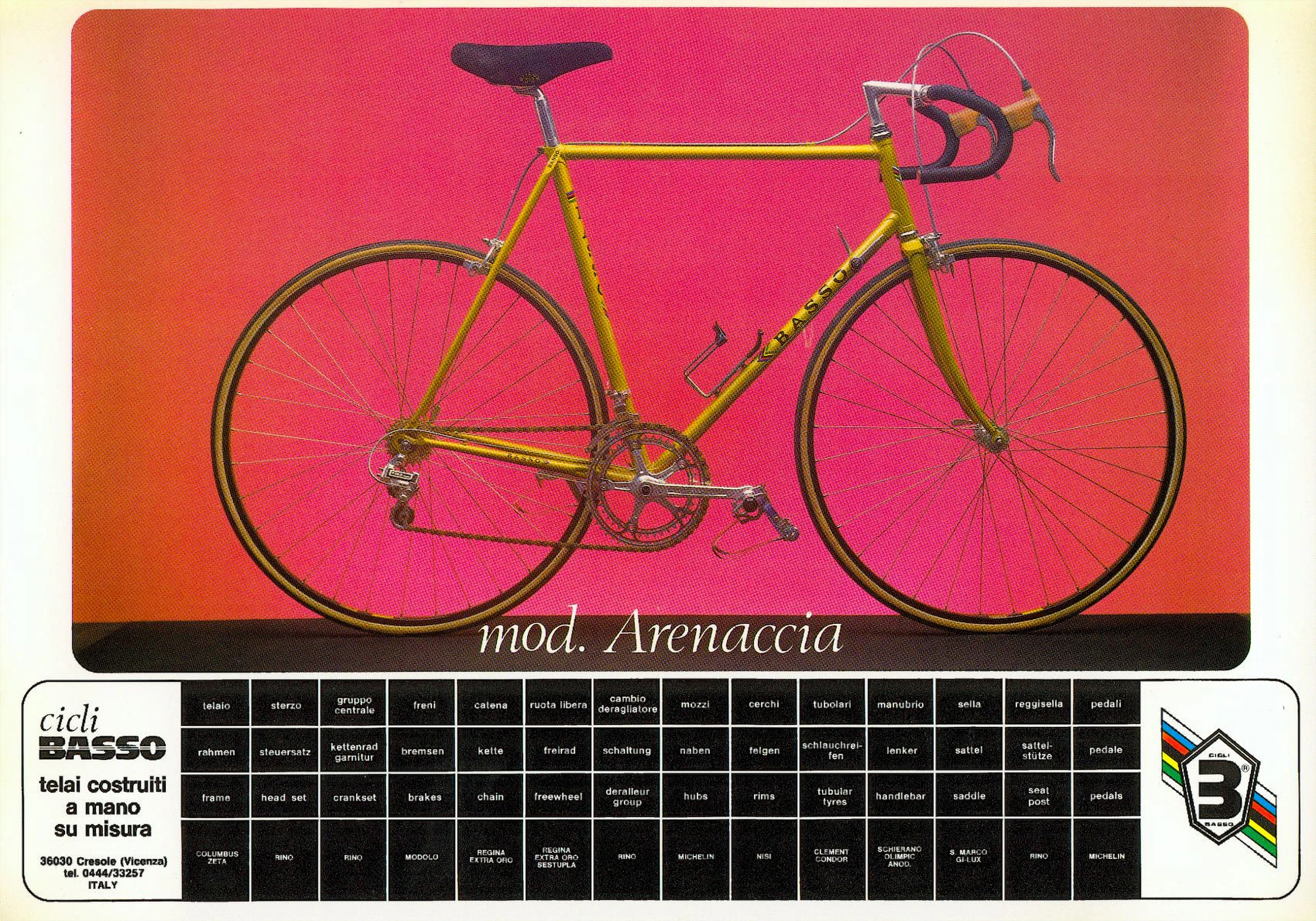
mod. Arenaccia
cicli BASSO
telai costruiti a mano su misura
36030 Cresole (Vicenza)
tel. 0444/33257
ITALY
telaio | sterzo | gruppo centrale | freni | catena | ruota libera | cambio deragliatore | mozzi | cerchi | tubolari | manubrio | sella | reggisella | pedali
rahmen | steuersatz | kettenrad garnitur | bremsen | kette | freirad | schaltung | naben | felgen | schlauchreifen | lenker | sattel | sattelstütze | pedale
frame | head set | crankset | brakes | chain | freewheel | deralleur group | hubs | rims | tubular tyres | handlebar | saddle | seat post | pedals
COLUMBUS ZETA | RINO | RINO | MODOLO | REGINA EXTRA ORO | REGINA EXTRA ORO SESTUPLA | RINO | MICHELIN | NISI | CLEMENT CONDOR | SCHIERANO OLIMPIC ANOD. | S. MARCO GI-LUX | RINO | MICHELIN
CICLI 3 BASSO
[A yellow racing bicycle with dark blue handlebar tape in a studio photograph on a pink and orange background, captioned “mod. Arenaccia”, with a black specification table of 14 columns in Italian, German and English and the component names beneath. The cicli BASSO name and address sit at the left of the table and the “3” badge with rainbow stripes at the right.]
— Page 12 —
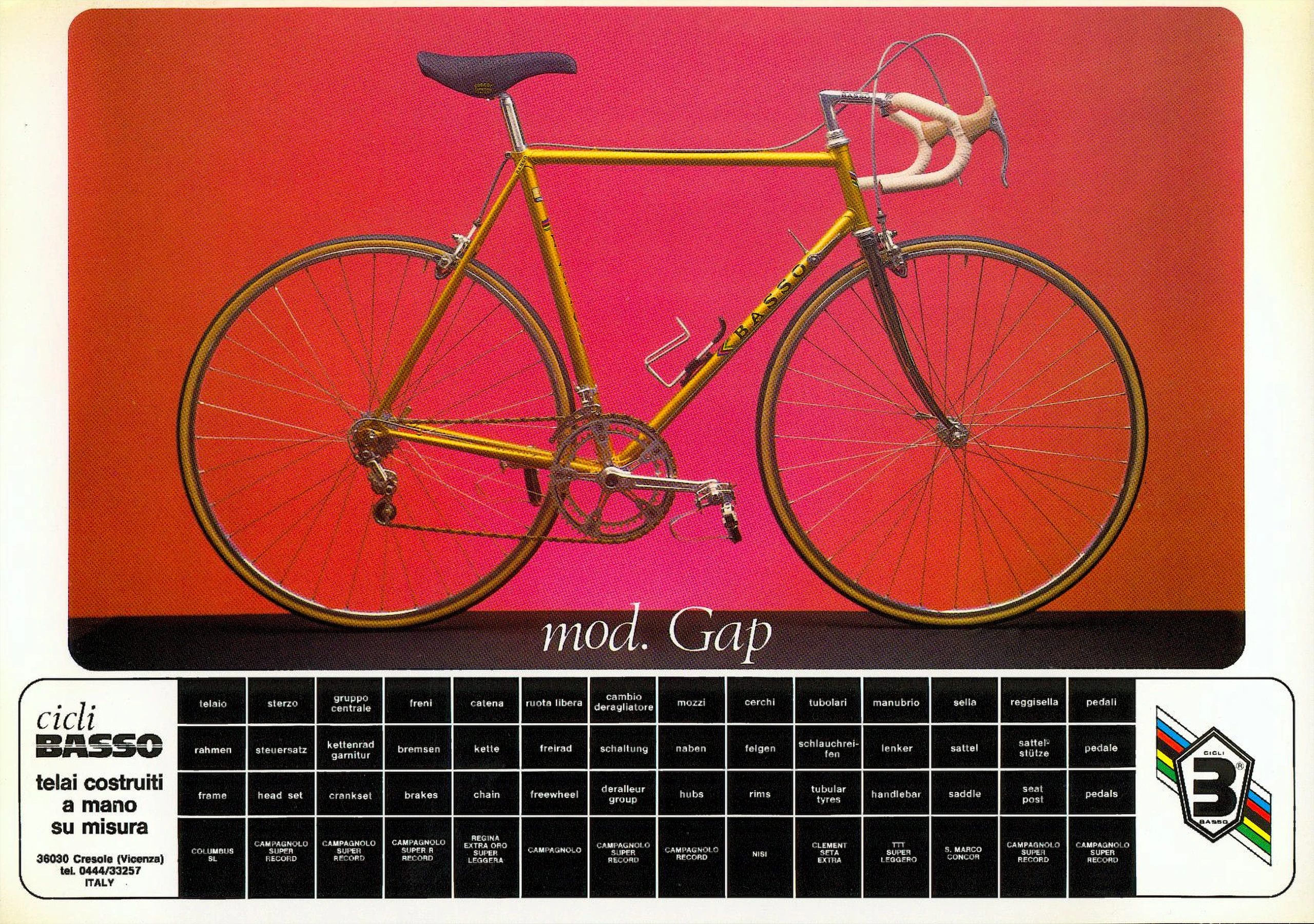
mod. Gap
cicli BASSO
telai costruiti a mano su misura
36030 Cresole (Vicenza)
tel. 0444/33257
ITALY
telaio | sterzo | gruppo centrale | freni | catena | ruota libera | cambio deragliatore | mozzi | cerchi | tubolari | manubrio | sella | reggisella | pedali
rahmen | steuersatz | kettenrad garnitur | bremsen | kette | freirad | schaltung | naben | felgen | schlauchreifen | lenker | sattel | sattelstütze | pedale
frame | head set | crankset | brakes | chain | freewheel | deralleur group | hubs | rims | tubular tyres | handlebar | saddle | seat post | pedals
COLUMBUS SL | CAMPAGNOLO SUPER RECORD | CAMPAGNOLO SUPER RECORD | CAMPAGNOLO SUPER R RECORD | REGINA EXTRA ORO SUPER LEGGERA | CAMPAGNOLO | CAMPAGNOLO SUPER RECORD | CAMPAGNOLO RECORD | NISI | CLEMENT SETA EXTRA | TTT SUPER LEGGERO | S. MARCO CONCOR | CAMPAGNOLO SUPER RECORD | CAMPAGNOLO SUPER RECORD
CICLI 3 BASSO
[A yellow racing bicycle with cream handlebar tape in a studio photograph on a red and pink background, captioned “mod. Gap”, with a black specification table of 14 columns in Italian, German and English and the component names beneath. The cicli BASSO name and address sit at the left of the table and the “3” badge with rainbow stripes at the right.]
— Page 13 —
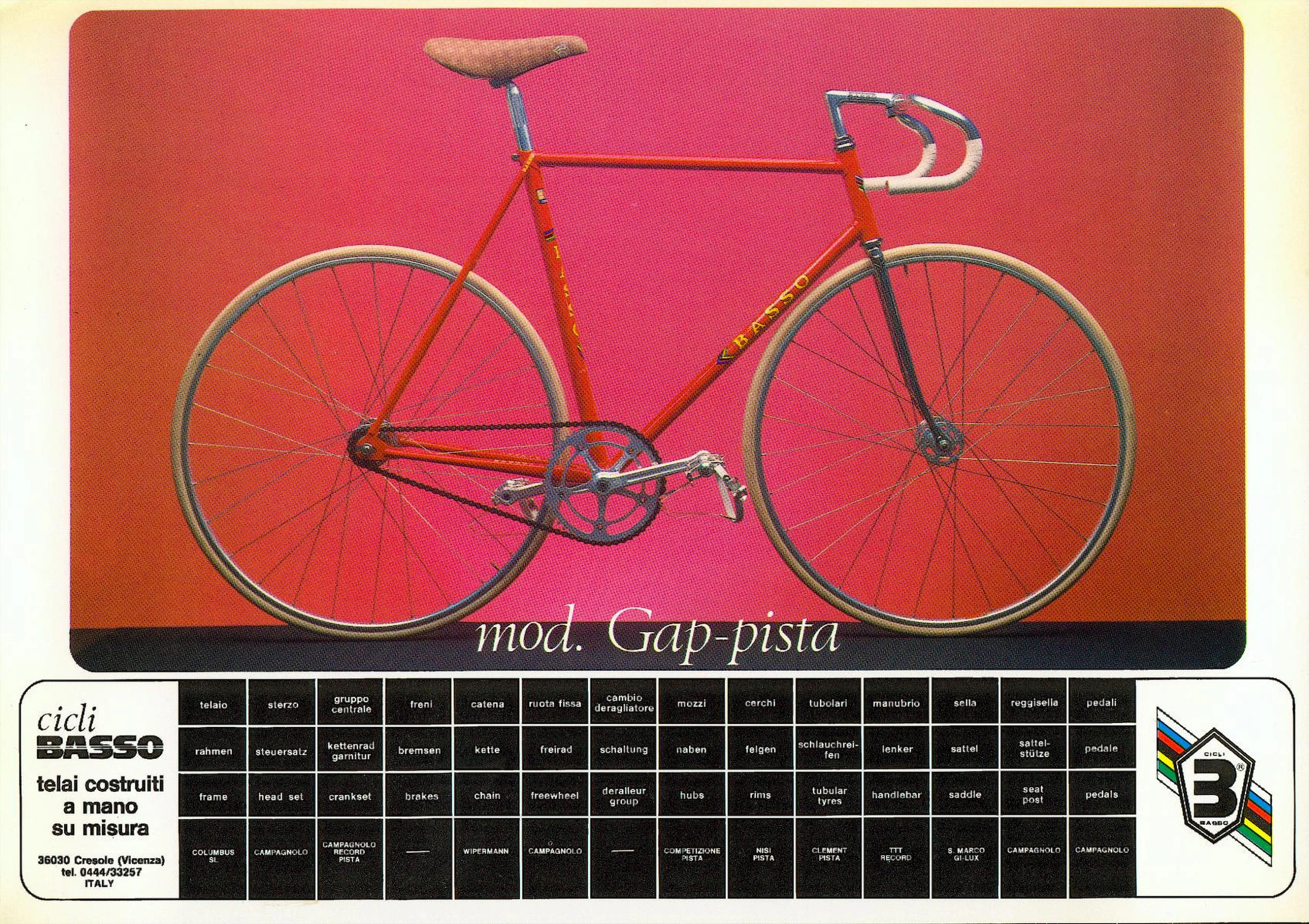
mod. Gap-pista
cicli BASSO
telai costruiti a mano su misura
36030 Cresole (Vicenza)
tel. 0444/33257
ITALY
telaio | sterzo | gruppo centrale | freni | catena | ruota fissa | cambio deragliatore | mozzi | cerchi | tubolari | manubrio | sella | reggisella | pedali
rahmen | steuersatz | kettenrad garnitur | bremsen | kette | freirad | schaltung | naben | felgen | schlauchreifen | lenker | sattel | sattelstütze | pedale
frame | head set | crankset | brakes | chain | freewheel | deralleur group | hubs | rims | tubular tyres | handlebar | saddle | seat post | pedals
COLUMBUS SL | CAMPAGNOLO | CAMPAGNOLO RECORD PISTA | — | WIPERMANN | CAMPAGNOLO | — | COMPETIZIONE PISTA | NISI PISTA | CLEMENT PISTA | TTT RECORD | S. MARCO GI-LUX | CAMPAGNOLO | CAMPAGNOLO
CICLI 3 BASSO
[A red track bicycle without brakes, with cream handlebar tape and a tan leather saddle, in a studio photograph on a pink background, captioned “mod. Gap-pista”, with a black specification table of 14 columns in Italian, German and English and the component names beneath. The brakes and derailleur cells hold a short dash, and the cicli BASSO name and address sit at the left of the table with the “3” badge at the right.]
— Page 14 (back cover) —
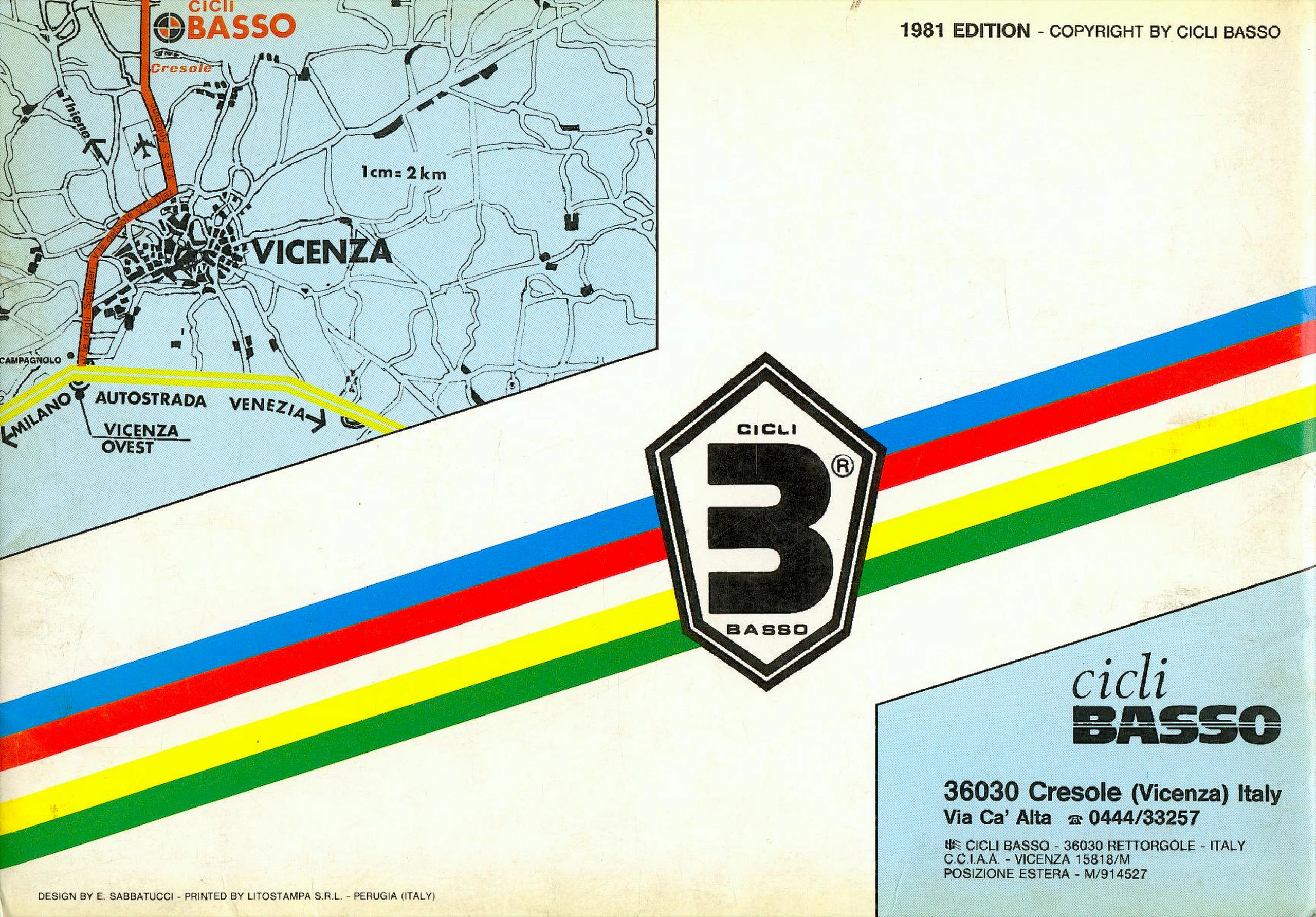
1981 EDITION – COPYRIGHT BY CICLI BASSO
cicli BASSO
Cresole
Thiene
V.le S. Antonino[?]
V.le Diaz
V.le del Sole
V.le degli Scaligeri
1cm= 2km
VICENZA
CAMPAGNOLO
MILANO
AUTOSTRADA
VENEZIA
VICENZA OVEST
CICLI 3 BASSO
cicli BASSO
36030 Cresole (Vicenza) Italy
Via Ca’ Alta 0444/33257
CICLI BASSO – 36030 RETTORGOLE – ITALY
C.C.I.A.A. – VICENZA 15818/M
POSIZIONE ESTERA – M/914527
DESIGN BY E. SABBATUCCI – PRINTED BY LITOSTAMPA S.R.L. – PERUGIA (ITALY)
[A street map of Vicenza with the cicli BASSO site at Cresole marked by an orange route, the autostrada from Milano to Venezia and the Vicenza Ovest exit, beside the “3” badge with rainbow stripes and the cicli BASSO address panel. A telephone symbol stands before the telephone number and a small company symbol before the Rettorgole line.]
Ebykr presents this material for research and education. If you hold rights to it or notice an ownership issue, please contact us and we will respond promptly.
The Ebykr Digest
New articles, timelines, catalog finds and registry activity — assembled from the archive once a month. Your address is never shared.
Double opt-in. One email per month. Unsubscribe at any time with one click.