About Ebykr
Ebykr celebrates classic and vintage lightweight bicycles through provoking imagery and opinion. Ride along with us.
About Ebykr
Ebykr celebrates classic and vintage lightweight bicycles through provoking imagery and opinion. Ride along with us.

Source: Ebykr archive.
| Marque | Automoto |
|---|---|
| Type | Catalog |
| Year | 1926 |
| Publisher | Cycles Automoto |
| Country | France |
| Language | French |
| Pages | 3 |
| Source | Ebykr archive. |
| Credit | Ebykr archive |
| Transcription | Transcribed by eye |
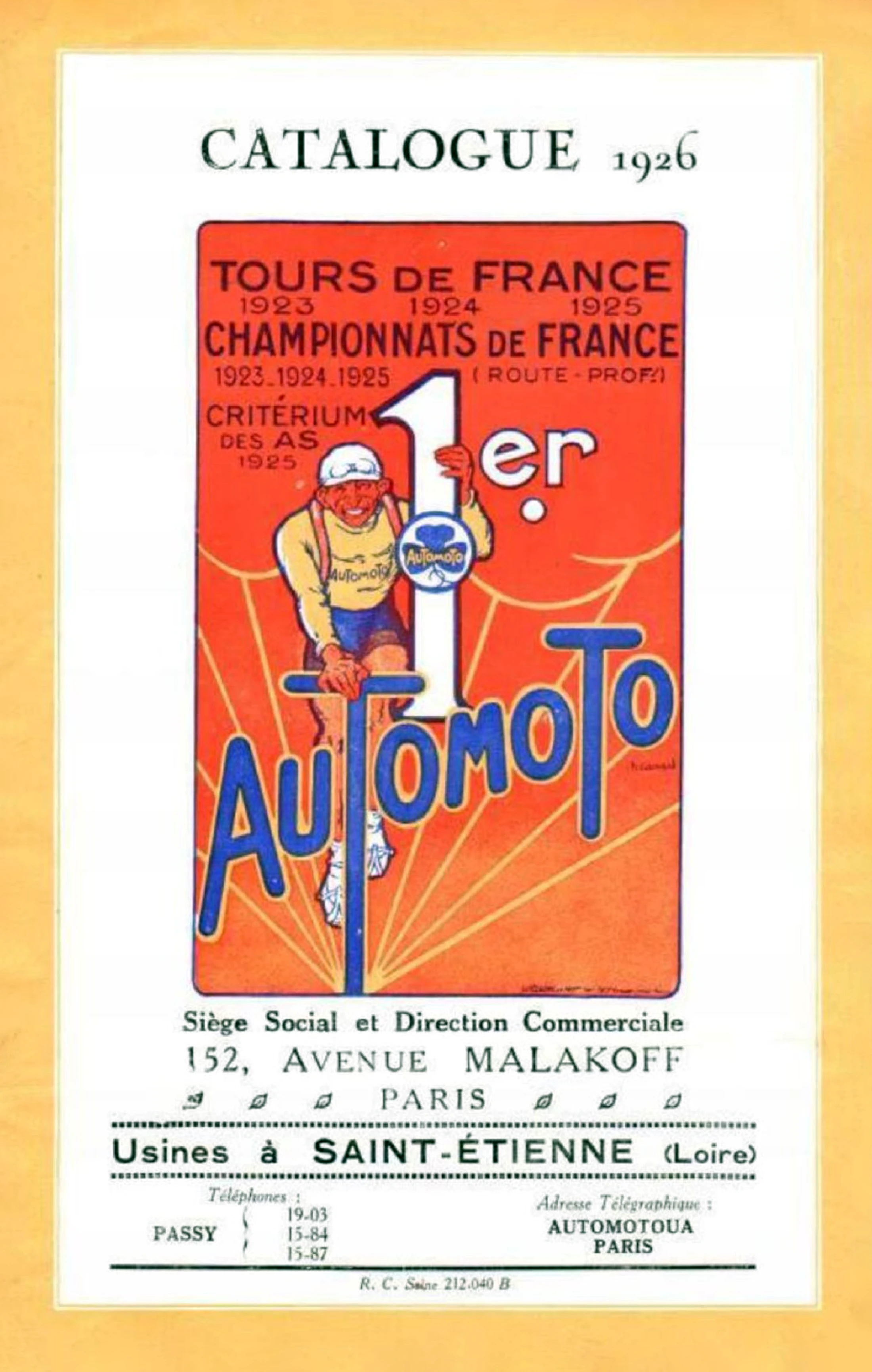
--- Cover --- CATALOGUE 1926 Within the poster panel reproduced on the cover: TOURS DE FRANCE 1923 1924 1925 CHAMPIONNATS DE FRANCE 1923.1924.1925 (ROUTE - PROF!) CRITÉRIUM DES AS 1925 1er. AUTOMOTO Beneath the panel: Siège Social et Direction Commerciale 152, AVENUE MALAKOFF PARIS Usines à SAINT-ÉTIENNE (Loire) Téléphones : PASSY 19-03 15-84 15-87 Adresse …
— Cover —
CATALOGUE 1926
Within the poster panel reproduced on the cover:
TOURS DE FRANCE
1923 1924 1925
CHAMPIONNATS DE FRANCE
1923.1924.1925 (ROUTE – PROF!)
CRITÉRIUM DES AS
1925
1er.
AUTOMOTO
Beneath the panel:
Siège Social et Direction Commerciale
152, AVENUE MALAKOFF
PARIS
Usines à SAINT-ÉTIENNE (Loire)
Téléphones :
PASSY 19-03
15-84
15-87
Adresse Télégraphique :
AUTOMOTOUA
PARIS
R. C. Seine 212.040 B
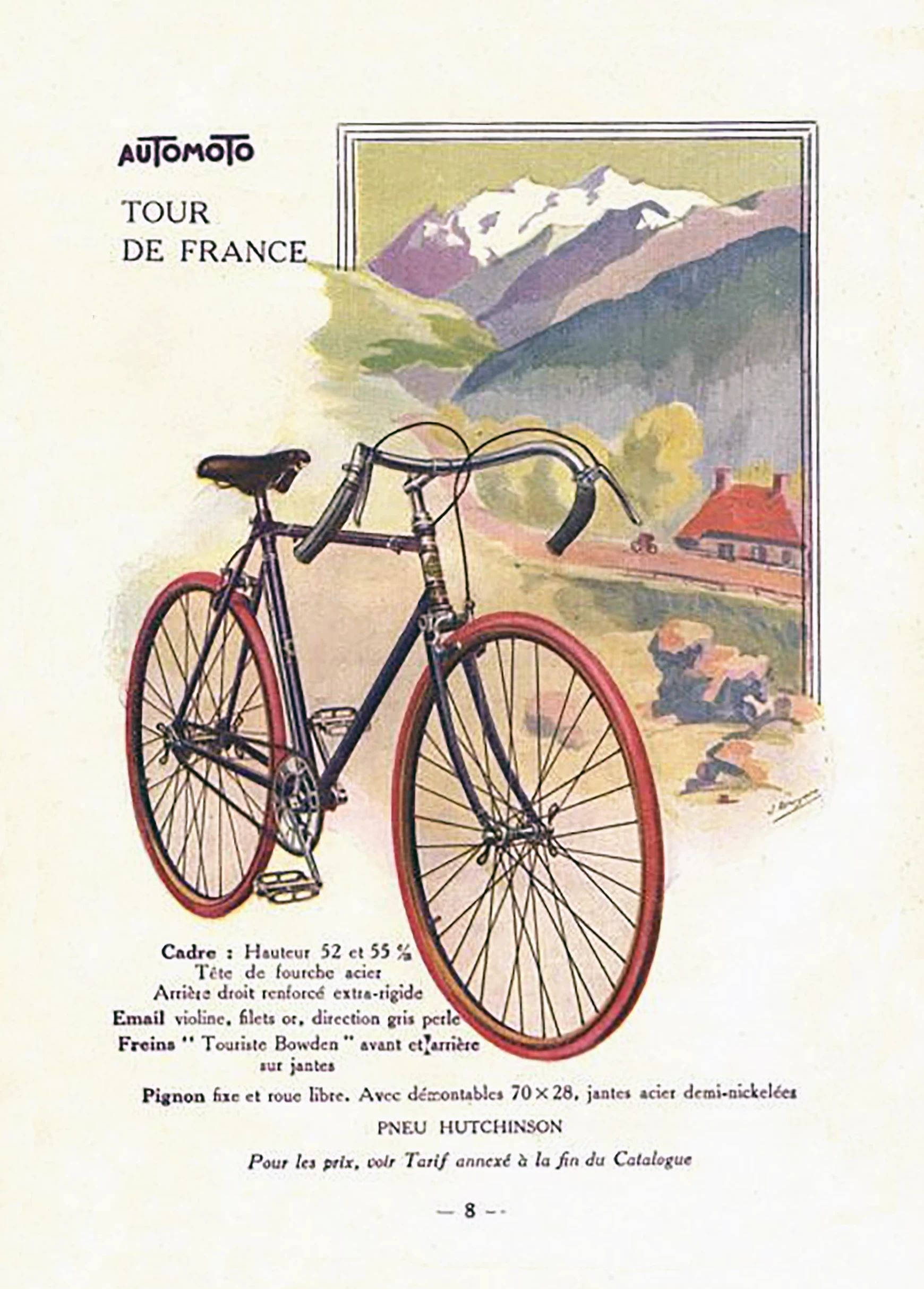
— Page 8 —
AUTOMOTO
TOUR
DE FRANCE
Cadre : Hauteur 52 et 55 c/m
Tête de fourche acier
Arrière droit renforcé extra-rigide
Email violine, filets or, direction gris perle
Freins ” Touriste Bowden ” avant et arrière sur jantes
Pignon fixe et roue libre. Avec démontables 70 × 28, jantes acier demi-nickelées
PNEU HUTCHINSON
Pour les prix, voir Tarif annexé à la fin du Catalogue
— 8 —
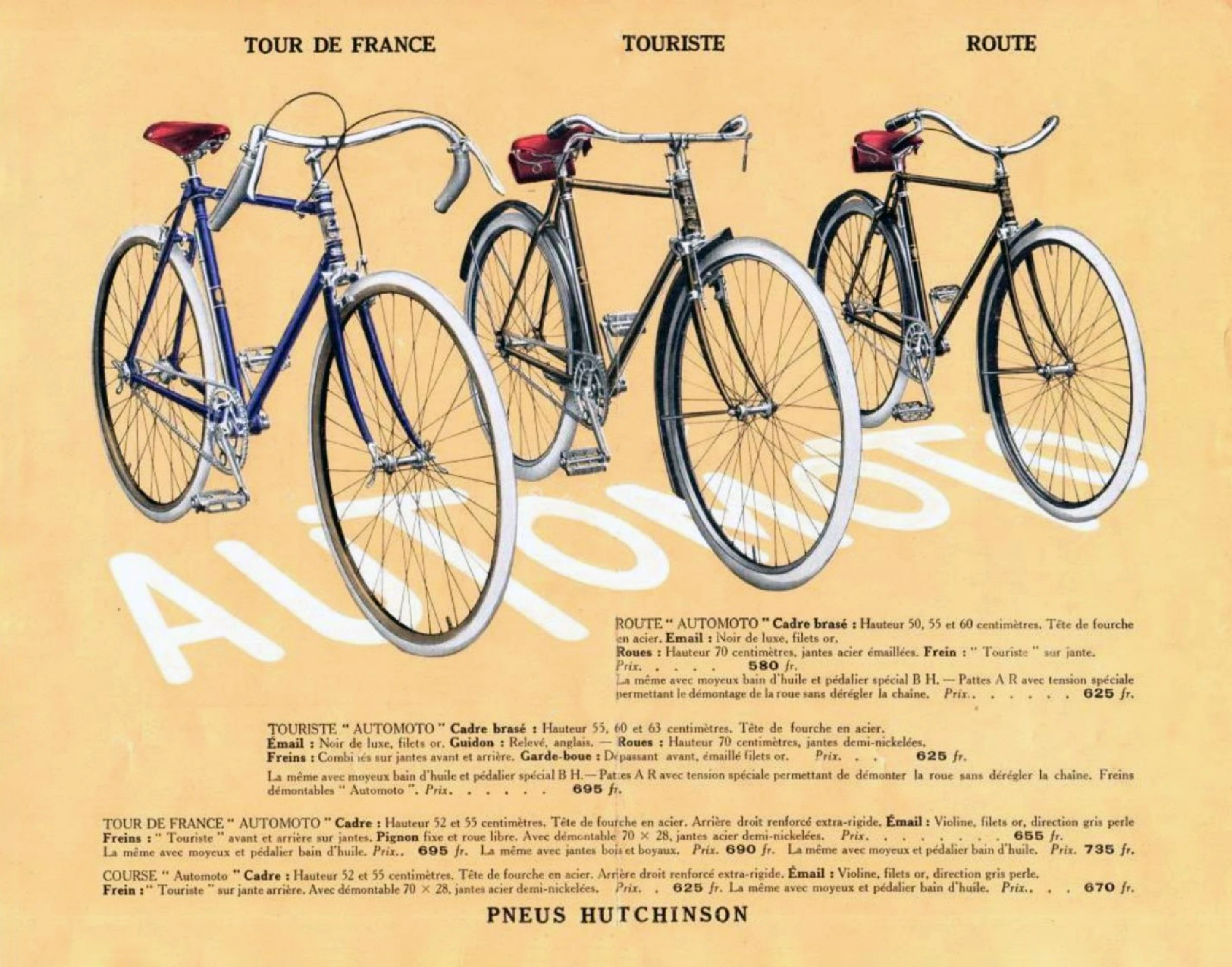
— Tarif annexé —
TOUR DE FRANCE TOURISTE ROUTE
ROUTE ” AUTOMOTO ” Cadre brasé : Hauteur 50, 55 et 60 centimètres. Tête de fourche en acier.
Email : Noir de luxe, filets or.
Roues : Hauteur 70 centimètres, jantes acier émaillées. Frein : ” Touriste ” sur jante.
Prix . . . . . 580 fr.
La même avec moyeux bain d’huile et pédalier spécial B H. — Pattes A R avec tension spéciale
permettant le démontage de la roue sans dérégler la chaine. Prix . . . . . . 625 fr.
TOURISTE ” AUTOMOTO ” Cadre brasé : Hauteur 55, 60 et 63 centimètres. Tête de fourche en acier.
Émail : Noir de luxe, filets or. Guidon : Relevé, anglais. — Roues : Hauteur 70 centimètres, jantes
demi-nickelées.
Freins : Combinés sur jantes avant et arrière. Garde-boue : Dépassant avant, émaillé filets or.
Prix . . 625 fr.
La même avec moyeux bain d’huile et pédalier spécial B H. — Pattes A R avec tension spéciale
permettant de démonter la roue sans dérégler la chaîne. Freins démontables ” Automoto “.
Prix . . . . . 695 fr.
TOUR DE FRANCE ” AUTOMOTO ” Cadre : Hauteur 52 et 55 centimètres. Tête de fourche en acier. Arrière
droit renforcé extra-rigide. Émail : Violine, filets or, direction gris perle.
Freins : ” Touriste ” avant et arrière sur jantes. Pignon fixe et roue libre. Avec démontable
70 × 28, jantes acier demi-nickelées. Prix . . . . . . 655 fr.
La même avec moyeux et pédalier bain d’huile. Prix.. 695 fr. La même avec jantes bois et boyaux.
Prix. 690 fr. La même avec moyeux et pédalier bain d’huile. Prix. 735 fr.
COURSE ” Automoto ” Cadre : Hauteur 52 et 55 centimètres. Tête de fourche en acier. Arrière droit
renforcé extra-rigide. Émail : Violine, filets or, direction gris perle.
Frein : ” Touriste ” sur jante arrière. Avec démontable 70 × 28, jantes acier demi-nickelées.
Prix . . 625 fr. La même avec moyeux et pédalier bain d’huile. Prix.. . . 670 fr.
PNEUS HUTCHINSON
[Three leaves of Automoto’s catalog for 1926: the front cover, the illustrated Tour de France page
numbered 8, and the tariff annexed at the back.
The cover is printed on cream card with an orange border and gives its whole upper half to a
reproduction of the marque’s poster of the moment. Against a flat vermilion ground a grinning rider
in an Automoto jersey leans on the top of a giant blue A, a large white 1er. rises behind his
shoulder and AUTOMOTO runs across the foot in blue capitals drawn as tubes. The palmares is stacked
above his head: three Tours de France, three French road professional championships and the 1925
Critérium des As. Below the panel the cover turns into a business card — the registered office and
commercial management at 152 avenue Malakoff in Paris, the works at Saint-Étienne, three Passy
telephone numbers, the telegraphic address AUTOMOTOUA PARIS and the Seine register number. The
Paris address is the selling end of the business and Saint-Étienne is where the machines are made,
which is the division every Automoto document of the period keeps making.
Page 8 is one model on one page. The Tour de France stands in three-quarter view, violet with gold
lining and crimson rims, and behind it, set in a thin ruled frame like a hung picture, is a
watercolor of a snow-covered range with a red-roofed cottage and a road running toward the
mountains. The machine is not shown in a race or on a track but standing against the high mountains
the Tour had made famous, so the model name and the landscape make the same claim without a rider
present. An artist’s signature at the lower right of the framed landscape begins with a J and does
not resolve at the resolution held.
The third leaf is the tariff. It is landscape where the book is portrait, and printed on tan stock
where the book is cream, because a tariff is annexed rather than bound in precisely so it can be
reprinted when prices move. Three machines are painted across it — Tour de France, Touriste and
Route — with the word AUTOMOTO laid over the ground in white, running away in perspective like
lettering painted on a road. Under them the range is priced: a Route at 580 francs plain and 625
with oil-bath hubs and the special B H chainset, a Touriste at 625 and 695 on the same terms, the
Tour de France from 655 to 735 depending on hubs, chainset and whether the buyer takes steel rims
with detachable tires or wood rims with glued tubulars, and the Course at 625, cheapest of the
racing pair because it carries one brake on the rear rim where the Tour de France carries two.
The three leaves belong together and the sheets say so themselves. Page 8 prints no price and sends
the reader to the tariff annexed at the end of the catalog; the tariff is that sheet. Its line for
the Tour de France repeats page 8’s build word for word, down to the reinforced straight rear end,
the violet enamel with gold lining and pearl-gray head, and the detachable 70 by 28 tires on
half-nickeled steel rims — and then supplies the 655 francs page 8 withholds. The tariff also prices
a fourth model, the Course, which it does not illustrate: a display page prices what it shows, but a
tariff prices the range, and this one does.
One difference is worth recording rather than smoothing over. Page 8 names the brakes Touriste
Bowden and the tariff names them only Touriste. That reads as the compressed description of a price
list rather than a change of specification, since every other term in the two passages matches
exactly, but it is the one place where the two sheets do not agree.]
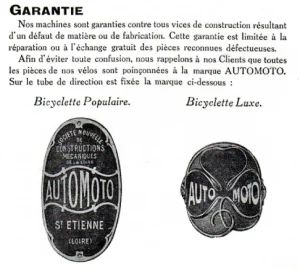 Automoto 1912 Catalog — Garantie and the Head Badges (Page 6)
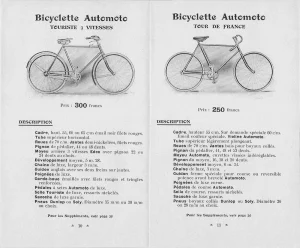 Automoto 1914 Catalog — Touriste 3 Vitesses and Tour de France (Pages 10 and 11)
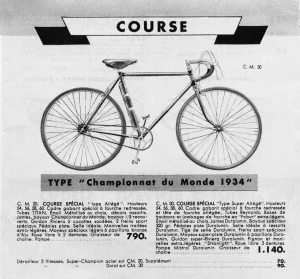 Automoto 1935 Catalog — Course, Type Championnat du Monde 1934
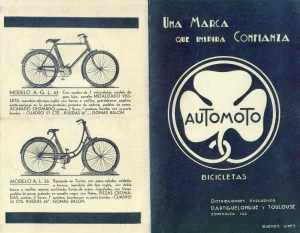 Automoto Catalog for Argentina — Una Marca que Inspira Confianza
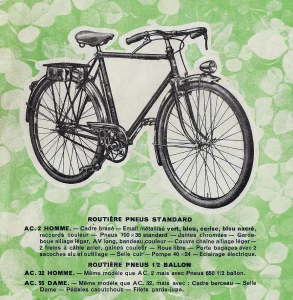 Automoto Catalog — Routière Pneus Standard and Pneus 1/2 Ballon
Ebykr presents this material for research and education. If you hold rights to it or notice an ownership issue, please contact us and we will respond promptly.
The Ebykr Digest
New articles, timelines, catalog finds and registry activity — assembled from the archive once a month. Your address is never shared.
Double opt-in. One email per month. Unsubscribe at any time with one click.