About Ebykr
Ebykr celebrates classic and vintage lightweight bicycles through provocative imagery and opinion. Ride along with us.
About Ebykr
Ebykr celebrates classic and vintage lightweight bicycles through provocative imagery and opinion. Ride along with us.

Source: bulgier.net (Mark Bulgier's site), the larger scans in the FrameParts gallery, posted in 2006.
| Marque | Andrew Hague |
|---|---|
| Type | Instructions |
| Publisher | Andrew Hague Cycles Ltd. |
| Country | Wales |
| Language | English |
| Pages | 2 |
| Source | bulgier.net (Mark Bulgier's site), the larger scans in the FrameParts gallery, posted in 2006. |
| Credit | Ebykr archive |
| Identifier | Permalink http://bulgier.net/pics/bike/FrameParts/ |
| Transcription | Transcribed by eye |
Andrew Hague ANDREW HAGUE CYCLES LTD., Cwm Draw Industrial Estate, Ebbw Vale, Gwent. NP3 5AE Wales. Telephone : 0495 305915 Telex : 497244 HANDLEBAR STEMS DEMAND FOR CUSTOM BUILT STEMS Some years ago I was making steel handlebar stems and at that time, working as a one man operation, it was a worthwhile product. Since …
Andrew Hague Cycles’ instructions for frame builders on making steel handlebar stems in a jig. It prints no date; its address in Gwent places it in 1974 or later.
— Page 1 —
Andrew
Hague
ANDREW HAGUE CYCLES LTD.,
Cwm Draw Industrial Estate,
Ebbw Vale, Gwent. NP3 5AE
Wales.
Telephone : 0495 305915
Telex : 497244
HANDLEBAR STEMS
DEMAND FOR CUSTOM BUILT STEMS
Some years ago I was making steel handlebar stems and at that time, working as a one man operation, it was a worthwhile product. Since then my business has grown into mass production and our skills lie in machining rather than brazing and hand finishing individually made items.
However, the exercise has proved that there is a significant demand for a custom built stem and the customer who will pay £200 for a frame and £80 for a chain set will readily pay £20 to £25 for a stem made to his own specification.
There is a demand for stems which are longer and taller than the usual aluminium stems. Steel stems are considerably more rigid than aluminium so for a larger stem steel must be used in preference to aluminium. By using the same care as you do when frame building you will make steel stems that are no heavier than an aluminium stem of similar size.
You will also be asked to add such items as a centre pull brake adjuster and a handlebar support bracket.
MORE PROFIT
By using a jig you can make a stem accurately and easily. It thus increases your business potential and will give you a better return on the capital already invested in frame building equipment.
PREPARE THE TUBES
The first operation in making a stem is to cut all your pieces to length, chamfer the edges where necessary and mitre the extension piece at the end that will but to the handlebar grip. This latter item should be drilled about ⅜” at approximately half way along its length. Drill ⅛” diameter holes opposite each other one inch from the end of the
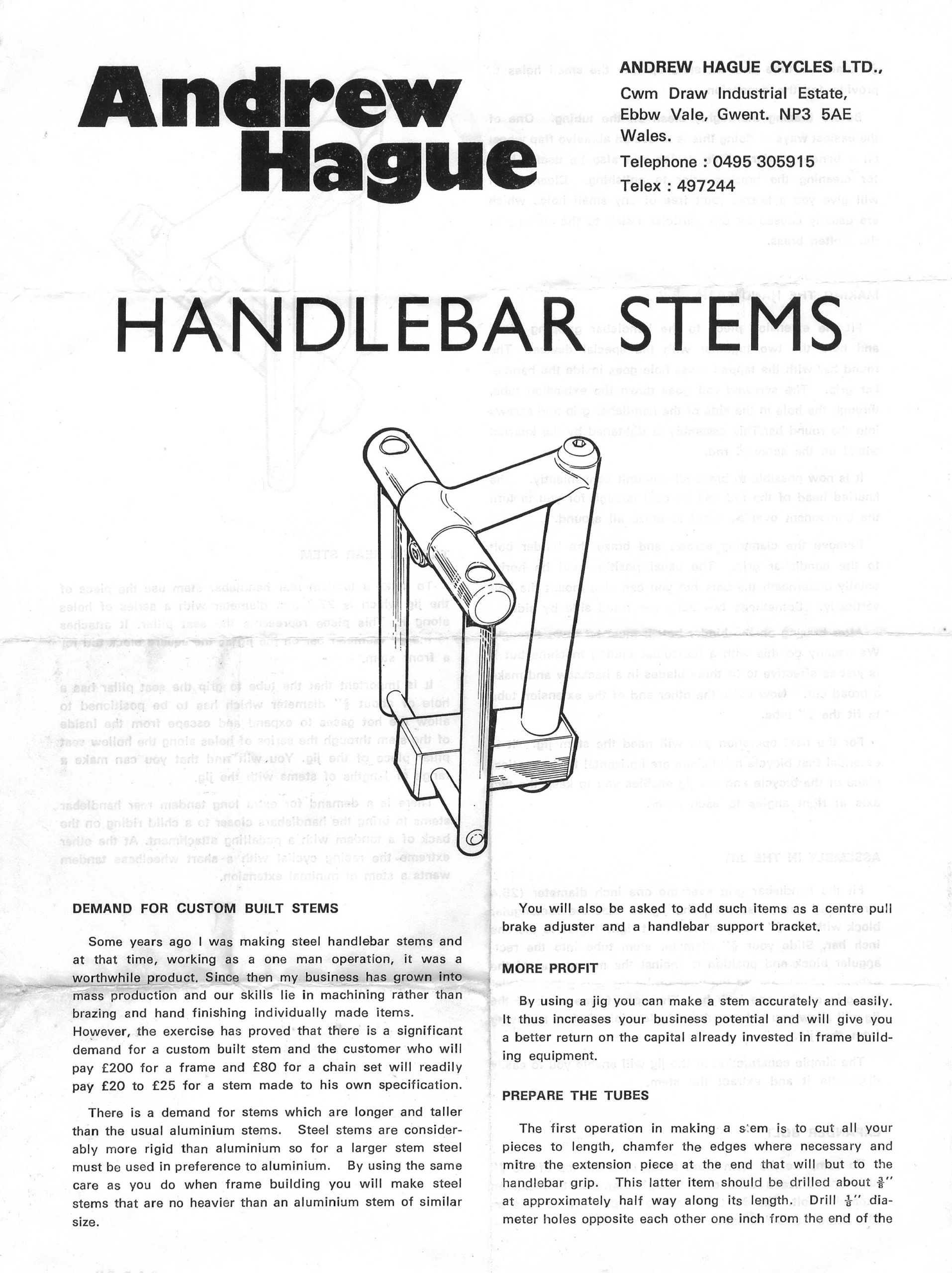
[Andrew Hague Cycles instructions for frame builders on making steel handlebar stems, with a line drawing of the Hague stem jig holding a front stem. The firm’s logo and Ebbw Vale address head the page above the title, and the two columns of text break off in mid sentence, to continue overleaf. Fold creases cross the sheet and the other side shows through in mirror image.]
— Page 2 —
⅞” diameter tube and cut slots up into the small holes to provide for the expansion.
Before brazing thoroughly clean all the tubing. One of the easiest ways of doing this is to use an abrasive flap wheel on a bench grinder. This device will also be useful later for cleaning the brazing prior to polishing. Clean metal will give you a brazed joint free of any small holes which are usually caused by dirt particles rising to the surface of the molten brass.
MAKING THE HANDLEBAR GRIP
Fit the extension piece to the handlebar gripping piece and hold the two together with the special device. The round bar with the tapped cross hole goes inside the handlebar grip. The screwed rod goes down the extension tube, through the hole in the side of the handlebar grip and screws into the round bar.This assembly is tightened by the knurled wheel on the screwed rod.
It is now possible to braze all this unit conveniently. The knurled head of the rod will be cool enough for you to turn the component over by hand to braze all around.
Remove the clamping screws and braze the binder bolt to the handlebar grip. The usual position will be horizontally underneath the bars but you can also mount the bolt vertically. Sometimes two bolts are fitted side by side.
After brazing on the binder bolt it must be sawn through. We usually do this with a horizontal milling machine but it is just as effective to fit three blades in a hacksaw and make a broad cut. Now mitre the other end of the extension tube to fit the ⅞” tube.
For the next operation you will need the stem jig. It is essential that bicycle handlebars are horizontal to the vertical plane of the bicycle and the jig enables you to keep the two axis at right angles to each other.
ASSEMBLY IN THE JIG
Fit the handlebar grip over the one inch diameter (25.4 mm) solid bar. Assemble the jig so that the rectangular block with the ⅞” diameter hole is at right angles to the one inch bar. Slide your ⅞” diameter stem tube into the rectangular block and position it against the mitred end of the extension tube. Secure the position by tightening the handlebar grip on the one inch bar. The open frame work of the jig will allow you to braze the complete joint before removing from the jig.
The simple construction of the jig will enable you to easily dismantle it and extract the stem.
EXPANDER BOLT
To complete the stem braze a cap onto the top of the ⅞” tube and braze a cone onto the ⅜” diameter to make an expander bolt. The ⅜” tube can be tapped M8 to take an M8 dome headed screw.
TANDEM REAR STEM
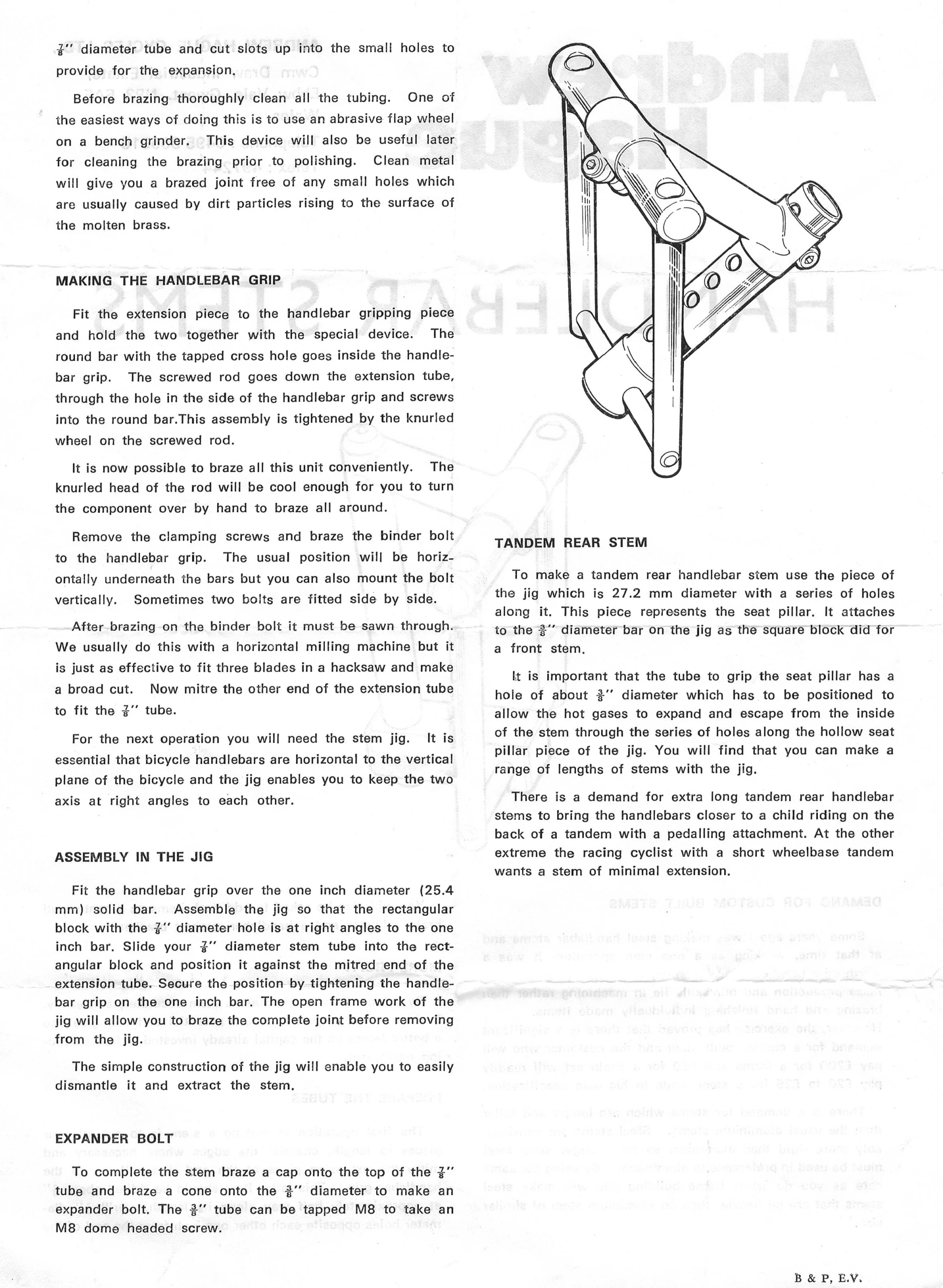
To make a tandem rear handlebar stem use the piece of the jig which is 27.2 mm diameter with a series of holes along it. This piece represents the seat pillar. It attaches to the ⅜” diameter bar on the jig as the square block did for a front stem.
It is important that the tube to grip the seat pillar has a hole of about ⅜” diameter which has to be positioned to allow the hot gases to expand and escape from the inside of the stem through the series of holes along the hollow seat pillar piece of the jig. You will find that you can make a range of lengths of stems with the jig.
There is a demand for extra long tandem rear handlebar stems to bring the handlebars closer to a child riding on the back of a tandem with a pedalling attachment. At the other extreme the racing cyclist with a short wheelbase tandem wants a stem of minimal extension.
B & P, E.V.
[Andrew Hague Cycles instructions on making the handlebar grip, assembling a stem in the jig, the expander bolt and the tandem rear stem, with a line drawing of the stem jig holding a tandem rear stem on its drilled seat pillar piece. The left column completes the sentence that breaks off on the other side of the sheet, and the printer’s imprint “B & P, E.V.” sits at the foot in a serif type. Fold creases cross the sheet and the other side shows through in mirror image.]
Ebykr presents this material for research and education. If you hold rights to it or notice an ownership issue, please contact us and we will respond promptly.
The Ebykr Digest
New articles, timelines, catalog finds and registry activity — assembled from the archive once a month. Your address is never shared.
Double opt-in. One email per month. Unsubscribe at any time with one click.