About Ebykr
Ebykr celebrates classic and vintage lightweight bicycles through provocative imagery and opinion. Ride along with us.
About Ebykr
Ebykr celebrates classic and vintage lightweight bicycles through provocative imagery and opinion. Ride along with us.

Source: Toronto Public Library Digital Archive (object 197675; the record page states Usage Rights: Public Domain), page images from the library's PDF; enlarged for Ebykr.
 Page 1
 Page 2
 Page 3
 Page 4
 Page 5
 Page 6
 Page 7
 Page 8
 Page 9
 Page 10
 Page 11
 Page 12
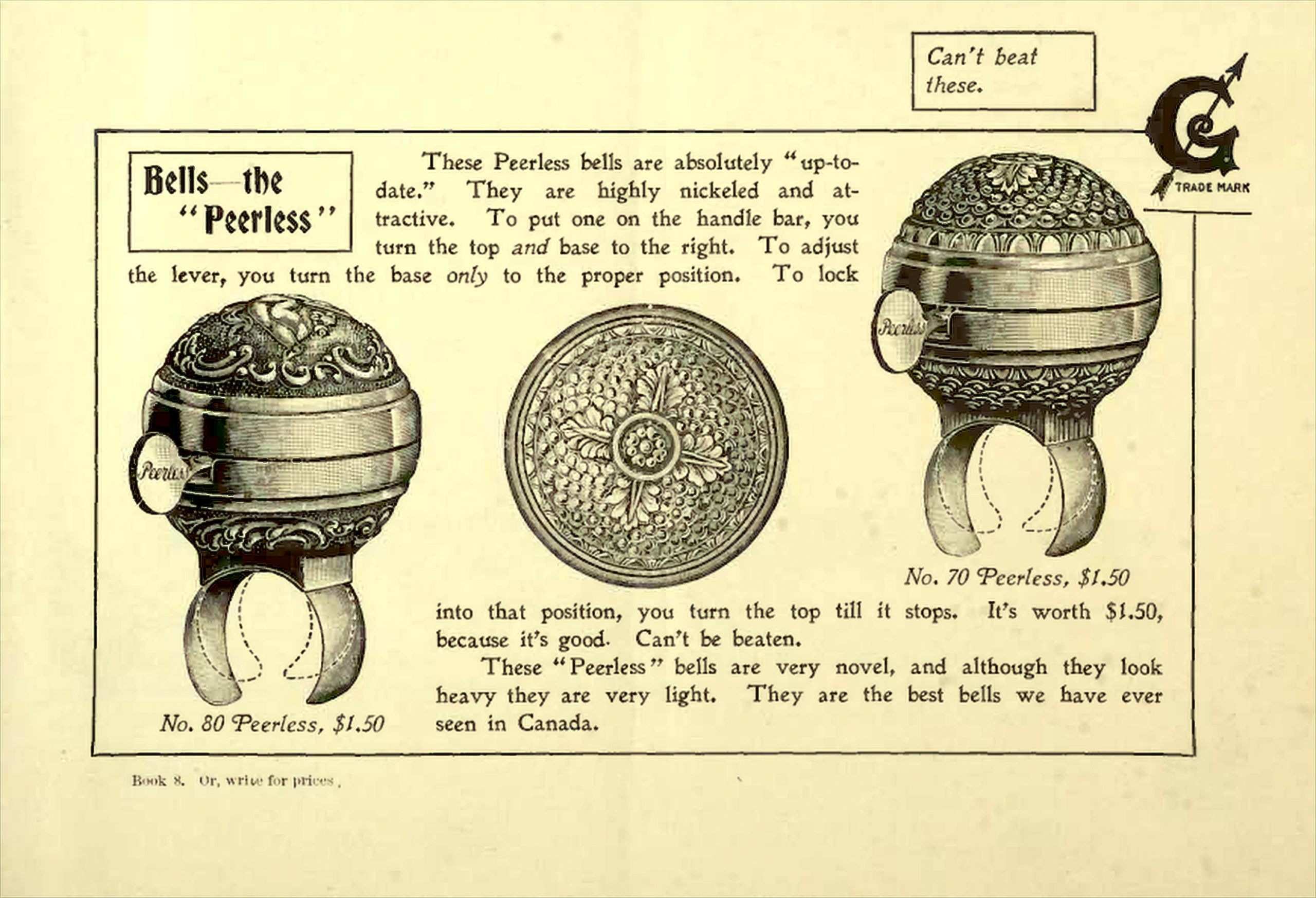 Page 13
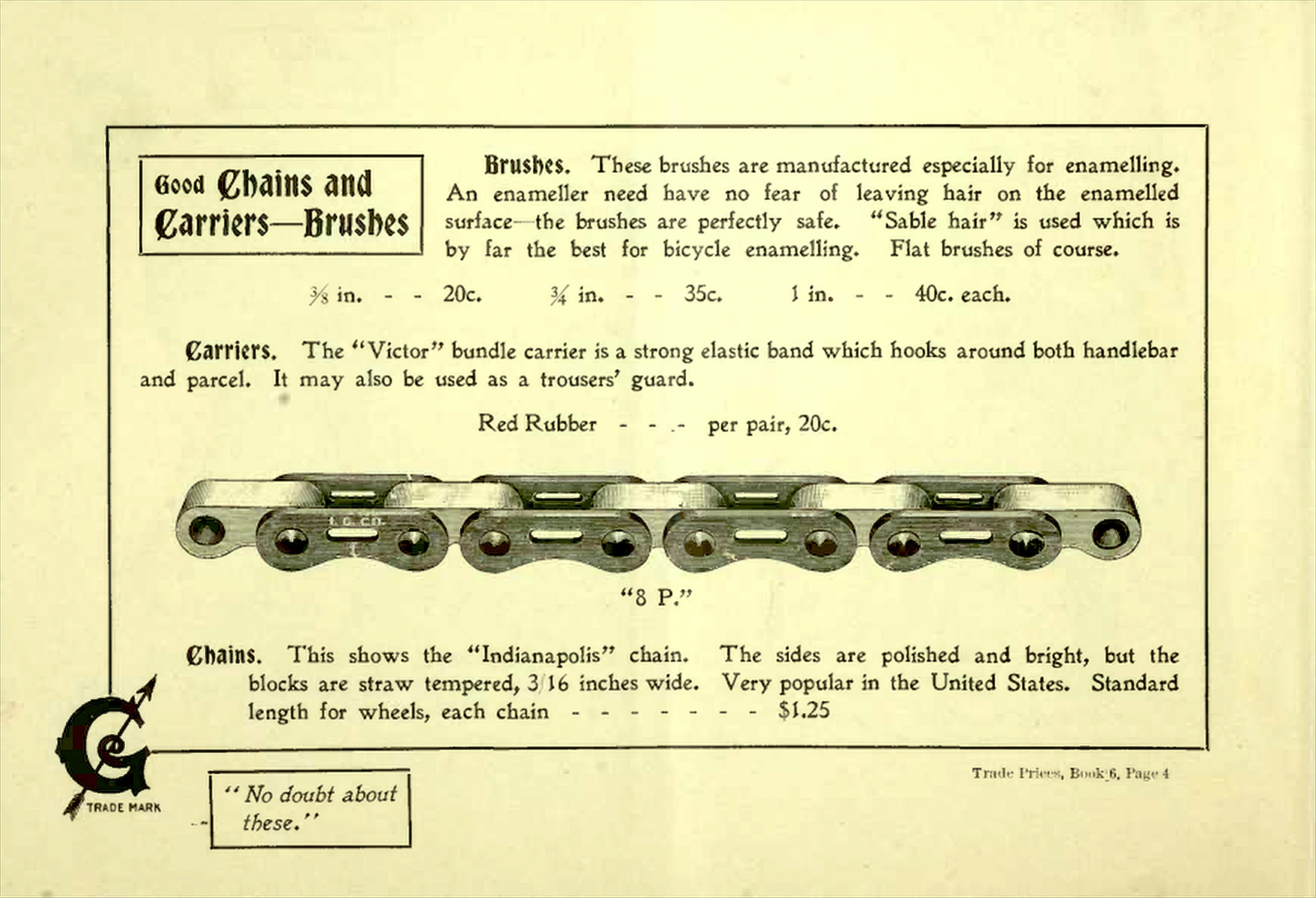 Page 14
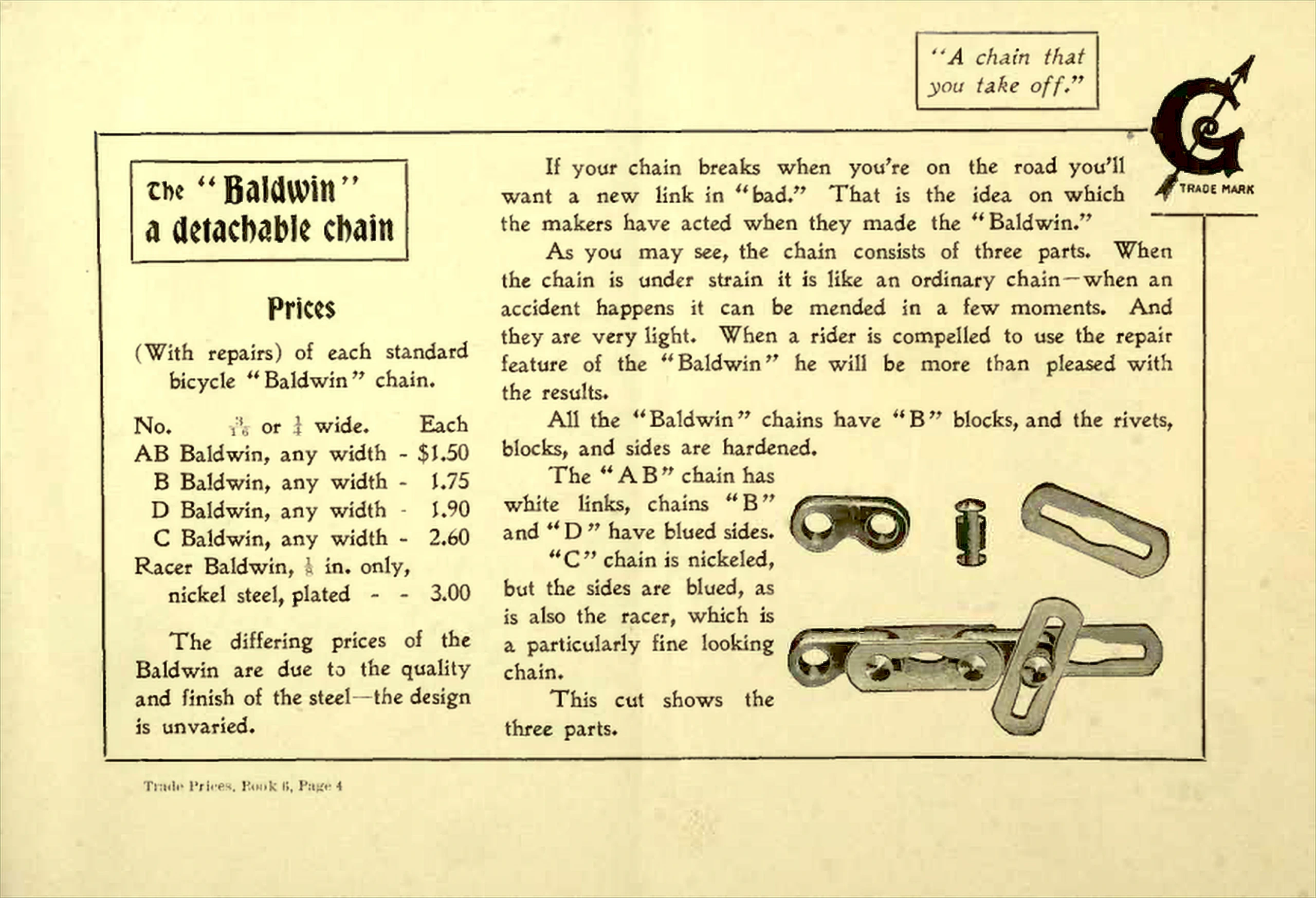 Page 15
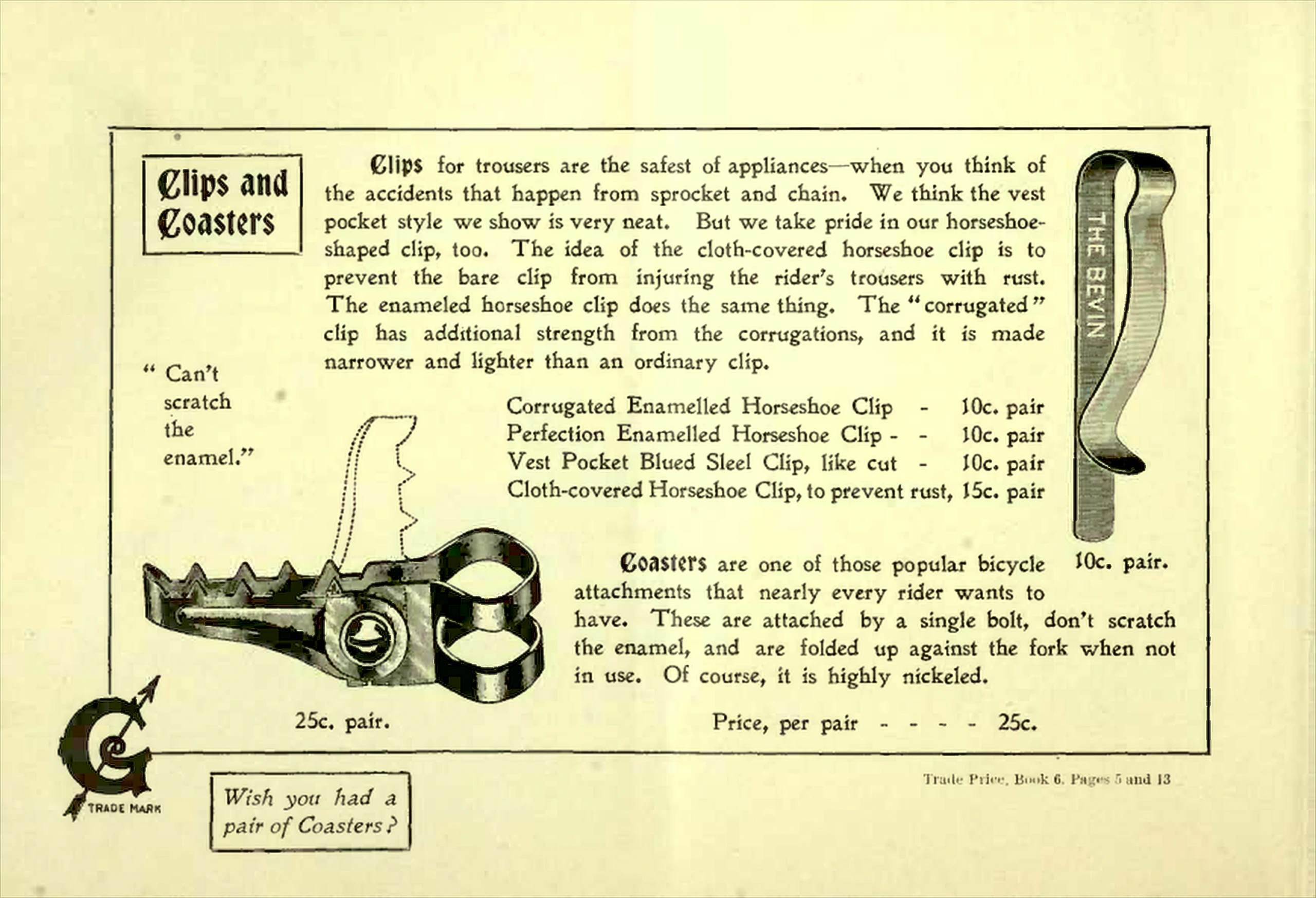 Page 16
 Page 17
 Page 18
 Page 19
 Page 20
 Page 21
 Page 22
 Page 23
 Page 24
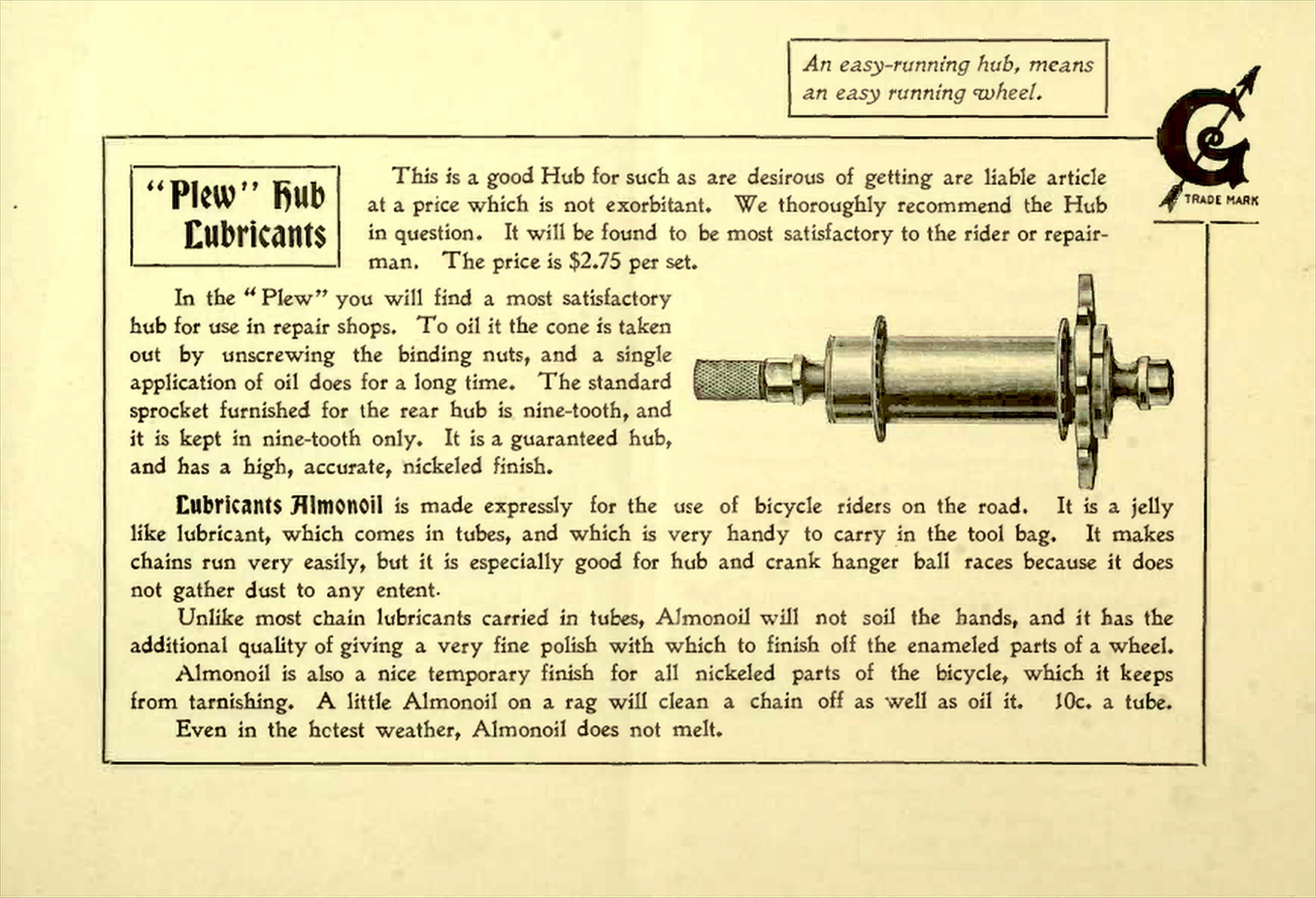 Page 25
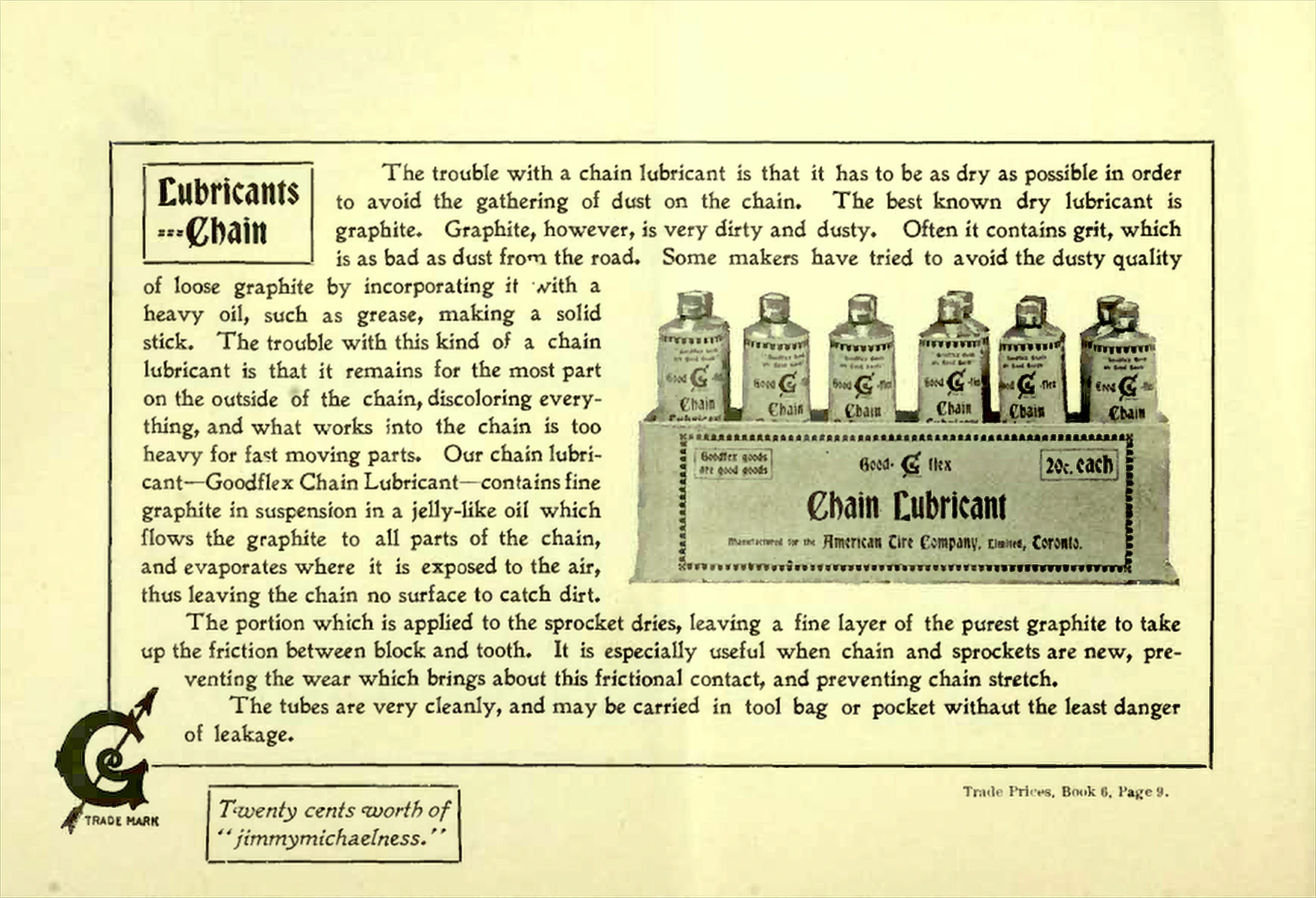 Page 26
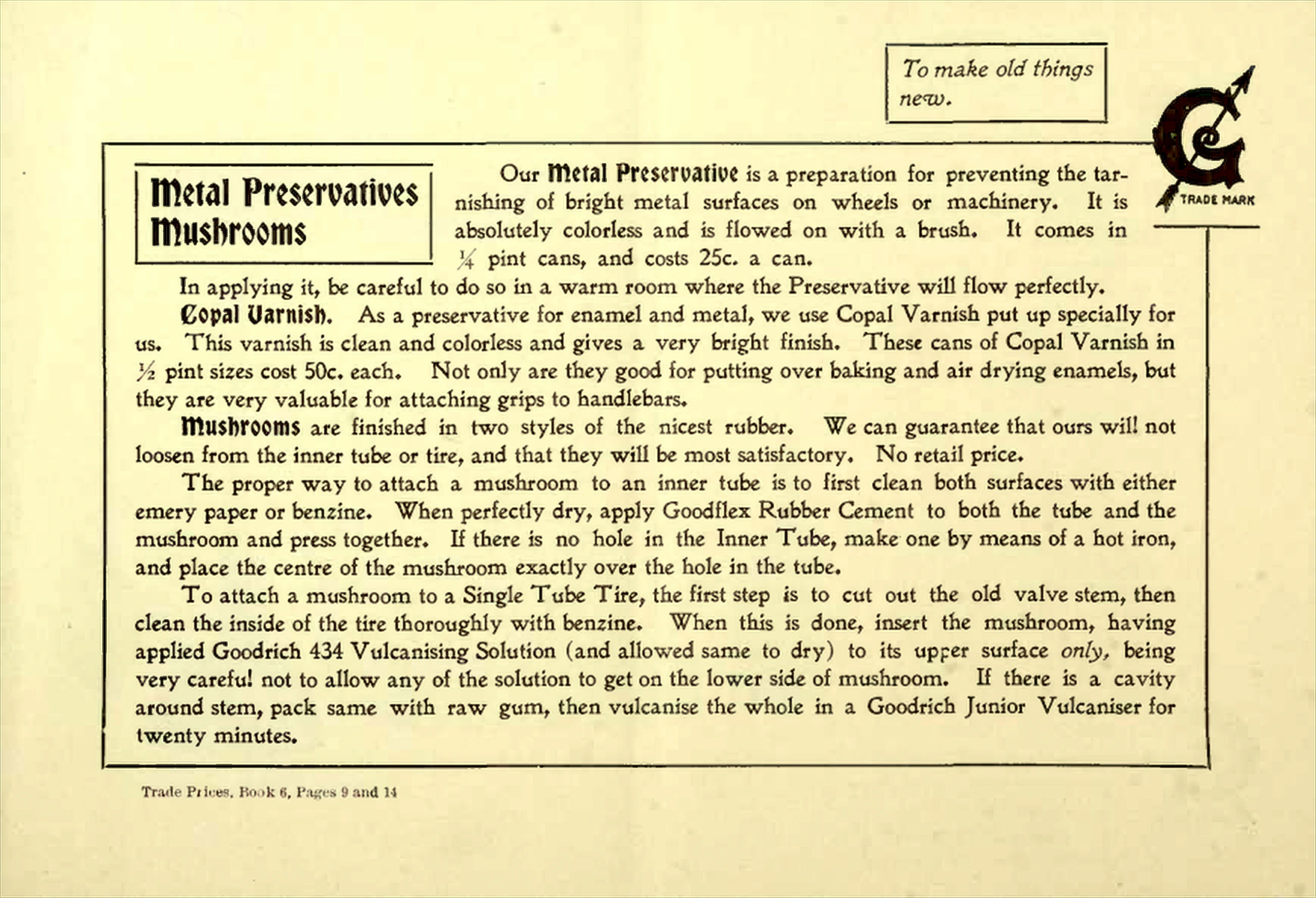 Page 27
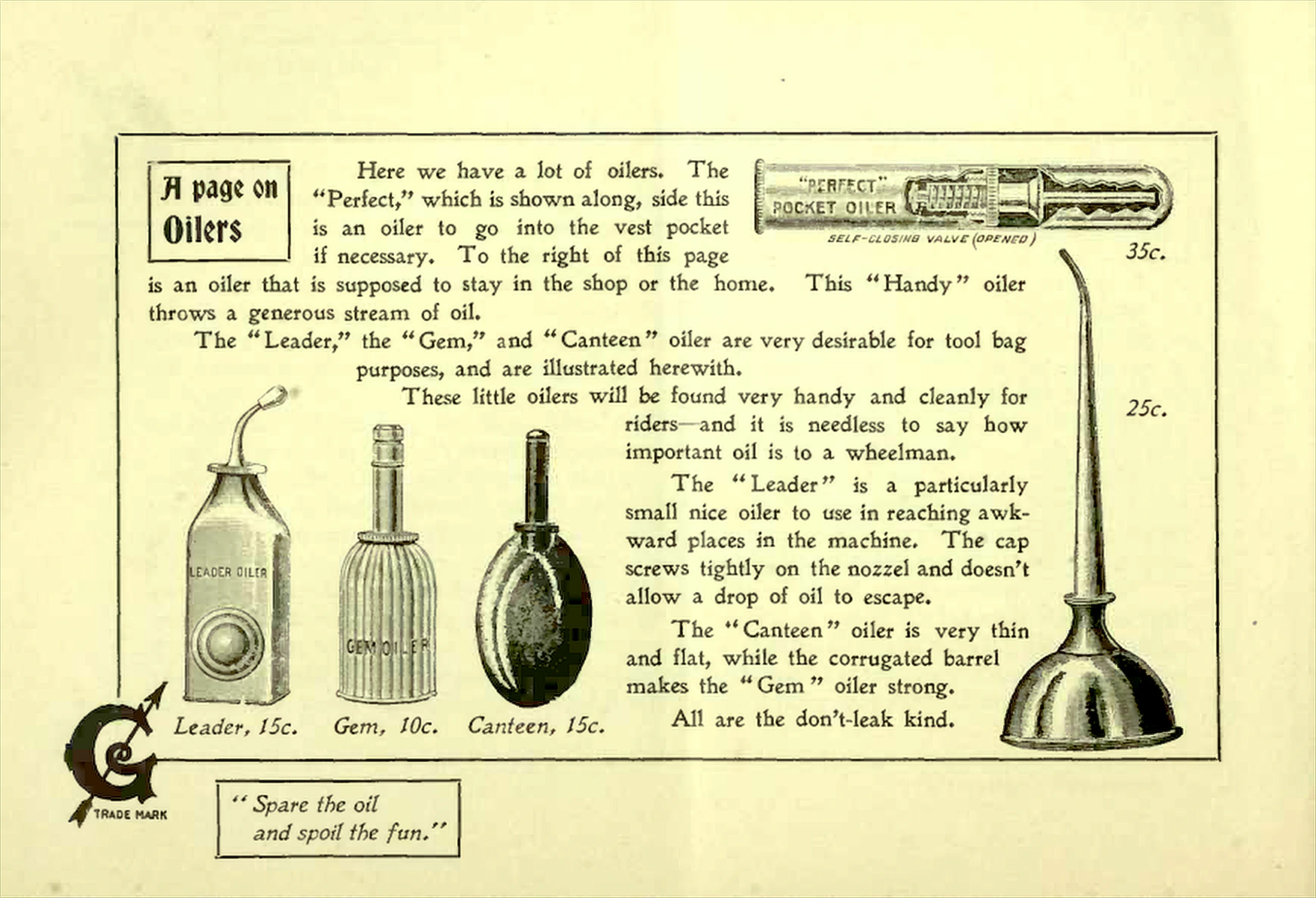 Page 28
 Page 29
 Page 30
 Page 31
 Page 32
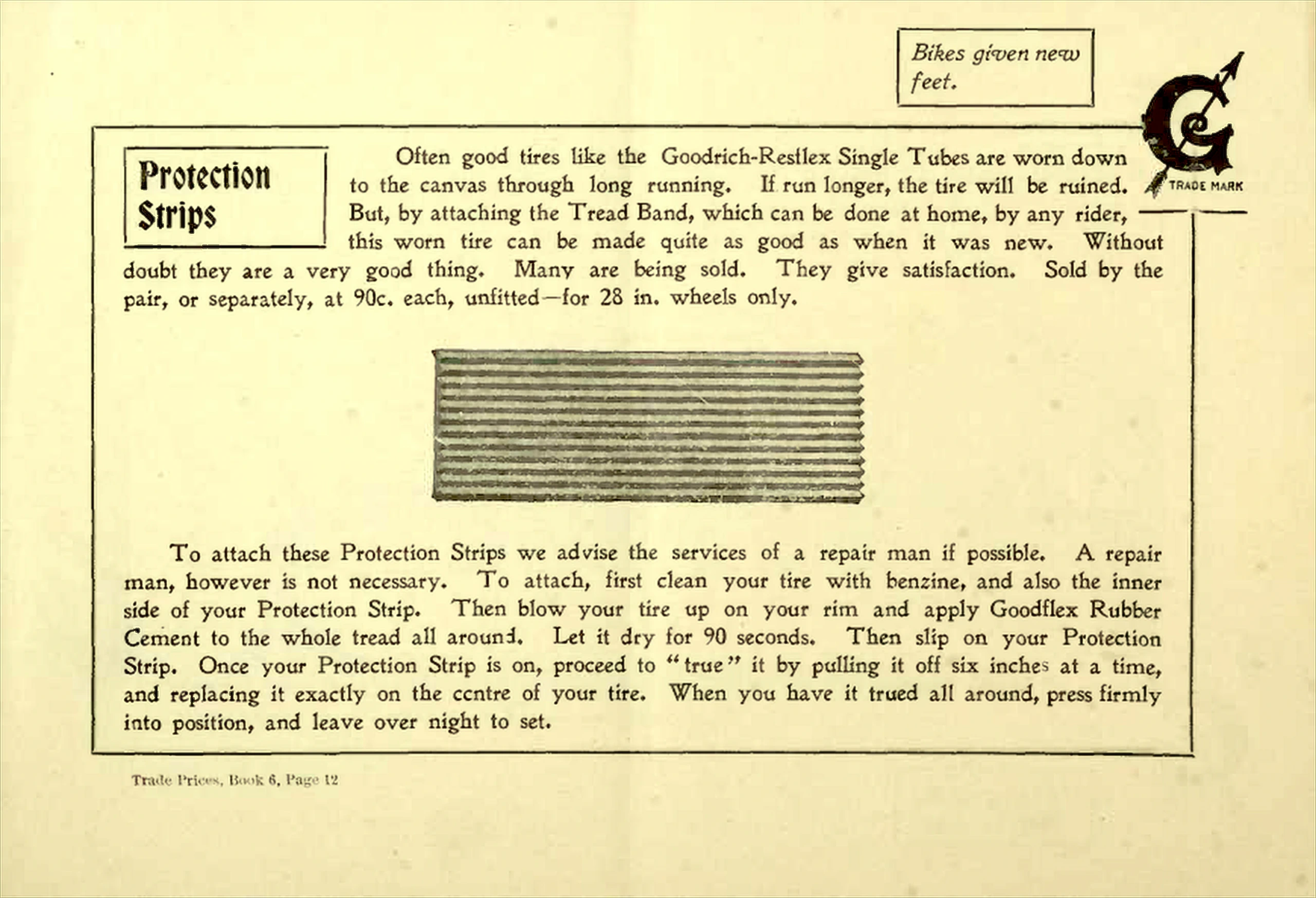 Page 33
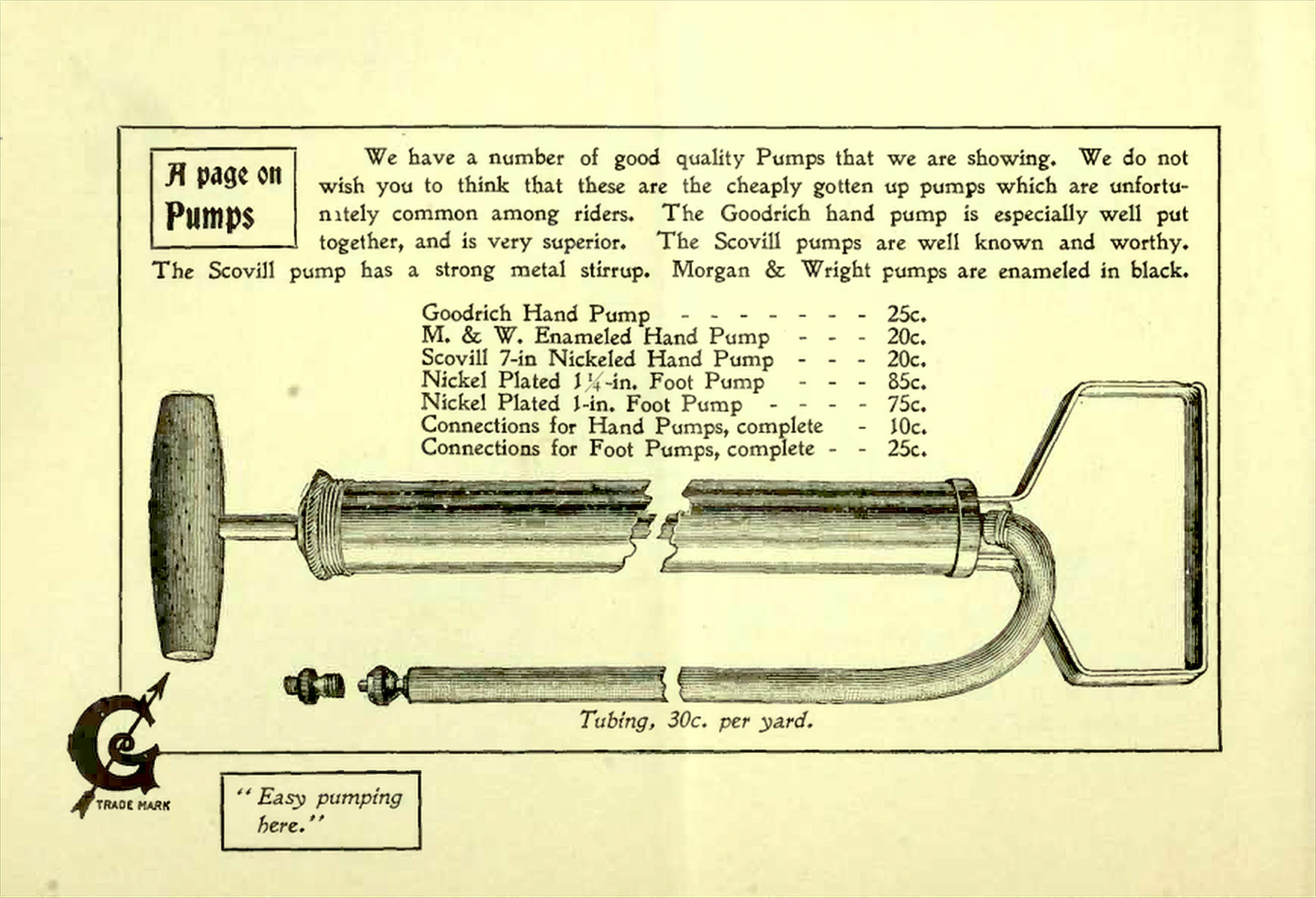 Page 34
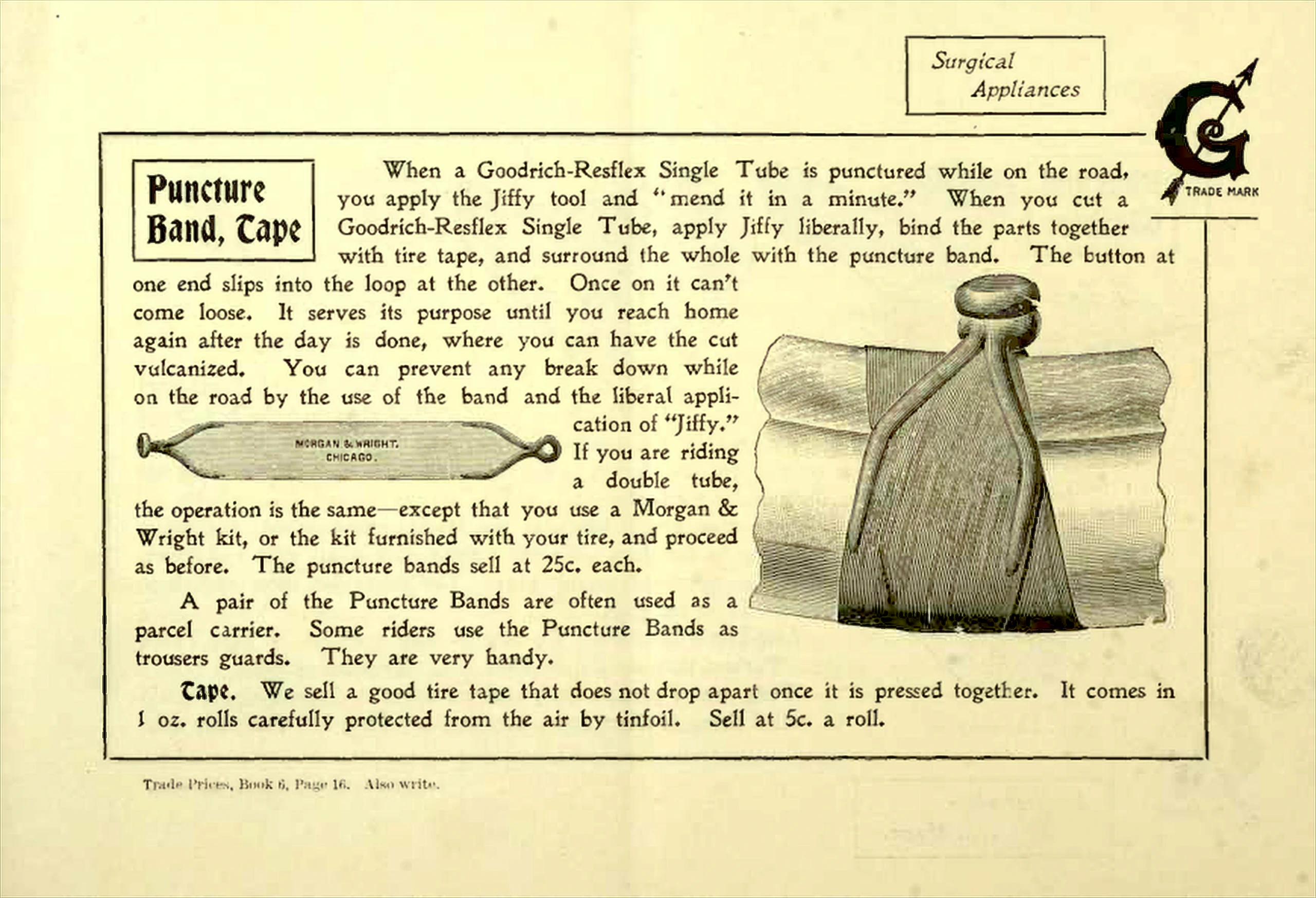 Page 35
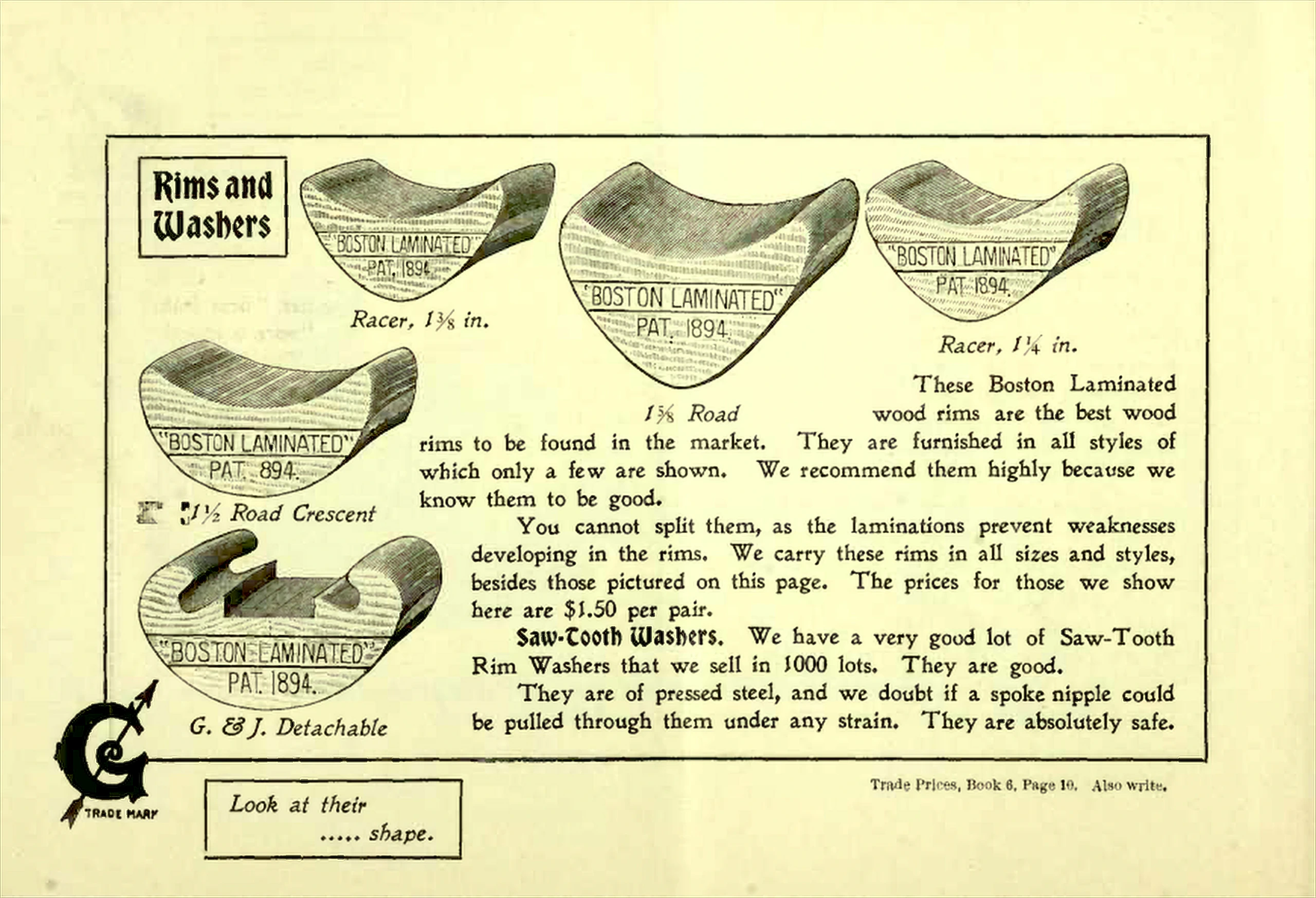 Page 36
 Page 37
 Page 38
 Page 39
 Page 40
 Page 41
 Page 42
 Page 43
 Page 44
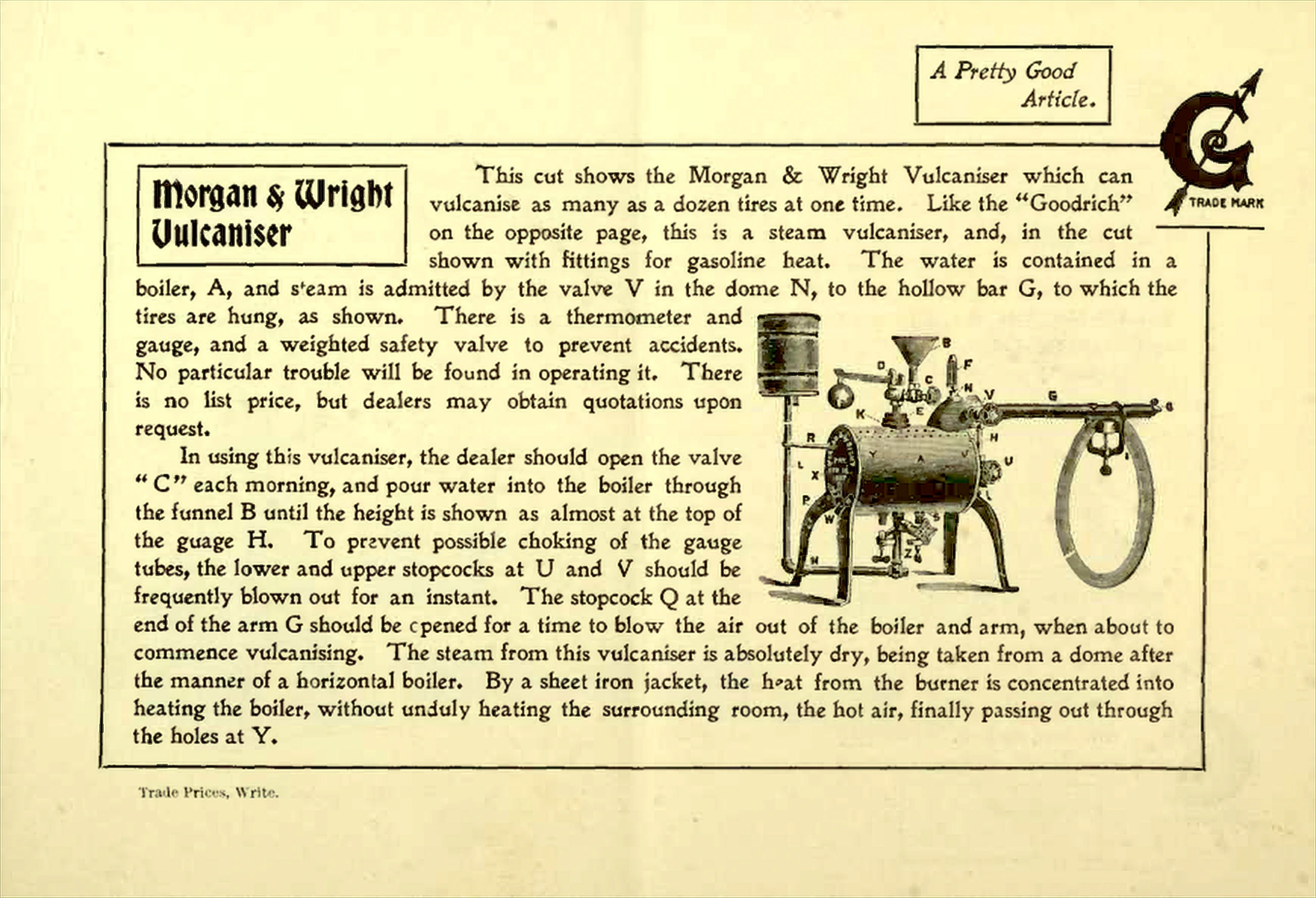 Page 45
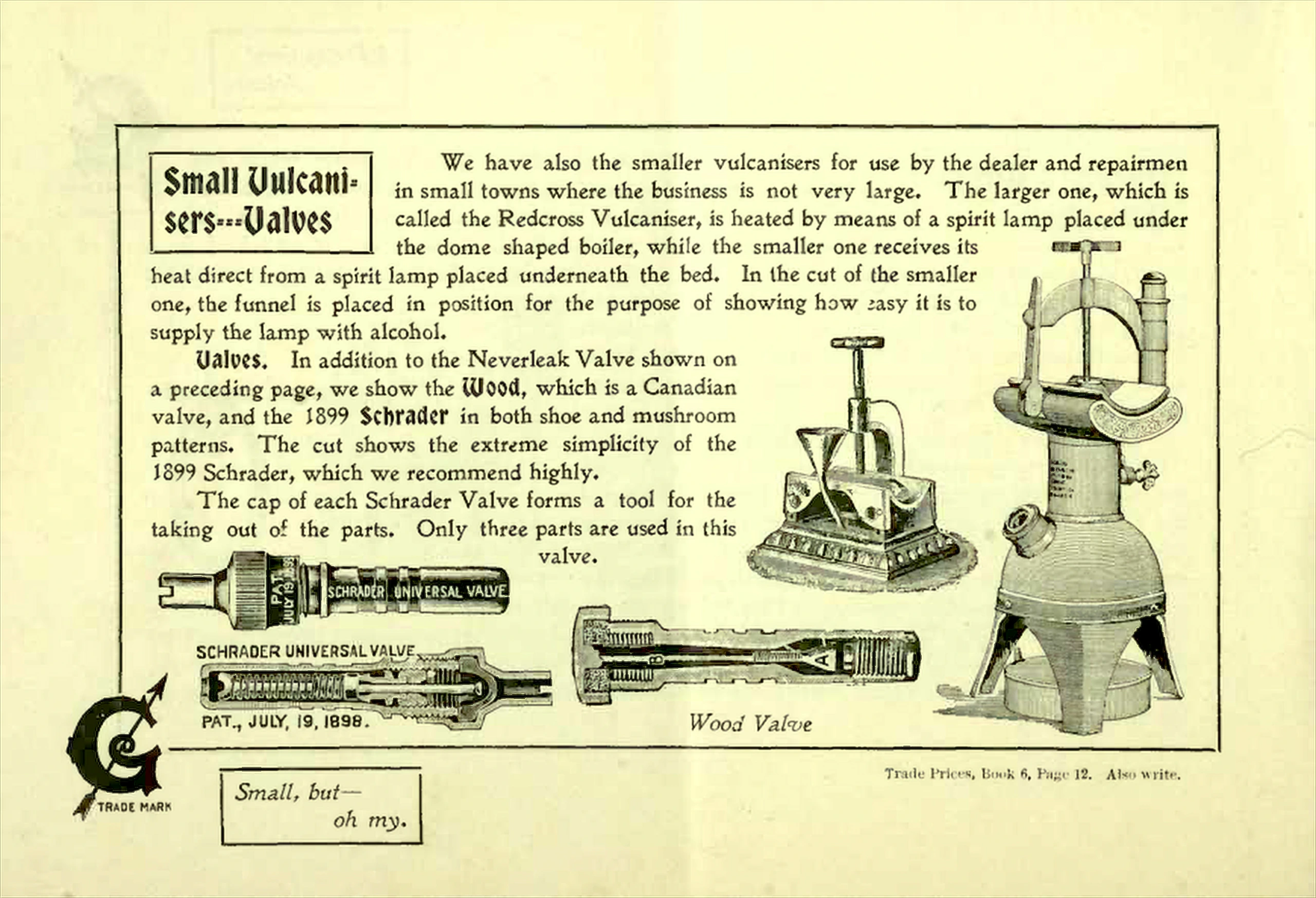 Page 46
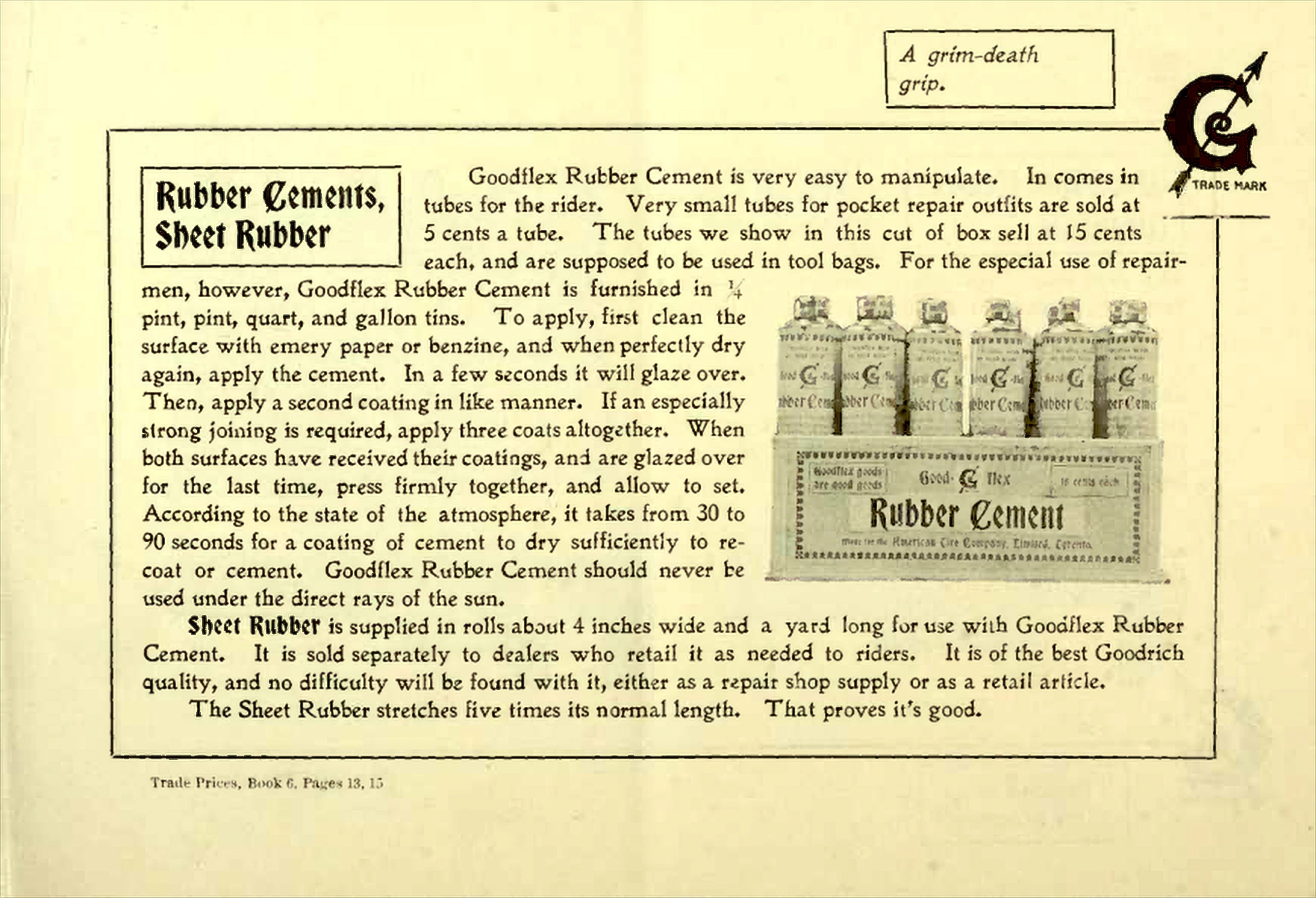 Page 47
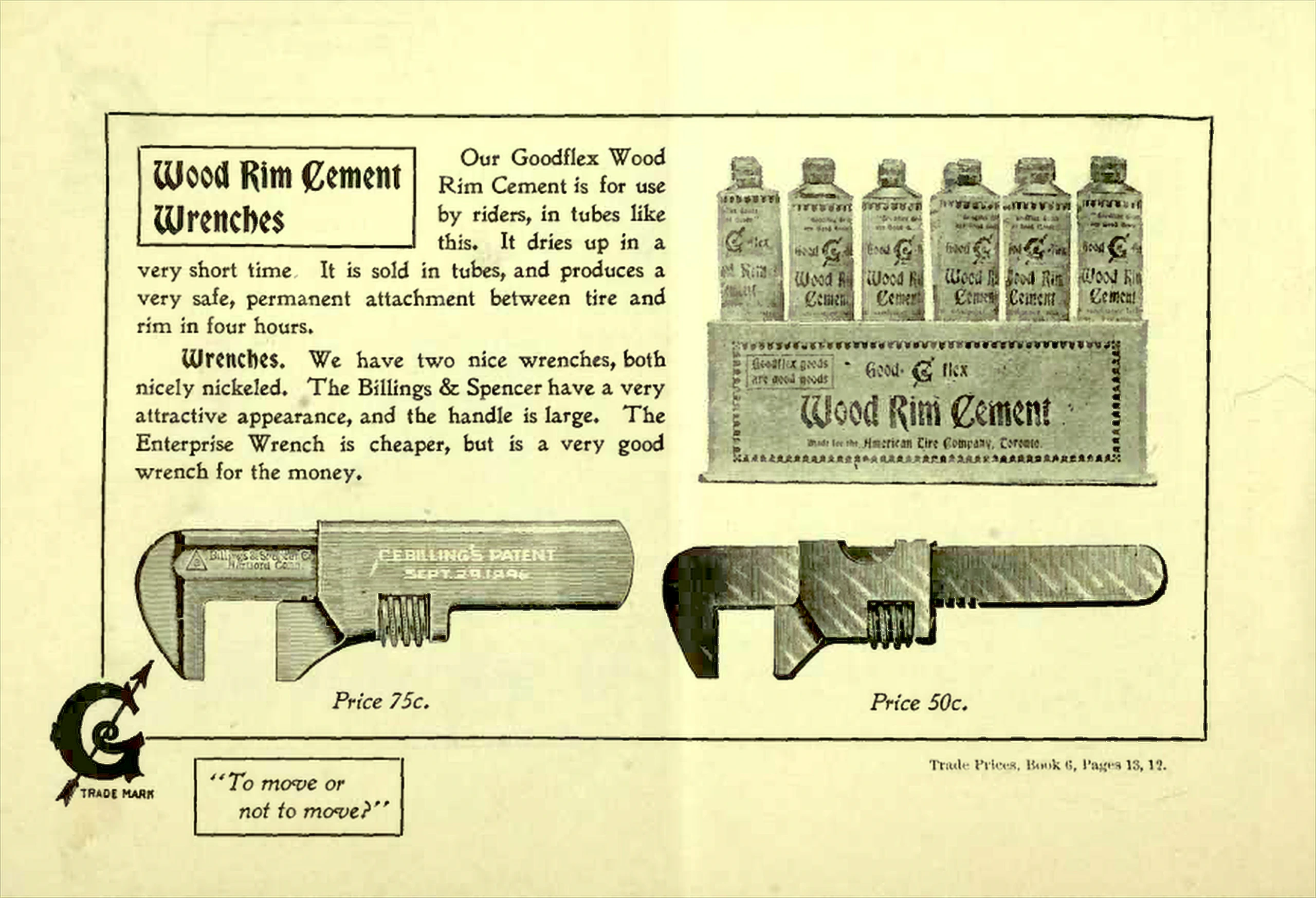 Page 48
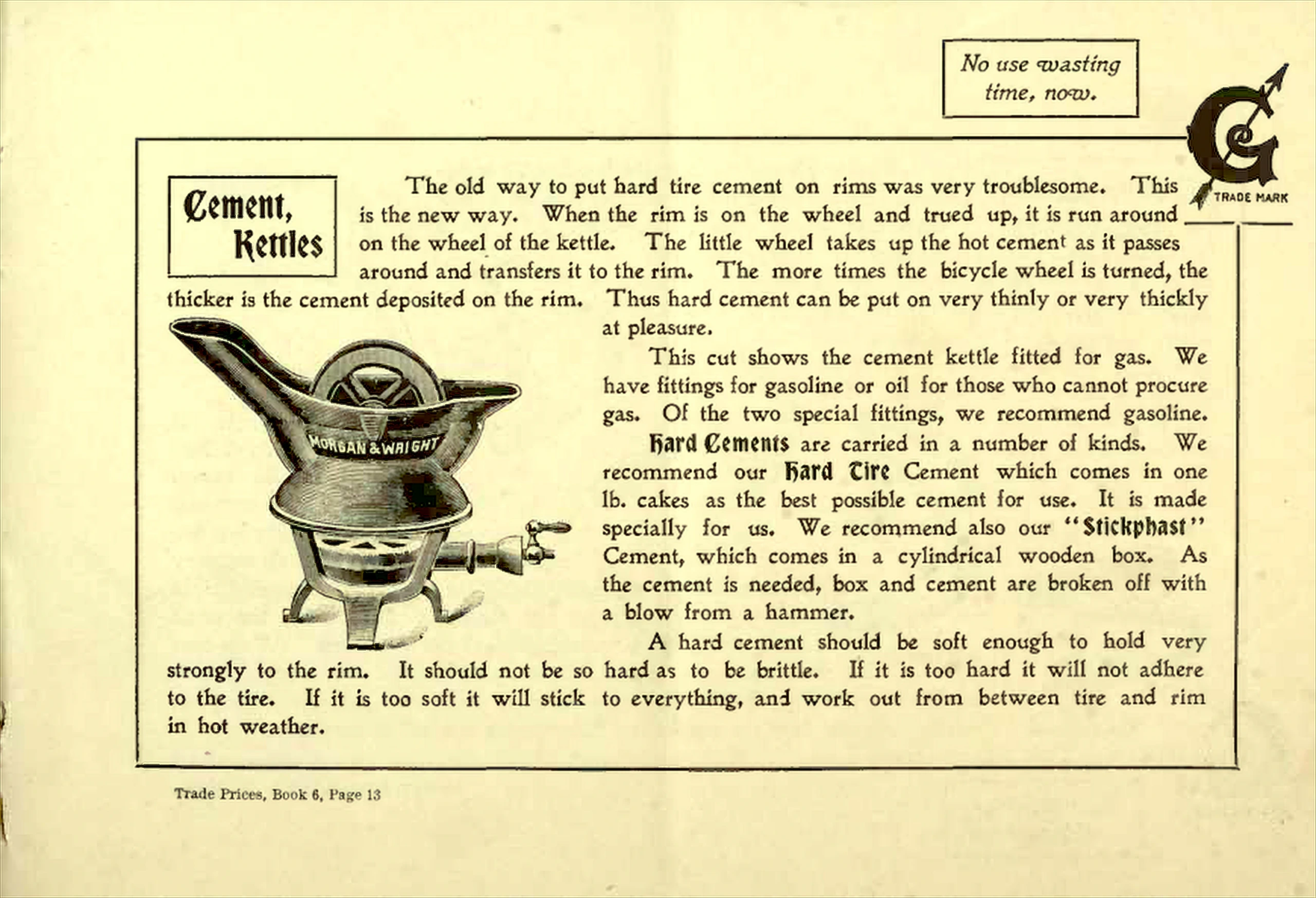 Page 49
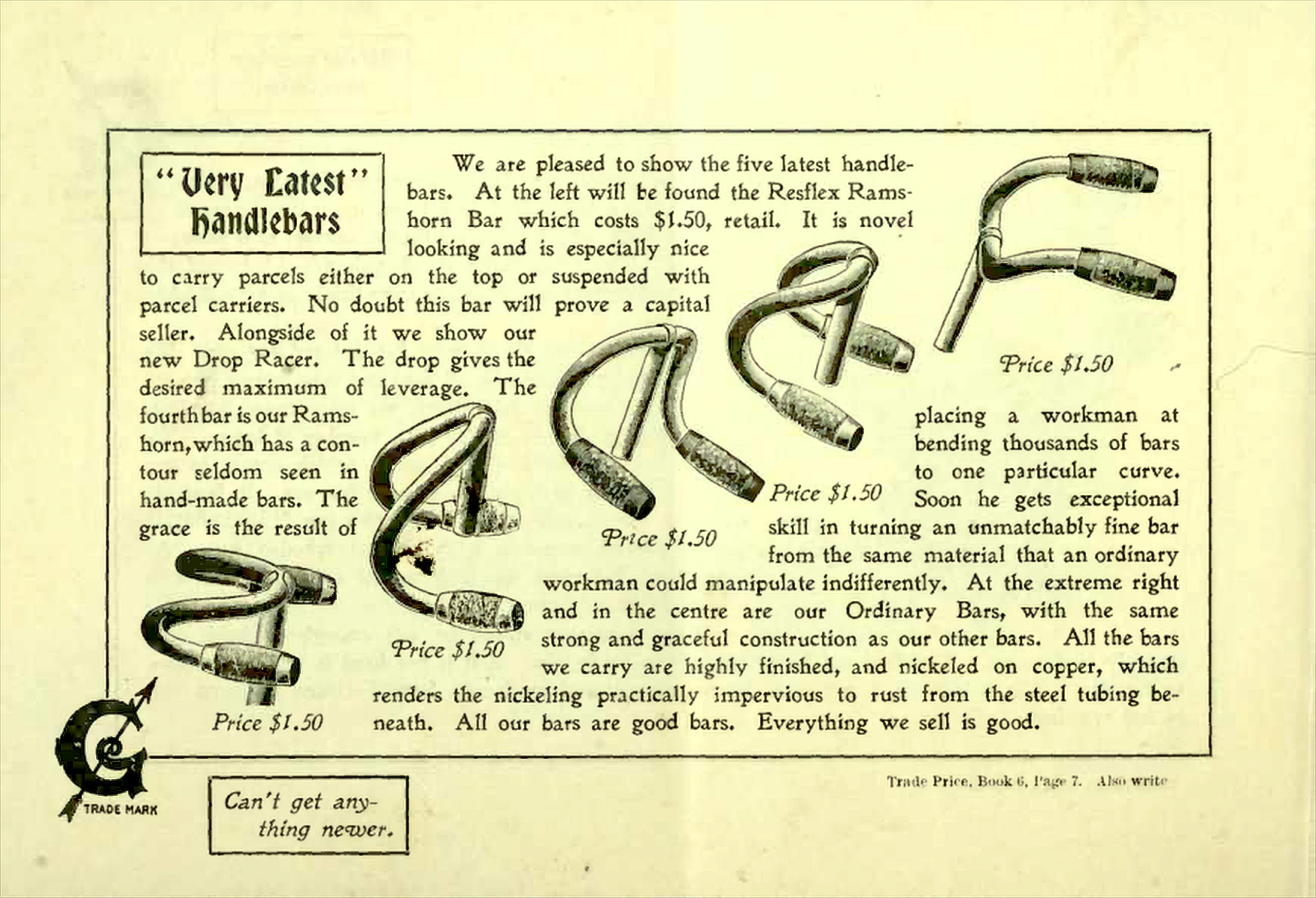 Page 50
 Page 51
 Page 52
| Marque | American Tire |
|---|---|
| Type | Catalog |
| Year | 1899 |
| Publisher | American Tire Company, Limited, 164-166 King St. W., Toronto |
| Country | Canada |
| Language | English |
| Pages | 52 |
| Source | Toronto Public Library Digital Archive (object 197675; the record page states Usage Rights: Public Domain), page images from the library's PDF; enlarged for Ebykr. |
| Credit | Toronto Public Library Digital Archive (Public Domain); Ebykr archive |
| Identifier | Permalink https://digitalarchive.tpl.ca/objects/197675 |
| Transcription | Transcribed by eye |
Reference
American Tire Company, Limited, 164-166 King St. W., Toronto. American Tire Co. Three Good Tires, also Sundries, 1899: Trade Catalog: Goodrich and Morgan and Wright Tires, Cements, Pedals, Saddles and Sundries, Toronto. 1899. Ebykr, https://ebykr.com/library/american-tire-co-three-good-tires-catalogue-1899/.
Wikipedia
{{cite book |title=American Tire Co. Three Good Tires, also Sundries, 1899: Trade Catalog: Goodrich and Morgan and Wright Tires, Cements, Pedals, Saddles and Sundries, Toronto |publisher=American Tire Company, Limited, 164-166 King St. W., Toronto |date=1899 |url=https://ebykr.com/library/american-tire-co-three-good-tires-catalogue-1899/ |via=Ebykr |access-date=}}Three Good Tires—also Sundries TRADE MARK The American Tire Co., Limited, Toronto. "Some Mighty Good Things" Terms We give no reductions, everybody pays the same price. Our terms are net on 30 days credit. On ten days the discount is 2 per cent. Accounts not remitted for, and under $10, are drawn with exchange added. …
Fifty-two landscape pages of the American Tire Company’s 1899 catalog “Three Good Tires, also Sundries”: the Goodrich and Morgan and Wright tire guarantees, then lamps, bells, hubs, oils, pedals, saddles, cements and tools, with trade prices in a separate booklet.
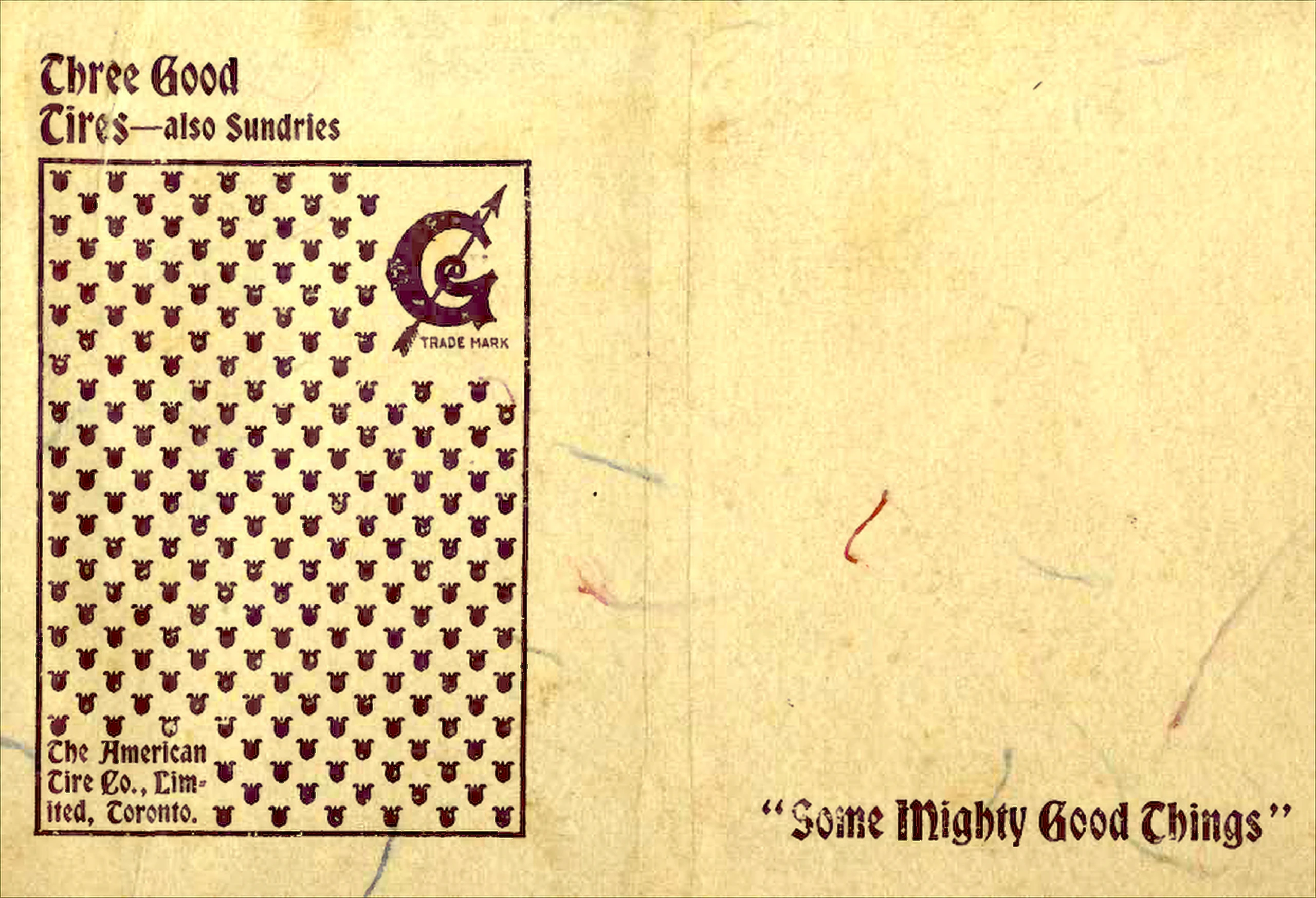
— Page 1 (front cover) —
Three Good Tires—also Sundries
TRADE MARK
The American Tire Co., Limited, Toronto.
“Some Mighty Good Things”
[The pink cover of “Three Good Tires” in blackletter lettering, with a boxed pattern of small tulip-shaped devices, a large letter G pierced by an arrow marked TRADE MARK, and the title “Some Mighty Good Things” on the right half. Faint pen and pencil scribbles lie on the paper.]
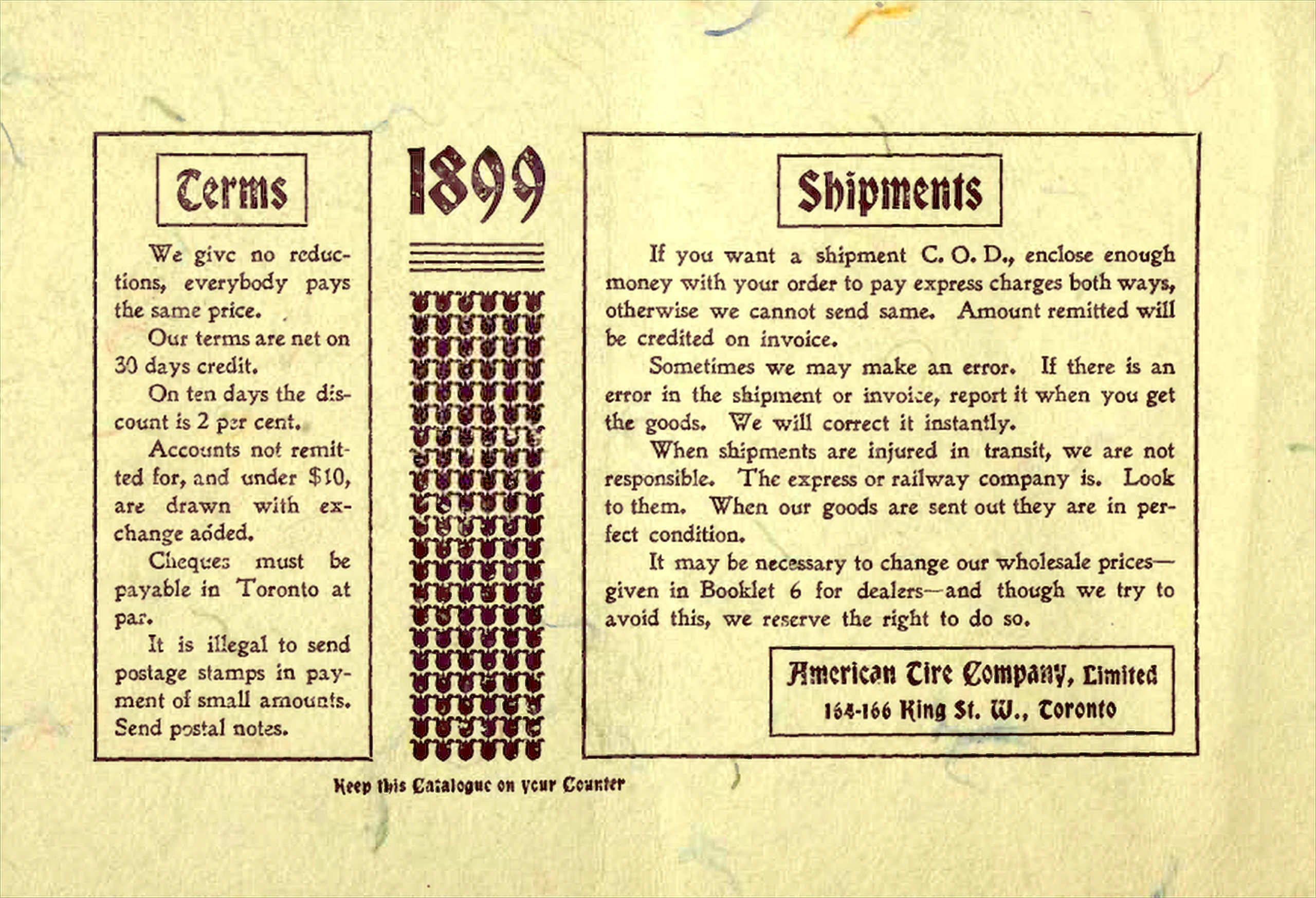
— Page 2 —
Terms
We give no reductions, everybody pays the same price.
Our terms are net on 30 days credit.
On ten days the discount is 2 per cent.
Accounts not remitted for, and under $10, are drawn with exchange added.
Cheques must be payable in Toronto at par.
It is illegal to send postage stamps in payment of small amounts. Send postal notes.
1899
Shipments
If you want a shipment C. O. D., enclose enough money with your order to pay express charges both ways, otherwise we cannot send same. Amount remitted will be credited on invoice.
Sometimes we may make an error. If there is an error in the shipment or invoice, report it when you get the goods. We will correct it instantly.
When shipments are injured in transit, we are not responsible. The express or railway company is. Look to them. When our goods are sent out they are in perfect condition.
It may be necessary to change our wholesale prices—given in Booklet 6 for dealers—and though we try to avoid this, we reserve the right to do so.
American Tire Company, Limited
164-166 King St. W., Toronto
Keep this Catalogue on your Counter
[The terms and shipments page of the American Tire Company in blackletter headings, with two boxed columns of text on either side of a tall column of tulip devices under the year 1899. A small address box and a counter note close the page.]
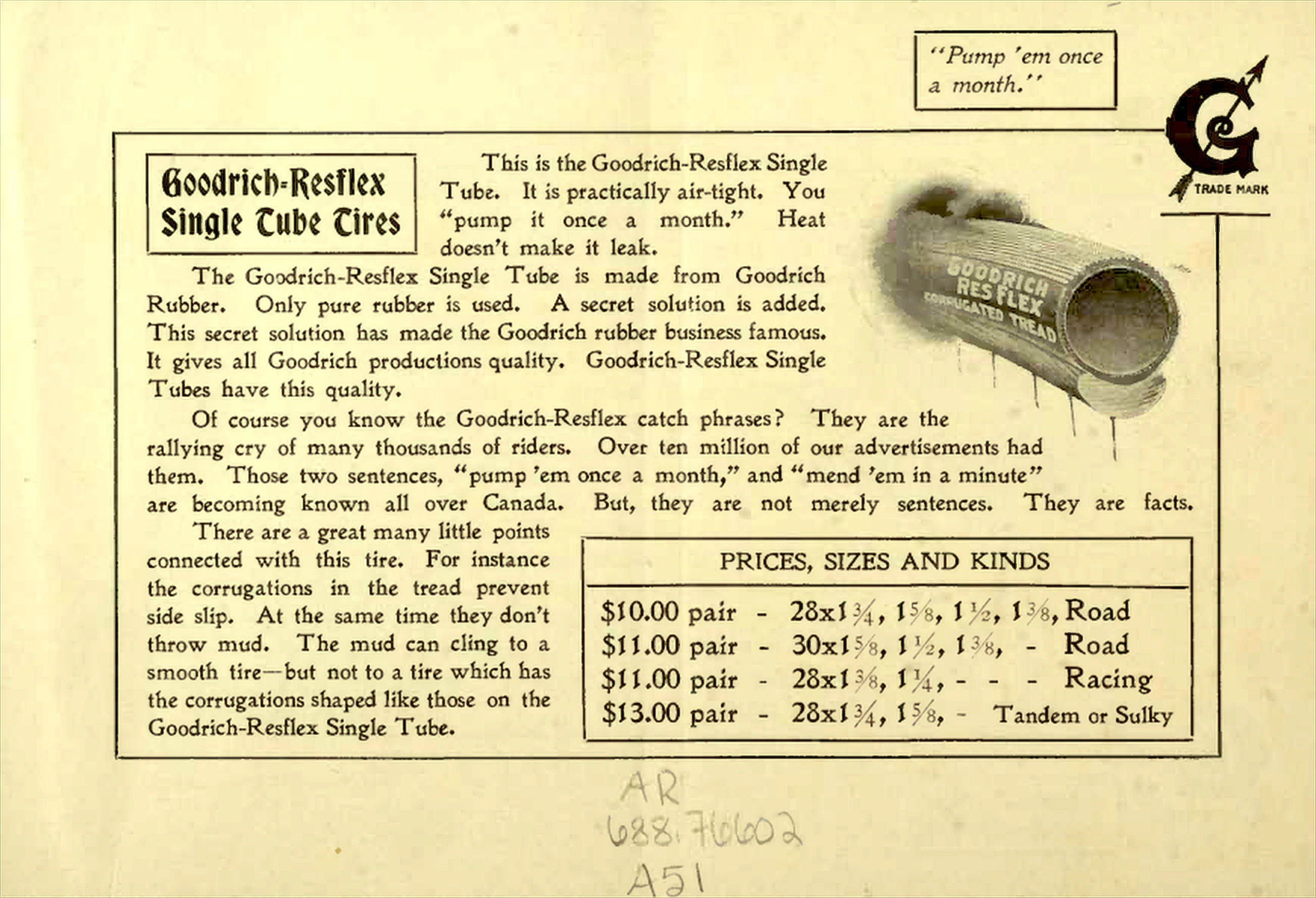
— Page 3 —
“Pump ’em once a month.”
TRADE MARK
Goodrich-Resflex Single Tube Tires
This is the Goodrich-Resflex Single Tube. It is practically air-tight. You “pump it once a month.” Heat doesn’t make it leak.
The Goodrich-Resflex Single Tube is made from Goodrich Rubber. Only pure rubber is used. A secret solution is added. This secret solution has made the Goodrich rubber business famous. It gives all Goodrich productions quality. Goodrich-Resflex Single Tubes have this quality.
Of course you know the Goodrich-Resflex catch phrases? They are the rallying cry of many thousands of riders. Over ten million of our advertisements had them. Those two sentences, “pump ’em once a month,” and “mend ’em in a minute” are becoming known all over Canada. But, they are not merely sentences. They are facts.
There are a great many little points connected with this tire. For instance the corrugations in the tread prevent side slip. At the same time they don’t throw mud. The mud can cling to a smooth tire—but not to a tire which has the corrugations shaped like those on the Goodrich-Resflex Single Tube.
PRICES, SIZES AND KINDS
$10.00 pair – 28×1 3/4, 1 5/8, 1 1/2, 1 3/8, Road
$11.00 pair – 30×1 5/8, 1 1/2, 1 3/8, – Road
$11.00 pair – 28×1 3/8, 1¼, – – – Racing
$13.00 pair – 28×1 3/4, 1 5/8, – Tandem or Sulky
[A page of the Goodrich-Resflex Single Tube Tires with a photograph of a tire with corrugated tread, a boxed list of prices, sizes and kinds, and a boxed saying in italics at the top. A pencil call number is written below the box in the lower margin.]
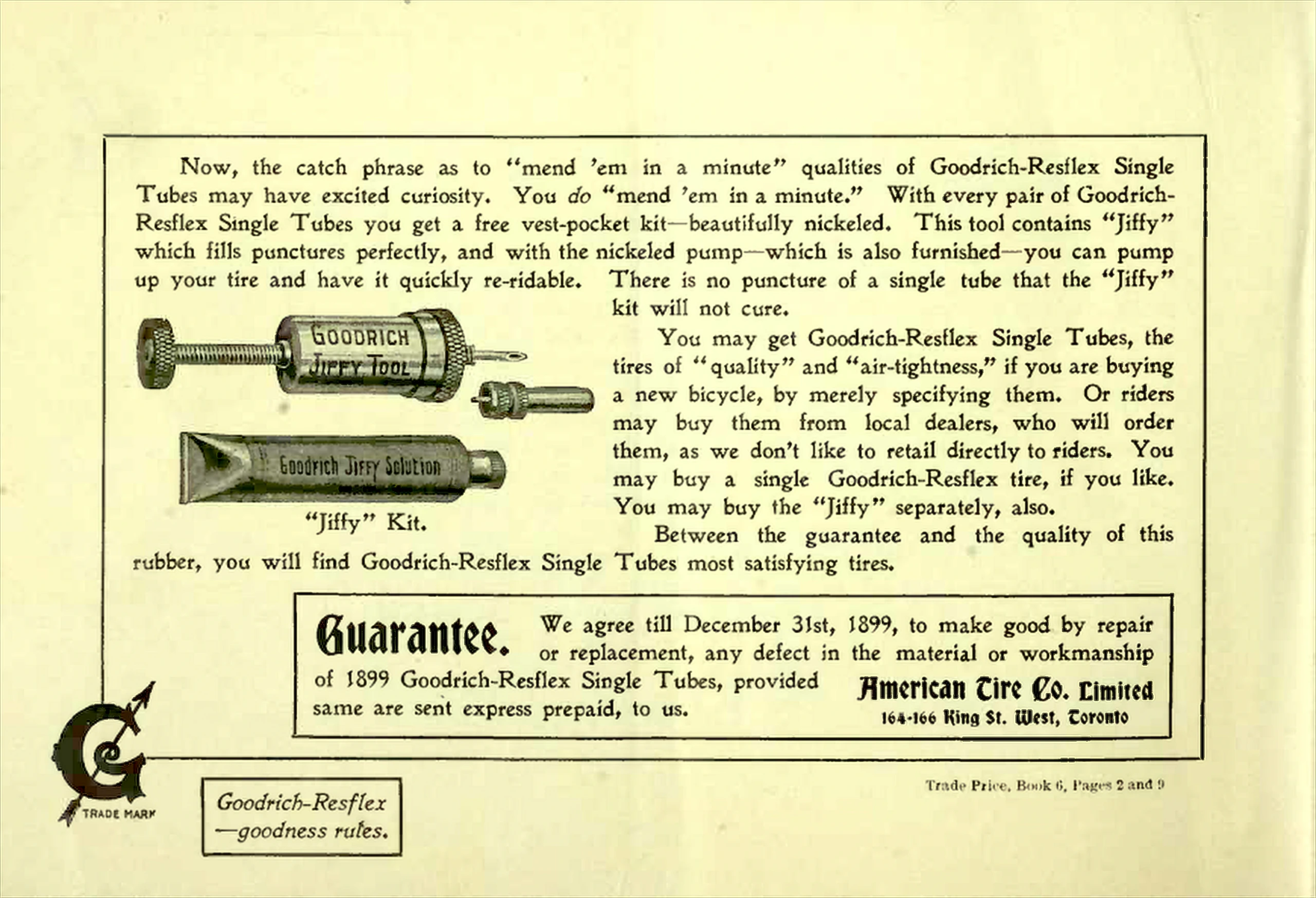
— Page 4 —
Now, the catch phrase as to “mend ’em in a minute” qualities of Goodrich-Resflex Single Tubes may have excited curiosity. You do “mend ’em in a minute.” With every pair of Goodrich-Resflex Single Tubes you get a free vest-pocket kit—beautifully nickeled. This tool contains “Jiffy” which fills punctures perfectly, and with the nickeled pump—which is also furnished—you can pump up your tire and have it quickly re-ridable. There is no puncture of a single tube that the “Jiffy” kit will not cure.
You may get Goodrich-Resflex Single Tubes, the tires of “quality” and “air-tightness,” if you are buying a new bicycle, by merely specifying them. Or riders may buy them from local dealers, who will order them, as we don’t like to retail directly to riders. You may buy a single Goodrich-Resflex tire, if you like. You may buy the “Jiffy” separately, also.
Between the guarantee and the quality of this rubber, you will find Goodrich-Resflex Single Tubes most satisfying tires.
“Jiffy” Kit.
Guarantee. We agree till December 31st, 1899, to make good by repair or replacement, any defect in the material or workmanship of 1899 Goodrich-Resflex Single Tubes, provided same are sent express prepaid, to us.
American Tire Co. Limited
164-166 King St. West, Toronto
TRADE MARK
Goodrich-Resflex—goodness rules.
Trade Price, Book 6, Pages 2 and 9[?]
[A page about the “Jiffy” kit for Goodrich-Resflex Single Tubes, with an engraving of the kit showing a tool, a small valve piece and a tube of solution, followed by a boxed guarantee and a boxed saying in italics. The G trade mark device sits at the lower left.]
— Page 5 —
“Second groove, strong grip.”
TRADE MARK
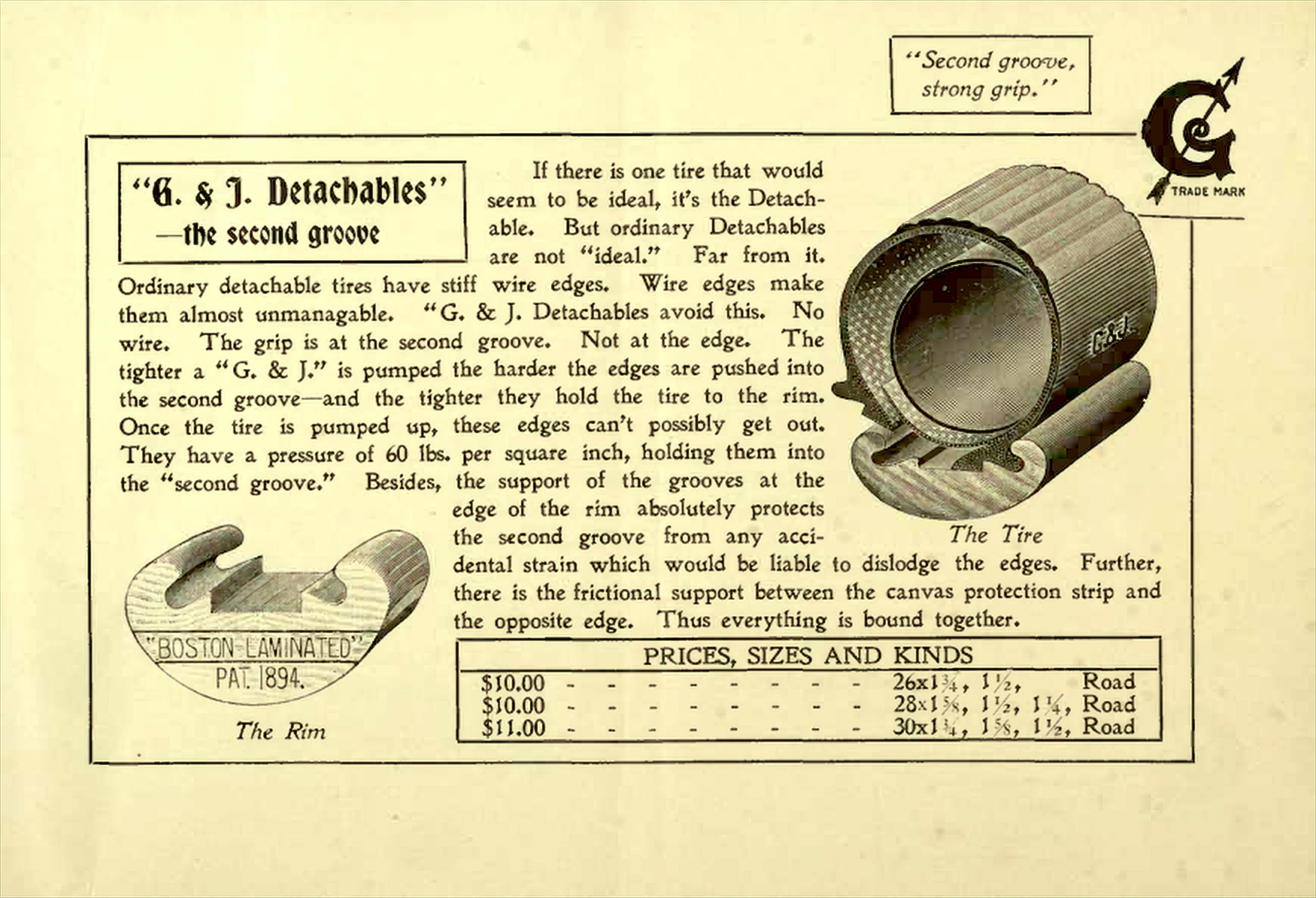
“G. & J. Detachables”—the second groove
If there is one tire that would seem to be ideal, it’s the Detachable. But ordinary Detachables are not “ideal.” Far from it. Ordinary detachable tires have stiff wire edges. Wire edges make them almost unmanagable. “G. & J. Detachables avoid this. No wire. The grip is at the second groove. Not at the edge. The tighter a “G. & J.” is pumped the harder the edges are pushed into the second groove—and the tighter they hold the tire to the rim. Once the tire is pumped up, these edges can’t possibly get out. They have a pressure of 60 lbs. per square inch, holding them into the “second groove.” Besides, the support of the grooves at the edge of the rim absolutely protects the second groove from any accidental strain which would be liable to dislodge the edges. Further, there is the frictional support between the canvas protection strip and the opposite edge. Thus everything is bound together.
The Tire
The Rim
PRICES, SIZES AND KINDS
$10.00 – – – – – – – – 26×1 3/4, 1 1/2, Road
$10.00 – – – – – – – – 28×1 5/8, 1 1/2, 1¼, Road
$11.00 – – – – – – – – 30×1 3/4, 1 5/8, 1 1/2, Road
[A page of “G. & J. Detachables” tires with an engraving of the tire and an engraving of the rim, which carries the words “Boston Laminated” and “Pat. 1894”, and a boxed list of prices, sizes and kinds. A boxed saying in italics and the G trade mark device sit at the top.]
— Page 6 —
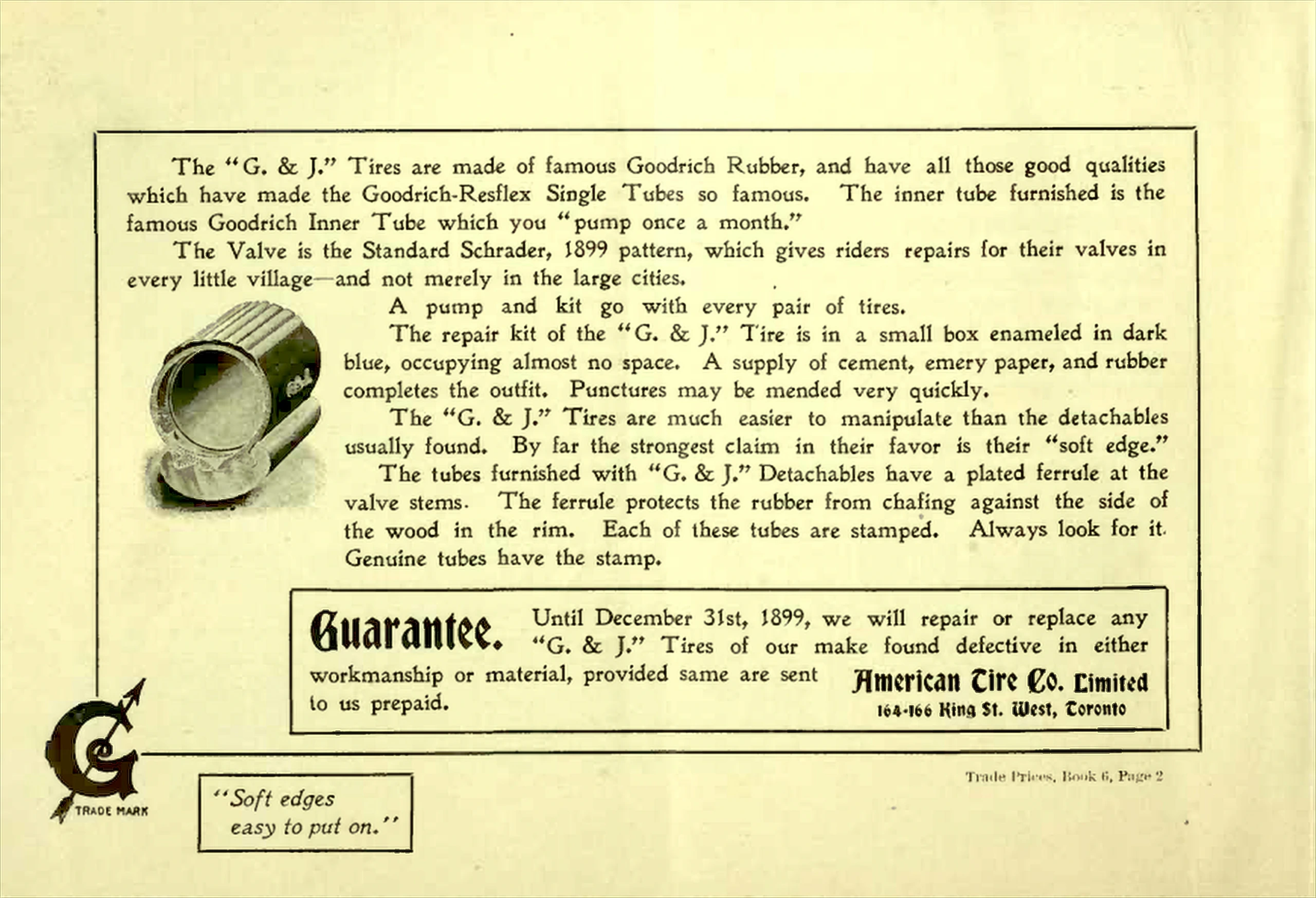
The “G. & J.” Tires are made of famous Goodrich Rubber, and have all those good qualities which have made the Goodrich-Resflex Single Tubes so famous. The inner tube furnished is the famous Goodrich Inner Tube which you “pump once a month.”
The Valve is the Standard Schrader, 1899 pattern, which gives riders repairs for their valves in every little village—and not merely in the large cities.
A pump and kit go with every pair of tires.
The repair kit of the “G. & J.” Tire is in a small box enameled in dark blue, occupying almost no space. A supply of cement, emery paper, and rubber completes the outfit. Punctures may be mended very quickly.
The “G. & J.” Tires are much easier to manipulate than the detachables usually found. By far the strongest claim in their favor is their “soft edge.”
The tubes furnished with “G. & J.” Detachables have a plated ferrule at the valve stems. The ferrule protects the rubber from chafing against the side of the wood in the rim. Each of these tubes are stamped. Always look for it. Genuine tubes have the stamp.
Guarantee. Until December 31st, 1899, we will repair or replace any “G. & J.” Tires of our make found defective in either workmanship or material, provided same are sent to us prepaid.
American Tire Co. Limited
164-166 King St. West, Toronto
TRADE MARK
“Soft edges easy to put on.”
Trade Prices, Book 6, Page 2
[A page of text about the “G. & J.” Tires with a small engraving of a tire, a boxed guarantee and a boxed saying in italics. The G trade mark device sits at the lower left.]
— Page 7 —
Morgan & Wright tires are good tires.
TRADE MARK
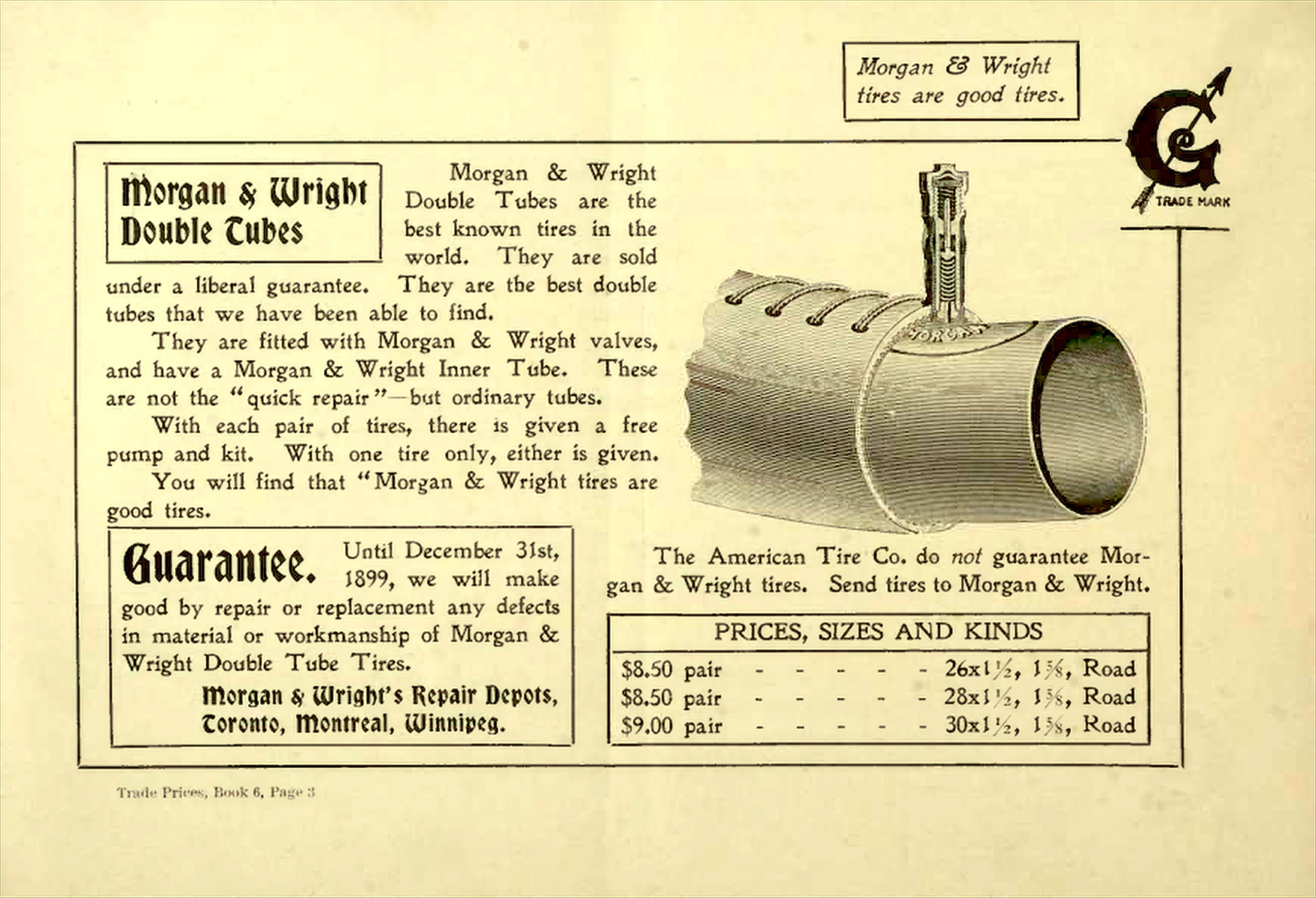
Morgan & Wright Double Tubes
Morgan & Wright Double Tubes are the best known tires in the world. They are sold under a liberal guarantee. They are the best double tubes that we have been able to find.
They are fitted with Morgan & Wright valves, and have a Morgan & Wright Inner Tube. These are not the “quick repair”—but ordinary tubes.
With each pair of tires, there is given a free pump and kit. With one tire only, either is given.
You will find that “Morgan & Wright tires are good tires.
Guarantee. Until December 31st, 1899, we will make good by repair or replacement any defects in material or workmanship of Morgan & Wright Double Tube Tires.
Morgan & Wright’s Repair Depots, Toronto, Montreal, Winnipeg.
The American Tire Co. do not guarantee Morgan & Wright tires. Send tires to Morgan & Wright.
PRICES, SIZES AND KINDS
$8.50 pair – – – – – 26×1 1/2, 1 5/8, Road
$8.50 pair – – – – – 28×1 1/2, 1 5/8, Road
$9.00 pair – – – – – 30×1 1/2, 1 5/8, Road
Trade Prices, Book 6, Page 3
[A page of Morgan & Wright Double Tubes with a large engraving of a tire with its valve and a boxed list of prices, sizes and kinds. A boxed guarantee and a boxed saying in italics are set around the text, and the G trade mark device sits at the top right.]
— Page 8 —
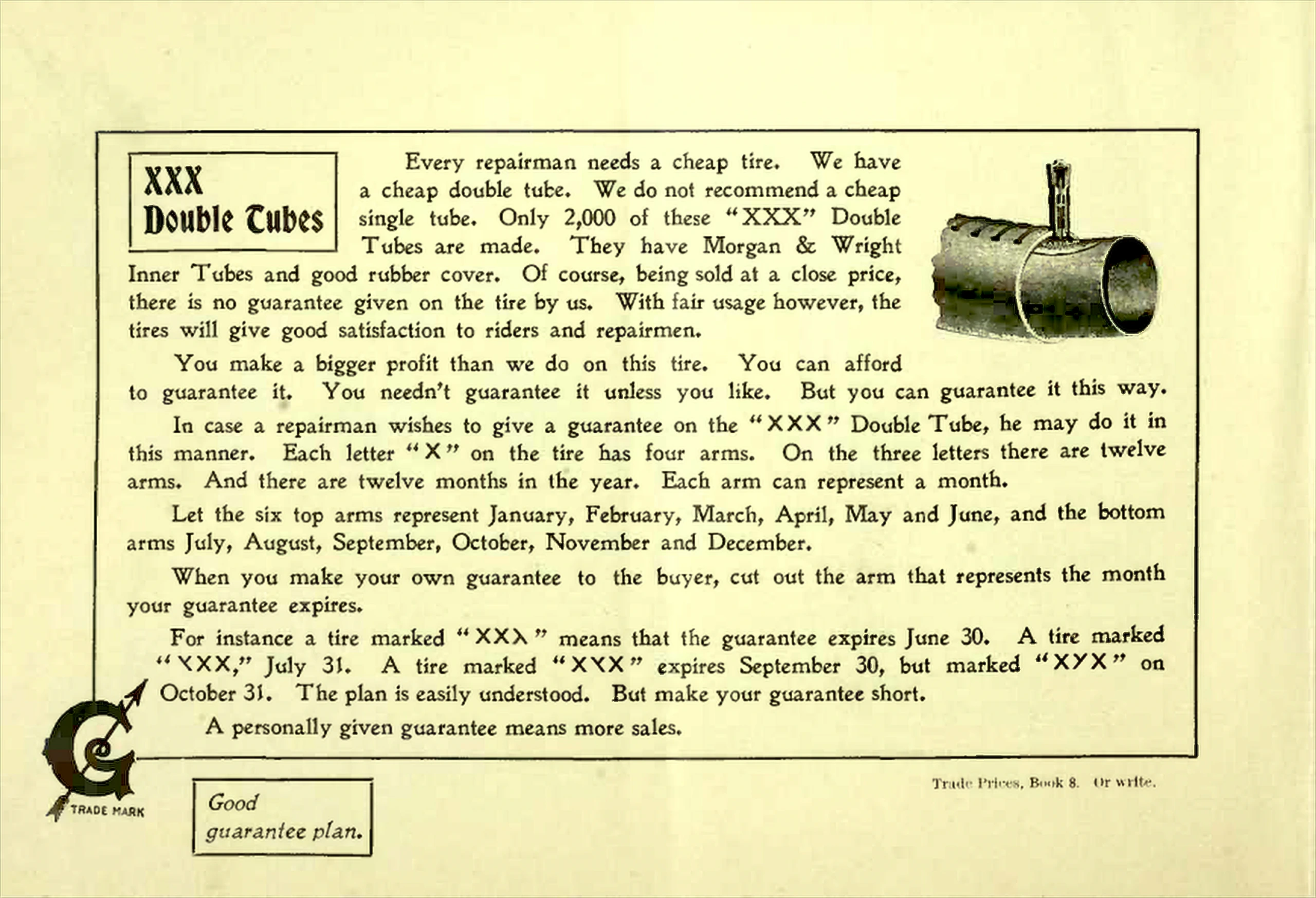
XXX Double Tubes
Every repairman needs a cheap tire. We have a cheap double tube. We do not recommend a cheap single tube. Only 2,000 of these “XXX” Double Tubes are made. They have Morgan & Wright Inner Tubes and good rubber cover. Of course, being sold at a close price, there is no guarantee given on the tire by us. With fair usage however, the tires will give good satisfaction to riders and repairmen.
You make a bigger profit than we do on this tire. You can afford to guarantee it. You needn’t guarantee it unless you like. But you can guarantee it this way.
In case a repairman wishes to give a guarantee on the “XXX” Double Tube, he may do it in this manner. Each letter “X” on the tire has four arms. On the three letters there are twelve arms. And there are twelve months in the year. Each arm can represent a month.
Let the six top arms represent January, February, March, April, May and June, and the bottom arms July, August, September, October, November and December.
When you make your own guarantee to the buyer, cut out the arm that represents the month your guarantee expires.
For instance a tire marked “XXX” means that the guarantee expires June 30. A tire marked “XXX,” July 31. A tire marked “XXX” expires September 30, but marked “XXX” on October 31. The plan is easily understood. But make your guarantee short.
A personally given guarantee means more sales.
TRADE MARK
Good guarantee plan.
Trade Prices, Book 8. Or write.
[A page about “XXX” Double Tubes with a small engraving of a tire and its valve, a boxed saying in italics and the G trade mark device at the lower left. In the last paragraph each marked “XXX” is set with one arm of a letter left out, to show the guarantee plan.]
— Page 9 —
Good rubber in these.
TRADE MARK
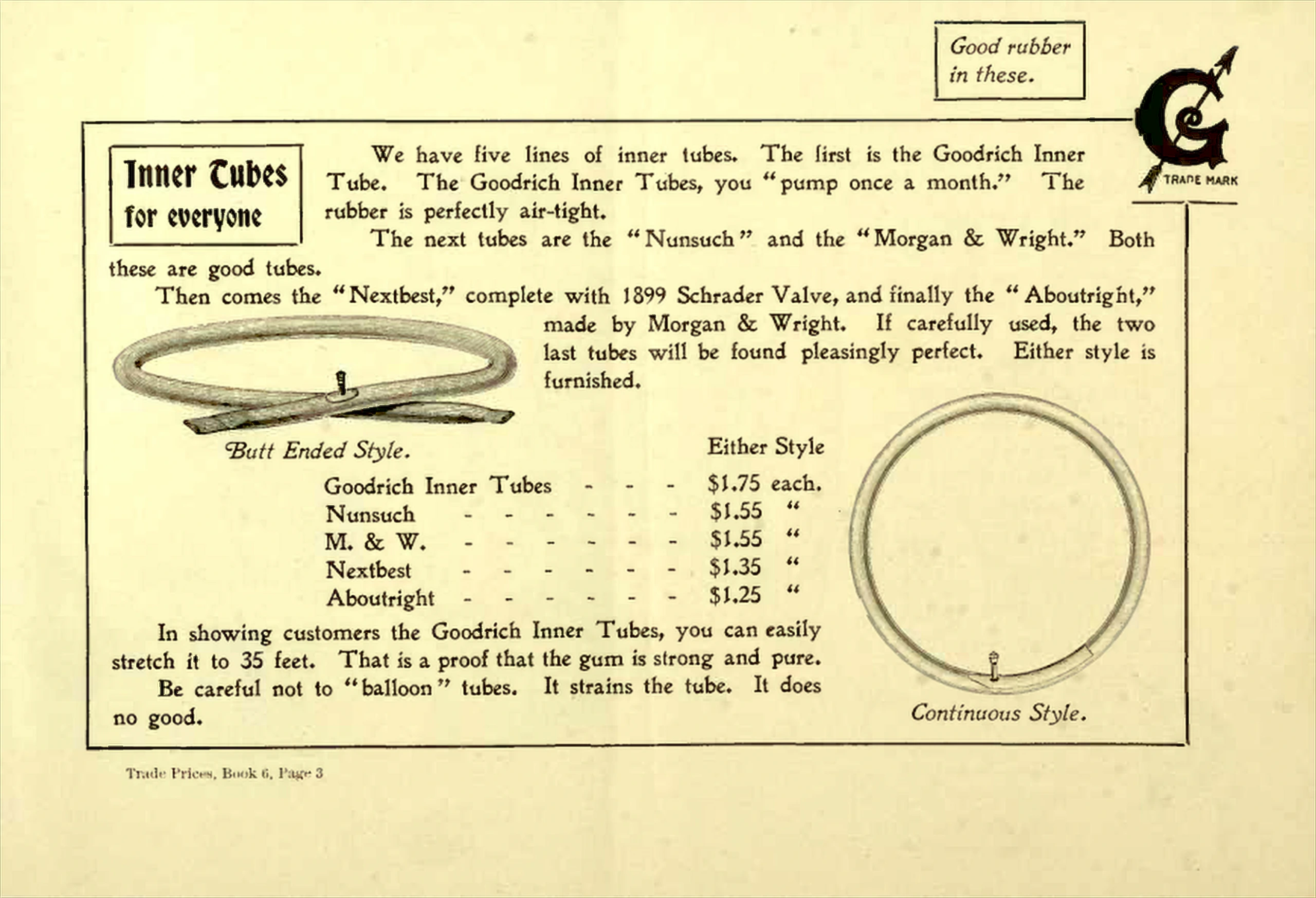
Inner Tubes for everyone
We have five lines of inner tubes. The first is the Goodrich Inner Tube. The Goodrich Inner Tubes, you “pump once a month.” The rubber is perfectly air-tight.
The next tubes are the “Nunsuch” and the “Morgan & Wright.” Both these are good tubes.
Then comes the “Nextbest,” complete with 1899 Schrader Valve, and finally the “Aboutright,” made by Morgan & Wright. If carefully used, the two last tubes will be found pleasingly perfect. Either style is furnished.
Butt Ended Style.
Either Style
Goodrich Inner Tubes – – – $1.75 each.
Nunsuch – – – – – – – $1.55 ”
M. & W. – – – – – – – $1.55 ”
Nextbest – – – – – – – $1.35 ”
Aboutright – – – – – – – $1.25 ”
In showing customers the Goodrich Inner Tubes, you can easily stretch it to 35 feet. That is a proof that the gum is strong and pure.
Be careful not to “balloon” tubes. It strains the tube. It does no good.
Continuous Style.
Trade Prices, Book 6, Page 3
[A page of “Inner Tubes for everyone” with an engraving of a butt ended tube and an engraving of a continuous tube, a short price list set with dot leaders and a boxed saying in italics. The G trade mark device sits at the top right.]
— Page 10 —
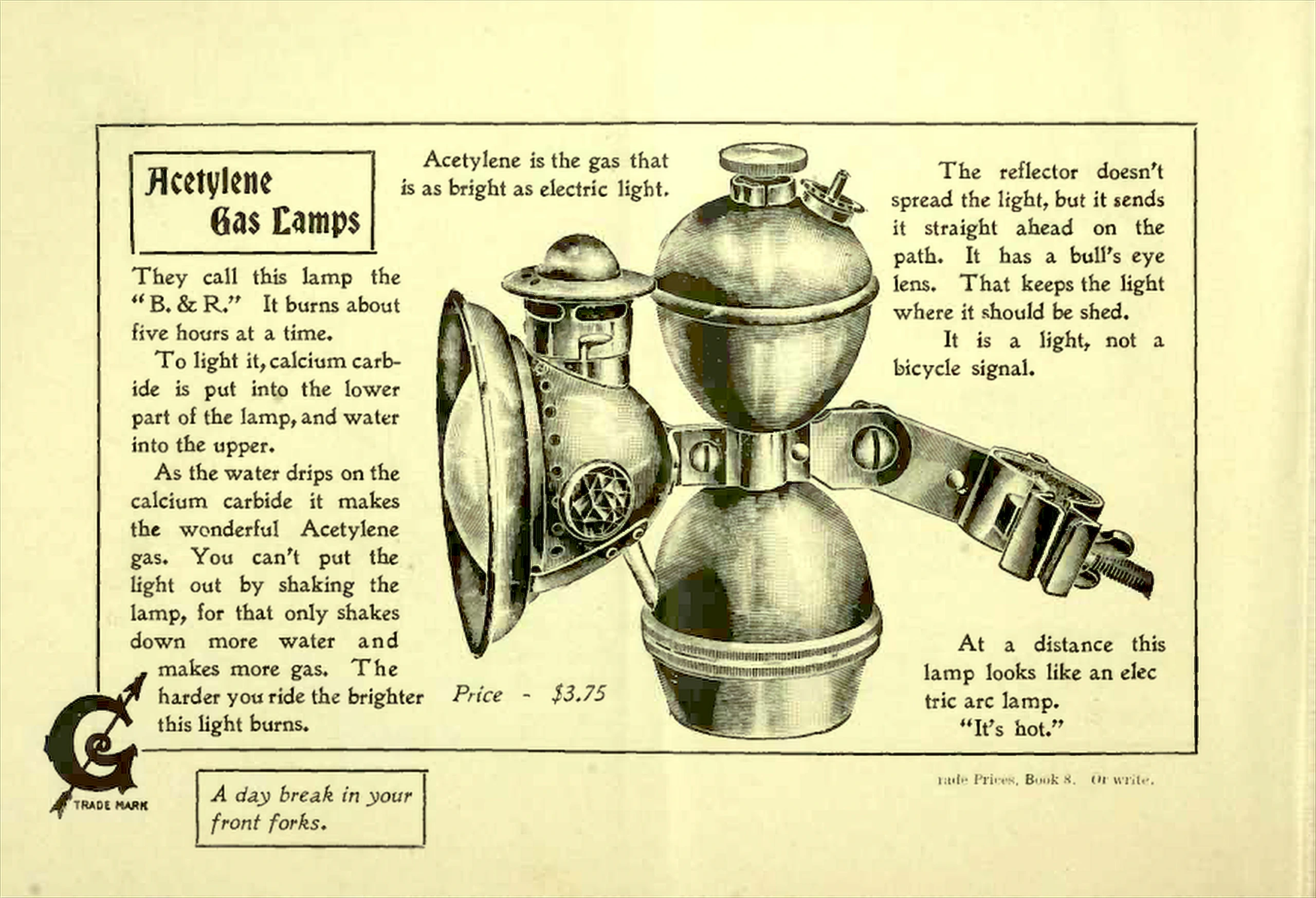
Acetylene Gas Lamps
They call this lamp the “B. & R.” It burns about five hours at a time.
To light it, calcium carbide is put into the lower part of the lamp, and water into the upper.
As the water drips on the calcium carbide it makes the wonderful Acetylene gas. You can’t put the light out by shaking the lamp, for that only shakes down more water and makes more gas. The harder you ride the brighter this light burns.
Acetylene is the gas that is as bright as electric light.
The reflector doesn’t spread the light, but it sends it straight ahead on the path. It has a bull’s eye lens. That keeps the light where it should be shed.
It is a light, not a bicycle signal.
Price – $3.75
At a distance this lamp looks like an electric arc lamp.
“It’s hot.”
TRADE MARK
A day break in your front forks.
[illegible]rade Prices, Book 8. Or write.
[An engraving of the “B. & R.” acetylene bicycle lamp with its reflector, lens, upper water tank, lower carbide tank and clamp bracket, within a ruled frame; the heading Acetylene Gas Lamps is in a box at the upper left, and a round G trade mark device stands at the lower left corner.]
— Page 11 —
Nothing breakable here.
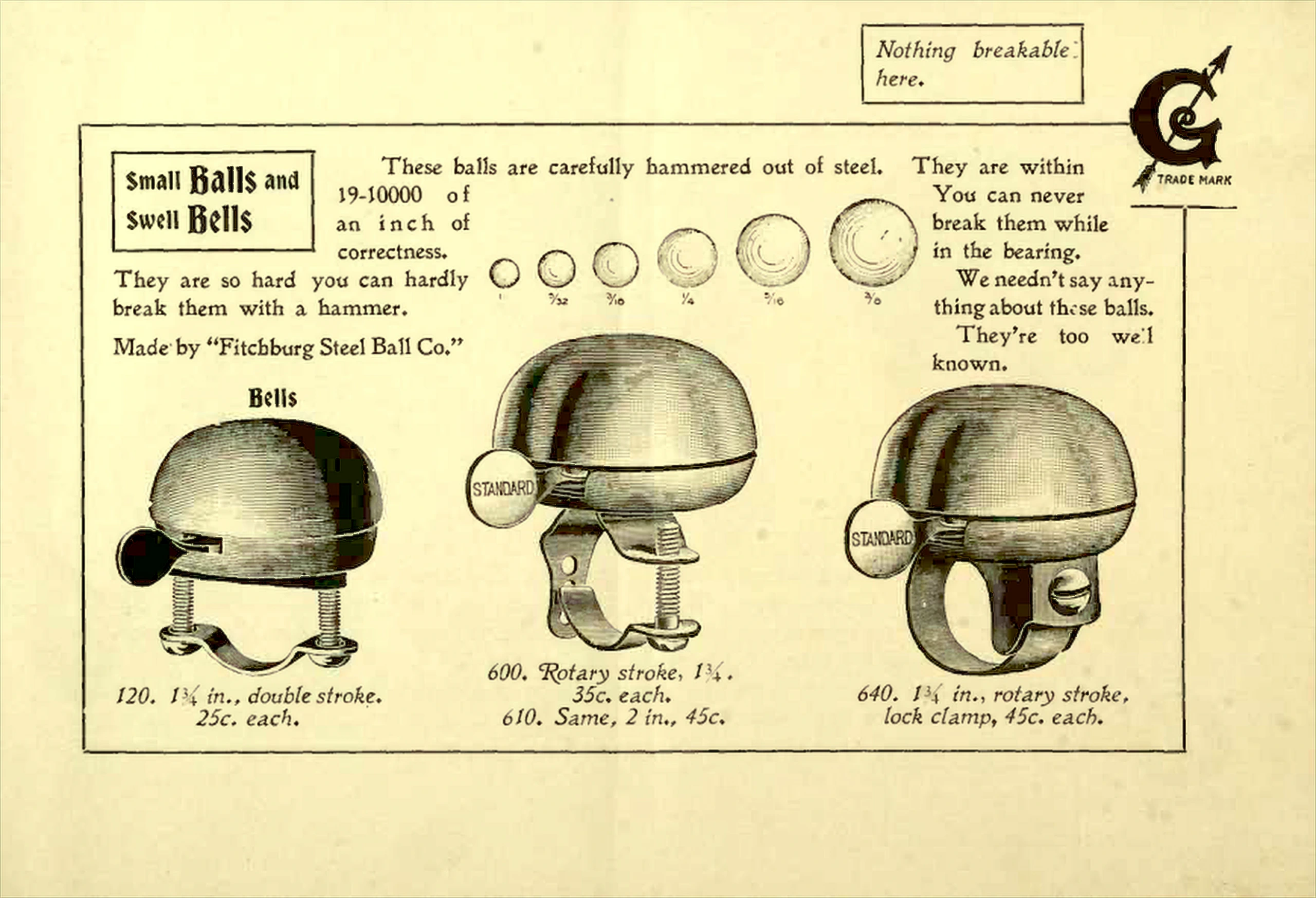
Small Balls and Swell Bells
These balls are carefully hammered out of steel. They are within 19-10000 of an inch of correctness.
They are so hard you can hardly break them with a hammer.
Made by “Fitchburg Steel Ball Co.”
You can never break them while in the bearing.
We needn’t say anything about these balls. They’re too well known.
Ball sizes under the balls: 1 [?] | 3/32 | 3/16 [?] | 1/4 | 5/16 [?] | 3/8 [?]
Bells
120. 1¾ in., double stroke. 25c. each.
600. Rotary stroke, 1¾. 35c. each.
610. Same, 2 in., 45c.
640. 1¾ in., rotary stroke, lock clamp, 45c. each.
TRADE MARK
[A row of six steel balls in graded sizes and three engraved bicycle bells with clamps, each with its number and price, within a ruled frame; the heading Small Balls and Swell Bells is in a box at the upper left and a round G trade mark device at the upper right.]
— Page 12 —
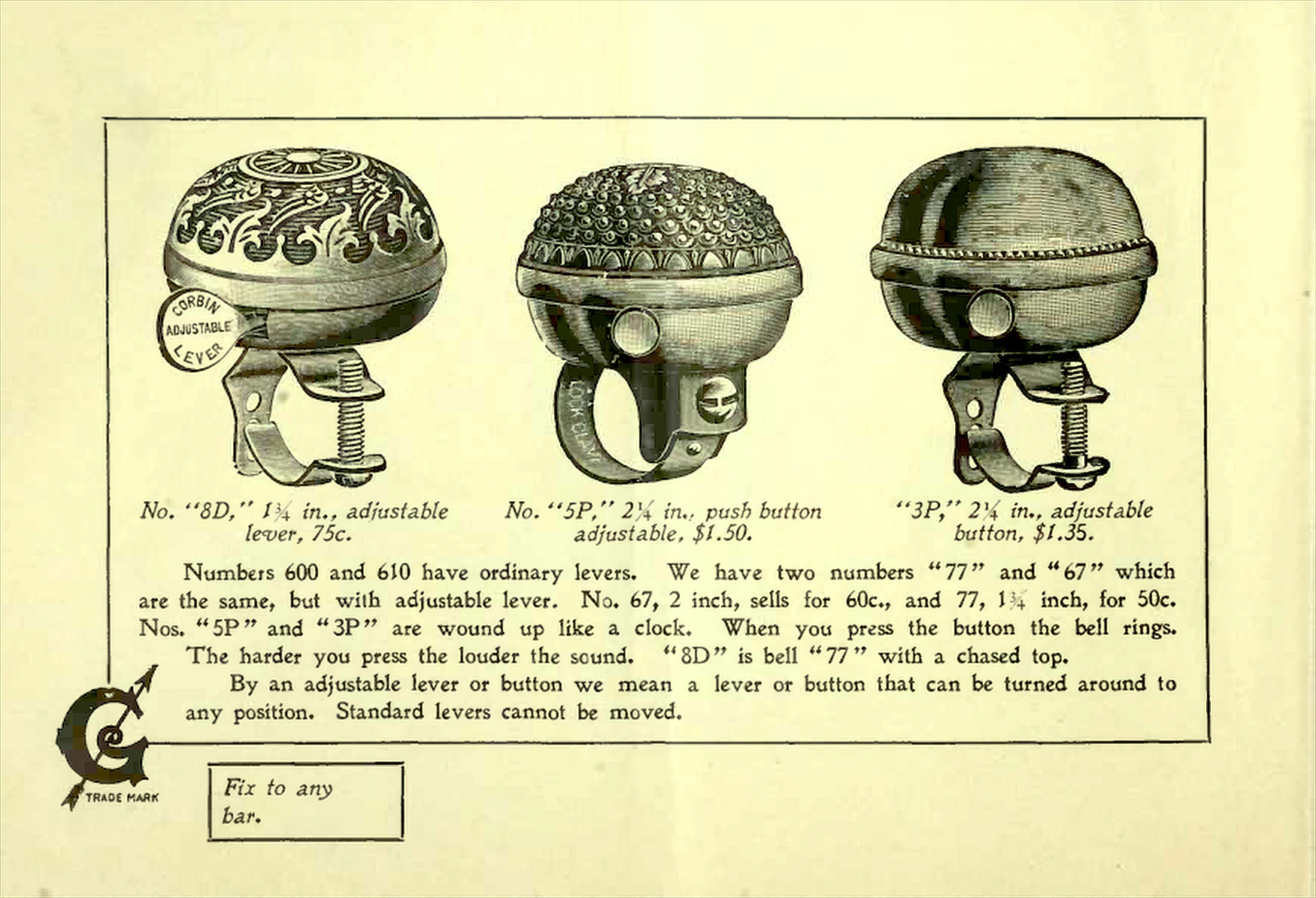
No. “8D,” 1¾ in., adjustable lever, 75c.
No. “5P,” 2¼ in., push button adjustable, $1.50.
“3P,” 2¼ in., adjustable button, $1.35.
Numbers 600 and 610 have ordinary levers. We have two numbers “77” and “67” which are the same, but with adjustable lever. No. 67, 2 inch, sells for 60c., and 77, 1¾ inch, for 50c. Nos. “5P” and “3P” are wound up like a clock. When you press the button the bell rings. The harder you press the louder the sound. “8D” is bell “77” with a chased top.
By an adjustable lever or button we mean a lever or button that can be turned around to any position. Standard levers cannot be moved.
TRADE MARK
Fix to any bar.
[Three engraved bicycle bells with clamps, labeled No. “8D”, No. “5P” and “3P” with sizes and prices, above a paragraph on lever and button types, within a ruled frame; a disc on the first bell is lettered Corbin Adjustable Lever, and a round G trade mark device and a boxed line stand at the lower left.]
— Page 13 —
Can’t beat these.
Bells—the “Peerless”
These Peerless bells are absolutely “up-to-date.” They are highly nickeled and attractive. To put one on the handle bar, you turn the top and base to the right. To adjust the lever, you turn the base only to the proper position. To lock into that position, you turn the top till it stops. It’s worth $1.50, because it’s good. Can’t be beaten.
These “Peerless” bells are very novel, and although they look heavy they are very light. They are the best bells we have ever seen in Canada.
No. 80 Peerless, $1.50
No. 70 Peerless, $1.50
TRADE MARK
Book 8. Or, write for prices.
[Two engraved Peerless bicycle bells, No. 80 and No. 70, with a top view of a bell dome between them, and a paragraph on adjusting and locking the bells, within a ruled frame; the heading is in a box at the upper left, a boxed line and a round G trade mark device at the upper right.]
— Page 14 —
Good Chains and Carriers—Brushes
Brushes. These brushes are manufactured especially for enamelling. An enameller need have no fear of leaving hair on the enamelled surface—the brushes are perfectly safe. “Sable hair” is used which is by far the best for bicycle enamelling. Flat brushes of course.
⅜ in. – – 20c. ¾ in. – – 35c. 1 in. – – 40c. each.
Carriers. The “Victor” bundle carrier is a strong elastic band which hooks around both handlebar and parcel. It may also be used as a trousers’ guard.
Red Rubber – – – per pair, 20c.
“8 P.”
Chains. This shows the “Indianapolis” chain. The sides are polished and bright, but the blocks are straw tempered, 3/16 inches wide. Very popular in the United States. Standard length for wheels, each chain – – – – – – – $1.25
TRADE MARK
“No doubt about these.”
Trade Prices, Book 6, Page 4
[An engraved length of “Indianapolis” bicycle chain marked “8 P.” beneath paragraphs on enamelling brushes and the Victor bundle carrier, within a ruled frame; the heading is in a box at the upper left, and a round G trade mark device and a boxed line stand at the lower left.]
— Page 15 —
“A chain that you take off.”
The “Baldwin” a detachable chain
Prices
(With repairs) of each standard bicycle “Baldwin” chain.
No. 3/16 or ¼ wide. | Each
AB Baldwin, any width – | $1.50
B Baldwin, any width – | 1.75
D Baldwin, any width – | 1.90
C Baldwin, any width – | 2.60
Racer Baldwin, ⅛ [?] in. only, nickel steel, plated – – | 3.00
The differing prices of the Baldwin are due to the quality and finish of the steel—the design is unvaried.
If your chain breaks when you’re on the road you’ll want a new link in “bad.” That is the idea on which the makers have acted when they made the “Baldwin.”
As you may see, the chain consists of three parts. When the chain is under strain it is like an ordinary chain—when an accident happens it can be mended in a few moments. And they are very light. When a rider is compelled to use the repair feature of the “Baldwin” he will be more than pleased with the results.
All the “Baldwin” chains have “B” blocks, and the rivets, blocks, and sides are hardened.
The “AB” chain has white links, chains “B” and “D” have blued sides. “C” chain is nickeled, but the sides are blued, as is also the racer, which is a particularly fine looking chain.
This cut shows the three parts.
TRADE MARK
Trade Prices, Book 6, Page 4
[A boxed heading The “Baldwin” a detachable chain with a price list for the Baldwin chain grades, a text column, and engravings of the chain’s three parts and an assembled link, within a ruled frame; a boxed line and a round G trade mark device stand at the upper right.]
— Page 16 —
Clips and Coasters
Clips for trousers are the safest of appliances—when you think of the accidents that happen from sprocket and chain. We think the vest pocket style we show is very neat. But we take pride in our horseshoe-shaped clip, too. The idea of the cloth-covered horseshoe clip is to prevent the bare clip from injuring the rider’s trousers with rust. The enameled horseshoe clip does the same thing. The “corrugated” clip has additional strength from the corrugations, and it is made narrower and lighter than an ordinary clip.
“Can’t scratch the enamel.”
Corrugated Enamelled Horseshoe Clip – 10c. pair
Perfection Enamelled Horseshoe Clip – – 10c. pair
Vest Pocket Blued Sleel Clip, like cut – 10c. pair
Cloth-covered Horseshoe Clip, to prevent rust, 15c. pair
10c. pair.
Coasters are one of those popular bicycle attachments that nearly every rider wants to have. These are attached by a single bolt, don’t scratch the enamel, and are folded up against the fork when not in use. Of course, it is highly nickeled.
25c. pair.
Price, per pair – – – – 25c.
TRADE MARK
Wish you had a pair of Coasters?
Trade Price, Book 6. Pages 5 and 13
[Engravings of a vest pocket trouser clip with the lettering The Bevin on its band and of a folding foot coaster with a toothed rest, beside paragraphs and a price list for clips and coasters, within a ruled frame; the heading is in a box at the upper left, and a round G trade mark device and a boxed line stand at the lower left.]
— Page 17 —
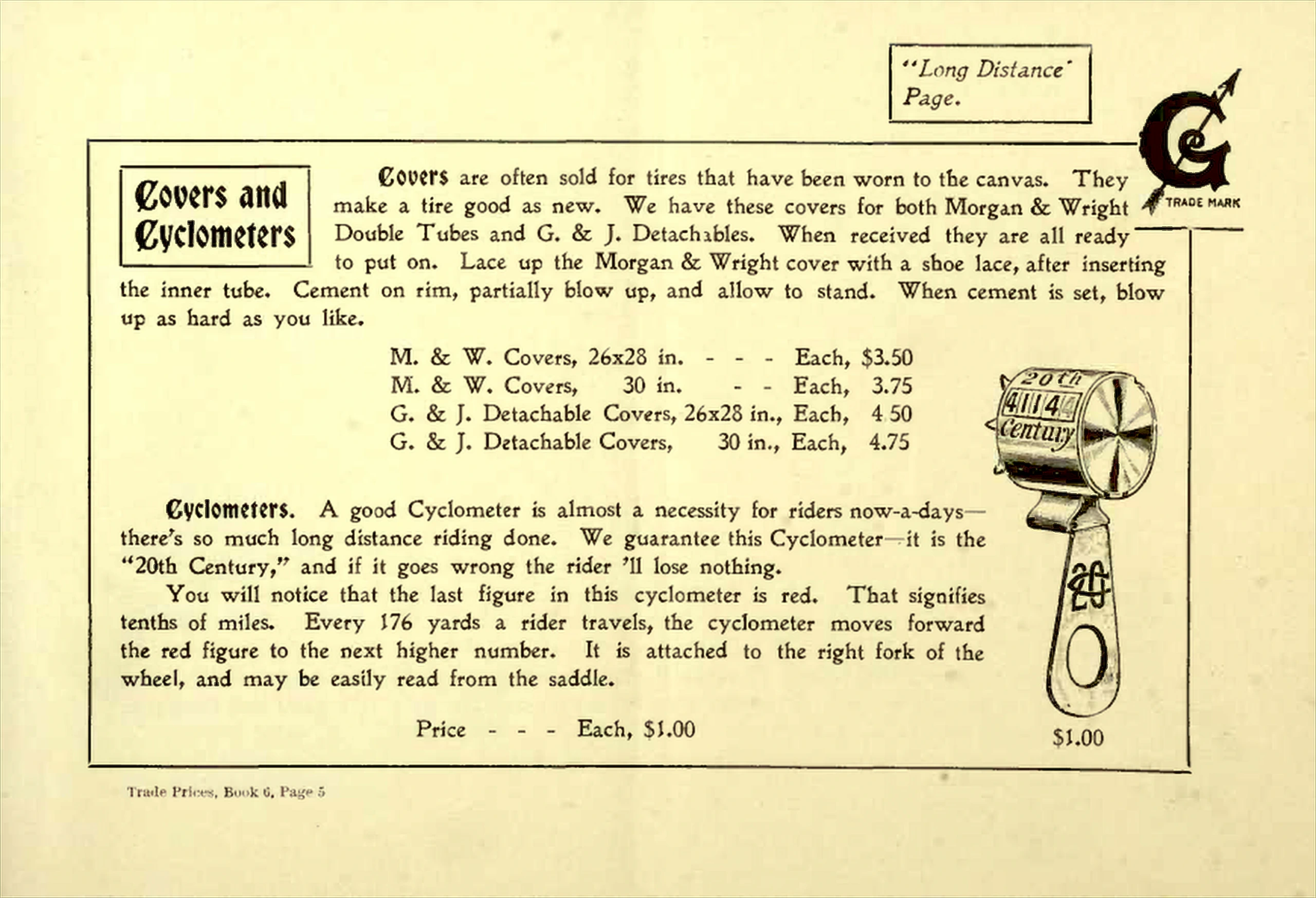
“Long Distance” Page.
Covers and Cyclometers
Covers are often sold for tires that have been worn to the canvas. They make a tire good as new. We have these covers for both Morgan & Wright Double Tubes and G. & J. Detachables. When received they are all ready to put on. Lace up the Morgan & Wright cover with a shoe lace, after inserting the inner tube. Cement on rim, partially blow up, and allow to stand. When cement is set, blow up as hard as you like.
M. & W. Covers, 26×28 in. – – – Each, $3.50
M. & W. Covers, 30 in. – – Each, 3.75
G. & J. Detachable Covers, 26×28 in., Each, 4 50
G. & J. Detachable Covers, 30 in., Each, 4.75
Cyclometers. A good Cyclometer is almost a necessity for riders now-a-days—there’s so much long distance riding done. We guarantee this Cyclometer—it is the “20th Century,” and if it goes wrong the rider ‘ll lose nothing.
You will notice that the last figure in this cyclometer is red. That signifies tenths of miles. Every 176 yards a rider travels, the cyclometer moves forward the red figure to the next higher number. It is attached to the right fork of the wheel, and may be easily read from the saddle.
Price – – – Each, $1.00
$1.00
TRADE MARK
Trade Prices, Book 6, Page 5
[An engraving of a “20th Century” cyclometer on its fork bracket beside paragraphs and a price list for tire covers and cyclometers, within a ruled frame; the heading is in a box at the upper left, and a boxed line and a round G trade mark device stand at the upper right.]
— Page 18 —
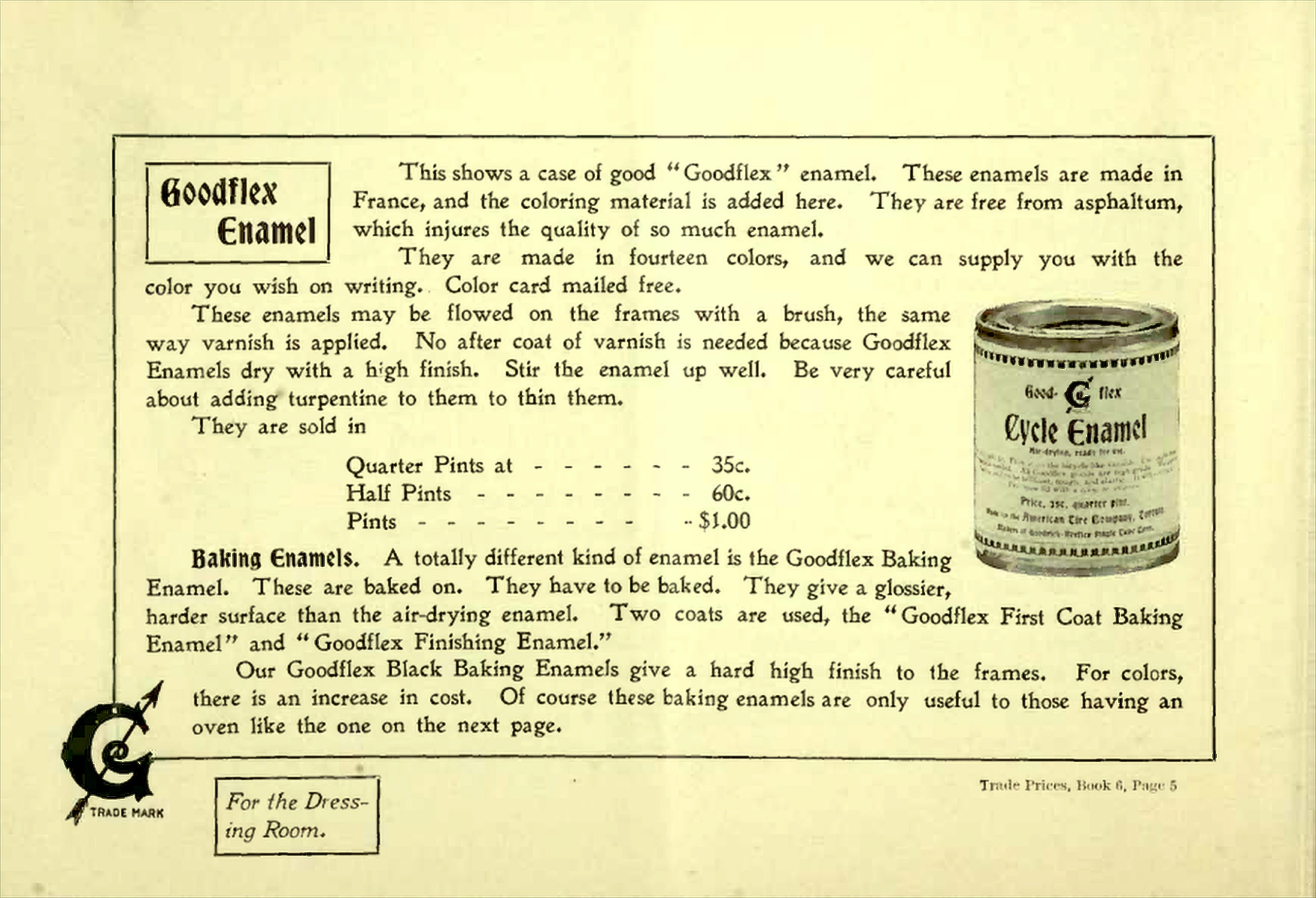
Goodflex Enamel
This shows a case of good “Goodflex” enamel. These enamels are made in France, and the coloring material is added here. They are free from asphaltum, which injures the quality of so much enamel.
They are made in fourteen colors, and we can supply you with the color you wish on writing. Color card mailed free.
These enamels may be flowed on the frames with a brush, the same way varnish is applied. No after coat of varnish is needed because Goodflex Enamels dry with a high finish. Stir the enamel up well. Be very careful about adding turpentine to them to thin them.
They are sold in
Quarter Pints at – – – – – – 35c.
Half Pints – – – – – – – – 60c.
Pints – – – – – – – – – $1.00
Baking Enamels. A totally different kind of enamel is the Goodflex Baking Enamel. These are baked on. They have to be baked. They give a glossier, harder surface than the air-drying enamel. Two coats are used, the “Goodflex First Coat Baking Enamel” and “Goodflex Finishing Enamel.”
Our Goodflex Black Baking Enamels give a hard high finish to the frames. For colors, there is an increase in cost. Of course these baking enamels are only useful to those having an oven like the one on the next page.
TRADE MARK
For the Dressing Room.
Trade Prices, Book 6, Page 5
[An engraving of a can of Goodflex Cycle Enamel beside paragraphs and a price list for air-drying and baking enamels, within a ruled frame; the heading Goodflex Enamel is in a box at the upper left, and a round G trade mark device and a boxed line stand at the lower left. The can label is mostly too small to read.]
— Page 19 —
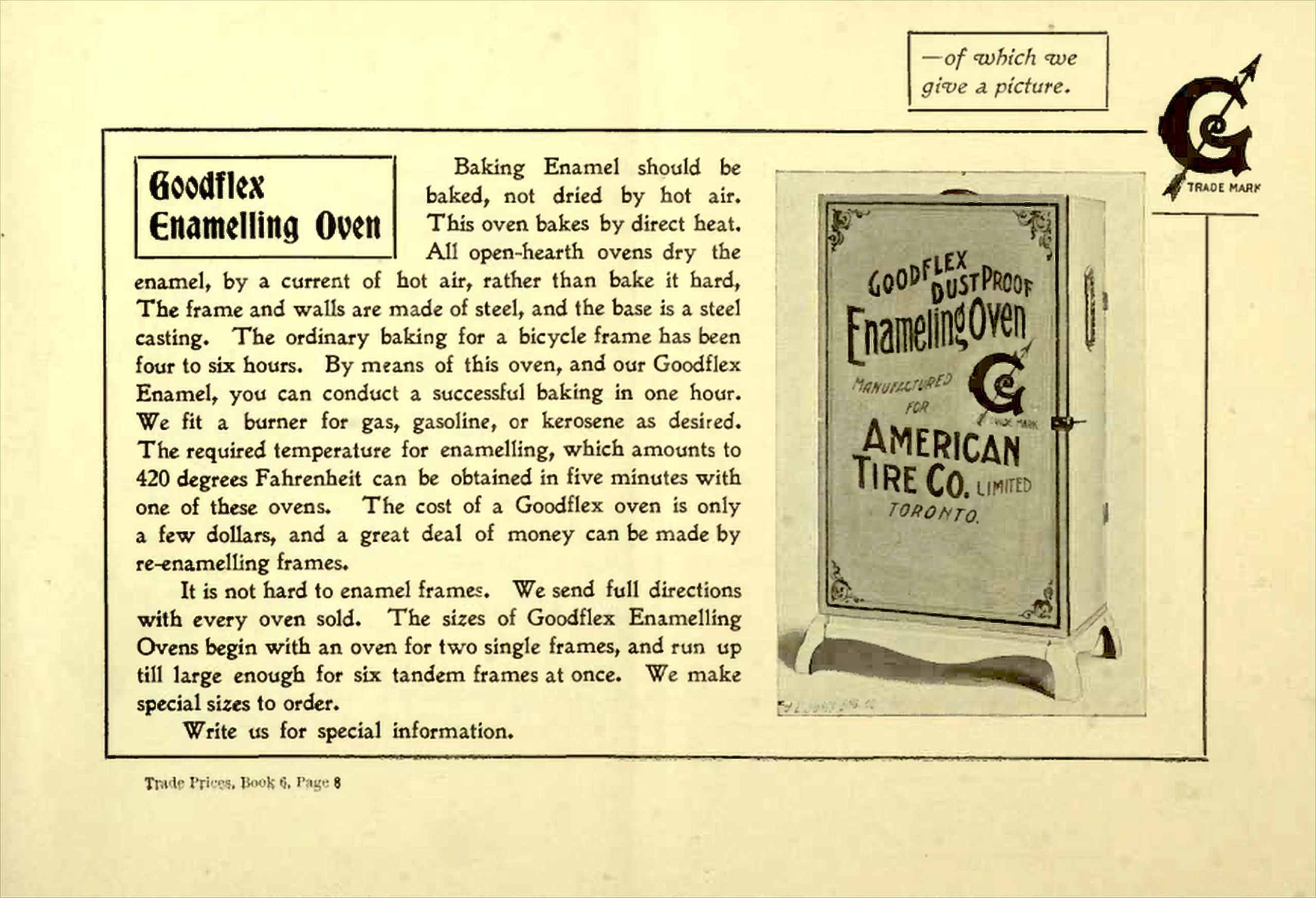
-of which we give a picture.
Goodflex Enamelling Oven
Baking Enamel should be baked, not dried by hot air. This oven bakes by direct heat. All open-hearth ovens dry the enamel, by a current of hot air, rather than bake it hard, The frame and walls are made of steel, and the base is a steel casting. The ordinary baking for a bicycle frame has been four to six hours. By means of this oven, and our Goodflex Enamel, you can conduct a successful baking in one hour. We fit a burner for gas, gasoline, or kerosene as desired. The required temperature for enamelling, which amounts to 420 degrees Fahrenheit can be obtained in five minutes with one of these ovens. The cost of a Goodflex oven is only a few dollars, and a great deal of money can be made by re-enamelling frames.
It is not hard to enamel frames. We send full directions with every oven sold. The sizes of Goodflex Enamelling Ovens begin with an oven for two single frames, and run up till large enough for six tandem frames at once. We make special sizes to order.
Write us for special information.
TRADE MARK
GOODFLEX DUST PROOF Enameling Oven MANUFACTURED FOR AMERICAN TIRE CO. LIMITED TORONTO.
Trade Prices, Book 6, Page 8
[The Goodflex Enamelling Oven: a boxed heading and a paragraph of text beside a photograph of a tall cabinet oven lettered for the American Tire Co. Limited, Toronto, with a small boxed note at the top right and the round G trade mark in the corner.]
— Page 20 —
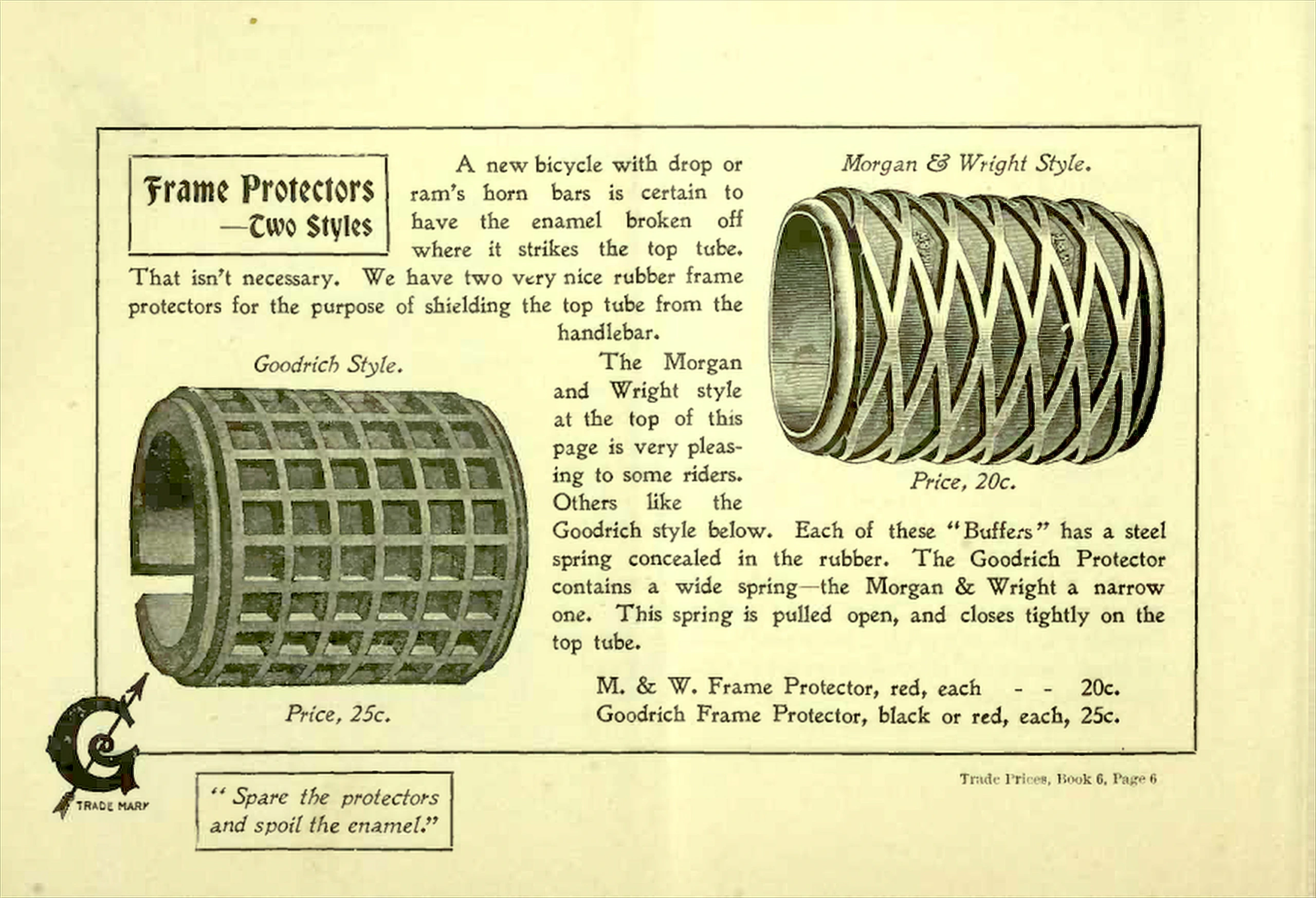
Frame Protectors -Two Styles
A new bicycle with drop or ram’s horn bars is certain to have the enamel broken off where it strikes the top tube. That isn’t necessary. We have two very nice rubber frame protectors for the purpose of shielding the top tube from the handlebar.
The Morgan and Wright style at the top of this page is very pleasing to some riders. Others like the Goodrich style below. Each of these “Buffers” has a steel spring concealed in the rubber. The Goodrich Protector contains a wide spring-the Morgan & Wright a narrow one. This spring is pulled open, and closes tightly on the top tube.
M. & W. Frame Protector, red, each – – 20c.
Goodrich Frame Protector, black or red, each, 25c.
Morgan & Wright Style.
Price, 20c.
Goodrich Style.
Price, 25c.
” Spare the protectors and spoil the enamel.”
TRADE MARK
Trade Prices, Book 6, Page 6
[Two rubber frame protectors in engravings, the Morgan & Wright Style and the Goodrich Style, each with its price, beside a boxed heading and text, with a boxed saying at the lower left and the round G trade mark in the corner.]
— Page 21 —
They give you the ” glad hand.”
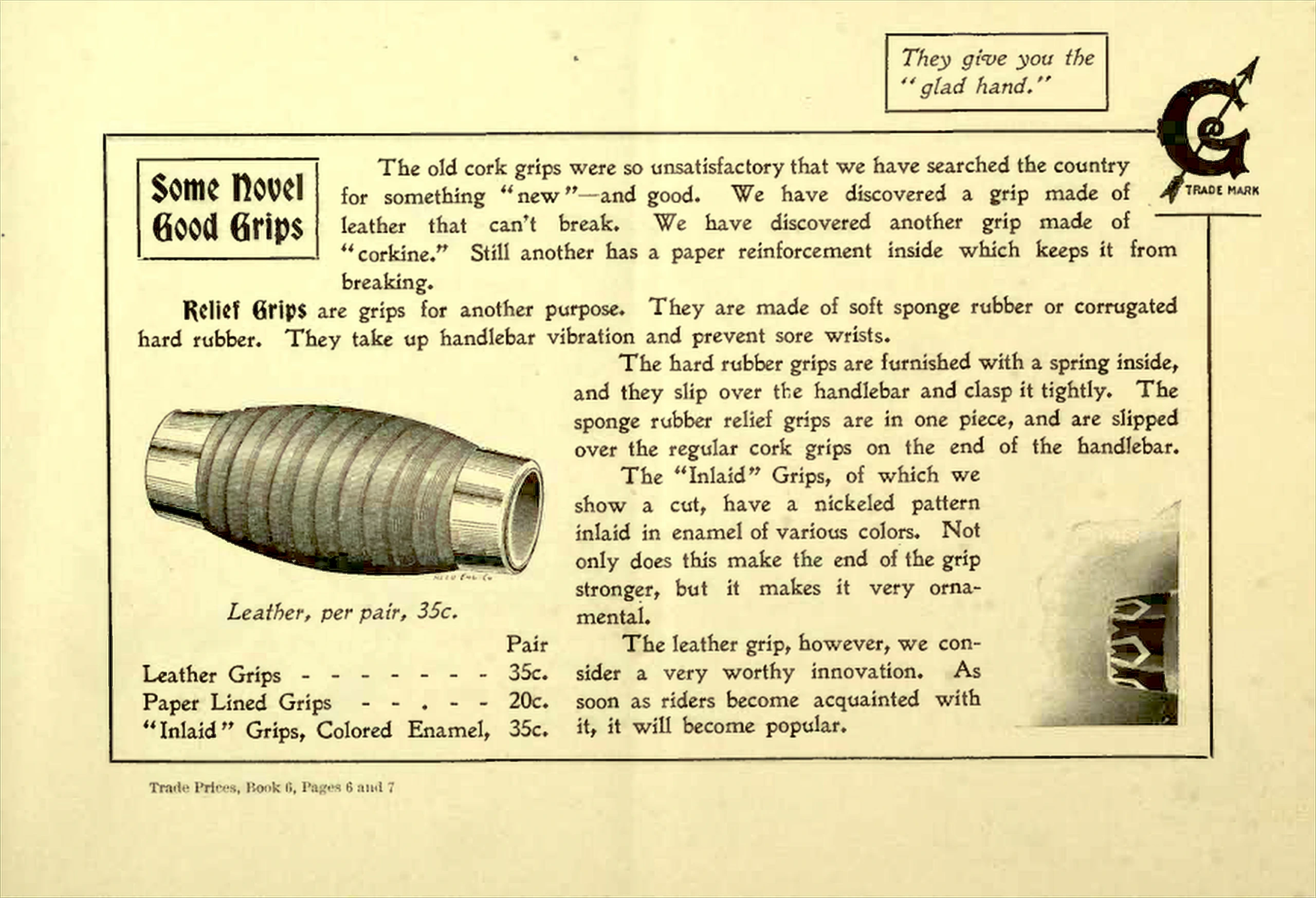
Some Novel Good Grips
The old cork grips were so unsatisfactory that we have searched the country for something “new”-and good. We have discovered a grip made of leather that can’t break. We have discovered another grip made of “corkine.” Still another has a paper reinforcement inside which keeps it from breaking.
Relief Grips are grips for another purpose. They are made of soft sponge rubber or corrugated hard rubber. They take up handlebar vibration and prevent sore wrists.
The hard rubber grips are furnished with a spring inside, and they slip over the handlebar and clasp it tightly. The sponge rubber relief grips are in one piece, and are slipped over the regular cork grips on the end of the handlebar.
The “Inlaid” Grips, of which we show a cut, have a nickeled pattern inlaid in enamel of various colors. Not only does this make the end of the grip stronger, but it makes it very ornamental.
The leather grip, however, we consider a very worthy innovation. As soon as riders become acquainted with it, it will become popular.
Leather, per pair, 35c.
Pair
Leather Grips – – – – – – – 35c.
Paper Lined Grips – – – . – – 20c.
“Inlaid” Grips, Colored Enamel, 35c.
TRADE MARK
Trade Prices, Book 6, Pages 6 and 7
[Some Novel Good Grips: text about leather, corkine, paper lined, relief and inlaid grips, an engraving of a ribbed grip captioned with its price per pair, a small photograph of an inlaid grip end and a short price list, with a boxed saying at the top right and the round G trade mark in the corner.]
— Page 22 —
Late Bars given on last page.
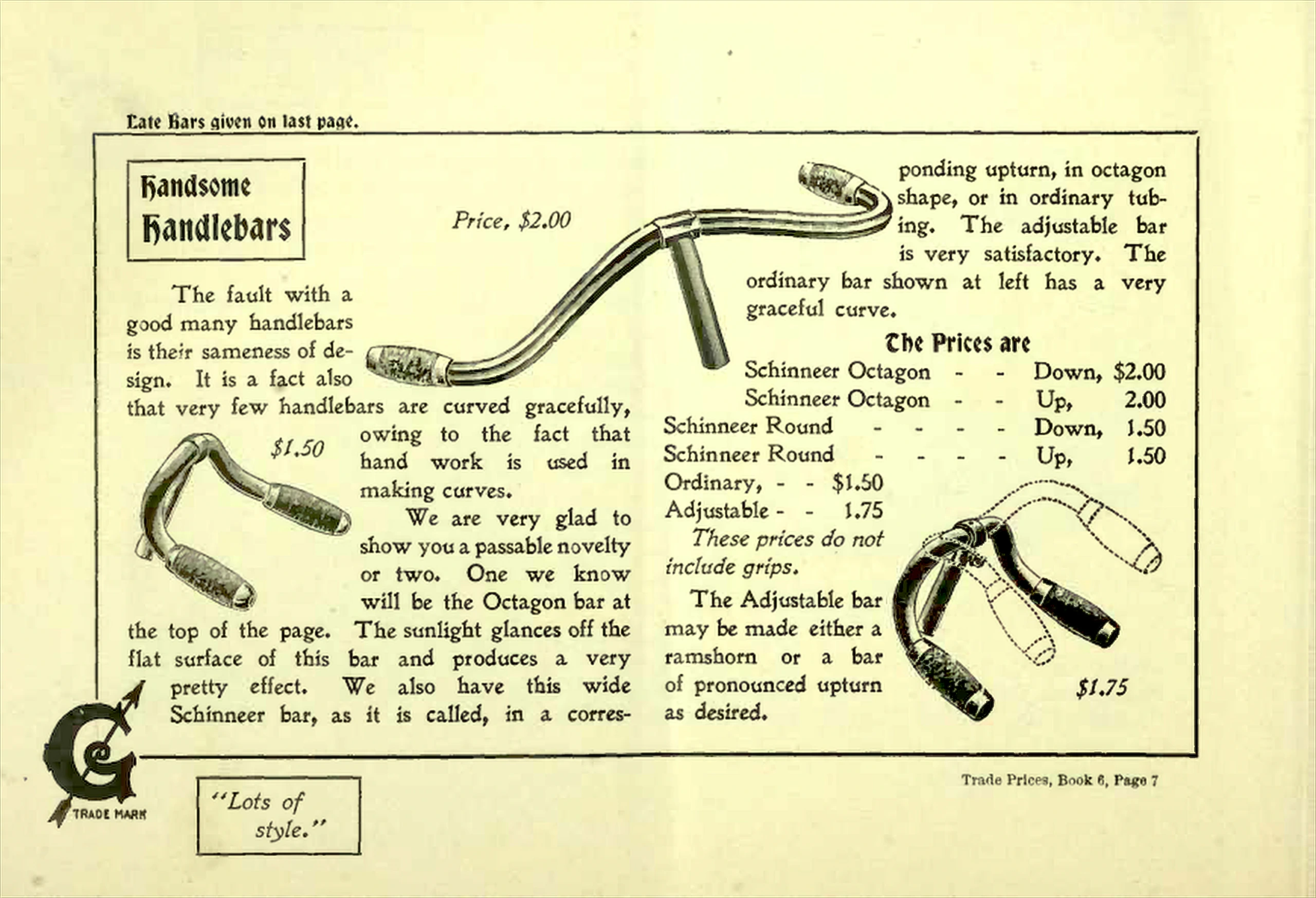
Handsome Handlebars
The fault with a good many handlebars is their sameness of design. It is a fact also that very few handlebars are curved gracefully, owing to the fact that hand work is used in making curves.
We are very glad to show you a passable novelty or two. One we know will be the Octagon bar at the top of the page. The sunlight glances off the flat surface of this bar and produces a very pretty effect. We also have this wide Schinneer bar, as it is called, in a corresponding upturn, in octagon shape, or in ordinary tubing. The adjustable bar is very satisfactory. The ordinary bar shown at left has a very graceful curve.
Price, $2.00
$1.50
$1.75
The Prices are
Schinneer Octagon – – Down, $2.00
Schinneer Octagon – – Up, 2.00
Schinneer Round – – – – Down, 1.50
Schinneer Round – – – – Up, 1.50
Ordinary, – – $1.50
Adjustable – – 1.75
These prices do not include grips.
The Adjustable bar may be made either a ramshorn or a bar of pronounced upturn as desired.
“Lots of style.”
TRADE MARK
Trade Prices, Book 6, Page 7
[Handsome Handlebars: engravings of an octagon bar priced $2.00, an ordinary bar priced $1.50 and an adjustable bar priced $1.75, with text and a list of prices, a boxed saying at the lower left and the round G trade mark in the corner.]
— Page 23 —
A good Hub makes a good wheel.
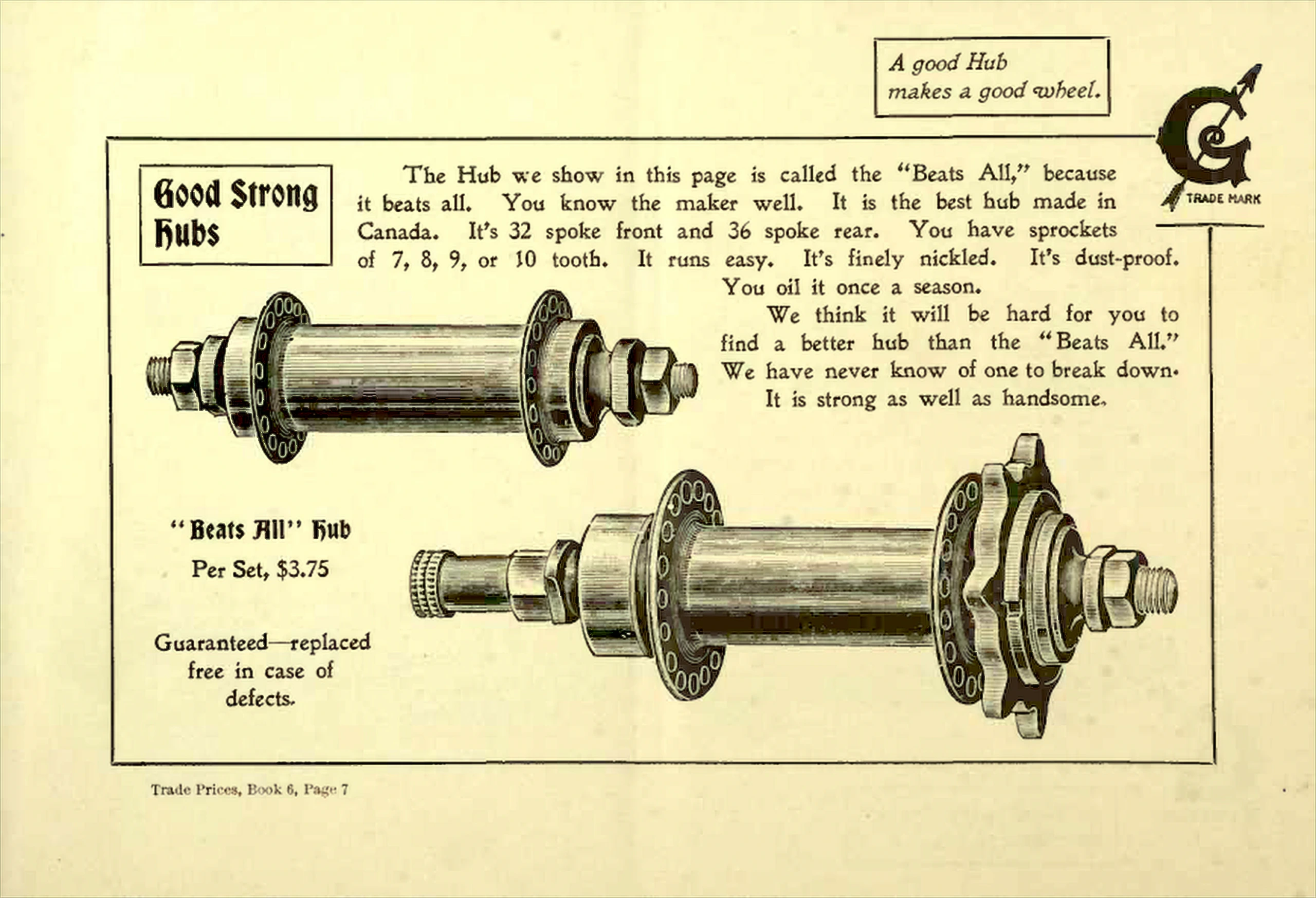
Good Strong Hubs
The Hub we show in this page is called the “Beats All,” because it beats all. You know the maker well. It is the best hub made in Canada. It’s 32 spoke front and 36 spoke rear. You have sprockets of 7, 8, 9, or 10 tooth. It runs easy. It’s finely nickled. It’s dust-proof. You oil it once a season.
We think it will be hard for you to find a better hub than the “Beats All.” We have never know of one to break down. It is strong as well as handsome.
“Beats All” Hub
Per Set, $3.75
Guaranteed-replaced free in case of defects.
TRADE MARK
Trade Prices, Book 6, Page 7
[Good Strong Hubs: engravings of a front hub and a rear hub with a sprocket, captioned “Beats All” Hub with its price per set, beside text and a guarantee note, with a boxed saying at the top right and the round G trade mark in the corner.]
— Page 24 —
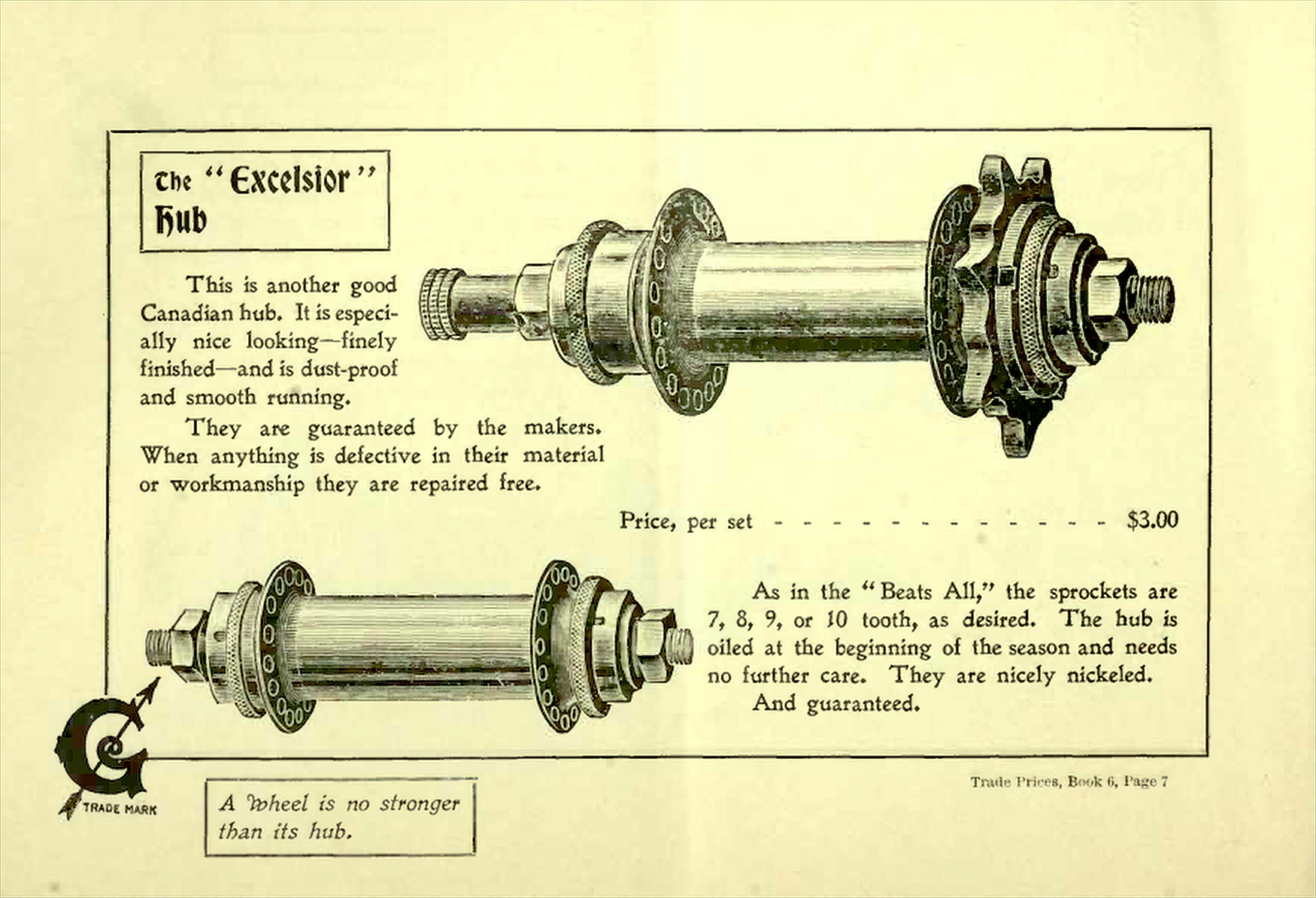
The “Excelsior” Hub
This is another good Canadian hub. It is especially nice looking-finely finished-and is dust-proof and smooth running.
They are guaranteed by the makers. When anything is defective in their material or workmanship they are repaired free.
Price, per set – – – – – – – – – – – – – – $3.00
As in the “Beats All,” the sprockets are 7, 8, 9, or 10 tooth, as desired. The hub is oiled at the beginning of the season and needs no further care. They are nicely nickled.
And guaranteed.
“A wheel is no stronger than its hub.”
TRADE MARK
Trade Prices, Book 6, Page 7
[The “Excelsior” Hub: engravings of a rear hub with a sprocket and a front hub, with text, a price per set and a guarantee note, a boxed saying at the lower left and the round G trade mark in the corner.]
— Page 25 —
An easy-running hub, means an easy running wheel.
“Plew” Hub Lubricants
This is a good Hub for such as are desirous of getting are liable article at a price which is not exorbitant. We thoroughly recommend the Hub in question. It will be found to be most satisfactory to the rider or repairman. The price is $2.75 per set.
In the “Plew” you will find a most satisfactory hub for use in repair shops. To oil it the cone is taken out by unscrewing the binding nuts, and a single application of oil does for a long time. The standard sprocket furnished for the rear hub is nine-tooth, and it is kept in nine-tooth only. It is a guaranteed hub, and has a high, accurate, nickeled finish.
Lubricants Almonoil is made expressly for the use of bicycle riders on the road. It is a jelly like lubricant, which comes in tubes, and which is very handy to carry in the tool bag. It makes chains run very easily, but it is especially good for hub and crank hanger ball races because it does not gather dust to any entent.
Unlike most chain lubricants carried in tubes, Almonoil will not soil the hands, and it has the additional quality of giving a very fine polish with which to finish off the enameled parts of a wheel.
Almonoil is also a nice temporary finish for all nickeled parts of the bicycle, which it keeps from tarnishing. A little Almonoil on a rag will clean a chain off as well as oil it. 10c. a tube.
Even in the hetest weather, Almonoil does not melt.
TRADE MARK
[The “Plew” Hub and Lubricants: an engraving of a rear hub with a sprocket beside text about the hub, its price per set and Almonoil in tubes, with a boxed saying at the top right and the round G trade mark in the corner. No printed folio is visible.]
— Page 26 —
Lubricants —Chain
The trouble with a chain lubricant is that it has to be as dry as possible in order to avoid the gathering of dust on the chain. The best known dry lubricant is graphite. Graphite, however, is very dirty and dusty. Often it contains grit, which is as bad as dust from the road. Some makers have tried to avoid the dusty quality of loose graphite by incorporating it with a heavy oil, such as grease, making a solid stick. The trouble with this kind of a chain lubricant is that it remains for the most part on the outside of the chain, discoloring everything, and what works into the chain is too heavy for fast moving parts. Our chain lubricant-Goodflex Chain Lubricant-contains fine graphite in suspension in a jelly-like oil which flows the graphite to all parts of the chain, and evaporates where it is exposed to the air, thus leaving the chain no surface to catch dirt.
The portion which is applied to the sprocket dries, leaving a fine layer of the purest graphite to take up the friction between block and tooth. It is especially useful when chain and sprockets are new, preventing the wear which brings about this frictional contact, and preventing chain stretch.
The tubes are very cleanly, and may be carried in tool bag or pocket withaut the least danger of leakage.
Goodflex goods are good goods
Good-G-flex
20c. each
Chain Lubricant
Manufactured for the American Tire Company, Limited, Toronto.
“Twenty cents worth of “jimmymichaelness.””
TRADE MARK
Trade Prices, Book 6, Page 9.
[Lubricants—Chain: text about the Goodflex Chain Lubricant beside a photograph of six tubes standing in a display box lettered Chain Lubricant, 20c. each, American Tire Company, Limited, Toronto, with a boxed saying at the lower left and the round G trade mark in the corner.]
— Page 27 —
To make old things new.
Metal Preservatives Mushrooms
Our Metal Preservative is a preparation for preventing the tarnishing of bright metal surfaces on wheels or machinery. It is absolutely colorless and is flowed on with a brush. It comes in ¼ pint cans, and costs 25c. a can.
In applying it, be careful to do so in a warm room where the Preservative will flow perfectly.
Copal Varnish. As a preservative for enamel and metal, we use Copal Varnish put up specially for us. This varnish is clean and colorless and gives a very bright finish. These cans of Copal Varnish in ½ pint sizes cost 50c. each. Not only are they good for putting over baking and air drying enamels, but they are very valuable for attaching grips to handlebars.
Mushrooms are finished in two styles of the nicest rubber. We can guarantee that ours will not loosen from the inner tube or tire, and that they will be most satisfactory. No retail price.
The proper way to attach a mushroom to an inner tube is to first clean both surfaces with either emery paper or benzine. When perfectly dry, apply Goodflex Rubber Cement to both the tube and the mushroom and press together. If there is no hole in the Inner Tube, make one by means of a hot iron, and place the centre of the mushroom exactly over the hole in the tube.
To attach a mushroom to a Single Tube Tire, the first step is to cut out the old valve stem, then clean the inside of the tire thoroughly with benzine. When this is done, insert the mushroom, having applied Goodrich 434 Vulcanising Solution (and allowed same to dry) to its upper surface only, being very careful! not to allow any of the solution to get on the lower side of mushroom. If there is a cavity around stem, pack same with raw gum, then vulcanise the whole in a Goodrich Junior Vulcaniser for twenty minutes.
TRADE MARK
Trade Prices, Book 6, Pages 9 and 14
[Metal Preservatives and Mushrooms: a boxed page of text about Metal Preservative, Copal Varnish and rubber mushrooms for inner tubes and Single Tube tires, with prices in the sentences, a boxed saying at the top right and the round G trade mark in the corner. There is no illustration.]
— Page 28 —
A page on Oilers
Here we have a lot of oilers. The “Perfect,” which is shown along, side this is an oiler to go into the vest pocket if necessary. To the right of this page is an oiler that is supposed to stay in the shop or the home. This “Handy” oiler throws a generous stream of oil.
The “Leader,” the “Gem,” and “Canteen” oiler are very desirable for tool bag purposes, and are illustrated herewith.
These little oilers will be found very handy and cleanly for riders—and it is needless to say how important oil is to a wheelman.
The “Leader” is a particularly small nice oiler to use in reaching awkward places in the machine. The cap screws tightly on the nozzle and doesn’t allow a drop of oil to escape.
The “Canteen” oiler is very thin and flat, while the corrugated barrel makes the “Gem” oiler strong.
All are the don’t-leak kind.
“Perfect” Pocket Oiler
SELF-CLOSING VALVE (OPENED)
35c.
25c.
Leader, 15c.
Gem, 10c.
Canteen, 15c.
TRADE MARK
“Spare the oil and spoil the fun.”
[Engravings of the “Perfect” pocket oiler, the “Leader”, “Gem” and “Canteen” oilers and the large “Handy” oiler with its price, inside a ruled box headed “A page on Oilers”; the round G trade mark sits at the lower left corner.]
— Page 29 —
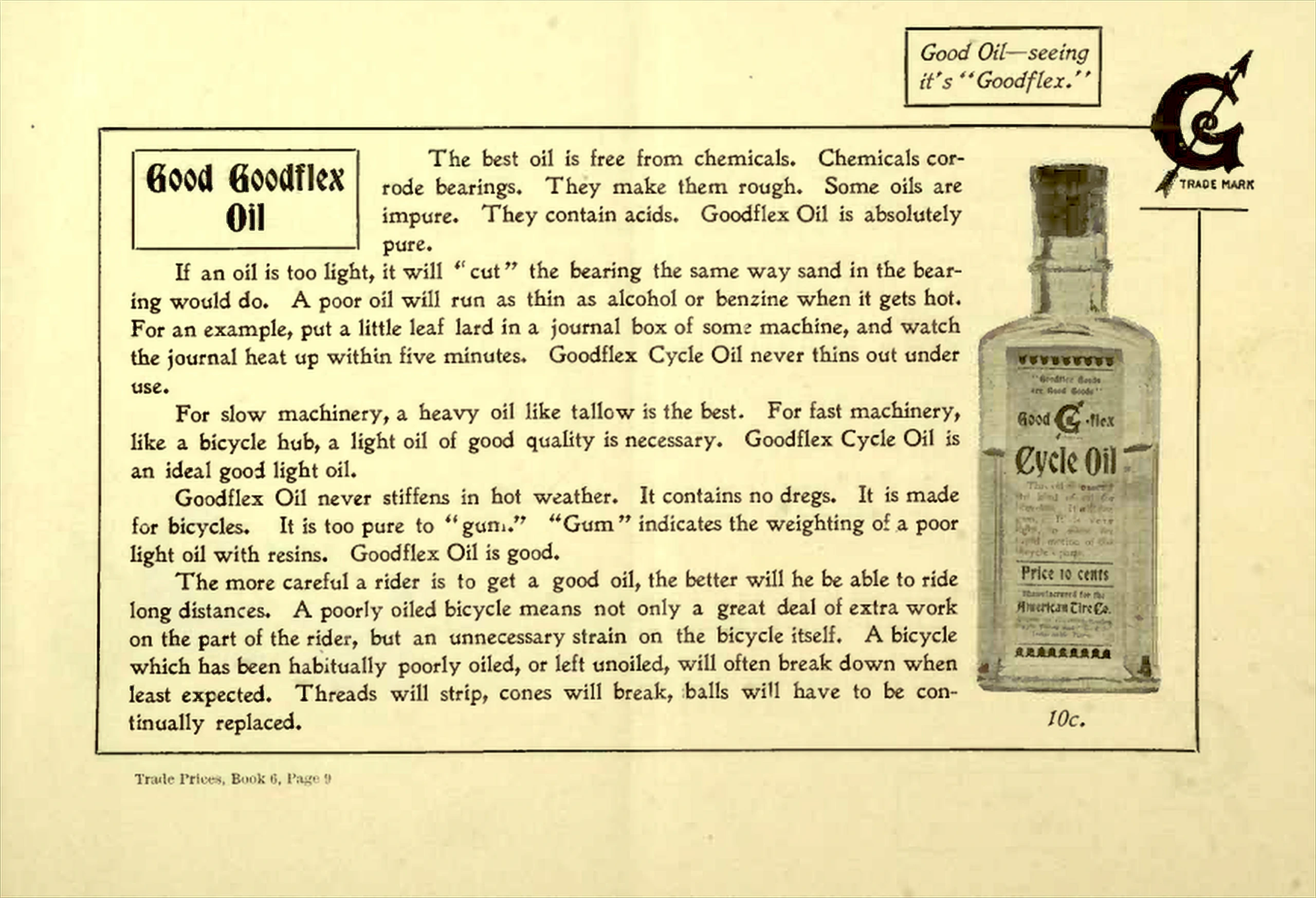
Good Oil—seeing it’s “Goodflex.”
Good Goodflex Oil
The best oil is free from chemicals. Chemicals corrode bearings. They make them rough. Some oils are impure. They contain acids. Goodflex Oil is absolutely pure.
If an oil is too light, it will “cut” the bearing the same way sand in the bearing would do. A poor oil will run as thin as alcohol or benzine when it gets hot. For an example, put a little leaf lard in a journal box of some machine, and watch the journal heat up within five minutes. Goodflex Cycle Oil never thins out under use.
For slow machinery, a heavy oil like tallow is the best. For fast machinery, like a bicycle hub, a light oil of good quality is necessary. Goodflex Cycle Oil is an ideal good light oil.
Goodflex Oil never stiffens in hot weather. It contains no dregs. It is made for bicycles. It is too pure to “gum.” “Gum” indicates the weighting of a poor light oil with resins. Goodflex Oil is good.
The more careful a rider is to get a good oil, the better will he be able to ride long distances. A poorly oiled bicycle means not only a great deal of extra work on the part of the rider, but an unnecessary strain on the bicycle itself. A bicycle which has been habitually poorly oiled, or left unoiled, will often break down when least expected. Threads will strip, cones will break, balls will have to be continually replaced.
10c.
TRADE MARK
Trade Prices, Book 6, Page 9
[A bottle of Goodflex Cycle Oil, its label reading “Price 10 cents” and “Manufactured for the American Tire Co.”, beside a text column headed “Good Goodflex Oil” in a ruled box; the round G trade mark sits at the top right corner.]
— Page 30 —
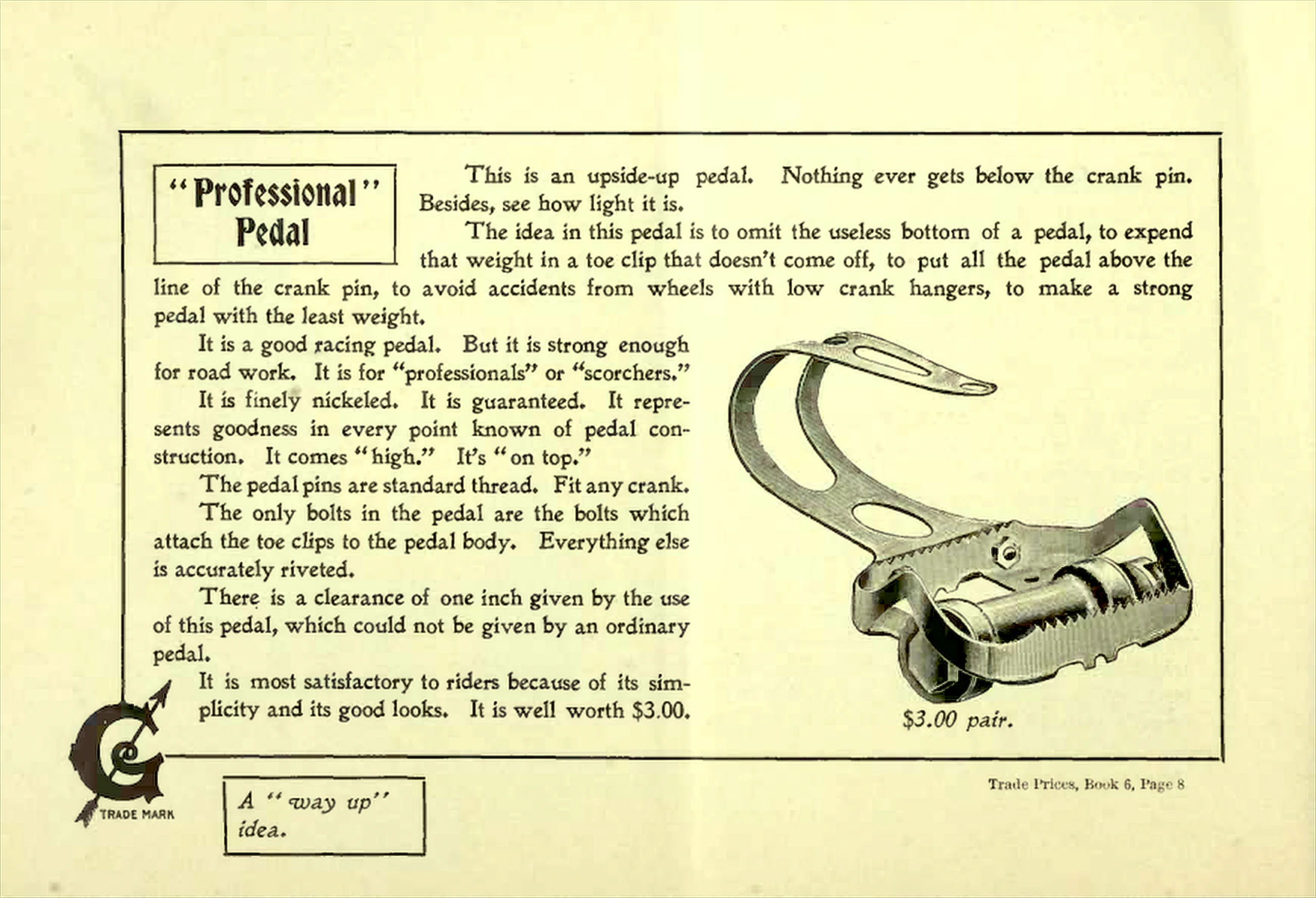
“Professional” Pedal
This is an upside-up pedal. Nothing ever gets below the crank pin. Besides, see how light it is.
The idea in this pedal is to omit the useless bottom of a pedal, to expend that weight in a toe clip that doesn’t come off, to put all the pedal above the line of the crank pin, to avoid accidents from wheels with low crank hangers, to make a strong pedal with the least weight.
It is a good racing pedal. But it is strong enough for road work. It is for “professionals” or “scorchers.”
It is finely nickeled. It is guaranteed. It represents goodness in every point known of pedal construction. It comes “high.” It’s “on top.”
The pedal pins are standard thread. Fit any crank.
The only bolts in the pedal are the bolts which attach the toe clips to the pedal body. Everything else is accurately riveted.
There is a clearance of one inch given by the use of this pedal, which could not be given by an ordinary pedal.
It is most satisfactory to riders because of its simplicity and its good looks. It is well worth $3.00.
$3.00 pair.
TRADE MARK
A “way up” idea.
Trade Prices, Book 6, Page 8
[An engraving of the “Professional” pedal with its toe clip beside a text column headed “Professional” Pedal in a ruled box; the round G trade mark sits at the lower left corner.]
— Page 31 —
Easy pedals mean happy feet.
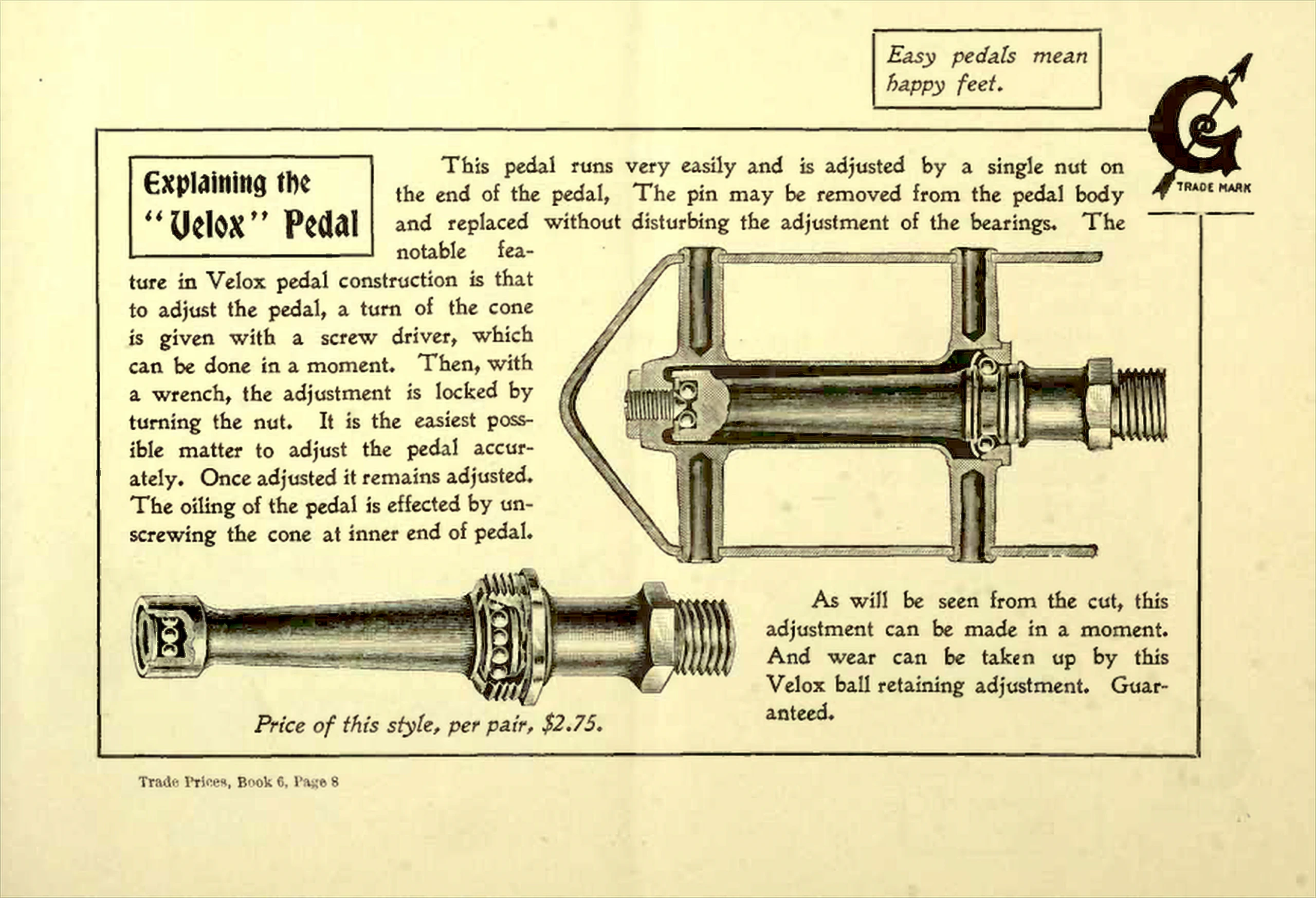
Explaining the “Velox” Pedal
This pedal runs very easily and is adjusted by a single nut on the end of the pedal, The pin may be removed from the pedal body and replaced without disturbing the adjustment of the bearings. The notable feature in Velox pedal construction is that to adjust the pedal, a turn of the cone is given with a screw driver, which can be done in a moment. Then, with a wrench, the adjustment is locked by turning the nut. It is the easiest possible matter to adjust the pedal accurately. Once adjusted it remains adjusted. The oiling of the pedal is effected by unscrewing the cone at inner end of pedal.
As will be seen from the cut, this adjustment can be made in a moment. And wear can be taken up by this Velox ball retaining adjustment. Guaranteed.
Price of this style, per pair, $2.75.
TRADE MARK
Trade Prices, Book 6, Page 8
[A sectional engraving of the “Velox” pedal and a second engraving of its spindle and cone, in a ruled box headed “Explaining the “Velox” Pedal”; the round G trade mark sits at the top right corner.]
— Page 32 —
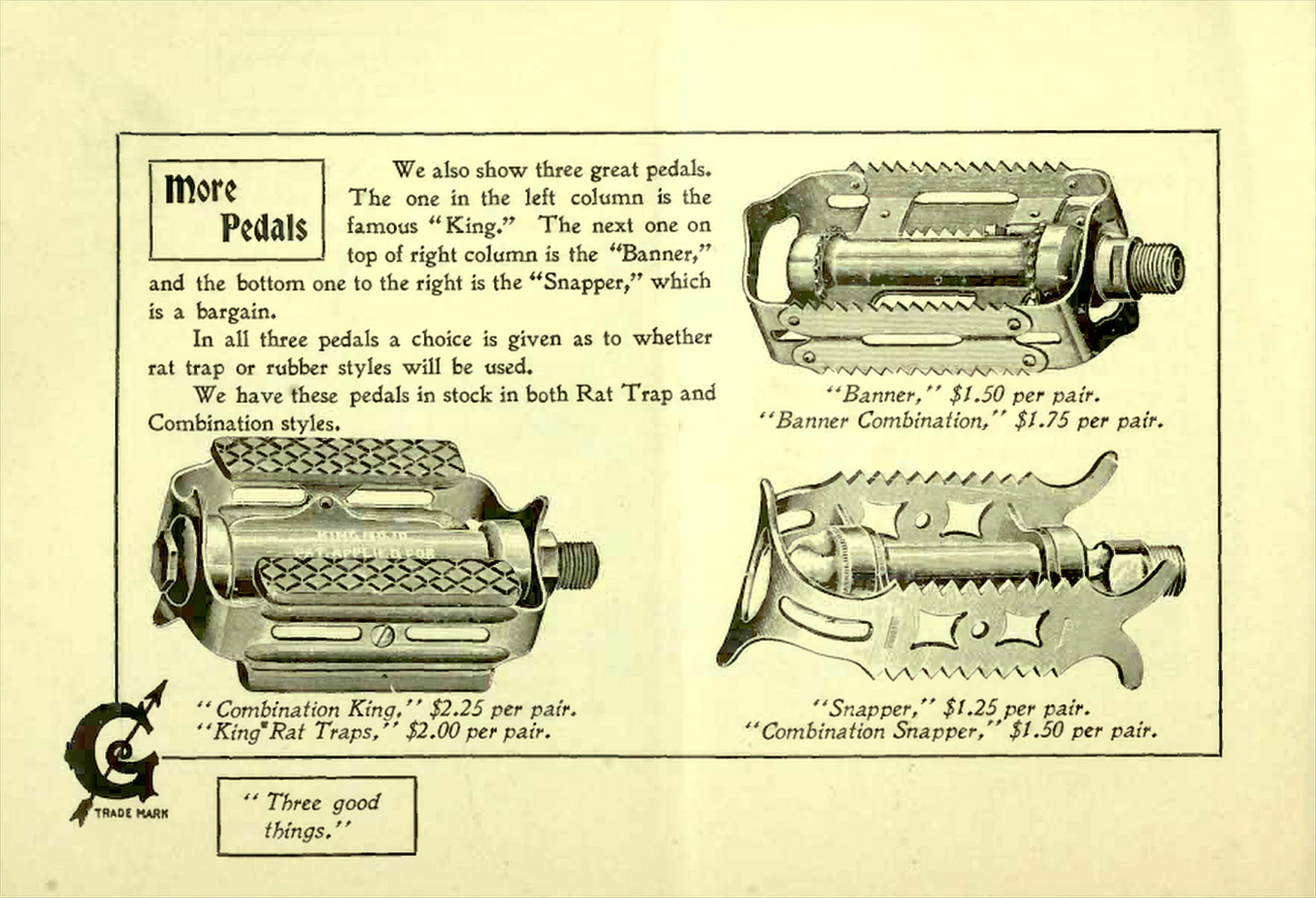
More Pedals
We also show three great pedals. The one in the left column is the famous “King.” The next one on top of right column is the “Banner,” and the bottom one to the right is the “Snapper,” which is a bargain.
In all three pedals a choice is given as to whether rat trap or rubber styles will be used.
We have these pedals in stock in both Rat Trap and Combination styles.
“Banner,” $1.50 per pair.
“Banner Combination,” $1.75 per pair.
“Combination King,” $2.25 per pair.
“King Rat Traps,” $2.00 per pair.
“Snapper,” $1.25 per pair.
“Combination Snapper,” $1.50 per pair.
TRADE MARK
“Three good things.”
[Engravings of the “Banner”, “Combination King” and “Snapper” pedals, each with its price caption, in a ruled box headed “More Pedals”; the round G trade mark sits at the lower left corner.]
— Page 33 —
Bikes given new feet.
Protection Strips
Often good tires like the Goodrich-Restlex Single Tubes are worn down to the canvas through long running. If run longer, the tire will be ruined. But, by attaching the Tread Band, which can be done at home, by any rider, this worn tire can be made quite as good as when it was new. Without doubt they are a very good thing. Many are being sold. They give satisfaction. Sold by the pair, or separately, at 90c. each, unfitted—for 28 in. wheels only.
To attach these Protection Strips we advise the services of a repair man if possible. A repair man, however is not necessary. To attach, first clean your tire with benzine, and also the inner side of your Protection Strip. Then blow your tire up on your rim and apply Goodflex Rubber Cement to the whole tread all around. Let it dry for 90 seconds. Then slip on your Protection Strip. Once your Protection Strip is on, proceed to “true” it by pulling it off six inches at a time, and replacing it exactly on the centre of your tire. When you have it trued all around, press firmly into position, and leave over night to set.
TRADE MARK
Trade Prices, Book 6, Page 12
[An engraving of a ribbed Protection Strip tread band in a ruled box headed “Protection Strips”; the round G trade mark sits at the top right corner.]
— Page 34 —
A page on Pumps
We have a number of good quality Pumps that we are showing. We do not wish you to think that these are the cheaply gotten up pumps which are unfortunitely[?] common among riders. The Goodrich hand pump is especially well put together, and is very superior. The Scovill pumps are well known and worthy. The Scovill pump has a strong metal stirrup. Morgan & Wright pumps are enameled in black.
Goodrich Hand Pump – – – – – – – – 25c.
M. & W. Enameled Hand Pump – – – 20c.
Scovill 7-in Nickeled Hand Pump – – – 20c.
Nickel Plated 1¼-in. Foot Pump – – – 85c.
Nickel Plated 1-in. Foot Pump – – – – 75c.
Connections for Hand Pumps, complete – 10c.
Connections for Foot Pumps, complete – – 25c.
Tubing, 30c. per yard.
TRADE MARK
“Easy pumping here.”
[An engraving of a hand pump with a wooden T handle joined by a long tube to a foot pump with a stirrup, and two small connection fittings, with a price list in a ruled box headed “A page on Pumps”; the round G trade mark sits at the lower left corner.]
— Page 35 —
Surgical Appliances
Puncture Band, Tape
When a Goodrich-Resflex Single Tube is punctured while on the road, you apply the Jiffy tool and “mend it in a minute.” When you cut a Goodrich-Resflex Single Tube, apply Jiffy liberally, bind the parts together with tire tape, and surround the whole with the puncture band. The button at one end slips into the loop at the other. Once on it can’t come loose. It serves its purpose until you reach home again after the day is done, where you can have the cut vulcanized. You can prevent any break down while on the road by the use of the band and the liberal application of “Jiffy.” If you are riding a double tube, the operation is the same—except that you use a Morgan & Wright kit, or the kit furnished with your tire, and proceed as before. The puncture bands sell at 25c. each.
A pair of the Puncture Bands are often used as a parcel carrier. Some riders use the Puncture Bands as trousers guards. They are very handy.
Tape. We sell a good tire tape that does not drop apart once it is pressed together. It comes in 1 oz. rolls carefully protected from the air by tinfoil. Sell at 5c. a roll.
TRADE MARK
Trade Prices, Book 6, Page 16. Also write.
[An engraving of a puncture band with a button at one end and a loop at the other, lettered MORGAN & WRIGHT. CHICAGO., and a larger engraving of the band fastened around a tire, in a ruled box headed “Puncture Band, Tape”; the round G trade mark sits at the top right corner.]
— Page 36 —
Rims and Washers
These Boston Laminated wood rims are the best wood rims to be found in the market. They are furnished in all styles of which only a few are shown. We recommend them highly because we know them to be good.
You cannot split them, as the laminations prevent weaknesses developing in the rims. We carry these rims in all sizes and styles, besides those pictured on this page. The prices for those we show here are $1.50 per pair.
Saw-Tooth Washers. We have a very good lot of Saw-Tooth Rim Washers that we sell in 1000 lots. They are good.
They are of pressed steel, and we doubt if a spoke nipple could be pulled through them under any strain. They are absolutely safe.
Racer, 1⅜ in.
1⅝ Road
Racer, 1¼ in.
1½ Road Crescent
G. & J. Detachable
TRADE MARK
Look at their ….. shape.
Trade Prices, Book 6, Page 10. Also write.
[Cross-section engravings of Boston Laminated wood rims lettered “BOSTON LAMINATED” and “PAT. 1894”: the Racer, 1⅜ in., the 1⅝ Road, the Racer, 1¼ in., the 1½ Road Crescent and the G. & J. Detachable, in a ruled box headed “Rims and Washers”; a dark smudge stands before the Crescent caption and the round G trade mark sits at the lower left corner.]
— Page 37 —
Air can’t pass these.
TRADE MARK
Resflexine, Tireine, Restorative, Jiffy
Resflexine is a liquid preparation for injection into tires in summer. In cheap tires, the reduction in price is made by reducing the amount of gum used. To make up for the small amount of rubber gum, the gum is heavily loaded with certain insoluble, powered chemicals. In hot weather, as the tire is ridden, these little particles of powder drop out from the substance of the rubber and leave minute air holes through which the air begins to leak, giving the tire “heat leak.” The reason Goodrich-Resflex Single Tubes, or Goodrich Inner Tubes need pumping “once a month” is because the rubber in them is pure and has no such adulterating chemicals. The function of Resflexine is to stop this heat-leak. It permeates all these minute pores. Air can’t get out. It is not acid, and it does not prevent the tire from being repaired later. At any time desired the Resflexine may be washed out of the tire with water. It does not hurt the tire in any way, and does not invalidate the guarantee.
Tireine does for the outside of a tire what Resflexine does for the inside.
Restorative makes old tires look like new. It freshens them up.
Jiffy cures punctures in tires. This is a secret preparation of rubber made by the Goodrich Company. For repairmen it comes in pints, quarts, and gallons. For riders it comes in tubes. It is applied by means of the Jiffy tool, to be found on page 2.
“Jiffy” has another use. When you get a tire to repair, put it liberally inside the tire, having diluted it with benzine, and it will stop cheap porous tires from leaking. In that it is very valuable.
Resflexine, 75c. a can. Tireine, 25c. a tube. Restorative, no retail price.
Jiffy in tubes, 10c. each. Jiffy in cans, no retail price.
Trade Prices, Book 6, Pages 10, 11, 9, 15.
[A boxed text on Resflexine, Tireine, Restorative and Jiffy tire preparations under a small boxed line about air not passing them, with the round G trade mark device at the top right corner.]
— Page 38 —
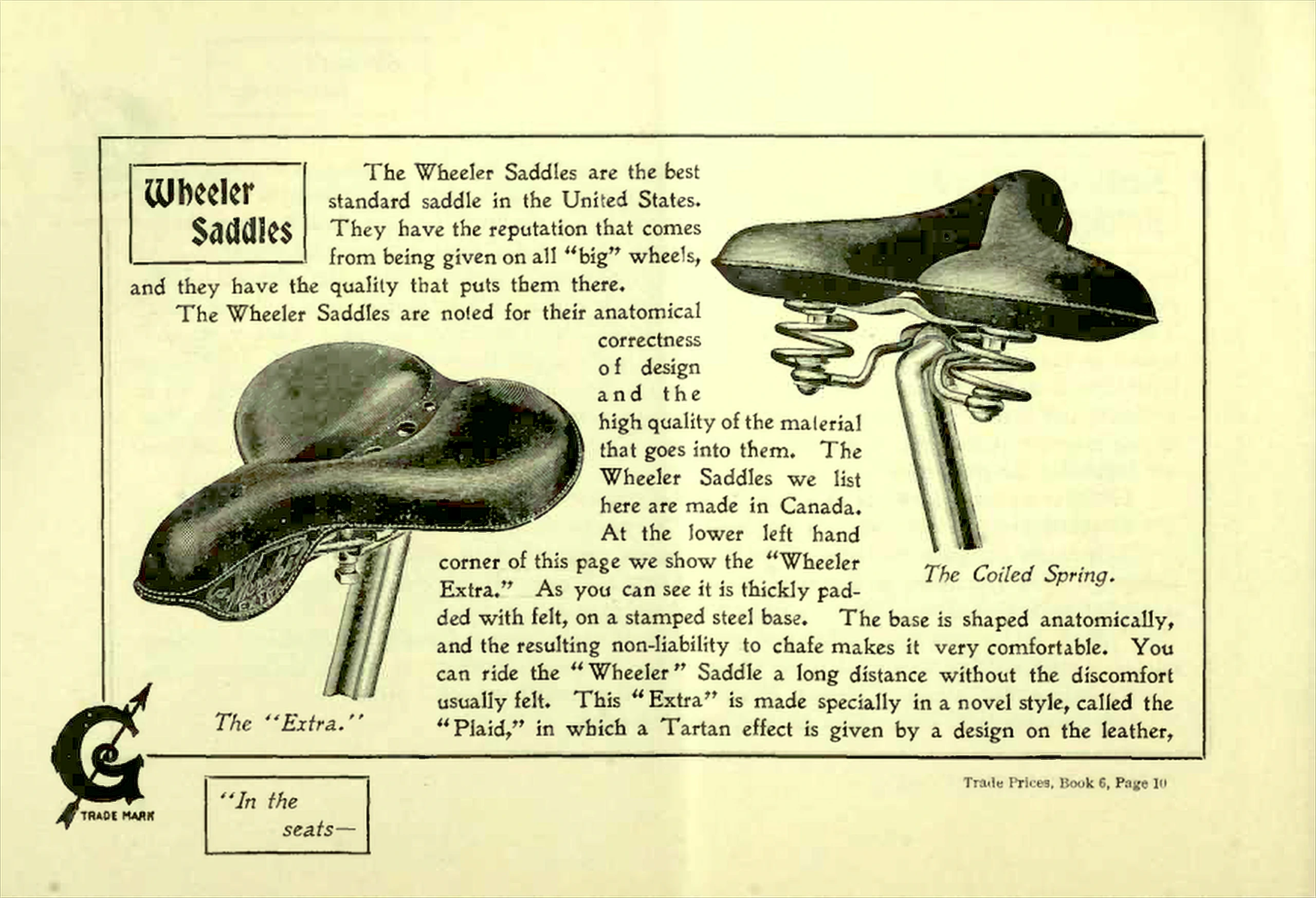
Wheeler Saddles
The Wheeler Saddles are the best standard saddle in the United States. They have the reputation that comes from being given on all “big” wheels, and they have the quality that puts them there.
The Wheeler Saddles are noted for their anatomical correctness of design and the high quality of the material that goes into them. The Wheeler Saddles we list here are made in Canada. At the lower left hand corner of this page we show the “Wheeler Extra.” As you can see it is thickly padded with felt, on a stamped steel base. The base is shaped anatomically, and the resulting non-liability to chafe makes it very comfortable. You can ride the “Wheeler” Saddle a long distance without the discomfort usually felt. This “Extra” is made specially in a novel style, called the “Plaid,” in which a Tartan effect is given by a design on the leather,
The Coiled Spring.
The “Extra.”
TRADE MARK
“In the seats—
Trade Prices, Book 6, Page 10
[Two engraved illustrations of Wheeler saddles, “The Coiled Spring.” and “The “Extra.””, with the boxed heading Wheeler Saddles, a small boxed line “In the seats—” at the lower left and the round G trade mark device.]
— Page 39 —
of the Mighty.”
TRADE MARK
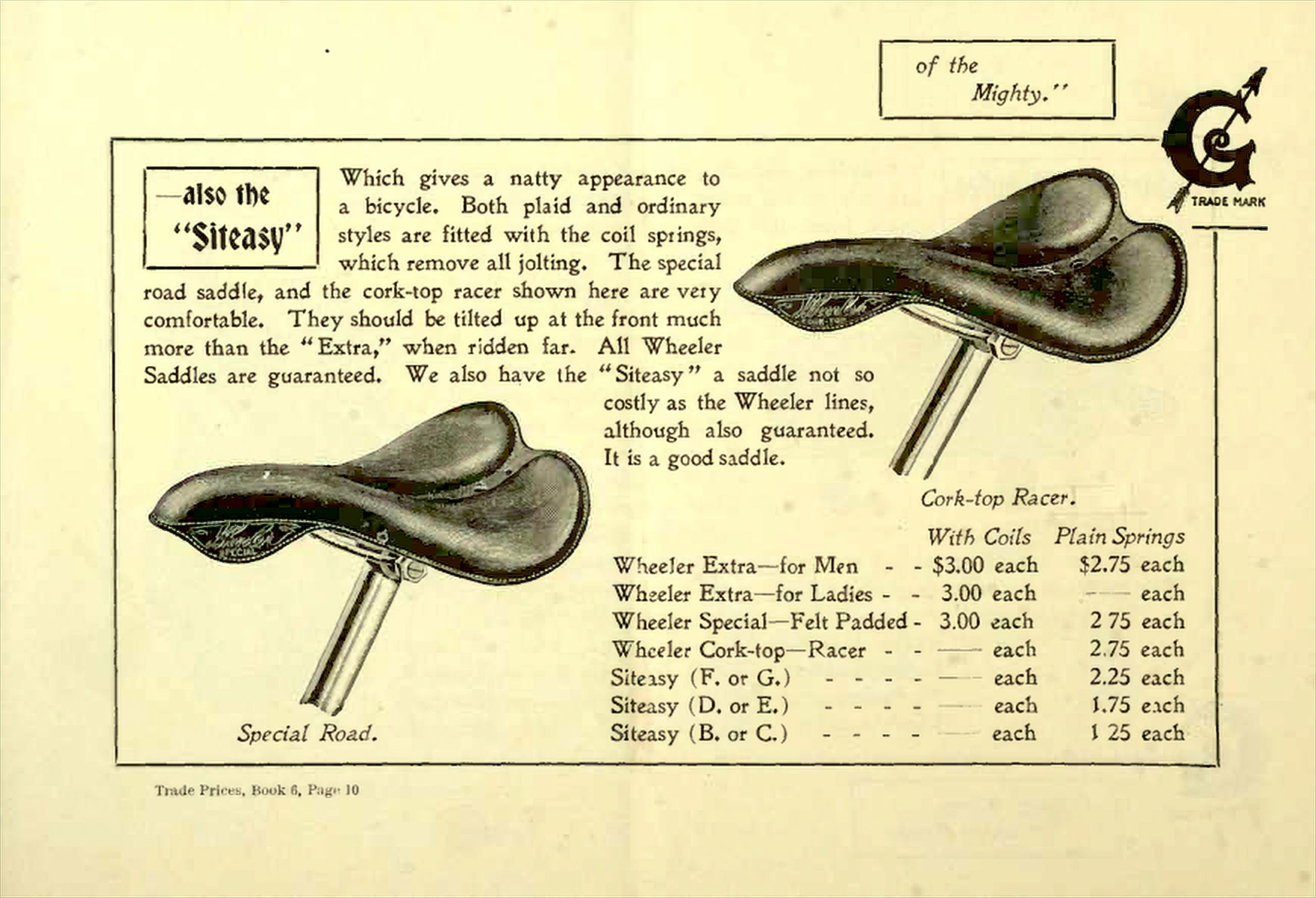
—also the “Siteasy”
Which gives a natty appearance to a bicycle. Both plaid and ordinary styles are fitted with the coil springs, which remove all jolting. The special road saddle, and the cork-top racer shown here are very comfortable. They should be tilted up at the front much more than the “Extra,” when ridden far. All Wheeler Saddles are guaranteed. We also have the “Siteasy” a saddle not so costly as the Wheeler lines, although also guaranteed. It is a good saddle.
Cork-top Racer.
Special Road.
| With Coils | Plain Springs
Wheeler Extra—for Men – – | $3.00 each | $2.75 each
Wheeler Extra—for Ladies – – | 3.00 each | —— each
Wheeler Special—Felt Padded – | 3.00 each | 2 75 each
Wheeler Cork-top—Racer – – | —— each | 2.75 each
Siteasy (F. or G.) – – – – – | —— each | 2.25 each
Siteasy (D. or E.) – – – – – | —— each | 1.75 each
Siteasy (B. or C.) – – – – – | —— each | 1 25 each
Trade Prices, Book 6, Page 10
[Two engraved illustrations of saddles, the “Cork-top Racer.” and the “Special Road.”, beside a text on the Siteasy saddle and a price table of Wheeler Extra, Wheeler Special, Wheeler Cork-top and Siteasy saddles with coils and with plain springs. The round G trade mark device is at the top right corner.]
— Page 40 —
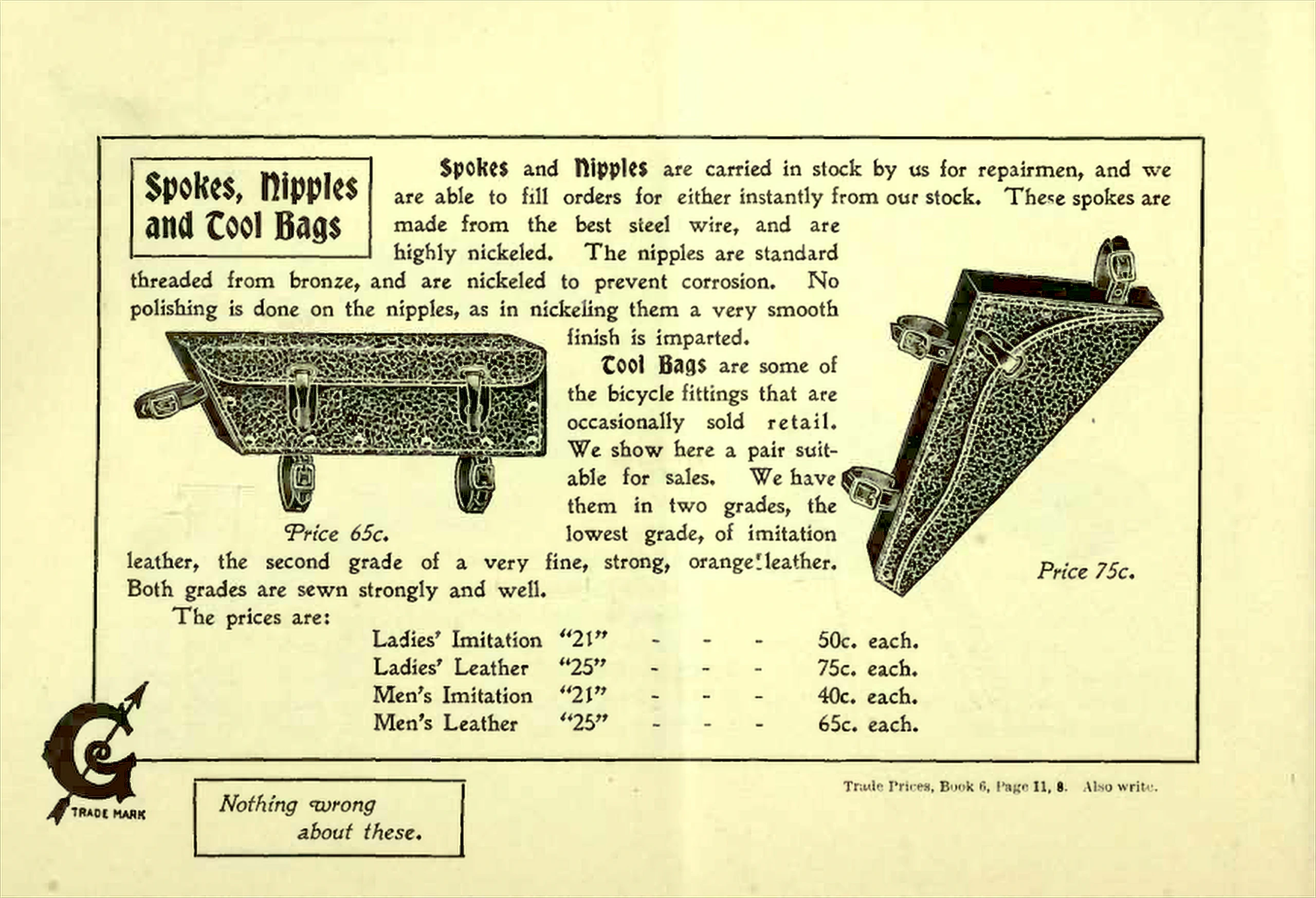
Spokes, Nipples and Tool Bags
Spokes and Nipples are carried in stock by us for repairmen, and we are able to fill orders for either instantly from our stock. These spokes are made from the best steel wire, and are highly nickeled. The nipples are standard threaded from bronze, and are nickeled to prevent corrosion. No polishing is done on the nipples, as in nickeling them a very smooth finish is imparted.
Tool Bags are some of the bicycle fittings that are occasionally sold retail. We show here a pair suitable for sales. We have them in two grades, the lowest grade, of imitation leather, the second grade of a very fine, strong, orange leather. Both grades are sewn strongly and well.
Price 65c.
Price 75c.
The prices are:
Ladies’ Imitation “21” – – – 50c. each.
Ladies’ Leather “25” – – – 75c. each.
Men’s Imitation “21” – – – 40c. each.
Men’s Leather “25” – – – 65c. each.
TRADE MARK
Nothing wrong about these.
Trade Prices, Book 6, Page 11, 8. Also write.
[Two engraved illustrations of leather tool bags, one marked “Price 65c.” and one “Price 75c.”, with the boxed heading Spokes, Nipples and Tool Bags, a price list of ladies’ and men’s tool bags and a small boxed line “Nothing wrong about these.” The round G trade mark device is at the lower left.]
— Page 41 —
Lots of holdonness.
TRADE MARK
Toe Clips
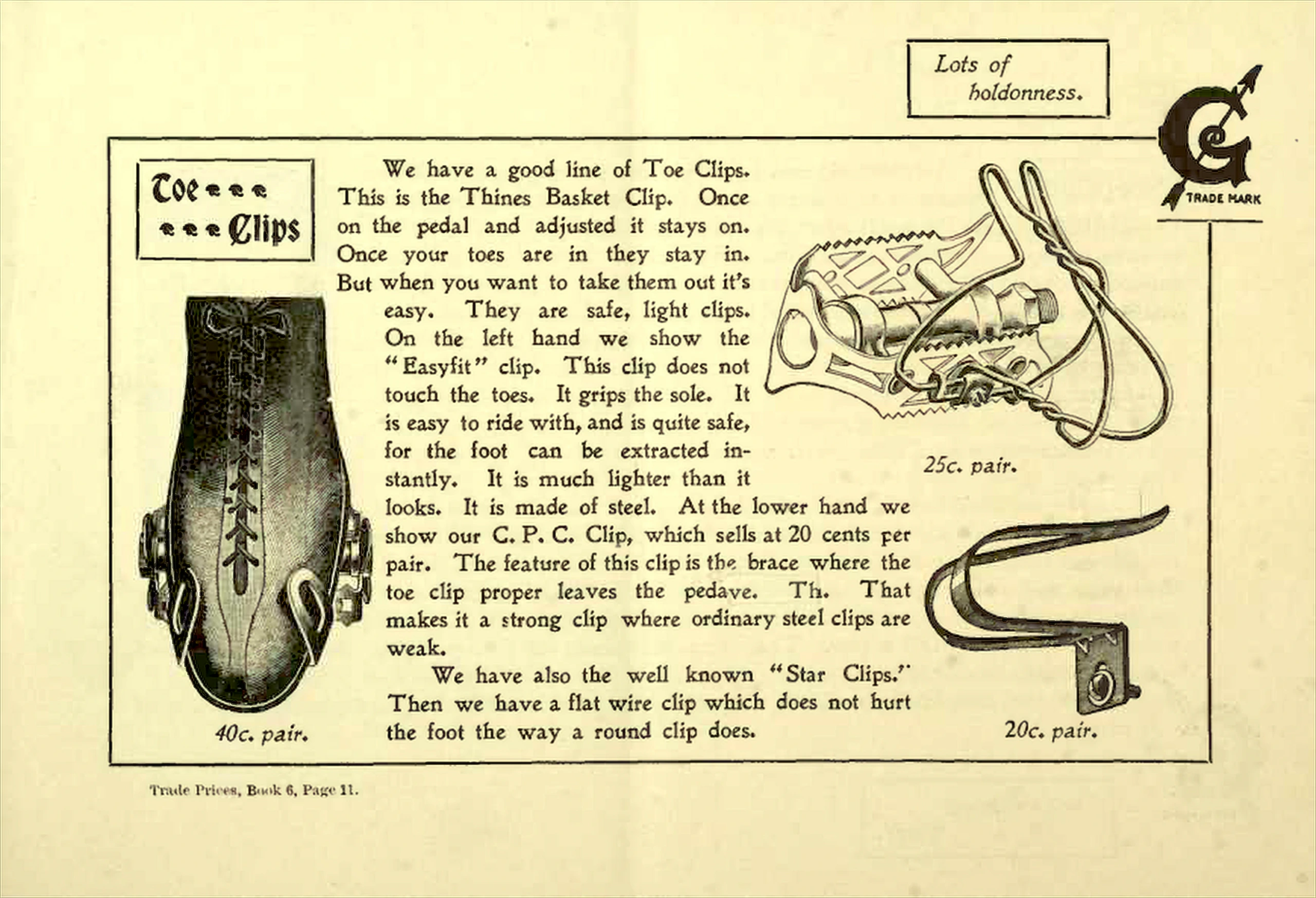
We have a good line of Toe Clips. This is the Thines Basket Clip. Once on the pedal and adjusted it stays on. Once your toes are in they stay in. But when you want to take them out it’s easy. They are safe, light clips. On the left hand we show the “Easyfit” clip. This clip does not touch the toes. It grips the sole. It is easy to ride with, and is quite safe, for the foot can be extracted instantly. It is much lighter than it looks. It is made of steel. At the lower hand we show our C. P. C. Clip, which sells at 20 cents per pair. The feature of this clip is the brace where the toe clip proper leaves the pedave. Th. That makes it a strong clip where ordinary steel clips are weak.
We have also the well known “Star Clips.” Then we have a flat wire clip which does not hurt the foot the way a round clip does.
40c. pair.
25c. pair.
20c. pair.
Trade Prices, Book 6, Page 11.
[Three engraved illustrations of toe clips, a clip on a laced shoe marked “40c. pair.”, a basket clip on a pedal marked “25c. pair.” and a flat clip marked “20c. pair.”, beside the boxed heading Toe Clips and a small boxed line “Lots of holdonness.” The round G trade mark device is at the top right corner.]
— Page 42 —
Soapstone—Valves
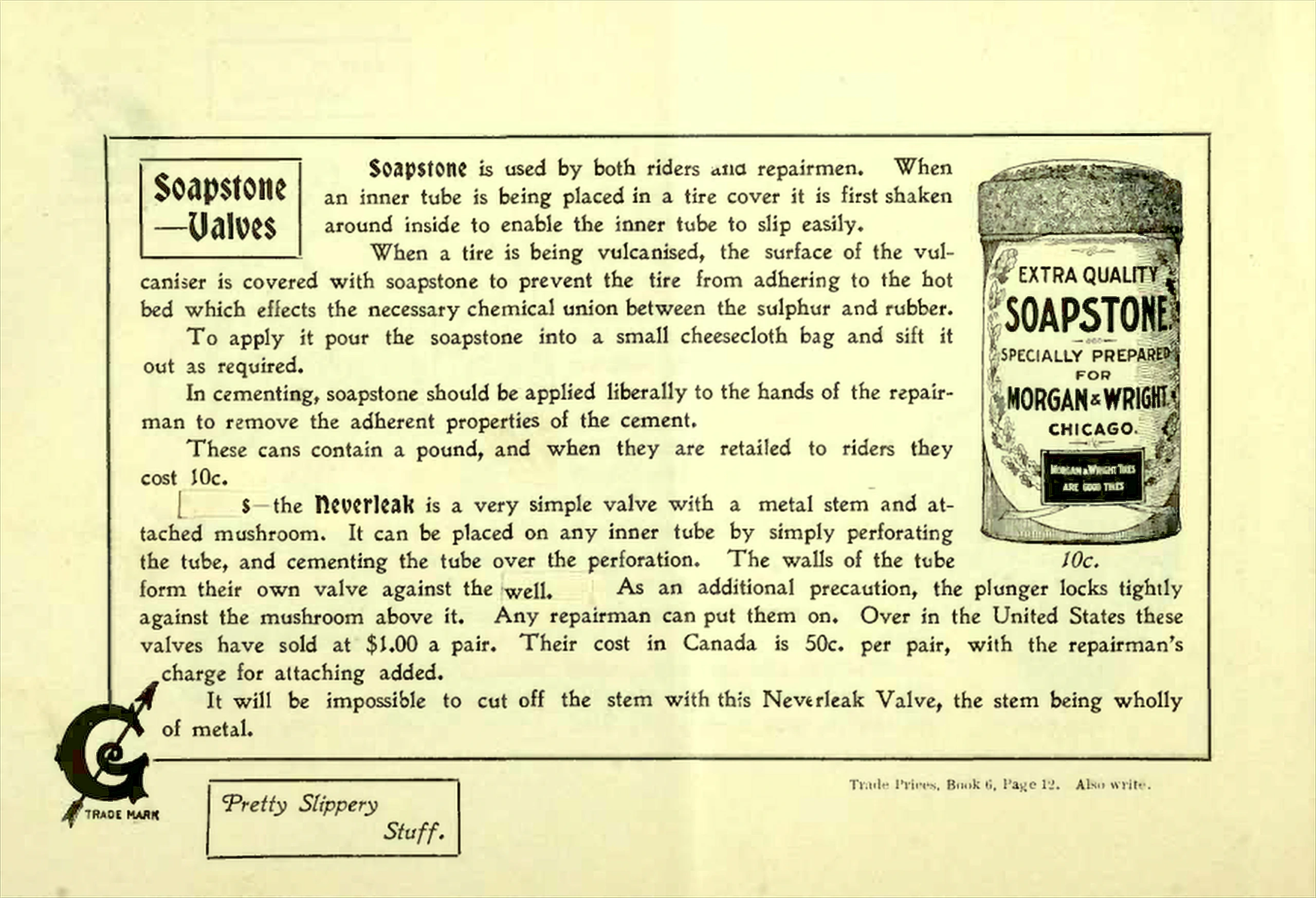
Soapstone is used by both riders and repairmen. When an inner tube is being placed in a tire cover it is first shaken around inside to enable the inner tube to slip easily.
When a tire is being vulcanised, the surface of the vulcaniser is covered with soapstone to prevent the tire from adhering to the hot bed which effects the necessary chemical union between the sulphur and rubber.
To apply it pour the soapstone into a small cheesecloth bag and sift it out as required.
In cementing, soapstone should be applied liberally to the hands of the repairman to remove the adherent properties of the cement.
These cans contain a pound, and when they are retailed to riders they cost 10c.
[illegible]s—the Neverleak is a very simple valve with a metal stem and attached mushroom. It can be placed on any inner tube by simply perforating the tube, and cementing the tube over the perforation. The walls of the tube form their own valve against the well. As an additional precaution, the plunger locks tightly against the mushroom above it. Any repairman can put them on. Over in the United States these valves have sold at $1.00 a pair. Their cost in Canada is 50c. per pair, with the repairman’s charge for attaching added.
It will be impossible to cut off the stem with this Neverleak Valve, the stem being wholly of metal.
EXTRA QUALITY SOAPSTONE. SPECIALLY PREPARED FOR MORGAN & WRIGHT CHICAGO. MORGAN & WRIGHT TIRES ARE GOOD TIRES
10c.
TRADE MARK
Pretty Slippery Stuff.
Trade Prices, Book 6, Page 12. Also write.
[An engraved illustration of a can of Extra Quality Soapstone labeled for Morgan & Wright, Chicago, marked “10c.”, beside the boxed heading Soapstone—Valves and text on soapstone and the Neverleak valve. A blank patch lies before the first word of the Neverleak paragraph and another near the word “well.”; the round G trade mark device is at the lower left.]
— Page 43 —
Money behind vulcanising.
TRADE MARK
Vulcanising Supplies
These are the supplies that are used in vulcanising. The space is somewhat crowded, and only the essential features of each line are given.
The first is “Goodrich 434 Solution” which vulcanises plugs in tires, and mushrooms to single tubes. Apply the 434 Solution to the top and stem of the mushroom, or the top and stem of the plug. Let dry. Be very careful to leave bottom of plug or mushroom clean. Clean the surface of tire where operation is to be done very carefully. When solution is dry, place plug or mushroom in position, and vulcanise for 12 minutes.
“434 Gum” is used to fill in all cavities not filled by the plug or mushroom. This prepared gum comes in sheets.
Plug Pliers are used to draw the plug base firmly against the inner surface of the tire.
Vulcanising Patches are ready-prepared patches of 434 gum and friction cloth, to vulcanise into cuts on single tubes and covers. Make them yourself out of the friction cloth and the gum bought separately, if you like them.
Vulcaniser Compound Number 10, and Vulcaniser Compound Number 11 are an entirely different set of solutions. They come in tubes. First clean the work. Apply Number 10 and dry. Then apply Number 11 and dry. Then use 434 Gum as above. Then, vulcanise.
Friction Duck is heavy cloth, saturated with a secret cement, and used as a reinforcement when vulcanising either cuts or tears in covers. It is heavy.
Friction Muslin is a thinner cloth used for the same purposes, when the strain will not be so great. It is lighter, and does not cost so much. The cost of making a patch with the muslin is less than with the duck. Sold by the square yard.
Trade Prices, Book 6, Pages 16, 15, 14.
[A boxed text on vulcanising supplies: Goodrich 434 Solution, 434 Gum, plug pliers, vulcanising patches, vulcaniser compounds, friction duck and friction muslin, under the boxed heading Vulcanising Supplies and a small boxed line “Money behind vulcanising.” The round G trade mark device is at the top right corner.]
— Page 44 —
“Goodrich” Vulcanizer
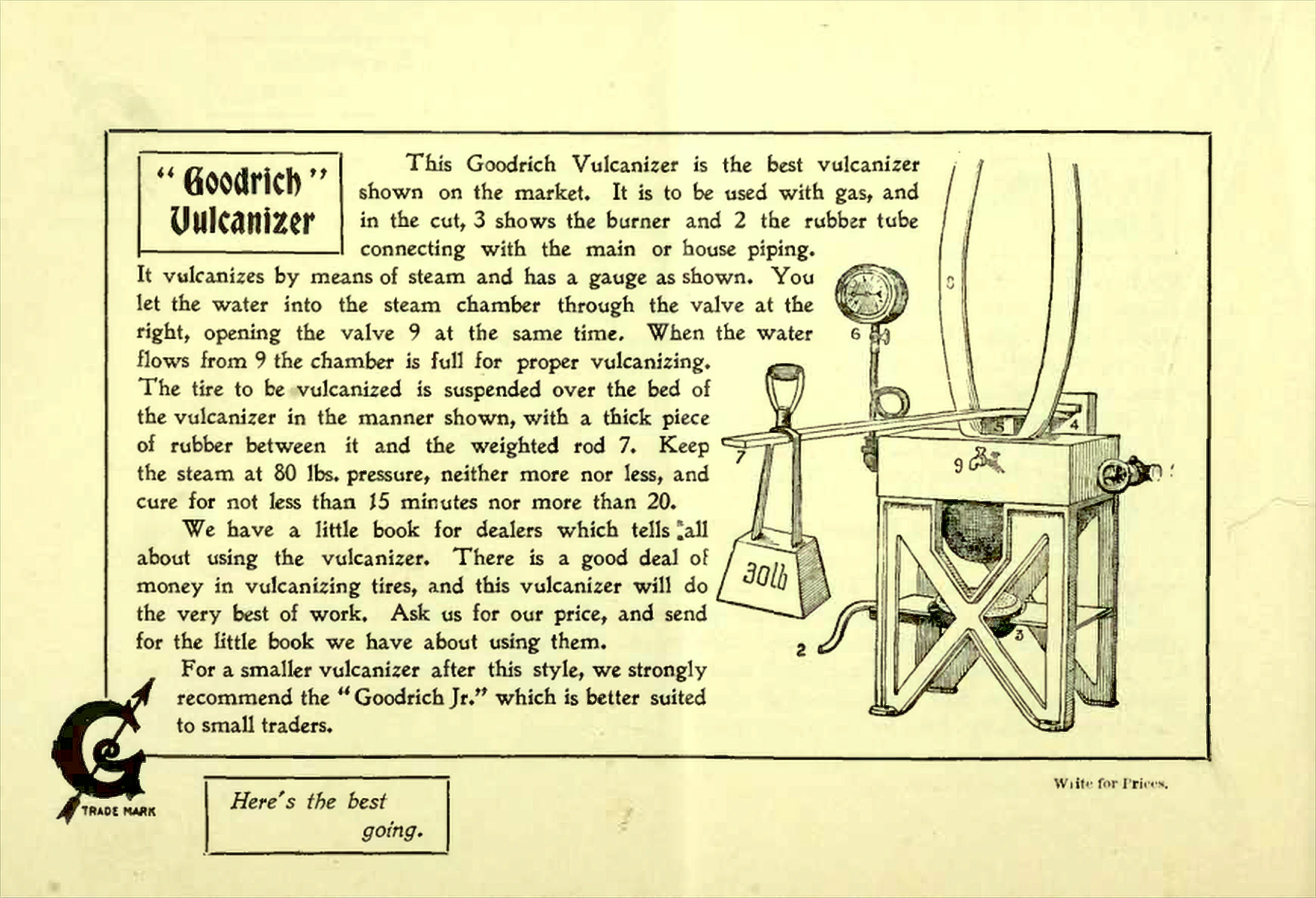
This Goodrich Vulcanizer is the best vulcanizer shown on the market. It is to be used with gas, and in the cut, 3 shows the burner and 2 the rubber tube connecting with the main or house piping.
It vulcanizes by means of steam and has a gauge as shown. You let the water into the steam chamber through the valve at the right, opening the valve 9 at the same time. When the water flows from 9 the chamber is full for proper vulcanizing. The tire to be vulcanized is suspended over the bed of the vulcanizer in the manner shown, with a thick piece of rubber between it and the weighted rod 7. Keep the steam at 80 lbs. pressure, neither more nor less, and cure for not less than 15 minutes nor more than 20.
We have a little book for dealers which tells all about using the vulcanizer. There is a good deal of money in vulcanizing tires, and this vulcanizer will do the very best of work. Ask us for our price, and send for the little book we have about using them.
For a smaller vulcanizer after this style, we strongly recommend the “Goodrich Jr.” which is better suited to small traders.
Callouts: 8 [?], 6, 7, 5, 4, 9, 3, 2
TRADE MARK
Here’s the best going.
Write for Prices.
[An engraved illustration of the Goodrich steam vulcanizer on a cross-braced stand with a pressure gauge, a weighted rod and a tire held over the bed, numbered 2 to 9 and with a weight marked 30lb, beside the boxed heading “Goodrich” Vulcanizer and a small boxed line “Here’s the best going.” The round G trade mark device is at the lower left.]
— Page 45 —
A Pretty Good Article.
TRADE MARK
Morgan & Wright Vulcaniser
This cut shows the Morgan & Wright Vulcaniser which can vulcanise as many as a dozen tires at one time. Like the “Goodrich” on the opposite page, this is a steam vulcaniser, and, in the cut shown with fittings for gasoline heat. The water is contained in a boiler, A, and steam is admitted by the valve V in the dome N, to the hollow bar G, to which the tires are hung, as shown. There is a thermometer and gauge, and a weighted safety valve to prevent accidents. No particular trouble will be found in operating it. There is no list price, but dealers may obtain quotations upon request.
In using this vulcaniser, the dealer should open the valve “C” each morning, and pour water into the boiler through the funnel B until the height is shown as almost at the guage H. To prevent possible choking of the gauge tubes, the lower and upper stopcocks at U and V should be frequently blown out for an instant. The stopcock Q at the end of the arm G should be opened for a time to blow the air out of the boiler and arm, when about to commence vulcanising. The steam from this vulcaniser is absolutely dry, being taken from a dome after the manner of a horizontal boiler. By a sheet iron jacket, the heat from the burner is concentrated into heating the boiler, without unduly heating the surrounding room, the hot air, finally passing out through the holes at Y.
Callouts: B, F, D, C, N, V, G, K, E, H, R, Y, A, U, L, X, P, W, S, Z, Q [?]
Trade Prices, Write.
[An engraved illustration of the Morgan & Wright steam vulcaniser, a horizontal boiler on legs with a funnel, valves and a hollow bar from which a tire hangs, lettered with reference letters, beside the boxed heading Morgan & Wright Vulcaniser and a small boxed line “A Pretty Good Article.” The round G trade mark device is at the top right corner.]
— Page 46 —
Small Vulcanisers—Valves
We have also the smaller vulcanisers for use by the dealer and repairmen in small towns where the business is not very large. The larger one, which is called the Redcross Vulcaniser, is heated by means of a spirit lamp placed under the dome shaped boiler, while the smaller one receives its heat direct from a spirit lamp placed underneath the bed. In the cut of the smaller one, the funnel is placed in position for the purpose of showing how easy it is to supply the lamp with alcohol.
Valves. In addition to the Neverleak Valve shown on a preceding page, we show the Wood, which is a Canadian valve, and the 1899 Schrader in both shoe and mushroom patterns. The cut shows the extreme simplicity of the 1899 Schrader, which we recommend highly.
The cap of each Schrader Valve forms a tool for the taking out of the parts. Only three parts are used in this valve.
SCHRADER UNIVERSAL VALVE
PAT., JULY, 19, 1898.
Wood Valve
TRADE MARK
Small, but—
oh my.
Trade Prices, Book 6, Page 12. Also write.
[Two small vulcanisers and the Schrader Universal Valve and Wood Valve in engravings, with a text block on small vulcanisers and valves; the round G trade mark and a boxed “Small, but– oh my.” sit at the foot. The word “easy” has its first letter broken in the print.]
— Page 47 —
A grim-death grip.
TRADE MARK
Rubber Cements, Sheet Rubber
Goodflex Rubber Cement is very easy to manipulate. In comes in tubes for the rider. Very small tubes for pocket repair outfits are sold at 5 cents a tube. The tubes we show in this cut of box sell at 15 cents each, and are supposed to be used in tool bags. For the especial use of repairmen, however, Goodflex Rubber Cement is furnished in ¼ pint, pint, quart, and gallon tins. To apply, first clean the surface with emery paper or benzine, and when perfectly dry again, apply the cement. In a few seconds it will glaze over. Then, apply a second coating in like manner. If an especially strong joining is required, apply three coats altogether. When both surfaces have received their coatings, and are glazed over for the last time, press firmly together, and allow to set. According to the state of the atmosphere, it takes from 30 to 90 seconds for a coating of cement to dry sufficiently to re-coat or cement. Goodflex Rubber Cement should never be used under the direct rays of the sun.
Sheet Rubber is supplied in rolls about 4 inches wide and a yard long for use with Goodflex Rubber Cement. It is sold separately to dealers who retail it as needed to riders. It is of the best Goodrich quality, and no difficulty will be found with it, either as a repair shop supply or as a retail article.
The Sheet Rubber stretches five times its normal length. That proves it’s good.
Trade Prices, Book 6, Pages 13, 15
[A carton of six tubes of Goodflex Rubber Cement in a halftone, with a text block on rubber cements and sheet rubber, a boxed phrase at the top and the round G trade mark at the top right.]
— Page 48 —
Wood Rim Cement Wrenches
Our Goodflex Wood Rim Cement is for use by riders, in tubes like this. It dries up in a very short time. It is sold in tubes, and produces a very safe, permanent attachment between tire and rim in four hours.
Wrenches. We have two nice wrenches, both nicely nickeled. The Billings & Spencer have a very attractive appearance, and the handle is large. The Enterprise Wrench is cheaper, but is a very good wrench for the money.
Price 75c.
Price 50c.
TRADE MARK
“To move or not to move?”
Trade Prices, Book 6, Pages 13, 12.
[Six tubes of Goodflex Wood Rim Cement in a carton and two engraved wrenches priced 75c. and 50c., with a text block on wood rim cement and wrenches. The round G trade mark and a boxed phrase sit at the foot.]
— Page 49 —
No use wasting time, now.
TRADE MARK
Cement, Kettles
The old way to put hard tire cement on rims was very troublesome. This is the new way. When the rim is on the wheel and trued up, it is run around on the wheel of the kettle. The little wheel takes up the hot cement as it passes around and transfers it to the rim. The more times the bicycle wheel is turned, the thicker is the cement deposited on the rim. Thus hard cement can be put on very thinly or very thickly at pleasure.
This cut shows the cement kettle fitted for gas. We have fittings for gasoline or oil for those who cannot procure gas. Of the two special fittings, we recommend gasoline.
Hard Cements are carried in a number of kinds. We recommend our Hard Tire Cement which comes in one lb. cakes as the best possible cement for use. It is made specially for us. We recommend also our “Stickphast” Cement, which comes in a cylindrical wooden box. As the cement is needed, box and cement are broken off with a blow from a hammer.
A hard cement should be soft enough to hold very strongly to the rim. It should not be so hard as to be brittle. If it is too hard it will not adhere to the tire. If it is too soft it will stick to everything, and work out from between tire and rim in hot weather.
Trade Prices, Book 6, Page 13
[An engraved cement kettle with a gas burner, a text block on cement kettles and hard cements, a boxed phrase at the top and the round G trade mark at the top right.]
— Page 50 —
“Very Latest” Handlebars
We are pleased to show the five latest handlebars. At the left will be found the Resflex Ramshorn Bar which costs $1.50, retail. It is novel looking and is especially nice to carry parcels either on the top or suspended with parcel carriers. No doubt this bar will prove a capital seller. Alongside of it we show our new Drop Racer. The drop gives the desired maximum of leverage. The fourth bar is our Ramshorn, which has a contour seldom seen in hand-made bars. The grace is the result of placing a workman at bending thousands of bars to one particular curve. Soon he gets exceptional skill in turning an unmatchably fine bar from the same material that an ordinary workman could manipulate indifferently. At the extreme right and in the centre are our Ordinary Bars, with the same strong and graceful construction as our other bars. All the bars we carry are highly finished, and nickeled on copper, which renders the nickeling practically impervious to rust from the steel tubing beneath. All our bars are good bars. Everything we sell is good.
Price $1.50
Price $1.50
Price $1.50
Price $1.50
Price $1.50
TRADE MARK
Can’t get anything newer.
Trade Price, Book 6, Page 7. Also write
[Five engraved handlebars, each marked Price $1.50, with a text block on the very latest handlebars, a boxed phrase at the foot and the round G trade mark at the lower left. A dark spotted stain or print flaw lies on the second bar.]
[A blank leaf of yellowed paper with no printed lettering, showing only paper fibers, specks and a faint vertical center fold line.]
[A blank leaf of yellowed paper with no printed lettering, showing only paper fibers, specks and a faint vertical center fold line.]
Ebykr presents this material for research and education. If you hold rights to it or notice an ownership issue, please contact us and we will respond promptly.
The Ebykr Digest
New articles, timelines, catalog finds and registry activity — assembled from the archive once a month. Your address is never shared.
Double opt-in. One email per month. Unsubscribe at any time with one click.