Long before it became a byword for the durable, elegant aluminum fenders that seem never to die or go out of style, the name of Lefol passed through the fires of revolutionary Paris, the golden era of French cyclotouring and two world wars before settling into its own quiet, understated permanence in the Courbevoie commune. The story is fragmentary and the man behind the marque, Jacques François Lefol, remains something of a mystery, yet the surviving advertisements, patents and catalog pages trace a clear arc from a single hammered fender design to a full range of brakes, levers, chain guards, fenders and rims that defined a certain French practicality for decades.
Here is a chronological timeline of key Lefol events, spanning from 1871 to 1961, based on the sources used for an accompanying Ebykr article on its history, “J. Lefol: Inventeur – Constructeur.”
15 of 15 events
1871
First Documented Reference
The first known cross reference of “J. Lefol” and “Courbevoie” appears in a letter co-signed by one J. Lefol, published by “L’association des Défenseurs de la République” in the third volume of works investigating the insurrection of March 18, 1871 by the National Assembly in Versaille. The letter sought to revive the courage of Courbevoie’s defenders and strike terror among still-hidden traitors from Versaille, and was signed “Vive la Commune! Long live the democratic and social Republic!”
March 18, 1871
Historical Milestone
The Paris Commune was first established on this date, the same day referenced in the Lefol-signed letter concerning Courbevoie’s defenders.
1936
First Advertisement
The first Lefol advertisement appeared in Le Cycliste magazine’s April 1936 edition, three years before known Lefol catalog entries. Le Cycliste was Paul de Vivie’s publication (de Vivie wrote as Vélocio and is widely regarded as the father of French cyclotouring and randonneuring). The ad featured the “Le Garde-Boue Martelé” fenders with “à plate-forme Emboutie,” attributed to “J. Lefol – Inventeur – Constructeur.”
from at least 1936
Company Location
Lefol was located in the 11th Arr. of Paris at 48 Boulevard Voltaire from at least 1936 until the company moved to Courbevoie around 1945 when World War Two ended.
1936-1939
Aluminum Fender Monopoly
During this period, no other aluminum fenders were widely available in pre-World War Two France, and Lefol appeared to have an effective monopoly on lightweight metal fenders, while manufacturers like HD Darnault and Nervurex produced thick steel models and the British firm Bluemels produced plastic models.
1939
Catalog Entries
Entries in the Gentil and Mestre et Blage catalogs from 1939 show Lefol offering his trademark fender design in varying widths with or without a platform or rear light, with the “demi-ballon” model with platform, light and duralumin hardware priced at 86 francs a pair and narrower “course” models priced at 52 francs.
around 1945
Relocation
When World War Two ended, Lefol moved its operations from Paris to Courbevoie, though the exact timing and reason for the move remain unknown.
1946
Product Introduction
A rarer brake model representing something of a hybridized cantilever and caliper style dates from this year.
1947
Full Product Line Established
By 1947, Lefol caliper brakes, cantilever brakes, brake levers, chain guards and fenders were all available, and the stylish “Le Paon” model had been introduced alongside the hammered, familiar “Le Martelé” model.
from around 1947 through at least 1961
Company Location
Lefol Cie was located at 49 Rue d’Alsace and then 43 Rue Louis-Blanc in Courbevoie during this span, confirmed by company catalog references and magazine advertisements.
May 1949
Patent
Lefol & Cie patented another innovative, lightweight rim design in May 1949, though this design did not seem to enjoy widespread manufacture.
1950
Catalog Published
The company’s 1950 catalog included the “Le Martelé” model fender range (no. 11 “demi-ballon,” no. 12 “route,” no. 13 “course” and “enfants” variations, plus no. 15 “plate-forme,” no. 16 front platform and no. 17 rear platform variations), the “Le Paon” model fenders (no. 21 “demi-ballon,” no. 22 “route” and no. 23 “course”), “Carter” chain guard options (no. 14 “Le Martelé” and no. 24 “Le Paon”), brake levers (no. 31 “course” and no. 32 “route”) and brakes (no. 41 cantilever-style model, plus the rarer 1946 hybridized cantilever/caliper model). “Le Pratique” model fenders and rims were not shown in this catalog.
after 1950
Product Introduction
The “Le Pratique” model fenders seem to have been introduced after 1950, in both “course” and “demi-ballon” variations, though exactly when remains unknown.
1950s
Peak of the Brand
The Lefol brand appears to have apexed during this decade.
1961
Advertisement and Diversification
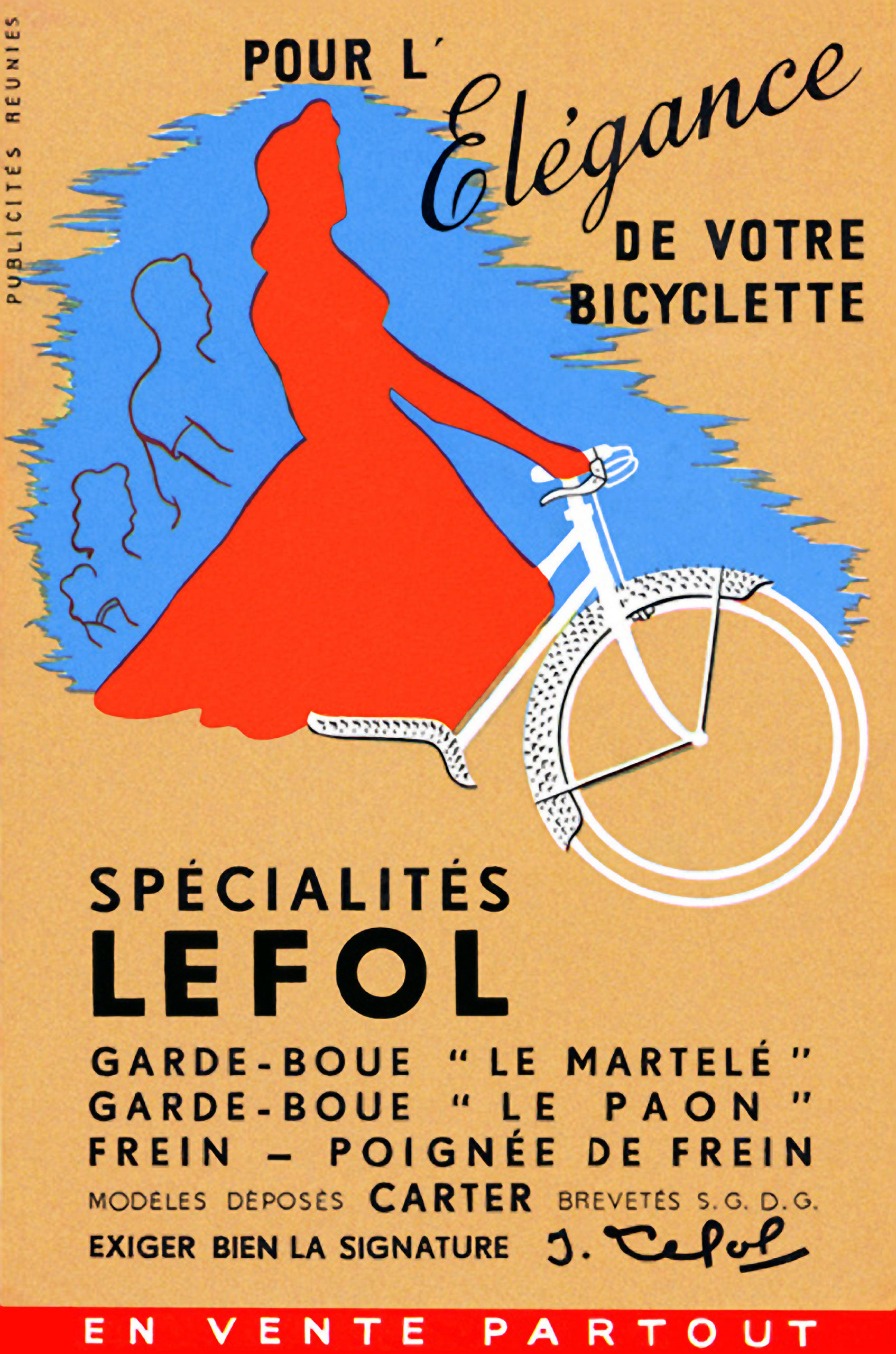
The “J. Lefol” signature still had marketing value in 1961, when Lefol Cie proclaimed, “exigez bien la signature” (“demand the signature”), in a black and white magazine advertisement harkening back to the art deco era of the 1920s and 1930s. By this time the company was also selling automobile bumpers and roof racks for boats.
Join the Lefol Heritage Discussion!
Do you own a bike with original Lefol Le Martelé fenders or one of the Le Paon or Le Pratique variants, or have you turned up any documentation on the mysterious J. Lefol himself — join the forum and help fill in the gaps in the Lefol story.



 Lefol
Lefol