About Ebykr
Ebykr celebrates classic and vintage lightweight bicycles through provocative imagery and opinion. Ride along with us.
About Ebykr
Ebykr celebrates classic and vintage lightweight bicycles through provocative imagery and opinion. Ride along with us.

Source: Gallica (Bibliothèque nationale de France), L'Officiel du cycle, du motocycle et du camping, 29 December 1951, N° 45, 61e Année, page 21; ark:/12148/bd6t54192889n. Source gallica.bnf.fr / BnF.
| Marque | Héloisa |
|---|---|
| Type | Review |
| Year | 1951 |
| Publisher | L'Officiel du cycle |
| Country | France |
| Language | French |
| Pages | 2 |
| Source | Gallica (Bibliothèque nationale de France), L'Officiel du cycle, du motocycle et du camping, 29 December 1951, N° 45, 61e Année, page 21; ark:/12148/bd6t54192889n. Source gallica.bnf.fr / BnF. |
| Credit | Ebykr archive; Bibliothèque nationale de France |
| Identifier | Gallica (BnF) ark:/12148/bd6t54192889n/f20 |
| Transcription | Headings and specifications transcribed; article text summarized |
Reference
"Le compteur kilométrique HELOISA." L'Officiel du cycle, 29 December 1951. Ebykr, https://ebykr.com/library/lofficiel-du-cycle-1951-12-21-compteur-kilometrique-heloisa-castima/.
Wikipedia
{{cite magazine |title=Le compteur kilométrique HELOISA |magazine=L'Officiel du cycle |date=29 December 1951 |language=French |url=https://ebykr.com/library/lofficiel-du-cycle-1951-12-21-compteur-kilometrique-heloisa-castima/ |via=Ebykr |access-date=}}Le compteur kilométrique HELOISA
This is a magazine article, so its running text is summarized here rather than reproduced; the headline, byline, specifications and scores are transcribed as printed.
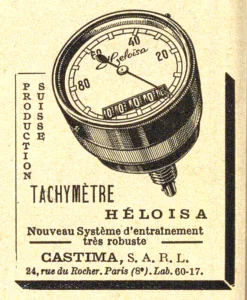
From L’Officiel du cycle, du motocycle et du camping, 29 December 1951, page 21: ‘Le compteur kilometrique HELOISA’: a Swiss-made speedometer and odometer for the bicycle (imported by Castima), aluminum case, rubber-roller drive on the front wheel; part 1 of 2. The title, headings, captions and lists are transcribed as printed; the text is summarized in Ebykr’s words, and the page images carry it in full.
— Page 1 —
Le compteur kilométrique HELOISA
[Ebykr summary; the article’s text is not reproduced. The Héloïsa speedometer is of Bernese (Swiss) manufacture and imported into France by Castima (printed in small capitals); it is an odometer that also gives the speed and embellishes the bicycle. It is a magnetic-type instrument in a strong aluminum cast shell, with a watertight chromed bezel and minimal weight, given as 550 grams complete. The general features listed are silent running, very simple mounting, position on the right of the steering column, and drive on the right of the front wheel. The drive wheel is an aluminum toothed wheel fixed to the spokes with hook screws, and a drive bracket screws to the fork so that the rubber roller sits square to the aluminum wheel and is pressed against it by the spring suspension of the bracket, or else so that the rubber toothed wheel meshes with the fixed wheel, which prevents slipping. Exact adjustment for each wheel size is made by moving the rubber roller up and down, and the text breaks off mid-sentence at this point and continues in the next image.]
[A column notice in italic roman type, introduced by a small three-star ornament centered at the top and a heading set in bold roman with the name HELOISA in capitals. The firm name Castima is set in small capitals inside the text. The image is text only, with no illustration or signature, and ends at the foot of the column in the middle of a sentence.]
— Page 2 —
[Ebykr summary; the article’s text is not reproduced. This image carries the end of the notice on the Héloïsa kilometer counter, picking up the sentence left open at the foot of the first image, which closes on the wheel being of aluminum. A check procedure follows: over a distance of 10 meters the small rubber roller should make 10 turns. A final line states that the speed indicator is calibrated for either 100 or 70 kilometers.]
[Text only, set in italic roman type across the full width of a single narrow column, five lines of running text justified to both edges. The first line completes a sentence begun above the cut, and a short paragraph beginning with an indented line follows. Below the text a small ornament of three asterisks, one raised above the other two, marks the end of the notice. No drawing, signature or agency mark appears in this image, and no text from the reverse of the leaf shows through.]
Ebykr presents this material for research and education. If you hold rights to it or notice an ownership issue, please contact us and we will respond promptly.
The Ebykr Digest
New articles, timelines, catalog finds and registry activity — assembled from the archive once a month. Your address is never shared.
Double opt-in. One email per month. Unsubscribe at any time with one click.