About Ebykr
Ebykr celebrates classic and vintage lightweight bicycles through provocative imagery and opinion. Ride along with us.
About Ebykr
Ebykr celebrates classic and vintage lightweight bicycles through provocative imagery and opinion. Ride along with us.

Source: Gallica (Bibliothèque nationale de France), L'Officiel du cycle, du motocycle et du camping, 29 December 1951, N° 45, 61e Année, page 7; ark:/12148/bd6t54192889n. Source gallica.bnf.fr / BnF.
| Type | Review |
|---|---|
| Year | 1951 |
| Publisher | L'Officiel du cycle |
| Country | France |
| Language | French |
| Pages | 2 |
| Source | Gallica (Bibliothèque nationale de France), L'Officiel du cycle, du motocycle et du camping, 29 December 1951, N° 45, 61e Année, page 7; ark:/12148/bd6t54192889n. Source gallica.bnf.fr / BnF. |
| Credit | Ebykr archive; Bibliothèque nationale de France |
| Identifier | Gallica (BnF) ark:/12148/bd6t54192889n/f7 |
| Transcription | Headings and specifications transcribed; article text summarized |
Reference
"La bicyclette Audoux." L'Officiel du cycle, 29 December 1951. Ebykr, https://ebykr.com/library/lofficiel-du-cycle-1951-12-07-bicyclette-audoux-pedalage-alterne-secteurs-dentes/.
Wikipedia
{{cite magazine |title=La bicyclette Audoux |magazine=L'Officiel du cycle |date=29 December 1951 |language=French |url=https://ebykr.com/library/lofficiel-du-cycle-1951-12-07-bicyclette-audoux-pedalage-alterne-secteurs-dentes/ |via=Ebykr |access-date=}}LA BICYCLETTE AUDOUX Un nouveau système de pédalage Elle se compose : 1° D'un pédalier sur lequel les deux pédales ont été réduites aux seules pièces servant à l'entraînement de l'axe de pédalier et sur lesquelles est vissée de chaque côté une roue libre ; 2° De deux pédales A1 et A2 pivotantes sur les …
This is a magazine article, so its running text is summarized here rather than reproduced; the headline, byline, specifications and scores are transcribed as printed.
From L’Officiel du cycle, du motocycle et du camping, 29 December 1951, page 7: “La bicyclette Audoux”: a new pedaling system (alternating pedals on toothed sectors, a single chain and a toothed wheel under the saddle) by Gérard Audoux of Le Pecq. The title, headings, captions and lists are transcribed as printed; the text is summarized in Ebykr’s words, and the page images carry it in full.
— Page 1 —
LA BICYCLETTE AUDOUX
Un nouveau système de pédalage
[Ebykr summary; the article’s text is not reproduced. Continuing the paper’s series of studies on the research multiplying in the field of the bicycle, the article turns to a new pedaling system developed by M. Gérard Audoux, of Le Pecq (written “du Pecq”). Audoux, a mechanic of long standing, set out to ease the effort of riders in mountain country and even on steep hills, which the author notes are found everywhere. The system, patented a few months earlier, is still practically unknown. As in the Havet bicycle (the paper refers readers to its issue of 15 December), it uses an alternating pedaling device, but no longer moving toward the rear; the description follows as Audoux drew it up, with a schema of the machine prepared by the paper. Starting from the known defects of rotary pedaling, the invention aims to solve the delicate problem of full traction by reducing the effort and removing the dead point.]
[Opening of a text-only article set in one wide column of roman type, headed by a short horizontal rule near the top edge. The title “LA BICYCLETTE AUDOUX” is set in heavy bold sans-serif capitals across the width, with the subtitle “Un nouveau système de pédalage” beneath it in smaller bold sans-serif lower case. The name Audoux is printed in small capitals in the text. There are no illustrations or signatures on this image.]
— Page 2 —
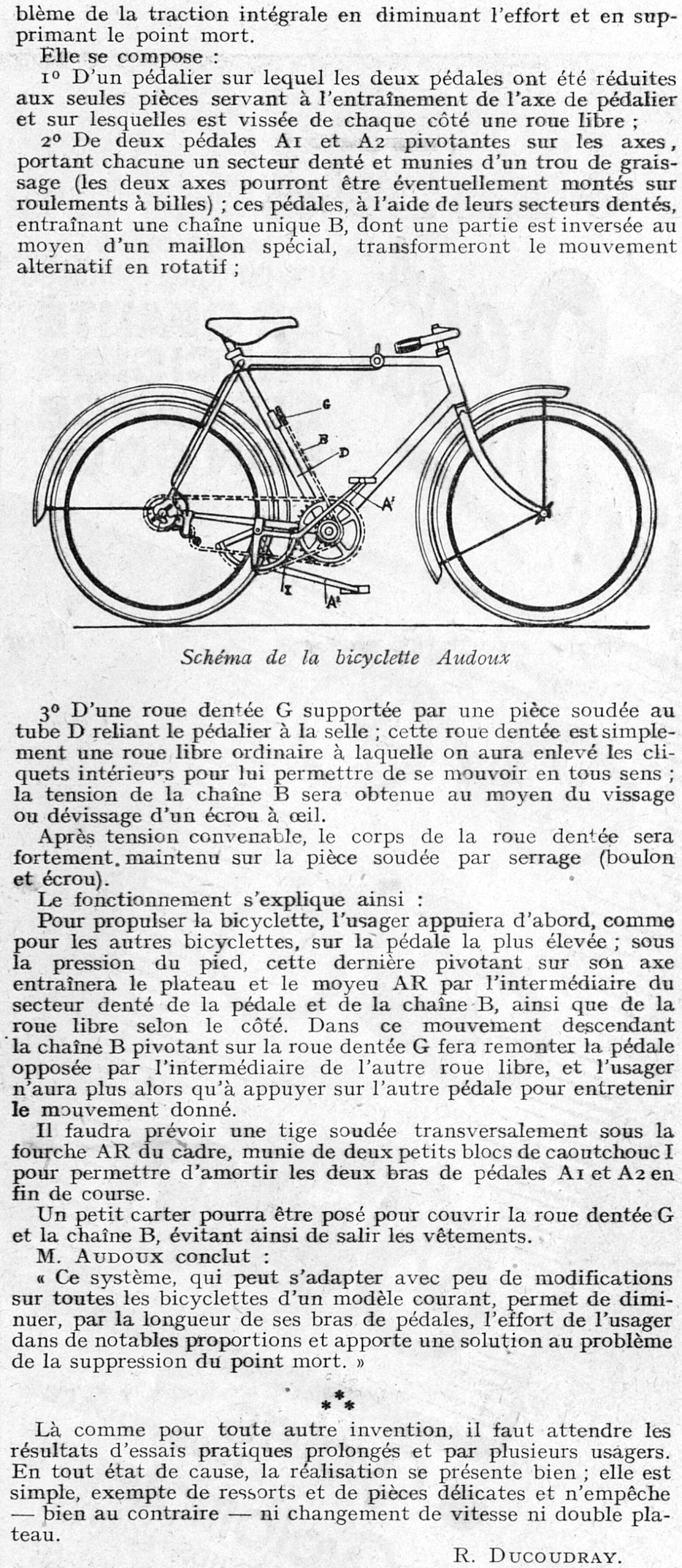
Elle se compose :
1° D’un pédalier sur lequel les deux pédales ont été réduites aux seules pièces servant à l’entraînement de l’axe de pédalier et sur lesquelles est vissée de chaque côté une roue libre ;
2° De deux pédales A1 et A2 pivotantes sur les axes, portant chacune un secteur denté et munies d’un trou de graissage (les deux axes pourront être éventuellement montés sur roulements à billes) ; ces pédales, à l’aide de leurs secteurs dentés, entraînant une chaîne unique B, dont une partie est inversée au moyen d’un maillon spécial, transformeront le mouvement alternatif en rotatif ;
Schéma de la bicyclette Audoux
3° D’une roue dentée G supportée par une pièce soudée au tube D reliant le pédalier à la selle ; cette roue dentée est simplement une roue libre ordinaire à laquelle on aura enlevé les cliquets intérieurs pour lui permettre de se mouvoir en tous sens ; la tension de la chaîne B sera obtenue au moyen du vissage ou dévissage d’un écrou à œil.
[Ebykr summary, after the list of the three parts. Once the tension is right, the body of the toothed wheel is clamped firmly to the welded piece by a bolt and nut. The operation is explained as follows: to drive the bicycle the rider first presses, as on other bicycles, on the higher pedal; under the foot’s pressure that pedal pivots on its axle and drives the chainring and the rear hub through its toothed sector, the chain B and the freewheel on that side. In this downward movement the chain B, turning on the toothed wheel G, brings the opposite pedal back up through the other freewheel, so the rider then only has to press the other pedal to keep the motion going. A cross rod must be welded under the rear fork of the frame, fitted with two small rubber blocks marked I to cushion the two pedal arms A1 and A2 at the end of their stroke. A small casing may be fitted over the toothed wheel G and the chain B to keep clothing clean. Audoux concludes, in a quotation, that the system, which can be fitted with few changes to any bicycle of a current model, reduces the rider’s effort considerably through the length of its pedal arms and offers a solution to the problem of removing the dead point.]
* * *
[Ebykr summary, after a three-star break. The author says that here as with any other invention one must wait for the results of prolonged practical trials by several riders. In any case the design looks sound: it is simple, free of springs and delicate parts, and, quite the opposite, does not prevent either gear changing or a double chainring.]
R. DUCOUDRAY.
[The second image of the article carries the rest of the text in one wide column of roman type, with the numbered list set in the same type. About two fifths of the way down a line engraving drawn in thin black outline shows a bicycle in side view on a ground line, with the drawing captioned in italic beneath as “Schéma de la bicyclette Audoux”. The machine has a saddle on a post, a straight frame with a short upper bar and a short handlebar pointing forward, a curved front fork, fenders over both wheels, a chainring at the pedal axle with a chain running to the rear, and two pedal arms hinged below the bottom bracket, one raised and pointing forward and the other hanging down toward the rear, each ending in a small flat pedal. Reference letters G, B, D, A1, A2 and I are printed beside the parts with thin leader lines. A three-star ornament in small asterisks stands centered before the closing paragraph, and the author’s name is set at the lower right in roman with small capitals. No artist signature is visible on the drawing.]
Ebykr presents this material for research and education. If you hold rights to it or notice an ownership issue, please contact us and we will respond promptly.
The Ebykr Digest
New articles, timelines, catalog finds and registry activity — assembled from the archive once a month. Your address is never shared.
Double opt-in. One email per month. Unsubscribe at any time with one click.