About Ebykr
Ebykr celebrates classic and vintage lightweight bicycles through provocative imagery and opinion. Ride along with us.
About Ebykr
Ebykr celebrates classic and vintage lightweight bicycles through provocative imagery and opinion. Ride along with us.

Source: Gallica (Bibliothèque nationale de France), L'Officiel du cycle, du motocycle et du camping, 29 December 1951, N° 45, 61e Année, pages 5 and 7; ark:/12148/bd6t54192889n. Source gallica.bnf.fr / BnF.
| Type | Review |
|---|---|
| Year | 1951 |
| Publisher | L'Officiel du cycle |
| Country | France |
| Language | French |
| Pages | 2 |
| Source | Gallica (Bibliothèque nationale de France), L'Officiel du cycle, du motocycle et du camping, 29 December 1951, N° 45, 61e Année, pages 5 and 7; ark:/12148/bd6t54192889n. Source gallica.bnf.fr / BnF. |
| Credit | Ebykr archive; Bibliothèque nationale de France |
| Identifier | Gallica (BnF) ark:/12148/bd6t54192889n/f5 |
| Transcription | Headings and specifications transcribed; article text summarized |
Reference
"Qui a inventé la bicyclette ?" L'Officiel du cycle, 29 December 1951. Ebykr, https://ebykr.com/library/lofficiel-du-cycle-1951-12-05-qui-a-invente-la-bicyclette-mac-millan-breyer/.
Wikipedia
{{cite magazine |title=Qui a inventé la bicyclette ? |magazine=L'Officiel du cycle |date=29 December 1951 |language=French |url=https://ebykr.com/library/lofficiel-du-cycle-1951-12-05-qui-a-invente-la-bicyclette-mac-millan-breyer/ |via=Ebykr |access-date=}}La Bicyclette QUI A INVENTÉ LA BICYCLETTE ? par Victor BREYER I. — KIRKPATRICK Mac MILLAN Personne, ou beaucoup ! Ils furent deux ! L'artisan à l'œuvre Le premier « cycle » à pédale (Mac Millan 1840). Le « diable sur roues » La fin de Mac Millan Victor BREYER. Prochain article : Pierre MICHAUX.
This is a magazine article, so its running text is summarized here rather than reproduced; the headline, byline, specifications and scores are transcribed as printed.
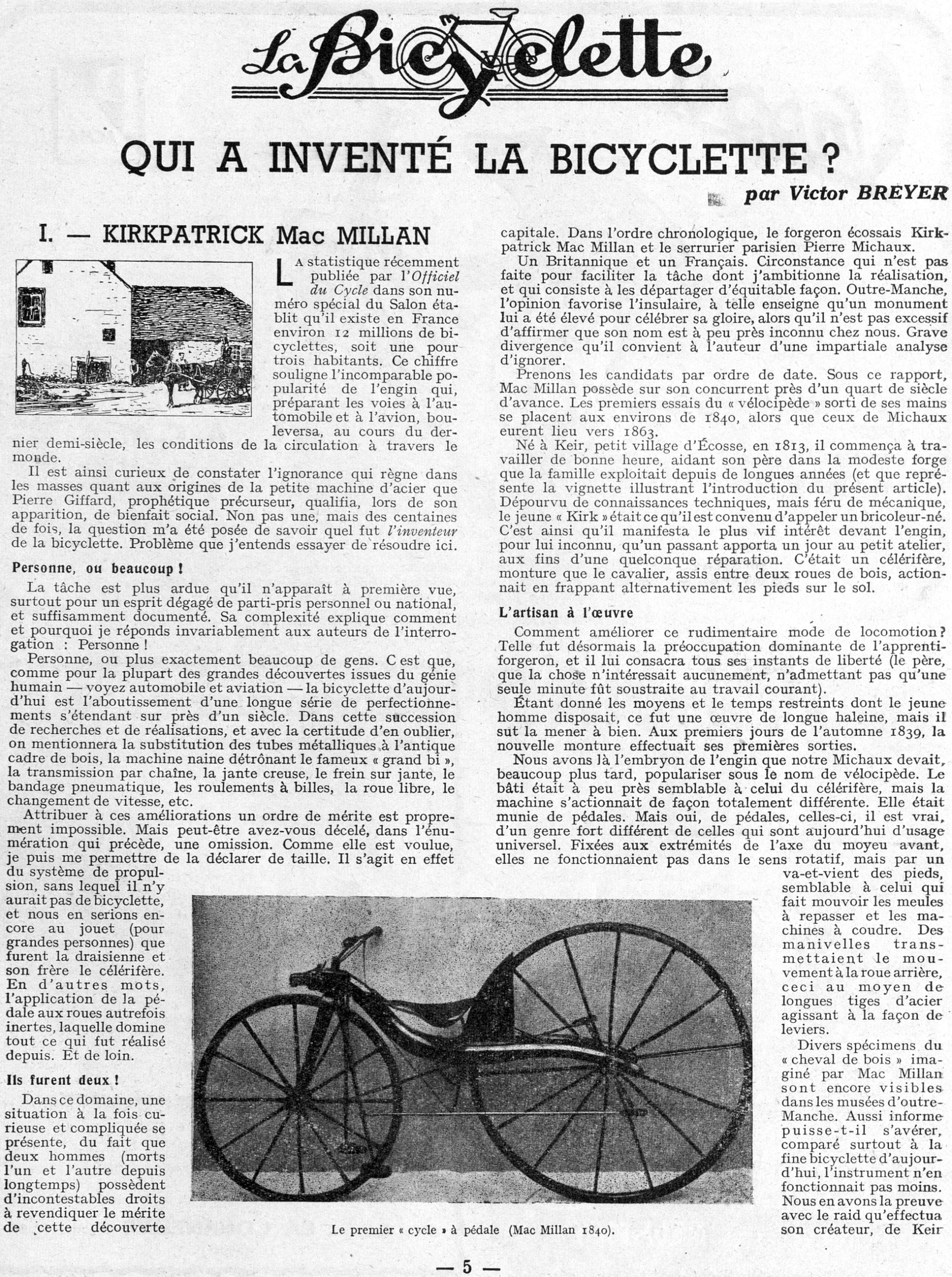
From L’Officiel du cycle, du motocycle et du camping, 29 December 1951, pages 5 and 7: “Qui a inventé la bicyclette ?” by Victor Breyer, I. Kirkpatrick Mac Millan: history of the first pedal cycle (1839-1842); photograph of the Mac Millan pedal cycle of 1840 and a vignette of the Keir forge. The title, headings, captions and lists are transcribed as printed; the text is summarized in Ebykr’s words, and the page images carry it in full.
— Page 1 —
La Bicyclette
QUI A INVENTÉ LA BICYCLETTE ?
par Victor BREYER
I. — KIRKPATRICK Mac MILLAN
[Ebykr summary; the article’s text is not reproduced. Breyer opens by noting that the statistic published by L’Officiel du Cycle in its special Salon issue puts the number of bicycles in France at about 12 million, one for every three inhabitants, a figure that shows the popularity of a machine that prepared the way for the automobile and the airplane and overturned traffic conditions around the world over the last half century. He then names the two chronological candidates for the invention, the Scottish blacksmith Kirkpatrick Mac Millan and the Parisian locksmith Pierre Michaux, a Briton and a Frenchman, and says the task of dividing the credit between them fairly is not made easier by that. Across the Channel opinion favors the islander and teaches that a monument was raised to his glory, while his name is almost unknown in France; the author says an impartial analysis must set that divergence aside. Taking the candidates by date, Mac Millan has nearly a quarter century on his rival: his first trials of the “vélocipède” date from about 1840, those of Michaux from about 1863.]
Personne, ou beaucoup !
[Ebykr summary, after the first subheading. Breyer remarks that most people are ignorant of the origins of the little steel machine that Pierre Giffard, a prophetic forerunner, called a social benefit when it appeared; he says he has been asked hundreds of times who invented the bicycle. His answer is invariably “Personne !”, or more exactly “many people”, because like most great discoveries (automobile and aviation are his examples) the present bicycle is the outcome of a long series of improvements over nearly a century. He lists, admitting he will forget some, metal tubes replacing the old wooden frame, the small machine displacing the “grand bi”, chain transmission, the hollow rim, the rim brake, the pneumatic tire, ball bearings, the freewheel and gearing. Ranking these in order of merit is impossible, but the list leaves out on purpose the propulsion system, without which there would be no bicycle and we would still have the grown-up toys that were the draisienne and its brother the célérifère. In other words, applying the pedal to formerly inert wheels dominates everything achieved since, and by far.]
Ils furent deux !
[Ebykr summary, after the second subheading. The author says two men, both long dead, have undeniable claims to the credit for this discovery: Mac Millan and Michaux. He begins with Mac Millan, born at Keir, a small Scottish village, in 1813, who began working early beside his father in the modest family forge, the subject of the vignette that illustrates the opening of the article. Without technical training but passionate about mechanics, “Kirk” was a born tinkerer, and he took a lively interest in a célérifère that a passer-by brought to the workshop for repair, a mount on which the rider, seated between two wooden wheels, pushed along by striking the ground alternately with his feet.]
L’artisan à l’œuvre
[Ebykr summary, after the third subheading. The young blacksmith made improving this rudimentary mode of travel his chief concern and gave it every free moment, since his father, who had no interest in the matter, would not spare a minute from the daily work. It was a long task given his limited means and time, but he saw it through, and in the first days of autumn 1839 the new mount made its first outings. The frame was much like the célérifère, but the machine was driven quite differently, being fitted with pedals, though of a kind very unlike those in universal use today: fixed to the ends of the front hub axle, they worked not by rotation but by a back-and-forth movement of the feet like that which drives grinding wheels and sewing machines. Cranks passed the motion to the rear wheel by long steel rods acting as levers. Several specimens of this “cheval de bois” can still be seen in museums across the Channel, and however crude it looks beside the modern bicycle it worked, as the raid its maker made from Keir to Glasgow proves; the sentence runs over to the end of the article on a later page.]
Le premier « cycle » à pédale (Mac Millan 1840).
[A page of an illustrated trade weekly set in two wide text columns under a large decorative heading. At the top right the series title “La Bicyclette” is lettered in heavy black script with a line drawing of a bicycle seen from the side running through the letters and three horizontal rules beneath, and below it the title stands in heavy slab-serif capitals with the author’s name in bold italic at the right. The subheading “I. — KIRKPATRICK Mac MILLAN” is set in bold sans-serif capitals. At the left of the first column a small rectangular vignette in line engraving, framed by a thin rule, shows a stone forge building with a slate roof, a small barred window and a doorway through which a horse harnessed to a two-wheeled trap and a standing man can be seen, with a lane and low ground in front. The first paragraph begins with a large dropped initial letter. The article’s other subheadings are set in bold sans-serif lower case. Across the lower part of the page a wide halftone photograph shows a dark early pedal cycle in side view against a plain gray wall, with a spoked front wheel, a carved head on the steering post, a curved frame carrying a saddle, a spoked rear wheel of about the same size and a thin rod running back along the frame; its caption sits beneath in small roman type. The text column beside the photograph narrows to a short measure. The page number “— 5 —” is printed at the foot. No signature or artist credit is visible on the photograph or the vignette.]
— Page 2 —
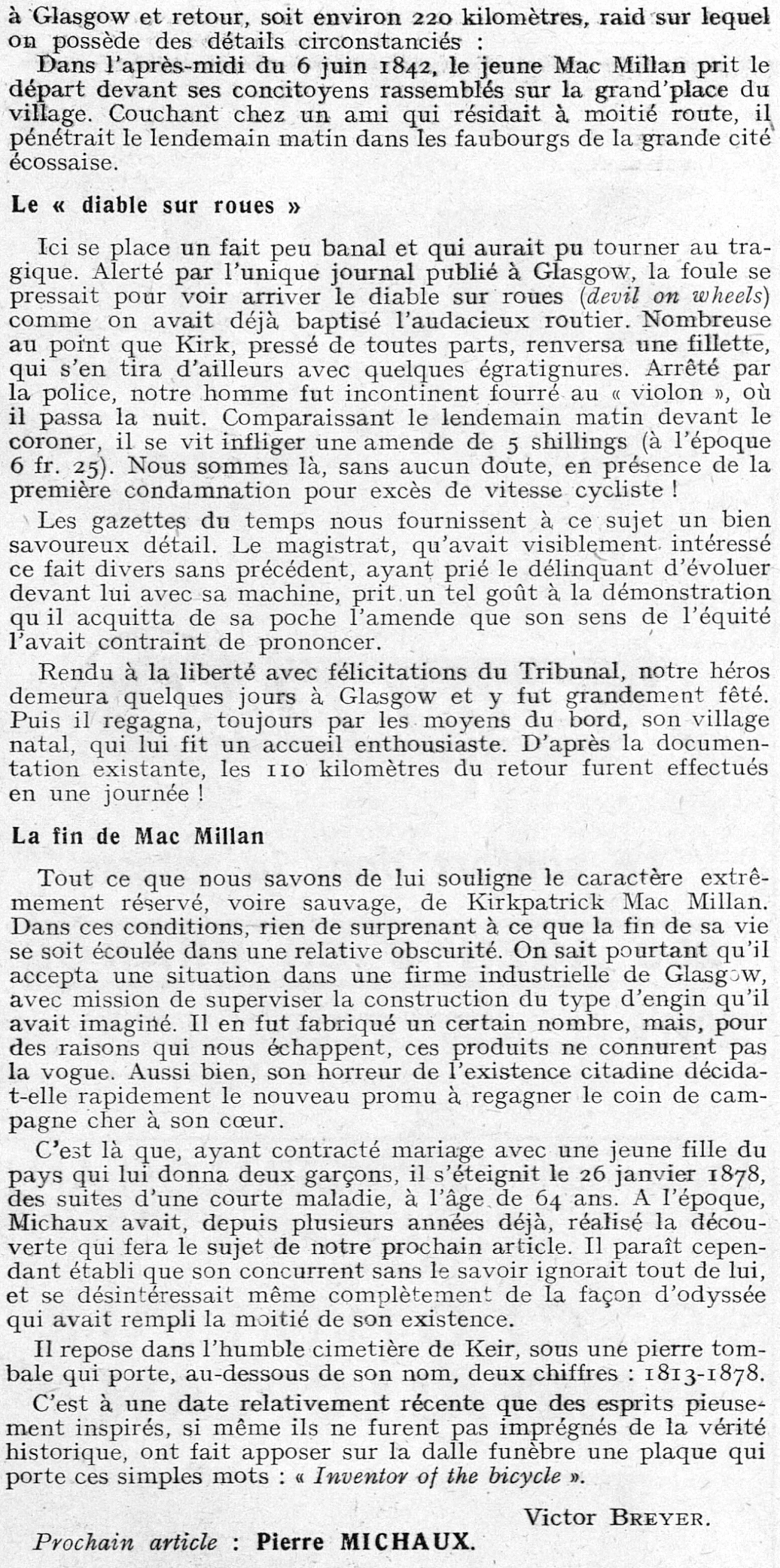
[Ebykr summary; the article’s text is not reproduced. The sentence from the previous page concludes: Mac Millan’s ride from Keir to Glasgow and back came to about 220 kilometers, and detailed accounts of it survive. On the afternoon of 6 June 1842 the young man set off before his fellow villagers gathered on the village square, slept at a friend’s house halfway, and reached the outskirts of the Scottish city the next morning.]
Le « diable sur roues »
[Ebykr summary, after the subheading. Alerted by the only newspaper then published in Glasgow, a crowd pressed to see the “devil on wheels” (the English words appear in italics), the nickname already given to the bold roadster. The crowd was so dense that Kirk, jostled on all sides, knocked down a little girl, who got off with a few scratches. Arrested by the police, he was put into the lockup for the night and the next morning was fined 5 shillings by the coroner, about 6 francs 25 at the time, which Breyer calls without doubt the first conviction for cycling speeding. The newspapers of the day add that the magistrate, who had asked the offender to ride his machine in front of him, enjoyed the demonstration so much that he paid the fine out of his own pocket. Released with the court’s congratulations, Mac Millan stayed a few days in Glasgow and was greatly celebrated, then rode home to an enthusiastic welcome; according to the existing documentation the 110 kilometers of the return were covered in one day.]
La fin de Mac Millan
[Ebykr summary, after the subheading. Everything known of Mac Millan shows him to have been extremely reserved, even wild, so it is no surprise that the end of his life passed in relative obscurity. He took a post with an industrial firm in Glasgow to supervise the building of the type of machine he had devised, and a number were made, but for reasons unknown they did not catch on; his horror of city life soon sent him back to the countryside he loved. There he married a local girl, who gave him two sons, and he died on 26 January 1878 after a short illness, aged 64. By then Michaux had for several years already made the discovery that will be the subject of the next article, though it seems established that his rival, without knowing it, knew nothing of him and was wholly indifferent to the odyssey that had filled half his life. He lies in the humble churchyard of Keir under a stone that bears his name and the two dates 1813-1878; in comparatively recent times pious minds, perhaps not steeped in historical truth, had a plaque fixed to the slab carrying the words “Inventor of the bicycle”, printed in italics.]
Victor BREYER.
Prochain article : Pierre MICHAUX.
[The concluding column of the article, set as continuous text in a single wide column of roman type, with bold sans-serif lower-case subheadings ahead of the second and third sections. The text opens with lines carried over from the previous page. The author’s name is set at the right in roman with small capitals, and below it at the left a line in italic and bold roman capitals announces the next article. There are no illustrations and no artist signature.]
Ebykr presents this material for research and education. If you hold rights to it or notice an ownership issue, please contact us and we will respond promptly.
The Ebykr Digest
New articles, timelines, catalog finds and registry activity — assembled from the archive once a month. Your address is never shared.
Double opt-in. One email per month. Unsubscribe at any time with one click.