About Ebykr
Ebykr celebrates classic and vintage lightweight bicycles through provocative imagery and opinion. Ride along with us.
About Ebykr
Ebykr celebrates classic and vintage lightweight bicycles through provocative imagery and opinion. Ride along with us.

Source: Gallica (Bibliothèque nationale de France), L'Officiel du cycle, du motocycle et du camping, 16 December 1950, pages 3 and 4; ark:/12148/bd6t54185532g. Source gallica.bnf.fr / BnF.
| Type | Review |
|---|---|
| Year | 1950 |
| Publisher | L'Officiel du cycle |
| Country | France |
| Language | French |
| Pages | 2 |
| Source | Gallica (Bibliothèque nationale de France), L'Officiel du cycle, du motocycle et du camping, 16 December 1950, pages 3 and 4; ark:/12148/bd6t54185532g. Source gallica.bnf.fr / BnF. |
| Credit | Ebykr archive; Bibliothèque nationale de France |
| Identifier | Gallica (BnF) ark:/12148/bd6t54185532g/f3 |
| Transcription | Headings and specifications transcribed; article text summarized |
Reference
"Vers la fin des primes." L'Officiel du cycle, 16 December 1950. Ebykr, https://ebykr.com/library/lofficiel-du-cycle-1950-12-03-vers-fin-des-primes-coupons-velocistes/.
Wikipedia
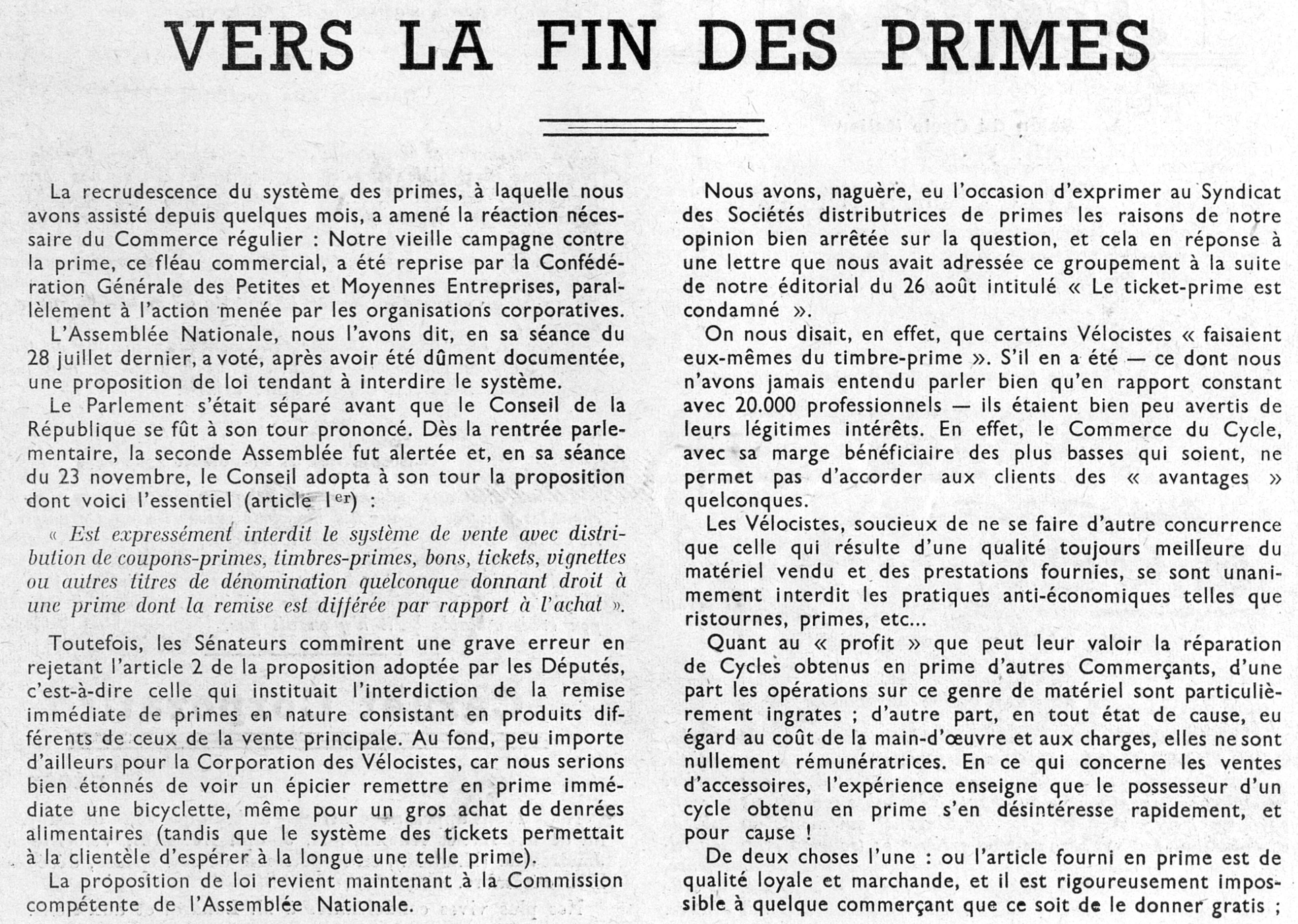
{{cite magazine |title=Vers la fin des primes |magazine=L'Officiel du cycle |date=16 December 1950 |language=French |url=https://ebykr.com/library/lofficiel-du-cycle-1950-12-03-vers-fin-des-primes-coupons-velocistes/ |via=Ebykr |access-date=}}VERS LA FIN DES PRIMES « Est expressément interdit le système de vente avec distribution de coupons-primes, timbres-primes, bons, tickets, vignettes ou autres titres de dénomination quelconque donnant droit à une prime dont la remise est différée par rapport à l'achat ».
This is a magazine article, so its running text is summarized here rather than reproduced; the headline, byline, specifications and scores are transcribed as printed.
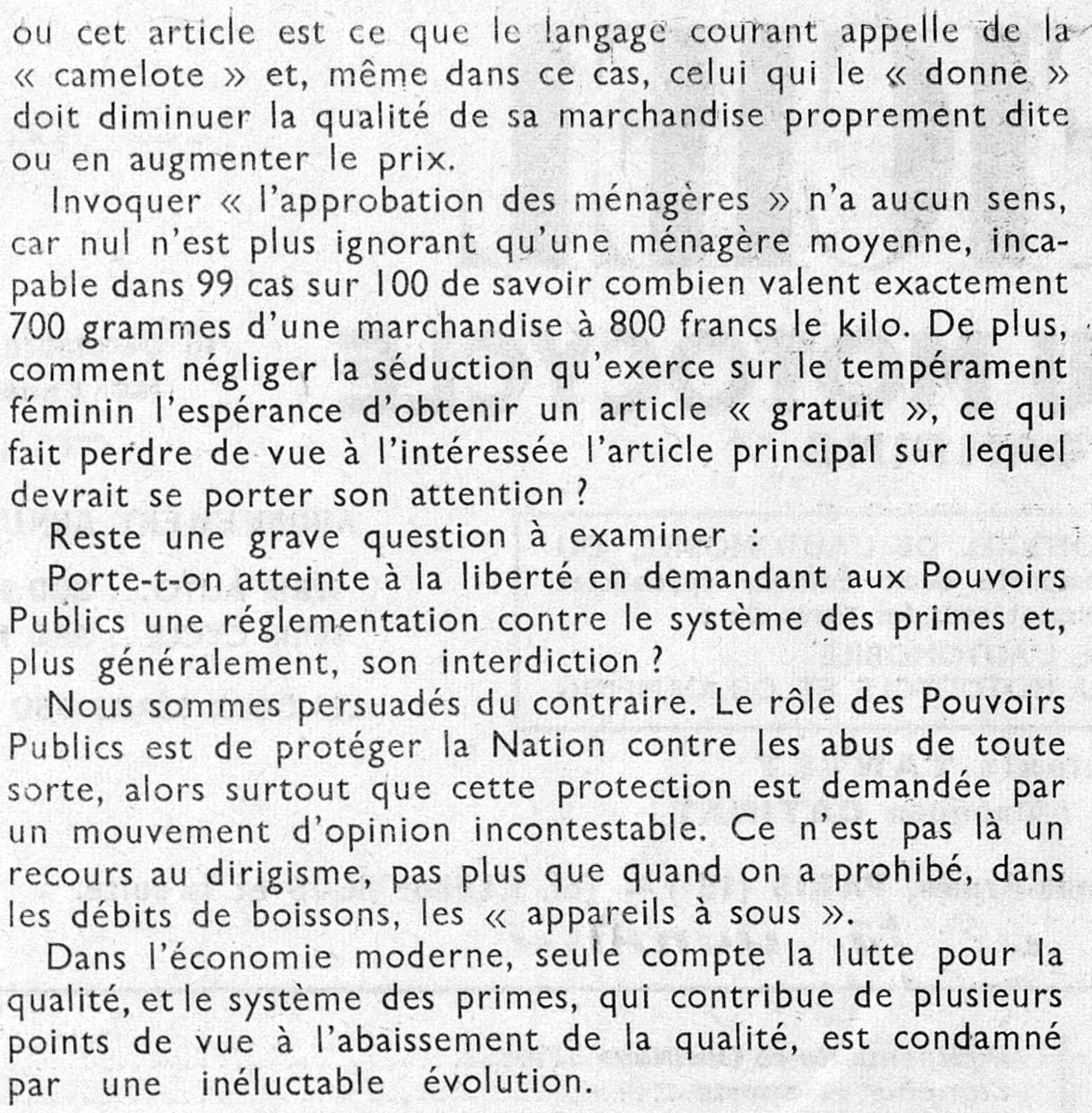
From L’Officiel du cycle, du motocycle et du camping, 16 December 1950, pages 3 and 4: editorial “Vers la fin des primes”: the National Assembly and the Council of the Republic move to ban premium coupons and tickets in retail; argues the cycle dealers (Vélocistes) have long refused them and that a bicycle given as a premium by a grocer would hurt the cycle trade; no illustrations. The title, headings, captions and lists are transcribed as printed; the text is summarized in Ebykr’s words, and the page images carry it in full.
— Page 1 —
VERS LA FIN DES PRIMES
[Ebykr summary; the article’s text is not reproduced. The editorial opens by noting a recent revival of the premium system and the response of regular commerce: the trade weekly’s long campaign against the premium, which it calls a commercial scourge, has been taken up by the Confédération Générale des Petites et Moyennes Entreprises alongside the work of the corporate organizations. The National Assembly, at its sitting of 28 July, voted a bill to ban the system after being properly briefed. Parliament had risen before the Council of the Republic could rule, but on the return of Parliament the second chamber was alerted and, at its sitting of 23 November, adopted the bill, whose essential text (article 1) is quoted as follows.]
« Est expressément interdit le système de vente avec distribution de coupons-primes, timbres-primes, bons, tickets, vignettes ou autres titres de dénomination quelconque donnant droit à une prime dont la remise est différée par rapport à l’achat ».
[Ebykr summary, after the quoted article. The Senators, the editorial says, made a serious mistake by rejecting article 2 of the bill adopted by the Deputies, which would have banned the immediate handing over of premiums in kind consisting of products different from those of the main sale. The author adds that this matters little to the cycle dealers (Vélocistes), since a grocer would hardly give a bicycle as an immediate premium even for a large food purchase, whereas the ticket system let customers hope for such a premium in the long run. The bill now returns to the competent committee of the National Assembly. The author then recalls that the paper recently explained its settled view to the Syndicat des Sociétés distributrices de primes, in reply to a letter received after its editorial of 26 August titled « Le ticket-prime est condamné ». The Syndicat had said some Vélocistes issued premium stamps themselves; the author answers that he never heard of it, although he is in constant contact with 20.000 professionals, and that the cycle trade, with one of the lowest profit margins, cannot grant customers any such « avantages ». Vélocistes, wanting competition only through ever better quality of goods and service, have unanimously forbidden themselves anti-economic practices such as rebates and premiums. As for the supposed « profit » from repairing cycles obtained as premiums from other merchants, the work is thankless and, given labor costs and overheads, not remunerative; and owners of premium cycles quickly lose interest in buying accessories, for good reason. The author sets out a dilemma: either the premium article is of fair, saleable quality, in which case no merchant can give it away free, and the text breaks off at the foot of the page, continuing overleaf.]
[A text-only editorial set in two wide justified columns on a ruled page, with no illustration. The title “VERS LA FIN DES PRIMES” stands across the head in heavy slab-serif capitals, with a set of three thin horizontal rules beneath it at the right. The running text is in a sans-serif roman face with paragraph indents, and the quoted article is set apart in italic between guillemets. No signature, firm name or address shows.]
— Page 2 —
[Ebykr summary, continued from the previous page. The author finishes the dilemma: the premium article is either honest merchandise or what everyday speech calls « camelote » (junk), and even then the one who gives it away must lower the quality of his own goods or raise their price. He dismisses the appeal to « l’approbation des ménagères » as meaningless, arguing that the average housewife cannot work out in 99 cases out of 100 what 700 grams of goods at 800 francs a kilo costs, and that the hope of getting a « gratuit » article distracts her from the main article she should be judging. He then raises the remaining serious question, whether asking the Pouvoirs Publics for regulation, and more generally a ban, of the premium system infringes liberty. He answers that it does not: the role of the public authorities is to protect the Nation against abuses of every kind, all the more when the protection is demanded by an undeniable movement of opinion, and this is no recourse to dirigisme, any more than the earlier prohibition of « appareils à sous » (slot machines) in cafes. He concludes that in the modern economy only the struggle for quality counts, and that the premium system, which in several ways lowers quality, is condemned by an inevitable evolution.]
[A text-only continuation set in a single wide justified column of sans-serif roman type with paragraph indents, with no illustration, rule, signature, firm name or address.]
Ebykr presents this material for research and education. If you hold rights to it or notice an ownership issue, please contact us and we will respond promptly.
The Ebykr Digest
New articles, timelines, catalog finds and registry activity — assembled from the archive once a month. Your address is never shared.
Double opt-in. One email per month. Unsubscribe at any time with one click.