About Ebykr
Ebykr celebrates classic and vintage lightweight bicycles through provocative imagery and opinion. Ride along with us.
About Ebykr
Ebykr celebrates classic and vintage lightweight bicycles through provocative imagery and opinion. Ride along with us.

Source: L'Officiel du cycle, du motocycle, du camping et des sports, N° 24, 23 November 1957, pages 5, 6, 7 and 9; scan of the issue from Cycle Memory (Mémoire du Cycle), Collection privée F.
| Type | Review |
|---|---|
| Year | 1957 |
| Publisher | L'Officiel du cycle |
| Country | France |
| Language | French |
| Pages | 4 |
| Source | L'Officiel du cycle, du motocycle, du camping et des sports, N° 24, 23 November 1957, pages 5, 6, 7 and 9; scan of the issue from Cycle Memory (Mémoire du Cycle), Collection privée F. |
| Credit | Ebykr archive |
| Identifier | Permalink https://cyclememory.org/fr/search-coll-list.php?collectionID=325&docID=B-1-0000001011 |
| Transcription | Headings and specifications transcribed; article text summarized |
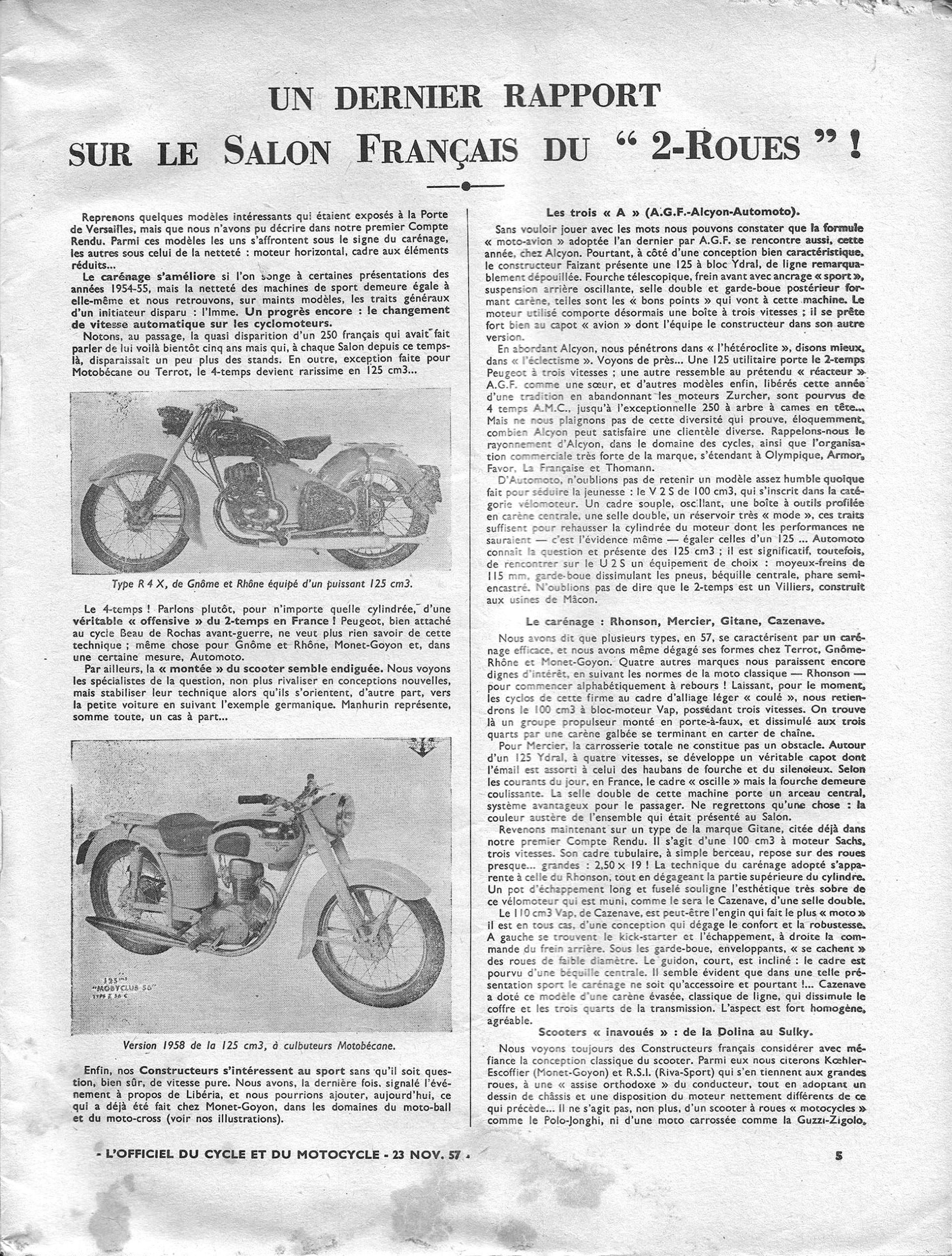
UN DERNIER RAPPORT SUR LE SALON FRANÇAIS DU “ 2-ROUES ” ! Les trois « A » (A.G.F.-Alcyon-Automoto). Le carénage : Rhonson, Mercier, Gitane, Cazenave. Scooters « inavoués » : de la Dolina au Sulky. - L'OFFICIEL DU CYCLE ET DU MOTOCYCLE - 23 NOV. 57 - 5 Les « vrais » scooters. Le sport …
This is a magazine article, so its running text is summarized here rather than reproduced; the headline, byline, specifications and scores are transcribed as printed.
Henri Jones’s “Un dernier rapport sur le Salon français du « 2-Roues »” in L’Officiel du cycle, 23 November 1957: the motorcycles, scooters and cyclomoteurs of the October 1957 Paris Salon, from A.G.F., Alcyon and Automoto to Peugeot, Motobécane, Terrot, Mercier, Gitane, Monet-Goyon and the German and Italian makes, and the blurring line between the cyclomoteur and the vélomoteur. The headings and signature are transcribed as printed; the text and captions are summarized in Ebykr’s words, and the page images carry them in full.
— Page 1 —
UN DERNIER RAPPORT SUR LE SALON FRANÇAIS DU “ 2-ROUES ” !
Les trois « A » (A.G.F.-Alcyon-Automoto).
Le carénage : Rhonson, Mercier, Gitane, Cazenave.
Scooters « inavoués » : de la Dolina au Sulky.
[Ebykr summary; the article’s text is not reproduced. A closing report on the French two-wheeler Salon at the Porte de Versailles, taking up interesting models not described in the magazine’s first report. The writer sees two camps: machines built around fairings (carénage) and machines built for clean lines, with horizontal engines and pared-down frames. Fairings have improved since the 1954-55 shows, while sports machines keep the general lines of a vanished pioneer, the Imme; another advance is the automatic gear change on cyclomoteurs. He notes that a French 250 shown for nearly five years has all but vanished from the stands, and that apart from Motobécane and Terrot the four-stroke has become very rare in 125 cm3. Instead the two-stroke is on the offensive in France: Peugeot, attached to the four-stroke (Beau de Rochas) cycle before the war, has dropped it, as have Gnôme et Rhône, Monet-Goyon and, to a degree, Automoto. The rise of the scooter seems checked, its specialists consolidating and looking toward the small car on the German example; Manhurin is a case apart. Makers are also turning to sport (not pure speed): after the Libéria event reported last time, Monet-Goyon is active in moto-ball and moto-cross. Under the three “A”: the “moto-avion” formula A.G.F. adopted last year now appears at Alcyon, and Faizant shows a clean 125 with an Ydral unit, telescopic fork, “sport” front brake anchorage, swinging-arm rear suspension, dual seat, a faired rear mudguard and a new three-speed gearbox, suited to the “avion” cowl of its other version. Alcyon’s range is eclectic: a 125 utility with the three-speed Peugeot two-stroke, another resembling the A.G.F. “réacteur”, and models that drop Zurcher engines this year for A.M.C. four-strokes, up to an exceptional 250 with overhead camshaft. The writer recalls Alcyon’s standing in bicycles (“cycles”) and its strong sales organization, extending to Olympique, Armor, Favor, La Française and Thomann. Automoto shows the V 2 S of 100 cm3, a vélomoteur for the young with supple swinging frame, toolbox faired into a central shell, dual seat and fashionable tank; Automoto also offers 125 cm3 machines, and the U 2 S has 115 mm hub brakes, mudguards hiding the tires, a center stand and a semi-recessed headlamp, its two-stroke a Villiers built at the Mâcon works. On fairings: having covered Terrot, Gnôme-Rhône and Monet-Goyon, the writer takes four more marques in reverse alphabetical order. Rhonson (whose cyclos have light cast-alloy frames) shows a 100 cm3 with a three-speed Vap unit, overhung and three-quarters hidden by a curved shell ending in a chain case. Mercier builds a full cowl around a four-speed 125 Ydral, enameled to match the fork stays and silencer, with a swinging frame, sliding fork, a dual seat with central grab rail, and an austere color. Gitane shows a 100 cm3 with a three-speed Sachs engine, single-cradle tubular frame, 2,50 x 19 wheels, fairing like the Rhonson’s but clearing the top of the cylinder, a long tapered exhaust and dual seat. Cazenave’s 110 cm3 Vap is the most “moto”: kick-starter and exhaust on the left, rear brake control on the right, small wheels under enveloping mudguards, a short inclined handlebar, center stand, and a flared shell hiding the box and most of the transmission. On “unavowed” scooters, French makers still distrust the classic scooter: Kœhler-Escoffier (Monet-Goyon) and R.S.I. (Riva-Sport) keep large wheels and a conventional riding position with different frames and engine layouts, neither a big-wheeled scooter like the Polo-Jonghi nor a bodied motorcycle like the Guzzi-Zigolo (continued on the next page). Captions: the Gnôme et Rhône Type R 4 X with a powerful 125 cm3; the 1958 version of the Motobécane 125 cm3 with pushrod overhead valves (culbuteurs).]
[Two halftone photographs in the left column, both unnumbered and unsigned. The first shows the Gnôme et Rhône R 4 X motorcycle in right side view, with telescopic fork, deeply valanced mudguards and dual seat. The second shows the Motobécane 125 in left side view against a plain backdrop, with a small winged emblem at the top right corner of the photograph and a show card on the stand at lower left lettered with the capacity, the name “MOBYCLUB” and a type code. No artist’s signature or monogram appears on the page.]
– L’OFFICIEL DU CYCLE ET DU MOTOCYCLE – 23 NOV. 57 –
5
— Page 2 —
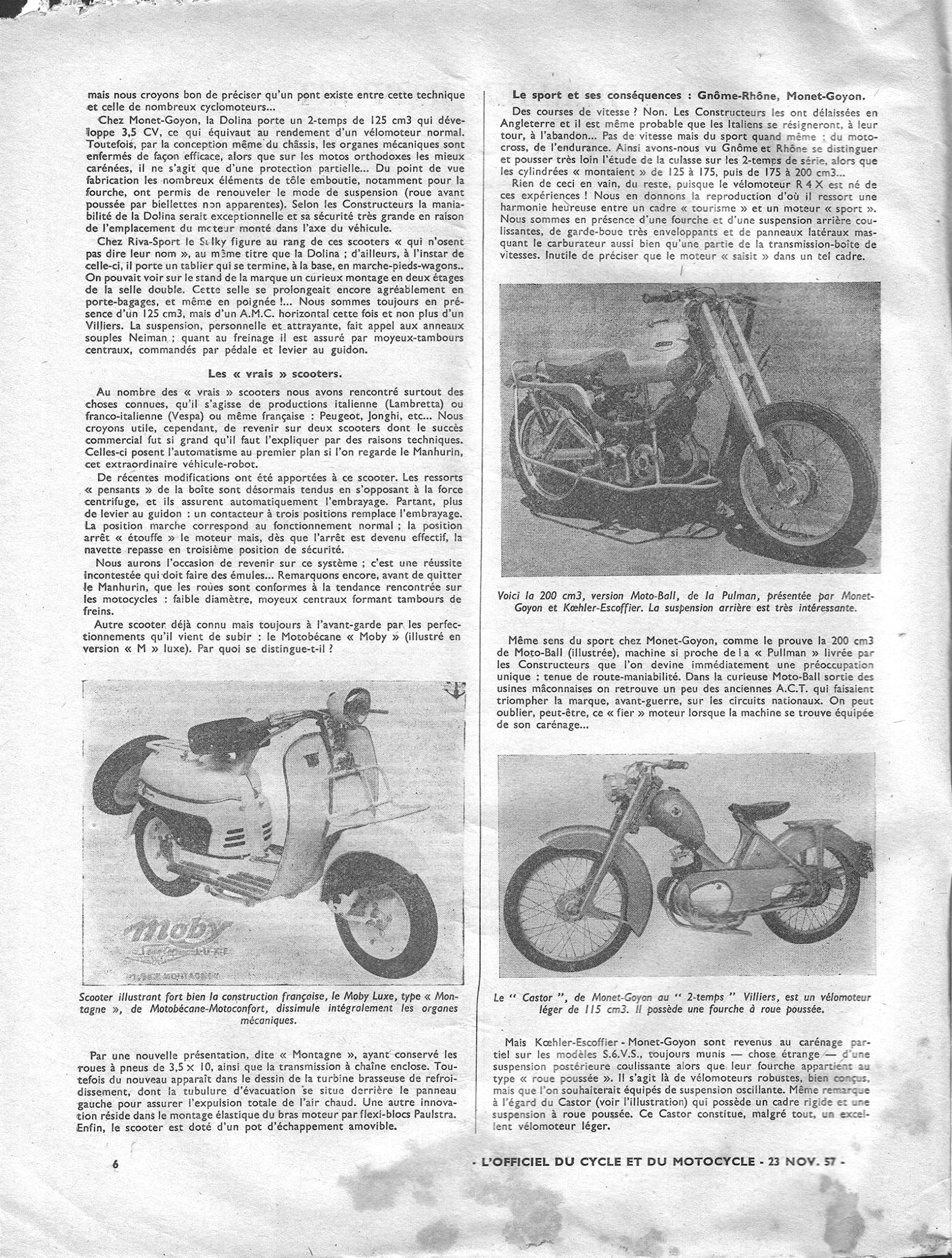
Les « vrais » scooters.
Le sport et ses conséquences : Gnôme-Rhône, Monet-Goyon.
[Ebykr summary; the article’s text is not reproduced. Continuing the section on “unavowed” scooters, the writer points out a link between that technique and many cyclomoteurs. Monet-Goyon’s Dolina carries a 125 cm3 two-stroke of 3,5 CV, the output of an ordinary vélomoteur, but its chassis encloses the mechanism far better than the best-faired orthodox motorcycles; much pressed steel, notably in the fork, allows a new suspension with a pushed front wheel on hidden links, and the makers claim exceptional handling and safety from the engine set on the machine’s axis. Riva-Sport’s Sulky is another scooter that dares not say its name: like the Dolina it has a legshield ending in running boards, and the stand showed a curious two-level dual seat extending into a luggage rack and a grab handle. It too is a 125 cm3, but with a horizontal A.M.C. engine instead of a Villiers, suspension on Neiman flexible rings and central drum hubs worked by pedal and handlebar lever. Among the “true” scooters were familiar Italian (Lambretta), Franco-Italian (Vespa) and French (Peugeot, Jonghi) machines; the writer returns to two whose commercial success has technical causes. The Manhurin, an “extraordinary robot vehicle”, has been modified: its centrifugal clutch springs now engage automatically, so a three-position switch replaces the clutch lever, with run, a stop position that chokes the engine and a third safety position; its small wheels with central drum hubs follow motorcycle practice. The Motobécane “Moby”, shown in “M” luxe form, has a new “Montagne” presentation keeping the 3,5 x 10 tires and enclosed chain drive, with a redesigned cooling fan whose outlet sits behind the left panel, Paulstra flexi-bloc rubber mounting of the engine arm and a removable exhaust. Under sport: speed racing has been dropped by the makers in England and the Italians will likely follow, but moto-cross and endurance remain. Gnôme et Rhône pushed cylinder-head work on production two-strokes as capacities rose from 125 to 175 and then 200 cm3, and the R 4 X vélomoteur came of it, pairing a touring frame with a sports engine: sliding fork and rear suspension, enveloping mudguards and side panels hiding the carburetor and part of the gearbox. Monet-Goyon’s 200 cm3 Moto-Ball, close to the “Pullman”, aims at roadholding and handling; this machine from the Mâcon works recalls the old A.C.T. engines that won for the marque before the war. Kœhler-Escoffier – Monet-Goyon return to partial fairing on the S.6.V.S. models, sturdy vélomoteurs with sliding rear suspension and a pushed-wheel fork that the writer would like to see with swinging-arm suspension; the same goes for the Castor, rigid-framed with a pushed-wheel fork, still an excellent light vélomoteur. Captions: the Moby Luxe, type “Montagne”, of Motobécane-Motoconfort hides all its mechanism; the Monet-Goyon and Kœhler-Escoffier 200 cm3 Moto-Ball version of the Pulman, with an interesting rear suspension; the Monet-Goyon “Castor”, a light vélomoteur of 115 cm3 with a Villiers two-stroke and a pushed-wheel fork.]
[Three halftone photographs, all unnumbered and unsigned. At lower left, the Moby Luxe scooter in right three-quarter view, fully enclosed in pressed-steel bodywork, with a small winged emblem at the top right corner of the photograph and a show card at lower left bearing the Moby script name and a type line. At upper right, the stripped Moto-Ball machine with tall fork, tubular crash bars around the engine and no bodywork. At lower right, the Castor light vélomoteur in right side view, with a pushed-wheel fork, tank-mounted badge and single saddle. No artist’s signature or monogram appears on the page.]
6
– L’OFFICIEL DU CYCLE ET DU MOTOCYCLE – 23 NOV. 57 –
— Page 3 —
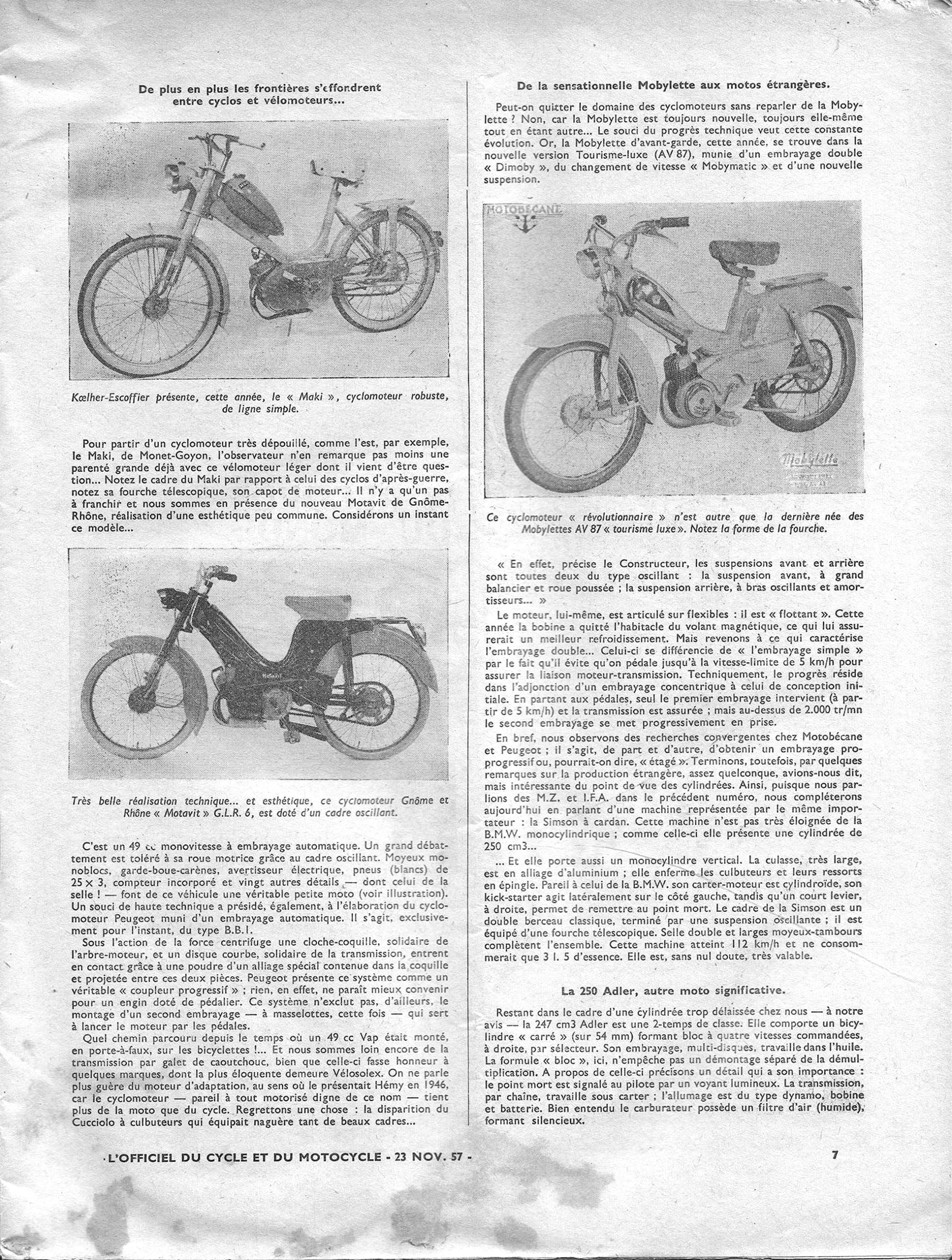
De plus en plus les frontières s’effondrent entre cyclos et vélomoteurs…
De la sensationnelle Mobylette aux motos étrangères.
La 250 Adler, autre moto significative.
[Ebykr summary; the article’s text is not reproduced. The writer argues that the line between cyclomoteurs and vélomoteurs is disappearing. Even a very plain cyclomoteur such as the Maki of Monet-Goyon is close kin to the light vélomoteur just described: its frame compared with postwar cyclos, telescopic fork and engine cowl. One step further is Gnôme-Rhône’s new Motavit, a 49 cc single-speed with automatic clutch, a swinging frame giving the driving wheel long travel, one-piece hubs, faired mudguards, electric horn, white 25 x 3 tires, a built-in speedometer and a careful seat, making it a real small motorcycle. Peugeot’s cyclomoteur with automatic clutch, for now only the type B.B.1, uses a bell-shaped shell on the engine shaft and a curved disc on the transmission brought into contact by centrifugal force through a special alloy powder held in the shell; Peugeot calls it a progressive coupler, suited to a machine with pedals, and a second clutch with flyweights lets the rider start the engine by pedaling. The writer measures the distance traveled since a 49 cc Vap was hung beside the wheel on ordinary bicycles (“bicyclettes”), and notes that friction drive by rubber roller survives with a few marques, Vélosolex the most notable; the add-on engine as Hémy presented it in 1946 is hardly mentioned now, since the cyclomoteur owes more to the motorcycle than to the bicycle (“cycle”). He regrets the disappearance of the pushrod Cucciolo engine once fitted to so many fine frames. The Mobylette remains ever new: this year’s advanced model is the Tourisme-luxe (AV 87), with the “Dimoby” double clutch, the “Mobymatic” gear change and new suspension. The maker states that front and rear are both swinging, the front with a long leading link and pushed wheel, the rear with swinging arms and dampers. The engine floats on flexible mounts, and the coil has left the flywheel magneto housing for better cooling. The double clutch spares the rider pedaling up to 5 km/h to engage the drive: a concentric second clutch is added, the first working from 5 km/h when moving off on the pedals and the second engaging progressively above 2.000 tr/mn. Motobécane and Peugeot are thus converging on a progressive, staged clutch. Turning to foreign machines, interesting for their capacities, and following the M.Z. and I.F.A. covered in the previous issue, the writer describes the shaft-drive Simson from the same importer: a 250 cm3 vertical single close to the single-cylinder B.M.W., with a wide aluminum-alloy head enclosing the rockers and hairpin springs, a cylindrical crankcase like the B.M.W.’s, a left-side kick-starter, a short right-hand neutral-finding lever, a classic double-cradle frame with swinging-arm rear suspension, telescopic fork, dual seat and wide drum hubs; it reaches 112 km/h and is said to use 3 l. 5 of fuel. The 247 cm3 Adler is a high-class two-stroke twin with “square” 54 mm dimensions, a four-speed unit with right-hand selector, a multi-plate clutch in oil, a separately removable gearbox, a neutral warning light, an enclosed chain, dynamo-coil-battery ignition and a wet air filter acting as silencer (continued on page 9). Captions: Kœlher-Escoffier’s “Maki”, a sturdy cyclomoteur of simple line; the Gnôme et Rhône “Motavit” G.L.R. 6 cyclomoteur with swinging frame; the latest Mobylette AV 87 “tourisme luxe”, with a note on its fork.]
[Three halftone photographs, all unnumbered and unsigned. At upper left, the Maki cyclomoteur in left side view, with telescopic fork, tank-mounted engine cowl and pedals. At lower left, the Motavit in left side view, with a swinging frame, deep valanced mudguards, a long dual seat and the name Motavit on the frame. At upper right, the Mobylette AV 87 in left three-quarter view, with leading-link front suspension and white-wall tires; the MOTOBÉCANE name and winged emblem sit at the top left corner of the photograph and a show card with the Mobylette script name sits at the lower right. No artist’s signature or monogram appears on the page.]
·L’OFFICIEL DU CYCLE ET DU MOTOCYCLE – 23 NOV. 57 –
7
— Page 4 —
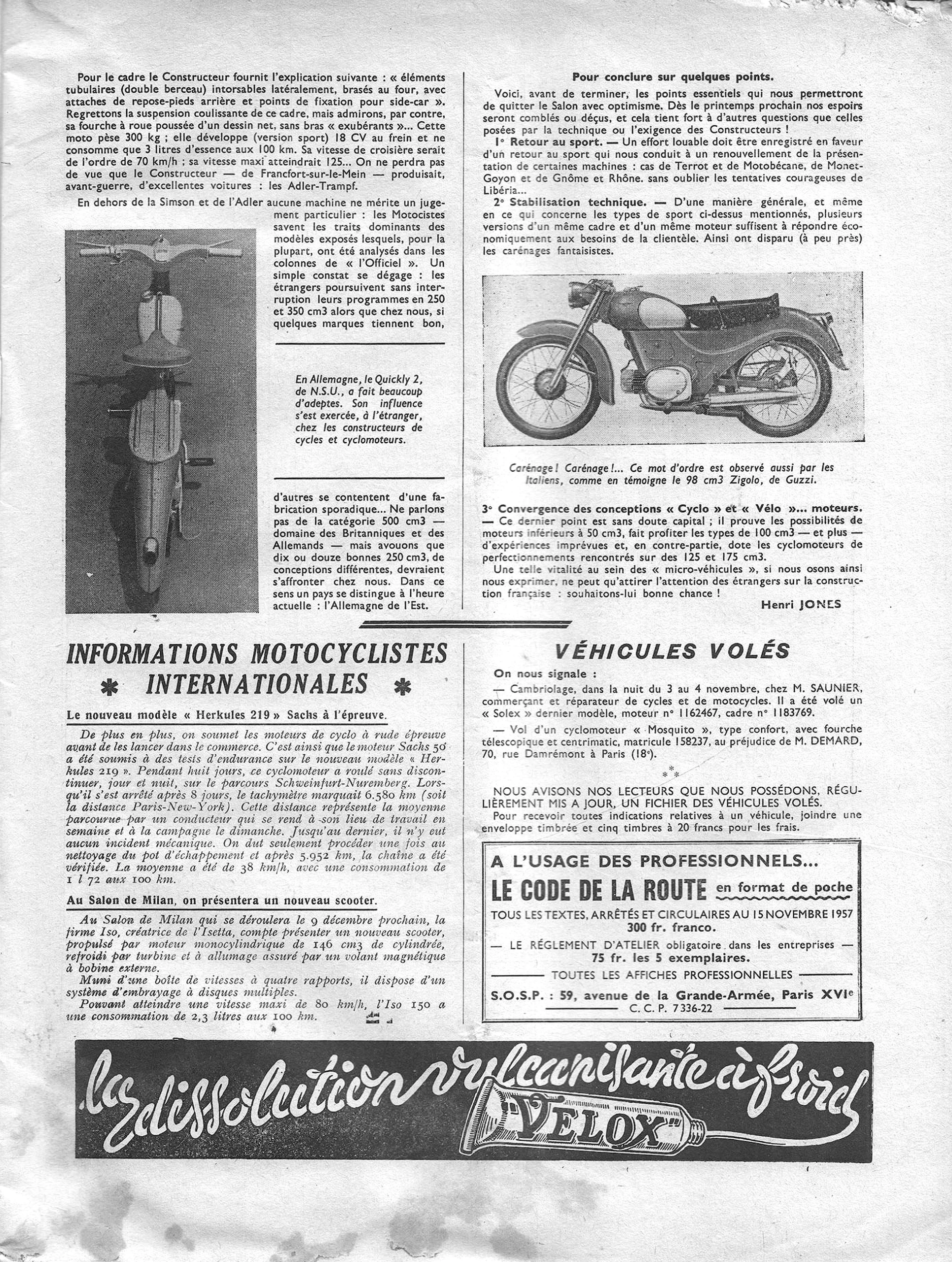
Pour conclure sur quelques points.
1° Retour au sport. —
2° Stabilisation technique. —
3° Convergence des conceptions « Cyclo » et « Vélo »… moteurs. —
Henri JONES
[Ebykr summary; the article’s text is not reproduced. Concluding the account of the 250 Adler (continued from page 7), the writer quotes the maker on its frame: a laterally rigid double-cradle tubular frame, furnace-brazed, with lugs for rear footrests and sidecar mounting points. He regrets its sliding rear suspension but admires the clean pushed-wheel front fork. The machine is given as weighing 300 kg, developing 18 CV at the brake in sport form and using 3 liters of fuel per 100 km, with a cruising speed of about 70 km/h and a top speed of 125; he recalls that the Frankfurt maker (Francfort-sur-le-Mein) built excellent cars before the war, the Adler-Trampf. Apart from the Simson and the Adler no foreign machine calls for special comment, most having been analyzed in the magazine’s columns already. Foreign makers keep up their 250 and 350 cm3 programs while in France a few marques hold on and others build only sporadically; leaving aside the 500 cm3 class, the preserve of the British and the Germans, he wishes 10 or 12 good 250 cm3 machines of different designs competed in France, and names East Germany as the country standing out. To conclude, he lists the points that let him leave the Salon optimistic, while noting that next spring’s results depend on more than technique. First, a return to sport, renewing the presentation of some machines at Terrot, Motobécane, Monet-Goyon and Gnôme et Rhône, along with the bold efforts of Libéria. Second, technical stabilization: several versions of one frame and one engine now meet customers’ needs economically, and fanciful fairings have nearly gone. Third, the convergence of cyclomoteur and vélomoteur design, which he thinks crucial: engines under 50 cm3 pass unexpected lessons to 100 cm3 types and beyond, while cyclomoteurs gain refinements from 125 and 175 cm3 machines. Such vitality among the “micro-vehicles” should draw foreign attention to French construction, and he wishes it good luck. Captions: in Germany the N.S.U. Quickly 2 has won many followers, and its influence abroad has reached the makers of bicycles (“cycles”) and cyclomoteurs; the Italians follow the fairing watchword too, as the Guzzi 98 cm3 Zigolo shows.]
[Two halftone photographs, both unnumbered and unsigned. In the left column, a tall narrow view of the N.S.U. Quickly 2 seen from directly ahead, showing the handlebar, the pressed-steel frame spine, the saddle and the front mudguard. In the right column, the Guzzi Zigolo in right side view, with the engine and rear wheel enclosed by a pressed-steel shell, telescopic fork and dual seat. No artist’s signature or monogram appears on the article.]
[The rest of the page, below the signature, carries the “INFORMATIONS MOTOCYCLISTES INTERNATIONALES” column, the “VÉHICULES VOLÉS” notice, the “LE CODE DE LA ROUTE” notice of the S.O.S.P. and a Velox cold-vulcanizing tire-repair solution advertisement at the foot, none of which is part of this record.]
Ebykr presents this material for research and education. If you hold rights to it or notice an ownership issue, please contact us and we will respond promptly.
The Ebykr Digest
New articles, timelines, catalog finds and registry activity — assembled from the archive once a month. Your address is never shared.
Double opt-in. One email per month. Unsubscribe at any time with one click.