About Ebykr
Ebykr celebrates classic and vintage lightweight bicycles through provocative imagery and opinion. Ride along with us.
About Ebykr
Ebykr celebrates classic and vintage lightweight bicycles through provocative imagery and opinion. Ride along with us.

Source: L'Officiel du cycle, du motocycle, du camping et des sports, N° 24, 23 November 1957, pages 28, 31 and 33; scan of the issue from Cycle Memory (Mémoire du Cycle), Collection privée F.
| Type | Review |
|---|---|
| Year | 1957 |
| Publisher | L'Officiel du cycle |
| Country | France |
| Language | French |
| Pages | 3 |
| Source | L'Officiel du cycle, du motocycle, du camping et des sports, N° 24, 23 November 1957, pages 28, 31 and 33; scan of the issue from Cycle Memory (Mémoire du Cycle), Collection privée F. |
| Credit | Ebykr archive |
| Identifier | Permalink https://cyclememory.org/fr/search-coll-list.php?collectionID=325&docID=B-1-0000001011 |
| Transcription | Headings and specifications transcribed; article text summarized |
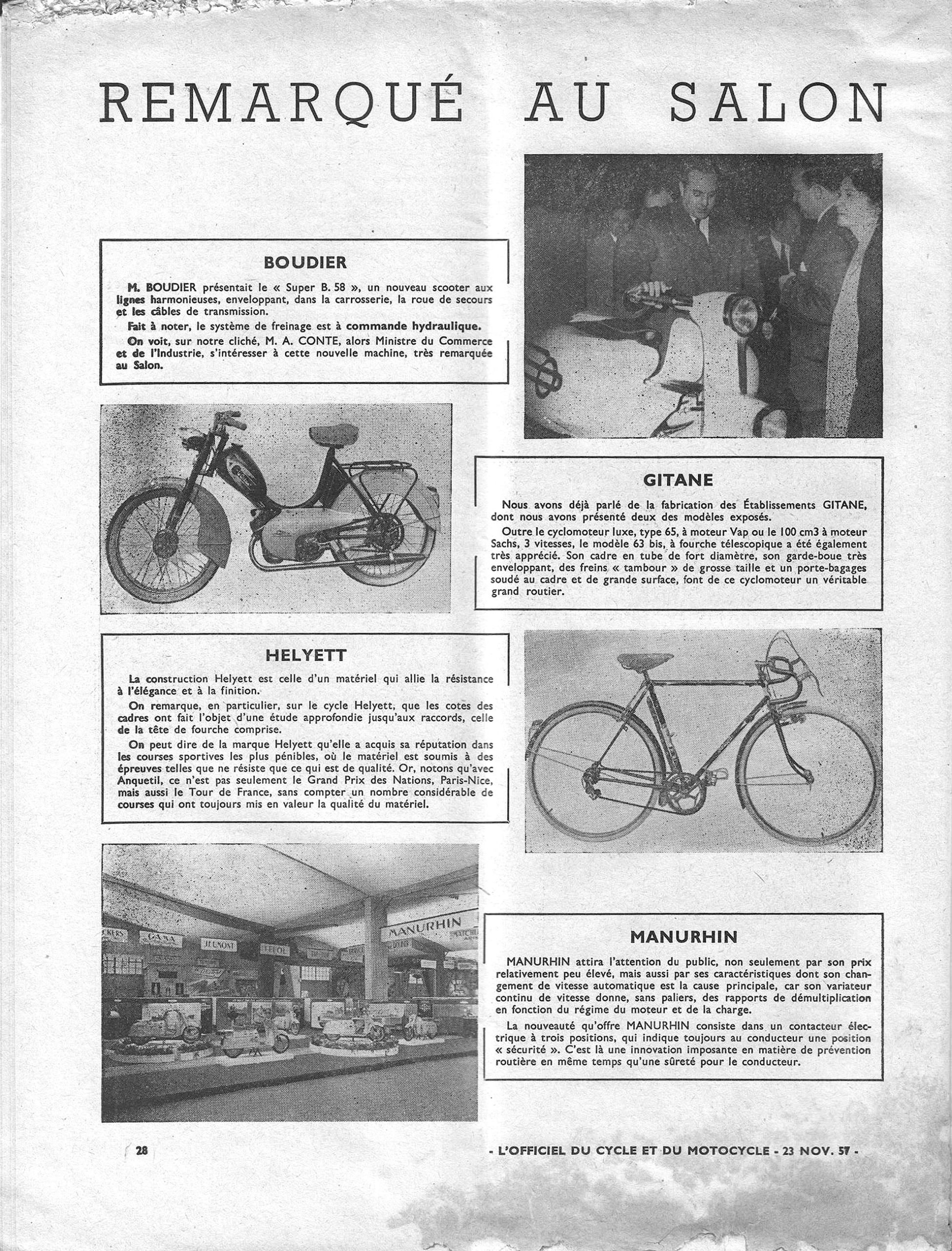
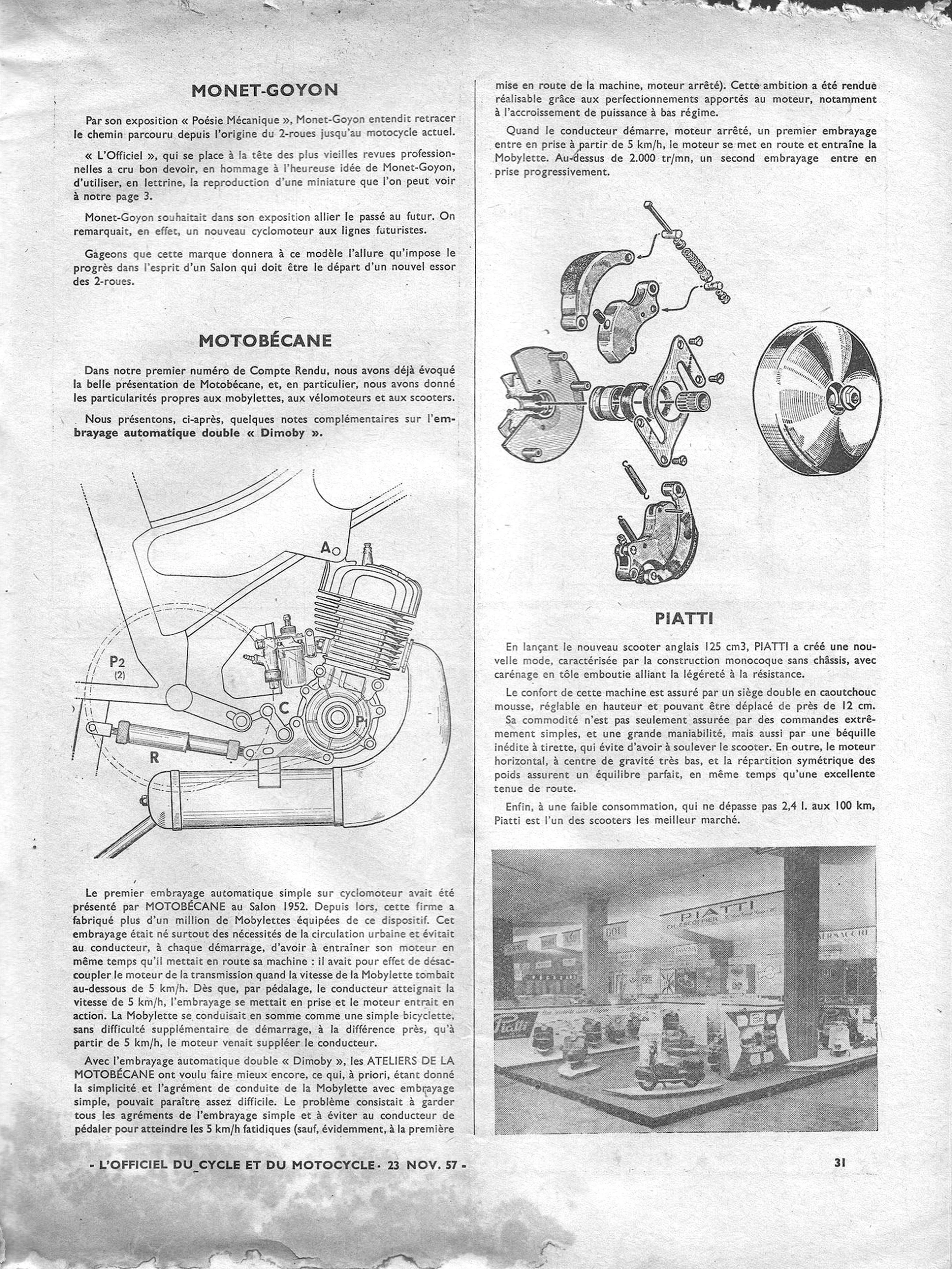
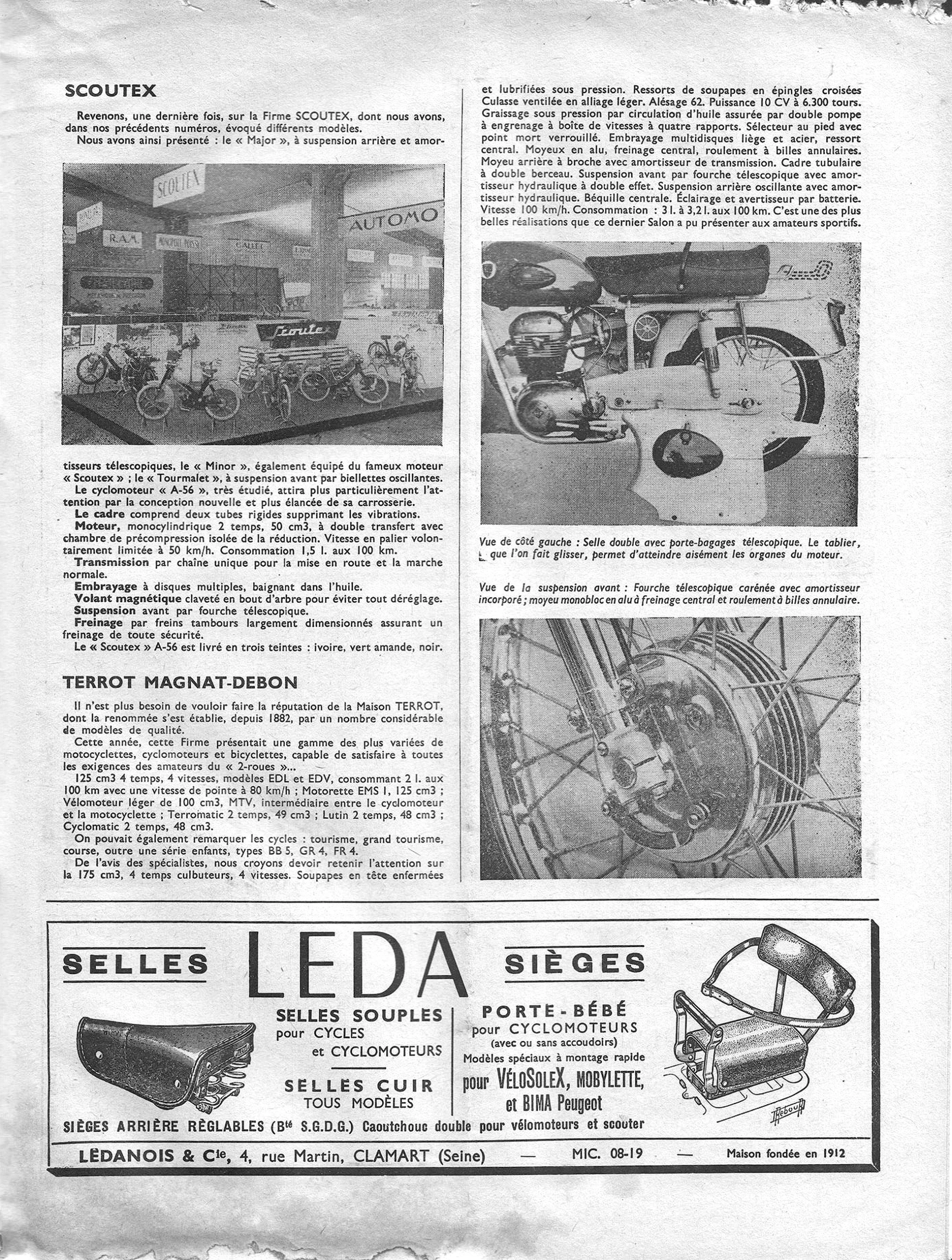
REMARQUÉ AU SALON BOUDIER GITANE HELYETT MANURHIN 28 - L'OFFICIEL DU CYCLE ET DU MOTOCYCLE - 23 NOV. 57 - MONET-GOYON MOTOBÉCANE PIATTI A P2 (2) C P1 R - L'OFFICIEL DU CYCLE ET DU MOTOCYCLE - 23 NOV. 57 - 31 SCOUTEX TERROT MAGNAT-DEBON
This is a magazine article, so its running text is summarized here rather than reproduced; the headline, byline, specifications and scores are transcribed as printed.
“Remarqué au Salon”, L’Officiel du cycle, 23 November 1957: new two-wheelers seen at the 1957 Paris Salon, maker by maker, among them Gitane’s cyclomoteur, the Helyett racing bicycle of Jacques Anquetil’s wins, Motobécane’s Dimoby double clutch and the Boudier, Manurhin, Monet-Goyon, Piatti, Scoutex and Terrot Magnat-Debon machines. The headings are transcribed as printed; the text and captions are summarized in Ebykr’s words, and the page images carry them in full.
— Page 1 —
REMARQUÉ AU SALON
BOUDIER
GITANE
HELYETT
MANURHIN
[Ebykr summary; the article’s text is not reproduced. A page of short boxed notes on machines seen at the Salon, one box per maker. BOUDIER: M. Boudier showed the « Super B. 58 », a new scooter with smooth lines whose bodywork encloses the spare wheel and the transmission cables; its brakes are hydraulically operated. The photograph shows M. A. Conte, then Minister of Commerce and Industry, looking at the machine, which drew much attention at the Salon. GITANE: the magazine has already described the products of the Établissements Gitane and shown two of the models exhibited; besides the luxury cyclomoteur type 65 with a Vap engine and the 100 cm3 machine with a three-speed Sachs engine, the model 63 bis with telescopic fork was also well received, with a large-diameter tube frame, deeply enveloping mudguards, large drum brakes and a broad luggage carrier welded to the frame, which make it a true long-distance cyclomoteur. HELYETT: the note concerns a bicycle. Helyett construction combines strength with elegance and finish; on the Helyett cycle the frame dimensions have been closely studied down to the lugs, the fork crown included. The make earned its reputation in the hardest races, where only quality equipment survives, and the note recalls that with Anquetil it won not only the Grand Prix des Nations and Paris-Nice but also the Tour de France, besides a great many other races that have shown off the quality of the equipment. MANURHIN: Manurhin drew the public by its relatively low price and above all by its automatic gear change, a continuously variable transmission that gives stepless ratios according to engine speed and load; its novelty is a three-position electric switch that always shows the rider a « sécurité » position, presented as a road-safety advance and a protection for the rider.]
[Four photographs, none signed. At top right, beside the Boudier box, a crowd of men in suits and a woman stand at the front of a white enclosed scooter with a large headlamp, one man with his hand on the handlebar; this is the scene with M. A. Conte the Boudier note describes. At left, beside the Gitane box, a cyclomoteur with telescopic fork, a tank on the front down tube bearing an unreadable badge, a rear carrier, deep mudguards and an enclosed engine and chain housing, presumably the Gitane 63 bis. At right, beside the Helyett box, a lightweight bicycle with drop handlebars, mudguards, derailleur gear and a leather saddle, a front lamp bracket rising above the bars, presumably the Helyett. At bottom left, a wide view of a Salon hall with scooters on low flower-edged platforms under a row of stand signs reading, as far as can be made out, …CKERS, GAMA, JEUMONT, LEFOL and MANURHIN, with a partly hidden sign beginning MATCHL…. No signature or monogram on any picture.]
28
– L’OFFICIEL DU CYCLE ET DU MOTOCYCLE – 23 NOV. 57 –
— Page 2 —
MONET-GOYON
MOTOBÉCANE
PIATTI
A
P2
(2)
C
P1
R
[Ebykr summary; the article’s text is not reproduced. MONET-GOYON: with its exhibition « Poésie Mécanique », Monet-Goyon set out to trace the path of the two-wheeler from its origins to the modern motorcycle; in tribute to the idea, « L’Officiel », which describes itself as one of the oldest trade papers, used a reproduction of one of the exhibition’s miniatures as a drop initial, to be seen on its page 3. Monet-Goyon wanted the display to join past and future, and showed a new cyclomoteur with futuristic lines; the writer hopes the make will give this model the progressive look the Salon called for, a Salon meant to launch a new rise of the two-wheeler. MOTOBÉCANE: the first Compte Rendu issue had already covered the Motobécane stand and the particulars of its Mobylettes, vélomoteurs and scooters; this note adds detail on the double automatic clutch « Dimoby ». Motobécane showed the first single automatic clutch on a cyclomoteur at the Salon 1952 and has since built more than a million Mobylettes fitted with it. Devised for town traffic, it spared the rider from turning the engine over at every start: it uncoupled the engine from the transmission below 5 km/h, engaged once the rider pedaled up to 5 km/h, after which the engine took over, so the Mobylette rode like a plain bicycle. With the « Dimoby » the Ateliers de la Motobécane aimed higher, keeping the ease of the single clutch while sparing the rider the pedaling up to 5 km/h (except when first starting with the engine stopped); improvements to the engine, notably more power at low revs, made this possible. On a start with the engine stopped, a first clutch engages from 5 km/h, the engine fires and drives the Mobylette; above 2.000 tr/mn a second clutch engages progressively. PIATTI: launching the new British 125 cm3 scooter, Piatti set a fashion with monocoque construction without a frame, the body in pressed sheet steel combining lightness and strength. Comfort comes from a double seat in foam rubber, adjustable for height and movable by about 12 cm; handling from very simple controls, great maneuverability and a new pull-handle stand that saves lifting the scooter; the horizontal engine with a very low center of gravity and the symmetrical weight distribution give balance and good roadholding. Fuel use does not exceed 2,4 l. per 100 km, and the Piatti is called one of the cheapest scooters.]
[Three illustrations, none signed. At left, under the Motobécane heading, a line drawing of the Mobylette engine unit in the frame: the finned cylinder and carburetor, the crankcase with its pulley lettered P1, a large dashed circle at the rear lettered P2 with (2) beneath, a linkage lettered C between them, a telescopic strut lettered R below and an A beside a small circle at the top of the frame casting, with the silencer along the foot. At top right, an exploded drawing of the « Dimoby » clutch: two curved clutch shoes, springs and a rod with arrows showing where they fit, a backing plate, a bearing and a splined hub on a mounting plate with screws, and a separate domed clutch drum; no letters on it. At bottom right, a photograph of the Piatti stand at the Salon, scooters on a low platform under a sign reading PIATTI with CH. ESCOFFIER beneath and a smaller unreadable line beside it, a Piatti script panel at left and other stand signs including DOT and one ending …ERSACCHI behind.]
– L’OFFICIEL DU CYCLE ET DU MOTOCYCLE – 23 NOV. 57 –
31
— Page 3 —
SCOUTEX
TERROT MAGNAT-DEBON
[Ebykr summary; the article’s text is not reproduced. SCOUTEX: a last look at the firm Scoutex, several of whose models earlier issues had described: the « Major » with rear suspension and telescopic dampers, the « Minor », also fitted with the well-known « Scoutex » engine, and the « Tourmalet » with front suspension by oscillating links. The cyclomoteur « A-56 » drew most notice for the new, more slender design of its bodywork. Its specification, set as a run-in list with bold lead words: Le cadre, two rigid tubes that suppress vibration; Moteur, single-cylinder two-stroke, 50 cm3, double transfer, with a precompression chamber isolated from the reduction gear, level speed deliberately limited to 50 km/h, consumption 1,5 l. per 100 km; Transmission by a single chain for starting and normal running; Embrayage, multiplate running in oil; Volant magnétique keyed on the shaft end so it cannot go out of adjustment; Suspension at the front by telescopic fork; Freinage by generously sized drum brakes. The « Scoutex » A-56 comes in three colors: ivory, almond green and black. TERROT MAGNAT-DEBON: the reputation of the Maison Terrot, built since 1882 on a great many quality models, needs no help. This year the firm showed a wide range of motorcycles, cyclomoteurs and bicycles: the 125 cm3 four-stroke four-speed models EDL and EDV, using 2 l. per 100 km with a top speed of 80 km/h; the Motorette EMS 1, 125 cm3; the light 100 cm3 vélomoteur MTV, between cyclomoteur and motorcycle; the Terromatic two-stroke 49 cm3; the Lutin two-stroke 48 cm3; and the Cyclomatic two-stroke 48 cm3. Also shown were touring, grand touring and racing cycles and a children’s series, types BB 5, GR 4 and FR 4. The writer singles out the 175 cm3 four-stroke overhead-valve four-speed machine: enclosed overhead valves lubricated under pressure, crossed hairpin valve springs, finned light-alloy cylinder head, bore 62, 10 CV at 6.300 tours, pressure lubrication by a double gear pump, four-speed gearbox with foot selector and locked neutral, multiplate cork-and-steel clutch with central spring, aluminum hubs with central braking and annular ball bearings, rear hub on a spindle with a transmission shock absorber, double-cradle tubular frame, telescopic front fork with double-acting hydraulic damper, swinging-arm rear suspension with hydraulic damper, center stand, battery lighting and horn; speed 100 km/h, consumption 3 l. to 3,2 l. per 100 km; it is called one of the finest machines the Salon offered sporting riders. The two captions, in italic, describe the 175 cm3 machine: the left-side view shows the double seat with a telescopic luggage carrier and the sliding apron that gives easy access to the engine; the front view shows the faired telescopic fork with built-in damper and the one-piece aluminum hub with central brake and annular ball bearing.]
[Three photographs, none signed. At top left, between the Scoutex paragraphs, the Scoutex stand at the Salon: cyclomoteurs on a low platform before a script Scoutex panel, under hanging stand signs reading SCOUTEX, R.A.M., MONOPOLE POISSY, GALLET and AUTOMO (the rest of the name hidden), with other signs too small to read. At top right, the left side of the Terrot 175 cm3 motorcycle: the engine with its finned cylinder, the double seat, rear carrier and damper, and the sliding side apron with an oval cover; an unreadable script emblem sits on the rear bodywork. At right below the captions, a close view of the faired telescopic fork and the large-diameter front hub with its spokes.]
[The foot of the page carries an advertisement for Leda saddles and baby seats, held as its own record.]
Ebykr presents this material for research and education. If you hold rights to it or notice an ownership issue, please contact us and we will respond promptly.
The Ebykr Digest
New articles, timelines, catalog finds and registry activity — assembled from the archive once a month. Your address is never shared.
Double opt-in. One email per month. Unsubscribe at any time with one click.