About Ebykr
Ebykr celebrates classic and vintage lightweight bicycles through provocative imagery and opinion. Ride along with us.
About Ebykr
Ebykr celebrates classic and vintage lightweight bicycles through provocative imagery and opinion. Ride along with us.

Source: L'Officiel du cycle, du motocycle, du camping et des sports, N° 24, 23 November 1957, pages 22, 23, 24, 25, 26 and 27; scan of the issue from Cycle Memory (Mémoire du Cycle), Collection privée F.
| Type | Review |
|---|---|
| Year | 1957 |
| Publisher | L'Officiel du cycle |
| Country | France |
| Language | French |
| Pages | 6 |
| Source | L'Officiel du cycle, du motocycle, du camping et des sports, N° 24, 23 November 1957, pages 22, 23, 24, 25, 26 and 27; scan of the issue from Cycle Memory (Mémoire du Cycle), Collection privée F. |
| Credit | Ebykr archive |
| Identifier | Permalink https://cyclememory.org/fr/search-coll-list.php?collectionID=325&docID=B-1-0000001011 |
| Transcription | Headings and specifications transcribed; article text summarized |
ÉQUIPEMENTS La coque C.L.B. ★ Nouvelle selle GALLET pour cyclomoteurs. & OUTILLAGE ★ Girolux au stand Motobi ★ Les sacoches GUEDIN HUGUET ★ P. JOURLAIT et Cie. ★ MAILLOT MALAKOFF AUTOMOBILES MOTTAZ S.A.T.A.M. 1° 2° 3° Équipements scooter ULMA-FRANCE VAR Les fabrications VELOX Les spécialités VICKERS WOLBER - L'OFFICIEL DU CYCLE ET DU MOTOCYCLE - …
This is a magazine article, so its running text is summarized here rather than reproduced; the headline, byline, specifications and scores are transcribed as printed.
“Équipements & Outillage”, L’Officiel du cycle’s column of the accessories, equipment and tools seen at the 1957 Paris Salon, 23 November 1957: the C.L.B. fairing, Gallet and Wolber saddles, Guedin bags, Jourlait’s Rigid chainguards, Huguet silencers, the Mottaz tank, S.A.T.A.M., Ulma-France, VAR, Velox and Vickers. The item headings are transcribed as printed; the text and captions are summarized in Ebykr’s words, and the page images carry them in full.
— Page 1 —
ÉQUIPEMENTS
La coque C.L.B.
★
Nouvelle selle GALLET pour cyclomoteurs.
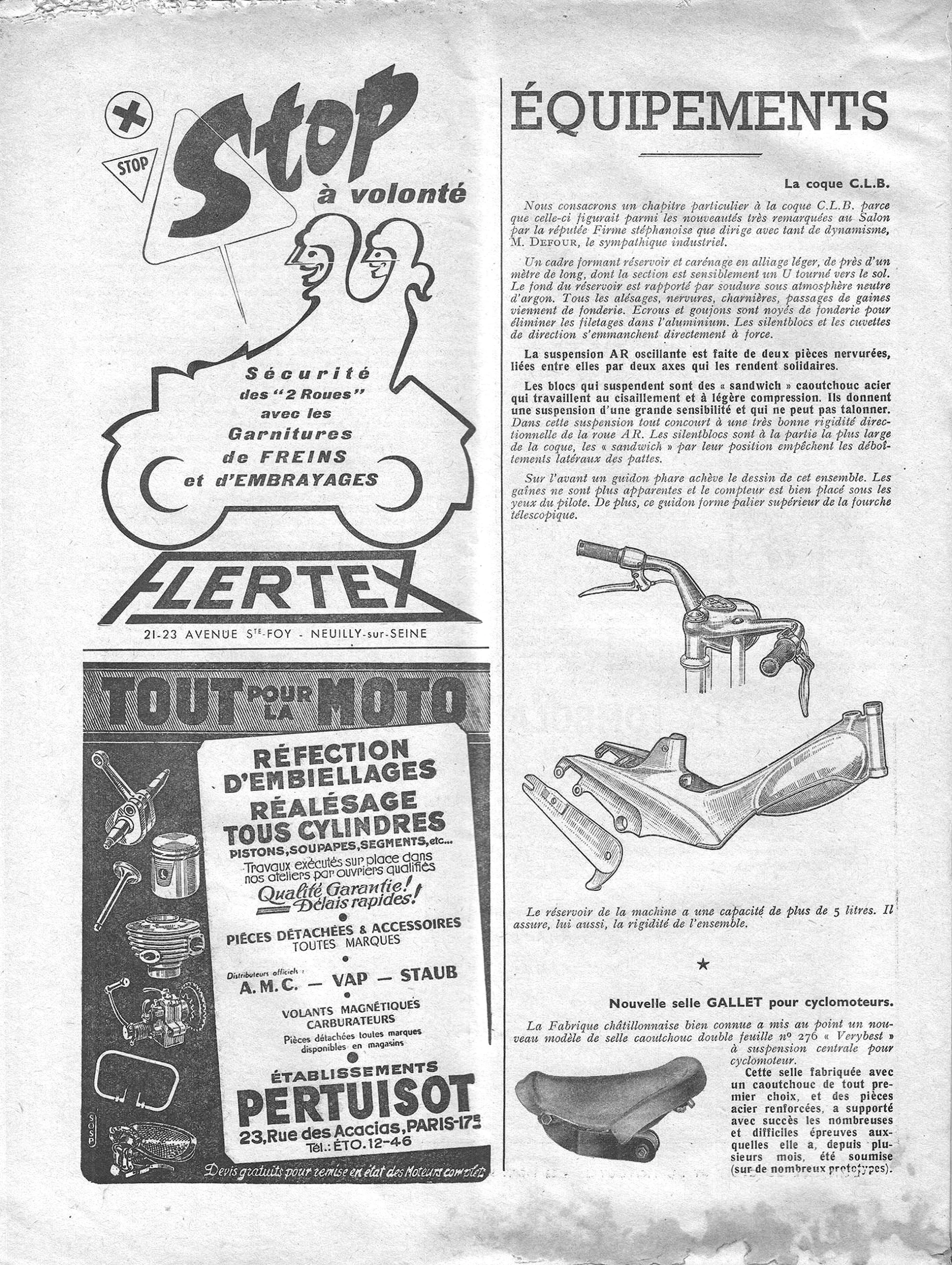
[Ebykr summary; the article’s text is not reproduced. The column opens with the C.L.B. “coque” (shell), singled out as one of the most noticed novelties of the Salon, shown by the Saint-Étienne (“stéphanoise”) firm directed by M. Defour. The shell is a frame that doubles as fuel tank and fairing, cast in light alloy, nearly one meter long, with a section roughly like an upturned U. The tank bottom is welded on under a neutral argon atmosphere; all bores, ribs, hinges and cable passages are cast in, and the nuts and studs are cast into the metal so that no threads are cut in the aluminum. The silentblocs and the steering-head cups are pressed straight in. The swinging rear suspension (“suspension AR oscillante”) is made of two ribbed pieces joined by two spindles; it hangs on rubber-and-steel “sandwich” blocks working in shear and light compression, said to give a sensitive suspension that cannot bottom out, with good directional rigidity of the rear wheel: the silentblocs sit at the widest part of the shell and the sandwich blocks stop the rear arms from shifting sideways. At the front a headlamp handlebar (“guidon phare”) completes the design: the cables are hidden, the speedometer sits in the rider’s line of sight and the bar forms the upper bearing of the telescopic fork. The caption under the drawings says the machine’s tank holds more than 5 liters and also adds to the rigidity of the whole. The second item announces a new Gallet saddle for cyclomotors: the well-known Châtillon factory (“Fabrique châtillonnaise”) has developed a double-sheet rubber saddle, n° 276 “Verybest”, with central suspension for cyclomotors, made of first-choice rubber with reinforced steel parts, which has stood up for several months to severe trials on many prototypes; the item runs on at the head of the next page.]
[Two line drawings illustrate the C.L.B. shell: above, the headlamp handlebar seen from the rider’s side, with grips, brake and clutch levers, the speedometer housed in the bar and the tops of the telescopic fork legs below it; beneath, the cast light-alloy shell in perspective, a long ribbed tank-and-backbone casting with the steering head at the right and the rear suspension mounting lugs at the left, with one of the two ribbed swinging-arm pieces drawn separately beside it. A halftone photograph at the foot of the column shows the Gallet n° 276 saddle, a dark rubber-covered cyclomotor saddle seen from the side over its central spring mounting and seat clip. No signature or monogram is visible on the drawings or the photograph.]
[The left half of the page carries advertisements for Flertex brake and clutch linings and for Pertuisot motorcycle parts, which are not part of this record.]
— Page 2 —
& OUTILLAGE
★
Girolux au stand Motobi
★
Les sacoches GUEDIN
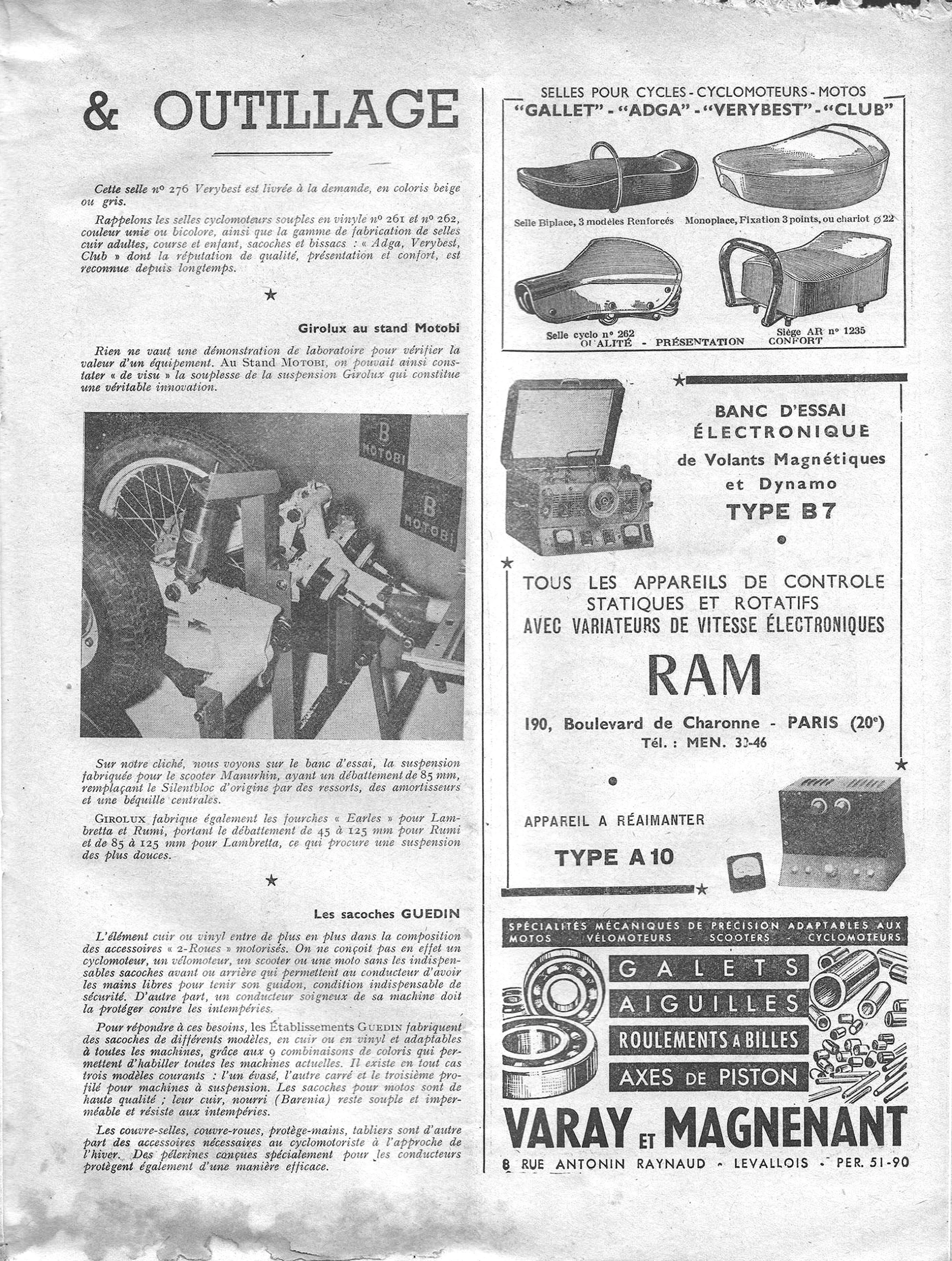
[Ebykr summary; the article’s text is not reproduced. The Gallet item from the previous page ends here: the n° 276 Verybest saddle is supplied to order in beige or gray, and the column recalls the soft vinyl cyclomotor saddles n° 261 and n° 262, in one color or two-tone, along with the firm’s range of leather saddles for adults, racing and children, its saddlebags and double panniers (“bissacs”) sold under the names Adga, Verybest and Club, long known for quality, finish and comfort. The second item, Girolux at the Motobi stand, says a laboratory demonstration is the best proof of a piece of equipment: at the Motobi stand visitors could see for themselves the suppleness of the Girolux suspension, called a real innovation. The photograph’s caption explains that it shows, on the test bench, the suspension made for the Manurhin scooter, with 85 mm of travel, which replaces the original Silentbloc with springs, shock absorbers and a center stand. Girolux also makes “Earles” forks for the Lambretta and the Rumi, raising the travel from 45 to 125 mm on the Rumi and from 85 to 125 mm on the Lambretta, for a very soft ride. The third item covers the saddlebags of the Établissements Guedin. Leather and vinyl are more and more part of motorized two-wheeler accessories: no cyclomotor, vélomoteur, scooter or motorcycle is complete without front or rear bags that leave the rider’s hands free for the handlebar, a safety necessity, and a careful rider must also protect the machine from bad weather. Guedin makes bags in several models, in leather or vinyl, to fit every machine, in nine color combinations; there are three standard models, one flared, one square and the third shaped for machines with suspension. The motorcycle bags are of high quality, their fed leather (Barenia) staying supple and waterproof and resisting the weather. The item adds that saddle covers, wheel covers, hand protectors and aprons (“tabliers”) are also needed by the cyclomotor rider as winter comes, and that specially designed capes (“pèlerines”) protect the rider effectively too.]
[A halftone photograph shows the Girolux suspension rig at the Motobi stand: a motorcycle wheel with a spoked rim and tire at the left, and a test frame of steel channel holding the suspension unit with its spring-and-damper legs, swinging links and fittings; two square wall plaques behind carry the Motobi “B” emblem and the name. No signature or monogram is visible on the photograph.]
[The right half of the page carries advertisements for Gallet saddles (held as its own record), the RAM electronic test bench and Varay et Magnenant engine parts, which are not part of this record.]
— Page 3 —
HUGUET
★
P. JOURLAIT et Cie.
★
MAILLOT
MALAKOFF
AUTOMOBILES
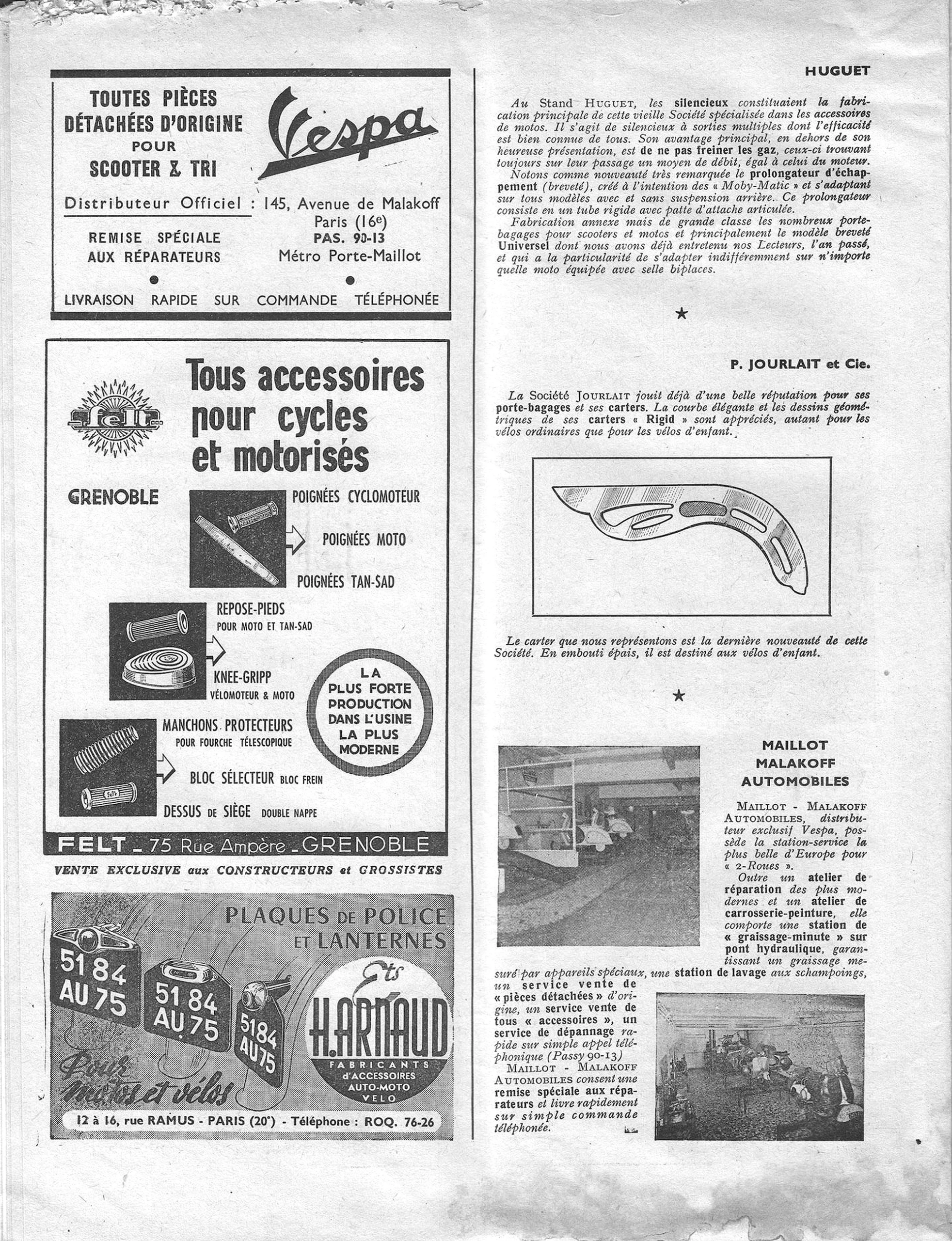
[Ebykr summary; the article’s text is not reproduced. At the Huguet stand the main line of this old firm specializing in motorcycle accessories was its silencers (“silencieux”), multiple-outlet silencers whose efficiency is described as well known; besides their attractive finish, their chief merit is that they do not choke the exhaust, since the gases always find a passage equal to the engine’s output. The column singles out a much-noticed novelty, the patented exhaust extension (“prolongateur d’échappement”), designed for the “Moby-Matic” and fitting all models with or without rear suspension; it is a rigid tube with an articulated mounting bracket. As a sideline of high quality Huguet makes many luggage carriers (“porte-bagages”) for scooters and motorcycles, above all the patented Universel model, already described to readers the previous year, which fits any motorcycle with a dual seat. The second item, on P. Jourlait et Cie, says the Jourlait company is already well regarded for its luggage carriers and its chainguards (“carters”), whose “Rigid” chainguards are liked for their elegant curve and geometric patterns on both ordinary and children’s bicycles; the caption says the chainguard drawn is the firm’s latest novelty, pressed from thick sheet (“embouti épais”) and meant for children’s bicycles. The third item reports that Maillot – Malakoff Automobiles, exclusive Vespa distributor, has what it calls the finest two-wheeler service station in Europe: besides a modern repair shop and a body-and-paint shop it has a quick-lubrication station (“graissage-minute”) on a hydraulic lift with metered greasing by special equipment, a shampoo washing station, a sales counter for original spare parts and for all accessories, and a rapid breakdown service on a simple telephone call (Passy 90-13); the firm gives a special discount to repairers and delivers quickly on a telephoned order.]
[A line drawing in a ruled frame shows the Jourlait “Rigid” chainguard for children’s bicycles in side view: a curved, tapering pressed-steel guard pierced with elongated slots, one slot shaded with a fine dot screen and the surface hatched to show its curvature. Two halftone photographs illustrate the Maillot – Malakoff Automobiles station: the first, beside the heading, shows a covered service bay with a row of Vespa scooters parked behind a tubular rack; the second, at the foot of the column, shows a long interior workshop or garage hall with scooters and machines lined up along the right wall. No signature or monogram is visible on the drawing or the photographs. A tiny blurred printer’s mark sits at the end of the last line of text, after the word “téléphonée.”]
[The left half of the page carries advertisements for Vespa parts, Felt accessories (held as its own record) and Harnaud number plates, which are not part of this record.]
— Page 4 —
MOTTAZ
S.A.T.A.M.
1°
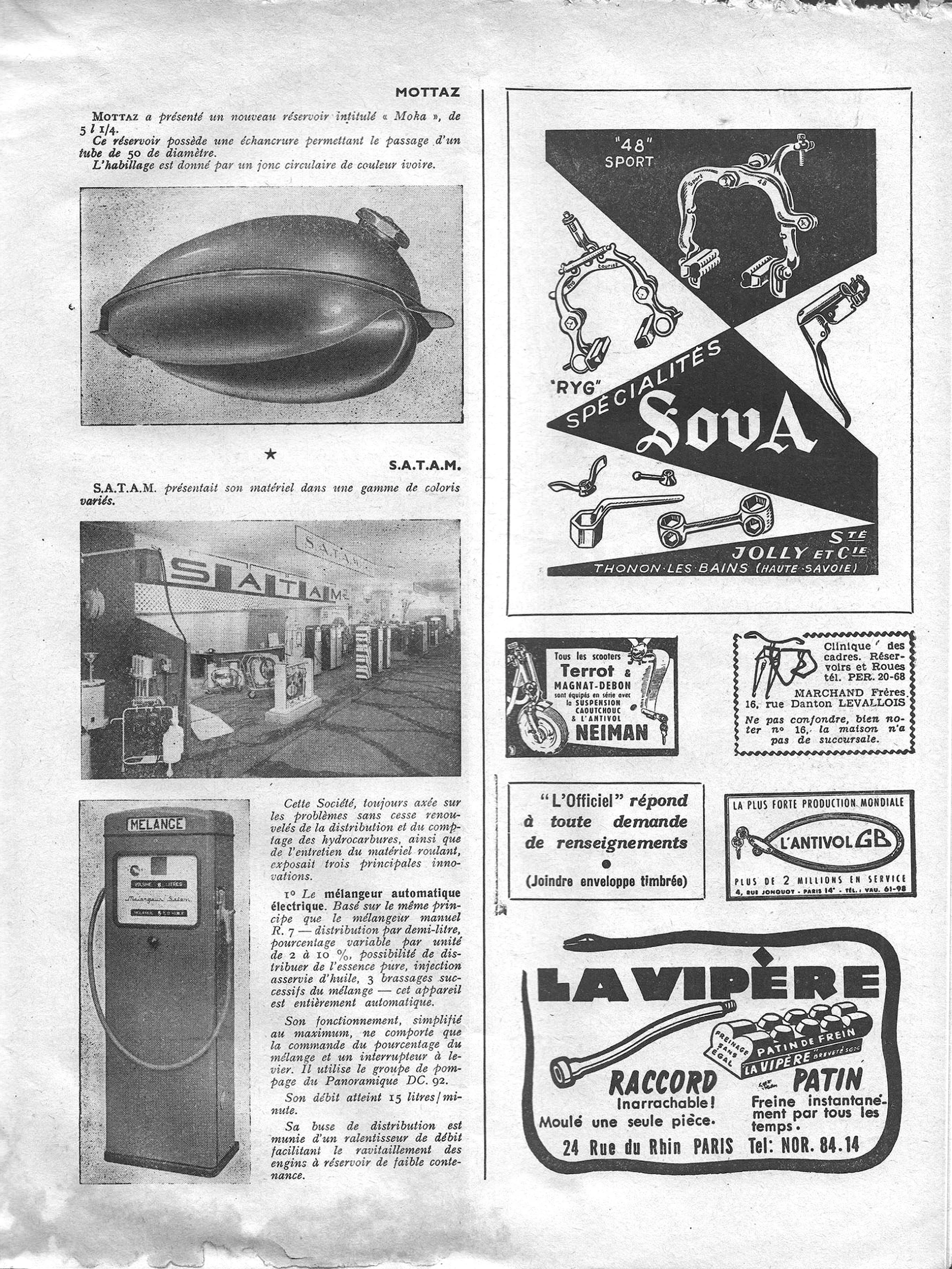
[Ebykr summary; the article’s text is not reproduced. Under MOTTAZ: the firm Mottaz showed a new fuel tank named “Moka”, of 5 l 1/4 (five and a quarter liters). The tank has a notch cut into it so that a tube of 50 diameter (50 mm) can pass, and it is trimmed with a circular ivory-colored beading strip. Under S.A.T.A.M.: S.A.T.A.M. showed its equipment in a range of different colors. The firm, whose concern is the distribution and metering of hydrocarbons (fuel) and the upkeep of rolling stock, exhibited three main innovations, of which this page gives the first (point 1°): the automatic electric mixer (mélangeur automatique électrique). It works on the same principle as the firm’s manual mixer R. 7: it dispenses by the half-liter, with the oil percentage adjustable in steps of one unit from 2 to 10 %, can also dispense pure gasoline (essence), has servo-controlled oil injection and stirs the mixture three times in succession, and it is fully automatic. Its controls are reduced to a percentage selector and a lever switch. It uses the pumping unit of the Panoramique DC. 92 pump. Its output reaches 15 liters per minute, and its dispensing nozzle has a flow reducer to make it easier to fill machines with small tanks. (The S.A.T.A.M. item continues on the next page of the record, page 26, with points 2° and 3°.)]
[Three photographs illustrate the column. The first, under the Mottaz item, shows the “Moka” tank alone against a plain ground, seen from above at three-quarters: a smooth, bulbous teardrop tank with a raised filler cap at the top right and a light beading strip running around its waist; no lettering shows on it. The second, under the S.A.T.A.M. heading, shows the S.A.T.A.M. stand at the Salon: a long fascia carrying the large stylized letters “S A T A M” (the last letters read “AM” with a small “e” or mark after them) over a row of fuel pumps and equipment, a lattice panel at the left, workshop equipment such as compressors and greasing units on the floor, and a second hanging “SATAM” sign behind. The third, beside the text on the mixer, shows a tall rounded-top fuel pump: a plate at its head reads “MELANGE”, and its dial window carries a band reading “VOLUME” and “LITRES” with a figure between, the script words “Mélangeur Satam”, a lower band beginning “MELANGE” with a figure and a percent sign that is too small to read, and a small “C”-shaped logo; the hose hangs in a loop at the left and the nozzle sits in a holster at the right. No signature or monogram appears on the photographs. A small star separates the Mottaz and S.A.T.A.M. items. No folio is printed in the visible part of this page: the foot of the sheet is water-stained and ragged where a folio or running foot would sit.]
[The rest of the page carries advertisements for the Sova brakes and keys of Jolly et Cie (held as its own record), the Neiman lock fitted to Terrot and Magnat-Debon scooters, Marchand Frères frame repairs, the magazine’s own information notice, L’Antivol GB and La Vipère (held as its own record).]
— Page 5 —
2°
3°
Équipements scooter ULMA-FRANCE
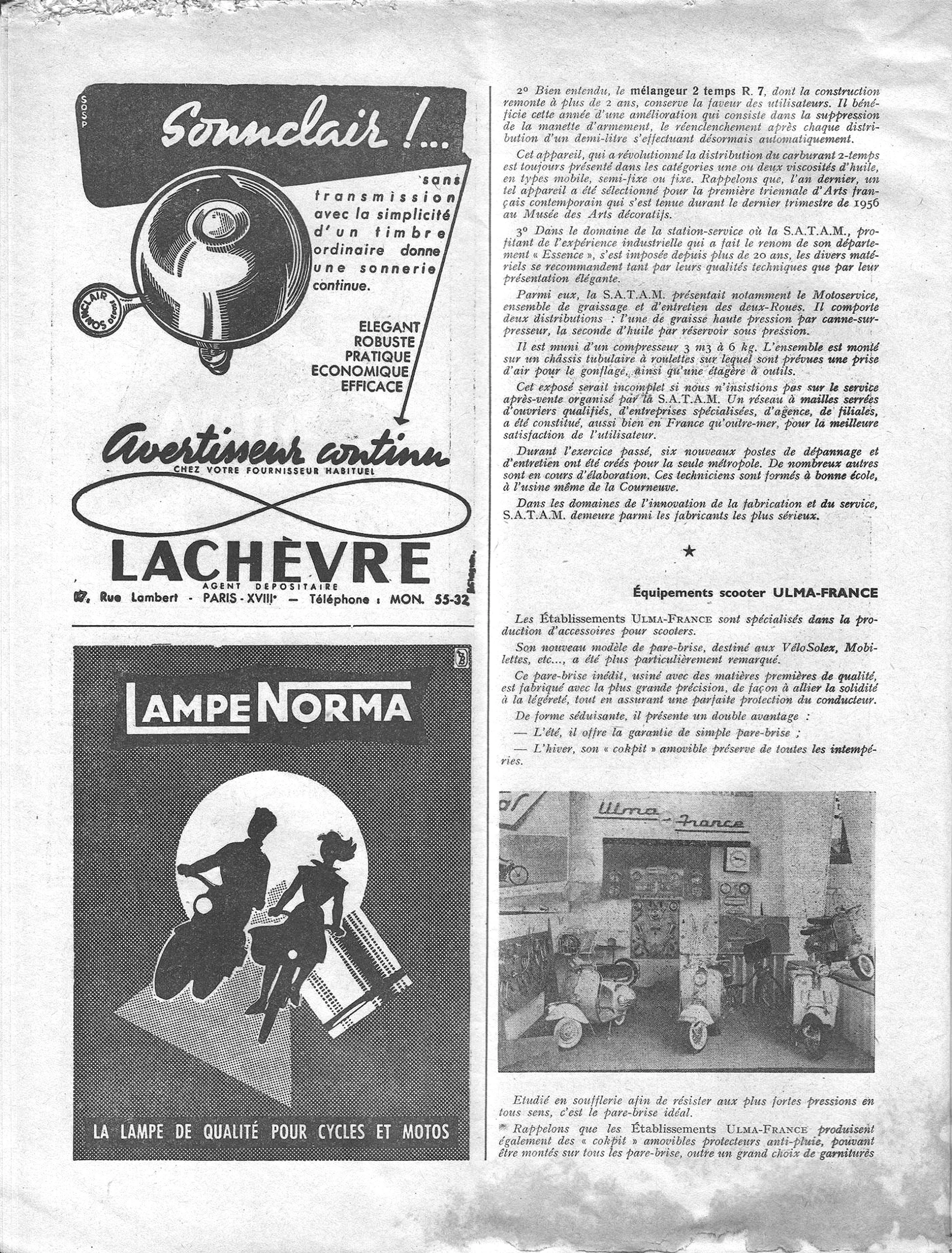
[Ebykr summary; the article’s text is not reproduced. The S.A.T.A.M. item continues from the previous page with its second and third points. Point 2°: the firm’s two-stroke mixer, the mélangeur 2 temps R. 7, built for more than two years, keeps the favor of its users; this year it is improved by doing away with the cocking lever, since it now resets itself automatically after each half-liter is dispensed. The column credits this machine with having revolutionized the dispensing of two-stroke fuel; it is offered for one or two oil viscosities, in mobile, semi-fixed or fixed form, and recalls that the year before such a machine was selected for the first triennial of contemporary French arts (triennale d’Arts français contemporain), held in the last quarter of 1956 at the Musée des Arts décoratifs. Point 3°: in service-station equipment, where S.A.T.A.M. has drawn for more than 20 years on the industrial experience of its “Essence” (gasoline) department, its products are praised for both engineering and elegant presentation. Among them S.A.T.A.M. showed the Motoservice, a greasing and maintenance unit for two-wheelers with two outlets, one for high-pressure grease by a booster gun (canne-surpresseur) and one for oil from a pressurized tank; it has a 3 m3 compressor at 6 kg, and the whole is mounted on a tubular chassis on casters fitted with an air outlet for tire inflation and a tool shelf. The column then praises S.A.T.A.M.’s after-sales service: a close network of skilled workers, specialist firms, agency and subsidiaries in France and overseas; six new breakdown and maintenance posts were opened in metropolitan France during the past financial year, with many more in preparation, their technicians trained at the firm’s own works at la Courneuve. It closes by ranking S.A.T.A.M. among the most serious makers in innovation, manufacture and service. Under “Équipements scooter ULMA-FRANCE”: the Établissements Ulma-France specialize in accessories for scooters. Their new windshield (pare-brise) for VéloSolex, Mobilettes and similar machines drew particular notice: made with quality materials and great precision to combine strength with lightness while fully protecting the rider. It offers two advantages: in summer it serves as a plain windshield, and in winter its removable “cokpit” (so spelled) protects from all weathers. Developed in a wind tunnel to withstand the strongest pressures from any direction, it is called the ideal windshield. The column adds that Ulma-France also make removable anti-rain “cokpit” protectors that fit any windshield, besides a wide choice of trim (the sentence continues at the head of page 27).]
[One photograph, below the Ulma-France text, shows the Ulma-France stand at the Salon: the script name “Ulma-France” painted on the back wall above a display window hung with instruments and fittings, a round clock and a board of gauges or dials to the right, a pennant at the upper right, part of a neighboring sign ending “as” at the upper left with a small bicycle picture below it, three light-colored scooters of the Vespa type standing on the stand floor with a bicycle between them, and a fourth, darker scooter raised on a platform at the right; at least the left-hand scooter carries a windshield. No signature or monogram appears on it. A small star separates the S.A.T.A.M. and Ulma-France items. No folio is printed in the visible part of this page: the foot of the sheet is water-stained and ragged where a folio would sit.]
[The rest of the page carries advertisements for the Sonnclair bell sold by Lachèvre (held as its own record) and the Lampe Norma (held as its own record).]
— Page 6 —
VAR
Les fabrications VELOX
Les spécialités VICKERS
WOLBER
– L’OFFICIEL DU CYCLE ET DU MOTOCYCLE – 23 NOV. 57 –
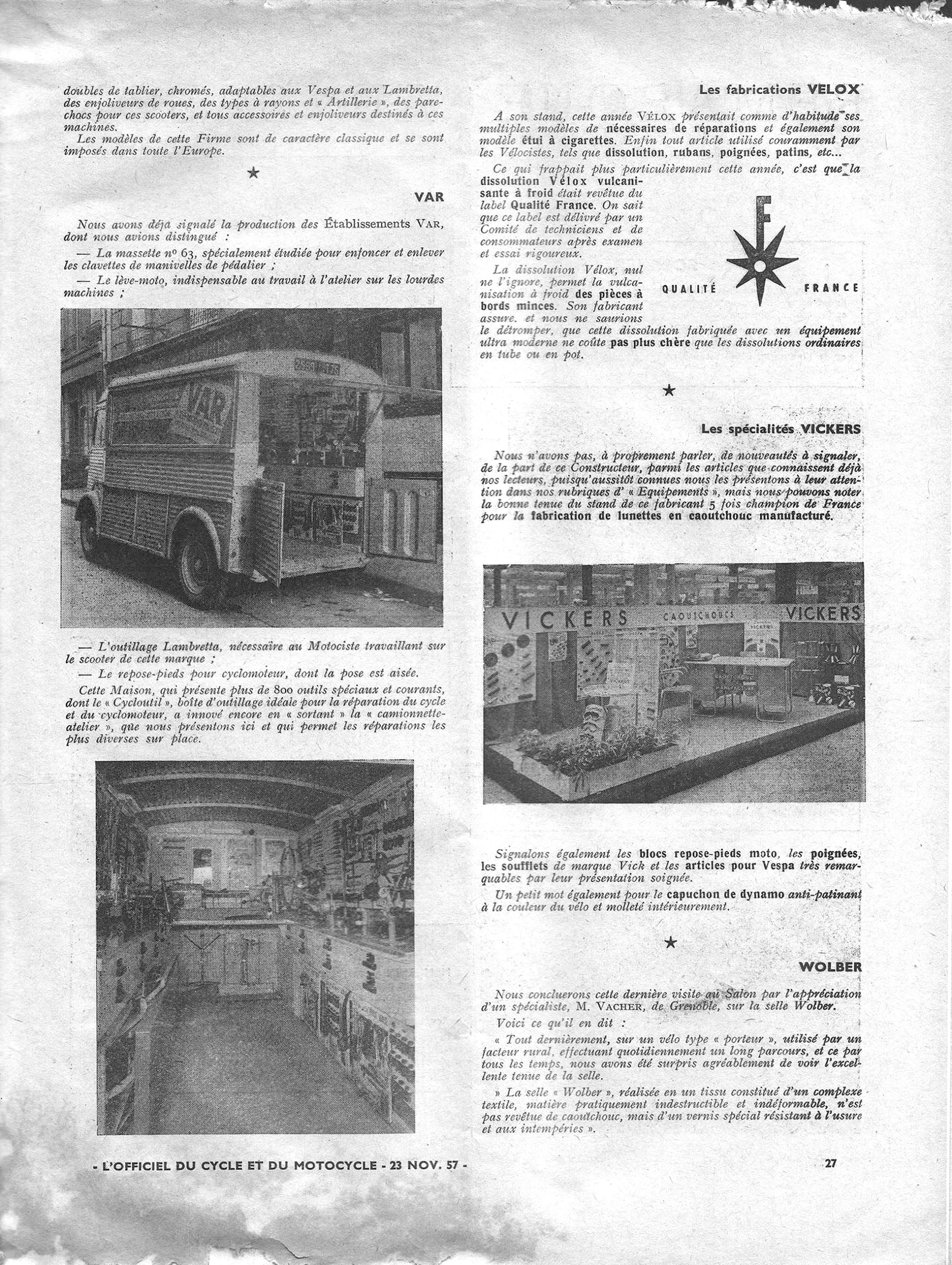
[Ebykr summary; the article’s text is not reproduced. The Ulma-France item ends at the head of the left column (continued from page 26): its range also includes chromed double apron trims (tablier) that fit the Vespa and the Lambretta, wheel embellishers of the spoked and “Artillerie” types, bumpers for these scooters and all their other accessories and trim; the firm’s designs are called classic in character and established across Europe. Under VAR: the column recalls that it has already reported on the Établissements Var and singled out four of their tools: the massette n° 63 (a mallet), designed for driving in and removing the cotters of bottom-bracket cranks; the lève-moto (motorcycle lift) for workshop work on heavy machines; the Lambretta tool kit (outillage Lambretta) for the dealer-mechanic (Motociste) servicing that make of scooter; and an easily fitted footrest (repose-pieds) for mopeds (cyclomoteurs). The firm, which offers more than 800 special and standard tools, among them the “Cycloutil”, a tool box for repairing bicycles and mopeds, has now brought out a “camionnette-atelier” (workshop van) for repairs of every kind on the spot, shown in the photographs. Under “Les fabrications VELOX”: at its stand Vélox (so printed in the text, “VELOX” in the heading) showed as usual its many repair kits (nécessaires de réparations), its cigarette-case model (étui à cigarettes) of kit, and every article the Vélocistes use daily, such as rubber solution (dissolution), tapes, grips and brake blocks (patins). Most striking this year, the Vélox cold-vulcanizing solution carried the Qualité France label, which the column explains is awarded by a committee of technicians and consumers after examination and strict testing. The solution allows cold vulcanizing of thin-edged parts, and its maker states that, though made with ultra-modern equipment, it costs no more than ordinary solutions in tube or pot. Under “Les spécialités VICKERS”: no new products to report from this maker, since the magazine presents its novelties in its equipment columns as soon as they are known, but the column notes the good showing of the stand of this manufacturer, five times champion of France (5 fois champion de France) for the manufacture of goggles in manufactured rubber (lunettes en caoutchouc manufacturé). It also mentions the motorcycle footrest blocks, the grips, the Vick-brand bellows (soufflets de marque Vick), the articles for Vespa, admired for their careful finish, and a non-slip dynamo cap (capuchon de dynamo) made in the color of the bicycle and knurled inside. Under WOLBER: the column ends its last visit to the Salon with a specialist’s opinion of the Wolber saddle (la selle Wolber), quoted from M. Vacher, of Grenoble. He reports that on a “porteur” (carrier) type bicycle ridden daily over a long round in all weathers by a rural postman (facteur rural), the saddle held up remarkably well; he describes the Wolber saddle as made of a cloth formed from a composite textile (complexe textile), practically indestructible and holding its shape, finished not with a rubber covering but with a special varnish that resists wear and weather. Wolber’s product here is a bicycle saddle, not a tire.]
[Three photographs illustrate the column. Under the first part of the VAR text, a photograph shows the Var workshop van parked at a curb in a street: a square, corrugated-sided delivery van with its side panel and rear door opened to show racks of tools inside, a large “VAR” sign on a panel along its side, and a registration plate above the opening whose characters cannot be read. Below the rest of the VAR text, a second photograph looks along the inside of the van: a narrow aisle with a curved roof, cabinets of drawers and tool boards along both walls and a workbench across the far end with a window above it; small labels on the drawers are too small to read. Under the Vickers text, a third photograph shows the Vickers stand at the Salon: a fascia lettered “VICKERS”, “CAOUTCHOUCS” and “VICKERS”, display boards of rubber goods on the back wall with a small “VICKERS” card, tubular-steel tables and chairs on a raised platform and a planter of foliage with a carved mask or head at the front. Set into the Vélox item is the Qualité France emblem: a large eight-pointed black star with a small open circle at its center, its top point drawn out into the stem of a tall capital “F”, flanked by the words “QUALITÉ” at the left and “FRANCE” at the right. Small stars separate the items, between Ulma-France and VAR, Vélox and Vickers, and Vickers and Wolber. No signature or monogram appears on any of the pictures.]
27
[The page carries no advertisements; the whole page belongs to the column.]
Ebykr presents this material for research and education. If you hold rights to it or notice an ownership issue, please contact us and we will respond promptly.
The Ebykr Digest
New articles, timelines, catalog finds and registry activity — assembled from the archive once a month. Your address is never shared.
Double opt-in. One email per month. Unsubscribe at any time with one click.