About Ebykr
Ebykr celebrates classic and vintage lightweight bicycles through provocative imagery and opinion. Ride along with us.
About Ebykr
Ebykr celebrates classic and vintage lightweight bicycles through provocative imagery and opinion. Ride along with us.

Source: L'Officiel du cycle, du motocycle et du camping, N° 8, 13 April 1957, pages 31 and 33; scan of the issue from Cycle Memory (Mémoire du Cycle), Collection privée F.
| Type | Review |
|---|---|
| Year | 1957 |
| Publisher | L'Officiel du cycle |
| Country | France |
| Language | French |
| Pages | 2 |
| Source | L'Officiel du cycle, du motocycle et du camping, N° 8, 13 April 1957, pages 31 and 33; scan of the issue from Cycle Memory (Mémoire du Cycle), Collection privée F. |
| Credit | Ebykr archive |
| Identifier | Permalink https://cyclememory.org/fr/search-coll-list.php?collectionID=325&docID=B-1-0000001007 |
| Transcription | Headings and specifications transcribed; article text summarized |
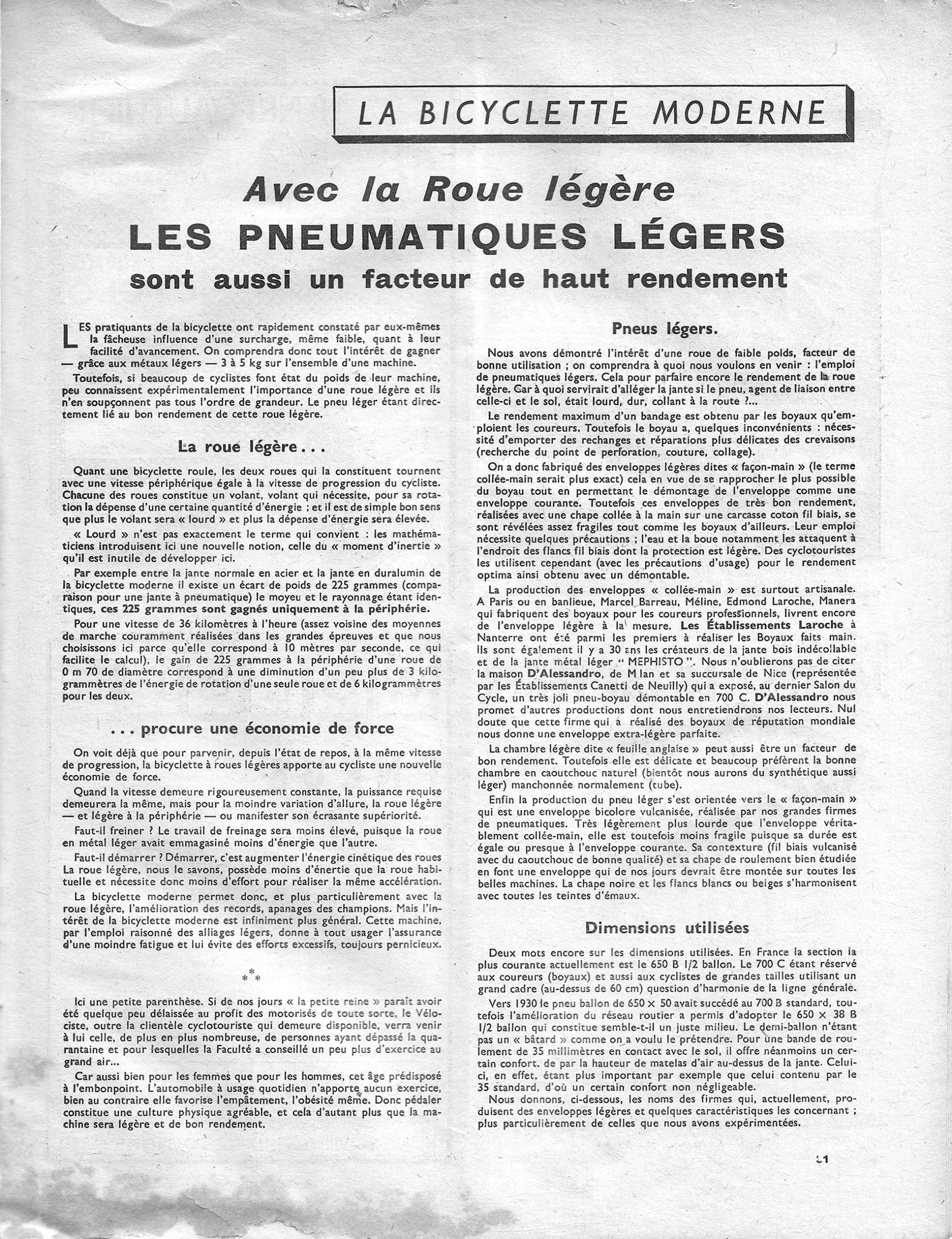
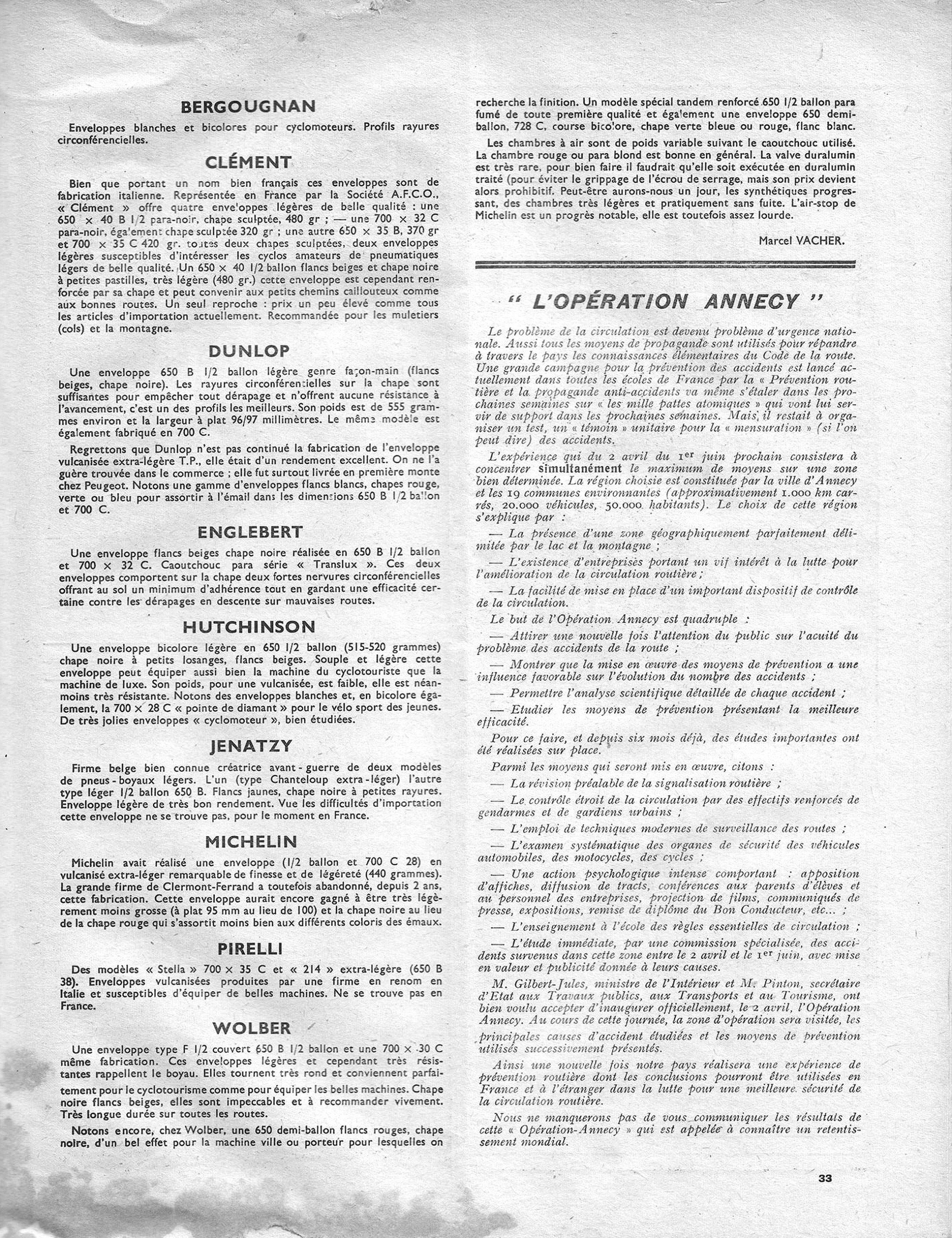
LA BICYCLETTE MODERNE Avec la Roue légère LES PNEUMATIQUES LÉGERS sont aussi un facteur de haut rendement La roue légère . . . . . . procure une économie de force Pneus légers. Dimensions utilisées 31 BERGOUGNAN CLÉMENT DUNLOP ENGLEBERT HUTCHINSON JENATZY MICHELIN PIRELLI WOLBER Marcel VACHER. 33
This is a magazine article, so its running text is summarized here rather than reproduced; the headline, byline, specifications and scores are transcribed as printed.
Marcel Vacher’s “Avec la roue légère, les pneumatiques légers sont aussi un facteur de haut rendement” in L’Officiel du cycle, 13 April 1957: why light tires on a light wheel save the cyclist’s effort, then the light bicycle tires and tubulars of Bergougnan, Clément, Dunlop, Englebert, Hutchinson, Jenatzy, Michelin, Pirelli and Wolber, with their sizes and weights. The headings and signature are transcribed as printed; the text is summarized in Ebykr’s words, and the page images carry it in full.
— Page 1 —
LA BICYCLETTE MODERNE
Avec la Roue légère
LES PNEUMATIQUES LÉGERS
sont aussi un facteur de haut rendement
La roue légère . . .
. . . procure une économie de force
Pneus légers.
Dimensions utilisées
[Ebykr summary; the article’s text is not reproduced. The writer notes that riders feel even a small excess weight, so light metals saving 3 to 5 kg on a machine are worthwhile, and that the light tire goes with the light wheel. Under “La roue légère . . .” each wheel is treated as a flywheel turning at road speed (the moment of inertia); the duralumin rim of the modern bicycle saves 225 grams over the ordinary steel rim (for a tire rim), all at the periphery. At 36 kilometers an hour (10 meters a second, near big-race averages) that saving on a 0 m 70 wheel cuts rotational energy by a little over 3 kilogrammeters a wheel, 6 for the pair. Under “. . . procure une économie de force” light wheels make starting, braking and every change of pace easier, help champions to records and spare the everyday rider fatigue. After a break the writer tells the dealer (the Vélociste) that besides touring riders, people past 40 sent out for exercise by doctors (la Faculté) are a growing clientele, since the car gives none. Under “Pneus légers.” racing tubulars (boyaux) are the most efficient but need spares and fiddly repairs (finding the puncture, sewing, gluing); hence the light façon-main (more exactly collée-main) covers, a tread glued by hand onto a bias-thread cotton carcass, efficient but fragile in the wet. Named makers: Marcel Barreau, Méline, Edmond Laroche and Manera around Paris; Les Établissements Laroche at Nanterre, early makers of hand-made tubulars and, 30 years ago, creators of the unglueable wooden rim and the light-metal “MEPHISTO” rim; and D’Alessandro of Milan (printed “M lan”) and its Nice branch, represented by the Établissements Canetti de Neuilly, which showed a detachable pneu-boyau in 700 C at the last Salon du Cycle. The light feuille anglaise inner tube is set against the usual natural-rubber tube, light synthetics being expected. The vulcanized two-color façon-main cover of the big tire firms is praised: a little heavier than true collée-main but almost as durable as an ordinary cover, black tread with white or beige sidewalls. Under “Dimensions utilisées” the commonest French size is the 650 B 1/2 ballon; 700 C is for racing tubulars and tall riders on frames over 60 cm. About 1930 the 650 x 50 balloon replaced the 700 B standard; better roads then brought the 650 x 38 B 1/2 ballon, whose 35-millimeter contact patch carries more air than the 35 standard. The page closes by introducing the list of firms that follows.]
[The page has no illustrations; the running head is set in a ruled box with a drop shadow, and the sections are divided by headings and a three-asterisk ornament.]
31
— Page 2 —
BERGOUGNAN
CLÉMENT
DUNLOP
ENGLEBERT
HUTCHINSON
JENATZY
MICHELIN
PIRELLI
WOLBER
Marcel VACHER.
[Ebykr summary; the article’s text is not reproduced. The maker-by-maker list of light covers announced at the foot of page 31. BERGOUGNAN: white and two-color moped (cyclomoteur) covers with circumferential-groove treads. CLÉMENT: Italian-made despite the French name, sold in France by the Société A.F.C.O.; four light covers, a 650 x 40 B 1/2 para-noir with sculpted tread (480 gr), a 700 x 32 C para-noir with sculpted tread (320 gr), a 650 x 35 B (370 gr) and a 700 x 35 C (420 gr), both sculpted, for amateur riders; also a 650 x 40 1/2 ballon with beige sidewalls and a black tread of small pastilles, very light (480 gr.) yet reinforced for stony lanes; dear like all imports, recommended for mountain passes (muletiers, cols). DUNLOP: a light façon-main-type 650 B 1/2 ballon, beige sidewalls, black tread with skid-resisting circumferential grooves, about 555 grams and 96/97 millimeters wide flat, also in 700 C; the writer regrets the discontinued extra-light vulcanized T.P. cover, supplied mostly as original equipment to Peugeot, and notes white-sidewall covers with red, green or blue treads to match the enamel in 650 B 1/2 ballon and 700 C. ENGLEBERT: a beige-sidewall, black-tread cover in 650 B 1/2 ballon and 700 x 32 C, para rubber of the « Translux » series, two strong circumferential ribs on the tread for low contact and grip on bad descents. HUTCHINSON: a light two-color 650 1/2 ballon (515-520 grammes), black tread of small diamonds, beige sidewalls, light for a vulcanized cover yet tough, for touring or luxury machines; also white covers, a two-color 700 x 28 C « pointe de diamant » for young riders’ sports bicycles and « cyclomoteur » covers. JENATZY: the Belgian firm made two light pneus-boyaux before the war, the type Chanteloup extra-léger and a light 1/2 ballon 650 B with yellow sidewalls and finely grooved black tread, unobtainable in France for now because of import difficulties. MICHELIN: the Clermont-Ferrand firm dropped its extra-light vulcanized cover (1/2 ballon and 700 C 28, 440 grammes) 2 years ago; it would have gained by being narrower (95 mm flat instead of 100) and black-treaded rather than red. PIRELLI: the « Stella » 700 x 35 C and the extra-light « 214 » (650 B 38), vulcanized Italian covers not sold in France. WOLBER: a type F 1/2 couvert 650 B 1/2 ballon and a 700 x 30 C of the same make, light, tough and round-running, black tread with beige sidewalls, warmly recommended; also a 650 demi-ballon with red sidewalls and black tread for town and carrier bicycles (machine ville ou porteur), a reinforced special tandem 650 1/2 ballon in smoked para and a 650 demi-ballon, 728 C, course bicolore with green, blue or red tread and white sidewall. Inner tubes: weight depends on the rubber, red or blond para tubes are generally good, duralumin valves are rare and should be heat-treated to stop the nut seizing, at a prohibitive price; synthetics may bring very light, almost leak-free tubes, and Michelin’s air-stop is a real advance though rather heavy.]
[The page has no illustrations; the maker headings are set in bold capitals and a heavy double rule closes the article under the signature.]
33
[The rest of page 33, the column “L’Opération Annecy”, is not part of this record.]
Ebykr presents this material for research and education. If you hold rights to it or notice an ownership issue, please contact us and we will respond promptly.
The Ebykr Digest
New articles, timelines, catalog finds and registry activity — assembled from the archive once a month. Your address is never shared.
Double opt-in. One email per month. Unsubscribe at any time with one click.