About Ebykr
Ebykr celebrates classic and vintage lightweight bicycles through provocative imagery and opinion. Ride along with us.
About Ebykr
Ebykr celebrates classic and vintage lightweight bicycles through provocative imagery and opinion. Ride along with us.

Source: L'Officiel du cycle, du motocycle et du camping, N° 1, 5 January 1957, pages 11, 13 and 15; scan of the issue from Cycle Memory (Mémoire du Cycle), Collection privée F.
| Type | Review |
|---|---|
| Year | 1957 |
| Publisher | L'Officiel du cycle |
| Artist | Daniel Rebour |
| Country | France |
| Language | French |
| Pages | 3 |
| Source | L'Officiel du cycle, du motocycle et du camping, N° 1, 5 January 1957, pages 11, 13 and 15; scan of the issue from Cycle Memory (Mémoire du Cycle), Collection privée F. |
| Credit | Ebykr archive |
| Identifier | Permalink https://cyclememory.org/fr/search-coll-list.php?collectionID=325&docID=B-1-0000001000 |
| Transcription | Headings and specifications transcribed; article text summarized |
POUR QUE VOS CLIENTS CYCLISTES « AIENT DU FREIN » Petite étude sur les différents modèles de freins et leur utilisation tension normale du cable le détendeur a pivoté dans son logement dégagement de la roue 11 QUELQUES CONSEILS 13 Marcel VACHER. LES PATINS DE FREINS “ GUTTACOLL ” LES MOYEUX-FREINS “ ARTHUR HÉROLD ” …
This is a magazine article, so its running text is summarized here rather than reproduced; the headline, byline, specifications and scores are transcribed as printed.
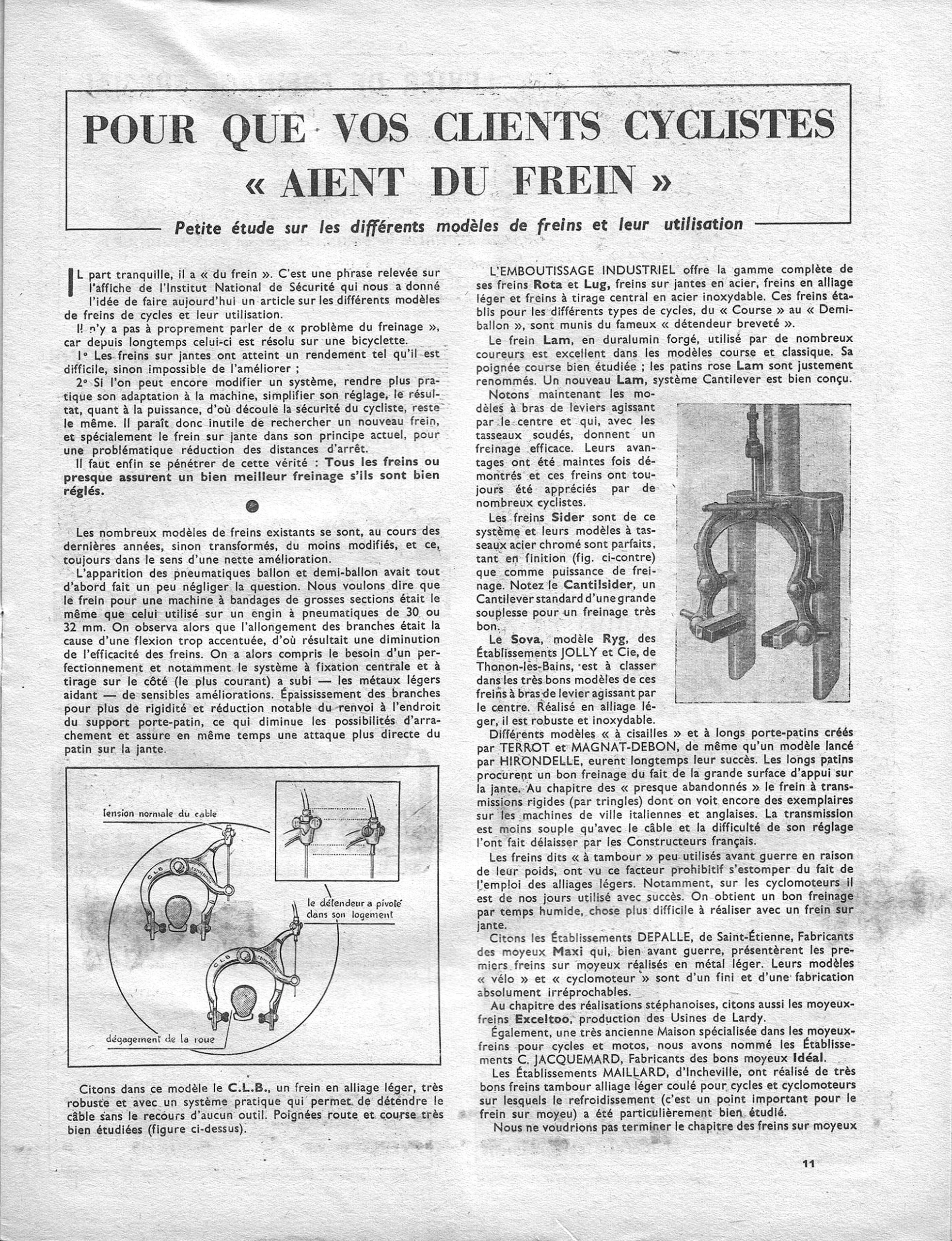
Marcel Vacher’s survey of the bicycle brakes on the French market, “Pour que vos clients cyclistes « aient du frein »”, in L’Officiel du cycle, du motocycle et du camping, 5 January 1957: side-pull, center-pull and Cantilever rim brakes, hub and coaster brakes, cables, shoes and adjustment, from C.L.B., Rota and Lug, LAM, Sider, Sova, Jolly, Mafac, Favorit, Hérold, Indéca and Guttacoll among others, with a figure drawn by Daniel Rebour. The headings, figure labels and signature are transcribed as printed; the text is summarized in Ebykr’s words, and the page images carry it in full.
— Page 1 —
POUR QUE VOS CLIENTS CYCLISTES « AIENT DU FREIN »
Petite étude sur les différents modèles de freins et leur utilisation
tension normale du cable
le détendeur a pivoté dans son logement
dégagement de la roue
[Ebykr summary; the article’s text is not reproduced. The article opens from a phrase on a poster of the Institut National de Sécurité, which prompted this survey of bicycle brakes and their use. It argues that braking on a bicycle is a long-solved problem: rim brakes have reached an efficiency that can hardly be improved, so a new brake design would gain little, and the key point (set in bold) is that almost every brake works far better when it is properly adjusted. Recent years brought steady improvement. Balloon and demi-ballon tires first made makers neglect the question, fitting the same brake to a fat-tired machine as to one on 30 or 32 mm tires; longer arms flexed and lost efficiency, so the side-pull brake with central fixing (the commonest type) was improved with light alloys, thicker arms and a shorter offset at the shoe holder (porte-patin), which reduces the risk of the shoe tearing away and gives a more direct attack on the rim. The C.L.B. is cited as a robust light-alloy brake whose quick cable-release lets the cable be slackened without tools, with well-designed road and racing levers (figure). L’EMBOUTISSAGE INDUSTRIEL offers its full range of Rota and Lug brakes: steel rim brakes, light-alloy brakes and stainless-steel center-pull brakes for every type of cycle from the Course to the Demi-ballon, all fitted with the patented cable adjuster (détendeur breveté). The Lam brake in forged duralumin, used by many racers, is excellent in racing and classic models, with a good racing lever and its renowned pink Lam shoes; a new Lam on the Cantilever system is also praised. Center-acting lever-arm brakes on brazed-on bosses (tasseaux soudés) are commended: the Sider brakes with chromed steel bosses (figure) and the Cantilsider, a standard Cantilever of great suppleness; and the Sova, model Ryg, of Établissements JOLLY et Cie of Thonon-les-Bains, in light alloy, robust and rustproof. Scissor-type brakes with long shoe holders by TERROT and MAGNAT-DEBON and a model by HIRONDELLE long enjoyed success, the long shoes giving a large bearing surface on the rim. Rod brakes (par tringles), still seen on Italian and English town machines, are called nearly abandoned by French makers because they are stiffer than cable and hard to adjust. Drum brakes, little used before the war because of their weight, now succeed thanks to light alloys, notably on cyclomoteurs, and brake well in the wet. Named hub-brake makers: Établissements DEPALLE of Saint-Étienne, makers of Maxi hubs, who made the first light-metal hub brakes well before the war, in vélo and cyclomoteur models; the Exceltoo hub brakes, made by the Usines de Lardy (also from Saint-Étienne); Établissements C. JACQUEMARD, an old house making Idéal hubs for cycles and motorcycles; and Établissements MAILLARD of Incheville, with cast light-alloy drum brakes for cycles and cyclomoteurs whose cooling is carefully designed. The text runs on to the next article page, page 13, without a printed continuation line.]
[A boxed line drawing at the foot of the left column shows the C.L.B. side-pull brake twice inside a large circle: above, with the cable at normal tension; below, with the cable adjuster turned in its seat so that the shoes open to clear the wheel, the tire drawn in section between the shoes. A small inset shows the adjuster in its two positions, linked by dotted lines. The brake arms carry the cast lettering C L B and, on the arm, a word that appears to read COMPETITION. The drawing is unsigned. A halftone photograph in the right column shows a center-acting brake mounted on brazed-on bosses of a fork crown, with its straddle cable and two long shoes; it is the Sider brake the text refers to and is unsigned.]
11
— Page 2 —
QUELQUES CONSEILS
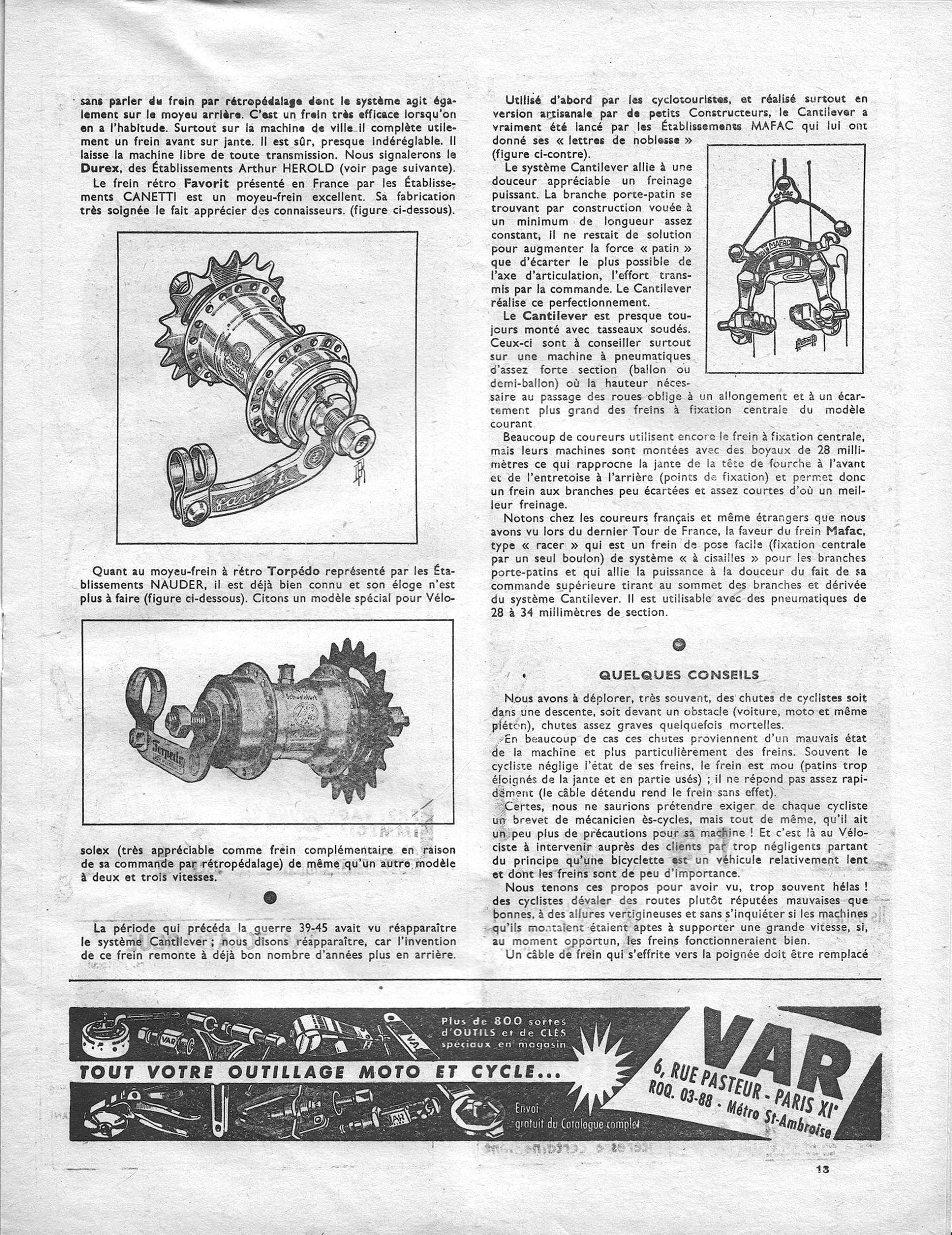
[Ebykr summary; the article’s text is not reproduced. Continuing from page 11, the hub-brake section closes with the coaster brake (frein par rétropédalage), which also works in the rear hub: very effective once the rider is used to it, especially useful on a town machine as a complement to a front rim brake, safe, almost never needing adjustment and leaving the machine free of any cable or rod. The page names the Durex of Établissements Arthur HEROLD (see the following page); the Favorit coaster hub brake, presented in France by Établissements CANETTI, praised as excellent and carefully made (figure); and the Torpédo coaster hub brake represented by Établissements NAUDER, already well known (figure), with a special model for the Vélosolex, valued as an extra brake because it is worked by back-pedaling, and another model with two and three speeds. A new section traces the Cantilever: it reappeared in the period before the 1939-45 war, though the invention is much older; first used by cyclotourists and built mostly by small craft makers, it was truly launched by Établissements MAFAC, who gave it its standing (figure). Because the shoe-holding arm must stay short, the only way to raise the force at the shoe is to move the pull of the cable as far as possible from the pivot, which the Cantilever does, combining smoothness with power. It is almost always mounted on brazed-on bosses (tasseaux soudés) and is advised above all for machines on fat tires (ballon or demi-ballon), where wheel clearance would force the ordinary center-fixed brake to grow longer and wider. Many racers still use the center-fixed brake, since their 28 mm tubulars bring the rim close to the fork crown in front and the bridge at the rear, allowing short, close-set arms and better braking. At the last Tour de France, French and foreign racers favored the Mafac type racer: a brake fixed by a single central bolt, with scissor-action (à cisailles) shoe arms pulled at their tops by a cable system derived from the Cantilever, usable with tires of 28 to 34 mm section. Under QUELQUES CONSEILS the author deplores falls on descents or before obstacles (cars, motorcycles, even pedestrians), sometimes fatal, often due to neglected brakes: shoes set too far from the rim and worn, or a slack cable. The vélociste should step in with careless customers who think a bicycle is too slow for brakes to matter, having seen riders hurtle down bad roads without checking their machines. A cable fraying near the lever must be replaced; the sentence breaks off at the foot of the column and runs on at the head of the next article page, page 15, with no printed continuation line.]
[Three drawings illustrate the page. A boxed line drawing at upper left shows the Favorit coaster-brake rear hub with its sprocket, flanges and long reaction arm with clip; the hub shell and the arm carry the script name Favorit and a round emblem, and the drawing is signed at lower right with a small monogram, not with Rebour’s signature. A boxed halftone at lower left shows the Torpédo coaster-brake hub with sprocket, axle nut and reaction arm; the arm and shell carry the name Torpedo, the word Schweinfurt and a round monogram. A boxed line drawing in the right column shows a Mafac center-pull brake seen from the front between two fork blades, with the straddle cable and its yoke, the arms marked MAFAC and two shoes; it is signed “Rebour” at lower right. The page thus carries one drawing signed “Rebour”.]
[The foot of the page carries an advertisement for VAR tools, held as its own record.]
13
— Page 3 —
Marcel VACHER.
LES PATINS DE FREINS “ GUTTACOLL ”
LES MOYEUX-FREINS “ ARTHUR HÉROLD ”
LES CABLES DE LA Sté “ INDÉCA ”
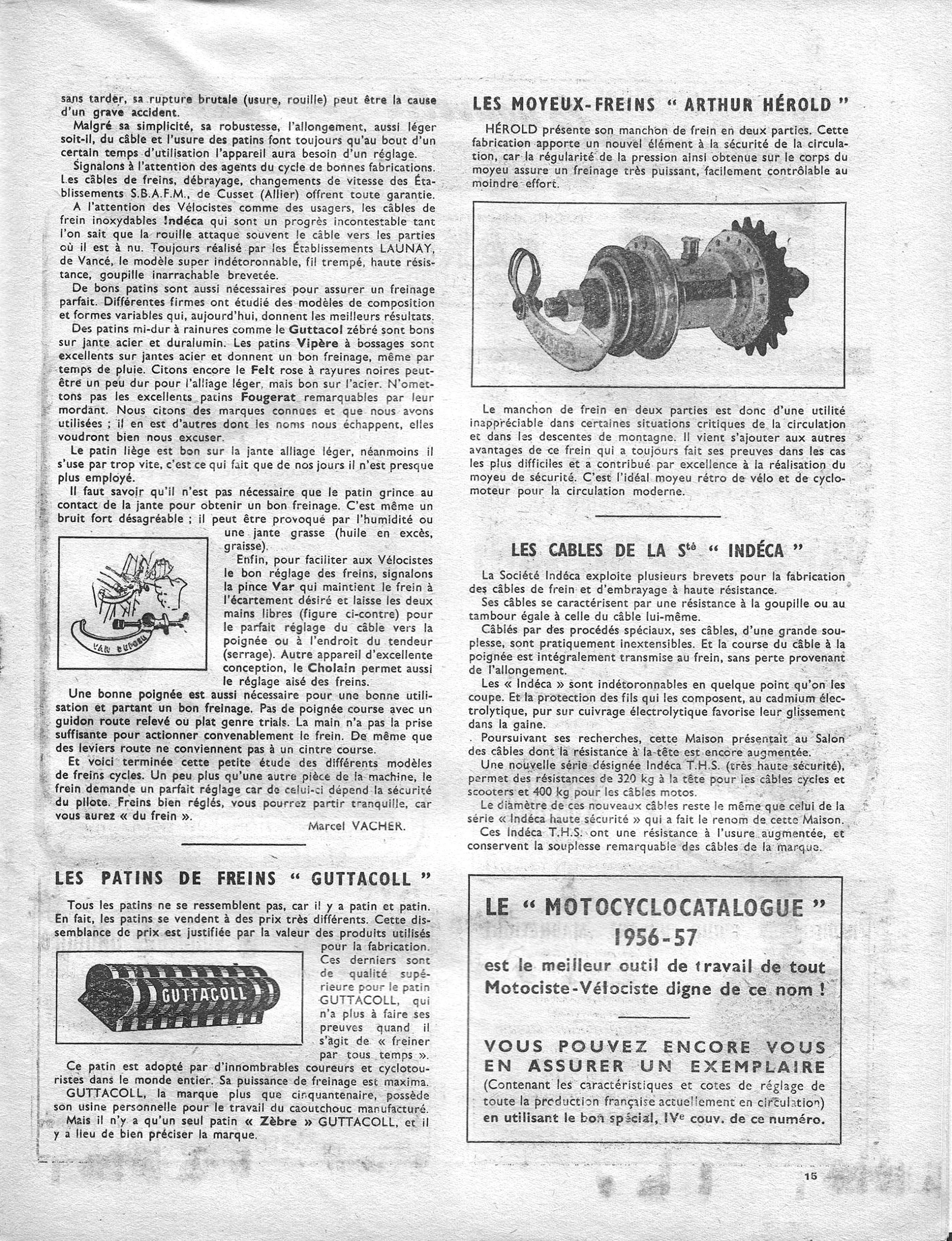
[Ebykr summary; the article’s text is not reproduced. Continuing from page 13, the advice section says a brake cable fraying near the lever must be replaced at once, since a sudden break from wear or rust can cause a serious accident, and that however simple and robust a brake is, cable stretch and shoe wear mean it will need adjusting after a time. Recommended to the trade: the brake, clutch and gear-change cables of Établissements S.B.A.F.M. of Cusset (Allier); the stainless Indéca brake cables, a real advance since rust attacks a cable where it runs bare; and, from Établissements LAUNAY of Vancé, the super indétoronnable model (a cable that does not unravel), with hardened wire, high strength and a patented pull-proof nipple (goupille). On brake shoes: grooved half-hard shoes such as the Guttacol zébré suit steel and duralumin rims; the Vipère shoes with raised studs grip well on steel rims even in rain; the pink Felt with black stripes is perhaps a little hard for light alloy but good on steel; the Fougerat shoes are praised for their bite; the author names only makes he has used. Cork shoes suit alloy rims but wear too fast and are now almost unused. A squealing shoe is not needed for good braking; the noise can come from damp or a greasy rim. For adjusting brakes the Var clamp (pince Var) holds the brake at the chosen opening and leaves both hands free to set the cable at the lever or the adjuster (figure); the Cholain tool is also commended. A good lever matters: a racing lever does not suit a raised road bar or a flat trials bar, nor do road levers suit a racing bend. The article ends by repeating that a well-adjusted brake is the rider’s safety, echoing the opening phrase, and is signed Marcel VACHER. Three product notes follow. LES PATINS DE FREINS “ GUTTACOLL ”: shoe prices vary with the materials used, which are of superior quality in the GUTTACOLL shoe, proven for braking in all weather and used by countless racers and cyclotourists worldwide; GUTTACOLL, a brand more than 50 years old, has its own factory for manufactured rubber, and there is only one « Zèbre » GUTTACOLL shoe, so the make should be specified. LES MOYEUX-FREINS “ ARTHUR HÉROLD ”: HÉROLD presents a brake sleeve (manchon de frein) in two parts whose even pressure on the hub body gives powerful, easily controlled braking with little effort, valuable in traffic and on mountain descents; it is offered as the ideal coaster hub for bicycle and cyclomoteur. LES CABLES DE LA Sté “ INDÉCA ”: the Société Indéca holds several patents for high-strength brake and clutch cables, whose strength at the nipple or drum equals that of the cable; they are supple, practically inextensible and do not unravel wherever cut, with wires protected by electrolytic cadmium over electrolytic copper plating for smooth running in the housing. At the Salon the firm showed cables with greater strength at the head, and a new Indéca T.H.S. series (très haute sécurité) reaches 320 kg at the head for cycle and scooter cables and 400 kg for motorcycle cables, at the same diameter as the « Indéca haute sécurité » series, with better wear resistance and the same suppleness.]
[A small boxed line drawing in the left column shows the Var clamp: a C-shaped clamp with a screw holding a brake’s arms and shoes against the rim while a hand adjusts the cable at the brake; the clamp carries cast lettering. A boxed halftone under the GUTTACOLL heading shows a striped brake shoe block with the name GUTTACOLL across it. A boxed halftone under the HÉROLD heading shows a coaster-brake rear hub with sprocket, axle nut and reaction arm with clip. None of the three illustrations is signed.]
[The foot of the right column carries the magazine’s own boxed advertisement for LE “ MOTOCYCLOCATALOGUE ” 1956-57, which is not part of this article.]
15
Ebykr presents this material for research and education. If you hold rights to it or notice an ownership issue, please contact us and we will respond promptly.
The Ebykr Digest
New articles, timelines, catalog finds and registry activity — assembled from the archive once a month. Your address is never shared.
Double opt-in. One email per month. Unsubscribe at any time with one click.