About Ebykr
Ebykr celebrates classic and vintage lightweight bicycles through provocative imagery and opinion. Ride along with us.
About Ebykr
Ebykr celebrates classic and vintage lightweight bicycles through provocative imagery and opinion. Ride along with us.

Source: L'Officiel du cycle, du motocycle et du camping, N° 1, 5 January 1957, page 5; scan of the issue from Cycle Memory (Mémoire du Cycle), Collection privée F.
| Type | Review |
|---|---|
| Year | 1957 |
| Publisher | L'Officiel du cycle |
| Country | France |
| Language | French |
| Pages | 1 |
| Source | L'Officiel du cycle, du motocycle et du camping, N° 1, 5 January 1957, page 5; scan of the issue from Cycle Memory (Mémoire du Cycle), Collection privée F. |
| Credit | Ebykr archive |
| Identifier | Permalink https://cyclememory.org/fr/search-coll-list.php?collectionID=325&docID=B-1-0000001000 |
| Transcription | Headings and specifications transcribed; article text summarized |
La Bicyclette LA BICYCLETTE A DES ATOUTS DANS SON JEU EN 1957... Mais il faut coordonner la propagande en sa faveur R. DUCOUDRAY.
This is a magazine article, so its running text is summarized here rather than reproduced; the headline, byline, specifications and scores are transcribed as printed.
R. Ducoudray’s article in L’Officiel du cycle, du motocycle et du camping, 5 January 1957, “La bicyclette a des atouts dans son jeu en 1957…”: after the congress of the Fédération Française de Cyclo-Tourisme, he argues that the bicycle can win back the riders lost to the cyclomoteur and proposes a round table of everyone who campaigns for it. The title and signature are transcribed as printed; the text is summarized in Ebykr’s words, and the page image carries it in full.
— Page 1 —
La Bicyclette
LA BICYCLETTE A DES ATOUTS DANS SON JEU EN 1957…
Mais il faut coordonner la propagande en sa faveur
R. DUCOUDRAY.
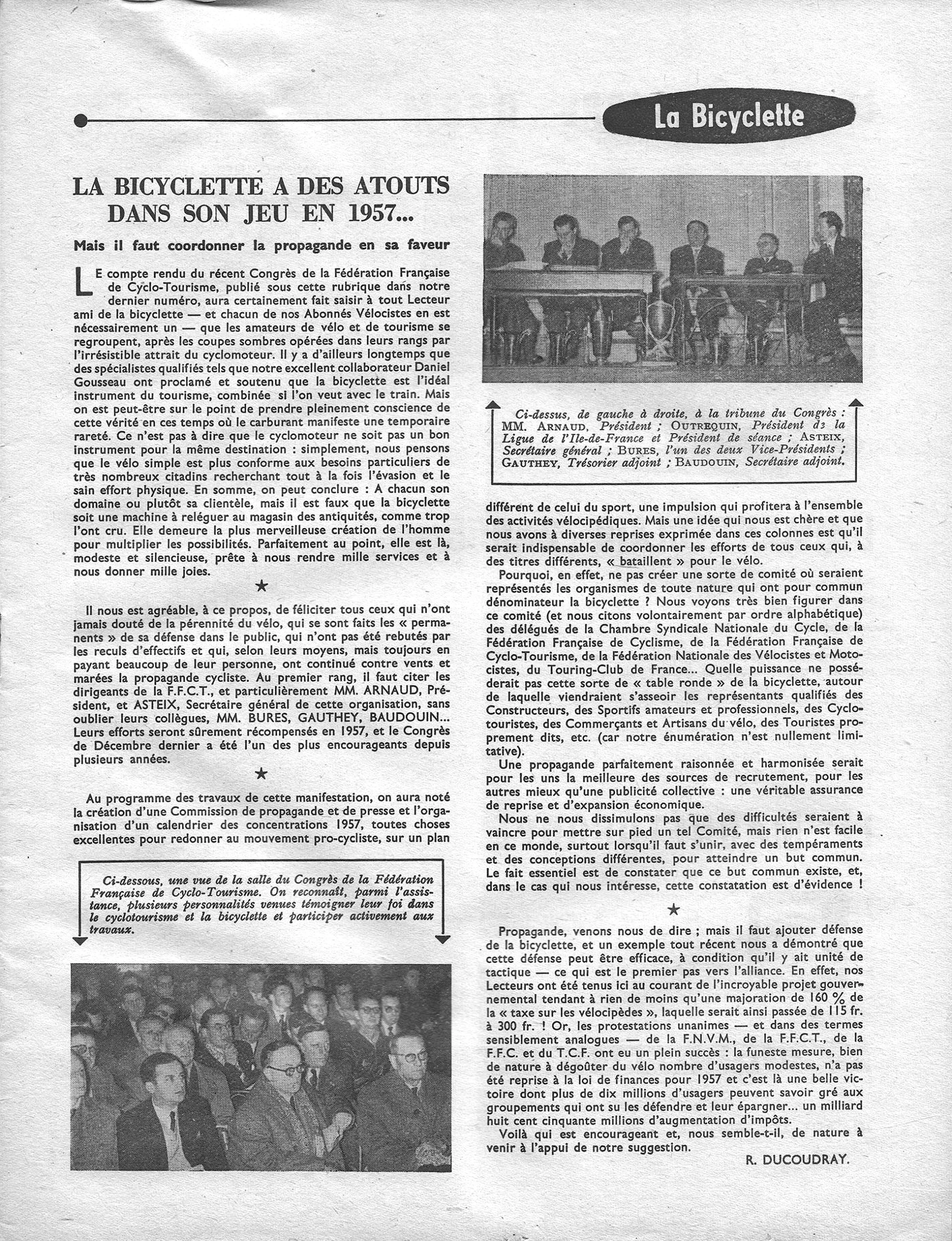
[Ebykr summary; the article’s text is not reproduced. The writer opens from the report on the recent congress of the Fédération Française de Cyclo-Tourisme, published under this same heading in the previous issue, and argues that it shows cycling and touring enthusiasts regrouping after the heavy losses their ranks suffered to the pull of the cyclomoteur. He recalls that specialists such as the magazine’s contributor Daniel Gousseau have long held the bicycle to be the ideal touring instrument, combined if one wishes with the train, and suggests that a temporary fuel shortage may now bring the point home. He does not dismiss the cyclomoteur, but holds that the plain bicycle better suits the many town dwellers who want both escape and healthy exercise, and that it is wrong to treat it as a machine for the antique shop. He congratulates those who kept up cycling propaganda through the falling membership, first among them the leaders of the F.F.C.T.: MM. ARNAUD, its President, and ASTEIX, its General Secretary, with their colleagues MM. BURES, GAUTHEY and BAUDOUIN, and he calls the December congress one of the most encouraging in years. Among its work he notes a new Commission de propagande et de presse and a calendar of 1957 rallies (“concentrations”). He then proposes a committee, a kind of round table of the bicycle, to coordinate everyone who campaigns for the vélo, naming in alphabetical order delegates of the Chambre Syndicale Nationale du Cycle, the Fédération Française de Cyclisme, the Fédération Française de Cyclo-Tourisme, the Fédération Nationale des Vélocistes et Motocistes and the Touring-Club de France, joined by builders, amateur and professional racers, cyclotourists, traders and craftsmen of the cycle and ordinary tourists. Coordinated propaganda would bring recruits to some and collective publicity to others; he admits the difficulty of uniting different temperaments but insists the common aim exists. As proof that a united defense works, he cites the government plan, already reported in these columns, to raise the “taxe sur les vélocipèdes” by 160 %, from 115 fr. to 300 fr.: unanimous protests from the F.N.V.M., the F.F.C.T., the F.F.C. and the T.C.F. kept it out of the finance law for 1957, sparing more than ten million users one billion eight hundred and fifty million francs in added tax. He ends that this supports his proposal. The two captions identify the photographs: the upper one names, from left to right at the congress platform, MM. ARNAUD, Président; OUTREQUIN, Président of the Ligue de l’Ile-de-France and chairman of the session; ASTEIX, Secrétaire général; BURES, one of the two Vice-Présidents; GAUTHEY, Trésorier adjoint; and BAUDOUIN, Secrétaire adjoint; the lower one describes a view of the hall of the Fédération Française de Cyclo-Tourisme congress, with several personalities in the audience who came to show their faith in cyclotourism and the bicycle and to take part in the work.]
[Two halftone photographs. Upper right, six men in suits sit behind two tables on the congress platform, with several trophies and cups standing on the floor in front of the tables. Lower left, a seated audience of men in jackets and ties, several wearing glasses, faces the platform. Each caption sits in a ruled box with an arrow pointing to its photograph. The page carries no drawings and no signatures.]
Ebykr presents this material for research and education. If you hold rights to it or notice an ownership issue, please contact us and we will respond promptly.
The Ebykr Digest
New articles, timelines, catalog finds and registry activity — assembled from the archive once a month. Your address is never shared.
Double opt-in. One email per month. Unsubscribe at any time with one click.