About Ebykr
Ebykr celebrates classic and vintage lightweight bicycles through provocative imagery and opinion. Ride along with us.
About Ebykr
Ebykr celebrates classic and vintage lightweight bicycles through provocative imagery and opinion. Ride along with us.

Source: Gallica (Bibliothèque nationale de France), L'Officiel du cycle, du motocycle et du camping, 12 November 1955, N° 23, pages 25, 27, 29, 31, 32, 35, 37 and 39; ark:/12148/bd6t54182363d. Source gallica.bnf.fr / BnF.
| Type | Review |
|---|---|
| Year | 1955 |
| Publisher | L'Officiel du cycle |
| Country | France |
| Language | French |
| Pages | 8 |
| Source | Gallica (Bibliothèque nationale de France), L'Officiel du cycle, du motocycle et du camping, 12 November 1955, N° 23, pages 25, 27, 29, 31, 32, 35, 37 and 39; ark:/12148/bd6t54182363d. Source gallica.bnf.fr / BnF. |
| Credit | Ebykr archive; Bibliothèque nationale de France |
| Identifier | Gallica (BnF) ark:/12148/bd6t54182363d/f25 |
| Transcription | Headings and specifications transcribed; article text summarized |
Reference
"La Bicyclette, les Motocycles: aux programmes de construction 56." L'Officiel du cycle, 12 November 1955. Ebykr, https://ebykr.com/library/lofficiel-du-cycle-1955-11-construction-1956-seconde-serie/.
Wikipedia
{{cite magazine |title=La Bicyclette, les Motocycles: aux programmes de construction 56 |magazine=L'Officiel du cycle |date=12 November 1955 |language=French |url=https://ebykr.com/library/lofficiel-du-cycle-1955-11-construction-1956-seconde-serie/ |via=Ebykr |access-date=}}La Bicyclette — Les Motocycles AUX PROGRAMMES DE CONSTRUCTION 56 (Une première série de présentations a figuré dans notre précédent numéro) Les cyclomoteurs et vélomoteurs AQUILA Les nouvelles présentations B.S.A. (Suite page 27) 25 Les motocycles B.M.W. Les productions BONNEFONT 27 Les cyclomoteurs COCYNETTE Le cliché ci-dessous représente la « Cocynette » grand luxe, moteur …
This is a magazine article, so its running text is summarized here rather than reproduced; the headline, byline, specifications and scores are transcribed as printed.
From L’Officiel du cycle, du motocycle et du camping, 12 November 1955, N° 23, pages 25, 27, 29, 31, 32, 35, 37 and 39: survey “La Bicyclette / Les Motocycles: Aux programmes de construction 56” (second series, the first was in the previous number), part 1: Aquila cyclomoteurs and vélomoteurs (5 LL with Lavalette motor, 9 MGS with Mistral motor, 11 VM 100) and the B.S.A. motorcycles (250 cc Princess, B.34 Gold Star); motorized machines only. The title, headings, captions and lists are transcribed as printed; the text is summarized in Ebykr’s words, and the page images carry it in full.
— Page 1 —
La Bicyclette — Les Motocycles
AUX PROGRAMMES DE CONSTRUCTION 56
(Une première série de présentations a figuré dans notre précédent numéro)
Les cyclomoteurs et vélomoteurs AQUILA
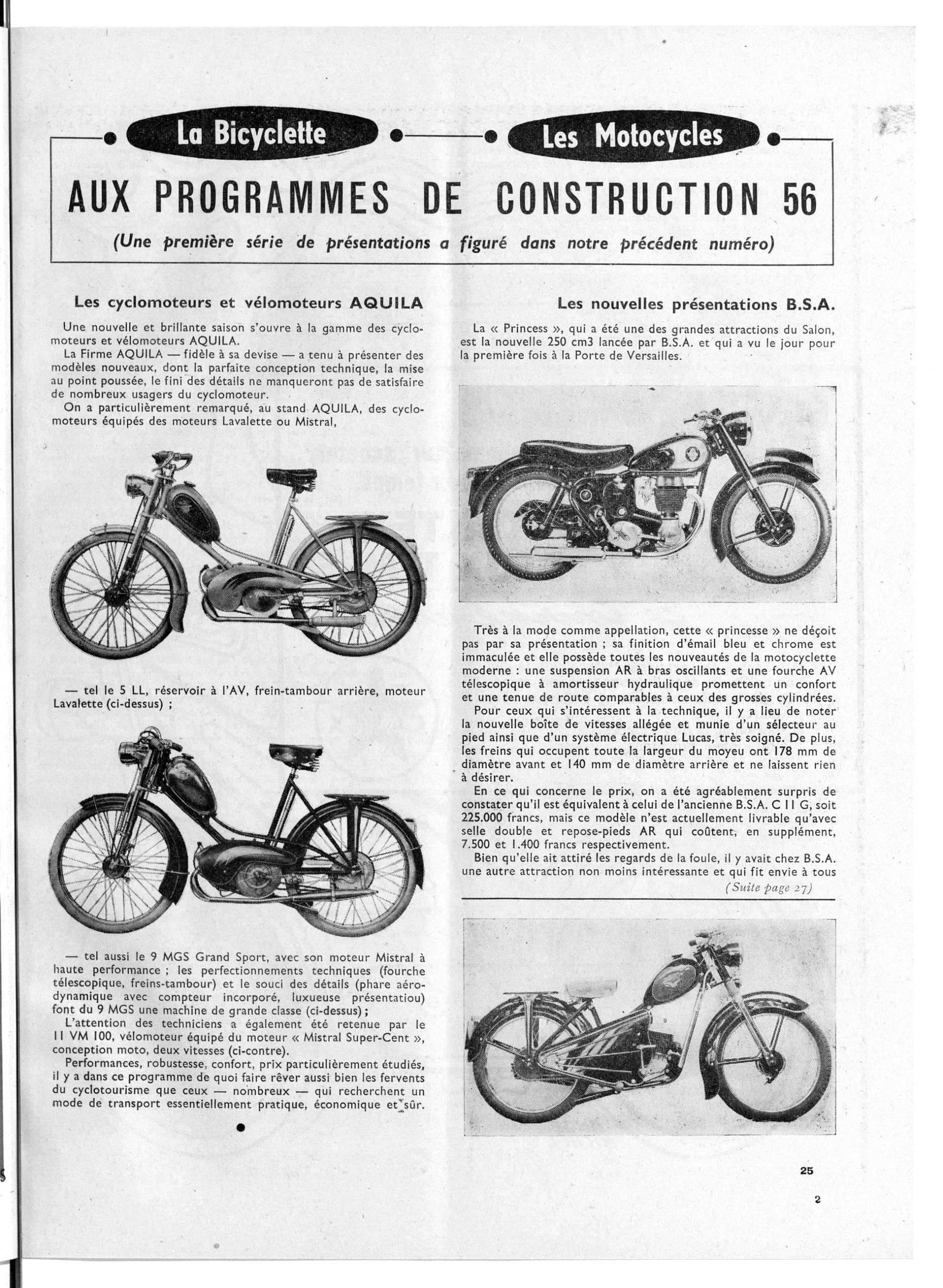
[Ebykr summary; the article’s text is not reproduced. The piece opens by saying a new and brilliant season begins for the Aquila range of cyclomotors and velomotors. The firm, true to its motto, chose to show new models whose sound technical design, finished development and attention to detail should please many cyclomotor users. At the Aquila stand the writer singled out cyclomotors fitted with Lavalette or Mistral engines, the first being the 5 LL, with the fuel tank at the front, a rear drum brake and a Lavalette engine, shown in the first photograph. The text then continues beneath that photograph.]
[Ebykr summary, after the first photograph. The 9 MGS Grand Sport has a high-performance Mistral engine, a telescopic fork, drum brakes and an aerodynamic headlamp with built-in speedometer, which the writer says make it a machine of the top class (second photograph). The 11 VM 100 is a velomotor with the “Mistral Super-Cent” engine, motorcycle-style, with two speeds, and drew the notice of technicians. The writer closes by saying the program offers performance, sturdiness, comfort and carefully studied prices, enough to appeal both to cyclotourists and to the many who want a practical, economical and safe means of transport. No bicycle is described.]
Les nouvelles présentations B.S.A.
[Ebykr summary; the article’s text is not reproduced. The “Princess”, one of the great attractions of the Salon, is a new 250 cc motorcycle launched by B.S.A. and shown for the first time at the Porte de Versailles (first photograph in this column). Its blue enamel and chrome finish is described as immaculate, and it has rear suspension on swinging arms and a telescopic front fork with hydraulic damper, promising comfort and road holding comparable to larger machines. The writer notes a new lightened gearbox with a foot selector and a Lucas electrical system, and brakes the full width of the hub measuring 178 mm at the front and 140 mm at the rear. The price equals that of the earlier B.S.A. C 11 G, 225.000 francs, but the model is at present delivered only with a dual seat and rear footrest, which cost 7.500 and 1.400 francs extra respectively. The text then turns to a second attraction at the B.S.A. stand and continues on page 27.]
(Suite page 27)
25
[A full magazine page printed in black on a cream ground, set in two columns under a framed banner across the head. In the banner two dark oval labels read “La Bicyclette” and “Les Motocycles” in white bold type, joined by a thin rule with a round dot at each end, above “AUX PROGRAMMES DE CONSTRUCTION 56” in large heavy spaced capitals and an italic line beneath. Each column opens with a bold sans-serif heading and runs in a small roman text face with paragraph indents. The left column holds two halftone photographs of Aquila cyclomotors, each shown side-on in profile against a plain ground, with a fuel tank, a motor unit below the frame, spoked wheels and a luggage rack over the rear wheel. The right column holds a halftone photograph of a B.S.A. motorcycle in profile with a dual seat, a rounded tank and a visible engine, framed in a thin ruled box, and a second halftone photograph of a lightweight motorcycle in profile near the foot of the column. No captions are printed with the B.S.A. photographs. A thin rule crosses the right column under the “Suite page 27” line. The page number 25 sits at the lower right in bold type, with a small figure 2 beneath it. No signature or agency mark is visible.]
— Page 2 —
[Ebykr summary, continuing from page 25; the article’s text is not reproduced. The second attraction at the B.S.A. stand, which the writer says made motocross enthusiasts envious, was the B.34 Gold Star shown cut away, with its engine running slowly. The writer notes that this model has already won the European championship with Draper and the world motocross championship with Smith, and has won the national championships of Italy, England, Sweden and Holland, which he takes as proof of its mechanical quality. A halftone photograph of a B.S.A. motorcycle follows.]
[Ebykr summary, after the first photograph. Once away from the cutaway machine, the visitor looked at the rest of the B.S.A. range. The favorites, the B.31, B.33, A 7, A 7 Shooting Star, A 10 Golden Flash and A 10 Road Rocket, were all present with important improvements to brakes and tires. The journal had once remarked that B.S.A. brakes left something to be desired, but the writer now finds that objection no longer valid: all models of groups A and B except the Gold Star have full-width hub brakes front and rear with aluminum drums, 178 mm in diameter and 38 mm wide. All models also carry ribbed front tires with a longitudinal tread, which the writer judges better suited to French roads than the universal pattern of earlier years. The importer, the Société MOVEA, said that all models of groups A and B except the Gold Star can be supplied with a full enclosed secondary chain case for a supplement of 5.000 francs, a guard the writer finds perfect and indispensable for riders who carry a passenger. Prices are the same as the year before, which he finds surprising given recent price rises in England. The B.S.A. stand showed fourteen models and was a whole exhibition in itself. No bicycle is described.]
Les motocycles B.M.W.
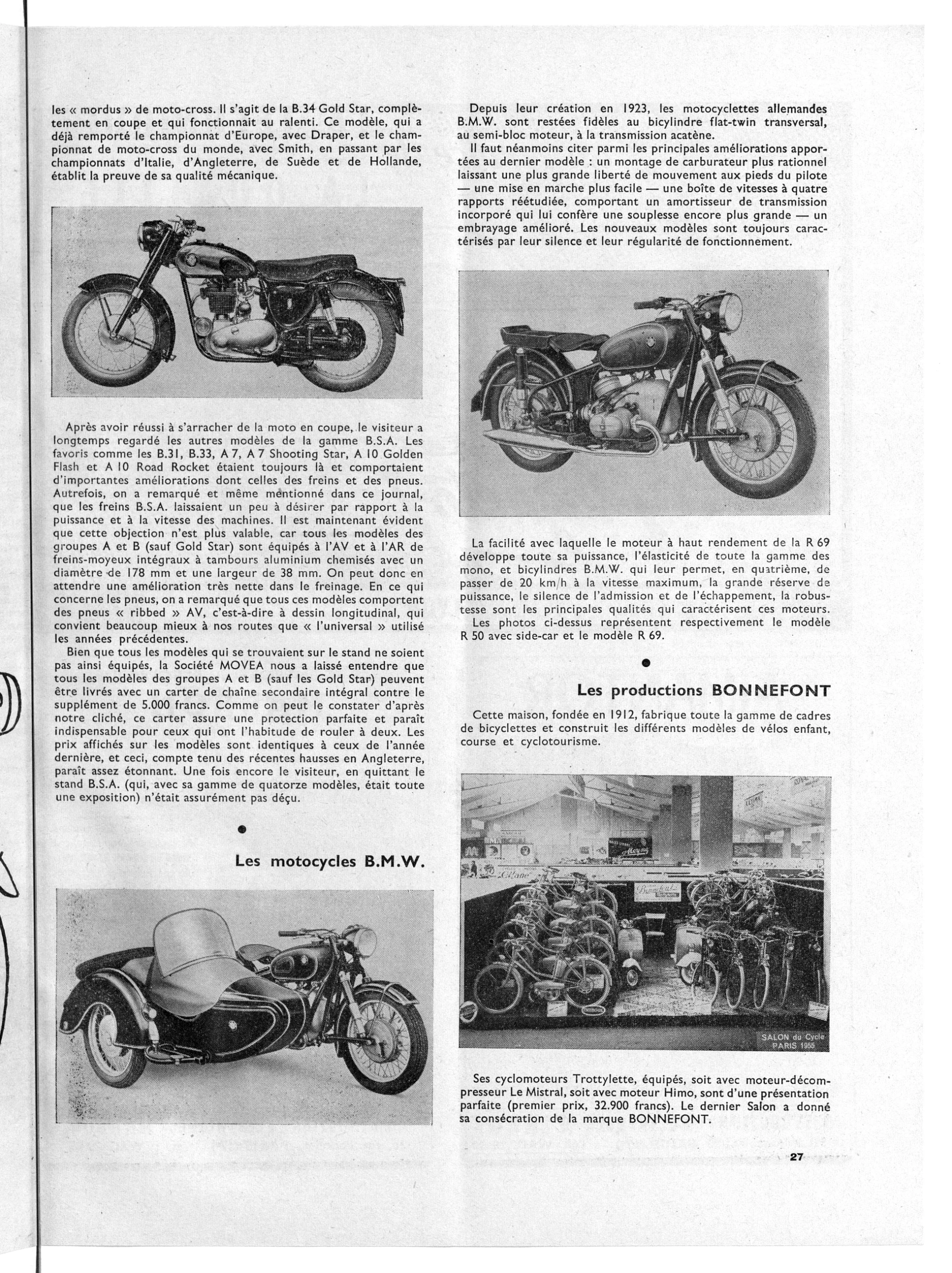
[Ebykr summary; the article’s text is not reproduced. The B.M.W. motorcycles, made in Germany since 1923, have kept the transverse flat-twin, the semi-unit engine and shaft drive. The writer lists the main improvements on the latest model: a more rational carburetor mounting that leaves the rider’s feet more freedom, easier starting, a reworked four-speed gearbox with a built-in transmission shock absorber, and an improved clutch. The new models remain known for quiet running and regularity.]
[Ebykr summary, after the first B.M.W. photograph. The R 69 engine develops its full power easily, and the flexibility of the whole range of single and twin-cylinder B.M.W. engines lets a rider go from 20 km/h to top speed in fourth gear. The writer names great reserve of power, silent intake and exhaust, and sturdiness as the main qualities. The photographs show the R 50 with sidecar and the R 69, two motorcycles.]
Les productions BONNEFONT
[Ebykr summary; the article’s text is not reproduced. The firm, founded in 1912, makes the whole range of bicycle frames and builds the various models of children’s, racing and cyclotouring bicycles. Its Trottinette cyclomotors, fitted either with the Le Mistral compressor-engine or with the Himo engine, are said to be perfectly presented, with a first price of 32.900 francs, and the writer says the last Salon confirmed the Bonnefont marque.]
27
[A full magazine page printed in black on a cream ground, set in two columns with a small round dot between sections. The left column carries the end of the B.S.A. piece and the heading “Les motocycles B.M.W.” in bold sans-serif type over a halftone photograph of a B.M.W. motorcycle fitted with a sidecar with a curved windscreen, shown against a plain ground. The right column opens with continuing text and a halftone photograph of a B.M.W. motorcycle in profile with a dual seat and a boxer engine, framed in a thin ruled box, then the bold heading “Les productions BONNEFONT” over a halftone photograph of an exhibition stand in a hall, showing rows of small-wheeled cyclomotors and one scooter beside signboards, with a white stamp in the lower right corner of the picture reading “SALON du Cycle PARIS 1955”. Above the left text a halftone photograph of a B.S.A. motorcycle in profile with a dual seat and a visible engine sits in a ruled box. No captions are printed under the photographs. The page number 27 sits at the lower right in bold type. No artist signature is visible.]
— Page 3 —
Les cyclomoteurs COCYNETTE
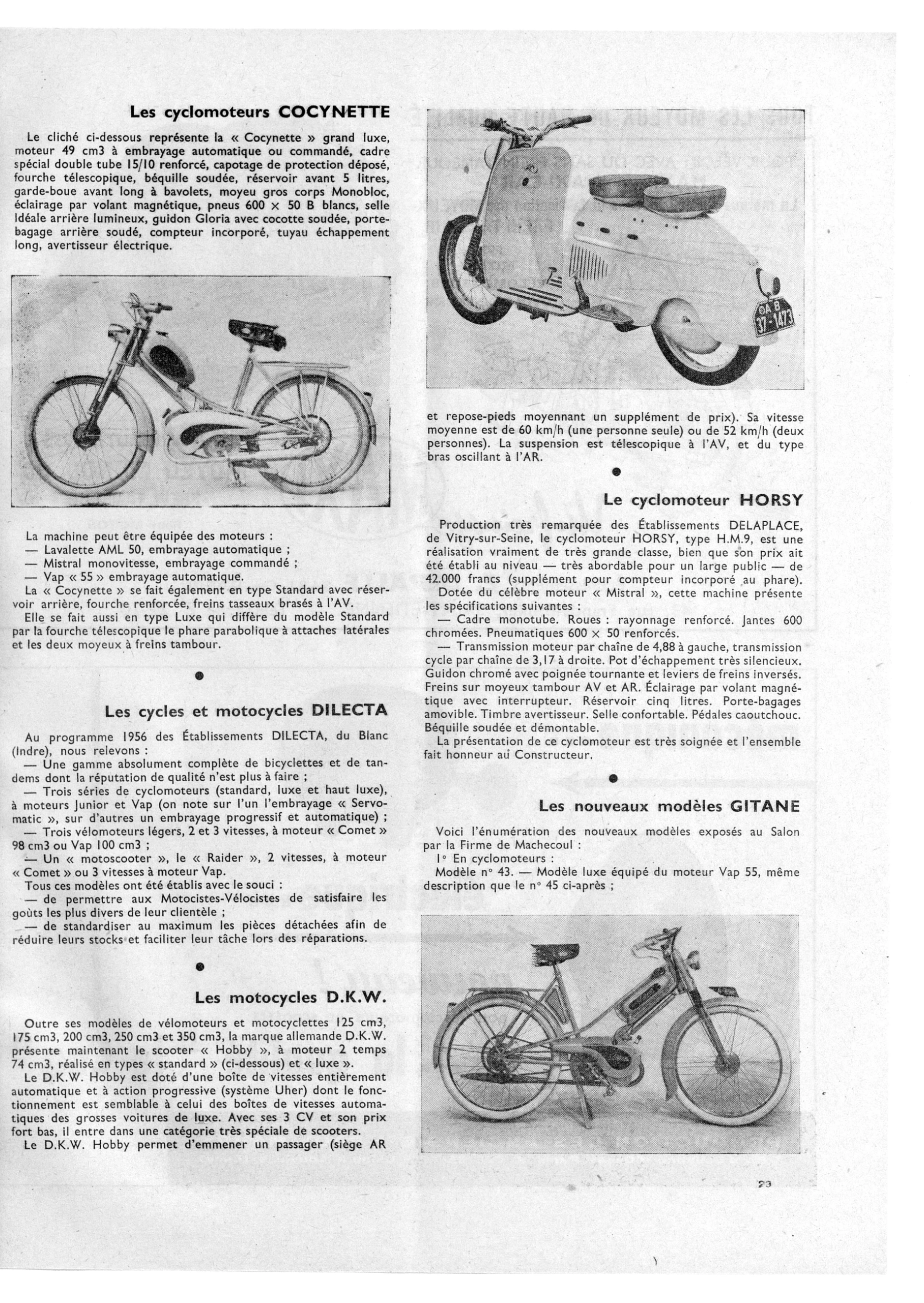
Le cliché ci-dessous représente la « Cocynette » grand luxe,
moteur 49 cm3 à embrayage automatique ou commandé, cadre
spécial double tube 15/10 renforcé, capotage de protection déposé,
fourche télescopique, béquille soudée, réservoir avant 5 litres,
garde-boue avant long à bavolets, moyeu gros corps Monobloc,
éclairage par volant magnétique, pneus 600 × 50 B blancs, selle
Idéale arrière lumineux, guidon Gloria avec cocotte soudée, porte-
bagage arrière soudé, compteur incorporé, tuyau échappement
long, avertisseur électrique.
La machine peut être équipée des moteurs :
— Lavalette AML 50, embrayage automatique ;
— Mistral monovitesse, embrayage commandé ;
— Vap « 55 » embrayage automatique.
[Ebykr summary; the article’s text is not reproduced. The Cocynette also comes in a Standard type with a rear tank, a reinforced fork and brazed shoe brakes at the front. The Luxe type differs from the Standard by its telescopic fork, a parabolic headlamp with side mounts and two drum-brake hubs. The photograph above shows the grand luxe cyclomotor.]
Les cycles et motocycles DILECTA
Au programme 1956 des Établissements DILECTA, du Blanc
(Indre), nous relevons :
— Une gamme absolument complète de bicyclettes et de tan-
dems dont la réputation de qualité n’est plus à faire ;
— Trois séries de cyclomoteurs (standard, luxe et haut luxe),
à moteurs Junior et Vap (on note sur l’un l’embrayage « Servo-
matic », sur d’autres un embrayage progressif et automatique) ;
— Trois vélomoteurs légers, 2 et 3 vitesses, à moteur « Comet »
98 cm3 ou Vap 100 cm3 ;
— Un « motoscooter », le « Raider », 2 vitesses, à moteur
« Comet » ou 3 vitesses à moteur Vap.
Tous ces modèles ont été établis avec le souci :
— de permettre aux Motocistes-Vélocistes de satisfaire les
goûts les plus divers de leur clientèle ;
— de standardiser au maximum les pièces détachées afin de
réduire leurs stocks et faciliter leur tâche lors des réparations.
[Ebykr summary, Dilecta. The list above is the firm’s 1956 program from Le Blanc (Indre): a complete range of bicycles and tandems, three series of cyclomotors, three light velomotors and one motorscooter, the Raider. The writer closes by naming the two aims of the line: letting motorcycle and bicycle dealers meet varied customer tastes, and standardizing spare parts as far as possible to cut stocks and ease repairs.]
Les motocycles D.K.W.
[Ebykr summary; the article’s text is not reproduced. Besides its velomotors and motorcycles of 125, 175, 200, 250 and 350 cc, the German marque D.K.W. now shows the “Hobby” scooter, a 74 cc two-stroke built in “standard” and “luxe” types, the standard being the one pictured (the scooter photograph at the head of the right column). The Hobby has a fully automatic gearbox of progressive action (Uher system), likened by the writer to the automatic gearboxes of large luxury cars, and with its 3 CV and very low price falls in a special category of scooters. It can carry a passenger on a rear seat with footrests for an extra charge, has an average speed of 60 km/h (one person) or 52 km/h (two), telescopic front suspension and swinging-arm rear suspension. Motorcycles and scooters only; no bicycle is described.]
Le cyclomoteur HORSY
Production très remarquée des Établissements DELAPLACE,
de Vitry-sur-Seine, le cyclomoteur HORSY, type H.M.9, est une
réalisation vraiment de très grande classe, bien que son prix ait
été établi au niveau — très abordable pour un large public — de
42.000 francs (supplément pour compteur incorporé au phare).
Dotée du célèbre moteur « Mistral », cette machine présente
les spécifications suivantes :
— Cadre monotube. Roues : rayonnage renforcé. Jantes 600
chromées. Pneumatiques 600 × 50 renforcés.
— Transmission moteur par chaîne de 4,88 à gauche, transmission
cycle par chaîne de 3,17 à droite. Pot d’échappement très silencieux.
Guidon chromé avec poignée tournante et leviers de freins inversés.
Freins sur moyeux tambour AV et AR. Éclairage par volant magné-
tique avec interrupteur. Réservoir cinq litres. Porte-bagages
amovible. Timbre avertisseur. Selle confortable. Pédales caoutchouc.
Béquille soudée et démontable.
La présentation de ce cyclomoteur est très soignée et l’ensemble
fait honneur au Constructeur.
Les nouveaux modèles GITANE
Voici l’énumération des nouveaux modèles exposés au Salon
par la Firme de Machecoul :
1° En cyclomoteurs :
Modèle n° 43. — Modèle luxe équipé du moteur Vap 55, même
description que le n° 45 ci-après ;
[Ebykr summary, Gitane. The Machecoul firm’s list of new Salon models begins with the cyclomotors; the first entry, model no. 43, is a deluxe machine with the Vap 55 engine, described as the same as no. 45, which the text says follows. The photograph below shows a Gitane cyclomotor.]
29
[A full magazine page printed in black on a cream ground, set in two columns, each section opening with a bold sans-serif heading set flush right and separated by a small round dot. The left column holds a halftone photograph of a cyclomotor with a pale frame, a front tank, a rear rack and a pale chain guard, drawn side-on in a thin ruled box under the Cocynette text. The right column opens with a halftone photograph of a pale scooter with a flat front shield, twin separate seats and a small rectangular license plate, shown from the front quarter in a ruled box, and closes with a halftone photograph of a cyclomotor with a front-mounted tank and rear rack in a ruled box. Ghost lettering and a faint ruled box from the reverse of the leaf show through behind the scooter photograph and the Horsy text. No captions are printed under the photographs. The page number 29, printed faintly, sits at the lower right below the last photograph. No signature or agency mark is visible.]
— Page 4 —
Modèle n° 45. — Moteur Mistral, embrayage automatique,
fourche télescopique, éclairage phare et code par projecteur de 100,
moyeux-freins AV et AR, tambour Monobloc, avertisseur électrique,
tuyau d’échappement long chromé ;
Modèle n° 50 équipé du Vap 55 ; modèle grand luxe, même
description que le n° 55 ci-après ;
Modèle n° 55 équipé du Mistral ; modèle grand luxe, fourche
télescopique renforcée avec enjoliveur, éclairage phare et code
pour projecteur de 100, chromé avec compteur incorporé, moyeux-
freins AV et AR, tambour Monobloc, avertisseur électrique, tuyau
d’échappement chromé, carénage et garde-boue très enveloppants
assurant une grande protection.
2° En vélomoteurs :
Type M 110 sport équipé du moteur 98 Mistral et de la selle
biplace, deux vitesses par poignée tournante au guidon, réservoir
huit litres, jantes chromées avec pneus de 600 × 65, moyeux-
freins tambour type Monobloc, projecteur phare et code 130 mm,
avec compteur kilométrique incorporé, avertisseur électrique,
carénage du moteur, sacoche avec outillage, pare-jambes chromé ;
Type V 100 sport équipé du moteur 100 cm3 ABG, trois vitesses
par poignée tournante.
3° En motocyclettes :
GYL sport équipé du 175 Ydral, moyeux Monobloc, suspension
oscillante, réservoir sport quatorze litres, selle biplace, carénage
sur demande. Le même modèle existe avec le moteur 125 cm3
Ydral.
L’ « Ondine » LUCER
[Ebykr summary; the article’s text is not reproduced. The item is announced for series production in the last days of December. The punches and dies needed to stamp the plastic bodywork weigh five tons of special steel in all. Cycles Lucer are also quickly preparing the tooling required for the thirty-four cut or stamped parts that complete the mechanical assembly. Negotiations are under way for manufacture of the Ondine under license in Belgium and Switzerland. For the home market the possible production rates are already absorbed by orders on the books until April 1956.]
Le vélomoteur ISOFLEX
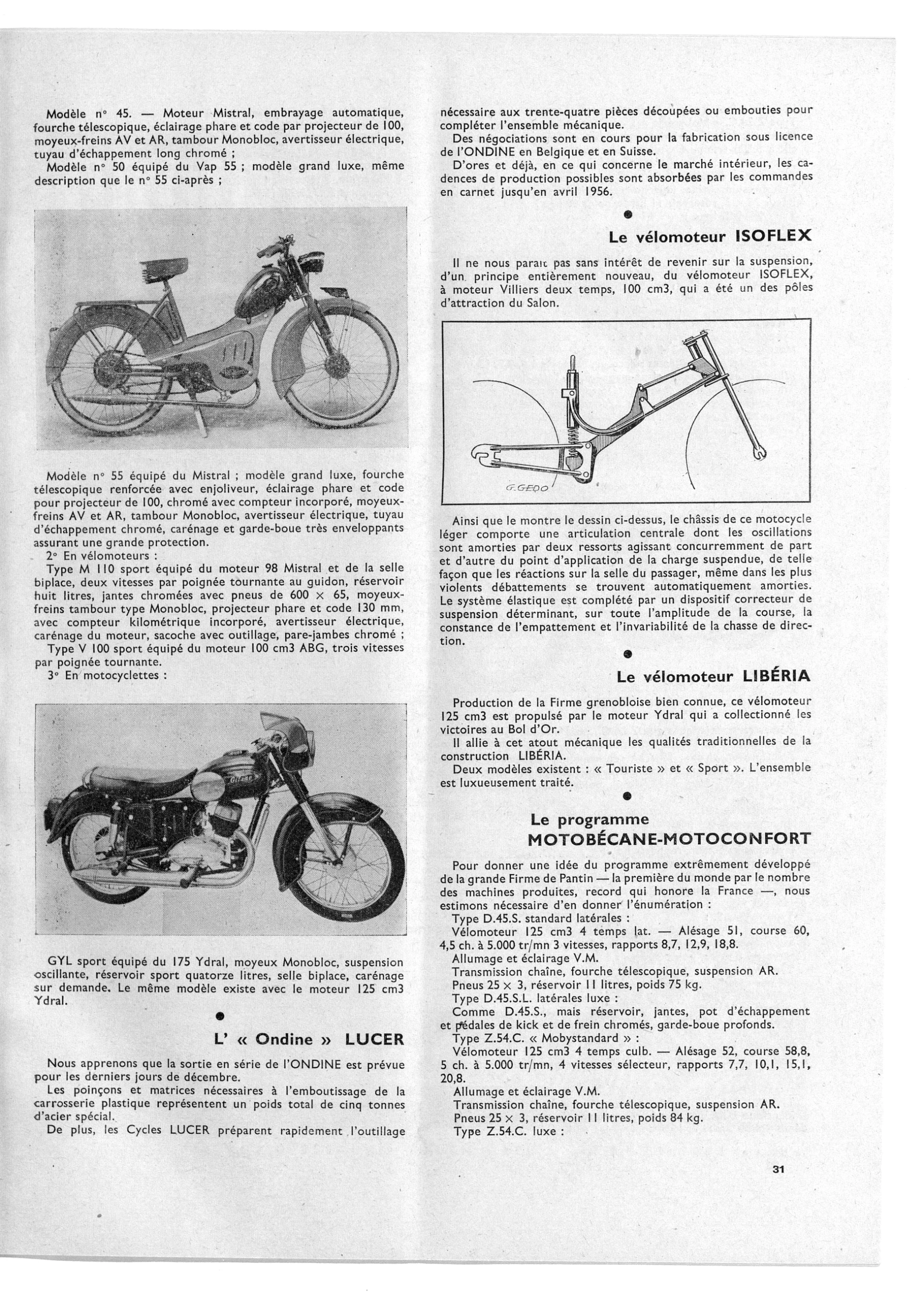
[Ebykr summary; the article’s text is not reproduced. The author returns to the entirely new suspension principle of the Isoflex motorized bicycle, fitted with a 100 cc two-stroke Villiers engine, which was one of the attractions of the Salon. The line drawing above shows that the frame of this light motorcycle has a central articulation whose oscillations are damped by two springs acting on either side of the point where the sprung load is applied, so that reactions at the passenger saddle are damped automatically even in the most violent movements. The elastic system is completed by a suspension corrector that keeps the wheelbase constant and the steering trail invariable over the whole travel.]
Le vélomoteur LIBÉRIA
[Ebykr summary; the article’s text is not reproduced. A product of the well-known Grenoble firm, this 125 cc motorized bicycle is driven by the Ydral engine that has collected the victories in the Bol d’Or, and it pairs that mechanical asset with the traditional qualities of Libéria construction. Two models exist, “Touriste” and “Sport”, and the whole is luxuriously finished.]
Le programme
MOTOBÉCANE-MOTOCONFORT
[Ebykr summary; the article’s text is not reproduced. To give an idea of the very extensive program of the large Pantin firm, described as the first in the world by number of machines produced, the author lists it as follows.]
Type D.45.S. standard latérales :
Vélomoteur 125 cm3 4 temps lat. — Alésage 51, course 60,
4,5 ch. à 5.000 tr/mn 3 vitesses, rapports 8,7, 12,9, 18,8.
Allumage et éclairage V.M.
Transmission chaîne, fourche télescopique, suspension AR.
Pneus 25 × 3, réservoir 11 litres, poids 75 kg.
Type D.45.S.L. latérales luxe :
Comme D.45.S., mais réservoir, jantes, pot d’échappement
et pédales de kick et de frein chromés, garde-boue profonds.
Type Z.54.C. « Mobystandard » :
Vélomoteur 125 cm3 4 temps culb. — Alésage 52, course 58,8,
5 ch. à 5.000 tr/mn, 4 vitesses sélecteur, rapports 7,7, 10,1, 15,1,
20,8.
Allumage et éclairage V.M.
Transmission chaîne, fourche télescopique, suspension AR.
Pneus 25 × 3, réservoir 11 litres, poids 84 kg.
Type Z.54.C. luxe :
31
[A text page of a trade survey, set in two columns of a humanist sans-serif roman type with bold sans-serif headings that are set toward the right of each column and separated by small black round ornaments. The upper left column holds a halftone photograph with a screened dot texture that shows a moped from the front three-quarter view, with a flat saddle, a teardrop-shaped fuel tank over the frame, a telescopic fork and wide enveloping fenders over spoked wheels. The right column holds a framed line drawing of the central articulated frame of a light motorcycle, with a vertical spring-and-damper unit, a curved frame member, a swinging rear fork and a leading link front fork, drawn in black line with fine hatching and signed “G. GEDO” at the lower left of the frame. A second framed halftone photograph in the lower left column shows a sport motorcycle from the front right, with a small fairing over the headlamp, a long tank, a dual seat, an exposed engine and a rear fork. The page number 31 sits in bold at the lower right of the right column, and the lower part of the left column is blank.]
— Page 5 —
Réservoir, jantes et pot d’échappement chromés.
Type Z.24.C. « Mobysérie » :
Motocyclette 175 cm3 4 temps culb. — Alésage 56, course 71,
7 ch. à 5.500 tr/mn, 4 vitesses sélecteur, rapports 6,8, 8,9, 13,3,
18,3.
Allumage et éclairage V.M.
Transmission chaîne, fourche télescopique, suspension AR.
Pneus 25 × 3, réservoir 11 litres, poids 90 kg.
Type Z.24.C. luxe :
Réservoir, jantes et pot d’échappement chromés.
Type Z.56.C. « Mobyclub 56 » :
Vélomoteur 125 cm3 4 temps culb. — Alésage 52, course 58,8,
5 ch. à 5.000 tr/mn, 4 vitesses sélecteur, rapports 7,7, 10,1, 15,1, 20,8.
Allumage et éclairage, volant magnétique, batterie.
Transmission chaîne, fourche télescopique, suspension AR par
bras oscillant avec amortisseurs hydrauliques double effet.
Pneus 18 × 3, réservoir 11 litres, poids 97 kg.
Type Z.26.C. « Mobysport 56 » :
Motocyclette 175 cm3 4 temps culb. — Alésage 56, course 71,
7 ch. à 5.500 tr/mn, 4 vitesses sélecteur, rapports 6,8, 8,9, 13,3, 18,3.
Allumage et éclairage, volant magnétique, batterie.
Transmission chaîne, fourche télescopique, suspension AR par
bras oscillant avec amortisseurs hydrauliques double effet.
Pneus 18 × 3, réservoir 11 litres, poids 98 kg.
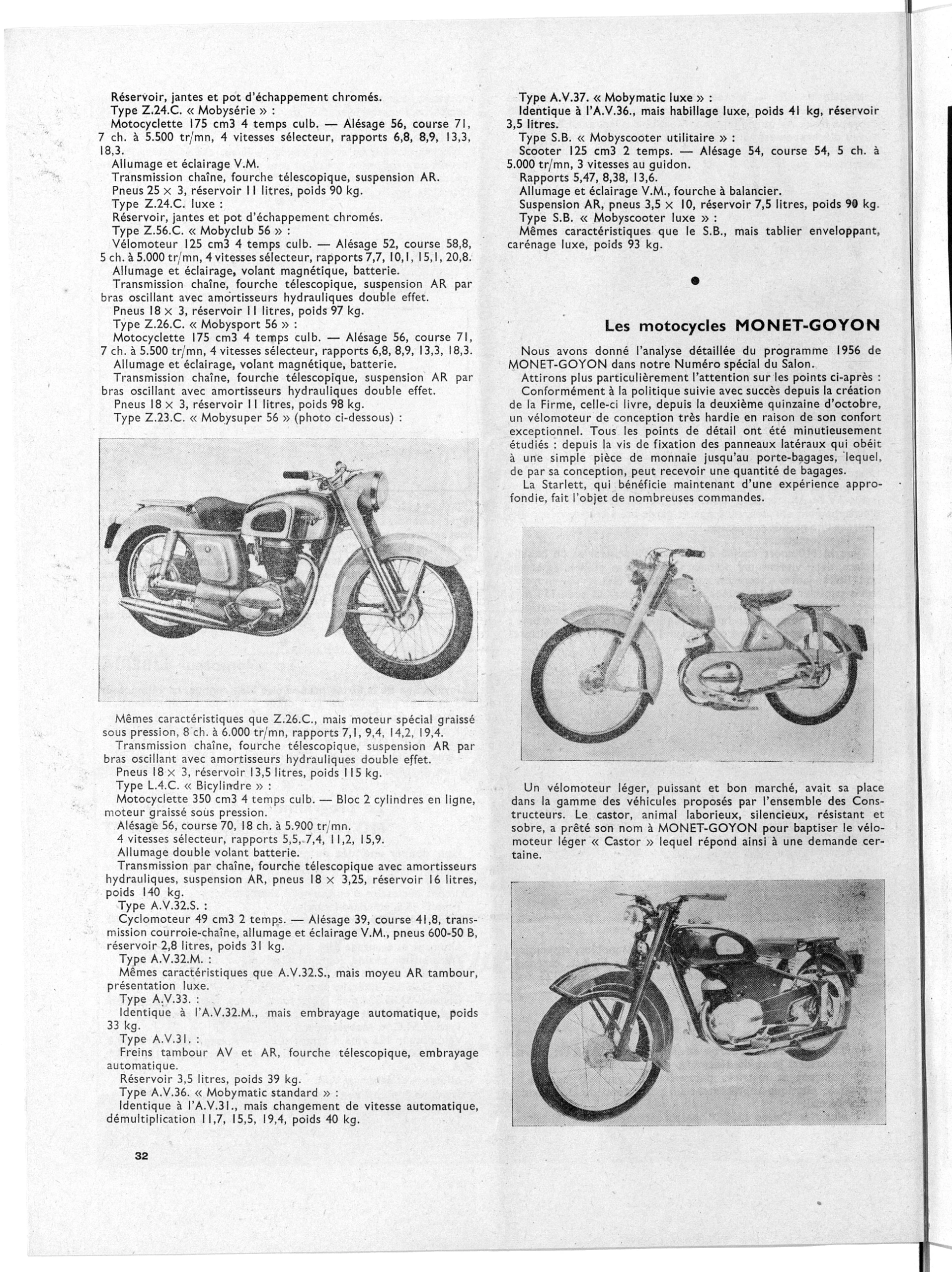
Type Z.23.C. « Mobysuper 56 » (photo ci-dessous) :
Mêmes caractéristiques que Z.26.C., mais moteur spécial graissé
sous pression, 8 ch. à 6.000 tr/mn, rapports 7,1, 9,4, 14,2, 19,4.
Transmission chaîne, fourche télescopique, suspension AR par
bras oscillant avec amortisseurs hydrauliques double effet.
Pneus 18 × 3, réservoir 13,5 litres, poids 115 kg.
Type L.4.C. « Bicylindre » :
Motocyclette 350 cm3 4 temps culb. — Bloc 2 cylindres en ligne,
moteur graissé sous pression.
Alésage 56, course 70, 18 ch. à 5.900 tr/mn.
4 vitesses sélecteur, rapports 5,5, 7,4, 11,2, 15,9.
Allumage double volant batterie.
Transmission par chaîne, fourche télescopique avec amortisseurs
hydrauliques, suspension AR, pneus 18 × 3,25, réservoir 16 litres,
poids 140 kg.
Type A.V.32.S. :
Cyclomoteur 49 cm3 2 temps. — Alésage 39, course 41,8, trans-
mission courroie-chaîne, allumage et éclairage V.M., pneus 600-50 B,
réservoir 2,8 litres, poids 31 kg.
Type A.V.32.M. :
Mêmes caractéristiques que A.V.32.S., mais moyeu AR tambour,
présentation luxe.
Type A.V.33. :
Identique à l’A.V.32.M., mais embrayage automatique, poids
33 kg.
Type A.V.31. :
Freins tambour AV et AR, fourche télescopique, embrayage
automatique.
Réservoir 3,5 litres, poids 39 kg.
Type A.V.36. « Mobymatic standard » :
Identique à l’A.V.31., mais changement de vitesse automatique,
démultiplication 11,7, 15,5, 19,4, poids 40 kg.
Type A.V.37. « Mobymatic luxe » :
Identique à l’A.V.36., mais habillage luxe, poids 41 kg, réservoir
3,5 litres.
Type S.B. « Mobyscooter utilitaire » :
Scooter 125 cm3 2 temps. — Alésage 54, course 54, 5 ch. à
5.000 tr/mn, 3 vitesses au guidon.
Rapports 5,47, 8,38, 13,6.
Allumage et éclairage V.M., fourche à balancier.
Suspension AR, pneus 3,5 × 10, réservoir 7,5 litres, poids 90 kg.
Type S.B. « Mobyscooter luxe » :
Mêmes caractéristiques que le S.B., mais tablier enveloppant,
carénage luxe, poids 93 kg.
Les motocycles MONET-GOYON
[Ebykr summary; the article’s text is not reproduced. The author notes that the detailed analysis of the 1956 Monet-Goyon program was given in the weekly’s special Salon number and draws attention to a few points. In keeping with the policy followed with success since the firm was founded, it has been delivering since the second half of October a motorized bicycle of very bold design for its exceptional comfort. Every detail was studied minutely, from the fastening screw of the side panels, which yields to a simple coin, to the luggage carrier, which by its design can take a quantity of baggage. The Starlett, which now benefits from deeper experience, is the subject of many orders.]
[Ebykr summary; the article’s text is not reproduced. A light, powerful and inexpensive motorized bicycle had its place in the range of vehicles offered by the manufacturers as a whole. The beaver, a hardworking, quiet, resistant and sober animal, lent its name to Monet-Goyon to christen the light motorized bicycle “Castor”, which thus answers a definite demand.]
32
[A text page of a trade survey, set in two columns of a humanist sans-serif roman type, with the specification lists in short indented lines and a bold sans-serif heading, “Les motocycles MONET-GOYON”, set toward the right of the right column under a small black round ornament. Three halftone photographs with screened dot texture and thin ruled edges carry no captions. The first, in the lower left column, shows a motorcycle from the front right with a small headlamp cowl, a rounded tank with a knee recess, a dual seat, a telescopic fork, a shaped engine casing and a rear fork, over spoked wheels with valanced fenders. The second, in the right column, shows a light motorized bicycle from the front left with a flat saddle, a small tank, a luggage rack over the rear wheel and a large enclosed chain-and-engine casing. The third, below it, shows a motorcycle from the front left with a long front fender, a rounded tank with a cutout panel, a dual seat and a boxed engine unit. The page number 32 sits in bold at the lower left, and the foot of the right column is blank.]
— Page 6 —
[Ebykr summary, continued from the preceding page and naming no marque here; the article’s text is not reproduced. The firm finally keeps in its range a classic motorized bicycle and a classic motorcycle that have proved themselves, the S 6 V S and the M 2 V DO.]
Le vélomoteur « Escapade » NEW-MAP
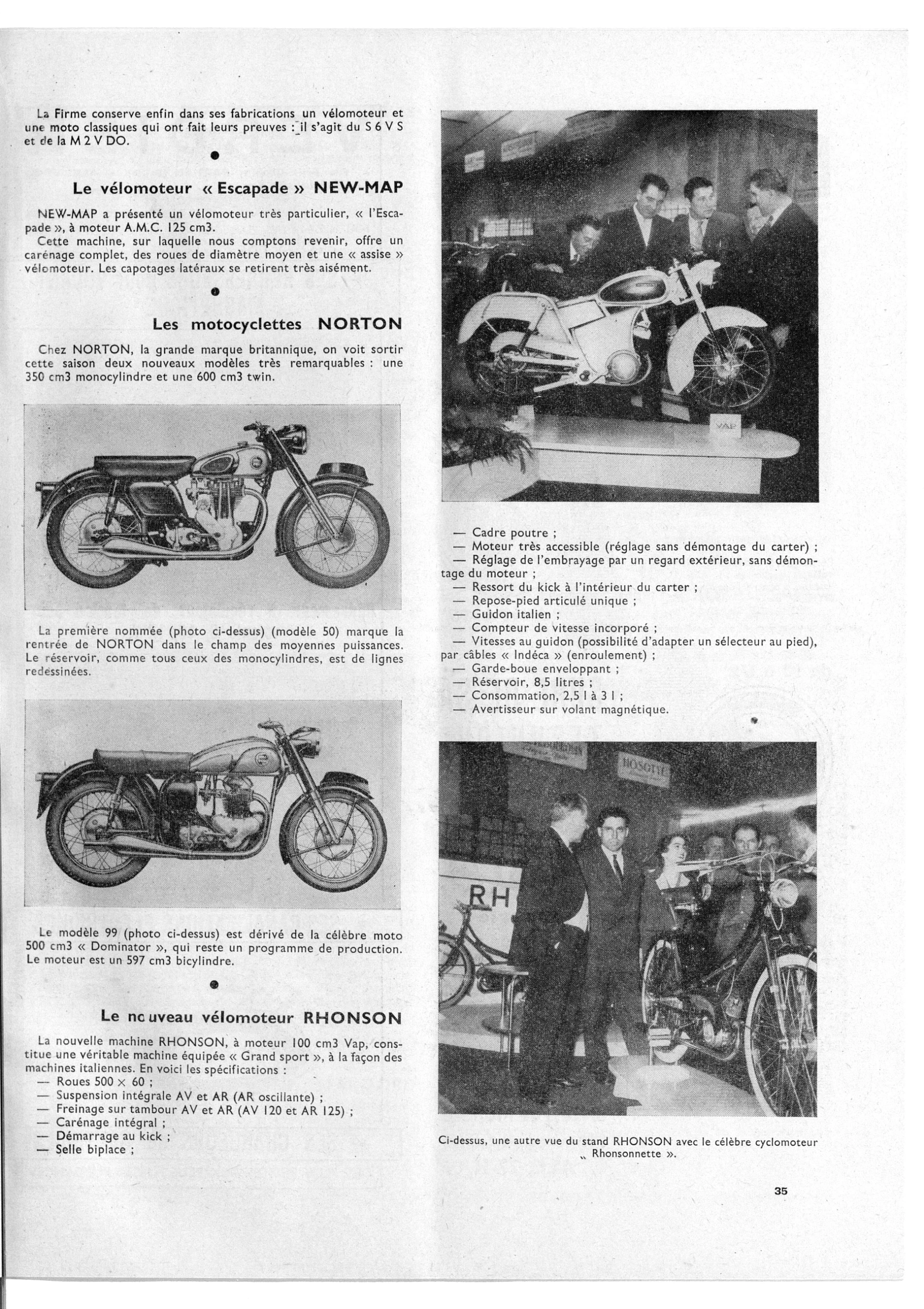
[Ebykr summary; the article’s text is not reproduced. New-Map presented a very particular motorized bicycle, the “Escapade”, with a 125 cc A.M.C. engine. The author expects to return to this machine, which offers complete fairing, medium-diameter wheels and a motorized-bicycle “seat”, and whose side covers come off very easily.]
Les motocyclettes NORTON
[Ebykr summary; the article’s text is not reproduced. Norton, the great British marque, is bringing out two very remarkable new models this season, a 350 cc single and a 600 cc twin. The first named (photo above, model 50) marks Norton’s return to the field of medium power, and its tank, like all those of the singles, has redrawn lines. Model 99 (photo above) derives from the celebrated 500 cc “Dominator” motorcycle, which remains in the production program, and its engine is a 597 cc twin.]
Le nouveau vélomoteur RHONSON
[Ebykr summary; the article’s text is not reproduced. The new Rhonson machine, with a 100 cc Vap engine, is a true “Grand sport” machine in the manner of Italian machines. Its specifications follow.]
— Roues 500 × 60 ;
— Suspension intégrale AV et AR (AR oscillante) ;
— Freinage sur tambour AV et AR (AV 120 et AR 125) ;
— Carénage intégral ;
— Démarrage au kick ;
— Selle biplace ;
— Cadre poutre ;
— Moteur très accessible (réglage sans démontage du carter) ;
— Réglage de l’embrayage par un regard extérieur, sans démontage du moteur ;
— Ressort du kick à l’intérieur du carter ;
— Repose-pied articulé unique ;
— Guidon italien ;
— Compteur de vitesse incorporé ;
— Vitesses au guidon (possibilité d’adapter un sélecteur au pied), par câbles « Indéca » (enroulement) ;
— Garde-boue enveloppant ;
— Réservoir, 8,5 litres ;
— Consommation, 2,5 l à 3 l ;
— Avertisseur sur volant magnétique.
Ci-dessus, une autre vue du stand RHONSON avec le célèbre cyclomoteur
„ Rhonsonnette ».
35
[A text and photograph page of a trade survey, set in two columns of a humanist sans-serif roman type, with bold sans-serif headings set toward the right of the column and separated by small black round ornaments. The upper right column holds a large halftone photograph without a caption, taken at an exhibition hall, of four men in dark suits leaning over a light-colored display motorcycle with a long tank, enclosed frame panels and a telescopic front fork on an oval raised platform, with a small card reading “VAP” at the front edge of the platform. The left column holds two framed halftone photographs of motorcycles shown from the right side, each with a dual seat, a tank with a knee recess, a visible vertical single-cylinder engine in the first and a twin-cylinder engine in the second, and spoked wheels. At the lower right a halftone photograph of a stand shows several men and a woman standing around a motorized bicycle with a round headlamp and a bicycle in the background, with a sign bearing the letters “RH” at the left edge; the caption sits centered beneath it. The page number 35 sits in bold at the lower right.]
— Page 7 —
Les modèles 56 RIVA-SPORT INDUSTRIES
[Ebykr summary; the article’s text is not reproduced. The opening paragraph recalls that the first Compte rendu issue gave the characteristics of the 1956 version of the 100 cm3 “Sulky” vélomoteur from Riva-Sport Industries, a motorized-bicycle machine and not a pedal bicycle.]
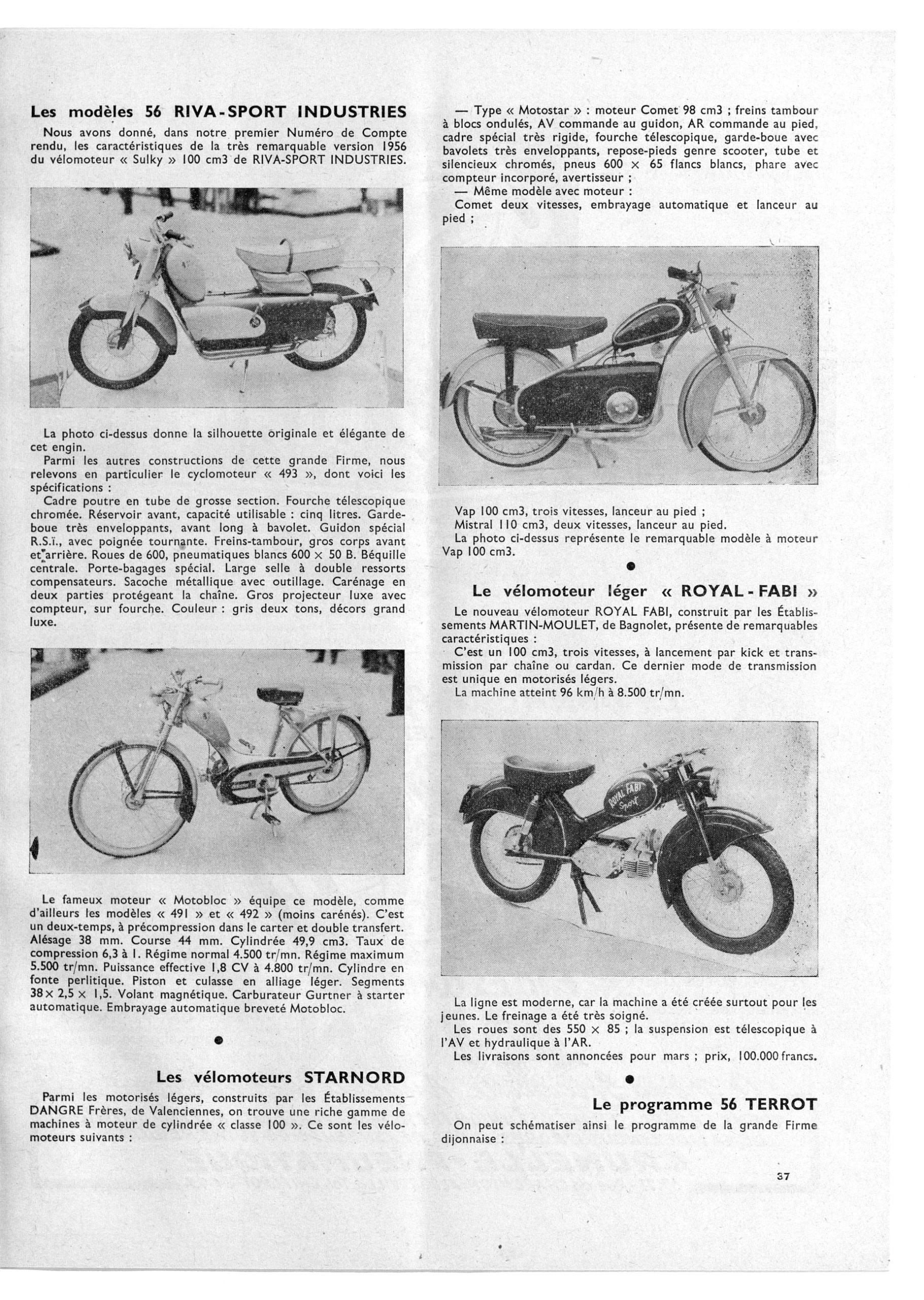
La photo ci-dessus donne la silhouette originale et élégante de cet engin.
[Ebykr summary; the article’s text is not reproduced. Among the firm’s other machines the writer singles out the “493” cyclomoteur and lists its specification, given here as printed.]
Cadre poutre en tube de grosse section. Fourche télescopique chromée. Réservoir avant, capacité utilisable : cinq litres. Garde-boue très enveloppants, avant long à bavolet. Guidon spécial R.S.ï., avec poignée tournante. Freins-tambour, gros corps avant et arrière. Roues de 600, pneumatiques blancs 600 × 50 B. Béquille centrale. Porte-bagages spécial. Large selle à double ressorts compensateurs. Sacoche métallique avec outillage. Carénage en deux parties protégeant la chaîne. Gros projecteur luxe avec compteur, sur fourche. Couleur : gris deux tons, décors grand luxe.
[Ebykr summary; the article’s text is not reproduced. Under the second photograph the writer says the “Motobloc” engine powers this model, as it does the less enclosed “491” and “492” models, and gives the engine data as printed below.]
Alésage 38 mm. Course 44 mm. Cylindrée 49,9 cm3. Taux de compression 6,3 à 1. Régime normal 4.500 tr/mn. Régime maximum 5.500 tr/mn. Puissance effective 1,8 CV à 4.800 tr/mn. Cylindre en fonte perlitique. Piston et culasse en alliage léger. Segments 38 × 2,5 × 1,5. Volant magnétique. Carburateur Gurtner à starter automatique. Embrayage automatique breveté Motobloc.
●
Les vélomoteurs STARNORD
[Ebykr summary; the article’s text is not reproduced. The motorized lightweights built by the Établissements Dangre Frères of Valenciennes form a rich range of “classe 100” vélomoteurs, listed as follows.]
— Type « Motostar » : moteur Comet 98 cm3 ; freins tambour à blocs ondulés, AV commande au guidon, AR commande au pied, cadre spécial très rigide, fourche télescopique, garde-boue avec bavolets très enveloppants, repose-pieds genre scooter, tube et silencieux chromés, pneus 600 × 65 flancs blancs, phare avec compteur incorporé, avertisseur ;
— Même modèle avec moteur :
Comet deux vitesses, embrayage automatique et lanceur au pied ;
Vap 100 cm3, trois vitesses, lanceur au pied ;
Mistral 110 cm3, deux vitesses, lanceur au pied.
La photo ci-dessus représente le remarquable modèle à moteur Vap 100 cm3.
●
Le vélomoteur léger « ROYAL-FABI »
[Ebykr summary; the article’s text is not reproduced. The new Royal Fabi vélomoteur, built by the Établissements Martin-Moulet of Bagnolet, is a 100 cm3 three-speed machine with kick starting and transmission by chain or by shaft; the writer calls the shaft drive unique among light motorized machines and says the machine reaches 96 km/h at 8.500 tr/mn. After the photograph he says the line is modern because the machine was created above all for young riders, that the braking has been carefully done, that the wheels are 550 × 85 with telescopic suspension at the front and hydraulic suspension at the rear, and that deliveries are announced for March at a price of 100.000 francs.]
●
Le programme 56 TERROT
[Ebykr summary; the article’s text is not reproduced. The section opens with one line saying the program of the large Dijon firm can be set out in outline; the list itself falls on the following page.]
37
[A full printed page of a trade survey, set in two justified columns of a sans-serif text face with bold sans-serif section headings, some of them set flush right and the first across the full width of the left column. Four rectangular halftone photographs of motorized machines, each in a thin ruled frame, sit in the columns. At the upper left a step-through moped is shown from the side with a long dual saddle, a large enclosed body between the wheels, deep rounded mudguards and a front fork. At the left below it a pedal-framed machine with a small saddle, a tank in the frame, a chain case along the lower tube, spoked wheels and mudguards, stands on a pale floor. At the upper right a light motorcycle is shown from the side with a long dark saddle, a dark tank, a large dark side casing, a telescopic fork and deep front and rear mudguards. At the lower right a dark machine is seen from the front three-quarter angle, with an oval tank bearing the words “Royal Fabi Sport”, a deep dark front mudguard, a finned engine below the frame and a prop stand. Black round bullets separate the sections. The page number 37 sits at the foot of the right column. No artist signature is visible. The foot of the left column and the right column below the Terrot line are blank.]
— Page 8 —
[Ebykr summary, continuing the Terrot program from the previous page; the article’s text is not reproduced. Among cyclomoteurs, the single-speed “Lutin” is to be joined by a two-speed cyclomoteur.]
[Ebykr summary; the article’s text is not reproduced. Under the photograph the writer says the 100 cm3 T.V.M.L. vélomoteur is a strictly utilitarian type, with an open frame, deep enclosure of the mechanism including the drive chain, and a sturdy telescopic fork. Its drum brakes are 115 mm in diameter, and the engine is a two-stroke Villiers licence with two speeds worked from the handlebar by a mechanism linked with the clutch release. Starting from an overhead-valve engine with continuous fully mechanical lubrication, built in unit with a four-speed gearbox worked by a foot selector, Terrot has set up a homogeneous range of three 125 cm3 vélomoteur models with many points in common. The E.T.M. has its own telescopic fork with simple spring damping and drum brakes of 100 mm at the front and 130 mm at the rear; the other two have full front and rear suspension, by a telescopic fork with double-acting hydraulic damping and a hydraulically damped swinging arm at the rear, a technique already perfected on the 250 cm3 O.S.S.D., with 130 mm brakes front and rear. The latest type, the E.T.D.S., on sale for some months, resembles the E.T.M.4.S mechanically but takes more care over its ancillary equipment and has a pleasant general line with protective covers, a headlamp molded into the front fork and deep mudguards. Terrot showed a second 125 cm3 scooter at the Salon, the “Scooterrot”, which complements the present V.M.S.2 and whose main feature is a three-speed preselective gearbox; the preselection is made with a handlebar grip on the left that moves against a fixed mark showing neutral, first, second or third, and the change is made by a floor pedal worked with the toe, which acts like the clutch pedal of a car. Among motorcycles, the 250 cm3 has been modified again in some details: the lubrication of the upper engine, at the valve-gear cage, has been restudied to prevent over-oiling that fouled the spark plug, the gear-change pinions have been redrawn and are now insensitive to centrifugal force, and the rear-suspension swinging arm has been lightened with a new profile. The writer adds that at the top of the range Terrot remains, with its 500 cm3, the principal supplier of the French Army.]
●
La production 1956 VESPA
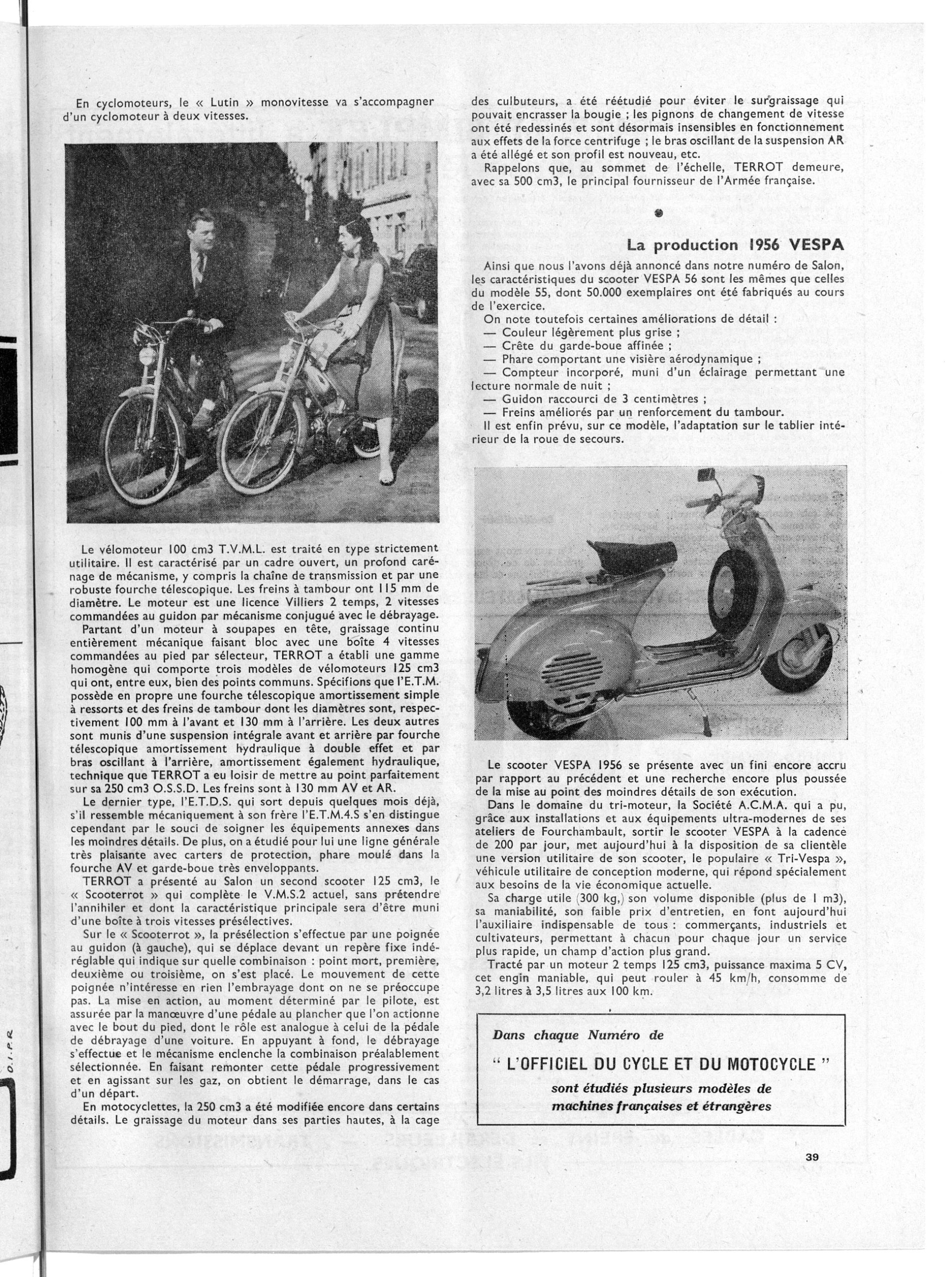
[Ebykr summary; the article’s text is not reproduced. As already announced in the Salon number, the specifications of the 1956 Vespa scooter are those of the 1955 model, of which 50.000 were built during the year. Certain detail improvements are listed as printed.]
— Couleur légèrement plus grise ;
— Crête du garde-boue affinée ;
— Phare comportant une visière aérodynamique ;
— Compteur incorporé, muni d’un éclairage permettant une lecture normale de nuit ;
— Guidon raccourci de 3 centimètres ;
— Freins améliorés par un renforcement du tambour.
[Ebykr summary; the article’s text is not reproduced. The writer adds that the fitting of the spare wheel on the inner apron is planned on this model. After the photograph he says the 1956 Vespa has an even higher finish and more refined attention to detail. In the three-wheeler field, the Société A.C.M.A., which turns out the Vespa scooter at 200 a day from its Fourchambault works, now offers the popular “Tri-Vespa”, a modern utility vehicle with a payload of 300 kg, a load volume of more than 1 m3, easy handling and low running cost, aimed at tradesmen, manufacturers and farmers. It has a two-stroke 125 cm3 engine of 5 CV maximum, runs at 45 km/h and uses 3,2 to 3,5 liters per 100 km.]
Dans chaque Numéro de
” L’OFFICIEL DU CYCLE ET DU MOTOCYCLE ”
sont étudiés plusieurs modèles de
machines françaises et étrangères
39
[A full printed page of a trade survey, set in two justified columns of a sans-serif text face with bold sans-serif headings and round black bullets between the sections. The page opens in the middle of a section, with no heading above the first line at the top left. Two rectangular halftone photographs sit in thin ruled frames. The first, in the left column, shows a young man in a dark suit and tie standing beside a pedal-framed motorized bicycle with his hands on the handlebars, and a young woman in a sleeveless dress seated on a second similar machine with one foot down, on a street in front of tall stone buildings; each machine has a round headlamp, a chain guard and a small engine below the frame. The second, in the right column, shows a scooter from the side with a long dark saddle, a spare wheel upright on the apron behind the steering column, a louvered engine cowl low on the rear body, a small front mudguard and a stand, with a single mirror at the end of the handlebar. At the foot of the right column a ruled rectangular panel carries a house advertisement of the magazine: an italic line, the title in tall condensed capitals between quotation marks, and two italic lines below. The page number 39 sits at the lower right. No artist signature is visible. A strip of the neighboring leaf shows along the left edge, with black ruled shapes and the vertical letters O.I.P.R, and a faint ghost of the reverse side shows near the foot of the page.]
Ebykr presents this material for research and education. If you hold rights to it or notice an ownership issue, please contact us and we will respond promptly.
The Ebykr Digest
New articles, timelines, catalog finds and registry activity — assembled from the archive once a month. Your address is never shared.
Double opt-in. One email per month. Unsubscribe at any time with one click.