About Ebykr
Ebykr celebrates classic and vintage lightweight bicycles through provocative imagery and opinion. Ride along with us.
About Ebykr
Ebykr celebrates classic and vintage lightweight bicycles through provocative imagery and opinion. Ride along with us.

Source: Gallica (Bibliothèque nationale de France), L'Officiel du cycle, du motocycle et du camping, 5 March 1955, N° 5, page 5; ark:/12148/bd6t541823479. Source gallica.bnf.fr / BnF.
| Type | Review |
|---|---|
| Year | 1955 |
| Publisher | L'Officiel du cycle |
| Country | France |
| Language | French |
| Pages | 1 |
| Source | Gallica (Bibliothèque nationale de France), L'Officiel du cycle, du motocycle et du camping, 5 March 1955, N° 5, page 5; ark:/12148/bd6t541823479. Source gallica.bnf.fr / BnF. |
| Credit | Ebykr archive; Bibliothèque nationale de France |
| Identifier | Gallica (BnF) ark:/12148/bd6t541823479/f5 |
| Transcription | Headings and specifications transcribed; article text summarized |
Reference
"La bicyclette passionne toujours les chercheurs." L'Officiel du cycle, 5 March 1955. Ebykr, https://ebykr.com/library/lofficiel-du-cycle-1955-03-05-bicyclette-chercheurs-lettre-fretay/.
Wikipedia
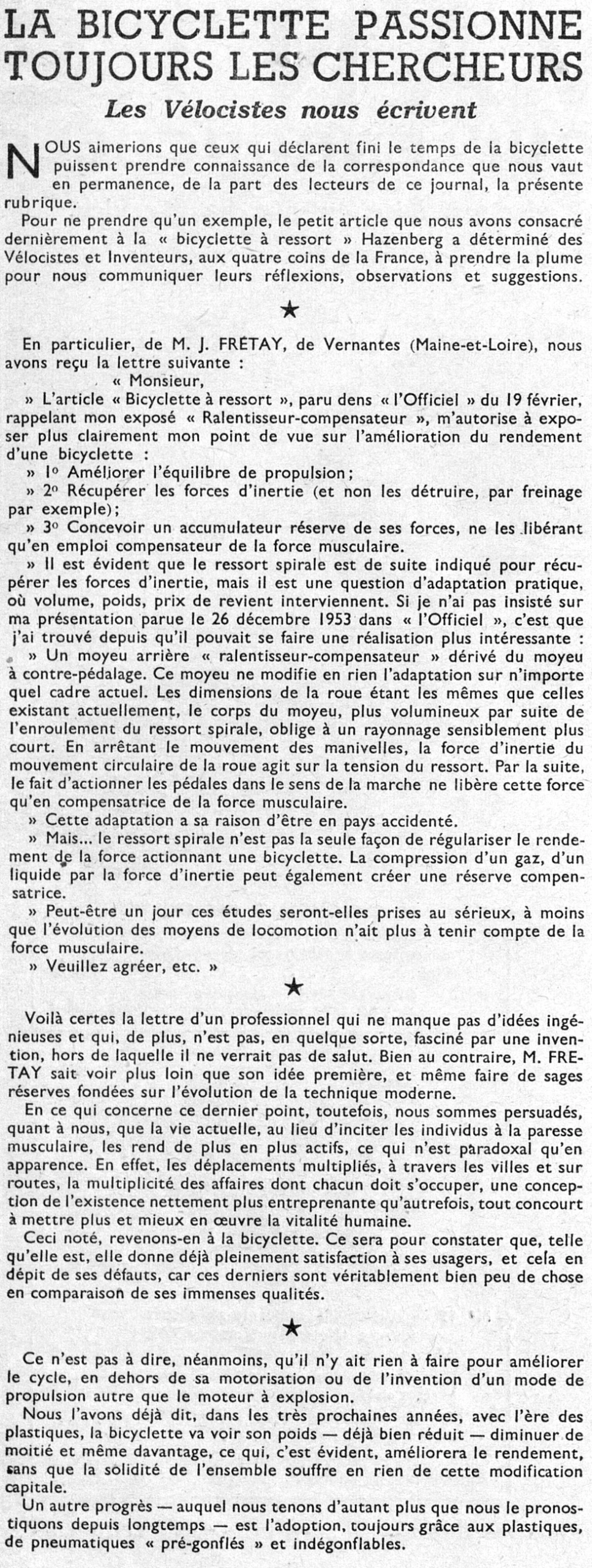
{{cite magazine |title=La bicyclette passionne toujours les chercheurs |magazine=L'Officiel du cycle |date=5 March 1955 |language=French |url=https://ebykr.com/library/lofficiel-du-cycle-1955-03-05-bicyclette-chercheurs-lettre-fretay/ |via=Ebykr |access-date=}}LA BICYCLETTE PASSIONNE TOUJOURS LES CHERCHEURS Les Vélocistes nous écrivent ★ En particulier, de M. J. FRÉTAY, de Vernantes (Maine-et-Loire), nous avons reçu la lettre suivante : ★ ★
This is a magazine article, so its running text is summarized here rather than reproduced; the headline, byline, specifications and scores are transcribed as printed.
From L’Officiel du cycle, du motocycle et du camping, 5 March 1955, N° 5, page 5: ‘La bicyclette passionne toujours les chercheurs – Les Vélocistes nous écrivent’: reader letter from M. J. Fretay of Vernantes proposing a spring or gas energy store in the rear hub of the bicycle, with the editor’s comment. The title, headings, captions and lists are transcribed as printed; the text is summarized in Ebykr’s words, and the page images carry it in full.
— Page 1 —
LA BICYCLETTE PASSIONNE
TOUJOURS LES CHERCHEURS
Les Vélocistes nous écrivent
[Ebykr summary; the article’s text is not reproduced. The editors say they wish that those who declare the age of the bicycle over could read the correspondence that this column regularly brings them from the journal’s readers. As one example, the short piece they recently devoted to the Hazenberg “spring bicycle” (“bicyclette à ressort”) led Vélocistes and inventors from all corners of France to write in with reflections, observations and suggestions.]
★
En particulier, de M. J. FRÉTAY, de Vernantes (Maine-et-Loire), nous
avons reçu la lettre suivante :
[Ebykr summary of the letter; the letter’s text is not reproduced. Writing about the 19 February article “Bicyclette à ressort”, which recalled his earlier paper “Ralentisseur-compensateur”, M. Frétay sets out three aims for improving the efficiency of a bicycle: first, improve the balance of propulsion; second, recover inertia forces rather than destroy them, by braking for example; third, devise an accumulator that holds a reserve of the rider’s strength and releases it only to compensate for muscular force. He grants that a spiral spring is the obvious means of recovering inertia but says volume, weight and cost price limit its practical use, and that he did not press his presentation of 26 December 1953 because he has since found a more interesting design: a rear hub, the “ralentisseur-compensateur”, derived from the coaster-brake hub. It fits any present frame; the hub body, bulkier because of the coiled spring, requires noticeably shorter spokes. When the cranks stop, the inertia of the turning wheel loads the spring, and pedaling forward afterward releases that force only to supplement muscular effort. He sees the design as justified in hilly country. He adds that a spiral spring is not the only way to even out the force driving a bicycle: compressing a gas or a liquid with inertia could also make a compensating reserve. He closes by hoping these studies may one day be taken seriously, unless the evolution of transport no longer has to count on muscular force, and ends with the usual courtesy formula.]
★
[Ebykr summary, after a star break; the article’s text is not reproduced. The editors call it the letter of a professional full of ingenious ideas who is not fascinated by an invention outside which he sees no salvation: M. Frétay sees beyond his first idea and even makes wise reservations based on modern technology. The editors themselves are persuaded that present-day life, far from inciting muscular laziness, makes people ever more active, through more travel in towns and on roads, many more business affairs and a more enterprising view of life. As for the bicycle, they hold that as it stands it already satisfies its users fully, its defects being very little beside its immense qualities.]
★
[Ebykr summary, after a second star break; the article’s text is not reproduced. The editors say there is still something to do to improve the cycle, apart from motorizing it or inventing a propulsion other than the internal-combustion engine. As they have said before, in the next few years with the age of plastics the bicycle will see its already low weight cut by half or more, improving efficiency without any loss of strength. A further advance they have long forecast, again thanks to plastics, is the adoption of “pre-inflated” non-deflating tires (“pneumatiques « pré-gonflés » et indégonflables”). The section ends here and the article continues in a second image.]
[A text-only page section in black on a plain field. A two-line heading in tall roman capitals with slab serifs fills the width of the column, and below it the subheading “Les Vélocistes nous écrivent” is set in bold italic type. The body is set in a sans-serif text face, with a large initial capital N dropped across the first three lines and a black star centered between sections. The reader’s letter is set in quotation marks, with a closing guillemet at the start of each paragraph. No drawing, signature or firm address appears in this section.]
Ebykr presents this material for research and education. If you hold rights to it or notice an ownership issue, please contact us and we will respond promptly.
The Ebykr Digest
New articles, timelines, catalog finds and registry activity — assembled from the archive once a month. Your address is never shared.
Double opt-in. One email per month. Unsubscribe at any time with one click.