About Ebykr
Ebykr celebrates classic and vintage lightweight bicycles through provocative imagery and opinion. Ride along with us.
About Ebykr
Ebykr celebrates classic and vintage lightweight bicycles through provocative imagery and opinion. Ride along with us.

Source: Gallica (Bibliothèque nationale de France), L'Officiel du cycle, du motocycle et du camping, 5 March 1955, N° 5, page 5; ark:/12148/bd6t541823479. Source gallica.bnf.fr / BnF.
| Type | Review |
|---|---|
| Year | 1955 |
| Publisher | L'Officiel du cycle |
| Artist | G. Gédovius |
| Country | France |
| Language | French |
| Pages | 1 |
| Source | Gallica (Bibliothèque nationale de France), L'Officiel du cycle, du motocycle et du camping, 5 March 1955, N° 5, page 5; ark:/12148/bd6t541823479. Source gallica.bnf.fr / BnF. |
| Credit | Ebykr archive; Bibliothèque nationale de France |
| Identifier | Gallica (BnF) ark:/12148/bd6t541823479/f5 |
| Transcription | Headings and specifications transcribed; article text summarized |
Reference
"La bicyclette passionne toujours les chercheurs." L'Officiel du cycle, 5 March 1955. Ebykr, https://ebykr.com/library/lofficiel-du-cycle-1955-03-05-bicyclette-chercheurs-dessin-gedovius-ducoudray/.
Wikipedia
{{cite magazine |title=La bicyclette passionne toujours les chercheurs |magazine=L'Officiel du cycle |date=5 March 1955 |language=French |url=https://ebykr.com/library/lofficiel-du-cycle-1955-03-05-bicyclette-chercheurs-dessin-gedovius-ducoudray/ |via=Ebykr |access-date=}}La Bicyclette ★ R. DUCOUDRAY.
This is a magazine article, so its running text is summarized here rather than reproduced; the headline, byline, specifications and scores are transcribed as printed.
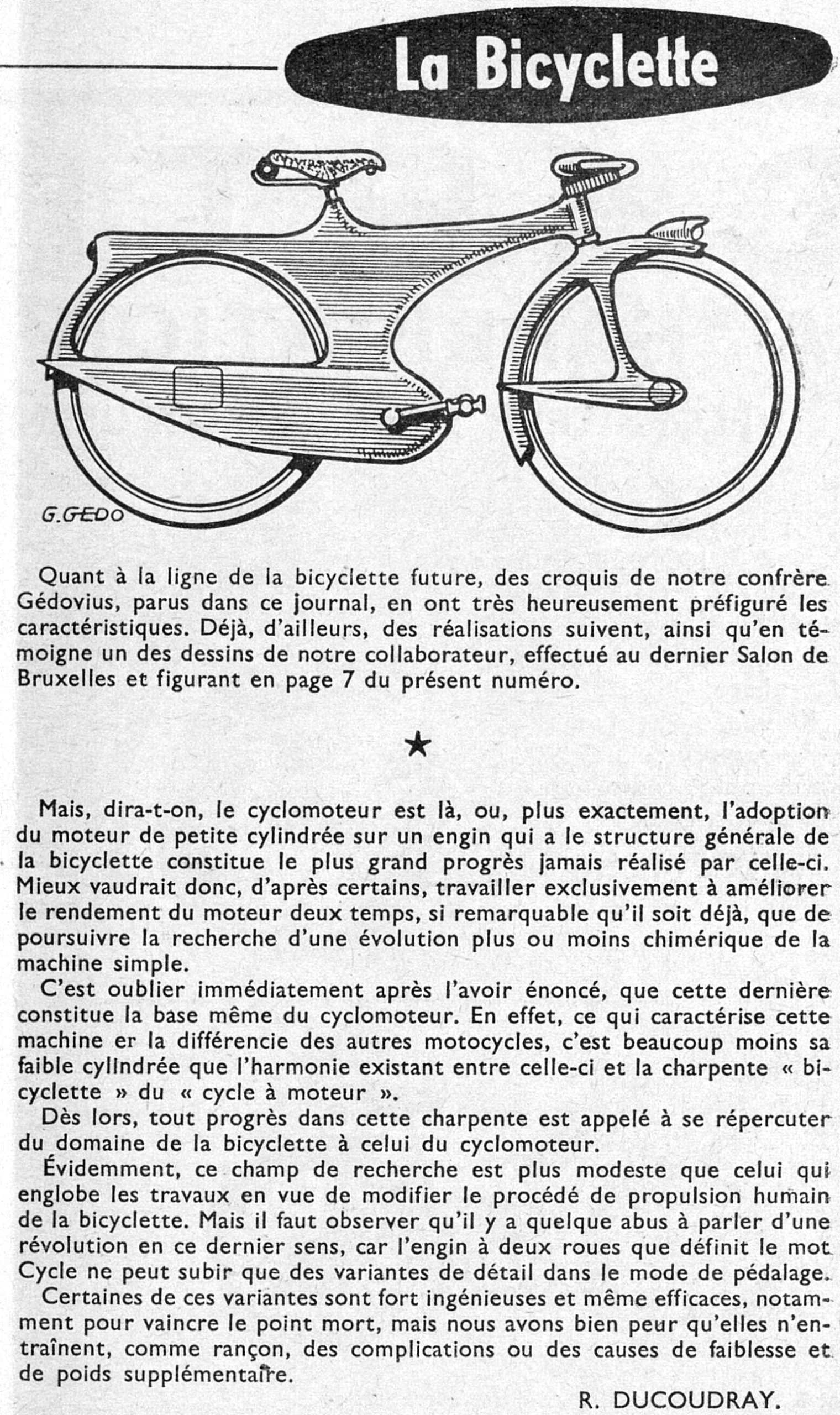
From L’Officiel du cycle, du motocycle et du camping, 5 March 1955, N° 5, page 5: part 2 of ‘La bicyclette passionne toujours les chercheurs’: drawing of a streamlined future bicycle (Gédovius), then R. Ducoudray on lighter bicycles with plastics, pre-inflated tires, and the relation between bicycle and cyclomoteur frame design. The title, headings, captions and lists are transcribed as printed; the text is summarized in Ebykr’s words, and the page images carry it in full.
— Page 1 —
La Bicyclette
[Ebykr summary; the article’s text is not reproduced. Turning to the lines of the future bicycle, the editors say that sketches by their colleague Gédovius, published in the journal, foretold its characteristics happily, and that realizations are already following, as one of their collaborator’s drawings made at the last Salon de Bruxelles, on page 7 of this issue, shows.]
★
[Ebykr summary, after a star break; the article’s text is not reproduced. The writer anticipates the objection that the cyclomoteur is already here: fitting a small-displacement engine to a machine with the general structure of the bicycle is the greatest progress the bicycle has ever made, and some would say effort is better spent only on improving the two-stroke engine than on a chimerical evolution of the simple machine. He answers that this forgets that the simple machine is the very base of the cyclomoteur, which is distinguished from other motorcycles less by its small displacement than by the harmony between the engine and the bicycle frame of the “cycle à moteur”. Any progress in the frame therefore carries over from the bicycle to the cyclomoteur. This field of research is more modest than work on changing the human propulsion of the bicycle, but it is an abuse to speak of revolution there, since the two-wheeled machine defined by the word Cycle can undergo only detail variants in its pedaling mode. Some variants are very ingenious and even effective, notably for overcoming the dead point, but he fears they bring, as the price, complications or causes of weakness and extra weight.]
R. DUCOUDRAY.
[A text-and-drawing section in black on a plain field. A black elongated oval at the upper right holds the words “La Bicyclette” in white bold condensed type, with a thin horizontal rule running from the left margin to the oval. Below it a line drawing in pen engraving with fine parallel hatching shows a streamlined bicycle seen from the side: one swollen body forms the frame, chain case and rear fender in a single piece, with an arched opening round the rear wheel, a small rectangular window in the chain case, a long fender sweeping over the front wheel with a small lamp on top, a leather saddle, a ring-shaped handlebar grip, one pedal crank and two wheels drawn as open rings without spokes. The drawing is signed at the lower left “G. GEDO” in script capitals. A paragraph of body text in a sans-serif face follows the drawing, then a black star and a long justified paragraph block in the same face. The piece ends with the signature “R. DUCOUDRAY.” set in spaced roman capitals at the right.]
Ebykr presents this material for research and education. If you hold rights to it or notice an ownership issue, please contact us and we will respond promptly.
The Ebykr Digest
New articles, timelines, catalog finds and registry activity — assembled from the archive once a month. Your address is never shared.
Double opt-in. One email per month. Unsubscribe at any time with one click.