About Ebykr
Ebykr celebrates classic and vintage lightweight bicycles through provocative imagery and opinion. Ride along with us.
About Ebykr
Ebykr celebrates classic and vintage lightweight bicycles through provocative imagery and opinion. Ride along with us.

Source: Gallica (Bibliothèque nationale de France), L'Officiel du cycle, du motocycle et du camping, 26 December 1953, N° 52, page 5; ark:/12148/bd6t541823427. Source gallica.bnf.fr / BnF.
| Type | Review |
|---|---|
| Year | 1953 |
| Publisher | L'Officiel du cycle |
| Country | France |
| Language | French |
| Pages | 2 |
| Source | Gallica (Bibliothèque nationale de France), L'Officiel du cycle, du motocycle et du camping, 26 December 1953, N° 52, page 5; ark:/12148/bd6t541823427. Source gallica.bnf.fr / BnF. |
| Credit | Ebykr archive; Bibliothèque nationale de France |
| Identifier | Gallica (BnF) ark:/12148/bd6t541823427/f5 |
| Transcription | Headings and specifications transcribed; article text summarized |
Reference
"Le système ralentisseur-compensateur J. Fretay." L'Officiel du cycle, 26 December 1953. Ebykr, https://ebykr.com/library/lofficiel-du-cycle-1953-12-05-ralentisseur-compensateur-fretay/.
Wikipedia
{{cite magazine |title=Le système ralentisseur-compensateur J. Fretay |magazine=L'Officiel du cycle |date=26 December 1953 |language=French |url=https://ebykr.com/library/lofficiel-du-cycle-1953-12-05-ralentisseur-compensateur-fretay/ |via=Ebykr |access-date=}}La BICYCLETTE Le SYSTÈME “RALENTISSEUR- COMPENSATEUR” J. FRETAY » 1° Freinage progressif par enroulement du ressort spirale. Le ressort tendu à bloc a une action d'entraînement sur les manivelles ; » 2° Le cliquetage roue libre ne permet pas au ressort de se détendre à l'arrière ; » 3° La force de propulsion supérieure à …
This is a magazine article, so its running text is summarized here rather than reproduced; the headline, byline, specifications and scores are transcribed as printed.
From L’Officiel du cycle, du motocycle et du camping, 26 December 1953, N° 52, page 5: . The title, headings, captions and lists are transcribed as printed; the text is summarized in Ebykr’s words, and the page images carry it in full. The piece is set over several columns or pages, so its images are given in reading order.
— Page 1 —
La
BICYCLETTE
Le SYSTÈME “RALENTISSEUR-
COMPENSATEUR” J. FRETAY
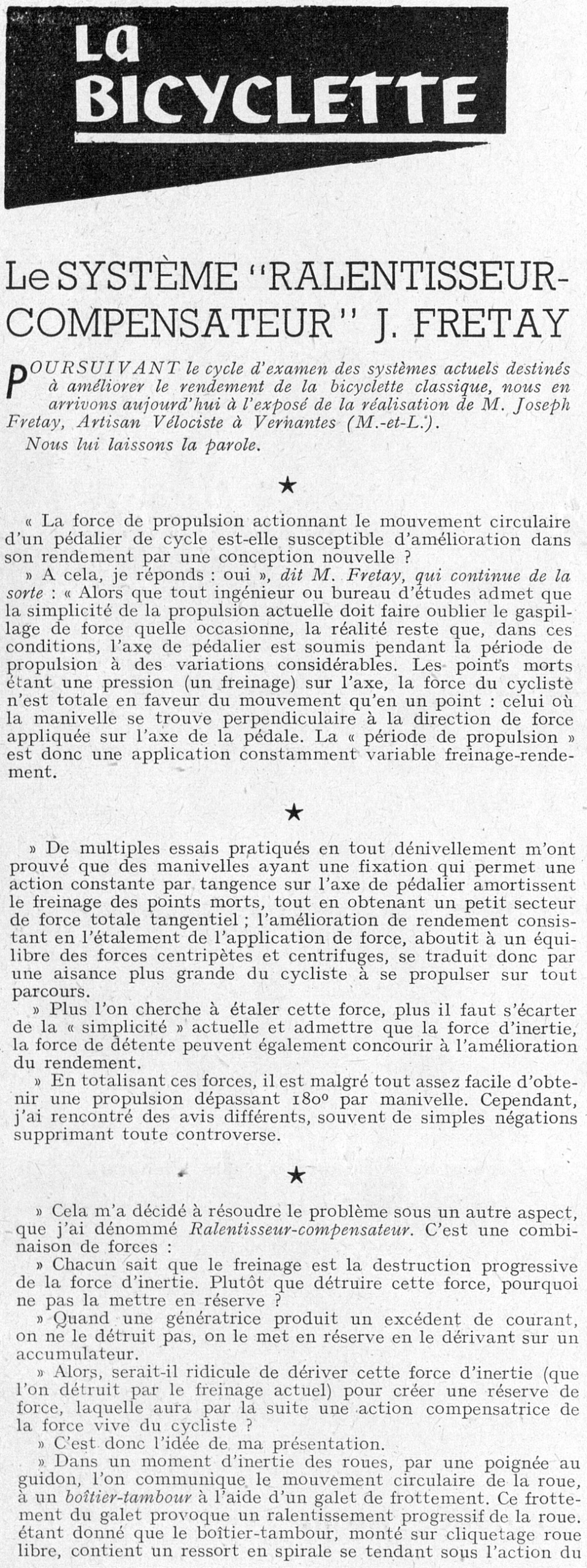
[Ebykr summary; the article’s text is not reproduced. The editor’s italic lead-in says that, continuing the review of present systems meant to improve the efficiency of the ordinary bicycle, the paper now reaches the invention of M. Joseph Fretay, Artisan Vélociste (cycle craftsman) at Vernantes (M.-et-L.), and gives him the floor.]
[Ebykr summary, after a star break, in the inventor’s own voice. Fretay asks whether the propulsive force at a bicycle’s pedal axle can be improved by a new design, and answers yes. Every engineer admits that the simplicity of the present drive should make one forget the waste of force it causes, but the fact is that during the propulsion period the axle undergoes considerable variation. The dead points act as pressure, a braking, on the axle, so the rider’s force is wholly effective for movement at only one point, where the crank is perpendicular to the direction of the force applied at the pedal axle; the “période de propulsion” is thus a constantly varying application of braking and efficiency.]
[Ebykr summary, after a second star break. Fretay reports that many trials on every kind of gradient showed that cranks fixed so as to give a constant tangential action on the bottom-bracket axle cushion the braking at the dead points while keeping a small sector of total tangential force; the gain in efficiency lies in spreading the application of force, ends in a balance of centripetal and centrifugal forces and gives the rider greater ease on any course. The more one tries to spread this force, the further one must depart from present “simplicity” and admit that inertia and the force of release (spring recoil) can also add to efficiency. By totaling these forces he finds it fairly easy to obtain a propulsion exceeding 180° per crank, though he has met differing opinions, often simple denials that end all discussion.]
[Ebykr summary, after a third star break. This decided him to solve the problem from another side, which he calls the Ralentisseur-compensateur, a combination of forces. Braking is the progressive destruction of inertia; instead of destroying it, he asks why it should not be put in reserve, as a generator’s surplus current is shunted to an accumulator rather than wasted. At a moment when the wheels are coasting, a handlebar grip communicates the wheel’s circular motion to a drum case (boîtier-tambour) by means of a friction roller, which slows the wheel progressively. The drum case, mounted on a freewheel ratchet, holds a coiled spiral spring that tightens under the circular motion; the account carries on to the next column.]
[A text-only extract from a printed page, in one column. The head carries a section banner: a heavy black pennant shape, wide at the left and tapering to a point at the lower right, with a thin pale rule across its lower edge, bearing the words “La” and “BICYCLETTE” reversed out in white in a rough, hand-cut-looking face with pointed serifs. Below it the article title stands in light slab-serif capitals with the first word in small type, set in two lines and ending with the inventor’s name. The lead-in is set in italic with a large italic initial P and the first word in spaced capitals. The body text is in a serif roman, justified, with indented opening lines and small solid stars as section breaks. Quotation marks open each paragraph of the inventor’s statement. No drawing, firm name or address appears on this part, and the last line breaks off mid-sentence at the foot.]
— Page 2 —
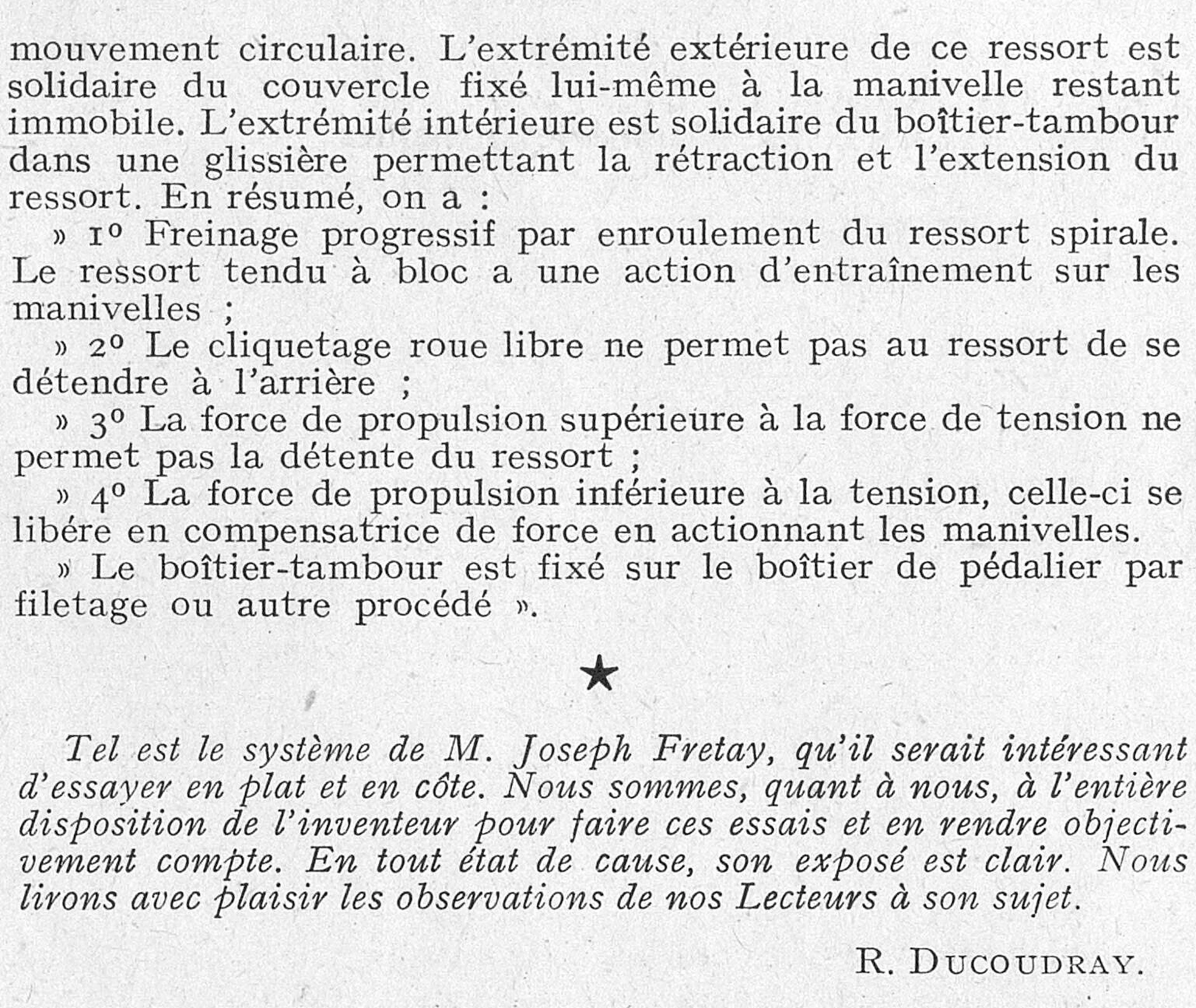
[Ebykr summary; the article’s text is not reproduced. The sentence broken off in the previous part continues: the outer end of the spiral spring is fixed to the cover, itself fixed to the crank and remaining motionless, while the inner end is fixed to the drum case in a slide that allows the spring to retract and extend. The inventor then sums up the action in a numbered list, printed as follows.]
» 1° Freinage progressif par enroulement du ressort spirale. Le ressort tendu à bloc a une action d’entraînement sur les manivelles ;
» 2° Le cliquetage roue libre ne permet pas au ressort de se détendre à l’arrière ;
» 3° La force de propulsion supérieure à la force de tension ne permet pas la détente du ressort ;
» 4° La force de propulsion inférieure à la tension, celle-ci se libère en compensatrice de force en actionnant les manivelles.
» Le boîtier-tambour est fixé sur le boîtier de pédalier par filetage ou autre procédé ».
[Ebykr summary, after a star break, in the editor’s italic closing note. The editor says that M. Joseph Fretay’s system would be worth trying on the flat and uphill, that the paper is at the inventor’s entire disposal to make the trials and report on them objectively, that in any event his account is clear, and that the paper will gladly read its readers’ observations on the subject.]
R. Ducoudray.
[A text-only extract from a printed page, in one column. The numbered list is set in a serif roman with a closing quotation mark at its end, and the editor’s closing note is set in italic. A small solid star stands as a section break between them. The piece is signed at the lower right in small capitals, “R. Ducoudray.” The text begins mid-sentence at the head, continuing from the previous column, and no drawing, firm name or address appears.]
Ebykr presents this material for research and education. If you hold rights to it or notice an ownership issue, please contact us and we will respond promptly.
The Ebykr Digest
New articles, timelines, catalog finds and registry activity — assembled from the archive once a month. Your address is never shared.
Double opt-in. One email per month. Unsubscribe at any time with one click.