About Ebykr
Ebykr celebrates classic and vintage lightweight bicycles through provocative imagery and opinion. Ride along with us.
About Ebykr
Ebykr celebrates classic and vintage lightweight bicycles through provocative imagery and opinion. Ride along with us.

Source: Gallica (Bibliothèque nationale de France), L'Officiel du cycle, du motocycle et du camping, 26 December 1953, N° 52, pages 5 and 7; ark:/12148/bd6t541823427. Source gallica.bnf.fr / BnF.
| Type | Review |
|---|---|
| Year | 1953 |
| Publisher | L'Officiel du cycle |
| Country | France |
| Language | French |
| Pages | 2 |
| Source | Gallica (Bibliothèque nationale de France), L'Officiel du cycle, du motocycle et du camping, 26 December 1953, N° 52, pages 5 and 7; ark:/12148/bd6t541823427. Source gallica.bnf.fr / BnF. |
| Credit | Ebykr archive; Bibliothèque nationale de France |
| Identifier | Gallica (BnF) ark:/12148/bd6t541823427/f5 |
| Transcription | Headings and specifications transcribed; article text summarized |
Reference
"À propos de l'amélioration de la position du cycliste." L'Officiel du cycle, 26 December 1953. Ebykr, https://ebykr.com/library/lofficiel-du-cycle-1953-12-05-position-cycliste-lettre-mazabraud/.
Wikipedia
{{cite magazine |title=À propos de l'amélioration de la position du cycliste |magazine=L'Officiel du cycle |date=26 December 1953 |language=French |url=https://ebykr.com/library/lofficiel-du-cycle-1953-12-05-position-cycliste-lettre-mazabraud/ |via=Ebykr |access-date=}}A PROPOS DE L'AMÉLIORATION DE LA POSITION DU CYCLISTE R. D.
This is a magazine article, so its running text is summarized here rather than reproduced; the headline, byline, specifications and scores are transcribed as printed.
From L’Officiel du cycle, du motocycle et du camping, 26 December 1953, N° 52, pages 5 and 7: . The title, headings, captions and lists are transcribed as printed; the text is summarized in Ebykr’s words, and the page images carry it in full. The piece is set over several columns or pages, so its images are given in reading order.
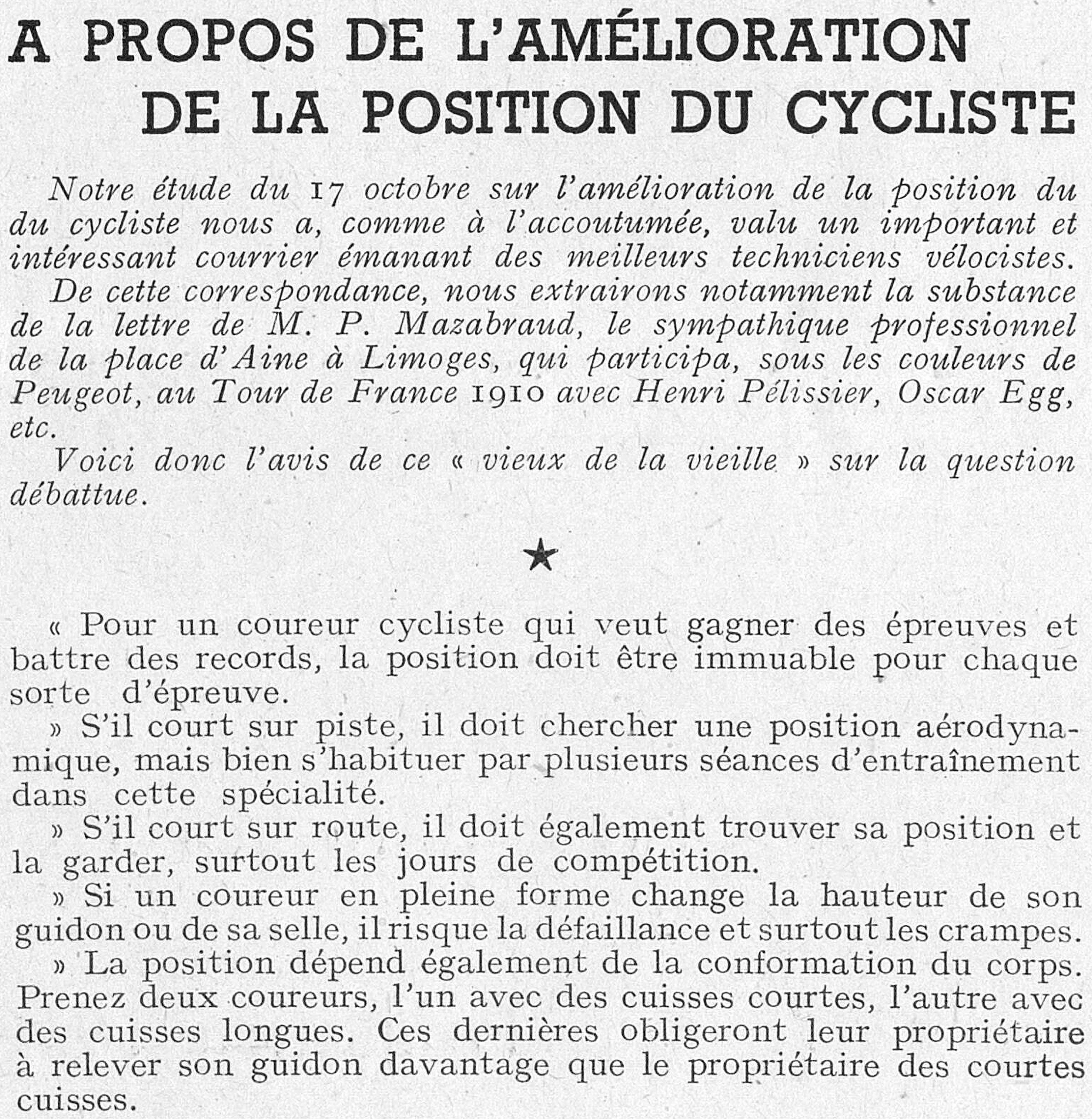
— Page 1 —
A PROPOS DE L’AMÉLIORATION
DE LA POSITION DU CYCLISTE
[Ebykr summary; the article’s text is not reproduced. The editor’s italic lead-in says that the paper’s study of 17 October on improving the cyclist’s position brought, as usual, an important and interesting mail from the best cycle-trade technicians. From this correspondence the paper extracts the substance of a letter from M. P. Mazabraud, the “sympathique professionnel” of the place d’Aine in Limoges, who rode under the Peugeot colors in the 1910 Tour de France with Henri Pélissier, Oscar Egg and others. It presents the opinion of this “vieux de la vieille” on the question under debate.]
[Ebykr summary, after a star break, giving the substance of the letter. For a racing cyclist who wants to win events and break records, the position must be immutable for each kind of event. On the track he must seek an aerodynamic position but get used to it well through several training sessions in that specialty. On the road he must likewise find his position and keep it, above all on competition days. A rider in top form who changes the height of his handlebar or saddle risks a failure and above all cramps. The position also depends on the build of the body: of two riders, one with short thighs and one with long thighs, the long-thighed man must raise his handlebar more than the short-thighed one. The letter continues on a later page.]
[A text-only extract from a printed page, set in a single column. The title stands across the head in two lines of heavy sans-serif capitals, the second line indented. Below it the editor’s lead-in is set in italic, with the year in old-style figures. A small solid star stands as a section break above the body text, which is in a serif roman, justified, with a quotation mark opening each paragraph of the letter. No drawing, firm name, address or signature appears on this part, and the last line ends at the foot while the letter is still running.]
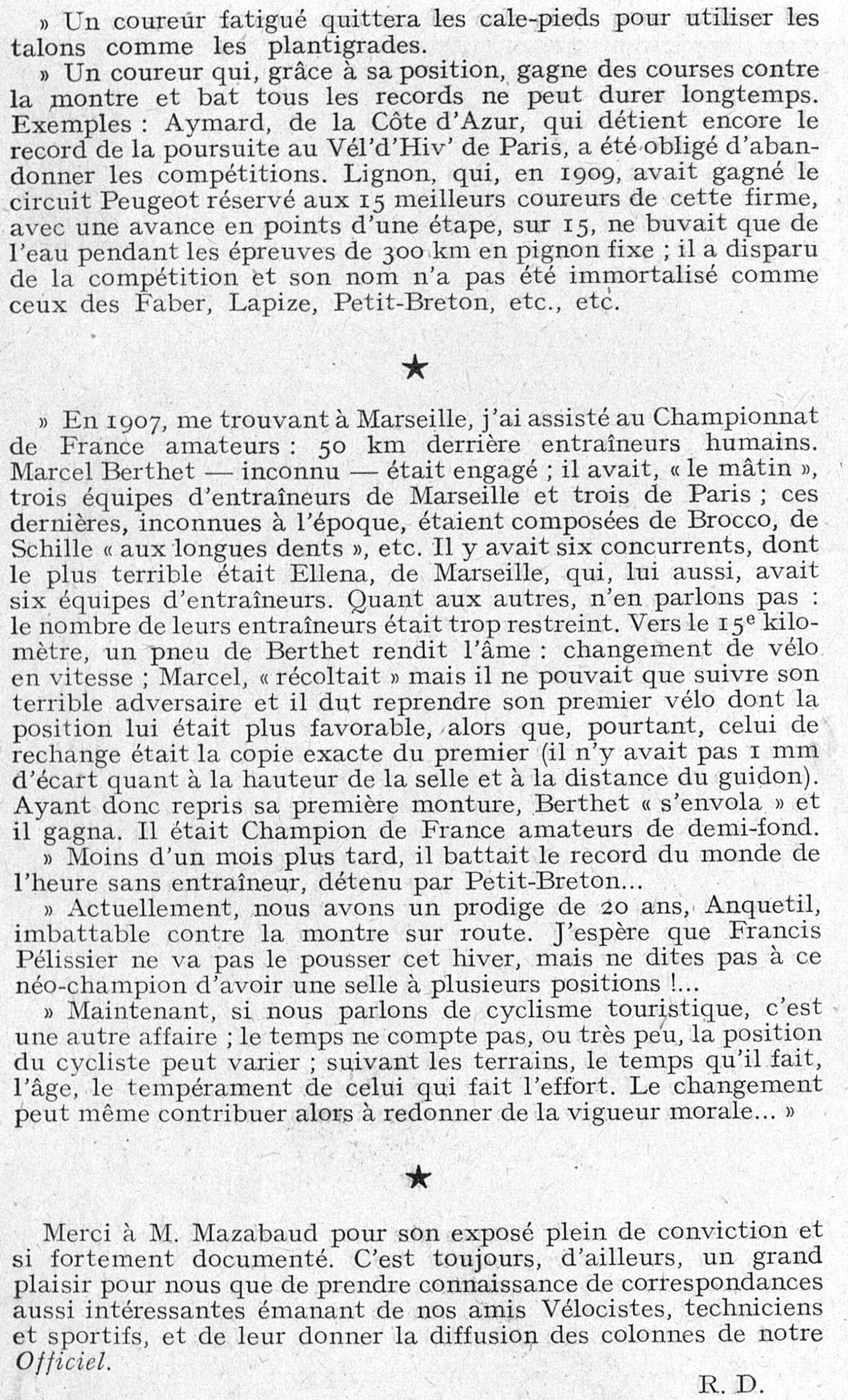
— Page 2 —
[Ebykr summary; the article’s text is not reproduced. The letter continues: a tired rider will leave the toe clips to use his heels like the plantigrades. A rider who, thanks to his position, wins time trials and breaks every record cannot last long. As examples Mazabraud cites Aymard, of the Côte d’Azur, who still holds the pursuit record at the Vél’d’Hiv’ of Paris and has been obliged to give up competition, and Lignon, who in 1909 won the Peugeot circuit reserved for the firm’s 15 best riders with a lead of one stage in points out of 15, drank only water in 300 km fixed-gear events, vanished from competition and whose name was not immortalized like those of Faber, Lapize, Petit-Breton, etc.]
[Ebykr summary, after a star break. In 1907, being at Marseille, Mazabraud attended the French amateur championship, 50 km behind human pacers. Marcel Berthet, then unknown, was entered and had three pacing teams from Marseille and three from Paris for pacing (“le mâtin” in the text), the Paris teams, unknown at the time, being made up of Brocco, Schille “aux longues dents” and others. There were six competitors, the most formidable being Ellena of Marseille, who also had six pacing teams; the others had too few pacers to mention. Around the 15th kilometer a Berthet tire gave out and he changed bicycles at speed; on the spare machine he could only follow his rival, although it was an exact copy of the first, with not 1 mm of difference in saddle height or handlebar distance, so he took back his first bicycle, whose position suited him better, flew and won, becoming amateur stayer champion of France. Less than a month later he beat the world hour record without pacer, held by Petit-Breton. Today, the letter adds, there is a prodigy of 20 years, Anquetil, unbeatable against the clock on the road; the writer hopes Francis Pélissier will not push him this winter, but says no one should tell this new champion to use a saddle with several positions. In touring cycling it is another matter: time counts little or not at all, the position may vary with terrain, weather, age and temperament, and the change may even help restore morale.]
[Ebykr summary, after a star break, in the editor’s closing note. The paper thanks M. Mazabaud for a presentation full of conviction and so well documented, and says it is always a great pleasure to read such interesting correspondence from its friends the cycle dealers, technicians and sportsmen and to give it the columns of “Officiel”.]
R. D.
[A text-only extract from a printed page, set in a single justified column of serif roman with no drawing, photograph or heading. The opening quotation mark of each paragraph of the letter is set in the margin line, and the letter ends with a closing quotation mark. Old-style figures are used for the dates. Small solid stars stand as section breaks, and the editor’s closing note ends with the word “Officiel” in italic. The piece is signed at the lower right “R. D.” in roman capitals. The text begins mid-column at the head, continuing from the previous part, and no firm name or address appears.]
Ebykr presents this material for research and education. If you hold rights to it or notice an ownership issue, please contact us and we will respond promptly.
The Ebykr Digest
New articles, timelines, catalog finds and registry activity — assembled from the archive once a month. Your address is never shared.
Double opt-in. One email per month. Unsubscribe at any time with one click.