About Ebykr
Ebykr celebrates classic and vintage lightweight bicycles through provocative imagery and opinion. Ride along with us.
About Ebykr
Ebykr celebrates classic and vintage lightweight bicycles through provocative imagery and opinion. Ride along with us.

Source: Gallica (Bibliothèque nationale de France), L'Officiel du cycle, du motocycle et du camping, 26 December 1953, N° 52, pages 3 and 4; ark:/12148/bd6t541823427. Source gallica.bnf.fr / BnF.
| Type | Review |
|---|---|
| Year | 1953 |
| Publisher | L'Officiel du cycle |
| Country | France |
| Language | French |
| Pages | 2 |
| Source | Gallica (Bibliothèque nationale de France), L'Officiel du cycle, du motocycle et du camping, 26 December 1953, N° 52, pages 3 and 4; ark:/12148/bd6t541823427. Source gallica.bnf.fr / BnF. |
| Credit | Ebykr archive; Bibliothèque nationale de France |
| Identifier | Gallica (BnF) ark:/12148/bd6t541823427/f3 |
| Transcription | Headings and specifications transcribed; article text summarized |
Reference
"Des pistes pour les 2 roues légers." L'Officiel du cycle, 26 December 1953. Ebykr, https://ebykr.com/library/lofficiel-du-cycle-1953-12-03-pistes-deux-roues-legers/.
Wikipedia
{{cite magazine |title=Des pistes pour les 2 roues légers |magazine=L'Officiel du cycle |date=26 December 1953 |language=French |url=https://ebykr.com/library/lofficiel-du-cycle-1953-12-03-pistes-deux-roues-legers/ |via=Ebykr |access-date=}}DES PISTES POUR LES " 2 ROUES LÉGERS "
This is a magazine article, so its running text is summarized here rather than reproduced; the headline, byline, specifications and scores are transcribed as printed.
From L’Officiel du cycle, du motocycle et du camping, 26 December 1953, N° 52, pages 3 and 4: . The title, headings, captions and lists are transcribed as printed; the text is summarized in Ebykr’s words, and the page images carry it in full. The piece is set over several columns or pages, so its images are given in reading order.
— Page 1 —
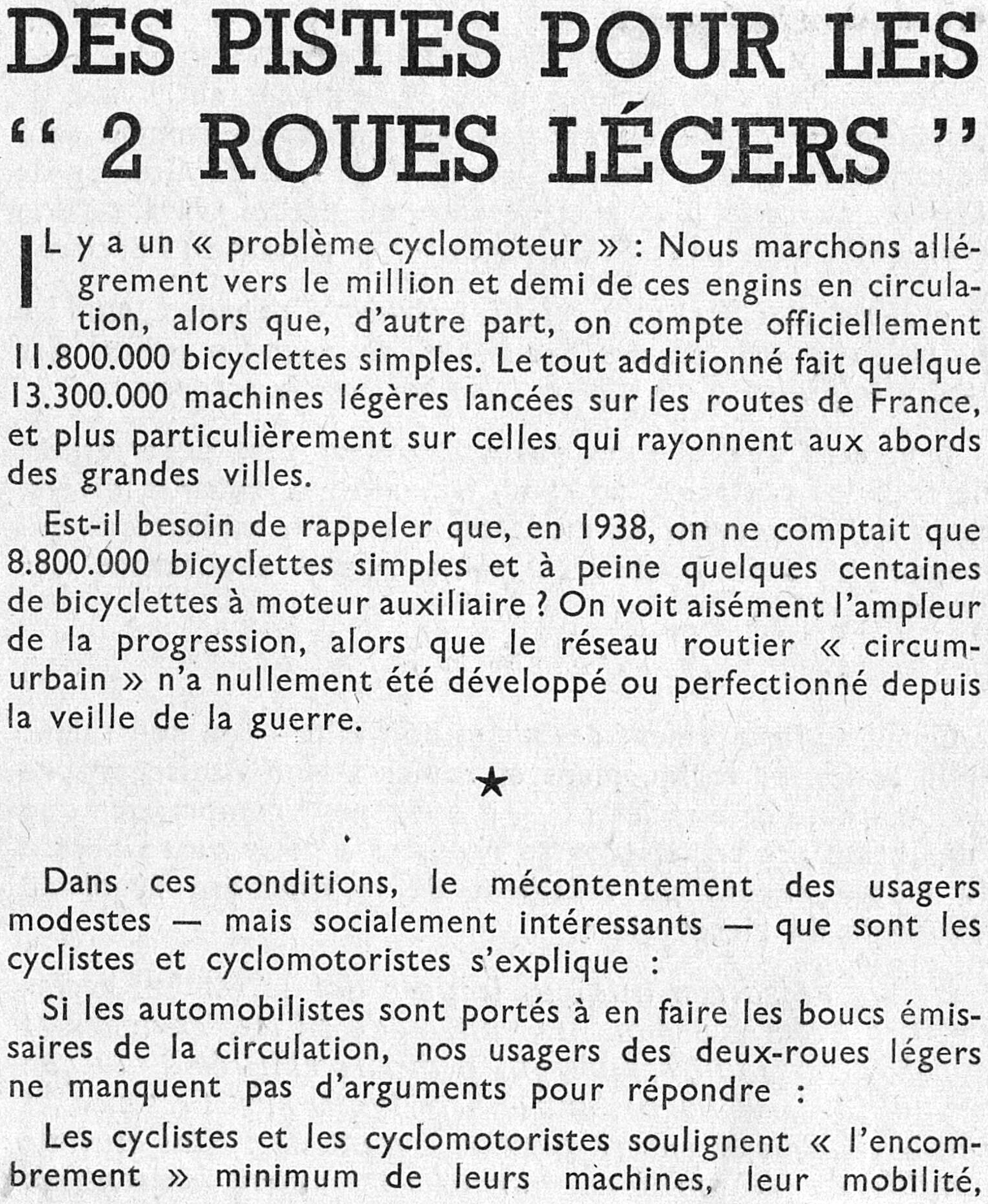
DES PISTES POUR LES
” 2 ROUES LÉGERS ”
[Ebykr summary; the article’s text is not reproduced. The opening paragraph, set with a drop initial, says there is a “problème cyclomoteur”: France is moving briskly toward a million and a half of these machines in circulation, while the official count also stands at 11.800.000 plain bicycles, so that some 13.300.000 light machines are launched on the roads of France, most of all on those radiating around the large cities. A second paragraph recalls that in 1938 there were only 8.800.000 plain bicycles and barely a few hundred motor-assisted bicycles, and notes how large the growth has been while the “circumurbain” road network has not been developed or improved since the eve of the war.]
[Ebykr summary, after a star break. The author says that in these conditions the discontent of the modest but socially valuable users, cyclists and cyclomotorists, is understandable. If motorists tend to make them scapegoats of traffic troubles, the light two-wheeler riders have arguments in reply: they point to the minimal bulk, mobility and handiness of their machines, and the text continues on the next page.]
[A text-only extract from a printed page, set in a single wide column with no drawing or photograph. The title stands across the head in two lines of heavy slab-serif capitals, the second line enclosed in typographic quotation marks around the figure 2. The body text is in a light sans-serif roman, justified, with the first paragraph opening on a tall heavy vertical bar as the drop initial and its first lines indented around it. A small solid star stands alone between paragraphs as a section break. No signature, firm name or address appears on this part, and the last line breaks off mid-sentence at the foot to continue on the following page.]
— Page 2 —
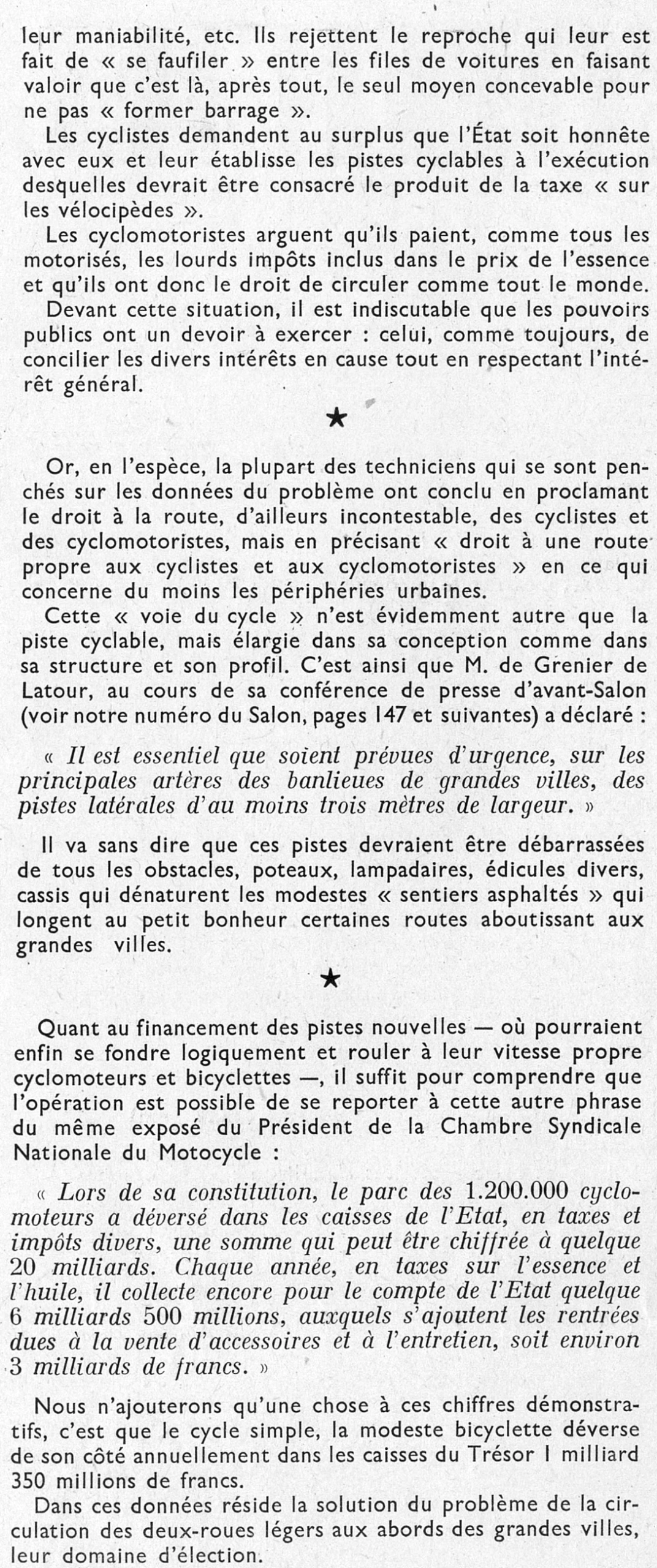
[Ebykr summary; the article’s text is not reproduced. The sentence broken off on the previous page continues: the riders reject the charge of “weaving” between files of cars, arguing that it is the only conceivable way not to “form a barrage” of traffic. Cyclists also ask that the State be honest with them and build the cycle tracks, to which the proceeds of the tax “on velocipedes” should be devoted. Cyclomotorists reply that they pay, like all motorized users, the heavy taxes included in the price of gasoline and so have the right to travel like everyone else. The author concludes that the public authorities have the duty, as always, to reconcile the interests involved while respecting the general interest.]
[Ebykr summary, after a star break. Most of the technicians who studied the problem declare the undeniable right of cyclists and cyclomotorists to the road, but specify a “droit à une route propre aux cyclistes et aux cyclomotoristes”, at least on the urban outskirts. This “voie du cycle” is the cycle track, but widened in design, structure and profile. The author reports that M. de Grenier de Latour, at his press conference before the Salon (the paper refers to its Salon issue, pages 147 and following), declared in a set-off italic quotation that it is essential to provide at once, on the main arteries of the suburbs of large cities, side tracks at least three meters wide. The author adds that such tracks should be cleared of posts, lamp standards, kiosks and gutter dips that spoil the modest “sentiers asphaltés” running alongside some roads into the large cities.]
[Ebykr summary, after a second star break. On financing the new tracks, where cyclomotors and bicycles could at last blend and travel at their own speed, the author turns to another passage of the same address by the President of the Chambre Syndicale Nationale du Motocycle, given as an italic quotation: when it was formed, the fleet of 1.200.000 cyclomotors poured into the State’s coffers some 20 milliards in taxes and various duties; each year, in taxes on gasoline and oil, it still collects some 6 milliards 500 millions for the State, to which are added the receipts from the sale of accessories and from maintenance, about 3 milliards of francs. The author adds one thing to these figures: the plain cycle, the modest bicycle, pours into the Treasury’s coffers each year 1 milliard 350 millions of francs. In these data, he concludes, lies the solution of the problem of traffic for light two-wheelers near large cities, their natural domain.]
[A text-only extract from a printed page, set in a single justified column of light sans-serif roman with no drawing, photograph or heading. Two passages of the column are set off in italic roman, indented, as quotations within guillemets. Small solid stars stand alone between paragraphs as section breaks. The text begins mid-sentence at the head, carrying on from the previous page, and ends at the foot with the last line of the piece. No signature, firm name or address appears.]
Ebykr presents this material for research and education. If you hold rights to it or notice an ownership issue, please contact us and we will respond promptly.
The Ebykr Digest
New articles, timelines, catalog finds and registry activity — assembled from the archive once a month. Your address is never shared.
Double opt-in. One email per month. Unsubscribe at any time with one click.