About Ebykr
Ebykr celebrates classic and vintage lightweight bicycles through provocative imagery and opinion. Ride along with us.
About Ebykr
Ebykr celebrates classic and vintage lightweight bicycles through provocative imagery and opinion. Ride along with us.

Source: Gallica (Bibliothèque nationale de France), L'Officiel du cycle, du motocycle et du camping, 18 October 1952, 62e Année, page 22; ark:/12148/bd6t541820745. Source gallica.bnf.fr / BnF.
| Type | Review |
|---|---|
| Year | 1952 |
| Publisher | L'Officiel du cycle |
| Country | France |
| Language | French |
| Pages | 1 |
| Source | Gallica (Bibliothèque nationale de France), L'Officiel du cycle, du motocycle et du camping, 18 October 1952, 62e Année, page 22; ark:/12148/bd6t541820745. Source gallica.bnf.fr / BnF. |
| Credit | Ebykr archive; Bibliothèque nationale de France |
| Identifier | Gallica (BnF) ark:/12148/bd6t541820745/f22 |
| Transcription | Headings and specifications transcribed; article text summarized |
Reference
"La bicyclette a droit à la « priorité »" L'Officiel du cycle, 18 October 1952. Ebykr, https://ebykr.com/library/lofficiel-du-cycle-1952-10-22-bicyclette-droit-priorite-cour-de-cassation/.
Wikipedia
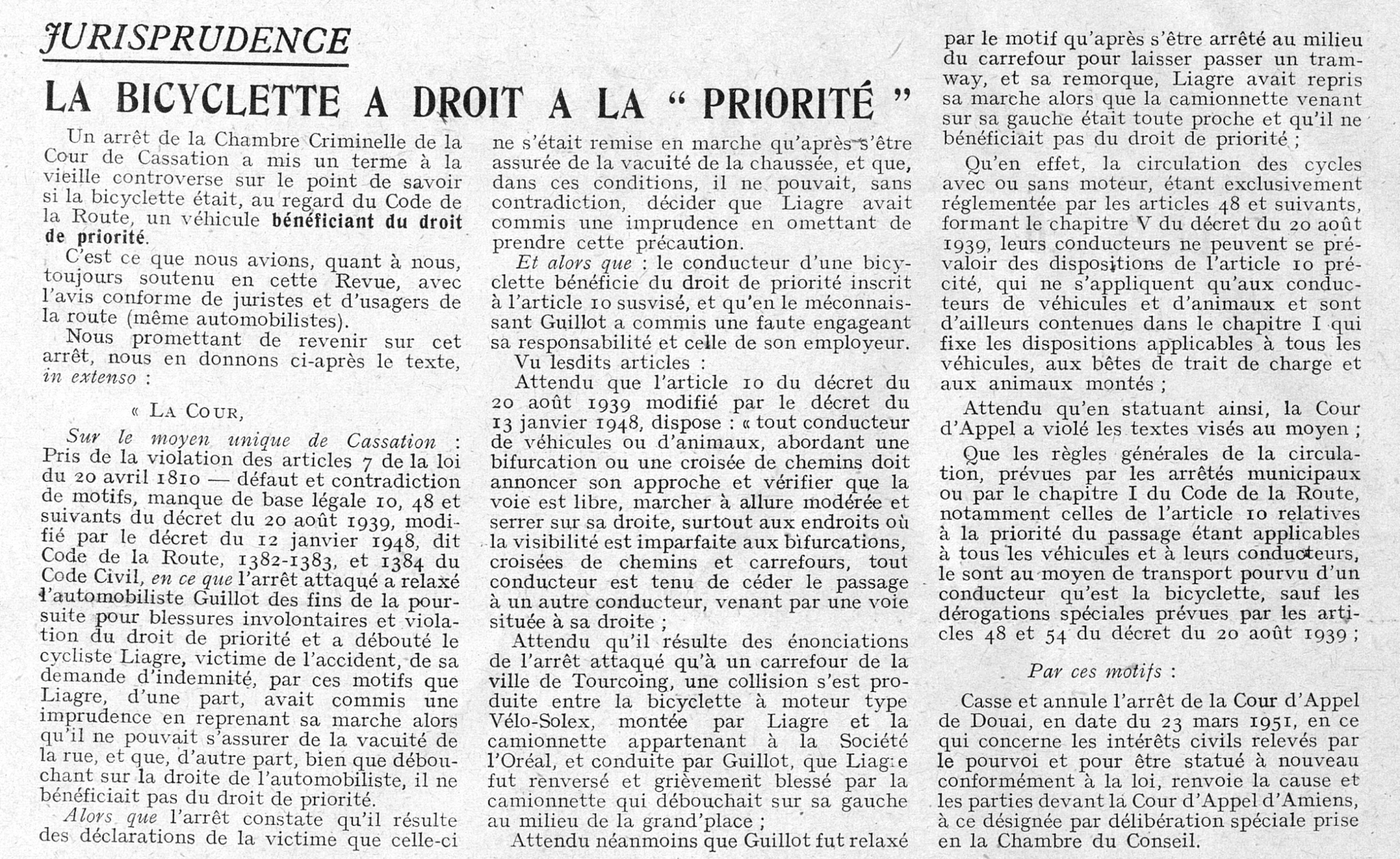
{{cite magazine |title=La bicyclette a droit à la « priorité » |magazine=L'Officiel du cycle |date=18 October 1952 |language=French |url=https://ebykr.com/library/lofficiel-du-cycle-1952-10-22-bicyclette-droit-priorite-cour-de-cassation/ |via=Ebykr |access-date=}}JURISPRUDENCE LA BICYCLETTE A DROIT A LA “ PRIORITÉ ”
This is a magazine article, so its running text is summarized here rather than reproduced; the headline, byline, specifications and scores are transcribed as printed.
From L’Officiel du cycle, du motocycle et du camping, 18 October 1952, page 22: jurisprudence: La bicyclette a droit a la priorite: Cour de Cassation ruling that a bicycle is a vehicle entitled to right of way, text of the judgment (the case involves a Velo-Solex). The title, headings, captions and lists are transcribed as printed; the text is summarized in Ebykr’s words, and the page images carry it in full.
— Page 1 —
JURISPRUDENCE
LA BICYCLETTE A DROIT A LA “ PRIORITÉ ”
[Ebykr summary; the article’s text is not reproduced. The editors report that an arrêt of the Chambre Criminelle of the Cour de Cassation has ended the old controversy over whether the bicycle is, under the Code de la Route, a vehicle benefiting from the right of priority (printed in bold). They say that this is what the journal had always maintained, with the agreement of jurists and road users, even motorists, and that they promise to return to the ruling and give its text in full.]
[Ebykr summary, the text of the judgment. The Cour opens on the single ground of appeal, which cites article 7 of the law of 20 April 1810 (defective and contradictory reasoning, lack of legal basis), articles 10, 48 and following of the decree of 20 August 1939 as modified by the decree of 12 January 1948, called the Code de la Route, and articles 1382, 1383 and 1384 of the Code Civil. It complains that the contested ruling released the motorist Guillot from the charge of involuntary injury and breach of priority, and turned away the cyclist Liagre, the victim, from his claim for compensation. The reasons given were that Liagre had been imprudent in moving off again when he could not be sure the roadway was clear, and that although he came from the motorist’s right he had no right of priority. The ground argues that a bicycle rider does have the right of priority in article 10, so that Guillot was at fault, which engages his own liability and that of his employer. The Cour then recalls article 10, as modified by the decree of 13 January 1948: a driver of vehicles or animals approaching a fork or crossroads must announce the approach, check that the way is clear, go at a moderate speed and keep to the right, especially where visibility is poor, and must give way to a driver coming from a road on the right.]
[Ebykr summary, the facts and the decision. The ruling states that at a crossroads in the town of Tourcoing a collision took place between the motor bicycle of the Vélo-Solex type ridden by Liagre and a light truck belonging to the Société l’Oréal and driven by Guillot. The truck came out on Liagre’s left in the middle of the grand’place, and Liagre was thrown and seriously hurt. Guillot was nevertheless released, on the ground that Liagre had stopped in the middle of the crossroads to let a tramway and its trailer pass and had moved off again when the truck was very close, and that he had no right of priority. The Cour holds that the movement of cycles with or without a motor is governed solely by articles 48 and following, which form chapter V of the decree of 20 August 1939. Their riders therefore could not rely on article 10, which applies only to drivers of vehicles and animals. It adds that the general traffic rules, set by municipal orders or by chapter I of the Code de la Route, including those of article 10 on priority of passage, apply to all vehicles and their drivers. They therefore apply to the bicycle as a means of transport with a driver, subject to the special exceptions in articles 48 and 54 of the decree of 20 August 1939. In ruling otherwise, the Cour d’Appel violated the texts cited. For these reasons the Cour quashes and annuls the arrêt of the Cour d’Appel of Douai dated 23 March 1951 as far as it concerns the civil interests raised by the appeal, and sends the case and the parties back before the Cour d’Appel of Amiens, designated by a special decision taken in the Chambre du Conseil.]
[A text-only legal article set in three columns of roman text. A section label, JURISPRUDENCE, is printed at the upper left in slanted capitals and underlined with a heavy rule. The headline below it runs across all three columns in heavy condensed capitals, with the word PRIORITÉ in quotation marks. Two phrases are in bold or italic type in the introduction, and the text of the judgment is set in the same roman type with italic opening words such as Sur le moyen unique de Cassation, Alors que, Et alors que and Par ces motifs. The words LA COUR appear in small capitals after an opening quotation mark. There is no drawing and no signature. The text ends at the foot of the crop after the words en la Chambre du Conseil, with no closing quotation mark visible.]
Ebykr presents this material for research and education. If you hold rights to it or notice an ownership issue, please contact us and we will respond promptly.
The Ebykr Digest
New articles, timelines, catalog finds and registry activity — assembled from the archive once a month. Your address is never shared.
Double opt-in. One email per month. Unsubscribe at any time with one click.